• About

Seeking and Serving

~ seek and serve Christ in all persons

Seeking and Serving

Tag Archives: purpose

Sermon – John 6.35, 41-51, P14, YB, August 11, 2024

28 Wednesday Aug 2024

Posted by jandrewsweckerly in Sermons

≈ Leave a comment

Tags

bread, Bread of Life, change, church, communion, feed, food, God, hierarchy of needs, Jesus, manna, needs, purpose, relationship, security, Sermon, share, tend

One of the components of our leadership training in Vestry is to talk about Maslow’s hierarchy of needs.  If you’re not familiar with his model, Maslow presents a pyramid of needs.  At the bottom are the physiological needs:  food, water, shelter, etc.  The next level of need is safety or security:  this would include health, employment, and social support.  The third level up the pyramid is love and belonging:  this entails friendship, family, intimacy, connection.  The fourth level is self-esteem:  including confidence, achievement, and respect.  And the final level, the tip of that pyramid is self-actualization:  creativity, a sense of purpose and meaning, and acceptance happen here.  The idea is, you cannot work on someone’s sense of purpose or meaning – the top of the pyramid, or even their sense of achievement and confidence without first meeting their basic needs at the base of the pyramid.  The same is true in the church.[i]  If we want to have excellent programming and ministry, where people are successfully naming and living into their vocations, we first have to make sure that we are a church who is in accordance with the canons of the Episcopal Church, that our property is safely maintained, that people feel welcome and cared for, before we think about people feeling proud about their church and helping their church thrive.  For Vestry members, when we are initiating change, we must be sure the hierarchy of needs has been met before we act.

Neal Mitchell tells a story of church who struggled with that sense of pacing with change.  There was a pastor who decided that the piano was not in the ultimate location in the sanctuary, so one week, he just moved it to the other side.  You would have thought he sacrificed a baby on the altar for the blowback he got.  He stirred such a commotion with his unilateral change that he eventually left the church and took another job.  Years and years later, that same pastor came back to the church for an anniversary celebration.  When he walked in the sanctuary, he immediately saw that the piano was in the location he always wanted but the church had refused to allow in his tenure.  After the worship service, he quietly asked the current pastor, “How in the world did you get them to move the piano over to that side of the worship space?!?”  The newer pastor said, “Oh, that.  Yeah, I just moved the piano an inch at a time.  No one even balked with the piano landed in the current position.”[ii] 

In John’s gospel today, Jesus in right in the middle of a lesson about Maslow’s hierarchy of needs.  We are in the third week of what is called the Bread of Life Discourse.  To the casual reader, you may be thinking, “Didn’t we just talk about the bread of life last week?”  And you wouldn’t be wrong.  We are in the middle of talking about the bread of life for five weeks.  But the text may not be as repetitive as the text feels.  You see, Jesus has been walking us through a hierarchy of needs.  First, we had that feeding of the five thousand.  Jesus starts by attending to the people’s immediate need – food.  You can’t share the love of Christ if your belly is growling with hunger.  Next, the conversation goes back to their history – when God provided manna in the wilderness – in other words, when God didn’t just tend today’s hunger, but worked on the need of security – of daily bread.  There God tended to the second level of need.  Today, Jesus is talking not about today’s bread, or even daily bread.  Jesus is talking about the bread of life – the bread that will sustain us for eternity – the feeding of our souls, not just our bodies.  This kind of bread means relationship, intimacy, care, and empowerment.[iii]  

This week, I experienced another week of Vacation Bible School – this time through one of our ecumenical partners in town.  Over the course of two weeks of VBS, one of the common conversations I have had with church members here, there, and with the other Williamsburg Episcopal Churches was a reflection about how although families find their way to church through a program like VBS, the next step of coming to church regularly is more difficult to inspire.  Now there is a lot wrapped up in that pondering, but at the heart of that reflection, particularly by longtime churchgoers is an understanding that they have found something deeply meaningful and lifegiving at church and they want to share that soul sustenance – that bread of life – with folks who do not have that same sustenance. 

I think that is what Jesus is trying to help us see today.  We are certainly called to be a community of food.  Lord knows Jesus did that all the time – feeding masses of people, tending to their health needs, helping lift up the poor.  And, Jesus was also about feeding souls – helping people find relationship, belonging, soul-nourishing, and that sense of purpose in the kingdom.  We consume the bread of life here every week not because the bread tastes all that particularly good or because that bread fills our stomachs (certainly not like Coffee Hour does).  We consume that bread of life because that taste, that lingering feeling of a melting wafer moving down our throats, is a balm of belonging, of purpose, of entrance into the eternal.  We are very good at describing our welcoming community here at Hickory Neck or our awesome children’s formation program or our incredible service to the community.  But what Jesus is inviting us into this week is vulnerable conversations with others about our deep-soul needs that God fills every week in this place.  Those kinds of conversations are tricky while standing at the bus stop with our kids, or while waiting in line at the grocery story, or while running into someone at the gas station.  But those are the conversations that move pianos and move hearts – conversations that name the deep, hidden longing for the eternal that we all have.  Jesus invites us to feed others today, to tend to others’ daily bread, and to share the bread of life:  to share the deepest gift of the Church with a hungry world.  Amen. 


[i] Idea explored by Matt Skinner in Sermon Brainwave Podcast, “#977: Twelfth Sunday after Pentecost (Ord. 19B) – Aug. 11, 2024,” August 4, 2024, as found at https://www.workingpreacher.org/podcasts/977-twelfth-sunday-after-pentecost-ord-19b-aug-11-2024 on August 7, 2024.

[ii] Neal O. Michell, How to Hit the Ground Running (New York:  Church Publishing, 2005), 51-58.

[iii] Idea explored by Karoline Lewis in aforementioned podcast.
On the Business of Church…

19 Wednesday Jun 2024

Posted by jandrewsweckerly in reflection

≈ Leave a comment

Tags

business, Episcopal Church, General Convention, God, good, governance, grace, Holy Spirit, Jesus, legislation, love, mission, prayer, purpose, vision

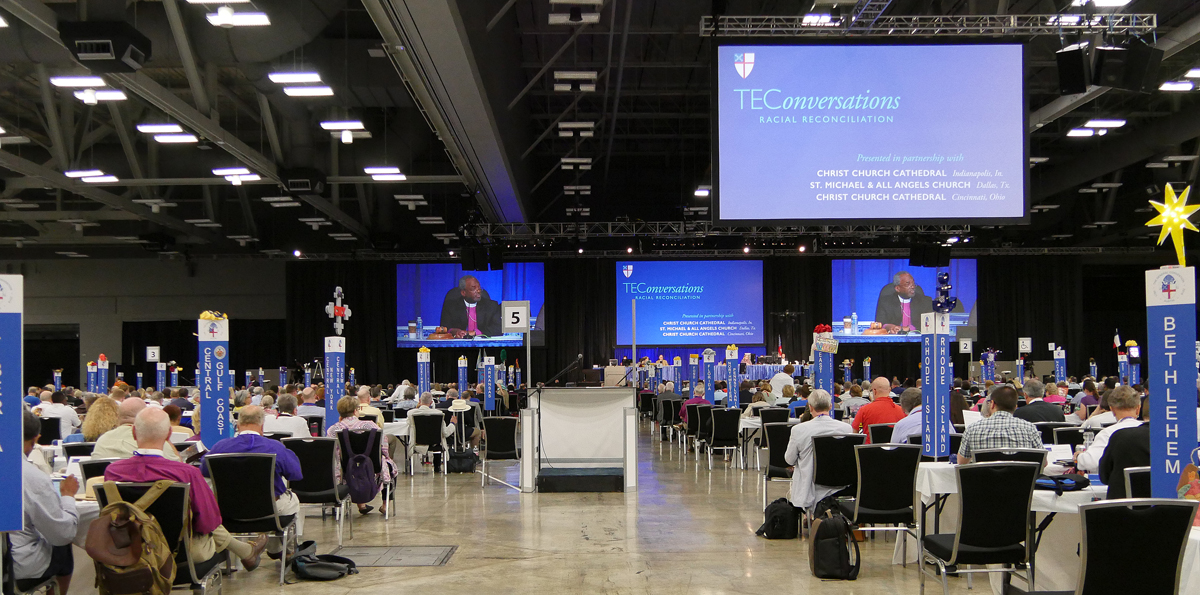
Photo credit: https://episcopalnewsservice.org/2020/11/20/80th-general-convention-postponed-to-july-2022-as-pandemic-disrupts-planning-of-triennial-gathering/

This weekend, Episcopalians will descend upon Louisville, Kentucky, for our General Convention.  The General Convention is the governing body of The Episcopal Church.  Every three years (or in this case, two years, due to a delayed GC during COVID), General Convention meets as a bicameral legislature that includes the House of Deputies and the House of Bishops, composed of deputies and bishops from each diocese.  In the House of Deputies, which includes elected lay and ordained deputies and alternates, over 1000 people will gather, and about 140 bishops will gather in the House of Bishops.  This year, we have a shortened Convention of six days of legislative sessions, covering everything from governance, justice issues, ecumenical and interfaith issues, evangelism and church vitality, liturgy, stewardship, formation, and mission.  In those six days, we will review over 275 pieces of legislation. 

Of course, General Convention is not all business.  It is a place of innovation and collaboration.  An exhibit hall of vendors is place of ideas, resources, and connection.  The legislative halls and common spaces are places of reunion with former seminary classmates, dioceses where one has served or worshiped before, and friends from professional connections.  It may be a chance to meet people in person that you have only known online, people you have admired the work of from afar, or a place to make new friends.  And then there are the opportunities to gather in worship in unfamiliar and familiar styles, the deep conversations and sharing of best practices, and the inspiration that can come from being steeped in the wideness of God’s church.

Ultimately, General Convention can be a place of great tension:  of trying to accomplish a great deal of business while honoring and developing relationships across difference, of challenging and trying to correct the failings of the Episcopal Church while learning and being inspired to renew our ministries, of taking a step back to clarify mission, purpose, and priorities while narrowing in and aligning decisions with that clarity.  Add in doing all that with over 1100 people, and that we get anything accomplished is a minor miracle.

Knowing all that, I invite your prayers for the Church as we gather:  that we root ourselves in God’s grace and power, that we ground ourselves in the love of Jesus and serve as faithful disciples, and that we undergird our work with the creative, life-giving, wise movement of the Holy Spirit.  And then ultimately, I invite your prayers that our work will mean something:  to the country church in rural America, to the beleaguered inner city church, to the bustling suburban church, and to churches whose primary languages are not English; to the churches who are shrinking and the churches who are thriving; to the person who is struggling with their faith, the person excited about a new ministry, to the person who is worried about the future of the church, and the person who is entirely unchurched.  We bring each of you with us in our prayers as we gather.  I hope you will surround us in prayer as well – that God is working for good in all of it.     

On an Amazing Day with Purpose…

30 Wednesday Aug 2023

Posted by jandrewsweckerly in reflection

≈ 1 Comment

Tags

amazing, day, gift, God, gym, hotel, intentionality, invitation, purpose, small talk

Hotel Gym View from Treadmill

On my sabbatical adventures, I stayed in a lot of hotels.  When you stay in that many hotels you get used to some rhythms:  finding the ice machine, sussing out the free breakfast, making your way to the gym.  I rarely encountered others at the gym, but when I did, the normal etiquette was usually a nod or a smile, but not really any small talk.  Everyone has their own headphones for music or video, and focuses on their workout in a parallel, but non-communal kind of way.

So, you can imagine my surprise at one hotel when someone broke out of the norm.  I was finishing up my workout and cleaning up my space.  As I grabbed my key to go, the only other woman in the gym turned to me and said, “Have an amazing day with purpose!”  She didn’t say a simple, “Bye!” or even “Have a good day!”  No, she said, “Have an amazing day with purpose!”  I have genuinely never had anyone say that phrase to me, let alone someone in the typically anti-social hotel gym. 

As I left the gym and made my way back to my room, my head was spinning.  Maybe today could be amazing, and not just “good.”  What might God have in store for the day?  But more importantly, what was my purpose that day?  If I was being invited to live the day with intentionality, and not just wait to see what happened to me, what would living that particular (supposedly amazing) day with purpose look like?

As a pastor who has visited the dying and buried the dead, I know all too well that every day is a gift.  I usually start most of my prayers thanking God for the gift of that day.  But I am not sure I usually go a step forward and ask what God wants me to do with that day – what the purpose is for the gift of the day God has given me. 

I do not know what you are facing today, or how you might be struggling today.  But God has gifted you another day today.  And that day has every potential to be amazing, especially depending on what lenses you put on to describe the day.  Your invitation, then, is to have an amazing day with purpose.  I cannot wait to hear how that sense of purpose drives you to do something amazing today!

Sermon – 1 Corinthians 1.10-18, EP3, YA, January 22, 2023

15 Wednesday Feb 2023

Posted by jandrewsweckerly in Sermons

≈ Leave a comment

Tags

invigorated, Jesus, mind, pressure, purpose, Sermon, tension, transformational, united

The following sermon was delivered as the Annual Address at Hickory Neck Episcopal Church.

A few months ago, we had a fellowship event on campus that had a large group of parishioners who did not necessarily know each other.  As we made introductions around the room, I noticed a trend.  People began their Hickory Neck story with a reference to our history:  I came in the Kellett days; I came to Hickory Neck through Father Michael; I started at Hickory Neck about the same time Mother Jennifer did.  As I surveyed the room, I knew there would be parishioners who needed to introduce themselves who had never heard of the previous clergy, let alone how their personalities and ministries were different.  Suddenly, I realized there were going to be people who are a part of the Hickory Neck family whose stories start with, “I joined in the pandemic days.”  I have always bragged about how we are a diverse community politically.  But our diversity is so much bigger than our political differences:  we came here at various historical points, from very different denominational backgrounds, at different stages of life (whether as a young singleton, a new parent, or a new retiree).  Even out of your four affiliated clergy, not one of us is a cradle Episcopalian.

I love then, on this day of our Annual Meeting, that we get this reading from Paul’s first letter to the Corinthians.  When Paul gathered the church in Corinth, he “attempted what scarcely anyone has tried before.  A church composed of rich and poor, Jew and Greek, and slave and free,” with none of the “normal bonds of ethnicity and family that holds a community together.”  As one scholar explains, with such diversity, the factions in Corinth were likely inevitable.[i]  To this unusual combination of people, Paul asks them to be united in the same mind and the same purpose, that everyone be in agreement and there be no division among them.  Anyone who has ever tried to accomplish anything with a group of two or more people knows this request from Paul is endearing, if not laughable.  Bless Paul’s heart!

But having gotten to know the stories of the people in this room, Paul’s encouragement for us to be united in the same mind and purpose is exactly what we are going to be doing in 2023 at Hickory Neck.  We have had an incredible year leading up to this new start.  We have worshiped and learned apart during yet another shutdown, we have gained new members who found us online, we have welcomed longtimers back after a multi-year hiatus, and we have brought along neighbors and friends who just wanted to find a community where they could belong.  We have baptized, married, and buried.  We have celebrated, grieved, and grown.  We have said goodbye and lots more hellos.  And now we find ourselves at the start line of 2023 in a season of vibrancy, of hope, of promise. 

I confess, I am feeling more invigorated and excited about Hickory Neck than I have at any other time in our almost seven years together.  We have an almost entirely new staff:  a staff who is extraordinarily talented, creative, passionate, and fun-loving.  We have a Vestry who is not only a brilliant combination of longtimers and newer members, but also a group who is dedicated to strategic thinking and leadership – not to mention laughter and love.  We have a Sabbatical Team who has thoughtfully and lovingly prepared a twelve-week plan of renewal and community-building activities that will bring health, refreshment, and renewed discipleship to our parish.  And we have some percolating ministries that are going to help us grow our stewardship, evangelism, formation, community engagement, and worship.

One of the things we teach our Vestry about every year is about church-size dynamics.  There is a whole science about behaviors and leadership patterns that are indicative of a church’s size.  A church who is family-sized, with just a few family units is run collectively and where everyone knows everyone else, whereas a corporate-sized parish has a highly structured leadership system and people find a sense of community through smaller groups within the larger system.  In that scientific analysis, Hickory Neck is situated in the most challenging size:  the transitional-sized parish.  We are not so small that everyone knows everyone or that one pastor can be hands on with every member; but we are also not so big that we are in a more complex and large-staffed system.  The reason our size is challenging is because there is always a tension:  a pull to be smaller, and more intimate, and a pull to grow and focus on programming and creating intimacy in multiple small group settings.  That tension has been here throughout my tenure at Hickory Neck, and I feel that tension acutely as we emerge from this pandemic:  where we have the choice to shrink into a more comfortable, manageable size, or to grow into a dynamic, changing size requiring creativity around funding, programming, and invitation.

Living in tension year after year can feel exhausting.  But living in tension can also be transformational.  When carbon is put into tremendous pressure, a diamond emerges.  I think Paul wanted the Corinthians to know that they were under that same kind of diamond-making pressure.  His advice for those hoping to become diamonds?  Be united in the same mind and the same purpose.  And how, might you wonder will the Corinthians (or Hickory Neckers) accomplish such a feat?  According to Paul, by the name of our Lord Jesus Christ.  Whether you found Hickory Neck when children were sitting in the window wells of the Historic Chapel because there was no room elsewhere, whether you were crowded into this newly constructed space with hopes and dreams about where we would go, whether a preschool on our campus meant an encounter with our community, or whether a livestream gave you a peak that made you want more – we are a community united in purpose and mind:  to seek and serve Christ, to make Christ known, to love neighbor as self, to experience belonging and meaning.  In the name of our Lord Jesus Christ, you will be invited into a year of pressure and transformation.  The promise is a diverse community who is ready to emerge with you.  Amen.


[i] James W. Thompson, “Exegetical Perspective,” Feasting on the Word, Yr. A, Vol. 1 (Louisville:  Westminster John Knox Press, 2010), 279.

On the Blessings of Family – Biological and Chosen…

05 Thursday Jan 2023

Posted by jandrewsweckerly in reflection

≈ Leave a comment

Tags

blessing, church, community, encouragement, engage, family, intergenerational, isolation, life, light, pleasure, purpose, relationship

Graphic Credit: https://www.thecolonygroup.com/introducing-your-children-to-your-family-wealth/

This past week, I spent hours delighting in my children’s relationships with their grandparents, aunts, uncles, and cousins.  Whether it was their uncontained excitement about a sleepover with their aunt and uncle, the deeply contented smiles of grandparents engaging in conversation with our children, the similarly-aged cousins who have never met but act thick as thieves within minutes of time together, or the admiration of the older new favorite “cousin” (a girlfriend who my children are desperately hoping marries into the family – no pressure though!). 

Living relatively far away from our family, I find watching my children with their grandparents and aunts and uncles in person to be a tremendous blessing.  I get to see our children through fresh eyes, watch their behavior transform, and see healthy relationships being forged that are totally separate from their relationship with me.  As our children age, I see how important these separate and special relationships are for all of us:  for me as a parent, for the children as individuals growing into adults, and for the extended family members.  I never lived close to my own grandparents and extended family, so perhaps others experience that blessing all the time.  But as I come off some holiday time with family, I am acutely aware of the importance of these relationships beyond what I and their father can provide.

I am usually quite loathe to call churches “families” because families also bring lots of baggage.  In fact, for some, church provides a safe haven their biological families did not.  However, churches can do what families do when at their best.  Part of why I am so committed to having my own children in church (even though it may appear obligatory as the community’s priest) is because we live so far from our biological families.  I want the elders of our church to dote on my children the same ways in which their grandparents do – in part because I know those relationships are just as life giving for the seniors as they are for the children.  I want the mid-age parents to be the cool aunts and uncles that my children can go to when they are tired of their own mom and dad – in part because those same parents may sometimes feel like parenting failures with their own children but can use the reminder that they are beloved and needed beyond their immediate family.  And I want my children to feel a sense of kinship with the other children of church – the cousins they rarely see, but for whom they can serve as role models at church.  The very intergenerational nature of church is a major reason why church is so important to our lives.

We live in a time when families are often dispersed, where work or service calls us from our extended families, or where, if we are blessed with immediate family nearby, we have neighbors who are not.  That reality became painfully poignant during the pandemic, when our sense of isolation grew, families with children felt unbearable weight as they became teachers, parents, and a little of everything else, and elders missed gathering with their own biological families.  As we emerge from this pandemic, if you have yet to come out of that internalized, isolated state, I invite you to engage (or reengage) with a church community.  It certainly will not be perfect – no community or family is.  But it will be a place of life and light, of encouragement and engagement, and of purpose and pleasure.  You are welcome here!

On Living into the Dream…

23 Wednesday Nov 2022

Posted by jandrewsweckerly in reflection

≈ Leave a comment

Tags

children, church, community, core values, families, God, hospitality, identity, intergenerational, mission, purpose, vision, welcome, witness

Photo credit: https://www.cccnz.nz/intergenerational-ministry_cfm/

I served in a parish once whose strategic initiative was to grow the church.  At a leadership retreat, when the facilitator asked us about our intention to grow, a key leader said, “Well we want to grow.  But not too much.”  His words were a shock to my system.  Something I had seen as a common goal that everyone supported and for which I was working suddenly seemed to be in question.  I was left doubting how we could possibly move forward if we were not together in our sense of direction.

When I came to Hickory Neck, I was regaled with stories of this parish’s love for children.  The stories of children sitting in the window wells in the Historic Chapel (before there was a New Chapel), and toddlers crawling under the pews only to be captured and passed back overhead to mom and dad slowly became my stories.  As I learned about our surrounding community, which draws both young families and recent retirees, our collective identity and purpose became clear.  We are a multigenerational church whose entire sense of purpose is bringing together the generations to experience, glorify, and serve God in community.

So, you can imagine my shock recently when I was told that one of our families was made to feel as if they were not welcome at Hickory Neck because their children were too loud.  My dismay was two-fold.  First, I am deeply sympathetic to our families with young children.  That they have their children dressed and in church by the time worship starts is a feat so laudable they should receive gold stars at church.  Despite a desire to bring one’s family to church, I promise you, getting there and staying there is no small feat.  It can be stressful enough to make you wonder why you do it at all.

But second, I could not reconcile something so contradictory to our core values and sense of purpose.  As a church that values hospitality and living fully into its multigenerational identity, we know those things are inherently messy.  But every squeal, cry, and wiggle are the sounds of life for the church.  Every child who is loved in our space comes to know the love of Christ, every parent who is encouraged in our space comes to experience God’s grace, and every surrogate grandma, grandpa, auntie, or uncle who experiences the “noise” of church has the opportunity to know the Holy Spirit.

Claiming an identity is the easy part.  Living that identity is the hard part.  We will all have days where we fail miserably and succeed fabulously.  Just this Sunday, the same day as the other incident, a visitor intimated to me, “You know, I can tell your church really supports young families.  When my children were that age, I found most churches were not welcoming.  Honestly, it made it hard to go to church.”  This week, I encourage us to live into the reality we have claimed and that, most days, others experience.  It will not be easy.  It will be loud, messy, and some days frustrating.  But it will also be heart-warming, sacred, and beautiful.  This is the Christian witness into which we are called.  But we can only achieve it together:  young and old, loud and quiet, energized and exhausted.    

Sermon – Luke 9.51-62, P8, YC, June 26, 2022

05 Wednesday Oct 2022

Posted by jandrewsweckerly in Sermons

≈ Leave a comment

Tags

alive, anger, conflict, Freedom Riders, Human Rights, Jerusalem, Jesus, love, purpose, Sermon, Supreme Court

This past week Simone and I visited the National Center for Civil and Human Rights in Atlanta.  One section that caught our attention was about the Freedom Riders.  There is a wall of mugshots of those Freedom Riders who were arrested.  We began talking about why white people were riding buses down to the South, especially noting how many of those pictured were white male priests.  Then came the question, “Would you have ridden down as a priest?”  I have been pondering that question ever since.  Echoing in my mind was the recording of a woman’s voice who said something like, “I was excited about the cause and rode down with the others.  But when I saw those beaten and almost burned to death, I realized I could die.  I was so afraid.”  As her words brought home the reality of those Riders, I looked at the words right in front of me from Martin Luther King, Jr., written on the back of a bus seat, “No one really knows why they are alive until they know what they’d die for.” 

In our gospel lesson today, Luke tells us Jesus sets his face to go to Jerusalem.  These may seem like throw-away words, but they are at the crux of the entire tumultuous reading today.  In setting his face to Jerusalem, Jesus knows that he will die and, as brother Martin says, what he is dying for.  All the nonsense of everyday life fades away, and Jesus is alive, knowing he will die and why that death must come.  And so, when the Samaritans refuse to receive Jesus, Jesus turns and goes to another village – despite John and James thinking they should call down fire upon the offending Samaritans.  When others ask to follow him, Jesus tells them they will face rejection, the loss of a sense of home, even the privileges of tending to the sacred parts of life, like burying and caring for loved ones.  There is a cold-hearted laser focus that comes to knowing what you would die for.

Jesus’ followers are not to be blamed.  John and James are suddenly violent.  They have just seen Elijah on the mountain of the Transfiguration.  Elijah himself rained down fire upon those who rejected the Lord.  And the potential followers of Jesus are not off-base either.  That same Elijah, when asked in our Hebrew Scripture reading today if Elisha can kiss his father and mother goodbye, gives Elisha permission and waits for him to settle his affairs.[i]  Even without biblical precedence, these are normal human emotions.  When someone rejects me, my Savior, and everything I believe in, anger and even retaliation is a human reaction.  When I agree to sacrifice everything for Jesus, closure with family and a healthy parting is a normal human desire. 

But that’s the thing about following Jesus.  Jesus invites us out of the id part of our brain and into the super-ego.  The question becomes for us how we can manage to do that.  I go back to that quote from Martin Luther King, Jr.  “No one really knows why they are alive until they know what they’d die for.”  Jesus knew what he would die for.  To phrase that differently, Jesus knew for whom he would die.  As scholar David Lose says, there is a “single-mindedness of purpose that is prompted by God’s profound love for humanity and all the world…This emphasis on God’s all-encompassing love is highlighted in these passages by the rejection of violence against the Samaritans:  it is not simply contrary to Jesus’ vision but incompatible with his very identity and mission…Everything,” Lose argues, “friendship, familial connections, piety, discipleship – looks different when viewed through the lens of God’s sacrificial love.”[ii]

This week our US Congress and our US Supreme Court released some decisions that had some dancing with glee in support, and some who are ready to rain down fire.  And those opposing views are likely both in this room, maybe sitting beside you, certainly watching with you online, and very soon to be kneeling at this very altar with you.  I can guarantee that each of you holding opposing opinions believe that your opinion is the right one.  We can either sit here, or watch this space virtually, and begin raining down fire upon one another until we burn up all of us.  Or, we can remember to turn our faces to Jerusalem, to take on the single-mindedness of purpose that is prompted by God’s profound love for humanity and all the world.  We need to do that in this space because unless we can figure out how to make a way through division while being rooted in the profound love that is in this place, we will never be able to go out into the world and navigate friendship, familial connections, piety, discipleship through the lens of God’s love. 

This is our space, right next to the people we may have been vilifying as “them” this week, where we can find the single-mindedness of purpose that is prompted by God’s profound love for humanity and all the world.  This is the place where we can come alive because we know what we’d be willing to die for.  This is the place where Jesus can prepare you to go back out into the world with new lenses, provided by the people sitting beside you, who will help you see how to live in the world through love.  Amen.


[i] Amy-Jill Levin and Ben Witherington, III, The Gospel of Luke:  New Cambridge Bible Commentary (Cambridge:  Cambridge University Press, 2018), 271.

[ii] David J. Lose, “Homiletical Perspective,” Feasting on the Word, Yr. C, Vol. 3 (Louisville:  Westminster John Knox Press, 2010), 195.

Sermon – Joshua 24.1-2a,14-18, John 6.56-69, P16, YB, August 22, 2021

25 Wednesday Aug 2021

Posted by jandrewsweckerly in Sermons

≈ Leave a comment

Tags

baptism, covenant, God, identity, Jesus, Joshua, political, posture, purpose, Sermon

The film Remember the Titans tells the story of the integration of the football team at TC Williams High School in Alexandria, Virginia in 1971.  Bringing together an all-white and an all-black team, the new head black coach has to be very clear about the rules – how and who they will be, how they will comport themselves, what is acceptable.  The rules are strict – if you’re on-time, you’re late.  The rules disrupt the norms – interracial roommates at camp for starters.  The rules are non-negotiable – break them and you are out.  In some ways, there is no other way for the head coach to be.  He is trying to do the impossible at a racially charged time in a racially charged town in a racially charged system.  Any lack of clarity about identity, purpose, and posture could lead to a collapse of the entire system.

This past week, we baptized another child into the household of God.  When the church celebrates a baptism, we are similarly clear about identity, purpose, and posture.  The parents and godparents promise to raise the child in the Christian faith and life, praying and witnessing for the child how to grow into the full stature of Christ.  Further, we claim that the child is marked as Christ’s own forever.  We are clear about identity.  We are also clear about purpose.  The community gathered promises to confess the faith of Christ crucified, to proclaim Jesus’s resurrection, and to share in the eternal priesthood.  We promise to continue in the apostles’ teaching and fellowship, the breaking of the bread, and in the prayers.  We are also clear about posture.  We will resist evil and when we fail, we will repent and return to the Lord.  We will proclaim by word and example the Good News of God in Christ.  We will seek and serve Christ in all persons, loving our neighbors as ourselves.  And we will strive for justice and peace among all people, and respect the dignity of every human being.  We are clear about identity, purpose, and posture:  who we are, what we are made for, and how we go about our faith. 

Of course, what we do in baptism is not that extraordinary among people of faith.  As people of faith, we have constantly handed down our sense of identity, purpose, and posture.  We hear some of that in the Hebrew Scriptures today. Joshua pulls the people of God together and demands they proclaim their identity:  they are the people of God who will serve the Lord.  They respond by telling their story – the way God led them out of slavery, protected and provided for them.  The people proclaim their purpose:  They are to serve the Lord.  And finally, they define their posture:  they will put away false gods, the gods of the ancestors to free them to serve only the Lord. 

What’s interesting is Jesus does the same thing in the gospel lesson today.  Jesus is trying to explain his identity, his purpose, and his posture – the same he expects from his followers.  In response, we are told many people walk away.  Not unlike that football team in Remember the Titans, some are just simply unwilling to get on board with the identity, purpose, and posture Jesus demands.  The text tells us, “Because of this many of his disciples turned back and no longer went about with him.”  Those disciples hear about Jesus’ identity, purpose, and posture, and they walk away – Jesus’ way of life is just too difficult.  But Jesus does not judge or condemn; in fact, Jesus gives an out.  He asks if those remaining wish to go too.  But those who remain are clear.  They know no other way but to follow Jesus now, the one who has the words of eternal life, the Holy One of God. 

You know, sometimes I think we take for granted how difficult being a Christian can be.  One of the things I consistently talked about in the bishop search was how proud I am to be a part of a Church who can gather people of all political persuasions around the Eucharistic Table peacefully.  But in my pride in our identity, purpose, and posture, I sometimes forget how much work that common table really is.  Just this week I read a blog post of epidemiologist who happens to be a preacher’s wife.  She writes of her sympathy for pastors making decisions about gathering the church during the escalation of the Delta variant of the Coronavirus, especially as pastors weigh all the sides.  She argues, “This is not a debate though.  There are no sides.”[i]  She argues that how we handle the church’s response to the pandemic is not political but a matter of faith.  But that is the rub today.  Everything these days is politicized:  how we handle the prevention of the spread of a pandemic, whether we go or stay in Afghanistan, what the extents of humanitarian aid and support should be, and on and on.  When people ask me how I handle politics in the pulpit, I usually say I just preach Jesus and let everyone figure out the rest.  But even Jesus is political.  His clear defining of his identity, purpose, and posture has people deserting him.  Walking with God has always been political.  The Israelites are given a similar choice by Joshua – to be with him and his house as they serve the Lord, or to serve the gods of the locals. 

Our invitation this week is to take a similar hard look at our lives and the difficult teachings of Jesus and to decide which god we will follow.  As Jesus gives the disciples a choice, we too have a choice; although, I suspect your answer may be similar to Simon Peter’s, “Lord, to whom can we go? You have the words of eternal life. We have come to believe and know that you are the Holy One of God.”  The question this week is just what Simon Peter’s declaration means for our daily lives.  How will we embrace our baptismal covenant this week, respecting the dignity of every human being, seeking and serving Christ in all persons, loving our neighbor as ourselves?  These are not just pretty words and lovely concepts.  They are difficult markers of identity, of purpose, and of posture.  Our work is to reclaim the baptismal promises together the only way we know how:  by promising, “I will, with God’s help.”[ii]  Amen.   


[i] Dr. Emily Smith, “Delta and Church:  Three questions: Is it truthful, faithful, and loving?” August 20, 2021, as found at https://emilysmith.substack.com/p/delta-and-church?r=aezlb&utm_campaign=post&utm_medium=web&utm_source=facebook&fbclid=IwAR0JMkDQ07Z1OHcV-ec0Z8s0lFQlyGMe8VdL-DDrvVbcF0txJi0LnyUncZM, on August 21, 2021.

[ii] BCP, 304-305.  This is the repeated response to the five baptismal covenant questions.

Sermon – Matthew 11.16-19, 25-30, P9, YA, July 5, 2020

15 Wednesday Jul 2020

Posted by jandrewsweckerly in Sermons, Uncategorized

≈ Leave a comment

Tags

abdication, comfort, delightful, God, Jesus, light, meaning, pandemic, purpose, reckless, refreshment, rest, satisfying, Sermon, weary, yoke

In Compline, one of the prayers is for “we who are wearied by the changes and chances of this life.”[i]  I have been feeling that prayer these last several weeks – or even months.  The longer we stay in our homes, the longer this pandemic wages illness and death upon us, the longer the spread of virus takes away the everyday privileges we never fully appreciated, and the longer civil unrest forces us to look at our demons and sinfulness, we become more and more weary.  We do not have to ponder too long why cases of the pandemic are soaring this summer.  People who are wearied by the changes and chances of this life are so grief-stricken they are becoming reckless, self-centered, and indignant.

So, you can imagine my full-bodied relief when I heard the last verses of our Gospel lesson today.  “Come to me, all you that are weary and are carrying heavy burdens, and I will give you rest.”  Those words from Jesus are sweet comfort to us, who just want a break, who just want some semblance of normalcy, who just want peace.  Jesus’ words are a warm embrace in a time of touchlessness.  Jesus’ words are a balm to our country who this very weekend honors a liberty that many of our neighbors are reminding us is not felt by all our citizens.

But as scholar Thomas Long says, “What Jesus offers, however, is not a hammock, but a yoke.”[ii]  I know we want to linger on verse 28, but immediately after that comforting embrace, Jesus says, “Take my yoke upon you, and learn from me; for I am gentle and humble in heart, and you will find rest for your souls.  For my yoke is easy, and my burden is light.”  In the shift between these last verses, Jesus does a bit of a bait and switch.  He beckons us into his comforting arms, but also places a burden on our shoulders.

I confess, I have been a bit cranky about that switch.  Can’t we just have one week, one Sunday, one moment, where we abdicate responsibility, where we take a sabbath from all this work, where we binge watch television and eat crappy food?  Isn’t that what Jesus means when he says he will give us rest?!?

Fortunately for all of us, I had my tempter tantrum early in the week, and have had some time to sit with this yoke of Jesus’.  You see, when I am being honest, I know binge watching television or eating junk food is not actually restorative.  I feel stiff and tired after sitting for hours.  And when I eat unhealthily, the lingering stomachache or sluggishness is not actually as comforting as the comfort food implies.

What Jesus is suggesting today is not a restful, self-centered, time of abdication.  What Jesus is suggesting is we find rest in the things of life that matter.  As one scholar suggests, “we will find rest for carrying the burden of the gospel by living out the unique mission to which Jesus calls each of us.”[iii]  That yoke we may be skeptical of this week, is not actually a ploy or a trick by Jesus.  The reason Jesus says his yoke is easy and his burden is light is “because [his yoke] is the way of God, and [his yoke] is profoundly satisfying to the human soul.”[iv]

Jesus uses some strong imperatives today:  come to me, take my yoke, learn from me.  But Jesus is not being bossy.  Jesus is reminding us, in his ever so firm, but pastoral way, that the ways we are seeking rest and relief from weariness are not the ways to life.  The way to life, of true refreshment, of renewed spirits is through the yoke of Christ.  How is that possible?  As one scholar reminds us, “The easy yoke means having something to do:  a purpose that demands your all and summons forth your best.  [The easy yoke] means work that is motivated by a passionate desire to see God’s kingdom realized.  [The easy yoke] means work toward a certain future in which all of God’s dreams will finally come true.  To accept the yoke of the gentle and humble Lord is to embrace the worthy task that puts the soul at ease.”[v]  Jesus reminds us today that the rest we seek is not mind-numbing, emotion-numbing, spirit-numbing relief, but purposeful, meaning-filled, reward-making clarity.  When we harness ourselves to Christ, the burdens no longer feel like burdens, the work no longer feels like work, and the desire to be done turns to a desire for God’s delightful sense of purpose and meaning.  That is the kind of profound satisfaction Jesus offers today.  Thanks be to God!

[i] Book of Common Prayer, 133.

[ii] Thomas G. Long, Matthew (Louisville:  Westminster John Knox Press, 1997), 132.

[iii] Emilie M. Townes, “Theological Perspective,”  Feasting on the Word, Year A, Volume 3 (Louisville:  Westminster John Knox Press, 2011), 214.

[iv] Long, 132.

[v] Lance Pape, “Homiletical Perspective,” Feasting on the Word, Year A, Volume 3 (Louisville:  Westminster John Knox Press, 2011), 217.

On Church, Community, and Crying…

01 Wednesday Apr 2020

Posted by jandrewsweckerly in Uncategorized

≈ Leave a comment

Tags

care, children, church, close, community, Coronavirus, crying, identity, love, parade, purpose, school, tears, village

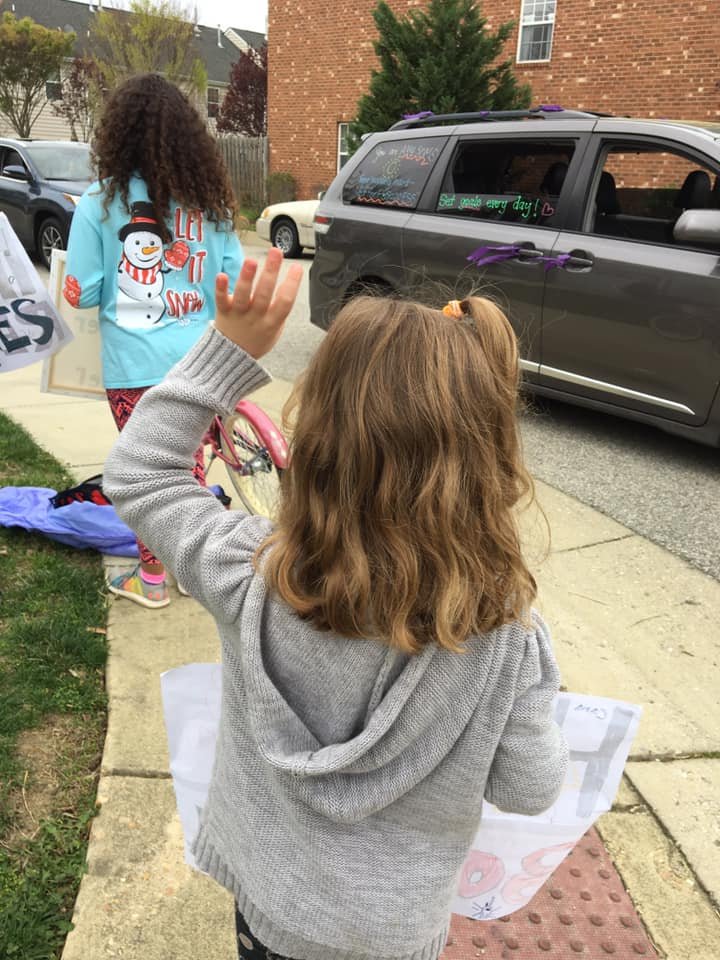
91663272_10158735760542565_2455793223893778432_n

Photo credit:  Jennifer Andrews-Weckerly; use with permission only.

I had seen the pictures and videos in my news feed of teachers and schools “parading” in neighborhoods, saying hello to their students from their cars (keeping safe social distances).  The idea seemed nice enough, but I did not really think too much about the concept.  But when my children found out their elementary school would be doing the same, they jumped right in, making signs for their teachers.  We rearranged our daily schedule, and headed up to the now-unused bus stop in our neighborhood, and waited.

But it was not until I saw familiar face after familiar face – the principal, my fifth grader’s first, third, and current grade teachers; the art, computer, music, orchestra, librarian, and gym teachers; even the custodian – that I lost it.  Tears burst into my eyes, and although I could not stop smiling, I also could not stop crying.  The previous week, we had found out that due to the Coronavirus, our schools would be out for the remainder of the school year.  My fifth grader would not get to say goodbye to friends and one of the best teachers she has ever had, nor the community that has shaped her for the last four years.  My kindergartner would get no closure on her first year of school.  But here was that amazing community, coming to our neighborhood to say goodbye.

I think I burst into tears because I realized how very deeply important community is in our lives.  For the schools, our children are there five days a week, nine months of the year.  The school is a major part of the village that raises our children, teaches them, forms them into amazing citizens, and helps them find their sense of identity and purpose.  The staff and teachers at our school love our children and are a part of our family.  What this virus did was expose a huge part of our children’s lives and take it away from them.  The tears I could not stop that day were tears of gratitude, tears of blessing, tears of humility for the community I had not fully appreciated until that moment.

That is what has been so hard about having our church closed too.  We are making inroads for connection, surely.  But part of the reason we are doing that is because we know that Church is a vital community in our lives too.  Certainly, we are there because of our faith – or our desire to have faith.  But we are also at Church because the community feeds us, sustains us, and gives our lives a sense of purpose and identity.  When we cannot gather, we lose a huge part of our lives.  This week, it is my prayer that for those of you missing your church community, you will take advantage of the ways we are trying to maintain virtual connection during this time of disconnection.  We may not be able to exchange signs of the peace, offer hugs or high fives of affirmation, or kneel at the altar together.  But we can laugh at Virtual Coffee Hour, sing during livestream worship, and even cry during daily pop-up prayers.  Your community is still here, loving you and supporting you.  And we cannot wait to see you again!!

← Older posts

Recent Posts

  • On the Myth and Magic of Advent…
  • On Risking Failure and Facing Fear…
  • Sermon – Luke 23.33-43, P29, YC, November 23, 2025
  • On Inhabiting Gratitude…
  • Sermon – Luke 20.27-38, P27, YC, November 9, 2025

Archives

  • December 2025
  • November 2025
  • October 2025
  • September 2025
  • August 2025
  • July 2025
  • June 2025
  • March 2025
  • February 2025
  • December 2024
  • November 2024
  • October 2024
  • September 2024
  • August 2024
  • July 2024
  • June 2024
  • May 2024
  • March 2024
  • February 2024
  • January 2024
  • December 2023
  • November 2023
  • October 2023
  • September 2023
  • August 2023
  • July 2023
  • June 2023
  • May 2023
  • March 2023
  • February 2023
  • January 2023
  • December 2022
  • November 2022
  • October 2022
  • June 2022
  • May 2022
  • January 2022
  • December 2021
  • November 2021
  • October 2021
  • September 2021
  • August 2021
  • June 2021
  • May 2021
  • April 2021
  • March 2021
  • February 2021
  • January 2021
  • December 2020
  • November 2020
  • October 2020
  • September 2020
  • August 2020
  • July 2020
  • June 2020
  • May 2020
  • April 2020
  • March 2020
  • February 2020
  • January 2020
  • December 2019
  • November 2019
  • October 2019
  • September 2019
  • August 2019
  • July 2019
  • June 2019
  • May 2019
  • April 2019
  • March 2019
  • February 2019
  • January 2019
  • December 2018
  • November 2018
  • October 2018
  • September 2018
  • August 2018
  • July 2018
  • June 2018
  • May 2018
  • April 2018
  • March 2018
  • February 2018
  • January 2018
  • December 2017
  • November 2017
  • October 2017
  • September 2017
  • August 2017
  • July 2017
  • June 2017
  • May 2017
  • April 2017
  • March 2017
  • February 2017
  • January 2017
  • December 2016
  • November 2016
  • October 2016
  • September 2016
  • August 2016
  • July 2016
  • June 2016
  • May 2016
  • April 2016
  • March 2016
  • February 2016
  • January 2016
  • December 2015
  • November 2015
  • October 2015
  • September 2015
  • August 2015
  • July 2015
  • June 2015
  • May 2015
  • April 2015
  • March 2015
  • February 2015
  • January 2015
  • December 2014
  • November 2014
  • October 2014
  • September 2014
  • August 2014
  • July 2014
  • June 2014
  • April 2014
  • March 2014
  • February 2014
  • January 2014
  • December 2013
  • November 2013
  • October 2013
  • September 2013
  • August 2013
  • July 2013
  • June 2013
  • May 2013
  • April 2013
  • March 2013
  • February 2013
  • January 2013
  • December 2012
  • November 2012
  • October 2012
  • September 2012

Categories

  • reflection
  • Sermons
  • Uncategorized

Meta

  • Create account
  • Log in
  • Entries feed
  • Comments feed
  • WordPress.com

Blog at WordPress.com.

  • Subscribe Subscribed
    • Seeking and Serving
    • Join 394 other subscribers
    • Already have a WordPress.com account? Log in now.
    • Seeking and Serving
    • Subscribe Subscribed
    • Sign up
    • Log in
    • Report this content
    • View site in Reader
    • Manage subscriptions
    • Collapse this bar
 

Loading Comments...