• About

Seeking and Serving

~ seek and serve Christ in all persons

Seeking and Serving

Tag Archives: relationship

On Serving, Humanity, and Jesus…

29 Wednesday Jan 2020

Posted by jandrewsweckerly in Uncategorized

≈ Leave a comment

Tags

abundance, comfort, community, homeless, humanity, Jesus, light, love, poor, poverty, relationship

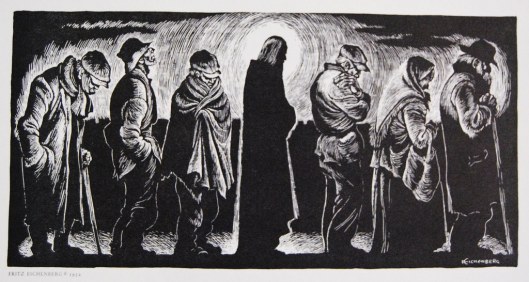
Christ of the Breadlines

Photo credit:  https://www.flickr.com/photos/jimforest/8367811926

This week our church is hosting our community’s winter shelter.  Every week, a different church hosts homeless community members from approximately 6:30 pm – 8:00 am, providing dinner, a place to sleep, breakfast, and a bag lunch to go.  The organization that runs the program also coordinates services like off-site showers, bus passes, referrals for services, and other necessities.  For our church, this is an all hands on deck kind of week – from checking in guests, setting up and cleaning spaces, making and serving meals, handling checkout, and doing security.  The week brings us together as a community, helps create a sense of giving back to the community, and gives us an outlet to shine Christ’s light.

But one of the things the shelter also does is forces us to look into the face of poverty.  As I talk with our parishioners, I find them surprised to know (or remember) that the homeless often have jobs, sometimes are going to school, and may have things like cars, cell phones, and laptops.  I find our parishioners reminded of our common humanity – that comfortable or poor, we all have likes, dislikes, joys, and sorrows.  I find our parishioners able to see how important community can be for support, care, and love – whether a church community, a nonprofit community, or a community of people struggling to get by who look out for each other.  I find our parishioners taking fresh new looks at their surroundings, perhaps seeing abundance for the first time in a long time.

Jesus spent a lot of time with the poor, oppressed, and marginalized.  Part of that time was certainly about relieving suffering and healing brokenness.  But I imagine part of that time was about looking into the face of poverty and seeing something one cannot see elsewhere – humanity, commonality, community, and abundance.  I think Jesus also knew how hard it is to see the realness of life when surrounded by wealth – that’s why he was always telling people to give it away!  Ultimately, Jesus cared about loving relationships, and sometimes money just gets in the way of those kind of authentic interactions.

Whether you are volunteering this week or not, I encourage you to find a way this week to step out of your comfort zone – have a conversation with someone who is suffering, look into the eyes of someone asking for help, or take a look at your own lifestyle and assess what you need less of in your life.  It is in those moments we see glimpses of where Jesus is, and it is in those moments that we shine Christ’s light for others.  I can’t wait to hear your stories!

One “Why” of Church…

22 Wednesday Jan 2020

Posted by jandrewsweckerly in Uncategorized

≈ Leave a comment

Tags

church, community, conflict, creation, faithful, gift, God, intentional, love, meaningful, relationship, sacred, scripture, why?

together-crop

Photo credit:  https://ncchagerstown.org/attendance-membership-and-belonging-at-new-creation/

A few months back, a commenter on my blog asked why people even need to go to church.  I have thought of hundreds of reasons, and could probably write a whole series of posts about that question.  But this week, one of those reasons became very clear to me.  One of reasons being a part of a church community is so important is because being a part of a church community teaches members how to be in meaningful, faithful, sacred relationships with others.

Certainly, scripture teaches us humans are made in the image of God, and that our creation was very good.  Scripture also teaches us to love God, love ourselves, and love our neighbor.  And there is much scripture that teaches us what community means, the value of every person to making the community whole, and what behaviors are needed to be loving people made in the image of God.

Now, I know the Church and her leaders have often failed at living in that specifically Christian way.  But belonging to a church means you are committing to trying to live the life of love intentionally, authentically, and humbly.  The Church is where we learn how to lovingly live through conflict.  The Church is where we learn how to kneel at the altar rail right next to someone who has hurt us, who disagrees with us, who has challenged us, and see the commonality in our outstretched arms, waiting for the healing body of Christ.  The Church is where we learn how to say, “I’m sorry,” “I was wrong,” “I messed up,” and “I forgive you.”  The Church is the place where we can hold the fragility of human experience, the sinful nature of each of us, and the beauty of God’s creation in tension, and experience the depths of love known only through the eyes of Christ.

Maybe Church is not a place like that for you.  For me, the Church makes me a better human being, and a better child of God.  The Church keeps me honest, loves me when I do not deserve it, and molds me into a servant of God who can share that same life-giving, liberating love with others.  I am so grateful to be a part of a church, so honored to be a priest in the Church, and so overwhelmed by the power of love I find powerfully within the community of the Church.  If that is a not a gift you have received, I invite you to my church, anytime.  If that is a gift you have received, I invite you to give thanks to God for God’s gift of the Church to us.  And if you are giving thanks this week for your own church experience, I encourage you to give that gift to someone else.

On Shining Our Light…

23 Wednesday Oct 2019

Posted by jandrewsweckerly in Uncategorized

≈ Leave a comment

Tags

abundance, anxiety, church, community, giving, Jesus, joy, light, money, nervous, passionate, pledge, relationship, shine, stewardship

711x400-FiC-LetYourLightShine

Photo credit:  https://wels.net/let-your-light-shine-3/

A couple of weeks ago, Hickory Neck had a wonderful guest preacher who talked to us about stewardship.  He led with a participatory set of questions.  The first was, “What is your reaction when I tell you today is a Stewardship Sunday?”  The responses ranged from “anxiety,” “nervousness,” “dread,” and “frustration” (though some people studiously responded, “gratitude”).  The next question was, “How do you think your rector feels about Stewardship Sundays?”  The responses were fairly similar, and the preacher surmised that stewardship is something rectors dread too because so much of what they can do is based on what parishioners are willing to give.

The funny thing is though, as I sat there listening to the preacher’s question about my own feelings, my initial response about how I, as rector, felt about stewardship season was “joy.”  I know what you are thinking, “Come on, Jennifer, we know you get stressed out about money as much as we do!”  And there is probably a latent sense of anxiety or at least uncertainty.  But mostly I feel joy.  I love talking about stewardship because to me, talking about stewardship is a lot like evangelism.  Both involve talking about something you love and inviting people into that passion.  And I absolutely love and am passionate about the community of Hickory Neck and the powerful ministry we are doing.  I see every day what a powerful place this is for people, and what an incredible impact it is making on their lives.  So, asking people to financially support this place is really just a matter of inviting people to affirm that goodness in their life – to give with the same abundance that is experienced within this community.

The other reason I feel joy in talking about stewardship is because talking about our financial giving is what people do when they are in relationship with one another – they talk about what it is important to them, and what effects their everyday lives.  Money is one of those things that is at the very heart of our lives – we need it, we use it, and we often wish we had more.  Jesus even talked about money perhaps more than any other issue in his ministry.  But the reason many of us get uncomfortable talking about money is because money feels personal and intimate.  But being in authentic relationship means sharing things that are personal and intimate.  With whom else can you talk about money if not with those to whom you are closest, who support you in your darkest moments, and who love you unconditionally?

The last couple of months I have run into many colleagues and long-time friends, and invariably they ask me how things are going at Hickory Neck.  I have noticed when I answer that inquiry, my body has a visceral response.  I immediately and unconsciously smile and let out a sigh of satisfaction before I launch into what I love about our community and the work we are doing together.  As you are working on your pledge cards this week, I hope you can first think about what those things are at Hickory Neck that give you joy, that make you excited to be here, investing your time and energy.  Then I hope you can allow your financial pledge to be a testimony to that joy.  Come, shine your light with me!tens-shining-our-light-horiz

Sermon – Lk. 16.1-13, P20, YC, September 22, 2019

25 Wednesday Sep 2019

Posted by jandrewsweckerly in Sermons, Uncategorized

≈ Leave a comment

Tags

ambiguity, black and white, dishonest, Episcopal Church, glorify, God, gray, Jesus, money, place, power, relationship, Sermon, via media, wealth

In seminary I took a class about Reconciliation, and one of the requirements of the class was to lead a Bible Study at the local jail.  Our team of four Episcopalians waltzed into the jail, prepared with study notes, a lesson plan, and as much of an air of confidence as we could muster.  Not very long into the Bible Study, though, we realized we were in trouble.  You see, many of us had been drawn to the Episcopal Church because the Episcopal Church embraces the via media, or the middle way; we are a church that affirms the sacredness of the gray over the black and white.  But an inmate has no time for gray.  Their whole lives are governed by black and white, right and wrong.  The rigidity of life in jail is applied to Holy Scripture as well.  Most of the inmates were either perplexed by our suggestion of any ambiguity or gray in Scripture, or simply thought we were wrong.  Fortunately, our professor had come along.  After about forty-five minutes of debate and disagreement, our professor quietly spoke.  He invited the men to reflect on life where they were from, the complexities of the street, racism, and poverty.  If life at home was so layered, ambiguous, and complicated, surely Scripture could be too.  I am not saying my professor made any great strides in the debate around the literal interpretation of Scripture, but I believe he may have opened a window for some of the inmates.

I think today’s Scripture lesson is a bit like that jail classroom.  At first glance, this could be considered a text that is black and white.  The final verse of our gospel says, “No slave can serve two masters; for a slave will either hate the one and love the other, or be devoted to the one and despise the other. You cannot serve God and wealth.”  There is no gray in Jesus’ words.  Either we choose God or we choose money.  And based on the fact God is one of our two options, there is no ambiguity about which of these options we should choose.  But here is the problem with trying to assert this passage of scripture is black and white.  Whereas as the end of the passage Jesus seems to be saying we must choose God or money, in the parable, Jesus seems to be saying something else.

If you recall, in the parable, we have a poorly-behaving manager.  The manager has squandered away the master’s money.  When he is caught, the manager takes a good look at himself and admits some honest truths – he is not capable of doing manual labor and he is too embarrassed to beg for money.  Having been honest about who he is, he connives his way into a solution:  he will engender goodwill among his neighbors by doing financial favors for each of them – forgiving portions of their debts in the hopes that they will sometime very soon return the favor.  Both the master and Jesus recognize the shrewdness or wisdom in the manager’s behavior because the manager uses his wits to get out of a devastating position.  In verse nine, the text says, “I tell you, make friends for yourselves by means of dishonest wealth so that when it is gone, they may welcome you into the eternal homes.”

This is where things get confusing.  At first, Jesus seemed to be clearly saying money is evil and we must choose God over money.  But when Jesus says to “make friends for yourselves by means of dishonest wealth,” Jesus seems to be claiming money can sometimes be one of those gray areas of life; in fact, money can be used as a means to an end.  Now, we all have varying philosophies about money.  Some of us manage to care very little about money, with money holding very little power over us.  Some of us struggle with money, sometimes remembering how money can be used for good, but most times feeling like money creates stress and anxiety in our lives that we cannot seem to shake.  And others of us become narrowly focused on money – either in how we can acquire more or what ways we can spend and enjoy money more.  What Jesus knows we often forget is money is inherently “dishonest.”  Money creates systems of injustice and hierarchies of power; money can destroy marriages and friendships; and money can be the ruin of many a person.  So when Jesus says to make friends through dishonest wealth, he does not mean to become a dishonest people; he means money inherently lures us into dishonesty, and we can either throw our hands up in the air in resignation and a refusal to be associated with that dishonesty, or we can use that dishonest wealth as a means to something much more important – relationship with others.

One of the things I like to do when I am struggling with a challenging Biblical text is to look at other translations to see if I can make more sense of Jesus’ words.  This week, I found the most help from a translation called, The Message.  Now as ample warning, The Message is a very contemporary paraphrase of the Bible, which takes a lot of theological liberties that I am often uncomfortable with; however, I also find that the language from the paraphrase opens up the biblical text enough for me to start seeing the text with fresh eyes.  The Message translates Jesus words in this way:  “Now here’s a surprise:  The master praised the crooked manager!  And why?  Because he knew how to look after himself.  Streetwise people are smarter in this regard than law-abiding citizens.  They are on constant alert, looking for angles, surviving by their wits.  I want you to be smart in the same way—but for what is right—using every adversity to stimulate you to creative survival, to concentrate your attention on the bare essentials, so you’ll live, really live, and not complacently just get by on good behavior.”

What Jesus is trying to say to us today is layered, and very much lives in the gray of life.  First, money has a corrupting force in our lives.  As I mentioned a couple of weeks ago, Jesus talks about money incessantly in scripture, from telling people to give away all their money, to scolding people about storing up their money in larger barns, to reminding people not to stress about money, to this odd text about money.  As Luke concludes today, Jesus tells us that we cannot serve God and money, because of the all-consuming way money can corrode our relationship with God.

Second, we cannot escape money.  Money is a part of our everyday lives, and as we all know is necessary for functioning – for food, for shelter, for clothing, for comfort, for ministry.  Even those monks and nuns who take on a vow of poverty still rely on the money of others for support.  Money, with all its potential for corruption, is inescapable in our lives.

Finally, once we understand the power and place of money in our lives, Jesus reminds us that when we are wise, keeping God at the center, we can use money as a means to goodness in our relationship with God and with one another.  The manager “transforms a bad situation into one that benefits him and others.  By reducing other people’s debts, he creates a new set of relationships based not on the vertical relationship between lenders and debtors (rooted in monetary exchange) but on something more like the reciprocal and egalitarian relationship of friends.”[i]   This kind of work is not about charity per se, but about making friends.[ii]

Many years ago, there was a commercial circulating around the internet.   In the video, a boy is caught red-handed trying to steal a bottle of medicine and a soda.  A woman is berating him in front of a marketplace, wanting to know why he would take these things.  He confesses that the items are for his mother.  A local merchant steps forward, and hands the woman a handful of money to cover the cost of the stolen items.  The man then quietly asks the boy if his mother is sick.  When the boy nods yes, the merchant has his daughter also bring a container of vegetable broth and other items, and sends the boy on his way.  The next clip of the commercial shows the merchant thirty years later, still working in his shop.  He collapses and is taken to the hospital.  The daughter becomes completely overwhelmed as the medical bills add up, even selling the shop they had once run together.  As she is found crying near her father’s bedside, she finds a revised copy of their medical bill.  The amount due is zero.  We find out through the video that the doctor who forgives the bill is that same boy who stole medicine thirty years ago.  He writes at the bottom of the bill, “All expenses paid thirty years ago with three packs of painkillers and a bag of veggie soup.”[iii]

Jesus knows how money corrupts our world.  To be sure there is no ambiguity about the place money takes when talking about God.  We are to choose God.  But Jesus also knows that we can shrewdly utilize our money as a tool to create relationships that glorify God.  This is Jesus’ invitation for us today:  to examine how our relationship with dishonest wealth can be used for goodness.  Jesus affirms for us this week that the way into the black and white, the right and wrong of life, might just be through the path of gray.  Amen.

[i] Lois Malcolm, “Commentary on Luke 16.1-13,” as found on http://www.workingpreacher.org/preaching.aspx? commentary _id= 1783 on September 18, 2013.

[ii] Thomas G. Long, “Making Friends,” Journal for Preachers, vol. 30, no. 4, Pentecost 2007, 55.

[iii] As found at https://www.youtube.com/watch?v=XADBJjiAO_0 on September 20, 2019.

Sermon – Luke 11.1-13, P12, YC, July 28, 2019

31 Wednesday Jul 2019

Posted by jandrewsweckerly in Sermons, Uncategorized

≈ Leave a comment

Tags

authentic, disciples, God, honest, Jesus, language, Lord's Prayer, power, pray, prayer, real, relationship, Sermon, teach, vulnerable

One of the practices highly recommended to clergy is having a spiritual director.  My director is a professor I had in seminary.  He is wise and insightful, and always helps me not only see the bigger picture, but also see goodness in what sometimes feels like darkness.  But perhaps my favorite thing about him is the way he prays.  You would think with such a spiritual, learned man, his prayers would be profound and flowery – worthy of the kind of prayers we find in our own Prayer Book.  But instead, his prayers are the opposite.  They are awkward and fumbling.  You can hear long pauses in them as he struggles to articulate what he wants to say to God.  He uses everyday language, rarely capturing the phrases we normally hear in prayers.  The first several times I heard him pray, I was admittedly a little disappointed and, when I’m really being honest, a bit judgmental.  But in time, I began to see his prayers differently.  His prayers may not be artfully constructed or perfectly paced, but his prayers are never canned or artificial.  His prayers may not be theologically intricate, but his prayers are honest, vulnerable, and capture the deep profundity of whatever you have just shared.  His prayers are not pretty, but they are real and raw – more real than most prayers I have heard.

Of course, I am not the first person to wonder, worry, or wander through prayers.  Today, the disciples ask a simple favor of Jesus, “Lord, teach us to pray.”  The disciples at this point have seen Jesus pray many times.  They see how good he is and they see how important prayer is in his life.  In fact, in Luke’s gospel, Jesus is regularly found in prayer.[i]  They watch Jesus enter into prayer with God for months, and they long to be able to do that too.  And so they come to Jesus, and they vulnerably submit their request:  teach us to pray.

Their request is full of implications.  First is the admission that they do not have the first idea about what they are doing.  Maybe they learned some prayers in temple, or maybe their parents prayed with them.  But they realize in watching Jesus that they do not actually know how to pray themselves.  Not really.  Second, they see a real connection between Jesus and God that somehow is revealed in Jesus’ prayer life.  Perhaps they see how prayer strengthens him in his weakness and how he is more vulnerable with God than even with them.  They long for that kind of connection with God too, but still, they are not sure how the whole thing works.  Finally, a deeper implication is at hand in the disciples’ request.  Perhaps they are not only asking Jesus how to pray, but also wanting to know what is actually happening in prayer.  Perhaps they have tried praying on their own – for an illness, for a new job, for a broken relationship – but the prayer did not work.  They want Jesus to teach them the right way to pray so that the results they desire are fulfilled.

And so, Jesus responds.  Jesus gives them the ultimate prayer – the prayer we call The Lord’s Prayer.  The prayer Jesus gives them is so beautiful and powerful, that two thousand years later, people who never go to church seem to know this prayer.  This is the prayer we pray when we pray the rosary, when we end our days, and at the end of every Eucharistic Prayer.  This is the prayer we pray when we have no other words.  This is the prayer we teach our children to pray and we sing in our own unique Hickory Neck way.

But if you look at Luke’s version of this prayer, the prayer sounds a little more like one of the prayers my spiritual director might pray.  As one scholar says, “Pious convention has conditioned most of us to repeat this prayer so quietly and reverentially that we fail to recognize how we are risking an aggressiveness incommensurate with bourgeois manners.”[ii]  In other words, the Lord’s Prayer is kind of pushy.  There is no flowery language or even polite deference or usage of the word “please.”  Instead, Jesus just tells us to ask for a bunch of stuff:  give us, forgive us, lead us, deliver us.  And every week or even every day, we say the same words – give us, forgive us, lead us, deliver us.  And if we keep reading Luke’s gospel, after the prayer, we hear Jesus saying that our prayerful life with God is akin to being a pushy friend who through their shameless relentlessness[iii] is able to get a friend up out of bed in the middle of the night.

So why in the world do we teach our children this prayer when the prayer is so flagrantly pushy?  Next week Ella and Charlie will be receiving their First Holy Communion.  First Communion is not really the norm in the Episcopal Church.  As a priest, I first encountered First Holy Communion on Long Island, where the Episcopal Church was highly influenced by the Roman Catholic tradition.  Though the Episcopal Church’s theology is that any baptized person can receive communion, some families prefer their children to understand what Holy Communion means before receiving instead of learning to understand communion through experience.  There really is no wrong way to approach Eucharist, but if we are to do a First Holy Communion, one of the things we require candidates to do is learn the Lord’s Prayer.  In part we do that so that there is at least one part of the Eucharistic service they have memorized and in which they can fully participate.

But there is another reason we have candidates learn the Lord’s Prayer.  We want candidates to learn the Lord’s Prayer because the Lord’s Prayer teaches us about what our relationship with God is like.  Our relationship with God is not flowery or picture perfect.  We  may have moments of poetic beauty with God, but when our relationship with God is at its deepest, we cry ugly, full-bodied tears, we rage about injustice – both personal and in the world, we confess our shame and sorrow for the awful things we sometimes do, and we laugh and rejoice with the kind of dancing we would only do in the confines of our homes.  We do not use language with God containing the formality of language we use with strangers; we use language with God we would use with a friend who knows all our foibles and loves us anyway.  All of that is not to say the poignant prayers of the Prayer Book cannot inspire faithfulness; they can and do.  But we teach the Lord’s Prayer to our children so they know we can say unsure, vulnerable, real words to God.

That is what Jesus is really teaching the disciples.  Jesus does not tell the disciples to “ask, and it will be given you; search, and you will find; knock, and the door will be opened for you,” because he is saying prayer is a vending machine for our every wish.  Jesus tells us to ask, search, and knock, because prayer and our relationship with God is active and relational.  As one scholar asserts, Jesus teaches us the Lord’s Prayer because he wants his disciples to know, “prayer is not a meek, contrived, and merely ‘religious’ act; [prayer] is the act of human beings who know how hard it is to be human.  Real prayer cannot be faked.  [Real prayer’s] only prerequisites are sufficient self-knowledge to recognize the depths of our need, and enough humility to ask for help.”[iv]

This week, I invite you to take a cue from Jesus’ own relationship with God.  Maybe you will start with a prayer like my spiritual director’s – one that does not lead with preplanned words, but instead tries to authentically say the words on your heart; not a structured collect, but a raw conversation with God.  Jesus gives you permission to ask for those things you need, the forgiveness you desire, the protection you long for, and the deliverance you seek.  Jesus invites you to just be you – to be a human with the God who loves you and made you in God’s image.  And if all that fails, then you can say the Lord’s Prayer.  You can rest in the assurance that although Jesus’ prayer sure sounds pretty, his prayer is one of the most honest ones you can offer – the small step you can take in connecting back to your Lord and your God.  Amen.


[i] James A. Wallace, “Homiletical Perspective,” Feasting on the Word, Yr. C, Vol. 3 (Louisville: Westminster John Knox Press, 2010), 289.

[ii] Douglas John Hall, “Theological Perspective,” Feasting on the Word, Yr. C, Vol. 3 (Louisville: Westminster John Knox Press, 2010), 288, 290.

[iii] Wallace, 291.

[iv] Hall, 290.

On Jesus, Love, Me, and You…

17 Wednesday Jul 2019

Posted by jandrewsweckerly in Uncategorized

≈ 1 Comment

Tags

Christ, intergenerational, Jesus, Jesus Loves Me, love, meaning, ministry, neighbors, profound, relationship, Savior, simple, song, together, walk

Jesus-Loves-Me-this-I-Know

Photo credit:  https://mandjsquared.com/index.php/product/jesus-loves-me-this-i-know/

After welcoming The Kensington School, an independent child development center, on to the Hickory Neck property, the two communities have sought ways to enter into mutual relationship.  One of those efforts has been offering a voluntary Godly Play class for students of the school.  We began the class in the fall, and have had over 18 children registered for the class.  We recently changed the day of the week the class is offered, and so yesterday, I was finally able to join the class.  The children were full of life and wonder, and I loved to watch them engage in the story.  But probably one of my favorite parts was singing Jesus Loves Me with the children.  They clearly knew the words, and it was fun to sing such a familiar childhood song – so simple and, especially in these days, so profound.

My day carried on like any other adventurous day in ministry, and that afternoon, I celebrated Eucharist at a local retirement home.  We usually sing a few songs, and the chaplain always reminds me that familiar songs are important, as they bring up many fond memories for the residents.  So, without thinking, I chose two, and midway through the final song, I realized I had subconsciously chosen the very song I had sung early that morning – Jesus Loves Me.  The same feelings emerged, especially as many of the retirees in that space are in bodies that no longer do all the things they used to do.  But they can sing about the love of a Savior – that they, even in their weakened states, are loved.

I have been thinking about a couple of things since then.  Hickory Neck has been articulating its mission in Upper James City County, and one of the tenets of our mission is to engage in intergenerational ministry.  Knowing our unique setting – a community comprised predominantly of young families and a large retirement community – our parish seeks to minister to both, and in fact, we believe our ministry will be richer as both young and old walk together in Christ.  Yesterday’s convergence of three and four year-olds singing the same words as ninety-three and ninety-four year-olds made me hopeful about the potential of Hickory Neck’s ministry.

But yesterday’s experience also made me think about all of us in the middle – those of us who are twenty-three and twenty-four to sixty-three and sixty-four; those of us who are busily going about life, trying to do our part to make the world a better place, and trying to find meaning and joy in this world.  For those of us in the middle, I wonder if we might hear the words of a song that seems almost childishly simple as instead something profoundly important about ourselves and our neighbors.  Yes, Jesus loves me.  But, Jesus also loves you.  And, from what I know about Jesus, he especially loves those whom we would like to deem “other,” or as unworthy of God’s love.  Jesus loves them too.  Perhaps we in the middle can take a cue from those at the beginning and those near the end and remember the simple, profound words that can hold us together, and help us love better.

God’s Gifts in the Chaos…

19 Wednesday Dec 2018

Posted by jandrewsweckerly in Uncategorized

≈ Leave a comment

Tags

Advent, beauty, blessing, breath, chaos, Christmas, crazy, gift, God, kids, life, moments, relationship, sacred

kids jumping on the bed

Photo credit:  https://www.pinterest.com/pin/214835844696012029/

Every December since our elder child was about two or three years old, the same thing happens.  The anticipation of Christmas turns our children into possessed creatures.  They argue more, act out in school, whine at the drop of a hat, and generally become entirely unpleasant to be around.  No matter how much I try to minimize the excitement of Christmas, the buzz around them is unavoidable, and, ergo, crazy behavior.  I found myself so frustrated the other day with the constant effort to reign them in that I had the distinct thought, “I just wish Christmas was over already!”

But I soon as had the thought, I knew I did not mean it.  You see, despite the mayhem of the season, in these last days of Advent, there are still sacred moments everywhere.  As we read our Advent devotional this week, one of the questions was, “Who are you praying for this Advent.”  My younger daughter immediately said, “I want to pray for all dead people.”  “Oh,” I said, “like whom?”  “Like MeeMaw,” she said.  And despite the fact that they nearly broke half the ornaments that came out of the ornament box, now, every morning, both girls rush to the tree to plug in the lights and find the ornaments that play Christmas tunes or funny sounds, twirling around in their nightgowns to the sounds.  And last week, as they had their Christmas dance performances, I teared up watching them, remembering how very special dance had been to me growing up.

The same can be true in any season.  Whether we are putting our heads down, trying to finish one more project, or absorbed in technology for extended periods of time, or simply fixated on our endless to-do lists, we can achieve a lot, but miss life along the way.  Fortunately, we are blessed with a God who is continually trying to get our attention anyway – who is relentless in pursuing relationship with us.  In these last days of Advent, God invites us to take a deep breath, lift up our heads, and open our eyes to the beauty of the sacred all around us.

Hickory Neck offers us the opportunity to do that over the next several days.  Whether you come to our Blue Christmas service, our last Advent liturgies, Christmas Eve services, or the service on Christmas Day, there will be multiple times to see glimpse of the sacred all around you – ways in which the manger is a window into the greater redemptive work God is doing in the world.  Whether it’s with an encouraging word from our Blue Christmas service, the sharing of memories at an upcoming funeral, or the wedding vows that one couple will renew on Christmas Day (sixty years later!), what we learn is that in the chaos of life, God is gifting us sacred gifts in tiny, momentous ways.  Today, I invite you to receive God’s gifts among the chaos.

On Relationships and Lunch…

05 Wednesday Dec 2018

Posted by jandrewsweckerly in Uncategorized

≈ Leave a comment

Tags

collaboration, God, health, inspiration, liturgy, lunch, productivity, reconciliation, relationship, respect, retiree, tedning, transformation

LSSLiving_SeniorLivingCommunities-1

Photo credit:  https://www.lssliving.org/communities/

Today we are hosting our second Retiree Lunch with the Rector at Hickory Neck Episcopal Church.  We kicked off this new event last month.  I threw together the event rather quickly, and expected only 10-15 people to show.  When RSVPs hit 60, I was floored – and ever so grateful for our Parish Life Committee who offered to make some more batches of chili, since my one or two Crock Pots would no longer suffice.  The idea for the lunches came out of my annual review with our Personnel Committee.  They were concerned about longtime and older parishioners feeling a sense of connectivity with me and with one another.  No need for a program, worship service, or class; just some time for all of us to be together.

As I thought about the feedback initially, I was not entirely convinced.  Surely gathering that many people was a lost opportunity for formation or enrichment.  But the more I thought about the feedback, the more I could understand the feedback.  One of the dangers of thinking Sunday worship is sufficient for connectivity is realizing how little personal relationship building happens.  Sure, the liturgy and shared experience of reflecting on scripture and sharing the meal is a central part of shaping our identity.  But the handshake, and the “Everything’s fine!” I get in the receiving line is hardly conducive to relationship building.  Some times you need to just spend time together, and that is what our lunches are trying to do.

I am in the midst of reading Simon Sinek’s Leaders Eat Last.  He argues relationships are core to healthy systems.  Setting visions, doing tasks, and sharing responsibility is great, but in order to get anything done, the members of the system need to be in relationship – to spend time together, simply getting to know each other.  He uses the example of the shift in Congress that happened under Newt Gingrich.  It used to be that Congress members lived in DC, played sports together, ate together, and got to know each other’s families, no matter party differences.  But the shift that happened under Gingrich meant more of a focus on spending time back in the home districts for fundraising.  Once the members weren’t spending time together, they gradually began to be more divided, rallying against “the enemy” – the members of the other party with whom they had little to no relationship.  The absence of relationship led to the absence of collaboration, respect, and productivity – a pattern that continues today.

For some, Retirees with the Rector may feel like a simple lunch.  For me, they feel like a dramatic statement about who and how we are going to be as a community.  We are going to make time to be together – to talk to church members from other services whom we rarely, if ever, see.  We are going to sit with parishioners who have very different political opinions from us and talk about the awesome apple pie someone made.  We are going to share stories, build camaraderie, and reconnect with who we are.  And hopefully we will find ways to take that model beyond our doors.

Who do you need to have lunch with today?  What relationships need tending, conversations need to be had, and laughter needs to be shared?  I suspect that that when we gather with others, with the sole intention of relating, we might find that God is working among us for transformation, reconciliation, and inspiration!

Sermon – Job 42.1-6, 10-17, Mark 10.46-52, P25, YB, October 28, 2018

31 Wednesday Oct 2018

Posted by jandrewsweckerly in Sermons, Uncategorized

≈ Leave a comment

Tags

Bartimaeus, belong, blessed, community, conversation, God, Jesus, Job, judge, relationship, Sermon, speak, stewardship, suffering, transformation

If ever there was a confluence of people not “getting it,” in holy scripture, today is that day of confluence.  First, we have the Job story.  Many of us are thrilled to hear the victorious ending of Job today.  After weeks of following Job’s story – from the fateful bargain between God and Satan, to Job’s suffering, to those around him cajoling him to give up on God – we finally arrive at the great redemption of Job.  But what I love most about this last chapter of Job is not what we heard, but the verses we skipped.  The verses we skipped are about Job’s friends, his friends who have tried and tried to tell Job what he has done wrong, what he needs to change, why all this bad stuff is happening to him.  In verses 7-9, God expresses God’s anger at Job’s friends, saying, “you have not spoken of me what is right, as my servant Job has.”  At least, the New Revised Standard Version translates the text that way.  But the original Hebrew does not say, “you have not spoken of me,” but “you have not spoken to me.”[i]  In other words, the friends of Job talked and talked to Job – but never to God.  They sat and mourned with Job, but when they opened their mouths, they did not open them in petition to God.  They just ran their mouths, spouting all sorts of unhelpful nonsense.

We could argue the same of the followers of Jesus.  They are faithfully following Jesus toward Jerusalem, presumably the innermost circle of Jesus’ followers.  When blind beggar Bartimaeus shouts out to Jesus, their immediate response is to shut him down.  We are not clear if they are embarrassed by this filthy beggar’s presumptuous cries, or they feel as if the beggar is breaking protocol for appropriate ways to seek healing, or they just think Jesus is above helping this person in need.  Regardless, their immediate reaction is to shut him down, push him aside, shush him into oblivion.  The crowd following Jesus assumes they knew better and they presume to speak for Jesus about when, how, and to whom God offers healing or blessing.  They never speak to Jesus himself.

The summer I spent as a hospital chaplain, I saw this sort of behavior all the time.  Hospitals can be places of deep despair and suffering.  The hospital can be the place where we face our mortality, where a diagnosis changes the course of our lives, or where decisions have to be made that no one ever wants to make.  In that thin place of life and death, all sorts of things are said, much of which is an attempt to make sense of things that do not make sense.  I cannot tell you the number of times a patient was blamed for their fate by a family member, a patient began to question their life choices, or a friend blamed God for the patient’s suffering.  When there was no medical solution, those who were suffering seemed to be looking for something or someone to blame.  Those were the times when devastatingly hurtful things were claimed or God was used as a weapon instead of a companion.

We could easily wag our fingers at the friends of Job or at the followers of Jesus or even those patients and family members in the hospital, saying in exasperation, “When will those people ever get it?!?”  We fancy ourselves as Jobs or Bartimaeuses.  But that is not where God is speaking to us today.  God sees us in the crowds today.  God sees us as we saddle up to friends, and instead of simply listening or affirming someone’s frustrations or sufferings, we offer explanations and answers, we think of hundreds of “if you just would do this” solutions, or we even act as judge, thinking of reasons why maybe they, in fact, deserve this suffering.  God sees us as we scold a panhandler or judge a family living in a motel.  God sees us when we judge someone’s addiction or mental health challenges as if they are not medical conditions.  God sees us secretly wonder about whether someone’s suffering is a result of “bad karma.”

This summer, in the days before General Convention started, the House of Bishops held a listening liturgy for victims of sexual abuse in the church.  The first-person accounts of twelve men and women were read by bishops.  Unlike most of General Convention, where one person after another makes impassioned, but time-limited speeches at a podium, this was an opportunity to simply listen, to let the painful words fall on those gathered, and to make space for painful truth.  The liturgy was made all the more powerful by having male and female bishops in purple clericals saying the words aloud – in essence, taking on the victim’s pain through their own voices, and ultimately, demonstrating the pain of individual victims belongs to the entire church.  Resolutions, covenants, and task forces would follow, but for that hour and a half, everyone stopped and sat in the ashes, not presuming to speak for God, not explaining the suffering away like the friends of Job, or not trying to stifle the voices of the suffering like the crowd around Jesus.

The counter example to the friends of Job and the crowds are Job and Bartimaeus.  Job could easily listen to his friends and turn his suffering inward, accepting his suffering is somehow his own fault or assuming his suffering is God’s way of casting Job out of favor and relationship.  But unlike Job’s friends, who God proclaims refuse to speak to God in the midst of suffering, Job does nothing but speak for about forty chapters.  Instead of abandoning his relationship with God as his friends do, Job does something different.  “In the midst of his dark night, he dares to tell the truth of his life to his Creator.  By lamenting, complaining, and shouting his discontent to the God he believes to be attacking him, he keeps his relationship with God alive.”[ii] As Biblical scholar Kathleen O’Connor explains, “In the midst of his abyss, Job holds fast to God; he argues, yells, and acts up in courage and fidelity; Job clings to his dignity as a human, maintains his integrity, and sets it without qualification before God.”[iii]  Job understands that suffering is not an occasion to walk away from God, but to stay in brutally honest, painful, vulnerable conversation with God.

Bartimaeus seemed to embrace a similar relationship with Jesus.  When Bartimaeus needs healing, he shouts out to Jesus – an uncouth, ugly, socially unacceptable, raw cry to Jesus.  And when the crowd shushes him, he cries out even more loudly.  Where the crowd wanted boundaries around Bartimaeus’ relationship with Jesus, Bartimaeus understands that relationship means staying in conversation, calling God to account, demanding presence with God.

Now the fact that Job is restored to wealth and wholeness and Bartimaeus’ sight is restored is not really the point.  We could easily and cheaply want to say, “all you need to do is cry out to God and you get whatever you want.”  You and I both know from firsthand experience that that is not how God works.  As O’Connor explains, “It is not true that good things always come to good people, but it is true, as Job discovers, that new experience of life requires new ways of speaking to God.”[iv]  What we see today in scripture is a model of how to engage with God throughout all of life’s journeys – the joys, the sorrows, the celebrations, the suffering.  We are not promised a happy ending, but we are promised a transformed life when we stay in active, vulnerable, ugly conversation with God.

Today we are celebrating our blessing to belong to this faith community, and are offering our financial pledges to support the work and ministry of this place that has blessed us beyond measure.  But our invitation today from scripture is to also celebrate the way in which we belong to God.  For some of us, that invitation will be quite easy.  We may be in a place where our love for the Lord is abundant, and we can happily proclaim our love.  For others of us, that celebration may be more difficult, because, quite frankly, we are a bit angry with God, have lost trust in God, or are just trying to make it through this day.  Part of our responsibility as a community who is blessed to belong here at Hickory Neck is embracing each one of us here and wherever we are in that journey with God.  The blessing of this community is that no one here is going to be like the crowd or the friends of Job, telling you to get your relationship right with God.  But we will sit with you in your suffering and celebrate the transformation of your life in Christ.  Because we know part of being blessed to belong here at Hickory Neck means you will do the same for us someday.  And that is a community I want to belong to everyday!  Amen.

[i] Rolf Jacobson, “Sermon Brainwave #629 – Ordinary 30 (Twenty-third Sunday after Pentecost),” October 20, 2018, http://www.workingpreacher.org/brainwave.aspx?podcast_id=1068, as found on October 24, 2018.

[ii] Kathleen M. O’Connor “Theological Perspective,” Feasting on the Word, Yr. B, vol. 4 (Louisville:  Westminster John Knox Press, 2009), 196.

[iii] O’Connor, 198.

[iv] O’Connor, 194.

Homily – Mt. 11.25-30, St. Francis Feast, YB, October 21, 2018

24 Wednesday Oct 2018

Posted by jandrewsweckerly in Sermons, Uncategorized

≈ Leave a comment

Tags

blessing, easy, healing, homily, hurt, Jesus Christ, light, love, pets, reconciliation, relationship, rest, sabbath, Sermon, St. Francis, village, wolf, yoke

FrancisOfAssisi

Photo credit:  http://thewildreed.blogspot.com/2007/10/st-francis-of-assisi-dancer-rebel.html

Today we honor the life of St. Francis of Assisi.  Francis is one of the most popular and admired saints of all time.  Most of us know the highlights of his story: born the son of a wealthy man in 1182; had a conversion experience and devoted his life to Lady Poverty; shaped monastic and lay devotion; was a friend to all God’s creatures – being known to have preached to the birds.  But the story I like most is the story about St. Francis and the Wolf.

According to legend, there was a wolf that was terrorizing a nearby town, killing and eating animals and people.  The villagers tried to fight back, but they too died at the jaws of the wolf.  Francis had pity on the people and went out to meet the wolf.  When Francis found the wolf, he made the sign of the cross, and said, “Come to me, Brother Wolf.  In the name of Christ, I order you not to hurt anyone.”  The wolf calmly laid down at Francis’ feet.  Francis then went on to explain to the wolf how the wolf was terrorizing the people and other animals – all who were made in the image of God.  The wolf and Francis then made a pact that the wolf would no longer harm the town and the town would no longer try to hurt the wolf.  The two traveled into town to explain the pact they had formed.  The people were amazed as Francis and the wolf walked side-by-side into town.  Francis made the people pledge to feed the wolf and the wolf pledge not to harm anyone else.  From that day on, the wolf went door to door for food.  The wolf hurt no one and no one hurt the wolf; even the dogs did not bark at the wolf.[i]

What I love about this story of St. Francis is that the story is about reconciliation and relationship.  At the beginning of the story the town and the wolf are at an impasse – the wolf is hungry and getting attacked; the people are afraid and are lashing out.  What Francis does for both parties is shock them out of the comfortable.  For the wolf, no one has addressed the wolf kindly – they have either shut the wolf out or actively tried to kill the wolf.  For the people, the wolf has not asked for help – he has simply and violently taken what he needed and wanted.  Francis manages to shock the wolf first – not through violence or force, but with the power of love and blessing.  By giving a blessing in the name of God, Francis is then able to implore the wolf to reciprocate with love.  Francis also manages to shock the village – not with a violent victory, but with a humble display of forgiveness and trust.  By walking into town with a tamed wolf at his side, Francis is able to encourage the town to embrace, forgive, and care for the wolf.  Francis’ actions remind both parties that unless their relationships are reconciled, unrest and division will be the norm.

The funny thing about this story is that the story is pretty ridiculous.  I mean, how many of us go around talking to wild animals, blessing them with the sign of the cross, expecting anything other than being attacked?  We will never really know whether the story is true.  But like any good Biblical story, or even any good midrash, whether the story is true is hardly the point: the point is that the stories point toward “Truth” with a capital “T.”  What this story teaches is that peace and reconciliation only happen through meeting others where they are.  We cannot expect great change unless we are willing to get down in the trenches – to go out and meet that destructive wolf face-to-face.  The other thing this story teaches is relationships are at the heart of reconciliation.  Only when the wolf and the town began to get to know each other and began to form a relationship with one another could they move forward.

This is the way life is under Jesus Christ.  In our gospel lesson today, Jesus says, “Come to me, all you that are weary and are carrying heavy burdens, and I will give you rest.  Take my yoke upon you, and learn from me; for I am gentle and humble in heart, and you will find rest for your souls.  For my yoke is easy, and my burden is light.”  Jesus’ words have layered meaning.  The first meaning we all catch is that Jesus offers us rest and refreshment.  Jesus encourages us to come to him, to cast our burdens and cares upon him, and to take rest, to take Sabbath in Christ.  Our souls will find peace in Christ Jesus.  The second meaning is that peace in Christ Jesus is not without work.  Jesus does not say come unto me and relax forever in happy retirement.  Jesus says we will still have to take on a yoke – the burden of disciple living.  But luckily, that burden of being Christ’s disciple will not be burdensome – it will be light.  Finally, not only will Jesus make the workload “light,” as in not heavy:  Jesus will also make us “light” – as in lights that shine into the darkness and refuse to allow the shadow to overwhelm[ii]; as in lights that shine on this very Holy Hill where Hickory Neck rests.  We become the light when we work for reconciliation in our relationships with others.

That is why we do so many special things today.  Today, we ask for prayers and then exchange signs of peace – that God might help us reconcile the relationships in our life that need healing.  Today, at our 9:00 am service, we ask for blessing on our animals – that God might help our relationship with our pet be one of blessing and light.  Today, we come to Jesus for Sabbath rest – that God might renew us on this Sabbath day, use the rest to fill us with light, and renew our commitment to be agents of reconciliation, gladly putting on Christ’s yoke.  Amen.

[i] John Feister, “Stories about St. Francis and the Animals,” October 4,2005, as found at https://faith32.livejournal.com/61897.html on October 18, 2018.

[ii] Mel Williams, “Let it go…and rest” Faith and Leadership, July 6, 2014 as found at http://www.faithandleadership.com/sermons/mel-williams-let-it-go%E2%80%A6and-rest  on October 18, 2018.

← Older posts
Newer posts →

Recent Posts

  • On Sharing the Love…
  • Sermon – Micah 6.1-8, Matthew 5.1-12, EP4, YA, January 30, 2026
  • On Justice, Kindness, Humility, and the Messy Middle…
  • Feast of the Rev. Dr. Martin Luther King, Jr., January 18, 2026
  • On Peace, Love, and Conduits…

Archives

  • February 2026
  • January 2026
  • December 2025
  • November 2025
  • October 2025
  • September 2025
  • August 2025
  • July 2025
  • June 2025
  • March 2025
  • February 2025
  • December 2024
  • November 2024
  • October 2024
  • September 2024
  • August 2024
  • July 2024
  • June 2024
  • May 2024
  • March 2024
  • February 2024
  • January 2024
  • December 2023
  • November 2023
  • October 2023
  • September 2023
  • August 2023
  • July 2023
  • June 2023
  • May 2023
  • March 2023
  • February 2023
  • January 2023
  • December 2022
  • November 2022
  • October 2022
  • June 2022
  • May 2022
  • January 2022
  • December 2021
  • November 2021
  • October 2021
  • September 2021
  • August 2021
  • June 2021
  • May 2021
  • April 2021
  • March 2021
  • February 2021
  • January 2021
  • December 2020
  • November 2020
  • October 2020
  • September 2020
  • August 2020
  • July 2020
  • June 2020
  • May 2020
  • April 2020
  • March 2020
  • February 2020
  • January 2020
  • December 2019
  • November 2019
  • October 2019
  • September 2019
  • August 2019
  • July 2019
  • June 2019
  • May 2019
  • April 2019
  • March 2019
  • February 2019
  • January 2019
  • December 2018
  • November 2018
  • October 2018
  • September 2018
  • August 2018
  • July 2018
  • June 2018
  • May 2018
  • April 2018
  • March 2018
  • February 2018
  • January 2018
  • December 2017
  • November 2017
  • October 2017
  • September 2017
  • August 2017
  • July 2017
  • June 2017
  • May 2017
  • April 2017
  • March 2017
  • February 2017
  • January 2017
  • December 2016
  • November 2016
  • October 2016
  • September 2016
  • August 2016
  • July 2016
  • June 2016
  • May 2016
  • April 2016
  • March 2016
  • February 2016
  • January 2016
  • December 2015
  • November 2015
  • October 2015
  • September 2015
  • August 2015
  • July 2015
  • June 2015
  • May 2015
  • April 2015
  • March 2015
  • February 2015
  • January 2015
  • December 2014
  • November 2014
  • October 2014
  • September 2014
  • August 2014
  • July 2014
  • June 2014
  • April 2014
  • March 2014
  • February 2014
  • January 2014
  • December 2013
  • November 2013
  • October 2013
  • September 2013
  • August 2013
  • July 2013
  • June 2013
  • May 2013
  • April 2013
  • March 2013
  • February 2013
  • January 2013
  • December 2012
  • November 2012
  • October 2012
  • September 2012

Categories

  • reflection
  • Sermons
  • Uncategorized

Meta

  • Create account
  • Log in
  • Entries feed
  • Comments feed
  • WordPress.com

Blog at WordPress.com.

  • Subscribe Subscribed
    • Seeking and Serving
    • Join 395 other subscribers
    • Already have a WordPress.com account? Log in now.
    • Seeking and Serving
    • Subscribe Subscribed
    • Sign up
    • Log in
    • Report this content
    • View site in Reader
    • Manage subscriptions
    • Collapse this bar
 

Loading Comments...