• About

Seeking and Serving

~ seek and serve Christ in all persons

Seeking and Serving

Tag Archives: relationship

Sermon – Job 42.1-6, 10-17, Mark 10.46-52, P25, YB, October 28, 2018

31 Wednesday Oct 2018

Posted by jandrewsweckerly in Sermons, Uncategorized

≈ Leave a comment

Tags

Bartimaeus, belong, blessed, community, conversation, God, Jesus, Job, judge, relationship, Sermon, speak, stewardship, suffering, transformation

If ever there was a confluence of people not “getting it,” in holy scripture, today is that day of confluence.  First, we have the Job story.  Many of us are thrilled to hear the victorious ending of Job today.  After weeks of following Job’s story – from the fateful bargain between God and Satan, to Job’s suffering, to those around him cajoling him to give up on God – we finally arrive at the great redemption of Job.  But what I love most about this last chapter of Job is not what we heard, but the verses we skipped.  The verses we skipped are about Job’s friends, his friends who have tried and tried to tell Job what he has done wrong, what he needs to change, why all this bad stuff is happening to him.  In verses 7-9, God expresses God’s anger at Job’s friends, saying, “you have not spoken of me what is right, as my servant Job has.”  At least, the New Revised Standard Version translates the text that way.  But the original Hebrew does not say, “you have not spoken of me,” but “you have not spoken to me.”[i]  In other words, the friends of Job talked and talked to Job – but never to God.  They sat and mourned with Job, but when they opened their mouths, they did not open them in petition to God.  They just ran their mouths, spouting all sorts of unhelpful nonsense.

We could argue the same of the followers of Jesus.  They are faithfully following Jesus toward Jerusalem, presumably the innermost circle of Jesus’ followers.  When blind beggar Bartimaeus shouts out to Jesus, their immediate response is to shut him down.  We are not clear if they are embarrassed by this filthy beggar’s presumptuous cries, or they feel as if the beggar is breaking protocol for appropriate ways to seek healing, or they just think Jesus is above helping this person in need.  Regardless, their immediate reaction is to shut him down, push him aside, shush him into oblivion.  The crowd following Jesus assumes they knew better and they presume to speak for Jesus about when, how, and to whom God offers healing or blessing.  They never speak to Jesus himself.

The summer I spent as a hospital chaplain, I saw this sort of behavior all the time.  Hospitals can be places of deep despair and suffering.  The hospital can be the place where we face our mortality, where a diagnosis changes the course of our lives, or where decisions have to be made that no one ever wants to make.  In that thin place of life and death, all sorts of things are said, much of which is an attempt to make sense of things that do not make sense.  I cannot tell you the number of times a patient was blamed for their fate by a family member, a patient began to question their life choices, or a friend blamed God for the patient’s suffering.  When there was no medical solution, those who were suffering seemed to be looking for something or someone to blame.  Those were the times when devastatingly hurtful things were claimed or God was used as a weapon instead of a companion.

We could easily wag our fingers at the friends of Job or at the followers of Jesus or even those patients and family members in the hospital, saying in exasperation, “When will those people ever get it?!?”  We fancy ourselves as Jobs or Bartimaeuses.  But that is not where God is speaking to us today.  God sees us in the crowds today.  God sees us as we saddle up to friends, and instead of simply listening or affirming someone’s frustrations or sufferings, we offer explanations and answers, we think of hundreds of “if you just would do this” solutions, or we even act as judge, thinking of reasons why maybe they, in fact, deserve this suffering.  God sees us as we scold a panhandler or judge a family living in a motel.  God sees us when we judge someone’s addiction or mental health challenges as if they are not medical conditions.  God sees us secretly wonder about whether someone’s suffering is a result of “bad karma.”

This summer, in the days before General Convention started, the House of Bishops held a listening liturgy for victims of sexual abuse in the church.  The first-person accounts of twelve men and women were read by bishops.  Unlike most of General Convention, where one person after another makes impassioned, but time-limited speeches at a podium, this was an opportunity to simply listen, to let the painful words fall on those gathered, and to make space for painful truth.  The liturgy was made all the more powerful by having male and female bishops in purple clericals saying the words aloud – in essence, taking on the victim’s pain through their own voices, and ultimately, demonstrating the pain of individual victims belongs to the entire church.  Resolutions, covenants, and task forces would follow, but for that hour and a half, everyone stopped and sat in the ashes, not presuming to speak for God, not explaining the suffering away like the friends of Job, or not trying to stifle the voices of the suffering like the crowd around Jesus.

The counter example to the friends of Job and the crowds are Job and Bartimaeus.  Job could easily listen to his friends and turn his suffering inward, accepting his suffering is somehow his own fault or assuming his suffering is God’s way of casting Job out of favor and relationship.  But unlike Job’s friends, who God proclaims refuse to speak to God in the midst of suffering, Job does nothing but speak for about forty chapters.  Instead of abandoning his relationship with God as his friends do, Job does something different.  “In the midst of his dark night, he dares to tell the truth of his life to his Creator.  By lamenting, complaining, and shouting his discontent to the God he believes to be attacking him, he keeps his relationship with God alive.”[ii] As Biblical scholar Kathleen O’Connor explains, “In the midst of his abyss, Job holds fast to God; he argues, yells, and acts up in courage and fidelity; Job clings to his dignity as a human, maintains his integrity, and sets it without qualification before God.”[iii]  Job understands that suffering is not an occasion to walk away from God, but to stay in brutally honest, painful, vulnerable conversation with God.

Bartimaeus seemed to embrace a similar relationship with Jesus.  When Bartimaeus needs healing, he shouts out to Jesus – an uncouth, ugly, socially unacceptable, raw cry to Jesus.  And when the crowd shushes him, he cries out even more loudly.  Where the crowd wanted boundaries around Bartimaeus’ relationship with Jesus, Bartimaeus understands that relationship means staying in conversation, calling God to account, demanding presence with God.

Now the fact that Job is restored to wealth and wholeness and Bartimaeus’ sight is restored is not really the point.  We could easily and cheaply want to say, “all you need to do is cry out to God and you get whatever you want.”  You and I both know from firsthand experience that that is not how God works.  As O’Connor explains, “It is not true that good things always come to good people, but it is true, as Job discovers, that new experience of life requires new ways of speaking to God.”[iv]  What we see today in scripture is a model of how to engage with God throughout all of life’s journeys – the joys, the sorrows, the celebrations, the suffering.  We are not promised a happy ending, but we are promised a transformed life when we stay in active, vulnerable, ugly conversation with God.

Today we are celebrating our blessing to belong to this faith community, and are offering our financial pledges to support the work and ministry of this place that has blessed us beyond measure.  But our invitation today from scripture is to also celebrate the way in which we belong to God.  For some of us, that invitation will be quite easy.  We may be in a place where our love for the Lord is abundant, and we can happily proclaim our love.  For others of us, that celebration may be more difficult, because, quite frankly, we are a bit angry with God, have lost trust in God, or are just trying to make it through this day.  Part of our responsibility as a community who is blessed to belong here at Hickory Neck is embracing each one of us here and wherever we are in that journey with God.  The blessing of this community is that no one here is going to be like the crowd or the friends of Job, telling you to get your relationship right with God.  But we will sit with you in your suffering and celebrate the transformation of your life in Christ.  Because we know part of being blessed to belong here at Hickory Neck means you will do the same for us someday.  And that is a community I want to belong to everyday!  Amen.

[i] Rolf Jacobson, “Sermon Brainwave #629 – Ordinary 30 (Twenty-third Sunday after Pentecost),” October 20, 2018, http://www.workingpreacher.org/brainwave.aspx?podcast_id=1068, as found on October 24, 2018.

[ii] Kathleen M. O’Connor “Theological Perspective,” Feasting on the Word, Yr. B, vol. 4 (Louisville:  Westminster John Knox Press, 2009), 196.

[iii] O’Connor, 198.

[iv] O’Connor, 194.

Homily – Mt. 11.25-30, St. Francis Feast, YB, October 21, 2018

24 Wednesday Oct 2018

Posted by jandrewsweckerly in Sermons, Uncategorized

≈ Leave a comment

Tags

blessing, easy, healing, homily, hurt, Jesus Christ, light, love, pets, reconciliation, relationship, rest, sabbath, Sermon, St. Francis, village, wolf, yoke

FrancisOfAssisi

Photo credit:  http://thewildreed.blogspot.com/2007/10/st-francis-of-assisi-dancer-rebel.html

Today we honor the life of St. Francis of Assisi.  Francis is one of the most popular and admired saints of all time.  Most of us know the highlights of his story: born the son of a wealthy man in 1182; had a conversion experience and devoted his life to Lady Poverty; shaped monastic and lay devotion; was a friend to all God’s creatures – being known to have preached to the birds.  But the story I like most is the story about St. Francis and the Wolf.

According to legend, there was a wolf that was terrorizing a nearby town, killing and eating animals and people.  The villagers tried to fight back, but they too died at the jaws of the wolf.  Francis had pity on the people and went out to meet the wolf.  When Francis found the wolf, he made the sign of the cross, and said, “Come to me, Brother Wolf.  In the name of Christ, I order you not to hurt anyone.”  The wolf calmly laid down at Francis’ feet.  Francis then went on to explain to the wolf how the wolf was terrorizing the people and other animals – all who were made in the image of God.  The wolf and Francis then made a pact that the wolf would no longer harm the town and the town would no longer try to hurt the wolf.  The two traveled into town to explain the pact they had formed.  The people were amazed as Francis and the wolf walked side-by-side into town.  Francis made the people pledge to feed the wolf and the wolf pledge not to harm anyone else.  From that day on, the wolf went door to door for food.  The wolf hurt no one and no one hurt the wolf; even the dogs did not bark at the wolf.[i]

What I love about this story of St. Francis is that the story is about reconciliation and relationship.  At the beginning of the story the town and the wolf are at an impasse – the wolf is hungry and getting attacked; the people are afraid and are lashing out.  What Francis does for both parties is shock them out of the comfortable.  For the wolf, no one has addressed the wolf kindly – they have either shut the wolf out or actively tried to kill the wolf.  For the people, the wolf has not asked for help – he has simply and violently taken what he needed and wanted.  Francis manages to shock the wolf first – not through violence or force, but with the power of love and blessing.  By giving a blessing in the name of God, Francis is then able to implore the wolf to reciprocate with love.  Francis also manages to shock the village – not with a violent victory, but with a humble display of forgiveness and trust.  By walking into town with a tamed wolf at his side, Francis is able to encourage the town to embrace, forgive, and care for the wolf.  Francis’ actions remind both parties that unless their relationships are reconciled, unrest and division will be the norm.

The funny thing about this story is that the story is pretty ridiculous.  I mean, how many of us go around talking to wild animals, blessing them with the sign of the cross, expecting anything other than being attacked?  We will never really know whether the story is true.  But like any good Biblical story, or even any good midrash, whether the story is true is hardly the point: the point is that the stories point toward “Truth” with a capital “T.”  What this story teaches is that peace and reconciliation only happen through meeting others where they are.  We cannot expect great change unless we are willing to get down in the trenches – to go out and meet that destructive wolf face-to-face.  The other thing this story teaches is relationships are at the heart of reconciliation.  Only when the wolf and the town began to get to know each other and began to form a relationship with one another could they move forward.

This is the way life is under Jesus Christ.  In our gospel lesson today, Jesus says, “Come to me, all you that are weary and are carrying heavy burdens, and I will give you rest.  Take my yoke upon you, and learn from me; for I am gentle and humble in heart, and you will find rest for your souls.  For my yoke is easy, and my burden is light.”  Jesus’ words have layered meaning.  The first meaning we all catch is that Jesus offers us rest and refreshment.  Jesus encourages us to come to him, to cast our burdens and cares upon him, and to take rest, to take Sabbath in Christ.  Our souls will find peace in Christ Jesus.  The second meaning is that peace in Christ Jesus is not without work.  Jesus does not say come unto me and relax forever in happy retirement.  Jesus says we will still have to take on a yoke – the burden of disciple living.  But luckily, that burden of being Christ’s disciple will not be burdensome – it will be light.  Finally, not only will Jesus make the workload “light,” as in not heavy:  Jesus will also make us “light” – as in lights that shine into the darkness and refuse to allow the shadow to overwhelm[ii]; as in lights that shine on this very Holy Hill where Hickory Neck rests.  We become the light when we work for reconciliation in our relationships with others.

That is why we do so many special things today.  Today, we ask for prayers and then exchange signs of peace – that God might help us reconcile the relationships in our life that need healing.  Today, at our 9:00 am service, we ask for blessing on our animals – that God might help our relationship with our pet be one of blessing and light.  Today, we come to Jesus for Sabbath rest – that God might renew us on this Sabbath day, use the rest to fill us with light, and renew our commitment to be agents of reconciliation, gladly putting on Christ’s yoke.  Amen.

[i] John Feister, “Stories about St. Francis and the Animals,” October 4,2005, as found at https://faith32.livejournal.com/61897.html on October 18, 2018.

[ii] Mel Williams, “Let it go…and rest” Faith and Leadership, July 6, 2014 as found at http://www.faithandleadership.com/sermons/mel-williams-let-it-go%E2%80%A6and-rest  on October 18, 2018.

GC79: Everyday Evangelism…

12 Thursday Jul 2018

Posted by jandrewsweckerly in Uncategorized

≈ Leave a comment

Tags

conversation, evangelism, General Convention, God, Jesus, relationship, story, stranger

36759698_10157020460107565_1355952824961204224_o

Photo credit:  Jennifer Andrews-Weckerly (reuse only with permission)

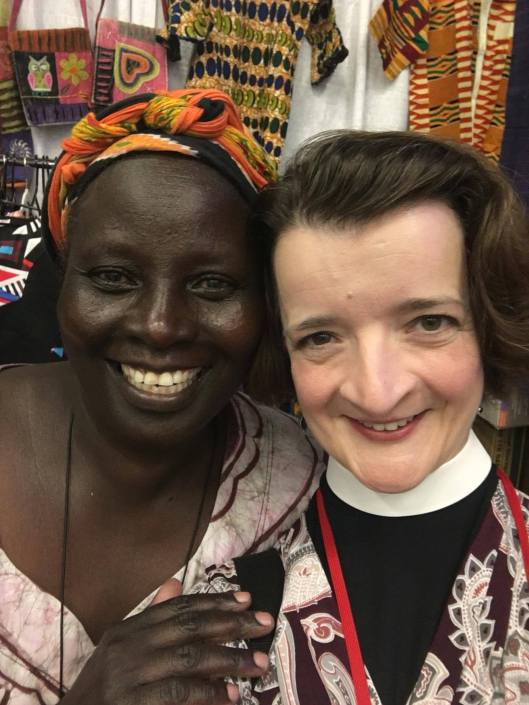
On my first day of General Convention, I had to start as a “visitor” until I could get my alternate name badge.  That meant I had some spare time to explore the exhibits in the Exhibit Hall.  I decided to grab lunch there, and after I made my purchase, I realized I didn’t know anyone in the eating area, and many of the tables were full of deputations or groups of friends.  There was a table with just one petite older woman of color.  I figured General Convention was partly about meeting the wider church, so I asked to join her.

We began the normal chitchat of the day – the weather, the food, etc.  I asked her where she was from and she said, “Arizona now, but I’m from Kenya.”  Well, you can imagine my excitement – one of my best friends from seminary is a female priest from Kenya.  We launched into a conversation about what brought her to the States, and before I knew it, we were deep in a conversation about the husband who left her for another woman, the kids he left her to manage, the impact of the divorce on her family, the hurtful things a priest said to her about the divorce, the way she has experienced racism – not just as a person of color, but as a woman from Africa.

After we grieved the hard stuff, and my apology about the sins of the church, she began to tell me about the good stuff:  the grandchildren she moved to Arizona to enjoy; the women she works with back in various countries in Africa to produce clothing that will feed their families; the school she is trying to help some of the women establish in their hometown.  She was at Convention to display and sell their wares.  She jokingly told me, “Yeah, I’m a little concerned.  The women gave me several items that are going to be way too small for anyone here to wear.”  I knew God had brought us together for a reason!  “Mary,” I exclaimed, “I guess that means I’m going to have to buy one of those smalls!”

Later that week, I dropped by new friend’s booth.  We embraced like old friends.  I could see the wrinkles of hurt and toil on her face more distinctly this time, but I could also see the twinkle of new relationship in her eyes.  I came away with a cute dress, but more importantly, I came away with a sense of kinship, of having connected with another human about the journey of life, and where God can work through us to do good.  When we talk about evangelism in the church, I always try to remind Hickory Neck that evangelism is about hearing people’s stories and naming God in them.  It is not easy work.  It will involve sitting down at tables with strangers and maybe even starting by talking about the weather.  But if you hang in there, you might just hear the story of how God is working through us all – and even find a new sister or brother in Christ along the way.

GC79: When People Start Getting Real…

07 Saturday Jul 2018

Posted by jandrewsweckerly in Uncategorized

≈ Leave a comment

Tags

apathy, children of God, compromise, conversation, Episcopal, General Convention, Jesus, justice, prayer, relationship, truth, uncomfortable

36768122_10157017520522565_436164541772988416_o

General Convention, July 6, 2018.  Photo credit: Jennifer Andrews-Weckerly (reuse with permission)

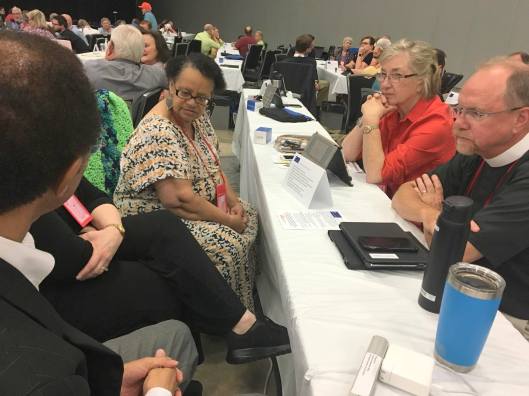
One of the things that I am finding powerful about General Convention is a willingness to enter into a time of truth-telling.  Before I arrived, the House of Bishops hosted a listening session of stories from women who have been sexually harassed or abused in the context of the church.  From what I hear it was a powerful experience of honesty and vulnerability, and I believe many of the bishops (most of whom are male) were moved by the experience.

Last night, I sat in on a hearing for people to offer their testimonies about a couple of resolutions involving marriage rights, particularly same-sex marriages.  Much of the conversation was about a resolution put forth involving a compromise (B012).  According to the resolution, bishops can still make decisions with their conscious for their priests and diocese, but would give permission for any priests who feel called to celebrate same-sex marriages to do so with the oversight of another bishop of the Church.  The testimonies lasted for almost two hours (not including the two hours earlier in the day), and many things became abundantly clear.  Our LGBTQ brothers and sisters are hurting and longing to be treated as equal children of God.  And our more conservative brothers and sisters are fearful about not being able to be faithful to their understanding of Scripture and tradition.  The tension was high.  But also present was a spirit of graciousness.  People of opposing views were sitting beside one another, able to make eye contact and stay in the room.  I came away realizing that what I was seeing was what compromise looks like – no one fully happy, but a path forward for now.  And in a county that seems incapable of compromise, it was a gift to see the Church moving in that direction.

And then today, we spent time together talking about Racial Reconciliation – a topic that my conversation partner said has been a topic for twenty years of General Conventions – which means we haven’t gotten there yet.  It was an inspiring, beautiful, hard time, but a time I was glad to see us have.  One of my favorite speakers, the Rev. Nancy Frausto, had this to say, “This society has been contaminated by the plague of apathy.”  In other words, in a political environment where injustice is rampant, we cannot afford to let apathy infect us.

I do not know where these conversations will lead.  I suspect we will not solve the world’s ills at this Convention.  But what we are starting to do is show the world what it means to be a diverse people who stay together, find a compromise, and love and lead together.  It is not easy.  In fact, it’s pretty uncomfortable. But following Jesus is pretty uncomfortable too.  If the Church can’t do it, I’m not sure we can ask anyone else to do that work.  I’m proud of the Episcopal Church tonight.  And I will continue to hold her in my prayers.

Sermon – Mark 5.21-43, P8, YB, July 1, 2018

04 Wednesday Jul 2018

Posted by jandrewsweckerly in Sermons, Uncategorized

≈ Leave a comment

Tags

connection, intimacy, Jairus, Jesus, Mark, need, power, relationship, Sermon, story, storytelling, woman

I once had a parishioner who was both the best and the worst storyteller.  He was the best because his stories were always fascinating, funny, and fantastic.  Not only did he have an intriguing life, he also just had a real gift for telling stories in ways that brought them to life in your mind’s eye.  But he was also not the best storyteller because he was easily distracted.  He would be in the middle of a story and then veer off course, “Which reminds me of the time…” he would say, and off he would go.  Sometimes he would go back to the other story, but you had to really pay attention to remind him of where he had started.  Sometimes the dropped ending on a story would come back to me days later and I would wonder, “I wonder what happened after he dropped that note to his secret love…”

Mark’s storytelling today is a bit like that parishioner’s way of telling stories.  After the fantastic stories of the calming of the sea, and the healing of a demon-possessed man, Mark tells us of Jesus’ next dramatic moment.  Jairus approaches Jesus and falls at Jesus’ feet, begging him to heal his dying twelve-year old daughter.  This whole event is a big deal because if you remember, many of the other synagogue leaders were suspicious of Jesus, and even plotting against him.  For a synagogue leader to approach Jesus for help is a huge break in rank.  Jesus goes with Jairus without comment, but before we can find out what happens, Mark basically says, “Speaking of which, there was this woman who approached Jesus without Jesus knowing.  You won’t believe what happened…”  And off Mark goes telling another fantastic story.

This time, we learn of a woman who is a total outcast.  She has been hemorrhaging for twelve years, she is destitute because she has spent all her money on doctors – to no avail, and let’s not forget she is a woman.  We can almost imagine the clandestine approach of this triple outcast weaving her way into the crowd just to touch Jesus’ garment.  To her credit, the simple touch works!  Now, the story really could end there, but Mark tells us something even more fascinating – Jesus stops dead in his tracks, demanding to know who touched him.  In a crowd of thousands, he wants to know which person touched him?!?  The woman comes forward for what should be a great castigation and humiliation.  Instead, her honesty and vulnerability open Jesus up to giving even more blessing.  Not only has her faith in him made her well, he offers her the peace, health, and wholeness that will allow her full integration back into society – a double gift!

Now the good news is that Mark is not as bad of a storyteller as my former parishioner.  Mark jumps back to Jairus’ story – but the news is bad.  The daughter has died!  Everyone thinks the cause is lost, but Jesus encourages Jairus to believe.  So off they go, but this time with only Peter, James, and John.  The gathered crowd mocks Jesus’ assertion that the girl is just sleeping.  But when the six of them go in, Jesus quite simply takes her by the hand, calls the girl to get up, and then asks them to give her some food – dying can really take a toll after all!

You might be shaking your head at Mark at this point, wondering if we can’t just focus on one of these stories – truly either is powerful enough on its own.  But Mark is not really like my former parishioner – he does not simply tell stories because he is good at telling stories, or because he likes to entertain guests.  In fact, Mark does this more than once in his gospel.  The biblical critics call this practice “intercalation,” but many people just call this a Markan sandwich.[i]  As N.T. Wright explains, by sandwiching the stories together, “The flavour of the outer story adds zest to the inner one; the taste of the inner one is meant in turn to permeate the outer one.”[ii]

So what do we learn about Jesus through Mark’s sandwiching these stories together?  Well, let’s start with how they are different.  Jairus is an insider – as a male synagogue leader, he is well-known and respected in the community, presumably with some power and influence.[iii]  Meanwhile, the bleeding woman is an outsider – a female, impure, impoverished outcast.[iv]  Jairus publicly invites Jesus to touch his dying daughter; the woman secretly touches Jesus’ cloak herself.  Jairus’ daughter is just a girl, but the woman has lived a longer life.  More interesting though is how the two stories are alike.  Both Jairus and the woman kneel before Jesus.  “Both victims of illness are female and ritually unclean, one as a result of death and one as a result of hemorrhage; both represent the significance of the number twelve in Jewish tradition (the twelve years of hemorrhage and the twelve-year old girl); and both are regarded as ‘daughters’ (the little girl being Jairus’s daughter and the woman who is addressed by Jesus as ‘Daughter’).  An act of touch restores both women to new life even as those surrounding them lack understanding.”[v]

Mark uses these two stories together because we need their differences and similarities to teach us something about Jesus and about ourselves.  We learn from Mark’s sandwich that Jesus is present with both the powerful and the powerless alike.  Both requests, despite the baggage both a synagogue leader and an impure woman bring, are honored by Jesus.  What we note though is Jesus tends the woman first.  Now some scholars might argue the pause in the story, and the death of the girl before Jesus gets there, are meant to build suspense.[vi]  But equally important is that Jesus stops for the person without power first[vii] – even taking precious time to not just heal her but demand to be in conversation and relationship with her.  He could have kept walking, knowing that his power had flowed out but staying the course with the good deed he was about to perform.  But instead, he stops everything, everyone, and demands a connection – one that leads not just to healing but total restoration within the community – shalom.[viii]  Jesus also shows us about the wideness of family.  A few weeks ago, we read the gospel lesson where Jesus questioned the crowd about who his mother and brothers and sister were.  Today he keeps expanding the circle.  The powerful and persecuting are his family; the most ostracized outcasts are his family; even the vulnerable children are his family.  Finally, Jesus teaches us that healing or the good works we do are meant to be within the context of relationship.  That Jesus tends the bleeding woman and the young girl is much less important than how he tends the two females.  Jesus’ help is not about an impersonal exchange – a few coins dropped in a hat or a check written to a charity – though those are necessary too.  Equally important to dropping a coin in a hat might be stopping to talk to the person asking for a handout.  In addition to contributing to a favorite charity, knowing the stories of specific clients is equally important.

What is hidden in these two tales about Jesus is the “flash of precious intimacy between two human beings who are socially very distant from each other.”  As one scholar explains, what Jesus brings alive for us today is “Our relationships – in the church, in friendships, and in marriage – are not just something extra added on to life for distraction and entertainment, as if we would be complete human beings in individual isolation.  Relationship, ‘touch,’ if you will, makes us human and whole.  As the contemporary Scottish philosopher John Macmurray once phrased it, ‘I need “you” in order to be myself.’”[ix]  What Jesus’ actions and Mark’s adept way at combining stories do today is invite us to consider not what we do, but how we do what we do.  Jesus invites us to slow down – to take those moments when someone’s pain is presented to us, and not just offer help, but stop long enough to make a connection – to develop intimacy with others.  “A teacher once remarked, ‘You know…my whole life I have been complaining that my work was constantly interrupted, until I discovered that my interruptions were my work.’”[x]  Jesus also invites us to care for everyone – rich, poor, young, and old – but he especially wants us to start with those most in need.  Finally, Jesus invites us today to see, really see, where people are, and to be a people of compassion, healing, and love.  Before you know it, you may be the one at coffee hour, veering off one story to tell yet another story, all highlighting the wonderful, lifegiving, challenging ways that stepping into relationship with others has changed your walk with Jesus.  I can’t wait to try to track your stories!  Amen.

[i] Karoline Lewis, “A Lesson from Mark,” June 25, 2018, as found at http://www.workingpreacher.org/craft.aspx?post=5184 on June 28, 2018.

[ii] N.T. Wright, Mark for Everyone (Louisville:  Westminster John Knox Press, 2004), 58.

[iii] Efrain Agosto, “Exegetical Perspective,” Feasting on the Word, Yr. B, Vol. 3 (Louisville:  Westminster John Knox Press, 2009), 189.

[iv] John R. Donahue, S.J. and Daniel J. Harrington, S.J., The Gospel of Mark, Sacra Pagina Series, vol. 2 (Collegeville:  The Liturgical Press, 2002), 174.

[v] Beverly Zink-Sawyer, “Homiletical Perspective,” Feasting on the Word, Yr. B, Vol. 3 (Louisville:  Westminster John Knox Press, 2009), 191.

[vi] Lamar Williamson, Jr., Mark, Interpretation:  A Bible Commentary for Teaching and Preaching (Louisville:  Westminster John Knox Press, 1983), 108.

[vii] Mark D. W. Edington, “Theological Perspective,” Feasting on the Word, Yr. B, Vol. 3 (Louisville:  Westminster John Knox Press, 2009), 192.

[viii] Williamson, 109.

[ix] Michael L. Lindvall, “Pastoral Perspective,” Feasting on the Word, Yr. B, Vol. 3 (Louisville:  Westminster John Knox Press, 2009), 192.

[x] Williamson, 112 (quoting Henri J.M. Nouwen, Reaching Out, p. 36).

Sermon – 1 Samuel 8.4-20, 11.14-14, P5, YB, June 10, 2018

13 Wednesday Jun 2018

Posted by jandrewsweckerly in Sermons, Uncategorized

≈ 2 Comments

Tags

choice, covenant, faithfulness, foundation, free will, God, king, leader, redeem, relationship, Sermon, theocracy, trust, worry

Today we encounter one of the most pivotal moments in our faith history.  The story from First Samuel may not seem that momentous.  Surely the Flood, or the crossing of the Red Sea, or the arrival at the Promised Land, or, I don’t know, the birth, ministry, death, and resurrection of Jesus Christ are more pivotal.  But this short piece of scripture contains something quite theologically significant in the covenantal relationship between God and God’s people.  Samuel has been a righteous prophet and judge for the people, but much like his predecessor Eli who we heard about last week, his sons have become corrupt leaders and the people are unhappy.  And so, the people suggest a solution:  a king.  In their minds this is a great solution.  A king could solve their problems, and most certainly would help protect them from enemies.  A king would dispense justice and mercy to foster right relationships among the people, would hold fast to the covenantal law, and would be appointed by God.  And they would still have prophets to act as their system of checks and balances.[i]  Besides, all the other nations have kings, why shouldn’t they?

The request sounds innocent enough.  As twenty-first century Americans, having no governing leader is inconceivable.  For us, the idea of a theocracy is so foreign, we almost have a hard time imagining the concept.  A king, or at least a president, sounds perfectly reasonable.  But for the people of God, a theocracy is all they have ever known.  “Since the time when Israel first became a nation, Israel had been a theocracy, a community guided and protected by YHWH.  They were set apart, distinctive from other nations, and they had no king as others nations did.  Israel was led by various judges whom God raised up in times of need.  These leaders included, among others, Moses, Miriam, Aaron, Deborah, Samson, Gideon, and Samuel, who served not as kings or queens but as mouthpieces for God as they arbitrated disputes, saw that justice was done, or led the people to victory over a threatening enemy.”[ii]  So this request for a king is a huge shift.  As Walter Brueggemann explains, “Their request is nothing less than a change in Israel’s foundational commitments….This request for a king is one more step in [a] continuing performance of mistrust.”[iii]  In other words, the people of God do not trust God, and out of their mistrust, they are willing to change the entire basis of their relationship with God.

Now if you were to ask me about my greatest spiritual struggle, I would likely say worry.  I have told countless people how much the Matthean text about worry has been a spiritual guide for me, “Consider the lilies of the field…do not worry about tomorrow, for tomorrow will bring worries of its own. Today’s trouble is enough for today.”[iv]  My whole life I have thought my greatest struggle was worry.  But in reflecting this week, I am not sure my greatest issue is worry.  My greatest issue might be trust.  I worry because I do not trust – I do not trust God to make a way, so I strive and fail and strive again to make my own way.  I suspect I am not alone.  We all fail to trust God from time to time.  And any logical person would quietly support your lack of trust in God.  Because to trust in God seems naïve, lacks self-responsibility, and discredits our agency in the world.  Most of us read today’s Old Testament lesson, and secretly we agree with the Israelites.  Sure, there is no perfect form of government, but you have to have something!  We may jokingly or even figuratively ask Jesus to take the wheel, but we all know that we still need to drive the car.

But when we step away from a theocracy, when we change the foundational covenantal commitment between us and God, we must face the same fate as the Israelites.  Samuel tells them what having a king will mean.  Having a king will mean giving up their sons for service in battle and for the tending of the king’s fields, giving up their daughters as cooks and sexual servants, giving up their best land, livestock, and produce.  And worst of all – worst of all – they will be the king’s slaves.  Now for a people who have been enslaved before, this should be the ultimate warning.  All they need to do was think back to those days with Pharaoh – no rights, no power, brutal labor, no hope.  But then, God says something even worse.  When the Israelites finally see God is right and that the new king they wanted is a mess (and spoiler alert:  the new kings will be a mess – the kings do all that Samuel predicts and even more horrible things); when the Israelites cry out, God will not answer them.  This critical part of their relationship with God will be over.

These are the words that have haunted me this week, “…in that day you will cry out because of your king, whom you have chosen for yourselves; but the LORD will not answer you in that day.”  Are there things I could do that would make God not answer me?  Is there a chance that on the two millionth time I refuse to trust God, our relationship could finally break?  Is there a chance we could have a government so broken by ego and lack of compassion and compromise that God would refuse to exert God’s power to redeem us?  A couple of years ago, we talked to our pediatrician about discipline and our frustration with our children’s constant pushing of boundaries.  The pediatrician recommended the “Three Rule.”  Instead of threatening punishments and consequences, instead of engaging in lengthy explanations about why behaviors were unacceptable and what the consequence would be, we should follow the “Three Rule.”  When a child does something unacceptable, the parent says, “one.”  No words are exchanged, no threats are made.  Just the number one.  If, or I guess I should say when, the behavior continues, the parent simply says, “two.”  Finally, when the behavior still continues, the parent says, “three,” and the child immediately goes to their room for a period of time commiserate with their age.  But, and here’s the kicker, when their time is up, there is no discussion, no scolding, just a return to normal.

Now I get a little wary of comparing God with a parent, since parents are just as flawed as kings, but here is what I appreciate about God in this text today.  God strikes me as a person who calmly works through the Three Rule.  So, although Samuel breaks the rule by going on an on about the consequences of a king, God does something extraordinary with the people of God’s request.  God says “okay.”  In a wonderful combination of “grace and judgment, the Lord commands Samuel to ‘listen’ to the people but also to ‘warn them and show them the ways of the king.’”  God does not smite the people or abandon the people.  God, as God always does, respects their free-will and allows the people of God to choose their fate – even if their choice is a fundamental altering of the very basis of their relationship with God.  There is something reassuring to me about a God who allows us full agency in our relationship – whose love is not tied to us making good decisions – and who can remain calm even when we are catastrophically proposing a fundamental change in our relationship with God.

But even more than God’s reaction, I am not convinced the judgment of God is as final as Samuel predicts.  We know God is a God who judges.  Lord knows the Israelites do indeed suffer the consequences of taking on a human king – their sons, daughters, and property are decimated, and eventually the kingdom is divided and ultimately destroyed, with the peoples scattered all over the world.  But we know a few things more about God.  We know that God’s mind can be changed.  We saw this reality firsthand when Moses advocated for mercy with the sinful people, or when Nineveh repented of their sins, or when some of those earthly kings changed their ways.  But mostly we know that God sends a Messiah – God’s only Son to redeem us.  Though judgment is a part of our relationship with God, so is redemption, forgiveness, and grace.  I am not sure I will ever master trusting God fully.  Perhaps I am just too human.  But our invitation this week is to keep trying.  Our invitation is to pause in those moments of mistrust and recount the wonderful deeds of our God.  Maybe you start with a scriptural mantra, “Noah, Abraham, Moses, Joshua, Hannah, Jonah, Ruth, Peter, Paul.”  But perhaps more importantly you start your own mantra, “That time when I walked away from God, that time when I blamed God, that time when I…”  We have seen God’s faithfulness, even through the sacrifice of God’s only Son.  But we have also seen God’s faithfulness every day of our earthly life.  Our invitation is to listen, as God listens to God’s people everyday.  Amen.

[i] Carol J. Dempsey, “Theological Perspective,” Feasting on the Word, Supplemental Essays for Year B (Louisville:  Westminster John Knox Press, 2012), 3.

[ii] Marianne Blickenstaff, “Pastoral Perspective,” Feasting on the Word, Supplemental Essays for Year B (Louisville:  Westminster John Knox Press, 2012), 1.

[iii] Walter Brueggemann, Interpretation:  A Biblical Commentary for Teaching and Preach, First and Second Samuel (Louisville:  John Knox Press, 1990), 62.

[iv] Matthew 6.28, 34

Homily – Mark 16.1-8, EV, YB, March 31, 2018

12 Thursday Apr 2018

Posted by jandrewsweckerly in Sermons, Uncategorized

≈ Leave a comment

Tags

covenant, Easter Vigil, God, Jesus, learning, relationship, resurrection, silent, tomb, wonderful

I once worked with a parish who wanted to tweak their outreach efforts.  Instead of simply volunteering together with an outreach ministry or donating funds, they wanted to partner outreach and formation – what the secular world would call service learning.  And so, we experimented.  We gathered a team for six weeks in preparation for service with a transitional home for women coming out of prison.  The first week, two clients came to talk to us about their experiences with the ministry we were serving.  We heard stories of abuse, addition, and authority.  We learned about the things within their control and the things outside their control. Then we spent four weeks reading about a woman whose ministry in a prison led to her live and serve among the prisoners, guards, and families affected by the prison.  In the final week, the parishioners served a meal for the women in the transitional house, engaging in meaningful conversation as we ate.  When we gathered after our days of service, each participant felt as though their experience at the transitional home was much richer than the experience would have been had they simply showed up at the house with a hot meal, having never thought much about who they would encounter and why.  With old assumptions gone, parishioners were able to ask meaningful questions, understand how hard the road ahead would be, and share their own journeys.

Easter Vigil is a bit like that service learning group.  You see, we could gather tonight, and ring in Easter, happily celebrating the empty tomb the two Marys discover.  The miracle of that event, and the consequences of Christ’s resurrection are cause enough for a tremendous celebration.  But what we do tonight is not just jump into the resurrection.  First, we learn together why the resurrection is meaningful at all.  We start at the beginning, when the world was a formless void.  We learn about the creative God, who makes order out of a disordered world, who creates the beauty of the world around us, and who trusts us to care for that beauty.  But, of course, we fail at being stewards of God’s creation, and fall into sin so deep that God destroys most of the created order, saving one family from every species.  And God gives us a covenant – to never destroy the world again.  Generations later, as God helps us flee suffering and enslavement, God does the impossible – parts an entire sea so that we might be forever free.  Later, God is able to restore a valley of dry bones to life through God’s prophet Ezekiel.  God teaches us that even death and destruction can be restored.  Even as they are scattered in exile, God once again promises to restore the people.  Story after story after story tells us tonight that we belong to a God who creates us in beauty, stays in relationship, and restores us to wholeness.

When you know the breadth of our walk with God – when you remember all the pieces of what we know about God – then what happens to God’s Son this night makes more sense.  We can move from singing, “this is the night,” to singing, “how wonderful.”  “How wonderful and beyond our knowing, O God, is your mercy and loving-kindness to us, that to redeem a slave, you gave a Son.  How holy is this night, when wickedness is put to flight, and sin is washed away.  It restores innocence to the fallen, and joy to those who mourn.  It casts out pride and hatred, and brings peace and concord.  How blessed is this night, when earth and heaven are joined and man is reconciled to God.”[i]  What is shocking about this night is not just the empty tomb.  What is shocking is the empty tomb in light of all that has gone before – despite our sinfulness, the breaking of covenant after covenant, our unfaithfulness and lack of gratitude, God stays in relationship.  God keeps making creation new.  God goes a step further in the resurrection of Christ Jesus.

That is why I love that we get Mark’s gospel to close our learning tonight.  Ever the succinct writer, Mark describes for us perfectly how overwhelming God’s love and commitment is to us.  Despite all the drama of our relationship with God, despite all the unfaithfulness, and despite all the waywardness of our behavior, God’s love never ends.  That realization leads to the same sort of terror, amazement, and fear that the Marys experience – the experience of a theophany – of an encounter with or a revelation of God.[ii]  The women flee the tomb tonight and remain silent because they are completely overwhelmed by their encounter with God and God’s love.  On Palm Sunday we were silent at the tomb in grief and despair.  Tonight we are silent at the tomb in unspeakable joy.  The women at the tomb give us permission tonight not to describe the experience, but simply to allow the blessing of this night to overwhelm us.  We can go and tell the news to others tomorrow.  But for tonight, hold on to that marvelous, wonderous feeling of knowing that Christ has been raised.  Amen.  Alleluia.

[i] BCP, 287.

[ii] Gail R. O’Day, “Homiletical Perspective,” Feasting on the Word, Year B, Vol. 2 (Louisville:  Westminster John Knox Press, 2008), 357.

Homily – Mark 11.1-11, 14.1-15.47, PS, YB, March 25, 2018

28 Wednesday Mar 2018

Posted by jandrewsweckerly in Sermons, Uncategorized

≈ Leave a comment

Tags

complicit, God, Holy Week, homily, Jesus, love, Mary, Palm Sunday, participate, physicality, relationship, senses, Sermon, silence, sin, tomb, uncomfortable, visceral

When I did my AmeriCorps year of service at a food bank in North Carolina, the warehouse manager was from Liberia.  Eugene and I talked about a lot of things, but one favorite topic was the church.  When Holy Week rolled around, I remember Eugene telling me about Good Friday in Liberia.  On the way to church on Good Friday in Liberia, the children lead a procession.  The children carry an effigy of Jesus, and all the children take turns flogging the effigy of Jesus all the way to the church.  I remember being mortified when I learned about this tradition, wondering who in their right mind would invite children to participate in worship in such a gruesome, grotesque way.

The weird thing is, this mortifying tradition is not all that dissimilar to the physicality of our own worship today.  Today, we invite everyone to vigorously wave palms hailing Jesus Christ the king; then we have voices from our parishioners narrate the text, sometimes taking roles of people like Judas, Pilate, or denying Peter; and if that were not bad enough, then we put the words, “Crucify him!” in bold in our bulletins, reminding everyone to shout the words together.  The practice is so visceral that I often notice many people resist participating.  I cannot tell you how many photos I had to scroll through to find a good Hickory Neck Palm Sunday processional photo this year.  In what is supposed to be replica of joyously welcoming the Messiah, Hickory Neck-ers rarely take more than one palm, we hold them upright so as not to seem too zealous, and forget about a smile or look of excited victory.  I do not know if we feel silly or if we know all too well what comes next so we resist, but we struggle to engage in even the joyful part of today’s liturgy.

And I have rarely found an Episcopal Church anywhere who wholeheartedly joins in the chant, “Crucify him!”  We are so uncomfortable with that part of the liturgy.  More often people do not say the words at all, or they embarrassingly mumble the words.  Sometimes I see people tense up if those beside them enthusiastically participate too much.

Our resistance is futile though.  As if we hesitantly wave palms, or if we stay silent while the crowd demands we crucify Christ, we somehow avoid complicity with this humiliating atrocity.  But we are complicit with sin every day, in the most heinous ways.  We are complicit as our neighbors decide between housing, health care, and child care costs.  We are complicit as racism creates separate, unequal experiences for our citizens.  We are complicit as our God invites into a new way and we say “no.”

That is why the church offers us this very tactile, primal service today.  We wave the palms with fervor today because we remember the ways in which we see in part – the ways in which we manage to follow Christ, even if we do not understand what Christ is doing, even if we do not catch how Jesus inverts his triumphal entry on the back of a young donkey.  We fully participate in the words of today’s passion in order to remind us to “stop abusing the image of God revealed in the dignity of every human being.”[i]  And then we let those final words soak in today, as we stand with Mary Magdalene and Mary the mother of Joses, silently at the tomb, seeing where Christ’s body is laid.

What we do in worship today is actually the perfect entry into this most Holy Week in Church.  Now some priests will tell you that we combine the liturgy of the palms with the passion narrative today because the designers of the Prayer Book knew that many of you would come on Palm Sunday, skip the days of worship during Holy Week, and then show up on Easter Sunday without having walked from this triumphal entry into Jerusalem through the cross and tomb.  And maybe they were right (though I know most of you rearranged your schedules this week for Holy Week services).  But more importantly, even if you walk through this journey with Christ this week, the reason we pair the Palms with the Passion is that we could never go from the Palms to the Resurrection without the connection to the cross.  The triumphal entry into Jerusalem makes no sense without the cross; the irony of that festive procession only makes sense when you are standing silently and bleakly at the tomb.

I know today is uncomfortable.  I know today is confusing, and oddly visceral, and may even be a bit overwhelming.  But today, and perhaps all this week if you are able to join us, allow the senses to take over.  Allow the sights, and smells, and touches, and sounds, and tastes to overwhelm you this week.  Allow the ache of standing with Mary Magdalene and Mary the mother of Joses to sink deep into the same body that has waved palms and shouted awful things today.  Because only when our senses are that overwhelmed are we able to see that the cross is not about suffering and death, but rather is about a relationship that holds.  Only then will we find a “love stronger than death, that can withstand whatever the forces of evil do against [love], and that can hold suffering even as [love] struggles to alleviate [suffering].”[ii]  What feels like an empty, guilty ache today instead becomes a sign of how God overcomes terror, enfolds us in Life, and dwells with us forever.[iii]  But until then, stand with the Marys and with one another at the tomb in silence.

[i] Michael Battle, “Pastoral Perspective,” Feasting on the Word, Year B, Vol. 2 (Louisville:  Westminster John Knox Press, 2008), 182.

[ii] Margaret A. Farley, “Theological Perspective,” Feasting on the Word, Year B, Vol. 2 (Louisville:  Westminster John Knox Press, 2008), 182.

[iii] Farley, 184.

Sermon – Jeremiah 31.31-34, Psalm 51.1-13, L5, YB, March 18, 2018

21 Wednesday Mar 2018

Posted by jandrewsweckerly in Sermons, Uncategorized

≈ Leave a comment

Tags

clean, comfort, communion, covenant, exile, God, heart, Lent, persistence, Psalm, relationship, repentance, Sermon, sin, sinfulness, ten commandments

As we heard our psalm today, you may have thought the psalm sounded familiar.  And you would be right.  Just under five weeks ago, we said this exact same psalm on Ash Wednesday.  After we were invited into a holy Lent – one of fasting, self-examination, and repentance, and ashes were spread across our foreheads, we said this psalm.  “Have mercy on me, O God…For I know my transgressions, and my sin is ever before me…[I have] done evil in your sight…” we confessed.  We begged God to create in us a clean heart and renew a right spirit within us.  I wonder how saying these words again, just several weeks later, feels today.  Perhaps after weeks of following your Lenten discipline, you feel closer to that clean heart and renewed spirit.  Maybe you are making your way out of Lent and the repetition of Psalm 51 feels unnecessary because you have completed your repentance work.  But maybe Psalm 51 feels unattainable, because your sinfulness feels like something you cannot shake.

If you are in the latter category, and if, in fact, you are beginning to wonder if you will ever master this sinfulness thing, take heart.  I actually say verse eleven of this psalm every time I celebrate the Eucharist.  Week in and week out, whether we are in Lent, Eastertide, or Ordinary time, even after I have prayed and confessed with the community, before I approach the altar to celebrate holy communion, I say these same words, “Create in me a clean heart, O God, and renew a right spirit within me.”  Whether in a season of penitence or not, whether I have already celebrated Eucharist two times earlier in the morning, I still pray Psalm 51.11, longing for the God of mercy and hesed, or loving-kindness, to create in me a clean heart.

That is why I think the beginning of our liturgy was so hard today.  As part of the penitential order, we prayed the decalogue, or the ten commandments.  With each commandment, we responded, “Amen. Lord have mercy.”  Reading the decalogue in scripture, as we did just a few weeks ago in Lent is a bit different – somehow having them in paragraph form makes them more palatable – with only certain commandments jumping out at us as areas of improvement.  But praying them is more difficult.  With each commandment receiving a closing petition, the idea is hammered home – we struggle with every last one of these commandments.  Now I can imagine what you are thinking – but I have never murdered.  While that may be true, the poor and the oppressed die every day because no one cares enough to change policy or ensure each person gets help.  Or maybe you are muttering that you have never put any gods before our God.  But we commit idolatry every day when we believe money or even we ourselves are in control instead of our God.  Each petition we pray in the decalogue reminds of how deep and diverse our sinfulness is.

But here’s the funny thing about those commandments – the Israelites could not follow them either.  The Israelites had been rescued from slavery and protected relentlessly.  Once the Israelites were finally in safety and heading to the Promised Land, God created a new covenant with the people.  God sent Moses up the mountaintop and had Moses write the law on tablets – the law that would guide the people into faithful, covenantal living.  But before Moses could even get down the mountain and deliver the covenant to the people, they had already created the golden calf – an idol in the place of God.  They people would struggle so much with the ten commandments that a whole generation of God’s covenantal people would not be allowed into the Promised Land – not even Moses himself.  Although God intended for the decalogue to shape the lives of the people and to create the boundaries for the covenant, and although none of the petitions are all that unreasonable, yet still the people would break their covenant with God time and again.

We are just like our ancestors.  I was just retelling a parishioner this week about my Lenten discipline in college.  You see, in college I picked up a bit of a potty mouth.  It got so bad that my freshman year, I decided to charge myself a quarter for every curse word I uttered, with the plan of giving the proceeds to church on Easter.  By the end of week two in Lent, I had to reduce the fee to a nickel because I could not afford the fee!  And the funny thing was that every year in college was the same.  “This year!  This year I will master my filthy mouth.”  And every year I would have to reduce the fees.  We are creatures of habit, masters of repeated sinfulness, just like our ancestors.

That is why reading Jeremiah is so powerful today.  Jeremiah writes in a time of desperation for the people of God. The Babylonians have razed the temple and carried King Zedekiah off in chains.  Effectively, the Babylonians have “destroyed the twin symbols of God’s covenantal fidelity.”[i]  Sometimes we talk about the exile so much that I think we forget the heart-wrenching experience of exile.  Being taken from homes and forced to live in a foreign land is certainly awful enough.  But the things that were taken – the land of promise, the temple for God’s dwelling, the king offered for comfort to God’s people – are all taken, leaving not just lives in ruin, but faith in question.  But today, in the midst of the physical, emotional, and spiritual devastation, Jeremiah’s reading says God will make a new covenant.  God knows the people cannot stop breaking the old covenant, and so God promises to “forgive their iniquity and remember their sin no more.”  Instead of making the people responsible for the maintenance of the covenant, God goes a step further and writes the law in their hearts, embodies God’s way within the people.

The words of Jeremiah in the section called “the Book of Comfort,”[ii] and this new covenant by God, show a God whose abundance knows no limits.  God offers this new covenant to a people who surely do not deserve another covenant.  God has offered prophets and sages, has called the people to repentance, has threatened and cajoled, and yet still the people could not keep the basic tenants of the covenant established in those ten commandments.  But instead of abandoning the people to exile, God offers reconciliation and restoration yet again.  And because God knows we have no power in ourselves to help ourselves, God basically says, “Here.  Let me help you.  Let me write these laws in your hearts so that you do not have to achieve your way into favor with me, but you will simply live faithfully, living the covenant with your bodies and minds.”  And when even that does not seem to work, God sends God’s only son.  God never gives up on us or our relationship with God.  Even all these years after Christ’s resurrection, God is still finding new ways to make our covenant work.

I have had parishioners attend two services in one day – maybe they were a speaker at two services or maybe they sang in two different choirs.  Invariably, one of these multi-service attendees will ask me, “Should I take communion again?  I shouldn’t, right?”  I always chuckle because I have to remind them that I take communion three times every Sunday – sometimes four or five if I take communion to someone homebound on a Sunday.  I confess all those times, I pray all those times, I say those words of Psalm 51 all those times, “Create in me a clean heart, O God, and renew a right spirit within me.” Lent is the same way – sometimes we are confessing multiple times in one day.  Sometimes we need to say the decalogue, and we need to confess our sins, and we need to hear Psalm 51.  And before we go to bed, we may need to confess to God again.  We do all those things with confidence because our God is a god of mercy, hesed, and restoration, always looking for ways to renew God’s covenant with us.  God’s persistence with us is what inspires our work this Lent.  So yes, create in us clean hearts, O God, and renew a right spirit within us – every week, every day, every hour.  Amen.

[i] Richard Floyd, “Pastoral Perspective,” Feasting on the Word, Year B, Vol. 2 (Louisville:  Westminster John Knox Press, 2008), 122.

[ii] Jon L. Berquist, “Exegetical Perspective,” Feasting on the Word, Year B, Vol. 2 (Louisville:  Westminster John Knox Press, 2008), 123.

Sermon – Mark 8.31.38, L2, YB, February 25, 2018

28 Wednesday Feb 2018

Posted by jandrewsweckerly in Sermons, Uncategorized

≈ 2 Comments

Tags

cede, Christ, control, conversation, follow, God, guns, invest, Jesus, Messiah, outcome, Peter, relationship, self-interest, Sermon, solution

Last week, as Lent Madness started up, the first matchup was between Peter and Paul.  Our family had a lively debate about which saint we preferred, including how cool it was for Paul to change his mind so radically.  But I advocated for Peter because I love how human he is – always being both the Rock on which Christ will build his Church, and the “Satan” who gets so tripped up in his own desires that he forgets what Jesus is trying to do.  Sometimes Peter’s praise and condemnation happen within verses of each other.  Today is just such a day.  In the few verses before the gospel reading from Mark we heard today, Peter boldly professes that Jesus is the Messiah when none of the other disciples are able to do so.  But then today, as soon as Jesus starts talking about suffering, rejection, and death, Peter slips again.  Like a celebrity’s manager, Peter quietly pulls Jesus aside to remind him that talking about suffering, rejection, and death is not going to help his ratings with the crowds.

I imagine many of us here have had similar conversations with God.  Like Peter, we have taken certain risks in our lives to follow Christ.  We have been mocked by non-believers, we have had to defend our God when the news feed seems to suggest God is absent, we have given up countless invitations for brunch or simply sleeping in because we agreed to read scripture in church or teach Sunday School.  We have taken jobs out a sense of call or we have loved an enemy when we did not want to love her.  We have made sacrifices for our faith.  And like any relationship where we have committed time and energy, we become invested in the outcomes.  So, when someone does not recover from an illness, or when a child is lost too soon, we get angry with God.  When another shooting happens, or when we hear reports of genocide, we voice our frustration with God.  Even when we follow politics, we become convinced that God would want a particular outcome or a particular party to win.

But here’s the trouble.  You see, when we follow Jesus, when we give up things and commit to the relationship, we become invested.  The process is natural – any relationship in which we commit our time is one in which we become invested in the results.  But that is the scary thing about following Jesus.  Not only does Jesus want us to follow him, Jesus also wants us to let go of control in the relationship.  That’s where Peter stumbles today.  You see, he is a faithful follower of Jesus.  But somewhere along the way, his faithfulness is not offered out of a total trust in whatever Jesus has to offer, but is rooted in a conviction that Jesus will behave in a particular way:  the conquering Messiah – the one who will bring redemption.  His rebuking Jesus is because what Jesus says today does not jive with his expectations of the Messiah.  And because he has a relationship with Jesus, because he is invested in his relationship with Jesus, he tries to exert his will over Jesus – to convince him to look like the Messiah he wants.

I once served at a parish that had a longtime missional relationship with a village in the Dominican Republic.  When I got involved with the program, the relationship had been floundering.  The church had worked with the village to build a community center.  Once that was done, not wanting the relationship to end, the church tried some other efforts, including microfinance and teaching different industries.  Most of those efforts failed, and the teams that would travel to the village began to feel like they were wasting their time or were doing busy work.  The more the church tried to control the relationship, the less satisfying the relationship became.

I remember on one of our last nights in the DR talking to the local priest.  I shared with him our concern – that we feared the relationship had accomplished all it could and everything we were trying to do in the village was forcing the relationship to be something the relationship could not be.  The priest understood our predicament, and gave us his blessing to do whatever we needed to do.  I went home convinced the church would gracefully end the relationship.  Instead, years later, I found out the relationship was still going strong – but not because the church had done something.  Instead, when the church was finally willing to let go, to stop trying to control the relationship, and force their own outcome, the relationship took off.  The village came to the church with a new proposal.  Instead of one more coat of paint, or one more attempted microbusiness, the village wanted to build more buildings.  But this time, the buildings would not just service the village – they would serve as a high school for the region.  Last I heard, the government finally noticed what the village was doing, and began to support the school with infrastructure and teachers.

What the church had to learn, what we need to learn, what Peter eventually learns is taking up our cross to follow Jesus means being open to death.  Perhaps that sounds obvious to those of you who have read Jesus’ words time and again.  But this week, when I think about what being open to death means I think Jesus means being open to the death of our self-interest – of our will – of our desperate need for control.  Once we allow that to die, we start to find life – life in Christ as Christ would have us live life.  We find ourselves able to keep our minds on divine things, not on human things.

This past week of dealing with the aftermath of another school shooting, I have been struggling.  Every time our country faces another mass shooting, I feel like I need to do something, to change something, to push our leaders to do something different.  Every time we face another tragedy, I join Christians in prayer and grief.  But, as one Christian theologian points out, “There is something deeply hypocritical about praying for a problem you are unwilling to resolve.”[i]  And so this week, instead of just looking to like-minded people about what to do or whom to blame, I tried something else.  I called up a friend who has very different feelings about these things and asked him to help me understand his point of view on guns in our country.  Instead of trying to convince him of my view, I let go of my own stuff, and listened.  When I let go – when I was open to the death of my self-interest or longing for control, I found that we got a lot closer to a common solution.  We began to discover ways forward.

And then, as I found myself loosening my own grip on a solution, our young people started speaking up.  Instead of the adults in this country trying to tell students how to feel or behave, the students began to teach us.  If we can deny ourselves, let go of our death grip on this issue on either side, our young people are inviting us into a new way of entering this problem – of listening differently to one another and responding in a way that transforms both sides of the aisle.

I cannot imagine a better time for us to grapple with our relationships with God and with one another.  Many of you have already shared with me the ways in which you have taken on Lenten disciplines to help you deepen your relationship with Christ.  What Peter’s experience this week invites us to consider is how we might not simply deepen our relationship, but also how me might cede our self-interest in our relationship with Christ – not simply following Christ, but letting go of how we think that journey should look; not simply taking up our cross, but being open to the fact that we do not know what that will mean or what we will encounter.  If we can engage in that kind of relationship with Christ, then we might just be able to engage in that kind of relationship with one another – no longer maddeningly holding on to what we want in our relationships, but trusting that God is working among us when we let go.  Then we are finally taking up our crosses and following Christ – together.  Amen.

[i] Attributed to Miroslav Volf by Kirsten Powers, “Why ‘thoughts and prayers’ is starting to sound so profane,” Washington Post, Nov. 6, 2017, https://www.washingtonpost.com/news/acts-of-faith/wp/2017/10/03/why-thoughts-and-prayers-is-starting-to-sound-so-profane, as referenced by Karoline Lewis, “Open Speech,” Feb. 19, 2018, http://www.workingpreacher.org/craft.aspx?post=5066, as found on Feb. 22, 2018.

← Older posts
Newer posts →

Recent Posts

  • On Redefining Community…
  • On Parenting, Milestones, and Community…
  • Sermon – Acts 2.42-47, E4, YA, April 26, 2026
  • On Seasons of Discernment…
  • Sermon – Luke 24.13-35, E3, YA, April 19, 2026

Archives

  • May 2026
  • April 2026
  • February 2026
  • January 2026
  • December 2025
  • November 2025
  • October 2025
  • September 2025
  • August 2025
  • July 2025
  • June 2025
  • March 2025
  • February 2025
  • December 2024
  • November 2024
  • October 2024
  • September 2024
  • August 2024
  • July 2024
  • June 2024
  • May 2024
  • March 2024
  • February 2024
  • January 2024
  • December 2023
  • November 2023
  • October 2023
  • September 2023
  • August 2023
  • July 2023
  • June 2023
  • May 2023
  • March 2023
  • February 2023
  • January 2023
  • December 2022
  • November 2022
  • October 2022
  • June 2022
  • May 2022
  • January 2022
  • December 2021
  • November 2021
  • October 2021
  • September 2021
  • August 2021
  • June 2021
  • May 2021
  • April 2021
  • March 2021
  • February 2021
  • January 2021
  • December 2020
  • November 2020
  • October 2020
  • September 2020
  • August 2020
  • July 2020
  • June 2020
  • May 2020
  • April 2020
  • March 2020
  • February 2020
  • January 2020
  • December 2019
  • November 2019
  • October 2019
  • September 2019
  • August 2019
  • July 2019
  • June 2019
  • May 2019
  • April 2019
  • March 2019
  • February 2019
  • January 2019
  • December 2018
  • November 2018
  • October 2018
  • September 2018
  • August 2018
  • July 2018
  • June 2018
  • May 2018
  • April 2018
  • March 2018
  • February 2018
  • January 2018
  • December 2017
  • November 2017
  • October 2017
  • September 2017
  • August 2017
  • July 2017
  • June 2017
  • May 2017
  • April 2017
  • March 2017
  • February 2017
  • January 2017
  • December 2016
  • November 2016
  • October 2016
  • September 2016
  • August 2016
  • July 2016
  • June 2016
  • May 2016
  • April 2016
  • March 2016
  • February 2016
  • January 2016
  • December 2015
  • November 2015
  • October 2015
  • September 2015
  • August 2015
  • July 2015
  • June 2015
  • May 2015
  • April 2015
  • March 2015
  • February 2015
  • January 2015
  • December 2014
  • November 2014
  • October 2014
  • September 2014
  • August 2014
  • July 2014
  • June 2014
  • April 2014
  • March 2014
  • February 2014
  • January 2014
  • December 2013
  • November 2013
  • October 2013
  • September 2013
  • August 2013
  • July 2013
  • June 2013
  • May 2013
  • April 2013
  • March 2013
  • February 2013
  • January 2013
  • December 2012
  • November 2012
  • October 2012
  • September 2012

Categories

  • reflection
  • Sermons
  • Uncategorized

Meta

  • Create account
  • Log in
  • Entries feed
  • Comments feed
  • WordPress.com

Blog at WordPress.com.

  • Subscribe Subscribed
    • Seeking and Serving
    • Join 391 other subscribers
    • Already have a WordPress.com account? Log in now.
    • Seeking and Serving
    • Subscribe Subscribed
    • Sign up
    • Log in
    • Report this content
    • View site in Reader
    • Manage subscriptions
    • Collapse this bar

Loading Comments...