• About

Seeking and Serving

~ seek and serve Christ in all persons

Seeking and Serving

Tag Archives: sacred

The Pilgrimage of Holy Week

13 Thursday Apr 2017

Posted by jandrewsweckerly in Uncategorized

≈ 1 Comment

Tags

Christ, church, God, Holy Week, Jesus, moments, pilgrimage, sacred, Savior, worship

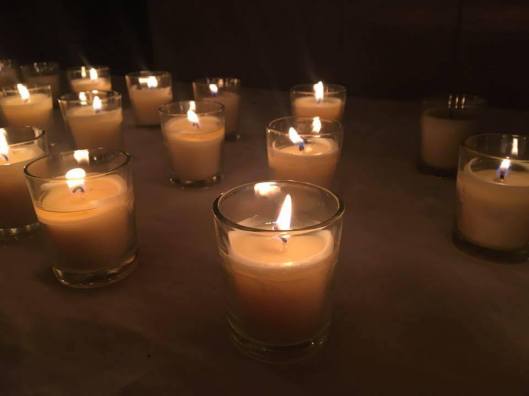
17903433_10155696878822565_4685487522288081020_nIn Holy Week, I like to offer the parishes I serve a service for each night of the week.  It can be labor intensive, and people can feel overwhelmed by the idea of coming every night of a week for church (even if it is only once a year).  But, if you can make it through every night, you find yourself in the midst of a beautiful pilgrimage – an unfolding story and walk with our Savior, Jesus Christ.  This year, we are only three days in, but each night has given me little “God moments.”

On Holy Monday, my heart was warmed that our community was gathering “virtually” to celebrate compline (evening prayers).  We have been doing it all Lent, but it was a wonderful way to close my evening in my pajamas, knowing that others were on Facebook, praying together with our Curate.  On Holy Tuesday, as I sat in the silence of our Taize service, I was watching the flames of the many lit candles flicker.  Since I knew people had lit the candles with prayer intentions, I imagined each of those flames as a prayer, symbolizing the cares and concerns of each person in the room.  As our silence extended, I imagined the flames represented the prayers and concerns around the world, remembering how our Coptic Christian brothers and sisters must be hurting this week.  It was a powerful, transfixing image.  Then last night, on Holy Wednesday, during our healing prayers, two things happened.  First, my daughter came forward for prayers by me.  Her request was humbling, and the privilege of affirming her and praying with her in that space was incredible.  Second, another local pastor laid hands on me and prayed just the prayer I needed this week.  It was all I could do to hold back the tears.

So, I do not know what the next three days, the Triduum, hold.  But I can promise you there will be many more sacred moments.  If you have a church home, I encourage you to take advantage of their offerings for the rest of the week.  If you do not have a church home, and live in the Williamsburg area, know that you are most welcome.  You can find all our information on our website.  A continued blessed Holy Week for you.  As you ponder your own connection to church, I offer you this video as inspiration for your Holy Week pilgrimage to Lent.  Peace!

On Sacred Snippets…

08 Wednesday Mar 2017

Posted by jandrewsweckerly in Uncategorized

≈ 1 Comment

Tags

balance, chaos, God, goodness, holy, Lent, lenten discipline, liturgy, prayer, sacred, sinfulness

lent_image

Photo credit:  https://prayerbookguide.wordpress.com/living-the-season/lent/

I know many Christians who loathe the season of Lent.  They find the season to be heavy-handed, to be too somber and full of self-loathing, and to be a bit of a downer.  I am not one of those Christians.  Lent is probably my favorite season of the Church Year.  There is an honesty about Lent that feels more authentic to me.  I feel like we do not have to pretend in Lent – pretend to be happy, pretend to have our lives together, pretend to be perfect.  Instead, Lent feels like a great equalizer – a time when we all confess our utter inability to live the lives we intend, and our utter dependence upon God.  Add on top of that intentional disciplines, liturgies that articulate the tension of our sinfulness and goodness, and additional church programming, and I come alive during Lent.

But this year, I have been struggling a bit with Lent.  I have gone through all the motions of Lent:  I am reading a book with a study group, I am playing Lent Madness with my oldest child, and I am attending a weekly ecumenical worship service and fellowship gathering.  I have also worked with our liturgical team to change up the liturgies to make them just different enough to shake up the senses.  I am helping teach a bible study in preparation for Holy Week.  I participated in the winter emergency shelter our church hosted last week.  The Lenten “wheels” are all in motion.  But I find this year that I am having a difficult time getting my Lenten grounding.

Now, it could be that my family has been in and out illness over the past month.  It could be that the church schedule has been particularly full, leaving me working most Saturdays this past month.  It could be that I’m still adjusting to my first full year at Hickory Neck, not having shaped a Lenten season here yet.  Whatever is going on, I was gently reminded by my Spiritual Director once that there is no wrong or right prayer life.  Our prayer life is a reflection of the rest of our life.  The Director told me that it was no wonder that my prayers were happening on the go much of the time – because juggling a family of four and a parish means that prayers happen with the rest of life.  In fact, it is unlikely that I will have an hour of prayer time every morning – because balance means finding varied ways to pray in various stages of life.

Remembering that instruction, I have been shifting my expectation of Lent this year.  Since there is little likelihood that Lent will slow down, I am trying to catch meaningful moments as they fly by.  Like how my seven-year old demands that she be allowed to go to Ash Wednesday services to get her ashes or how she begsto go to the winter shelter one more time.  Like how a parishioner calls between drop-offs to talk about navigating the faithful raising of children.  Like how the Great Litany shakes me to my core.  Like how a sermon I prepared speaks to me on a totally different level as I am preaching it.  Like how a conversation with a parishioner reminds me of the powerful ways we are living into God’s call to respect the dignity of every human being.  I may not be finding long periods of silence, setting apart times of dutiful Lenten practices, or mastering a Zen-like experience at church.  But holiness is happening all around me.  My hope now is to savor each moment for just a bit longer, honoring the holy moments God throws my way in the midst of a chaotic season of life.

Participating in Gratitude…

02 Wednesday Nov 2016

Posted by jandrewsweckerly in Uncategorized

≈ Leave a comment

Tags

blessed, cycle, generosity, gift, God, grateful, gratitude, note, sacred, thanks, Thanksgiving

thank-you-note

Photo credit:  https://fastcompany.com/3057431/hit-the-ground-running/heres-what-to-write-in-your-thank-you-after-a-job-interview

In honor of Thanksgiving Day at the end of the month, a trend has developed that uses the entire month of November as a month of gratitude.  The practice has several forms:  journaling about at least five things for which you are grateful every day; posting daily on Facebook a note of gratitude; or using Instagram or other outlets to post a daily photo of something for which you are grateful.  The practice is quite spiritually based.  I have had countless spiritual directors who have encouraged me to use gratitude as a discipline for my prayer life – using the end of the day to give thanks for things in life as opposed to our natural tendency to look back at the day and make mental note of all the things that went unaccomplished or were hurtful to ourselves or others.

This past Sunday we gathered our pledges for the upcoming calendar year.  Each year in the Episcopal Church, parishioners are asked to fill out a pledge card, letting the Vestry, or governing board, know how much income can be expected so they can formulate a budget.  The pledge cards certainly serve a practical purpose.  But their use can also serve a deep spiritual purpose.  As I blessed three different baskets of pledge cards on Sunday, I had the thought that each of those baskets were like piles of thank you notes to God – a way of articulating how blessed we are and how grateful we are for the resources we have and our ability to share and support ministry with those resources.  Each card held a story – a story of someone who feels connected to and passionate about Hickory Neck, who has been nurtured and challenged in this place, who has a unique life story, and who has encountered Christ here.  As I thought of the conversations, prayers, and reflections those cards represented, I could not help but smile.  There is something quite beautiful in witnessing the intimate, vulnerable exchange between God and parishioner.  I felt privileged to bless that sacred act.

In the coming weeks, I have the privilege of entering into that sacred space of thanksgiving and gratitude.  I have the task of thanking each pledging member.  When the Stewardship Committee and I first talked about the campaign, we joked about whether my hand would be able to survive writing so many notes.  There may be times my hand actually does get sore, but so far, I am nothing but grateful to be writing those notes.  I have found that writing them has been a tremendous time of blessing – an opportunity for me to pray for each parishioner, to thank God for the gift of them to our community, and to send my blessings upon them.  The “duty” has become an incredible gift that keeps the cycle of gratitude going.

How are you participating in the cycle of gratitude?  In what ways do you cultivate a spirit of generosity, passing your sense of gratitude and blessing on to others?  I look forward to hearing how you are participating in the cycle, and how God is using you to bless others.

Sermon – I Kings 19.1-15a, P7, YC, June 19, 2016

22 Wednesday Jun 2016

Posted by jandrewsweckerly in Sermons, Uncategorized

≈ Leave a comment

Tags

abandoned, body of Christ, comfort food, desensitized, done, Elijah, fight, food, go, God, healing, life, love, Orlando, peace, sacred, Sermon, serve, shooting, strength, tragedy, tree, wilderness

Last Sunday, after the parish picnic, I found out about the tragedy in Orlando.  When the youth and I gathered for Holy Eucharist that night, we lifted up our prayers for the victims and their families.  Being able to name the tragedy in the context of Eucharist was comforting, but by the time I got home and poured over news coverage, I found myself bereft.  I was not in shock, for this kind of tragedy has honestly become commonplace in our country.  I think I wanted to be in shock or at least surprised.  But instead, I felt a sense of familiarity and coldness.  I realized that my psyche has become desensitized to this sort of tragedy.  Instead of feeling sad, I just felt numb.  I felt powerless, with nothing to do but be resigned to the fact that this is the way our life is now.  Nothing can change.  Mass murder is normal – whether by a religious radical, a mentally unstable person, a racist, or a disillusioned teen.  Mass death is normal – whether LGBT brothers and sisters, people going to the movies, African-Americans worshiping, or children attending school.  All I could comprehend in my numbness was the fight, the outrage, and the compassion draining out of me.

The same thing happens to Elijah in our story today.  If you remember, a couple of weeks ago we heard about how Elijah has been putting Ahab’s practices to shame.  You see, in an effort to keep the political peace, King Ahab agreed to take a foreign wife, Jezebel, and worship her god, Baal, in addition to Yahweh.  The God of Israel is none too pleased, and so Elijah dramatically challenges the prophets of Baal to a duel.  Elijah is full of confidence, taunting, and dramatic flair.  And when Yahweh wins, Elijah slays the entire lot of Baal’s prophets.  But today, Jezebel proclaims she will avenge their deaths, and all of the fight leaves Elijah.  He runs into the wilderness until he cannot run any longer.  He crumbles under a tree, and proclaims that he is done.  He feels that he is all alone.  He asks God to take his life.

We all know the feeling that Elijah has.  Maybe we or a loved one has been fighting cancer.  We go for one last evaluation only to find that things have made a turn for the worse.  Or maybe we have been advocating for a particular political issue and the tide seems to be turning.  But a court decision is made or a vote is cast and the decision or vote does not go our way.  Or we think we have finally seen an addicted friend reach the end of his addictive behavior.  We are relieved to see healthy patterns until we get a late night call about how he has gotten into trouble again.  The fight leaves us.  We no longer feel a sense promise, victory, and confidence.  Instead the darkness settles over us like a fog, and we crumble under a tree and say, “Enough.  I am done, Lord.”

But something seemingly small happens to Elijah in his moment of despair.  The story goes, “Then Elijah lay down under the broom tree and fell asleep.  Suddenly an angel touched him and said to him, ‘Get up and eat.’  He looked, and there at his head was a cake baked on hot stones, and a jar of water. He ate and drank, and lay down again.  The angel of the Lord came a second time, touched him, and said, ‘Get up and eat, otherwise the journey will be too much for you.’  He got up, and ate and drank; then he went in the strength of that food forty days and forty nights to Horeb the mount of God.”  God gives Elijah food.  No words of encouragement, no pep talk about how things will get better.  God feeds Elijah in the wilderness, in a moment of despair, in a time of darkness.

There is a reason why we have something called “comfort food,” in our culture.  In fact, every culture has some version of comfort food.  Whether the food is a southern mom’s chicken and dumplings or a Jewish grandmother’s matzah ball soup; whether the food is Burmese mohingar, Vietnamese pho, or a New Mexican posole; or whether the comfort food is North Carolina, Memphis, or Texas barbeque, we all have food that brings us back to ourselves.  Somehow the taste of something familiar and rooted in our identity or a fond experience connects to our entire body in a visceral way.  The smell of the food, the flavors that are just right, the warmth filling our bellies, and the happy memories that flood our consciousness allows our entire body to relax.  Whatever has been ailing us – a sore throat, a homesickness, or a broken heart – can be wiped away by that simple, familiar, healing meal.

But comfort food does not just make you feel good.  Comfort food gives you strength:  mends your heart, heals your soul, and emboldens your spirit.  Elijah does not simply eat the food from God and wallow longer at the tree.  Elijah gets up.  He journeys for forty days on the strength from that bread.  His renewed spirit allows him to have a deep conversation with God, where he eventually finds out that he is in fact not alone.[i]  God has not abandoned him.  God has enabled other prophets to stand with him.  God is not done with Elijah yet.  Though God does not expect Elijah to go at it alone, God does expect Elijah to get back in there.[ii]

I am fully aware that we as a community are a diverse group of people with a wide range of political opinions.  My guess is that the violence of Orlando brought out a wide variety of responses to the event and the politicking that has happened since then.  But no matter how you feel about the shooter, the victims, or the instruments of the victims’ death, a week ago, 49 of our brothers and sisters died.  Life is sacred, and that sanctity was snuffed out last week.  And this is not the first time this has happened.  Though the stories behind the shooters, the motives behind the shootings, and the demographics of the victims are different each time, invariably, more life is desecrated.

We learn from Elijah’s story that God knows we need to mourn.  God knows we need to wallow for a time.  God knows that we may feel alone, or powerless, or just plain tired.  That is why God gives us trees in the wilderness.  But eventually, God will send us some comfort food – to soothe our aching heart certainly, but more importantly to strengthen us to continue the journey.  Because whether we feel like we have the inner strength or not, God is calling us to step out of the shade of the tree, and get back on the journey.[iii]

What that means for each of us here may be entirely different.  Certainly our work is to be grounded in prayer – prayers for the victims and their family members, prayers for the shooter, prayers for our nation as we sort out how we will govern ourselves, and prayers for us as we figure out how to be witnesses for Christ in the midst of the chaos.  But prayers are not all we are called to do.  We could do that under a tree or in a cave.  Instead, God sends us comfort food to heal our broken hearts, soothe our wearied souls, and embolden our spirits.

Today, and every Sunday, our comfort food, like Elijah’s, is also in the form of bread.  We call that bread the body of Christ.  That bread has power.  That bread has power to forgive our sinfulness and complicity with sin.  That bread has power to comfort our aches and sorrow.  That bread has the power to make us Christ’s body in the world, witnesses to the love that Jesus taught us about.  We know that our prayers and our consumption of Christ’s body does that for us because the very last thing we do – the very last thing we say – in our worship service is “Go in peace to love and serve the Lord.”  We do not say, “Have a good week.”  Or “Be at peace.”  We say “Go in peace to love and serve the Lord.”  How God will use us to love and serve the Lord in the world varies widely.  We all have a variety of vocations that take us to varied and sundry places.  But wherever we find ourselves, God has work for us to do.  Our work is to not only say, “Thanks be to God,” but to mean, “Thanks be to God.”  We thank God for our call to love and serve others.  We thank God for food for the journey.  We thank God for the ways that God does not leave us alone.  We thank God the ways that God will empower us and use us to be agents of love in the world.  So take a little more time today to pray and to mourn.  But then get ready to be sent out into the world to love and serve the Lord.  Thanks be to God.  Amen.

[i] Trevor Eppehimer, “Theological Perspective,” Feasting on the Word, Yr. C, Vol. 3 (Louisville: Westminster John Knox Press, 2010), 150.

[ii] Haywood Barringer Spangler, “Homiletical Perspective,” Feasting on the Word, Yr. C, Vol. 3 (Louisville: Westminster John Knox Press, 2010), 151.

[iii] Terrance E. Fretheim, “Commentary on 1 Kings 19:1-4[5-7]8-15a,” June 19, 2016 as found at http://www.workingpreacher.org/preaching.aspx?commentary_id=2876 on June 16, 2016.


The Power of Stories

18 Wednesday May 2016

Posted by jandrewsweckerly in Uncategorized

≈ Leave a comment

Tags

church, connect, encounter, meet, power, sacred, stories, stranger

Story

Photo credit: coolerinsights.com/2016/04/how-to-tell-winning-brand-stories-on-social-media/

Last week we started our Meet and Greets at Hickory Neck.  I knew that I wanted to get to know the people of the parish in a more meaningful way than just shaking hands in the receiving line after church.  And so, we are gathering in small groups of 10-12 people, and taking time to tell our stories.  The gatherings have already been a tremendous blessing.  I am learning about the varied ways that people found their way to Hickory Neck, their loves and passions, and their hopes and dreams.

What I particularly enjoy about the gatherings is the reminder of how powerful our stories are.  Each person in our community has a unique story, with elements that are quite familiar to us, and elements that are totally foreign to us.  I think that fascination with stories is why I have been attracted to efforts like Humans of New York or StoryCorps.  Those efforts are hoping to capture the everyday nature of our stories, while demonstrating the powerful ways that we connect through our stories.  Our stories have the ability to bring others joy, to elicit empathy, to bring us to tears, and to open up new worlds.

Too often, we are tempted to ignore the depth of those stories with strangers.  We are busy about our business, trying to accomplish tasks, or stick to a schedule.  In that routine, we forget that there are people all around us who have rich stories and whose lives may have something to teach us.  From that man who snapped at you in line, to the child who fell asleep in school, to the mom out in public in her pajamas, to the teen engrossed in social media, each person has a story behind their behavior – and the story may be much different than a quick glance allows us to assess.

If you have not joined a Meet and Greet, I encourage you to sign up at church.  In fact, even last night someone commented about how much they were learning about people they had known for quite some time.  But beyond our work within the community, I invite you to start looking at those outside of our community with a different eye:  the eye of someone who sees the unique and sacred stories we all have.  I look forward to hearing how your encounters go.

Sermon – Luke 9.28-36, TRS, YC, February 7, 2016

12 Friday Feb 2016

Posted by jandrewsweckerly in Sermons, Uncategorized

≈ Leave a comment

Tags

absent, down, Epiphany, God, hope, Jesus, listen, marriage, mountain, mountaintop experiences, realities, sacred, Sermon, Transfiguration, valley, wedding

Today is a pivotal day in the Church year.  In Advent, we start out the Church year anticipating and then celebrating God taking on human form in the Christ Child.  After Christmas we celebrate the season of Epiphany – a series of moments in which the true identity of Christ is revealed.  We hear first from the magi who devote their lives to finding Jesus.  At Jesus’ baptism we hear God claiming Jesus as God’s son.  In Cana, Jesus reveals his power at a wedding.  And then today, we close out the season of Epiphany with another revelation of the true identity of Christ – the transfiguration.

An epiphany is defined as a sudden manifestation or perception of the essential nature or meaning of something; an illuminating discovery, realization, or disclosure; or a revealing scene or moment – in our case, of the divine.  That is what is happens to Peter, James, and John on the mountaintop:  a revealing of the essential nature of Jesus as the divine son of God.  When they see Jesus standing there with Moses and Elijah, talking about Jesus’ pending departure or exodus,[i] Peter, James and John can finally connect the dots about all Jesus has told them.  And in case the dazzling white light, and the appearance of the ancient prophet and lawgiver are not enough, out of the cloud they hear God’s voice saying, “This is my Son, my Chosen.”  On this last day of Epiphany, we get the epiphany of epiphanies!

Many of us have had our own epiphanies when it comes to God.  Whether we suddenly and clearly hear God’s voice, whether someone says something so profound that it shakes us to the core, or whether we see Christ in the face of a child, we have all had those revealing God moments.  My favorite epiphany story comes from the parish I served as a curate.  The associate had a rare Sunday where he was the only clergy person serving at the altar that day.  Everything had been going along smoothly in the service.  After he pronounced and shared the peace, he started to make his way back to the altar when something caught his eye.  He froze as he realized at the corner of the alter sat a bat.  Panicked, he turned around and looked down the long aisle.  There, he says, standing in the Narthex by the baptismal font, bathed in light from the morning sun stood our Sexton, Walt.  The priest, mesmerized by and grateful for Walt’s presence, briskly walked down the long aisle to Walt.  As parishioners looked on with curiosity, the priest quickly whispered to the sexton about the rodent sitting on the altar.  “Don’t worry,” said Walt.  “I got it.”  The priest walked shakily back down the aisle, giving the bat a wide berth on the other side of the altar.  Before he could even start fumbling at the credence table, Walt mysteriously appeared from the side door with a t-shirt, walked past the priest, swooped the bat up with the t-shirt, and then disappeared out the other side door.  Though Walt would never claim sacred status, the priest that day saw Christ in him not unlike the disciples on the mountaintop.

Most of us have more traditional epiphany moments in life:  baptisms, confirmations, ordinations, or weddings.  Today, we will honor two people who celebrated their wedding twenty-five years ago.  Weddings are not unlike those mountaintop experiences.  The soon-to-be-married couple sees each other bathed in light – if not literally, then certainly figuratively.  That day seems to be a day when the couple sees only the goodness in the other person:  their beauty, their care, their compassion, and their love.  There is a certain clarity that comes on a wedding day:  this is the person who makes the other better.  Together they are better servants of God than apart.  Time almost stands still, noises drop into the background, and suddenly, the couple is offered a moment deep assurance that this is a good and holy decision.  I had fun talking with Bob and Janet about that day for them so many years ago.

I think God knows that we need those sacred moments because God knows what happens next:  we come down the mountain.[ii]  I always like to remind couples about their wedding, especially those married for a long time, because their mountaintop experience may feel far away.  When we come down the mountain, we see the realities of life.  No matter how dreamy someone seems basked in light, all of their imperfections are obvious outside of the light.  In Luke’s gospel, the next verses tell the story of a young man who needs healing.  The disciples fail to heal him and the father of the young man begs Jesus for help.  Jesus is frustrated with his easily distracted disciples and scolds them.  The disciples are definitely not on the mountain anymore.  Jesus is no longer gloriously bathed in light – now he is just a scolding teacher.

We know that feeling too.  For as many mountaintop experiences we have had – whether at a wedding or at a retreat or even in a holy moment of prayer – we also have those experiences in the fields of everyday life.  We may even wonder where that glorious God is in those moments.   In fact, when we stay in the valleys and trenches too long, we sometimes wonder whether we imagined the mountaintop.  How could we have seen things so clearly and radiantly when in everyday life we feel nothing but God’s distance?  We may begin to doubt, to experience anger, or to simply feel like God is absent.

Luckily today’s text gives us some hope in our valley and trench moments.  First, epiphany moments are so strong that they keep revealing themselves to us.  On occasions like an anniversary, we can go back to that mountaintop moment and ask, “Why did I choose this person?”  We do not need long to be flooded with list of reasons.  Suddenly all the little annoyances fade, and what is left are the loving, tender moments, the caring, sacrificial actions, and the joyful, abiding experience.  I imagine that is why Luke tells this story today.  Only three of the disciples were privileged enough to be on that mountain.  But in Jesus’ death, resurrection, and ascension, I imagine they returned to this story again and again, recalling with affirmation how God had said that Jesus is God’s son.[iii]

Second, today’s text also gives us hope through the other part of God’s words.  God says, “This is my Son, my Chosen; listen to him!”  We are all going to have hard days.  But those hard days are even harder when we refuse to listen.  No matter where we are, no matter how low the valley, Jesus is there speaking to us.  We simply need to listen.  All the answers to our questions, all our cries for support, all our loneliness and aching is answered when we listen.  When we get caught up in the illusion of self-sufficiency and having everything figured out, we forget God’s words.  The epiphany today – Jesus’ transfiguration – reminds us that God is speaking.  We need only to listen.

This week Janet and Bob will bask in the glory of their anniversary and the renewal of their vows.  They may even experience some of the radiance of that initial wedding day.  But eventually, the anniversary bliss will fade as they come down the mountain.  In that journey back to reality, their hope will be in listening to Christ as God commands.  The same will be true for us.  This week we begin the journey of Lent.  As we step into that time of penitence and fasting, God’s words offer us hope, “Listen to him.”  If God is telling us to listen, we can be assured that Jesus is speaking.  Our journey off the mountaintop and into the valley in these next forty days will be blessed and full when we listen to our Redeemer speaking to us.  As grateful as I am for a retelling of that transcendent day on the mountain, I am even more grateful for the reminder that disciples, like us, came back down the mountain.  But even on that journey down, Jesus is still with them, speaking truth, love, and hope.  Amen.

[i] N. T. Wright, Luke for Everyone (Louisville:  Westminster John Knox Press, 2004), 114.

[ii] Lori Brandt Hale, “Theological Perspective,” Feasting on the Word, Yr. C, vol. 1 (Louisville:  Westminster John Knox Press, 2009), 456.

[iii] Fred B. Craddock, Luke, Interpretation:  A Bible Commentary for Teaching and Preaching (Louisville:  John Knox Press, 1990), 135.

Sermon – John 13.1-17, 31b-35, MT, YB, April 2, 2015

15 Wednesday Apr 2015

Posted by jandrewsweckerly in Uncategorized

≈ Leave a comment

Tags

belonging, brokenness, church, dinner, Eucharist, failings, footwashing, forgiveness, God, home, identity, Jesus, joy, Last Supper, Maundy Thursday, peace, renewal, sacred, Sermon, sinfulness, strength, table

The dinner table is where sacred things happen.  The dinner table is where food is served that can satisfy a hunger, can heal an ailing body, can delight the senses, and can invoke a nostalgia like no other.  The dinner table is where stories are told, days are recounted, prayers are said, and laughter is had.  The dinner table is where places are set, dishes are passed, plates are cleared, and remnants are cleaned.  The dinner table is the host of all things mundane – like that frozen meal you threw together before you ran off to the next thing; and the dinner table is the host of all things momentous – like that gloriously planned and executed Thanksgiving meal that you hosted for your friends and family.  Because the dinner table can do all these things, the dinner table becomes the place in our home where sacred things happen – a holy site for one’s everyday and one’s extraordinary moments.

The dinner table where Jesus and his disciples gathered for that Last Supper was no different.  They had gathered at table hundreds of times in the three years they had spent together.  There had been learning and laughter, stories and questions, arguments and celebrations.  In many ways, all of these things seem to happen in the course of this one night during the Last Supper.  Jesus and the disciples are likely chatting up a storm, talking about the days events, when Jesus does something extraordinary.  He gets up, takes off his outer robes, and washes the feet of his disciples.  This kind of event is unheard of.  Hosts and well-respected teachers do not wash others feet; that task was assigned to a household slave.[i]  And some of the midrashic commentary suggests that not even a Hebrew slave was expected to perform such a menial task.  Instead, the slave might bring out a bowl of water, but the guest would wash his own feet.[ii]  So of course, a lively debate ensues with Peter, who does not understand what is happening.  Jesus washes Peter’s feet anyway – and washes Judas’ feet – before returning to that dinner table to explain what he has done.  He goes on to explain that not only will he die soon, but also that he expects a certain behavior after he is gone – that they love one another.

That is the funny thing about dinner tables.  They can bring out the most sacred and holy of conversations.  The dinner table is where one tells his family that he has terminal cancer.  The dinner table is where one tells her best friend that she lost her job and has no idea what she is going to do.  The dinner table is where the young couple announces that that they lost their pregnancy.  The dinner table is where the college student tells his parents that he is dropping out of school.  We tell these awful, scary stories at the dinner table because we know that the table can handle them.  The table is where we gather with those who we care about and is therefore the place where we can share both the joys of life and also the really hard stuff of life.  Though our table may have never hosted a dinner as beautiful as one of the tables Norman Rockwell could paint, our table is still a sacred place that can hold all the parts of us – the good, the bad, the beautiful, and the ugly.  We can share the awfulness of life there because we know that those gathered can handle it, and can carry us until we can be back at the table laughing some day.

What I love about our celebration of this day is that all of those things – the good, the bad, the beautiful, and the ugly – were present that night with Jesus and his disciples.  So yes, earlier in the evening, there probably is a raucous conversation.  The disciples are gathered at the table, in all their imperfection: those who love Jesus with a beautiful innocence and those who greedily hope to be at Jesus’ left and right hand; those who humbly understand Jesus and those who want Jesus to victoriously claim his Messianic power; those who profess undying faithfulness (even though they will fail to be faithful) and those who actively betray Jesus.  At that table Jesus not only talks about how to be agents of love, Jesus also shows them how to love.  On this last night – this last night before the storm of Jesus’ trial, crucifixion, and death – a sacred moment happens at the dinner table.  And though we do not hear the story tonight, we also know that Jesus then breaks the bread and offers the wine, instituting the sacrament of Holy Communion.

We know the rest of the story.  The disciples, who still do not really understand Jesus fully, muddle their way through footwashing and Holy Communion.  Then those same dense disciples sleep their way through Jesus’ last prayers.  One of those disciples becomes violent when a soldier tries to seize Jesus.  And eventually, most of the disciples betray and abandon Jesus altogether.  To this unfaithful, dimwitted, scared group, Jesus offers a sacred moment at the dinner table, inviting them into the depths of his soul and a pathway to our God:  and encourages them to love anyway.

Our own Eucharistic table is not unlike that dinner table with Jesus.  Tonight, we too will tell stories, sing, and laugh.  We too will wash feet in humility, embarrassment, and servitude.  We too will hear the sobering invitation to the Eucharistic meal, and will walk our unworthy selves to the rail to receive that sacrificial body and blood.  We too will argue with God in our prayers, pondering what God is calling us to do in our lives and resisting that call with our whole being.  We too will lean on Jesus, longing for the comfort that only Jesus can give.  And we too will hear Jesus’ desperate plea for us to also be agents of love – not just to talk about love, or profess love, but to show love as Jesus has shown love to us.

In this way, our Eucharistic table is not unlike the dinner table in your own home.  Our Eucharistic table has hosted countless stories, arguments, and bouts of laugher.  Our Eucharistic table has witnessed great sadness and great joy.  Our Eucharistic table feeds us, even when we feel or act unworthily.  And our Eucharistic table charges us to go out into the world, being the agents of love who are willing to wash the feet of others – even those who betray us and fail us.  This Lent, we have been praying Eucharistic Prayer C.  In that prayer, the priest prays, “Deliver us from the presumption of coming to this Table for solace only, and not for strength; for pardon only, and not for renewal.”[iii]   This Eucharistic table, like our own dinner table, can handle all of us – all our failings, sinfulness, and brokenness.  This table can fill us up with joy, forgiveness, and peace.  This table can be a place where we find belonging, identity, and security.  But this table is also meant to build us up – to give us strength and renewal for doing the work God has given us to do – to love others as Christ loves us.  Sacred things happen at this table.  Those sacred things happen so that we can do sacred things in the world for our God.  Amen.

[i] Guy D. Nave, Jr., “Exegetical Perspective,” Feasting on the Word, Yr. B, vol. 2 (Louisville:  Westminster John Knox Press, 2008), 279.

[ii] Mary Louise Bringle, “Homiletical Perspective, Feasting on the Word, Yr. B, vol. 2 (Louisville:  Westminster John Knox Press, 2008), 279.

[iii] BCP, 372.

Sermon – 2 Kings 2.1-12, Mark 9.2-9, LE, YB, February 15, 2015

16 Monday Feb 2015

Posted by jandrewsweckerly in Uncategorized

≈ Leave a comment

Tags

Elijah, Elisha, God, Jesus, pay attention, respond, sacred, Sermon, thin moments, thin spaces, Transfiguration

One of the often told stories I heard at a parish where I once served was the birth story of a set of twins.  The parish was celebrating its annual fundraising gala – a party that welcomes hundreds of people and raises nearly $100,000.  The event is one of the major social scenes of the Christmas season.  People don their furs, sparkling dresses, and tuxedos, wait staff float around with hors d’oeuvres and drinks, jovial bidding wars happen in the silent auction, and laugher and music fill the halls.  On this particular night, when the entire parish was wrapped up in merry making, one parishioner was being whisked away to the emergency room.  She was pregnant with triplets and the babies were coming early.  Something was wrong and the word began to slowly spread through the bubbling parish hall.  Shocked into sobriety, many of the parishioner’s friends left the party and went up to the quiet chapel upstairs.  They began a prayer vigil for the mother and the babies.  That night was a night of contrasts:  parishioners and guests oblivious to the crisis; parishioners who were worried, but agreed to keep the event going; and parishioners who could no longer be present in the face of crisis and who were brought to their knees as this mother and the doctors battled to save as many of the babies as they could.  Eight years later when I met the twins, that story was told time and again as if the event had happened yesterday.

That night was what I would call one of those thin moments.  Thin moments are those moments that are so spiritual, so sacred that you can actually feel God.  One person explains that the feeling of thin moments is “undeniably life-affirming, breath-stopping, mind-tingling, goose bump-motivating, heart-melting, soul-quenching, and wonderful.  And by wonderful I mean truly full of the wonder, the awe, the mystery, the otherness of God.  Celts talk about two worlds that exist in one place – thin places.  This world, the here, and the other world, the more, the one that’s just on the other side we mostly can’t see now because now see through a mirror dimly.  Celts believe a veil exists between the two worlds.  The veil is like a thick wool army blanket.  But every once in a while the blanket gets worn down so you can see through it, like gossamer.  Those are thin moments.  Grace moments.  When for just a second you glimpse something that’s greater than the present moment, something that connects you to everyone else.”[i]  Of course, not everyone reacts to those thin moments in the same way.  I think that is why that some people were drawn to the chapel on that awful, wonderful night while others needed to busy themselves at the party.  When life, death, God, and wonder are all mixed in a moment, we all respond differently.

Today in our scripture lessons we have two such thin moments:  Elijah being taken up in a whirlwind to God and Jesus being transfigured before the disciples.  What I love about these stories are the widely different responses to the thin moments.  In the Elijah story, we have all sorts of activity.  Elisha, knowing that Elijah’s death is coming soon refuses to leave Elijah’s side.  Three times, Elisha tells Elijah, “As the LORD lives, and as you yourself live, I will not leave you.”  Elisha’s way of coping with that thin space between life, death, God, and wonder was to cling to Elijah for as long as he could.  Meanwhile, there were a bunch of prophets around Elisha who wanted nothing better than to gossip about the pending death.  Two different groups of prophets come to Elisha and say, “You know the LORD is taking your master away from you today.”  You can almost hear the catty pleasure they take in knowing this information.  In the face of a thin place, these prophets want to gossip and flaunt their knowledge.  Elisha’s response to them is to insist on silence.  As the prophets try to engage him, he cuts off their pandering by responding, “Yes, I know; keep silent.”  Elisha prefers to quietly be present in the presence of the thin space.  Other prophets seem to agree.  The third group of prophets does not taunt Elisha.  They too know death is coming, and they stand at a distance as Elisha and Elijah cross the Jordan.  They keep watch, holding the pair in awe and in prayer.

Meanwhile, in Jesus’ story, we see additional reactions.  In the face of Jesus’ transfiguration, Peter, James, and John have different reactions.  James and John seem to be content with silent terror.  They have no idea what to say and so they say nothing.  Meanwhile, Peter also has no idea what to say, but words bubble out of his mouth anyway.  He starts fussing around in the thin space, busily wondering if he should make dwellings for Jesus, Elijah, and Moses.  You can sense the nervous energy in his response, as silence is too discomforting for Peter in the thin space.  That is the funny thing about thin spaces – some people run around nervously, while others gather around and gossip for comfort; some demand silence and proximity, while others stand at a quiet distance; some are terrified, while others eager to stay connected.[ii]

I have seen the same reaction in people when they travel on mission trips.  Mission trips, especially in foreign countries really take people out of their comfort zones.  Not only are you struggling through the basics like sleeping on floors, boiling water for fear of sickness, using facilities that are not exactly modern, you are also sometimes struggling with language barriers, hard labor, extreme poverty.  Add on to all of that the sacred, thin moments that come when people meet one another and God in the ways that one only can in a rural Honduran or Dominican village and you have a recipe for all kinds of reactions.  I have seen stoic men break down in tears.  I have seen nervous women babble on for hours.  I have seen normally talkative teens retreat in quiet discomfort.  And I myself have had all of those reactions and many more.

What is key in all of these reactions to the sacred is that none of them are inherently wrong.  There is nothing inherently wrong with the groups of prophets who want to gossip with Elisha about Elijah’s pending death.  There is nothing inherently wrong about getting tongue-tied, excited, or totally silent.  We all react differently to those thin spaces because those thin spaces are the times when we come closest to the God who is beyond comprehension, beyond the earthly, beyond us.  Our reactions have nothing to do with whether we are a good Christian or a bad Christian.  Our reactions have more to do with the fact that we are humans, and God, especially God in those close, intimate, thin moments, is utterly non-human.

Although there is nothing wrong with our varied human reactions to the sacred, the important message for us today is that we pay attention to the thin moments and our reactions.  I have often wondered what would have happened if Elisha had not been paying attention that day when Elijah told him he was heading to Bethel.  Elisha would have missed a life-defining moment if he had busily said, “Okay, catch you later Elijah!”  If those prophets had known something was happening to Elijah but had decided to focus on other work that day instead of keeping watch on the other side of the Jordan, imagine all that they would have missed.  Or if Peter, James, or John had turned down Jesus’ offer to go up the mountain or even earlier had declined Jesus’ offer to follow him, they would have never had this terrifying, babble-making, yet wonderful moment with Jesus.

That is our invitation today: to pay attention.  Pay attention to the thin spaces that are given to you in life.  They do not just happen on mountaintops or near the River Jordan.  They happen all the time in simple, everyday moments.  God is constantly breaking in to this world, and revealing God’s self to us through those around us.  We may not respond in the perceived “right” way, but that is the joy of our lessons today.  The only “wrong” way to respond is to not pay attention at all and to miss the chance to respond, however messily.  The prophets and disciples assure us that we will be in good company in whatever our responses are – our only job is to make sure we pay attention enough to have a response.  God is waiting in thin moments for each of us.  Amen.

[i] Cathleen Falsani, as quoted at http://esteevalendy.blogspot.com/2010/04/thin-moments.html found on February 13, 2015.

[ii] Wm. Loyd Allen, “Theological Perspective,” Feasting on the Word, Yr. B, Vol. 1 (Louisville: Westminster John Knox Press, 2008), 438.

A time to laugh…

03 Tuesday Feb 2015

Posted by jandrewsweckerly in Uncategorized

≈ Leave a comment

Tags

comedy, gift, God, humor, joy, laughter, sacred, Spirit

This week I had one of “those” days.  I had a funeral at 10:00 am, which I had specifically scheduled early in the day so that I could run over to Clergy Day with the diocesan clergy, hoping to fit in a few hours with colleagues.  Of course, the day before it snowed and iced, and the schools were on a two-hour delay.  My oldest would need to board the bus at the exact same time the funeral was to begin.  So with lots of help and rearranging, I managed to figure out a way to take my youngest to childcare by 9:00, bring the oldest back to church with me while I setup the funeral, and then have a parishioner take her to bus stop while I began the service.  Perfect plan!  Of course, that is not exactly how it played out.  As I was loading bags in the car, I discovered a small bird in the garage.  Then, as I was doing a last-minute pumping, my infant started crying inconsolably.  Then my eldest could not find her favorite snow books and also began crying.  Once I managed to get everyone in the car and to nursery school, we found out the director was stuck in traffic and school would be opening ten minutes late.

That was the point at which I started laughing.  I have no idea why, but suddenly my whole morning just seemed comical – hilarious really.  I kept laughing.  Despite my eldest daughter’s confusion about why I was laughing so hard, she started laughing too.  Somehow the stress of the morning lifted.  Despite all my scurrying around nothing could keep this day on track – and through unbridled laughter, that reality was suddenly okay.

Laughter has a sacred place in my life.  One of my favorite activities with my husband is watching stand-up comedy.  Though we have pretty different senses of humor, when we find a comedian who can make us both laugh, it is more precious than gold.  And although he regularly laughs at things I deem inappropriate for humor, his belly-laughs make it impossible for me to stifle a smile.  At other times, you can find my husband, eldest daughter, and me huddled around the baby trying to get laughs out of her – which of course lead to our own laughs.  When my eldest and I get into a struggle of wills, I have found laughter to be the key to unlocking the tension and setting us back on track.  In fact, just the other day, as I was struggling to get her out of bed, for some reason I started making funny faces at my daughter.  She started giggling, which got me giggling.  Before I knew it, she was out of bed and we were having one of the more pleasant mornings we have had in a while.

A beautifully captured laugh.

A beautifully captured laugh.

Laughter is gift of the Spirit.  I think of the many times that laughter comes up in scripture.  When God tells Abraham that Sarah will bear a son in her old age, she laughs.  In fact, their son’s name, Isaac, means “he laughs.”  Ecclesiastes proclaims that there is a time for everything, “a time to weep, and a time to laugh; a time to mourn, and a time to dance…” (3.4)  Even in Luke’s beatitudes, Jesus says, “Blessed are you who weep now, for you will laugh.” (6.21)  I think God longs for us to have more laughter in our life.  Through our laughter, we get a glimpse of the unbridled joy of God – a joy that can fill our entire bodies.  I invite you this week to make some space for laughter.  My guess is that you will find God there too.

Sermon – Mark 1.4-11, E1, YB, January 11, 2015

15 Thursday Jan 2015

Posted by jandrewsweckerly in Uncategorized

≈ Leave a comment

Tags

baptism, beloved, God, Jesus, sacred, Sermon, water

I have always had an affinity for water.  I am not sure why, but something about water connects to something deep in my soul.  Whether listening to water bubble over rocks in a river, hearing the roar of a waterfall, listening to a lake lap on the shore, or hearing the crashing of waves on the beach, something about the sound of water quiets my mind and connects with some deeper part of me.  Some of my most intimate conversations with God have taken place near water – times when I was facing a big transition, times when I was worried about a major life event, or times when I had run out of things to say and just needed a place to just listen.  Whether a quiet drip or trickle or a roaring rush, somehow the noise of water connects me to the mysterious and transcendent voice of God.

To be honest, I have always thought my connection to the water was a little strange.  But this week, as I studied our lessons, my connection suddenly made sense.  Water has always been a part of our faith narrative.  When we celebrate a baptism, we always retell the biblical story of water.  One denomination retells the biblical story this way, “Eternal Father, when nothing existed but chaos, you swept across the dark waters and brought forth light.  In the days of Noah you saved those on the ark through water.  After the flood, you set in the clouds a rainbow.  When you saw your people as slaves in Egypt you led them to freedom through the sea.  Their children you brought through the Jordan to the land which you promised.  In the fullness of time you sent Jesus, nurtured in the water of a womb.”[i]  Of course we know there are countless other water stories in scripture: Jonah who is thrown into the sea and swallowed by a great fish, Jesus who calms the seas and walks on water, women encountering God as they draw water in wells, and eunuchs running to rivers to be baptized.  Water is everywhere in our biblical narrative, and is where many people see, hear, taste, and feel God in their lives.

Today, we hear one of those ultimate stories of water – in fact, today is a feast day in the Episcopal Church:  Jesus’ baptism in the waters of the river Jordan.  When Jesus comes to be baptized, baptism in the river Jordan has already been transformative for many.  People from all over the Judean countryside have been coming to John to confess their sins, repent, and be baptized into forgiveness.  As if those experiences of conversion were not enough, something even more extraordinary happens in that water.  Jesus comes from Nazareth to be baptized by John, and when he comes up out of the water, the heavens are torn apart and the Spirit descends upon him like a dove.  Then a voice comes from heaven, saying, “You are my Son, the Beloved; with you I am well pleased.”  Just like all those other stories of water in the biblical story, something sacred and transformative happens in water – something so powerful that the heavens are torn apart, the Spirit descends, and the Lord proclaims favor, love, and affection.

Many of us do not remember our own baptism in water.  Though adults and young people are certainly welcome to be baptized later in life, most of us are baptized as infants.  Unless our parents or godparents told us the story of our baptism, we have no idea if we cried or cooed that day.  We have no idea what emotions or thoughts the priest or our sponsors had that day.  We have no idea whether we were inherently changed by the water that was poured over our heads.  For most of us, the holy experience of water at our own baptism is a lost memory.  But the Church does not let us forget the power of baptismal waters.  Every year we celebrate the feast of Jesus’ baptism.  Every year, we reaffirm our baptismal covenant – often multiple times per year.  And depending on the membership of the church, every year we baptize new members into the life of the church.  So even if we do not remember our own baptism, the repetition of the story of baptism, and the experience of reaffirming our vows, creates new memories for us.  That formation is so powerful that many of us will dip our fingers in Holy Water, looking for a blessing and a reminder of another water that was once poured over our heads.

But today is not a day just to celebrate sacred experiences with water.  Today is not just a day when we think back to our own encounters at the font and how holy they were.  Today is not just a day we think back to those biblical stories of water in our faith and marvel at the miracles that have happened through water.  Today is not just a day that we remember those moments by a river, lake, or beach where God seemed to be whispering comfort, truth, or blessing to us.  The danger with the text we hear from Mark today is that we could be tempted to do just that.  Our lesson ends with those words from the voice of heaven that says, “You are my Son, the Beloved; with you I am well pleased.”  We could sit here today and savor those words for Jesus.  In fact, I could tell you today that those words are words for you – that you are God’s beloved and with you God is well pleased.  I could do those things because they are true.  You are God’s beloved and God is well pleased with you.  The baptismal waters should always remind you of that – and others waters, like rivers, waterfalls, and oceans, may do the same.

But today we do not simply celebrate the gift of blessing, beloved-ness, and bounty.  Today is the day when we celebrate the “so what?” of Jesus’ baptism.  As one scholar explains, “Jesus did not receive the Spirit in order to enjoy privately its spiritual benefits, but rather in order to pass it on.”[ii]  In Mark’s gospel, in the immediate next verse, Jesus is driven out into the wilderness to be tempted.  His baptism opens a road that will lead to the cross.  For Jesus, his entire ministry is informed by this moment – this tremendous in-breaking of the Spirit and a declaration of Jesus as being the beloved of God.  But Jesus does not tarry in this moment.  Jesus keeps on moving, holding fast to the moment, but using the moment to change his future.

That is our invitation today too:  to think about the “so what?” of our own baptisms.  When I think about all of those sacred moments I have had near water, a distinct part of that memory is what walking away from those moments felt like.  Sometimes I walked away from that bubbling brook with a sense of peace that God would be with me in the trials that were ahead.  Sometimes I turned from that lapping lake with a sense of empowerment and energy about what new thing God was calling me to do.  And sometimes I walked away from that roaring ocean having no idea what was to come, but knowing that God would help me face whatever came.

Our invitation today is to consider the “so what?” of our own sacred watery moments.  You can come to Jesus’ story today like you would come to a body of water for renewal and refreshment.  You can soak in the blessing and affirmation that come to Jesus and to you.  But you will also need to walk out of those doors today.  In fact, our liturgy does not let you leave this place without a dismissal that sends you out in the world to do the work that God has given you to do.  The question this week is what that work is.  What is God renewing you for?  What is God empowering you to do?  The answers will be different for each of us.  But the answer is there, if you are willing to listen to the sacred sound of water.  Amen.

[i] Barbara Sholis, “A watery solution,” Christian Century, vol. 119, no. 26, December 18-31, 2002, 19.

[ii] Lee Barrett, “Theological Perspective,” Feasting on the Word, Yr. B, Vol. 1 (Louisville: Westminster John Knox Press, 2008), 240.

← Older posts
Newer posts →

Recent Posts

  • On the Myth and Magic of Advent…
  • On Risking Failure and Facing Fear…
  • Sermon – Luke 23.33-43, P29, YC, November 23, 2025
  • On Inhabiting Gratitude…
  • Sermon – Luke 20.27-38, P27, YC, November 9, 2025

Archives

  • December 2025
  • November 2025
  • October 2025
  • September 2025
  • August 2025
  • July 2025
  • June 2025
  • March 2025
  • February 2025
  • December 2024
  • November 2024
  • October 2024
  • September 2024
  • August 2024
  • July 2024
  • June 2024
  • May 2024
  • March 2024
  • February 2024
  • January 2024
  • December 2023
  • November 2023
  • October 2023
  • September 2023
  • August 2023
  • July 2023
  • June 2023
  • May 2023
  • March 2023
  • February 2023
  • January 2023
  • December 2022
  • November 2022
  • October 2022
  • June 2022
  • May 2022
  • January 2022
  • December 2021
  • November 2021
  • October 2021
  • September 2021
  • August 2021
  • June 2021
  • May 2021
  • April 2021
  • March 2021
  • February 2021
  • January 2021
  • December 2020
  • November 2020
  • October 2020
  • September 2020
  • August 2020
  • July 2020
  • June 2020
  • May 2020
  • April 2020
  • March 2020
  • February 2020
  • January 2020
  • December 2019
  • November 2019
  • October 2019
  • September 2019
  • August 2019
  • July 2019
  • June 2019
  • May 2019
  • April 2019
  • March 2019
  • February 2019
  • January 2019
  • December 2018
  • November 2018
  • October 2018
  • September 2018
  • August 2018
  • July 2018
  • June 2018
  • May 2018
  • April 2018
  • March 2018
  • February 2018
  • January 2018
  • December 2017
  • November 2017
  • October 2017
  • September 2017
  • August 2017
  • July 2017
  • June 2017
  • May 2017
  • April 2017
  • March 2017
  • February 2017
  • January 2017
  • December 2016
  • November 2016
  • October 2016
  • September 2016
  • August 2016
  • July 2016
  • June 2016
  • May 2016
  • April 2016
  • March 2016
  • February 2016
  • January 2016
  • December 2015
  • November 2015
  • October 2015
  • September 2015
  • August 2015
  • July 2015
  • June 2015
  • May 2015
  • April 2015
  • March 2015
  • February 2015
  • January 2015
  • December 2014
  • November 2014
  • October 2014
  • September 2014
  • August 2014
  • July 2014
  • June 2014
  • April 2014
  • March 2014
  • February 2014
  • January 2014
  • December 2013
  • November 2013
  • October 2013
  • September 2013
  • August 2013
  • July 2013
  • June 2013
  • May 2013
  • April 2013
  • March 2013
  • February 2013
  • January 2013
  • December 2012
  • November 2012
  • October 2012
  • September 2012

Categories

  • reflection
  • Sermons
  • Uncategorized

Meta

  • Create account
  • Log in
  • Entries feed
  • Comments feed
  • WordPress.com

Blog at WordPress.com.

  • Subscribe Subscribed
    • Seeking and Serving
    • Join 394 other subscribers
    • Already have a WordPress.com account? Log in now.
    • Seeking and Serving
    • Subscribe Subscribed
    • Sign up
    • Log in
    • Report this content
    • View site in Reader
    • Manage subscriptions
    • Collapse this bar
 

Loading Comments...