• About

Seeking and Serving

~ seek and serve Christ in all persons

Seeking and Serving

Tag Archives: sacred

Homily – II Cor. 9.6-15, Thanksgiving Day, YA, November 27, 2014

03 Wednesday Dec 2014

Posted by jandrewsweckerly in Uncategorized

≈ Leave a comment

Tags

abundance, God, homily, sacred, secular, share, thankful, Thanksgiving Day

One of the funny things about being a priest is the way that everyday people interact with me.  The funniest experiences occur when people first find out I am a priest.  I love seeing the raised eyebrows or hearing the stammers as someone panics about any inappropriate things they might have said in the first ten minutes of our conversation.  Parties with strangers or our children’s school gatherings are always fun as people try to figure out how they should modify their behavior in front of me.  In fact, many of my single and dating priest friends have avoided the conversation altogether about what they do for a living, hoping that the other person will get to know them for who they are, not just what they do.  There really is a sort of cultural divide that I forget about until I get in one of these situations and then have work with someone to create a sense of comfort and commonality.

That cultural divide is no more obvious than on a holiday like Thanksgiving Day.  Today we gather to celebrate what is mostly a secular holiday.  This day has become a day about an abundance of food, watching parades and football, enjoying fellowship with friends and family, and post-turkey naps.  This is a day of giving thanks for the good things of life, but often in a secular way.  I know many people who have a tradition of going around the table and saying something for which they are thankful.  But those things are usually listed without a mention of God.  In fact, the non-specific nature of gratitude this day is what makes it a perfect day for interfaith groups, like our own Plainview-Old Bethpage Interfaith Group, to celebrate – because we can all recognize in our own different ways our gratitude and thanks.

But for us Christians, this day is a little different.  We may do all the same activities: feast, fellowship, and fun; but we also root those activities in gratitude toward God – the source of all our blessings.  For us, today is not just a day to be grateful for the good things in life, but to be thankful to God for our blessings.  That may sound like semantics, but I think that, especially today, our language matters.  So we can still go around the table listing our blessing, but we also acknowledge that God is the source of those blessings.  We can still enjoy a feast, but we begin our meal in a prayer that thanks God for the bounty of the earth, the hands that touch our meal in its many stages, and for the privilege and pleasure of good food.  We can still watch the game or the parade, but we are grateful to God for the blessing of shelter and the disposable income to afford that television and cable service.  And we can still enjoy the company of friends and family because we know that God blesses us with companions on our journey.

So why does our naming God today matter?  What difference does our calling this a sacred day have to do with anything?  The difference is that when we name God in the midst of blessing, there is a “so what?” attached.  Our epistle lesson says today, “God is able to provide you with every blessing in abundance, so that by always having enough of everything, you may share abundantly in every good work.”  In other words, when we give thanks today, that is not the end of the story.  When we give thanks today, God is well pleased.  And God also expects us to share that abundance with others.  As the epistle says, our blessing is not strictly for us.  Our blessing is given to us so that our blessing might be a blessing to others.

And that is why we mark this day as a sacred day.  Because if Thanksgiving Day is simply a secular day of being grateful, the day begins and ends with us – our experiences, our gratefulness, our happiness.  But if we celebrate Thanksgiving Day as a sacred day, then the day may begin with us, but the day ends with others – our blessings overflowing to bless others.  That is the true abundance of Thanksgiving Day.  The abundance cannot be contained.  In fact, our epistle lesson says that the more we pass along our abundance, the more that abundance grows, “The one who sows sparingly will also reap sparingly, and the one who sows bountifully will also reap bountifully.”  So, go home and enjoy all the blessings of this day – and then share those blessings bountifully.  Amen.

Sermon – Exodus 3.1-15, P17, YA, August 31, 2014

05 Friday Sep 2014

Posted by jandrewsweckerly in Uncategorized

≈ 1 Comment

Tags

discomfort, God, holy ground, Moses, paranoia, sacred, Sermon, shoes

Shoes are a funny thing.  Their basic function is protection – from rough roads and paths, from debris and water, from extreme heat and extreme cold.  Not having shoes can lead to injury, disease, and disability.  But having shoes can create problems too.  Once feet are covered, they can become sweaty or smelly.  Shoes can hide unkempt toenails or misshapen feet, making us hesitant to remove them at times.  And of course, shoes can also be markers of status – those fancy Nikes or Manolo Blahniks.

And so when we are asked to remove our shoes, our first response can often be panic.  Every year when we do the foot washing on Maundy Thursday, I hear people chatting about their foot concerns.  Holy Wednesday of that week could be relabeled, “Holy Pedicure Day.”  I have overheard parishioners strategizing about socks versus hose, about pre-washing their feet before the service, and about avoiding the foot washing part of the liturgy altogether.

Our paranoia about feet and footwear can be found everywhere.  We all know people who have a “no shoe rule,” in their home.  Sometimes when you forget about that rule, you may panic, wondering if you put on those socks with the holes in them that day.  In my daughter’s nursery care room, there is a sign that asks everyone to take off their shoes before entering the room since the little ones who are crawling will put everything in their mouths – including debris from shoes.  Because I usually have my five-year old in tow, plus a baby in my arms, the trouble of shoe removal is often annoying.  When I traveled to Burma, I bought special sandals because we were told that the Burmese always remove their shoes before entering any building.  I knew with such frequency of removing shoes, I had to worry about sandals that were both comfortable for lots of walking, but also easily slipped on and off.

This fall, St. Margaret’s will be offering a new Sunday School program for our Middle School students.  The program is called Rite-13.  The program is meant to help middle schoolers to start claiming their faith lives and their adulthoods as their own.  They will spend time talking about images of God, their prayer lives, their understanding of God’s call to love one another, and what being a young person of faith means.

One of my favorite lessons from Rite-13 is one that talks about prayer.  In the lesson, the young adults and teachers are not admitted into the room unless they take off their shoes.  When I taught this lesson many years ago, the reaction was immediate.  Some of the kids giggled, some looked worried; other kids refused at first and hung back, while others seemed skeptical, but willing.  The action was simple, but the action of taking off their shoes created unease.

Though our Old Testament lesson is filled with vivid images of burning bushes and Moses debating with God, the line that caught my attention this week says, “Come no closer!  Remove the sandals from your feet, for the place on which you are standing is holy ground.”  As I pondered on this moment for Moses, when God proclaims the ground to be holy and worthy of shoes being removed, all those places where I have also been asked to remove my shoes kept coming back to me – Maundy Thursday foot washings, my friend who insists that shoes be left at the door in the winter, my daughter’s nursery school room, Burmese diocesan offices, and that Rite-13 classroom.  Though some of those places require removed shoes for religious purposes, some of those places make that request for purely practical reasons.  But despite the sacred and secular division, I found myself imagining each of those places as places that God might call holy ground.

When I come forward for foot washing on Maundy Thursday, I do so to allow the foot washer to claim their servant ministry.  As I vulnerably offer my battered feet, and they humbly kneel to wash those feet, the ground becomes hallowed in the sacred exchange.  As water splashes on the wooden floor, something holy happens on that ground.

When I visit my friend’s home, and slip off my shoes in respect of her rules, something sacred always happens.  Whether we share a hearty laugh, we commiserate over a glass of wine, or we simply break bread together, God is present between us.  The carpet of her home is holy ground.

When I drop of my daughter at school, and dutifully take off my shoes, I mark the space as something other than simply a place to care for children.  Those workers are joining me in the sacred work of raising a child – of sharing in milestones, of caring for bodily needs, of loving and sharing joy.  By taking off my shoes, I remind myself that God is present with our children even when we are not there.

When I entered a building in Burma, I always loved the visual of piles of flip flops near the door.  On those cold cement floors walked servants of God who simply wanted to know that they were not forgotten by their American Christian brothers and sisters.  And though we struggled to communicate in vastly different languages, the friendships that we forged were forged on holy ground.

And when I entered that Rite-13 classroom, and those teenagers and I began to talk about what prayer is and who this God is that we worship, with our feet exposed to each other, our awkward, vulnerable conversations were held on holy ground.

When we hear Moses’ dramatic call narrative today, we often think that Moses is told to take off his shoes because that specific ground at Horeb is holy.  But I wonder if something else is happening in this story.  Perhaps the ground itself is not holy, but what is happening on the ground is what makes the ground holy.  The soil itself is not made up of particular particles that are inherently holy.  The soil becomes holy because of what happens there.[i]  God calls Moses to a task that will change his life forever – to free the people of Israel from bondage and to lead them to the Promised Land.  In this sacred conversation between Moses and God – even when Moses argues with God constantly about how ill-equipped he is for this mission – the ground becomes hallowed because of the vulnerable, honest, sacred exchange between a holy servant of God and the great, “I AM.”

We encounter holy ground in our own lives everyday.  That holy ground is obvious to us in some places – at the communion rail, in our favorite pew, or in our favorite prayer spot.  But this week, Moses invites us to see holy ground in more unexpected places – in our workplace, at school, in our homes – and to take off our shoes in recognition of the holy encounters that are happening.  Now, there may be some places that removing your shoes is impractical – while waiting for the train on your morning commute, on the playground at play, or in your favorite restaurant.  But I want you to at least imagine taking your shoes off in all the places you find yourself this week and see how your perspective changes.  Maybe with your shoes off, that guy who elbowed you on the LIRR seems more sympathetic as you look at the dark circles under his eyes.  Maybe with your shoes off, that silent orderly who cleans up the neighboring hospital room seems like more of a crucial part of the hospital than the doctors and nurses.  Maybe with your shoes off, that clerk at the grocery story who barely makes eye contact seems much more interesting as you ponder how she makes a living serving you.  And when you lay your head down to sleep each night this week, I invite you to thank God for the holy ground in your life and the opportunity to remove the sandals from your feet, for the place on which you are standing is holy ground.  Amen.

[i] This train of thought inspired by reflections by Anathea Portier-Young, “Commentary on Exodus 3:1-15,” found at http://www.workingpreacher.org/preaching.aspx?commentary_id=2136 on August 28, 2014.

Love and marriage…

06 Wednesday Aug 2014

Posted by jandrewsweckerly in Uncategorized

≈ 1 Comment

Tags

anniversary, church, community, God, love, marriage, sacred, secular, vows

Courtesy of http://www.carbonfiberweddingbands.org/wedding-bands/

Courtesy of http://www.carbonfiberweddingbands.org/wedding-bands/

This week my husband and I celebrated thirteen years of marriage.  A few friends asked me what romantic plans we had, and I found I had to do some explaining.  You see, twelve years ago, on our first wedding anniversary, we found ourselves at an impromptu family reunion.  At the time, we reasoned that we would just celebrate our anniversary some other time.  But a few days later, as we talked about the reunion, we realized something.  Our wedding was a celebration not only of our love and commitment and the covenant we were entering into, but also a celebration of the community who was vowing to hold us to our covenant – to support us, love us, and encourage us in the good and bad times.  In that light, it seemed completely appropriate that we would celebrate our anniversary in the same fashion as we celebrated our wedding – surrounded by the community that holds us accountable to our vows.

Ever since the first anniversary, we have made a point of celebrating our special day with others.  Sometimes the gathering has been large; sometimes quite small.  Sometimes we have celebrated with family, and sometimes we have celebrated with friends.  We have celebrated our anniversary with people who did not even know us when we got married, and we have celebrated with people who knew us before we knew each other.  Each year, the celebration reminds us of the blessing of friends and family in our lives and how we could not grow and thrive in marriage with the support of a lot of others.

What I like about the tradition we have developed is that the tradition pushes against secular expectations.  Secular expectations tell us that we should have a dreamy, romantic night with expensive gifts exchanged (don’t get me wrong – I am all for date nights and presents!).  Secular expectations would tell us that marriage is private.  But that is not what the Church tells us.  Sacred expectations are that marriage is blessed within the context of a community.  Sacred expectations are that the community should ask how marriages are going – not just to gossip or vent, but to continue to live into the vow that the entire community takes to help marriages thrive.

So today, I ask for your prayers: prayers that my husband and I might continue to find joy in one another, might continue to find love and support in our marriage, and might glorify God in our life together.  In return, I lift up prayers today for all my friends who are married:  those who are in those first years of wedded bliss, those who are struggling with all sorts of marital challenges, and those who are just treading water.  I also lift up prayers for those who long to be married, but have not found a partner; for those who have lost their spouses to death; for those who are divorced; and for those who long to be married legally but still live in places where that is not an option.  We are all the community of faith, and we all need one another.  I thank God for all of you today!

On touch…

12 Wednesday Feb 2014

Posted by jandrewsweckerly in Uncategorized

≈ Leave a comment

Tags

church, God, intimacy, pregnancy, sacred, touch

Courtesy of http://tips.pregnancycalculator-duedate.com/all-hands-on-baby-especially-during-the-pregnancy/

Courtesy of http://tips.pregnancycalculator-duedate.com/all-hands-on-baby-especially-during-the-pregnancy/

Being pregnant is a pretty incredible experience.  I have been so grateful to experience the phenomenon one more time with our second child, and continue to be amazed by the miracle of pregnancy.  Of course, being pregnant comes with a certain set of consequences too.  The funniest for me has been the way that the mother’s body becomes fodder for public consumption.  Not only does there seem to be a constant conversation about my changing body (usually accompanied by comments that would never be acceptable at any other time – like how “enormous” my body is getting); there also seems to be a strange longing to touch the growing belly, even by total strangers.

In general I have mixed feelings about being touched.  Understanding the miracle of pregnancy and the life and hope that it generates, I understand the longing to be connected to that gift.  I am especially patient about this longing when it comes from much older women – women who are long past childbearing age, and who in their advanced age seem to appreciate the gift of life more than those of us who are much younger.  But there is also a strange and somewhat uncomfortable intimacy that comes from having someone touch your belly – something you would never be permitted to at any other stage of life.

So imagine my surprise this past weekend while on retreat when, without permission or warning, a 90-year old Franciscan brother immediately placed his hands on my belly when he discovered I was pregnant.  He broke into a beautiful and meaningful blessing on my pregnancy, my unborn child, and my pending delivery, making the sign of the cross on my stomach.  Though my instinct was to pull away when he first touched me, somehow, his steady hands and his heartfelt blessing held me still.

As the brother pulled away with an encouraging smile, I realized two things.  One, I think we as a people have become incredibly guarded about touch.  We separate ourselves so much through technology and creating appropriate boundaries that, in the end, we sometimes limit touch altogether.  Life can become incredibly lonely and lack intimacy when the basic gift of touch – whether a held hand, a hug, or a reassuring pat – is denied to us as a society.  Two, as a priest, I think our profession has become so guarded about safe church practices that we forget the power of touch in our ministries.  It has never occurred to me to touch another pregnant woman’s belly to bless her – even when she is a longtime parishioner.  Even if the thought had occurred to me, I am sure I would have asked permission, felt self-conscious about the act, and stumbled over my words in my fumbling.  But this Franciscan brother reminded me that part of our job as clergy is to honor and celebrate the intimacy that Christian community creates, and to invite people into that sacred space.  Though I realize there is always a time and place to respect the danger of touch and the harm that it can do, I wonder if out of our caution we have not lost out on opportunities to open up the spaces where God can bless and sanctify all stages of life through the power of touch.  I know there are no simple answers, but having experienced the blessedness of sacred touch, I am grateful for a church that is willing to try to find the balance.

Homily – John 6.57-63, Clement of Alexandria, December 5, 2013

13 Friday Dec 2013

Posted by jandrewsweckerly in Uncategorized

≈ Leave a comment

Tags

Clement of Alexandria, experience, faith, gifts, God, homily, Jesus, questions, sacred, secular

Today we honor Clement of Alexandria, priest and philosopher in the mid-to-late second century.  Clement was originally a Greek philosopher who sought truth in many schools until he met Pantaenus, head of a Christian school in Egypt.  Clement later became head of that school and was for many years an apologist for the Christian faith to both pagans and Christians.  His background and abilities helped him to commend Christianity to the intellectual circles of Alexandria.  He had a liberal approach to secular knowledge and his work prepared the way for Origen, one of the most eminent theologians of Greek Christianity.

We honor Clement today because he did what so many of us simultaneously hope to do and fear to do.  We long to share our faith experiences with both the Christians and non-Christians in our lives.  We have had some incredible encounters with God and we want to share that experience with others.  And yet we fear sharing because we worry that people may ask us questions we cannot answer.  We worry we do not have the intellectual acumen of Clement to tie together our experiences in a logical way.

Perhaps we feel a bit like the disciples in John’s gospel today.  As Jesus explains that he is the bread of life meant to be consumed, the disciples complain, “This teaching is difficult; who can accept it?”  Their complaint is not hard to understand – I am sure any of us hearing Jesus’ metaphor for the first time would be especially baffled.  All we need is one hearty experience trying to explain to a child that a wafer is Jesus’ body and we all get a little nervous about this crazy faith of ours.

In the midst of our hesitancy, we find encouragement through Clement.  Clement gives us permission to interweave our sacred and secular worlds.  Clement used his gift – the gift of a brilliant secular mind – to interpret his faith and make it accessible to the faithful and those without faith.  God gives each of us similar gifts too.  God empowers us with “spirit and life,” as Jesus Christ says.  God gives us a unique spiritual journey that can speak truth because ultimately we, too, are a mixture of sacred and secular: who better to interpret this crazy world and our crazy faith than us?  Clement invites us to share our own truths with others – knowing that our truth is a part of the bigger truth of Jesus Christ.  Though we may not have everything figured out, we have experienced enough of God in us, and we have been given gifts to enable us to share that truth with others.  Amen.

Advent attention…

05 Thursday Dec 2013

Posted by jandrewsweckerly in Uncategorized

≈ 2 Comments

Tags

Advent, attention, God, music, pilgrimage, sacred, secular

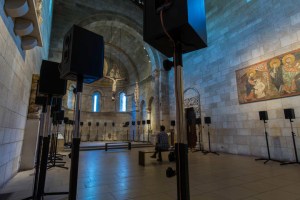
Courtesy of http://www.metmuseum.org/exhibitions/listings/2013/janet-cardiff/slideshow

Courtesy of http://www.metmuseum.org/exhibitions/listings/2013/janet-cardiff/slideshow

This week, several parishioners and I embarked on a “mini-pilgrimage” to the Cloisters in the City.  Though I loved many parts of the Cloisters, I found that I was most drawn to a sound installation by Janet Cardiff of The Forty Part Motet.  Cardiff positioned forty high-fidelity speakers on stands in a large oval in the middle of the Fuentidueña Chapel.  The motet is a reworking of the forty-part motet Spem in alium (which translates as “In No Other Is My Hope,”) by Thomas Tallis.  One part is played in each speaker in the room, and if you stand in the center and close your eyes, you can almost imagine yourself sitting in the chancel of a Cathedral listening to those beautiful voices.  And because the speakers are setup in the Chapel, which features the late twelfth-century apse from the church of San Martín at Fuentidueña, near Segovia, Spain, you really can transport yourself into sacred beauty of the music.

Part of what I loved about the installation was the way in which it froze me in my path.  No longer was I ready to hustle through the exhibits – instead I was transfixed in one place, just listening.  And even more strange was that I was not the only one – the whole room was filled with people just standing and listening to the incredible sound.  I was fascinated by the way such beautiful music held us captive, arresting our attention.

As I venture into Advent, I wonder how we might hold on to that sense of arrested attention on God.  Advent is a season often co-opted by the world around us.  I can count countless secular things that send us into a flurry – buying gifts, decorating houses, hosting and attending parties, and generally running around chaotically.  But our sacred worlds can keep us just as busy.  I know that in our parish during the month of December we have an Annual Meeting, a Bishop’s Visit, our 50th Anniversary Gala, the decorating our church with greens, and the flurry of Christmas worship services.

Our invitation this week might be to find small ways to commit arrested attention to God.  Maybe our way will be simply stopping for a prayer.  Maybe our way will be dropping everything we had planned and stopping to visit with an elderly person, with someone who is sick, or with a child.  Or maybe it is a more intentional commitment to being fully present wherever you are – putting aside the other forty things that also need to be done immediately, and just giving yourself over to the task or experience at hand fully.  If we can isolate our attention, and arrest our harried selves, maybe we can find our way back to the God who loves us and simply wants a bit of our arrested attention too.

Homily – Interfaith Thanksgiving Service, November 26, 2013

27 Wednesday Nov 2013

Posted by jandrewsweckerly in Uncategorized

≈ Leave a comment

Tags

culture, differences, faith, God, interfaith, praise, sacred, secular, Thanksgiving, Thanksgiving Day

I grew up in the South, where being a person of faith meant you were either a Baptist or a United Methodist.  It was not until well after college that I began to meet and really get to know a few individuals of other faiths – learning about both their cultural and religious experiences.  I even had an interfaith clergy support group back in Delaware – during which much of our time was spent discussing differences and similarities in polity and worship.

So I was thrilled when I heard there was an interfaith group here when we moved from Delaware to Plainview two years ago.  I was looking forward to who would be in the room, and finding an instant support group of fellow persons of faith.  So you can imagine my surprise when I, southerner that I was, went to my first meeting and realized that as a Christian, I was a minority in the room.  I do not think I have ever been in a room of clergy when I felt like there were significant portions of the conversation that I just did not understand – whether it was a particular holiday, a way of doing business, a language barrier, or knowing what to order at Ben’s.  I had always thought that interfaith differences were not that significance – if we are all persons of faith, surely that identity creates enough common ground for us to work together.  But the truth is that among the clergy, and perhaps among you as persons of faith, we are so steeped in our religious identity and culture, that we forget how particular that experience is to us – and how foreign that experience is to others.

That is why I love this service so much.  We have found a holiday that we as Americans can all recognize and celebrate – regardless of our faith background.  And yet, we as a community of faithful people gathered here tonight claim this day not as just a secular day to eat copious amounts and gather with family and friends, or even a day we can all commonly agree upon because we are Americans.  We claim this day as a sacred day – because we know that true thankfulness belongs to God – the source of sustenance and life itself.  In the Episcopal Church, we have a special liturgy set aside for Thanksgiving Day.  I never knew that until I became a priest.  In fact, at my first cure, I remember learning about the service and being totally annoyed, thinking, “What, I have to work on Thanksgiving too?!?”  But after my first Thanksgiving service, I knew why the Episcopal Church had set aside time for worship:  because the world around us tries fill this day with “stuff” other than true thanksgiving.  We slave over food, we fret about misbehaving family members, we jostle for position around the TV for the Macy’s parade or the football game, and some of us even go out shopping, especially as the stores try to lure us out of our homes to spend money.

But the community of faith makes another way for us.  The community of faith says that if we are going to dedicate an entire day to thanksgiving, let’s talk about what giving thanks is really about – to whom we really need to give thanks.  Tonight, we turn to scripture.  The palmist says, “It is good to give thanks unto the Lord, and to sing praises unto Thy name, O Most High.”[i]  We say together, “Praise God!  Bless God’s name!  For God is good; God’s steadfast love, [God’s hesed] is eternal; God’s faithfulness is for all generations.”[ii]

To be honest, praise and thanksgiving is not necessarily something that we are always good at doing.  We are really good at complaining to God, or asking God for things, or worrying to God.  But we often forget to truly praise God, to thank God for God’s abundant love and faithfulness.  I am not sure if our prayers to God tend toward being self-centered or we just are simply a culture who tends to complain or want something from God.  And I am not saying those kind of prayers do not have a time and place.  Our God can take all of that from us and more.  But when we turn our prayers to prayers of thanksgiving, we may be amazed at how we, and all that we are worried about, are transformed.  Centering ourselves in gratitude and thanksgiving puts even the direst of situations in perspective.  We remember not only that God is with us, but we also see those around us differently.  Our hearts grow in love and compassion simply by praising and thanking God.

Of course, there are practical implications to giving thanks to God.  Somehow that annoying uncle or nagging mother seems a lot more lovable when our hearts are rooted in this kind of thanksgiving.  Somehow that fallen soufflé or that dry turkey seems much less important than the fact that we have food at all – let alone shelter, warmth, and electricity.  That is the power of thanksgiving for us as a community of faith.  When we turn to God, from whom all blessings flow, we turn our hearts toward generosity as well.  We find ourselves buying extra food to feed our neighbor.  We find ourselves making time to serve others – whether making peanut butter and jelly sandwiches with our interfaith brothers and sisters, or in some other way.  We find ourselves focusing less on ourselves, and more on the wonderful creation God has given to us – and in turn we find ourselves much more well-taken care of than when we were wrapped up in ourselves.

And so tonight, we set the tone for this national holiday.  We proclaim a true day of Thanksgiving – for the abundance of food, for the privilege of rest, for the blessing of life – but mostly for the God that gives us such life, who cares for us more than we deserve, and who loves us more than we can imagine.  We give thanks for a God beyond our full comprehension or knowing, and we give thanks for the interfaith community who, despite all our differences, collectively reminds us to whom we belong.  May your Thanksgiving holiday be a sacred time with the God who created you, sustains you, and loves you.  Amen.


[i] Ps. 92.1

[ii] Ps. 100.4-5

Save me a seat…

06 Wednesday Feb 2013

Posted by jandrewsweckerly in Uncategorized

≈ Leave a comment

Tags

Holy Spirit, invitation, sacred, space, vulnerability

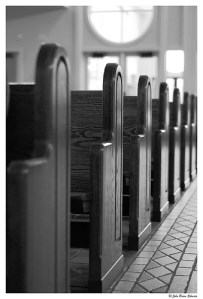
empty pewsYesterday I was reminded of a practice I picked up in seminary.  At VTS, we were required to attend chapel and daily lunch together.  Like any good Episcopalians, seminarians and faculty all had their “regular seats” in chapel.  And like any insecure adolescent, we often had a similar worry at lunch – wanting to make sure we had someone (preferably someone we liked) to sit with at lunch.

With that in mind, by my senior year, I developed a practice that brought much joy to my seminary life.  When I went to chapel, instead of bee-lining my way to a familiar seat with a friend, I would pick a pew and sit by myself.  I was always pleasantly surprised with the result.  Sometimes I ended up sitting alone the entire service – a practice that allowed me to become much more focused on my prayers.  Sometimes the most wonderful friends snuck into the seat beside me just as the service was starting.  Their presence brightened my day and lifted my joyful heart in worship.  And sometimes someone I was not as excited to see would sit beside me.  Inevitably though, we would end up chatting after the service and something about that conversation softened my heart into a much more Christ-like way of loving all my neighbors.

The same was true at lunch.  If all the tables were full, instead of squeezing in one more seat, I would pick an empty table and sit down.  This was the biggest gamble because up to seven people could join you.  Again, sometimes the closest of friends and professors would join me, leading to much laughter and enjoyment; sometimes an odd conglomeration of individuals would join me, leading to intriguing conversations; and sometimes total strangers or even those who I was not so fond of would join me, but the interactions were no less rich, and always opened me up to something new.

So yesterday, at our Diocesan clergy day, I sat in a row by myself.  To be fair, I did sit behind a set of clergy I really like, but I did decline their invitation to squeeze in, just so that I could enjoy my old seminary practice.  And the experience did not disappoint.  I enjoyed a great pew of colleagues with some stimulating conversation after worship.

Driving home, I began to wonder where we make room in our everyday lives.  Where do we leave space for others to join us?  Certainly, this applies to our church pew and coffee hour sitting behaviors, but the question is bigger than that.  Where do I make room for holy interaction with others, talking about my faith, listening to their sacred story?  How do I make room for the movement of the Holy Spirit to act in the open space I create?  This pattern of behavior is not easy or even comfortable.  Making room for others takes intentionality, vulnerability, and a willingness to sit alone until someone else arrives.  I invite you today to ponder where you are leaving space in your life, and how God is already using that space for good.

Newer posts →

Recent Posts

  • On the Myth and Magic of Advent…
  • On Risking Failure and Facing Fear…
  • Sermon – Luke 23.33-43, P29, YC, November 23, 2025
  • On Inhabiting Gratitude…
  • Sermon – Luke 20.27-38, P27, YC, November 9, 2025

Archives

  • December 2025
  • November 2025
  • October 2025
  • September 2025
  • August 2025
  • July 2025
  • June 2025
  • March 2025
  • February 2025
  • December 2024
  • November 2024
  • October 2024
  • September 2024
  • August 2024
  • July 2024
  • June 2024
  • May 2024
  • March 2024
  • February 2024
  • January 2024
  • December 2023
  • November 2023
  • October 2023
  • September 2023
  • August 2023
  • July 2023
  • June 2023
  • May 2023
  • March 2023
  • February 2023
  • January 2023
  • December 2022
  • November 2022
  • October 2022
  • June 2022
  • May 2022
  • January 2022
  • December 2021
  • November 2021
  • October 2021
  • September 2021
  • August 2021
  • June 2021
  • May 2021
  • April 2021
  • March 2021
  • February 2021
  • January 2021
  • December 2020
  • November 2020
  • October 2020
  • September 2020
  • August 2020
  • July 2020
  • June 2020
  • May 2020
  • April 2020
  • March 2020
  • February 2020
  • January 2020
  • December 2019
  • November 2019
  • October 2019
  • September 2019
  • August 2019
  • July 2019
  • June 2019
  • May 2019
  • April 2019
  • March 2019
  • February 2019
  • January 2019
  • December 2018
  • November 2018
  • October 2018
  • September 2018
  • August 2018
  • July 2018
  • June 2018
  • May 2018
  • April 2018
  • March 2018
  • February 2018
  • January 2018
  • December 2017
  • November 2017
  • October 2017
  • September 2017
  • August 2017
  • July 2017
  • June 2017
  • May 2017
  • April 2017
  • March 2017
  • February 2017
  • January 2017
  • December 2016
  • November 2016
  • October 2016
  • September 2016
  • August 2016
  • July 2016
  • June 2016
  • May 2016
  • April 2016
  • March 2016
  • February 2016
  • January 2016
  • December 2015
  • November 2015
  • October 2015
  • September 2015
  • August 2015
  • July 2015
  • June 2015
  • May 2015
  • April 2015
  • March 2015
  • February 2015
  • January 2015
  • December 2014
  • November 2014
  • October 2014
  • September 2014
  • August 2014
  • July 2014
  • June 2014
  • April 2014
  • March 2014
  • February 2014
  • January 2014
  • December 2013
  • November 2013
  • October 2013
  • September 2013
  • August 2013
  • July 2013
  • June 2013
  • May 2013
  • April 2013
  • March 2013
  • February 2013
  • January 2013
  • December 2012
  • November 2012
  • October 2012
  • September 2012

Categories

  • reflection
  • Sermons
  • Uncategorized

Meta

  • Create account
  • Log in
  • Entries feed
  • Comments feed
  • WordPress.com

Blog at WordPress.com.

  • Subscribe Subscribed
    • Seeking and Serving
    • Join 394 other subscribers
    • Already have a WordPress.com account? Log in now.
    • Seeking and Serving
    • Subscribe Subscribed
    • Sign up
    • Log in
    • Report this content
    • View site in Reader
    • Manage subscriptions
    • Collapse this bar
 

Loading Comments...