• About

Seeking and Serving

~ seek and serve Christ in all persons

Seeking and Serving

Tag Archives: scripture

Flip-Flops and Fresh Looks…

29 Wednesday May 2019

Posted by jandrewsweckerly in Uncategorized

≈ Leave a comment

Tags

adventure, belonging, casual, church, communion, God, Jesus, mass, meaning, passion, purpose, routine, scripture, Sunday, table, worship

61146359_2375297735859806_6242277340265578496_n

Photo credit:  https://www.facebook.com/events/1137823373087599/

This Sunday, our church is trying something new called “Flip-Flop Mass.”  The concept began with the idea that we wanted to move our “Mass on the Grass” indoors because, let’s face it, even in early June, Virginia is hot and humid.  We also had some rearranging with musical leadership, and we wanted to keep the casual vibe of our outdoor service.  But as we shifted to the idea of an indoor casual mass, the ideas started flowing.  What if we totally rearranged the space?  What if we played with the liturgy and how we interact with Scripture?  What if we not only went casual, but we also went ancient?

What has resulted, after a ton of logistical plans, gathering different supplies, and coordinating with servers, is a worship service like that of the earliest church – an intimate meal around the table reminiscent of the meal between Jesus and his disciples.  I suspect the service will have its fumbles and things we did not anticipate, but I am also hopeful that the service will shift our routine just enough that we thoughtfully reflect on what it is we do on Sundays and what it all means.

Whatever style of church you prefer (and believe me, Hickory Neck manages to artfully offer lots of different styles), I encourage you to join us this Sunday for the adventure.  I suspect whatever you are used to or you prefer, this Sunday will give you the opportunity to engage just differently enough that you experience the elements of worship more powerfully:  the gathering of a community of strangers and friends, seeking a sense of belonging and meaning; a space to wrestle with Scripture, especially when Scripture is sometimes difficult to relate to modern-day life; a fresh way to experience God’s presence, using all of your senses; a place where you can find a renewed sense of purpose and passion for serving the world.  I don’t know about you, but I am thrilled to be invited to experience church with fresh eyes this weekend.

So, grab your flip-flops, grab a dish to share for lunch, grab a friend (or a stranger!), and come to church.  We’ll save you a seat at the table!

Sermon – 1 Sam 1.4-20, 2.1-10, P28, YB, November 18, 2018

28 Wednesday Nov 2018

Posted by jandrewsweckerly in Sermons, Uncategorized

≈ Leave a comment

Tags

God, Hannah, powerful, Ruth, scripture, Sermon, stories, transformation, women

A little over a year ago, I was talking to a parishioner about my sermon, and he said to me, “Oh yeah, as soon as I heard them talking about a woman in the lessons, I knew that would be what you preached on!”  At first I laughed, because he was not wrong.  In general, I am often drawn to stories of women in scripture.  But the more I thought about his comment, the more I wondered why I am drawn to them.  I suspect most people would assume I am drawn to women in scripture because I am a woman.  There is probably some truth to that assumption.  But the bigger reason I am drawn to women in scripture is because when women are featured in scripture (which is infrequently, and rarely with a name attached), something notable happens.  I am not necessarily drawn to those stories because of a sense of camaraderie; instead, I am drawn to those stories because they are a signal – a signal that we should perk up and listen to what dramatic thing is going to happen.

The last few weeks two women have done that for us:  last week, Ruth captured our imagination, and this week, Hannah captures our attention.  The women capture our attention for different reasons.  Ruth is a loyal daughter-in-law, who sacrifices everything to follow Naomi.  She endures hardship, discrimination, and uncertainty about her future before her life settles into some sense of normalcy.  Hannah, on the other hand struggles with fertility.  For any families who have been through the journey of infertility, Hannah’s story probably rips at the tenuously healed hole left in your heart.  If you have known infertility, then you probably have known people like the brutal second wife, the clumsy, loving husband, and the clueless priest.  For those familiar with grief work, the people in Hannah’s life evoke a basic prayer, “God deliver me from well-meaning friends.”[i]

Now, I could spend all day talking about Hannah’s story this week because her story evokes so many things in us:  the grief and trauma of infertility, the pain of those who taunt us, the frustration of misguided counsel, what prayer means and what we believe about unanswered prayers, and even the sacrifices we make with children.  But this week, something more macrocosmic has been tugging at me.  You see, despite the heart-wrenching, relatable story of Hannah, something much bigger comes out of her story.  The miracle child she is given she dedicates to God.  After all her suffering and pain, and although God restores her to value within the community through her baby boy, Hannah gives Samuel away. We know she does this because she bargained with God to have a child in the first place.  But what is more significant is her child is not just a baby boy.  Samuel is one of the most prominent figures in scripture.  Samuel is the last judge of Israel, who helps God shepherd in the era of the kings.[ii]  And even more prominently, the important king he anoints is the legendary King David.

The same thing happened to Ruth last week.  After her dramatic tale, we learn that she is also blessed with a baby boy, who we learn at the end of the book will become the grandfather of (you guessed it!) King David.  So in the course of two weeks, we meet the great-grandmother of King David and the mother of Samuel, the judge who will anoint King David.  The two women are not contemporaries, but they bear two of the most prominent men in Holy Scripture.

So you may be sitting there thinking, “Okay, we have two stories of two women who produced two important figures in Scripture.  Big deal!”  But that is just it:  this is a very big deal.  Holy Scripture could have started both David and Samuel’s stories differently.  They could have both started with stories that began, “Once upon a time there was a man named…”  But neither of their stories start that way.  Through Ruth’s story and Hannah’s story we learn that their beginning – in fact, sometimes their grandfather’s beginning, matters.  The tales of these two women are not just idle tales.  They are stories with implications that impact generations.

For Ruth, we need to know that David is descendant from Ruth for a few reasons.  One, David’s birth from a foreigner (and not just any foreigner, but the detested Moabites!), tells us that not only is our king from an impure lineage – in fact our Messiah, Jesus Christ, comes from that same lineage.  Later, when we see Jesus’ ministry expanding to all people, we begin to see the expansion not just one of generosity – but based in Jesus’ very genealogy.  Second, Ruth’s parentage is important not just because she is an outsider.  Her parentage is important because she is one of the most righteous, faithful, loyal, self-sacrificial exhibitors of loving-kindness we meet in scripture.  In fact, her loving-kindness, her hesed, is the akin to the loving-kindness embodied by and attributed to God.

For Hannah, we need to know that Samuel comes out of a place of barrenness. You see, by being the last of the judges, he finds the entire people of Israel are in a place of barrenness.  The weight of foreign powers is upon them, they feel a sense of anxiety and abandonment by God, and they long for relief.  Samuel offers them the same relief he offered his mother Hannah.  Likewise, the monarchy being born in such emotion and in such surrender to God is significant.  Samuel’s birth “springs from a place of trust, a place of humility, even a place of mystical union.”[iii]  The conditions surrounding Samuel’s birth will shape the tenor of the entire monarchy.

But perhaps more significantly, the stories of these two women are mirrored in stories we will hear later in Advent.  Elizabeth also shepherds in a messenger of God – John the Baptist.  She bears John in her old age.  And just like faithful Ruth, faithful Mary will bear the child of Jesus – a child descendant from Ruth.  And what’s more, as we heard the canticle of Hannah today, praising God for the revolutionary thing God is doing through Samuel’s birth, so Mary will sing a song almost identical to Hannah’s, proclaiming the revolutionary thing God is doing through Jesus’ birth.

So why have we walked through these women’s stories?  Because our stories matter.  The journey we walk, the suffering we face, the challenges we overcome, the people we encounter, the life we stumble our way through matters.  All of those things not only shape who we are, but they also shape our understanding of God.  That same story also shapes what God does through us.  So when we encounter the person whose parents divorced at the same time in life as our parents divorced, we find ourselves in a place to uniquely witness God’s love.  When we encounter that person who was infertile or lost a pregnancy like we did, we find ourselves in a place to uniquely witness God’s love.  When we encounter that person who lost a parent or a spouse or a child too soon, we find ourselves in a place to uniquely witness God’s love.  Our story matters in the ways in which our story can transforms someone else’s story – and even God’s story here on earth.

But our story matters on an even broader level.  In Hannah’s song or canticle we heard today, and in Mary’s canticle we will hear in late Advent, we see how God transforms stories into global action.  Their canticles are songs of social upheaval, songs of justice.  Both talk about how the poor are raised up and the rich are sent away empty.  Both talk about how the powerless are raised up to power, and the barren are made prolific.  Just a few weeks ago, I talked with our youth about how voting is a Christian action – that our votes as persons of faith reflect our understanding of how the kingdom of God can be enacted on earth.  We acknowledged that two Christians might vote quite differently, but the point is that God is not absent from public life, from justice, and from peace.  Our stories help us transform the world from a place of anger, division, and mistrust, to a place of respect, dignity, and truth.

I do not know what God is doing in your story.  I do not know how God is using you to affect those around you or make an impact more broadly.  But what I do know is that God intends you for goodness and invites you to step into that goodness.  We know that God does not act in our lives meekly:  of the four women we talked about today, we saw barrenness, suffering, isolation, misjudgment, shame, and societal displacement.  But through those dramatic stories, God acted dramatically.  I suspect God can do powerful things through us too when we let God work through our story.  Amen.

[i] Martin B. Copenhaver, “Pastoral Perspective,” Feasting on the Word, Yr. B, vol. 4 (Louisville: Westminster John Knox Press, 2009), 292.


[ii] Thomas D. Parker, “Theological Perspective,” Feasting on the Word, Yr. B, vol. 4 (Louisville: Westminster John Knox Press, 2009), 296.

[iii] Marcia Mount Shoop, “Theological Perspective,” Feasting on the Word, Yr. B, vol. 4 (Louisville: Westminster John Knox Press, 2009), 292.

On Raising Kids in the Faith…

01 Wednesday Aug 2018

Posted by jandrewsweckerly in Uncategorized

≈ Leave a comment

Tags

baptism, children, church, faith, formation, God, kids, questions, scripture, teach, teaching, vacation bible school

kids_SS

Photo credit:  http://livingwaterlutheran.us/

Last week, as we were driving to summer day-camp, my eight-year old was mid-stream with a story from the backseat when she abruptly jumped to another story she remembered.  Used to the constant chatter from my little ones, I barely noticed, but she exclaimed, “Oh my goodness!  I’m just like Mark!”  “What?” I asked, having no idea who this Mark was and what he had to do with either of her stories.  “You know, like Mark from the Bible, when he interrupts one story with another one.  Ha!”

As I struggled to stay focused on driving, my mouth fell open.  I was stunned.  You see, several weeks ago, I preached a sermon about Mark, explaining his “sandwiching technique,” – basically interrupting the telling of a story with another story, only to return to the original story.  You can read here about why he utilizes this literary technique.  I was shocked to know that my daughter actually remembered that detail from a sermon; honestly, I was a little surprised that she was listening at all, let alone remembering anything I said.  In my shock, I managed to stammer out, “Oh, you remember that?”  “Yeah.  Everyone thinks I don’t listen in church because I’m doing other things.  But I listen.”

Now I don’t expect children of all ages to grasp literary devices of Gospel writers, but what that conversation reminded me of is how often children are listening, and especially listening to what we have to say about God.  Many parents I talk to often worry about how to help their children learn about God, feeling a bit inadequate themselves for such a daunting task.  The advice I give them is simple:  bring them to church.  Let them experience as much of the liturgies as they can handle.  Let them go to Children’s Chapel and Sunday School as much as you can.  And when things like Vacation Bible School come up, as they do next week at Hickory Neck, take them.  The songs, the stories, the dialogue will slowly seep in, and the questions will surely pop up in the backseat of a car, at the dinner table, or before bed.  And if you are not sure about the answers, don’t worry.  You can always use the question as a “wondering moment,” asking questions and leaving things open for their imaginations (and the Holy Spirit!).

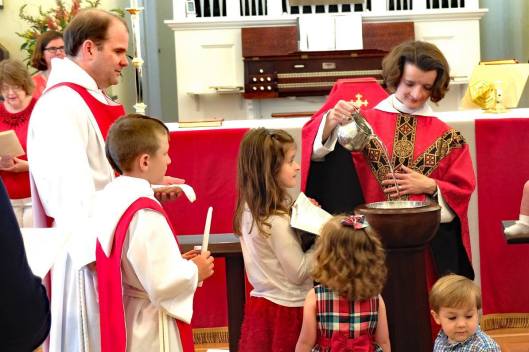
This Sunday we will baptize a baby at Hickory Neck, and his parents, godparents, and the parish will pledge to do the same – see that the child is raised up in the church.  We won’t have all the answers, and we may even stumble through trying to explain our faith (I could tell you countless stories about my own bumbling).  But in the end, each child’s journey feeds and enriches the journey of each of us.  Their questions inspire the adults to get into church too – to be steeped in the liturgy, to study scripture, to engage in conversation, to reflect on the presence of God in our lives.  The Church offers that tremendous gift to us every week.  Our invitation is to get ourselves there.

33076825_1843825552340363_5100443877848907776_o

Photo credit:  John Rothnie (permission required for reuse)

GC79: On Needing Revival…

18 Wednesday Jul 2018

Posted by jandrewsweckerly in Uncategorized

≈ Leave a comment

Tags

Bible, Bishop Curry, church, Episcopal Church, General Convention, God, God's word, Holy Spirit, interpretation, liberation, love, ordination, protest, revival, role, scripture, women

This week, I continue with more reflections from the General Convention of the Episcopal Church.  Look for posts in the days to come that give some insight into the experiences of the week, the take-home lessons, the pondering questions still ruminating in me.  Thanks for following along!

On Saturday evening of General Convention, we were invited to a revival at a local church.  The revival was powerful and clearly moving to many in the crowd.  Of particular note was the Spanish translator hired to translate for Bishop Curry.  She was poised, animated, and seemed to feed off Bishop Curry’s energy.  I do not know how she did it, but the two of them really seemed to be preaching together – to be dancing in God’s word as they preached a message of love and life.  Even for someone whose Spanish is minimal, I found her translation and presence really made Bishop Curry’s sermon come alive in a new way.

But what has been staying with me about that evening was the protest outside the church.  Members of Westboro Baptist Church gathered to protest what the Episcopal Church has been doing; from their signs, I understand they are mostly upset about the ordination of women, and our inclusion of the LGBTQ community in ordained and married life.  In the course of my life, I have had many conversations about both of those issues, including people confronting me about my own ordination and my theological understanding about the expansiveness of God’s love for all.  Those conversations have sometimes been hard, hurtful, and even anger-inducing.  But ultimately, they were always conversations – things said to my face, debates had between people, disagreements had within the context of relationship.

So the sentiments of the protestors was not new to me (although some of the language used against female pastors would have made many clutch their pearls).  What was heartbreaking was seeing a preteen standing next to her mother with a sign that read, “No Women Preachers – 1 Tim. 2.12.”  I went back and reread 1 Timothy 12, and I confess, a good portion of the chapter is about wives submitting to their husbands, keeping silent, allowing their husbands to lead.  We’ll talk about that in another blog post.  But as I looked at the young girl, I remembered all the times I started asking hard questions about things I had read in the Bible that did not seem to make sense – that did not seem to jive with the wide embrace of God’s love.  I remembered the Sunday School teacher who encouraged us to read the Bible literally, condemning her own current marriage because she had once been divorced.  I remember feeling a sense of discomfort until I found liberation in the Episcopal Church – a church that taught me to ask hard questions, to be uncomfortable in the ambiguity, to be released from the bonds of literal biblical interpretation, and to read the Bible in a new way.

Holding all that in my mind, I grieved for this young woman.  I sorrowed for the mother standing next to her, teaching her to keep silent, and to disrespect every woman who believes God is empowering us with God’s word.  I lamented the hate being inculcated into this young girl.  I mourned the light being limited in her life.  As female preachers poured out of buses for the revival, I found myself wanting to whisper into her ear, “God’s love is bigger than the words in 1 Timothy.”  Holy Scripture has been used time and again to limit God’s love, grace, and mercy.  I am sure I am guilty of a similar sin in one way or another; perhaps even this blog post is an exercise in sinful presumption.  My prayer for all of us is that we have people whispering in our ears words of truth, reconciliation, and peace.  Let not the work of the Holy Spirit be extinguished in us.

IMG_1755

Photo credit:  Jennifer Andrews-Weckerly (permission needed for reuse)

On Politics, Priests, and Prayer…

20 Wednesday Jun 2018

Posted by jandrewsweckerly in Uncategorized

≈ 4 Comments

Tags

American, Bible, Christian, communion, dignity, disciple, diversity, Episcopal Church, Eucharist, Good News, gospel, Jesus, policy, politics, prayer, priest, scripture, table

lightstock_99088_medium_david_needham

Photo credit:  https://www.lebanonfbc.org/ministries/power-prayer-pop

One of the hardest parts of being a priest is creating a community in which we can talk about the Gospel of Jesus Christ, hold widely varying political opinions, and yet still gather at the Eucharistic Table – elbow to elbow, as the imperfect, but beloved body of Christ, determined to stay in community.  I say that the work is difficult because I have seen how fragile this work really can be.  During my priestly formation at seminary, congregations and Dioceses were walking away from that common table over the issue of human sexuality.  Although I was proud of what the Episcopal Church did at the time, I also deeply mourned the loss of diversity at the Table – the creation of a more homogenous Church than a Church who was devoted to staying in the tension while honoring the Gospel.

Because of my high value of the uniting force of the Eucharistic Table, my priesthood has taken a slightly different shape than I might have imagined in my early twenties.  If you had asked me then about the primary role of the priest, I might have argued the role of prophet – decrying injustice and leading the people of faith to a more just world.  But as I aged, and as I served diverse parishes, I began to see the role of prophet is one of many roles, one that needs to be used judiciously so as not to alienate parishioners and create an exclusive community of like-minded people.  And so, my priesthood has been marked with great caution around politics.  While many of my colleagues will beat the drum for justice, I find myself trying to carefully walk with my diverse congregations as we discern together how to interpret politics in light of the Gospel – not in light of Democrats or Republicans, but in light of the witness of Jesus Christ.  That doesn’t mean I don’t have strong political opinions; it just means that I try to take focus off the politician or political issue of the moment and try to create disciples who can see and follow Christ.

That being said, this past week, the issue of what is happening to families seeking asylum on our southern border, and the separation of children from parents as a punitive, purportedly deterring action has shifted my normal practice – not because I changed my mind about politics and the Church, but because two agents of our government utilized Holy Scripture to justify those actions.  Here’s the thing:  if this were just another issue where we are divided about policy, where we had a debate about the extents to which we value national security over other values, I would have happily encouraged our parishioners to be faithful Christians in dialogue.  But when Attorney General Jeff Sessions invoked Holy Scripture to justify separating children from parents, he stepped into my area of authority, leaving me no other option but to speak.

Now I could layout a Biblical defense against the small portion of Romans 13 that Attorney General Sessions quoted, giving you the context of the chapter, giving you the verses immediately following what he quoted as a counter to his argument.  I could quote to you chapter and verse for countless other scripture lessons that tell us to love one another, respect the dignity of other human beings, care for the outcast and alien, tend the poor, and honor children.  I could also tell you about how that same bit of scripture was used to justify slavery, Nazis, or apartheid in South Africa.  But the problem with a scripture quoting war is that no one wins.  What is more important is what we know of the canon of Scripture:  that our God is a God of love, that Jesus walked the earth showing us how to be agents of love, healing, and grace, and that the Holy Spirit works through us today to keep spreading that love.

Knowing what I know about the Good News of God in Christ, in my baptismal identity as one who seeks and serves Christ in all persons, respecting the dignity of every human being, I cannot stand idly by or be silent when the Holy Scriptures of Christians are being used to justify political actions that are antithetical to our Christian identity.  As a priest, I invite you this week, especially when a governmental leader is invoking our faith, to reflect on how the Gospel of Christ is informing your view on this issue.  Not as a Republican and not as a Democrat, but as a follower of Christ.  Fortunately, prominent politicians on both sides of the aisle seem to be coming to agreement on this issue – a rarity these days – but also an example to Episcopalians who hold a high view of coming to the Eucharistic Table across our differences.  I am not saying we need to agree on this – in fact, I suspect we will not.  What I am asking is that you live into your identity as a disciple of Christ, as an agent of love, and then respond in conversation, in political advocacy, and in worship as one holding in tension both our American and Christian identities.  I support you in this difficult, hard work.  I love you as you struggle.  I welcome you to the Eucharistic Table.

On Searching for Hope…

06 Wednesday Jun 2018

Posted by jandrewsweckerly in Uncategorized

≈ Leave a comment

Tags

Christ, church, division, God, hope, politics, reconciliation, redemption, scripture, sustain, today, walk

e4c08c2a8201dc34bbae76b2c5b2a0b3_how-to-break-sunlight-through-the-clouds-sun-rays-through-clouds-drawing_1450-1024

Photo credit:  https://clipartxtras.com/categories/view/8acee3134d57ecf959eedd985d89984fd9af8e11/sun-rays-through-clouds-drawing.html

One of my favorite podcasts has become “Stayed Tuned with Preet,” a podcast hosted by Preet Bharara, former U.S. Attorney, that addresses issues of justice and fairness.  The topics vary pretty widely – from law enforcement, to the psychology of leadership, to the opioid crisis, to gun control, to the #metoo movement.  What I appreciate about his podcast is he breaks down a lot of the complicated legal matters in the news into terms I can understand, he shares his passion for justice, and he tries to frame a current specific issue in the broader context of justice in society.  Admittedly, there are times when I listen to Preet’s podcast and begin to wonder if there is any hope.  But what Preet always does at the end of his podcast is tell a story of hope – sometimes entirely unrelated to the current episode, but always life-giving.

What Preet does is what I try to do in preaching.  I am always looking for the problem in the scriptural text assigned for the day (and the related problem in our modern lives), and the hope in the text (and the related hope in our everyday lives).  Sometimes finding the hope is harder than others.  This Sunday, we get the text from I Samuel where the people finally ask God for a king.  That may not sound like an unreasonable request, but you have to remember that God just spent a generation’s lifetime liberating the people from an overlord – from Pharaoh.  And despite God’s faithfulness, and the warning God’s prophet gives them about what life will be like under a king (spoiler alert:  it’s not good!), the people stubbornly demand a king anyway.  In Samuel’s warning, he says, “And in that day you will cry out because of your king, whom you have chosen for yourselves; but the Lord will not answer you in that day.”  As I have been praying on this text this week, I have been wondering where the hope is.

Last night, I sat in on a conversation on racial reconciliation, and we wondered the same thing too.  As we look at the world around us, and see the deep divisions among us (on every issue!), and see the ongoing prejudice among us, many of us found ourselves wondering where the hope is.  We spent time talking openly and vulnerably about where our hope is being dashed and the moments that seem irredeemable in life.  But after some time, our conversation shifted – from the moments that were irredeemable to the ones that were redemptive.  We began to talk about how and where we find hope.  And each bit of hope shared brought more hope into the room.  Though we all come from different backgrounds, we seemed to conclude the night convinced that God, through the instrument of the Church, was going to be the source of hopeful change in the world.

I am wondering where you are finding hope today.  Whatever is going on your life, whatever is dragging you down today, what are the glimmers of hope that are sustaining you?  I could preach to you about how God is always our source of “big picture” hope, but I think more often God provides us with little glimmers of hope that leads us on the path to that big picture hope.  Those glimmers are our food for the daily walk with Christ that nourish our souls and keep us out of the dark and searching for the light.  If you have not found the hope today, keep looking.  And if you get to the close of the day and are still not convinced, reach out for support.  You are not alone.

On the Timelessness of Scripture…

23 Friday Mar 2018

Posted by jandrewsweckerly in Uncategorized

≈ Leave a comment

Tags

#metoo, Apocrypha, Christ, Daniel, dignity, harassment, kingdom of God, love, men, power, respect, scripture, sin, Susanna, women

This reflection is from a book of devotions that our youth group at Hickory Neck created for our parish’s use this Lent.  Each day, parishioners offer their reflections on the text assigned for that day in Lent.  This is my reflection on an apocryphal writing, Susanna 1-9, 15-29, 34-62.  If it is unfamiliar to you, I highly recommend reading it first.  You can find the text here.

**********

I am struck by the timeliness of Susanna’s story.  Because Susana is a book from the Apocrypha, most Christians do not know her story.  But her story joins the chorus of the many #metoo stories of sexual assault and harassment we have discovered in the last six months.  Susanna’s story is a story of the abuse of power.  Though the two elders purport to give Susanna a choice, either choice will leave her devastated.  Though she chooses the option that feels free from sin, her choice will lead to her condemnation and death.  In truth, she has no choice – the men sinfully exert power of her.

What encourages me about Susanna’s story is that there is a man who uses his power for good.  We are told that God stirs up the holy spirit of Daniel, and Daniel (a man of power in his own right), responds, eventually proving Susanna’s innocence.  Daniel’s role in this story reminds us that God longs for us to use our power for good.  The #metoo stories of our day are not just the stories of women.  They are stories about all of us – stories of how we, men and women, are to love as Christ loves, and to respect the dignity of every human being.  How might we be agents of love, using our power today to help those without power?  How might we be agents in bringing about the kingdom of God?

Sermon – Mark 1.29-39, EP5, YB, February 4, 2018

14 Wednesday Feb 2018

Posted by jandrewsweckerly in Sermons, Uncategorized

≈ Leave a comment

Tags

#metoo, Bible, disciples, discipleship, gender, interpret, Jesus, men, reassuring, role, scripture, Sermon, together, uncomfortable, women

One of the things I love about the Bible is that the Bible never makes you feel wholly comfortable.  You can always find a comforting passage – a victorious song from Isaiah, soothing words from a psalm, a story of encouragement or inspiration about a beloved character.  But as you read Holy Scripture, you can almost as equally find passages that make you bristle.  This especially happens when you follow the lectionary, because, much to the chagrin of your preachers, you cannot pick and choose what texts you like.  And so, you open up the assigned text and your modern sensibilities say, “Whoa!  Hey now!”

Today’s lesson from Mark hit me that way at first glance.  Jesus has had a pretty full day.  On the Sabbath, Jesus and the disciples go to the synagogue and Jesus teaches with an authority that amazes those gathered.  He rids a man of an unclean spirit, and the people marvel again.  Jesus leaves the temple and goes to Simon Peter’s house.  Before he can even sit down, the disciples tell him that Simon’s mother-in-law has a fever – which, in those days, is a dangerous condition.  Jesus goes to her, offers her his hand, she rises, and is healed.  And this is the part where I bristle.  The text says, “Then the fever left her, and she began to serve them.”

The timing of this text could not be worse.  Our country is in the middle of a complete reevaluation of the treatment and role of women.  Just a few weeks ago, women around the country, and even here in Williamsburg, marched to protest the ways in which women are being treated and the ways in which legislation is affirming that treatment.  This year, Time Magazine chose the women of the #metoo movement as their “Person of the Year.”  These Silence Breakers are women who have begun to take a stand against sexual harassment and assault.  The magazine’s selection was timely, as story after story continues to break of prominent men are accused of mistreating and assaulting women.  Even our political elections are seeing more women running for office, including three graduates from the Naval Academy.[i]  In this season of women and men calling our country to examine the role and treatment of women, the last thing I wanted to hear was a story about a woman whose immediate reaction to a miraculous healing and resurrection is to go into the kitchen and serve the men.  She does not join the four disciples as part of Jesus’ entourage; she does not sit with Jesus and learn more from his teachings; she does not become an evangelist of the Good News.  The text simply says, “Then the fever left her, and she began to serve them.”

One of the tricky things about reading Holy Scripture is how to interpret scripture in the context of our modern sensibilities.  In my last year of seminary, I decided to write my thesis on the book of Ruth for this same reason.  Here was an entire book on women – a rarity in scripture.  The first three chapters of the book show women of agency and power, who make their way, even in a world where widows have very little power.  Even Ruth is described as a woman of hayil, a Hebrew word reserved almost entirely to describe men of great power and military prowess.  And what happens to this mighty, powerful woman?  In the final chapter of the book, men determine Ruth’s fate, she gets married, has a child, and the child redeems her mother-in-law.  This character who speaks throughout the book is rendered voiceless throughout the last chapter.  It took me a year of wrestling with this book to realize that my modern lens and interpretation of the book of Ruth prevented me from understanding how Ruth’s fate does not mitigate her hayil, her power in the story.  Reading Ruth would never translate the same way to modern ears.  Ruth’s story is still a story of empowerment.  But in order to hear that empowerment, I would need a deeper understanding of the cultural context.  And I would need to be open to other messages from the text – not simply what I wanted to hear and have affirmed to my everyday life.

A similar reality is true in today’s reading from Mark.  This is not a story about a woman’s role or a woman’s expected place with Jesus.  This is not a story about the differences between men and women in the kingdom of God.  This is not a story about gender and discrimination.  This is a story about discipleship.[ii]  The past three weeks we have been talking about discipleship –  how discipleship is discerned within community, how discipleship involves sacrifice and a response to Jesus, how discipleship involves a sense of immediacy.  Today’s lesson reminds us that discipleship is also about service.

Simon’s mother-in-law does not recover from an illness and immediately begin to serve Jesus out of a sense of gendered identity.  She immediately begins to serve Jesus because, through her healing, she understands a key component in discipleship:  service. This is something the disciples will not learn until many chapters later, when Jesus says, “For the Son of Man came not to be served but to serve.”[iii]  Two of the same disciples who are there this night of the mother-in-law’s healing, James and John, after ten chapters of following Jesus think discipleship means power and privilege – sitting at Jesus’ left and right hand.  But Jesus, the mother-in-law, and countless others show the disciples that discipleship is about service.  Discipleship is about what we reaffirm in our baptismal covenant – to seek and serve Christ in all persons, loving our neighbor as ourselves.

This story is not a story about gender and the role of women and men.  This story is about discipleship.  Now, for those of you who may still feel dissatisfied, what is interesting in this story is that in a room full of men, the woman is the one who actually understands what Jesus is all about.  We see that point even more fully when Simon Peter approaches Jesus later as Jesus is praying.  The text says, “In the morning, while it was still very dark, [Jesus] got up and went out to a deserted place, and there he prayed.  And Simon and his companions hunted for him.”  Scholar’s argue that Simon did not simply “hunt for” or look for Jesus.  The implication of the Greek word here is that Simon vigorously looked for and approached Jesus with the intent of forcing Jesus to get back to work.[iv]  Simon misunderstands Jesus and the work of discipleship; Simon’s mother-in-law does not misunderstand.  But taking this story to be a feminist text of the women getting it and not the men is probably reading too much into the text too.  This is a text about one disciple getting it – getting it to strong degree.  In fact, the word used for “service” here, is the same root of the word for deacon.[v]  The service of the mother-in-law is akin to the work of deacons in the church.

I do not know where you find yourself in this text today.  Maybe the text is reassuring because you have made your life of discipleship about the service of the kingdom.  Maybe this text is reassuring because you understand that sometimes you do not always get the message, and yet you can still be disciples.  Or maybe this text is reassuring because you are grateful to be surrounded by disciples on various points of the spectrum, who are all figuring it out.  The point is – this is a reassuring text.  This passage from Mark is not meant to be a text for bristling, for defensiveness (on either side), or for creating a sense of failure.  This is a text which reassuringly reminds us that we are all on a journey to understanding discipleship and becoming more faithful disciples every day.  This text reminds us that we need each other: men and women, old and young, married and single.  Together we help each other walk with Christ.  Together we teach each other the work of discipleship.  Together we do the work of seeking and serving Christ in all persons, loving our neighbors as ourselves.  Amen.

[i] Michael Tackett, “From Annapolis to Congress? These Three Women Know Tough Missions,” January 28, 2018, as found at https://www.nytimes.com/2018/01/29/us/politics/women-annapolis-democrats-congress-trump.html on February 2, 2018.

[ii] Karoline Lewis, “A Call Story,” January 28, 2018, as found at http://www.workingpreacher.org/craft.aspx?post=5052 on February 1, 2018.

[iii] Mark 10.45a.

[iv] Daniel J. Harrington, ed., The Gospel of Mark, Sacra Pagina Series, vol. 2 (Collegeville, MN:  The Liturgical Press, 2002), 87.

[v] Gary W. Charles, “Exegetical Perspective,” Feasting on the Word, Year B, Vol. 1 (Louisville: Westminster John Knox Press, 2008), 335.

Sermon – Matthew 21.33-46, P22, YA, October 8, 2017

11 Wednesday Oct 2017

Posted by jandrewsweckerly in Sermons, Uncategorized

≈ Leave a comment

Tags

balm, comfort, covenant, darkness, forgiveness, generosity, God, goodness, grace, Jesus, Journey to Generosity, light, love, mass shooting, mercy, parable, scripture, Sermon, tenants, vineyard, violence

One of the things I love about coming to church week in and week out is the practice setting time aside to discern how Holy Scripture is speaking to our everyday life.  Whether I have had a stressful week or a week of celebration, whether I am struggling in life or am experiencing a time of joy, or whether I am pained by the world around me or encouraged by the world around me, the Holy Scripture that we hear on Sunday always finds a way of speaking to me – of comforting, encouraging, challenging, and journeying with me.

But I confess to you I have been struggling to hear a good word from God through Holy Scripture this week.  You see, six days ago, we awoke to the news of the deadliest mass shooting in our modern history.  I cannot seem to shake the awful images and sounds of that night – the rapid sound of gunfire, the screams of terror in the crowd, the panic created in a crowd who had no idea how to escape the unseen shooter, and the sheer volume of deaths, injuries, and psychological trauma.  A week later, having no real leads on motive, all I am left with is the reality of violence in our society that seems inescapable – of one more city to add to the growing list of instances of mass violence:  Columbine, Blacksburg, Aurora, Newtown, Charleston, Orlando.

With the weight of the sinfulness of our violence upon one another, what I really wanted from Holy Scripture was a balm or a promise from God that love would win.  Instead, our gospel lesson today feels more like a mirror of our modern violence.  Jesus tells the leaders of the faithful a parable about a landowner who plants a vineyard and entrusts the tending of the vineyard to tenants.  When the time comes for the tenants to proudly show the landowner the fruits of their labor, instead the tenants do something awful.  They beat, kill, and stone the servants sent by the landowner.  And their action is not a one-time occurrence.  The landowner sends even more of his servants to the tenants, and they beat, kill, and stone them too.  The landowner even sends his own son; but filled with greed, entitlement, and violence, they kill the landowner’s son too.  Instead of redemption at the end of the parable, Jesus says, “Therefore I tell you, the kingdom of God will be taken away from you and given to a people that produces the fruits of the kingdom.”

Because this is a parable, we know that Jesus is trying to tell the people of Israel something about themselves.  Stanley Hauerwas interprets the parable in this way, “The parable of the wicked tenants can serve as an outline of Matthew’s understanding of the life of Israel.  God [calls] Israel to be his vineyard fenced by the law, grounded in the land, and protected by worship of God in the temple.  God [sends] his prophets to call the people to faithfulness, but the people beat, [stone], and [kill] them.  Finally God [sends] his very Son, but even he [is] rejected…Jesus [leaves] no ambiguity about how this parable is to be understood.  The chief priests and the Pharisees [realize] that they are the ‘rejected.’  Yet they are not in any fashion to repent.”[i]

The starkness of Jesus’ parable has left me wondering whether we have become like the tenants in this story.  Not knowing the motive of the shooter in Las Vegas, we can somewhat distance ourselves from him – perhaps blaming mental illness or labeling him as an outlier in an otherwise healthy society.  But what concerns me more is that this is not an isolated event.  This is not the first time I have had to talk about a mass shooting from the pulpit.  We have not just beaten, killed, and stoned a couple of servants.  We keep committing awful violence, and what is worse is I fear we are becoming desensitized, accepting violence as the status quo – a consequence we are willing to live with in order to have the things we want in life.

In the spiral of darkness between our news feed and Holy Scripture, I had to take a deep breath, praying for some glimmer of hope.  So I started with where we started in worship today – with our collect.  We prayed, “Almighty and everlasting God, you are always more ready to hear than we are to pray, and to give more than we either desire or deserve: Pour upon us the abundance of your mercy, forgiving us those things of which our conscience is afraid, and giving us those good things for which we are not worthy to ask, except through the merits and mediation of Jesus Christ our Savior…”  The collect today reminded me that no matter how dark things seem, there is always light to be found.

With the encouragement of the collect, I was able to go back to the parable.  I realized that perhaps the tenants, or perhaps even ourselves, are not going to be the origin of our hope.  Instead, our hope in darkness rests on God.  The landowner in the parable is marked by goodness.  The landowner plants the vineyard, puts a fence around it, digs a wine press, and builds a watchtower.  Then the landowner allows tenants to use the land, having given them the tools they need, trusting them to care for the land.  Heard another way, we hear all the good news of our creative God.  God creates this beautiful land which we are given the privilege to tend – our own breathtaking vineyard.  And because tending vineyards is hard work, God gives us the “fence” of the law – a set of guidelines to order our common life.  God gives us the tools for work, protection, and worship, knowing we will need those things too.  God even sends us prophets, knowing we will likely go astray.  Eventually, God sends us God’s Son.  This parable is the story of God’s covenantal relationship with us – a relationship marked by love, forgiveness, and grace.  And just like the whole of our Christian story, there will be moments of faithfulness, and moments of repentance.  There will be moments of honor and moments of shame.  In spite of the winding nature of our journey, God is ever present, pouring out love, abundance, mercy, and grace.  Even on our darkest days, when we crucify God’s Son, God does not answer violence with violence.  As one scholar conveys, “… rather than return violence for violence, in the cross of Jesus God absorbs our violence and responds with life, with resurrection, with Jesus triumphant over death and offering, not retribution, but peace.”[ii]

In the midst of stewardship season, I have been wondering all week how in the world I could talk about stewardship today.  But I think stewardship might be the perfect response to the seeming hopelessness of the world and this parable.  A Journey to Generosity is just that:  a journey.  Each one of us has been gifted a vineyard to tend, is surrounded by the gift of God’s word to root us in love, is given the tools needed to tend the vineyard, and is promised that even when we are pretty terrible farmers, Jesus will redeem our darkest days.  God has given us all we need, walks with us in the darkness, and makes a way for us toward light.

The invitation for us today is two-fold.  The first is to go back to the beginning – whether we go back to the collect we heard today, go back to the covenantal stories of our walk with God, or go back to our own vineyard to look around at the abundance in which we find ourselves.  Sometimes in order to appreciate where we are in our Journey to Generosity, we have to look back at the faithfulness of God that is often only evident in the rearview mirror.  After we have immersed ourselves in the abundance of love, grace, mercy, and forgiveness offered by our God, then we take the next step on our journey.  What that next step is will be different for each person in this room.  But if we can envision each person in this room as agents of God’s light and love, imagine the collective power we have to drive out darkness, and transform the world into goodness.  We do not do this work alone.  We are encouraged today by fellow companions on the Journey to Generosity.  I cannot wait to hear the stories from your adventures in generosity.  God is doing great things through you.  And that is reason enough for hope.  Amen.

[i] Stanley Hauerwas, Matthew:  Brazos Theological Commentary on the Bible (Grand Rapids:  Brazos Press, 2006), 186-187.  Verbs in quotation changed to present tense for preaching purposes.

[ii] David Lose, “Pentecost 18A: Words and Deeds,” October 6, 2017, as found at http://www.davidlose.net/2017/10/pentecost-18-a-words-and-deeds/ on October 6, 2017.

Sermon – Exodus 16.2-15, Matthew 20.1-16, P20, YA, September 24, 2017

27 Wednesday Sep 2017

Posted by jandrewsweckerly in Sermons, Uncategorized

≈ Leave a comment

Tags

abundance, complain, deserve, fairness, faithful, generosity, God, gratitude, Jesus, laborers, loyal, parable, scripture, Sermon, whine

This week in Discovery Class, we did a review of Holy Scripture.  We talked about how many years writing the Bible took, the content in each section, the types of literature we find in scripture, and what scripture reveals about us as God’s people.  Our homework was to study today’s gospel lesson, being sure to read the text immediately before and after the text we hear today as a way of helping us interpret the passage.  That tip was especially telling in today’s Old and New Testament lessons

In our lesson from Exodus last Sunday, we heard the story of the parting of the Sea of Reeds.  We heard of that dramatic moment where God allows the Israelites to pass through on dry land, but destroys the Egyptians as the waters return.  The last line in last week’s lesson from Exodus is, “Israel saw the great work that the Lord did against the Egyptians.  So the people feared the Lord and believed in the Lord and in his servant Moses.”  Today, the first sentence from our Exodus reading is, “The whole congregation of the Israelites complained against Moses and Aaron in the wilderness. The Israelites said to them, ‘If only we had died by the hand of the Lord in the land of Egypt, when we sat by the fleshpots and ate our fill of bread; for you have brought us out into this wilderness to kill this whole assembly with hunger.’”  Israel’s groaning and complaining today are much more grievous when we read the great heights of their praise and faithfulness last week.

Likewise, in our gospel lesson today, we hear the familiar story of the generous landowner, who gives the same wage to those who work an hour and those who work all day in the broiling sun.  We can read this passage, and criticize the envious, hardworking laborers for their lack of gratitude.  But the power of the story is heightened when we realize immediately before Jesus’ parable, Peter interrupts Jesus’ teaching and basically says, “But what about us?  We left everything behind and we have been following you.  What’s in it for us?”  And right after Jesus’ parable, the mother of James and John approaches Jesus and basically says, “Listen, if it’s not too much trouble, can my boys sit at your right and left hand in the kingdom?”  So, when Jesus says to Peter, “many who are first will be last, and the last will be first,” and when the landowner says to the workers, “the last will be first, and the first will be last,” what do you think Jesus is trying to address?[i]

I do not know about you, but both of these texts have left me pretty uncomfortable this week.  Watching the Israelites go from faithful, obedient, loyal followers, to whiny, unappreciative, complaining messes hits a little too close to home.  Admittedly, part of me cringes at this text because we have been hammering home the importance of gratitude with our own children.  No sooner is the ice cream cone finished before the complaint comes that we never do anything nice for them.  But as much as we fuss at them, we know the same is true for us.  We are great at praise and thanksgiving to God – when things are going well.  When seas are parting, and enemies are defeated, our God is awesome.  But when we cannot seem to make ends meet, when our loved one is sick again, or when our relationships are falling apart, gratitude is the last thing on our lips.  We find ourselves in what one scholar calls the “spiritual wilderness of ingratitude.”[ii]  We cringe at these readings because we are no more masters at gratitude than our children are.

What both of these lessons do, ever so brutally, is lure us in with stories about abundant, underserved generosity, and put under a microscope our deeply buried discomfort with abundant, underserved generosity.  Part of the reason we are uncomfortable is because God’s generosity often bumps up against our notions of fairness.[iii]  I do not know if we understand the concept of fairness innately or if we are taught fairness by our community, but somewhere along the line, we learn the concept of fairness and apply the concept with exacting scrutiny.  I remember when I was a child and wanted a treat, my dad would make my brother and me share the treat.  One child was allowed to split the treat in half, but the other child got to pick which half he or she wanted.  You can imagine how precise my cuts became when looking at that cookie.

But our notions of fairness evolve over time.  One could take that same cookie and give a slightly larger half to the older child since they are bigger.  Or one could take that same cookie and give the slightly larger half to the child who was better-behaved.  Or one could give the larger half to the one who was physically weaker and needed more nourishment.  There are all sorts of ways to determine fairness.  But God’s measure, in both the Hebrew and Christian Scriptures seems to be that everyone receives God’s generosity despite worth or effort – or even the showing of gratitude.

Take our lesson from Exodus.  The people have clearly approached mutiny.  Their love for God is buried in their physical hunger and their self-centered greed.  But instead of punishing the Israelites, God lavishes them with all they need.  God gives them bread every day and meat every night.  In fact, God even gives them a double portion on the eve of the Sabbath so that they can observe the Sabbath without having to work for their food.  The feast is not a rich feast of wines and marrow, but their feast is gloriously generous and enough.

The same is true in Jesus’ parable.  Yes, the landowner has a weird way of putting the day-long workers in the awkward position of watching his generosity, but ultimately, the landowner gives everyone enough.  He gives the wage he promised to the day-long workers – a wage that will fill them and their families for days.[iv]  But he also gives the same wage to the hour-long workers.  Sure, they did not deserve the wage, but the same wage that feeds the other workers feeds them too.  The landowner is gloriously generous and gives enough.[v]

I have been wondering all week where these texts leave us:  maybe a bit guilty, perhaps a bit convicted, and definitely “last” in the pecking order Jesus describes.  But what I realized this week is both in Exodus and in Jesus’ parable, perhaps being last is not all that bad.  You see, Jesus does not say, “The last shall be first, and the first shall be ejected.”  No, Jesus says, “the last will be first, and the first will be last.”  So even on our worst Israelite days, when we are moaning and complaining about the very God who miraculously saved us, or even on our worst vineyard days, when we are complaining about an unfair, albeit generous, owner, we are still not ejected.  We are not taken out of God’s generosity; we are not stripped of our blessing.  We may be last, but we still have enough.  Our abundantly generous God takes care of us when we deserve God’s care and when we do not.  Our abundantly generous God gives us enough when we think God’s generosity is fair and when we do not.  Our abundantly generous God loves us whether we embrace God’s generosity or we do not.

I cannot promise we will ever get in line with God’s generosity.  I am not sure we will ever be cured of our sense of fairness or even our ill-conceived notions that we could earn God’s generosity.  But what I can tell you is that we are not alone.  Our people thousands of years ago did not master God’s generosity.  The disciples two thousand years ago did not master Christ’s generosity.  And I suspect we will not either.  But every week, we try.  Every week we continue on our journey toward generosity – seeing God’s generosity in ourselves and others – being inspired to try again.  I am not sure we will ever be first in line.  But the good news is we get to stay in line – which means there is always room to try again.  Our generous God will make sure we have enough until then.  Amen.

[i] Barbara Brown Taylor, The Seeds of Heaven: Sermons on the Gospel of Matthew (Louisville:  Westminster John Knox Press, 2004), 100-102.

[ii] Deborah A. Block, “Homiletical Perspective,” Feasting on the Word, Supplemental Essays, Year A  (Louisville:  Westminster John Knox Press, 2011), 2.

[iii] Taylor, 103.

[iv] Amy-Jill Levine, Short Stories by Jesus: The Enigmatic Parables of a Controversial Rabbi (New York:  Harper Collins, 2014), 224.

[v] Block, 4.

← Older posts
Newer posts →

Recent Posts

  • On the Myth and Magic of Advent…
  • On Risking Failure and Facing Fear…
  • Sermon – Luke 23.33-43, P29, YC, November 23, 2025
  • On Inhabiting Gratitude…
  • Sermon – Luke 20.27-38, P27, YC, November 9, 2025

Archives

  • December 2025
  • November 2025
  • October 2025
  • September 2025
  • August 2025
  • July 2025
  • June 2025
  • March 2025
  • February 2025
  • December 2024
  • November 2024
  • October 2024
  • September 2024
  • August 2024
  • July 2024
  • June 2024
  • May 2024
  • March 2024
  • February 2024
  • January 2024
  • December 2023
  • November 2023
  • October 2023
  • September 2023
  • August 2023
  • July 2023
  • June 2023
  • May 2023
  • March 2023
  • February 2023
  • January 2023
  • December 2022
  • November 2022
  • October 2022
  • June 2022
  • May 2022
  • January 2022
  • December 2021
  • November 2021
  • October 2021
  • September 2021
  • August 2021
  • June 2021
  • May 2021
  • April 2021
  • March 2021
  • February 2021
  • January 2021
  • December 2020
  • November 2020
  • October 2020
  • September 2020
  • August 2020
  • July 2020
  • June 2020
  • May 2020
  • April 2020
  • March 2020
  • February 2020
  • January 2020
  • December 2019
  • November 2019
  • October 2019
  • September 2019
  • August 2019
  • July 2019
  • June 2019
  • May 2019
  • April 2019
  • March 2019
  • February 2019
  • January 2019
  • December 2018
  • November 2018
  • October 2018
  • September 2018
  • August 2018
  • July 2018
  • June 2018
  • May 2018
  • April 2018
  • March 2018
  • February 2018
  • January 2018
  • December 2017
  • November 2017
  • October 2017
  • September 2017
  • August 2017
  • July 2017
  • June 2017
  • May 2017
  • April 2017
  • March 2017
  • February 2017
  • January 2017
  • December 2016
  • November 2016
  • October 2016
  • September 2016
  • August 2016
  • July 2016
  • June 2016
  • May 2016
  • April 2016
  • March 2016
  • February 2016
  • January 2016
  • December 2015
  • November 2015
  • October 2015
  • September 2015
  • August 2015
  • July 2015
  • June 2015
  • May 2015
  • April 2015
  • March 2015
  • February 2015
  • January 2015
  • December 2014
  • November 2014
  • October 2014
  • September 2014
  • August 2014
  • July 2014
  • June 2014
  • April 2014
  • March 2014
  • February 2014
  • January 2014
  • December 2013
  • November 2013
  • October 2013
  • September 2013
  • August 2013
  • July 2013
  • June 2013
  • May 2013
  • April 2013
  • March 2013
  • February 2013
  • January 2013
  • December 2012
  • November 2012
  • October 2012
  • September 2012

Categories

  • reflection
  • Sermons
  • Uncategorized

Meta

  • Create account
  • Log in
  • Entries feed
  • Comments feed
  • WordPress.com

Blog at WordPress.com.

  • Subscribe Subscribed
    • Seeking and Serving
    • Join 394 other subscribers
    • Already have a WordPress.com account? Log in now.
    • Seeking and Serving
    • Subscribe Subscribed
    • Sign up
    • Log in
    • Report this content
    • View site in Reader
    • Manage subscriptions
    • Collapse this bar
 

Loading Comments...