
• About

Seeking and Serving

~ seek and serve Christ in all persons

Seeking and Serving

Tag Archives: Sermon

Sermon – Matthew 5.1-12, All Saints Sunday, YA, November 2, 2014

05 Wednesday Nov 2014

Posted by jandrewsweckerly in Uncategorized

≈ Leave a comment

Tags

Beatitudes, blessed, discipleship, God, Jesus, journey, money, path, road, Sermon, stewardship, walking the way
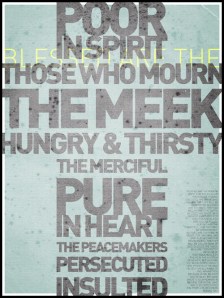
Courtesy of http://firecatching.blogspot.com/2011_04_01_archive.html

Courtesy of http://firecatching.blogspot.com/2011_04_01_archive.html

Today we hear one of the most beloved pieces of scripture.  The Beatitudes from Matthew’s gospel have been the source of inspiration for Christians for centuries, for artists and musicians, for entire ministries, and even for comedians like Monty Python.  As soon as we hear that phrase, “Blessed are…” our eyes close and we let the words flow over us.  We nod in assent, and maybe even whisper, “Yes!”  And as the preacher for In-Gathering Sunday, getting the Beatitudes in the lectionary is like being handed a silver platter.  What other inspiration can we need on a Sunday like this than to think about blessings?  That is what our Stewardship Committee has been encouraging us to do for weeks: to think about the ways that we are blessed and to return that blessing to this community through the gift of our financial resources.  That message could not be better captured than in the Beatitudes from our gospel lesson today.

Or at least that is what I thought before I started really working with the Beatitudes this week.  The more I poured over the text, the more I became confused.  Then the questions came pouring in:  What does it mean to be poor in spirit?  How do we know if we are pure in heart?  I might prefer peace, but could any of us in our everyday lives be considered peacemakers?  And those are just the surface level questions.  When we read at a deeper level, ethical questions begin to emerge.  Our news outlets have been flooded lately with people who are reviled, persecuted, and having evil uttered against them.  All we have to remember are Christians in Iraq, Palestine, or Burma whose very faith means a life of oppression and sometimes death.  Is the word for them today, “You are blessed”?  Many a liberation theologian has balked at the idea of Holy Scripture being used to keep down oppressed peoples.

Luckily, I stumbled on two things this week that opened up the Beatitudes for me in a fresh way.  First I began to look at what the word translated as “blessed” really means.  There are a couple of words in scripture that are translated in English as “blessed,” but they do not necessarily have the same meaning.  In our Beatitudes today, one scholar argues that the phrase translated as “blessed are you when…” is more rightly translated as “You are on the right road when…”  For example, “You are on the right road when you are poor in spirit.”[i]  So blessed does not really mean, “Happy are you when people persecute you,” but instead, “You are on the right road when people persecute you.”  Somehow this translation makes for a much more sober, honest rendering of Jesus’ words.  Jesus is not saying that these things are cause for happiness in a superficial way.  Jesus is saying that we are fortunate in those experiences because they point us to a deeper truth:  that we are heading in the right direction, making the right decisions, and living a meaningful life.

The other source of insight I found this week was from The Message’s translation of this text.  If you are not familiar with The Message, The Message is a paraphrase of the Bible:  not a literal translation of the Biblical language, but a modern rephrasing of the text to make the text more accessible.  Of course, biblical scholars often cringe when they hear certain paraphrases of key texts, but in the case of the Beatitudes, I found this paraphrase quite useful.

I have taken the two ideas – The Message’s paraphrase and the new introduction of “You are on the right road when…” and want to read for you my hybrid rephrasing of the Beatitudes.  Our text now goes like this:

You are on the right path when you’re at the end of your rope.  With less of you there is more of God and God’s rule.  You are on the right path when you feel you’ve lost what is most dear to you.  Only then can you be embraced by the One most dear to you.  You’re on the right path when you’re content with just who you are—no more, no less.  That’s the moment you find yourselves proud owners of everything that can’t be bought.  You’re on the right path when you’ve worked up a good appetite for God.  God’s food and drink in the best meal you’ll ever eat.  You’re on the right path when you care.  At the moment of being ‘care-full,’ you find yourselves cared for.  You’re on the right path when you get your inside world—your mind and heart—put right.  Then you can see God in the outside world.  You’re on the right path when you can show people how to cooperate instead of compete or fight.  That’s when you discover who you really are, and your place in God’s family.  You’re on the right path when your commitment to God provokes persecution.  The persecution drives you even deeper into God’s kingdom.  Not only that— You’re on the right path every time people put you down or throw you out or speak lies about you to discredit God.  What it means is that the truth is too close for comfort and they are uncomfortable.  You can be glad when that happens—give a cheer, even!—for though they don’t like it, God does!  And all heaven applauds.  And know that you are in good company.  God’s prophets and witnesses have always gotten into this kind of trouble.

This Stewardship Season, we have been talking about “Walking the Way.”  Certainly Walking the Way is a metaphor for our journey into a time of reflection about the value our money holds for us and how our relationship with that money is connected to our relationship with God.  But the Walking the Way metaphor is one that goes beyond just our money too.  Walking the Way is a metaphor for our entire journey with God – a path that is ever winding, has steep slopes at times, is sometimes full of potholes and rocks, and at other times is as smooth as a freshly paved road.  Our entire life is a journey – one in which we mature in faith from the time of our birth and baptism to the time of our old age and death.  We are constantly Walking the Way with Christ, growing, learning, messing up, and returning to a loving God.

What I like about this reworded rendition of the Beatitudes is the affirmation in them.  When we are on a journey, Walking the Way, we sometimes struggle to know whether we are on the right path.  We wonder if we are where we should be and whether God is really with us.  This rendition of the Beatitudes gives us a tiny glimpse into that affirmation:  You are on the right path when…  Of course, the description is not all roses.  Mourning, persecution, and making peace are not easy roads.  But a sign of true discipleship, of Walking the Way, are those times when the path is in fact quite rocky.  Then we know that we are on the right path, and Jesus is walking right beside us.  Amen.

[i] Earl F. Palmer, “Pastoral Perspective,” Feasting on the Word, Year A, Vol. 4 (Louisville: Westminster John Knox Press, 2011), 238.
Sermon – Matthew 22.34-46, P25, YA, October 25, 2014

30 Thursday Oct 2014

Posted by jandrewsweckerly in Uncategorized

≈ 2 Comments

Tags

active, commandment, God, heart, Jesus, love, mind, neighbor, passive, Sermon, soul, stewardship

I hear it all the time.  Whether talking to engaged friends or working with a couple in premarital counseling, inevitably the question will come up, “So why do you want to get married?”  And then I get the response, “Well, we’re just so in love.”  Though their googly eyes are endearing and make me somewhat nostalgic for a time long ago, my thought is almost always, “Cute.  I wonder how long that will last.”  Though I try not to squash their mushy moment, eventually we get around to talking about life outside of their love bubble – talking about what happens when they argue, how they will negotiate the in-laws, and who will balance the checkbook.  Those are the times when the warm emotions of love are sometimes difficult, if not impossible, to maintain.  I do not meant to suggest that those warm, fuzzies of love are temporary necessarily; I simply mean that the emotional experience of love is not enough to sustain any relationship – neither those between couples, family, nor friends.  We are right to assume that love is necessary for relationships, but our definition of love has to be much bigger if we are to maintain any kind of meaningful relationships with others.

Sometimes we forget the multilayered meaning of love when we hear passages like the one from our gospel lesson today.  When asked about the greatest commandment, Jesus says, “You shall love the Lord your God with all your heart, and with all your soul, and with all your mind… and… love your neighbor as yourself.”  These commandments are so familiar to us that we sometimes forget how hard they really sound.  If our definition of love only includes the emotional kind of love that we might call “being in love,” does that mean we need to have googly eyes toward God?  I know very few people who profess to be “in love” with God.  In fact, I am not sure we would even say that we love God.  We might be grateful to God, we may revere God, or we might even be in awe of God.  But I know very few people who would say, “I love God.”  That emotion just feels strange to us.  And yet, Jesus says today, love the Lord your God with all your heart, and with all your soul, and with all your mind.

Now the second commandment is a little easier.  We are used to loving our neighbors – loving people is what we are used to doing.  We love our friends and our family.  But Jesus says to love our neighbor, not just our friends.  Our neighbor includes those grouchy neighbors next door, that kid from school or that guy from work who always pushes your buttons, and most certainly that woman who cut you off while driving.  Our neighbor also includes those neighbors that often go unseen by us: the teen at JFK High School whose family cannot afford clothes and school supplies this year, that family who picked up our produce in Huntington Station through Food Not Bombs, that homeless man who received basic toiletries from St. Ignatius this week, or that Veteran’s family who is struggling to put life back together after returning to Plainview from war.  About these grouchy, mean, and unseen neighbors Jesus says, “Love your neighbor as yourself.”

When I work with those couples planning weddings, I am grateful when they choose the First Corinthians passage for their wedding, “Love is patient, love is kind…”[i]    I am grateful because then we can talk about what love really is.  We can talk about how love is more than simply a warm feeling or even a passionate desire.  In fact, when scripture talks about love, more often than not the kind of love scripture is talking about is not a passive emotion, but an active mercy.  In scripture, love is not something we feel, but something that we do.  To help us understand the difference, scripture will often translate the word for love as “loving-kindness.”  Love is not a feeling, but a choice:  a choice that we have to make over and over again.  As one person explains, “To love neighbor as oneself is to act toward the other as one would act toward those close to you.  We treat the stranger as well as we treat those that we love emotionally.”[ii]

So what does this active love look like?  For our neighbor, this kind of love is a bit more obvious.  The next time someone is rude to you or unkind to you, instead of reacting to them defensively, perhaps you take a moment to wonder what happened to them in life that made them act this way toward you.  Once you start to wonder about what things make them human and what has hurt them in life, your ability to be angry with them for hurting you lessens a bit.  In my early working days, I worked with a woman who most of the time was pretty pleasant to be around.  But there were times that she lashed out – and when she did I used to be both perplexed and angry.  I eventually started avoiding her altogether when, in a totally different context, someone who knew her shared with me that her father and an ex-husband had been alcoholics and were both abusive.  Suddenly the pieces fell together for me.  She had not known the kind of love that God commands – and I had not loved her as my neighbor.  The next time she snapped at me, her snapping felt less personal and awful – and instead I could see a vulnerable, hurting person who did not know how to love.  When Jesus tells us to love our neighbor as ourselves, this is the kind of shift in thinking Jesus invites.

In some ways, loving our neighbor is a tangible task we can imagine assuming.  But loving God still feels a little foreign, let alone loving God with all our heart, mind, and soul.  Luckily, God leads by example.  Our stories of God tell us of how, time and again, God chooses God’s people, makes covenants with them, forgives them, and invites them into relationship again. God’s love for God’s people is not an emotion, but an action.  Just recently we reheard the Exodus stories of how as soon as the people get out of bondage, they complain about not having food, not having water, and feeling separated from their creature comforts.  We heard again about how when God takes too long with Moses up on the mountain, they quickly revert to worshiping a golden calf.  And yet God keeps providing for, caring for, and loving them.  This is our model for how we are to love God too.  “We can love with our heart: through generosity to God’s people.  We can love with our soul: by worshiping God and praying for our neighbors and ourselves.  And we can love with our minds: studying God’s Word and letting it correct us, enlighten us, and send us out in loving action to the world.”[iii]

As we continue to prayerfully walk the way through this stewardship season, I first wondered whether this lesson really had anything to say about stewardship.  But as I thought about loving God and neighbor, I realized that is what stewardship is really all about.  Like love, stewardship is not something we feel or think about – stewardship is something we do.  When we make a financial pledge or contribution, we are expressing to God our gratitude for our blessings.  We take money from our pockets – money that certainly could be used for a hundred other things we want or need – and we instead give that money to God.  This is our full-bodied way of loving God with our heart, soul, and mind.  And, when the church uses that money for educating our children, serving our neighbors in need, and sharing the Gospel in our community, the church helps us to love our neighbor through our money too.  Jesus is certainly inviting us to change our feelings about God and our neighbor – but Jesus is also inviting us to change our actions toward God and neighbor.  That is what love is.

Next week, you will have the chance to act on that love.  We will process our pledge cards forward, as a symbolic gesture of our financial commitment to the work and ministry of St. Margaret’s.  We commit to funding the worship, which helps us love God with our soul.  We commit to funding the outreach and evangelism, which helps us love God with heart.  We commit to funding education and formation, which helps us love God with our minds.  And we commit to funding a ministry that enables us to not only love God, but to love our neighbor as ourselves.  I cannot think of a better way to invest our money than to invest our money in love.  Amen.

[i] 1 Corinthians 13.1-13.

[ii] Clayton Schmit, “Matthew 22:34-46 Commentary,” 2011, as found at http://www.workingpreacher.org/preaching.aspx?commentary_id=1063 on October 21, 2014.

[iii] Schmit.

Sermon – Matthew 22.15-22, P24, YA, October 19, 2014

23 Thursday Oct 2014

Posted by jandrewsweckerly in Uncategorized

≈ Leave a comment

Tags

belong, church, emperor, giving, God, Jesus, perspective, Sermon, state, stewardship, taxes

Today’s gospel lesson is one of those funny lessons in the Bible that is often quoted, but frequently misconstrued.  Jesus’ says, “Give therefore to the emperor the things that are the emperor’s, and to God the things that are God’s.”  As one scholar points out, “Some people point to this passage as proof that God and politics should be kept separate — that things like taxes have absolutely nothing to do with one’s theological commitments.  Others say that this story proves that religion is a matter of the heart, and that Jesus doesn’t really care about mundane things like what you do with your money.  And some have cited this passage as proof that Jesus taught that the law is the law, and our duty as Christians is to support the government no matter what.”[i]

All of these conclusions are based in modern assumptions, and ignore the context within which Jesus says these words.  Jesus is not laying out a treatise of how his followers are to navigate the tensions between church and state.  What Jesus is doing is navigating the various factions that would much rather have him eliminated than hear the real meaning of his words.  The Pharisees and the Herodians have little in common.  In fact, they are pretty much enemies, with the Herodians being dedicated to King Herod and the Pharisees being dedicated to Jewish Law – including being opposed to paying the tax to Caesar for religious reasons.  But despite these divided loyalties, the Pharisees and Herodians are united in their desire to remove Jesus from the scene.[ii]  And so they play this game, trying to trick Jesus into either angering the state or angering the faithful – either way cursing Jesus.  What they had forgotten is how clever and insightful Jesus can be.  And with this one response, “Give therefore to the emperor the things that are the emperor’s, and to God the things that are God’s,” Jesus answers a trick question much more broadly than the answer that either the Pharisees or the Herodians were hoping for.

Jesus is not really talking about the separation of church and state today.  He is not even really talking about taxes.  Jesus is talking about a new perspective on the whole of our lives – a way to think about money certainly, but also a way to put all things in perspective.  Now I do not know about you, but I am kind of a visual learner.  I need to see something in writing or have something in a chart or spreadsheet to really grasp a new idea.  So let’s take Jesus’ statement, “Give therefore to the emperor the things that are the emperor’s, and to God the things that are God’s,” and make a mental pie chart.  Are you ready?  First, let’s put our taxes pie piece in the chart.  What is that, like twenty percent, right?  So now we have a pie chart that leaves about eighty percent.  From that, let’s take our pledge out.  For ease of argument, let’s say you subscribe to giving a tithe, so we will take ten percent out.  That leaves us with seventy percent with which to play.  But Jesus says that the things that belong to God should be given to God.  If we have jobs or we go to school, our ability to do those things belongs to God.  So, we have to give that back to God.  That probably leaves us with about fifty percent in our pie chart.  Our good health is all owed to God as well, so now we are down to about forty percent.  Those friends and family that we hold so dear – those are also gifts from God.  Now we are down to about thirty percent.  And let’s not forget about food, shelter, and clothing.  We just dropped down to about fifteen percent.  Then there is the air we breathe, and God’s own creation upon which we rely.  Now we are down to about five percent.

Whew!  We have five percent of our “stuff” that belongs to us.  But wait – Jesus did not say, “Give therefore to the emperor the things that are the emperor’s, and to God the things that are God’s…and then keep the final five percent for yourselves.”  Surely Jesus knew we would need a night on the town, or a moment to just be self-absorbed, and not think about those suffering around the world.  But here is where the rub is in our lesson today.  The reason why the Pharisees and the Herodians leave Jesus amazed and go away is because they are shocked into silence.  If Jesus answers that the people should not pay the tax, the Herodians will be able to call him a seditionist.  If Jesus tells the people they should pay the tax, the Pharisees will be able to accuse him of not following the law of God because the use of the coin alone, which claimed Caesar’s divinity, was blasphemous.  Not to mention the fact that Caesar was oppressing the people.  If Jesus says they should pay the tax, surely the people of faith will turn on him.[iii]  But Jesus answers with “Give therefore to the emperor the things that are the emperor’s, and to God the things that are God’s.”

The reason Jesus is able to send the people away amazed is because Jesus point out one even trickier, harder truth – everything we have – our tax money, our tithe, our jobs, our health, our family and friends, our food, shelter and clothing, the very air we breathe – everything belongs to God.  What Jesus is really saying today is that our question – and yes, this is our question too, not just the question of the Pharisees and Herodians – our question today is laughable.  We can make all the pie charts and balance sheets we want.  The pie chart really only has one big piece – and that piece says, “God’s.”

This past week, my daughter and I were talking about the prayer rocks that we got from the Stewardship Committee last week.  If you have not received yours yet, there are some in the back.  The idea is that when you received your pledge card and stewardship packet, you would have a tool to help you prayerfully consider your pledge for the coming year.  The rock is meant to be your tactile way of praying about your pledge this year.  The other nice thing about the rock is that the rock is also a conversation piece.  That is how my daughter and I had a prayerful conversation this week.  We were comparing our rocks – both of ours says “love” on the rock, but hers is more oblong and black, while mine is rounder and grayer.  When my daughter asked me what we were supposed to do with our rocks, I told her that the rock was supposed to help us think about what we wanted to give to God this year.  I suggested she decide on a coin that she could take to church every Sunday.  Instead, my daughter told me she wanted to give a can of food every Sunday.  See, I wanted her to understand the connection of our money with God.  But perhaps my daughter understood the bigger statement of Jesus today – that everything, including the food on our shelves, belongs to God.  So we compromised, agreeing that she could do both.  Because she was right – our money, our food, our livelihood all belongs to God.  Our poor pledge coordinator is going to have to figure out how to calculate that pledge when we turn in our card on November 2nd.

I joke, but I think our pledge card this year might be some hybrid of our ideas.  The adults of our family will certainly be putting on a tithe.  The children in our family will have to calculate a dime or nickel times 52 weeks in the year.  And our cupboard will have to sacrifice 52 items as well.  Normally once a month or so, our family goes to Costco and gets a packet of something to put in our food drive.  But I like my daughter’s idea better – because my daughter’s idea reminds us that the food on our shelves – our food, not food bought for others – belongs to God.  And as Jesus reminds us today, we are to give to God the things that are God’s.  Amen.

[i] Lance Pape, “Commentary on Matthew 22:15-22, found at http://www.workingpreacher.org/preaching.aspx?commentary_id=2201 on October 15, 2014.

[ii] Marvin A. McMickle, “Homiletical Perspective,” Feasting on the Word, Year A, Vol. 4 (Louisville: Westminster John Knox Press, 2011), 191.

[iii] Susan Grove Eastman, “Exegetical Perspective, Feasting on the Word, Year A, Vol. 4 (Louisville: Westminster John Knox Press, 2011), 191, 193.  Other resources explain this duality as well.

Sermon – Matthew 11.25-30, St. Francis’ Feast Day, YA, October 5, 2014

08 Wednesday Oct 2014

Posted by jandrewsweckerly in Uncategorized

≈ Leave a comment

Tags

animals, blessing, burden, disciple, Jesus, light, reconciliation, rest, Sermon, St. Francis, wolf

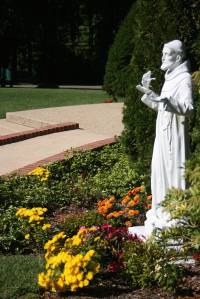
Today we honor the life of St. Francis of Assisi.  Francis is one of the most popular and admired saints of all time.  Most of us know the highlights of his story: born the son of a wealthy man in 1182; had a conversion experience and devoted his life to Lady Poverty; shaped monastic and lay devotion; was a friend to all God’s creatures – being know to have preached to the birds.

But the story I like most is the story about St. Francis and the Wolf.  According to legend, there was a wolf that was terrorizing the town of Gubbio, killing and eating animals and people.  The villagers tried to fight back, but they too died at the jaws of the wolf.  Francis had pity on the townspeople and went out to meet the wolf.  When Francis found the wolf, he made the sign of the cross, and said, “Come to me, Brother Wolf.  In the name of Christ, I order you not to hurt anyone.”  In response, the wolf calmly laid down at Francis’ feet.  Francis then went on to explain to the wolf how he was terrorizing the people and other animals – all who were made in the image of God.  The wolf and Francis then made a pact that he would no longer harm the townspeople and the townspeople would no longer try to hurt the wolf.  The two traveled into town to explain the pact they had formed.  The people were amazed as Francis and the wolf walked side-by-side into town.  Francis made the people pledge to feed the wolf and the wolf pledge not to harm anyone else.  From that day on, the wolf went door to door for food.  The wolf hurt no one and no one hurt the wolf; even the dogs did not bark at the wolf.[i]

What I love about this story of St. Francis is that the story is about reconciliation and relationship.  At the beginning of the story the town and the wolf are at an impasse – the wolf is hungry and getting attacked; the people are afraid and are lashing out.  What Francis does for both parties is shock them out of the comfortable.  For the wolf, no one has addressed the wolf kindly – they have either shut the wolf out or actively tried to kill him.  For the people, the wolf has not asked for help – he has simply and violently taken what he needed and wanted.  Francis manages to shock the wolf first – not through violence or force, but with the power of love and blessing.  By giving a blessing in the name of God, Francis is then able to implore the wolf to reciprocate with love.  Francis also manages to shock the village – not with a violent victory, but with a humble display of forgiveness and trust.  By walking into town with a tamed wolf at his side, Francis is able to encourage the town embrace, forgive, and care for the wolf.  Francis’ actions remind both parties that unless their relationships are reconciled, unrest and division will be the norm.

The funny thing about this story is that the story is pretty ridiculous.  I mean, how many of us go around talking to wild animals, blessing them with the sign of the cross, expecting anything other than being attacked?  We will never really know whether the story is true.  But like any good Biblical story, whether the story is true is hardly the point: the point is that the stories point toward “Truth” with a capital “T.”  What this story teaches is that peace and reconciliation only happen through meeting others where they are.  We cannot expect great change unless we are willing to get down in the trenches – to go out and meet that destructive wolf face-to-face.  The other thing this story teaches is relationships are at the heart of peace work.  Only when the wolf and the town began to get to know each other and began to form a relationship with one another could they move forward.

This is the way life is under Jesus Christ.  In our gospel lesson today, Jesus says, “Come to me, all you that are weary and are carrying heavy burdens, and I will give you rest.  Take my yoke upon you, and learn from me; for I am gentle and humble in heart, and you will find rest for your souls.  For my yoke is easy, and my burden is light.”  Jesus’ words have layered meaning.  The first meaning we all catch is that Jesus offers us rest and refreshment.  Jesus encourages us to come to him, to cast our burdens and cares upon him, and to take rest, to take Sabbath in Christ.  Our souls will find peace in Christ Jesus.  The second meaning is that peace in Christ Jesus is not without work.  Jesus does not say come unto me and relax forever in happy retirement.  Jesus says we will still have to take on a yoke – the burden of disciple living.  But luckily, that burden of being Christ’s disciple will not be burdensome – it will be light.  Finally, not only will Jesus make the workload “light,” as in not heavy.  Jesus will also make us “light” – as in lights that shine into the darkness and refuse to allow the shadow to overwhelm.[ii]  We become the light when we work for reconciliation in our relationships with others.

That is why we do so many special things today.  Today, we ask for healing prayers – that God might help us reconcile the relationships in our life that need healing.  Today, we ask for blessing on our animals – that God might help our relationship with our pet be one of blessing and light.  Today, we come to Jesus for Sabbath rest – that God might renew us on this Sabbath day, use the rest to fill us with light, and renew our commitment to be agents of reconciliation, gladly putting on Christ’s yoke.  Amen.

[i] John Feister, “Stories about St. Francis and the Animals,” as found at http://www.americancatholic.org/features/francis/stories.asp on September 30, 2014.

[ii] Mel Williams, “Let it go…and rest” Faith and Leadership, July 6, 2014 as found at http://www.faithandleadership.com/sermons/mel-williams-let-it-go%E2%80%A6and-rest  on September 30, 2014.

Sermon – Philippians 2.1-13, P21, YA, September 28, 2014

01 Wednesday Oct 2014

Posted by jandrewsweckerly in Uncategorized

≈ Leave a comment

Tags

community, ego, humility, Jesus, other, Paul, self, Sermon, spiritual discipline, together

Humility has always been one of the trickiest virtues for me.  I actually see myself as a pretty humble person, mainly because life has deflated my ego enough times that I learned pretty quickly to be humble.  In high school I was at the top of my class, and I remember how my classmates all thought I was pretty smart.  But when I got to college, everyone else had been at the top of their class too – and quite frankly, the workload was crazy hard.  Any ego I had started to build up in high school was immediately brought down to size.  Or, as I like to tell the acolytes, in one of my first Sundays as an ordained priest, I was serving the chalice.  We missed a latecomer, so I grabbed the chalice and rushed around the altar to serve them.  In my rushing, my elbow hit the side of the altar, and the wine splashed all over the stone floor.  The gasp from the choir in the chancel was audible.  For someone who holds the sacredness of liturgy dear, I was mortified; but there was nothing I could do.  So humility has never really been an issue for me.  But the weird thing about humility is owning the virtue.  As soon as you declare, “I am a pretty humble person,” haven’t you just negated your humility by bragging about your humility?

Of course, the quest for humility can go to the other extreme as well.  I have a friend who went through a phase of being a pretty fanatical Christian.  At some points I found talking with him to be so frustrating that I avoided him altogether.  He was so obsessed with being a humble Christian that you could never pay him a compliment.  I might say something simple like, “I’m so proud of how well you are doing in school.”  And his immediate retort would be, “Oh, well I had nothing to do with that.  All the credit belongs to God.”  There really is no good response to a retort like that without sounding sarcastic or rude.

But humility is what our epistle lesson today demands.  Paul addresses the community at Philippi with a letter from prison.  Worried that the community of Philippi stay on the right track, Paul tells them, “Do nothing from selfish ambition or conceit, but in humility regard others as better than yourselves.  Let each of you look not to your own interests, but to the interest of others.  Let the same mind be in you that was in Christ Jesus.”  In three simple sentences, Paul’s instructions get harder and harder.  First, Paul tells the community not to let their egos get too big.  Paul wants the community to right-size itself by looking at their intentions and attitudes.  Second, Paul tells the community not just to be humble, but to put the needs of others above their own needs.  Here Paul is commanding the community not just to correct their attitudes, but to reorient their actions as well, focusing on others before themselves.  Finally, as if the other two were not hard enough, Paul takes his instructions one step further and tells the community to have the same mind as Christ Jesus.  Paul wants the community to be a humble as the man who sacrificed his own existence for the sake of humanity.  The more I read Paul’s letter this week, the more I wondered whether my fanatical friend had not been rooting his whole life in the mandate presented here by Paul.  Maybe my friend’s annoying, over-the-top humility was actually what Paul was suggesting.

The challenge with trying to take on any spiritual discipline, like taking on the mind of Christ, or becoming more humble, is that we tend to fret so much over the discipline that we get lost in ourselves – which is, in fact, the very opposite of what Paul invites us to do today.  In focusing on our weaknesses or lack of humility, and trying to work our way into a more humble way of being, instead, we find ourselves alone, struggling with God, but separate from others who may actually be able to help us in our quest for humility.  The secret to mastering humility is not by focusing on the self, but instead by focusing on others.  One scholar describes this method by explaining, “One does not ‘self-empty’ by focusing upon oneself.  One is emptied of self to the degree one is overcome by the needs, pains, hopes, and desires of others.  When concern for others takes one utterly beyond self-interest, beyond obsessions with achievements and self-obsessing guilt over failures, beyond self, then one receives the comfort of an Easter ‘yes’ so overwhelming, unconditional, undeniable, and absolute that [the ‘yes’] is experienced as unfailing and forever – a yes more potent and enduring than any imaginable no.”[i]

When I did my year of AmeriCorps service, I arranged to clean and lock up the Episcopal Campus House in exchange for a free room in the back of the house.  Since AmeriCorps volunteers get a very modest living stipend, the free housing was a huge help.  But one day, at the end of a particularly physically grueling day of work, I was talking to one of the clients that the Food Bank served.  He lived in a group home and was trying to transition to independent housing.  We were talking about my housing situation and he marveled, “Man, I wish I could find a situation like that!”  Truthfully, I had taken my housing situation for granted – occasionally I even resented having to clean toilets and mop floors.  But after that conversation, every time I mopped those floors I remembered how incredibly lucky I was.  I needed that client to help me get to a place of humility and gratitude.

That realization is what Paul is hoping the community at Philippi will have as well.  Paul knows that setting aside the self is difficult.  That is why he pushes us to look at the needs of others.  Paul knew that when the community of faith began focusing on others, they would forget about themselves.  They would gain the perspective needed to help them on the journey toward humility.  And as the community turned more and more outward, they would be turning more and more toward the life of Christ – a life always oriented toward the other.  The work of building individual humility and having a mind like Christ only happens in the context of community.  The work cannot be done alone.

In 1974, poet Adrienne Rich was awarded the National Book Award in poetry, having beaten out fellow nominees Audre Lorde and Alice Walker.  When she gave her acceptance speech, she shocked the literary community.  She began, “We, Audre Lorde, Adrienne Rich, and Alice Walker, together accept this award in the name of all women whose voices have gone and still go unheard in a patriarchal world.”  The three women had sat down together before the event and written the statement.  No matter who won that night, this would be the statement of the winner.  When asked about the statement, they “said they believed that by supporting and giving to each other they could enrich each other’s lives and work more than by competing against each other.”[ii]  What these three poets did was refuse to play by the rules of the game.  Instead of accepting that there must be one winner, they declared that they had all won – despite what the award givers were proclaiming.

What these women did is what Paul was hoping the Church community would do.  By working together, these women resisted the temptation to lose their humility.  If any of them alone had won, they could have become puffed up with pride.  Conversely, if any of them alone had lost, they could have spiraled into the depths of self-doubt.  But together, they were able to claim a humble acknowledgement that God was working through each of them to do great things.  That is the true nature of humility – one found and expressed through community.  We are blessed to already have in place the kind of community that can support and encourage one another in the development of humility.  Our invitation is to trust this community enough to uplift us, to challenge us, and to help us grow.  We cannot face the journey alone; but luckily, we are not alone in the midst of this community.  Amen.

[i] William Greenway, “Theological Perspective,” Feasting on the Word, Year A, Vol. 4 (Louisville: Westminster John Knox Press, 2011), 114.

[ii] Entire story told by Mike Grave, “Homiletical Perspective,” Feasting on the Word, Year A, Vol. 4 (Louisville: Westminster John Knox Press, 2011), 113.

Sermon – Matthew 20.1-16, P20, YA, September 21, 2014

25 Thursday Sep 2014

Posted by jandrewsweckerly in Uncategorized

≈ Leave a comment

Tags

equality, fair, generous, God, good works, gracious, gratitude, Jesus, judgment, justice, laborer, landowner, love, Sermon, unfair

Having worked in the non-profit sector for almost seven years before going off to seminary, I learned that even when people are trying to be at their best, sometimes ugliness slips in and makes the waters murky.  At Habitat for Humanity, as part of the homeowner application process, each applicant received a home visit before being selected to be in the program.  The home visit enabled us to get to know the homeowners better, to ask clarifying questions, and to get a real sense of how desperate their current housing situation was.  Since volunteers usually did these visits, we had to do a great deal of training – not just on the logistics of a visit, but really on how to be thoughtful visitors.  For example, many of our volunteers would come back to our staff and complain about the applicants.  “They would be a lot better off if they hadn’t bought that big TV and weren’t paying for cable,” some would argue.  Or another complaint often was, “If they weren’t giving so much of their income to church, they might be able to make ends meet.”

Both arguments were true – but they did not capture the full truth.  Yes, that big TV purchase and that cable bill might seem like an extravagance to one of our volunteers.  But if you can never afford going to the movies, eating dinner out, or going to a play or concert, the TV is the only thing that makes you feel connected to the world, offers release from stress, and gives some modicum of entertainment to your children.  Likewise, yes, that weekly donation to their church probably would be better used to pay down credit card debt.  But their relationship with God is probably the only thing that has helped them survive this long.  That contribution gives them a sense of grounding, of priorities, and a feeling like they too are contributing something to the world.  Even though the Habitat volunteers were generously giving of their time, and were generally kind-hearted people, sometimes their judgments got in the way of their good works.

The same can be true about our relationship with God.  We often give lip service to how much we appreciate that our God is a generous, gracious God who is full of love and compassion.  We have experienced that abundance many times in our lives and we strive to incorporate a sense of gratitude in our lives.  But our sense of gratitude often battles with our sense of justice – in a way that brings out the ugliest versions of ourselves.  Jesus knew this reality all too well.  Jesus captures that tension in the parable he tells today.  The parable is familiar.  A landowner goes out to the market five times in one day, hiring additional laborers each time.  The first group, hired at 6:00 a.m. is promised the usual daily wage.  Each subsequent group is promised “whatever is right” as a wage.  But when the time comes to pay the laborers, the landowner pays the group who only worked one hour a full day’s wage.  The group who started twelve hours earlier sees the landowner’s generosity and assumes they may be getting more than the landowner promised.  But when their turn comes, they only get the usual daily wage.  The workers do not like this, and immediately hoist up the “that’s not fair” flag.

The truth is that the twelve-hour workers are right.  The landowner is not fair.  I imagine any of us who saw a glimpse of the pay distribution at our jobs would be pretty miffed if the newest employees were making as much as the employees who had been there many years longer.  Many people have been advocating lately for legislation that helps to equalize pay for women.  And many activists have challenged the ways in which our justice system has a bias towards the wealthy.  We are a people who are passionate about fairness and justice.  Even when someone pushes back with the classic line, “well, life’s not fair,” we still will fight for fairness as much as we can.

The problem in our gospel lesson is that the kingdom of God does not value fairness over all other ethics.  The kingdom of God holds other values before fairness:  the value of love, the value of graciousness, the value of care.  Most of us can admit that when we hear of the landowner’s generous giving to the last round of workers, our immediate thought is how lovely the landowner’s generosity is.  We all love generosity until we see that some are getting more generosity than we are.  Then something awful happens.  The “evil eye” creeps in and starts to distort our view.  This is the very accusation the landowner makes.  The landowner’s response is simple, “Are you envious because I am generous?”  Other translations translate the phrase for “being envious” as “having an evil eye.”  In other words, insidious jealousy, envy, and greed immediately prevent any sense of celebration and goodwill among the workers.  Instead of a pat on the shoulder, or an acknowledgment of the incredible blessing the late workers receive, the early workers start grumbling about fairness and equality.  They forget that they got what they agreed to:  a day’s wage for a day’s work.

What the parable is trying to communicate, albeit a bit harshly, is that the fact that God is so generous is a benefit to all of us at some point in our lives.  For those of us who have ever been at the bottom, we know how blessed we can feel when God reaches out a generous hand to us.  But I think what makes today’s lesson so difficult for many of us is that although we know that God’s preference for generosity can help us when we are down, we do not ever want to actually be down.  We want to be earning our keep, striving for success, and achieving our way to the top.  We do not like the feeling of not being able to achieve our way through life.

I read an article this past summer about a woman who had been firmly ensconced in her middle-class life, making a reasonable amount of money.  She and her husband were pregnant with twins when two things happened in rapid succession.  First, they bought a house at the top of the housing bubble, right before the bubble popped, making their home depreciate in value by about $90,000.  Then, her husband lost his job.  The twins were born premature, necessitating very expensive formula.  The article goes on to explain how this middle-class, successful couple went from comfortable living to trying to make ends meet with assistance from Medicaid, food stamps, and the WIC program.  She describes the judgmental comments and gestures people made, from blaming her for her problems, to criticizing the food she was buying for her family.  She writes, “What I learned…will never leave me.  We didn’t deserve to be poor, any more than we deserved to be rich.  Poverty is a circumstance, not a value judgment.  I still have to remind myself sometimes that I was my harshest critic.  That the judgment of the disadvantaged comes not just from conservative politicians and Internet trolls.  It came from me, even as I was living it.”[i]

The invitation for the laborers in the field, and the invitation for with each of us is to remember the words from that offertory prayer, “All things come of thee, O Lord…”[ii]  When our hearts are set on gratitude for all that we have, instead of wrapped up in our manmade notions of entitlement, then celebrating with the one-hour workers is a lot easier.  Because we know, like that middle-class woman, that we could at any moment be one of those waiting all day for an hour’s worth of work.  As one scholar says, “This parable reminds us that God is a lousy bookkeeper and invites us to transform our pride, envy, and hardness into joy by admiring and celebrating God’s astounding generosity.  The parable calls us to look at ourselves honestly and lovingly, as God looks at us.  [The parable] invites us to turn from holding grudges because things did not go our way, to let go of the stuff of our lives that keeps us from being joy-filled and grateful people.”[iii]  When we accept that invitation, and turn ourselves toward gratitude, we catch a glimpse of the joyous party that is waiting with the landowner in the kingdom of heaven.  Amen.

[i] Darlena Cunha, “This is what happened when I drove my Mercedes to pick up food stamps,” Washington Post, July 8, 2014 found at http://www.washingtonpost.com/posteverything/wp/2014/07/08/this-is-what-happened-when-i-drove-my-mercedes-to-pick-up-food-stamps/.

[ii] 1 Chronicles 29.14.

[iii] Charlotte Dudley Cleghorn, “Pastoral Perspective,” Feasting on the Word, Year A, Vol. 4 (Louisville: Westminster John Knox Press, 2011), 96.

Sermon – Matthew 18.21-35, P19, YA, September 14, 2014

19 Friday Sep 2014

Posted by jandrewsweckerly in Uncategorized

≈ Leave a comment

Tags

domestic violence, forgiveness, free, gift, hurt, Jesus, love, obligation, Peter, self, Sermon, terrorism

This week has been a bit rough.  We started the week talking about Ray Rice and the NFL’s handling of the physical abuse of Rice’s then-fiancée.  The incident raised all sorts of questions about domestic violence:  how genuine the NFL’s stance on domestic violence is, why people stay in abusive relationships, and what domestic violence really looks like.  And then, just days later, we honored the anniversary of September 11th.  We made space for those who are still mourning deaths, we remembered our own experiences of that day, and we reflected on how much our world has changed in the shadow of that event.

Needless to say, when pondering the horrors of domestic violence and terrorism, the absolute last thing I wanted to do this week was to pray on our gospel lesson from Matthew.  The scene is familiar.  Jesus has just told the disciples about how to resolve conflict within the community of faith, and Peter appears with a question.  “Lord, if another member of the church sins against me, how often should I forgive?  As many as seven times?”  In other words, Peter basically comes to Jesus asking the question that we all want ask, “Okay, so I know you want us to be a community that honors God, even when we fight.  But how many times, exactly, do we really have to forgive someone?  I mean, surely there are limits to how many times we have to keep forgiving someone?”  I give Peter credit.  Peter manages to come off sounding pretty generous.  I mean, how many of us would propose forgiving someone seven times before cutting them off completely?  Instead, our most common colloquialism is “Fool me once, shame on you.  Fool me twice, shame on me.”  In our culture, we will forgive someone once and clear the slate.  But if people cross us twice, we believe we would be foolish to stay in a relationship with them because they have proven that they cannot be trusted.

But Jesus does not concede to our modern sensibilities about forgiveness.  Jesus’ response to Peter is shocking, “Not seven times, but I tell you, seventy-seven times.”  Now seventy-seven times is way more leeway with which most of us feels comfortable.  And that is not even taking into account that some translations translate Jesus’ instructions not as seventy-seven times but seventy times seven.[i]  Regardless, the point is that Jesus is basically saying that there is not true end to forgiveness.  “There can be no limit on forgiveness, because [forgiveness] is a never-ending practice that is essential to the life of the church.”[ii]

What ultimately makes us feel uncomfortable about Jesus’ words is that when we begin to talk about forgiveness, most of us have some pretty distorted beliefs about forgiveness.  Some of us believe that forgiveness means excusing or overlooking the harm that has been done to us and saying that everything is okay.  For those who hold that belief, forgiveness can be equated with stuffing our feelings down deep inside or downright lying in order to keep the peace.  Others of us believe that forgiveness means allowing those who have hurt us to persist in their behavior.  For those who hold this belief, forgiveness is so important, that we become recurring victims of offenses.  Still others believe that forgiving means forgetting what happened.  For those who hold this belief, forgiveness is pretending an old hurt does not still hurt.  Finally, others see forgiveness as something that we can do at will, and always all at once.  For those who hold this belief, forgiveness must be immediate and offered quickly.  The problem with all these models of forgiveness – of overlooking the harm, saying everything is okay, of allowing recurring behavior, of trying to forget, or forgiving once and for all – is that these models of forgiveness fall apart when we run into extreme situations like the ones from this week with Ray Rice or September 11th.

The tremendously good news this week is that all of these understandings about forgiveness would have been foreign to Jesus.  I was reading one of my favorite authors this week on her thoughts about forgiveness.  Jan Richardson says of forgiveness, “The heart of forgiveness is not to be found in excusing harm or allowing [the harm] to go unchecked.  [Forgiveness] is to be found, rather, in choosing to say that although our wounds will change us, we will not allow them to forever define us.  Forgiveness does not ask us to forget the wrong done to us but instead to resist the ways [the wrong] seeks to get its poisonous hooks in us.  Forgiveness asks us to acknowledge and reckon with the damage so that we will not live forever in [the damage’s] grip.”[iii]

That is why Jesus tells the hyperbolic parable about the servant and the forgiving king.  The forgiveness by the king of ten thousand talents (or the equivalent of 150,000 years of labor)[iv] is almost ludicrous in its generosity.  The servant would never have been able to pay that amount back.  But then again, the forgiveness we receive from our Lord and Savior Jesus Christ is also ludicrous – ludicrously abundant, underserved, and more than we could ever earn.  And yet, the times we struggle to forgive will be like when the unforgiving servant cannot forgive the hundred denarii owed by another servant (or the equivalent of a hundred days of labor) – a much less egregious amount to owe.  In order to be a people who live under Jesus’ excessive forgiveness, we must be a people who are also willing to work on the art of forgiveness.  But we do not do that work out of obligation – instead we do that work as a gift to ourselves.

There once was a woman who went to see her Rabbi.  The woman was a divorced single mom who was working to support herself and her three children.  She explained to the Rabbi that since her husband walked out on them, every month she struggled to pay the bills.  Though she and the kids could not afford everyday treats like going to the movies, her ex-husband was living it up with his new wife.  The Rabbi suggested that the woman forgive her ex-husband and she was indignant.  “How can you tell me to forgive him,” she demanded.  The Rabbi responded, “I’m not asking you to forgive him because what he did was acceptable.  What he did was not acceptable – it was mean and selfish.  I am asking you to forgive him because he does not deserve the power to live in your head and turn you into a bitter angry woman.  I would like to see him out of your life emotionally as completely as he is out of your life physically, but you keep holding on to him.  Know this:  you are not hurting him by holding on to that resentment.  You are only hurting yourself.”[v]

Jesus does not propose that we forgive seventy-seven or seventy times seven times because Jesus is a sadist.  Jesus knows forgiving is hard.  But Jesus also knows that the worst part about forgiveness is not that the work is hard.  The worst part about forgiveness is that when we do not forgive, we only hurt ourselves.  And Jesus does not want us to be locked in a prison of resentment and anger.  Jesus wants us to be free.  One of the reasons Jesus asks us to forgive so many times is because Jesus knows this work does not happen overnight.  Forgiveness is not a once-and-for-all event.  Forgiveness requires us to keep going, to keep trying, because only in the practice of trying – in fact trying until our earthly lives are over – will we ever come close to the profound forgiveness that we receive through the life, death, and resurrection of Christ Jesus our Lord.  Our work on mastering the art of forgiveness is not a gift that we give to others.  Our work on mastering the art of forgiveness is the gift that we give to ourselves.  We work on the art of forgiveness because we are working on loving ourselves as much as Jesus loves us.  Amen.

[i] Lewis R. Donelson, “Exegetical Perspective,” Feasting on the Word, Year A, Vol. 4 (Louisville: Westminster John Knox Press, 2011), 69.

[ii] Charles Campbell, “Homiletical Perspective,” Feasting on the Word, Year A, Vol. 4 (Louisville: Westminster John Knox Press, 2011), 69.

[iii] Jan Richardson, “The Hardest Blessing,” Sept. 9, 2014, as found at http://paintedprayerbook.com/2014/09/09/the-hardest-blessing/#.VBOogcKwKi0.

[iv] David Lose, “Pentecost 14A: Forgiveness and Freedom,” Sept. 7, 2014, as found at http://www.davidlose.net/ 2014/09/ pentecost-14-a/.

[v] Paraphrased story by Harold S. Kushner, quoted by Charlotte Dudley Cleghorn, “Pastoral Perspective,” Feasting on the Word, Year A, Vol. 4 (Louisville: Westminster John Knox Press, 2011), 72.

Sermon – Matthew 18.15-20, P18, YA, September 7, 2014

11 Thursday Sep 2014

Posted by jandrewsweckerly in Uncategorized

≈ Leave a comment

Tags

avoid, church, conflict, conflict resolution, God, Jesus, present, reconciliation, Sermon

I have heard the argument many times before.  When people see conflict, poor behavior, and ugliness in the Church, the complaint is always the same.  People feel like they see enough ugliness in the world, at work, at school, or even at home.  When they come to Church they just want to be around people who love each other, who never fight, and who are always on their best, most loving, supportive behavior.  Many imagine that the Church should be a conflict-free zone of love and joy; full of those who love the Lord, love one another, and love every person who walks through those doors.  We want an escape from the world when we come to Church – not more of the same.

And so, in order to create this magical conflict-free Church, we start engaging in behaviors that avoid immediate conflict, but probably make things a lot worse.  Instead of dealing with conflict directly, when we feel wronged by someone, we just talk about them behind their back.  Or, when someone sins against us, instead of approaching the problem with the person, we just call a bunch of people in the church to complain about them.  Or if we are feeling wronged by someone, instead of talking to them one-on-one, we just send them a nasty email, copy the clergy, and, while we are at it, we CC the bishop.  Or if all else fails, when someone does us wrong, we don’t say anything:  we just avoid them; un-friend them on Facebook; and, if we cannot avoid them on Sundays, then we just leave the church altogether.[i]

Part of the reason we engage in these behaviors that usually make the conflict worse is because the alternative is downright scary.  We hear Jesus’ instruction manual for dealing with conflict in the church in Matthew’s gospel and we panic.  First of all, Jesus’ instructions force us to admit that we will have to deal with conflict within the Church.  This premise totally dismantles our dream of the loving, conflict-free Church.  And we are not sure we are ready to let go of that dream.  But secondly, if we can let go of our tight grasp on our conflict-free Church dream, we sure as heck do not want to follow Jesus’ instructions.  Going to someone directly to talk about how someone has sinned against us scares most of us to death.  We are not sure what to say and we are not sure how what we say will be received.  And if we somehow manage to get over our fears and the person rejects us, we cannot imagine taking one or two others with us to approach the offender again.  That sounds way too much like an intervention, and we worry that the number of people in the room will only escalate things.  And since we can barely imagine taking one or two other parishioners along with us, we find the idea of bringing the offence before the entire parish unfathomable.  Jesus must be out of his mind if he thinks we are going to parade our personal business in front of the whole church.

I served in a parish once that went through a major conflict.  A parishioner who had been working with the youth group had developed some serious boundary issues which came to a crisis point.  After receiving complaints from several parishioners, the rector called the person-in-question into his office.  That one-on-one meeting did not go so well.  Rumors started to fly, and the offender’s version of the conversation was quite different from the rector’s version.  Eventually, others had to be brought into the conversation.  The whole issue took about a year to resolve, and the offender was so angry that he eventually left the church and many other parishioners were hurt and frustrated along the way.

Part of the challenge is that using Jesus’ model for conflict resolution is not as simple as the model sounds.  Meeting one-on-one can go horribly wrong, as the meeting with my old rector went wrong.  And having a meeting with three or four people can also go horribly wrong – the offender can feel attacked, confidentiality can be difficult to keep, and rumors can start to spread.  And sharing an individual offense with the entire parish is difficult in our litigious society.  Charges of slander and libel are much too easy to file.

The good news is that I do not think the specifics of Jesus’ conflict resolution plan really matter – at least not in the strictest sense.[ii]  What is more important is that this passage from Matthew does several critical things.  First, this passage debunks the notion that the Church will ever be conflict-free.  That this passage exists at all is evidence that conflict is a natural, unavoidable part of life, even life in the church.[iii]  I know that may sound like bad news to some of us, but actually the reality that conflict is unavoidable opens the door to the second good part of this passage.  In addition to helping us see the inevitability of conflict, this passage also reminds us that there are healthy ways to deal with conflict.  Though we may not choose Jesus’ exact method, there are ways to encourage reconciliation over back-stabbing and gossip.  And those reconciling methods are healthy for the offender, the victim, and the community as a whole.  Jesus is not worried about “whether or not we fight, disagree, or wound one another, but how we go about addressing and resolving those issues.”[iv]

Finally, Jesus reminds us that God is with us even in our ugly moments of conflict.  Jesus says, “For where two or three are gathered in my name, I am there among them.”  We often jokingly quote this passage when we are having low church attendance.  But what Jesus means when he says these words is that when two or three are gathered in resolving conflict, Jesus is there in their midst.  I cannot imagine a more assuring word from Jesus today.

I once knew a couple who were married for 55 years.  One day I asked the wife what their secret was.  She told me several things, but one of them stuck.  She said that if either of them was disciplining the children and the other parent disagreed with their decision, they never questioned the decision in front of the children.  Later that night, they might talk about their disagreement, but they always supported one another in the heat of the moment.  I remember thinking that their practice necessitated respect, biting one’s tongue, and a humble love that was free from pride.  All of that was not visible through the good stuff of their marriage, but instead through the hard stuff of their marriage.

Now I know some of you are going to go home disappointed today.  Your dream of Church being a conflict-free love fest is getting shattered today.  You may have been hoping after hearing Paul talk about love today that we could all just sing, “They Will Know We Are Christians by Our Love,” and walk out of here on a cloud.  Truthfully, having people see how we love each other and being able to recognize our Christian identity through our love is wonderful.  But equally wonderful today would be if we could sing, “They Will Know We Are Christians by How We Fight.”

In a few moments, we will do a few things that mark our Christian identity.  We will confess our sins, ask for healing, and pass the peace.  These are all steps toward reconciliation with God, with ourselves, and with one another.  Perhaps you have been experiencing conflict here in our church community, at home, or at work.  Now is your chance to reconcile that conflict, and live into what being a person of faith means.  There is no way to avoid the fact that Christians fight, disagree, and argue.  But how we fight means much more than that we fight.  The church invites us to be a people committed to reconciliation, knowing that where two or three are gathered in conflict together, Christ is in the midst of us.  Amen.

[i] Rick Morley, “Before You Unfriend – Matthew 18:15-20,” August 23, 2011, as found at http://www.rickmorley. com/ archives/803?utm_source=rss&utm_medium=rss&utm_campaign=proper18agospel on September 4, 2014.

[ii] Eric Barreto, “Commentary on Matthew 18:15-20,” as found at http://www.workingpreacher.org/preaching.aspx? commentary_id=2164 on September 5, 2014.

[iii] Jin S. Kim, “Pastoral Perspective,” Feasting on the Word, Year A, Vol. 4 (Louisville: Westminster John Knox Press, 2011), 46.

[iv] Kim, 46.

Sermon – Exodus 3.1-15, P17, YA, August 31, 2014

05 Friday Sep 2014

Posted by jandrewsweckerly in Uncategorized

≈ 1 Comment

Tags

discomfort, God, holy ground, Moses, paranoia, sacred, Sermon, shoes

Shoes are a funny thing.  Their basic function is protection – from rough roads and paths, from debris and water, from extreme heat and extreme cold.  Not having shoes can lead to injury, disease, and disability.  But having shoes can create problems too.  Once feet are covered, they can become sweaty or smelly.  Shoes can hide unkempt toenails or misshapen feet, making us hesitant to remove them at times.  And of course, shoes can also be markers of status – those fancy Nikes or Manolo Blahniks.

And so when we are asked to remove our shoes, our first response can often be panic.  Every year when we do the foot washing on Maundy Thursday, I hear people chatting about their foot concerns.  Holy Wednesday of that week could be relabeled, “Holy Pedicure Day.”  I have overheard parishioners strategizing about socks versus hose, about pre-washing their feet before the service, and about avoiding the foot washing part of the liturgy altogether.

Our paranoia about feet and footwear can be found everywhere.  We all know people who have a “no shoe rule,” in their home.  Sometimes when you forget about that rule, you may panic, wondering if you put on those socks with the holes in them that day.  In my daughter’s nursery care room, there is a sign that asks everyone to take off their shoes before entering the room since the little ones who are crawling will put everything in their mouths – including debris from shoes.  Because I usually have my five-year old in tow, plus a baby in my arms, the trouble of shoe removal is often annoying.  When I traveled to Burma, I bought special sandals because we were told that the Burmese always remove their shoes before entering any building.  I knew with such frequency of removing shoes, I had to worry about sandals that were both comfortable for lots of walking, but also easily slipped on and off.

This fall, St. Margaret’s will be offering a new Sunday School program for our Middle School students.  The program is called Rite-13.  The program is meant to help middle schoolers to start claiming their faith lives and their adulthoods as their own.  They will spend time talking about images of God, their prayer lives, their understanding of God’s call to love one another, and what being a young person of faith means.

One of my favorite lessons from Rite-13 is one that talks about prayer.  In the lesson, the young adults and teachers are not admitted into the room unless they take off their shoes.  When I taught this lesson many years ago, the reaction was immediate.  Some of the kids giggled, some looked worried; other kids refused at first and hung back, while others seemed skeptical, but willing.  The action was simple, but the action of taking off their shoes created unease.

Though our Old Testament lesson is filled with vivid images of burning bushes and Moses debating with God, the line that caught my attention this week says, “Come no closer!  Remove the sandals from your feet, for the place on which you are standing is holy ground.”  As I pondered on this moment for Moses, when God proclaims the ground to be holy and worthy of shoes being removed, all those places where I have also been asked to remove my shoes kept coming back to me – Maundy Thursday foot washings, my friend who insists that shoes be left at the door in the winter, my daughter’s nursery school room, Burmese diocesan offices, and that Rite-13 classroom.  Though some of those places require removed shoes for religious purposes, some of those places make that request for purely practical reasons.  But despite the sacred and secular division, I found myself imagining each of those places as places that God might call holy ground.

When I come forward for foot washing on Maundy Thursday, I do so to allow the foot washer to claim their servant ministry.  As I vulnerably offer my battered feet, and they humbly kneel to wash those feet, the ground becomes hallowed in the sacred exchange.  As water splashes on the wooden floor, something holy happens on that ground.

When I visit my friend’s home, and slip off my shoes in respect of her rules, something sacred always happens.  Whether we share a hearty laugh, we commiserate over a glass of wine, or we simply break bread together, God is present between us.  The carpet of her home is holy ground.

When I drop of my daughter at school, and dutifully take off my shoes, I mark the space as something other than simply a place to care for children.  Those workers are joining me in the sacred work of raising a child – of sharing in milestones, of caring for bodily needs, of loving and sharing joy.  By taking off my shoes, I remind myself that God is present with our children even when we are not there.

When I entered a building in Burma, I always loved the visual of piles of flip flops near the door.  On those cold cement floors walked servants of God who simply wanted to know that they were not forgotten by their American Christian brothers and sisters.  And though we struggled to communicate in vastly different languages, the friendships that we forged were forged on holy ground.

And when I entered that Rite-13 classroom, and those teenagers and I began to talk about what prayer is and who this God is that we worship, with our feet exposed to each other, our awkward, vulnerable conversations were held on holy ground.

When we hear Moses’ dramatic call narrative today, we often think that Moses is told to take off his shoes because that specific ground at Horeb is holy.  But I wonder if something else is happening in this story.  Perhaps the ground itself is not holy, but what is happening on the ground is what makes the ground holy.  The soil itself is not made up of particular particles that are inherently holy.  The soil becomes holy because of what happens there.[i]  God calls Moses to a task that will change his life forever – to free the people of Israel from bondage and to lead them to the Promised Land.  In this sacred conversation between Moses and God – even when Moses argues with God constantly about how ill-equipped he is for this mission – the ground becomes hallowed because of the vulnerable, honest, sacred exchange between a holy servant of God and the great, “I AM.”

We encounter holy ground in our own lives everyday.  That holy ground is obvious to us in some places – at the communion rail, in our favorite pew, or in our favorite prayer spot.  But this week, Moses invites us to see holy ground in more unexpected places – in our workplace, at school, in our homes – and to take off our shoes in recognition of the holy encounters that are happening.  Now, there may be some places that removing your shoes is impractical – while waiting for the train on your morning commute, on the playground at play, or in your favorite restaurant.  But I want you to at least imagine taking your shoes off in all the places you find yourself this week and see how your perspective changes.  Maybe with your shoes off, that guy who elbowed you on the LIRR seems more sympathetic as you look at the dark circles under his eyes.  Maybe with your shoes off, that silent orderly who cleans up the neighboring hospital room seems like more of a crucial part of the hospital than the doctors and nurses.  Maybe with your shoes off, that clerk at the grocery story who barely makes eye contact seems much more interesting as you ponder how she makes a living serving you.  And when you lay your head down to sleep each night this week, I invite you to thank God for the holy ground in your life and the opportunity to remove the sandals from your feet, for the place on which you are standing is holy ground.  Amen.

[i] This train of thought inspired by reflections by Anathea Portier-Young, “Commentary on Exodus 3:1-15,” found at http://www.workingpreacher.org/preaching.aspx?commentary_id=2136 on August 28, 2014.

Sermon – Exodus 1.8-2.10, P16, YA, August 24, 2014

27 Wednesday Aug 2014

Posted by jandrewsweckerly in Uncategorized

≈ Leave a comment

Tags

change, choice, difference, Exodus, genocide, God, impact, midwives, other, Pharaoh, Puah, racism, Sermon, Shiphrah

We know exactly where our story is going today in Exodus when the introduction says, “Now a new king arose over Egypt, who did not know Joseph.”  This introduction is ominous because to not know Joseph is to not know how Joseph saved Egypt from famine, making Egypt a world leader in a time of crisis.  But on a more personal note, to not know Joseph means that the warm welcome the Israelites once received in gratitude for Joseph’s service has also been forgotten.  This is how Pharaoh’s reign of terror begins.  Not knowing the formerly friendly arrangement between these two very distinct groups, Pharaoh chooses prejudice and fear.  Afraid that this foreign group will pose a threat, Pharaoh strikes preemptively.  First, he enslaves the Israelites, forcing them into labor for Egypt.  But that kind of subjugation is not enough to assuage Pharaoh’s paranoia.  So Pharaoh starts another campaign – he enlists midwives to kill any male newborns, in the hopes of reducing the number of men who can revolt against his new stratified system.  And when that campaign does not work, Pharaoh extends his reach and calls upon all the Egyptians, instructing them to kill all Hebrew newborn boys that they encounter.

This story is scary because the story is a bit too familiar.  Just in the past several months we have witnessed similar violence and oppression of “the other.”  The advance of ISIS in Iraq is so extreme that their violence is being labeled as genocide.  Whole communities of faith, both Christian and other faiths, are either being displaced, murdered, or sold into slavery.  And though the players and terrain may be foreign to us, genocide is not.  Whether through Pharaoh thousands of years ago, in the Holocaust seventy years ago, or in Rwanda twenty years ago, we know the devastation, trauma, and scars that genocide leaves.  Each time we pray, “Never again,” and yet, here we find ourselves again in Iraq.

A more complicated version of oppression can be found much closer to home – in Ferguson, Missouri, in Staten Island, and yes, even in Plainview.  Though the recent cases are about the racial tensions between police officers and African-Americans, the truth is that racism is a reality throughout our country and involves a system of oppression that benefits some over others.  I remember when I first met my husband, Scott, we had a conversation about racism.  As young seventeen-year olds, we came from very different backgrounds.  He was a conservative Republican (though I think he was a Republican mostly in defiance of the long history of liberal democrats in his family – but that is another story).  He grew up in San Diego:  a military town across the border from Mexico.  His peers were people of every race, nationality, and geography, and what he saw was a mixture of people who seemed to function without much prejudice.  I, on the other hand, was an idealistic Democrat, who saw a very different world in rural Georgia and North Carolina.  I was a part of an organization as a young woman who did not welcome people of color – a fact I did not realize until I wanted to invite my African-American girlfriend to join.  At my high school, there were threats of the KKK coming by to intimidate the few African-Americans at our school.  So when Scott and I first began to talk about racism, you can imagine that we had very different opinions about the role that race places in our country.

The scary part for me in our news lately is that genocide and racism are two different expressions of the same problem.  Both stem from the recognition of difference – of there being one group of privilege and one group of disenfranchisement – or “the other.”  Once an “other” has been established, judgments of value are next.  Through those judgments of values emerges prejudice – and in the instance of race, racism.  When taken to the extreme, that prejudice can lead to genocide – a complete annihilation of “the other.”  So genocide and racism are just markers on a spectrum of reactions to difference.

Now many of you may be thinking, “Okay, so we cannot help but notice differences among us.  And if we notice differences, and the next natural step is a judgment of value, then what are we supposed to do?  How are we supposed to change our natural judgments?  Obviously most of us are opposed to the extreme of genocide, but can we really do anything about racism?”  As a person who has attended many anti-racism trainings and programs, this is where many of us are caught up short.  When we enter into discussion about this issue, we feel guilt, frustration, helplessness, defensiveness, confusion, anger, and shame.  Though most of us can agree that we do not want a society where prejudice exists, truthfully, we just do not even know where to start or what to do.

That is why I love this story from Exodus today.  Though Pharaoh brings the ugliness of our current events into light, the women in this story show the way toward salvation.  My favorite women are the midwives, Shiphrah and Puah.  Pharaoh tells the midwives that as the Hebrew women are delivering their children, if they deliver any male children, the midwives are to kill the boys immediately.  Shiphrah and Puah have several options here.  They can run away – out of fear of Pharaoh, they can disregard their charge from Pharaoh and run for safety.  They can stand up to Pharaoh, refusing to kill others, but face the consequences of Pharaoh’s anger.  But what they do instead is genius.  Instead, they disobey, but they disobey with cunning.  The midwives play into the prejudice of Pharaoh – that the Hebrews are somehow different.  So they come back to Pharaoh with farcical story about why they did not kill the babies, “Because the Hebrew women are not like the Egyptian women; for they are vigorous and give birth before the midwife comes to them.”  You can almost hear the feigned innocence and incompetence in their response.  Though we all know that the midwives basically lie to pharaoh, Amy Merrill Willis calls this act by the midwives a “gracious defiance,” because of the way “it embraces life and blurs Pharaoh’s attempts to draw lines of distinction between ‘us’ and ‘them,’ between Egyptian and Hebrew, between dominating and dominated.”[i]   Shiphrah and Puah show the world another way to respond to prejudice.  And their small act – their act of gracious defiance – changes the course of history.

What I love about Shiphrah and Puah’s story is that they basically teach us that we can all make a difference – in fact, we can all change the world.  Now I know that sounds idealistic or pie-in-the-sky, but think about this.  Shiphrah and Puah were of little consequence in their time.  They have very little power.  They work under Pharaoh and they are women in a time when women had even less power than they do today.  All they did in a little slice of history was disobey an order and tell a tiny little, but incredibly awesome, lie.  And from that small, tiny action, they save an entire people.

Andy Andrews wrote a book called The Butterfly Effect, in which he argues that each of us makes decisions every day that have a ripple effect on others, and that simple, courageous efforts can have an extraordinary impact.[ii]  The possibilities are endless:  the teacher who encourages a student who later befriends another student who is going through a rough patch; the grandfather who volunteers to read at the local elementary school who instills a love of reading in a child who later becomes a prolific writer; the parishioner who makes a sandwich for a client of the INN, who is no longer so hungry and disheartened that he cannot care for his struggling family; the young woman who helps a mom load groceries into her trunk who is then encouraged to be much more kind and patient with her rowdy, sometimes frustrating children.

The point is that when we talk about the world’s ills – racism, prejudice, or genocide – we often feel overwhelmed and incapable of affecting change.  But the truth is, we can be a part of changing the world every day.  The choices we make impact others and ripple out in much larger ways that we can imagine.  Sometimes our choices are bold and courageous, but sometimes they are small, often unnoticed choices.  But our choices have the potential to impact greater change than we know.  Thousands of years ago, Shiphrah and Puah were the gracious defiers who quietly and cunningly stood up to a bully and tyrant.  This week, you can be the gracious defier who chips away the world’s injustice.  The choice is yours – and the potential for goodness is great.  Amen.

[i] Amy Merrill Willis, “Commentary on Exodus 1:8-2:10,” as found at http://www.workingpreacher.org/preaching. aspx? commentary_ id=972 on August 19, 2014.

[ii] David Lose, “The Butterfly Effect,” as found at https://www.workingpreacher.org/craft.aspx?post=1599 on August 19, 2014.

← Older posts
Newer posts →

Recent Posts

  • On Politics, Football, and Love…
  • On Sharing the Love…
  • Sermon – Micah 6.1-8, Matthew 5.1-12, EP4, YA, January 30, 2026
  • On Justice, Kindness, Humility, and the Messy Middle…
  • Feast of the Rev. Dr. Martin Luther King, Jr., January 18, 2026

Archives

  • February 2026
  • January 2026
  • December 2025
  • November 2025
  • October 2025
  • September 2025
  • August 2025
  • July 2025
  • June 2025
  • March 2025
  • February 2025
  • December 2024
  • November 2024
  • October 2024
  • September 2024
  • August 2024
  • July 2024
  • June 2024
  • May 2024
  • March 2024
  • February 2024
  • January 2024
  • December 2023
  • November 2023
  • October 2023
  • September 2023
  • August 2023
  • July 2023
  • June 2023
  • May 2023
  • March 2023
  • February 2023
  • January 2023
  • December 2022
  • November 2022
  • October 2022
  • June 2022
  • May 2022
  • January 2022
  • December 2021
  • November 2021
  • October 2021
  • September 2021
  • August 2021
  • June 2021
  • May 2021
  • April 2021
  • March 2021
  • February 2021
  • January 2021
  • December 2020
  • November 2020
  • October 2020
  • September 2020
  • August 2020
  • July 2020
  • June 2020
  • May 2020
  • April 2020
  • March 2020
  • February 2020
  • January 2020
  • December 2019
  • November 2019
  • October 2019
  • September 2019
  • August 2019
  • July 2019
  • June 2019
  • May 2019
  • April 2019
  • March 2019
  • February 2019
  • January 2019
  • December 2018
  • November 2018
  • October 2018
  • September 2018
  • August 2018
  • July 2018
  • June 2018
  • May 2018
  • April 2018
  • March 2018
  • February 2018
  • January 2018
  • December 2017
  • November 2017
  • October 2017
  • September 2017
  • August 2017
  • July 2017
  • June 2017
  • May 2017
  • April 2017
  • March 2017
  • February 2017
  • January 2017
  • December 2016
  • November 2016
  • October 2016
  • September 2016
  • August 2016
  • July 2016
  • June 2016
  • May 2016
  • April 2016
  • March 2016
  • February 2016
  • January 2016
  • December 2015
  • November 2015
  • October 2015
  • September 2015
  • August 2015
  • July 2015
  • June 2015
  • May 2015
  • April 2015
  • March 2015
  • February 2015
  • January 2015
  • December 2014
  • November 2014
  • October 2014
  • September 2014
  • August 2014
  • July 2014
  • June 2014
  • April 2014
  • March 2014
  • February 2014
  • January 2014
  • December 2013
  • November 2013
  • October 2013
  • September 2013
  • August 2013
  • July 2013
  • June 2013
  • May 2013
  • April 2013
  • March 2013
  • February 2013
  • January 2013
  • December 2012
  • November 2012
  • October 2012
  • September 2012

Categories

  • reflection
  • Sermons
  • Uncategorized

Meta

  • Create account
  • Log in
  • Entries feed
  • Comments feed
  • WordPress.com

Blog at WordPress.com.

  • Subscribe Subscribed
    • Seeking and Serving
    • Join 391 other subscribers
    • Already have a WordPress.com account? Log in now.
    • Seeking and Serving
    • Subscribe Subscribed
    • Sign up
    • Log in
    • Report this content
    • View site in Reader
    • Manage subscriptions
    • Collapse this bar
 

Loading Comments...