• About

Seeking and Serving

~ seek and serve Christ in all persons

Seeking and Serving

Tag Archives: stewardship

On Inhabiting Gratitude…

12 Wednesday Nov 2025

Posted by jandrewsweckerly in reflection

≈ Leave a comment

Tags

act, barriers, God, gratitude, incarnate, practice, stewardship, tangible, Thanksgiving

Photo credit: https://www.southernliving.com/culture/what-to-write-in-thank-you-card

November is regularly a month when I talk about gratitude with my parish.  Most of that push comes from the confluence of things that happen in November.  We are almost always closing up our stewardship season in November – a season when we encourage parishioners to let their giving reflect their gratitude toward God.  We are also preparing for the Thanksgiving holiday – which although a secular holiday comes pretty close to being a sacred time of thanksgiving and praise.  And just yesterday we took the day to thank Veterans, honoring the sacrifices their vocations require and the blessings we enjoy because of their work.

This year, to help cultivate my own sense of gratitude, I picked up a calendar one of my favorite non-profits produced call “30 Days of Gratitude.”  Though some of the “activities” are to think about something I am grateful for, like a good memory in my home, most of the “activities” are more hands-on – like expressing gratitude to every member of the household or greeting a neighbor.  What I have loved about the calendar is the shift the calendar has created. 

Often when we talk about gratitude, we feel burdened – like we’re supposed to force ourselves into an emotion.  But what the calendar has done is make gratitude tangible – to act on my gratitude.  What’s beautiful about that shift is that the action is something I can do that has the unintended consequence of feeling gratitude instead of trying to manufacture gratitude out of thin air.  The calendar has made gratitude incarnate – allowed me to inhabit gratitude instead of simply emoting gratitude.  It’s a subtle change, but one that feels much more freeing.

I wonder how you are navigating gratitude during this season.  What are the barriers to you inhabiting gratitude?  What burdens are clouding your gratitude practices, making you more cranky than grateful?  Gratitude is not easy.  If it were, folks wouldn’t be producing gratitude calendars and journals.  I invite you to find the tool, the person, or the community who can help make your gratitude incarnate.

On Commitments and Gratitude…

15 Wednesday Oct 2025

Posted by jandrewsweckerly in reflection

≈ Leave a comment

Tags

blessing, commitment, God, grateful, gratitude, joy, list, positive, sight, stewardship, support

Photo credit: https://medium.com/@mnwieschalla/why-you-should-make-a-gratitude-list-every-night-before-bed-fc4a30196af9

One of the tools I use in my line of work is an executive coach.  The coach helps me examine my leadership and develop tools for higher levels of executive functioning.  Sometimes that means troubleshooting a specific challenge I am facing and sometimes that means skill development work.  Each month that we meet, we monitor progress and reflect on newly emerging needs or unresolved issues.  This month the content of our meeting was a little different.  We spent most of the meeting reflecting on things that were going well – successes to celebrate, progress being made, and joys to honor.  As I shared each positive reflection, I was reminded of other things to celebrate.  It was as if the positive news was multiplying, bubbling up as I recalled each source of thanksgiving.

In many ways, that is what we have been inviting our entire congregation to do in this season of stewardship.  Before asking parishioners to consider how they might support ministry with their time, talent, and treasure, first we have been sharing our joys – what good things are happening in our church, what positive impact we are making inside and outside of our church community, and what goodness is motivating our members.  Each bit of sharing has led to more positive, encouraging reflection:  from the mom who really appreciated the elder member sharing about how much he values the formation of children in our church, to the person who still isn’t sure they are an Episcopalian hearing about someone else’s journey to the Episcopal Church through Hickory Neck, to the parishioner who knows the speaker has different views from them but who finds a similar sense of belonging in this unique place.  We have found the sharing of our gratitude begets more gratitude – opens our eyes to the abundance that seems hard to see lately.

This week, as we begin to think about our commitment of support to our church, I invite all of you to start first with gratitude.  What is bringing you joy in your faith community?  What are you grateful for?  What keeps bringing you back?  Start today with a list of three different things for which you are grateful.  Write them down (or make a note in your phone).  Tomorrow, think about three other items, repeating the process each day.  See how the list grows, and watch how your sight begins to widen.  You’re welcome to have your commitment card and forms nearby (or the link from our website open in your tabs), but first, take some time filling your heart with gratitude before filling out the forms with commitments.  Let your commitments pour out of your grateful heart and your conversation with God before sharing those commitments with the community.  I can’t wait to hear how starting with gratitude changes your sight.

Sermon – Luke 17.11-19, P23, YC, October 12, 2025

15 Wednesday Oct 2025

Posted by jandrewsweckerly in Sermons

≈ Leave a comment

Tags

blessing, duty, God, gratitude, Jesus, lenses, lepers, see, Sermon, sight, stewardship, Thanksgiving

Several years ago, A.J. Jacobs wrote a book called Thanks a Thousand.  Jacobs had decided that he loved his daily cup of coffee from his local coffee shop so much that he wanted to thank every person who made the cup of coffee possible.  His book journals what started out as that simple premise that became a journey around the world.  You see, he could easily thank the barista he saw every morning.  But then he realized he should thank the owner of the shop for the shop existing in the first place.  From there, he realized the owner had a graphics designer who designed the logo, and there was company that made his coffee cup that carried that logo.  He eventually recalled the beans for the coffee came from somewhere – and there were hundreds of people who moved the beans from tree to harvest to packaging to shipping to storage and to distribution.  And that didn’t include those who made sure the city had clean water that was used to combine beautifully with beans to make his daily beloved cup of coffee.  Each thank you – often received with confusion, surprise, mystification, and occasional delight – led to another individual for Jacobs to thank.  Jacobs had read that the practice of gratitude could change your life, and slowly, he began to find that genuine gratitude made him kinder, happier, and gave him the opportunity to make an impact in the world.  Gratitude helped him to see the world differently.

In our gospel lesson today, ten lepers experience a miraculous healing through Jesus.  Jesus sends the lepers to the priests and they become clean along the way.  But only one of the lepers actually sees that he is healed.  We are told that because he sees, he turns back, praises God, and prostrates himself at Jesus’ feet, thanking him.  Now, to be clear, the other nine lepers do nothing wrong.  In fact, they follow Jesus’ instruction explicitly and enjoy being healed.  The promise made to them is fulfilled.  The tenth leper – a Samaritan of all people – though sees.  And when he returns to give thanks, he is blessed a second time.  David Lose explains, “Jesus concludes his exchange by inviting the man to rise and go on his way and saying that his faith has made him not only physically well, but also whole and, indeed, saved.  That’s part of the complex and multivalent meaning of the Greek root word σoζω (transliterated as “sozo” and pronounced “sod-zo”) Jesus uses.”[i]  That second blessing does not happen though without the act of seeing.

The Samaritan leper experienced a second blessing much like A.J. Jacobs experienced a second blessing.  Once Jacobs began his coffee gratitude journey – thanking all those folks who made that perfect cup of daily coffee – he began to see just like the leper.  His eyes were opened to the powerful work of God by the simple act of gratitude.  Scholars across the centuries have noted how deeply faith and gratitude are linked.  “Karl Barth was fond of saying that the basic human response to God is gratitude – not fear and trembling, not guilt and dread, but thanksgiving.  ‘What else can we say to what God gives us but stammer praise?’ [Barth says.]”  C.S. Lewis “also observed the connection between gratitude and personal well-being.  [He said,] ‘I noticed how the humblest and at the same time most balanced minds praised most:  while the cranks, misfits, and malcontents praised least.  Praise almost seems to be inner health made audible.’”[ii]  The entire enterprise of thanking thousands of people for his cup of coffee was A.J. Jacobs’ attempt to correct his vision so that he might cultivate a healthy practice of faith.

The Stewardship team at Hickory Neck this year has been doing the same thing.  They have been working to help us better see God in this place we keep returning to.  Today you will receive a packet of information meant to engage your vision.  In the packet will be testimonies of how much this community has impacted the lives of your fellow parishioners.  You will find a visual representation of how every dollar is stretched to make possible the goodness we experience here.  You will find an invitation to respond to your own gratitude to Jesus for the many blessings in your faith journey by committing your time, your talent, and your treasure –not out of a sense of duty, but because you have seen goodness here, and gratitude is bubbling out of you.  And in case all those invitations into seeing differently are not enough, our Stewardship team will be bringing back to you the stories of your fellow parishioners in their own words.  Each week, you will be sent videos on what they are calling Motivational Mondays and Faithful Fridays – videos of your fellow parishioners describing how their devotion to generosity has richly blessed their faith journey.

In the coming weeks, you may be tempted to do what the nine lepers do – to dutifully follow Jesus’ invitation to go and be healed – and simply open your stewardship packet and return the commitment card and time and talent form.  And doing so would not be wrong at all – in fact, the Stewardship Team and Vestry would be deeply grateful.  But our invitation from today’s gospel lesson goes a little further than duty.  Our invitation is to put on new lenses – to use the tools Hickory Neck is gifting you to better see the overwhelming blessings from the Spirit and to make tangible our gratitude – “gratitude for the gift of life, gratitude for the world, gratitude for the dear people God has given us to enrich and grace our lives.”[iii]  I cannot wait to hear what you see.  Amen.


[i] David Lose, “Second Blessing,” October 7, 2013, as found at https://www.workingpreacher.org/dear-working-preacher/second-blessing on October 10, 2025. 

[ii] John M. Buchanan, “Homiletical Perspective,” Feasting on the Word, Yr. C, Vol. 4 (Louisville:  Westminster John Knox Press, 2010), 165.

[iii] Buchanan, 169.

Sermon – Luke 12.13-21, P13, YC, August 3, 2025

27 Wednesday Aug 2025

Posted by jandrewsweckerly in Sermons

≈ Leave a comment

Tags

community, enough, financial planning, God, Jesus, parable, resources, rich, self, Sermon, steward, stewardship, support

One of the last things that happens when you graduate from seminary is the staff from the Church Pension Group comes to talk to you about money management.  They help you understand how retirement funds work for clergy, encourage you to make sure you are doing some additional savings and investment planning, and remind you that, like tithing, how you manage your finances is a witness to your congregation about being good stewards.  Each year, you are encouraged to be a smart investor through email reminders.  We even go to a wellness conference a few times over the course of our ministry to make sure we are tending to our financial wellness in addition to vocational, spiritual, and bodily wellness.  The repeated lesson to clergy is to be good stewards of our financial resources.

You can imagine how your clergy and anyone schooled in financial stewardship hears today’s parable from Jesus.  At first glance, this is a story about smart financial management.  A man has a bumper crop – the land produces so abundantly he cannot fit the excess crops into his current barns.  Knowing the land is fickle, maybe even having taken some notes from our ancestor Joseph who prevented a seven-year famine by stockpiling during a seven-year boon, the man decides he will just have to build a bigger barn to hold all the extra crops.  His actions do not sound that far off from what any investment counselor might tell us to do – store the excess away so that when a rainy day comes, or even when retirement comes, we can still “eat, drink, and be merry.” 

But, like any good parable, there is a plot twist:  the day the newly enlarged barn is finished is the same day the man will die.  All those plans, hopes, and dreams for a secure retirement are gone.  He never gets to enjoy the fruits of his labor.  He never gets to retire in comfort.  He never gets to eat, drink, and be merry.  Our immediate reaction to this tragedy might be to proclaim how life or God is not fair.  But into our protest, Jesus says, “So it is with those who store up treasures for themselves but are not rich toward God.”

These last words from Jesus are ones that sting.  Jesus reminds us that being a good steward of our resources means lots of things:  being smart with our money, saving for times of famine, giving to the church, and caring for our neighbor.  But most importantly, being a good steward of our resources is not just about sound financial practices.  Being a good steward of our resources is also about managing our relationship with our money – and more specifically, managing our relationship with God in relation to our money.

Now some of you may be thinking, “Here she goes.  She’s going to tell me how I need to give more money to the church to right my relationship with God.”  The good news is I do not think Jesus is looking for a specific corrective – as if to say, “Do not be like the man with the barns:  give your full ten percent to the church and all will be well.”  No, what Jesus is trying to do is help us see that our relationship with money matters.  Unlike a polite Southerner, Jesus never shies away from talking about money.  He is constantly warning us about the potential of riches to corrupt our relationship with God.  The answer to what the rich man should do may not be specific, but we get some obvious clues about what Jesus means by being rich toward God.

Going back to the story is particularly helpful.  The most obvious thing we see happening in the parable is the wealthy man has become completely self-absorbed and ego-centric.  Listen again to the words of the parable, “And he thought to himself, ‘What should I do, for I have no place to store my crops?’ Then he said, ‘I will do this: I will pull down my barns and build larger ones, and there I will store all my grain and my goods.  And I will say to my soul, ‘Soul, you have ample goods laid up for many years; relax, eat, drink, be merry.’”  The list is long:  What should I do?  My crops, my barns, my grain, my goods, my soul.  All the words of the wealthy man are self-referential.[i]  Nowhere does he talk to God.  Nowhere does he talk to his family or a trusted friend.  Nowhere does he consult his property manager, or the local priest – the whole conversation is with himself.  Further, he never praises God for the abundance.  He never acknowledges that the land has provided.  He never even considers sharing his abundance.  He is self-interested, self-protecting, and self-centered.  All that focus on the self comes from a relationship with money and with God that is simply out of whack.

So how do we avoid the slippery slope that leads to self-centeredness and greed, luring us to constantly redefine how much is “enough”?  What exactly is being rich toward God?  Jesus tells us the answer to our quandary throughout Luke’s gospel.  As one scholar explains, “Being rich toward God entails using one’s resources for the benefit of one’s neighbor in need, as the Samaritan did (10:25-37).  Being rich toward God includes intentionally listening to Jesus’ word, as Mary did (10:38-42).  Being rich toward God consists of prayerfully trusting that God will provide for the needs of life (11:1-13, 12:22-31).  Being rich toward God involves selling possessions and giving alms as a means of establishing a lasting treasure in heaven (12:32-34).”  In other words, “Life and possessions are a gift of God to be used to advance God’s agenda of care and compassion, precisely for those who lack resources to provide for themselves.”[ii]

I served on a church board many years ago that received a surprise bequest of about 1.3 million dollars.  The bequest came from a woman who had seemed to be of little consequence.  Each year she had probably given the charitable group about $25 a year.  We assumed that was about all she could do.  When the gift came in, we were stunned.  After some prayerful discernment, we elected to put one million into our endowment, to ensure that we could keep helping ministries in our diocese.  But we designated the remaining three hundred thousand for us to try new and innovative ministries – and luckily for us, there was already a proposal on the table that we thought we could not afford:  a food truck that would take food around to the homeless in one of our cities, and maybe even host a social worker and or nurse.  I do not know what sort of life this woman led or how she managed her money.  But even in death, her richness toward God was obvious to us all.

Though we may be tempted to finger-point at the self-centered man of means, Jesus knows that money has the power to corrupt all our relationships with God.  And unfortunately, the consequences are not limited to our relationships with God – our ability to live lives rich toward God impacts our neighbors too.  The good news is we have a community of faith sitting right next to us who can be our support system as we work to turn our hearts and our riches to God.  Now I know we all value being good Southerners, but this time, Jesus is pushing us out of our cultural norms and patterns.  In order to turn our hearts and riches toward God, we are going to need to start talking with our friends about the place of money in our lives and in our relationship with God.  We are going to need to talk about our struggles and failures.  And we are going to need to celebrate our victories and successes.  We are basically going to need to become a giant support group for becoming rich toward God.

Pastor and scholar David Lose tells a story of a “congregation who invited families to not buy any unnecessary new thing for six months in order to break the culturally-induced habit of trying to buy happiness.  But they didn’t just invite people to do this, they formed a culture in which they supported each other.  They read and talked about a common book on abundant life, they kept in touch via small groups and email, they shared where they were succeeding and struggling and what they were learning.  In short, they formed a community so that they could stand against the all-too-human and culturally supported belief that if we just had a little more we’d be happy.”[iii]

I do not know what model or what goals are going to work for each of you.  But I do know that just by our very citizenship in this country, in this time of scarcity thinking and fear mongering, we face more temptation toward greed than in probably any other country.  If we are going to follow Jesus, to avoid a life of self-centeredness, and claim a life of being rich toward God, we are going to need each other.  Whether you want to form a small group or just find a trusted friend, this is the important work Jesus invites us into today.  My guess is that building up a community of support that is rich toward God will create much more opportunities to eat, drink, and be merry, than any bigger barn could ever give us.  Amen.


[i] Audrey West, “Theological Perspective,” Feasting on the Word, Yr. C, Vol. 3 (Louisville: Westminster John Knox Press, 2010), 312.

[ii] Richard P. Carlson, “Exegetical Perspective,” Feasting on the Word, Yr. C, Vol. 3 (Louisville: Westminster John Knox Press, 2010), 315.

[iii] David Lose, “What Money Can and Can’t Do,” July 29, 2013, as found at http://www.workingpreacher.org/craft.aspx?post=2668 on August 1, 2025.


Sermon – 1 Kings 17.8-16, P27, YB, November 10, 2024

13 Wednesday Nov 2024

Posted by jandrewsweckerly in Sermons

≈ Leave a comment

Tags

afraid, blessing, church, consecration, drought, election, Elijah, enough, God, promise, Sermon, stewardship, trust, widow of Zarephath

On this Consecration Sunday, the day we offer and celebrate our gifts to support the ministry of this beloved community, the lectionary seemingly delivers the perfect text – the widow’s mite.  One might guess the lectionary shapers designed the lectionary just for a day like today – so that the sermon might be a nice a tidy story about how you too might give sacrificially.  But that story – and that sermon – are not our gift today.  After the tumultuous election week we have had, our gift lies with another widow – the widow of Zarephath from the first book of Kings. 

The widow of Zarephath is both a woman and widow, and as you know by now, that makes her doubly vulnerable in Elijah’s day.  In fact, although our translation says she is a widow, the original Hebrew actually adds, “…the word ‘woman’ in apposition before ‘widow.’  Verse 9 could literally be translated as, “Rise and go to Zarephath, which belongs to Sidon, and dwell there.  Look, I have commanded a woman, a widow, to sustain you.”[i]   The widow is also the mother of a child who is dependent upon her, so she has needs beyond her own.  If we read a bit further in Kings, we learn she is not normally poor – even as a widow, she owns a home that is large enough for an upper chamber.[ii]  And, we know she lives in Sidon, which means she is a foreigner, and that she likely worships Baal.

But to fully understand this widow we have step back even further.  The reason Elijah wanders into Sidon needing food is because he is fleeing Queen Jezebel, another Sidonian woman who has convinced King Ahab to build temples to Baal, and who threatens to kill Elijah.  So, we already see two different treatments of Elijah by two different Sidonian women.[iii]  But the other big piece of information is there is a drought in the land – and the lack of water means a threat to life – in fact, any poverty the widow of Zarephath faces is because the drought has dried up the food supply.  But drought also has theological significance in this story.  “…the condition of drought is the result of the Israelite King Ahab’s disobedience.”[iv]  As Old Testament Scholar Ellen Davis explains, “Overall, from a biblical perspective, the sustained fertility and habitability of the earth, or more particularly of the land of Israel, is the best index of the health of the covenant relationship.”[v]  In other words, if there is a drought, the people of God have really messed up!

Now sometimes stories from the Bible feel so foreign, that even with context like we just learned, we do not really feel like we can relate.  But if we really think about the widow of Zarephath and her context today, we find much more relatability than we might like to admit.  We certainly know the reality of people of means suffering financially.  In fact, a recent story from Forbes said that over 75% of Americans are living paycheck to paycheck.[vi]  That’s a lot of folks eking out a living with last bits of grain and oil.  We also know something about fighting about authority and ultimate values – where we put our trust.  I would say the dramatically different reactions to the election this week are a classic example – from people who are relieved by the election results to people who feel so marginalized they do not feel like they can even stay in relationship with their neighbors.  Our church too is living donation to donation – with the annual threat of budget deficits – and is now facing the reality of what being a politically diverse community means – how we will not just respect differences but how we will actively serve Christ as one.  I think we are all too familiar with what being in a theological drought is all about.

So, what happens to this woman widow in Zarephath?  As she faces the ludicrous request of Elijah to feed him when she is literally about to feed her son and herself their last meal before they die of starvation, Elijah says, “Do not be afraid.”  I confess, when I first read those four words this week, “Do not be afraid,” I was pretty upset.  That’s God’s answer to this theological drought we are in?  This hurting, deeply divided, seemingly irreparable place?  Do not be afraid?!?  Now, the good news is I stayed in the text.  As I kept studying, I stumbled on a commentary in which Professor Robert Wall said, “‘Do not be afraid,’ is not meant to comfort one facing death but rather to inspire confidence that [Elijah’s] God keeps promises of salvation made.”[vii]  Elijah’s God keeps promises of salvation made.  And as if to support the good professor’s insight, Elijah goes on to say in the text, “For thus says the LORD the God of Israel:  The jar of meal will not be emptied and the jug of oil will not fail until the day that the LORD sends rain on the earth.”[viii]  God never says the jar will be overflowing or we will have so much we will need a second jug.  But God does say we will have enough.

Those words from Elijah, those words that often introduce an oracle of salvation[ix], are words for us too.  Do not be afraid.  I know those four words may feel impossible for some of us today.  Many of you have already told me about your literal fears:  either your fears about the economy before the election or your fears for your rights and dignity after the election.  But those four words are our promise today – that God keeps promises of salvation made.  Like Elijah promises the widow, so God promises to you today that your jar of meal will not be emptied and your jug of oil will not fail until the day that the LORD sends rain on the earth.  So, even in our fears, we make promises to the church about what time, talent, and treasure we can share to ensure our ministries remain vibrant and thriving.  In our fears, we keep coming to church and engaging with neighbors who differ from us more meaningfully than we did before.  In our fears, we trust in our God, no matter what civic leaders are in place.  Because our jar will not be emptied and our jug will not fail, we can trust that we will have enough – enough for ourself, enough for our neighbor, and enough for the church.  We can say yes, just like the widow of Zarephath on the verge of death.  We can say yes.  Do not be afraid.  Amen.


[i] David G. Garber, Jr, “Commentary on 1 Kings 17:8-16,” Working Preacher, November 10, 2024, as found at https://www.workingpreacher.org/commentaries/revised-common-lectionary/ordinary-32-2/commentary-on-1-kings-178-16-9 on November 8, 2024.

[ii] Denise Dombkowski Hopkins, “Exegetical Perspective,” Feasting on the Word Supplemental Essays, Year B, Batch 4 (Louisville:  Westminster John Knox Press, 2012), 6.

[iii] Hopkins, 4.

[iv] Garber.

[v] Ellen F. Davis, Scripture, Culture, and Agriculture: An Agrarian Reading of the Bible (New York: Cambridge University Press, 2009), 8, as quoted by Garber.

[vi] Emily Batdorf , “Living Paycheck To Paycheck Statistics 2024,” Forbes Advisor, April 2, 2024 as found at https://www.forbes.com/advisor/banking/living-paycheck-to-paycheck-statistics-2024/?fbclid=IwY2xjawGcVSVleHRuA2FlbQIxMAABHSkGQLYo1Mye_ETSWURRZckm0B5EKB226F-g1znt-H6_s6kt5j5eFvxjvw_aem_OKcSGHZduH78GmIJSrYAZw on November 8, 2024.

[vii] Robert W. Wall, “Theological Perspective,” Feasting on the Word Supplemental Essays, Year B, Batch 4 (Louisville:  Westminster John Knox Press, 2012), 3.

[viii] 1 Kings 17.14.

[ix] Ronald J. Allen, “Considering the Text: Week Six, Twenty-Fifth Sunday After Pentecost, 10 November 2024”  Center for Faith and Giving, as found at centerforfaithandgiving.org, 41.

Sermon – Mark 10.17-31, P23, YB, October 13, 2024

13 Wednesday Nov 2024

Posted by jandrewsweckerly in Sermons

≈ Leave a comment

Tags

earn, faithful, giving, God, instrument, Jesus, love, matters, measure, money, pledge, relationship, stewardship, trust, ultimate

As we kickoff stewardship season today, I know what you must be thinking, “Wow!  Jennifer went all-in on scripture this week – she’s really trying to get us to make a big pledge this year!”  And while I would love for you to make a generous pledge this year, you know from how much I complain about the assigned lectionary over the course of the year that I had no part in choosing today’s gospel.  And, if I’m really being honest, if I could choose a passage to kickoff stewardship season, I would not have chosen this text from Mark. 

“Why?” you might ask.  Mark’s story about the wealthy man seems like the perfect tee up for stewardship.  The sermon simply could be, “You heard the words from Jesus directly – sell what you own and give the money away – preferably to your favorite local church.”  But I would not have chosen this text or that sermon – not because this text is so extreme (trust me, I am not asking you to sell everything you own), but because this text goes deeper than money.  Jesus in this text is not just challenging us to be generous givers, Jesus is asking us even bigger questions about salvation and the very nature of our relationship with God.

This story is repeated in all three gospels.  In Luke’s gospel, the man is described as a “ruler,” and in Matthew he is described as “young.”  “But for Mark he is just a regular guy, although with ‘great possessions.’”[i]  In other words, this guy is just like you and me.  Just like you and me, he is trying so very hard to live a faithful life.  Just like you and me, he is already doing the basics – loving his neighbor by following those ten commandments about how we treat one another.  And just like you and me, he is faithfully striving to live a better life – he has sought out this Jesus to learn more and to discover how to order his life so that he can be in right relationship with God.  Jesus gives him, and us, an answer – the way to right that relationship with God – to follow those ten commandments that tell us to both love neighbor and love God – is to right our relationship with money. 

As one scholar explains, “The problem is not wealth per se but our attitude toward [wealth].  As we accumulate riches, we are tempted to trust in our possession and our powers of acquiring them, rather than in God, for our ultimate security and comfort.  Even honestly acquired and generously shared wealth can thus lead to pride.  That is why it is easier for a camel to go through the eye of a needle than for a rich person to enter the kingdom of God.  It is hard to let go of the immediate basis of our security and comfort – and the more we have, the harder [letting go] gets.”[ii]  And so Jesus gives us today the ultimate spiritual discipline – to untangle our relationship with money from our relationship with God:  to see our material blessings not as a badge of honor for righteous living or hard work, but as a tool for sharing the love of Christ – an instrument to demonstrate our love of God through how we use money.

Now, I do not know what your relationship with your wealth is.  Growing up, our family did not have very much of it.  We had what we needed, but some of what we needed was gifted by a neighbor dropping off a basket of produce or a bag of hand-me-down clothing.  I knew if I wanted to go to college, I was going to need to earn some scholarships and financial aid.  The challenge with that kind of upbringing is that, as you come into your own, you realize you are now responsible for ensuring you have enough wealth not to need those gifts from neighbors and institutions.  You have to earn that wealth.  And the danger in knowing your earning of wealth is dependent upon your own blood, sweat, and tears is that you begin to think of everything you have as earned by yourself as opposed to being gifted by God – as though the gifts and talents you have were not gifted by God and enable you to then earn the wealth you need to purchase the rewards for your hard work.  And when we read stories like today’s gospel, we start to get a pit in our stomach – that small, nagging, gnawing feeling that we too might walk away grieving if Jesus were to tell us our relationship with money was interfering with our relationship with God.

That small, nagging, gnawing feeling is what leads the disciples to ask, “Who, then, has any chance at all?”  And here is where the grace comes.  Jesus basically says, “No chance at all if you think you can pull it off by yourself.  Every chance in the world if you let God do it.”[iii]  In other words, we can right our relationship with wealth, we can become peoples of generous giving only through God.  Now Jesus is not saying giving generously will not be hard.  What Jesus is saying is, “You can do hard things.” 

Last fall, one of our families had a long conversation during stewardship season.  As a couple, they handle finances independently in some areas and together in others.  Their giving to church was one of those in the areas they handled independently from one another.  After hearing a testimony from a fellow parishioner, they sat down to look at the numbers – and realized their giving didn’t reflect their theology of money.  And so, they decided to make some changes – to right-size their household budget to reflect the deep relationship with God they knew they had but that they weren’t reconciling within their wallets.  That kind of reconciling work was not easy – but their relationship with God and their membership in a faith community helped them know they could do hard things.

 This year, we have already been talking about ultimate things – about measuring what matters in our lives.  You have heard stories from parishioners about what this community means to them, and how they have come to understand that intimate relationship between their relationship with God and their relationship with their wealth.  Even talking about that small, nagging, gnawing feeling was hard for many of them.  But each one of them knew they could do the hard thing because Jesus enabled them to do so.  They knew, through God, all things were possible.  Their testimonies, Jesus’ words today, and our own desires for greater intimacy with God are the tools that enable us to do hard things:  to examine our relationship with wealth, to examine our relationship with God, and to examine our fears and feelings that hold us back from the freedom that comes from trusting in God and not in our own bootstraps.  Jesus is very plain today.  You cannot pull off right relationship by yourself.  But with God – with God, all things are possible.  Thanks be to God!  Amen.


[i] David B. Howell, “Pastoral Perspective,” Feasting on the Word, Yr. B, vol. 4 (Louisville: Westminster John Knox Press, 2009), 164.

[ii] James J. Thompson, “Theological Perspective,” Feasting on the Word, Yr. B, vol. 4 (Louisville: Westminster John Knox Press, 2009), 166.

[iii] Mark 10.27 as quoted in The Message paraphrase (Eugene H. Patterson, The Message: The Bible in Contemporary Language (Colorado Springs:  NavPress, 2002).

Sermon – Mark 4.26-32, P6, YB, June 16, 2024

19 Wednesday Jun 2024

Posted by jandrewsweckerly in Sermons

≈ Leave a comment

Tags

care, familiar, gift, God, Jesus, kingdom of God, memorable, mustard seed, parable, plant, seed, Sermon, steward, stewardship, talent, time, treasure, work

Many of you know that I grew up in the United Methodist Church.  Growing up in the Methodist Church meant that I was steeped a particular set of hymns, many written by John and Charles Wesley themselves – John being attributed with the founding of the Methodist movement.  I can be at a retirement community or an ecumenical service and one of those songs will come up, and I am instantly transported back to the old country church where my dad was the pastor.  There is something about that music that almost feels like the music is a part of my DNA.  So, imagine my surprise when I found out in seminary that much of the music settings for those old timey hymns I love were actually pub songs – tunes that anyone who had spent time at the pub would know, just set to new words about Jesus.  Charles and John did that because they knew it would make the songs deeply familiar, while becoming teaching tools for the church.  No wonder those hymns are so catchy!

In some ways, parables from Jesus are similar.  Jesus uses story to teach truth.  Teaching through parables makes the teaching engaging, accessible, and memorable.  I bet that even today, two thousand years later, when we heard Mark’s gospel today, we probably thought, “Oh yeah!  The one about the mustard seed.  That’s about just having a little faith is all you need!”  And in part, you would be right.  But as catchy as pub songs are and parables seem, unfortunately, Jesus’ parables, while memorable, are not always simple in meaning. 

Our trouble starts with the fact that we have two parables together today – not just the one about the mustard seed.  In the first one, Jesus says the kingdom is like a guy who scatters some seed and then does literally almost nothing – he does not even know how the growing of seeds into plants works.  And then he just goes out to harvest.  So, that’s parable number one.  Parable number two compares the kingdom of God to a tiny little mustard seed that, when planted, grows into a huge bush big enough where birds can make nests.  So, this is not exactly a set of stories about just having a little bit of faith.  And quite frankly, if you take these two together, they seem to be saying that basically we do not really have much of a hand in the fruitfulness of the kingdom – that maybe we do not even understand the kingdom.  So, is that the message?  Just sit back because God does all the work to bring about the kingdom – oh, and the kingdom will be really big?

As much as I would like to send you all home today thinking you can just kick up your feet and sit back while God does the heavy lifting, especially as summer gets into full swing, unfortunately, we have summertime work to do.  You see, in both of these parables, while the miracle of growth happens through God, the planting in both stories has to be done by a person – by us, namely.  Scholar Amy-Jill Levine explains that in these parables, the seed still has to be planted.  She confesses that certainly some things need to be left alone – notice the man in the first parable.  And sometimes we need to get out of the way – notice the planter in the second parable.  But most importantly, Levine argues “The kingdom is present when humanity and nature work together, and we do what we were put here to do – to go out on a limb and provide for others, and ourselves as well.”[i]

That doing something, that lack of passivity in the bringing about of the kingdom, is what we are talking about when we talk about stewardship.  Often when we talk about stewardship, we think of that as the church’s codeword for our money.  But we were made stewards long before there was a church.  Even in the moment of creation way back in the book of Genesis, God created us to steward God’s creation – to tend to the blessings given to us.  Now that may feel daunting – as if not only are we to tend to this church but now we must tend to the whole world! 

But before you panic, let’s go back to that mustard seed parable.  I do not know how many of you have actually been around mustard plants, but mustard plants are a lot like kudzu – they tend to take over an area where they are germinated.  Jesus is telling us all we do is plant one of those teeny-tiny seeds, and suddenly we will have kudzu spreading everywhere.  In other words, our work of stewardship is like kudzu[ii] – we invest our time, our talent, and our treasure here in this place – and the results will spread like wildfire.  Suddenly, we have whole hillsides full the love of Christ, spilling over into the neighbor’s yard, draping everything in goodness.  We do not have to micromanage the growth – we do the planting, and God partners with us to bring the growth – even growth we sometimes do not understand.  Our job is simply to plant.

Our invitation today, then is to ponder what seeds we can plant here at Hickory Neck.  What gift of time can you place here that can spread to your fellow parishioner?  What gift of your unique talent can you plant here that can grow into powerful ministry?  What gift of your financial resources can you gift here that reach beyond these walls to share and spread God’s love?  Jesus’ familiar story reminds us that whatever we give, our giving allows us to participate with God in helping manifest the kingdom of God.[iii]  And God will spread our gifts like kudzu!  Amen.


[i] Amy-Jill Levine, Short Stories by Jesus:  The Enigmatic Parables of a Controversial Rabbi (New York:  Harper One, 2014), 182.

[ii] Ronald J. Allen, “Considering the Text: Week Two, Fourth Sunday After Pentecost, 16 June 2024,” Center for Faith and Giving, 11, as found at centerforfaithandgiving.org, 2.

[iii] Allen, 13.

Sermon – Acts 1.1-11, AS, YB, May 12, 2024

29 Wednesday May 2024

Posted by jandrewsweckerly in Sermons

≈ Leave a comment

Tags

Ascension, brokenness, church, community, healing, Holy Spirit, Jesus, kingdom of God, lifestyle, money, pivot, relationship, Sermon, sharing, stewardship

Our Stewardship Team gathered throughout the winter and spring and had some meaningful conversations about how we measure what matters in life.  We talked about how stewardship is more than money.  Stewardship is a lifestyle based on a relationship with Jesus Christ and fulfilling our baptismal covenant to provide and participate in the mission and ministry of Hickory Neck Episcopal Church to proclaim the Gospel in word and deed in order to change the world in which we live.  But we also talked about how things can get in the way of our faith journey:  our allegiances, our faith, our compassion, our use of money, our generosity, and our belief that God provides what is necessary for living out our lives.  And so, we agreed.  In order to help us navigate how to be faithful stewards, we would begin a preaching series over the next several months – looking at those challenges to our faith journey and what scripture has to say about them.  Today, the Stewardship team teed me up on this Ascension Sunday to talk about allegiances.

Now I do not know about you, but when I read the text about the Ascension from Acts, I did not really hear anything about stewardship.  Jesus did not lean over his shoulder as he was ascending to heaven and shout, “Don’t forget to tithe 10% to the Church!” So, what does the Ascension have to do with faithful living – with stewardship?  Well, to understand that notion, we have to take a big step back from the event of the Ascension.  You see, the Ascension is sort of a pivot moment in our lives.  Luke, the author of both the gospel of Luke and the Acts of the Apostles, understood history to be “divided into two ages:  the broken old world marked by Satan, idolatry, sin, injustice, exploitation, fractiousness, scarcity, enmity with nature, violence, and death.”  The renewed world where God restores all things to God’s purposes is “marked by true worship, forgiveness, justice, mutuality, community, abundance, blessing between nature and humankind, shalom, and life.”[i]  Jesus’ life and ministry was in witness against the broken world and a shepherding in of the renewed world.  In the process of ascending Jesus gives authority to the disciples to continue the work of the renewed world.  That’s why the whole rest of the book of the Acts of the Apostles will be about how the community of Jesus – the Church – will live:  sharing resources, supporting those in need, living as a community of abundance, mutuality, and justice.

This past Thursday’s Discovery Class was the session where the attendees teach the rest of class on given topics.  One set of our class members focused on the history of the early church in America.  They talked about how the church in the 1600s and 1700s was the governing body of the region – using their resources to care for widows and orphans, tending to those who fell on hard times, basically serving as the social services agency of the region.  Now, they also had clergy appointed by the governor and charged local residents a mandatory levy to help the Church pay for those expenses (an idea I imagine a certain treasurer of ours probably wouldn’t mind) – but for all intents and purposes, the early church of the Americas operated just like the early church in the Acts of the Apostles – living as a community sharing resources, supporting those in need, embracing abundance, mutuality, and justice.  In essence, a community who understood their allegiance to be to the kingdom of God and not to the kingdom of brokenness:  a community of faithful stewardship.

We are told in our reading from the Acts of the Apostles that as the disciples watch Jesus ascend to the heavens they stand there for a moment – frozen in time as their scrambled brains try to figure out what has just happened and what Jesus’ ascension means.  While they are standing there, looking at heaven, two men in white robes appear and ask them a simple question, “Why do you stand looking up toward heaven?”  In other words, God uses these men in white to tell the disciples, “Don’t just stand there – go be the church!  Jesus showed you the way to abundant, faithful stewardship.  Now go bring kingdom living to life!”

That is our invitation today too.  Now you may be thinking, “Yeah, but the Church has changed so much.  We are not the primary social services agency in town – we are not the place responsible for people’s physical, emotional, and spiritual well-being!”  But Jesus tells us today that we are.  That every single member of this community has a part to play – can contribute your financial resources, the gift of your skills and expertise, the offering of your time to make this church a modern expression of the kingdom of God here in Upper James City County.  On this Ascension Sunday, we can choose to carry on the work of Christ, to do our part to turn away from brokenness and be agents of healing and wholeness.  Where will we find the capacity to enliven that abundant life?  In our Eucharistic Prayer today we will pray, “And, that we might live no longer for ourselves, but for him who died and rose for us, he sent the Holy Spirit, his own first gift for those who believe, to complete his work in the world, and to bring to fulfillment the sanctification of all.”[ii]  Not only did Jesus give us the mission, Jesus also gives us the Holy Spirit – that gift we will celebrate next week – so that we might be the faithful stewards of God’s abundance, declaring our allegiance to living in the light – to being the agents of abundance God knows we can be.  Our invitation is stop looking up, and start looking around at the kingdom God has gifted us to tend.  Amen.


[i] Ronald J. Allen, “Considering the Text: Week One, Ascension Sunday, 12 May 2024”  Center for Faith and Giving, as found at centerforfaithandgiving.org, 2.

[ii] BCP, 374.

On Looking Back to Look Forward…

20 Friday Oct 2023

Posted by jandrewsweckerly in reflection

≈ Leave a comment

Tags

church, Episcopal Church, formation, God, gospel, history, impact, seminary, stewardship

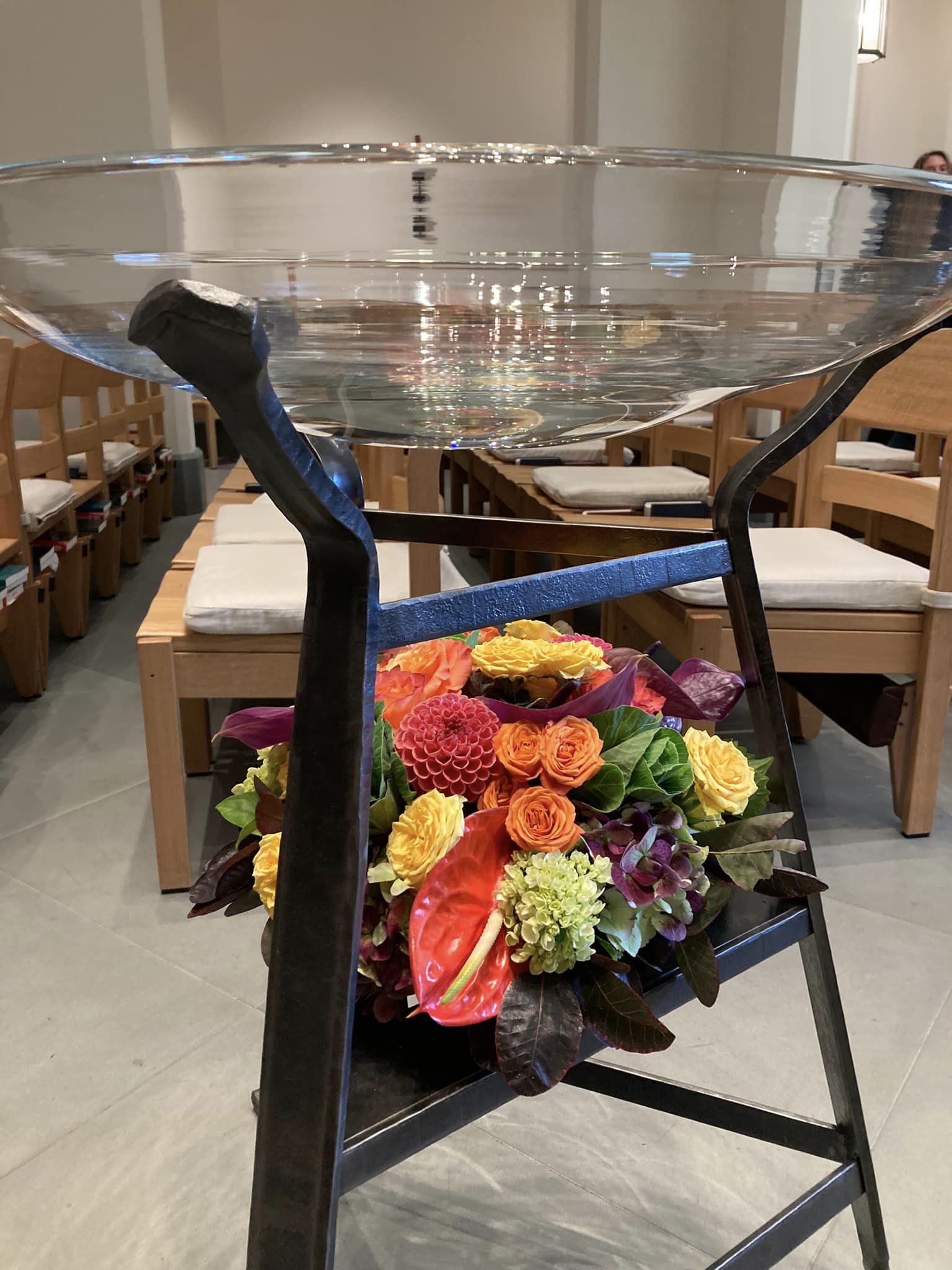
Font at Virginia Theological Seminary

I remember when I was a seminarian, sitting in daily worship, my eyes and mind would sometimes wander.  In particular, I was fascinated by the names or other small mementos carved into the old pews.  I always wondered who the mystery person was who left their mark, how long ago they carved it, and how they managed not to get caught.  What I loved about those small little marks was how they made me feel connected – connected to a long line of priests and lay leaders shaped by the seminary, all with varying gifts and talents, serving God in God’s church around the world.

Last week, my seminary honored 200 years of forming priests in the Episcopal Church.  Though those pews from the old chapel were lost in a fire, what struck me was the massive changes the seminary has seen.  From slaves who helped build and then worked on the property, wars that shaped the context for ministry dramatically for generations, fiduciary decisions that impacted the viability and structure of the seminary, the growing diversity of the student body as the Episcopal Church’s understanding of who can be called to ministry has expanded, and an evolving physical plant that has shifted what the school on the holy hill looks like – all of that change has made for a rich and layered history, of which I am a small part. 

But perhaps what speaks to me most about Virginia Theological Seminary is the ways that it also has a microcosmic impact on the church – namely, the ministry of every graduate from the seminary.  My time at VTS shaped and formed me into the priest I am today – from academic formation to liturgical formation, from learnings on leadership to the development of relationships, from shaping my spirituality to shaping my sense of the wider church.  And for every graduate like me, VTS has shaped thousands of others who go out into the world to preach the gospel.  That reality is what inspires my financial support every year – knowing the future generations I can support.

As my church journeys into stewardship season, a time of discernment about how we will support our church financially and with our time, I am reminded of how we all come to think about the stewardship of our resources.  Supporting my seminary and my church financially are ways I say to those institutions and my community that these institutions are important to me:  they have made an impact in my life, and have inspired me to make an impact on the them.  I would not be the priest, mother, or wife that I am without either my seminary or Hickory Neck Church.  What about you?  How has our church shaped your life?  What stories are the stories that make you eager to be a part of financially supporting ministries of impact?  I can’t wait to hear what inspires your giving!

Sermon – Matthew 22.1-14, P23, YA, October 15, 2023

20 Friday Oct 2023

Posted by jandrewsweckerly in Sermons

≈ Leave a comment

Tags

allegory, anxiety, church, clothing of discipleship, discipleship, dream, God, kingdom of God, membership, parable, response, Sermon, stewardship, wedding banquet

I cannot count the number of times I have had some variation of the dream.  The procession has started and I am not vested yet.  I run into the vesting room, only to be unable to find my alb and cincture.  Of course, I could grab one of the hundreds of albs in the vesting room but they are either too long or too short.  If I somehow manage to run into church vested, usually the service has begun without me.  And sure enough, when I look at the pulpit, my sermon is nowhere to be found.  Before I was a priest, the nightmares were about a test for a class I have not attended all semester, or a classroom I cannot find, or a mystery locker that has books I need.  We all have them – or at least I hope I am not the only one!  I have heard of church musician nightmares about unpracticed pieces of music or music missing from the music stand.  And, of course, there is the classic nightmare of showing up to an important event without your clothes.

So, in our gospel lesson, when the person who was not originally invited to the wedding banquet because he did not have enough social capital is put on the spot in front of everyone by an agitated and somewhat violent host about not wearing the right garment, our anxiety levels and sense of injustice soar.  What if he did not own a wedding garment?  Maybe he was too poor to have one.  Maybe he did not know the social mores of fancy banquets.  Surely God does not cast us out with no regard for human dignity.  Isn’t that what Jesus is all about – loving and welcoming all?!?

Truth be told, this whole parable is one of those awful parables we wish we could skip or at least skim until we reach something more palatable.  With the Holy Land crumbling into violence and suffering, the last thing I wanted to read about this week was of entitled invitees to the king’s wedding feast violently mistreating messengers from the king and the retaliatory destruction and burning of the city.  And then, when the seemingly guilty parties have done to them what they did to others, the king cannot seem to contain his anger, and lashes out at a seemingly innocent man about not wearing the right garment, even though he had very little time to prepare for the afterthought invitation to the banquet.  In what has been a week of violence, particularly violence against civilians on all sides, the last thing I wanted to hear this morning was more violence from our gospel lesson. 

If we are going to tackle this seemingly awful parable, we are going to have to step back to see what is happening.  First, as scholar Yung Suk Kim explains, “a parable is not intended for literal interpretation…  For example, while the king is like God in some sense, he is not the same as God.  Likewise, his son is not Jesus.  His slaves who went out to call the invited guests are not prophets, and invited guests are not Israel.  The king’s violent response is not the same as the fall of Jerusalem.  Allegorical interpretation is not wrong [with parables] but has limitations…  Indeed, the allegorical interpretation cannot explain the complexities in the parable of the wedding banquet.”[i]

Second, despite our ability to remove immediate comparisons of God to the violent king, Matthew does say the kingdom of God is like this parable.  So, there is some learning, even in the uncomfortable casting out of the man who shows up at the party in the wrong garb – fulfilling every anxiety dream we have ever had.  When we hear those harsh words, many called, but few are chosen, we finally understand the “so what?” of all this violence and seeming overactions.  Karoline Lewis explains, “…many are called but few are chosen indeed.  The chosen are the ones who realize that just showing up is not enough anymore.  The chosen are the ones who insist that mere acquiescence, week after week, day after day, to doctrine and dogma will not stand the test of what it means to be the salt of the earth and the light of the world.  The chosen are the ones who believe that a God who is Immanuel might very well stake a claim on their own humanity.  And, the chosen are the ones who understand that the time for bringing about the Kingdom of Heaven is now — not later, not tomorrow, not someday, but now.”[ii]

Today’s language is violent and somewhat despondent.  And although that may not be literally applied to God, this text comes with consequences.  Today’s text reminds us that RSVPing to church, and showing up to consume comfort and reassurance is not the totality of membership in the body of Christ.  Showing up in this community means being gifted the clothing of discipleship – clothing we will put on every week.  We are always welcome in these chairs and on our YouTube channel.  And, to belong here means to take on the clothing of discipleship.  As Lewis says, we can no longer don the clothing of “complacency, conformity, and any kind of garb that is content with the way things are.”  Today we are invited to put on “…the kind of compassion, birthed by God’s own righteousness, that cannot, anymore, leave things the way they are.”[iii] 

But no need to worry about a new anxiety dream.  If you forget your clothing of discipleship, we have that clothing ready for you every Sunday.  That is why in stewardship season, so many of us are generous with our gifts of time, talent, and treasure – because we know how precious the gift of that weekly garb is.  We know the feeling of coming to church weary, downtrodden, and tired, and we also know the feeling of leaving church empowered and invigorated to slip on that gown of discipleship anew for the coming week.  Hickory Neck is the place we come to every week to join in the communal feast.  And Hickory Neck is the place where that weekly feast emboldens us to feed others.  There is no casting out into the outer darkness from these doors – not without the garb of discipleship we are gifted with from this place of nourishment and belonging.  Amen.


[i] Yung Suk Kim, “Commentary on Matthew 22:1-14,” October 15, 2023, as found at https://www.workingpreacher.org/commentaries/revised-common-lectionary/ordinary-28/commentary-on-matthew-221-14-9 on October 12, 2023.

[ii] Karoline Lewis, “What Not To Wear,” October 8, 2017, as found at https://www.workingpreacher.org/dear-working-preacher/what-not-to-wear on October 12, 2023.

[iii] Lewis.

← Older posts

Recent Posts

  • On the Myth and Magic of Advent…
  • On Risking Failure and Facing Fear…
  • Sermon – Luke 23.33-43, P29, YC, November 23, 2025
  • On Inhabiting Gratitude…
  • Sermon – Luke 20.27-38, P27, YC, November 9, 2025

Archives

  • December 2025
  • November 2025
  • October 2025
  • September 2025
  • August 2025
  • July 2025
  • June 2025
  • March 2025
  • February 2025
  • December 2024
  • November 2024
  • October 2024
  • September 2024
  • August 2024
  • July 2024
  • June 2024
  • May 2024
  • March 2024
  • February 2024
  • January 2024
  • December 2023
  • November 2023
  • October 2023
  • September 2023
  • August 2023
  • July 2023
  • June 2023
  • May 2023
  • March 2023
  • February 2023
  • January 2023
  • December 2022
  • November 2022
  • October 2022
  • June 2022
  • May 2022
  • January 2022
  • December 2021
  • November 2021
  • October 2021
  • September 2021
  • August 2021
  • June 2021
  • May 2021
  • April 2021
  • March 2021
  • February 2021
  • January 2021
  • December 2020
  • November 2020
  • October 2020
  • September 2020
  • August 2020
  • July 2020
  • June 2020
  • May 2020
  • April 2020
  • March 2020
  • February 2020
  • January 2020
  • December 2019
  • November 2019
  • October 2019
  • September 2019
  • August 2019
  • July 2019
  • June 2019
  • May 2019
  • April 2019
  • March 2019
  • February 2019
  • January 2019
  • December 2018
  • November 2018
  • October 2018
  • September 2018
  • August 2018
  • July 2018
  • June 2018
  • May 2018
  • April 2018
  • March 2018
  • February 2018
  • January 2018
  • December 2017
  • November 2017
  • October 2017
  • September 2017
  • August 2017
  • July 2017
  • June 2017
  • May 2017
  • April 2017
  • March 2017
  • February 2017
  • January 2017
  • December 2016
  • November 2016
  • October 2016
  • September 2016
  • August 2016
  • July 2016
  • June 2016
  • May 2016
  • April 2016
  • March 2016
  • February 2016
  • January 2016
  • December 2015
  • November 2015
  • October 2015
  • September 2015
  • August 2015
  • July 2015
  • June 2015
  • May 2015
  • April 2015
  • March 2015
  • February 2015
  • January 2015
  • December 2014
  • November 2014
  • October 2014
  • September 2014
  • August 2014
  • July 2014
  • June 2014
  • April 2014
  • March 2014
  • February 2014
  • January 2014
  • December 2013
  • November 2013
  • October 2013
  • September 2013
  • August 2013
  • July 2013
  • June 2013
  • May 2013
  • April 2013
  • March 2013
  • February 2013
  • January 2013
  • December 2012
  • November 2012
  • October 2012
  • September 2012

Categories

  • reflection
  • Sermons
  • Uncategorized

Meta

  • Create account
  • Log in
  • Entries feed
  • Comments feed
  • WordPress.com

Blog at WordPress.com.

  • Subscribe Subscribed
    • Seeking and Serving
    • Join 394 other subscribers
    • Already have a WordPress.com account? Log in now.
    • Seeking and Serving
    • Subscribe Subscribed
    • Sign up
    • Log in
    • Report this content
    • View site in Reader
    • Manage subscriptions
    • Collapse this bar
 

Loading Comments...