• About

Seeking and Serving

~ seek and serve Christ in all persons

Seeking and Serving

Tag Archives: stewardship

Flourishing in Faith…

18 Friday Oct 2013

Posted by jandrewsweckerly in Uncategorized

≈ Leave a comment

Tags

church, generosity, goodness, gratitude, Jesus, money, stewardship

This month, I have offered space on the blog to members of our Stewardship Committee to reflect on their experiences of flourishing in faith.  This week, Debbie McGee offers her reflections.

Thanks for stopping by to check out St. Margaret’s blog today. I wanted to take this opportunity to chat a bit about what “Stewardship” means and how it relates to my life.

Yesterday, my 20-something son received the St. Margaret’s Stewardship letter and enclosure in the mail. His response was, “They want my money!” I replied, “Who wants your money?” He responded, “The Church!” It was soon apparent that my son did not understand what Stewardship is about and that we needed to spend some time talking about it – but how about you? Would you have experienced the same reaction?

As a member of St. Margaret’s stewardship committee for the past two years, I have traveled a long road in coming to terms with what stewardship is truly about. This is not something that occurs overnight but becomes clearer as one deepens their spirituality. I remember as a kid, watching my dad leave home at night to “go visit” other parishioners to talk about stewardship, and hopefully come back with a new pledge card. It did not make much sense to me back then, but my dad was always happy when he received a new pledge commitment!

Courtesy of http://www.kihealing1.com/tag/gratitude-365

Courtesy of http://www.kihealing1.com/tag/gratitude-365

Today, I find myself as one of God’s stewards and have a much better understanding of what stewardship is all about. Firstly, it is NOT about paying dues or membership to an organization. Stewardship is about responding to God’s generosity in your life with a glad, grateful and generous heart. “It is important to look around each day and recognize we are blessed. It is important to live with an attitude of gratitude. People who are grateful see the good side of life more often and have a tendency to perceive their glass as half full, not half empty. Living with such an attitude also makes us more realistic, for we realize that nothing just is, and everything is a blessing.”[1]

I am a faithful follower of Jesus Christ. Being a good steward brings me closer to God. It has become a journey for my family and me as we intentionally make a choice to give and give generously. We experience such joy with our giving. We are part of St. Margaret Church’s commitment to mission and have seen firsthand the positive change our giving has made. We have tremendous community in our parish and I have witnessed the generosity displayed toward one another. St. Margaret’s continues to be transformed as we seek out and explore new kinds of outreach due to a groundswell of stewardship.

God designed us for goodness and generosity. It is a privileged role we can play as his stewards. Jesus Christ challenged his disciples about their relationship with money and possessions. And so I challenge you! What do you value and how will you walk in the steps of Jesus Christ? Your stewardship is both a gift and a response to God’s boundless and unending grace. God is calling us to be faithful supporters; so give generously from your heart for all the blessings you have received.

How will you respond?


[1] Cutie, Albert R. (2013) Forward Day by Day. 1:76.

Sermon – Luke 17.11-19, P23, YC, October 13, 2013

17 Thursday Oct 2013

Posted by jandrewsweckerly in Uncategorized

≈ Leave a comment

Tags

blessing, Episcopal, faithful living, gratitude, Jesus, lepers, praise, Samaritan, Sermon, stewardship, tithe

I have never been what I would call physically expressive with my faith.  I remember the last time I worshipped at my mother’s church, I was so uncomfortable with the raised hands and utterances of praise, that I found my arms tightly crossed and my eyes glued to the screens to avoid looking around me.  I remember walking an outdoor labyrinth with a priest friend of mine, who upon reaching the center of the labyrinth raised her arms and her head silently to God and just stood there for a long time.  My pace slowed dramatically as I began to panic about how I would never feel comfortable in such a stance, even if I was all alone.  I remember in the multi-cultural church where I worshipped in college watching parishioners stomp and clap as the choir led a spirit-filled song.  I managed to eek out an “Amen,” or maybe even a quiet, “Yes,” but I was drowned out by the boisterous praise around me.

As Episcopalians (or as many call us, “God’s Frozen Chosen”), I imagine that many of us in this room do not see anything strange about my aversion to physical manifestations of praise.  The most physicality we like to show in worship is through our active alternating between standing, sitting, and kneeling.  But my aversion to praise lately has not simply been physical.  I have noticed that the lack of praise has been missing from my words and actions lately too.  Lately my prayers for the parish have become a long litany of people who are hurting or suffering or who simply could use a sense of God’s presence in their lives.  Rarely do I lift up an equally long litany of things for which I am grateful for in this parish and in your lives.  I am not really sure how I got to this praise-lacking place.  Part of me wants to blame my lack of praise on the endless bad news in our world – the recent government shutdown, the economy, shootings, natural disasters, injustice and oppression, and wars.  But I think a larger part of the lack of praise has to do with something missing in my relationship with God – a focus on what needs work in my life as opposed to a focus on what ways my life is so blessed.

I guess you could say I sympathize with the nine lepers who do not return to Jesus when they are healed.  Of course, those lepers do nothing wrong per se.  In fact, they follow Jesus’ instructions to the letter.  Jesus tells them to go and present themselves to the priests and that they will be healed along the way.  And so, the nine lepers obediently follow directions, and in doing so, live life faithfully.  But when Jesus asks the Samaritan leper where the other nine lepers are, we notice immediately that there might be more to our spiritual journey than simply living life faithfully or following the rules.  The contrast between the lepers is so vivid that you can almost see the story in colors.  The nine lepers who are healed and follow Jesus’ instructions to go to the priests might be depicted in beige or taupe.  They do not lack color, but their color is pretty neutral.  Much like their actions are mundane, so are the colors they merit.  Meanwhile, the Samaritan leper might be depicted in vibrant reds, oranges, and golds.  His return to Jesus and his physically dramatic praise that includes prostrating himself at Jesus feet makes him more vibrant in the story.  He is the man raising his hands in praise, standing in wonder before God in the center of a labyrinth, or stomping his feet and shouting at the top of his lungs in worship.  Of course our eyes might be drawn to the vibrant colors of the Samaritan, but we would rarely pick such vibrant colors ourselves – or if we did, we would only use those colors in accessories – a vibrant bag or pair of shoes, but certainly not an entire vibrant outfit.

What the Samaritan leper shows us is that faithful living is more than just following rules or being relatively well-behaved.  Faithful living is more than trying to be a generally good person, or occasionally dropping a few extra dollars in the offering plate if you have some to spare.  The Samaritan shows us that true faithful living is not a quiet or mild experience.  Faithful living is expressive, passionate, and full of wonder and gratitude.  The Samaritan shows us this reality because not only does he perceive his blessing, he articulates his blessing.[i]  This is what sets the Samaritan apart from the other lepers.  Surely they perceive or see their blessing too.  But the Samaritan then articulates or gives word to his blessing.  We see what this double action of seeing and speaking does – the Samaritan is blessed by Jesus.  All ten of the lepers are healed.  That work is done and given without strings attached.  All are healed.  But the Samaritan gains more.  By articulating his thanksgiving, his blessing is doubled.  His gratitude overwhelms him, which seems to overwhelm God into more blessing.  What a fantastic cycle!

David Lose says, “Gratitude is the noblest emotion.  Gratitude draws us out of ourselves into something larger, bigger, and grander than we could imagine and joins us to the font of blessing itself.  But maybe, just maybe, gratitude is also the most powerful emotion, as it frees us from fear, releases us from anxiety, and emboldens us to do more and dare more than we’d ever imagined.”[ii]  The practice of gratitude changes things.  “When Christians practice gratitude, they come to worship not just to ‘get something out of it,’ but to give thanks and praise to God.  Stewardship is transformed from fundraising to the glad gratitude of joyful givers.  The mission of the church changes from ethical duty to the work of grateful hands and hearts.  Prayer includes not only our intercessions and supplications, but also our thanksgivings at the table.”[iii]

Gratitude is something we have been talking a lot about these past couple of months within the Stewardship Committee.  Today is our official kickoff of stewardship season, and you will be hearing a lot about gratitude over these coming Sundays.  A long time ago, before Scott and I were even married, we talked about the model of stewardship with which I had grown up.  Though United Methodists do not use “pledge” language, they do talk about giving and more specifically about tithing.  Growing up, my family always committed to tithing and talked about that practice regularly.  I always knew money was tight, but no matter what, that ten percent was going back to God on Sundays.  I saw how deeply tithing impacted my parents’ spiritual lives, and Scott and I agreed early in our relationship that we would take on that same spiritual discipline.

So you can imagine my amusement then when I first experienced stewardship in the Episcopal Church.  I heard people making the invitation to give and they used a phrase called the “modern tithe.”  Apparently the modern tithe was the phrase used for giving a percentage of your income to the church – a percentage that you could determine yourselves.  I almost laughed the first time I heard about the modern tithe.  The modern tithe idea sends the message that gratitude is important, but we should decide how much of the tithe we want to give.  The whole idea seemed like a slippery slope to me.  The reason I found the idea strange was because I had lived with the ten percent notion my whole life.  And what I learned about ten percent is that sometimes that ten percent is easy and feels great to give, and sometimes that ten percent feels like it could send you into poverty and despair.  But that is what is great about a sacrificial discipline.  No matter where you are in life, that practice of always giving that percentage is a way of saying, “Lord, this does not feel good right now, but I know you to be faithful and full of blessing, and so I give this to you grudgingly, hoping you can infuse my heart with the gratitude I have felt so many times before.”

I tell you that the Andrews-Weckerlys tithe ten percent not because I want to guilt you into doing the same.  I tell you about our tithing because I want my story to help me reclaim some of that joyful gratitude that the Samaritan has and that I have had at many times in my life.  I confess that lately that monthly pledge check has been hard.  More often I write those numbers with a deep sigh of resignation than with a song of praise.  My hope is that in telling you my story of how I feel like one of the nine lepers, that you might encourage me to be like the one Samaritan leper.  My hope is that in sharing my struggles, you might begin to ponder where you are in your spiritual walk with God and whether your financial giving is a reflection of the deep gratitude you have toward God or instead is the obedient, but joyless following of expectations.  My hope is that in offering up my challenges, we might all have more open, honest conversations at home, with one another, and with God about where we are and where we want to be.  The invitation of that bright, loud, boisterous Samaritan is there for all of us.  Blessings await.  Amen.


[i] David Lose, “Second Blessing,” as found on http://www.workingpreacher.org/craft.aspx?post=2796 on October 11, 2013.

[ii] Lose.

[iii] Kimberly Bracken Long, “Pastoral Perspective,” Feasting on the Word, Yr. C, vol. 4 (Louisville: Westminster John Knox Press, 2010), 168.


Gratitude adjustment…

10 Thursday Oct 2013

Posted by jandrewsweckerly in Uncategorized

≈ Leave a comment

Tags

discipline, God, gratitude, journey, pledge, prayer, stewardship

Courtesy of http://www.budaao.com/daily-life/add-a-daily-dose-of-gratitude/

Courtesy of http://www.budaao.com/daily-life/add-a-daily-dose-of-gratitude/

This Sunday, we kick off our Stewardship Season.  Our Stewardship Committee has been working hard, reading some great work, exploring some creative ways of expressing our needs, and prayerfully taking steps toward this kickoff.  In the coming weeks, my weekly reflection will be replaced by guest posts from our parishioners, reflecting on how they hope to flourish in faith this Stewardship Season.

The more and more we have prepared for this time, the more and more I have been pondering the practice of gratitude.  I have been thinking about how dominated my prayer is by intercessions and how few thanksgivings I have been offering to God.  I have noticed how grudgingly I write that hefty pledge payment each month – praying that we can still make our other bills instead of thanking God for the gifts with which we have been blessed.  I have been listening to my responses to that age-old question, “How are you?” and been a bit disappointed about how consistently I manage to fit in some complaint about my life.  As I run from one thing to the next, I have found myself more burdened by life than rejoicing in life as a gift.

So I have decided to use Stewardship Season as a mini-Lenten experience.  As we encourage parishioners to prayerfully consider their financial giving, I will be prayerfully implementing gratitude back into my life.  I am committing myself to infusing gratitude into my relationship with God, my relationships with others, and my relationship with myself.  I figure that if I can focus on that work, the conversation I have with my family about our financial pledge might just take on a different tenor.  I am also excited to see what other surprises God has in store for my mini-Lenten Stewardship experience.  I am looking forward to the journey, and hope you will consider yourself duly invited to join me.

Homily – Matthew 11.25-30, St. Francis, October 6, 2013

10 Thursday Oct 2013

Posted by jandrewsweckerly in Uncategorized

≈ Leave a comment

Tags

creator, gift, God, gratitude, homily, Jesus, life, possessions, St. Francis, stewardship, stuff, yoke

Today we honor the life and work of St. Francis of Assisi.  Francis was born in 1182, and was the son of prosperous merchant.  But later in life, he was moved by the beggars and lepers he saw and decided to devote his life to a life of poverty – despite his father’s intense opposition.  Francis gathered a community together – although his ideal of strict and absolute poverty was so stark that almost no one could maintain the ideal.  But what Francis was trying to get the brothers to see was that “stuff” got in the way of life with Christ.  Once he renounced his “stuff” he was better able to see – see his neighbors’ poverty and suffering.  And giving up his “stuff” allowed Francis to take in a bigger view of God’s creation.  Though we sometimes narrow in on Francis’ love of animals, St. Francis had a much larger sense of the creative God and God’s created world.  Francis reveled in the creator God, who time and again during the creation process saw that, “it was good.”

Our Sunday School children have been working on the creation story this Fall.  They are learning about the vast expanse of interstellar space, as well as this fragile earth, our island home.  They are learning about how God created plants and every living creature.  They are also learning about how we are created in God’s image and we are to be stewards of God’s creation.  They are learning how we are designed for goodness and generosity, and that all of life is a gift – that we do not own any of it.  St. Francis knew this well.  His understanding of life as a gift is why he could give up everything.

But we struggle – we clutch to our resources and we use words like “earned,” and “deserve” and forget words like “gift” and “generosity.”  St. Francis’ life is all well and good, but when we really look at our resources, we more often find our hands clenched around our possessions than our hands openly giving them away.  I invite us to ponder this contrast not to make us feel guilty, but to invite us to live into God’s generosity.  That is what St. Francis wanted too.  He did not want to guilt people, but to welcome people into the freedom of knowing that all we have is gift, and to live a life in celebration of that gift.  Francis had experienced this radical way of living into the people God calls us to be, and he wanted to share that blessing with others.

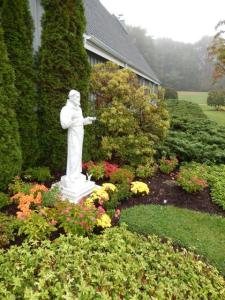
Our Gospel lesson today gives us some clues about what all this means in practice.  Jesus says, “Come to me, all you that are weary and are carrying heavy burdens, and I will give you rest.  Take my yoke upon you, and learn from me; for I am gentle and humble in heart, and you will find rest for your souls. For my yoke is easy, and my burden is light.”  Those words from Jesus are echoed in St. Francis’ life and witness.  We may not be able to walk around shoeless in the depths of winter like Francis, or even beg for our food, but when we enter into relationship with God with a greater sense of God’s invitation into the life of generosity, we can image and experience the light yoke.  This is the reflection work we will be doing throughout our stewardship season this fall – but Francis and Jesus give us a little preview about what stewardship really looks like.  So take a moment to start today.  Take in the beautiful creation of our property, as its Fall glory begins to unfold.  If you are an animal lover, look at the generous love of your pet.  Look at one another, remembering the vulnerable beauty of each person here – even those who annoy you the most.  Let this wonder and gratitude fill you up – so that you can slip on that light yoke of generosity and live into the goodness that God has created for you and has created you for.  Amen.

Sermon – Ruth 3.1-5; 4.13-17, Mk. 12.38-44, P27, YB, November 11, 2012

12 Monday Nov 2012

Posted by jandrewsweckerly in Uncategorized

≈ Leave a comment

Tags

blessing, dependence, God, independence, money, Sermon, stewardship

This week, once our power was finally restored, Simone and I caught an episode of our favorite show, Sesame Street.  Typically I am running around the house getting us ready for school and work during Sesame Street, but this week, I found myself glued to the television.  In this particular episode, Sesame Street experienced a hurricane, and Big Bird’s home was destroyed.  All the neighbors of Sesame Street came out to help Big Bird.  But Big Bird struggled with their help.  Although he appreciated all their hard work, he was so fraught with sadness and despair that he could hardly focus on their generosity.  Although they put him up for the night, their houses were not the same as his.  Although they fed him meals, the food was not quite as he would want.  You could tell that he appreciated their efforts, but what he truly missed was his independence.  He did not like depending on others, especially because their care took him out of his comfort zone.

To be honest, I almost could not watch the episode.  The story was a little too close to home.  We have all been struggling with the battle between independence and dependence these last two weeks.  We have been dependent on the generosity of our neighbors and friends who have given us breaks from the cold, a space to recharge our electronics, a warm meal, or a place to clean laundry.  We have been dependent of the workers of LIPA and electrical workers from around the country to help us get our electricity restored.  We have been dependent on the availability of gasoline for transportation and for the few of us with generators.  Almost all of us have experienced episodes of dependence over the last two weeks, and we do not like it!  Receiving help feels awkward, throwing off the balance of power that we have with others.  We do not like the lack of control that dependence creates.  In fact some of us have stayed in cold homes, avoiding shelters or the offers of friends and neighbors just because we want some modicum of control over our disrupted lives.

With this internal struggle with dependence, our lectionary lessons today then are almost salt in our wounds.  First we hear from the concluding chapters of Ruth.  Ruth is often seen as one of the most independent, strong-willed women in scripture.  But in the portion of text we hear today, we hear the other reality of Ruth’s life – Ruth’s life is marked by dependence.  Ruth is dependent upon Naomi, who conceives of a plan to save them both; she is dependent upon Boaz, who can support her and sustain her; and she is dependent upon the community, who understands the roles of women and community in very different ways than we do in modern America.  In some ways, Ruth goes from being the central woman of fierce independence, to the dependent wife, mother, and daughter-in-law who fades into the life of the community.

Then we get the widow in our gospel lesson today.  Here is a woman, who barely has anything, who, as a widow, is inherently dependent upon others for support, and who is found putting the two final coins in her possession in the treasury.  Jesus praises her because she gives not out of her abundance like the others, but because she recognizes her total dependence upon God, and freely gives away everything.  The lesson we hear from Jesus today about this woman is that we are to be “dependent on nothing but the grace of God.  We are to be people without any resources except the riches of God’s mercy.”[i]

And this is where we all get more than a little bit uncomfortable with Jesus’ words and Ruth’s actions.  We replay these past two weeks and worry that if we cannot get comfortable depending on our neighbors, how are we ever to get comfortable with depending fully on God?  Or our practical brains kick in and we immediately begin to argue with God.  How are we supposed to function on our own without a penny to our name?  Are we just supposed to walk away from everything, standing on the street, saying, “Okay God, I am dependent upon you.  Take care of me.”  In our independent American culture, the idea of dependence is uncomfortable and almost feels impossible to us.

For guidance, I go back to our lessons.  First, I listen again to Ruth.  Instead of imagining Ruth as the woman oppressed by a patriarchal system, I like to imagine the joy that comes from Ruth’s life – the joy that is found when an entire community comes together for the sake of survival.  When Obed is born, everyone rejoices, everyone wins.  Maybe Ruth is not a liberated, independent woman – but are any of us truly so liberated that we do not need others in our lives?  Ruth chooses dependence – she willingly chooses dependence because she trusts that God will make everything right.  In fact, her independent self chooses dependence throughout her blessed story.

Next, I look back at the widow.  She irrationally gives everything to God – her very last pennies.  But we should be honest.  When all you have are pennies left, those little coins are not going to dramatically change your life anyway.[ii]  Her utter poverty and dependence upon others who care for widows allow her to see what the wealthy cannot – that everything belongs to God anyway.  What she teaches us is not to feel guilty or irrational about wealth and giving, but to realize that we will have to choose dependence upon God – because dependence never comes naturally.

When I worked at Habitat, I remember having a conversation with the financial consultant to our homeowner families.  In looking at one homeowner’s budget, she saw that the homeowner was giving about ten percent of her income to her Church.  The consultant was frustrated, because she knew that all that giving to the Church was hurting the homeowner’s children.  But the homeowner would not budge on the issue.  The homeowner insisted they would just have to find another way to balance the budget, because God was getting that ten percent.

The truth is that our lessons are not condemning wealth or independence.  What the lessons are trying to teach us is that both wealth and our own egos can trick us into thinking that we can truly be independent.  They can trick us into thinking that we do not really need God.  That is why the Stewardship Committee and I have been talking about our relationship with money this past month.  We have not been talking about money because we need to bring in enough to pay the bills, or because we want us to feel guilty about our wealth.  We have been talking about money because we want us all to see how our relationship with money can impact our relationship with God.  When we cling to our money or our independence so tightly that we blind ourselves to the blessings that can bubble out of letting go of those things, we miss out on opportunities for the Holy Spirit to work on us, to help us see through the lens of Christ.  Although some may connect dependence with oppression and depression, Ruth and Jesus show us that our dependence on God leads to joy and thanksgiving.[iii]

As I think back on these past two weeks, I will also remember the blessings.  I will remember how a hot bowl of soup or a warm pot of spaghetti warmed not only my insides, but also warmed my spirits.  I will remember the camaraderie of people gathered at the public library, charging electronics and helping kids blow off steam.  I will remember the ways in which our mutual dependence led to conversations with people that normally would have been superficial but were now full of meaning and shared support.  I will remember the great comfort of sharing an impromptu coffee hour with those of us who could spare the gasoline to get here last week, and how overjoyed I was just to see your faces and hear your stories.  If anything, this horrible storm has shown how we are more dependent than we all might like, but also how that dependence has led to incredible blessings.  Our invitation today is to embrace our dependence on God in the same way that we are embracing our dependence on one another.  Amen.


[i] Mary W. Anderson, “Widow’s Walk,” Christian Century, vol. 20, no. 22, Nov. 1, 2003, 18.

[ii] Anderson, 18.

[iii] Anderson, 18.

Blessings…

09 Friday Nov 2012

Posted by jandrewsweckerly in Uncategorized

≈ Leave a comment

Tags

blessed, blessing, pledge, stewardship

Despite the fact that we have had a bit of hiatus with posts due to Hurricane Sandy, we are still wrapping up our Stewardship campaign.  Last week was our Stewardship In-Gathering.  I had imagined a full and joyful church, a procession with music, and warmth inside and out.  Instead, we worried about those who were missing, we sang without accompaniment, and we processed in the frigid, unheated church.  But somehow, that simplified offering of our pledges spoke volumes for me.  There was a sense that life goes on in the midst of chaos, and that the things that are good here at St. Margaret’s are still very, very good.

If you missed last week, or expect to miss this week too with gasoline lines, feel free to mail in your pledge to the church office.  We are hoping to wrap up pledging by the end of this month so that we can present a realistic budget to the church at our Annual Meeting in December.  If you have already pledged, thank you.  If you are still considering your pledge, or if you just want to enjoy hearing a testimony from a fellow parishioner, I encourage you to read Kim Irvine’s guest submission below.  Kim offers her thoughts on what being “Blessed to be a Blessing” has meant for her.

***************************

A few months ago, when I was asked to serve on the stewardship committee, I was totally surprised. It seemed far out of my comfort zone.   While I do contribute financially to our church, I never really thought of myself as a “steward”.    Honestly, I hadn’t put a lot of thought into how my financial giving impacted my relationship with God.   The correlation of the two, God and money, was not very apparent to me.

I’ve learned a lot from serving on this committee.   One of the strongest messages for me is that God has entrusted me with his resources.  I am responsible to use God’s resources in ways that are pleasing to Him.   For me, giving to St. Margaret’s is one way to share what God has entrusted to me.   This church has been part of my life since childhood.  The people as well as the church building and grounds are very near and dear to me.

I’ve also learned some of the values associated with stewardship, which include:

  • Giving intentionally;
  • Giving regularly;
  • Giving generously;
  • Giving first to God;
  • Give in proportion to the blessings you have received; and
  • Cheerful giving.

While I can relate to some of the values above, I recognize several that I need to work on.

I’ve always liked the adage “actions speak louder then words”.  In order for our church to continue to grow and develop, it is so important to make a commitment to being stewards by using our finances, time and talent in every way we can.

“For where your heart is, there your treasure will be also. “  Luke 12:34

~ Kim Irvine

Sermon – Job 42.1-6, 10-17, P25, YB, October 28, 2012

28 Sunday Oct 2012

Posted by jandrewsweckerly in Uncategorized

≈ Leave a comment

Tags

blessing, God, Sermon, spiritual journey, stewardship, suffering

After a month of reading through the book of Job on Sundays, you would think today would feel victorious.  Finally, Job is rewarded for all his suffering!  The text tells us that God restores the fortunes of Job and gives Job twice as much as he had before.  Family members return to greet him and shower him with gifts, and he is blessed with ten new children.  For any of us who have been through a time of suffering, this should feel like great news.

But this week, as I have been praying on this text, I cannot shake the hollow feeling of this good news today.  Sure, Job has ten new children, but they can never erase the memory of the ten children he lost.  Sure, all his wealth is returned, but after losing everything, having his friends and family abandon and blame him, and sitting covered in boils, surely wealth had lost its value and importance to Job.  The good news of this text has left me feeling hollow because I just cannot imagine how Job lives into this good news.  How can he conceive children with his wife who mocked him and God, risk loving again, and know that his children will never know the reality of the suffering he experienced.  And his family and friends who return with gifts – where were they when he needed them?

I struggle too because we do not really get answers today from Job or God.  We never really find out why God allows Job’s blessings to be taken away.  The only semblance of an answer happened last week when God railed against Job for assuming that Job could understand the ways of God.  But an answer does not come in the blessings either.  The last verses of the book of Job do not “say that God restored Job’s fortunes and relationships in response to Job’s words of repentance and humility.  Instead, God’s reasons for giving things to Job are as unexplained as the reasons they were taken away.  God does not explain suffering, but God does not explain beatitude either.”[i]  We are left at the end of a month of Job no clearer about suffering and blessing than we were when we started.

Maybe this ending to Job feels hollow to me now because I have seen and experienced too much of Job’s journey.  I have held in prayer friends, family, and parishioners who have sat in the ashes of suffering with neither of us finding satisfactory answers.  I have listened to St. Margaret’s stories of pain and suffering that happened in the years before my arrival.  And I have had more friends than I wish to count who have lost a child in pregnancy.  Many of us here have lost teen or adult children.  Having journeyed with friends, I know that you can never replace those children.

I think also the ending of Job feels hollow to me because the ending does not address Job’s relationship with God.  God and Job have been on incredible journey.  Job moves in the book from talking about God with his friends to talking more and more directly to God.  What was once a theological concept is now an intimate relationship.  Job manages throughout the journey to hold on to “God with one hand and shake his fist at God with the other.  He stays in relationship with God, addressing God directly even from the depths of despair.”[ii]  But the ending of Job does not really give us a clue about what that relationship looks like going forward.  Are they back to square one?  Does Job go back to being blessed and on good terms with God?  Now that his blessing is doubled, does God slip back into the background, unnecessary or at least not thought about too much?

As I have struggled with this text, I finally began to find footing in the small details of the text today.  The first details are in Job’s confession at the beginning of the lesson.  Job confesses that his relationship with God has changed.  Job says, “I had heard of you by the hearing of the ear, but now my eye sees you.”  In other words, Job declares that he had heard about God, but now he knows God.  This journey of suffering and pain changes Job’s experience of God – from being a relationship of dutiful obedience and distant reverence, to a deep intimacy and knowledge.  He no longer simply knows God cognitively; Job knows God in the depths of his being.  As Job experiences utter devastation, loss, abandonment, and pain; as Job rages at God in anger and fury; as Job moans through his misery – Job never pushes God away.  Through some forty chapters of pain, Job manages to grow into deeper love of God.

The other small detail in Job where I find footing today comes in how he orders his life in the midst of his restored fortunes.  Job does not tell his family and friends – the abandoners – to go away, holding a grudge against them that can never be healed.  Instead, he receives their gifts without protest.  Job does not live a guarded life.  Instead, he risks new life with his wife which results in the birth of ten children.  And Job does not return to the same old way of doing things.  Instead he gives his daughters an inheritance just like his sons.  That may not sound like a big deal by modern standards, but giving an inheritance to his daughters is a huge deal.  This act by Job is a radical and innovate way of extending his own transformation by transforming the social order for his daughters.[iii]  The way that Job orders his life during his restored fortunes says a lot about how this ordeal has transformed him.

In the midst of what can feel like a hollow ending, we two can find hope for our own spiritual journey.  We learn two things from Job.  First, our relationship with God is indeed a journey.  The experience of Job gives us permission to be angry with God, to question God, to be a fully and ignorantly limited human with God, and to humbly stand with God.  We can do all of this not as defeated individuals but as transformed individuals – so transformed, in fact, that we can be a people who endeavor to risk love.

The other thing that we learn from Job is to redefine our understanding of blessedness.  We never hear in the text about how Job feels about being doubly blessed.  I like to imagine that Job is sober about his second blessing, his experience of suffering coloring the blessing.  On Simone’s first day of school in Delaware, when I met her teacher, we both were shocked by the recognition.  Simone’s teacher was a Habitat homeowner who had gone through the program when I worked with Habitat for Humanity.  Here was a woman who had gotten into a situation of housing instability.  Her income was 25-50% of median income.  Her children were squeezed into one room at a friend’s house.  Their anxiety and stress had been overwhelming.  But she put in hundreds of hours of sweat equity, she built a home, and she stabilized her family.  Simone’s teacher could have gone back to school to find a higher-earning job.  But she stayed with this school, forming and shaping one- and two-year olds into loving, caring toddlers.  Simone’s teacher was one of the most amazing women I have ever met, and she transformed my daughter’s life at a formative time.  Simone’s teacher could have been distant, cut-off from extending love, or resentful for her time in poverty.  But instead, Simone’s teacher was full of life and love.

Job, like this teacher, learned that he could use his blessing to transform others.  Job invites us to also consider the ways that we can use our blessings to transform others – to become a blessing.  In our stewardship campaign this year, we have been talking about how we are blessed to be a blessing.  Job shows us the way of living into this life.  Yes, I want you to consider how you can be a financial blessing to St. Margaret’s.  But I also want you to see the great invitation of transforming your spirit into one of blessing.  We all have a laundry list of things that could make us bitter, guarded, or careful.  But Job and God invite us to instead live the blessed life that blesses others.  We are promised today that we can live into a blessing life through the example of Job – a man who had every reason to abandon hope, love, and God – but who instead is strengthened in God, renewed in hope, and overflowing with love.  We too can embrace Job’s embodiment of being a blessing in this life.  Amen.


[i] Martin B. Copenhaver, “Risking a Happy Ending,” Christian Century, vol. 111, no. 28, Oct. 12, 1994, 923.

[ii] Kathryn Schifferdecker, http://www.workingpreacher.org/preaching.aspx?tab=2&alt=1, as found on October 26, 2012.

[iii] Dale P. Andrews, “Homiletical Perspective,” Feasting on the Word, Yr. B, vol. 4 (Louisville: Westminster John Knox Press, 2009), 199.

Blessed…

24 Wednesday Oct 2012

Posted by jandrewsweckerly in Uncategorized

≈ 1 Comment

Tags

blessing, God, stewardship

As we journey into our stewardship season, we continue to reflect as a community about how we have been blessed.  This week, Fal Gibson offers a reflection on her own gratitude to God for the many blessings in her life.  I hope you will enjoy the blessing of Fal in her words as much as we enjoy the blessing of her presence every week!

*******************************************

Beginning each day with “Thank you, God,” I set the tone for the entire day.  Whether I am going to work, or looking forward to a time of celebration with family or friends, starting today with an attitude of gratitude reminds me that God is the source of all blessings. I am thankful for blessings large and small, for expected and unexpected ones, and for the special people in my life.

I am blessed to be a part of St. Margaret’s church family, so I asked myself the question, what shall I return to the Lord for all his bounty to me?  I need to support my church financially. I offer with joy and thanksgiving what God has first given me – my family, time and possessions. “Giving is a privilege, something we appreciate being able to do as a result of God’s grace.” (2 Corinthians 8:4)

Our church cost money to operate and, thus depends on the contributions of our members to meet the expenses.  The expenses that come with our lovely St. Margaret’s church: utilities, maintenance, upkeep, our educational programs, materials and equipment, St. Margaret’s newsletters and mailings to members and/or others in the community. The Bible says that everyone is to give “according to means” (2 Corinthians 8: 3, 11).

I pray for all of God’s children and see each one being divinely blessed.  I pray for all members of St. Margaret’s Church and for the beauty, joy and wisdom we all share as being part of a beautiful church family. Everyone is a unique and purposeful creation. I pray that every member is blessed with love, food, shelter, and safety.  I pray that the Episcopal Church of St. Margaret, with its red, welcoming doors will continue to be an important part of your spiritual journey. “Giving is a witness to the gospel, demonstrating the genuineness of the church’s love,” (2 Corinthians 8: 8, 24).

During our Stewardship campaign, I ask you to take some time and pray about how you can use the blessings, you received from God to further HIS Kingdom.  I think as receptive Christians you will be moved by scripture and the spirit to go beyond providing such support to give up a further portion of your money as a sacrifice.  Support and sacrifice: the first is our duty; the second our delight. I knew a member of our parish, Miriam Emerson, who made it her duty to make sure that the children at the Lillian Valley School in Barefoot, Idaho received school supplies, and the seafarers through the Seamen Institute received knitted hats and scarves every year with great delight.  Miriam was indeed a blessings to the St. Margaret’s church family and many others, and I was truly blessed to have known her.

I like to say that stewardship puts into practice our faith in God as our Creator, our Redeemer, and our Sustainer. Everything we are and everything we have belongs to God.  Can you feel the Holy Spirit at St. Margaret?  Can you count your Blessings and name them, one by one?  I can.  I pledged.  Wouldn’t you pledge and help Rev. Jennifer do the work within our parish and the outer community as God has called her so lovingly to do?

~ Fal. Gibson

Blessed to be a Blessing…

17 Wednesday Oct 2012

Posted by jandrewsweckerly in Uncategorized

≈ Leave a comment

Tags

blessed, blessing, God, spiritual, stewardship

Blessed to be a blessing.  This is the theme that the stewardship team has adopted this year as we begin to reflect on the abundant blessings in our lives and discern how we might use those blessings to be a blessing to others.  I have had the great pleasure of working with six other parishioners from St. Margaret’s since this summer, and we have all been discerning how our relationship with God and money are connected.  We have debated and discussed whether and how our faithful financial stewardship impacts our relationship with God.  We have helped one another draw the connections between our relationship with money and our relationship with God.  This work is on-going among us, as we continue to pray through this issue as we discern our own pledges this year.  Some of us have already witnessed how sacrificial giving can be life giving.  Others of us wonder how our attitude toward money can impact our relationship with God.  And so we continue to pray – for our own discernment, for each other’s discernment, and for St. Margaret’s.  We know that St. Margaret’s has been a blessing to us, and so we both want to be a blessing to St. Margaret’s, and we want St. Margaret’s to be a blessing to our community.  We invite you into this circle of blessing!

To help you get a better idea of the content of the Stewardship Committee’s discernment, I invite you to read articles in The Message, our parish newsletter, found on our website; and for the next three weeks, to see guest blog posts from Committee members.  This week, Debbie McGee offers her reflections.

*************************************

Although the calendar tells me it is October, the lingering warm weather triggered happy memories of warm and sunny days spent beachside this summer.  The soft, cool breezes, the gentle lapping of the waves and long quiet walks upon the sand gave me pause to the presence of God and the beautiful world he blessed us with.

God blesses us with many gifts – abundantly – and does so without any strings attached.  It is up to us to choose to be good and faithful stewards – to express our gratitude for all God’s blessings.  As we enter into Stewardship season, it is an opportunity for all of us to praise God through whom all blessings flow.

Join me in being a faithful steward – be generous with your treasure!  I feel so very blessed by the beautiful environment that God has created for us that I want to be a blessing to St. Margaret’s.  It is important to me that St. Margaret’s parish continues to thrive and makes a difference in the lives of our local community and beyond, while still providing the spiritual home so many of us treasure.

All good gifts around us

Are sent from Heaven above…

So thank the Lord, oh thank the

Lord for all his love…….

I really wanna thank you Lord!

 (Stephen Schwartz Lyrics & Music)

-Debbie McGee

Sermon – Mark 10.17-31, P23, YB, October 14, 2012

15 Monday Oct 2012

Posted by jandrewsweckerly in Uncategorized

≈ Leave a comment

Tags

faith, God, money, Sermon, stewardship, wealth

For those of you paying attention to the gospel lesson today and who realize we are kicking off Stewardship Season this week, I promise I did not pick the lessons today!  We are blessed by a lectionary that guides us through our sacred scripture every year, and the use of the lectionary is one of the many things that attracted me to the Episcopal Church.  That being said, since Jesus so conveniently brought up the subject of money, it only seems fitting that we talk about money today.

We know that the issue of money was important to Jesus.  All three of the synoptic gospels tell a version of the story we hear today.  We know the story well, and tend to avoid the story like the plague.  At some point or another, we have convinced ourselves that this text does not really apply to us.  We do not see ourselves as rich – we can all think of someone who has more than we do and we all struggle with our finances at times.  But in the depths of our hearts, we know that Jesus is talking to us.  As Americans, we constitute five percent of the world’s population, but consume twenty-four percent of the world’s energy.  Americans eat roughly 200 billion more calories a day than we need, which is enough to feed 80 million people every day.  We consume about 159 gallons of water a day, while more than half of the world’s population lives on 25 gallons.  We have more shopping malls than high schools.[i]  Whether we prefer to admit the truth or not, we are the rich person that today’s gospel lesson is addressing.  And if Jesus is talking to us, Jesus is also asking us to give up our wealth because otherwise, we, the camels, have no chance of getting through that needle’s eye.

But before we go too far down the road to guilt or panic, let’s look at what Jesus is really saying in our gospel lesson today.  This young man is a righteous man who approaches Jesus with a genuine desire to ensure he is on the right path to eternal life.  He approaches Jesus humbly, racing to Jesus and kneeling before him like so many other sick people have.[ii]  He must have been fairly certain that his life was not whole to pursue Jesus like this.  What he may not have expected is what Jesus tells him.  Jesus tells him that he is living a righteous life – with one small exception.  His wealth, his possessions, his “stuff” is getting in the way of salvation.  His possessions and wealth have become a source of separation from God.  This is what Jesus is really after today.  Having money is not in and of itself evil.  We need money to survive.  But our relationship with money has the potential to separate us from God.

Wealth can separate us from God in one of two ways.  When we have abundant resources, we eventually assume that whatever needs to be done, we can do.  But this kind of self-sufficiency and self-produced security cuts us off from grace.  Life becomes an achievement earned or a commodity purchased rather than a gift gratefully received and shared.  God becomes unnecessary or simply another commodity.  And if security and worth are rooted in achievements and resources, amassing more becomes our driving motivation.  We cannot let up.  We cannot relax.  We cannot give sacrificially.  Wealth becomes addictive.[iii]

The other way that wealth can separate us from God is that wealth can separate us from those who are impoverished.  Our wealth makes avoiding the poor possible, keeping them out of sight and mind.  As we have been working through our hunger curriculum on Wednesday nights, we have all said at one point or another that we simply do not run into the poor that often in our daily lives.  As one bishop explains, the reason why that socioeconomic divide separates us from God is because, “We cannot know the God of Jesus Christ apart from relationships with the poor and the powerless.  God has chosen the poor, the least, the most vulnerable, those whom the world considers ‘the weak’ as special friends.”[iv]  If we want to grow closer to God, we must grow closer to those whom Jesus cared for the most.  And in order to grow close to the poor, we must examine our relationship with our own wealth.

Now all of this is not to say that Jesus is mad at the wealthy man or sees him as lost.  Mark’s gospel tells us that, “Jesus, looking at him, loved him…”  Now if you remember, Mark is usually the most succinct of the gospel writers.  Neither Matthew nor Luke includes this small detail.  So if Mark is including this detail, the detail is important.[v]  We need to know that Jesus loves this young man because in his loving gaze we learn that Jesus believes the young man has a chance.  The young man has a chance not because he can achieve this new life style.  In fact, when the disciples ask Jesus about this very issue of who can overcome the hurdles of wealth, Jesus says, “For mortals it is impossible, but not for God; for God all things are possible.”  The young man cannot change his relationship between wealth and God alone.  That relationship can only be changed with God – because with God, all things are possible.

Today we kick off our stewardship season at St. Margaret’s.  For the next several weeks, we will be examining our own relationship between wealth and God.  In order to help us with that discernment, the Stewardship Committee has chosen the theme, “Blessed to be a Blessing.”  We chose this theme because we do not want us to have a guilty or conflicted relationship with wealth.  We want to see our individual wealth as a blessing that enables each of us to be a blessing to others.  All of us at St. Margaret’s have been blessed.  We have our basic needs met – a place to live, food to eat, and clothes to wear.  Most of us have been blessed beyond our basic needs – with cars, entertainment, and technology.  And we have been blessed spiritually by this community.  We have a community of faith where we can come and seek a deeper knowledge and understanding of God.  We have a community that engages us in the faith journey, challenging us to grow into the love of God.  And we have a community that sends us out in the world, showing us the real meaning of God’s love through our service of others.

This stewardship season is not a season to wallow in guilt and beat up ourselves.  But this season is a season to act.  God blesses us so that we can be a blessing.  So where do we start this work of being a blessing?  We start that work by righting our relationship between God and our wealth – our blessings.  As you are pondering your own experience of that relationship, I want you to consider how your pledge this year might be a spiritual discipline that rights that relationship; how this community might help each other right our relationships with wealth and God together.  Now I know we do not like to talk about money with other people.  But if this is a place of spiritual discipline, prayer, teaching, formation for our children and adults, and reaching out and loving our neighbors, where else is a better place to talk honestly about our relationship with money.  This community is forming each of us to be faithful disciples; but we cannot be fully formed unless we are willing to work on our whole being, including our relationship with wealth.  Our discipline of giving more generously and sacrificially – more out of blessing than obligation – can help us to loosen our grip on a relationship with wealth that separates us from God.  Your financial giving to Church is as much of a discipline as your prayer, your study, your serving, your seeking, and your worshiping in this place.  If we can put energy in those areas, we can put some work into our financial stewardship.

In the coming weeks, you will hear from every member of the Stewardship Committee about their own struggles with wealth.  You will hear about how looking at their relationship with money and God is transforming that relationship into one of blessing.  You will see Message articles, blog posts, and updates on our new stewardship bulletin board.  This committee of seven people is intentionally looking at how they feel blessed to be a blessing, examining the quality of their own relationship between wealth and God.  Their invitation to us is to engage in this reflection with them, to discern how God is moving in our lives, and to act.  We can do this work together, because with God, all things are possible.  Amen.


[i] Frank Thomas, “Can Rich People Be Saved?” Ex Auditu, vol. 22, 2006, 219.

[ii] Barbara Rossing, “Healing Affluenza:  A Sermon on Mark 10:17-27,” Currents in Theology and Mission, vol. 22, no. 4, August 2006, 300.

[iii] Kenneth L. Carder, “The Perils of Riches,” Christian Century, vol. 114, no. 26, Sept. 24 – Oct. 1, 1997, 831.

[iv] Carder, 831.

[v] Stacey Elizabeth Simpson, “Who Can be Saved?” Christian Century, vol. 117, no. 26, Sept. 27 – Oct. 4, 2000, 951.

Newer posts →

Recent Posts

  • On Sharing the Love…
  • Sermon – Micah 6.1-8, Matthew 5.1-12, EP4, YA, January 30, 2026
  • On Justice, Kindness, Humility, and the Messy Middle…
  • Feast of the Rev. Dr. Martin Luther King, Jr., January 18, 2026
  • On Peace, Love, and Conduits…

Archives

  • February 2026
  • January 2026
  • December 2025
  • November 2025
  • October 2025
  • September 2025
  • August 2025
  • July 2025
  • June 2025
  • March 2025
  • February 2025
  • December 2024
  • November 2024
  • October 2024
  • September 2024
  • August 2024
  • July 2024
  • June 2024
  • May 2024
  • March 2024
  • February 2024
  • January 2024
  • December 2023
  • November 2023
  • October 2023
  • September 2023
  • August 2023
  • July 2023
  • June 2023
  • May 2023
  • March 2023
  • February 2023
  • January 2023
  • December 2022
  • November 2022
  • October 2022
  • June 2022
  • May 2022
  • January 2022
  • December 2021
  • November 2021
  • October 2021
  • September 2021
  • August 2021
  • June 2021
  • May 2021
  • April 2021
  • March 2021
  • February 2021
  • January 2021
  • December 2020
  • November 2020
  • October 2020
  • September 2020
  • August 2020
  • July 2020
  • June 2020
  • May 2020
  • April 2020
  • March 2020
  • February 2020
  • January 2020
  • December 2019
  • November 2019
  • October 2019
  • September 2019
  • August 2019
  • July 2019
  • June 2019
  • May 2019
  • April 2019
  • March 2019
  • February 2019
  • January 2019
  • December 2018
  • November 2018
  • October 2018
  • September 2018
  • August 2018
  • July 2018
  • June 2018
  • May 2018
  • April 2018
  • March 2018
  • February 2018
  • January 2018
  • December 2017
  • November 2017
  • October 2017
  • September 2017
  • August 2017
  • July 2017
  • June 2017
  • May 2017
  • April 2017
  • March 2017
  • February 2017
  • January 2017
  • December 2016
  • November 2016
  • October 2016
  • September 2016
  • August 2016
  • July 2016
  • June 2016
  • May 2016
  • April 2016
  • March 2016
  • February 2016
  • January 2016
  • December 2015
  • November 2015
  • October 2015
  • September 2015
  • August 2015
  • July 2015
  • June 2015
  • May 2015
  • April 2015
  • March 2015
  • February 2015
  • January 2015
  • December 2014
  • November 2014
  • October 2014
  • September 2014
  • August 2014
  • July 2014
  • June 2014
  • April 2014
  • March 2014
  • February 2014
  • January 2014
  • December 2013
  • November 2013
  • October 2013
  • September 2013
  • August 2013
  • July 2013
  • June 2013
  • May 2013
  • April 2013
  • March 2013
  • February 2013
  • January 2013
  • December 2012
  • November 2012
  • October 2012
  • September 2012

Categories

  • reflection
  • Sermons
  • Uncategorized

Meta

  • Create account
  • Log in
  • Entries feed
  • Comments feed
  • WordPress.com

Blog at WordPress.com.

  • Subscribe Subscribed
    • Seeking and Serving
    • Join 395 other subscribers
    • Already have a WordPress.com account? Log in now.
    • Seeking and Serving
    • Subscribe Subscribed
    • Sign up
    • Log in
    • Report this content
    • View site in Reader
    • Manage subscriptions
    • Collapse this bar
 

Loading Comments...