• About

Seeking and Serving

~ seek and serve Christ in all persons

Seeking and Serving

Tag Archives: value

Sermon – I Timothy 6.6-19, Luke 16.19-31, P21, YC, September 28, 2025

01 Wednesday Oct 2025

Posted by jandrewsweckerly in Sermons

≈ Leave a comment

Tags

community, faith, God, grasp, lesson, life, money, parenting, Sermon, share, sympathize, value, vocation

Parenting is probably the most difficult of the vocations God has given me – not simply because parenting can be physically, emotionally, and spiritually exhausting, or because of the heftiness of the responsibility of shaping decent human beings who will have an impact on the world, or because parenting forces you to justify every belief and value you hold.  Those alone would be daunting enough.  But parenting is also a difficult vocation because of the way parenting evolves:  from those early days of helping this creature learn the basics for survival, to those young days of helping children wonder and ask the big questions of life, to those middle days of clarifying family, faith, and individual values that will guide their behavior and choices, to those later days of gently reflecting on those ultimate things of life – of what really makes for a life of meaning and purpose.

In many ways, our scripture lessons lately have felt like listening to a parent trying to help us figure out what this whole life thing is all about.  On the surface, our lessons today are straight of central casting for a stewardship talk – we’ve really teed up the parishioner who will share his testimony today with everything he needs.  From Amos who foreshadows what will happen to those who spend their lives luxuriating in lavishness, as if luxuriating is an end in and of itself; to Paul’s letter to Timothy who warns how dangerous a love of money can be, distracting us from things of ultimate significance; to our gospel lesson which starkly depicts the eternal significance of how wealth can make us so blind to the needs of others that we condemn ourselves in the life beyond this life.  The lessons this week seem to serve up the ultimate stewardship sermon:  the place of money in our lives is so fraught with spiritual consequences, you should just give that money to the church so that you do not have to worry about a fate like those in our lessons today!

And while our budget for next year might appreciate such a lesson, much like parenting has varied phases, so does the church’s teaching of us.  The one line of all the weighty lessons on wealth from today that has been hovering in my mind comes from Paul’s first letter to Timothy.  In the last line of the portion of his letter we heard today, Paul says we “are to do good, to be rich in good works, generous, and ready to share, thus storing up for [ourselves] the treasure of a good foundation for the future, so that [we] may take hold of the life that really is life.”  So that we may take hold of the life that really is life.  The verb in the Greek translated as “take hold” is a not a gentle verb – taking hold is better translated as to grasp desperately.[i]  So we are to grasp desperately to the life that really is life. 

This is the phase of parenting where I find myself:  how do I teach my children what the “life that really is life” is?  In a world that very much feels like the passage from Amos, telling us that “life that really is life” is a life so comfortable you can set your goal as luxuriating in peace, or in a world that so values individualism that we are trained not to let our gaze linger on people like Lazarus or to even know their name for that matter, or in a world that seems to jump from one political controversy to the next, destabilizing our moral compass, how are we supposed to even know what the life that really is life is?

Award winning journalist Amy Frykholm, inspired by that simple phrase “the life that really is life,” traveled to a tiny city in southern Mexico, Fortín de las Flores, after reading Sonia Nazario’s book Enrique’s Journey.  The book details the story of a Honduran man trying to make his way into the United States by traveling on top of a freight train.  His story is not all that unique – the 20,000 residents of Fortín see people like him all the time.  What is unusual about Fortín is how they respond to these migrants.  Instead of responding with fear, or with self-protection, or even with a blind eye, the people of Fortín act as a place of mercy.  Actively making their way to the trains to deliver food, water, and supplies every day – food left over from their food trucks which are just barely making enough for their own families to survive, water poured into zipped baggies they can toss them to the tops of trains, and even sweatshirts or winter hats because they know that after the stop in Fortín, the migrants will face the brutal cold of a trip through mountains.  When journalist Frykholm asked them why they cared for these strangers, most of the residents just looked at her like she was asking a silly question.  A resident of Fortín who had lived in the United States understood her confusion.  He said, “‘The central value of this society is compartir,’ [the Spanish word for “sympathize”] …as he carried a bag of oranges toward a train that had briefly stopped not far from the hotel.  ‘Even a business is primarily a place from which to share.’”[ii] 

The wealth the rich man has in our gospel lesson is not bad in and of itself.  The wealthy man is not even an evil man – he does not actively do anything bad to people like Lazarus.  The danger in the wealthy man’s life is how he does not see,[iii] how he presumes his wealth is simply a blessing for him to enjoy from God.  Debie Thomas writes, “It has taken me a long time to recognize how insidious this notion of ‘blessing’ really is.  How contrary [the notion of blessing] is to Jesus’s teachings.  When I was growing up, no one ever told me that by locking human suffering out, I was locking myself in.  Locking myself into a life of superficiality, thin piety, and meaninglessness.  As our reading from [Paul’s letter to Timothy] puts it this week, the refusal to confront my own privilege, the refusal to bear the burdens of those who have less than me, is a refusal ‘to take hold of the life that really is life.’”[iv]

That is our invitation today – to desperately grasp on to the life that really is life.  Fortunately, scripture does not give us this hefty command like a parent sending out their grown child with one last bit of advice.  Paul wrote this letter not just to Timothy but to the community of faith.  Paul wrote this letter to the community of faith because Paul knew they could not grasp desperately to the life that really is life without some companions on the journey – without a village of people whose central value is compartir.  We gather with people every week because we need a community who can hold us accountable to our values and who can challenge us when loose track of what a life that really is life is.  Sometimes the community will do that by looking at us like we are asking a silly question; sometimes the community will do that by inviting us to be generous givers; and sometimes the community will do that by sitting us down to open up wisdom for us.  But mostly, the community will partner with us because each one of us is desperately trying to grasp onto that life that really is life too.  Together, we create our own little Fortín right here in Toano, witnessing with simplicity the life that really is life – together.  Amen.


[i] Stephanie Mar Smith, “Theological Perspective,” Feasting on the Word, Yr. C, Vol. 4 (Louisville:  Westminster John Knox Pres, 2010), 110.

[ii] Amy Frykholm, “Life That Really Is Life,” September 21, 2025, as found at https://journeywithjesus.net/essays/3969-life-that-really-is-life on September 26, 2025

[iii] Charles B. Cousar, “Exegetical Perspective,” Feasting on the Word, Yr. C, Vol. 4 (Louisville:  Westminster John Knox Pres, 2010), 119.

[iv] Debie Thomas, “The Great Chasm,” September 22, 2019, as found at https://journeywithjesus.net/essays/2374-the-great-chasm on September 26, 2025.

Sermon & Annual Meeting Address – 1 Corinthians 12.12-31a, EP3, YC, January 26, 2025

12 Wednesday Feb 2025

Posted by jandrewsweckerly in Sermons

≈ Leave a comment

Tags

Annual Meeting, anxiety, body, Christ, Holy Spirit, home, Jesus, members, Paul, Sermon, system, value

One of the things we do on Annual Meeting Sunday is install new Vestry Members.  Even though only one third of the Vestry rotates on and off each year, I always remind Vestries that we become a new, changed body every year.  Each of those nine members bring different gifts, talents, and insights.  Each of those members shifts the tone and tenor of our work, and helps us dance a little bit differently.  I was reminded of this reality last week.  When talking about a retiring Vestry member, another member said, “What’s so cool about him is that he does not speak often, but when he does everyone gets really quiet because the insight he offers is so profound.”  That feedback was entirely true – and that feedback reminded of me of another Vestry member much earlier in my tenure at Hickory Neck who would do the same thing – come in toward the end of a conversation with an insight none of us had seen but was entirely needed.

That is the funny thing about bodies – we need all our parts to be the best versions of our bodies.  I think that is why Paul leans into the metaphor of a body to describe the followers of Christ in first Corinthians.  As one scholar writes, “The human body has 206 bones, 693 muscles, and about 6 pounds of skin, along with ligaments, cartilage, veins, arteries, blood, fat, and more.  Every time we hear a sound; every time we take a step; every time we take a breath, hundreds of different parts work together so that what we experience is a single movement, our minds and bodies working as one unit.  Even the great engineers struggle to achieve anything like [the body] in mechanical form.  The human body represents one of the most complex systems in existence.”[i]

For Paul, that super complex system represents the body of Christ – the way each part of the body (or in this case, each member of the church) is not just a belonging member, but is a member whose participation is vital – the whole body is thrown out of balance when we are not all using our gifts.  Scholar Raewynne Whiteley explains, “Every single person in the church matters – the homebound elderly, babies, those with disabilities, and well as the generous givers and hard workers.  This is a reality we can name, which has less to do with equality than with wholeness.  Only with all our members can the body of the church be whole.”[ii]

This last year, we saw what wholeness looks like at Hickory Neck.  Tech team members and pop-up prayer leaders who stream worship online connect us to homebound members, overstretched families who cannot make their way to church but want to pray with us, and those unchurched in our wider community who want to see if they have a place in this body before braving the doors that open to super friendly (sometimes overwhelmingly so) Hickory Neckers.  Retirees who live far from their families and have very little interaction with children in the daily lives connect with children whose own grandparents may live far away and whose parents may be frazzled just by trying to get the family in the car on Sunday mornings.  College students who love to sing but maybe have an estranged relationship or no relationship with the Church connect with a community who cares about the poor and hear sermons from clergy that help them think about faith and politics a little differently. 

And that is just the everyday Sunday at Hickory Neck.  If we are to believe Paul’s metaphor that we are a complex body of parts that need one another, we need only to look at the long list of moving parts in our community in the last year:  from 5 baptisms, 2 first communions, 11 confirmations/receptions/ reaffirmations, and 1 wedding; from 19 members of Discovery Class, 25 participants in Godly Play classes at the Kensington School, and countless volunteers during the Winter Shelter; from a brand new Choir Camp with 20 children, guest concerts with well over 100 attendees each time, to a guest choir of 38 high school students from New Jersey; from over 13,000 points of pastoral care from clergy, an increase in pledges by over $17,000, and an increase in average Sunday attendance by 8%.  This is a complex community, who is not only content with daily operations but is ever trying new things like a Cursillo Eucharist, St. Patrick’s Day Liturgy, a children’s Chorister program, Holy Vino fundraiser, a new organ, a Finance Committee, and even a priest as a dancing star in Williamsburg.  When Bishop Haynes visited us in 2024, and said we are a vibrant, thriving community, this is what she meant.

Now, there is an inherent tension about being a body with varying parts, as Paul reminds us.  As scholar Karen Stokes explains, “There will always be differences with a congregation – differing opinions, experiences, priorities, needs – and it is dangerous to try to play down those differences in the interest of some superficial harmony.  When this natural diversity within a congregation is not allowed to be expressed openly, subtle judgments are communicated:  when the ear gets the message that it would really be better if [the ear] were an eye, when the foot realizes the community values hands more highly.”[iii]  If we do not let the uniqueness of each part be celebrated, when we face changes, anxieties can increase.  And Stokes goes on to say, “Anxiety lessens once’s ability to be imaginative, creative, and self-reflective, and instead causes reactivity, defensiveness, even paranoia”[iv] 

We have been talking a lot the last couple of weeks about our finances and our need for increased revenue to support our vibrant, varied ministries.  Those conversations have brought up a lot of anxiety.  After nine years at Hickory Neck, I have come to recognize that every January is similar – talk of finances gets all of us anxious.  As I have been marinating on Paul’s body metaphor and thinking about the miracle of such diverse parts working so harmoniously together, and as I reflected on 2024 and how we started with anxiety around budgets twelve months ago and managed to power through a tremendous year of vibrant ministry, I find I am looking toward 2025 with renewed confidence.  Perhaps this is the time of year when we are reminded that we are not all ears or feet or eyes.  We will not see ministry the same or hold the same opinions.  Even though we might approach ministry differently, we are all here to see the body do what the body of Christ does best – love God, love self, and love neighbor. 

Just a few weeks ago, I was talking to a first-time visitor who was looking for a new church home.  She heard about Hickory Neck from another new family to Hickory Neck and was able in that one Sunday to see a place for her family here.  That experience tells us all something powerful:  we may be a body that is complex, and beautiful, and sometimes anxious because of our differences; but we are also a body who honors how every person who comes through that door is a part we did not even realize we were missing and who we are thrilled to welcome into their unique contribution to our whole.  Having seen church communities who are not open to new body parts being added, I can tell you, having that experience made me realize we are a beautiful, complex, fabulous body, made possible by the gifts of the Spirit, who works in and through each of us.[v]  Our work this year is to let the Spirit use us to be awesome ears, eyes, feet, tendons, and muscles.  I cannot wait to see what the Spirit does with this fabulous body in 2025!  Amen.


[i] Raewynne J. Whiteley, “Homiletical Perspective,” Feasting on the Word, Yr. C, Vol. 1 (Louisville:  Westminster John Knox Press, 2009), 279.

[ii] Whiteley, 283.

[iii] Karen Stokes, “Pastoral Perspective,” Feasting on the Word, Yr. C, Vol. 1 (Louisville:  Westminster John Knox Press, 2009), 280.

[iv] Stokes, 280.

[v] Whiteley, 283.

On Race, Earthquakes, and Action…

17 Wednesday Jun 2020

Posted by jandrewsweckerly in Uncategorized

≈ 2 Comments

Tags

action, African-American, beauty, blindness, compassion, complacency, confederate, earthquake, harassed, Jesus, learn, listen, love, power, protest, racism, senses, uncomfortable, value

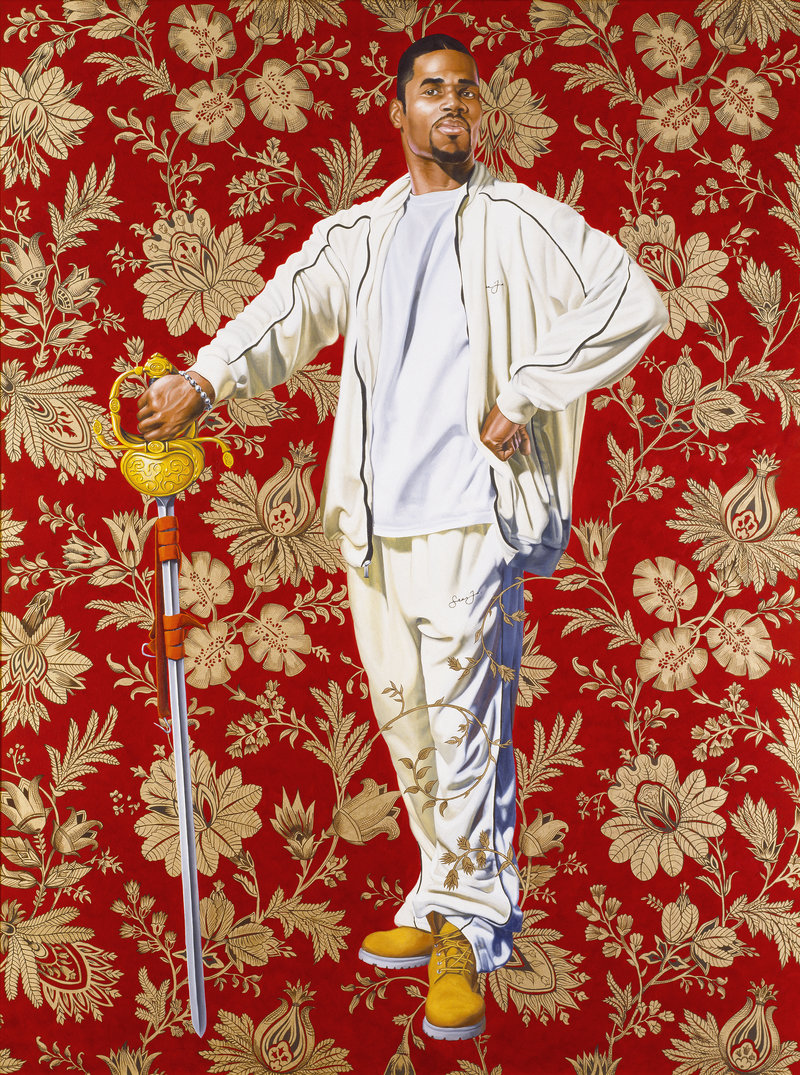
Kehinde Wiley

Photo credit:  https://www.npr.org/2015/05/22/408558234/the-exquisite-dissonance-of-kehinde-wiley

A few years ago, the Virginia Museum of Fine Arts had an exhibit of the works of Kehinde Wiley.  I had not seen his work before, and found his pieces in the exhibit shocking to the eye.  Wiley managed to take traditional poses and settings from art history and infuse them with images of modern African-Americans.  The pieces were jarring to the senses.  As I made my way through the exhibit, it began to dawn on me why my senses were so jarred. By consistently seeing classical art featuring people with light-colored skin, I had been enculturated to expect certain images in art.  The prominence of one kind of subject also created unspoken messages about value, beauty, and power.  Wiley’s vibrant pieces were like an earthquake.  And as someone who considers herself fairly self-aware, I found myself humbled by his work, and sorrowful for my ignorance.

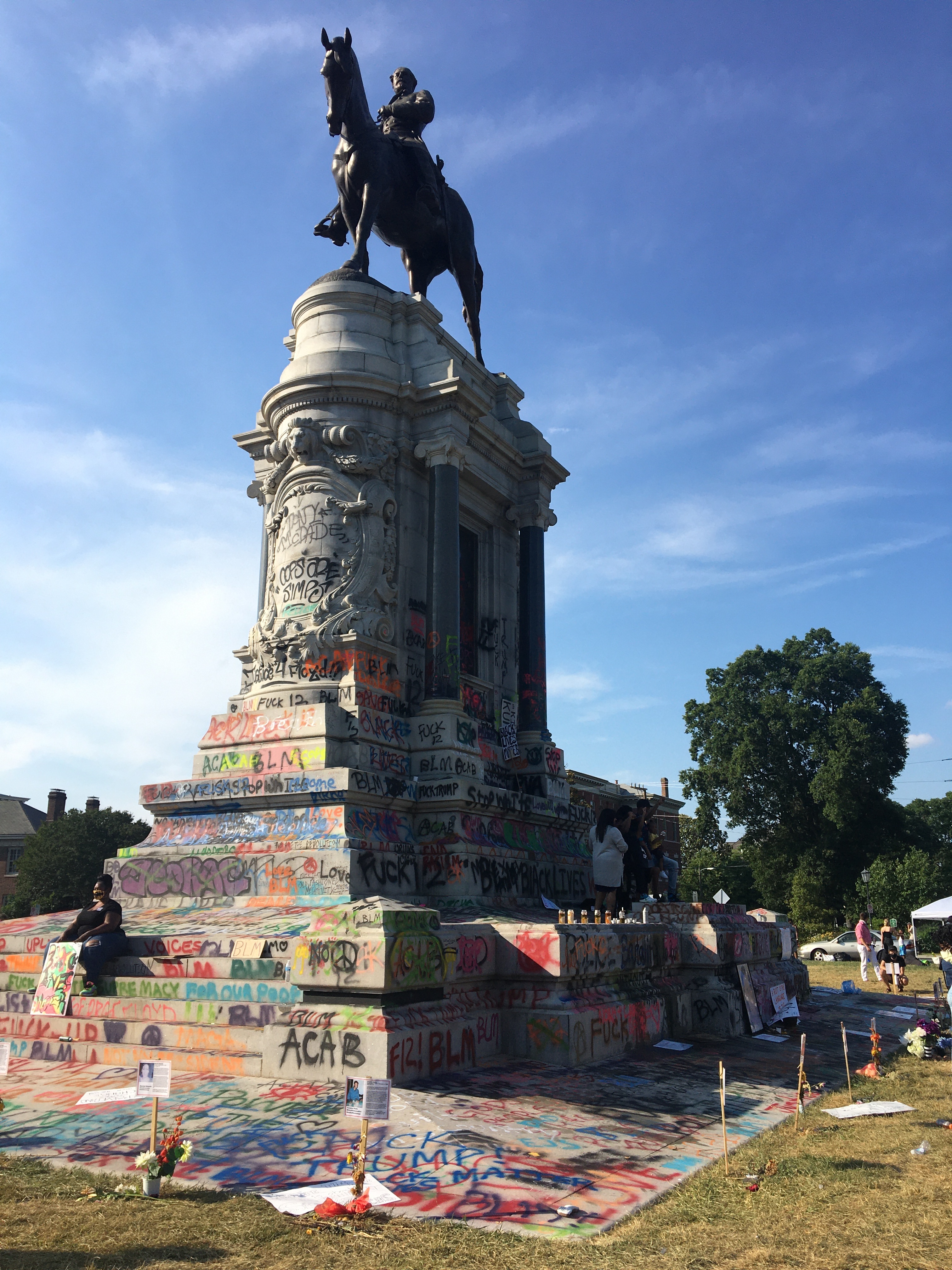
I think that is why I was so surprised by an experience last week.  Last Tuesday night, our family went up to Richmond to take a look at the Robert E. Lee statue and the surrounding damage to businesses and monuments.  For those of you who have not been following the story, as part of the protests about George Floyd’s death and the Black Lives Matter cause, the prominent Confederate monuments in Richmond have come under fire.  The statue of Robert E. Lee’s large stone plinth has been covered in graffiti, protesting George’s death, the treatment of African-Americans by the police, and systemic racism.  As I took in the visceral, pain-filled cries of graffiti, as I looked at pictures of black victims of police violence surrounding the statue, whose names I have prayed for over the years, as I watched families of color take pictures in front of this once pristine, but ever-controversial, statue with a new sense of pride and defiance, what I began to understand is those who are harassed and feel helpless have been begging for our compassion for a long time – cries that could no longer be ignored when staring at that powerfully altered statue.

But mostly, I mourned again for my complacency and blindness.  As a descendant of Confederate veterans, student of African-American history and politics, and pastor of a church built long before the Civil War, I know the issue of Confederate statues and monuments is sensitive.  But watching what was happening at the Robert E. Lee statue created the same feeling as Kehinde Wiley’s art work:  an earthquake for all in positions of privilege and power.  Standing there with my family, I felt like I was on unstable ground, my complicity in systemic racism exposed, and the weight of the question pressing on my chest:  what are you going to do about it?

For my brothers and sisters of color, I am sorry.  I am sorry that you have had to do the work to awaken my senses instead of doing that work myself.  For my brothers and sisters of European descent, we have work to do.  Hickory Neck Church has been posting ways for you to engage this issue – not necessarily telling you what to do, but inviting you into the position of making yourself vulnerable to listening, learning, and acting.  This is our work to do.  It is hard and uncomfortable, and this post may even make you defensive.  Please know that I am here – here to walk with you, here to encourage you, and here to hold us all to Jesus’ message of love.  What you do next will vary widely.  Maybe you can only do one small thing to start.  Our invitation is do something – and keep doing something until we find ourselves doing the work of the kingdom Jesus has desired for a long time.

IMG_8253

Photo credit:  Jennifer Andrews-Weckerly; reuse with permission only.


On Needing Each Other…

16 Thursday Nov 2017

Posted by jandrewsweckerly in Uncategorized

≈ Leave a comment

Tags

community, discipleship, each other, equal, gifts, God, housing, need, others, value

each-other

Photo credit:  https://www.gcurley.info/news/2015/01/

This morning I attending a symposium about housing in the greater Williamsburg area.  The theme of the symposium was the effect of housing on health, both for individuals and the community.  One of the ideas that stuck with me was about the consequence of a lack of affordable housing.  What the researchers found was that a lack of affordable housing had a negative impact on the entire community – not just those struggling to make ends meet, but also on those in upper-income brackets.  When communities do not have affordable housing, service industry workers can eventually opt out of living and working in the community altogether, creating a void of laborers, and an increase in the cost-of-living for all.  Whereas many wealthy community members may not be concerned about affordable housing, in fact, a lack of affordable housing hurts the property values and economy for all.

The idea of affordable housing being a problem for everyone reminded me of an idea I have been pondering lately:  we need each other.  In the United States, we have long-held ideals about individualism, independence, and industriousness.  We value an “every man for himself” ethic.  But that kind of ethic only gets us so far.  Sooner or later, we eventually discover that every man (or woman!) cannot do everything for himself or herself.  In fact, we need each other.  I suspect that our need for one another is not a surprise when we are really honest.  But many of us have a hard time being honest about our mutual need because it means admitting vulnerability, dependency, and incompleteness.  Whether we like it or not, we need one another.

This Sunday at Hickory Neck Church, we are finishing a series on discipleship, using Rowan Williams’ book Being Disciples.  Williams argues that there are two principles of Christian faith and discipleship that we need to form the basis of a moral society:  we are each of equal value to God, and we are all dependent on each other.  His second point is what connected with me today.  Williams argues, “The community that most perfectly represents what God wants to see in the human world is one where the resources of each person are offered for every other, whether those resources are financial or spiritual or intellectual or administrative.”[i]  When we allow each person to be needed, to play a role in each other’s lives, we begin to be able to see that we are not just being kind – we actually need each other.

I invite you to take a look around this week, and try to imagine what each person you meet has to offer the world.  From infants to wise elders; from wealthy to homeless; from male to female; from convict to free – imagine what gift each person has for the world, and how you can honor and respect the dignity of each person you meet.  Even when someone is rude, unkind, or on the other side of the political aisle, I encourage you to find what you need in each other.  God will help you find the answers, and I hope you will share them here!!

[i] Rowan Williams, Being Disciples:  Essentials of the Christian Life (Grand Rapids:  William B. Eerdmans Publishing Company, 2016), 69.

Sermon – Acts 16.16-34, E7, YC, May 8, 2016

11 Wednesday May 2016

Posted by jandrewsweckerly in Sermons, Uncategorized

≈ Leave a comment

Tags

Christ, enslaved, faith, freedom, live, Moral Mondays, Paul, power, praise, privilege, protest, Silas, slave, suffering, truth, value, wealth

Thousands of years ago, our people were enslaved.  Once-friendly Egypt got a new pharaoh who saw the sheer number of us, and out of fear, enslaved us.  We lost our freedom, and labored under a brutal new regime.  We longed for better days.  We longed for a return to our homeland, even though our homeland could not have sustained us because of the famine years before.  Every night, our cries went out to God.  One day, God heard us.  God sent us a man by the name of Moses, who dramatically managed to convince Pharaoh to let us go back home.  So we quickly packed our things and ran.  Pharaoh changed his mind and sent his armies after us.  But when we crossed the Sea of Reeds, and Pharaoh’s army drowned, we celebrated.  We were free.

Not long after, the rejoicing stopped.  Freedom did not look like what we thought freedom would look like.  Freedom was hard.  When we were enslaved, we always knew from where our next meal would come.  We knew where we would lay our heads at night.  We knew the routine.  With Moses, we were constantly wandering in the wilderness, wondering where our next meal would come from, searching for water, unsure of what would happen.  Nothing in our journey unfolded as we imagined.  We thought freedom would mean being able to do whatever we wanted, being free of obligation, and not being constrained by anyone or thing other than ourselves.  Pharaoh was admittedly awful, but better the devil you know, right?

Being from a country whose primary value is freedom, sometimes I think we get as confused as our ancestors about what freedom means in the context of being people of faith.  Take our lesson from the Acts of the Apostles today.  There are both people who are free and people who are not.  Those who own the slave-girl are free to collect money for someone else’s performance, and they are free to get someone thrown in jail.  The judges who throw Paul and Silas into jail are also free – free to choose who is punished and who is not.  Finally, we might put the jailer into the free category as well.  He is a man with a steady, respectable job, who has power over those in prison.

Meanwhile, our story has those who are lacking freedom.  The first character we hear about is a slave-girl.  In some ways, this nameless slave is a double slave – a slave to her owners who use her for money and a slave to the spirit of divination inside her.  Paul and Silas also lose their freedom.  They are thrown into jail midway through our story, which clearly puts them in the not-free category.  Plus, the slave-girl calls them “slaves of the Most High God.”

Looking at the characters in Acts, we can see how confusing the definition of freedom can be.  If freedom is a value in and of itself, then the heroes of our story are the slave owners, magistrates, and the jailer.  The owners of the slave girl obviously have social capital and an income source.  They have influence and power, and up until Paul and Silas come along, they have the comforts of wealth.  The judges also have a great deal of respect and power in the community.  They are charged with keeping order in the community and protecting the community’s way of life.  Even the jailer has a clear sense of identity and purpose.  He may not have wealth and prestige, but he has a secure job and a sense of clear identity in the community.

Consciously, we know that we should not identify with these three entities.  But subconsciously, and in a country that does not distinguish between freedom and freedom in Christ, we find ourselves much more aligned with and, quite frankly, longing for the kind of freedom that these three parties have.  Meanwhile, the slave-girl is nothing like what we hope for ourselves.  Being possessed by a spirit and being owned by another individual do not usually make the top of our lists for happiness and fulfillment.  And in no way do we want to be like Paul and Silas, who not only seem to be homeless rebel-rousers, they also are physically brutalized and imprisoned.  We are faithful followers of Christ, but I doubt many of us would take that commitment all the way to jail.

Last week, a friend of mine had that very debate.  She is a priest in North Carolina, and she decided to join the weekly protests that has become known as Moral Mondays.  Moral Mondays have been happening since 2013, as religious leaders and followers across North Carolina have gathered in peaceful protest of the laws being passed that promote unfair treatment, discrimination, and oppression.  Bishop Michael Curry was a frequent protestor and speaker at Moral Mondays before being elected Presiding Bishop.  Last week, my friend decided that she needed to join fellow Christians in protest, but she was uncertain about the possibility of being arrested.  She knew what was happening in the legislature was unjust, but she also had a family and job to think about.  She was unsure about how she could best be of use – by staying long enough to be escorted to jail, or whether her presence at the protest would be enough.

What my friend was on the cusp of understanding is what Paul, Silas, and the slave-girl already know.  The slave-girl already knows the truth that no one else can see – that Jesus is the way to salvation.  And when she shouts that long and loudly enough, she is not only freed of her possession, she is free of the bondage of slavery – because her owners can no longer use her as they did before.  Even Paul and Silas, who are locked in jail, are more free than they seem at first glance.  What person, after being brutally whipped and thrown into a cold cell, can be found praying and singing praises to God in the middle of the night?  Only someone who is so free of the bondage of this world can be able to praise God in the midst of earthly suffering.

If Paul, Silas, and the slave-girl are free, guess who the real enslaved ones in our story are.  Those owners, who seem to have the earthly freedom of wealth, have actually become slaves to their wealth.  They are so enslaved to that wealth that when their source of income is freed, they lash out, bringing pain and suffering down upon others.  They cannot see the gift of freedom and health for the slave-girl; they only see the consequences for themselves.  The magistrates are no freer than the owners.  They are so enslaved to their rigid rules that they cannot see the inherent injustice that the slave-girl has faced for so many years.  Even the jailer is not truly free.  He is so caught up in his identity as a jailer that he is willing to take his life for his job.  He is ready to kill himself for what he thinks is a failure on his part than to see how this job has taken over his sense of identity.[i]

So how do we avoid living like the complaining Israelites, who were physically free, but not yet spiritually free to live as the Lord our God invited them to live?  How do we, in a nation that reveres freedom, avoid being enslaved by the wealth, power, and identity that comes from being free?  The jailer asks the same question to Paul and Silas when he asks, “What must I do to be saved?”  In the paraphrase of our text, Paul’s answer is simple:  Put your entire trust in the Master Jesus. Then you’ll live as you were meant to live.[ii]  Paul and Silas could have easily fled that jail when the earthquake happened.  They could have sped past the jailer, and been focused solely on their own self-preservation.  But we see that there is a peace in Paul and Silas that comes from true freedom – of living how we are meant to live.  Instead of weeping and plotting in that cell, they sing and pray to God.  Instead of running when the doors fling open, they ensure that the jailer is okay.  Instead of demonizing the jailer, they offer him baptism.  This is what true freedom looks like.[iii]

In our freedom, we have become enslaved – in varied and sundry ways, but we are all enslaved by something.[iv]  Paul, Silas, and the slave-girl invite us into another way.  They invite us to live as liberated people who trust in our Lord Jesus Christ.  That true freedom may mean we find ourselves shouting out truth in a peaceful rally.  That true freedom may mean that we find ourselves praising God when no one else is, sacrificing our own comfort so that someone might find theirs.  That true freedom might mean trusting God is acting when we feel like God left the building long ago.  When we claim that freedom, then finally, finally, we will begin living as we were meant to live.  Amen.

[i] David G. Forney, “Pastoral Perspective,” Feasting on the Word, Yr. C, Vol. 2 (Louisville: Westminster John Knox Press, 2009), 526.

[ii] Eugene Patterson, The Message, as found at https://www.biblegateway.com/passage/?search=Acts+16%3A16-34&version=MSG on May 6, 2016.

[iii] L. Gregory Jones, “Come, Lord Jesus,” Christian Century, vol. 109, no. 16, May 6, 1992, 485.

[iv] Ronald Cole-Turner, “Theological Perspective,” Feasting on the Word, Yr. C, Vol. 2 (Louisville: Westminster John Knox Press, 2009), 524.


Homily – Luke 12.4–12, Vincent, January 22, 2015

16 Monday Feb 2015

Posted by jandrewsweckerly in Uncategorized

≈ Leave a comment

Tags

call, care, God, grace, homily, Jesus, Moses, unworthy, value, Vincent

This past week I was able to visit the Rite-13 class.  They were discussing the call narrative of Moses.  We talked about the many ways Moses tries to avoid his call and the excuses he gives.  We talked about how God knows Moses well and has intimate conversations with him.  And then an interesting question came up.  We wondered whether God cares about each one of us in the same way God seems to have cared about Moses.  The responses were varied, but the one that stuck with me was the skeptic who wasn’t sure that God really cared about each of us – especially when there are about 6 billion of us in the world.  How could God know and care about each little thing about each one of us?  And then I recalled the gospel lesson we heard today: “even the hairs of your head are all counted.”  When we did the math about the numbers of hairs on all the billions of people in the world, we were all a little stunned into silence.

That is the hard part of our gospel lesson today.  Can we really believe that God is so infused in our lives – and that God cares what is going on with each and every one of us?  The question is one that Christians have been asking for centuries – is our God big enough to really know and love each one of us?  I am sure Vincent, who we honor today, asked that same question.  Vincent was a native of northwestern Spain, born in the late 200s or early 300s.  He was ordained deacon by Valerius, the Bishop of Saragossa.  In those years, the fervent Christian community in Spain suffered great persecution by the Roman emperors Diocletian and Maximus.  The governor of Spain had Bishop Valerius and Deacon Vincent arrested.  According to legend, the bishop had a speech impediment and Vincent often preached for him.  When the two prisoners were challenged to renounce their faith or else be tortured and killed, Vincent turned to his bishop, willing to make a stand.  Vincent’s bishop encouraged him to defend the faith.  Vincent’s passionate defense angered the governor.  The bishop was exiled and Vincent was tortured and finally killed.  Vincent is venerated as a bold and outspoken witness to the truth of the living Christ.

I am sure there were days, especially at the end, that Vincent wondered whether God really knew the hairs on his head.  To Vincent and even to us in our lesser trials, Jesus says, “Do not be afraid, you are of more value than many sparrows.”  Then and now, Jesus affirms that none of us is forgotten by God.  When we question God, when we feel forgotten by God, or even when we forget God, God is still there valuing the hairs of our head.  That is God’s profound promise every day.  Even when we flounder, or when, like Moses, we try to avoid our call or feel unworthy for the work God gives us to do, or when the pain of life feels overwhelming – God is with us, guiding us, valuing us, loving us.  Thanks be to God for God’s abundant care and grace and the reality that we are of more value than many sparrows – each one of us!  Amen.

Recent Posts

  • On the Myth and Magic of Advent…
  • On Risking Failure and Facing Fear…
  • Sermon – Luke 23.33-43, P29, YC, November 23, 2025
  • On Inhabiting Gratitude…
  • Sermon – Luke 20.27-38, P27, YC, November 9, 2025

Archives

  • December 2025
  • November 2025
  • October 2025
  • September 2025
  • August 2025
  • July 2025
  • June 2025
  • March 2025
  • February 2025
  • December 2024
  • November 2024
  • October 2024
  • September 2024
  • August 2024
  • July 2024
  • June 2024
  • May 2024
  • March 2024
  • February 2024
  • January 2024
  • December 2023
  • November 2023
  • October 2023
  • September 2023
  • August 2023
  • July 2023
  • June 2023
  • May 2023
  • March 2023
  • February 2023
  • January 2023
  • December 2022
  • November 2022
  • October 2022
  • June 2022
  • May 2022
  • January 2022
  • December 2021
  • November 2021
  • October 2021
  • September 2021
  • August 2021
  • June 2021
  • May 2021
  • April 2021
  • March 2021
  • February 2021
  • January 2021
  • December 2020
  • November 2020
  • October 2020
  • September 2020
  • August 2020
  • July 2020
  • June 2020
  • May 2020
  • April 2020
  • March 2020
  • February 2020
  • January 2020
  • December 2019
  • November 2019
  • October 2019
  • September 2019
  • August 2019
  • July 2019
  • June 2019
  • May 2019
  • April 2019
  • March 2019
  • February 2019
  • January 2019
  • December 2018
  • November 2018
  • October 2018
  • September 2018
  • August 2018
  • July 2018
  • June 2018
  • May 2018
  • April 2018
  • March 2018
  • February 2018
  • January 2018
  • December 2017
  • November 2017
  • October 2017
  • September 2017
  • August 2017
  • July 2017
  • June 2017
  • May 2017
  • April 2017
  • March 2017
  • February 2017
  • January 2017
  • December 2016
  • November 2016
  • October 2016
  • September 2016
  • August 2016
  • July 2016
  • June 2016
  • May 2016
  • April 2016
  • March 2016
  • February 2016
  • January 2016
  • December 2015
  • November 2015
  • October 2015
  • September 2015
  • August 2015
  • July 2015
  • June 2015
  • May 2015
  • April 2015
  • March 2015
  • February 2015
  • January 2015
  • December 2014
  • November 2014
  • October 2014
  • September 2014
  • August 2014
  • July 2014
  • June 2014
  • April 2014
  • March 2014
  • February 2014
  • January 2014
  • December 2013
  • November 2013
  • October 2013
  • September 2013
  • August 2013
  • July 2013
  • June 2013
  • May 2013
  • April 2013
  • March 2013
  • February 2013
  • January 2013
  • December 2012
  • November 2012
  • October 2012
  • September 2012

Categories

  • reflection
  • Sermons
  • Uncategorized

Meta

  • Create account
  • Log in
  • Entries feed
  • Comments feed
  • WordPress.com

Blog at WordPress.com.

  • Subscribe Subscribed
    • Seeking and Serving
    • Join 394 other subscribers
    • Already have a WordPress.com account? Log in now.
    • Seeking and Serving
    • Subscribe Subscribed
    • Sign up
    • Log in
    • Report this content
    • View site in Reader
    • Manage subscriptions
    • Collapse this bar
 

Loading Comments...