• About

Seeking and Serving

~ seek and serve Christ in all persons

Seeking and Serving

Tag Archives: witness

Sermon – Luke 6.20-31, AS, YC, November 2, 2025

05 Wednesday Nov 2025

Posted by jandrewsweckerly in Sermons

≈ Leave a comment

Tags

All Saints Sunday, Beatitudes, compassion, faithful, fragrance, God, Golden Rule, Jesus, justice, love, saint, scent, sensory, Sermon, witness

On the blog this week, I shared about friends of ours who are fragrance aficionados.  When we spend time together, we’ve taken to doing fragrance samplings with them – sort of like wine tastings, but with the focus on the sense of smell.  Invariably, I find a new fragrance I like that I had never heard of, but that brings me a sense of playful joy.  This past week I was sharing one of those fragrances with one of our daughters and she said, “It’s okay, but I prefer your ‘Mom smell.’”  While I wish there was a more attractive label to that particular fragrance, and while I suspect that “Mom smell” is some combination of the scents of my soap, hair products, and laundry detergent, I get what my daughter meant.  Just like fragrances can evoke memories of special places, fragrances can also recall to us people in our lives.  One whiff, and we are transported to another time and place, remembering what someone meant to us.

On this All Saints Sunday, we engage in a similar kind of sensory recalling.  In our case at Hickory Neck, instead of the sense of smell, we invoke the sense of touch – the feel of smooth or ridged ribbons running through our fingers as we tie them to the altar rail in memory of a saint of God, the feel of droplets of water landing on our heads and bodies as we recall our baptismal identity and the baptisms of saints who have died, and the feel of the wafer in our hands and mouth or the feel of the priest’s thumb as they rub a blessing on our forehead, as we engage in the earthly banquet, reminiscent of the heavenly banquet our loved ones are enjoying.

But just like scents have the power to remind us of beloved memories, so scents can remind us of painful memories.  While some of us may have a “Mom scent” we recall with love and affection or wistful memory, others of us didn’t have such beloved memories or experiences – and unfortunately, smells can recall those memories too.  As I was reading Luke’s gospel for today, that’s where I landed – that all of us – all of us saints of God – have the opportunity to live lives of good or ill – to leave behind fragrances that help or harm.  And since Luke’s language is entirely literal and not at all the flowery, spiritual language of Matthew’s beatitudes[i], we are very clear on Jesus’ words and meaning.  The blessings and woes of Luke’s beatitudes are straightforward and simple.  As one scholar puts it, “If you want anything to do with Jesus or the God who sent him, Luke says, you had better go find the poor, the hungry, the captives, the blind, and the outcast, and join Jesus, as Jesus cares for them.  The way we know who Jesus is, is to go where Jesus is, with the poor, the hungry, and the oppressed.”[ii]

While All Saints Sunday can take us to place of remembering loved ones and the saints of the church, tempting us to get lost in those memories, what All Saints Sunday ultimately hopes to impart is that the lives we live matter.  We remember the saints of the church and the lives of our loved ones we miss because they showed us what living lives that matter looked like.  We do not honor them because they were rich or well fed or joyful or respected.  We honor them because they loved their enemies, they did good to those who hated them, they blessed those who cursed them, and prayed for those who hurt them.  We honor them because they were nonviolent, because they gave sacrificially of their wealth, because they understood that poverty makes people desperate – and because they did to others as they would have them do to them.

We could easily leave here today with the commission to “go and do likewise,” as if Jesus’ words are a simple commission.  But nothing about what Jesus is saying is simple or easy.  Several years ago, I was talking to our children about the Golden Rule – those words we hear today about doing unto others as you would have them do unto you.  To my great shock, my children did not see the wisdom of the words at all.  Instead, their desires were rooted in a sense of justice or fairness.  “No way!” one said.  “I’ll do unto others what they do to me.”  What I had understood as simple, universal wisdom that is shared among faith traditions totally flies in the face of secular, American ideals.  Even Professor Johnson says about Luke’s text today, “It is not only greed that jeopardizes the wealthy Christian’s relationship with God, but the simple – and subtle – temptation to think we can take care of ourselves.”[iii]

Luke leaves us, then, with a challenging invitation.  As you tie on a ribbon to remember a loved one today, you can certainly recall whatever fragrance of theirs you miss.  But Luke asks you to go further – to recall the witness they left to you about living a faithful life, and be emboldened to start leaving your own faithful fragrance behind too.  Lean into those who have gone before to encourage your own witness of love, compassion, and justice.  Lean into the faithful who gather beside you in person every Sunday who struggle to live that Golden Rule with gusto instead of resentment.  Lean into Jesus, who walked before us in incarnate form, leaving behind the fragrance of incense – the fragrance of humility, compassion, and sacrificial love.  With them, you can then begin to create a signature fragrance of your own that will help draw others to God.  Amen. 


[i] Marjorie Procter-Smith, “Homiletical Perspective,” Feasting on the Word, Yr. C, Vol. 4 (Louisville:  Westminster John Knox Press, 2010), 239.

[ii] E. Elizabeth Johnson, “Exegetical Perspective,” Feasting on the Word, Yr. C, Vol. 4 (Louisville:  Westminster John Knox Press, 2010), 239.

[iii] Johnson, 241.

Sermon – Matthew 5.17-19, UJCCM Ecumenical Service, March 26, 2025

18 Wednesday Jun 2025

Posted by jandrewsweckerly in Sermons

≈ Leave a comment

Tags

Christian, dignity, ecumencial, follow, Jesus, love, new, political, Sermon, subversive, witness

Several years ago, I was in a Bishop Search process.  Ordinarily, I do not recommend the process – in fact, I often actively discourage the process, because in our Episcopal tradition, the search is very public, exacting, and takes a toll on your parish, even when they are cheering you on and supporting you.  But if I enjoyed anything from the experience, I enjoyed the opportunity to take a wider look at the Church – a wider look at this endeavor we are all undertaking, called being Christian.  One of those defining identity moments happened in one of the public interviews.  A church member at one of the local churches said to me, “Our current bishop is very active politically.  Would you as a bishop continue that political activity, or would you focus on following Jesus?” 

Now we all know that the county our ecumenical group is situated in is decidedly “purple” politically.  I haven’t really asked your clergy about your individual churches, but I know Hickory Neck is also a very “purple” congregation – I often joke that if you took a look at the bumper stickers in our parking lot you would wonder how in the world we peacefully worship every Sunday.  In fact, my own church members have often heard me say that we don’t preach politics, we preach Jesus.

The trouble with that dichotomy is that although Jesus was not a democrat or a republican, he was inherently political.  He lived and breathed in a politically loaded time – something with which we are very familiar.  And although he may not align with our current political parties in the United States, his actions and words have political ramifications on how we live as Christians. 

Now why in the world, on this Wednesday right in the middle of Lent, in the middle of our beloved peacefully ecumenical gatherings would I bring up something divisive?  Well, I blame Jesus.  The gospel lesson we just heard from Matthew is only three verses long.  But in order to understand what is going on, we need to step back just a bit to recall where we are in Matthew’s gospel.  Chapter five of Matthew starts with the beatitudes, and is just the beginning of what we call the Sermon on the Mount – Jesus’ sort of treatise on how to be a Christian – or even more clearly, the answer to “What would Jesus do?”  So, Jesus sits down for an extra long sermon (or at least long for Episcopal standards – I know some of your traditions love a good 30-minute to hour-long sermon!).  He starts with those beloved beatitudes, letting us know where true blessing lies.  He then moves on to talk about being salt and light as disciples in the world.  And then he talks about the law in the portion we heard tonight.

Before we get too far, we have to remember that conversations about the law (not the Roman law, but the very law we heard about in Deuteronomy tonight) – conversations about the law needs to be very careful.  Many a scholar has tried to use this passage to argue the supersessionism of the Chrisitan Church over the Jewish people – as though by Jesus saying he came to fulfill the law that now Christians supersede the Jewish people as God’s chosen.  Jesus has been confusing followers for centuries by this statement – theologians as distinguished at Thomas Aquinas tried to separate the types of law, arguing that we need to follow the moral law, but not the juridical or ceremonial law of the Old Testament.[i]

That is not what Jesus is arguing in these three short verses.  Jesus never intended to bifurcate the faithful in such a way.  Just like Jesus was not saying be a republican or be a democrat, Jesus is saying be a person of faith.  In the verse following what we read today, Jesus says, “For I tell you, unless your righteousness exceeds that of the scribes and Pharisees, you will never enter the kingdom of heaven.”  Just like in our day, the faithful of Jesus’ day lived in a politically charged time.  As Stanley Hauerwas explains, “…too often Israel sought to be faithful in a manner that would not challenge the powers, and in particular the power of Rome.  The Pharisees quite understandably tried to observe the law without that observance being recognized as subversive to those who ruled them.”  Like in our day, they were not claiming a particular party, but claiming the faith.  Not preaching politics, but preaching Jesus.

But here’s the problem with that way of life – and quite frankly, the dichotomy that the person in that interview asked me about.  The kingdom of God cannot avoid being subversive.  We know this because Jesus was so subversive that he was crucified – because instead of “…violently overthrowing the old order Jesus creates a people capable of living in accordance with the new order in the old.”[ii]  What does that mean exactly?  Stanley Hauerwas tells us that fulfilling the law means creating a way of life that is unlike the world.  That way of life is voluntary:  you cannot be born into it, but can only join by repenting and freely pledging allegiance to its king (Jesus).  And the next generation is not automatically admitted – every member joins of their own volition.  Two, that way of life creates a mixed community:  racially, religiously, economically.  And finally, that way of life is, well, a new way of life.  Jesus, “…[gives] them a new way to deal with offenders – by forgiving them.  He [gives] them a new way to deal with violence – by suffering.  He [gives] them a new way to deal with money – by sharing it.  He [gives] them a new way to deal with problems of leadership – by drawing upon the gift of every member, even the most humble.  He [gives] them a new way to deal with a corrupt society – by building a new order, not smashing the old.  He [gives] them a new pattern of relationship between man and woman, between parent and child, between master and slave, in which [is] made concrete a radical new vision of what it means to be a human person…”[iii]

I do not know what your Lenten discipline has been this year.  Given the weight of the political environment, the anxiety floating around in the atmosphere, and the sense of radical challenge, doing things like giving up chocolate or screen time or meat has not felt, well, meaty enough for me this year.  I think part of the challenge has been the sober, somber nature of Lent has felt so congruent with the sober, somber nature of everyday living these days.  Perhaps why Lent feels so heavy is because I can see no way to answer that dichotomy of a question, “Will you be political or will you follow Jesus?” 

I do not think our invitation tonight is to leave this place planting our red or blue flags.  In fact, our invitation might just be carrying our purple flags out of this space while helping others see and experience Jesus.  The new way of life that Jesus laid out for us – of forgiving, suffering, sharing, empowering, building, relating – is not unique to one political party.  Our invitation is to support that new way of life through Jesus in all political parties – republican, democrat, independent, or whatever else you may be feeling tonight.  That new way of life is so subversive that members of your own party may challenge you, and like a Pharisee, you may want to be a Christian while not rocking the boat.  But following Jesus means rocking the boat.  Following Jesus means loving neighbors, caring for the less than, respecting the dignity of others.  Following Jesus means sometimes following him out of the boat into some scary, stormy waters.  But if we can sit together in this room – as Presbyterians, Methodists, Lutherans, Episcopalians, Baptists, Mennonites, Roman Catholics, and Disciples of Christ – surely we can step into those waters together outside of this room, witnessing another way…together.  Amen.


[i] Stanley Hauerwas, Matthew: Brazos Theological Commentary on the Bible (Grand Rapids:  Brazos Press, 2006), 65.

[ii] Hauerwas, 67.

[iii] Hauerwas, 67-68.

UJCCM Ecumenical Service Sermon – Matthew 5.17-19, Deuteronomy 4.1-2, 5-9, March 6, 2024

15 Friday Mar 2024

Posted by jandrewsweckerly in Sermons

≈ Leave a comment

Tags

Decalogue, free, fulfill, God, Holy Scripture, Jesus, law, Moses, relationships, Sermon, ten commandments, witness

This sermon was preached at Our Saviour’s Lutheran Church in Norge, VA as part of a seven-week pulpit exchange between ecumenical churches during Lent.

I do not know what your experience with Holy Scripture has been.  I grew up in the South where Scripture was meant to be memorized, and at the very least you needed to know the Ten Commandments by heart.  As someone who is pretty terrible at memorizing scripture, you can imagine how tortured my childhood was.  When I was in grade school our Sunday School teacher quizzed us for weeks, making sure we were memorizing the Ten Commandments.  I vividly remember that dreaded day when each of us had to stand up in front of our peers and recite all ten.  My friend Nathan went before me and recited them perfectly.  My hands started to sweat, and I was fidgeting in my chair.  I could only imagine the whispers around church when everyone found out the minister’s kid (yes, I’m a preacher’s kid!) could not remember all of the Commandments.  I felt like a failure before I had even begun.

For those of you in parishes that follow the Sunday lectionary, you likely heard the Ten Commandments this past Sunday.  The scripture lessons appointed by the lectionary today continue the conversation about the commandments.  In Deuteronomy, Moses is preparing the people of Israel for the Commandments he is about to enumerate in the next chapter.  Meanwhile, in Matthew, Jesus proclaims that he comes to fulfill the law and that whoever breaks the least of the commandments will be least in the kingdom of heaven.  In the verses following the ones we heard tonight, Jesus goes on to describe some of those Ten Commandments more fully. 

But Jesus’ harsh standards about those Commandments are unnecessary really.  All we need is a slow reading of the Ten Commandments, or the Decalogue as they are often called, and we realize how woefully unfaithful we are.  Any deeper dive into the commandments probably has our hands sweating like that little kid in Sunday School.  Likely the only commandment most of us have avoided is the murdering, although we have probably wished we could murder someone at least once.  But all the others sneak in and tempt us.  We may not have stolen something large, but we have probably taken home a pen, paper clip, or notepad here and there from work.  If we have not committed adultery, we have certainly coveted someone else, which the Commandments say is equally bad.  We may think we have avoided creating idols, but when we realize the centrality of money in our lives, we discover that money has become a god for us.  And keeping the Sabbath – forget about it!  We are lucky if we make our way to church three out of four Sundays.  And even when we make it to church, we immediately whisk ourselves away to our busy schedules afterwards – even if those schedules are only packed with watching games or hanging out with friends.  We rarely take a true break in our week for a full day with God.  We prefer Jesus’ summary of the commandments much later in Matthew’s gospel to, “love the Lord your God with all your heart, soul, and mind, and your neighbor as yourself,”[i] because his summary allows to avoid thinking about all the specific ways we sin against God and our neighbor.  In our minds and in the minds of many, “the Ten Commandments have somehow become burdens, weights, and heavy obligations.”[ii]  We sense their burdensome weight on our shoulders, and we feel like our bodies and our spirits are being physically pushed down by God.

What may help us tonight, then, is to take a step back and look at those troubling commandments and laws that Jesus came to fulfill.  The Decalogue does not start out with the preface, “Here are ten rules that you will obey.”  Instead, the commandments begin with a “breathtaking announcement of freedom: ‘I am the Lord your God, who brought you out of the land of Egypt, out of the house of slavery.’”[iii]  God is not the overbearing parent who is saying, “You will do what I say because I am the boss.”  Instead, God is saying, “Remember that you are free.  Remember that I brought you out of a terrible place and now, you are free, my beloved ones.”  As a freed people, God is simply reminding them of how freed people live – in relationship with God and in relationship with one another. 

Jesus’ summary of these commandments later in Matthew is helpful, especially in that the summary reminds us of how we are to attend to our relationship with God – which is presented in those first four commandments, and how we are to attend to our relationship with people – what those final six commandments teach us.  But Jesus’ summary can allow us to forget how interrelated these two relationships are.  As one scholar argues, the Commandments teach us more specifically that, “having ‘no other gods before me’ means that money, sex, and power will not wiggle their way into the altars of our lives, and thus will not be used to exploit others.  Keeping the Sabbath is a reminder that all of creation is a gift and we have a responsibility to be wise stewards of it…‘you shall not murder’ suggests that others are gifts who bear the image of God for us.”[iv]  Those Ten Commandments show the people of God how life should be structured as a freed people, and how that life is an intertwined life of relationships between God and one another.  Out of those commandments comes a way of being.  Out of those commandments comes a full understanding of liberation.  Out of those commandments comes the path of life – a life that reminds us that not only does Jesus come to fulfill the law, but as Stanley Hauerwas argues, “…our discipleship of Jesus entails our fulfillment of the law.”[v]

Several years ago, a hoopla arose around an Alabaman judge who wanted the Ten Commandments posted in his courthouse.  In response, many Alabamans posted small plastic signs in their yards with the Ten Commandments written on them.  I remember visiting my family in Alabama and seeing the signs everywhere.  At the time, I rolled my eyes.  I could not imagine what good posting those rules up all over neighborhoods could really do.  Were they meant to teach others about being a person of faith, or were they meant to be a way of flaunting their Christian identity (and yes, in Alabama, those posting the Ten Commandments were Christian, not Jewish)?  At the time, they seemed to me to be self-righteous or at least condescending.  But as I have been thinking about those silly signs this past week, I have begun to wonder if there is not something to them.  What if instead of being a finger-wagging at the neighborhood, the posted signs are a way for each resident to claim on which path they hope to live – what law they are trying to fulfill through their own life.  What if instead of saying, “You all need to live like this,” the signs say, “I need to live like this.”  What if the signs are a way of saying, “I am liberated by God and want to try to live on the path of life.  Help keep me on that path – and join me if you like!”

Our liturgy tonight in some small way is doing the same thing that those signs had the potential of doing.  Our liturgy tonight, both in our prayers and in our scripture reading, invites us to remember that we are liberated by God, that we have been given the path to life, and that we can rejoice in those gifts tonight.  Our liturgy tonight invites us to shrug off our perceived burdens and to step into the warmth and love of the law and commandments.  Our liturgy tonight invites us to create our own metaphorical plastic yard sign that will remind us to live on the path of life, to do the work of fulfilling the law, and to invite others along the path through our witness of Decalogue-living.  Amen.


[i] Paraphrase of Matthew 22.37-38.

[ii] Thomas G. Long, “Dancing the Decalogue,” Christian Century, vol. 123, no. 5, Mar. 7, 2006, 17.

[iii] Long, 17.

[iv] Craig Kocher, “Pastoral Perspective,” Feasting on the Word, Year B, Vol. 2 (Louisville: Westminster John Knox Press, 2008), 78.

[v] Stanley Hauerwas, Matthew: Brazos Theological Commentary on the Bible (Grand Rapids:  Brazos Press, 2006), 66.

Sermon – John 1.6-8, 19-28, A3, YB, December 17, 2023

03 Wednesday Jan 2024

Posted by jandrewsweckerly in Sermons

≈ Leave a comment

Tags

Advent, call, discernment, Episcopal, evangelism, identity, Jesus, John, nervous, Sermon, vocation, witness

Episcopalians are a funny crew.  I can claim that description honestly because I actively chose the Episcopal Church, having been raised in another denomination.  But what continues to humor me all these many years later is the almost universal look of panic Episcopalians get in their eyes when you start talking about evangelism.  I can already feel the nervous shifting in the room, so know that you are not alone.  The problem is the concept of evangelism brings up all sorts of images:  the guy on the street corner with a megaphone talking about the end being near; people knocking on your door with tracks about Jesus; the person asking you directly if you have been saved; or maybe even some more personally deeply damaging memories from so-called evangelicals.  And so, Episcopalians either:  just don’t do evangelism (entirely faithful but absolutely unwilling to talk to people about their faith life or Jesus); or they might be willing to share something vaguely about their church, but couldn’t imagine uttering the name Jesus; or they’ll do my favorite thing, which is quote St. Francis who is quoted as saying, “Preach the gospel at all times and if necessary, use words.” – and use that as the ultimate excuse to never actually have to use words.

For all of us squeamish Episcopalians, scripture gives us John today.  Now, in Mark’s gospel, John is called “John the baptizer.”  In Matthew’s gospel, he is called “John the Baptist.”  In Luke’s gospel, he is called, “John, the son of Zechariah, in the wilderness.”  But in John’s gospel that we read today, our beloved John is “John the Witness.”[i]   In fact, John’s gospel doesn’t have any narratives about John leaping in the womb, John dressed in funny clothes, or even John baptizing Jesus.  Instead, John’s gospel is the one that starts with that flowery poetry, “In the beginning was the Word, and the Word was with God, and the Word was God.”  Into this beautifully convoluted prologue comes John, who comes as a witness – whose entire job is to point to Jesus. 

I am not suggesting that your whole life needs to be a self-emptying, agency-free pointing to Jesus.  I had a dear friend whose response to every compliment was, “It’s not me.  It’s all Jesus working in me.”  This is a wonderfully humble way to live, but also a completely irritatingly sanctimonious way to live.  Instead, what John’s gospel today is inviting us to do today is to be entire clear about who we are in relation to Jesus.  Four times John the Witness is asked about his identity, “Who are you?” they ask.  “Are you Elijah?  Are you the prophet?  Who are you?”  And John the Witness says over and over again, “I am not.  I am not.  No, I am not.”  Even the prologue in the gospel tells us, “[John] came as a witness to testify to the light…He himself was not the light, but he came to testify to the light…”[ii]  In the verses following what we read, we’ll find John the Witness shouting to crowds about Jesus, “There he is!”  John is crystal clear about who is he and his role in honoring Jesus the Messiah.  His whole purpose is to be a witness.

Now, I know I might have painted this Advent as a time of sacred silence, a time of quiet preparation.  We even spent last week letting the words of Advent lap over us like cool refreshing water.  But this week, our quiet work is not passive.  Our invitation today is to get real clear on who we are.  Those questions for John are questions for each of us as well.  Who are you?  What then?  Who are you?  We have talked countless times about the work of discernment about our call – our vocation in the world.  Our work of being faithful followers of Christ is constantly checking that we know who we are and what we are called to be doing.  This is ongoing work that does not end – even in the midst of crazy Christmas preparations, we are to ask, “Who am I?” – what is God calling me to do?

This work of discernment does not excuse us nervous Episcopalians from evangelism.  I can imagine the math you were all just doing:  If John the Witness’s answers to “Who am I?” was that he was a witness, maybe my “Who am I?” will be something else – something less evangelical.  But the entire reason we do the work of answering the barrage of questions about who we are is so that we can prepare ourselves for active encounters with others about who they are – what they long for – how the coming Jesus has blessed us, and how our Church has helped us answer “Who are you?”  John is not the only Witness today in our gospel lesson.  John is simply pointing the way for our own witness too.  Amen.


[i] Gary W. Charles, “Exegetical Perspective,” Feasting on the Word, Yr. B, Vol. 1 (Louisville: Westminster John Knox Press, 2008), 71.

[ii] John 1.7-8.

Sermon – Matthew 18.15-20, P18, YA, September 10, 2023

20 Wednesday Sep 2023

Posted by jandrewsweckerly in Sermons

≈ Leave a comment

Tags

avoidance, Christian, church, community, conflict, conflict resolution, discipleship, gift, Jesus, reconciliation, relationship, Sermon, transform, witness

I have been looking forward to this Sunday for weeks!  Although we just had our post-sabbatical gala last night, there are still several parishioners who I expect to see for the first time in months today.  Our staff finally reunited for the first time since sabbatical began this week.  Our choir is back in action at the 10:00 am service and our Sunday School and Adult Formation teams are doing open houses today.  Our Parish Life Committee has brewed up fresh coffee – which is no small feat after transforming the New Chapel for last night’s festivities.  Church members have been inviting friends to join them for church, or maybe you yourself decided today was the day to search for a new church home – either in person or online.  I have felt the anticipation building as this has day approached. 

Into my excitement to kick off a new program year, to invite people to engage in their faith journey, and to share an invitation to others to discover the beauty of this vibrant community, what does the gospel lesson from Matthew offer us?  A text about fighting within the church.  Jesus does not just admit that sometimes, every once in a while, people in the church might experience conflict.  No, Jesus goes into great detail about what to do when you face conflict in the church:  embrace conflict directly, repeatedly, and publicly.  To those of us who were raised in the South, or at least to those of us who were raised in conflict-avoidant families, this text is our worst nightmare!  And this is certainly not the joyful text I was looking for when anticipating this festive day.

Part of what bothers us about this text from Holy Scripture is many of us come to church looking for a break from the conflict that surrounds our everyday life.  Whether we experience conflict in our families, conflict in our workplaces, schools, or service organizations, or conflict in our political lives, the last thing we want to do when we come to church on Sundays is deal with more conflict.  A friend of mine once confessed to me that he was thinking about leaving his current church home over a conflict within the church.  We were both young adults, on our own for the first time since college, and we had images in our minds about what church should be and what we wanted from our church communities.  But instead of bucolic communities of peace, harmony, and justice, we were both finding churches riddled with conflict and disunity.  As we were talking about his frustration, my friend finally confessed, “When I go to church, I just want everyone to get along.  I go to church to escape what is going on in my everyday life, not relive it!”

Now, I could spend the next hour deconstructing his complaint, but there is something powerful at the heart of his complaint, and perhaps at the heart of our own experience of church.  When we talk about church as being like a family, or being like home, what we really mean is we want a place that is a bit unlike our families or homes.  We want a place that is always happy, loving, nurturing, sometimes challenging, but more often comforting.  When we think about the warm, fuzzy feeling we have, the feeling we find at a place like Hickory Neck, the last thing we think is, “Man, I love the way we handle conflict at church!” 

Unfortunately, that is exactly what our text is inviting us to do – to celebrate the way that the church teaches us to fight – or to phrase it a little differently, how the church teaches us to deal with conflict in healthy ways.  In order to get to the point where we can see the gift of healthy conflict resolution as a good thing, we need to do a few things.  First, we need to get to the point where we can embrace the inevitability of conflict in the church community.  For some of us, that is not a big hurdle.  For others of us, the assumption of conflict is difficult.  Perhaps you were raised in a family who treated conflict as something to be avoided at all costs.  Or perhaps you grew up in an environment where conflict was so aggressive you created patterns of conflict-avoidance later in life.  Regardless, if we have come to see conflict as the enemy, accepting the inevitability of conflict is going to be our first task.  In Matthew’s gospel today, Jesus says, “For where two or three are gathered in my name, I am there among them.”  But what he implies is that when two are three are gathered in his name, there will be conflict.  Jesus himself is so sure there would be conflict that he develops a whole conflict management plan.  So, repeat after me, “Conflict is unavoidable in church.” 

Now that you are accepting the unavoidable, the next thing we need to do is honor the gift of conflict management Jesus gives us in scripture today.  For those of us who are conflict avoidant, Jesus’ conflict management plan is going to seem daunting.  The good news is scholars agree with you.  Many of the scholars who have written about this text say the step-by-step instructions do not necessarily need to be read as a step-by-step guide to solving conflict within a church.[i]  What is most important is what the instructions convey:  conflict in the church is not to be ignored, hidden, or buried.  Theologian Stanley Hauerwas has this to say about conflict, “[Jesus] assumes that conflict is not to be ignored or denied, but rather conflict, which may involve sins, is to be forced into the open.  Christian discipleship requires confrontation because the peace that Jesus has established is not simply the absence of violence.  The peace of Christ is nonviolent precisely because it is based on truth and truth-telling.  Just as love without truth cannot help but be accursed, so peace between the brothers and sisters of Jesus must be without illusion.”[ii] 

As Christians, Jesus wants us to behave differently.  Jesus wants us to be truthful with one another.  Jesus wants us to deal with one another face-to-face instead of talking behind each other’s backs.  Jesus wants us to work on reconciliation of relationships instead of letting hurt and pain fester and erode relationships.  For Jesus, being right or wrong is much less important than being in relationship.  Being in right relationship, keeping the family together is much more important.[iii]  Jesus wants us to repeat after him, “Conflict is not the enemy.  Letting conflict ruin relationships is the enemy.”

Finally, once we have accepted the inevitability of conflict, and once we have agreed to value relationships over the avoidance of discomfort, we are ready to embrace the gift of our gospel lesson today – and perhaps even claim that this might be the perfect lesson for a Kickoff Sunday.  If you came to church to escape conflict or enter some bubble of blissfully ignorant happiness, Hickory Neck is probably not the right place for you.  But, if you came to Hickory Neck to learn how to transform conflict into something holy, then you may have just found a real home – not a home based on illusion, but a home based on truth, dignity, and respect.  When you accept the inevitability of conflict and the value of meaningful relationship, you receive the tools to work through conflict and land in the reality of reconciliation. 

But here is the best part of Jesus’ Conflict Resolution Class today.  If we can stay on the journey through conflict to reconciliation, gaining the tools that this community has to offer us, then we as a community create something much more powerful than can be contained in these walls.  We create a witness for our community.  We create disciples capable of not only working through conflict within the community, but also capable of modeling reconciliation beyond our community.  Anyone who has read a headline in our country in the last several years knows that our country needs more models for healthy conflict engagement.  That is what Jesus offers us today:  tools to work on our own issues around conflict, tools to become a loving, honest, and reconciling community, and tools to teach reconciliation beyond these walls.  Jesus has promised to be with us as we do our work.  In fact, Jesus is here with us now as we anxiously try to step on that path toward reconciliation.  So, repeat after me, “Conflict is a blessing my church teaches me to embrace.  Thank you, Jesus, for the blessing of conflict and the promise of reconciliation.  Help me to share that gift with others.”  Amen. 


[i] David Lose, “Pentecost 14 A – Christian Community,” September 6, 2017, as found at http://www.davidlose.net/2017/09/pentecost-14-a-christian-community/ on September 8, 2023.

[ii] Stanley Hauerwas, Matthew:  Brazos Theological Commentary on the Bible (Grand Rapids:  Brazos Press, 2006), 165-166.

[iii] Barbara Brown Taylor, The Seeds of Heaven: Sermons on the Gospel of Matthew (Louisville:  Westminster John Knox Press, 2004), 88-89.

Sabbatical Journey…on Being the Church

03 Monday Jul 2023

Posted by jandrewsweckerly in reflection

≈ Leave a comment

Tags

blessing, church, God, Jesus, love, prayer, witness

Several years ago, I encountered a mobile chapel at General Convention.  The idea was that if people are being taken away from church on Sundays by sports, competitions, or other commitments, bring the church to them.  The mobile chapel was set up so people could go in for personal prayer, but there was also a set time for the distribution of Eucharist with a priest.  It was a creative expression of an ever evolving Church.

Travelers Chapel, Wall Drug in Wall, SD (reuse with permission)

On today’s leg of our sabbatical journey, I felt embraced by several other folks bringing church to me.  The first encounter was at Wall Drug, the famous roadside attraction and tourist stop in Wall, South Dakota.  Among the drug store, gift shops, stores, and restaurants is a “Travelers Chapel.”  The Chapel is always open, offering a peaceful setting for prayer.  Amidst the consumerism and loud animatronic singing, the Chapel is like an oasis for all of us passing through.  Somehow, Wall Drug managed to bring church to me today.

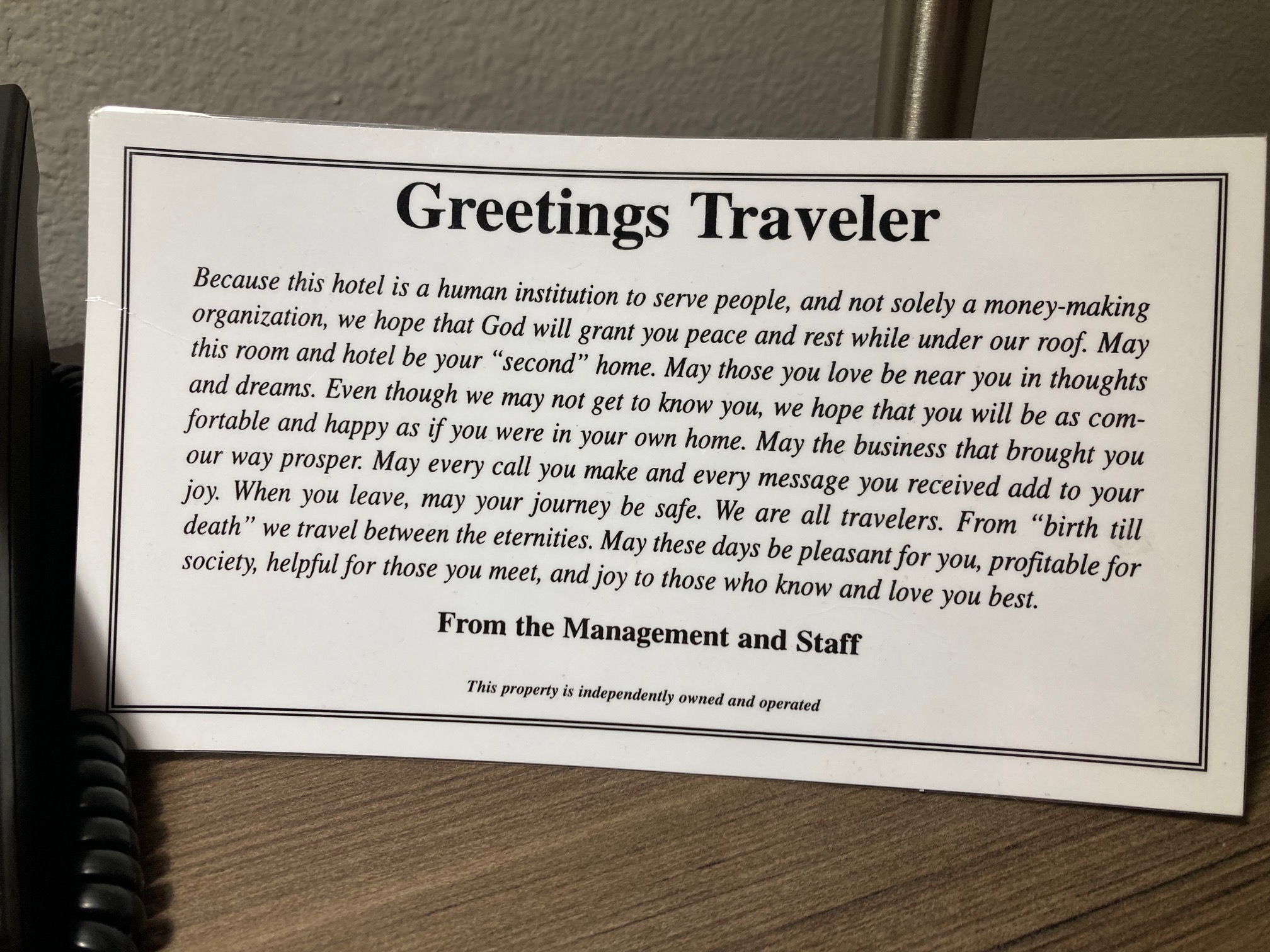
The second encounter came as we checked in at hotel tonight.  A laminated card was left on the nightstand.  The card is basically a greeting and blessing for all who stay at the hotel.  I confess I have never received such a note at a secular hotel, and I was thoroughly humbled by the witness of love of the management and staff of this hotel.  Once again, church found its way to me, this time at a Comfort Inn and Suites.

Hotel Note in Albert Lea, MN (reuse with permission)

Far too often I hear churchgoers complaining about how fewer people are making their way to church.  Today I am reminded that our work is take church to others.  Jesus was always commissioning people to go out and witness God’s love and redemption.  Our work is no different.  I wonder what unique way you might figure out how to be someone’s church today.

Sermon – John 14.1-14, E5, YA, May 7, 2023 (8:00 AM)

30 Tuesday May 2023

Posted by jandrewsweckerly in Sermons

≈ Leave a comment

Tags

believe, disciple, Eastertide, everyday, funerals, God, grace, human, Jesus, Philip, resurrection, Sermon, share, slow, Thomas, witness

The gospel text we hear from John today may be quite familiar.  Today’s text is a favorite for funerals.  I have lost count of the number of times I have heard the first six verses of chapter fourteen, and after countless funerals, I am convinced the first six verses would be the ones I want read at my own funeral.  What I love about this text, and what I suspect so many others love too, is layered.  I love Jesus’ description of the heavenly kingdom – a place of abundance, with many dwelling places.  I love that Jesus lovingly goes before us, and even promises to come back for us and guide us there.  I love the assurance that I already know the way, and I love Jesus’ words, “Do not let your hearts be troubled.”  And as if that were not enough, I love the very human response of Thomas – so stuck in his anxiety and fear that he cannot really hear Jesus.  His panicked words make me feel reassured in my own human messiness.

But what is funny about this text is that we never read the rest of the verses at funerals.  Because I have studied just the first six verses countless times, I was stunned this week by the following eight verses of our text.  After that entire interaction with Thomas, where clearly Thomas needed and received careful, loving guidance, Philip enters the scene – and does the exact same thing as Thomas.  Literally seconds after Jesus patiently explains how he will go and prepare a place for us, and he will guide them, and they will know the way because Jesus is the way, what does Philip do?  He basically says, “Great, if you could just prove yourself one more time, then I will definitely believe you.” 

Truth be told, the introduction of Philip makes me love this text even more.  You see, in this Eastertide season, as we continue to talk about what the resurrection means in our everyday life, we go back to this time before Jesus’ death when he broke the resurrection down, not once, but twice.  But the explanation we hear today – twice – really takes us all the way back to the beginning.  Remember John’s gospel does not start with warm, familiar birth stories.  John starts with the poetic, “In the beginning was the Word, and the Word was with God, and the Word was God.”  John has told us from the beginning that Jesus was from the beginning and became flesh so that the followers of God might make God known.  And so, Jesus patiently (and occasionally a little impatiently) tells us over and over again that Jesus is there to help us know God and to bring us into resurrection life in the heavenly kingdom.  And if Jesus can be patient, and occasionally a little impatient, with Thomas and Philip, surely God can handle my own slowness to come to confidence in Christ.

But that is not the end of our invitation today – to recognize Jesus’ salvation and care for us.  This entire convoluted conversation with Thomas and Philip is to help them and us believe.  Now, do not confuse things, I do not mean belief as end in and of itself.  Karoline Lewis sheds light on what believing means, “…to believe in Jesus,” Lewis says, “is to witness in the world his presence so that others might have their own encounter by which then to believe in Jesus…Every sign, every encounter, every conversation has been with that sole purpose in mind, to make God known so that a moment of believing might happen.  In these works, the disciples are invited to participate.”  This witness becomes important because Jesus is returning to the Father, because discipleship is based on witnessing, because greater works will be made possible in our witnessing.[i] 

So as much as I love these very human interactions between Thomas, Philip, and Jesus, this text is not just meant to reassure me of my humanness and God’s grace with me despite that flawed humanness.  This text is meant to remind us of our commission as disciples.  Resurrection promise is not just comfort food for the journey.  Resurrection promise is fuel for the journey – a journey that is not just about us, but about who we bring along with us into resurrection life.  That is our invitation today.  As we journey in this Eastertide, Jesus reminds us once again that our Easter joy is not meant for us alone; our Easter joy is meant to be shared.  Thomas and Philip just remind us in our very humanness that we can be the faithful disciples Jesus needs.  Amen.


[i] Karoline M. Lewis, John:  Fortress Biblical Preaching Commentaries, (Minneapolis:  Fortress Press, 2014), 189-190.

Sermon – John 1.29-42, EP2, YA, January 15, 2023

15 Wednesday Feb 2023

Posted by jandrewsweckerly in Sermons

≈ Leave a comment

Tags

anxious, evangelism, gift, invitation, Jesus, John the Baptist, light, Sermon, transform, witness

In my first position as a Rector, we had a wonderful facilitator for one of our Vestry Retreats.  The first question she asked is for us to tell her what we love about our church.  Everyone thought for a minute and then slowly we shared stories of what brought us to the church, what was meaningful, or what keeps us coming back.  It was a quiet, thoughtful conversation, as people really pondered why we were there.  Then the retreat leader asked us to tell her about the best meal we ever ate.  Well, the mood of the room totally flipped, and people’s faces lit up as they described succulent meals, decadent desserts, and mouthwatering food experiences.  We laughed and delighted in the stories as people gesticulated their enthusiasm and were almost tripping over one another as we remembered other amazing meals we have had.

Once we settled down, the facilitator asked us to note the total difference in our descriptions between what we love about our church and what we love about the best food we ever ate.  The question was not meant to shame us (though we did feel a little sheepish), but to help us see how blocked we sometimes get when talking about our love for our church.  Clearly, we have the capacity to witness – albeit to witness to an amazing meal.  But something about culture mores or maybe a history with a bad evangelism encounter makes us much more reticent to invite others into our joy.

I have been thinking about that hesitancy or inability this week as I read our gospel story today.  Although we always call him John the Baptist, one scholar suggests that in John’s gospel, John the Baptist really should be called John the Witness:  because that’s the emphasis of the fourth gospel – not John’s work of baptizing, but John’s work of witnessing to Jesus’ identity.[i]  In the portion of the fourth gospel we read today, John the Witness is a little like someone raving about the best thing they ever ate.  We are told that after the officials spend time inquiring about John’s identity, the next day, John is found shouting after the approaching Jesus, “‘Here is the Lamb of God who takes away the sin of the world!  This is he of whom I said, ‘After me comes a man who ranks ahead of me because he was before me.’”  John’s cheerleading continues the next day when he sees Jesus again and says, “Look, here is the Lamb of God!”  John is so passionate about Jesus that even John’s followers drop John and follow after Jesus:  a result of which I have to believe John is wholly supportive.

Now I imagine you are sitting there, tensing up a bit, waiting for me to tell you to go get a megaphone and some pom poms because we have some witnessing to do!  The good news is your only partially right.  Here is what I know.  You came here today (either in person or online) for a reason.  Maybe this community helps you find a sense of purpose and meaning.  Maybe this community brings you a sense of comfort and belonging.  Maybe this community is helping you find you way to or enrich your relationship with Jesus.  Whatever the reason, that reason is your witness.  That reason is this beautiful, sacred thing, that when you do not share with others is like refusing to give a gift to others.  I know you may feel awkward, or like you don’t have “holy enough” words, or that you might even be rejected or disdained.  The truth is your words do not even really matter when you are witnessing – what will matter is the way your face transforms when you talk about how this place has impacted your walk with God.  And if using the word witness makes your stomach tense, then use the word invitation.

So, your invitation today is to begin embracing a practice of invitation.  Maybe you have no qualms pulling out that megaphone and pom poms for Jesus like John the Witness.  Maybe you will be you will be like Andrew in our passage today and drag your brother or friend along with you to church with a forceful, “Come on!”  Or maybe your invitation will be as soft as Jesus’ to the new disciples asking questions, who simply says, “Come and see.”[ii]  Someone in your own journey did that for you.  Maybe a long time ago or maybe very recently.  Maybe their words were loud and proud or maybe they were soft and encouraging.  But something in their countenance changed that made you want to see more.  Our invitation today is to share that same light with others, inviting them to come and see this place where you invest your time, your gifts, and your treasure.  Your invitation is to not hoard the gift of this place, but to share the gift of this place and your faith with others.  Amen.


[i] Karline M. Lewis, John:  Fortress Bibilcal Preaching Commentaries (Minneapolis:  Fortress Press, 2014), 27.

[ii] Greg Garrett, “Homiletical Perspective,” Feasting on the Word, Yr. A, Vol. 1 (Louisville:  Westminster John Knox Press, 2010), 265.

On Living into the Dream…

23 Wednesday Nov 2022

Posted by jandrewsweckerly in reflection

≈ Leave a comment

Tags

children, church, community, core values, families, God, hospitality, identity, intergenerational, mission, purpose, vision, welcome, witness

Photo credit: https://www.cccnz.nz/intergenerational-ministry_cfm/

I served in a parish once whose strategic initiative was to grow the church.  At a leadership retreat, when the facilitator asked us about our intention to grow, a key leader said, “Well we want to grow.  But not too much.”  His words were a shock to my system.  Something I had seen as a common goal that everyone supported and for which I was working suddenly seemed to be in question.  I was left doubting how we could possibly move forward if we were not together in our sense of direction.

When I came to Hickory Neck, I was regaled with stories of this parish’s love for children.  The stories of children sitting in the window wells in the Historic Chapel (before there was a New Chapel), and toddlers crawling under the pews only to be captured and passed back overhead to mom and dad slowly became my stories.  As I learned about our surrounding community, which draws both young families and recent retirees, our collective identity and purpose became clear.  We are a multigenerational church whose entire sense of purpose is bringing together the generations to experience, glorify, and serve God in community.

So, you can imagine my shock recently when I was told that one of our families was made to feel as if they were not welcome at Hickory Neck because their children were too loud.  My dismay was two-fold.  First, I am deeply sympathetic to our families with young children.  That they have their children dressed and in church by the time worship starts is a feat so laudable they should receive gold stars at church.  Despite a desire to bring one’s family to church, I promise you, getting there and staying there is no small feat.  It can be stressful enough to make you wonder why you do it at all.

But second, I could not reconcile something so contradictory to our core values and sense of purpose.  As a church that values hospitality and living fully into its multigenerational identity, we know those things are inherently messy.  But every squeal, cry, and wiggle are the sounds of life for the church.  Every child who is loved in our space comes to know the love of Christ, every parent who is encouraged in our space comes to experience God’s grace, and every surrogate grandma, grandpa, auntie, or uncle who experiences the “noise” of church has the opportunity to know the Holy Spirit.

Claiming an identity is the easy part.  Living that identity is the hard part.  We will all have days where we fail miserably and succeed fabulously.  Just this Sunday, the same day as the other incident, a visitor intimated to me, “You know, I can tell your church really supports young families.  When my children were that age, I found most churches were not welcoming.  Honestly, it made it hard to go to church.”  This week, I encourage us to live into the reality we have claimed and that, most days, others experience.  It will not be easy.  It will be loud, messy, and some days frustrating.  But it will also be heart-warming, sacred, and beautiful.  This is the Christian witness into which we are called.  But we can only achieve it together:  young and old, loud and quiet, energized and exhausted.    

On the Ministry of Coffee…

05 Wednesday Oct 2022

Posted by jandrewsweckerly in reflection

≈ Leave a comment

Tags

coffee, Jesus, love, ministry, parenting, relationship, witness

Photo credit: https://www.pexels.com/search/coffee%20cup/

In the Book of Common Prayer, the Catechism answers the question, “What is ministry?”  It defines ministry by orders:  lay, deacon, priest, and bishop.  For the laity, the Catechism says, “The ministry of lay persons is to represent Christ and his Church; to bear witness to him wherever they may be; and, according to the gifts given them, to carry on Christ’s work of reconciliation in the world; and to take their place in the life, worship, and governance of the Church.” (BCP, 855)  Sometimes, we get caught up and think ministry is only when we are serving the poor or leading worship.  But, in fact, the Catechism reminds us that our ministry is to represent Christ and the Church, bearing witness to Jesus wherever we may be.

Several years ago, we welcomed a childcare center onto our property.  The relationship was a beautiful one of getting to know one another, of building relationships with strangers, and bearing witness to Christ’s love.  When the center moved to a neighboring town to accommodate more students, our Church knew we wanted to keep the relationship going.  And so, we have sent cards, supported teachers, and once a month, we bring coffee and snacks for what we call “Joe to Go.” 

For some, this may seem like an odd form of ministry.  If we are going to use our resources and time, shouldn’t we be helping those hurting the most?  Unfortunately, that question creates a false dichotomy.  We should be helping those who are hurting most.  And, as our Catechism says, we also should be bearing witness to Christ wherever we find ourselves.  For this ministry, that means seeing the everyday burdens of families – the nights without sleep, the struggles to work to support the cost of childcare, the strain of raising up children to be well-adjusted, loving members of society.  If we learned anything in the pandemic, it was that the struggles of parenting in today’s economy are real, and hard, and regularly unnoticed.

And so, we bear witness to Jesus’ love with every snack and cup of coffee.  We represent Jesus when we offer an encouraging word to a weary parent.  We are being the Church when we show lovingkindness wherever we may be.  This is what ministry is.  How are you bearing witness to Christ’s love today?  How have you experienced Christ’s love today through someone else’s ministry?  I can’t wait to hear your stories of coffees, shared stories, and encouraging words. 

← Older posts

Recent Posts

  • On the Myth and Magic of Advent…
  • On Risking Failure and Facing Fear…
  • Sermon – Luke 23.33-43, P29, YC, November 23, 2025
  • On Inhabiting Gratitude…
  • Sermon – Luke 20.27-38, P27, YC, November 9, 2025

Archives

  • December 2025
  • November 2025
  • October 2025
  • September 2025
  • August 2025
  • July 2025
  • June 2025
  • March 2025
  • February 2025
  • December 2024
  • November 2024
  • October 2024
  • September 2024
  • August 2024
  • July 2024
  • June 2024
  • May 2024
  • March 2024
  • February 2024
  • January 2024
  • December 2023
  • November 2023
  • October 2023
  • September 2023
  • August 2023
  • July 2023
  • June 2023
  • May 2023
  • March 2023
  • February 2023
  • January 2023
  • December 2022
  • November 2022
  • October 2022
  • June 2022
  • May 2022
  • January 2022
  • December 2021
  • November 2021
  • October 2021
  • September 2021
  • August 2021
  • June 2021
  • May 2021
  • April 2021
  • March 2021
  • February 2021
  • January 2021
  • December 2020
  • November 2020
  • October 2020
  • September 2020
  • August 2020
  • July 2020
  • June 2020
  • May 2020
  • April 2020
  • March 2020
  • February 2020
  • January 2020
  • December 2019
  • November 2019
  • October 2019
  • September 2019
  • August 2019
  • July 2019
  • June 2019
  • May 2019
  • April 2019
  • March 2019
  • February 2019
  • January 2019
  • December 2018
  • November 2018
  • October 2018
  • September 2018
  • August 2018
  • July 2018
  • June 2018
  • May 2018
  • April 2018
  • March 2018
  • February 2018
  • January 2018
  • December 2017
  • November 2017
  • October 2017
  • September 2017
  • August 2017
  • July 2017
  • June 2017
  • May 2017
  • April 2017
  • March 2017
  • February 2017
  • January 2017
  • December 2016
  • November 2016
  • October 2016
  • September 2016
  • August 2016
  • July 2016
  • June 2016
  • May 2016
  • April 2016
  • March 2016
  • February 2016
  • January 2016
  • December 2015
  • November 2015
  • October 2015
  • September 2015
  • August 2015
  • July 2015
  • June 2015
  • May 2015
  • April 2015
  • March 2015
  • February 2015
  • January 2015
  • December 2014
  • November 2014
  • October 2014
  • September 2014
  • August 2014
  • July 2014
  • June 2014
  • April 2014
  • March 2014
  • February 2014
  • January 2014
  • December 2013
  • November 2013
  • October 2013
  • September 2013
  • August 2013
  • July 2013
  • June 2013
  • May 2013
  • April 2013
  • March 2013
  • February 2013
  • January 2013
  • December 2012
  • November 2012
  • October 2012
  • September 2012

Categories

  • reflection
  • Sermons
  • Uncategorized

Meta

  • Create account
  • Log in
  • Entries feed
  • Comments feed
  • WordPress.com

Blog at WordPress.com.

  • Subscribe Subscribed
    • Seeking and Serving
    • Join 394 other subscribers
    • Already have a WordPress.com account? Log in now.
    • Seeking and Serving
    • Subscribe Subscribed
    • Sign up
    • Log in
    • Report this content
    • View site in Reader
    • Manage subscriptions
    • Collapse this bar
 

Loading Comments...