• About

Seeking and Serving

~ seek and serve Christ in all persons

Seeking and Serving

Tag Archives: world

On Leaks and Parishes…

31 Thursday Jul 2025

Posted by jandrewsweckerly in reflection

≈ Leave a comment

Tags

church, Episcopal, faith, God, member, parish, spiritual, world

Photo credit: Jennifer Andrews-Weckerly. Reuse with permission only.

Last week at our church we discovered a leak in our parish house that necessitated saws, hammers, and very loud industrial fans.  By Friday, the constant noise broke my patience and I decided I needed to find an alternate place to work remotely – maybe not a place of silence, but certainly a change of scenery.  I landed in two different eateries/coffeehouses and decided to publicize my “remote office.”

What I found was people visiting from out-of-town I did not know were here, parishioners running errands, happy for an open ear, and lots of gratitude for being invited into the shared experience – both from church members and non-members alike.  The experience reminded me why Episcopal Churches are often referred to as “parishes.” Once upon a time, Episcopal churches served a geographic region, or a parish, and the priest was sort of the neighborhood priest.  Doing my work and meeting people where they are – whether they are from my actual church or not, reminded me of the original intention or churches:  that their priests were for the good of the entire community, not just the members.

Archbishop William Temple is attributed with having once said, “The Church is the only institution that exists primarily for the benefit of those who are not its members.”  At our church, we often talk about our mission being simultaneously about those inside our walls and those outside our walls.  That’s why we are doing some big things of late:  developing a third worship service designed specifically for people who are not a part of our community; forming a team who will look at alternative uses of our property that are missional and community-facing; and establishing small groups for spiritual formation that meet off campus – in homes and places of everyday “parish” life.  If we truly believe Archbishop Temple, then our clergy sitting in coffeehouses and eateries should more often be the norm than the crisis-driven exception.

Being out in the “parish” is not just the role of the priest.  I wonder how you are taking your faith, your worship community, your church out into the world.  When was the last time you asked a friend about their spiritual health (in the same way you would ask them about their physical or emotional health)?  When was the last time you were listening deeply to another person’s story and were willing to offer where you saw God in their story?  When was the last time you invited someone to church – not necessarily to the building on Sunday at a certain time, but into the experience of “church” that has been so transformative for you?  I cannot wait to hear about how you can envision taking your church out into the parish!

On the Sacred and Bus Stops…

08 Wednesday Sep 2021

Posted by jandrewsweckerly in reflection

≈ Leave a comment

Tags

action, bus, children, compassion, empathy, holy, prayer, ritual, sacred, transition, world

Photo credit: https://www.longislandpress.com/2019/12/13/school-bus-stop-arm-cameras-coming-soon-to-long-island/

For years now, I have walked my children to the school bus stop.  It has been precious time – holding hands, talking about expectations and hopes for the day, noticing nature’s wonders, playing games while we wait.  We have goodbye rituals too:  the four instructions they get everyday (have fun, be kind, learn lots, and do your best), waving and making heart signs from the bus, waiting until the bus pulls away.  They are rituals that are often taken for granted as the day’s to-do list creeps into one’s mind.  But when one pays attention, one realizes these are sacred rituals.

As you can imagine, the transition to the new rituals of Middle School has been a bit rough.  I am still allowed to drive my child to the bus stop, but definitely not allowed to get out of the car.  We still talk about hopes and expectations, except when a friend finally shows up and becomes the priority.  We are in that journey to adulthood where my child’s primary influences are changing from me to her peers:  and this is good and holy too. 

And so, I am creating new practices for myself.  When my child leaves the safe space of the car and boards the bus with twenty other kids, I have been surprised to find myself praying.  Praying for my own child, certainly:  that she will be safe from this pandemic, that she will cultivate friendships that are life-giving, that she will be inspired by the gift of learning.  But as I watch the other children board the bus, I find myself praying for them too:  for the ways in which Middle School can be so brutal, for the struggles at home they may be experiencing, for the pressures they face as they define their identity.  I even pray for the bus driver, and the ways in which he is the guardian of our children, even if only for a couple of hours a day.

I imagine there are opportunities for expanding prayer for all of us in everyday life.  Where have you found yourself worryingly praying for a loved one?  Who in their immediate field can you pray for too:  their coworkers, teammates, doctors and nurses?  Who are the shepherds who need your prayers too:  their bosses, coaches, ministers?  This week, in your prayers, I invite you to let your prayers expand – fan out a little further than the immediate concern on your heart.  Observe how your fanning prayers expand something inside of you too:  a larger worldview, a bit more compassion, a lot more empathy.  Then, maybe add an action:  send a note to someone, make a phone call, send a text.  I would love to hear how your expanding prayers and actions help expand your experiences with the sacred.

On Bringing the Church and World Together…

02 Wednesday May 2018

Posted by jandrewsweckerly in Uncategorized

≈ Leave a comment

Tags

bless, church, community, fellowship, holy, identity, rogation, sacred, service, welcome, world

img_0160

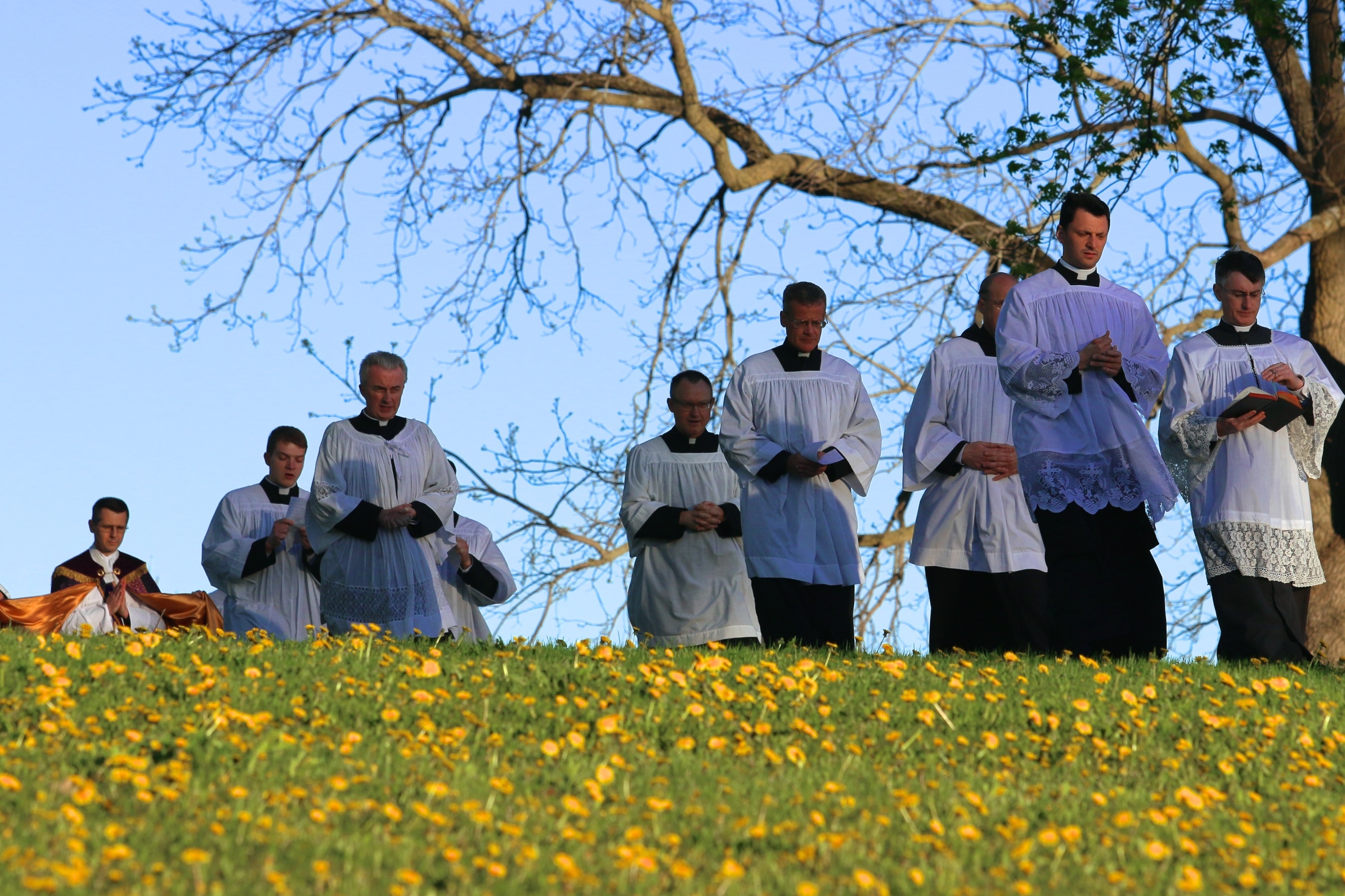
Photo credit:  http://stas.org/en/media/photos/rogation-days-2016-15612

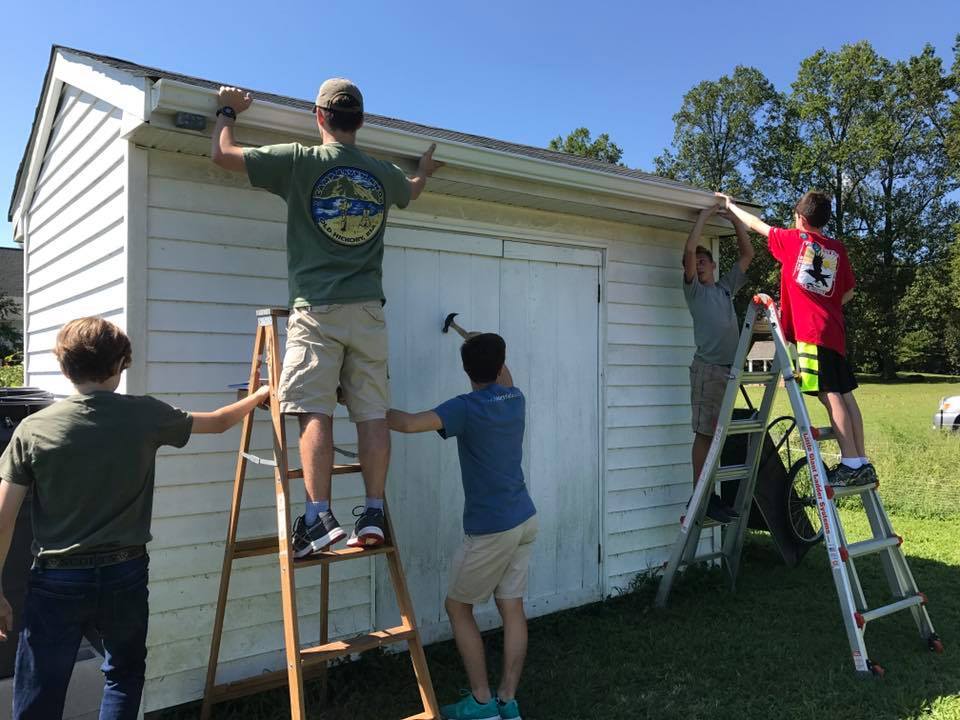
This coming Sunday at Hickory Neck, we will be adding a procession and blessing before our service begins in honor of Rogation Days.  Traditionally, Rogation Days are the three days before Ascension Day during which the litany is said as an act of intercession. In England, Rogation Days were associated with the blessing of the fields at planting, and in the United States they have been associated with rural life, agriculture and fishing, commerce and industry, and the stewardship of creation.[i]  For Hickory Neck, we are using this year’s Rogation Days to give thanks for rainwater collection barrels built for our Community Garden by a Boy Scout in our parish.  We will also bless the Garden, praying for a fruitful harvest for our parishioners and neighbors who use the gardens this year.

What I love about this upcoming event is that it represents a confluence of everything about which the church should be.  Our Community Garden has long been an example of using our property as a way to bless and welcome others.  At the garden, I see strangers become friends, people planting and tending in sacred silence, and the fruits of labor shared with one another.  Meanwhile, it has been a joy to watch our parishioner take leadership of an Eagle Scout project that benefits the church, the community, and his troop.  Watching our parishioner bring his faith community and his service community together has been a tremendous witness to each of us about how to make connections between the various parts of our lives.  And marking Rogation Days with liturgy is the church’s way of making the everyday parts of our lives sacred.  We take the labor of our hands, the fellowship of friends and strangers, the bounty of creation, and we name it all as holy.

Often when people think about church, they think about the building and the people who regularly attend worship services on Sundays.  But the church is much more about what the faith community does outside of the walls of the building, and how the community uses the blessing of its property to bless others.  This Sunday, we celebrate the ways in which we are living into the fullness of our identity, while also challenging ourselves to ever be outwardly-minded in our ministry.  I hope you will join us, but mostly, I hope you will invite a friend as we celebrate the ways in which the blessing of our community flows out into the world!

21463342_1589859034403684_3079109709240303206_n

Rainwater Collection Barrels Installation.  Photo credit:  Paula Simmons.  Permission required for reuse.


[i] Donald S. Armentrout and Robert Boak Slocum, eds., An Episcopal Dictionary of the Church:  A User-Friendly Reference for Episcopalians, “Rogation Days,” as found at https://www.episcopalchurch.org/library/glossary/rogation-days on May 1, 2018.

Sermon – Luke 24.36b-48, E3, YB, April 15, 2018

19 Thursday Apr 2018

Posted by jandrewsweckerly in Sermons, Uncategorized

≈ Leave a comment

Tags

afraid, Christian, disciples, God, hiding, identity, Jesus, judge, Sermon, witness, world

Last month I was talking to Pastor Alex from Stonehouse Presbyterian.  We were walking toward our cars and he complimented my license plate, noting how fun spotting my plate around town has been.  I chuckled and told him the plate had been both a blessing and a curse.  He asked me what I meant, and I explained.  You see, I love the plate for the very reason he mentioned – that I run into people who recognize my plate, that people connect who I am with what I do, that people ask me about my vocation and about Hickory Neck.  But the plate is also a bit of a curse.  If I had to choose any place to be a witness for Christ, I am not sure the car is the best location.  You see, the car is where I leave prayer books, post-its about phone calls, gum wrappers, and coffee cups.  The car is where I cart around children – sometimes singing at the tops of our lungs to a favorite song, and sometimes scowling after an argument about behavior.  The car is where I find a moment to getaway before picking up children, and the car is where I sometimes reveal that I once lived in a region of the country that is known for impatient, sometimes foul-mouthed drivers.  The car is not really home to my best witness for loving Christ.  And yet, there is where a big plate – on both the front and the back – witnesses to the world who and whose I am.

That is what I find so funny about the disciples this week.  Here they are in Luke’s gospel, not unlike what we heard in John’s gospel last week, hiding in a room, afraid, disbelieving, and wondering what to make of all that has happened.  To be fair, life has gotten a bit chaotic of late.  Their whole world has gotten turned upside down since that beautiful, sacred night when Jesus washed their feet.  They had ideas about what was coming in their life, what was going to happen to Jesus, and how the world would be changed.  But Jesus dies, they are outcasts, and God seems to have closed a door – a tomb door.  Then, just days later, their world gets upended again.  The disciples learn from the women that the same closed tomb door is now open.  Two of the disciples have an encounter with the risen Christ on the road to Emmaus.  And as if all of that is not enough, today, Jesus shows up – very much alive, proving his corporality, teaching them, and reminding them they are witnesses.

The disciples certainly have our sympathy and concern.  And yet, the disciples remain holed up in a room – as if they can hide.  As if they can integrate back into the world, with no one realizing who and whose they are.  As if no one will notice the license plate on their car that says, “Jesus’ disciple.”  The disciples are hiding, acting as though no one is watching, no one is making conclusions about them based on their behavior, no one is making conclusions about Christ.  Their hiding is just as much of a witness as going out into the community.  Perhaps they feel being in that room is giving them a break from being witnesses – that no one sees them.  But we know better.  And so does Jesus.  “You are witnesses of these things,” says Jesus.

Sometimes we do the exact same thing.  We too can start to believe that we have hiding places in our lives – places where we do not have to be witnesses.  Maybe yours is a car.  Maybe yours is at work or school because those places seem more removed from what we do here on Sundays.  Maybe yours is at home, on vacation, or when surrounded by friends.  Like the disciples, we too have that same longing to “turn off” our witness.  Maybe we are just tired and feel like being a witness for Christ is exhausting.  Maybe we are upset with or disappointed in God and are not sure communicating those feelings helps our witness of Christ.  Or maybe we are just afraid – that people will notice that we do not live lives that reflect who and whose we are.

But “turning off” our identity as people of faith is not really an option.  Sooner or later we will get caught.  Sometimes being caught can be a very positive thing.  An acquaintance who knows you go to church may ask you to add them to your church’s prayer list because they or their child just received a horrible diagnosis.  But sometimes being caught can be less flattering.  At our Adult Forum series on evangelism this fall, we watched a video about how not to invite people to church.  The video features two neighbors, one who is out gardening in the yard and the other who is clearly just coming home from church.  The neighbor who is out gardening wonders to himself, “I wonder why he never invites me to his church.  I would go if he asked me.”  But sometimes being caught can be even worse.  I had a friend who waited tables during college.  She always moaned when she got her work schedule and discovered she was assigned a Sunday.  I finally asked her why she hated Sundays so much.  She said, “Because that’s when all the churchgoers go out to eat – and they are the worst tippers!”  Somehow, in all her long hours of trying to make a few bucks to pay for books and school fees she had gotten the message that people of faith did not value her.

We know from experience that hiding as a Christian is really an illusion.  Wherever we are, whenever we are, with whomever we are, our identity is always there.  Jesus confirms that today.  As biblical scholar Karoline Lewis says, “Jesus’ address to the disciples is not, ‘you will be witnesses.’ Not, ‘please be witnesses.’ Not, ‘consider being witnesses if you have time.’ No, [Jesus says] ‘you are witnesses of these things.’ We are witnesses.  As it turns out, witnessing is not voluntary, but a state of being.”[i]  Lewis goes on to add, “‘We are witnesses’ does not depend on our acceptance or agreement or approval. ‘We are witnesses’ does not depend on our readiness or recognition or responsiveness. ‘We are witnesses’ just is.”[ii]  The disciples learn that today.  When Jesus says, you are witnesses, he empowers a very scared, uncertain, fearful group of followers to remember who and whose they are.

The good news is that Jesus does not judge the disciples today.  Jesus meets the disciples where they are.[iii]  Jesus’ first words are words of encouragement.  “Peace be with you,” he says.  Then, ever the tender pastor, Jesus asks the question in verse 38, “Why are you frightened, and why do doubts arise in your heart?”  Knowing their confusion, Jesus eats with them to assure them he is really there, not just some ghost or figment of their imagination.  He sits down and teaches them once again, taking them back to their roots, reminding them of how the prophets have taught them all they need to know.  And then, come those fateful words in verse 48, “you are witnesses of these things.”  Jesus meets them where they are, offering comfort, assurance, and affirmation.  But Jesus also encourages them to move beyond where they are.

After September 11th, there were two widows featured on the news.  “Grateful for the outpouring of support they received, they started thinking about the women in Afghanistan who, when widowed, lose status in that society and therefore find their already difficult lives even harder.  They raised money and formed a foundation called Beyond the 11th to support Afghani widows, and even made visits to Afghanistan to meet the widows they were helping.”[iv]  Those widows had lot of options – fear, anger, vengeance, or isolation.  But instead, they remembered how Jesus encourages us to remember our identity as witnesses and to move beyond where we are.  Our invitation today is to reclaim that same identity.  Now I do not know if that means you go put a Hickory Neck bumper sticker on your car, or you start wearing that cross necklace again, or you start tangibly connecting your words and actions to your identity as a witness.  Only you can know the shape your witness will take.  But today Jesus invites us to let go of our hiding places, realizing that even when we think we are hiding, we are still witnessing.  Our invitation is to own who we are, so that others might see the beauty of who and whose we are.  Amen.

[i] Karoline Lewis, “We Are Witnesses,” April 9, 2018, as found at http://www.workingpreacher.org/craft.aspx?post=5126 on April 12, 2018.

[ii] Lewis.

[iii] Nancy R. Blakely, “Pastoral Perspective,” Feasting on the Word, Year B, Vol. 2 (Louisville:  Westminster John Knox Press, 2008), 424.

[iv] Blakely, 428.

Sermon – Romans 5.1-5, John 16.12-15, TS, YC, May 22, 2016

25 Wednesday May 2016

Posted by jandrewsweckerly in Sermons, Uncategorized

≈ Leave a comment

Tags

activity, attention, community, disciples, doctrine, faith, God, grace, grow, guide, heresy, Holy Spirit, Jesus, learn, love, seminary, Sermon, suffering, theology, Trinity, Trinity Sunday, world

In seminary one of my favorite professors was our theology professor.  I did not like her because of the subject she taught.  In fact, her class was one of the classes that gave me the most headaches as I struggled to understand theological arguments.  Instead, what I liked about her was the way that she taught.  She had a dizzying intellect, and yet she had the ability to gently make you feel like you were not an idiot.  Someone in class would ask a question, trying to get their head around a theological concept.  Her soft response would be, “Oh, yes, yes, I could see how you might get to that conclusion.  So-and-so also argued that heresy in the fourth century.”  Or she might answer, “Oh yes, that heresy is one of the church’s favorite,” and then go on to explain how the church struggled to counter the heresy.  What I loved about her responses was she let you know that although you clearly did not understand the theological concept, you were not the first person to struggle to understand and you will not be the last.  Struggling to understand and articulate a cogent theological concept without slipping into a heretical argument is a basic part of being a Christian.

What I loved about the pastoral nature of my professor’s responses was she understood that being able to articulate a definition of God is incredibly difficult.  More important to her than you getting that articulation correct was your engagement with the concept.  Perhaps she understood that theologians for centuries have tried to do the same thing – define who God is and what God means.  That may be why she never seemed bothered by our heresies – because she knew that her role, and in fact the role of the church, is to be involved in the ongoing endeavor of naming God’s activity in our world.[i]  That is the same work that we do every year on the feast of Trinity Sunday – embracing the endeavor of naming God’s activity in our world.

To help us in that endeavor, we get two great pieces of scripture today.  In our gospel lesson from John, Jesus tells the disciples that the Spirit will guide the disciples into all truth.  Jesus’ promise to the disciples tells us those closest to Jesus, those who have been sitting at Jesus’ feet, learning truth from the source, are still going to need help.  The disciples, who will be commissioned to go out into the world to share the Good News, will not do that work alone.  The Spirit will go with them, helping them to continue to learn and grow into the fullness of faith.

I was recently invited to come to Sunday School for a little round of “stump the priest.”  I laughed at the title, but inside I was thinking, “What if they ask a question that really does stump me?!?”  Luckily, a cooler head prevailed.  The truth is they probably will stump me – several times over.  But that will give us a chance to talk about how the Spirit guides us into all truth – in childhood, in young adulthood, and into our older years.  But more importantly, I hope that we get the chance to talk about how the community of faith is a vital part of that learning of all truth.  We are certainly dependent on the Spirit, but we are also dependent on each other, because the Spirit so often speaks to us through people and the words of those around us.[ii]

That is one of the things I love most about being in the Episcopal Church.  The Episcopal Church has always been a place where ambiguity is okay.  As David Lose explains, “…being part of being a Trinitarian community [means] striving to be a place that knows it doesn’t have all the answers, and so consequently makes space for conversation and values those who bring different voices and experiences into its midst.  Conversation, valuing difference, being inclusive – these things aren’t easy, but genuine community, while challenging, is also creative, productive, and enriching.”[iii]

The other great piece of learning today comes from our reading in Romans.  On the surface, this piece of scripture has always troubled me.  Paul’s claim that suffering produces endurance, endurance produces character, and character produces hope, has always sounded a little dismissive about suffering.  But I do not think Paul meant for this formula of suffering leading to hope was not meant to be prescriptive, but descriptive.[iv]  In other words, he is not saying those who are suffering should be grateful.  What he is saying is those who are suffering have the opportunity to not waste the pain.  Peter Steinke says, “We ‘waste’ suffering if we gloss over, deny, avoid, or neglect its message…. If, however, we can learn from pain, [pain] is not wasted but a source of life and health.”[v]  My suspicion is that Paul is trying to capture what we learn from our gospel lesson today.  Even in the midst of suffering the Holy Spirit and the community of faith can guide us into all truth.

I have been a part of parishes that have a communal component to their premarital counseling.  In addition to meeting with the priest, each engaged couple is partnered with a married couple in the parish for mentoring.  One would think that the married couple’s job is to tell the engaged couple how to do everything and give them advice.  But more often, the couples end up talking about how hard marriage is, what struggles they have dealt with, and how they got through the suffering.  The relationships between the mentors and the mentees often last well beyond the wedding.  When done with honesty, vulnerability, and compassion, the couples realize that they gain strength from one another and find a place where they can go when they are looking for truth and guidance.

Our gospel and epistle lessons today weave together an understanding of the Trinity that is both vertical and horizontal.[vi]  Vertically, we learn that our understanding of God is ever changing and dynamic – much like God is ever changing and dynamic.  I think that is why my professor was so open to us stepping into and out of heresies and doctrine.  She knew that every Christian had to take that journey of steps and missteps.  But I think she also understood that truth was ever evolving and that the Spirit was with us in that journey.  She was not worried about us because, “…a critical characteristic of faith is an ever-striving and dynamic making sense of God.  The Trinity [cannot] be the only way to get God.  [That theology] is as limited and finite as our humanity.  [The theology of the Trinity] is one attempt of the church to articulate the being of God in a particular time and place.”[vii]  We will continue to walk toward truth in our own time and place too.

Horizontally, our lessons teach us that we find our way to that truth the Spirit is showing us through the vehicle of those around us – both those in the church, and those outside our walls.  I cannot count the number of times I have learned something profound about God by someone who never harkens the door a church.  Our job is to pay attention:  pay attention to the way that God is using others to show us more about God; pay attention to the ways God invites us to interpret our sufferings with others; pay attention to those who are struggling toward truth along with us.  We will surely step into heresy now and then.  But we will also step into God’s love and grace through the guidance of the Holy Spirit and those around us.  Amen.

[i] Karoline Lewis, “Trinity Talk,” May 15, 2016, as found on http://www.workingpreacher.org/craft.aspx?post=4648 on May 18, 2016.

[ii] David Lose, “Trinity C:  Don’t Mention the Trinity,” May 17, 2016, as found on http://www.davidlose.net/2016/05/trinity-c-shh-dont-mention-the-trinity/ on May 18, 2016.

[iii] Lose.

[iv] Richard L. Sheffield, “Homiletical Perspective,” Feasting on the Word, Yr. C, Vol. 3 (Louisville: Westminster John Knox Press, 2010), 39.

[v][v] Sheffield, 41.

[vi] Lose.

[vii] Lewis.

Redefining home…

19 Friday Sep 2014

Posted by jandrewsweckerly in Uncategorized

≈ Leave a comment

Tags

church, comfort, community, construction, home, Jesus, joy, outside, renovation, welcome, world

Courtesy of Dan McGee, St. Margaret's Parishioner

Courtesy of Dan McGee, St. Margaret’s Parishioner

This past Sunday we rededicated our Undercroft.  The Undercroft has been under construction since November 2013, and includes two Sunday School Rooms, our Parish Hall, two bathrooms, and the kitchen.  All rooms were completely renovated with the exception of the kitchen, which only received new flooring.  During construction, our Coffee Hours were moved to the Narthex; a tight space, but one that sufficed – and certainly brought us closer, literally and figuratively.  Many of our normal fellowship activities were either moved off campus or were cancelled altogether.  Our support groups had to move to our Library, which meant meetings on those nights also had to go off campus.

As I looked around the room during our rededication celebration, two things occurred to me.  One, I had really missed being in that space.  Many warm memories have been formed in that space, which all came flooding back.  But mostly, I missed the sound – the noise of people talking, laughing, sharing stories, and lingering a little longer over a meal.  Though we had shared in communion at the altar upstairs, the communion meal was continuing downstairs:  and it was a raucous meal – one I am sure Jesus would have approved.

Two, I found myself a little wary by the sense of deep comfort that was overwhelming me.  One of the nice things about being forced off campus was that we finally did what we had been hesitant to do – take the church out into the world.  Our committees were meeting at local dining establishments, our coffee hours spilled out into the lawn over the summer, and we got to know each other’s homes more intimately.  My fear is that in the comfort of being back “home” we will stop venturing out into the world, sharing our presence and ministry with others.

My hope is that we can do two things with our space.  First, my hope is that we can share that feeling of home with others by inviting more outside groups to utilize our space.  I would love for us to share our joy and warmth with others, so that this can become their home too.  Two, my hope is that we can keep taking church to the streets and to one another.  There is a way in which having meetings here month after month starts to stifle joy and creativity.  My hope is that our committees will agree to keep going off campus at least a few times a year to mix it up; but more importantly, to show the community that there is life and activity at St. Margaret’s.  And they are most welcome to join us!

Recent Posts

  • On the Myth and Magic of Advent…
  • On Risking Failure and Facing Fear…
  • Sermon – Luke 23.33-43, P29, YC, November 23, 2025
  • On Inhabiting Gratitude…
  • Sermon – Luke 20.27-38, P27, YC, November 9, 2025

Archives

  • December 2025
  • November 2025
  • October 2025
  • September 2025
  • August 2025
  • July 2025
  • June 2025
  • March 2025
  • February 2025
  • December 2024
  • November 2024
  • October 2024
  • September 2024
  • August 2024
  • July 2024
  • June 2024
  • May 2024
  • March 2024
  • February 2024
  • January 2024
  • December 2023
  • November 2023
  • October 2023
  • September 2023
  • August 2023
  • July 2023
  • June 2023
  • May 2023
  • March 2023
  • February 2023
  • January 2023
  • December 2022
  • November 2022
  • October 2022
  • June 2022
  • May 2022
  • January 2022
  • December 2021
  • November 2021
  • October 2021
  • September 2021
  • August 2021
  • June 2021
  • May 2021
  • April 2021
  • March 2021
  • February 2021
  • January 2021
  • December 2020
  • November 2020
  • October 2020
  • September 2020
  • August 2020
  • July 2020
  • June 2020
  • May 2020
  • April 2020
  • March 2020
  • February 2020
  • January 2020
  • December 2019
  • November 2019
  • October 2019
  • September 2019
  • August 2019
  • July 2019
  • June 2019
  • May 2019
  • April 2019
  • March 2019
  • February 2019
  • January 2019
  • December 2018
  • November 2018
  • October 2018
  • September 2018
  • August 2018
  • July 2018
  • June 2018
  • May 2018
  • April 2018
  • March 2018
  • February 2018
  • January 2018
  • December 2017
  • November 2017
  • October 2017
  • September 2017
  • August 2017
  • July 2017
  • June 2017
  • May 2017
  • April 2017
  • March 2017
  • February 2017
  • January 2017
  • December 2016
  • November 2016
  • October 2016
  • September 2016
  • August 2016
  • July 2016
  • June 2016
  • May 2016
  • April 2016
  • March 2016
  • February 2016
  • January 2016
  • December 2015
  • November 2015
  • October 2015
  • September 2015
  • August 2015
  • July 2015
  • June 2015
  • May 2015
  • April 2015
  • March 2015
  • February 2015
  • January 2015
  • December 2014
  • November 2014
  • October 2014
  • September 2014
  • August 2014
  • July 2014
  • June 2014
  • April 2014
  • March 2014
  • February 2014
  • January 2014
  • December 2013
  • November 2013
  • October 2013
  • September 2013
  • August 2013
  • July 2013
  • June 2013
  • May 2013
  • April 2013
  • March 2013
  • February 2013
  • January 2013
  • December 2012
  • November 2012
  • October 2012
  • September 2012

Categories

  • reflection
  • Sermons
  • Uncategorized

Meta

  • Create account
  • Log in
  • Entries feed
  • Comments feed
  • WordPress.com

Blog at WordPress.com.

  • Subscribe Subscribed
    • Seeking and Serving
    • Join 394 other subscribers
    • Already have a WordPress.com account? Log in now.
    • Seeking and Serving
    • Subscribe Subscribed
    • Sign up
    • Log in
    • Report this content
    • View site in Reader
    • Manage subscriptions
    • Collapse this bar
 

Loading Comments...