One of the great things about the lessons in the summer is that we often get these dramatic stories from the Old Testament. Last week, we had Hagar and Ishmael’s story. Today, we have the story of the binding of Isaac. Both of these stories are the dramatic kind of stories that make us uncomfortable and certainly make many people say, “Well that’s the Old Testament God…not the God that I know.” We cannot fathom who this God is that “tests” people, deliberately asking them to commit the most heinous of crimes – killing one’s own child. We are perplexed by Abraham, who upon God’s instruction, simply goes to where God sends him, fully willing to commit this most horrible crime, all the while deceptively luring his child to death. And poor Isaac – we question how God can expect this test of Abraham’s not to create lifelong psychological scars on Isaac.
The only way I could find my way out of this story this week was to reconsider each character in the text. I started with God, whose test of Abraham feels more like torture. I have never felt comfortable with the concept of a god who puts us through tests. That kind of agency and intervention by God is counter to my understanding of who God is. I do believe that Satan or the powers of evil regularly test us, and awful things simply happen at times. But our God is a God who gives us free will – who allows us to make mistakes, but never actively manipulates us in a way that could be labeled as testing. God does not send us cancer, or take our children, or leave us hungry.
So why does this story say that God “tests” Abraham. Well, one clue is found in the first sentence. The story begins with this sentence, “After these things God tested Abraham.” “After these things,” is not just some transitional phrase like, “In other news…” Those “things” the story refers to are not insignificant. If you remember, Abraham has had a circuitous journey, and quite frankly, Abraham has not proved to be very trustworthy so far – constantly taking matters into his own hands, and making a mess of things. Take, for example, those two times that Abraham’s wife Sarah ended up in a harem in Egypt and Canaan. Both of those times Abraham lied about Sarah, saying she was his sister, simply to protect himself from being killed by a covetous king. For a man who trusted God so much that he was willing to leave everything behind, Abraham clearly did not trust God fully enough to take care of Abraham and Sarah. And so he concocted these horrible lies, forcing Sarah into an awful position – not once, but twice! Then, of course, there was that time that Abraham did not believe that God would give him children. So the untrusting Abraham and Sarah got impatient, and decided that Abraham should father a child with Sarah’s handmaid, Hagar. That fiasco led Abraham’s beloved son being cast out into the wilderness, never to be seen again. So “these things,” are not insignificant things. Any of us in relationships with family, spouses, or intimate friends know that trusting someone who betrays your trust over and over again is difficult, if not impossible.
Meanwhile, God is making a pretty big leap of faith in the person of Abraham. God has already witnessed failure after failure in God’s people – from Adam and Eve to Cain and Abel; from the cleansing of the earth with Noah to the return to sin at the tower of Babel. And so God takes all that experience with broken covenants and this time attempts to enter into relationship with God’s people through the person of Abraham. All will be blessed through this one person, the blessing passing through Abraham like a prism, “through which God’s blessing is to be diffused through the whole world.”[i] So in taking on such a substantial risk, and in seeing Abraham falter many times, a time of testing does not sound so abhorrent after all. In fact, we begin to see that God is making God’s self pretty vulnerable with Abraham. And because God grants free will, God cannot know what choices Abraham will actually make.[ii] The longing for assurance while in a vulnerable position is only natural – one we experience anytime we decide to put ourselves in vulnerable positions with others.
So after coming to some peace with God in this story, I began to pick apart Abraham. Why does Abraham submit to this test? He has taken matters into his own hands before, including arguing against killing all the Sodomites. Why does he submit to God now? In fact, when God commands Abraham to take Isaac up for sacrifice, Abraham does not protest at all. The ancient rabbis tried to address this frustration by proposing a little embellishment. Whenever the rabbis did not understand something in biblical text, they would create a little midrash, or imaginative expansion of the text, to help interpret the text. So in their retelling of the Genesis story, they create a dialogue between God and Abraham. In the original text we heard today, all we have are these words: Take your son, your only son Isaac, whom you love, and go to the land of Moriah… The midrash changes the story to read like this: “Take your son,” God says. “I have two sons,” Abraham replies. “Your only one,” God says. “This one is the only son of his mother, and this (other) one is the only son of his mother.” “The one you love,” God clarifies. “I love them both,” Abraham argues. “Isaac,” God finally asserts.[iii]
What the midrash tries to do is highlight what might have been going on inside Abraham – something the story never tells us. Just because Abraham obeys does not mean that he likes obeying. We can also surmise some of Abraham’s conflicted feelings in other parts of the story. We hear how torn he is by the ways that he responds to both God and Isaac. When God calls upon Abraham, he replies, “Here I am.” That age-old response to God, hineni, is Abraham’s way of showing deference to God. But Abraham says those same words to Isaac when Isaac calls to him. “Here I am, my son.” You can almost hear the devastation in his voice. But you also hear a deep sense of respect and love for his son – the same deep respect and love Abraham has for God. Ultimately, what we see in Abraham is a deep trust that things might work out for the best. When Isaac asks where the lamb is for the sacrifice, Abraham says, “God himself will provide the lamb for a burnt offering, my son.” Some might read that as a white lie, told to placate an inquisitive son. But I like to imagine that Abraham hoped against hope that God would in fact provide a lamb, instead of his son. In fact, perhaps that is the only thing Abraham has left in this horrible story – a trust that God will act and save his son.
Finally, there is Isaac. As I read this story this week, my immediate thought was, “Poor Isaac. He has some serious therapy in his future!” And perhaps that is true – that Isaac is the innocent lamb, deceived, and almost killed. In fact, many scholars call this story, “The sacrifice of Isaac,” as opposed to “The binding of Isaac.”[iv] But there is more to Isaac’s story than meets the eye. In the story, two times the text says of Abraham and Isaac, “and the two of them walked together.” We know enough about scripture to know that when something is repeated, that repetition is significant. The text does not say, Abraham led Isaac or Abraham forced Isaac. The text says the two walked together. We do not know how much Isaac knows at this point, but the way that the two walk together suggests a certain equality – as if the two face this test together. Though we imagine Isaac terrified under his father’s knife, perhaps Isaac allows himself to be bound, facing this test with is father, fully trusting as his father does that God will provide the lamb.
The artwork depicting this story varies widely. There are frightened pictures of Isaac, anguished depictions of Abraham, and strong angels who forcefully grab Abraham’s raised arm before he can damage Isaac. But my favorite depiction is one by Peggy Parker.[v] Peggy’s woodcut shows a bound, but peaceful Isaac, curled up on the altar. Abraham is lovingly and with grief looking over Isaac, a knife hidden behind his back. And above them both is a large angel, wings spread widely, arms extended over them both, as if lovingly embracing the father and son. What I like about Peggy’s rendering is that there is a sense that all three characters are vulnerable, all three characters are pained, and yet all three characters trust their vulnerability with one another.
This is our takeaway today. This story is tough – I doubt that I will be using the story as a bedtime story anytime soon. But this story also reveals how hard being in relationship with God is – not just for us and our loved ones, but for God too. We are all trying to love and trust one another. And just like in any other relationship, that love and trust is hard work. But when we understand that each of us in this relationship, fully committing to being vulnerable and trusting each other, somehow we find the courage to take that first step. And when we take those steps, we do not take them alone and we are not forced. We take them together, equally sacrificing security in the trust of something much greater with our God. Amen.
[i] Ellen F. Davis, Getting Involved with God: Rediscovering the Old Testament (Cambridge: Cowley Publications, 2001),60.
[ii] Ellen F. Davis, “Radical Trust,” July 26, 2011 as found at http://www.faithandleadership.com/sermons/ellen-f-davis-radical-trust on June 25, 2014.
[iii] Davis, Getting Involved, 55.
[iv] Kathryn Schifferdecker , “Commentary on Genesis 22.1-14,” as found on http://www.workingpreacher.org/ preaching. aspx?commentary_id=2138 on June 26, 2014
[v] http://www.margaretadamsparker.com/biblical/biblical_abraham.aspx as found on June 27, 2014.

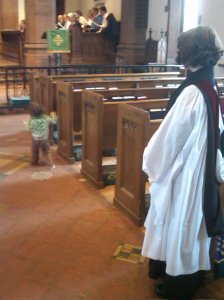 I am a regular advocate for children in Church. I think the practice shapes children at a young age and enlivens worship for the community. Though distracting to some, the noise of children makes me feel like the church is alive and joyful. That is why I always encourage parents with young children, because I know from experience that the noises of your own child sound ten times louder than they do to anyone else. I also know that wrangling little ones can be frustrating some days and other days down-right impossible. Many a parent has expressed to me that they are glad the sermons are posted online, since they often do not hear it when their little ones are particularly active. I encourage parents to persevere and even make sure that Sunday School does not bleed into worship time so that our children can be present as gifts to the rest of the congregation.
 Seeking and Serving