• About

Seeking and Serving

~ seek and serve Christ in all persons

Seeking and Serving

Monthly Archives: October 2014

To whom does it belong?

31 Friday Oct 2014

Posted by jandrewsweckerly in Uncategorized

≈ Leave a comment

Tags

God, greed, parable, stewardship, tenants, walking the way

As St. Margaret’s approaches our In-Gathering Sunday, a day when we gather our pledges for the coming year, some parishioners have been praying on what it means to Walk the Way in this Stewardship Season.  Below is a guest post from parishioner Barbara Archer.  I hope you enjoy her words.

As I sat in the pew Out East four weeks ago, listening to the Parable of the Tenants (Matthew 21:33), I found myself thinking, “What could I possibly have to do with this awful parable that Jesus told over 2,000 years ago?”  In addition, I thought, “I can’t wait to see how the priest is going to use this is parable in his sermon.  “The priest admitted that this was one of the “hard” parables but I was quite taken aback when he compared the tenants in the parable to me!

For a quick refresher of the Parable of the Tenants, there was an absentee vineyard owner who rented his vineyard to tenants.  When the owner sent his slaves to collect his portion of the grapes, the tenants killed the slaves.  The vineyard owner sends a second set of slaves to collect his portion of the grapes and the tenants do the same thing as before, killing the slaves.  Finally, the owner sends his son to the tenants thinking that they would respect his son and give the owner’s son his share of the grapes.  The tenants decide to kill the son so that they can have the son’s inheritance.  The parable goes on further but I will stop at this point.

I think most would agree that the tenants were the greedy scoundrels of this parable so how could I be compared to them?  The priest went on to explain that even though the vineyard owner had given the tenants all of his property, they were unwilling to share any portion of their profits.  The tenants greedily wanted to hang on to whatever they had made regardless of the fact that the vineyard owner had given them everything they needed to be  successful.  The priest went on to remind us that God gives us everything we need to be successful yet, often times, we turn our backs on God.  We refuse to give God, His share of our hard earned dollars despite the fact that He has given us everything!

Are you giving back to God his fair share?  Are you like the tenants?  It is a sobering question to ask yourself and to reflect on.  As we find our Stewardship Campaign coming to an end and our In-Gathering or Commitment Sunday nearly upon us (Nov. 2), please continue to pray and return your blue card with your 2015 Pledge Commitment this coming Sunday.  Our Stewardship theme this year is “Walking the Way.”  Which way are you walking?

Faithfully,
Barbara Archer

Sermon – Matthew 22.34-46, P25, YA, October 25, 2014

30 Thursday Oct 2014

Posted by jandrewsweckerly in Uncategorized

≈ 2 Comments

Tags

active, commandment, God, heart, Jesus, love, mind, neighbor, passive, Sermon, soul, stewardship

I hear it all the time.  Whether talking to engaged friends or working with a couple in premarital counseling, inevitably the question will come up, “So why do you want to get married?”  And then I get the response, “Well, we’re just so in love.”  Though their googly eyes are endearing and make me somewhat nostalgic for a time long ago, my thought is almost always, “Cute.  I wonder how long that will last.”  Though I try not to squash their mushy moment, eventually we get around to talking about life outside of their love bubble – talking about what happens when they argue, how they will negotiate the in-laws, and who will balance the checkbook.  Those are the times when the warm emotions of love are sometimes difficult, if not impossible, to maintain.  I do not meant to suggest that those warm, fuzzies of love are temporary necessarily; I simply mean that the emotional experience of love is not enough to sustain any relationship – neither those between couples, family, nor friends.  We are right to assume that love is necessary for relationships, but our definition of love has to be much bigger if we are to maintain any kind of meaningful relationships with others.

Sometimes we forget the multilayered meaning of love when we hear passages like the one from our gospel lesson today.  When asked about the greatest commandment, Jesus says, “You shall love the Lord your God with all your heart, and with all your soul, and with all your mind… and… love your neighbor as yourself.”  These commandments are so familiar to us that we sometimes forget how hard they really sound.  If our definition of love only includes the emotional kind of love that we might call “being in love,” does that mean we need to have googly eyes toward God?  I know very few people who profess to be “in love” with God.  In fact, I am not sure we would even say that we love God.  We might be grateful to God, we may revere God, or we might even be in awe of God.  But I know very few people who would say, “I love God.”  That emotion just feels strange to us.  And yet, Jesus says today, love the Lord your God with all your heart, and with all your soul, and with all your mind.

Now the second commandment is a little easier.  We are used to loving our neighbors – loving people is what we are used to doing.  We love our friends and our family.  But Jesus says to love our neighbor, not just our friends.  Our neighbor includes those grouchy neighbors next door, that kid from school or that guy from work who always pushes your buttons, and most certainly that woman who cut you off while driving.  Our neighbor also includes those neighbors that often go unseen by us: the teen at JFK High School whose family cannot afford clothes and school supplies this year, that family who picked up our produce in Huntington Station through Food Not Bombs, that homeless man who received basic toiletries from St. Ignatius this week, or that Veteran’s family who is struggling to put life back together after returning to Plainview from war.  About these grouchy, mean, and unseen neighbors Jesus says, “Love your neighbor as yourself.”

When I work with those couples planning weddings, I am grateful when they choose the First Corinthians passage for their wedding, “Love is patient, love is kind…”[i]    I am grateful because then we can talk about what love really is.  We can talk about how love is more than simply a warm feeling or even a passionate desire.  In fact, when scripture talks about love, more often than not the kind of love scripture is talking about is not a passive emotion, but an active mercy.  In scripture, love is not something we feel, but something that we do.  To help us understand the difference, scripture will often translate the word for love as “loving-kindness.”  Love is not a feeling, but a choice:  a choice that we have to make over and over again.  As one person explains, “To love neighbor as oneself is to act toward the other as one would act toward those close to you.  We treat the stranger as well as we treat those that we love emotionally.”[ii]

So what does this active love look like?  For our neighbor, this kind of love is a bit more obvious.  The next time someone is rude to you or unkind to you, instead of reacting to them defensively, perhaps you take a moment to wonder what happened to them in life that made them act this way toward you.  Once you start to wonder about what things make them human and what has hurt them in life, your ability to be angry with them for hurting you lessens a bit.  In my early working days, I worked with a woman who most of the time was pretty pleasant to be around.  But there were times that she lashed out – and when she did I used to be both perplexed and angry.  I eventually started avoiding her altogether when, in a totally different context, someone who knew her shared with me that her father and an ex-husband had been alcoholics and were both abusive.  Suddenly the pieces fell together for me.  She had not known the kind of love that God commands – and I had not loved her as my neighbor.  The next time she snapped at me, her snapping felt less personal and awful – and instead I could see a vulnerable, hurting person who did not know how to love.  When Jesus tells us to love our neighbor as ourselves, this is the kind of shift in thinking Jesus invites.

In some ways, loving our neighbor is a tangible task we can imagine assuming.  But loving God still feels a little foreign, let alone loving God with all our heart, mind, and soul.  Luckily, God leads by example.  Our stories of God tell us of how, time and again, God chooses God’s people, makes covenants with them, forgives them, and invites them into relationship again. God’s love for God’s people is not an emotion, but an action.  Just recently we reheard the Exodus stories of how as soon as the people get out of bondage, they complain about not having food, not having water, and feeling separated from their creature comforts.  We heard again about how when God takes too long with Moses up on the mountain, they quickly revert to worshiping a golden calf.  And yet God keeps providing for, caring for, and loving them.  This is our model for how we are to love God too.  “We can love with our heart: through generosity to God’s people.  We can love with our soul: by worshiping God and praying for our neighbors and ourselves.  And we can love with our minds: studying God’s Word and letting it correct us, enlighten us, and send us out in loving action to the world.”[iii]

As we continue to prayerfully walk the way through this stewardship season, I first wondered whether this lesson really had anything to say about stewardship.  But as I thought about loving God and neighbor, I realized that is what stewardship is really all about.  Like love, stewardship is not something we feel or think about – stewardship is something we do.  When we make a financial pledge or contribution, we are expressing to God our gratitude for our blessings.  We take money from our pockets – money that certainly could be used for a hundred other things we want or need – and we instead give that money to God.  This is our full-bodied way of loving God with our heart, soul, and mind.  And, when the church uses that money for educating our children, serving our neighbors in need, and sharing the Gospel in our community, the church helps us to love our neighbor through our money too.  Jesus is certainly inviting us to change our feelings about God and our neighbor – but Jesus is also inviting us to change our actions toward God and neighbor.  That is what love is.

Next week, you will have the chance to act on that love.  We will process our pledge cards forward, as a symbolic gesture of our financial commitment to the work and ministry of St. Margaret’s.  We commit to funding the worship, which helps us love God with our soul.  We commit to funding the outreach and evangelism, which helps us love God with heart.  We commit to funding education and formation, which helps us love God with our minds.  And we commit to funding a ministry that enables us to not only love God, but to love our neighbor as ourselves.  I cannot think of a better way to invest our money than to invest our money in love.  Amen.

[i] 1 Corinthians 13.1-13.

[ii] Clayton Schmit, “Matthew 22:34-46 Commentary,” 2011, as found at http://www.workingpreacher.org/preaching.aspx?commentary_id=1063 on October 21, 2014.

[iii] Schmit.

Stepping out on faith…

23 Thursday Oct 2014

Posted by jandrewsweckerly in Uncategorized

≈ Leave a comment

Tags

ambiguity, confidence, control, faith, fear, generosity, God, hope, trust

Courtesy of http://blog.catchthesun.net/2014/09/computer-tools-for-copy-editors-macros/

Courtesy of http://blog.catchthesun.net/2014/09/computer-tools-for-copy-editors-macros/

Control is something I write about a lot.  Perhaps I write about it so much because I never quite master giving up my desire for control back to God.  I am reminded of the book, Divergent, by Veronica Roth.  In it, the dauntless faction seeks to master its fears through simulations.  In the book there is disagreement about whether fears can ever actually be mastered or whether the work is just recognizing the fear and its cues, and then modifying one’s bodily response to those fears.

If you asked me this week whether I was in the “never mastering fears” camp, the answer would be a resounding yes.  As someone who values control, my life has felt totally out of control this week.  It started with a standby jury summons – every day this week I could not know the fate of my day until 5:00 pm the night beforehand.  So I was already in a state of ambiguity, hoping my childcare arrangement for the day would work.  Then, just as the week was starting, I received a late night pastoral care call night, necessitating a visit in the wee hours of the night.  Two nights later my youngest daughter had one of “those” nights: uncontrollable crying, waking up everyone in the house, and leaving us all weary.  Even as I sit waiting to be called for voir dire, I wonder what will happen today.  Needless to say, this creature of control is being pushed to the limit.

This experience is especially interesting to me as I think about what is happening at St. Margaret’s.  We are approaching our Annual Meeting in December, where we present our budget for 2015.  We do not know what our pledges will be this year yet, especially because some of our older members are quite frail.  So during budget planning, our Vestry had to step out on faith with an estimated budget – in fact, a budget that expects a deficit.  And yet, here we are, stepping into the great unknown, praying that God and the people are with us.

As I plod through my stressfully ambiguous week, I appreciate what kind of ambiguity and risk our Vestry has assumed.  But I especially appreciate their faith, hope, and confidence.  They are inspiring us to embrace generosity – generosity of our time, talent, and treasure.  I am grateful for the powerful witness this week.  They are an inspiration to me and the entire parish.

Sermon – Matthew 22.15-22, P24, YA, October 19, 2014

23 Thursday Oct 2014

Posted by jandrewsweckerly in Uncategorized

≈ Leave a comment

Tags

belong, church, emperor, giving, God, Jesus, perspective, Sermon, state, stewardship, taxes

Today’s gospel lesson is one of those funny lessons in the Bible that is often quoted, but frequently misconstrued.  Jesus’ says, “Give therefore to the emperor the things that are the emperor’s, and to God the things that are God’s.”  As one scholar points out, “Some people point to this passage as proof that God and politics should be kept separate — that things like taxes have absolutely nothing to do with one’s theological commitments.  Others say that this story proves that religion is a matter of the heart, and that Jesus doesn’t really care about mundane things like what you do with your money.  And some have cited this passage as proof that Jesus taught that the law is the law, and our duty as Christians is to support the government no matter what.”[i]

All of these conclusions are based in modern assumptions, and ignore the context within which Jesus says these words.  Jesus is not laying out a treatise of how his followers are to navigate the tensions between church and state.  What Jesus is doing is navigating the various factions that would much rather have him eliminated than hear the real meaning of his words.  The Pharisees and the Herodians have little in common.  In fact, they are pretty much enemies, with the Herodians being dedicated to King Herod and the Pharisees being dedicated to Jewish Law – including being opposed to paying the tax to Caesar for religious reasons.  But despite these divided loyalties, the Pharisees and Herodians are united in their desire to remove Jesus from the scene.[ii]  And so they play this game, trying to trick Jesus into either angering the state or angering the faithful – either way cursing Jesus.  What they had forgotten is how clever and insightful Jesus can be.  And with this one response, “Give therefore to the emperor the things that are the emperor’s, and to God the things that are God’s,” Jesus answers a trick question much more broadly than the answer that either the Pharisees or the Herodians were hoping for.

Jesus is not really talking about the separation of church and state today.  He is not even really talking about taxes.  Jesus is talking about a new perspective on the whole of our lives – a way to think about money certainly, but also a way to put all things in perspective.  Now I do not know about you, but I am kind of a visual learner.  I need to see something in writing or have something in a chart or spreadsheet to really grasp a new idea.  So let’s take Jesus’ statement, “Give therefore to the emperor the things that are the emperor’s, and to God the things that are God’s,” and make a mental pie chart.  Are you ready?  First, let’s put our taxes pie piece in the chart.  What is that, like twenty percent, right?  So now we have a pie chart that leaves about eighty percent.  From that, let’s take our pledge out.  For ease of argument, let’s say you subscribe to giving a tithe, so we will take ten percent out.  That leaves us with seventy percent with which to play.  But Jesus says that the things that belong to God should be given to God.  If we have jobs or we go to school, our ability to do those things belongs to God.  So, we have to give that back to God.  That probably leaves us with about fifty percent in our pie chart.  Our good health is all owed to God as well, so now we are down to about forty percent.  Those friends and family that we hold so dear – those are also gifts from God.  Now we are down to about thirty percent.  And let’s not forget about food, shelter, and clothing.  We just dropped down to about fifteen percent.  Then there is the air we breathe, and God’s own creation upon which we rely.  Now we are down to about five percent.

Whew!  We have five percent of our “stuff” that belongs to us.  But wait – Jesus did not say, “Give therefore to the emperor the things that are the emperor’s, and to God the things that are God’s…and then keep the final five percent for yourselves.”  Surely Jesus knew we would need a night on the town, or a moment to just be self-absorbed, and not think about those suffering around the world.  But here is where the rub is in our lesson today.  The reason why the Pharisees and the Herodians leave Jesus amazed and go away is because they are shocked into silence.  If Jesus answers that the people should not pay the tax, the Herodians will be able to call him a seditionist.  If Jesus tells the people they should pay the tax, the Pharisees will be able to accuse him of not following the law of God because the use of the coin alone, which claimed Caesar’s divinity, was blasphemous.  Not to mention the fact that Caesar was oppressing the people.  If Jesus says they should pay the tax, surely the people of faith will turn on him.[iii]  But Jesus answers with “Give therefore to the emperor the things that are the emperor’s, and to God the things that are God’s.”

The reason Jesus is able to send the people away amazed is because Jesus point out one even trickier, harder truth – everything we have – our tax money, our tithe, our jobs, our health, our family and friends, our food, shelter and clothing, the very air we breathe – everything belongs to God.  What Jesus is really saying today is that our question – and yes, this is our question too, not just the question of the Pharisees and Herodians – our question today is laughable.  We can make all the pie charts and balance sheets we want.  The pie chart really only has one big piece – and that piece says, “God’s.”

This past week, my daughter and I were talking about the prayer rocks that we got from the Stewardship Committee last week.  If you have not received yours yet, there are some in the back.  The idea is that when you received your pledge card and stewardship packet, you would have a tool to help you prayerfully consider your pledge for the coming year.  The rock is meant to be your tactile way of praying about your pledge this year.  The other nice thing about the rock is that the rock is also a conversation piece.  That is how my daughter and I had a prayerful conversation this week.  We were comparing our rocks – both of ours says “love” on the rock, but hers is more oblong and black, while mine is rounder and grayer.  When my daughter asked me what we were supposed to do with our rocks, I told her that the rock was supposed to help us think about what we wanted to give to God this year.  I suggested she decide on a coin that she could take to church every Sunday.  Instead, my daughter told me she wanted to give a can of food every Sunday.  See, I wanted her to understand the connection of our money with God.  But perhaps my daughter understood the bigger statement of Jesus today – that everything, including the food on our shelves, belongs to God.  So we compromised, agreeing that she could do both.  Because she was right – our money, our food, our livelihood all belongs to God.  Our poor pledge coordinator is going to have to figure out how to calculate that pledge when we turn in our card on November 2nd.

I joke, but I think our pledge card this year might be some hybrid of our ideas.  The adults of our family will certainly be putting on a tithe.  The children in our family will have to calculate a dime or nickel times 52 weeks in the year.  And our cupboard will have to sacrifice 52 items as well.  Normally once a month or so, our family goes to Costco and gets a packet of something to put in our food drive.  But I like my daughter’s idea better – because my daughter’s idea reminds us that the food on our shelves – our food, not food bought for others – belongs to God.  And as Jesus reminds us today, we are to give to God the things that are God’s.  Amen.

[i] Lance Pape, “Commentary on Matthew 22:15-22, found at http://www.workingpreacher.org/preaching.aspx?commentary_id=2201 on October 15, 2014.

[ii] Marvin A. McMickle, “Homiletical Perspective,” Feasting on the Word, Year A, Vol. 4 (Louisville: Westminster John Knox Press, 2011), 191.

[iii] Susan Grove Eastman, “Exegetical Perspective, Feasting on the Word, Year A, Vol. 4 (Louisville: Westminster John Knox Press, 2011), 191, 193.  Other resources explain this duality as well.

Homily – Acts 20.28-32, Robert Grosseteste, October 9, 2014

23 Thursday Oct 2014

Posted by jandrewsweckerly in Uncategorized

≈ Leave a comment

Tags

baptism, clergy, God, grace, homily, laity, ministry, Robert Grosseteste, self-care, shepherd

Today we honor Robert Grosseteste.  Robert was one of the outstanding English bishops from the 13th century.  Though he had humble beginnings in Suffolk, he rose to preeminence in the Church, distinguishing himself as a scholar in all branches of study:  law, medicine, languages, sciences, and theology.  He was appointed master of the Oxford School.  He was a theology professor and translated Aristotle’s works from the Greek, wrote commentaries on them, and sought to refute the philosopher’s views by developing a scientific method based on Augustine’s theories.  Because of Robert, Oxford began to emphasize the study of sciences – and many of his pupils became leaders.  In 1235, Robert was consecrated Bishop of Lincoln.  He was a very hands-on bishop, making a point to tend to the pastoral needs of his clergy and laity.  Those under his care really saw him as the shepherd of the Diocese.

In many ways, I think Bishop Grosseteste took to heart the instructions from Acts today.  “Keep watch over yourselves and over all the flock, of which the Holy Spirit has made you overseers, to shepherd the church of God …” says the lesson.  Robert was the consummate shepherd tending to his flock.  His regular visits to rural deaneries were not only to tend to pastoral needs, but also to questions of doctrine.  He knew, as Acts says, that “savage wolves” would come among his flock, and he tended and protected them as much as he could.

In some ways, we hear about bishops or those called to tend flocks, and we start to tune out.  The work from Acts sounds like the work of the clergy.  What we forget is that through our baptism, we are all given work to do.  We are all tenders of this community.  We take care of each other, we pray for one another, we visit the hurting in our community.  That is the work of the baptized. But Acts also says, “Keep watch over yourselves.”  What we sometimes forget is that we also need to confess when we need pastoral care ourselves; we need to remember that our own formation is ongoing – meaning we need to make sure we are consistently finding ways to grow in our faith.  If we do not care for our own spiritual well-being, we will find it much more difficult to tend to others’ spiritual well-being.

Luckily, as Robert knew and Acts affirms, God and the message of God’s grace is able to build us up.  This is the final reminder from Acts – that God will strengthen us through grace.  We can all be the pastors, the ministers that we become through our baptism – because God and God’ grace enables and continually invites us in to watch over ourselves and all the flock.  Amen.

Walking the Way…

15 Wednesday Oct 2014

Posted by jandrewsweckerly in Uncategorized

≈ Leave a comment

Tags

God, prayer, stewardship, walking the way

This past Sunday, St. Margaret’s kicked off its Stewardship Campaign, “Walking the Way.”  As part of the campaign, we have distributed information packets that include a pledge card.  You will be seeing guest blog posts from our parishioners here on this blog.  There will be articles written in our newsletter.  This promises to be a fun and engaging campaign.

But one of the things I am most excited about is an idea that one of our Stewardship Committee Members had.  The Walking the Way logo has both a cross and a stone path.  When we first looked at the logo, the path symbolized for us the “way” that we walk with God – our own spiritual journey with God.  But as we continued to look at the logo, the image became richer for us.  We began to imagine the stones as representative of each parishioner at St. Margaret’s, as we journey together on this walk with God.  Finally, as we played with the image of a walk and stones, we began to wonder whether actual stones might be a wonderful tool for us this year as we pray about our own stewardship this year.

And so an idea was born.  This year, in addition to our letter, narrative budgets, and pledge cards, we each received a stone.  The stone is meant to be a gift during this time for us to use during our prayer time – a tangible invitation into times of prayer in the coming weeks.  For those of you who have used prayer beads before, you know how useful tangible tools for prayers can be.  The tactile nature of something like a stone helps us focus our prayers, work through our anxieties, and ultimately cling to something that reminds us of our gracious Lord and Savior – as well as the community of faith who prays with us.

If you did not get your prayer stone on Sunday, don’t worry: there are more.  If you did get your prayer stone, I hope you will start using it, and discover what gift awaits you in your prayer time.  Each rock has a word painted on it to help encourage your prayers.  Mine happens to say, “Love.”  I look forward to meditating on how God’s love is a blessing to me, and how I hope to bless others through that same love.  Happy prayers!

With these hands…

08 Wednesday Oct 2014

Posted by jandrewsweckerly in Uncategorized

≈ Leave a comment

Tags

Christ, control, gift, God, hands, love, ministry, vocation

Courtesy of http://www.alisonslist.com/healing-for-life-day-6-a-healing-hour/

Courtesy of http://www.alisonslist.com/healing-for-life-day-6-a-healing-hour/

When I was ordained as a priest, the bishop anointed my hands.  The bishop explained to me that my hands would be used by God for the work of ministry.  At the time, I thought about various ways my hands might be used – for consecrating the Eucharist, for blessing the people, for baptizing the faithful, and for writing sermons and blog posts.  What I had not fully understood was that my hands would become a lifeline of support, care, and love – an extension of Christ’s loving embrace.  Though as an extrovert, I tend to rely on my words for ministry, there would be times when my words could not do the work – only my hands were needed.

The lesson was one that my chaplaincy supervisor had tried to teach me many years before.  I had expressed to my supervisor how I was struggling with some of the non-verbal patients because I felt like I was paralyzed.  By not being able to have a conversation, I felt like I was doing nothing.  In fact, my visits with non-verbal patients tended to be the shortest.  But one particular patient that summer helped me start to break through that fear.  I had been visiting the patient off and on for a couple of weeks, when the nurses asked me to come for another visit.  They were worried that the patient was not far from death.  When I went to the patient’s room, the patient was groggy, but was able to speak a little.  Sooner than I would have liked, the patient’s words were no longer available.  Uncertain what to do next, I offered my hand to the patient.  I was surprised at the force with which the patient grabbed my hand – squeezing so hard that had it been any other situation, I would have pulled away.  But instead, I let the patient cling to my hand with a fierceness of emotion, and we sat there in silence for quite some time.  Somehow, the strength of the grasp filled the room like a shout, and all the words that would have normally bubbled out of my mouth were finally silenced.  Later, after leaving the room, I remember the strange sensation of my hands – as if I were seeing them for the first time.

I was reminded of that powerful lesson earlier this week.  I was pumping while my six-month old was swinging in her swing.  She was fussy, fighting off sleep with wails and writhing.  I had tried soothing her with toys, a pacifier, and coos, but nothing was working.  Finally she reached out her hand toward me, and I grasped it.  I could not pick her up, but I could certainly hold her hand.  As I rubbed the back of her tiny hand, smiling and looking lovingly into her eyes, my daughter slowly calmed down, and managed to give in to sleep.  Though the feel of her hand in mine was totally different from the grasp of an adult, I became keenly aware of my hands once again.  As she drifted off, my thoughts marveled at the many different ways Christ has used my hands over the years.  Both in my vocation as priest and in my vocation as mother, God is constantly using me, literally using my hands, to be a blessing;  and in return, filling me up with joy, renewed vigor, and peace.

When my chaplaincy supervisor warned me that I would not always be able to talk my way through situations, I resisted at first.  I suppose words are my way of trying to exert some sense of control – in essence, my resistance in acknowledging Who is really in control.  Several years later, I am so grateful for the encouragement to embrace that lesson.  As God reminds me over and over Who is in charge within my vocations, I feel relief more than frustration.  The burden of being in control is lifted.  The failings of my words no longer feel like failings.  And I am profoundly grateful for the gift of hands that have been anointed to do God’s work.

Sermon – Matthew 11.25-30, St. Francis’ Feast Day, YA, October 5, 2014

08 Wednesday Oct 2014

Posted by jandrewsweckerly in Uncategorized

≈ Leave a comment

Tags

animals, blessing, burden, disciple, Jesus, light, reconciliation, rest, Sermon, St. Francis, wolf

Today we honor the life of St. Francis of Assisi.  Francis is one of the most popular and admired saints of all time.  Most of us know the highlights of his story: born the son of a wealthy man in 1182; had a conversion experience and devoted his life to Lady Poverty; shaped monastic and lay devotion; was a friend to all God’s creatures – being know to have preached to the birds.

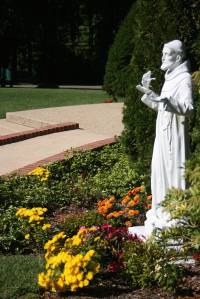
But the story I like most is the story about St. Francis and the Wolf.  According to legend, there was a wolf that was terrorizing the town of Gubbio, killing and eating animals and people.  The villagers tried to fight back, but they too died at the jaws of the wolf.  Francis had pity on the townspeople and went out to meet the wolf.  When Francis found the wolf, he made the sign of the cross, and said, “Come to me, Brother Wolf.  In the name of Christ, I order you not to hurt anyone.”  In response, the wolf calmly laid down at Francis’ feet.  Francis then went on to explain to the wolf how he was terrorizing the people and other animals – all who were made in the image of God.  The wolf and Francis then made a pact that he would no longer harm the townspeople and the townspeople would no longer try to hurt the wolf.  The two traveled into town to explain the pact they had formed.  The people were amazed as Francis and the wolf walked side-by-side into town.  Francis made the people pledge to feed the wolf and the wolf pledge not to harm anyone else.  From that day on, the wolf went door to door for food.  The wolf hurt no one and no one hurt the wolf; even the dogs did not bark at the wolf.[i]
What I love about this story of St. Francis is that the story is about reconciliation and relationship.  At the beginning of the story the town and the wolf are at an impasse – the wolf is hungry and getting attacked; the people are afraid and are lashing out.  What Francis does for both parties is shock them out of the comfortable.  For the wolf, no one has addressed the wolf kindly – they have either shut the wolf out or actively tried to kill him.  For the people, the wolf has not asked for help – he has simply and violently taken what he needed and wanted.  Francis manages to shock the wolf first – not through violence or force, but with the power of love and blessing.  By giving a blessing in the name of God, Francis is then able to implore the wolf to reciprocate with love.  Francis also manages to shock the village – not with a violent victory, but with a humble display of forgiveness and trust.  By walking into town with a tamed wolf at his side, Francis is able to encourage the town embrace, forgive, and care for the wolf.  Francis’ actions remind both parties that unless their relationships are reconciled, unrest and division will be the norm.

The funny thing about this story is that the story is pretty ridiculous.  I mean, how many of us go around talking to wild animals, blessing them with the sign of the cross, expecting anything other than being attacked?  We will never really know whether the story is true.  But like any good Biblical story, whether the story is true is hardly the point: the point is that the stories point toward “Truth” with a capital “T.”  What this story teaches is that peace and reconciliation only happen through meeting others where they are.  We cannot expect great change unless we are willing to get down in the trenches – to go out and meet that destructive wolf face-to-face.  The other thing this story teaches is relationships are at the heart of peace work.  Only when the wolf and the town began to get to know each other and began to form a relationship with one another could they move forward.

This is the way life is under Jesus Christ.  In our gospel lesson today, Jesus says, “Come to me, all you that are weary and are carrying heavy burdens, and I will give you rest.  Take my yoke upon you, and learn from me; for I am gentle and humble in heart, and you will find rest for your souls.  For my yoke is easy, and my burden is light.”  Jesus’ words have layered meaning.  The first meaning we all catch is that Jesus offers us rest and refreshment.  Jesus encourages us to come to him, to cast our burdens and cares upon him, and to take rest, to take Sabbath in Christ.  Our souls will find peace in Christ Jesus.  The second meaning is that peace in Christ Jesus is not without work.  Jesus does not say come unto me and relax forever in happy retirement.  Jesus says we will still have to take on a yoke – the burden of disciple living.  But luckily, that burden of being Christ’s disciple will not be burdensome – it will be light.  Finally, not only will Jesus make the workload “light,” as in not heavy.  Jesus will also make us “light” – as in lights that shine into the darkness and refuse to allow the shadow to overwhelm.[ii]  We become the light when we work for reconciliation in our relationships with others.

That is why we do so many special things today.  Today, we ask for healing prayers – that God might help us reconcile the relationships in our life that need healing.  Today, we ask for blessing on our animals – that God might help our relationship with our pet be one of blessing and light.  Today, we come to Jesus for Sabbath rest – that God might renew us on this Sabbath day, use the rest to fill us with light, and renew our commitment to be agents of reconciliation, gladly putting on Christ’s yoke.  Amen.

[i] John Feister, “Stories about St. Francis and the Animals,” as found at http://www.americancatholic.org/features/francis/stories.asp on September 30, 2014.

[ii] Mel Williams, “Let it go…and rest” Faith and Leadership, July 6, 2014 as found at http://www.faithandleadership.com/sermons/mel-williams-let-it-go%E2%80%A6and-rest  on September 30, 2014.

Shaking up normal…

01 Wednesday Oct 2014

Posted by jandrewsweckerly in Uncategorized

≈ Leave a comment

Tags

Christian, church, faithful, holiday, holy days, Jewish, normal

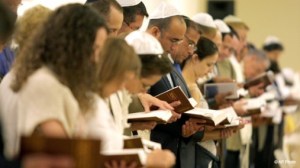
I grew up in the rural South, where there was not a whole lot of diversity.  Though I knew about the Jewish faith, I did not really know any practicing Jewish people growing up.  It wasn’t until adulthood that I became friends with a practicing Jewish person.  She took me to her synagogue, made me latkes, and talked to me about her experience of faith.  When I got to seminary, the study of Hebrew broke open that world even further, and suddenly I found myself exposed to my Jewish heritage as a Christian.  But nothing really prepared me for my experience here in Plainview, NY, which has a moderately large Jewish population.  I may have learned Hebrew and studied about Jewish people, but I had yet to live among a modestly large Jewish population.  When I first went to the interfaith clergy group, I found that the fellow Christians and I were in the minority among eight other rabbis and cantors.  I quickly realized how little I knew, and kept having to ask questions.  The rabbis and cantors have been ever patient and helpful.

Our parish is located right next door to one of the larger synagogues in Plainview.  On the high holy days, the synagogue uses our parking lot, and the lot is flooded with cars.  In the past couple of years, I have enjoyed watching the people of faith flock to the temple, as they honor their holy days.  As a person who loves Holy Week, I love to see another faith tradition alive with honoring their holy days.

Courtesy of http://mthollywood.blogspot.com/2012/09/rosh-hashanah-jewish-new-year.html

Courtesy of http://mthollywood.blogspot.com/2012/09/rosh-hashanah-jewish-new-year.html

But this year, since my oldest child is now in public school, I realized that the schools are closed for Rosh Hashanah.  If I am being honest, my first thought was not about honor and respect.  My first thought was the dread of having to secure childcare while I kept working.  But as the faithful came in and out of our parking lot that day, and as my kindergartener asked all sorts of questions, I began to see things from a different perspective.  I structure much of my life around the church calendar – Christmas, Lent, Easter.  My vacation plans and workload are all connected to these holy days.  I realize only now how strange my honoring of those days might be to non-Christians, who also have to work out childcare and the disruption of what is just another day in December or the spring.

This week, I am grateful to my Jewish brothers and sisters for reminding me of how self-centered I can be, and for pushing me out of my comfort zone.  My guess is that my faith-keeping is not just unusual to them, but may be unusual to all un-churched persons.  Even my southern United Methodist mother finds all our Episcopal rituals and observances a little over the top.  I note this because I think we can all become caught up in our own “normal” and forget the ways that our normal can seem strange or be downright alienating.  My hope is that this observation makes us all a little more self-aware, a bit more intentional about how we share our Christmas and Easter joy when the time comes, and a lot more attuned to the ways that we can make our own faith traditions accessible, inspiring, and intriguing to our neighbors outside our walls.

Sermon – Philippians 2.1-13, P21, YA, September 28, 2014

01 Wednesday Oct 2014

Posted by jandrewsweckerly in Uncategorized

≈ Leave a comment

Tags

community, ego, humility, Jesus, other, Paul, self, Sermon, spiritual discipline, together

Humility has always been one of the trickiest virtues for me.  I actually see myself as a pretty humble person, mainly because life has deflated my ego enough times that I learned pretty quickly to be humble.  In high school I was at the top of my class, and I remember how my classmates all thought I was pretty smart.  But when I got to college, everyone else had been at the top of their class too – and quite frankly, the workload was crazy hard.  Any ego I had started to build up in high school was immediately brought down to size.  Or, as I like to tell the acolytes, in one of my first Sundays as an ordained priest, I was serving the chalice.  We missed a latecomer, so I grabbed the chalice and rushed around the altar to serve them.  In my rushing, my elbow hit the side of the altar, and the wine splashed all over the stone floor.  The gasp from the choir in the chancel was audible.  For someone who holds the sacredness of liturgy dear, I was mortified; but there was nothing I could do.  So humility has never really been an issue for me.  But the weird thing about humility is owning the virtue.  As soon as you declare, “I am a pretty humble person,” haven’t you just negated your humility by bragging about your humility?

Of course, the quest for humility can go to the other extreme as well.  I have a friend who went through a phase of being a pretty fanatical Christian.  At some points I found talking with him to be so frustrating that I avoided him altogether.  He was so obsessed with being a humble Christian that you could never pay him a compliment.  I might say something simple like, “I’m so proud of how well you are doing in school.”  And his immediate retort would be, “Oh, well I had nothing to do with that.  All the credit belongs to God.”  There really is no good response to a retort like that without sounding sarcastic or rude.

But humility is what our epistle lesson today demands.  Paul addresses the community at Philippi with a letter from prison.  Worried that the community of Philippi stay on the right track, Paul tells them, “Do nothing from selfish ambition or conceit, but in humility regard others as better than yourselves.  Let each of you look not to your own interests, but to the interest of others.  Let the same mind be in you that was in Christ Jesus.”  In three simple sentences, Paul’s instructions get harder and harder.  First, Paul tells the community not to let their egos get too big.  Paul wants the community to right-size itself by looking at their intentions and attitudes.  Second, Paul tells the community not just to be humble, but to put the needs of others above their own needs.  Here Paul is commanding the community not just to correct their attitudes, but to reorient their actions as well, focusing on others before themselves.  Finally, as if the other two were not hard enough, Paul takes his instructions one step further and tells the community to have the same mind as Christ Jesus.  Paul wants the community to be a humble as the man who sacrificed his own existence for the sake of humanity.  The more I read Paul’s letter this week, the more I wondered whether my fanatical friend had not been rooting his whole life in the mandate presented here by Paul.  Maybe my friend’s annoying, over-the-top humility was actually what Paul was suggesting.

The challenge with trying to take on any spiritual discipline, like taking on the mind of Christ, or becoming more humble, is that we tend to fret so much over the discipline that we get lost in ourselves – which is, in fact, the very opposite of what Paul invites us to do today.  In focusing on our weaknesses or lack of humility, and trying to work our way into a more humble way of being, instead, we find ourselves alone, struggling with God, but separate from others who may actually be able to help us in our quest for humility.  The secret to mastering humility is not by focusing on the self, but instead by focusing on others.  One scholar describes this method by explaining, “One does not ‘self-empty’ by focusing upon oneself.  One is emptied of self to the degree one is overcome by the needs, pains, hopes, and desires of others.  When concern for others takes one utterly beyond self-interest, beyond obsessions with achievements and self-obsessing guilt over failures, beyond self, then one receives the comfort of an Easter ‘yes’ so overwhelming, unconditional, undeniable, and absolute that [the ‘yes’] is experienced as unfailing and forever – a yes more potent and enduring than any imaginable no.”[i]

When I did my year of AmeriCorps service, I arranged to clean and lock up the Episcopal Campus House in exchange for a free room in the back of the house.  Since AmeriCorps volunteers get a very modest living stipend, the free housing was a huge help.  But one day, at the end of a particularly physically grueling day of work, I was talking to one of the clients that the Food Bank served.  He lived in a group home and was trying to transition to independent housing.  We were talking about my housing situation and he marveled, “Man, I wish I could find a situation like that!”  Truthfully, I had taken my housing situation for granted – occasionally I even resented having to clean toilets and mop floors.  But after that conversation, every time I mopped those floors I remembered how incredibly lucky I was.  I needed that client to help me get to a place of humility and gratitude.

That realization is what Paul is hoping the community at Philippi will have as well.  Paul knows that setting aside the self is difficult.  That is why he pushes us to look at the needs of others.  Paul knew that when the community of faith began focusing on others, they would forget about themselves.  They would gain the perspective needed to help them on the journey toward humility.  And as the community turned more and more outward, they would be turning more and more toward the life of Christ – a life always oriented toward the other.  The work of building individual humility and having a mind like Christ only happens in the context of community.  The work cannot be done alone.

In 1974, poet Adrienne Rich was awarded the National Book Award in poetry, having beaten out fellow nominees Audre Lorde and Alice Walker.  When she gave her acceptance speech, she shocked the literary community.  She began, “We, Audre Lorde, Adrienne Rich, and Alice Walker, together accept this award in the name of all women whose voices have gone and still go unheard in a patriarchal world.”  The three women had sat down together before the event and written the statement.  No matter who won that night, this would be the statement of the winner.  When asked about the statement, they “said they believed that by supporting and giving to each other they could enrich each other’s lives and work more than by competing against each other.”[ii]  What these three poets did was refuse to play by the rules of the game.  Instead of accepting that there must be one winner, they declared that they had all won – despite what the award givers were proclaiming.

What these women did is what Paul was hoping the Church community would do.  By working together, these women resisted the temptation to lose their humility.  If any of them alone had won, they could have become puffed up with pride.  Conversely, if any of them alone had lost, they could have spiraled into the depths of self-doubt.  But together, they were able to claim a humble acknowledgement that God was working through each of them to do great things.  That is the true nature of humility – one found and expressed through community.  We are blessed to already have in place the kind of community that can support and encourage one another in the development of humility.  Our invitation is to trust this community enough to uplift us, to challenge us, and to help us grow.  We cannot face the journey alone; but luckily, we are not alone in the midst of this community.  Amen.

[i] William Greenway, “Theological Perspective,” Feasting on the Word, Year A, Vol. 4 (Louisville: Westminster John Knox Press, 2011), 114.

[ii] Entire story told by Mike Grave, “Homiletical Perspective,” Feasting on the Word, Year A, Vol. 4 (Louisville: Westminster John Knox Press, 2011), 113.

Recent Posts

  • On the Myth and Magic of Advent…
  • On Risking Failure and Facing Fear…
  • Sermon – Luke 23.33-43, P29, YC, November 23, 2025
  • On Inhabiting Gratitude…
  • Sermon – Luke 20.27-38, P27, YC, November 9, 2025

Archives

  • December 2025
  • November 2025
  • October 2025
  • September 2025
  • August 2025
  • July 2025
  • June 2025
  • March 2025
  • February 2025
  • December 2024
  • November 2024
  • October 2024
  • September 2024
  • August 2024
  • July 2024
  • June 2024
  • May 2024
  • March 2024
  • February 2024
  • January 2024
  • December 2023
  • November 2023
  • October 2023
  • September 2023
  • August 2023
  • July 2023
  • June 2023
  • May 2023
  • March 2023
  • February 2023
  • January 2023
  • December 2022
  • November 2022
  • October 2022
  • June 2022
  • May 2022
  • January 2022
  • December 2021
  • November 2021
  • October 2021
  • September 2021
  • August 2021
  • June 2021
  • May 2021
  • April 2021
  • March 2021
  • February 2021
  • January 2021
  • December 2020
  • November 2020
  • October 2020
  • September 2020
  • August 2020
  • July 2020
  • June 2020
  • May 2020
  • April 2020
  • March 2020
  • February 2020
  • January 2020
  • December 2019
  • November 2019
  • October 2019
  • September 2019
  • August 2019
  • July 2019
  • June 2019
  • May 2019
  • April 2019
  • March 2019
  • February 2019
  • January 2019
  • December 2018
  • November 2018
  • October 2018
  • September 2018
  • August 2018
  • July 2018
  • June 2018
  • May 2018
  • April 2018
  • March 2018
  • February 2018
  • January 2018
  • December 2017
  • November 2017
  • October 2017
  • September 2017
  • August 2017
  • July 2017
  • June 2017
  • May 2017
  • April 2017
  • March 2017
  • February 2017
  • January 2017
  • December 2016
  • November 2016
  • October 2016
  • September 2016
  • August 2016
  • July 2016
  • June 2016
  • May 2016
  • April 2016
  • March 2016
  • February 2016
  • January 2016
  • December 2015
  • November 2015
  • October 2015
  • September 2015
  • August 2015
  • July 2015
  • June 2015
  • May 2015
  • April 2015
  • March 2015
  • February 2015
  • January 2015
  • December 2014
  • November 2014
  • October 2014
  • September 2014
  • August 2014
  • July 2014
  • June 2014
  • April 2014
  • March 2014
  • February 2014
  • January 2014
  • December 2013
  • November 2013
  • October 2013
  • September 2013
  • August 2013
  • July 2013
  • June 2013
  • May 2013
  • April 2013
  • March 2013
  • February 2013
  • January 2013
  • December 2012
  • November 2012
  • October 2012
  • September 2012

Categories

  • reflection
  • Sermons
  • Uncategorized

Meta

  • Create account
  • Log in
  • Entries feed
  • Comments feed
  • WordPress.com

Blog at WordPress.com.

  • Subscribe Subscribed
    • Seeking and Serving
    • Join 394 other subscribers
    • Already have a WordPress.com account? Log in now.
    • Seeking and Serving
    • Subscribe Subscribed
    • Sign up
    • Log in
    • Report this content
    • View site in Reader
    • Manage subscriptions
    • Collapse this bar
 

Loading Comments...