• About

Seeking and Serving

~ seek and serve Christ in all persons

Seeking and Serving

Monthly Archives: July 2015

On humanity…

29 Wednesday Jul 2015

Posted by jandrewsweckerly in Uncategorized

≈ Leave a comment

Tags

Bathsheba, community, David, dignity, healthy, honest, human, humanity, humble, king, Nathan, power, sin

This summer I have loved the unfolding of the David story in our lectionary.  I have preached on his story several times because I love how very complicated his story is.  When most of us think of David, we think of the revered king.  He was favored and anointed by God, is celebrated by the people of faith as an exemplary king, and for Christians, he is honored in the lineage that produces Jesus, the Messiah.  Our selective memory of David is not unfounded.  He has very humble beginnings.  As the youngest son of his family, relegated to working in the fields as a shepherd, he is anointed as the favored one.  As a boy, when whole armies feared Goliath, David is considered brave, fighting off the giant Goliath with only a bag of stones.  As a young man he is the beloved friend of Jonathan and Michal.  He survives multiple murder attempts by Saul – even being presented with the opportunity to kill Saul himself, David refrains.  He dances boldly before God when he becomes king, showing proper adoration of the Lord.  He and his son, Solomon, will be the last of the noble kings, before a strain of evil kings runs the people of Israel to the ground.

At least that is what our selective memory holds.  When we proudly proclaim Jesus is descended from the house of David, we sometimes gloss over the other “stuff” about David.  We gloss over the way he cuts off Michal in her grief.  We gloss over the way he rapes Bathsheba, and then has her husband killed when he cannot hide his indiscretion.  Of course, the text does not say David raped her – just that he “lay with her.”  But when a king (who has infinitely more power than a common woman) sends men to your home when your husband is away, and they take you (not asking if you are interested in going) to the king, and the king has sex with you, I am guessing the sex was not consensual.  Later, we gloss over the fact that despite this horrid beginning of a relationship with Bathsheba, Bathsheba is the one who later bares him the son, Solomon.  The list of things we gloss over about David is indeed long.

I think that is why I love the unfolding story of David.  He is beloved and horribly flawed.  He is a revered leader with deep sinfulness.  He is noble king and he is human.  I have great affection for David and I am deeply disappointed by him.  But isn’t that the way with all great people?  I remember when I first learned of how The Rev. Dr. Martin Luther King, Jr. was complicit with the sexism of his time, I finally began to see him as human too.  And of course, David’s humanity forces me to reconcile with my own humanity.

Photo credit:  http://www.artforhumanity.org/

Photo credit: http://www.artforhumanity.org/

But all of that reflection on David overshadows the humanity of Bathsheba.  Like so many characters in the Bible, especially women, we are left with little of her perspective.  And because we have so little information, many of us are hesitant to preach about her story.  And yet, we are a community that has Bathshebas too – women stripped of power and dignity.  I do not know what that means for Sunday’s preaching (when we will get Nathan’s judgment of David for his actions with Bathsheba), especially since I try to be careful about sensitive subjects in the pulpit.  But this week, as we continue to journey with David, I am lingering with Bathsheba.  I am lingering on what it means to be a community of Davids, Bathshebas, and Nathans – and how we do that in a healthy, honest, and humble way.  Stay tuned!

Sermon – John 6.1-12, P12, YB, July 26, 2015

29 Wednesday Jul 2015

Posted by jandrewsweckerly in Uncategorized

≈ Leave a comment

Tags

abundance, baskets, church, disciples, five thousand, Jesus, scarcity, Sermon, theology

On one of the first days on a mission trip to Burma, our team went to Church.  Like any good Anglican Church, the Burmese have their own version of Coffee Hour.  Lots of people wanted to be around us, but mostly all we could do was smile and nod because of the language barrier.  One of the mothers of the parish came up to us and asked our translator if we were hungry.  She said she would bring us some Mohingar.  When she returned, we discovered Mohingar was a soup.  My teammate and I graciously thanked our host, but suspiciously eyed the soup.  I mean, it’s soup, so how bad can it be, right?  But it’s soup – there’s not telling what is in that thick broth.  But when you are a guest, you eat.  And, so, with many eyes on us, we tentatively ate our Mohingar.  As we ate, flavors filled our mouths.  The soup was good – really good.  In fact, this “Mohingar” was probably the best soup I have ever eaten.  This was no ordinary soup – Mohingar is like a meal in soup form.  Mohingar has eggs, noodles, fish, banana stems.  It sounds strange, but I promise you it was delicious.  I had no problem needing to pretend to graciously like the soup.  It was amazing!  At the end of my very satisfying, filling bowl of Mohingar, I raved to our host.  Unfortunately, that meant she insisted I have more.  I later realized on that trip in Burma, that this was always the practice with food.  If you even came close to finishing your food, you were always offered more – more rice, more fish, more fruit, more Mohingar.  We finally broke down and learned how to say, “I’m full” in Burmese.  What I learned about food in Burma was that showing love and hospitality meant showing abundance through food.  That is not to say that our hosts were well-off.  In fact, many of them were struggling.  But even in the midst of poverty, abundance found a way.

The disciples in our gospel lesson today were not accustomed to this practice of abundance.  Instead, they were quite adept at the practice of scarcity.  When Philip is asked where they can buy bread for everyone, he calculates the number of wages that would be needed to feed such a crowd, basically concluding that there is no way they can afford to feed so many.  When Andrew is presented with just a little food from boy – five loaves and two fish, he scoffs.  His scarcity mentality is too limited to imagine how greatness can come from so little.  I am sure that when Jesus told the disciples to sit the people down, the disciples were vacillating between skepticism, disbelief, and maybe even fear of what would happen when all five thousand people realized how hungry they were and how little this Jesus and his disciples had.

We are all familiar with this theology of scarcity.  Karen Yust imagines the same scene in a contemporary congregation.  She says, “One might expect the [Vestry] to echo Philip’s money-management concern, pointing out that the congregation does not take in enough revenue to support such a project.  The outreach committee might reinforce Andrew’s position, stating that the congregation has earmarked only a small percentage of its income for mission giving and the proposed project’s needs far exceed the allocated amount.  The groups responsible for discipleship and worship may not even offer an opinion, as they are busy preparing for a fast-approaching religious festival.  The buildings and grounds committee may assist with seating everyone on the lawn, although some [committee] members might worry about the effects of this event on the property’s landscaping.  It is likely that none of the congregations’ boards or committees would expect to participate in a miracle, as that is not what they signed on for.”[i]  On the surface, those behaviors are all smart behaviors.  Vestries have fiduciary responsibility for parishes.  Outreach committees must be wise in managing their aid.  The Altar Guild, Buildings and Grounds Committee, and Sunday School teachers all have areas of responsibility that need tending.  Even I have parameters around my discretionary fund and how often one person or family can receive aid.  The challenge is when a group of people have gathered to serve and glorify God, but only have a limited financial ability to do so (and trust me, big parishes sweat paying the bills as much as small parishes do), a seemingly necessary but nasty habit evolves – a theology of scarcity.  We all have faced that temptation.  Think about the last time you were planning your pledge to the church.  I am sure each of us looked at our income and other financial obligations before deciding what we had left to spare for the church.  We want to be sure that if we give generously to the church, we still have enough to pay the bills!

But Jesus does not seem to know anything about this theology of scarcity.  In fact, Jesus seems to have developed the opposite theology – a theology of abundance.  Of course, this feeding of five thousand should be no surprise.  This is the same Jesus who turned water into wine in Cana – and not just a little wine, but gallons upon gallons of wine; and not just any wine, but the best wine they had had all night long.  This is the same Jesus who will later explain to his disciples that in God’s house, there are many dwelling places – not just room for each of them, but many dwelling places.  In John’s gospel, “we are confronted with this profuse and full-measured flood of God’s grace mediated through the Christ.”[ii]  Nowhere does Jesus invite us to be careful or reserved.  Instead, Jesus keeps reminding us of the abundance of God.  Not only can he feed five thousand people, there will be leftovers.  And my guess is that those leftovers were there even after Jesus kept asking if they wanted more – until the people found the right words for “I’m full.”

Today, Jesus leaves us with baskets – twelve to be exact.  Twelve full baskets that are left over after feeding five thousand.  Those baskets sit there, challenging our every tendency to live on our own scarcity or fears of insufficiency.  Those baskets sit there, challenging our tendency to hoard, save, worry, and live a very small, safe life.  Those baskets sit there, challenging all the times we would rather pull back than push forward.  Instead, the baskets sit here today, right here at St. Margaret’s, inviting us to exercise faith in God’s abundance.  The baskets sit here today, calling us as a community to go places we have never been, to do things we have never tried, and to be things we have never envisioned.[iii]  The baskets sit here today, reminding us of all the times St. Margaret’s has had enough and emboldening us to live our lives as though we will always have not just enough, but an abundance.  The baskets sit here today, inviting us not be a people of anxiety and competition, but a people of generosity and hope.[iv]  Those baskets – that message of abundance is our good news today.  Amen.

[i] Karen Marie Yust, “Pastoral Perspective,” Feasting on the Word, Yr. B, vol. 3 (Louisville:  Westminster John Knox Press, 2009), 284.

[ii] Charles Hoffman, “More than Enough,” Christian Century, vol. 123, no. 15, July 25, 2006, 18.

[iii] Hoffman, 18

[iv] H. Stephen Shoemaker, “Bread and Miracles,” Christian Century, vol. 117, no. 20, July 5-12, 2000, 715.

On love and change…

17 Friday Jul 2015

Posted by jandrewsweckerly in Uncategorized

≈ Leave a comment

Tags

affirm, Bishop Curry, challenge, change, encourage, Episcopal Church, General Convention, God, Jesus, love, terrify

One of the things that I am most excited about from General Convention is the election of Bishop Michael Curry as our next Presiding Bishop.  I have been a longtime fan of Bishop Curry.  He is arguably one of the Church’s best modern-day preachers, and I believe his passion for Jesus and ability to communicate that passion in a dynamic, accessible way may give the Episcopal Church the boost it needs to get back into the business of spreading the Good News.

Photo credit:  http://grist.org/article/2010-11-23-behavior-change-causes-changes-in-beliefs-not-vice-versa/

Photo credit: http://grist.org/article/2010-11-23-behavior-change-causes-changes-in-beliefs-not-vice-versa/

At General Convention, Presiding Bishop-Elect Curry preached the closing Eucharist sermon, which can be found here.  His words have been rolling around in my mind, but one quote from his sermon stood out for me for St. Margaret’s.  Bishop Curry, quoting Max Lucado, said, “God loves you just the way you are, but he [doesn’t intend] to leave you that way.”  I think the reason that quote spoke to me so much is because it gets right to the heart of the fear and resistance we as a community have had around change.

In my time at St. Margaret’s we have talked a lot about change.  The feedback has ranged widely.  “I knew we would need to change, but does it have to be all at once?”  “I know we need to grow, but I don’t want us to grow too much.”  “I just wish we could go back to the way things used to be.”  When we are really honest with ourselves, no one really likes change.  Change is hard, it involves work, and it means letting go of things we might like.  And yet, here Bishop Curry is affirming that God does not intend to leave us as we are.  In other words, God intends to change us – over and over again.

Of course, Bishop Curry wisely couches his sentiments in affirmation.  God loves us just the way we are.  That statement in and of itself is wildly affirming and encouraging.  Without changing, God loves us just as we are.  I am reminded of that scene from Bridget Jones’ Diary when the unexpected love interest tells the heroine, “I like you very much – just as you are.”  But Bishop Curry’s comment is a both-and statement.  God loves us, just as we are; AND God does not intend us to leave us as we are.  The both-and statement is affirming, challenging, and terrifying.  And it is just the word I needed to hear this week as I think about the ways that God does not intend to leave me the way that I am.  May you be similarly encouraged and terrified with me!

Sermon – 2 Samuel 6.1-5, 12b-19, P10, YB, July 12, 2015

17 Friday Jul 2015

Posted by jandrewsweckerly in Uncategorized

≈ Leave a comment

Tags

celebration, church, community, dancing, David, God, grief, hurt, joy, Michal, mourning, praise, restraint, Sermon, silly, social media, sorrow

One of the side bonuses of being a parent of small children is that you have to step up your silliness game.  In general, I am not what most people would call being adept at being silly – I tend to err on the side of being serious and thoughtful.  I am not sure when the loss of silliness happened, but I imagine the loss began as I matured into adulthood.  Even scripture seems to condone this putting away of silliness.  First Corinthians says, “When I was a child, I spoke like a child, I thought like a child, I reasoned like a child; when I became an adult, I put an end to childish ways.”[i]  Most of us embrace the mantra of putting aside childish ways when we mature – except perhaps when we are in the presence of a child.  I learned pretty quickly that harnessing silliness could garner me much parenting success.  Nothing deflates a temper tantrum like a silly face contest.  Nothing distracts a fussy baby like silly noises.  And nothing makes a car of children happier than a parent grooving out to a favorite song on the radio while driving.  Sure, the drivers on either side of the car will look at you like you are crazy – and if you think about them too much, you’ll become too self-conscious to keep up your silly dancing.  But if you can block them out, and dance with abandon, the joy in the car multiplies – and the whole car shakes as you and the children dance in your seats.

Restraint is a value for most of us.  Most of the time, dancing while driving is not really appropriate.  Instead we should be calmly and intently focused on driving.  Most of the time, we expect a certain amount of decorum while working.  The expectations around attire, behavior, and language are quite different at work than they are at home.  And most of the time, we expect a significant amount of restraint from those attending church, especially as Episcopalians.  Though we encourage people to come as they are, there are still certain garments that would raise eyebrows if you wore them to church.  Though we say “Amen,” throughout our services, we have designated times for those amens, and many of us tense up when someone says a spontaneous “Amen.”  Though we often sing songs of praise in church, many of us get uncomfortable if someone embodies that praise, either through clapping, raising their hands, or, heaven-forbid, dancing.

And yet, that is exactly where we find David today in our Old Testament lesson – exuberantly, and without many clothes, dancing before the ark of the Lord.  Before we can understand why David’s actions are so outlandish, we need to understand the fullness of this story.  If you recall, we have been tracking David’s story this summer.  We have seen him from his earliest days, when Samuel anoints him after calling him in from the shepherd’s fields; to his daring battle as a boy with the giant Goliath; to his tenuous relationship with Saul and Saul’s children – who seemed to both love David and fear the threat of David at the same time; to the ultimate demise and death of Saul and Jonathan; and to today’s reading, where David is establishing his rule of the people by bringing the ark of the Lord into the city of Jerusalem – the city of David.  If you remember, the ark of the Lord is known as the container of God’s presence among the people.  They built the ark back in Moses’ day, and most recently, the ark had been stolen by the Philistines.  David retrieves the ark so that the ark can be brought back in the center of the people, marking how David’s rule and God’s presence and favor are tied.[ii]  David’s favor with God leads David to begin his dancing journey of celebration to Jerusalem.

Now lest we think that dancing before the ark is totally normal in those days, we encounter a strange comment by David’s wife, Michal.  The text says, “As the ark of the LORD came into the city of David, Michal daughter of Saul looked out of the window, and saw King David leaping and dancing before the LORD; and she despised him in her heart.”[iii]  You almost miss the line in the long text, but that is partially because we do not get the rest of the story today.  In the verses following what we hear today, David and Michal have a heated conversation about the inappropriateness of a king dancing nearly naked before the common people.  In the end, the text says that Michal never bears a child to David, as if suggesting that she is in the wrong for judging David.

But here this is where I am intrigued.  You see, Michal was the daughter of Saul and the sister of Jonathan, both of whom are now dead.  There is some debate about why Michal despises David,[iv] but I think we must remember that Michal is mourning.  In theory, this is a day for joy, since Michal’s husband is now king.  But Michal has every right to be mourning.  That line, “and she despised him in her heart,” though sharp and jarring, is not unfamiliar to me when I really think about her reaction.

One of the realities of the advent of social media is how quickly news travels.  If you follow social media, you are bombarded with news.  Normally, this is a good thing, because social media allows us to stay in touch with the highlights of friends’ lives from around the world.  Where social media becomes a challenge is when someone is struggling.  I have many friends who have struggled with infertility.  Nothing is worse for someone struggling with infertility than to watch a news feed of friend after friend getting pregnant.  They post the coveted ultrasound picture of a baby.  There are endless congratulations, and follow-up baby-bump pictures.  Everyone is full of joy, except for the person who wants that reality and cannot have it.  Every pregnancy announcement feels like another painful reminder of how you cannot seem to become pregnant.  The same is true about jobs or college acceptances.  The social media community seems adept at celebrating the good, but really struggles with recognizing those who mourn while we simultaneously rejoice.  We prefer to dance instead and forget the bad stuff.

We struggle with that reality in the context of church too.  On our healing prayer Sundays I am acutely aware of that reality.  Though each Sunday is meant to be an Easter celebration, once a month we try to remember how Sunday does not always feel like a celebration.  There are parts of our lives that are not whole or healed.  There are times when we still mourn or long for something else.  There are times when we are just not in the mood to dance, and would much rather have people sit with us in our discomfort than for them to be dancing around praising a God who quite frankly may seem absent, neglectful, or downright mean.[v]

I think that is why I love this story from Second Samuel so much.  When we read about David, we long to be like David – unfettered, totally unself-conscious, and full of joy.  We want to be a people of gratitude, celebration, and praise.  But sometimes, we are more like Michal.  We are not ready for joy, we are not ready for celebration, and we not ready to praise God yet.  And quite frankly, having someone in our face doing just that – or worse, telling us to get over ourselves and start dancing makes us despise them in our hearts too.  But that is what I love about this story.  Michal was not edited out of the story.  This is not a simple story about how we should always praise God.  This is a complex story about how freeing and life-giving praising God can be.  In fact, the joy we get from God can make us dance with abandon, totally liberated from what is socially acceptable.  But, there are also times when we are just not there – and the command to make a joyful noise makes us more angry than willing to yield.  And that’s okay.  Things may not turn out how we want them.  We may need to mourn that reality for a long time.  In this complex reality, the Church stands in solidarity with us all, celebrating what can be celebrated, giving space for hurt and mourning where needed.  We are a community of both Davids and Michals.  And sometimes we identify with one more than the other.  To us all, the Church offers a humble meal, reminding us that there is room for all at God’s table.  Amen.

[i] 1 Corinthians 13.11

[ii] Walter Brueggemann, First and Second Samuel: Interpretation, A Bible Commentary for Teaching and Preaching (Louisville:  John Knox Press, 1990), 250-251.

[iii] 2 Samuel 6.16

[iv] Brueggemann, 251.  Also, see other theories by J. Mary Luti, “Homiletical Perspective,” Feasting on the Word, supplemental essays (Louisville:  Westminster John Knox Pres, 2012), 6.

[v] David G. Forney, “Pastoral Perspective,” Feasting on the Word, supplemental essays (Louisville:  Westminster John Knox Pres, 2012), 3.

On Being the Church…

08 Wednesday Jul 2015

Posted by jandrewsweckerly in Uncategorized

≈ Leave a comment

Tags

baptism, church, decline, Episcopal, growth, Jesus, responsibility

Over the course of the last year, I have read countless articles about the state of our struggling Church.  The struggle is not just an Episcopal one, but is common across most denominations.  There are all sorts of theories about why it is happening and who or what is to blame.  I myself have pondered these theories in my heart, as I wonder what ministry will look like twenty years from now.  But in all the finger-pointing and discussion about what is causing our attrition, I stumbled on this prayer last week in a blog entry by David Lose:

L: Let us pray together.
C: Your church is composed of people like me.
I help make it what it is.
It will be friendly, if I am.
Its pews will be filled, if I help fill them.
It will do great work, if I work.
It will make generous gifts to many causes, if I am a generous giver.
It will bring other people into its worship and fellowship, if I invite and bring them.
It will be a church where people grow in faith and serve you, if I am open to such growth and service.
Therefore, with your help Lord, we shall dedicate ourselves to the task of being all the things you want your church to be.  Amen.[i]

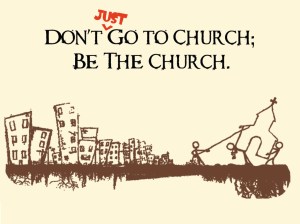
What I loved about this prayer is that it took the argument about church decline and made it personal.  No longer was the issue one that “the Church” was facing, but one that I am personally facing.  There is no mysterious formula that will solve this problem.  The issue is me – about how I make the Church the place the Church is meant to be – the place God longs for her to be.  I cannot count on people simply having an inspired desire to come to Church.  I need to share my story.  I need to get my hands dirty being Church.  I need to stop hiding my love of Jesus and start living as one who is loved by that same Jesus.

Photo credit:  http://www.cfi-hq.org/2015/04/

Photo credit: http://www.cfi-hq.org/2015/04/

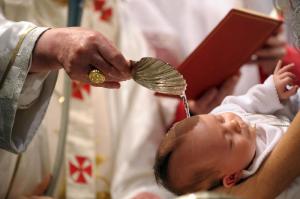
Our church just had two baptism Sundays in a row.  In those services we made some tremendous promises – to seek and serve Christ, to share the good news, to strive for justice and peace, and to be present in the life and work of the church.  That all sounds like a lot of work.  But the truth is that the work is not onerous when done in community.  The work is not onerous when we look into the eyes of infants and confidently welcome them into the community of faith.  The work is not onerous when it gives us great joy.  Over the next few weeks, I invite you to pray this prayer everyday.  Pay attention to whether its words create some shifting in you.  Linger in the parts that seem the most uncomfortable.  And then keep inviting the Spirit of the Living God to fall afresh on you.

[i] The prayer was not written by David Lose, but one he stumbled upon in a church in Wisconsin.  The full citation can be found at https://www.workingpreacher.org/craft.aspx?post=1620.

Sermon – Mark 6.1-13, P9, YB, July 5, 2015

08 Wednesday Jul 2015

Posted by jandrewsweckerly in Uncategorized

≈ Leave a comment

Tags

baptism, Christian, covenant, disciples, faith, identity, Jesus, liturgy, protection, purpose, seek, Sermon, serve, share, vulnerability

A few weeks ago, as we were planning liturgies, we were discussing the fact that we had two baptisms in a row – last Sunday and today.  A few people in the group kind of groaned, “Two in a row?!?”  I laughed at the time.  But the more I thought about their exasperation, the more I wondered why they were exasperated.  Certainly baptisms can take longer.  Between the blessing of the water, the renewal of vows, and the baptism itself, the service is a bit longer.  And perhaps to groan came out of a place of wanting to spread out the requency of special services – much like one rations out Halloween candy instead of eating it all at once.  But the more I thought about having two baptisms in a row, the more I liked the idea; in fact, the more I thought about the baptismal liturgy, I began to wish we had one every Sunday.

Now before you all issue a collective groan of exasperation, let me explain.  You see, the baptismal liturgy is one of those foundational liturgies.  In baptism, we ritually welcome someone into the family of faith.  But the baptismal liturgy is about more than the cute baby (though Rose is very cute, I admit!).  The baptismal liturgy is the time when we declare who we are, how we are to live, and how we will accomplish that ideal.  In this liturgy, we retell the story of our history – how God moved over the waters in creation, how God split the waters to free the enslaved people of Israel, and how God used the waters of baptism to mark a new way through Jesus’ own baptism.  In this liturgy, we also talk about our nature – how we are prone to sin, how we (despite the fact that we are saved by the waters of baptism) are on a continual journey of repenting and returning to the Lord, and how we need each other if we are ever to keep turning toward God.  In this liturgy, we also declare the radical way that we will live our lives in Christ – what being a Christian actually means.  Being a Christian means regularly gathering to learn together, to pray together, to eat at the Holy Table together, and to join in fellowship together.  Being a Christian means sharing the good news with others – not just by example, but by our words too.  Being  a Christian means seeking and serving Christ in others, loving our neighbor, striving for justice and peace, and respecting the dignity of others.  I don’t know about you, but regular worship, regular evangelism, and regular mission sounds like a lot of work!  And yet, here we are (for the second week in a row!) proclaiming that we will do these things.

So if today is all about defining who we are and who we are going to shape little Rose into being, what might be the best way for us to prepare her for her new life in Christ?  Some of us might imagine the story we heard a few weeks ago about David and Goliath.  If you remember, David was just a boy who agreed to take on the enormous Goliath, that everyone feared.  When King Saul agrees to let David fight Goliath, he first wants to suit up David.  Saul clothes David with Saul’s armor; he puts a bronze helmet on David’s head and clothes him with a coat of mail.  By the time Saul puts his sword over the armor, David cannot even walk!  David realizes the protection weighs him down.  So he removes the armor and weapon and instead takes only a staff, five smooth stones in his shepherd’s bag, and his sling.  Goliath (and if we are honest, probably everyone else gathered, including the people of God) laughs at David’s puny preparation.  The funny thing is that in our gospel lesson today, Jesus does the same thing for the disciples when he commissions them to go out in the world.  Jesus tells them to take nothing for their journey except a staff; no bread, no bag, no money in their belts; they get a staff, one pair of sandals, and one tunic.

When we think about preparing ourselves for the life of faith – of going out into the world to seek Christ, serve Christ, and share Christ – most of us think about preparing the way that Saul prepares David.  We want some armor for all those times that we are rejected when we share our faith; we want a sword in case we run into trouble while seeking Christ; we want some heavy mail so that when we serve others, nothing or no one gets too close[i]  But instead, Jesus sends out the disciples with a staff to steady their walking as they share the good news, a pair of sandals and one tunic so that they can humbly encounter others as they serve Christ, and empty hands and bellies so that they can seek Christ in others.  On this day when we proclaim who we are and how we will live, one might imagine that we are readying ourselves and gathering our supplies, and especially that we are arming this small, vulnerable child for walking the way of Christ.  But instead, Jesus basically tells us that there is no way to protect ourselves; there is no way to prepare.[ii]  We go with our trust in the Lord, with vulnerability, and with a sense of identity and purpose.

That is why I think we could stand to have baptism Sunday every Sunday.  Our tendency would be to find the biggest backpack we can and load that bag with all the things we think we need for our journey.  But Jesus tells us to put that bag down and start walking:  walking the way, the truth, and the light; walking by seeking, serving, and sharing Christ.  In many ways Rose has more to teach us today than we have to teach her.  She came into this world with very little.  In fact, she even came here with very little – sure her parents might have a monster diaper bag with all the “just in case” stuff babies often need.  But Rose herself cannot carry a bag; she is not self-sufficient; she is vulnerable with us all.  Instead of giving Rose an armor for Christ today, she encourages us to take off our armor and swords, and get back to the basics: our staff, sandals, and tunic.  That is the beauty of baptism.  Baptism helps us remember that we need each other.  Rose needs us to teach her the way.  We need her to teach us how to gat back to basics.  Together we find our way to living the faithful life in Christ.  Thanks be to God!  Amen.

[i] Michael L. Lindvall talks about the anxiety that evangelism produces in all of us in his article, “Pastoral Perspective,” Feasting on the Word, Yr. B, Vol. 2 (Louisville:  Westminster John Knox Press, 2009), 216.

[ii] C. Clifton Black, “Commentary on Mark 6:1-13,” July 5, 2015, as found at http://www.workingpreacher.org/preaching.aspx?commentary_id=2502 on July 2, 2015.

Always go to the baptism…

01 Wednesday Jul 2015

Posted by jandrewsweckerly in Uncategorized

≈ Leave a comment

Tags

baptism, bold, community, faith, funeral, Jesus, journey, life-giving, radical, transformation

Photo credit:  http://www.holyangelssturgis.org/sacraments/baptism/

Photo credit: http://www.holyangelssturgis.org/sacraments/baptism/

At St. Margaret’s we are in the middle of two big weeks.  This past Sunday we baptized twin girls and this coming Sunday we are baptizing another baby girl.  It is fairly rare for our parish to have back-to-back baptisms.  For the Altar Guild, that has meant that the same paraments can stay on the altar, the Pascal Candle can stay in the sanctuary, and flowers will be equally festive.  For the liturgical leaders it means that the occasionally used service is much more familiar as we head into this weekend – we should not need as much preparation and should be primed for who is holding what and when (it turns out there is a lot of choreography when it comes to liturgy!).  And for the parish, the liturgy will be very familiar and they will be ready for their big line, “We will!” when it is their turn to affirm that they will do all in their power to support these persons in their life in Christ.

But just because this coming Sunday feels familiar or even repetitive, nothing about it is rote.  That is the thing about baptisms:  although everything surrounding the day is the same, the experience is totally unique.  In the Episcopal Church, we only baptize once.  A baptism is a once-in-a-lifetime experience, something that is tremendously significant and special.  Nothing can invalidate our baptism.  Once we are welcomed into the household of God, nothing the person does can take away that status.  Baptism is a big deal.

I have often heard it said that you should never miss a funeral.  A funeral only happens once, and is something you can never recreate.  Though many of us fear what to say or do or how to approach the family, just being there becomes a blessing to the bereaved and to you.  It is a practice many have come to value:  always go to the funeral.  In fact, I began to embrace that mantra fully after seeing this story.

I think the same can be said of a baptism.  Though the liturgy is always the same, the liturgy says and does something very important.  It is not about the pretty dresses or handsome outfits.  It is about a sacred thing that happens.  It is about committing to a way of life – declaring the importance of faith in one’s life and agreeing to live in a certain way.  It is about renewing our own commitment to our baptismal covenant – something that, if done regularly, could probably help us change the world.  And it is about standing tall as a community, and taking ownership for the ways in which we form one another.  When we jubilantly say, “We will!”, our commitment is to being a community that lives life in a radically different way – in seeking Jesus, in serving Jesus, and in sharing Jesus.  When we stand at the font as a community we are claiming a radical identity that changes everything in our lives.  Something bold, invigorating, and life-giving happens at baptism.  You may think that if you have seen one baptism, you have seen them all.  On the contrary, I suggest that each one has a unique way of transforming us in Christ.  For the health of ourselves, the community, and the newly baptized, we need to be at the baptism as much as the family wants us to be there.  Always go to the baptism.  It will change your life.

Sermon – Mark 5.21-43, P8, YB, June 28, 2015

01 Wednesday Jul 2015

Posted by jandrewsweckerly in Uncategorized

≈ Leave a comment

Tags

baptism, Christ, communion, community, doubt, faith, God, hemorrhaging woman, Jairus' daughter, Jesus, powerful, saints, strong, weakness, witness, women

Today we are surrounded by some powerful women.  Many of you do not know Charlotte and Piper, who we are baptizing today, but they came into the world fighting.  While they were in the womb, their lives were threatened.  Doctors were able to operate in the womb at twenty-one weeks to ensure their survival.  Despite that help, they were born early and very tiny, but amazingly, had to have very little medical support.  Once they gained weight, they were able to come home and enjoy a healthy infancy.  My guess is that the strength these two children of God harnessed is what has pulled them through – a strength that their parents might regret when they hit their teenage years!

When we baptize Charlotte and Piper, we will baptize them into a communion full of strong saints – women who have paved the road before them, who have shown great faithfulness and strength, and who will serve as mentors and guides in their earthly pilgrimage.  We meet a couple of those women today.  First we meet Jairus’ daughter through her father.  Now, we might not think of her as a strong woman, since she is near death, but this young woman was powerful nonetheless.  She evokes such devotion in her father that he, a synagogue leader, is willing to bow down to the controversial Jesus and beg for healing for his dying daughter.  Jairus’ love for this powerful young woman made him willing to cross boundaries, to show vulnerability, and put great faith in Jesus.  We also know that Jairus’ daughter is twelve, about the age that women start menstruating, making them capable of producing life – one of the most powerful gifts of nature.  Though she is at death’s door, her power as a woman and as an individual bring people like Jesus to her, so that she might be restored to wholeness of life.

Of course, we also meet another strong woman today.  By all accounts, this woman should not have been strong.  In those days, menstruation alone meant that women had to be separated from the community for a period of time for ritual impurity.  But to have been bleeding for twelve years means that this woman has been ostracized from others for as long as Jairus’ daughter has been alive.  Furthermore, she spent all her money trying to obtain healing from doctors.  Her poverty and her impurity make her a double outcast.[i]  But this woman will not quit.  She boldly steps into a crowd (likely touching many people that she ritually should not) and she grabs on to Jesus’ clothing, knowing that simply by touching Jesus she can be healed.  She does not ask Jesus to heal her or mildly whisper among the crowds, “Excuse me Jesus, could you please heal me?”  No, she takes matters into her own hands, and though Jesus demands to speak with her, her own determination and faith make her whole.

In many ways, the baptism that we witness today is a same expression of strength and faith.  When we are baptized, we (or in the case of infants our parents and godparents) boldly claim the life of faith.  We renounce the forces of evil and we rejoice in the goodness of God.  We promise to live our life seeking and serving Christ, honoring dignity in others, and sharing Christ in the world.  This action is not a meek or mild one.  This action is an action of boldness – one in which we stand before the waters of baptism, and stake our claim in resurrection life.

Now, here’s the good news:  even though we are surrounded by powerful women today and we are doing and saying powerful things, we do not always have to be strong.  All the women we honor today are strong – but they have moments of weakness too.[ii]  I am sure over the course of twelve years, the hemorrhaging woman has doubts.  As bold as she is today, I am sure there are moments when she fears – maybe even that day – whether she could really reach out and claim Jesus’ power as her own.  And as Jairus’ daughter feels the life fade from her, I am sure she doubts.  I am sure she wonders whether she will ever be able to claim the life-force that is budding inside of her or to live a long life honoring her parents.  And though Charlotte and Piper have been warriors thus far in life, they will both have their own doubts and weaknesses.  In fact, that is why we as a congregation today promise that we will do all in our power to support them in their life in Christ.  That is why her parents and godparents promise by their prayers and witness to help them grow into the full stature of Christ.  That is the good news today.  For all the moments of strength that we honor in one another, we also honor the doubts, fears, and weaknesses.  God is with us then too, and gives us the community of faith to keep us stable until we can be strong witnesses again.  Amen.

[i] Mark D. W. Edington, “Theological Perspective,” Feasting on the Word, Yr. B, Vol. 2 (Louisville:  Westminster John Knox Press, 2009), 190.

[ii] David Lose, “Come As You Are,” June 24, 2012 at https://www.workingpreacher.org/craft.aspx?post=1493 found on June 25, 2015.

Recent Posts

  • On the Myth and Magic of Advent…
  • On Risking Failure and Facing Fear…
  • Sermon – Luke 23.33-43, P29, YC, November 23, 2025
  • On Inhabiting Gratitude…
  • Sermon – Luke 20.27-38, P27, YC, November 9, 2025

Archives

  • December 2025
  • November 2025
  • October 2025
  • September 2025
  • August 2025
  • July 2025
  • June 2025
  • March 2025
  • February 2025
  • December 2024
  • November 2024
  • October 2024
  • September 2024
  • August 2024
  • July 2024
  • June 2024
  • May 2024
  • March 2024
  • February 2024
  • January 2024
  • December 2023
  • November 2023
  • October 2023
  • September 2023
  • August 2023
  • July 2023
  • June 2023
  • May 2023
  • March 2023
  • February 2023
  • January 2023
  • December 2022
  • November 2022
  • October 2022
  • June 2022
  • May 2022
  • January 2022
  • December 2021
  • November 2021
  • October 2021
  • September 2021
  • August 2021
  • June 2021
  • May 2021
  • April 2021
  • March 2021
  • February 2021
  • January 2021
  • December 2020
  • November 2020
  • October 2020
  • September 2020
  • August 2020
  • July 2020
  • June 2020
  • May 2020
  • April 2020
  • March 2020
  • February 2020
  • January 2020
  • December 2019
  • November 2019
  • October 2019
  • September 2019
  • August 2019
  • July 2019
  • June 2019
  • May 2019
  • April 2019
  • March 2019
  • February 2019
  • January 2019
  • December 2018
  • November 2018
  • October 2018
  • September 2018
  • August 2018
  • July 2018
  • June 2018
  • May 2018
  • April 2018
  • March 2018
  • February 2018
  • January 2018
  • December 2017
  • November 2017
  • October 2017
  • September 2017
  • August 2017
  • July 2017
  • June 2017
  • May 2017
  • April 2017
  • March 2017
  • February 2017
  • January 2017
  • December 2016
  • November 2016
  • October 2016
  • September 2016
  • August 2016
  • July 2016
  • June 2016
  • May 2016
  • April 2016
  • March 2016
  • February 2016
  • January 2016
  • December 2015
  • November 2015
  • October 2015
  • September 2015
  • August 2015
  • July 2015
  • June 2015
  • May 2015
  • April 2015
  • March 2015
  • February 2015
  • January 2015
  • December 2014
  • November 2014
  • October 2014
  • September 2014
  • August 2014
  • July 2014
  • June 2014
  • April 2014
  • March 2014
  • February 2014
  • January 2014
  • December 2013
  • November 2013
  • October 2013
  • September 2013
  • August 2013
  • July 2013
  • June 2013
  • May 2013
  • April 2013
  • March 2013
  • February 2013
  • January 2013
  • December 2012
  • November 2012
  • October 2012
  • September 2012

Categories

  • reflection
  • Sermons
  • Uncategorized

Meta

  • Create account
  • Log in
  • Entries feed
  • Comments feed
  • WordPress.com

Blog at WordPress.com.

  • Subscribe Subscribed
    • Seeking and Serving
    • Join 394 other subscribers
    • Already have a WordPress.com account? Log in now.
    • Seeking and Serving
    • Subscribe Subscribed
    • Sign up
    • Log in
    • Report this content
    • View site in Reader
    • Manage subscriptions
    • Collapse this bar
 

Loading Comments...