• About

Seeking and Serving

~ seek and serve Christ in all persons

Seeking and Serving

Monthly Archives: November 2016

On Turning Down the Noise…

30 Wednesday Nov 2016

Posted by jandrewsweckerly in Uncategorized

≈ 1 Comment

Tags

Advent, breath, breathe, Christ Child, church, God, loud, noise, quiet

o-shh-facebook

Photo Credit:  www.huffingtonpost.co.uk/lucy-gaskin/playing-the-game-of-shh_b_7894332.html

I live in a noisy house.  We have tried teaching our children about volume control (we use a scale to help our oldest; e.g. “You’re at a 10.  I need you at a 6.”).  We have worked on the concept of taking turns while speaking.  We have tried yoga breathing (which more often sounds like hyperventilating that calming breaths).  And we use a lot of “time out.”  As a parent, most of the time I am used to the volume of our house.  But occasionally I spend time with families who have much more quiet homes, and the experience reminds me of how loud my house really is.

We are currently living in a culture of loud.  Every day I receive emails from some online store who promises that today’s sale is even better than yesterday’s.  When I try to work in public places on my laptop, either music or TVs are blaring loudly.  Our current political discourse feels more like a shouting match than a quiet discussion of issues.  And that does not even include the noise of Christmas preparation.  Our lives are very loud when we stop to listen.

I think that is why I love Advent so much.  It is the one church season that is almost always the total opposite of our secular season.  In a time when the secular world is getting louder and louder, the church invites us to be more and more quiet.  Our liturgies get simplified.  Our educational offerings focus more on quiet reflection than dynamic presentations or lively conversations.  Our calendar invites us to slow down.  We do all this not to be contrary, but because our church wants to give us space to ponder and savor the coming miracle of the Christ Child.

This morning I used on online version of Morning Prayer that I don’t usually use.  The nice thing about the website (or app if you use it on your phone), is the lessons are incorporated into the page so you do not have to find them separately.  Also incorporated are some hymns and canticles.  Today, the hymn was “Breathe on me Breath of God.”  I remember that old hymn from my childhood and it was just what I needed to help me stay engaged in the quiet of Advent.  My prayer for each of you today is not only that you feel God’s breath on you, filling you with life anew, but also that you breathe in God, allowing God to work through you so that God’s light might shine through you with renewed vigor.  Perhaps simply by breathing in God and allowing God to breathe on you, you might find some small way to combat the loudness of life today.

On Blessings and Curses, and Surviving Thanksgiving Meals

23 Wednesday Nov 2016

Posted by jandrewsweckerly in Uncategorized

≈ Leave a comment

Tags

conflict, creation, fall, family, God, gratitude, heart, leaves, mind, prayer, space, Thanksgiving, Thanksgiving Day

Colorful autumn

Photo credit:  www.fluentu.com/french/blog/french-fall-autumn-vocabulary-word-list

For those of you who know me well (or read this blog each fall), you know that I love the changing of the leaves during Fall.  Fall is my favorite season of the year – the cooler weather, the crunch of leaves, and the brilliant reds, yellows, and oranges that take your breath away.  The leaves turned later than usual this year in Virginia, so I have had time to enjoy their beautiful journey until now.  Just this week, a light wind was blowing, and a tree was raining down yellow leaves like a flower girl before the bride.  Some people like to stop and smell the roses.  I like to stop and revel in the beauty of God’s changing leaves.

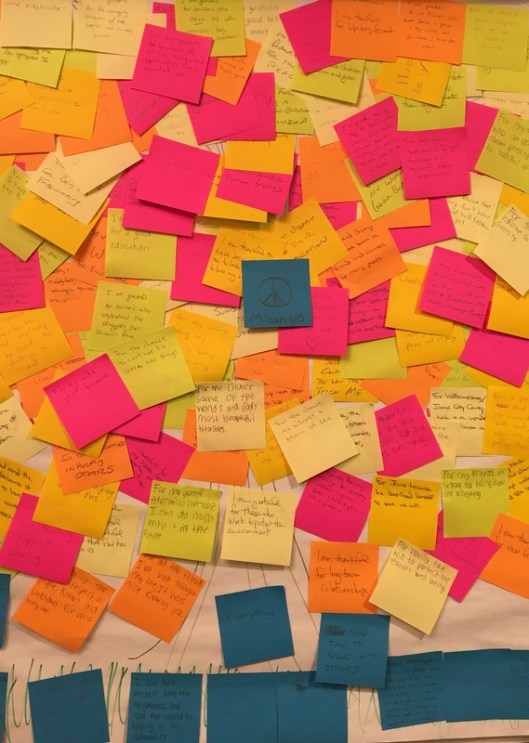
Watching and being fed spiritually by that beauty this year led us to creating a Thanksgiving Tree at Youth Group this past Sunday.  We took a poster with a bare tree, and then used our post-it notes to cover the tree with things for which we are grateful.  We had five categories, including family, relationships, creation, God, and school/work.  I challenged the group to write down three things in each category – not just a one-word response, but an explanation of their gratitude.  Perhaps 15 notes seemed like overkill to the young adults, but what I was hoping was that the more they thought about the blessings in their lives, the less space the negative would have in their hearts and minds.

That is my prayer for each of you this week as we head into Thanksgiving celebrations.  Though we may have Normal Rockwell images of Thanksgiving Day meals in our minds, and although some of you may actually get that experience, the reality of most meals, especially if spent with family, is that they will include a fair share of conflict.  If you are lucky to avoid talking about politics, some other family drama will surely emerge.  Expecting that conflict, I invite you to start praying your thanksgivings.  If your crazy family promises to bring angst, start praying now about the things that bring you joy about each member of your family.  You may have to dig deep (Lord knows your uncle’s jokes can drive you insane – but maybe you can thank God for predictability with your uncle or for the knowing glances of your cousins).  But my guess is that the more you start looking at your family or friends with the eyes of gratitude, there will be a lot more space in your heart and mind for blessings than curses.

If you can master that practice of thanksgiving prayers throughout one of the more stressful days of the year, perhaps you can carry that prayer practice through the next month.  As you hone that spiritual discipline for the next month, you may find it becomes easier to carry it into the next year.  Given our current climate, we are going to need all the space we can get for blessings. img_3401

Ecumenical Thanksgiving Homily – Ruth 2.2-9, Matthew 22.34-40, November 20, 2016

23 Wednesday Nov 2016

Posted by jandrewsweckerly in Uncategorized

≈ Leave a comment

Tags

active, Boaz, community, ecumenical, God, gratitude, Great Commandment, homily, Jesus, love, mercy, ministry, neighbor, Ruth, Thanksgiving, worship

When I learned we would be gathering for worship as ecumenical brothers and sisters to celebrate a service of Thanksgiving, I could not have been happier.  But when I realized we would be reading from the book of Ruth, I was thrilled!  Ruth has always held a special place in my heart.  This woman, a complete stranger to our faith, teaches us more about faithful living than most of our ancestors. She marries a foreigner, quickly becoming a widow with no support, following her widowed mother-in-law to a foreign land.  In her abandonment, she pledges allegiance to a God who in many ways has felt absent.  And when they return the foreign land of Bread, and she sees Naomi may not be able to support her, she takes it upon herself to go sweat in the fields, and secure them a livelihood.  She even eventually permanently ensures their security by somewhat scandalously approaching Boaz for not only food, but marriage, and progeny.  Ruth puts all others before herself, and she is faithful to God and her family.  If anyone is a beacon of living into the Great Commandment to love neighbor as self, Ruth is that beacon of light.

But the more I thought about our text today, the more I realized that despite the fact that I love Ruth, we gathered here today are more like Boaz.  You see, we are people of privilege and power.  Though we can certainly name countless people who may have more wealth and influence than we do, most of us know where our next meal is coming from, have a roof over our heads, and have our basic needs met.  Some of us are even comfortable enough to enjoy much more than our basic needs.  In that way, we are much more like Boaz, a man with power and influence, who can use that power for good or for evil.

Boaz has little obligation to Ruth, the foreigner.  He knows she is connected to Naomi, making her adopted family, but allowing her to glean with the other gleaners would have been enough.  He didn’t have to give her tips about how to be safe from the men, give her access to drinking water, feed her his bread at mealtime, and tell his men to make sure she got extra grain to glean.  He did not have to say yes when she asked for his help in taking her in.  He did not have to negotiate with the next-of-kin to have her hand.  Boaz takes God’s command to love neighbor beyond what anyone would expect.

I have been thinking about Boaz as I have been thinking about our ministry together.  Though you may not know about each case, each of the clergy here work with families in need through the use of discretionary or alms funds.  Each church here has ministries that we support – whether food pantries, homeless shelters, elder care, medical clinics, or assistance with basic needs like back-to-school supplies, clothing drives, or holiday support.  And all of us collectively have taken that a step further and agreed to help provide more food assistance by starting up a local food distribution outlet through our partners at House of Mercy.  But just because we do that work does not mean that we do that work like Boaz.

My husband is a social worker in Richmond and he was recently telling me about a client’s experience with a church.  The client reached out to a church for assistance, and instead of pastorally working with the client, the church representative gave them a hard time, wanting to know what poor decisions the client had made that brought them to the church doors.  Now, I know we all screen the clients we help.  We have to be smart about how we help those in need.  But that client experienced a loss of dignity at that church that Boaz never exerts.  In fact, Boaz knows how degrading poverty can be.  He sees Ruth, and knows simply by her gender and foreignness that she is at risk for assault and manipulation.  And so, not only does he help her, but he looks at all those around him and hold them accountable for caring for the disadvantaged too.  He does not act alone in his mercy – he makes his whole community merciful.

As we head into a holiday marked for Thanksgiving, the church invites us to look at our ancestors for the best ways to fulfill Jesus’ Great Commandment.  Want to know how to love God and our neighbors?  Look at our sister Ruth.  Want to know how to show love, dignity, and compassion?  Look at our brother Boaz.  Though many of us spend this time of year reflecting on what we have to be grateful for, the church invites us also to use this time as a time of action.  Our gratitude is not passive.  Our gratitude is active – a call to action to love God and love neighbor.  I know many families who have a tradition of going around the Thanksgiving table, enumerating those things for which they are grateful.  Perhaps this year, our families can also enumerate what we are going to do in response to those things for which we are grateful.  Our ancestors, our Savior, and our faith communities are here to embolden us in that response.  Thanks be to God!

Sermon – Luke 23.33-43, P29, YC, November 20, 2016

23 Wednesday Nov 2016

Posted by jandrewsweckerly in Uncategorized

≈ Leave a comment

Tags

Christ the King, cross, darkness, forgiveness, hope, Jesus, king, kingdom of God, kingdom of man, light, love, politics, Sermon, shine, thief, tired, weary

Today I have a confession.  I am tired.  After the election two weeks ago, and struggling to understand how vastly different the kingdom of God is from the kingdom of man, I found myself not emboldened, but just tired.  As our country and the world has tried to absorb what America’s decision means, as sides seem to dig in their heels – identifying all sorts of ways in which their side has been right, and as uncertainty, instead of peace, seem to rise, I find myself, quite simply, tired.  I was certainly given some opportunities for redemption.  Our Celebration of a New Ministry filled with me such joy that the evening felt like a redemptive group hug.  While reading the psalms appointed for evening prayer this week, I found several verses full of righteous indignation and a call against enemies.  The words felt cathartic, but later, left me feeling empty, as I know vengeance is not the answer.  Even at our Clergy Conference this week, we took some time to talk about how to navigate the results of the election as leaders of churches.  Though I appreciated the gift of that time from the Bishop, I could tell that most of us were filled with the same uncertainty that everyone else is feeling.  And, like a dutiful priest, I keep trying to stay tuned in to the news so that I am sure we are being relevant – but that, too, makes me tired.

As I turned to our gospel lesson for today, I was hoping for some bit of encouragement – some promise that everything would be okay.  Knowing today is Christ the King Sunday, the last Sunday in the liturgical year whose text should bring into focus the point of a year of journeying with Christ, I had hoped that there would be some sort of rallying text that would invigorate me and shake me out of my emotional and spiritual exhaustion.  But instead, on this day when we honor Christ our King, what is the image we are given?  A beaten, humiliated, ridiculed, discredited, shameful shell of a man, hanging on a cross, defeated in the approaching death.  We do not get Christ risen from the grave today – the ultimate Easter message.  No, today we get Good Friday – our hoped-for Messiah, seemingly defeated on the cross.  Of course, he dies with great dignity, forgiving sinners until the very end, welcoming the repentant even on their last breath, resisting every urge strike back or at least refute the charges against him.  He dies with dignity, but he dies nonetheless.

As we close out this liturgical year and prepare to begin a new year with the season of Advent, I have been thinking a lot about the other version of Christ we will soon be talking about – the Christ Child.  As I meditated on Christ the King, imagining his battered body, whose mother is not far away, I wondered if she too is thinking back to those early days with her infant.  I imagine every mother has some hopes and dreams for whom her child might become.  Maybe they have specific hopes of power and influence for their child.  Certainly, at the very least, they hope their child will be a decent, respectful human being.  But Mary could be tempted to dream much more for her child – shepherds, angels, and wise men told her to expect great things.  I wonder how she sits at that cross, devastated at what had come of her son’s journey.  Of course, her son never really had an overwhelmingly positive journey.  He was run out of towns; people were constantly trying to trick him into saying something incriminating; though those who were healed were often happy, more often, people were upset about Jesus’ healing ministry; and although they had that parade just a few days ago for her son, how quickly they had turned against him.  As she sits at the foot of that cross, I wonder if she is, at the root of her being, just plain tired.

I have often thought it is strange how the cross, and not the empty tomb is our primary Christian symbol.  That we use an instrument of death as our sign for victory is rather odd.  But today we do not just honor Christ’s death on the cross; we honor how he died on the cross.  Even in death Christ our King managed to love his neighbor – even the really bad neighbors.  Even in death, Christ managed to love God – inviting God to forgive even the most hateful behavior.  Even on the cross, Jesus never loses his focus.  Jesus never gets tired.

Just like the kingdom of God is different, so is the king of God.  The people of God never really had a king until they reached the Promised Land.  They saw the neighboring countries with their armies and their admirable kings, and they wanted one for themselves.  That was their first mistake.  God granted them a king to rule over them, but inevitably, the kings, like any humans, were flawed – some more than others.  Hence, there are four books in the Hebrew Scriptures about the kings who ruled and the judges who tried to correct their behavior.  Most of the kings were corrupted by power, money, and greed.  Many abused the people.  Even the most revered king, King David, was a bit of a mess.  But Jesus is not like foreign kings or the kings of Israel.  Jesus’ kingship is different.  He loves the poor and cares for the sick, he sees through the pretenses of the temple and calls for authenticity, he loves deeply and forgives infinitely.[i]  And he never tires of being this kind of king.

For most of us, looking to Jesus as an example of how to rally out of our fatigue and weariness may feel overwhelming to our tired selves.  Instead, I found looking at the repentant thief to be helpful.  You see, the thief was probably tired too.  Anyone who is a thief has been hustling long before he gets caught.  He may have even been caught several times before for more minor offenses.  His arrest this time is different.  There will be no escape.  He will hang on that cross until he dies.  With the cruelty of the cross, and the pain of his body, also shining forth is an overwhelming sense of fatigue.  He too is tired.  Tired of running, tired of hustling, tired of the life that leads one to become a thief.  But even in his deep fatigue, he does something extraordinary.  When the other thief taunts Jesus, the repentant thief lets the other thief have it.  Hanging in agony, he looks outside himself, and refuses to stand for the hypocrisy of the other thief.  He decries the injustice of Jesus’ sentence, he wisely points out his own, as well as the other’s, culpability in sin, and then, without shame looks right at Jesus and asks Jesus to remember him.

Even at our most weary, tired states, when we feel like there is no hope, or when death feels ever present, Jesus invites us to keep shining our light for all to see.[ii]  Our gospel this week is full of people doing just that:  taking their world of hurt, pain, sadness, sorrow, defeat, seeming hopelessness, and turning toward the light.[iii]  Mary and the other women eventually find their light despite their fatigue.  The thief hanging in humiliation and death finds his light.  And Jesus, defeated in the eyes of all but the thief today, keeps shining his light until the bitter end.  Christ our King invites us to do likewise.  Of all people, Jesus understood being tired.  His cry out to God in prayer in the Garden of Gethsemane is a prayer of a tired man.  But Jesus stood up that night, all the way to the cross on Calvary and refused to let fatigue be an excuse for a world without love, hope, and forgiveness.  Our king may not look like other kings.  His story may be strange and full of contradictions.  But our king has the power to pull you out of darkness and drag you into the light.  But along the way, he is going to need you to shine your light too.  Amen.

[i] David Lose, “Christ the King C:  What Kind of King Do You Want?” November 14, 2016, as found at http://www.davidlose.net/2016/11/christ-the-king-c-what-kind-of-king-do-you-want/ on November 16, 2016.

[ii] Caroline Lewis, “Who and What is Your King?” November 13, 2016, as found at http://www.workingpreacher.org/craft.aspx?post=4754 on November 17, 2016.

[iii] Patrick J. Willson, “Homiletical Perspective,” Feasting on the Word, Yr. C, Vol. 4 (Louisville: Westminster John Knox Press, 2010), 337.

Sermon Luke 21.5-19, Isaiah 65.17-25, P28, YC, November 13, 2016

23 Wednesday Nov 2016

Posted by jandrewsweckerly in Sermons, Uncategorized

≈ Leave a comment

Tags

church, disagree, diversity, election, Episcopal Church, ethics, God, Jesus, kingdom of God, kingdom of man, love, Messiah, politics, Sermon, vote

One of the things you will learn about me as we grow together is that I generally avoid politics in the pulpit.  I avoid talking about politics because one of the blessings of the Episcopal Church is that we represent a wide range of political viewpoints.   Though some would like to categorize our church as liberal because of some of our national Church decisions, our membership is diverse.  Most of the time our diversity is a gift.  Our diversity means that we cannot become an echo chamber, always preaching to the proverbial choir.  We will have differences of opinion, we will argue and debate about how scripture is applied in modern life, and we will be forced to agree to disagree when we come to the table each week.  We are one of the rare denominations who walk that fine line well, and that ability is one of the things I love about the Episcopal Church.

The curse of our diversity means that we will rarely be on the same page about an issue on any given Sunday.  That reality is most glaringly obvious on a Sunday like this one:  the first Sunday after one of the most contentious elections in modern history.  As I step into this pulpit today, I am aware that there are people in this room who feel like we made a good decision on Tuesday – a decisive vote to do business differently on a national level.  I am aware that there are people in this room who are gravely disappointed by the decision we made on Tuesday.  They feel a range of emotions, including sadness, disappointment, hurt, anger, fear, and threat.  I am also aware that there are people in this room who do not put too much credence in what happened Tuesday.  They may have voted, but they did not feel like there were any good options, and so they were resigned to be dissatisfied with whatever the outcome would be.

The trouble with our scripture lessons from Luke and Isaiah today is that they tempt us to conflate what has happened in our political sphere this week with the kingdom of God.  Teaching at the Temple, Jesus predicts the destruction of the Temple.  When asked when this will take place and what the signs will be, Jesus’ answer is dire.  He warns of false prophets; wars and insurrections; nations rising up against each other; earthquakes, famines, and plagues; betrayals by family and friends; and personal arrests and persecutions.  Conversely, Isaiah prophesies of the coming kingdom:  where there will be no weeping or distress; people will live into old age; people will stay on their land and their fruits will prosper; and the wolf and the lamb will feed together.  We could look at these two worlds – the world of destruction and judgment and the world of the peaceful kingdom and easily say, “Well because my candidate won or lost, we will be dealing with either the day of doom or the day of the peaceful kingdom.”  The scripture today tantalizingly tempts us to look at these last five days and say with either dread or joy, “The kingdom of God has come near.”  But I would argue that that kind of conflating is not only false, but also ascribes too much power to humans.

Eight years ago, I voted for Barak Obama.  I remember feeling like he could bring us into a new era.  He talked about hope, and I felt filled with a sense of hope and renewal.  He made a lot of promises, many of which felt in line with what I would call gospel living.  When he took office, I remember holding on to that sense of hope.  I should not have been surprised years later when I became disappointed with some of Obama’s decisions.  My idyllic sense of hope began to deflate, and I remember several people talking about how disappointed they were – as if Obama was a false prophet or failed messiah.  As soon as that rhetoric surfaced, I realized the fatal flaw of my vote of confidence in Obama.  I had placed Obama in the role of Messiah – someone who would bring about the reign of God.  Suddenly, I realized how unfair, and quite frankly, unchristian, that expectation was.  Obama would never be the Messiah I wanted because I already had a Messiah.  No president could ever represent Christ effectively, because we only have one Messiah.  Not until I had that realization was I able to see politics a little differently.  Though I strongly encourage us all to be involved in the political life of our country, and I also strongly encourage us to use our Christian ethics as a moral compass in electing officials, I am also keenly aware that no political servant can ever be a messiah, because every political servant is a flawed human, just like you and me.  Likewise, I am also ever more aware that Jesus was not a Democrat or a Republican, because political parties are made up of flawed human beings with flawed abilities to fully represent the gospel of Jesus Christ.

So where does that leave us?  Are we supposed to step back from political activism if the political system is inherently flawed?  Scholars have debated this issue for centuries.  In their book Resident Aliens, Stanley Hauerwas and Will Willimon argued that Christians should be in the world, but not of the world.  They argued that, “The Confessing church does not take as its primary aim the transformation of the world through the political route of the State.  Instead, [the Church] seeks to transform the world by creating a counterculture of people who live under the reign of Jesus.  In this counterculture ‘people are faithful to their promises, love their enemies, tell the truth, honor the poor, suffer for righteousness, and thereby testify to the amazing community-creating power of God.  The confessing church has no interest in withdrawing from the world, but it is not surprised when its witness evokes hostility from the world’ (46).  In doing so this counterculture church becomes the people of the cross, demonstrating God’s love for the world.  The most ‘effective’ thing the church can do is to become the ‘actual creation of a living, breathing, visible community of faith’ (46) in a hostile world.”[i]

Here is what I know:  the kingdom of man is not like the kingdom of God.  I say that not as an excuse to hide in a bubble, but as a salve for our wounded spirits when we see how far apart the kingdom of man can be from the kingdom of God.  We could leave church today with our hands thrown up in the air, feeling like the two are different and there is nothing we can do to change it.  But that is not what Hauerwas, Willimon, or even Jesus want from us today.  In Jesus’ prediction of doom and personal persecution, Jesus also says something simple and almost comical.  He says, “This will give you an opportunity to testify.”[ii]  Our political system is not perfect.  We are not a perfect country.  We hurt each other and we suffer at the hand of one another.  But that lack of perfection and the presence of hurt is no excuse to not work on bringing about the kingdom of God here on earth.  The prophecy of Isaiah is not some pie-in-the-sky dream about what happens when we die.  The coming of Jesus meant the inbreaking of the kingdom here on earth.  In Christ’s absence, our work is turning this kingdom of man into the kingdom of God.  The vision from Isaiah is just that:  a vision for us to align our steps, and to do our work.  The vision of Isaiah is not a Republican vision or a Democrat vision.  The vision of Isaiah is the vision of God:  of taking “the original creation that the Divine called good,” and “transforming that creation into something new.”[iii]

After this contentious election, I would love to tell you that everything will be okay – that God will magically make things right.  But Jesus tells us today that he needs us to do our work.  When Jesus tells those gathered that they will have the opportunity to testify, he also tells them, “make up your minds not to prepare your defense in advance; for I will give you words and a wisdom that none of your opponents will be able to withstand or contradict.”[iv]  Things will be bad before the kingdom of God reigns over the kingdom of man.  Our political systems are not capable or perhaps even interested in bringing about the reign of God.  That work is ours to do.  But Jesus promises that he will be with us, giving us the words as we work, empowering us to right the ills of this world, strengthening us for work of kingdom making.  And you are in the right place this morning to prepare yourself for that work.  Today and every Sunday we offer you the chance to cry out to God, to confess your own complicity with sin, to learn and be formed into a disciple of Christ, to be strengthened with the holy meal, and then to get back out there in the work of bringing about the kingdom of God.  If you need to linger today a little longer at the altar rail, with your anger or your grief at what happened this week, by all means do it.  If you are emboldened by what happened this week, then take that sense of victory and turn it into kingdom work.  But before you leave today, remember that each of us, in all our diverse opinions and experiences are needed to testify and help each other testify.  We need each other and our Messiah, the Christ.  He will give us the words when the time comes so that we can create a world where the lion and the lamb feast together.  Amen.

[i] Steven Kopp, “Book Summary: Resident Aliens by Stanley Hauerwas,” August 21, 2015, as found at https://slasherpastor.wordpress.com/2015/08/21/book-summary-resident-aliens-by-stanley-hauerwas/ on November 11, 2016.  The page numbers are page citations from Hauerwas and Willimon’s book.

[ii] Luke 21.13.

[iii] Mary Eleanor Johns, “Pastoral Perspective,” Feasting on the Word, Yr. C, Vol. 4 (Louisville: Westminster John Knox Press, 2010), 290.

[iv] Luke 21.14-15.

On Saints, Elections, and God…

09 Wednesday Nov 2016

Posted by jandrewsweckerly in Uncategorized

≈ 1 Comment

Tags

altar, church, election, God, liturgy, messiness, saints, worship

14917060_1270799702976287_658328143983009977_oThis past Sunday, I got to try on one of Hickory Neck’s traditions.  For the past several years, every All Saints Sunday, the congregation has been invited to tie a ribbon on the altar rail in honor of saints who have gone before.  To be honest, before our liturgies started, I was not sure how the liturgical action would go.  I had imagined all sorts of reasons it might be awkward:  I didn’t think our early, reserved worshipers would be that interested; I worried that the ribbons would be messy, making communion at the rail difficult; I wondered if the symbolism would work in our space.  Happily, I was wrong on all accounts.

Instead, the liturgical symbolism was potent.  As I watched countless people kneel at the rail, tying on the ribbons, many with tears streaming down their faces, I realized how easy it is for me to forget the pain of grief that people struggle with every day.  When we see a well-dressed person at church on Sunday, we forget that there is a unique, sometimes painful story underneath appearances.  As I looked at ribbons draped on the altar rail, I imagined the bodies of the saints, draped on the entrance of the heavenly banquet, having given their lives to love and witness.  As my mind struggled with the messiness of the rail, my heart could see the messiness of life, clinging to the very altar where we kneel not just for solace and pardon, but for strength and renewal.  The liturgical action created a beautiful moment that was overwhelmingly powerful.

Today, I woke up to the news of election returns. Being a pastor of a diverse congregation, I know there are hearts that are relieved, hearts that are satisfied, and hearts that are saddened, fearful, and disappointed.  As I process that reality today, I am reminded of those ribbons, dripping from the altar of church.  I am reminded of the saints that have gone before, who have waded through their own times of conflict.  I am reminded of the fact that on Sunday, each worshiper will be bringing a story to the altar that I will never know fully.  I am reminded of the fact that our church offers a rail where we all kneel or stand, in all of life’s messiness, longing for something bigger and with greater meaning than we can give each other in our limited humanity.

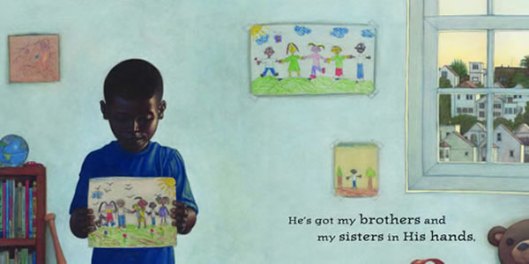
As I got ready for the day this morning, my two-year old sat in the floor of our bedroom with some books.  I was still processing that image of All Saints Day when I heard her singing from one of her books.  “He’s got my brothers and my sisters in his hands…he’s got the whole world in his hands.”  Her sweet voice brought me to tears as I realized the deep wisdom in her, perhaps unintended, words.  In this messiness of life, there will be days that are really complicated, confusing, and hard.  But as a person of faith, I also trust that the Lord our God is holding us in God’s hands, tending not just to me, but to my brothers and my sisters.  For today, that is all I can ask for.

world6

Photo credit:  He’s Got the Whole World in His Hands, Kadir Nelson.  Photo found at http://www.walkingbytheway.com/blog/picture-books-for-transracial-adoptive-families/

Participating in Gratitude…

02 Wednesday Nov 2016

Posted by jandrewsweckerly in Uncategorized

≈ Leave a comment

Tags

blessed, cycle, generosity, gift, God, grateful, gratitude, note, sacred, thanks, Thanksgiving

thank-you-note

Photo credit:  https://fastcompany.com/3057431/hit-the-ground-running/heres-what-to-write-in-your-thank-you-after-a-job-interview

In honor of Thanksgiving Day at the end of the month, a trend has developed that uses the entire month of November as a month of gratitude.  The practice has several forms:  journaling about at least five things for which you are grateful every day; posting daily on Facebook a note of gratitude; or using Instagram or other outlets to post a daily photo of something for which you are grateful.  The practice is quite spiritually based.  I have had countless spiritual directors who have encouraged me to use gratitude as a discipline for my prayer life – using the end of the day to give thanks for things in life as opposed to our natural tendency to look back at the day and make mental note of all the things that went unaccomplished or were hurtful to ourselves or others.

This past Sunday we gathered our pledges for the upcoming calendar year.  Each year in the Episcopal Church, parishioners are asked to fill out a pledge card, letting the Vestry, or governing board, know how much income can be expected so they can formulate a budget.  The pledge cards certainly serve a practical purpose.  But their use can also serve a deep spiritual purpose.  As I blessed three different baskets of pledge cards on Sunday, I had the thought that each of those baskets were like piles of thank you notes to God – a way of articulating how blessed we are and how grateful we are for the resources we have and our ability to share and support ministry with those resources.  Each card held a story – a story of someone who feels connected to and passionate about Hickory Neck, who has been nurtured and challenged in this place, who has a unique life story, and who has encountered Christ here.  As I thought of the conversations, prayers, and reflections those cards represented, I could not help but smile.  There is something quite beautiful in witnessing the intimate, vulnerable exchange between God and parishioner.  I felt privileged to bless that sacred act.

In the coming weeks, I have the privilege of entering into that sacred space of thanksgiving and gratitude.  I have the task of thanking each pledging member.  When the Stewardship Committee and I first talked about the campaign, we joked about whether my hand would be able to survive writing so many notes.  There may be times my hand actually does get sore, but so far, I am nothing but grateful to be writing those notes.  I have found that writing them has been a tremendous time of blessing – an opportunity for me to pray for each parishioner, to thank God for the gift of them to our community, and to send my blessings upon them.  The “duty” has become an incredible gift that keeps the cycle of gratitude going.

How are you participating in the cycle of gratitude?  In what ways do you cultivate a spirit of generosity, passing your sense of gratitude and blessing on to others?  I look forward to hearing how you are participating in the cycle, and how God is using you to bless others.

Sermon – Habakkuk 1.1-4; 2.1-4, P26, YC, October 30, 2016

02 Wednesday Nov 2016

Posted by jandrewsweckerly in Sermons, Uncategorized

≈ Leave a comment

Tags

anger, argue, bold, celebration, cry, dreams, God, Habakkuk, joy, lament, listen, plain, pledge, Sermon, stewardship, vigil, vision, watch, write

I don’t know about you, but there are times when I have to tune out from the world.  I binge watch HGTV or find a mindless comedy and I just zone out.  In part, I do this because my psyche, my spirit, my soul feels overwhelmed.  I cannot listen to one more story of natural disaster – of floods, of famine, of destruction.  I cannot learn of one more part of the world where humanity seems lost – of genocide, of systemic violence against women, of the taking of land from its rightful owners.  And lately, I cannot absorb one more barb by a political campaign – of slander, of innuendo, of plain meanness.  And if I am not trying to hide from the world around us, sometimes I find I need to hide from the world right in front of us – from awful diagnoses, to life lost, to relationships broken.

While one common response is to relieve tension through mindless activity, the other alternative is to do what Habakkuk does today:  cry out to God.  “How long, O LORD, must I call for help, but you do not listen?”  The reading from Habakkuk today starts with what is called a lament – something commonly seen in the psalms,[i] but known by us all because at some point in our lives, we have all cried out a lament to God.  In this particular lament, Habakkuk is angry with God because the world is crumbling around him.  Violence is on every side and those supposed to enforce justice are perverting justice.  You can hear the sense of betrayal in Habakkuk’s voice – as if God has abandoned him and the rest of God’s people.  And so, Habakkuk does what God’s people have done from the days of Abraham – he argues with God.[ii]  He demands a response.  He calls God to task – demanding that God not let this ungodly world continue on its ungodly path.

If you are ever in a crisis, one of the things you will learn about me is what I love about our God:  God can take our anger, our righteous indignation, our arguments.  Our people have been engaging this way with God from the beginning – not victim to an all-powerful God who demands our obedience, but in relationship with a God who can handle all of our “stuff.”  Lord knows God has gotten an earful from me over the years – every time a child is lost, fellow citizens die from senseless violence, or life just seemed too much to bear – God has heard from me.  Sometimes I cry out in a lament, sometimes I cannot even find the words I am so angry.  I learned a long time ago that the good news is God can take it.

After his lament, Habakkuk does something that is quite familiar to me as a parent of young children.  Habakkuk stomps his feet, crosses his arms, and stares in silent indignation, daring God to respond.  Of course, one could certainly label this as the conclusion of Habakkuk’s temper tantrum.  But an alternative may be to see something else in what Habakkuk is doing.  In the face of great sorrow, anger, and despair, Habakkuk does not flee.  Though he feels abandoned, he does not abandon God.  Instead, he demands God’s presence and will not be satisfied until he hears a word from God.  And so he waits.  He waits, and watches.  He keeps vigil, listening for God to speak.

Several years ago, Hickory Neck was thriving and heading toward what looked like a tremendous time of growth and change.  The community rallied around creating this new worship space to house the community that was bursting at the seams.  We even have plans for how to expand this building into phases two and three when we expected we would be bursting at the seams again.  But a few years ago, we hit a bit of snag.  Our pastor became ill and eventually took a new call.  Though we had an interim priest, we had interims without the interim.  I would not say that things ever got so rough that we called out in lament to God like Habakkuk.  But we did take a play out of Habakkuk’s book:  we stood in wait, keeping vigil, listening for God to speak a new word to us.

And slowly, God did just that.  God began to speak.  God began to whisper new dreams, new visions.  We began to dream about mission trips, increased local outreach, repurposing building or building new spaces to house ministries for the growing population of both retirees and young families in our area, and meaningful worship and growth.  God began to open our hearts to what new clergy might join us, and what new visions we might build together.  We began to do what God tells Habakkuk to do today.  When God finally speaks to Habakkuk, God says, “Write the vision; make it plain on tablets, so that a runner may read it.”  Now there is a little scholarly debate[iii] about what the vision is God is communicating – one of promise or one of condemnation – one to be rejoiced or one to be feared[iv] – but the clarity is what strikes me.  Write the vision; make it plain.

A little under a year ago, your Vestry engaged in just that kind of work.  They looked at the state of Hickory Neck, they talked about their dreams for Hickory Neck, they looked at the finances, and then the wrote a vision.  They knew what everyone here knows:  that Hickory Neck is a special place that has been challenged to grow in new and exciting ways.  We have all experienced the power of worship in this place, the transformative nature of formation and prayer in this place, the radical commitment to hospitality in this place, and the passion for Christ’s call to love our neighbors in this place.  And so, the Vestry did what may feel a little like that line from a Field of Dreams, declaring “If we build it, they will come.”  But the Vestry did not just wait for “them” to come.  They soberly looked at finances and decided they would not only fund a rector, but also a curate.  They named their vision to make our buildings not just useful to us, but useful to our communities:  through Winter Shelter and outside guests, but maybe eventually to a preschool or day center for seniors.  The Vestry committed to not just waiting for “them” to come, but employing tools to invite, welcome, and connect seekers into our community.  They wrote the vision and they made it plain.

When I first came on board with Hickory Neck in April, the Vestry began to ask me under what vision we were going to operate.  What I told them is what I will tell you:  we are already operating under a vision.  Now, there are certainly dreams I have for where we will be 5 to 10 to 15 years from now, but for today, for next year, we already have a vision.  Now, being pragmatists, the Vestry wanted me to make it plainer.  And so, we worked in reverse.  We sat down and we mapped out the entire calendar from August to August.  We wrote down everything we normally do and everything we hope to do.  And then we stepped back and said, “Is this us?  Does our calendar reflect who we are and our vision for this place?”  You see, our calendar was just a tool to mark our values and vision.

We have been engaging in that same conversation in our homes, in small groups, and as a community these last four weeks.  As we laid out a vision of being a community that lives generously, we took stock not of our calendars, but of our checkbooks.  We sat down and looked at where our money was going and whether that cash flow reflected our values and vision.  For the Vestry, our budget involves some commitments that are hefty, but reflect a vision of who we want to be.  Each Vestry member went home and engaged in a similar exercise at home, looking to see if their budgets reflected a vision of who they want to be as individuals.

The Vestry and Stewardship Committee have written a vision and made it plain.  Instead of scaling back and being tentative, we have committed to being a parish who boldly is ready to seek and serve Christ in all persons and to share the Good News of God in Christ.  As the Prayer Book says in the Catechism, our vision is to restore all people to unity with God and each other in Christ, as we pray and worship, proclaim the Gospel, and promote justice, peace, and love.[v]  Those are bold promises that will require all of us to succeed.  Today, we are talking about how our treasure is needed to bring that vision to fruition; in January, we will also talk about how our time and talent will bring that vision to fruition.  But because our vision is living generously, this is not a call to sacrifice and struggle.  No, this vision is an occasion for celebration and joy.  I look forward to marking that celebration and joy with you today as we bless our commitments to live generously, eagerly helping Hickory Neck to shine its light on the hill for all to see.  Amen.

[i] Bryan Spinks, “Theological Perspective,” Feasting on the Word, Yr. C, Vol. 4 (Louisville: Westminster John Knox Press, 2010), 242, 244.

[ii] Theodore Hiebert, “Habakkuk,” Neil M. Alexander, ed., The New Interpreter’s Bible, vol. 7 (Nashville:  Abingdon Press, 1996), 632.

[iii] Karl Jacobson, “Commentary on Habakkuk 1:1-4, 2:1-4,” November 3, 2013, as found at http://www.workingpreacher.org/preaching.aspx?commentary_id=1875 on October 26, 2016.

[iv] Corrine L. Carvalho, “Exegetical Perspective,” Feasting on the Word, Yr. C, Vol. 4 (Louisville: Westminster John Knox Press, 2010), 247.

[v] BCP, 855.

Recent Posts

  • On the Myth and Magic of Advent…
  • On Risking Failure and Facing Fear…
  • Sermon – Luke 23.33-43, P29, YC, November 23, 2025
  • On Inhabiting Gratitude…
  • Sermon – Luke 20.27-38, P27, YC, November 9, 2025

Archives

  • December 2025
  • November 2025
  • October 2025
  • September 2025
  • August 2025
  • July 2025
  • June 2025
  • March 2025
  • February 2025
  • December 2024
  • November 2024
  • October 2024
  • September 2024
  • August 2024
  • July 2024
  • June 2024
  • May 2024
  • March 2024
  • February 2024
  • January 2024
  • December 2023
  • November 2023
  • October 2023
  • September 2023
  • August 2023
  • July 2023
  • June 2023
  • May 2023
  • March 2023
  • February 2023
  • January 2023
  • December 2022
  • November 2022
  • October 2022
  • June 2022
  • May 2022
  • January 2022
  • December 2021
  • November 2021
  • October 2021
  • September 2021
  • August 2021
  • June 2021
  • May 2021
  • April 2021
  • March 2021
  • February 2021
  • January 2021
  • December 2020
  • November 2020
  • October 2020
  • September 2020
  • August 2020
  • July 2020
  • June 2020
  • May 2020
  • April 2020
  • March 2020
  • February 2020
  • January 2020
  • December 2019
  • November 2019
  • October 2019
  • September 2019
  • August 2019
  • July 2019
  • June 2019
  • May 2019
  • April 2019
  • March 2019
  • February 2019
  • January 2019
  • December 2018
  • November 2018
  • October 2018
  • September 2018
  • August 2018
  • July 2018
  • June 2018
  • May 2018
  • April 2018
  • March 2018
  • February 2018
  • January 2018
  • December 2017
  • November 2017
  • October 2017
  • September 2017
  • August 2017
  • July 2017
  • June 2017
  • May 2017
  • April 2017
  • March 2017
  • February 2017
  • January 2017
  • December 2016
  • November 2016
  • October 2016
  • September 2016
  • August 2016
  • July 2016
  • June 2016
  • May 2016
  • April 2016
  • March 2016
  • February 2016
  • January 2016
  • December 2015
  • November 2015
  • October 2015
  • September 2015
  • August 2015
  • July 2015
  • June 2015
  • May 2015
  • April 2015
  • March 2015
  • February 2015
  • January 2015
  • December 2014
  • November 2014
  • October 2014
  • September 2014
  • August 2014
  • July 2014
  • June 2014
  • April 2014
  • March 2014
  • February 2014
  • January 2014
  • December 2013
  • November 2013
  • October 2013
  • September 2013
  • August 2013
  • July 2013
  • June 2013
  • May 2013
  • April 2013
  • March 2013
  • February 2013
  • January 2013
  • December 2012
  • November 2012
  • October 2012
  • September 2012

Categories

  • reflection
  • Sermons
  • Uncategorized

Meta

  • Create account
  • Log in
  • Entries feed
  • Comments feed
  • WordPress.com

Blog at WordPress.com.

  • Subscribe Subscribed
    • Seeking and Serving
    • Join 394 other subscribers
    • Already have a WordPress.com account? Log in now.
    • Seeking and Serving
    • Subscribe Subscribed
    • Sign up
    • Log in
    • Report this content
    • View site in Reader
    • Manage subscriptions
    • Collapse this bar
 

Loading Comments...