• About

Seeking and Serving

~ seek and serve Christ in all persons

Seeking and Serving

Monthly Archives: February 2017

On Cuisine and Community…

15 Wednesday Feb 2017

Posted by jandrewsweckerly in Uncategorized

≈ 3 Comments

Tags

church, comfort, comfort food, communion, community, cuisine, Eucharist, feast, fellowship, food, God, journey, recipe, strength, sustenance

mac-and-cheese

Photo credit:  whoneedsacape.com/2016/10/italian-mac-cheese/

This weekend, I made a family recipe from my husband’s grandfather.  Though Grandpa Gray is no longer with us, somehow, making this recipe for the first time in a long while flooded me with all kinds of memories.  You see, Italian Mac was the family’s favorite dish – the ultimate comfort food.  One year, I finally asked for the recipe and stayed with Grandpa Gray in the kitchen while he made it.  Now, as I look at the words of the recipe, I can hear his beautiful voice in the words.  As I crush the herbs as he instructed, I can imagine his worn hands doing the same thing.  As our house fills with the aromas of Italian Mac and garlic bread, I can remember the smell of his house.  As I sip the red wine that the recipe suggests I pair with the meal, I can recall the comforting sound of his laughter.

Food has a special power.  Whenever I have been on mission trips, food has created intimate connection.  In Honduras, we all took turns helping the women of the village cook for our team.  After ten minutes of attempting to grind corn, we were all laughing at how much stronger the women were than the men who were lifting bricks to build the church.  On my second visit to Costa Rica, I wanted to learn how to make the beans and rice we ate regularly.  The women were surprised that I was willing to get up early with them and learn.  After that morning, our relationship shifted.  In Myanmar, giggles and laughter ensued as we tried new foods and our hosts appreciated our boldness.

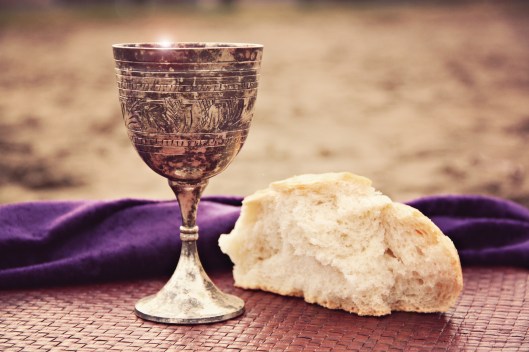
The same is true of the Eucharist.  I have been in churches that use grape juice and a small cube of pasty, crunchy “bread.”  I remember the splendor of the sweet Hawaiian bread used at another church.  I remember the first time I had real wine at communion, and the way that it burned down my throat, lighting a new fire in me.  Whether baked bread, bland wafers, or store-purchased pita bread, each texture and flavor imprints in my mind the church, the community, the spiritual place where I was at the time.  Even this weekend, at my goddaughter’s baptism, my own daughter commented on the “yucky” communion bread they had.  I would have just said it was dense, but that dense texture will linger in my mind as my reminder of our celebration.

Holy Eucharist is the comfort food of Church.  That is why I love being a part of a sacramental church that has Eucharist every Sunday.  But the Church offers other comfort foods as well.  The pancakes we eat every Shrove Tuesday remind me of years of fellowship and laughter – with communities all over the East Coast.  The Brunswick Stew of the Fall Festival at Hickory Neck will always remind me of warmth and community.  There are those dishes at every potluck that you search for, knowing the comfort it will bring.  And of course, there is the Sunday morning coffee – a staple of hospitality and grace.  If you have been missing a sense of community and comfort, I hope you will make your way to Church this week and join us in the feast that not only comforts us, but also strengthens us for the journey.  God has given us great work to do – but God has also given us the sustenance we need for the road ahead.

lords-supper-church-stock-photos

Photo credit:  stthomasnorwalk.com/religious-ed/sacraments/Eucharist

On hitting our stride…

08 Wednesday Feb 2017

Posted by jandrewsweckerly in Uncategorized

≈ Leave a comment

Tags

blessing, dream, God, identity, life, ministry, retreat, Vestry

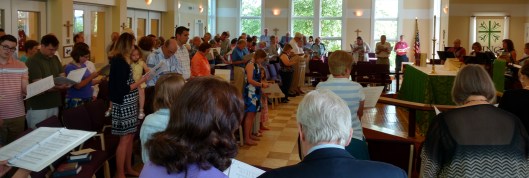
family-service-1This weekend, our Vestry gathered for a retreat.  Only a few things were on the agenda:  getting to know each other better (nothing like filling out some Lent Madness brackets to help you get to know someone!), defining who we are as a community, and looking forward to where we are going.  The weekend was a wonderful combination of laughter, reflection, quiet, conversation, dreaming, and planning.  I am reminded once again how blessed we are by the diverse, talented group of leaders who are helping guide our parish into its next phase of life.

One of the things we did on our retreat was to watch a video about Hickory Neck from 2004.  As a relative newcomer to Hickory Neck, it was fascinating to see so many familiar faces (don’t worry – you all still look fabulous!), to hear what was energizing the community back then, and to see what the goals and dreams were.  The video was produced to prepare Hickory Neck for a capital campaign which would support the construction of our New Chapel.  Despite the intent to raise funds, you still could hear clearly what Hickory Neck was about, and where it was going.

What I loved about watching the video was seeing how much things have changed, and how some things have not changed at all.  We are still a community of hope, joy, and belonging.  We still love to worship the Lord in the beauty of holiness, we are still journeying toward deeper relationship with God and our neighbor, and we still want to be beacon of light to our neighbors in need.  And yet, since the video was created, the economy has changed, technology has changed, and demographics have changed.  Our work now is listening to the new ways God is calling us to be faithful disciples to a world in need of redemption.

This is an exciting time for Hickory Neck.  These last ten months, we have been alternately jogging, sprinting, and trying to match each other’s pace.  As we wrap up this first year together, we are hitting a rhythmic stride together.  We have learned a lot more about each other, figured out how to adjust for each other’s gifts and talents, and are now getting ready to take off.  It’s an exciting time and the fun is just beginning.  If you haven’t met Hickory Neck yet, I would encourage you to come on over and check us out.  You won’t be disappointed!  And if you have been around a bit, I think you are going to be pleased to be a part of this next phase of life and ministry together.  God has great things in store!

Sermon – Isaiah 58.1-12, EP5, YA, February 5, 2017

08 Wednesday Feb 2017

Posted by jandrewsweckerly in Sermons, Uncategorized

≈ Leave a comment

Tags

church, fast, fasting, God, Isaiah, love, need, outreach, relationship, Sermon, serve, worship

In about three and half weeks we will gather in the Historic Chapel for Ash Wednesday services.  In the liturgy for Ash Wednesday, the priest invites us into the “observance of a holy Lent, by self-examination and repentance; by prayer, fasting, and self-denial; and by reading and meditating on God’s holy Word.”  I don’t know about you, but this invitation always makes me a little nervous.  The truth is, I am terrible at fasting.  I have often blamed the issue on low blood-sugar.  But really, I just hate the way not eating makes me feel.  I get cranky, I cannot focus on work, and I just want to crawl into bed.  And what makes fasting worse is that we get scriptural passages that warn us about grimacing while fasting – that we should go so far as to put oil on our faces so that we look shiny and happy during our fasting.

Knowing my utter sense of failure at my inability to engage in the most holy of spiritual practices, I confess that I was secretly pleased to read our text from Isaiah today.  The people of Israel have become quite good at fasting and pious worship.  We are told that day after day the Israelites come to God in worship, delighting to know more about God, and fasting like righteous followers of God.  They even bow down and lie in sackcloth and ashes.  They are the epitome of penitential Lenten worshippers.  Except for one small, teeny, tiny problem.  Despite their devotional fasting and their fervent prayers, God is angry with the Israelites.  You see, while the Israelites are piously engaging in reverent, penitential worship, their hired hands are working under their oppressive orders.  While they have been perfecting reverential bows, there are hungry, homeless, naked, impoverished peoples just outside their doors.  Oblivious, the Israelites complain to God, “Why do we fast, but you do not see?  Why humble ourselves, but you do not notice?”  God’s response is a brutal question:  Why are you here?

In polite Episcopal circles, we do not often ask that question:  Why are you here?  We might ask a visitor a much softer version of that question, “What brings you to Hickory Neck?”  But we almost never ask a regular or long-time church member, “Why are you here?”  I think part of why we do not ask someone else that question is because we are afraid someone will ask us that question.  We are afraid to be asked that question because the question feels like a trick.  If I say I am here because I want peace or comfort, does that make me a passive, self-serving Christian?  If I say I am here because I enjoy the community, does that mean my church is more like a country club than a church?  If I admit that I do not know why I am in church this morning other than a strange longing somewhere deep inside me, does that mean that my worship is superficial or doomed for ambiguity?

The scary part about our anxiety around that question, “Why are you here today,” is that God has a very clear response before we or the Israelites can even answer the question.  God says that if we do not come to worship to be changed, we are doing something wrong.  As one scholar argues, Isaiah’s words today tell us that, “Worship without justice has no value in the eyes of God.”[i]   For Isaiah, a gap has formed between the faithful’s seeking God and God’s ways and their actual way of life.  What Isaiah wants the people to know is that fasting, prayer, and worship are all well and good, but without some connection to the other 167 hours of their week, their worship, their fasting, their relationship with God is hollow.  Now, God is not telling us that worship is inherently bad or self-serving.  As another scholar points out, “worship is the most important thing we do together.  It is the place that forms us into the people of God.  It is the place where we inhale God’s love and grace, so that,” and here comes the important part, “so that we can be sent forth to exhale God’s love and grace in a broken world in need of redemption.”[ii]

One of the things that attracted me to Hickory Neck was the wide variety in styles of worship.  On any given Sunday, I can pray the Prayer of Humble Access in the midst of a quiet Rite I liturgy; I can belt out a praise song that is so familiar I don’t need to look at the words; I can chant the Eucharistic Prayer while the Choral Scholars respond with beautiful, precise, haunting harmonies; or I can sing a version of the Lord’s Prayer that my seven-year old daughter has learned by memory.  I love the variety of expressions of worship here, and love our unique gift that is rare in most parishes.  But variety can be dangerous.  Variety means bringing together people who don’t necessarily revel in the differences.  There will be people who only come to our early service because they find music to be a distraction.  There will be people who only come to the late service because anything other than traditional Anglican music interferes with their worship.  And there will be people who only like the middle service because they can let their hair down and be themselves.  Slowly, what is meant to be the gift of variety becomes a competition for the best – the most holy, most reverent, most relatable, most “of God.”  But what all that comparison leads to is not deeper relationship with God.  That comparison leads us to focus on the worship as an end unto itself, instead of as a means “right relationship.”[iii]

In order to get to the point of fasting or worship, God tells the Israelites to redefine fasting.  Instead of abstaining from food or drink, the fast God desires, “is outreach to those in need, which involves not only feeding the hungry, clothing the naked, and caring for one’s own, but also addressing the attitudes and structures responsible for injustices.”[iv]  In the Episcopal Church, we have codified this redefinition of fasting in our dismissal.  We take all of our prayers, all of learning, all of our confessions, and all of our feasting and we say, “Go in peace, to love and serve the Lord.”  In other words, we give ourselves the beauty of worship, and then remind ourselves of the point of that worship – right relationship with God and our neighbor.  I have often thought the church needs the words of the dismissal painted above the Narthex door, so that as each of us departs this space, we can jump up and slap the words – much life a sports team entering the arena who slaps a slogan or the team name.  Go in peace to love and serve the Lord.

Now some of you may be thinking about this radical redefinition of fasting and this question of why we are here in worship, and be wondering, “Can’t I just give up some food and call it a day?!?  Can’t I just sit in worship and not worry about why I am here?!?”  You may know well that righting relationships with God and neighbor is a lot harder than a day’s worth of sacrificing food or just showing up on Sunday.  But before you get too anxious, listen again to Isaiah’s words about what happens when we enter the kind of fast God prefers, “The Lord will guide you continually, and satisfy your needs in parched places, and make your bones strong; and you shall be like a watered garden, like a spring of water, whose waters never fail.  Your ancient ruins shall be rebuilt; you shall raise up the foundations of many generations; you shall be called the repairer of the breach, the restorer of streets to live in.”  God’s work is never too difficult – exhaling God’s love and grace in a broken world in need of redemption is as easy as breathing in the love and grace we inhale every Sunday.  The promise of God’s blessing is waiting – we just need to breathe.  Amen.

[i] Carol J. Dempsey, “Theological Perspective,” Feasting on the Word, Yr. A, Vol. 1 (Louisville:  Westminster John Knox Press, 2010), 314.

[ii] Andrew Foster Connors, “Pastoral Perspective,” Feasting on the Word, Yr. A, Vol. 1 (Louisville:  Westminster John Knox Press, 2010), 316.

[iii] Dempsey, 316.

[iv] Dempsey, 316.

On Staying at the Table…

01 Wednesday Feb 2017

Posted by jandrewsweckerly in Uncategorized

≈ 4 Comments

Tags

controversy, conversation, dinner, Eucharist, God, listen, protest, respect, shelter, table

Yesterday morning, I heard a statistic that said 57% of Americans supported Trump’s current immigration ban.  The number surprised me because I had watched all weekend as people poured into airports and joined protests against the Executive Order.  Perhaps one could argue that the press loves to cover controversy and made the hype feel bigger than the numbers.  Regardless, watching the passionate, immediate, and spontaneous emergence of protests, I was surprised to hear such support in opposition to the protestors’ visceral response.  As I thought about that contradiction, I realized that there must be some part of the supporters’ position that I do not understand.

I have been thinking a lot this past week about how we are going to move through this tense time as a country.  One of the constant refrains I have been hearing is about how we need to listen – really listen – to each other and engage in meaningful conversation with the “other.”  I have appreciated articles like this one, that present a point of view without comment, which is one form of really listening.  But I have not been sure how I would go about engaging in these conversations myself.  But, as God often does, I have found it happening in spite of me.

Last week, Hickory Neck joined another Episcopal Church to host an emergency winter shelter week.  I volunteered for an evening shift.  During dinner, I found that the conversation between guests and volunteers slipped into a conversation about politics.  My initial instinct was to shut the conversation down – worrying I might step on some toes.  But I took a deep breath and tried to do what I kept hearing about – listen.  The points of view varied widely among our homeless guests and our parishioners.  Some points of view were extreme – on both sides!  And some of the things we shared I worried would cause alienation between my parishioners and I.  But we all stayed at the table.

That’s one of the things I have always loved about the Episcopal Church – we stay at the table.  Every week we bring our opposing views, our sinful hearts, and poor hearing to the table, and kneel side-by-side, remember whose we are, and go out into the world renewed and made whole.  Our table fellowship at dinner that night was not a Eucharistic meal.  But the results were quite similar.  As my volunteer shift ended, we shook hands, we looked each other in the eye, and we nodded in mutual respect.  Our conversation did not change the world.  But hopefully it changed each of us just a little.  And that may be the most we can hope for – small changes, made possible by staying at the table.  On Sundays, the church shows us how.  Our job is to create table opportunities as often as we can throughout the week.

life-changing-table

Photo credit:  www.boundless.org/life-changing-power-of-table/

Recent Posts

  • On the Myth and Magic of Advent…
  • On Risking Failure and Facing Fear…
  • Sermon – Luke 23.33-43, P29, YC, November 23, 2025
  • On Inhabiting Gratitude…
  • Sermon – Luke 20.27-38, P27, YC, November 9, 2025

Archives

  • December 2025
  • November 2025
  • October 2025
  • September 2025
  • August 2025
  • July 2025
  • June 2025
  • March 2025
  • February 2025
  • December 2024
  • November 2024
  • October 2024
  • September 2024
  • August 2024
  • July 2024
  • June 2024
  • May 2024
  • March 2024
  • February 2024
  • January 2024
  • December 2023
  • November 2023
  • October 2023
  • September 2023
  • August 2023
  • July 2023
  • June 2023
  • May 2023
  • March 2023
  • February 2023
  • January 2023
  • December 2022
  • November 2022
  • October 2022
  • June 2022
  • May 2022
  • January 2022
  • December 2021
  • November 2021
  • October 2021
  • September 2021
  • August 2021
  • June 2021
  • May 2021
  • April 2021
  • March 2021
  • February 2021
  • January 2021
  • December 2020
  • November 2020
  • October 2020
  • September 2020
  • August 2020
  • July 2020
  • June 2020
  • May 2020
  • April 2020
  • March 2020
  • February 2020
  • January 2020
  • December 2019
  • November 2019
  • October 2019
  • September 2019
  • August 2019
  • July 2019
  • June 2019
  • May 2019
  • April 2019
  • March 2019
  • February 2019
  • January 2019
  • December 2018
  • November 2018
  • October 2018
  • September 2018
  • August 2018
  • July 2018
  • June 2018
  • May 2018
  • April 2018
  • March 2018
  • February 2018
  • January 2018
  • December 2017
  • November 2017
  • October 2017
  • September 2017
  • August 2017
  • July 2017
  • June 2017
  • May 2017
  • April 2017
  • March 2017
  • February 2017
  • January 2017
  • December 2016
  • November 2016
  • October 2016
  • September 2016
  • August 2016
  • July 2016
  • June 2016
  • May 2016
  • April 2016
  • March 2016
  • February 2016
  • January 2016
  • December 2015
  • November 2015
  • October 2015
  • September 2015
  • August 2015
  • July 2015
  • June 2015
  • May 2015
  • April 2015
  • March 2015
  • February 2015
  • January 2015
  • December 2014
  • November 2014
  • October 2014
  • September 2014
  • August 2014
  • July 2014
  • June 2014
  • April 2014
  • March 2014
  • February 2014
  • January 2014
  • December 2013
  • November 2013
  • October 2013
  • September 2013
  • August 2013
  • July 2013
  • June 2013
  • May 2013
  • April 2013
  • March 2013
  • February 2013
  • January 2013
  • December 2012
  • November 2012
  • October 2012
  • September 2012

Categories

  • reflection
  • Sermons
  • Uncategorized

Meta

  • Create account
  • Log in
  • Entries feed
  • Comments feed
  • WordPress.com

Blog at WordPress.com.

  • Subscribe Subscribed
    • Seeking and Serving
    • Join 394 other subscribers
    • Already have a WordPress.com account? Log in now.
    • Seeking and Serving
    • Subscribe Subscribed
    • Sign up
    • Log in
    • Report this content
    • View site in Reader
    • Manage subscriptions
    • Collapse this bar
 

Loading Comments...