• About

Seeking and Serving

~ seek and serve Christ in all persons

Seeking and Serving

Monthly Archives: October 2022

On the Power of Yes…

19 Wednesday Oct 2022

Posted by jandrewsweckerly in reflection

≈ 1 Comment

Tags

ask, complicate, expectation, God, inconvenient, invitation, joy, no, opportunity, parenting, plan, talent, time, treasure, unexpected, yes

Photo credit: https://www.psychologytoday.com/us/blog/darwins-subterranean-world/201809/the-power-yes

The last couple of weeks, I have been hit by unexpected asks.  While away on a work-related trip, I got an urgent text from one of my daughters needing help on a homework assignment.  While I was not required to be somewhere else, I certainly had other work plans for that hour that I would need to forego.  Just this past Monday, our unofficial laundry day, my other daughter asked if we could play games after dinner.  I assure you I had a mound of laundry that needed switching out, meaning I would not finish laundry that night.  Meanwhile, a long-time friend is in town and would like to renew his wedding vows at my church this Sunday.  This Sunday already feels like an “overbooked” Sunday with picking up Fall Festival wares, welcoming a new staff member, and hosting a notable guest preacher. 

I tend to be a planner who gets in my head how things are going to go.  Unexpected asks often mean foregoing a plan, shifting expectations, and at a base level, saying no to something else in order to say yes to the ask.  And if I am really being honest, my gut reaction is often to say “no.”  No is easier.  No does not complicate your life, does not require you to do any work, and does not mean having to problem-solve.  There are countless parenting studies that say the best method of parenting is to find as many yeses as you can.  The idea is not to become a parent-doormat, but to build up children’s self-esteem and confidence, improve emotional intelligence, and develop trust in the parent-child bond.  Yes-parenting is a response to research that says parents say no to children about 400 times a day!

I am not saying I have mastered yes-parenting, but I have begun to wonder about the power of yes.  That hour of homework-help last week meant a deeper connection with my daughter at the end of the call and a sense of accomplishment on my own part (trust me, parenting more often makes you feel like a failure than an accomplishment).  That hour of playing games brought back so many fond memories of playing games with my parents and even my children (before technology took hold!).  And those renewed wedding vows are going to make this Sunday one of the most exciting Sundays we have had in a while.  How can I say no to more joy?

I wonder what yeses you are being invited into this week.  Sometimes they are tiny yeses:  agreeing to take a picture for strangers with their cell phone.  Sometimes the yeses are inconvenient:  giving up on your planned activity to help with something else.  And sometimes the yeses are huge:  taking a new job, going on a date with someone new, trying a new activity to meet new friends.  God is constantly offering opportunities for us to say yes:  yeses that involve our time, talent, and treasure.  Our invitation this week is to start saying yes – maybe tiny yeses, but maybe some really big ones.  I cannot wait to hear about your yes adventures!

Sermon – Jeremiah 36.27-37.2, VTS Convocation Evensong, October 11, 2022

19 Wednesday Oct 2022

Posted by jandrewsweckerly in Sermons

≈ Leave a comment

Tags

church, God, how, Jeremiah, kingdom of God, love, normalcy, pandemic, poll, prophet, repeat, repent, rest, salvation narrative, Sermon, values, why

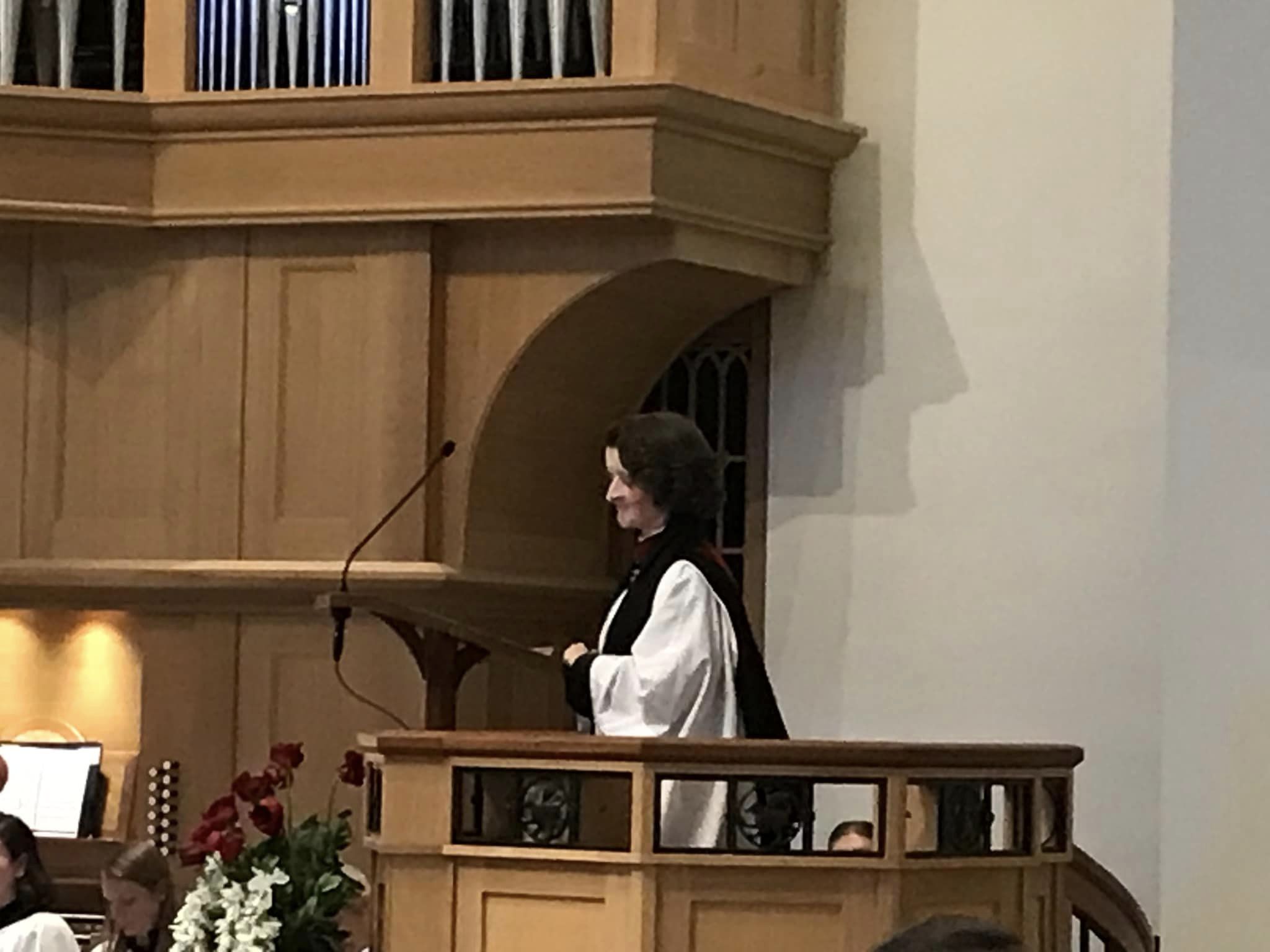
This sermon was delivered to Virginia Theological Seminary on the occasion of our annual Convocation for alumni, faculty and staff, and seminarians.

Photo credit: The Rev. Matthew Tucker

I live in a pretty “purple” district in Southern Virginia.  My Congressman represents a different party than my own, but I make a point to stay on his mailing list as a way to remind him that he represents a politically diverse district.  Every month he sends out polls, and I dutifully respond to them.  But with every survey I find myself frustrated.  My Congressman either has never taken a class in crafting an unbiased survey or he is simply not interested in different opinions.  The questions are always phrased something like, “In your opinion, how bad of a job is our president doing:  terrible, really bad, pretty bad, or I’m not sure.”  Or without any nuance or explanation about the background of the issue, the poll will ask something like, “The Congress wants to pay illegal immigrants who knowingly broke the law hundreds of thousands of dollars.  Should we pay these illegal immigrant criminals, yes or no?”  Or, one of my favorites, “Which of these issues should be the priority of Congress?” (PS, none of the options listed talk about caring for the poor or our neighbor, and there definitely isn’t an “other” category).  But I dutifully take the surveys, hoping my voice is part of my representative’s decision making.

I have been pondering the ministry of Jeremiah and thinking his prophetic ministry is a bit like trying to engage my Congressman.  For those of us not taking Old Testament this semester, Jeremiah is prophesying in a time of political decline.  The northern kingdom, Israel fell to Assyria nearly a hundred years before, and Judah remains in a tenuous situation.  The Assyrians are still in control, but in the course of the book of Jeremiah, Babylon defeats Assyria and takes control of Judah.  There are rebellions against Babylon, in particular by King Jehoiakim who we hear about today, but they are eventually unsuccessful.[i]  Like any good prophet, Jeremiah is attempting to get the people and king to repent and return to the Lord.  And like all people of all time, the people refuse to listen to God.  King Jehoiakim is particularly egregious in this refusal.  In fact, just verses before our reading, the King has his attendant read Jeremiah’s prophetic scroll three or four columns at a time, then cuts those columns off the scroll and throws them in a fire.  King Jehoiakim is not alarmed by the prophecy, and certainly not repentant. 

But here’s the funny part.  In the verses we read today, the Lord tells Jeremiah to rewrite the entire scroll and add in a little final judgment.  Like me, sitting down with yet another poll from my Congressman, he sits down and does the same thing over again.  I have been of two minds about this passage.  On the one hand, and no offense toward the Lord’s prophetic practices and policies, but how many times are we to keep doing the same thing and expecting different results.  As if King Jehoiakim is going to receive the second scroll and say, “Oh, a second scroll?  Okay, I guess I won’t burn this one and will change my ways!”  If this pandemic has taught us anything this pandemic has taught us we cannot keep doing Church the way we always have and expect the Church to thrive (or in biblical terms, to repent and return to the Lord).  This pandemic has made us nimble, agile, creative, and versatile.  This pandemic made us stop thinking about hybrid ministries and digital relevance and demanded we start doing and being those things.  And God help us if our churches just want to “return to normal” after the pandemic – if we just want to write another scroll. 

But as I mentioned, I am of two minds on this passage.  On the other hand, despite what seems like poor strategy on the Lord’s part, God’s covenantal relationship with us has never really made sense.  The entire salvation narrative is about failure after failure on our part as the people of God to listen and respond to the Lord.  Promise after promise, covenant after covenant, even the sending of God’s Son has meant the Lord’s corporate strategy is a case study in what not to do to thrive in business.  But that’s what we love about the Lord, right?  God keeps writing another scroll, God keeps giving another chance, God keeps holding out hope and promise because God’s love is not meted out in a logical, economical way.  Despite all of the innovation which has been entirely life giving during this pandemic, in some ways, what we have offered to a hurting world is the same as what we have always offered:  a community of faith, redeemed by God’s grace, commissioned to love God, self, and neighbor.  Perhaps that is why I am of two minds about this text.  Although this pandemic has not changed who we are and what we offer a broken world, this pandemic has changed how we are.  Our core values as the Episcopal Church have not changed.  But throughout this pandemic we have learned that how we go about living into those core values certainly can, should, and hopefully has changed.  And, as the Genesis writer would say, “…it was very good.”

In this particular season of the Church, many of us are feeling a longing for rest, for relief from constant pivoting, for a sense of normalcy.  Many of us would like to sit down and just write the same scroll over again.  In Jeremiah’s day that second scroll meant suffering and exile, and there would be more than twenty years before the people of God would see God’s promise of restoration realized.[ii]  But I do not think that is the invitation from scripture today.  I do not think the Lord is inviting the Church to write another scroll or fill out another poll.  We have a whole Bible full of examples of how doing the same thing over and over does not lead to the fulfillment of the kingdom of God.  Instead, the invitation from scripture today is to see the patterns of the resistance to love, and find a new way to love.  God is not inviting us to change our “who” or our “what,” but to change our “how.”  Your “how” might be different from mine.  But Jeremiah shows us time and again that the same repeated “how” does not turn hearts.  Our work in this season is to listen to what new “hows” the Holy Spirit is showing us, and then be willing to be vulnerable enough to try them.  Because, Lord knows, we do not need another scroll.  Amen. 


[i] Josey Bridges Synder, “Jeremiah,” The CEB Women’s Bible, (Nashville:  Common English Bible, 2016), 953.

[ii] 953.

Sermon – Luke 17.11-19, P23, YC, October 9, 2022

19 Wednesday Oct 2022

Posted by jandrewsweckerly in Sermons

≈ Leave a comment

Tags

blessing, bountiful, faith, goodness, grateful, gratitude, healing, health, Jesus, praise, Sermon, stewardship, talent, thanks, time, treasure, wholeness

Every once in a while, when we are having a particularly whiny, complaining, cranky evening at the Andrews-Weckerly household, I will break out the old, “So, what are you grateful for today?” question.  I cannot claim that our family has mastered some Zen-like practice of gratitude.  In fact, we still have to regularly remind each other simply to say, “Thank you!”  And if I am being honest, my question about what we are grateful for is a question based out frustration not out of a sense of habituated thankfulness.

I think that is why today’s Gospel lesson from Luke makes me so uncomfortable today.  Jesus graciously heals ten lepers at once with barely a word or flourish.  One of them, a Samaritan to be clear, returns, praising God in a loud voice, prostrating himself at Jesus’ feet, and thanking Jesus.  But Jesus’ response is where my guilt resides. “Were not ten made clean?  But the other nine, where are they?  Was none of them found to return and give praise to God except this foreigner?” Jesus asks.  How many times have I been one of the nine?  How many times have I experienced blessing, only to focus on another ill in my life?  How many times have I been surrounded by bountiful abundance only to be able to talk about scarcity?

For Jesus, this is unfathomable.  For Jesus, faith and gratitude go hand in hand.  Scholar Kimberly Long describes the issue thus, “…to ‘have faith’ is to live it, and to live [faith] is to give thanks.  It is living a life of gratitude that constitutes living a life of faith…One might almost say, in fact, that ‘faith’ and ‘gratitude’ are two words for the same thing:  to practice gratitude is to practice faith.”[i]  Some of you may be thinking, “Oh, to be faithful I just have to be thankful?  That’s not so hard!”  But how many of us have started a gratitude journal only to get out of the habit?  How many of us have engaged in the Ignatian practice of closing the day with enumerating the blessings of the day, giving thanks to God, only to slip into watching one more episode of your favorite show or reading one more chapter of a book, only to slip off to sleep before remembering to give thanks?  How many of us have had New Year’s resolutions or Lenten disciplines about gratitude only to drop them after a few weeks?

But here is why gratitude and faith are so intimately connected.  Jesus says at the end of this passage today, “…your faith has made you well.”  Now if we understand faith and gratitude as being synonymous, then Jesus does not mean because the Samaritan believes something he is healed.  He means because the Samaritan has embodied gratitude he has been made well.  But Jesus is not simply referring to being healed of leprosy.  The Samaritan’s life of gratitude has made him whole – has made him “truly and deeply well.”[ii]  C.S. Lewis perhaps captured the relationship of gratitude and wholeness most clearly.  He said, “I noticed how the humblest and at the same time most balanced minds praised most:  while the cranks, misfits, and malcontents praised least.  Praise almost seems to be inner health made audible.”[iii] 

Of course, this should not be news to us.  Luke’s gospel is always featuring praising.  As one professor explains, “Praising/thanking/blessing/glorifying God is a recurring theme in [Luke’s] writings – from the shepherds in the fields (2.20), to Simeon and Anna at the presentation in the temple (2.28, 38), to witnesses of Jesus’ miracles (5.25, 7.16, 18.43, etc.), to the centurion at the foot of the cross (23.47), and to both Jews and Gentiles who witness the growth of the church in Acts (4.21, 11.18, 13.48, etc.).  It seems, therefore, that Luke recounts this story not to distinguish one leper from the others but to emphasize the proper response to any act of grace:  thanks and praise to God.”[iv]

Luckily for you, Hickory Neck actually grounds you in praise every Sunday.  When we celebrate the Eucharistic feast, the celebrant says, “Let us give thanks to the Lord our God,” and you respond, “It is right to give him thanks and praise.” [or in the case of Rite I, we say, It is meet and right so to do.]  And then the celebrant affirms your words, saying, “It is right, and a good and joyful thing, always and everywhere to give thanks to you, Father Almighty, Creator of heaven and earth.”[v]  [“It is very meet, right, and our bounden duty, that we should at all times, and in all places, give thanks unto thee, O Lord, holy Father, almighty, everlasting God.]   In fact, the entire Eucharist Prayer is also referred to as the “Great Thanksgiving.” Our whole purpose of gathering on Sundays is to enter into praise of God – and as Luke tells us, we do that to make our beings whole – to make our beings truly and deeply well. 

And because we know doing something out of habit can make us forget why we are doing what we are doing, this month we enter into what we call stewardship season – or perhaps what should be called gratitude season.  This month we will be talking about the bountiful goodness we all experience in this community – the ways in which Hickory Neck is a blessing to us, the ways in which Hickory Neck feeds and shapes our faith lives, and the ways in which Hickory Neck helps us be a blessing to others.  In this month of praise and thanksgiving, we will be talking about how to make our praise tangible:  how the gift of our time, the offering of our talents, and the presentation of our financial giving might be acts of praise and gratitude.  This community has been a place where most of us have experienced transformative healing and wholeness.  Our invitation is to follow the example of the Samaritan and let our acts of gratitude become reflections of how Hickory Neck is helping us be truly and deeply well.  Amen.    


[i] Kimberly Bracken Long, “Pastoral Perspective,” Feasting on the Word, Yr. C, Vol. 4 (Louisville:  Westminster John Knox Press, 2010), 166.

[ii] Long, 166.

[iii] As quoted by John M. Buchanan, “Homiletical Perspective,” Feasting on the Word, Yr. C, Vol. 4 (Louisville:  Westminster John Knox Press, 2010), 165.

[iv] Oliver Larry Yarbrough, “Exegetical Perspective,” Feasting on the Word, Yr. C, Vol. 4 (Louisville:  Westminster John Knox Press, 2010), 169.

[v] BCP, 361.

On the Ministry of Coffee…

05 Wednesday Oct 2022

Posted by jandrewsweckerly in reflection

≈ Leave a comment

Tags

coffee, Jesus, love, ministry, parenting, relationship, witness

Photo credit: https://www.pexels.com/search/coffee%20cup/

In the Book of Common Prayer, the Catechism answers the question, “What is ministry?”  It defines ministry by orders:  lay, deacon, priest, and bishop.  For the laity, the Catechism says, “The ministry of lay persons is to represent Christ and his Church; to bear witness to him wherever they may be; and, according to the gifts given them, to carry on Christ’s work of reconciliation in the world; and to take their place in the life, worship, and governance of the Church.” (BCP, 855)  Sometimes, we get caught up and think ministry is only when we are serving the poor or leading worship.  But, in fact, the Catechism reminds us that our ministry is to represent Christ and the Church, bearing witness to Jesus wherever we may be.

Several years ago, we welcomed a childcare center onto our property.  The relationship was a beautiful one of getting to know one another, of building relationships with strangers, and bearing witness to Christ’s love.  When the center moved to a neighboring town to accommodate more students, our Church knew we wanted to keep the relationship going.  And so, we have sent cards, supported teachers, and once a month, we bring coffee and snacks for what we call “Joe to Go.” 

For some, this may seem like an odd form of ministry.  If we are going to use our resources and time, shouldn’t we be helping those hurting the most?  Unfortunately, that question creates a false dichotomy.  We should be helping those who are hurting most.  And, as our Catechism says, we also should be bearing witness to Christ wherever we find ourselves.  For this ministry, that means seeing the everyday burdens of families – the nights without sleep, the struggles to work to support the cost of childcare, the strain of raising up children to be well-adjusted, loving members of society.  If we learned anything in the pandemic, it was that the struggles of parenting in today’s economy are real, and hard, and regularly unnoticed.

And so, we bear witness to Jesus’ love with every snack and cup of coffee.  We represent Jesus when we offer an encouraging word to a weary parent.  We are being the Church when we show lovingkindness wherever we may be.  This is what ministry is.  How are you bearing witness to Christ’s love today?  How have you experienced Christ’s love today through someone else’s ministry?  I can’t wait to hear your stories of coffees, shared stories, and encouraging words. 

Sermon – Matthew 11.25-30, St. Francis Feast, YC, October 2, 2022

05 Wednesday Oct 2022

Posted by jandrewsweckerly in Sermons

≈ Leave a comment

Tags

animals, blessing, Jesus Christ, light, peace, reconciliation, relationship, rest, sabbath, Sermon, St. Francis, truth, wolf, work, yoke

Today we honor the life of St. Francis of Assisi.  Francis is one of the most popular and admired saints of all time.  Most of us know the highlights of his story:  born the son of a wealthy man in 1182; had a conversion experience and devoted his life to Lady Poverty; shaped monastic and lay devotion; was a friend to all God’s creatures – being known to have preached to the birds.

But the story I like most is the story about St. Francis and the Wolf.  According to legend, there was a wolf that was terrorizing the town of Gubbio, killing and eating animals and people.  The villagers tried to fight back, but they too died at the jaws of the wolf.  Francis had pity on the townspeople and went out to meet the wolf.  When Francis found the wolf, he made the sign of the cross, and said, “Come to me, Brother Wolf.  In the name of Christ, I order you not to hurt anyone.”  In response, the wolf calmly laid down at Francis’ feet.  Francis then went on to explain to the wolf how he was terrorizing the people and other animals – all who were made in the image of God.  The wolf and Francis then made a pact that the wolf would no longer harm the townspeople and the townspeople would no longer try to hurt the wolf.  The two traveled into town to explain the pact they had formed.  The people were amazed as Francis and the wolf walked side-by-side into town.  Francis made the people pledge to feed the wolf and the wolf pledge not to harm anyone else.  From that day on, the wolf went door to door for food.  The wolf hurt no one and no one hurt the wolf; even the dogs did not bark at the wolf.[i]

What I love about this story of St. Francis is that the story is about reconciliation and relationship.  At the beginning of the story the town and the wolf are at an impasse – the wolf is hungry and getting attacked; the people are afraid and are lashing out.  What Francis does for both parties is shock them out of the comfortable.  For the wolf, no one has addressed the wolf kindly – they have either shut the wolf out or actively tried to kill him.  For the people, the wolf has not asked for help – he has simply and violently taken what he needed and wanted.  Francis manages to shock the wolf first – not through violence or force, but with the power of love and blessing.  By giving a blessing in the name of God, Francis is then able to implore the wolf to reciprocate with love.  Francis also manages to shock the village – not with a violent victory, but with a humble display of forgiveness and trust.  By walking into town with a tamed wolf at his side, Francis is able to encourage the town embrace, forgive, and care for the wolf.  Francis’ actions remind both parties that unless their relationships are reconciled, unrest and division will be the norm. 

The funny thing about this story is that the story is pretty ridiculous.  I mean, how many of us go around talking to wild animals, blessing them with the sign of the cross, expecting anything other than being attacked?  We will never really know whether the story is true.  But like any good Biblical story, whether the story is true is hardly the point: the point is that the stories point toward “Truth” with a capital “T.”  What this story teaches is peace and reconciliation only happen through meeting others where they are.  We cannot expect great change unless we are willing to get down in the trenches – to go out and meet that destructive wolf face-to-face.  The other thing this story teaches is relationships are at the heart of peace work.  Only when the wolf and the town begin to get to know each other and begin to form a relationship with one another can they move forward. 

This is the way life is under Jesus Christ.  In our gospel lesson today, Jesus says, “Come to me, all you that are weary and are carrying heavy burdens, and I will give you rest.  Take my yoke upon you, and learn from me; for I am gentle and humble in heart, and you will find rest for your souls.  For my yoke is easy, and my burden is light.”  Jesus’ words have layered meaning.  The first meaning we all catch is that Jesus offers us rest and refreshment.  Jesus encourages us to come to him, to cast our burdens and cares upon him, and to take rest, to take Sabbath in Christ.  Our souls will find peace in Christ Jesus.  The second meaning is that peace in Christ Jesus is not without work.  Jesus does not say come unto me and relax forever in happy retirement.  Jesus says we will still have to take on a yoke – the burden of disciple living.  Luckily, that burden of being Christ’s disciple will not be burdensome – it will be light.  Finally, not only will Jesus make the workload “light,” as in not heavy.  Jesus will also make us “light” – as in lights that shine into the darkness and refuse to allow the shadow to overwhelm.   We become the light when we work for reconciliation in our relationships with others. 

That is why we do a couple of special things today.  First, we ask for blessing on our animals – that God might help our relationship with our pet be one of blessing and light.  Second, we come to Jesus for Sabbath rest – that God might renew us on this Sabbath day, use the rest to fill us with light, and renew our commitment to be agents of reconciliation, gladly putting on Christ’s yoke.  Amen.


[i] Jack Wintz, “St. Francis and the Taming of the Wolf,” as found at https://www.franciscanmedia.org/franciscan-spirit-blog/st-francis-and-the-taming-of-the-wolf on September 30, 2022. 

Sermon – Luke 16.1-13, P20, YC, September 18, 2022

05 Wednesday Oct 2022

Posted by jandrewsweckerly in Sermons

≈ Leave a comment

Tags

corrupting, dishonest wealth, God, Jesus, loving, manager, money, relationships, Sermon, student debt, wealth

About a month ago, President Biden announced a plan to offer student loan relief for low- to middle-income earning borrowers.  The reaction has been all over the place.  Those owing thousands of dollars have expressed tremendous gratitude and relief, often chained to an albatross of debt with no hope of financial stability.  Critics have argued that taxpayers should not bear the financial burden of funding what is essentially seen as privilege and access to financial advancement that is only accessible to a few.  Supporters have pointed to the fact that the cost of college has tripled since the 1980s, even accounting for inflation, while things like Pell grants, which once covered 80% of college costs now only cover 33%.[i]  Meanwhile, I have heard critics say, “I had to pay all my student loans back myself.  So should they!”

What has struck me in this debate, and quite frankly any debate about money these days, is we tend to take a very individualist view of the issue.  We debate and argue about what is fair to me personally, why one individual should be privileged over another, or why he or she gets more or less than me.  But what we rarely question is the financial system within which we operate, the very structure surrounding and shaping our relationships that gives no regard for you, or me, or her, or him, or them. 

That is what our tantalizing gospel lesson is all about.  A wealthy man’s manager is accused of mismanaging funds and is facing termination.  In the face of the threat, the manager sneakily collaborates with the rich man’s debtors to reduce their debts – anywhere from 25-50% of what they owed.[ii]  And when the boss finds out, we all hold our breath, waiting for the wealthy man’s wrath.  But the story goes sideways.  The owner compliments the manager for his shrewdness – instead of anger, he has the owner’s admiration.  And then, as if to keep us disoriented, Jesus says the enigmatic:  make friends for yourselves by means of dishonest wealth. 

When we tell stories in Godly Play, like our kids are hearing today in the Narthex, the last thing we imagine is a lesson where the teacher says, “Okay, kids, today I want to teach about how to be manipulative and sneaky in case you get into trouble.”  So, what is going on in this parable?  Our first problem seems to be in the title of the parable, “The parable of the dishonest steward.”[iii]  Perhaps if this parable was called, “The parable of the corrupting power of money,” we might be in a better place to understand what Jesus is trying to teach us.  You see, Jesus is living in “…Roman-occupied Galilee in the first century.  Rich landlords and rulers [are] loan-sharks, using exorbitant interest rates to amass more land and to disinherit peasants of their family land, in direct violation of biblical covenantal law.  The rich man…along with his steward or debt collector, [are] both exploiting desperate peasants.”[iv]  To Jesus, this is not a story about an individual behaving badly, but about a system that is failing to act justly, love mercy, and walk humbly with God.[v] 

So, what is this “make friends with dishonest wealth” stuff?  What Jesus is saying is wealth has the power to corrupt and shape an unjust system for all.  Our primary responsibility as followers of Christ is to love our neighbors.  We are not likely to be able to dismantle entire economic systems.  But we can tend to relationships with others, not seeing that I get fairness personally, or even that I get testy about what one person has over what I have, but seeing that we are responsible for one another.  In our relationships with one another – the wealthy, the poor, and everyone in between – and for that matter, those who go to college, those who do not, and everyone in between – our relationships with one another and our ability to see one another’s humanity and beloved status before God is our work. 

Now, loving each other (even those people we do not particularly like) does not mean that we suddenly get to wipe our hands free of money.  In fact, one scholar argues this, “We not only are entrusted with the vision of the kingdom of heaven; we are given the treasures of the King!  Even in the present age, with the imperfect treasures of this world, we are stewards of God.”[vi]  We cannot escape the power of money.  But we can prioritize our care for one another, carefully and shrewdly showing the world how we can use the sometimes-corrupting power of money for good.  Our invitation this week is to hold on to the disorientation of this parable, examining how our relationships with others are being pushed and pulled by the power of money – and how we might more shrewdly use that power of money for good – for you, for me, and for everyone in between.  Amen.


[i] “FACT SHEET: President Biden Announces Student Loan Relief for Borrowers Who Need It Most,” The White House, August 24, 2022, as found at https://www.whitehouse.gov/briefing-room/statements-releases/2022/08/24/fact-sheet-president-biden-announces-student-loan-relief-for-borrowers-who-need-it-most/ on September 17, 2022.

[ii]  Barbara Rossing, “Commentary on Luke 16:1-13,” Working Preacher, September 18, 2016, as found at https://www.workingpreacher.org/commentaries/revised-common-lectionary/ordinary-25-3/commentary-on-luke-161-13-2 on September 17, 2022.

[iii] The idea of renaming this parable comes from Matt Skinner on the podcast, “#862: 15th Sunday after Pentecost (Ord. 25C) – September 18, 2022,” September 5, 2022 as found at https://www.workingpreacher.org/podcasts/862-15th-sunday-after-pentecost-ord-25c-september-18-2022 on September 17, 2022.

[iv] Rossing.

[v] Micah 6.8

[vi] Helen Montgomery Debevoise, “Pastoral Perspective,” Feasting on the Word, Yr. C, Vol. 4 (Louisville:  Westminster John Knox Press, 2010), 96.

Sermon – Luke 15.1-10, P19, YC, September 11, 2022

05 Wednesday Oct 2022

Posted by jandrewsweckerly in Sermons

≈ Leave a comment

Tags

Sermon

Today is an interesting day for Hickory Neck.  Unofficially, this is our Kickoff Sunday.  Sunday School starts up today, the Nursery reopens for the first time since the pandemic began, we are blessing bags for those who want a good start to the school year (or maybe a good post-summer start for work), our Choral Scholars are back from summer break, and our festive Community Picnic is this afternoon.  And some of us are making our way back to church after summer adventures – or even after a long hiatus caused by the pandemic.  All of this is an occasion for great joy.  But amid all this scheduled and experienced celebration is a shadow.  We cannot look at today’s date without thinking of what September 11 will always mean to our country.  We have been mourning this week the loss of the long reign of a faithful, graceful, exemplary, though like us all, flawed, Queen.  And we are ever in the shadow of political divisions, racism, and violence. 

But scripture tells us today that joy is always a bit countercultural.  We are told right at the beginning of today’s Gospel, as Jesus is at table fellowship with both insiders and outsiders, tax collectors and Pharisees, sinners and scribes – certainly an occasion for inclusive joy – there is grumbling.  Despite Jesus’ invitation into joy, there is tension about who is in and who is out, and what proper faithful living should be like.  As I have read and reread this text, I have wondered where we find ourselves:  from whose perspective are we to read this text?  Are we tax collectors and sinners who have been welcomed to the table?  Are we faithful followers who are grumbling and stingy with God’s grace?  Are we sheep owners and coin holders who have lost things entrusted to us?  Are we sheep or coins who are left alone so that another one can be saved?  Are we lost in our faith journey?

As many of you may know, Hickory Neck finds itself in an interesting time and place too.  Unlike some churches, we found the pandemic to be an incredible time of growth.  I remember seeing and meeting many new faces during the last two and a half years.  Initially I was concerned about our newcomers because they were meeting Hickory Neck at this strange in-between time.  I could not introduce them to someone who had been here for many years because many of those members were staying home out of fear for their health and safety.   They could not see the fullness of our programming, our ministries, or even our welcoming coffee hours.  And yet, slowly but surely, despite the absence of those things, our newcomers ceased to be newcomers and became beloved members of our church.  Meanwhile, after about a year or two, many of our long-timers began to return to in-person gatherings and suddenly realized the room was full of people they did not know.  We were two communities of people, both fully the body of Hickory Neck, and yet, we were not yet one body. 

What has slowly been revealed is how astounding this new reality is.  Despite a long physical absence, and despite not being able to see the “stuff” of our community, somehow, the core values of Hickory Neck remained and allowed all of us to blossom into this new thing.  Hickory Neck has always been a place of our four core values:  of Hospitality, of Nurture, of Evangelism, and of Creativity.  That core identity has attracted a new community of the faithful, has sustained a continuing community of the faithful, and continues to reach our online community of the faithful, showing us that no matter what the world is throwing at us, Hickory Neck’s life, ministry, and witness is so compelling that we are thriving and responding to the movement of the Holy Spirit.  And if that is not cause for joy, I don’t know what is!

Now I know these two parables talk about repentance of sinners.  And we can talk about our need for repentance another time.  Even scholars confess that sheep and coins are incapable of repentance.[i]  But what Professor Charles Cousar reminds us is these parables are not meant “to call sinners to repentance, but to invite the righteous to join the celebration.”[ii]  I know there is a lot weighing us down in the world, things we mourn happening to us and things for which we have cause for repentance.  But today, I invite you into joy.  Joy for all the goodness that is in your life right now – however big or small.  Joy for all the surprising blessings we have experienced in the last two and half years.  Joy in the life and vitality of this Church that we call home.  The words from Jesus are clear today, “Rejoice with me!” – today, tomorrow, and for all the days to come!  Amen.


[i] Amy-Jill Levine, Short Stories by Jesus:  The Enigmatic Parables of a Controversial Rabbi (New York:  Harper Collins, 2014), 36.

[ii] Charles B. Cousar, “Exegetical Perspective,” Feasting on the Word, Yr. C, Vol. 4 (Louisville:  Westminster John Knox Press, 2010), 73.

Sermon – Isaiah 58.9b-14, P16, YC, August 21, 2022

05 Wednesday Oct 2022

Posted by jandrewsweckerly in Sermons

≈ Leave a comment

Tags

baptism, church, community, darkness, Episcopal Church, faith, Jesus, journey, light, messy, salvation, Sermon, water

Last night, we baptized Becky Breshears in the waters of the Chickahominy River.  When most of us think of baptism, we imagine the baptism of an infant or child, someone for whom godparents make promises to raise in the life of the faith, much like we did with baby Olivia a few weeks ago.  The sacrament of baptism for a child is certainly considered being fully initiated into the family of Christ, but we make pronouncements and promises on behalf of the baptized.  And as the baptized grows up, we continue to shepherd and guide her, answer her questions, and help her claim her faith as her own.  There is an endearing, almost romantic, notion to baptism, full of idealism and hope. 

At least, that seems to be true in Episcopal Churches, where we quite primly and gently pour water from beautiful fonts over the heads of babies – the messiest part being if the water accidently runs into the baby’s eyes.  Of course, adult baptism is totally normal in our tradition too, we just do not do adult baptism as frequently.  When we do adult baptism, we become much more like other denominations, who have always understood baptism to be a mature proclamation of one’s own faith.  In some ways an adult baptism is more exciting because an adult baptism is not about something we hope and pray will develop into a faithful life, but adult baptism is the fully developed proclamation now – a set of pronouncements and promises on one’s own behalf.  An adult baptism is bold, dramatic, and, especially in instances like last night, much messier!

But adult baptism, especially in the Episcopal Church, are not about proclaiming one has her faith life all figured out – that she has some sense of earned clarity and certainty that has led her to baptism, as if baptism is the end of a journey of discernment.  Quite the opposite; baptism is a beginning for Episcopalians.  The baptized does not proclaim she knows all there is to know about faith and salvation.  Instead, the baptized claims that she is starting a new journey with Jesus, with a community of faith who walks with her.  And part of the act of baptism is giving the newly baptized tools to walk that journey.

That’s why I love the lesson from Isaiah today.  Instead of scripture capturing a moment (like a baptism), scripture today tells us what the baptized journey will be like.  Isaiah describes five things that are critical to the life of baptism.  First, the faithful will “remove the yoke from among you” – or in modern language, be an agent of economic liberation for the oppressed, not taking advantage of others.  Second, the faithful will refrain from “pointing the finger,” or take responsibility for one’s own actions, not accusing others but acting to change the self.  Third, the faithful will “refrain from speaking evil,” because “speech, when it is careless or deceitful, can be destructive and injurious.”[i]  Our words have power and are to be used for good.  Fourth, the faithful are to “offer food to the hungry.”  The life of the faithful is a life of self-sacrifice and sharing what we have learned to call our own.  And finally, we are to “satisfy the needs of the afflicted” – not just helping others or solving their problems but letting the disadvantaged “define their own needs and letting them set the criteria for deciding whether our help is effective.”[ii]

What the prophet Isaiah tells us is that as the faithful, we structure our lives differently than the secular, self-interested world might have us live.  That includes honoring even the sabbath – this holy day, not as just a day to go to church (though I hope you all will regularly – either in person or online), but also to be a day of honoring God through letting go of the self and focusing on the Lord and on the cares of those in need.   That’s why in our gospel lesson Jesus’ actions of healing others on the sabbath is so controversial – because Jesus reminds us the sabbath is a day of selflessness, healing, and giving glory to God.

Last night, Becky committed herself to that life, and we, as fellow baptized recommit ourselves this very day, to a life lived differently – a life lived in the light of Christ.  The prophet Isaiah tells us that when we live faithful lives, our light shall rise in the darkness, the Lord will guide us continually, will satisfy our needs in parched places, make our bones strong, and we shall be like a watered garden – a spring – whose waters never fail.  We shall be repairers of the breach, restorers of the streets to live in. 

Earlier I used the language of self-sacrifice.  What the Holy Spirit does in baptism and what the Church tries to continue to do on every sabbath is relocate the self from the center of our universe and place us firmly within a community of faith who cares for one another while placing God in the center of our universe.  When we take that step in baptism or renew the step our parents took for us, and in gathering in weekly worship (whether gathering in person or gathering virtually), we commit not to having this faith thing figured out – but just that we want to live a life where our parched places are always quenched through the living waters of baptism, and where our lives become bigger than they have ever been – where our lives shine the light of Christ in the darkness.  Amen.


[i] Jon L. Berquist, “Exegetical Perspective,” Feasting on the Word, Yr. C, Vol. 3, Supplement for P16 (Louisville: Westminster John Knox Press, 2010), 4.

[ii] Berquist, 4.

Sermon – Lk 11.1-13, P12, YC, July 24, 2010

05 Wednesday Oct 2022

Posted by jandrewsweckerly in Sermons

≈ Leave a comment

Tags

abundance, accountability, disciples, God, how, Jesus, Lord's Prayer, mutual, pray, Sermon, vulnerable

The single most common topic I have been asked about in the course of my ministry, year in and year out, through crisis, through joys, through transitions, and change, young and old have approached me asking for one thing:  teach me how to pray.  The request is simple, yet complicated all at the same time.  You see, when someone asks me how they can pray a reel begins in my mind, flashing all the experiences of prayer I have seen in my lifetime:  the healing prayers that splayed someone to the ground in the Pentecostal church of my early childhood; the United Methodist prayers spoken extemporaneously from the heart; the hippy campus minister who always started prayer with silence so long you wondered if he had fallen asleep; the prayers written to accompany the prayer beads my fingers strung together; the stiff Episcopal collects that seem at the same time formulaic and beautiful; saying the Lord’s Prayer in Spanish, trying to keep up with the native speakers; silent prayers in the middle of the night as I seethed in my anger at God, with no words left; praying into a telephone that doubled as a speaker in the retirement home’s dining room; resorting to digital Pop-Up Prayers when a pandemic forced us into isolation.  When asked, “teach me to pray,” where can I possibly begin?!?

When the disciples ask Jesus to teach them how to pray, Jesus’ mind seems to be all over the place too.  Jesus begins his lesson with the actual text of the Lord’s Prayer.  Jesus says, “When you pray, say this…”  But Jesus does not stop his lesson there.  Jesus goes on to teach the disciples through three small vignettes. 

In the first vignette, the disciples hear about the man who refuses his friend bread in the middle of the night because he has already gone to bed.  The disciples learn through this funny battle of wills that their posture in prayer is to be persistently inquiring.  In fact, the word used in our translation today for “persistent” is also translated by some scholars as “shamelessness.” [i]  In the second vignette, the disciples are told in the instruction to ask, seek, and knock that God responds to their inquiries.  They learn here that their posture in prayer is a posture of action.  Prayer is to express their need to God, to search out God when they feel abandoned, and to cry out to God with a loud knock.  The final vignette compares the care of a parent with the care of God for the disciples.  The disciples learn that God’s love for them is greater than the instinctual, caring love of a parent for a child.  The disciples experience that abundance when they enter into a prayerful relationship with God. 

A vulnerable, active, abundant relationship with God sounds wonderful and easy enough.  The problem is the relationship Jesus describes is not easy.  We find it difficult to be continuously vulnerable, active, and overwhelmed by God in prayer.  In fact, we find simply remaining in prayer with God difficult.  When I was in seminary, I had a group of lay persons from my field education parish who met with me once a month to help me reflect on my ministry at the church.  One of my committee members, Joe, was notorious for keeping me on the spot in these meetings.  “So, Jennifer, how is your prayer life?” Joe would always ask me.  The first time he asked me that question, I stammered through some sort of reply about corporate and individual prayer.  But Joe wanted to know the specifics of what my prayer life entailed.  Joe’s monthly prodding was the first real experience I had with accountability in my prayer life.  Finally, after about a year of asking me about my prayer life, I asked Joe about his prayer life.  Joe explained that the reason he always asked me about my prayer life was because he struggled with his own prayer life.  His pushing me was a way of also pushing himself.  He knew that if I struggled to keep an engaged prayer life, he could gain some camaraderie in his own struggle; and if I was feeling particularly connected to God in prayer, he would be challenged to engage God with more intentionality.

The mutual support that Joe was unknowingly creating is the promise of our Gospel lesson today.  First Jesus gives the disciples words:  the Lord’s Prayer.  Once they own those words, they have an assuring entry into dialogue with God.  And once the disciples have that entry, they are assured of God’s presence in the prayer relationship.  God is the faithful friend, who gets up in the middle of the night to answer prayer.  God is the responding God who will answer, be present, and open doors through the prayer relationship.  God is the parent that our parents can never fully be because God’s love is more abundant than the disciples, as humans, can ever be.  Jesus does not promise that God will respond to the disciples’ prayers in a particular or specific way.  The disciples are not promised riches or earthly gain through a life in prayer.  But Jesus does promise that God will respond, will stay present with the disciples, and will love the disciples abundantly. 

Despite all the modes of prayer I have witnessed over time, perhaps the best advice is to start where Jesus does with the words of the Lord’s Prayer.  Jesus affirms for us today that if all you can pray is the Lord’s Prayer, then pray the Lord’s Prayer.  The vehicle of the Lord’s Prayer has the power to take us to that point of vulnerability with God.  The vehicle of the Lord’s Prayer has the power to push us to action, seeking God by asking for those basic needs, knowing that God provides beyond those needs.  The vehicle of the Lord’s Prayer has the power to remind us of the abundance we already experience – of daily food, of forgiveness of sins, of salvation.  Jesus’ words for you today are words of encouragement.  Your relationship through prayer with God is going to require you to be vulnerable and to engage, but your relationship through prayer with God will be marked with abundance.  And if you feel overwhelmed by that promise, then start today with these words, “Our Father, hallowed be your name…”  Amen.


[i] James A. Wallace, “Homiletical Perspective,” Feasting on the Word, Yr C, Vol. 3 (Louisville: Westminster John Knox Press, 2010), 291.

Sermon – Luke 10.38-42, P11, YC, July 17, 2022

05 Wednesday Oct 2022

Posted by jandrewsweckerly in Sermons

≈ Leave a comment

Tags

breathe, comfort, defensive, discipleship, feelings, fragmentation, gracious, Jesus, Martha, Mary, ministry, Sermon

Sean is the primary income earner for his family, and his wife cares for their two small children.  Sean came home after a long day at work to find the house in utter chaos.  Out of exhaustion and disappointment, he asked his wife what she had been doing all day.  She curtly responded, “Keeping our children alive.”  Sean, properly chided, went to the kitchen to start making dinner.  Hannah had been sitting in the staff meeting listening to her supervisor being praised for the success of the PR event last week.  She had put in hours on that event, and her supervisor did not mention her creative and physical input at all during the meeting.  Susan complained to a fellow co-worker on the way back to her office, rolling her eyes about how self-centered her supervisor can be.  That afternoon, her supervisor sent her an email that apologized for not mentioning her name at the staff meeting; he had been distracted by a death in the family.  Sam had been working at the Habitat construction site for a couple of months, and rarely saw the homeowner who was supposed to be putting sweat equity hours into her home.  One day, Sam complained to the site supervisor about how the homeowner must be falling behind on her sweat equity hours.  The site supervisor explained that the homeowner had a rare disease the prevented her from doing physical labor, so she had been doing her hours in the Habitat office.  In fact, the supervisor had heard that she had been so productive, that the office staff was struggling to find enough work for her to do. 

Just like Sam, Hannah, and Sean, holy scripture today is going to, as pop singer Lizzo would say, get us into our feelings.  I am not sure if Martha and Mary’s story gets me into my feelings because the story involves women arguing about stereotypical gender roles, or if Jesus’ lack of support and criticism of Martha is so biting, or if I just see too much of myself in Martha, but this story puts all my defenses on high alert.  If Martha and Mary’s story today has you similarly anxious, uncomfortable, or defensive, do me a favor and take a deep breath. 

Starting with the text will help.  On the surface, this is a story about an older sibling, Martha, taking on all the household work while the younger sister, Mary, sits with Jesus, enjoying the luxury of learning from Jesus while Martha does all the work.  But in verse 40, the translation we have says Martha is distracted by her many tasks.  Now according to scholars, the Greek translation actually says something more like, “Martha is ‘distracted by much ministry.’”[i]  This is not a critique of stereotypically gendered work women must do.  Martha is not just distracted by preparing food, cleaning the house, and making beds for disciples.  Martha is doing the sacred, faithful work of hospitality – a crucial act of ministry.  Later, Jesus says Martha is “worried and distracted by many things…”  Here, the Greek word for “worry” is “‘strangle’ or ‘seize by the throat’ and ‘tear.’  The root meaning of the word ‘distraction’ is a dragging apart of something that should be whole.  These are [two] violent words.  Words that wound and fracture.  States of mind that render us incoherent, divided, and un-whole.”[ii]

Now let’s take another breath.  This story is not about who is the better sibling, whether women’s work is inferior to men’s work, or even about judgment of identity for us Marthas in the room.  This is a story about how all of us have ministries – ministries of discipleship that involve learning and action, of studying the Word and showing Christian hospitality to strangers, of speeding up and slowing down.  What Jesus is really concerned about is our intention around our discipleship.  The question is not if we are doing God’s work, but how we are doing God’s work.[iii]  According to Debie Thomas, Martha is in “such a state of fragmentation, a condition in which she cannot enjoy [Jesus’] company, savor his presence, find inspiration in her work, receive anything he wishes to offer her, or show him genuine love.  Instead, all she can do is question his love…fixate on herself…, and triangulate.”  Martha seems to think she can “invite Jesus into her life – and then carry on with that life as usual, maintaining control, privileging her own priorities, and clinging to her long-cherished agendas and schedules.”  And unfortunately, “That’s not how discipleship works.”[iv]

Perhaps after we have taken one last long breath, we can let go of our feelings and start to ask some questions.  How are we approaching our ministry these days?  Are we so wrapped up in our assumptions about other people’s behaviors that we have forgotten to look at our own?  Have we invited Jesus into our lives, but only under our own set of requirements and strictures?  After we have gotten into our feelings, Martha, Mary, and Jesus invite us today to take that breath and refocus[v].  Maybe we need to take some more time at Jesus’ feet, praying, reading scripture, coming to church, or joining something like Faith and Film.  Maybe we need to look at those dinner plates as an invitation to prayer, holding dear the bodies that will be fed by our labor.  Maybe we need step out of our controlled kitchens and go serve up a meal at Meals on Wheels or at From His Hands.  Jesus graciously handles our feelings every day.  But Jesus also knows that when we start looking at how we are doing our ministries, the real, life-giving, whole-making discipleship will come.  Amen.


[i] Amy-Jill Levine and Ben Witherington, III, The Gospel of Luke: New Cambridge Bible Commentary (Cambridge:  Cambridge University Press, 2018), 297.

[ii] Debie Thomas, Into the Mess & Other Jesus Stories:  Reflections on the Life of Christ (Eugene, Oregon:  Cascade Books, 2022), 51.

[iii] Matthew L. Skinner, “Exegetical Perspective,” Feasting on the Word, Yr. C., Vol. 3 (Louisville: Westminster John Knox Press, 2010), 265 and 267.

[iv] Thomas, 51.

[v] James A. Wallace, “Homiletical Perspective,” Feasting on the Word, Yr. C., Vol. 3 (Louisville: Westminster John Knox Press, 2010), 265.

← Older posts

Recent Posts

  • On the Myth and Magic of Advent…
  • On Risking Failure and Facing Fear…
  • Sermon – Luke 23.33-43, P29, YC, November 23, 2025
  • On Inhabiting Gratitude…
  • Sermon – Luke 20.27-38, P27, YC, November 9, 2025

Archives

  • December 2025
  • November 2025
  • October 2025
  • September 2025
  • August 2025
  • July 2025
  • June 2025
  • March 2025
  • February 2025
  • December 2024
  • November 2024
  • October 2024
  • September 2024
  • August 2024
  • July 2024
  • June 2024
  • May 2024
  • March 2024
  • February 2024
  • January 2024
  • December 2023
  • November 2023
  • October 2023
  • September 2023
  • August 2023
  • July 2023
  • June 2023
  • May 2023
  • March 2023
  • February 2023
  • January 2023
  • December 2022
  • November 2022
  • October 2022
  • June 2022
  • May 2022
  • January 2022
  • December 2021
  • November 2021
  • October 2021
  • September 2021
  • August 2021
  • June 2021
  • May 2021
  • April 2021
  • March 2021
  • February 2021
  • January 2021
  • December 2020
  • November 2020
  • October 2020
  • September 2020
  • August 2020
  • July 2020
  • June 2020
  • May 2020
  • April 2020
  • March 2020
  • February 2020
  • January 2020
  • December 2019
  • November 2019
  • October 2019
  • September 2019
  • August 2019
  • July 2019
  • June 2019
  • May 2019
  • April 2019
  • March 2019
  • February 2019
  • January 2019
  • December 2018
  • November 2018
  • October 2018
  • September 2018
  • August 2018
  • July 2018
  • June 2018
  • May 2018
  • April 2018
  • March 2018
  • February 2018
  • January 2018
  • December 2017
  • November 2017
  • October 2017
  • September 2017
  • August 2017
  • July 2017
  • June 2017
  • May 2017
  • April 2017
  • March 2017
  • February 2017
  • January 2017
  • December 2016
  • November 2016
  • October 2016
  • September 2016
  • August 2016
  • July 2016
  • June 2016
  • May 2016
  • April 2016
  • March 2016
  • February 2016
  • January 2016
  • December 2015
  • November 2015
  • October 2015
  • September 2015
  • August 2015
  • July 2015
  • June 2015
  • May 2015
  • April 2015
  • March 2015
  • February 2015
  • January 2015
  • December 2014
  • November 2014
  • October 2014
  • September 2014
  • August 2014
  • July 2014
  • June 2014
  • April 2014
  • March 2014
  • February 2014
  • January 2014
  • December 2013
  • November 2013
  • October 2013
  • September 2013
  • August 2013
  • July 2013
  • June 2013
  • May 2013
  • April 2013
  • March 2013
  • February 2013
  • January 2013
  • December 2012
  • November 2012
  • October 2012
  • September 2012

Categories

  • reflection
  • Sermons
  • Uncategorized

Meta

  • Create account
  • Log in
  • Entries feed
  • Comments feed
  • WordPress.com

Blog at WordPress.com.

  • Subscribe Subscribed
    • Seeking and Serving
    • Join 394 other subscribers
    • Already have a WordPress.com account? Log in now.
    • Seeking and Serving
    • Subscribe Subscribed
    • Sign up
    • Log in
    • Report this content
    • View site in Reader
    • Manage subscriptions
    • Collapse this bar
 

Loading Comments...