• About

Seeking and Serving

~ seek and serve Christ in all persons

Seeking and Serving

Monthly Archives: May 2023

On Companions for the Journey…

31 Wednesday May 2023

Posted by jandrewsweckerly in reflection

≈ Leave a comment

Tags

community, companion, Elizabeth, God, Jesus, journey, joy, Mary, reassurance, relationship, surprise, victory, Visitation, walk

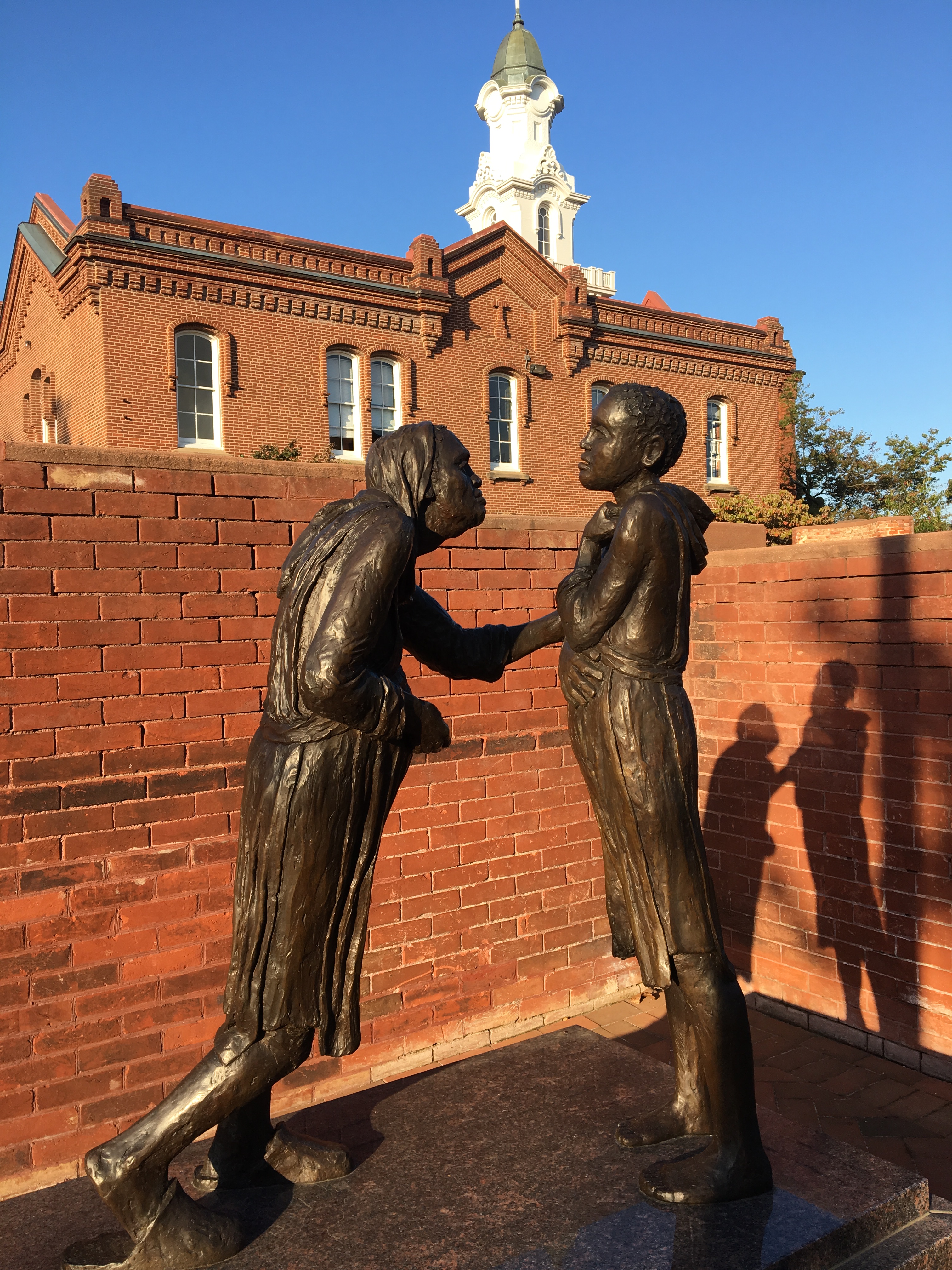
Mary as Prophet by Margaret Parker at Virginia Theological Seminary (photo by Jennifer Andrews-Weckerly; reuse with permission)

Today is the Feast Day of the Visitation – that lovely encounter between Elizabeth and Mary, the mother of Jesus, when they are both unusually pregnant.  You may recall Elizabeth is older, and had likely assumed she would never have children.  Her child would become John the Baptist.  And of course, Mary, officially unwed and a virgin, is now newly pregnant with the son of God.  When the two cousins meet at the Visitation, John leaps in Elizabeth’s womb, and we get the profession of faith that is so familiar to us in the rosary, “Blessed are you among women, and blessed is the fruit of your womb”[i]  Just a few verses later, Mary’s response to Elizabeth is the text we call the Magnificat, or the Song of Mary[ii] – a text sung at Evensongs for centuries. 

As I heard this text retold at the monastery today, I was reminded of how important companions are in our spiritual journey.  I imagine Elizabeth’s pregnancy was full of anxiety – fear that she might lose the precious child in her high-risk pregnancy.  And I imagine Mary’s pregnancy was full of a totally different kind of anxiety – so many social mores to manage, Joseph to worry about, and, well, the whole God-bearing thing.  And yet, only in this meeting of two women do we get two of the richest texts in our tradition.  Sometimes we need earthly companions to help us digest the big stuff that God throws our way.

I wonder who your earthly companions are these days.  I wonder whether you have reached out to them recently with whatever stuff God has been throwing your way.  We are a people made for community and relationship.  We are not meant to walk the journey alone – even though we are perfectly capable of doing so.  But how much more joy, surprise, reassurance, and victory do we experience when we walk together?  May this Feast Day of the Visitation be your invitation to find someone to walk with in this crazy season God has given you.


[i] Luke 1.42

[ii] Luke 1.46-55

On Searching for Slightly Sideways…

30 Tuesday May 2023

Posted by jandrewsweckerly in reflection

≈ Leave a comment

Tags

God, listen, powerful, prayer, retreat, routine, sideways, spirituality

Mepkin Abbey 2023. Photo credit: Jennifer Andrews-Weckerly (reuse only with permission).

You might imagine as a priest that going to a monastery on retreat is like going to church on steroids.  And perhaps in some ways it is:  certainly, going to worship five times in a day for multiple days in a row is pretty churchy.  But spending time at a monastery at the root does something much more subtle and important.  Spending time at a monastery turns everything familiar slightly sideways.

When I’m here, I eat three meals a day just like anywhere else.  But here, I have no control over the menu, the food is straightforward, and you eat what is available.  No buffet of options, no taking orders, no preview of the menu.  You just show up and eat something simple, satisfying, and sufficient.

And let’s not forget that those meals are eaten in silence.  At home, I fight tooth and nail to get my family members to put down their technology (me included!), to talk for 15-20 minutes.  It’s often the only intentional time we get together as a family to find out what’s going on in our lives.  But when I’m at the monastery, despite the fact that I am sitting across from people from all walks of life –  other religious members, seekers, those needing spiritual nourishment – I cannot talk to them, ask them what they thought of the service we just attended, talk about their journey with God, or even see if they have tips about good places to be inspired on campus. 

Of course, there is worship.  As an Episcopalian, the Roman Catholic daily office and Eucharist of the Trappist monks is familiar – but not exactly the same.  I know how to follow along with chanting psalms and antiphons, I know what to expect with the Magnificat, and I know some of the words of the Eucharist.  But I stumble through various books, parts of the liturgies that the other Romans know by heart, and even which direction to face (despite the orientation materials!).  Everything is perfect – and slightly off from familiar.

And that is what this churchy person needs while on retreat.  I need things to be slightly “off” to shake up my spiritual routines.  When I am slightly uncomfortable in worship, I hear rhythms differently, I catch words more powerfully, and I am surprised by God’s presence more readily.  When I am eating unfamiliar food, the simple flavors awaken my senses more than an exotic meal – making me savor the gift of nourishment in ways I never do when I am rushing to the next thing.  When I am sitting in silence, all the words that regularly tumble out of my mouth must be put on a shelf:  instead, my ears become more attuned to both my neighbor and to God.  Prayer seeps into the meal in ways more powerful than daily grace. 

I wonder what ways you and I can create that “slightly sideways” experience at home.  In the hum of everyday life, perhaps there are ways to shake up the familiar.  Perhaps it means refusing to engage in stimulation while driving:  no music, podcasts, or quick phone calls.  Perhaps it means having a certain day of the week for a simple meal.  Or perhaps you have another way of breaking your routine – just briefly enough to turn down the noise of life and let in the noise of God.  I look forward to hearing what you try!

Sermon – Acts 1.6-14, E7, YA, May 21, 2023

30 Tuesday May 2023

Posted by jandrewsweckerly in Sermons

≈ Leave a comment

Tags

absence, anxiety, apostles, Ascension, experience, focus, God, Holy Spirit, intimacy, Jesus, presence, sabbatical, Sermon, staring, temptation

One of my favorite videos on YouTube is an experiment by the group called SoulPancake.  They asked six pairs of individuals, in various stages of relationship (from total strangers to a couple who has been married 55 years) to sit in two chairs facing one another, and without speaking, look into one another’s eyes for four minutes.  At first the couples are a bit uncomfortable – initially unsettled by the forced silence, but ultimately jarred by what they quickly realize is deep intimacy.  Slowly over the four minutes the couples settle in, their faces transforming from discomfort to curious to deep connection.  You can almost see the sparks of love emerging in their eyes, tension draining from their bodies, and invariably smiles of appreciation spreading across their mouths.[i] 

When Willie James Jennings writes about the ascension of Jesus, one his primary concerns is that in focusing on the heavens, where Jesus used to be, the disciples will forget to focus on one another, on the stranger in need of witness, and on the presence of God.  Jennings worries that the disciples are looking “into the heavens concerned by absence rather than looking forward to see presence.”[ii]  The text from the Acts of the Apostles tells us of the last earthly day of Jesus’ post-resurrection life.  Jesus gives the disciples a commission and is lifted up into the clouds and whisked away.  The text tells us the disciples do exactly what you might imagine – they stand there, staring at the heavens.  I imagine that standing and staring had several iterations:  there was likely the stunned awe of the moment; there may have been some not wanting to leave for fear of missing what might happen next; there may be some immediate second guessing about what this all means; there may be some Peter-esque desire to preserve the sacred location of the profound moment; there may be a sense deep grief, or conversely a sense of profound joy.  Whatever those disciples are doing, they are not at all doing they are supposed to do.  Hence the men in white robes asking their very basic question, “Why do you stand looking up toward heaven?”

You and I are about to engage in the profound and infrequent journey of sabbatical.  The temptations in this time are many.  For either of us, we could easily see this as twelve weeks of frozen time – where we will each gaze upon God, and then simply pick up where we left off in August.  For either of us, we could be prepared to happily engage in sabbatical activities, absorbed in our own mountaintop experiences, forgetting the journey of the other.  For either of us, we could be guided by fear, burying our talent like in the parable in Matthew – just hoping not to risk doing sabbatical the “wrong way” instead of investing our talents to see what return we gain. 

But there is danger in looking up in the heavens into absence as opposed to looking forward to presence.  Alan Hirsch tells us, “the biggest blockage to the next experience of God is often the last experience of God, because we get locked into it.”[iii]  [repeat]  What those men in white knew was that if the disciples stood there lost in themselves or even in the ascended Jesus, they would never get their next experience of God – they would get so locked into the mountaintop experience of Jesus’ ascension, that they would never make their way to the next experience of God – in their case the great gift of the Holy Spirit on Pentecost.

That is our invitation today.  As we stand on the precipice of sabbatical, maybe as we are still reveling in the memory of an outstanding parish-wide retreat this weekend, or wondering what sabbatical activities we want to try, or even feeling a bit of anxiety about what is next, a great whispering is happening nearby, “why are you standing looking up toward heaven?”  Our invitation instead is to resist letting our next experience of God be our last experience of God.  Our invitation is to gather in these next weeks in prayer and community, knowing that the Holy Spirit will do a new thing in all of us.  Our invitation is to walk down the mountain and into the valley of witnessing the gospel of Jesus, looking forward not only for the presence of God, but gazing deeply into the eyes of others.[iv]  This time of sabbatical is not a time to marked by absence, but instead is a time looking forward to see presence.  We can only see that presence if we pull our eyes from heaven and gaze into the sacred we find in one another.  The next experience of God promises to be greater still than our last experience of God.  I can’t wait to hear all about your next experience.  Amen.


[i] Georgia Koch, “How To Connect With Anyone,” SoulPancake, February 12, 2015, as found at https://www.youtube.com/watch?v=Xm-T3HCa618 on May 20, 2023.

[ii] Willie James Jennings, Acts:  Belief:  A Theological Commentary on the Bible (Louisville:  Westminster John Knox Press, 2017), 19-20.

[iii]  Alan Hirsch and Rob Kelly, Metanoia: How God Radically Transforms People, Churches, and Organizations From the Inside Out (Cody, Wyoming:  100 Movements Publishing, 2023).

[iv] John S. McClure, “Homiletical Perspective,” Feasting on the Word, Yr. A, Vol. 2 (Louisville:  Westminster John Knox Press, 2010), 525.

Sermon – John 14.1-14, E5, YA, May 7, 2023 (8:00 AM)

30 Tuesday May 2023

Posted by jandrewsweckerly in Sermons

≈ Leave a comment

Tags

believe, disciple, Eastertide, everyday, funerals, God, grace, human, Jesus, Philip, resurrection, Sermon, share, slow, Thomas, witness

The gospel text we hear from John today may be quite familiar.  Today’s text is a favorite for funerals.  I have lost count of the number of times I have heard the first six verses of chapter fourteen, and after countless funerals, I am convinced the first six verses would be the ones I want read at my own funeral.  What I love about this text, and what I suspect so many others love too, is layered.  I love Jesus’ description of the heavenly kingdom – a place of abundance, with many dwelling places.  I love that Jesus lovingly goes before us, and even promises to come back for us and guide us there.  I love the assurance that I already know the way, and I love Jesus’ words, “Do not let your hearts be troubled.”  And as if that were not enough, I love the very human response of Thomas – so stuck in his anxiety and fear that he cannot really hear Jesus.  His panicked words make me feel reassured in my own human messiness.

But what is funny about this text is that we never read the rest of the verses at funerals.  Because I have studied just the first six verses countless times, I was stunned this week by the following eight verses of our text.  After that entire interaction with Thomas, where clearly Thomas needed and received careful, loving guidance, Philip enters the scene – and does the exact same thing as Thomas.  Literally seconds after Jesus patiently explains how he will go and prepare a place for us, and he will guide them, and they will know the way because Jesus is the way, what does Philip do?  He basically says, “Great, if you could just prove yourself one more time, then I will definitely believe you.” 

Truth be told, the introduction of Philip makes me love this text even more.  You see, in this Eastertide season, as we continue to talk about what the resurrection means in our everyday life, we go back to this time before Jesus’ death when he broke the resurrection down, not once, but twice.  But the explanation we hear today – twice – really takes us all the way back to the beginning.  Remember John’s gospel does not start with warm, familiar birth stories.  John starts with the poetic, “In the beginning was the Word, and the Word was with God, and the Word was God.”  John has told us from the beginning that Jesus was from the beginning and became flesh so that the followers of God might make God known.  And so, Jesus patiently (and occasionally a little impatiently) tells us over and over again that Jesus is there to help us know God and to bring us into resurrection life in the heavenly kingdom.  And if Jesus can be patient, and occasionally a little impatient, with Thomas and Philip, surely God can handle my own slowness to come to confidence in Christ.

But that is not the end of our invitation today – to recognize Jesus’ salvation and care for us.  This entire convoluted conversation with Thomas and Philip is to help them and us believe.  Now, do not confuse things, I do not mean belief as end in and of itself.  Karoline Lewis sheds light on what believing means, “…to believe in Jesus,” Lewis says, “is to witness in the world his presence so that others might have their own encounter by which then to believe in Jesus…Every sign, every encounter, every conversation has been with that sole purpose in mind, to make God known so that a moment of believing might happen.  In these works, the disciples are invited to participate.”  This witness becomes important because Jesus is returning to the Father, because discipleship is based on witnessing, because greater works will be made possible in our witnessing.[i] 

So as much as I love these very human interactions between Thomas, Philip, and Jesus, this text is not just meant to reassure me of my humanness and God’s grace with me despite that flawed humanness.  This text is meant to remind us of our commission as disciples.  Resurrection promise is not just comfort food for the journey.  Resurrection promise is fuel for the journey – a journey that is not just about us, but about who we bring along with us into resurrection life.  That is our invitation today.  As we journey in this Eastertide, Jesus reminds us once again that our Easter joy is not meant for us alone; our Easter joy is meant to be shared.  Thomas and Philip just remind us in our very humanness that we can be the faithful disciples Jesus needs.  Amen.


[i] Karoline M. Lewis, John:  Fortress Biblical Preaching Commentaries, (Minneapolis:  Fortress Press, 2014), 189-190.

Sermon – John 10.1-10, Acts 2.2.42-47, E4, YA, April 30, 2023

30 Tuesday May 2023

Posted by jandrewsweckerly in Sermons

≈ Leave a comment

Tags

abundant, community, Easter, faithful, Good Shepherd, Jesus, life, love, nurture, parenting, resurrection, Sermon, serve, sheep

As a parent of young children, I often found that I mourned when certain stages ended.  One of the harder transitions was when I was no longer physically able to manhandle my children.  Before then, if a kid was refusing to move, or was throwing an epic tantrum, I could just swoop them up and manage their outburst physically.  But once I could not long hold their weight or battle those strong little arms, I realized my parenting technique was going to need a dramatic change – I was going to have to give up some control and figure out how to help both of us verbally work through what was going on in the moment.  Of course, that probably was the way I should have been parenting from the beginning, but sometimes a good swoop sure did feel good and gave me the illusion of control.

When I see images of Jesus the Good Shepherd – the biblical image we celebrate today – I find a similar sense of disappointment.  If Jesus is the Good Shepherd, I am metaphorically that helpless, probably not too bright, albeit cuddly sheep draped over Jesus’ shoulders.  That kind of image has always made me feel a little disempowered.  But this week I stumbled on a Byzantine icon[i] of Jesus Christ the Good Shepherd which shifted things for me.  Instead of a sheep draped over Jesus’ shoulders, the icon has a person draped over Jesus’ shoulders.  Their eyes are closed, their body is limp, but Jesus, complete with the nail scars in his hands and feet, seems to effortlessly be carrying this person out of the wilderness.  The image did not necessarily make me feel empowered, but the image did humanize this metaphor for me.  I could easily imagine an adult who has been walking through the valley of the shadow of death, exhausted from suffering or grief.  Or I could imagine a protective Jesus who has swooped someone out of harm’s way.  And I can definitely imagine an adult who has worn themselves out with their own tantrum.

In John’s Gospel today, Jesus is shepherding the crowd through all those scenarios.  You may remember back in Lent we got that long story from John’s gospel about the blind man Jesus heals, only to have the religious community freak out about Jesus healing on the sabbath and not believing the man had actually been blind in the first place.  Well after the blind man proclaims his desire to follow Jesus, Jesus then turns back to the community of faith and offers this explanation of his healing the blind man.  His teaching in John is actually much longer than what we hear today – in fact, Chapter 10 of John’s gospel is usually divided into three sections – all about the Good Shepherd – but a different section is appointed for each liturgical year.  In year A, we get the “I am the gate,” or door, portion of Chapter 10.  We are told that when we pass through the gate, the “good shepherd,” tends to us so that we will have life, and have life abundantly.

This passage is the “so what” of Easter.  If you remember, people have been running around, demanding proof of Jesus’ resurrection, taking whole walks with Jesus before realizing who the resurrected Jesus is.  And so, Eastertide is a celebration of the resurrection, and we spend seven weeks trying to figure out what resurrection means.  The “so what” today then is that Jesus came, died, and rose again so that we might have life, and have that life abundantly.  And if that abundant life means Jesus has to carry us out of trouble, hold us when we cannot walk on our own, or haul us over his shoulder when we are just too stubborn to accept his gift of abundant life, that is what Jesus the Good Shepherd will do.  Jesus’ resurrection matters because his resurrection reminds us of the gift of abundant life.

But that story is only part one of our “so what” today.  The rest of the “so what” of resurrection happens in our lesson from Acts today.  Since Easter we have been reading in Acts about the beginnings of the church community.  We have heard two parts of Peter’s sermon after the great day of Pentecost, where he gathers the first mega church of over 3000 people.  Now we hear the “so what” of Jesus being the gate.  You see, when Jesus becomes the gate, the door through which we pass into the protected sheepfold, you know what that gathering of the sheep looks like?  We are not disempowered, limp bodies, lying under protection.  When we pass through Jesus’ resurrection, we join a community – a community of action.[ii]  The text from Acts says of that growing body, “They devoted themselves to the apostles’ teaching and fellowship, to the breaking of bread and the prayers.”[iii]  As the community grows, they share in economic justice, sharing their wealth and caring for all equally.  They spend time together, eating with glad, generous hearts, praising God, and tending to the goodwill of all.  Jesus doesn’t just carry our limp, weary selves, and then deposit us into the world to try again.  Jesus brings us into a fold – a community of study, fellowship, communion, and prayer.

That is the beginning of your “so what” of Easter today.  We are an Easter people because Jesus gave his life so that we might have life and have that life abundantly.  As Easter people we are gifted that abundantly life so that we can enter the sheepfold of faithful community.  Your invitation today is hop off Jesus’ shoulders, walk through the gate of Jesus, and come into to a community of faith where we will study God’s word, develop meaningful relationships, come together around the common table, and pray.  When we gather in that kind of community, when we are fed mentally, physically, and spiritually, then we fueled for the rest of the “so what” of Easter.  Once nurtured in that generous, abundant community, we are led back out through the gate that is Jesus, better able to love and serve the Lord out in the world.  Thanks be to God!


[i] As found at https://www.etsy.com/listing/856250878/hand-painted-byzantine-icon-of-jesus?gpla=1&gao=1&&utm_source=google&utm_medium=cpc&utm_campaign=shopping_us_a-home_and_living-spirituality_and_religion-other&utm_custom1=_k_Cj0KCQjwgLOiBhC7ARIsAIeetVDhfiQo66BpPPH4Bg02sff293o0Q8_YqIhIUuxfVbEDRA8-6wbArd0aAg3OEALw_wcB_k_&utm_content=go_12559942249_120251207180_506897847531_pla-302895540136_c__856250878_122003557&utm_custom2=12559942249&gclid=Cj0KCQjwgLOiBhC7ARIsAIeetVDhfiQo66BpPPH4Bg02sff293o0Q8_YqIhIUuxfVbEDRA8-6wbArd0aAg3OEALw_wcB on April 29, 2023.

[ii] The idea of what life is like in the sheepfold is articulated by Matt Skinner in “Sermon Brainwave:  #901: Fourth Sunday of Easter (Year A) – April 30, 2023,” April 23, 2023, as found at https://www.workingpreacher.org/podcasts/901-fourth-sunday-of-easter-year-a-april-30-2023 on April 29, 2023.

[iii] Acts 2.42-47.

Sermon – Luke 24.13-35, E3, YA, April 23, 2023

30 Tuesday May 2023

Posted by jandrewsweckerly in Sermons

≈ Leave a comment

Tags

confusion, Easter, Emmaus, fear, gather, glorious, Jesus, joy, listen, renewed, resistance, Sermon

In 2015, Jamil sat in a hospital room distraught.  His newborn daughter, Alma, had suffered a stroke during childbirth, and had been whisked away to the Neonatal Intensive Care Unit.  Doctors and nurses had been tending to her around the clock.  And then, in the haze of the hospital stay, at about one o’clock in the morning, a doctor came into their hospital room and shared some difficult news about Alma’s treatment plan.  And here’s where the story gets interesting:  “‘…instead of just delivering the news compassionately and leaving, [the doctor] just pulled up a chair.’  The two men talked for about 90 minutes — a wide-ranging conversation in which the doctor told Jamil about his own struggles as a new father, and shared his thoughts about parenthood.”  Jamil recalls of Dr. Petersen, “It was as though he hit the pause button on this torrent of pain and anguish that we were feeling.” [i]

Sometimes we have a hard time remembering what the first Easter and Eastertide felt like for the followers of Christ.  We read Luke’s gospel today, but in all the gospel narratives of that first Easter, we discover not a sense of victory and responding alleluias.  We find fear, confusion, and resistance.  In Luke’s gospel today, the women have already discovered and reported the empty tomb, and Peter even had run to confirm the amazing news.  Today we pick up the story as Cleopas and another disciple of Jesus have packed up and are heading back home to Emmaus.  They do not believe the women and the inability of Peter to see the risen Lord makes them even more incredulous.  As they unknowingly talk to Jesus along their walk to Emmaus, they express their despondency acutely, “…we had hoped that he was the one to redeem Israel.”[ii]

We too get trapped in post-Easter uncertainty.  We had a glorious Holy Week and Easter Sunday here at Hickory Neck, and even enjoyed a healthy crowd last Sunday.  This past week we started our Gratitude Gatherings, which have been full of joyful pondering about all that the Holy Spirit is doing among us.  As we turned our conversations to our hopes for Hickory Neck, I have heard a similar thread:  a longing to know what is next.  We have walked through all sorts of identity changing years of late:  from new leadership, to welcoming, nurturing, and then sending on the Kensington School, to wading through a pandemic and becoming a hybrid community, to the promise of a sabbatical in just a month’s time.  As we have talked about our hopes for the future, we have many dreams and desires; but it also feels like we are standing at a precipice.  We have that feeling of goodness and blessing, and also that unsettling feeling of wondering where God is taking us next. 

When Jamil sat with Dr. Petersen for an hour and half in the midst of his grief and anxiety, he says, “‘I just felt like I couldn’t control anything…I was feeling this loss of autonomy, of agency.  And then I just remember [Dr. Petersen] not leaving.’  Petersen’s honest conversation about the ups and downs of fatherhood reminded [Jamil] that he wasn’t doing this alone.”  Jamil says, “Afterwards I stopped thinking about the suffering that we were going through and started thinking about, OK, well, what do we do for Alma next?”[iii]

Jesus does not leave Cleopas and the other disciple in the despondency.  He walks with them.  He listens and he shares the salvation narrative with them.  And as if that were not enough, Jesus “leaves them free to continue on without him.”  Like he always does, he gives his followers free will.  And when Jesus is invited to stay on, Jesus does.  Only then – in the sacrament of breaking bread, blessing bread, and distributing bread – only then are the disciples’ eyes opened.[iv]  Jesus tarries with the disciples until they can ask the question that the followers in our Acts narrative ask today, “What should we do?”[v]

That is our invitation at Hickory Neck in these coming weeks and months.  We are invited to sit with Jesus – to not let him depart, but to continue walking, talking, and eating together at his table.  We are invited in these weeks of Easter and sabbatical, to keep gathering together, to listen in the midst of our busy lives, to be open to how Jesus is warming our hearts with his presence.  That is where our hopes and dreams become redefined.  That is where we become renewed and delivered from our fears and anxieties.  That is where we can let go of what has been and take up what we are to do next.  Jesus is with us – and his presence is a glorious promise for warmed hearts and renewed spirits.  Amen.


[i] Laura Kwerel, “Jamil was struggling after his daughter had a stroke. Then a doctor pulled up a chair.”  My Unsung Hero from Hidden Brain, NPR, April 17, 2023, as found at https://www.npr.org/2023/04/17/1167802053/jamil-was-struggling-after-his-daughter-had-a-stroke-then-a-doctor-stepped-in on April 19, 2023.

[ii] Luke 24.21

[iii] Kwerel.

[iv] Cynthia A. Jarvis, “Homiletical Perspective, Feasting on the Word, Yr. A, Vol. 2 (Louisville:  Westminster John Knox Press, 2010), 423.

[v] Acts 2.37.

Sermon – Matthew 28.1-10, ED, YA, April 9, 2023

30 Tuesday May 2023

Posted by jandrewsweckerly in Sermons

≈ Leave a comment

Tags

beginning, death, Easter, end, eternal life, forgive, God, Good News, grace, Jesus, love, resurrection, Sermon, share, trust

I have a friend who does one of the most unconscionable things in life:  she flips to the end of every book and reads the ending first before going back to the beginning to start.  When she first told me about this habit, I was mortified.  How could you ruin the suspense, ignore the carefully crafted character development, and destroy the experience of imagination so callously?  For her, the answer is simple.  She needs to be assured that everything will turn out okay – the only way she can trust the journey the author will take her on is if she knows how the journey will end.  Now I have certainly read my fair share of books whose ending made me furious, so I get her logic.  But I have yet to be converted to her method, even by the bad endings.

Sometimes I think Easter Sunday is a bit like flipping to the end of the book.  We want to know Jesus rises from the dead, forgives our sins, and restores us to the promise of eternal life.  But that is not where the story starts today.  We are told that Mary Magdalene and the other Mary go to see the tomb.  These two women do not come to prepare the body with spices like in the other Gospel narratives.  They just come to see the stone-cold reminder of death and lay down all that has been.  In any death, there is a flurry of activity – the realization of pending death; the calling in of loved ones to say goodbye, or in the case of sudden death, the shocked gathering of grief; the funeral plans and details so complicated all your brain can do is make one decision at a time; and then the receiving of condolences and public marking of goodbye.  But in any death, eventually everyone leaves, and the mourning are left doing what Mary Magdalene and Mary do – going to sit at the tomb with the stark reality of all that has happened.[i]

In some ways, that is our posture as a church today.  If we participated in Holy Week at all, we walked the last meal of Jesus, his washing of feet, his agonizing prayers, his betrayal and denial, his torturous death, and the finality of his tomb.  Of if we participated in Lent, we walked through the depths of our sinfulness, doing the hard work of repentance, even being reminded we are dust and to dust we shall return.  Of if we go to church on a regular basis, we know that Jesus is just the final act of God in response to the ways the people of God broke their covenant with God again and again – ignoring prophets and sages, ignoring the sins of their ancestors, ignoring all the blessings and glimmers of hope from God and instead doing our own will, not God’s will.

Once you know that whole narrative, humbling dragging our baggage of misbehavior, misdeeds, misguided wills, then the story we hear today is not just a “and then they lived happily ever after” ending.  Today’s story is profound, unbelievable, and, as the text says, literally earth-shattering.  What God in Jesus does today is entirely undeserved, nothing we are remotely entitled to, and utterly full of love, forgiveness, and grace.  When we carry the weight of that entire book we have been reading, then today’s text is the very reason we say alleluia over and over again today.  Today’s text is the reason we make our way to this place, whether we have never been here before, are not entirely sure we want to be here, whether our faith journey has begun to be renewed here, or whether this place feels like home for us.  Today’s text is the reason we have any hope at all in this conflicted, messy, seemly unsavable world.

But here is the funny thing about this beyond happily ever after ending:  this is not the end.  After the earth is literally shaken at its core, the appearance of an otherworldly angel, and even an encounter with the risen Christ, the story goes on.  Mary Magdalene and the other Mary go witness to the other disciples.  We are told they go with fear – even though both the angel and Jesus tell them to not be afraid.  We are told they go with joy – because even though this new thing is terrifying, this new thing is terrifyingly joyful.  We are told they run – run to share the best beginning they have ever heard.

That is our invitation today.  In Christ’s death, we hear the best beginning we have ever heard.  Knowing all that we know of the prelude, we know that this is terrifyingly joyful news.  But this is news that we are invited not just to share, but to run and share.  I do not know to whom you need to run to today.  Maybe someone in your life needs this terrifyingly joyful reminder of resurrection.  Maybe someone you have never met before is waiting for you to run into them.  Or maybe you just need to run into your downtrodden self and remind yourself of this good news.  When the clergy today says, “Let us go forth into the world rejoicing in the power of the Holy Spirit, alleluia, alleluia,” our response is not just a verbal one.  Today we are invited to run and share the good news!  Amen!


[i] Kathryn M. Schifferdecker, “Dear Working Preacher:  The Foundation of Christian Hope,” April 2, 2023, as found at https://www.workingpreacher.org/dear-working-preacher/the-foundation-of-christian-hope on April 5, 2023.

Sermon – Gen., Ex., Ez., Zeph., Mt. 28.1-10, EV, YA, April 8, 2023

30 Tuesday May 2023

Posted by jandrewsweckerly in Sermons

≈ Leave a comment

Tags

alleluia, darkness, Easter Vigil, God, Jesus, joy, light, rejoice, salvation narrative, Sermon

If you have ever longed for a way to explain or express your faith to someone or even to yourself, this night, Easter Vigil, is the best articulation or encapsulation of our faith.  If ever you were hoping to showcase to a friend the best example of Church, this is the night in which the Church is at the Church’s fullest.  This night has everything – the drama of the Pascal fire and candle, the haunting beauty of the Exsultet, the narration of our salvation history, Baptism and Eucharist, and all the joy that comes with Easter.  After this night, the rest of our Easter celebrations pale in comparison.  This is the night. 

The challenge of Easter for us is that not only are we quick to forget the darkness of the past week, but also we are tempted to only celebrate what God has done in Jesus Christ, and not celebrate how extraordinary what God has done in Jesus Christ is in light of what God has done throughout all time.  Easter Vigil pulls us out of that desire to be narrowly focused and thrusts us back into the full story that is our story – the story that makes Jesus’ resurrection all the more powerful.  Easter Vigil gives us the opportunity to step out of the empty tomb, and to immediately recall all the other things that God has done for us – the ways that God has repeatedly delivered us – and to understand at a much deeper level the significance of this night.

Tonight, we hear five of the nine possible readings we could have read which narrate our salvation history.  First, we hear the creation story – that story wherein God takes a watery chaos and creates the earth and all that is in the earth:  the lights, the waters, the birds, the animals, the ground and vegetation, humanity, and Sabbath.  We hear again and again how God creates and how that creation is good.  We hear in this first reading the tender lovingkindness of God, the abundance of creation, and the glory of God.  Second, we hear the dramatic story of the flood, where our sinfulness drives God to flood the earth.  But the flood story is also a story of God’s mercy – a God who loves so much that God cannot totally annihilate God’s creation.  After the flood, God promises to never again harm creation so deeply.  Then we hear the Exodus story – that story where God takes God’s people out of slavery, frees them from Egypt, and guides them through the Red Sea to the final destruction of pharaoh’s army.  Despite the people’s groaning, their illogical desire to return to slavery rather than to trust in the Lord, and the people’s unworthiness of such grace, God saves the people, delivering them from bondage and death.  Next, we hear that haunting story from Ezekiel, where the prophet breathes breath back into a valley full of dry bones – the dry bones of the people Israel, symbolizing God’s restoration of Israel.  Finally, finally, we hear the Zephaniah story of the gathering of God’s people back together from exile – that story in which God promises to return God’s people to the Promised Land, to deliver them from their suffering at the hands of oppressors, and to restore their fortunes.  As an exiled people, who quite frankly deserved the loss of their land because of the ways they deserted God, this promise of being regathered is more than they could ever hope for or imagine.

In light of this salvation history – this snapshot way of showing how lovingly God creates us, how lovingly God forgives us, and how lovingly God returns to us time and again, despite our grievous sins – we then turn to Jesus’ story.  We see that as God’s people we have benefited from the many times that God has delivered us from oppression and suffering caused by our sinfulness; but in this final act by God, the giving of God’s Son Jesus Christ to suffering, persecution, and death, we see that Jesus’ resurrection means that we not only have a God that delivers us from the bondage of death in this world, but also we have a God that delivers us from bondage of death in the life to come.  Instead of taking away one more earthly oppressor, God takes away the oppressor of death – granting us forgiveness of our sins and eternal life.  This narrative, the story of the empty tomb is the last stop in that salvation narrative for us. 

This is the night – when we remember what God does for us at the Red Sea.  This is the night – when we recall that Christ died for our sins.  This is the night – when we proclaim that Christ has broken the bonds of death and given us eternal life.  And we remember all of that this night through our actions – the lighting of the Pascal candle, the reaffirmation of our baptismal covenant, and the receiving of bread and wine.  We hear the word of God, and we respond to the word of God through our liturgical actions. 

And so what does God call us to do in light of this night?  Rejoice now!  The whole earth – that earth that God created – rejoices because darkness is vanquished through Jesus Christ.  The heavenly chorus rejoices – shouting for the salvation fulfilled and completed in Christ the King.  The Church rejoices – we resound as a people, being glad for all that God does for us through Jesus Christ.  Like our ancestor the prophet Miriam who led the women in dancing and song, we too are bursting with praise and thanksgiving.  We praise God in song, prayer, and proclamation because we are so overwhelmed with the abundance of God’s love and grace for us.  We rejoice now, because like the Israelites on the other side of the Sea, we are awed by God, and can only offer our adoration.  We have no way of paying God back or thanking God enough.  And so, with great adoration and awe, we rejoice now.  And we leave this place, bursting with joy as we share the salvation story of all that God has done for us.  Rejoice now, Mother Church!  Alleluia!  Alleluia! 

Sermon – Mt. 21.1-11, 26.14-27.66, PS, YA, April 2, 2023

30 Tuesday May 2023

Posted by jandrewsweckerly in Sermons

≈ Leave a comment

Tags

contrast, darkness, failing, heartache, helpers, hope, hosannas, Jesus, Lent, lightness, Palm Sunday, passion narrative, Sermon

This Lent, our ecumenical brothers and sisters from Upper James City County gathered for worship every Wednesday night, slowly walking through Matthew’s Palm and Passion Narrative – in fact, our last gathering will be this Wednesday at Hickory Neck.  The idea of walking slowly through the Passion was most of us have to navigate Palm Sunday in ways that do not do the massive amounts of scripture justice:  some of us only read the Palm narrative, saving the passion for Good Friday; some of us only read the portion of the Passion narrative that includes Jesus’ trial before Pilate through crucifixion; and the crazy Episcopalians read both the Palm and Passion narratives like a fire hose, overwhelming us with “Hosannas!” and heartache[i] all in one breath.  When we started Lent, I thought reading these narratives in seven segments, with a sermon for each one would make them more digestible – make me feel like I could contain their grief and shame in small portions.  But even as each sermon mingled sin and grace, sorrow and comfort, heartaches and hosannas, I still felt overwhelmed by enormity of the story – perhaps even more overwhelmed than when we just take the texts all at once, like chugging down bad-tasting medicine.

I have been thinking about contrasts of this day – the high of waving palms and proudly welcoming our king, to the low of betrayal, denial, and complicity in Jesus’ death – and I realized what makes me the most uncomfortable with the contrasts of this day is that how similar this day is to every day we live.  We watch in horror as tornados lay waste to homes, praying for the victims, while not acknowledging or doing anything about the fact that those who will likely suffer the most are the poor, who can only afford land in the most tornado-prone locations and whose homes are the least safely constructed because that is all they can afford.  Or we make supportive posts on social media about International Transgender Day of Visibility, and yet we do not work with our legislature, schools, and workplaces to ensure the transgendered children of God’s legal and physical safety.  Or we read about another mass school shooting in Kentucky – one that includes the life of a nine-year old daughter of a pastor – one that is just the latest in a list of school shootings so long you’ll spend minutes scrolling the list – and then go about our lives not doing anything to change things, just praying that hopefully that won’t happen to this pastor’s nine-year old daughter.  And all those events happened in just this past week.

Palm Sunday feels like whiplash – a contrast in hosannas and heartache.  But what makes that whiplash so unsettling is that we live that whiplash every single day.  And what makes that whiplash even more painful today is we do not get to point our fingers at others, shaking our heads in a high-and-mighty fashion.  No, those who wave palms on Sunday and call for crucifixion on Friday are each of us.  No, Judas’s betrayal and Peter’s denial are ours.  No, Pilate’s weaseling, ignoring of warnings from his wife, and his attempt to clean his hand is ours.  No, the faithful who plot against Jesus and demand Jesus Barrabus over Jesus the Messiah are us.  All the work we have done this Lent – from the Great Litany, to our penitential order, to songs of our sinfulness – all of that work gets relived today, and we experience viscerally what our sinfulness does – our sinfulness leads to the degradation and death of Jesus, the conscription of each of us into denying goodness, the witnessing to our children of what failing to be faithful means.

So how in the world do we leave this place today with even an ounce of hope?  How do we look our failings in the eye, at how very low we have sunk, both in Jesus’ day and in our own day, and walk out of here renewed for hosannas?  Well, as the great theologian Mr. Fred Rogers would say, “Look for the helpers.”  Mr. Rogers always said when something is scary, or frightening, or full of tragedy, looking for the helpers can give us hope.[ii]  And believe Mr. Rogers or not, there are helpers in our text today.  The crowds are helpers to Jesus in the Palm narrative as they proclaim his identity with joy and vigor.  Judas becomes a helper as he returns his silver pieces that are used to create a burial place for foreigners.  Pilate’s wife, a foreigner and uninterested party, becomes a helper when her dream warns her about Jesus.  When forced to carry a cross, Simone of Cyrene becomes a helper.  A centurion becomes a helper when he, despite being a part of the crucifixion, also admits Jesus’ divinity.  Joseph of Arimathea becomes a helper when he boldly asks for Jesus’ body and buried Jesus.  The Marys and mothers become helpers as they keep watch and guard over Jesus, witnessing their devotion and commitment to Jesus.

For all the devastating failings of humankind, even in the darkness of this massive amount of text, there are still hosanas to be found among the heartache.  Our invitation this week, as we continue to journey through lightness and dark, is to not just look for the helpers, but to become helpers outside these walls.  Our lives do not stop resembling the chaos of hosannas and heartache today.  But we can be helpers who shine light in the darkness, who bring hosannas to the table.  Witnesses found their way on this darkest of days many years ago.  Now, our turn to shine light begins.  Amen. 


[i] Karoline Lewis, “Dear Working Preacher:  Hosanna and Heartache,” March 26, 2023, as found at https://www.workingpreacher.org/dear-working-preacher/hosanna-and-heartache on April 1, 2023.

[ii] Fred Rogers, “Fred Rogers:  Look for the Helpers,” posted by Alex Forsythe, excerpted from Television Academy Foundation’s interview, as found at https://www.youtube.com/watch?v=-LGHtc_D328 on April 1, 2023.

Sermon – John 9.1-41, L4, YA, March 19, 2023

29 Monday May 2023

Posted by jandrewsweckerly in Sermons

≈ Leave a comment

Tags

award, belief, blind man, confident, human, Jesus, journey, Lent, new, proud, repent, resist, Sermon, should

We are in the midst of award season.  Just last weekend, the Oscars grabbed our attention with surprising wins and disappointing losses.  This week College Basketball’s March Madness has us riveted again, with expected wins, surprising upsets, and underdogs to encourage.  Despite the vested interest I may have in some of these “award” events, I find myself most drawn to the human responses.  At the Oscars, and most award shows these days, they split the TV screen with the five nominees in order to help us capture the suspense and joy of the moment.  Later, in replays and online chatter, our attention gets redirected to those who do not receive awards:  were they gracious in their loss, do they visibly show their disappointment, or do they struggle to conceal their emotions?  The Big Tournament is not much different.  Every game could either be the last of the season or the last of a career for some students.  Like clockwork, players whose teams do not advance show a variety of emotions:  from the gracious loser who can genuinely say “good game,” to the victor, the player who looks angry about the loss – perhaps most angry at themselves, or the player who just breaks down in tears at a season or career suddenly gone. 

The worst part about the award season though is our reaction to those human responses.  We say things like, “She should have been happy to just be nominated,” or “Someone should have taught them about being a good sportsman?”  Our shift from understanding to a finger-pointing-should happens almost instantaneously.  Sadly, when we are given the vivid stories we have been given these last three weeks in John’s Gospel, we do the same thing in Scripture.  I can imagine the thoughts that were bouncing around in our heads during that long gospel lesson:  How could the disciples, of all people, assume someone sinned just because he is blind?  How dare those parents just abandon their son – they should have been leading the healing celebrations! And those hard-headed Pharisees?  They should relent with what Jesus is trying to show them.  Before we realize, we have turned into that Pharisee from Luke’s gospel who prays loudly, “God, I thank you that I am not like other people: thieves, rogues, adulterers, or even like this tax collector!”[i]

The challenge when we moralize this story about the blind man is that we tend to place ourselves dishonestly in the story.  Either, we relate most to the blind man, perhaps even recalling when God has brought about some transformation in our lives or when we have followed Jesus even when we were judged or outcast; or we read the story as an outsider looking in – as if this is a story unrelated to our own journey with Jesus.  In other words, this becomes a story about those people.  But John’s Gospel will not let us do either of those things today.  You see, John’s whole gospel is about belief.  Just two weeks ago we talked about belief when we read John 3.16 – whosoever believes in him.  But, according to scholar Karoline Lewis, “…believing in the Gospel of John is synonymous with relationship with Jesus.  To state that he believes in Jesus means that the formerly blind man is in relationship with Jesus.”  Lewis goes on to say, “When we say, ‘Lord, I believe,’ we are not only making a confession of faith but making a claim of the true presence of relationship with Jesus…To acknowledge belief as a relational category may very well transform much of how we think church and faith need to be.”[ii]

The Pharisees, the folks whom we are most like in this story, cannot be moved into this belief as relationship with Jesus.  They are confident in their own truth:  they follow the God of Moses, they know that no one but God heals on the sabbath, they know blindness is caused by sin (even the disciples agree with this one).  They resist God doing a new thing:  they demand to know Jesus’ origin, they grill the formerly blind man not once, but twice, and they even do a background check with this man’s parents.  They are proud:  when the formerly blind man asks if they might be asking so many questions because they want to follow Jesus too, and when Jesus suggests they are the blind ones, the people of faith scoff and hold their ground. 

Now, I know putting ourselves in the place of the Pharisees may feel a little too-Lent-y today.  We know we need to be repenting of our confidence in self alone, our hardhearted resistance, and our pride and vainglory.  But surely, we are not that bad, right?  Instead of assuring us that we are not, I want to assure us of something else.  The blind man’s journey to belief is just that.  At the beginning of our story today, he cannot see Jesus at all.  But he can hear Jesus and he does respond by going down and washing away the mud.  When he is first questioned by his neighbors, he honestly says he doesn’t know where this Jesus guy is.  When questioned by the religious authority about Jesus’ identity, he only slowly makes his way to belief by claiming Jesus must be a prophet.  When pushed even further, he reviews the truth of his experience, slowly realizing that maybe, just maybe, he is disciple of this stranger.  Finally, in his conversation with Jesus after being kicked out of the synagogue, he says, “I believe.”  Or in other words, “I have and want a relationship with you.”  The formerly blind man’s relationship is not immediate,[iii] he does not come to relationship confidently, and he struggles to understand.  But he does struggle.

Our invitation today is not to go home feeling guilty about our hardhearted, self-centered, pride and resistance.  Our invitation is to see and hear how God can transform our resistance to the new things Jesus is doing.  The journey will not be easy – we will have people question us – in fact, we may question ourselves.  We will not know the answers, we may be afraid, and we may be cutoff from what we thought was our place of belonging.  But what the formerly blind man reminds us today is that belief, relationship with Jesus, is a journey.  Amazing things will happen – my goodness, how amazing that a man blind from birth can find new life.  But new life really comes as we walk as disciples of Christ, following Jesus when those around us, and even we ourselves, resist.  Our invitation though is to keep listening, knowing that slowly, our blindness will be lifted too.  Thanks be to God!  Amen.


[i] Luke 18.11.

[ii] Karoline M. Lewis, John:  Fortress Biblical Preaching Commentaries (Minneapolis:  Fortress Press, 2014), 132.

[iii] Karoline M. Lewis, “Exegetical Perspective,” Feasting on the Word, Yr. A, Vol. 2 (Louisville:  Westminster John Knox Press, 2010), 119

← Older posts

Recent Posts

  • On the Myth and Magic of Advent…
  • On Risking Failure and Facing Fear…
  • Sermon – Luke 23.33-43, P29, YC, November 23, 2025
  • On Inhabiting Gratitude…
  • Sermon – Luke 20.27-38, P27, YC, November 9, 2025

Archives

  • December 2025
  • November 2025
  • October 2025
  • September 2025
  • August 2025
  • July 2025
  • June 2025
  • March 2025
  • February 2025
  • December 2024
  • November 2024
  • October 2024
  • September 2024
  • August 2024
  • July 2024
  • June 2024
  • May 2024
  • March 2024
  • February 2024
  • January 2024
  • December 2023
  • November 2023
  • October 2023
  • September 2023
  • August 2023
  • July 2023
  • June 2023
  • May 2023
  • March 2023
  • February 2023
  • January 2023
  • December 2022
  • November 2022
  • October 2022
  • June 2022
  • May 2022
  • January 2022
  • December 2021
  • November 2021
  • October 2021
  • September 2021
  • August 2021
  • June 2021
  • May 2021
  • April 2021
  • March 2021
  • February 2021
  • January 2021
  • December 2020
  • November 2020
  • October 2020
  • September 2020
  • August 2020
  • July 2020
  • June 2020
  • May 2020
  • April 2020
  • March 2020
  • February 2020
  • January 2020
  • December 2019
  • November 2019
  • October 2019
  • September 2019
  • August 2019
  • July 2019
  • June 2019
  • May 2019
  • April 2019
  • March 2019
  • February 2019
  • January 2019
  • December 2018
  • November 2018
  • October 2018
  • September 2018
  • August 2018
  • July 2018
  • June 2018
  • May 2018
  • April 2018
  • March 2018
  • February 2018
  • January 2018
  • December 2017
  • November 2017
  • October 2017
  • September 2017
  • August 2017
  • July 2017
  • June 2017
  • May 2017
  • April 2017
  • March 2017
  • February 2017
  • January 2017
  • December 2016
  • November 2016
  • October 2016
  • September 2016
  • August 2016
  • July 2016
  • June 2016
  • May 2016
  • April 2016
  • March 2016
  • February 2016
  • January 2016
  • December 2015
  • November 2015
  • October 2015
  • September 2015
  • August 2015
  • July 2015
  • June 2015
  • May 2015
  • April 2015
  • March 2015
  • February 2015
  • January 2015
  • December 2014
  • November 2014
  • October 2014
  • September 2014
  • August 2014
  • July 2014
  • June 2014
  • April 2014
  • March 2014
  • February 2014
  • January 2014
  • December 2013
  • November 2013
  • October 2013
  • September 2013
  • August 2013
  • July 2013
  • June 2013
  • May 2013
  • April 2013
  • March 2013
  • February 2013
  • January 2013
  • December 2012
  • November 2012
  • October 2012
  • September 2012

Categories

  • reflection
  • Sermons
  • Uncategorized

Meta

  • Create account
  • Log in
  • Entries feed
  • Comments feed
  • WordPress.com

Blog at WordPress.com.

  • Subscribe Subscribed
    • Seeking and Serving
    • Join 394 other subscribers
    • Already have a WordPress.com account? Log in now.
    • Seeking and Serving
    • Subscribe Subscribed
    • Sign up
    • Log in
    • Report this content
    • View site in Reader
    • Manage subscriptions
    • Collapse this bar
 

Loading Comments...