• About

Seeking and Serving

~ seek and serve Christ in all persons

Seeking and Serving

Author Archives: jandrewsweckerly

On Being Love and Light…

29 Wednesday Nov 2023

Posted by jandrewsweckerly in reflection

≈ Leave a comment

Tags

Advent, care, Christmas, emotions, humanity, light, love, love of Christ, priorities, respect, shopping

Photo credit: https://www.thekitchn.com/amazon-pipishell-shopping-cart-review-23250404

This week, I was out shopping for household basics and managed to get in a fairly short line.  But before I could load my items onto the conveyer belt, I noticed the customer checking out was having some sort of issue.  Eventually I surmised it was an issue with a credit card.  The staff and customer realized she was using a card the store doesn’t accept.  The customer rifled around for another card, but for some reason, during her flustered search, she became emotional.  I would not have noticed except the checkout clerk and the bagger immediately jumped into caretaking.  I heard them soothing her, assuring her everything was okay.  I then overheard the bagger explaining how his day had been pretty crummy too, with a broken-down car and a phone that fell into a rain puddle.  The mood lightened – for the three of them, certainly, but even for those of us further back in line who may have been tempted to become impatient or frustrated. 

I confess, I was in awe of the interaction.  Here were three very different people – of different genders, races, and socioeconomic statuses – and yet, in that moment, they showed anyone willing to see how to be a decent human.  That may sound simple, but with shoppers bustling around with the frenzy of the holiday season upon us, and the emotions that are often lingering right under the surface this time of year, it was a powerful reminder about our priorities this season.

I do not know about the religious affiliation of anyone in that triad, but in Church speak, those two staff members were showing the love of Christ to that woman – they were showing what our baptismal covenant calls “respecting the dignity of every human being.”  One of our core purposes at Church is to equip followers of Christ to go out into the world, sharing the love of Christ in their own particular vocation.  As Advent approaches this Sunday, I am reminded that the world needs that love now more than ever.  We certainly do that intentionally at Hickory Neck, with services like our Blue Christmas service that acknowledges how our vulnerable emotions can be bubbling right under the surface this time of year, or with our Invitation Sunday coming up that honors how much longing there is in the world for meaningful community.  But more importantly, I hope our church is empowering our parishioners to be agents of love everyday, who can, at the drop of a dime, see need right in front of them, and show compassion, mercy, and grace.  I look forward to hearing from you where you see invitations this week to show Christ’s love and light!

Sermon – Matthew 25.14-30, P28, YA, November 19, 2023

29 Wednesday Nov 2023

Posted by jandrewsweckerly in Sermons

≈ 1 Comment

Tags

call, distort, exchatological, fear, gifts, God, Jesus, motivation, parable, real, risk, Sermon, vocation

One of the beloved pastors in my life I met in college.  She led me on my first international mission trip, opening my eyes to the realities of ethical living and our responsibilities to what scripture would define as the “least of these.”  She introduced me to the Episcopal Church in a subtle way that left me intrigued and wanting to know more.  She taught me about radical hospitality, as her family of five were constantly welcoming wandering students into their home.  And she introduced me to the Cathedral where I would ultimately experience a call to ordained ministry.  To say she played a formative role in my faith journey is an understatement.

What I knew as a loving pastor, a model Christian, and an inspiring mentor, though, had another side.  After college, I decided to volunteer for a year:  a noble endeavor, to be sure, but also an endeavor that left me with very little to spend on housing.  This pastor offered to let me live in the guest quarters of the Episcopal Center on campus in exchange for being the building’s caretaker:  cleaning it weekly, making sure the building was shut down and locked after group use, being on hand with any repairmen or women who needed access to the building.  It was a dream job, but it came with a cost.  No longer was my pastor my pastor – she was my boss.  And my pastor as a boss had a very different way of being than my pastor as a pastor.  She was firm, curt, and had little tolerance for anything other than excellence.  Gone were the niceties and loving nature, and in their place was an all-business task master.  It took me several weeks to figure out how to switch hats with her:  when to know we could be loving and playful and when to know we were being focused and task-oriented. 

The contrast between my mentor and pastor reminds me of the contrast we have seen in Jesus in these last several weeks of Matthew’s gospel.  First, we got the wedding host who seemed to be generously welcoming all to the party, only to cast someone out who wore the wrong clothing.  Then we got the feuding bridesmaids who refuse to care for one another, and the bridegroom who has no patience for a lack of preparedness.  And then we get today’s parable with the affirming, encouraging landowner and his harsh treatment of the tentative servant with his one talent.  If we simply had just today’s instance of God’s harshness or unjust judgment, we could say the parable is an anomaly, a strange outlier.  But given the repeated telling of scary-ending stories, we are cued into the idea that something else is going on in Matthew’s gospel.  Indeed, all these unsettling parables are what we call eschatological parables – stories about the end times.[i]  At this point in Matthew’s gospel, Jesus is approaching the end of his life.  Instead of continuing to heal, preach, and lovingly teach his disciples, he starts getting real.   I am reminded of one of the first reality television shows that ever aired, MTV’s The Real World.  MTV would pair seven very different individuals and make them live together for a few months.  The tagline of the show was, “This is what happens when people stop being polite and start getting real.” 

Understanding that Jesus is facing his immanent death is critical to understanding what is going on with Jesus in these parables.  Any of us who has journeyed with someone who is dying knows that at some point, they stop being polite and start getting real.  This is their last chance to tell others the essentials:  the life lessons learned, the love they want to share, and the stern encouragement they want to give.  Although this landowner seems harsh or even irrationally mean, what he is doing is communicating ultimate significance. 

Let’s go back to that third servant in today’s parable.  We know what the third servant does is not all that bad.  He does not squander the entrusted wealth, or act rashly.  He is conservatively prudent and, perhaps based on his skill level, wise to restrain himself.  But ultimately, the landowner is not upset about what the servant does.  The landowner is upset about the servant’s motivation:  fear.[ii] 

Now fear can be a very healthy thing, indeed.  Healthy doses of fear can secure survival and safety.  But fear can also be dangerous.  Fear can distort every good thing about our nature.  Fear can cut off creativity.  When we are overcome with fear, we cannot be imaginative and playful, coming to new solutions and ways of being.  Fear can mess with our sense of trust.  When we are overcome with fear, we forget the goodness of others, our previous examples of how things have gone well, or even the bold support of our God.  Fear can diminish our confidence.  When we are overcome with fear, all the good, powerful, and holy parts of us get riddled with self-doubt and inaction.  And finally, fear hinders with our willingness to take risks.  When we are overcome with fear, we cannot do the things that will lead to great payoff. 

Fear in the abstract is a normal reaction in life.  But we have to remember what Jesus is talking about in this parable to understand why the landowner is so harsh about fear.  You see, talents are not just metaphors for the thing things we are good at or even for the money we have in life.  Talents are metaphors for the vocations we each have.[iii]  Each person in this room has a calling.  Some of us are called to particular jobs or courses of study.  Some of us are called to particular roles within families or groups.  Some of us are called to use our gifts in particular ways.  We all have a call, a vocation in life.  And our vocation is affirmed by the skills or materials we are given to live out that call.  The problem with the third servant is that he is given what he needs in abundance – that single talent represents about twenty years of pay![iv]  The landowner affirms him, trusts him, and gives him space and time to live out his vocation.  But the third servant allows himself to be so overcome with fear that he does not live out his vocation.  He shuts down creativity, trust, confidence, and risk-taking all because he is afraid.  And that is the ultimate sin for God. 

What this parable invites us to do today is not to see this landowner – this stand-in for God – as a mean, cruel, reactive God that punishes.  Quite the opposite, the parable today invites us to remember that our God is trusting, discerning about our gifts, confident in our abilities, and joyful in our obedience.  God gives each person in this room a vocation, a purpose, in this world, gives us the gifts and encouragement we need to fulfill that vocation, and, ultimately, expects us to go out into the world and boldly take the risk of doing what God has already enabled us to do.  No one likes being thrust out of the nest, having to use our wings to sustain us.  But our parable reminds us we can do what we need to do.  We have beautiful wings and our flying will help others, will bring blessing to the world, and will bring us great joy.  Getting scared when God stops being polite and starts getting real is normal.  But letting fear overpower our beauty is not what God desires for us – because God knows you can do it.  God knows your willingness to live out your vocation means great things for the world.  You can do it – and you will, because the world needs you.  Amen.


[i] Mark Douglas, “Theological Perspective,” Feasting on the Word, Yr. A, Vol. 4 (Louisville:  Westminster John Knox Press, 2011), 308

[ii] Douglas, 312.

[iii] Idea presented by Matthew Skinner in the podcast, “SB570 – Twenty-fourth Sunday after Pentecost (Ord. 33)” November 11, 2017, as found at http://www.workingpreacher.org/brainwave.aspx?podcast_id=948 on November 17, 2017.

[iv] Debie Thomas, “The Good Kind of Worthless,” November 8, 2020, as found at https://www.journeywithjesus.net/essays/2814-the-good-kind-of-worthless on November 17, 2023.


Sermon – Mathew 25.1-13, P27, YA, November 12, 2023

29 Wednesday Nov 2023

Posted by jandrewsweckerly in Sermons

≈ Leave a comment

Tags

abundance, bridesmaids, God, Jesus, parable, poor, prepared, scarcity, Sermon, talent, time, today, treasure, welcome

I have never really liked this parable from Matthew.  Every time I hear it, I think of hundreds of reasons why Jesus gets the story all wrong.  Surely, Jesus does not mean that we should not share our bounty or at least figure out creative solutions to inclusivity.  Just two weeks ago we talked about loving our neighbor as ourselves, and loving means sharing your bounty.  And surely, Jesus does not mean that one moment of being unprepared means being kept from the heavenly banquet.  Even the sinner dying on the cross beside Jesus is gifted eternal life in the kingdom.  And surely, Jesus does not mean to advocate a theology of scarcity.  We are always talking about God’s abundant love, and hoarding our “oil” can only create a cold heart of scarcity that is rigidly stuck on self-preservation.  Nothing of this parable feels remotely like the Jesus I know, and yet here we are, on a Celebration Sunday studying a celebration that seems to be the antithesis of the Good News.

Though Matthew gives us this uncomfortable story, I am reminded of another uncomfortable story in John’s gospel.  Jesus is reclining with his friends, enjoying a relaxing meal.  And Mary, whose brother has recently been raised from the dead, kneels at Jesus’ feet, and pours this really expensive perfume all over Jesus’ feet.  Judas freaks out, exclaiming that the cost of that perfume could have been used to feed the poor – a group of people Jesus deeply cares about and argues that the kingdom of God holds dear.  Now, there is some commentary in John’s gospel about how Judas is a little shady and that he did not actually care about the poor.  But we know Jesus cared about the poor – a lot!  And yet Jesus shushes Judas and basically says there is a time for all things.  Certainly, they will always be time for serving the poor.  But in this moment, they only have Jesus a little longer and Mary’s undivided focus on Jesus is just the right thing to be doing, forsaking all the other good things she could be doing.  

One of my favorite theologians is Stanley Hauerwas.  There are many reasons why I love him – both personally and theologically – but Stanley has always been a theologian who has made uncomfortable arguments for followers of Jesus – always arguing that our lives must be lived radically differently than our capitalistic societies would have us live.  Following Jesus means sacrifice and valuing of the community over the self.  So, when I went to his writings about Matthew’s bridesmaid parable, I thought for sure he would have something to say about these stingy “wise bridesmaids.”  Surely Hauerwas of all people would have encouraged the wise bridesmaids to stand by the foolish ones, letting them benefit from their light.  Or surely Hauerwas would encourage the foolish bridesmaids to not go running around in the night, but to stand firmly before our God of mercy and wait for the abundant, merciful bridegroom to hold wide the door for unprepared sinners.

Sadly, that is not what Hauerwas argues.  Hauerwas says that if the bridesmaids who had thought ahead, “had shared their oil when the bridegroom had come, there would have been no light.  Those who follow Jesus will be expected to lead lives that make it possible for the hungry to be fed and the stranger welcomed, but the practice of charity requires a community prepared to welcome Christ as the bridegroom, for he alone makes possible hospitality to the stranger in the world where there will always be another stranger needing hospitality.”[i]

This parable today is not about us navigating some perceived ethical challenge about caring for the “less than.”  Today’s parable is instead about being prepared for Christ.  I may not like that the foolish bridesmaids return too late to enter the celebration, and I may not like that the groom closes the doors, and I definitely do not like that five women are left out in the cold.  I do not like any of those things, but they happen whether I like them or not.  “Windows close.  Chances fade.  Times runs out…  The opportunity to mend the friendship, forgive the debt, break the habit, write the check, heal the wound, confront the injustice, embrace the church, relinquish the bitterness, closes down.  Opportunities end.”  As Debie Thomas says, “We tell ourselves that there’s always tomorrow.  That we’ll get to it – whatever “it” is – eventually.  Because there will always be more time.” But, “what if there isn’t?  What if this parable is telling us to be alert now, awake now, active now?  What if [this parable is] inviting us to live as if each day – singular and fleeting – is all we have?  Tomorrow, if [tomorrow] comes, will be its own gift, its own miracle, its own challenge.  Don’t presume that [tomorrow] belongs to you.  Do what is needful now.”[ii] 

That is our invitation on this Celebration Sunday.  Hickory Neck offers the vehicle of your time, talent, and treasure to help you see whether you have arranged your resources to reflect your preparation for Christ the bridegroom.  That is likely the most accessible way for us to step back and look at all the things we are holding – that oil for our lamps – and see if we are using that oil in a way that allows us to welcome Christ so that Christ can make possible hospitality to the stranger in the world.  There will always be strangers for us to welcome, but today, our invitation is to ensure that we have first welcomed Christ in our lives in such a powerful way that we are invited to dance into the banquet hall with Christ, ready for the dance that will take its light back out into the world.  Amen.


[i] Stanley Hauerwas, Matthew:  Brazos Theological Commentary on the Bible (Grand Rapids:  Brazos Press, 2006), 209.

[ii] Debie Thomas, Into the Mess and Other Jesus Stories:  Reflections on the Life of Christ (Eugene, OR:  Cascade Books, 2022),162.

Sermon – Matthew 5.1-12, AS, YA, November 5, 2023

29 Wednesday Nov 2023

Posted by jandrewsweckerly in Sermons

≈ Leave a comment

Tags

All Saints, Beatitudes, bless, blessed, communion of saints, disciples, faith journey, faithful, holy, Jesus, right road, saints, unattainable

I once served at a church that decided to support a ministry for women exiting prison.  We decided to prepare ourselves for our engagement in the ministry by reading the book The Prison Angel, about a wealthy divorcee in California who has an epiphany about her call, and eventually becomes a nun that lives in the notorious prisons of Tiajuana, Mexico, serving the men and their families.  We spent weeks reading the book, reflecting on Mother Antonia’s stories, slowly grasping the realities of prison life and those who serve them.  I was feeling energized by how well prepared our book study group would be when we finally began serving our local ministry.  But on the last day of our study, one of our participants shared, “I don’t know.  I don’t think I could ever be as self-sacrificial as Mother Antonia.  She’s sort of superhuman and I just cannot imagine living that kind of life.”  I remember feeling completely deflated – here I was trying to inspire servanthood and instead, I had made servanthood feel unattainable.

Sometimes I fear All Saints Sunday does the same thing.  Certainly, that can happen as we think of those significant saints of the church, like St. Peter, St. Francis, or Mother Teresa.  But our feelings of inadequacy can happen with the personal saints of our lives – the souls of beloved parents, lovers, children, and friends.  We remember the faithful ways they lived and only see our own failings.  And then we go and read the Beatitudes from Matthew’s gospel, we can become downright despondent.  Maybe I have mourned or felt poor in spirit.   But do I hunger and thirst for righteousness?  Am I pure in heart?  As we grieve the violence in the Middle East, have I done anything tangible to be considered peacemaking?  Has anyone ever reviled or persecuted me for the sake of Jesus?  Instead of inspiring and uplifting us today, this feast day with Matthew’s gospel has the potential to leave us feeling unworthy and unmotivated in our journey to live faithfully.

I can assure you that is not the lectionary’s intent.  In fact, after weeks of stories about discipleship in Matthew, the lectionary takes us back to the fifth chapter of Matthew for a purpose.  Perhaps we should look at what the Beatitudes are not doing today before we look at what they are doing.  The Beatitudes are not “to do” items.  As scholar Debie Thomas explains, these are not suggestions, instructions, or commandments.  There is no sense of “should,” “must,” or “ought” in these words.  We are not to walk away from these words thinking we should “try very hard to be poorer, sadder, meeker, hungrier, thirstier, purer, more peaceable, and more persecuted…”[i]  Likewise, the Beatitudes are not meant to shame us.  Jesus is not attempting to make us feel like overprivileged wretches worthy of self-condemnation.  Likewise, Jesus is not telling us to grit our teeth through whatever suffering we are living through, knowing that relief comes after death.[ii]

Instead, the Beatitudes are redefining what our modern culture might define as “#blessed.”  When we talk about being blessed, we are usually referring to our bounty or at the very least, the goodness we see in an otherwise hard world.  Instead, theologian Stanley Hauerwas explains that by declaring the poor in spirit, the mourning, the meek, the merciful, and the peacemakers as blessed, Jesus is indicating the transformed world of the kingdom of God has begun.  “Each of the Beatitudes names a gift, but it is not presumed that everyone who is a follower of Jesus will possess each beatitude.  Rather, the gifts named in the Beatitudes suggest that the diversity of these gifts will be present in the community of those who have heard Jesus’s call to discipleship.  Indeed, to learn to be a disciple is to learn why we are dependent on those who mourn or who are meek, though we may not possess that gift ourselves.”[iii]

What is particularly helpful as we read these familiar words, then, is to clarify what we me by the literal word “blessed.”  Going back to the Hebrew scriptures here will help.  There are two words for “blessing” in Hebrew:  ’ashar and barak.  Barak means to “bow or stoop.”  For example, in Psalm 103, when we say “Bless the Lord my soul,” we mean “Bow to the Lord.”  But ’ashar literally means, “to find the right road.”  So, if we go back to Beatitudes, we instead hear “You are on the right road when you are poor in spirit; You are on the right road when you hunger and thirst for righteousness; you are on the right road when you are persecuted.”  Jesus is calling his disciples to hear and walk in the way of his will for our lives.[iv]

As we remember those saints who inspire us, as we recall those loved ones who taught us about how to live faithfully, as we hear Jesus’ beautiful blessings of all kinds of experiences in life, we are reminded today not to feel guilted into a more holy life.  We simply remember that the people sitting next to you today are all different points of the faith journey, with different blessings or things that feel like curses.  Because we choose to walk together, we will learn to be faithful people that, someday, someone else will remember – that someone else will tie a ribbon onto this altar rail to remember the ways you taught them what being “#blessed” really means.  Our invitation today is to celebrate the right road, knowing the fullness of that road is only visible through the communion of saints who walk the right road together.  Amen.


[i] Debie Thomas, Into the Mess and Other Jesus Stories:  Reflections on the Life of Christ (Eugene, OR:  Cascade Books, 2022),120.

[ii] Thomas, 120-121.

[iii] Stanley Hauerwas, Matthew:  Brazos Theological Commentary on the Bible (Grand Rapids:  Brazos Press, 2006), 63

[iv] Earl F. Palmer, “Pastoral Perspective,” Feasting on the Word, Yr. A, Vol. 4 (Louisville:  Westminster John Knox Press, 2011), 238

On Looking Back to Look Forward…

20 Friday Oct 2023

Posted by jandrewsweckerly in reflection

≈ Leave a comment

Tags

church, Episcopal Church, formation, God, gospel, history, impact, seminary, stewardship

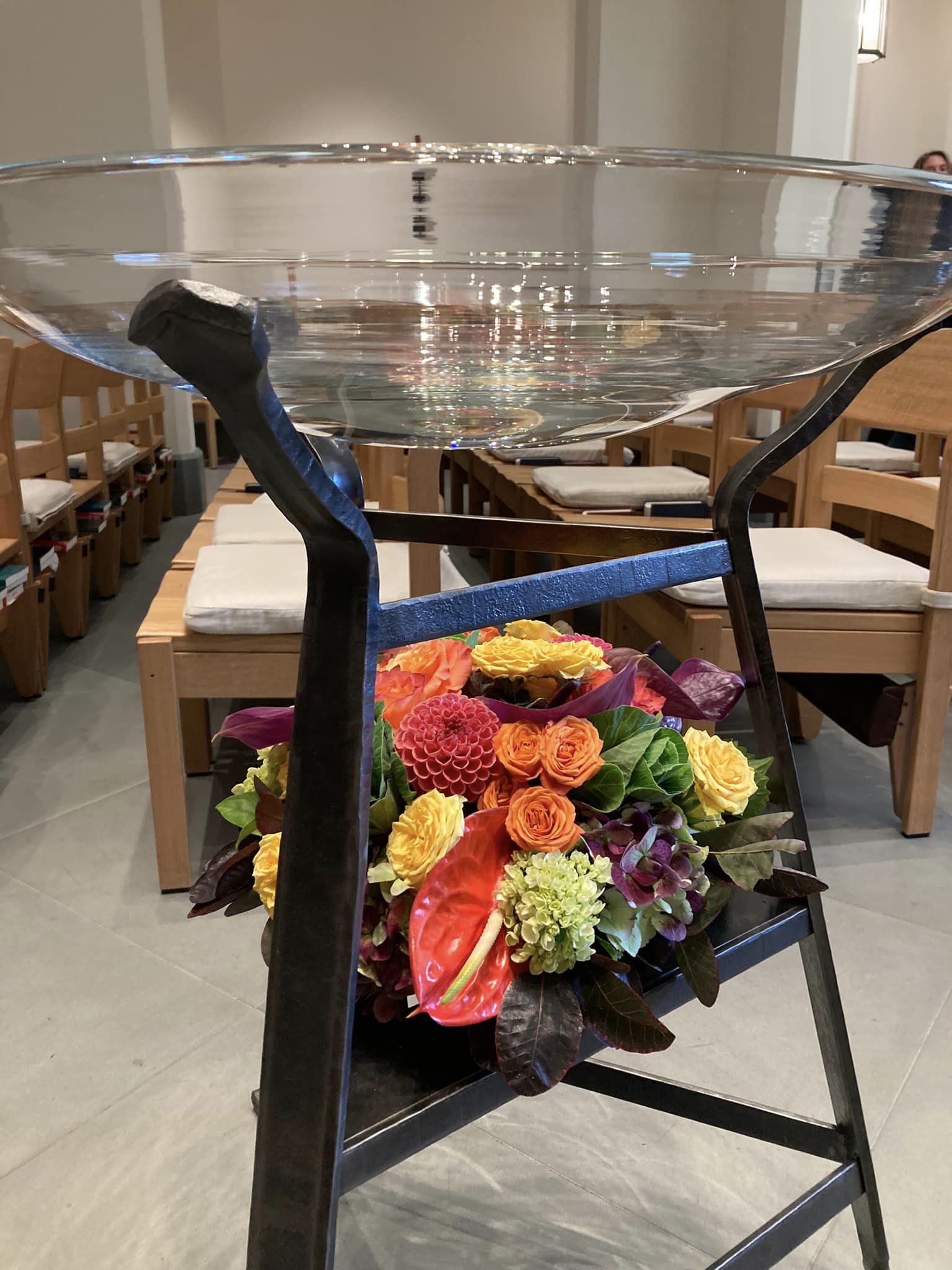
Font at Virginia Theological Seminary

I remember when I was a seminarian, sitting in daily worship, my eyes and mind would sometimes wander.  In particular, I was fascinated by the names or other small mementos carved into the old pews.  I always wondered who the mystery person was who left their mark, how long ago they carved it, and how they managed not to get caught.  What I loved about those small little marks was how they made me feel connected – connected to a long line of priests and lay leaders shaped by the seminary, all with varying gifts and talents, serving God in God’s church around the world.

Last week, my seminary honored 200 years of forming priests in the Episcopal Church.  Though those pews from the old chapel were lost in a fire, what struck me was the massive changes the seminary has seen.  From slaves who helped build and then worked on the property, wars that shaped the context for ministry dramatically for generations, fiduciary decisions that impacted the viability and structure of the seminary, the growing diversity of the student body as the Episcopal Church’s understanding of who can be called to ministry has expanded, and an evolving physical plant that has shifted what the school on the holy hill looks like – all of that change has made for a rich and layered history, of which I am a small part. 

But perhaps what speaks to me most about Virginia Theological Seminary is the ways that it also has a microcosmic impact on the church – namely, the ministry of every graduate from the seminary.  My time at VTS shaped and formed me into the priest I am today – from academic formation to liturgical formation, from learnings on leadership to the development of relationships, from shaping my spirituality to shaping my sense of the wider church.  And for every graduate like me, VTS has shaped thousands of others who go out into the world to preach the gospel.  That reality is what inspires my financial support every year – knowing the future generations I can support.

As my church journeys into stewardship season, a time of discernment about how we will support our church financially and with our time, I am reminded of how we all come to think about the stewardship of our resources.  Supporting my seminary and my church financially are ways I say to those institutions and my community that these institutions are important to me:  they have made an impact in my life, and have inspired me to make an impact on the them.  I would not be the priest, mother, or wife that I am without either my seminary or Hickory Neck Church.  What about you?  How has our church shaped your life?  What stories are the stories that make you eager to be a part of financially supporting ministries of impact?  I can’t wait to hear what inspires your giving!

Sermon – Matthew 22.1-14, P23, YA, October 15, 2023

20 Friday Oct 2023

Posted by jandrewsweckerly in Sermons

≈ Leave a comment

Tags

allegory, anxiety, church, clothing of discipleship, discipleship, dream, God, kingdom of God, membership, parable, response, Sermon, stewardship, wedding banquet

I cannot count the number of times I have had some variation of the dream.  The procession has started and I am not vested yet.  I run into the vesting room, only to be unable to find my alb and cincture.  Of course, I could grab one of the hundreds of albs in the vesting room but they are either too long or too short.  If I somehow manage to run into church vested, usually the service has begun without me.  And sure enough, when I look at the pulpit, my sermon is nowhere to be found.  Before I was a priest, the nightmares were about a test for a class I have not attended all semester, or a classroom I cannot find, or a mystery locker that has books I need.  We all have them – or at least I hope I am not the only one!  I have heard of church musician nightmares about unpracticed pieces of music or music missing from the music stand.  And, of course, there is the classic nightmare of showing up to an important event without your clothes.

So, in our gospel lesson, when the person who was not originally invited to the wedding banquet because he did not have enough social capital is put on the spot in front of everyone by an agitated and somewhat violent host about not wearing the right garment, our anxiety levels and sense of injustice soar.  What if he did not own a wedding garment?  Maybe he was too poor to have one.  Maybe he did not know the social mores of fancy banquets.  Surely God does not cast us out with no regard for human dignity.  Isn’t that what Jesus is all about – loving and welcoming all?!?

Truth be told, this whole parable is one of those awful parables we wish we could skip or at least skim until we reach something more palatable.  With the Holy Land crumbling into violence and suffering, the last thing I wanted to read about this week was of entitled invitees to the king’s wedding feast violently mistreating messengers from the king and the retaliatory destruction and burning of the city.  And then, when the seemingly guilty parties have done to them what they did to others, the king cannot seem to contain his anger, and lashes out at a seemingly innocent man about not wearing the right garment, even though he had very little time to prepare for the afterthought invitation to the banquet.  In what has been a week of violence, particularly violence against civilians on all sides, the last thing I wanted to hear this morning was more violence from our gospel lesson. 

If we are going to tackle this seemingly awful parable, we are going to have to step back to see what is happening.  First, as scholar Yung Suk Kim explains, “a parable is not intended for literal interpretation…  For example, while the king is like God in some sense, he is not the same as God.  Likewise, his son is not Jesus.  His slaves who went out to call the invited guests are not prophets, and invited guests are not Israel.  The king’s violent response is not the same as the fall of Jerusalem.  Allegorical interpretation is not wrong [with parables] but has limitations…  Indeed, the allegorical interpretation cannot explain the complexities in the parable of the wedding banquet.”[i]

Second, despite our ability to remove immediate comparisons of God to the violent king, Matthew does say the kingdom of God is like this parable.  So, there is some learning, even in the uncomfortable casting out of the man who shows up at the party in the wrong garb – fulfilling every anxiety dream we have ever had.  When we hear those harsh words, many called, but few are chosen, we finally understand the “so what?” of all this violence and seeming overactions.  Karoline Lewis explains, “…many are called but few are chosen indeed.  The chosen are the ones who realize that just showing up is not enough anymore.  The chosen are the ones who insist that mere acquiescence, week after week, day after day, to doctrine and dogma will not stand the test of what it means to be the salt of the earth and the light of the world.  The chosen are the ones who believe that a God who is Immanuel might very well stake a claim on their own humanity.  And, the chosen are the ones who understand that the time for bringing about the Kingdom of Heaven is now — not later, not tomorrow, not someday, but now.”[ii]

Today’s language is violent and somewhat despondent.  And although that may not be literally applied to God, this text comes with consequences.  Today’s text reminds us that RSVPing to church, and showing up to consume comfort and reassurance is not the totality of membership in the body of Christ.  Showing up in this community means being gifted the clothing of discipleship – clothing we will put on every week.  We are always welcome in these chairs and on our YouTube channel.  And, to belong here means to take on the clothing of discipleship.  As Lewis says, we can no longer don the clothing of “complacency, conformity, and any kind of garb that is content with the way things are.”  Today we are invited to put on “…the kind of compassion, birthed by God’s own righteousness, that cannot, anymore, leave things the way they are.”[iii] 

But no need to worry about a new anxiety dream.  If you forget your clothing of discipleship, we have that clothing ready for you every Sunday.  That is why in stewardship season, so many of us are generous with our gifts of time, talent, and treasure – because we know how precious the gift of that weekly garb is.  We know the feeling of coming to church weary, downtrodden, and tired, and we also know the feeling of leaving church empowered and invigorated to slip on that gown of discipleship anew for the coming week.  Hickory Neck is the place we come to every week to join in the communal feast.  And Hickory Neck is the place where that weekly feast emboldens us to feed others.  There is no casting out into the outer darkness from these doors – not without the garb of discipleship we are gifted with from this place of nourishment and belonging.  Amen.


[i] Yung Suk Kim, “Commentary on Matthew 22:1-14,” October 15, 2023, as found at https://www.workingpreacher.org/commentaries/revised-common-lectionary/ordinary-28/commentary-on-matthew-221-14-9 on October 12, 2023.

[ii] Karoline Lewis, “What Not To Wear,” October 8, 2017, as found at https://www.workingpreacher.org/dear-working-preacher/what-not-to-wear on October 12, 2023.

[iii] Lewis.

On Celebrating Life, Death, and Movies…

04 Wednesday Oct 2023

Posted by jandrewsweckerly in reflection

≈ Leave a comment

Tags

bless, celebration, change, community, death, end, Episcopal Church, eternal life, finality, grace, growth, Holy Spirit, Jesus, joy, life, ministry, movies, new, past

Photo credit: https://www.cnn.com/2023/09/28/tech/netflix-dvd-rental-movies-ending/index.html

Well, it finally happened.  Netflix’s DVD business closed last Friday.  Now I recognize that acknowledging I still received DVDs from Netflix may make me seem old-fashioned.  Even a contemporary exclaimed recently, “Do people even have the equipment to play DVDs anymore?!?”  I took a good ribbing, but the truth is I love movies, and Netflix’s DVD business allowed me to watch movies that were not available via streaming services.  I was constantly finding new gems, and still had over 100 movies in my queue that I hoped to watch some day.

For those of us old-timers still watching DVDs, the closing of Netflix’s DVD branch has been tinged with nostalgia and a tiny bit of grief.  Over the course of 18 years, I watched 667 films, each story sparking my imagination, eliciting pleasure, sorrow, excitement, indignation, laughter, and hope.  Obviously there will be other ways for me to revel in the artistry of filmmaking, but there is a certain finality to the closing of this chapter. 

Despite my wistfulness, I commend Netflix for the way they have handled this change.  Instead of wallowing in grief, or attempting to apologize for market changes beyond their control, instead, they have handled this “death” with grace and joy.  Knowing the closing was coming, this year they used their iconic mailing envelopes to feature celebratory artwork honoring how a whole generation has been shaped by their service.  On the week of their closure, the sent a “gift” to every member – a summary of the highlights of our membership – what movies we had watched each year, milestones in our membership, and even the list of movies in our queue in case we want to find another way to see them.  Instead of a death, it has felt like a celebration of life.

In a lot of ways, it has reminded me of the ways the Episcopal Church approaches death.  When someone we love passes, we use the burial office to celebrate life – certainly the life of the one who has died, but especially the promise of eternal life promised in Jesus Christ.  But I’ve been thinking about it over this last week, and the Church honors “mini-deaths” all the time:  the ending of a ministry that is no longer needed or effectively utilized, the retirement of a ministry leader after a successful tenure, or the blessing of a parishioner or staff member who moves away from the community.  All those transitions can be hard because they make us remember fondly the ways ministry blessed us in the past.  But those transitions are also often the source of new life:  a new ministry we could never have imagined five years ago, a new leader whose fresh ideas opens up new opportunities, and new members who shape and mold us into a new community.

I wonder what things feel like they are dying in your life right now – what things you thought would always be there are undergoing change.  Where might the Holy Spirit be inviting you to see new shoots of growth in the midst of something withering on the vine?  How might those “mini-deaths,” be tremendous gifts to you or your community?  How might we take a cue from Netflix, and find ways to celebrate those endings with dignity and joy?  I am grateful for the ways a secular business is helping me see the sacred in our own life cycles.  Let’s celebrate together!

Sermon – Matthew 11.25-30, Feast of St. Francis, October 1, 2023

04 Wednesday Oct 2023

Posted by jandrewsweckerly in Sermons

≈ Leave a comment

Tags

blessing of animals, burden, creation, disciples, discipleship, easy, impact, Jesus, light, pets, Sermon, serve, St. Francis, yoke

“Come to me, all you that are weary and are carrying heavy burdens, and I will give you rest.”  Whether you are wearied from wrestling your pets this morning (or your kids!), weary from full fall schedules, or weary from illness, anxiety, or bad news, Jesus’ words are words of comfort today.  They remind us of our time of renewal in sabbatical, and we want to cozy into the Gospel words today.

But today is not about Jesus blessing times of rest.  Jesus is actually commissioning disciples.  At this point in Matthew’s gospel, Jesus has been describing the way of discipleship:  serving the poor, working for justice, striving for peace.  Jesus tells them the work will be hard and will make the disciples weary.  To those disciples, Jesus offers a way to reach comfort.  Jesus says, “Take my yoke upon you, and learn from me; for I am gentle and humble in heart, and you will find rest for your souls.  For my yoke is easy, and my burden is light.”

Now, I do not know how much you know about yokes, but I have been studying up on yokes this past week.  There are actually two kinds of yokes.  Some yokes are meant for one person.  Imagine, if you will, a person hauling water from a well in village, the yoke over her shoulders, while two buckets full of water hang below.  The yoke distributes the weight of the water, but the yoke is not exactly an easy yoke.  The other kind of yoke is meant for two animals – like two oxen working together.  If one ox gets tired, the other pushes a little harder; later the roles may reverse.  A good yoke balances the work between the animals, without chafing or rubbing.  The work is genuinely easier and lighter.

This second kind of yoke is the metaphor Jesus uses to depict discipleship.[i]  Jesus tells them the work of discipleship will be hard and wearisome.  But when yoked to Jesus, the work will feel light.  So often, when we think of disciples as easing suffering, fighting for the poor, struggling for justice, we think we need to solve the worlds’ problems on our own – that we must use our own gifts to make a difference.  We go unyoked, and we feel overwhelmed and disheartened.[ii]  Even when try to do good work:  building beds for kids in need, buying extra food for food collection Sunday, or donating money to events like our Murder Mystery – we can still become discouraged.  When we think we can go at it alone (or maybe even better than others), we do not get relief in Jesus’ yoke. 

St. Francis, who we honor today, knew all about the yoke of Jesus.  Francis came from a wealthy family, had a rambunctious youth, and enjoyed status and privilege.  But one day he encountered some beggars and lepers and everything changed.  Francis renounced his privilege and wealth, took on poverty, and honored the sick, poor, and disenfranchised.  What Francis discovered was his wealthy had become its own burden of sorts.  Once he yoked himself to Jesus, everything changed.  He began to see Jesus in everyone, even birds to which he preached and the animals for whom he advocated.  Francis yoked himself to Jesus and became a faithful steward of God’s creation – so faithful that we bless animals and rejoice in creation ourselves through music and scripture today.

Now, I know you maybe came today to bless your pet, or maybe to remember a beloved pet who showed you what unconditional love really is.  And while that will bring us comfort today, and we do so with love and laughter, we also do something much bigger.  Today we remember all the instances where we have felt love – in animals, in each other, even in Jesus – and we take that love not only as a comfort, but also as a commission.  Today Jesus invites us outside of ourselves – our worries, our woes, our weariness, and put our attention on those who may need love even more than we do. 

Do not get confused.  I am not asking you to add weight to that single yoke, asking you to add more water to your heavy buckets.  I am inviting you to take off the single yoke and step in a double yoke – to yoke yourself to Jesus, yoke yourself to other disciples in this room.  Take on that yoke of Christ because the yoke is easy and light – and will actually free up your burden.  Jesus will give you the comfort, encouragement, and strength you need.  And you will be enabled to stride forward making an impact right here in James City County.  We will do that work together, because the yoke is easy and the burden is light.  Amen.


[i][i] Douglas R. A. Hare, Matthew:  A Bible Commentary for Teaching and Preaching (Louisville:  John Knox Press, 1993), 129.

[ii] Barbara Brown Taylor, The Seeds of Heaven:  Sermons on the Gospel of Matthew (Louisville:  Westminster John Knox Press, 2004), 21.

On Loss and Light…

20 Wednesday Sep 2023

Posted by jandrewsweckerly in reflection

≈ 1 Comment

Tags

blessing, church, darkness, death, God, grief, life, light, loss, resurrection, sight

Photo credit: https://pixy.org/361878/

There’s an old adage, at least among clergy, that deaths often come in threes.  As clergy, we are accustomed to walking a community through the death of a loved one.  In death, time sort of stands still, as being present with the grieving, and preparing for funerals takes precedence over all other work that was formerly deemed urgent.  If a second death happens, clergy get a little skittish because of that old adage about threes.  So, death can not only upend a week or two, it can last for weeks on end. 

But recently, I have begun to wonder if subscribing to that adage about threes clouds our vision about what else is happening.  I have had the experience of sitting with someone in the hospital who was approaching death, only to hear over the hospital PA system the tinkling sound that marks the birth of a new baby.  I have had the experience of within twenty-four hours receiving four texts:  one about the death of a friend’s mom, followed by one about a clean bill of health after cancer treatment; another one about a death in the parish, followed by one about the birth of a grandchild.  When we only see deaths in threes, we seem to lose sight of the incidents of life all around us. 

I do not mean to minimize the experience of death – each one is unique and needs time to go through the full cycle of grief.  But I have been wondering if in those darkest moments – whether in death, divorce, or the loss of a job – there isn’t lightness breaking in too.  That tinkling sound announcing a birth did not negate the end of life walk of my parishioner.  But as we made eye contact, that tinkling did help us remember all the moments of life that parishioner had experienced before those last days. 

I do not know what you are going through today:  what losses you may be grieving or what deaths are hanging over you like a cloud.  But as a people of resurrection, I suspect there is life surrounding you too – maybe as quietly as a tinkling, or maybe as loud as a toddler who has found her words.  My prayer for you today is that whatever pain you are experiencing in death today, you might be gifted with eyes to see the blessing of God’s light and life.   

Sermon – Matthew 18.21-35, P19, YA, September 17, 2023

20 Wednesday Sep 2023

Posted by jandrewsweckerly in Sermons

≈ Leave a comment

Tags

abundance, conflict, faith, forgive, forgiven, forgiveness, God, health, Jesus, love, parable, power, resentment, scarcity, Sermon

One of the tricky things about Jesus’ parables is where to situate ourselves, especially when the parable is a familiar one.  As soon as we hear the words, “…the kingdom of heaven may be compared to a king who wished to settle accounts…” our brains jump ahead, “Oh, this is the one where the guy is forgiven of his debts and then two seconds later turns around and refuses to forgive someone else’s debt.”  We may have felt pity for the first slave who owed so much, we may have been shocked by his poor behavior toward the other slave, or we may have even thought, “That guy deserved what he got!”  But the thing that is the hardest to do when reading this familiar parable is to situate ourselves in the shoes of the first slave.  And yet, that is the entire reason Jesus tells the parable today. 

We know where to situate ourselves because of what happens before the parable.  If you remember our gospel last week, we talked about Jesus’ conflict resolution plan.  In the very next verse after Jesus explains how the community of faith is to handle conflict, Peter asks a question in today’s text.  The question is a fair one, and when we’re really honest with ourselves, one we may have asked God ourselves.  Peter asks, “Lord, if another member of the church sins against me, how often should I forgive?  As many as seven times?”  The parable Jesus tells today is in response to Peter’s question about conflict, sin, and forgiveness in the community of faith.  Essentially, Jesus says, “Let me tell you a little story about forgiveness.”  So, we, who have resisted forgiveness ourselves like Peter, can situate ourselves with not just Peter, but with the slave who fails so miserably at forgiveness. 

Now, before you get too defensive about how you would never treat a fellow human being like the first slave treats the second, we need to think about Peter’s question first.  Theologian Stanley Hauerwas explains, “Peter’s question presupposes that he is the one who has been sinned against.  He assumes that he is in the position of power against the one who has wronged him.  But Jesus’s reply reminds Peter that he is to learn to be the forgiven.”[i]  Before we begin to think about offering forgiveness, we operate from one foundational truth:  we are a people who have first been forgiven.[ii]  Our forgiven status is at the heart of our ability to be a people of forgiveness.

But before we even talk about being a people of forgiveness, we need to talk a little bit about what forgiveness is not.  Some of us believe that forgiveness means excusing or overlooking the harm that has been done to us and saying that everything is okay.  For those who hold that belief, forgiveness can be equated with stuffing our feelings down deep inside or downright lying in order to keep the peace.  Others of us believe that forgiveness means allowing those who have hurt us to persist in their behavior.  For those who hold this belief, forgiveness is so important, that we become recurring victims of offenses.  Still others believe that forgiving means forgetting what happened.  For those who hold this belief, forgiveness is pretending an old hurt does not still hurt.  Finally, others see forgiveness as something that we can do at will, and always all at once.  For those who hold this belief, forgiveness must be immediate and offered quickly.  The problem with all these models of forgiveness – of overlooking the harm, saying everything is okay, of allowing recurring behavior, of trying to forget, or forgiving once and for all – is that these models of forgiveness would have been totally foreign to Jesus.  According to author Jan Richardson, in Jesus’ teaching about forgiveness, “…nowhere does Jesus lay upon us the kinds of burdens we have often placed upon ourselves—burdens that can make one of the most difficult spiritual practices nearly impossible.”[iii]

So, if we know what forgiveness is not, we need to know what forgiveness is.  I like what scholar Debie Thomas has to say about forgiveness.  She says, “I think forgiveness is choosing to foreground love instead of resentment. If I’m consumed with my own pain, if I’ve made injury my identity, if I insist on weaponizing my well-deserved anger in every interaction I have with people who hurt me, then I’m drinking poison, and the poison will kill me long before it does anything to my abusers. To choose forgiveness is…to cast my hunger for healing deep into Christ’s heart, because healing belongs to him, and he’s the only one powerful enough to secure it.”  She goes on to say, “Secondly, …forgiveness is a transformed way of seeing.  A way of seeing that is forward-focused.  Future-focused.  Eschaton-focused.  …abuse and oppression are [n]ever God’s will or plan for anyone.  But I do believe that God is always and everywhere in the business of taking the worst things that happen to us, and going to work on them for the purposes of multiplying wholeness and blessing…Because God loves us, we don’t have to forgive out of scarcity. We can forgive out of God’s abundance.”[iv]

So how many times are we to forgive?  Not seven times.  Not even really seventy-seven times or seventy times seven, as some translations say.[v]  The forgiveness that first slave receives is hyperbolically abundant – the forgiveness by the king of ten thousand talents (or the equivalent of 150,000 years of labor)[vi] is almost ludicrous in its generosity.  But that is how abundantly God loves us.  We are invited today to love with that kind of ludicrous abundance too.  For our health, for our faith in the better world God is creating, we pray for the strength to ask God to “forgive us our sins as we forgive those who sin against us.”  We are a forgiven people, who, because God loves us, can forgive not out of scarcity, but out of God’s abundance.  Amen.  


[i] Stanley Hauerwas, Matthew:  Brazos Theological Commentary on the Bible (Grand Rapids:  Brazos Press, 2006), 166.

[ii] Hauerwas, 166.

[iii] Jan Richardson, “The Hardest Blessing,” September 9, 2014, as found at http://paintedprayerbook.com/2014/09/09/the-hardest-blessing/#.VBOogcKwKi0 on September 16, 2023.

[iv] Debie Thomas, “Unpacking Forgiveness,” September 6, 2020, as found at https://www.journeywithjesus.net/essays/2748-unpacking-forgiveness on September 16, 2023.

[v] Lewis R. Donelson, “Exegetical Perspective,” Feasting on the Word, Year A, Vol. 4 (Louisville: Westminster John Knox Press, 2011), 69.

[vi] David Lose, “Pentecost 14A: Forgiveness and Freedom,” Sept. 7, 2014, as found at http://www.davidlose.net/ 2014/09/pentecost-14-a/.

← Older posts
Newer posts →

Recent Posts

  • On Change and Bread…
  • Sermon – Exodus 14.19-31, P19, YA, September 13, 2026
  • On Realizing Dreams…
  • On Seeing the Kingdom…
  • Sermon – Exodus 3.1-15, P17, YA, August 30, 2026

Archives

  • September 2026
  • August 2026
  • July 2026
  • June 2026
  • May 2026
  • April 2026
  • February 2026
  • January 2026
  • December 2025
  • November 2025
  • October 2025
  • September 2025
  • August 2025
  • July 2025
  • June 2025
  • March 2025
  • February 2025
  • December 2024
  • November 2024
  • October 2024
  • September 2024
  • August 2024
  • July 2024
  • June 2024
  • May 2024
  • March 2024
  • February 2024
  • January 2024
  • December 2023
  • November 2023
  • October 2023
  • September 2023
  • August 2023
  • July 2023
  • June 2023
  • May 2023
  • March 2023
  • February 2023
  • January 2023
  • December 2022
  • November 2022
  • October 2022
  • June 2022
  • May 2022
  • January 2022
  • December 2021
  • November 2021
  • October 2021
  • September 2021
  • August 2021
  • June 2021
  • May 2021
  • April 2021
  • March 2021
  • February 2021
  • January 2021
  • December 2020
  • November 2020
  • October 2020
  • September 2020
  • August 2020
  • July 2020
  • June 2020
  • May 2020
  • April 2020
  • March 2020
  • February 2020
  • January 2020
  • December 2019
  • November 2019
  • October 2019
  • September 2019
  • August 2019
  • July 2019
  • June 2019
  • May 2019
  • April 2019
  • March 2019
  • February 2019
  • January 2019
  • December 2018
  • November 2018
  • October 2018
  • September 2018
  • August 2018
  • July 2018
  • June 2018
  • May 2018
  • April 2018
  • March 2018
  • February 2018
  • January 2018
  • December 2017
  • November 2017
  • October 2017
  • September 2017
  • August 2017
  • July 2017
  • June 2017
  • May 2017
  • April 2017
  • March 2017
  • February 2017
  • January 2017
  • December 2016
  • November 2016
  • October 2016
  • September 2016
  • August 2016
  • July 2016
  • June 2016
  • May 2016
  • April 2016
  • March 2016
  • February 2016
  • January 2016
  • December 2015
  • November 2015
  • October 2015
  • September 2015
  • August 2015
  • July 2015
  • June 2015
  • May 2015
  • April 2015
  • March 2015
  • February 2015
  • January 2015
  • December 2014
  • November 2014
  • October 2014
  • September 2014
  • August 2014
  • July 2014
  • June 2014
  • April 2014
  • March 2014
  • February 2014
  • January 2014
  • December 2013
  • November 2013
  • October 2013
  • September 2013
  • August 2013
  • July 2013
  • June 2013
  • May 2013
  • April 2013
  • March 2013
  • February 2013
  • January 2013
  • December 2012
  • November 2012
  • October 2012
  • September 2012

Categories

  • reflection
  • Sermons
  • Uncategorized

Meta

  • Create account
  • Log in
  • Entries feed
  • Comments feed
  • WordPress.com

Blog at WordPress.com.

  • Subscribe Subscribed
    Seeking and Serving
    Join 397 other subscribers

    Have a WordPress.com account? Log in now.

  • Seeking and Serving
    View site in Reader
    Manage subscriptionsSign upLog in
    Report this content
    Collapse this bar
Loading Comments...