• About

Seeking and Serving

~ seek and serve Christ in all persons

Seeking and Serving

Author Archives: jandrewsweckerly

Sermon – Matthew 3.1-12, A2, YA December 8, 2013

13 Friday Dec 2013

Posted by jandrewsweckerly in Uncategorized

≈ Leave a comment

Tags

Advent, anxiety, dreams, hopes, John the Baptist, re-orientation, repentance, Sermon, vision

Today we are going to do something a little different.  We are going to try an exercise I found recently.[i]  I want you to pull out your bulletin or a scrap of paper, and grab the pencil in your pew or a pen you brought with you.  Next, I want you to make a quick “to do” list for Advent.  I want you to put all the things you need and want to get done:  maybe shopping for gifts, decorating the Christmas tree, sending those Christmas cards, or attending the kids’ school Christmas concert.  Maybe you want to make some end-of-year charitable contributions, or need to get those Christmas Eve services on your calendar.  I want you to put all the things on the list and feel free to be fairly exhaustive about what you want to get done in these next two and half weeks.  I am going give you a second, as I imagine your list is probably as long as mine.  And this is probably the only time I will ever encourage you to make a to-do list during the sermon, so enjoy!

Now, I want you to take a deep breath, clear your mind a bit, and I want you to daydream about what you hope Christmas will be like this year.  Think about the kind of day you want to have or maybe the kind of relationships you want to be a part of your life.  Think about what kind of world you want to live in this Christmas, and maybe even beyond Christmas Day.  Your hopes can certainly be about your immediate wants and needs, but they can also include your larger families, communities, and the world.  If you want, go ahead and take just another moment to write a brief sentence below your other list that captures your hope for your life and the world this Christmas.  As you are thinking about the kind of world you want to live in, think about the passage we heard from Isaiah today:  a world where the wolf shall live with the lamb, the cow and the bear graze together, and a nursing child shall play over the hole of the asp.  Perhaps this kind of harmony and peace is a part of your Christmas hope and can certainly be a part of your dreaming today.

Okay, now that you have your to-do list and your Christmas hope in mind, I want you to work backwards.  Look at the to-do list you made and circle those tasks that might contribute directly to your own deep hopes and longings about your life and this world.  Certainly, there are going to be some items on your list that are important in the short-term, but maybe do not contribute to your larger vision and hope.  Here is where our invitation lies today.  Perhaps this Advent can be a time of putting things in perspective and channeling our energy and resources to those things that matter most to us, to our families, to our communities, and to God.

Of course, that invitation may not have been what you initially imagined when you heard John the Baptist’s words today in our gospel lesson.  His words of repentance and judgment are honestly more scary than comforting this time of year.  I have many times wondered why we have to hear John’s words now, as we approach that blessed holy night, as opposed to some other text about happy anticipation or blessed expectation.  But John does not mince words, “Repent, for the kingdom of heaven has come near.”

I have been reading a lot these last couple of weeks about the season of Advent and people’s varying opinions about whether Advent is a penitential season or not.  I have been part of parishes that have insisted that Advent is not a mini-Lent, and refuse to take on anything that resembles the penitential nature of Lent.  But I have also been a part of parishes who see the themes in our collects this season and hear words like John the Baptist’s words today and cannot help but to claim the penitential nature of Advent.

Part of the challenge is that we all get a bit hung up on the fact that we think of repentance as being about guilt, inadequacy, and unworthiness.  We imagine that repentance is about our standard of moral worthiness or about our feelings of remorse.  Barbara Brown Taylor explains, “The kind of repentance most of us shrink from is all about us, in case you hadn’t noticed.  It is all about me, me, me, the miserable sinner.  No wonder it is so revolting.”  But, Taylor suggests that there might be another way to look at repentance.  “The other kind of repentance, the healing kind is far more interested in God.  It spends more time looking at the kingdom than the mirror.  It has more faith in God’s power to make new than in our own power to mess up.”[ii]  In fact, some have argued that repentance is about God’s desire to realign us with Christ’s life, God’s hope to transform us into Christ’s image.[iii]  Real repentance is not about our failings, but about God’s desires for us.

I think many of us want to avoid texts like our gospel lesson today, because the last thing we want to hear as we try to struggle through those Advent to-do lists is that we need to repent, and think about the kingdom of heaven coming near.  But John is not trying to push us to feel bad about ourselves this Advent season, or even to wallow in apologies.  Instead, repentance is about “re-orientation, a change of perspective and direction, a commitment to turn and live differently.”[iv]  Our gospel lesson today is not trying to get us to limit our hopes or define ourselves by our ancestry or piety, but to dream bigger dreams, and to work toward those bigger hopes on that Christmas hope list you just made this morning.  This is what John means when he says to bear fruit worthy of repentance.

Now if you imagine that I am saying that you have more work to do this Advent season, you are partially right.  I am inviting you to take up the work of living into your bigger hopes and dreams this season.  But I am also giving you permission to let go of those things on that to-do list that are not allowing you to focus on the real joy of this season: the joy of a life of repentance – of re-orientation.  Now you may not be able to get out of that party or those Christmas cards, but maybe your presence at that party will be marked by your new Advent re-orientation.  Maybe those cards will have a different message than you originally planned, or your approach to completing them may be full of love and compassion instead of obligation and annoyance.  John’s words for us today are a wake-up call, but not the wake up call that fills us with dread and self-criticism.  John’s wake-up call is a reminder of the hope of this season – the hope that is ours to claim when we are ready.  Amen.


[i] David Lose, “Hoping for More,” as found at http://www.workingpreacher.org/craft.aspx?post=2901 on December 2, 2013.

[ii] Barbara Brown Taylor, “A Cure for Despair: Matthew 3:1-12,” Journal for Preachers, vol. 21, no. 1, Advent 1997, 18.

[iii] John P. Burgess, “Theological Perspective,” Feasting on the Word, Yr. A, Vol. 1 (Louisville:  Westminster John Knox Press, 2010), 46.

[iv] Lose.
Homily – John 6.57-63, Clement of Alexandria, December 5, 2013

13 Friday Dec 2013

Posted by jandrewsweckerly in Uncategorized

≈ Leave a comment

Tags

Clement of Alexandria, experience, faith, gifts, God, homily, Jesus, questions, sacred, secular

Today we honor Clement of Alexandria, priest and philosopher in the mid-to-late second century.  Clement was originally a Greek philosopher who sought truth in many schools until he met Pantaenus, head of a Christian school in Egypt.  Clement later became head of that school and was for many years an apologist for the Christian faith to both pagans and Christians.  His background and abilities helped him to commend Christianity to the intellectual circles of Alexandria.  He had a liberal approach to secular knowledge and his work prepared the way for Origen, one of the most eminent theologians of Greek Christianity.

We honor Clement today because he did what so many of us simultaneously hope to do and fear to do.  We long to share our faith experiences with both the Christians and non-Christians in our lives.  We have had some incredible encounters with God and we want to share that experience with others.  And yet we fear sharing because we worry that people may ask us questions we cannot answer.  We worry we do not have the intellectual acumen of Clement to tie together our experiences in a logical way.

Perhaps we feel a bit like the disciples in John’s gospel today.  As Jesus explains that he is the bread of life meant to be consumed, the disciples complain, “This teaching is difficult; who can accept it?”  Their complaint is not hard to understand – I am sure any of us hearing Jesus’ metaphor for the first time would be especially baffled.  All we need is one hearty experience trying to explain to a child that a wafer is Jesus’ body and we all get a little nervous about this crazy faith of ours.

In the midst of our hesitancy, we find encouragement through Clement.  Clement gives us permission to interweave our sacred and secular worlds.  Clement used his gift – the gift of a brilliant secular mind – to interpret his faith and make it accessible to the faithful and those without faith.  God gives each of us similar gifts too.  God empowers us with “spirit and life,” as Jesus Christ says.  God gives us a unique spiritual journey that can speak truth because ultimately we, too, are a mixture of sacred and secular: who better to interpret this crazy world and our crazy faith than us?  Clement invites us to share our own truths with others – knowing that our truth is a part of the bigger truth of Jesus Christ.  Though we may not have everything figured out, we have experienced enough of God in us, and we have been given gifts to enable us to share that truth with others.  Amen.

Advent attention…

05 Thursday Dec 2013

Posted by jandrewsweckerly in Uncategorized

≈ 2 Comments

Tags

Advent, attention, God, music, pilgrimage, sacred, secular

Courtesy of http://www.metmuseum.org/exhibitions/listings/2013/janet-cardiff/slideshow

Courtesy of http://www.metmuseum.org/exhibitions/listings/2013/janet-cardiff/slideshow

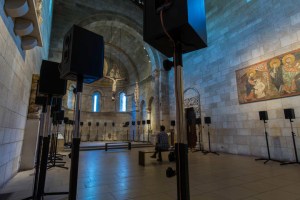
This week, several parishioners and I embarked on a “mini-pilgrimage” to the Cloisters in the City.  Though I loved many parts of the Cloisters, I found that I was most drawn to a sound installation by Janet Cardiff of The Forty Part Motet.  Cardiff positioned forty high-fidelity speakers on stands in a large oval in the middle of the Fuentidueña Chapel.  The motet is a reworking of the forty-part motet Spem in alium (which translates as “In No Other Is My Hope,”) by Thomas Tallis.  One part is played in each speaker in the room, and if you stand in the center and close your eyes, you can almost imagine yourself sitting in the chancel of a Cathedral listening to those beautiful voices.  And because the speakers are setup in the Chapel, which features the late twelfth-century apse from the church of San Martín at Fuentidueña, near Segovia, Spain, you really can transport yourself into sacred beauty of the music.

Part of what I loved about the installation was the way in which it froze me in my path.  No longer was I ready to hustle through the exhibits – instead I was transfixed in one place, just listening.  And even more strange was that I was not the only one – the whole room was filled with people just standing and listening to the incredible sound.  I was fascinated by the way such beautiful music held us captive, arresting our attention.

As I venture into Advent, I wonder how we might hold on to that sense of arrested attention on God.  Advent is a season often co-opted by the world around us.  I can count countless secular things that send us into a flurry – buying gifts, decorating houses, hosting and attending parties, and generally running around chaotically.  But our sacred worlds can keep us just as busy.  I know that in our parish during the month of December we have an Annual Meeting, a Bishop’s Visit, our 50th Anniversary Gala, the decorating our church with greens, and the flurry of Christmas worship services.

Our invitation this week might be to find small ways to commit arrested attention to God.  Maybe our way will be simply stopping for a prayer.  Maybe our way will be dropping everything we had planned and stopping to visit with an elderly person, with someone who is sick, or with a child.  Or maybe it is a more intentional commitment to being fully present wherever you are – putting aside the other forty things that also need to be done immediately, and just giving yourself over to the task or experience at hand fully.  If we can isolate our attention, and arrest our harried selves, maybe we can find our way back to the God who loves us and simply wants a bit of our arrested attention too.

Homily – Advent Lessons and Carols, December 1, 2013

05 Thursday Dec 2013

Posted by jandrewsweckerly in Uncategorized

≈ Leave a comment

Tags

Advent, Christmas, different, Episcopal Church, Lessons and Carols, music, ordinary, quiet

My first experience of Advent in the Episcopal Church was a bit of a let-down.  In the United Methodist Churches where I grew up in, Advent was a time to sing all our favorite Christmas songs, preparing us for the great feast of Christmas.  It was sort of like turning on the local Christmas radio station throughout Advent, but only with the religious songs.  I loved the experience, and looked forward to December all year long.  So when I encountered Advent in the Episcopal Church for the first time, you can imagine my surprise and disappointment.  Not only were we not singing Christmas songs, the songs we were singing felt drab and disappointing.  Everything about the season felt quiet and reserved – nothing like the boisterous build-up I was used to for Christmas.  I found myself thoroughly confused – wondering if the Episcopal Church had not received the Christmas memo.

But slowly, as the Church usually does, the Episcopal Church won me over.  As my adult life became more frenetic, the quiet of Advent became like a precious gift.  Instead of putting me in the stable on December 1st, the Church reminded me of the journey toward the stable – of prophecies and promises, of visitations and expectations, of hopes and dreams.  And believe it or not, slowly over the years, I found that there were actually Advent songs that I liked, and eventually came to love, cherish, and anticipate every year.  Many of my favorites we hear today:  O Come, O Come Emmanuel; The Angel Gabriel; and Let All Mortal Flesh Keep Silence.  Not only are the words beautiful, but the music reaches something deep inside of me and invites me into a rich, reflective reverence as I block out all that beckons me into a break-neck pace of life.  I find that the music calms my spirit and invites me into contemplation and quiet before our God.

And so today, on this first Sunday in Advent, the Church gives us the gift of Advent Lessons and Carols.  Leading up to this day, many of you have asked me, on this day of joint worship, as we head into our Annual Meeting, why we would not have Holy Eucharist.  The strict answer is that the liturgy of Advent Lessons and Carols does not recommend Holy Eucharist.  But the better answer for me is that by having a service so outside our normal pattern, we are marking the differentness of this season of Advent.  By starting out the season with a service so out of the ordinary, we proclaim that Advent is not ordinary.  Our behavior during Advent will not be ordinary – at least not the ordinary of the secular world this time of the year.  As we claim this season of Advent is as quiet oasis during in an otherwise frenzied time, we shake up our senses so much that we cannot help but to set our intentions for these four weeks on a different way of being throughout this season.

I invite you today to drink in the gift of Lessons and Carols.  I invite you too soak in the differentness of this day, letting the service awaken your senses to what is to come.  I invite you to listen to the lessons, many of which you will hear again throughout Advent, remembering why the birth of the Christ Child is so momentous.  I invite you to meditate on the music of this day, letting the words speak new truth to you, and allowing the melodies to calm and renew you.  Advent is the Church’s gift to you, and our service of Lesson and Carols reminds us of the availability of that gift.  Drink from the rich, deep pools of refreshment waiting for you today.  Amen.

Homily – Matthew 6.25-33, TG, YC November 28, 2013

05 Thursday Dec 2013

Posted by jandrewsweckerly in Uncategorized

≈ Leave a comment

Tags

control, God, gratitude, Jesus, Sermon, Thanksgiving Day, trust, worry

Our gospel lesson today is one of my favorites.  Jesus’ instructions not to worry are a soothing ointment for the constant itch of worry in my life.  His words calm my nerves and remind me of the need for perspective.  I can almost imagine Jesus as a yoga instructor, calmly affirming a room of people who are trying to take in deep breaths and to relax their tight muscles.  As I think about the heavenly Father who knows my every need, I am given a sense of perspective and calm that I can rarely muster on my own.  Because I am a person prone to worry, this passage truly is one of my favorite passages from scripture.

That being said, this passage is also one of my least favorite passages.  We tend to think of ourselves as having a certain amount of responsibility in this life – a responsibility to use the talents God has given us to care for ourselves, and even to care for others.  But who among us has not had times when that was just not possible – either from being laid off or furloughed from work, not being able to find a job in unemployment, or having an injury that has made our work impossible.  Besides, what does Jesus expect us to do?  Just go about life, expecting everything to be handed to us – clothing, food, and drink?  The proposition seems naïve and ultimately frustrating.

But even harder than a basic frustration with Jesus is the underlying message of what Jesus is saying:  that through our behavior of worrying, we are implying that we have ultimate control over life, and that God plays little, or at least a superficial, role in our lives.  The presumption of worry is the presumption that we have the ability to fully control what happens and then fix things when they go awry.  Our worrying is a way of saying to God, “I do not trust you to handle things in my life.  I am not willing to give up that control to you.”  One question from Jesus summarizes this conflict for us, “Can any of you by worrying add a single hour to your span of life?”  Jesus really knows how to get to the heart of the matter, and when he does, his words feel like a stab to the heart.

Truthfully, there really could not be a better lesson for us today on Thanksgiving Day.  I imagine every one of us has had a worry about this day in the past week or more.  Talk about worrying about what you will eat!  We stress about what food to serve, how to accommodate our gluten-free friends in the menu, what items can be prepared in advance, how to get the moistest turkey, and whether we have made enough for those gathered.  Some of us have worried about what outfit to wear, knowing there will be countless photos trying to capture the happiness of this day.  And what to drink?  I know parties where the host has purchased copious amounts of wine, despite delegating wine to guests, for fear that there will not be enough to cover the gathering.  And those worries do not even cover the other worries of the day – how to fit in Eucharist while the turkey is still cooking, whom to sit near our cranky aunt, and what kind of arguments might erupt between family members.  For those hosting meals, many of us barely have a chance to catch our breath after the meal before the clean-up process begins.

But that is the beauty of this lesson today:  like our eternal battle between worry and control, this special day also has the potential for lost focus.  Our country, with all its flaws, gives us a day that is almost sacred in nature – a day set aside for gratitude and thanksgiving; a day when we can pause, and remember the abundant blessings of our lives and the incredible gift of this life.  And if we are at all considering what we are grateful for, our minds inevitably end up with God – the one from whom all blessings flow.  The simple act of thanksgiving melts away tensions, and turns our worry-hardened hearts to hearts overflowing with gratitude.  When we really think about all that we have to be grateful for, the list gets longer and longer – even if we are not even in much of a mood to celebrate.

I was wondering, then, how we might incorporate the lessons we learn today from the gospel and from Thanksgiving Day into a rule of life beyond this day.  Then I remembered the last line of the gospel, “But strive first for the kingdom of God and his righteousness, and all these things will be given to you as well.”  We have been singing these very words since September, “Seek ye first the kingdom of God and his righteousness.  And all these things shall be added unto you.  Alleluia.”  I have been singing these words every Sunday, and I took until today, with today’s gospel and today’s celebration to finally connect the dots.  The answer is not to throw up our hands, naively trusting God to put food on the table.  The answer is changing our pursuit – not pursuing the things that we think we want and need, but instead pursing the kingdom of God.  The rest is just gravy.  Amen.

Giving thanks…

27 Wednesday Nov 2013

Posted by jandrewsweckerly in Uncategorized

≈ Leave a comment

Tags

breath, busy, God, quiet, thanks, Thanksgiving Day, worship

At 6:30 this morning, I got a call from the Chair of my Buildings and Grounds Committee.  He was worried about the amount of water we are getting here and asked if I would run over to the church to make sure the undercroft had not flooded overnight (as his basement at home had).  Luckily I was dressed, but our family was in the morning flurry of getting showers, eating breakfast, and making lunches.  I had hoped to sneak over to the church quietly, but as soon as my daughter found out what I was doing, she wanted to go too.  So we rushed to find her shoes and raincoat, I rushed to grab an umbrella, and we ran out the door.  About half-way to the church, I realized I had forgotten the church keys.  As I quickly tried to rush my 4-year old back to the house, I realized that my lack of church keys meant I also had left my house keys inside the house.  Of course, my husband was in the shower.  Needless to say, there was lots of doorbell ringing over the following five minutes.  Ah, the joys of a crazy, scattered priest and mother.

For this and so many other reasons, I am tremendously grateful that my husband suggested we take this Thanksgiving to just have a quiet holiday alone.  As an extrovert, my immediate response to his request was a bit of sadness and wistfulness – Thanksgiving is supposed to be about loud families or friends and yummy food.  But then I remembered how for the last several weekends in a row I have had multiple church commitments, how last week alone I had three night meetings, and how my husband I have felt like ships passing in the night these last several weeks.  I knew the wisdom behind his request, and so we have gathered a much smaller amount of food, and have plans to just be together as a family this weekend.  Well…and maybe clean the house and unpack some baby stuff.  But at least we are doing that together!

Courtesy of http://metropraise.blogspot.com/2012/11/the-history-of-thanksgiving-in-united.html

Courtesy of http://metropraise.blogspot.com/2012/11/the-history-of-thanksgiving-in-united.html

I know for most of you, Thanksgiving is not really about quiet and retreat.  That may feel like a foreign, if not uncomfortable, concept to you.  But even if you are planning to gather with your loud Uncle Joe or your nagging mother-in-law, I hope that you will take a moment to take a little breath, and remember in the quiet what Thanksgiving is really about.  Maybe you invite your family into prayer before the meal, maybe you invite everyone to share something they are grateful for, or maybe you just do your own self assessment of the bounty surrounding you on every side – of food, of shelter, of clothing, of laughter, of a God who loves and cares for you abundantly.  And if that is the only breath of thanksgiving you can afford on that day, then you have taken a sip of the pool of thanksgiving available to you.  And if you are thirsty for more, find a church holding a Thanksgiving Day service, and give yourself an entire hour of this kind of thankfulness.  It may be the greatest gift you give yourself this holiday season.

St. Margaret’s Church celebrates Holy Eucharist on Thanksgiving Day at 10:00 AM.  All are welcome!

Homily – Interfaith Thanksgiving Service, November 26, 2013

27 Wednesday Nov 2013

Posted by jandrewsweckerly in Uncategorized

≈ Leave a comment

Tags

culture, differences, faith, God, interfaith, praise, sacred, secular, Thanksgiving, Thanksgiving Day

I grew up in the South, where being a person of faith meant you were either a Baptist or a United Methodist.  It was not until well after college that I began to meet and really get to know a few individuals of other faiths – learning about both their cultural and religious experiences.  I even had an interfaith clergy support group back in Delaware – during which much of our time was spent discussing differences and similarities in polity and worship.

So I was thrilled when I heard there was an interfaith group here when we moved from Delaware to Plainview two years ago.  I was looking forward to who would be in the room, and finding an instant support group of fellow persons of faith.  So you can imagine my surprise when I, southerner that I was, went to my first meeting and realized that as a Christian, I was a minority in the room.  I do not think I have ever been in a room of clergy when I felt like there were significant portions of the conversation that I just did not understand – whether it was a particular holiday, a way of doing business, a language barrier, or knowing what to order at Ben’s.  I had always thought that interfaith differences were not that significance – if we are all persons of faith, surely that identity creates enough common ground for us to work together.  But the truth is that among the clergy, and perhaps among you as persons of faith, we are so steeped in our religious identity and culture, that we forget how particular that experience is to us – and how foreign that experience is to others.

That is why I love this service so much.  We have found a holiday that we as Americans can all recognize and celebrate – regardless of our faith background.  And yet, we as a community of faithful people gathered here tonight claim this day not as just a secular day to eat copious amounts and gather with family and friends, or even a day we can all commonly agree upon because we are Americans.  We claim this day as a sacred day – because we know that true thankfulness belongs to God – the source of sustenance and life itself.  In the Episcopal Church, we have a special liturgy set aside for Thanksgiving Day.  I never knew that until I became a priest.  In fact, at my first cure, I remember learning about the service and being totally annoyed, thinking, “What, I have to work on Thanksgiving too?!?”  But after my first Thanksgiving service, I knew why the Episcopal Church had set aside time for worship:  because the world around us tries fill this day with “stuff” other than true thanksgiving.  We slave over food, we fret about misbehaving family members, we jostle for position around the TV for the Macy’s parade or the football game, and some of us even go out shopping, especially as the stores try to lure us out of our homes to spend money.

But the community of faith makes another way for us.  The community of faith says that if we are going to dedicate an entire day to thanksgiving, let’s talk about what giving thanks is really about – to whom we really need to give thanks.  Tonight, we turn to scripture.  The palmist says, “It is good to give thanks unto the Lord, and to sing praises unto Thy name, O Most High.”[i]  We say together, “Praise God!  Bless God’s name!  For God is good; God’s steadfast love, [God’s hesed] is eternal; God’s faithfulness is for all generations.”[ii]

To be honest, praise and thanksgiving is not necessarily something that we are always good at doing.  We are really good at complaining to God, or asking God for things, or worrying to God.  But we often forget to truly praise God, to thank God for God’s abundant love and faithfulness.  I am not sure if our prayers to God tend toward being self-centered or we just are simply a culture who tends to complain or want something from God.  And I am not saying those kind of prayers do not have a time and place.  Our God can take all of that from us and more.  But when we turn our prayers to prayers of thanksgiving, we may be amazed at how we, and all that we are worried about, are transformed.  Centering ourselves in gratitude and thanksgiving puts even the direst of situations in perspective.  We remember not only that God is with us, but we also see those around us differently.  Our hearts grow in love and compassion simply by praising and thanking God.

Of course, there are practical implications to giving thanks to God.  Somehow that annoying uncle or nagging mother seems a lot more lovable when our hearts are rooted in this kind of thanksgiving.  Somehow that fallen soufflé or that dry turkey seems much less important than the fact that we have food at all – let alone shelter, warmth, and electricity.  That is the power of thanksgiving for us as a community of faith.  When we turn to God, from whom all blessings flow, we turn our hearts toward generosity as well.  We find ourselves buying extra food to feed our neighbor.  We find ourselves making time to serve others – whether making peanut butter and jelly sandwiches with our interfaith brothers and sisters, or in some other way.  We find ourselves focusing less on ourselves, and more on the wonderful creation God has given to us – and in turn we find ourselves much more well-taken care of than when we were wrapped up in ourselves.

And so tonight, we set the tone for this national holiday.  We proclaim a true day of Thanksgiving – for the abundance of food, for the privilege of rest, for the blessing of life – but mostly for the God that gives us such life, who cares for us more than we deserve, and who loves us more than we can imagine.  We give thanks for a God beyond our full comprehension or knowing, and we give thanks for the interfaith community who, despite all our differences, collectively reminds us to whom we belong.  May your Thanksgiving holiday be a sacred time with the God who created you, sustains you, and loves you.  Amen.


[i] Ps. 92.1

[ii] Ps. 100.4-5

Sermon – Luke 23.33-43, P29, YC, November 24, 2013

27 Wednesday Nov 2013

Posted by jandrewsweckerly in Uncategorized

≈ Leave a comment

Tags

Christ the King, Jesus, John Rawls, justice, kingdom of God, kings, need, political science, Sermon, want

Today we celebrate Christ the King Sunday.  This is the last Sunday in the liturgical year, before we start the Church’s new year with Advent.  You would think on this last Sunday of the liturgical year, after having marked the birth of the Christ Child, journeyed through Epiphany, waded through Lent and Holy Week, celebrated Eastertide, and learned through Christ’s ministry during the season of Pentecost, that this very last Sunday would be some sort of culminating day – where we celebrate what the life in Christ is really about.  So what is our gospel lesson today?  A story of Christ on the cross, being ridiculed and humiliated.  Not exactly the happiest way to end the year, and certainly not the text most of us would choose to summarize a cycle celebrating Christ or even the way we might prepare ourselves for entering into Advent.

I have been thinking about Christ as King all week.  Not being able to shake that grim image of a bloodied, battered, berated king hanging on a cross, I began to think about what else we know about kings in Scripture.  The people of God never really had a king until they reached the Promised Land.  They saw the neighboring countries with their armies and their admirable kings, and they wanted one for themselves.  That was their first mistake.  God granted them a king to rule over them, but inevitably, the kings, like any humans, were flawed – some more than others.  Hence, there are four books in the Hebrew Scriptures about the kings who ruled and the judges who tried to correct their behavior.  Most of the kings were corrupted by power, money, and greed.  Many abused the people.  Even the most revered king, King David, was a bit of a mess.  He was the one who coveted Bathsheba, slept with her, and then killed her husband when he got her pregnant and realized he would not be able to get away with it.

Having been through a horrible patch of awful kings, the prophets predicted the coming of a Messiah – the king of kings and Lord of lords[i].  This king would be triumphant and would make the people of Israel dominant at last.  You can imagine that with such a great promise, the people of Israel are not too pleased with the man who finally claimed be the Messiah.  Nothing about Jesus says “king.”  He is nonviolent, hangs out with sinners of all sorts, and travels with a sorry band of misfits.  Even his grand entrance into Jerusalem where he is heralded as a king is not so grand – he rides in on a donkey, for goodness sake!  This could not possibly be the king that Yahweh had promised them.

And yet, this is exactly the king that God sends.  The Lord, who never wanted God’s people to have an earthly king anyway, makes a king that represents everything that is kingly:  a man who loves the poor and cares for the sick, a man who sees through the pretenses of the temple and calls for authenticity, a man who loves deeply and forgives infinitely.  So why are the people of God not excited about this king?  Why can they not love this countercultural king as much as the king they think they need?

When I was in college, one of the first Political Science classes I took was called Political Theory.  When we started reading the first book, I knew I was in trouble.  We read John Rawls’ A Theory of Justice.  In the book, he presents the best way to get to a just political system.  He imagines gathering a random, diverse group of people who are blind about what their lot in life will be.  They have no guarantees about whether they will be old or young, rich or poor, male or female, member of a minority group or not.  In the midst of this blindness, the people gathered are required to make up a set of rules to govern society.  Rawls’ basic argument is that if those people were truly blind about what their lot in life would be, they would be more likely to come up with a system of governance that is the fairest for all – since no one would want to take a chance on being the one victimized by an unfair system.  Though I appreciated what Rawls was saying, I was immediately annoyed at his argument.  How could we ever recreate a system of justice from scratch, and truly blind anyone enough to create such a system?  Since that seemed impossible, the whole premise was frustrating to me.  Needless to say, my focus in Political Science was not Political Theory!

That being said, many years later, I think I may finally understand what Rawls was trying to communicate.  Our political system, or even this earthly life in general, is governed by a set of human-made standards that do not look out for the poor, that create injustices, and that benefit very few.  This is why so many of us get frustrated when we talk about justice or trying to make a difference – we see the system of injustice that fights against us and we can end up feeling helpless.  This is the very injustice that our king – Jesus – comes to fight.  In fact, I am now curious to know whether John Rawls and Jesus were perhaps acquainted.  Though he professed to be an atheist, early in his life Rawls considered becoming an Episcopal priest.  Perhaps this world that we can only achieve through blindness is the same world that Jesus could see through God’s eyes.

In Rawls’ argument, when the blinded people make the rules, and then have their blindfolds removed, some are relieved to be well-off and others are dismayed to see themselves in poverty or at a disadvantage.  But all have some sense of acceptance because the rules they made do not make rich-life as advantageous and do not make poor-life as horrible.  This is the kind of fairness Jesus invites us into.  Jesus shows us a world where a humiliated man can look at his persecutors and forgive them.  Jesus shows a world where a man is willing to suffer for the salvation of others.  Jesus shows us a world where even a criminal can see truth in the last hour, can admit his guilt, and turn to Christ for leniency.

This is why we celebrate Christ as King today:  not because he is victorious in putting us in control over others, but because he invites us into that life that evens the playing field – the life of the kingdom of God.  There are certainly going to be days when we just wish that Jesus would mount a mighty horse and triumph over evil.  But most days we realize that what we really need is a king who enables us to create a world of fairness here and now – a world that is much more similar to the kingdom of God than the kingdom of humankind.

So why do we honor this not-so-kingly king today on the last day of the liturgical year?  I think the very best reason we close one year and prepare to start another with today’s gospel lesson is so that as we can more humbly approach the Christ Child.  If we can imagine ourselves gathered around that manger on that most holy of nights, not eager for vindication, but instead humbled by the path we will all walk with this king, then we enter into Advent with more reverence, less arrogance, and a healthy dose of gratitude.  This king – Christ the King – is the most sobering, challenging, merciful, joyous, steadying king for which we could hope.  He is not the king we always want, but he is certainly the king we always need.  Today we celebrate the wise gift by God of a true King – a king who makes us all better versions of ourselves.  Amen.


[i] Revelation 19.16.

Homily – Psalm 150, St. Cecilia, November 21, 2013

27 Wednesday Nov 2013

Posted by jandrewsweckerly in Uncategorized

≈ Leave a comment

Tags

Cecilia, God, homily, music, praise, song

Music has a unique power in our lives.  There are those songs that remind us of a romance, those songs that we played over and over in a rough patch in our lives, and those songs that always bring a smile to our faces and make us want to dance.  Music has a similar power in our faith lives too.  There are those songs that always make us cry or remember a loved one, those songs that fill us with joy at the remembrance of a special connection to God on a retreat or revival, and those songs whose words capture what we cannot capture better with hours of trying.  Music helps us connect to the awesome power of God and to express the full range of the emotional journal of walking with God.

Cecilia, who we honor today, reveled in singing passionately the praises of God.  Known as the patron saint of singer, organ builders, musicians and poets, Cecilia is venerated as a martyr.  Of noble birth, Cecilia was betrothed to a pagan, who she eventually converted by her witness – along with his brother.  But because of their conversion and her role with them, all three were eventually martyred around 230 during a time of Roman persecution of Christians.  Cecilia’s life has inspired countless artists and composers over the centuries.

Though we may turn to spiritual music for different seasons of our lives, what Cecilia invites us into today is a passion for praise.  Now I know what you may be thinking – that I am asking you to be some constant ray of sunshine who continually pretends everything is ok.  To be honest I know some people who are like that and I do not get it.  How can anyone be that happy all the time?  Does God really want us to stuff our true emotions, pain, and hurt, and pretend all is well?

That is not what a passion for praise is really about.  The psalm we all read today is full of praise: “Praise God in his holy temple … praise him for his mighty acts … praise him with lyre and harp … with resounding cymbals.”  In these six short verses, we are told to praise God 11 times.  I think what the psalmist gets and what Cecilia got is that praise is the vehicle that gets us through pain to God.  Almost like making yourself smile until the smile becomes real, when we praise God, even if we do not feel like praising, eventually our praise overwhelms us, and we cannot help but be lead closer to joy.  Our invitation today is to a life of praise – annoying, hard, gentle, forgiving, joyful, real praise.  Amen.

Sermon – Luke 21.5-19, P28, YC, November 17, 2013

27 Wednesday Nov 2013

Posted by jandrewsweckerly in Uncategorized

≈ Leave a comment

Tags

God, Hurricane Sandy, Jesus, Precious Lord, prepare, scripture, Sermon, suffering, testimony, Thomas Dorsey, trust, words

“Blessed Lord, who caused all holy Scriptures to be written for our learning:  Grant us so to hear them, read, mark, learn, and inwardly digest them, that we may embrace and ever hold fast the blessed hope of everlasting life, which you have given us in our Savior Jesus Christ; who lives and reigns with you and the Holy Spirit, one God, for ever and ever.  Amen.”[i]  So on this day, when we celebrate Holy Scripture, praying one of my favorite collects, a day that we hear, read, mark, learn, and inwardly digest, imagine my intense dissatisfaction when I opened up the gospel lesson for this week.  I have been reading, marking, learning, and inwardly digesting all week, and this text still makes me uncomfortable.  On this day of celebrating Scripture, who wants to hear of collapsing houses of worship; false prophets that can lead us astray; wars, natural disasters, famines, and plagues; great persecution, including being betrayed by our very own family members?  And what is our reward for all this suffering?  All of this calamity will give us an opportunity to testify.  I do not know about you, but after having my church destroyed, navigating false prophets, fighting disasters, and dealing with persecution, testifying would be about the last thing on my mind.  In fact, I know a few Episcopalians who might even add testifying as one of the major types of tortuous, painful experiences. 

At Diocesan Convention this weekend, we watched a video about the Diocese of Long Island’s response to Hurricane Sandy one year ago.  The video began with news coverage leading up to the storm, during the storm, and immediately after the storm.  I have no idea why, but I found myself tearing up during the coverage.  I had forgotten all of the anxiety and stress that came from that storm.  I forgot about the utter despair and the feelings of helplessness – having friends try to contact me about how they could help, and yet, not even having power to be able to watch the news and see what was going on all around us.  I remember wanting to know what had happened to churches in the areas most impacted by the storm, but the Diocesan offices being crippled by their own lack of power and employees’ inability to get to work.  I remember wanting to help, but not being sure how to do that without electricity ourselves.  I remember being so cold at night without heat, and yet knowing that I was lucky to have an undamaged roof over my head.  I remember anxiously watching my car’s gas gauge approach empty – knowing the panic of gas lines, and how quickly stations ran out of gas.  The video brought all of those emotions bubbling up to the surface. 

But the video also offered a testimony.  After the storm, churches began opening doors for collections, housing, and powering stations.  Teams from churches headed to devastated areas to help demo and begin repairing homes.  Those too far from the action, offered up their space to electrical workers who had volunteered to help, but had been given no place to stay at night.  Our hospital in the Rockaways treated patients for three weeks solely on generator power.  A year later, people are still being helped as they repair homes, find new places to stay, and deal with the emotional ordeal.  In a time of great darkness, the Episcopal Church on Long Island began to find a way out of the darkness and into the light. 

One of the coordinators of the effort from the Diocese said that one of the things the Church had to learn to do was not to go into areas telling them how they were going to help – but instead had to simply show up and ask what people needed.  The representative said that this model made the work and efforts much more chaotic, but in the end, brought about the change that people really needed.  I could hear echoes of today’s gospel lesson in his words.  Jesus says, “Make up your minds not to prepare your defense in advance, for I will give you words and a wisdom that none of your opponents will be able to withstand or contradict.”  This strange gift of being able to testify is made even stranger by Jesus’ words – not only is our gift to testify in the midst of suffering, we are to force ourselves to not even prepare the testimony on the way – no thinking of anecdotes, no making outlines, no trying to even think about what we might say.  We must simply show up and trust that God will give us the words.

One of my favorite hymns is “Precious Lord.”  “Precious Lord,” is one of those songs that I can close my eyes to and just overflow with love and gratitude toward God.  Of course, my favorite version is not the version sung out of the hymnal, but by the great Al Green.  He breathes a life and joy into the song that we can rarely muster in church.  But this week, my appreciation for this favorite song grew infinitely when I heard the story behind the song.  The song was written by Thomas Dorsey.  Born in 1889 in rural Georgia, Dorsey was a prolific songwriter and excellent gospel and blues musician.  As a young man, he moved to Chicago where he worked as a piano player in churches as well as in clubs and theaters.  After some time, Dorsey finally devoted his talent exclusively to the church.  In August of 1932, Dorsey left his pregnant wife in Chicago and traveled to be the featured soloist at a large revival meeting in St. Louis.  After the first night of the revival, Dorsey received a telegram that simply said, “Your wife just died.”  Dorsey raced home and learned that his wife had given birth to a son before dying in childbirth.  The next day his son died as well.  Dorsey buried his wife and son in the same casket and withdrew in sorrow and agony from his family and friends.  He refused to compose or play music for quite some time. 

While still in the midst of despair, Dorsey said that as he sat in front of a piano, a feeling of peace washed through him.  That night, Dorsey recorded this testimony while in the midst of suffering:

Precious Lord, take my hand,

Lead me on, let me stand;

I am tired, I am weak, I am worn;

Through the storm, through the night,

Lead me on to the light;

Take my hand, precious Lord,

Lead me home.[ii]

In the midst of that darkest of times, Dorsey did not sit at that piano with a song all planned out.  In fact, if you had asked him to testify at that moment, he might have railed at the way that God and the world were treating him.  And yet, empty and vulnerable, God filled Dorsey with words that would touch people eighty years later, and would be sung by countless famous people over the years.

In the midst of darkness – of destruction, pain, suffering, persecution, even betrayal by those we love most – God gives us a testimony too.  And even more than a testimony, Jesus promises that we do not even have to prepare this testimony.  God will provide the words and the wisdom when we need them.  Our only mandate today is to hold fast to God in the midst of trials, to remain open to the movement of the Spirit, and to speak those words of truth and wisdom when we feel them spilling out of our mouths.  That time of testimony may not be before some king or governor demanding to hear about our faith.  But our testimony might spill out with a grieving widow or mother, a traumatized victim of natural disaster, or a friend who has felt disenfranchised by the Church.  We cannot prepare the testimony.  We cannot even try to craft a basic testimony story to be ready whenever we need the story.  Jesus tells us to “make up our minds not to prepare.”  This is perhaps one of the hardest challenges Jesus will give us, and yet, as we see in Dorsey’s testimony and the many other testimonies we have heard, when we yield that power to Christ, the real, vulnerable beauty of our story gives life to others and to us.  Amen.


[i] BCP, 236.

[ii] Story of Dorsey take from Nancy Lynne Westfield, “Pastoral Perspective,” Feasting on the Word, Yr. C, vol. 4 (Louisville: Westminster John Knox Press, 2010), 312.

← Older posts
Newer posts →

Recent Posts

  • On New Clothes and Neighbors…
  • Sermon – Matthew 20.1-16, P20, YA, September 20, 2026
  • On Change and Bread…
  • Sermon – Exodus 14.19-31, P19, YA, September 13, 2026
  • On Realizing Dreams…

Archives

  • September 2026
  • August 2026
  • July 2026
  • June 2026
  • May 2026
  • April 2026
  • February 2026
  • January 2026
  • December 2025
  • November 2025
  • October 2025
  • September 2025
  • August 2025
  • July 2025
  • June 2025
  • March 2025
  • February 2025
  • December 2024
  • November 2024
  • October 2024
  • September 2024
  • August 2024
  • July 2024
  • June 2024
  • May 2024
  • March 2024
  • February 2024
  • January 2024
  • December 2023
  • November 2023
  • October 2023
  • September 2023
  • August 2023
  • July 2023
  • June 2023
  • May 2023
  • March 2023
  • February 2023
  • January 2023
  • December 2022
  • November 2022
  • October 2022
  • June 2022
  • May 2022
  • January 2022
  • December 2021
  • November 2021
  • October 2021
  • September 2021
  • August 2021
  • June 2021
  • May 2021
  • April 2021
  • March 2021
  • February 2021
  • January 2021
  • December 2020
  • November 2020
  • October 2020
  • September 2020
  • August 2020
  • July 2020
  • June 2020
  • May 2020
  • April 2020
  • March 2020
  • February 2020
  • January 2020
  • December 2019
  • November 2019
  • October 2019
  • September 2019
  • August 2019
  • July 2019
  • June 2019
  • May 2019
  • April 2019
  • March 2019
  • February 2019
  • January 2019
  • December 2018
  • November 2018
  • October 2018
  • September 2018
  • August 2018
  • July 2018
  • June 2018
  • May 2018
  • April 2018
  • March 2018
  • February 2018
  • January 2018
  • December 2017
  • November 2017
  • October 2017
  • September 2017
  • August 2017
  • July 2017
  • June 2017
  • May 2017
  • April 2017
  • March 2017
  • February 2017
  • January 2017
  • December 2016
  • November 2016
  • October 2016
  • September 2016
  • August 2016
  • July 2016
  • June 2016
  • May 2016
  • April 2016
  • March 2016
  • February 2016
  • January 2016
  • December 2015
  • November 2015
  • October 2015
  • September 2015
  • August 2015
  • July 2015
  • June 2015
  • May 2015
  • April 2015
  • March 2015
  • February 2015
  • January 2015
  • December 2014
  • November 2014
  • October 2014
  • September 2014
  • August 2014
  • July 2014
  • June 2014
  • April 2014
  • March 2014
  • February 2014
  • January 2014
  • December 2013
  • November 2013
  • October 2013
  • September 2013
  • August 2013
  • July 2013
  • June 2013
  • May 2013
  • April 2013
  • March 2013
  • February 2013
  • January 2013
  • December 2012
  • November 2012
  • October 2012
  • September 2012

Categories

  • reflection
  • Sermons
  • Uncategorized

Meta

  • Create account
  • Log in
  • Entries feed
  • Comments feed
  • WordPress.com

Blog at WordPress.com.

  • Subscribe Subscribed
    Seeking and Serving
    Join 397 other subscribers

    Have a WordPress.com account? Log in now.

  • Seeking and Serving
    View site in Reader
    Manage subscriptionsSign upLog in
    Report this content
    Collapse this bar
Loading Comments...