• About

Seeking and Serving

~ seek and serve Christ in all persons

Seeking and Serving

Category Archives: Uncategorized

Sermon – Luke 1.39-45, A4, YC, December 20, 2015

05 Tuesday Jan 2016

Posted by jandrewsweckerly in Uncategorized

≈ Leave a comment

Tags

acceptance, authenticity, Christmas, community, Elizabeth, fear, God, intimacy, Jesus, love, Mary, pregnancy, relationship, Sermon

This time of year, seven years ago, I was about a month into pregnancy.  The season was one of expectation, disbelief, and excitement, but we were not telling anyone about the pregnancy for fear that something could go wrong.  Hiding one’s pregnancy in those first months is a common cultural practice for many women and families who are sensitive about the uncertainty of pregnancy.  But holding a secret like pregnancy can invoke a mixture of emotions.  You may feel anxious that someone will discover your secret.  You may feel afraid that something will go wrong and worry about how you would share the news.  You may feel guilty about telling white lies to hide your ultimate secret.  Holding a secret about ourselves can create an inner tension and an outer isolation that is unsettling and unnerving.

We do not know whether Mary had planned to tell Elizabeth about her pregnancy.  In Luke’s gospel, Mary never gets the chance to tell Elizabeth the news herself.  Luke only tells us that after Mary is told that she is pregnant with Jesus, the angel tells her that Elizabeth, who is past the childbearing age, is six months pregnant.  Mary immediately goes to Elizabeth.  Most scholars believe that Mary goes to Elizabeth to offer care for Elizabeth’s pregnancy.[i]  But we cannot know whether Mary planned to tell Elizabeth about her own pregnancy.  Mary had every reason not to tell her.  To an outsider, Mary’s pregnancy is not good news. She is unwed, young, poor, and pregnant.  This combination would make her an outcast, and typically no man would take her as a wife.[ii]  In Mary’s day, her pregnancy and her resulting un-marriable status is almost a death sentence.  Women in this time depended on a husband for financial support and social acceptance.  Although Mary’s pregnancy is good news from God, in the social context, that joy is negated and forced into silence.  Given her situation, we can imagine that Mary might have wanted to keep her pregnancy a secret.  Although she is rushing to Elizabeth to care for her, Mary may have been dreading the pending time of holding a secret and the inner tension and outer isolation that her secret will cause.

In modern times, we too struggle with sharing information within a community.  One of our most common greetings is, “How are you?”  And the usual response is, “Good.”  But our common greeting is rarely a genuine question about how someone is actually doing.  In fact, many of us have a short list of people with whom we avoid asking that question altogether because we know we will be there an hour later hearing about aches, pains, and their crazy neighbor.  We prefer our short greeting and response because not only do we not want to really hear about someone else’s problems, we do not want to tell others how we are truly doing either.  “Good” becomes our code word for, “I am mostly fine, but I don’t want to tell you how I really am.”  Sometimes “good” is a necessary response for keeping others from prying into our lives.

But sometimes “good” is a way of preventing authentic relationship.  While I was in seminary we were required to serve part-time in local parishes.  At the church where I was serving, Easter Vigil was a big deal.  We had many more acolytes, ushers, and Eucharistic Ministers than normal.  As we prepared to line up the large group for the procession, I noticed one of the acolytes was not as chipper as she usually is.  I asked her if she was okay, and she blurted out that she had had a fight with her parents on the way to church and was still in a bad mood.  I was surprised by her candor, especially in front of all the other acolytes.  But as soon as she shared her frustration, several of the acolytes gave her a pat on the shoulder, or commiserated with her experience.  Somehow, saying out loud why she was in a bad mood allowed her to release some of her tension and start fresh that night.

Preventing authentic relationship is not just something we do with each other.  We also struggle with sharing information with God.  During worship, we model corporate confession to God.  But how many of us really take our personal struggles to God?  Perhaps we have been so ashamed of something that we could not even talk to God about it.  Or perhaps we have been angry about how something is going in our life – the job that we did not get, the unhappiness we are having in a relationship, or the illness that is not healing.  Sometimes our anger about a situation clouds our emotions so much that we cannot imagine lifting the situation to God in prayer.  At times of heightened emotions, we feel the least capable of inviting God into our shame, anger, or grief.

The encounter between Elizabeth and Mary today offers a complete counter to our natural tendencies toward being guarded and resistant to authenticity and intimacy.  Before Mary can offer a veiled “I’m good,” Elizabeth immediately greets Mary with joy and blessing.  If Mary is at all concerned about Elizabeth’s judgment, shunning, or slandering within the community, Mary misjudges.  Instead of the expected judgment, Elizabeth offers Mary warm acceptance and praise.  Elizabeth not only blesses Mary for being the carrier of the Savior, she also blesses Mary for being faithful to God.[iii]  Elizabeth does not tentatively ask Mary if she is going to be okay or encourage her to be quiet about her shameful pregnancy.  Instead, Elizabeth sees the glory of Mary’s pregnancy, ignores cultural norms, and celebrates loudly the magnificence of what God will do through Mary.  Elizabeth proclaims, “Blessed are you among women, and blessed is the fruit of your womb.”  Elizabeth’s response is the exact opposite of what Mary may have expected.

The countercultural response of Elizabeth to Mary is the same countercultural way that God operates among us.  God chooses Mary, a young, poor, unwed woman to be the bearer of God.  God chooses Elizabeth, a woman far beyond the age of conception, to be God’s prophet.[iv]  God lifts up the poor and oppressed and calls them blessed.  God takes on human form in Jesus, lowering God’s self to come and be among us.  God’s way is almost always countercultural.  God has a way of turning things upside down and shaking up our thinking.  Through the brief encounter between Elizabeth and Mary – two marginal women – God reveals the earthy, authentic, countercultural way that God calls us to be in relationship with one another and with God.  Looking through this very human interaction between two women, we are able to anticipate the very human child of Jesus who will transform all our relationships in a countercultural way.

As we anticipate the celebration of Christ’s birth and we await the coming of Christ again, we are reminded through Elizabeth and Mary of the invitation that we have into authentic, Christian relationship with one another and with God.  Mary and Elizabeth’s encounter reminds us that our church community is a gift.  Our community is a place where we can be vulnerable with one another, share our hopes and dreams with one another, and share our shame, guilt, and fear with one another.  Our community is a place where when someone asks you how you are, we really want to know how you are.  Our community is a place where we can expect beautifully, and often brutally, shared honesty.  Our community helps us model the kind of relationship that Elizabeth and Mary have.

Elizabeth and Mary also invite us into authentic relationship with God.  Most Sundays we open our worship with a prayer called the Collect for Purity.  We pray: Almighty God, unto whom all hearts are open, all desires known, and from whom no secrets are hid…”  Weekly we admit that despite the fact that we do not want to take our shame, our anger, our fear, or our secrets to God, God knows them anyway.  God is the Elizabeth for us Marys.  God greets us with joy and blessing before we can even share our secret.  God already knows and God loves us.  God wipes away tension and isolation and throws upon us the cloak of love.  As we enter into a time with family, friends, and church to celebrate Christ’s birth, I invite you to let go of anxiety and isolation.  I invite you to consider the warmth of Elizabeth toward Mary and God toward us, and to give that anxiety and isolation to God.  Give those feelings to God because perhaps this year, you will find an Elizabeth in your life who can warmly embrace you into the love and acceptance of Christ.  Amen.

[i] Robert Redman, “Theological Perspective,” Feasting on the Word, Yr. C, vol. 1 (Louisville:  Westminster John Knox Press, 2009), 94.

[ii] Judith Jones, “Commentary on Luke 1:39-45, (46-55),” December 20, 2015 as found at https://www.workingpreacher.org/preaching.aspx?commentary_id=2723 on December 12, 2015.

[iii] Stephen A. Cooper, “Exegetical Perspective,” Feasting on the Word, Yr. C, vol. 1 (Louisville:  Westminster John Knox Press, 2009), 95.

[iv] Charles C. Campbell, “Homiletical Perspective,” Feasting on the Word, Yr. C, vol. 1 (Louisville:  Westminster John Knox Press, 2009), 95.

Homily – Isaiah 25.6-9, Cemetery Memorial Service, December 19, 2015

05 Tuesday Jan 2016

Posted by jandrewsweckerly in Uncategorized

≈ Leave a comment

Tags

baby, banquet, celebrate, child, Christ, Christmas, comfort, death, feast, heaven, life, love, Sermon, shadow

One of the little secrets that they don’t tell you about in ministry is that this time of the year is filled with death.  While the rest of the world is running around singing about this being the most wonderful time of the year, priests are bracing themselves for a slew of funerals.  I remember my first year as an ordained person our parish having five or six funerals in December.  I mentioned the oddity to my fellow clergy and they gave me a knowing nod.  “Oh yeah, December always has lots of deaths,” they told me.

A month of concentrated deaths would be strange in and of itself.  But probably what is even more strange is the juxtaposition of death and life in December.  You see, every year we celebrate new birth – in fact one of the most important births of our Christian identity.  And yet every year, in the face of wondrous new birth is the overshadowing of death.  Last year at St. Margaret’s, one of our beloved parishioners died days before Christmas.  On the morning of Christmas Eve, we celebrated his death.  That afternoon we celebrated Christ’s birth.  Life and death seeped into each other, making separating the two realities impossible.

I imagine the reality of death clinging so closely to life is not new to most of you here.  We gather this evening every year to honor the reality of celebrating Christmas in the shadow of death.  We set time apart to honor how fresh the death of our loved ones is at this time of year – whether they died months or weeks ago, or whether they died thirty years ago.  The problem is that no matter when our loved one died, they left a mark on our collective experience of Christmas.  Maybe they cooked Christmas dinner every year.  Maybe we always visited their house and exchanged presents.  Maybe they always told loud, awful jokes or made the holidays a little more bearable.  Whatever their legacy on this time of year, there is some part of our heart that is missing without them here.  Sure, we make new Christmas memories without them.  Eventually, there will be new babies, cousins, and grandchildren who will never know those loved ones we knew.  But for us, those loved ones are never far this time of year, however briefly stealing away some of the joy that this time of year can bring.

I think that is what I love about our Old Testament lesson today.  Isaiah talks about the coming kingdom of God.  Isaiah says, “…the Lord of hosts will make for all peoples a feast of rich food, a feast of well-aged wines, of rich food filled with marrow, of well-aged wines strained clear.”  There is something about that image of a feast that gives me great comfort this time of year.  Maybe the image is comforting because this holiday is often about comfort food – recipes that give us a sense of nostalgia or make us feel safe just through their familiarity.  Maybe the image is comforting because we can imagine that raucous table with a large crowd gathered eating, drinking, laughing, and sharing in each other’s joy.  Or maybe the image is comforting because we can connect our earthly banquets with the heavenly banquet – imagining those sacred moments and places where we really feel like our loved one’s presence is palpable at our Christmas table – a mystical union between the two feasts.

I cannot promise you that Christmas will be easy this year.  In fact, I suspect that those of you whose loved ones passed away years and years ago already know that Christmas will always have a tinge of sadness and loss.  Death and new life will always be oddly intermingled this time of year.  But I also suspect that may be on purpose.  Even though death is inevitable and keeps coming at us, reminding us of our own mortality, we keep celebrating the birth of the Christ Child and the new life and promise of hope he brings.  Nothing quite warms the heart like warmth of a swaddled baby.  Nothing gives us greater hope and wonder than the miracle of new life.  Nothing brings us deeper joy than the innocence and purity of a newborn.  We know that any baby can bring that kind of joy.  But celebrating the Christ Child is about even more – celebrating the Christ Child is a celebration of all that he will bring – the banquet that his life inaugurates and the feast that he creates for us.  Christmas will not be the same without our loved ones.  But Christ promises to keep bringing us new life until we can join our loved ones in that heavenly banquet that never ends.  Amen.

On being good…

11 Friday Dec 2015

Posted by jandrewsweckerly in Uncategorized

≈ Leave a comment

Tags

Advent, Barth, behavior, Christ, church, forgiveness, good, Paul, repent, Romans, sin

Driving home from school this week, my daughter and I talked about some challenges she is having with poor behavior in the classroom.  We talked about some strategies to help her work on it.  I encouraged her to just keep trying.  Exasperated, she said to me, “I am trying.  It’s just so hard being good!”

Her words to me were both funny and profound.  I felt sympathy for this little first grader who is trying her best.  But I also felt an odd sense of relief.  I thought to myself, “I’m so glad I am an adult and don’t have to worry about ‘being good’ anymore!”  Then today, we read the lessons for the feast day for Karl Barth.  The epistle was from Paul’s letter to the Romans (7.14-25).  Paul says, “I do not understand my own actions.  For I do not do what I want, but I do the very thing I hate…For I do not do the good I want, but the evil I do not want is what I do.”  It dawned on me that I was being self-righteous with my daughter.  As adults, we do not ever “grow out of” struggling to be good.  Adults struggle with our sinful nature as much as children do.

Karl Barth knew a little about sinfulness.  During the rise of Hitler, Barth argued that the Church’s allegiance to God in Christ gave the Church the moral imperative to challenge the rule and violence of Hitler.  In fact, when Barth refused to swear an oath to Hitler, he lost his professorship.  One of the greatest theological minds of the twentieth century, Barth argued about sin that the Incarnation was the bridge between God’s revelation and human sin.

Photo credit: http://www.sacristies-of-the-world.com/?tag=advent-wreath

Talking about sin during Advent may seem strange to some.  Most of us are more focused on buying gifts, preparing our homes, and going to parties.  But the reason we have to celebrate in the first place is the nativity of our Lord – that bridge between God’s revelation and human sin.  Even in the first weeks of Advent, we hear from John the Baptist telling us to repent of our sins.  The time of Advent is not the Church’s way of delaying the gratification of Christmas.  Advent is an invitation to prepare our hearts and minds for the Christ Child.  Part of that preparation is examining our own sinfulness – to right our relationship with God, with ourselves, and with one another.  Being “good” is not easy.  But Advent is our reminder to keep trying – even when being good is hard.  My suspicion is that our work of repentance will not only warm our hearts with the forgiveness we receive from God, but also help us to be agents of forgiveness.  Lord knows we’ll need a heap of that too when the holidays come!

Sermon – Philippians 1.3-11, A2, YC, December 6, 2015

11 Friday Dec 2015

Posted by jandrewsweckerly in Uncategorized

≈ Leave a comment

Tags

action, affirmation, community, faith, family, God, Good News, Jesus, letter, love, mission, overflow, Paul, Philippians, seeking, Sermon, serving, sharing

This sermon was given on the occasion of our Annual Meeting.

My dearest St. Margaret’s, “I thank my God every time I remember you, constantly praying with joy in every one of my prayers for all of you, because of your sharing in the gospel from the first day until now.  I am confident of this, that the one who began a good work among you will bring it to completion by the day of Jesus Christ.  It is right for me to think this way about all of you, because you hold me in your heart, for all of you share in God’s grace with me…For God is my witness, how I long for all of you with the compassion of Christ Jesus.”

If ever I were to write a love letter to St. Margaret’s, I would steal these words from Paul to the Philippians.  You see, Paul saw in the Philippians what I see in you:  a community of faith alive with the Holy Spirit, sharing the Good News of Christ Jesus in our community.  A little over four years ago, I became your rector.  You were bruised and battered, having not only survived a tumultuous relationship with your last rector, but also a strained relationship with an interim, as well as the absence of consistent leadership for over two years through the limits of a supply priest.  Having had years of struggle, I quickly came to realize that St. Margaret’s had some baggage.  But St. Margaret’s also had a sense of tenacity, determination, and a deep-rooted joy that could not be stifled.  You see, as Paul writes, I could see that over fifty years ago, “the one who began a good work among you [would] bring [that good work] to completion by the day of Jesus Christ.”  I knew God was not done with us yet.

And so, over time, I came to love each of you:  not the dreamy romantic love of love birds, but the kind of love that family has for each other.  That is what people usually describe as being so wonderful about St. Margaret’s:  that we are like family.  Now when I first heard that description, I got a little nervous.  I have served at too many funerals and weddings to know that every family has some drama.  Every family has a loud Uncle Carl, crazy Aunt Bessie, or overbearing Grandma Jones.  Every family has experienced sibling drama or tensions between parent and child.  Describing St. Margaret’s as being like a family made me wary.  I began to wonder who the loud uncle, the crazy aunt, or the overbearing grandma were in this community.  But over the years, I began to understand more fully why the description of St. Margaret’s as family works so well.  Don’t get me wrong, we have our loud uncles, crazy aunts, and overbearing grandmas – though I will never tell you who they are!  But like a family, we know each other.  We know each other’s foibles, quirks, and tendencies.  We know each other’s hurts, failures, and embarrassing moments.  We even know how to predict the reactions of each other to any given situation.  But also like family, we love each other anyway.  We love each other in the way that loving mothers, protective fathers, supporting sisters, and encouraging brothers can.  We love each other not despite our weaknesses but because of those weaknesses.  In fact, no matter how much we might annoy each other at times, those foibles, quirks, and tendencies are what we have come to love about one another.  In essence, we have come to see each other with the loving eyes that Christ has for each of us.  We have come to love like Paul.[i]  Somewhere deep in our hearts, we too pray, “I thank my God every time I remember you, constantly praying with joy in every one of my prayers for all of you.”

Paul gushes about the Philippians today:  about how much he loves them, how proud he is of their work to spread the Good News, and how he sees Christ moving and acting among them for good.  But Paul’s letter is not simply a letter of affirmation – a love letter for the Philippians to put under their pillows and pull out when they are feeling low.  Paul’s letter is more.  Paul’s letter comes with a charge.  “And this is my prayer, that your love may overflow more and more with knowledge and full insight to help you to determine what is best, so that in the day of Christ you may be pure and blameless, having produced the harvest of righteousness that comes through Jesus Christ for the glory and praise of God.”  Paul does not want the Philippians to keep this love to themselves.  He wants them to let their love overflow into action.[ii]

The more and more I read Paul’s charge this week, the more and more I began to see the mission of St. Margaret’s in his words.[iii]  Several years ago, St. Margaret’s took up a mantra.  We want to be a community of faith seeking Christ, serving Christ, and sharing Christ in our community and beyond.  First, we want to be a community seeking Christ – a community committed to learning more about this God we follow, and deepening our journey with Christ.  As Paul says, we want to build up knowledge and full insight to help us determine what is best.  And so that is a part of our work here.  We are teaching our children how to walk in the way of Christ.  We are studying God’s word and challenging one another to grow through prayer, reading, and reflection.  We are engaging in meaningful worship that inspires and delights us, and helps us to connect with our God.  We are a community of faith seeking Christ.

We are also a community of faith serving Christ.  As Paul says, we are letting our love overflow.  St. Margaret’s is a community that cares about others – not just those inside the doors, but outside the doors too.  I see that love in the ways that wallets open as soon as we learn of a need in our community.  I see that love when you think of others when grocery shopping for yourselves, adding in a few extra cans or boxes for people you have never met.  I see that love when we spread peanut butter and scoop jelly, praying that the recipient of that sandwich might know the love of Christ that you have known and be encouraged in their struggle.  Our love overflows into vegetable gardens, into grief support groups, and into the hearts and minds of those who long for love.  We are a community of faith serving Christ.

We are also a community of faith sharing Christ.  As Paul says, we are to let our love overflow so that it might produce a harvest.  What I have loved about this community is that although we are nervous about sharing the Good News – of evangelizing – we share the Good News anyway.  When you gush with friends about the meaningful thing that happened at church, when you tell a stranger about how your church is doing good work, or when you serve as an example of Christ-like love in the world, you are sharing the Good News.  We do that when we walk in the parade, we do that when we put our name on baseball jerseys, and we do that when we wear our St. Margaret’s shirts to the gym, grocery store, or shopping mall.  We are a community of faith sharing Christ.

We are a community of faith seeking Christ, serving Christ, and sharing Christ because the love, joy, and acceptance we have found inside these walls is not just for us.  Fifty-two years ago, God began a good work in us.  God planted the seeds of righteousness in this community, and today we are invited to harvest that work.  And Paul assures us, as he assured the Philippians years ago, that God will bring to completion the good work began in us.  All we have to do is let our love overflow – overflow from us, overflow from our beautiful, complicated relationships with one another, and overflow from our community out into the world.  So tuck that love letter under your pillow when you need affirmation and a reminder that you are doing the good work that God calls you to do.  But also pull out that love letter when you feel weary – when you need to be inspired to get back out there, to seek Christ, serve Christ, and share Christ.  God loves you with a deep affection; and God wants your love to overflow to others more and more.  Amen.

[i] Leander E. Keck, ed., New Interpreter’s Bible, vol. 11 (Nashville: Abingdon Press, 2000), 484.

[ii] Philip E. Campbell, “Exegetical Perspective,” Feasting on the Word, Yr. C, vol. 1 (Louisville:  Westminster John Knox Press, 2009), 39.

[iii] Edward Pillar, “Commentary on Philippians 1.3-11,” December 6, 2015 as found at  http://www.workingpreacher.org/preaching.aspx?commentary_id=2695 on December 3, 2015.

All in…

03 Thursday Dec 2015

Posted by jandrewsweckerly in Uncategorized

≈ Leave a comment

Tags

accountable, Advent, Christmas, church, community, God, spiritual disciplines

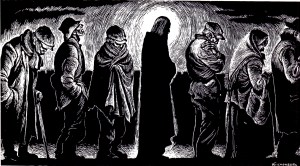
Photo Credit: http://www.catholic-chaplaincy.org.uk/homily-2014-november-30-advent-1st-sunday/

Photo Credit: http://www.catholic-chaplaincy.org.uk/homily-2014-november-30-advent-1st-sunday/

We often talk about spiritual disciplines in Church.  We encourage regular prayer, daily devotions, or time set aside for Bible study or journaling.  The options are endless really.  The idea is that you create space for regular connection to God.  Otherwise, we can easily get swept up in the busyness of life and only connect to God on Sundays – or worse, neglect our relationship with God altogether.  That temptation is ever heightened during Advent:  a time when many of forget about Advent altogether because we are so focused on Christmas.  And the secular world has no intention of helping us separate the two.  Even the Church struggles as we plan Christmas parties, pageants, greening, and liturgies.  Put simply, it is hard to focus on Advent, even if we want to focus on Advent.

To help combat this tendency, I have taken up two spiritual disciplines – one with my family and one with my Church.  The discipline my family is taking on is the 40-day bag challenge.  We are taking turns with the bags, figuring out who will be purging what areas.  But the idea is that by clearing out space in our home we might also clear out space for one another and for God.

The other discipline is reading the Advent and Christmastide devotional book, Night Visions, by Jan L. Richardson.  Richardson combines reflections, art, and poetry each day to take us out of ourselves and to help us reconnect with the quiet, intentional invitation of Advent.  Our parish is reading this book together as part of our “Reading with the Rector” program.  My hope is that by regular, short readings, I will get the boost I need to re-center each day in hope, waiting, and quiet expectation.

I mention these two disciplines not because I am proud or because I think my disciplines are particularly praiseworthy this Advent.  I mention these two disciplines because I want your help.  I want your help to keep me accountable to the life I want to have as priest, a wife, a mother, and member of my community, especially in a season when I could easily be tempted to do otherwise.  That’s the funny thing about spiritual disciplines.  Though they are personal and individual, we experience the most success in our disciplines when we share them within the community of faith.  So feel free to message me here, email me, or post questions on my Facebook wall.  And if you need help with your own disciplines, I’m happy to ask you about yours too.  Maybe together we can prepare our hearts for that most sacred night with the Christ Child.  I’m in.  Are you?

Sermon – Luke 21.25-36, A1, YC, November 29, 2015

03 Thursday Dec 2015

Posted by jandrewsweckerly in Uncategorized

≈ Leave a comment

Tags

alert, armor, Christ Child, darkness, fear, hope, Jesus, light, on guard, second coming, Sermon, waiting

Many years ago, when my husband and I were driving from our honeymoon in the Outer Banks back home to Delaware, we decided to take the scenic route.  At the time, the idea of a scenic drive sounded romantic.  We were excited to take the Chesapeake Bay Bridge-Tunnel.  And of course, as newlyweds, we were just excited to have more time together.  But by hour ten, I thought I was going to lose my mind.  I devolved into a whiny mess who could not keep still and who huffed and puffed in frustration.  I kept shifting around and fidgeting in my seat, and I am pretty sure I groaned at some point, “Are we there yet?!?”  Any notion of a romantic journey was lost – all I wanted was to get home immediately.

Truthfully, I feel similarly about Advent.  As a priest well-trained in preaching from the lectionary, I know I am supposed to be appreciative of the intentional ways in which the lectionary shapes, prepares, and teaches us.  But as soon as Advent starts, I get overly excited.  I think about the Advent candles, the purple vestments, and the greenery.  And because I know what is waiting for us on December 24th, I turn into that car-trapped honeymooner, complaining, “Are we there yet?!?”  Since I know a baby is coming, all I want to think about is Mary’s pregnancy, her relationship with Joseph, and the long journey to Bethlehem.  I am not saying I need to celebrate baby Jesus right away, but I at least would like to throw a baby shower or see Mary’s baby bump.

But that is not how Advent is presented to us in the beginning of Advent.  Instead of talking about the first coming of the Christ child, we talk about the second coming of Christ.  Instead of giddy, romantic stories about lovers making it work with an unexpected pregnancy, we get dark, foreboding tales of earthly disorder and destruction.  Instead of happy expectation, we get somber warnings to prepare ourselves and to stand guard.  Normally, I do not mind these texts at the beginning of Advent.  Theologically, I understand the concept of framing the first coming of Christ within the second coming.[i]  I understand that in order to appreciate Christ’s birth I need to remember what his birth means many years later.  I understand the need for a warning about being on guard for the second coming – a reminder that I do not get to enjoy all the fun stuff of Christ’s birth without realizing the significance of Christ’s death and return as well.  But emotionally, I am tired of being on guard.  I am tired of earthly destruction.  I am tired of feeling like the end is upon us.

That is what is so hard about Advent this year.  We are already on guard this Advent.  With terrorism striking worldwide, with gun violence in our own country, and with debates about welcoming refugees, we are already “alert at all times,” as Jesus demands.  I know people who are avoiding shopping in Manhattan this year because they are afraid of potential threats.  There are rumors of out-of-state school field trips getting canceled due to fear of danger. And some states have shut down their borders to refugees because of suspicions of terrorists in refugee disguise.  We know all too well the reality of living in fear, guardedness, and preparation for the darkness of this world.  And quite frankly, when we come to church, especially in this season of preparing for the Christ Child, the last thing we want to do is dwell on the darkness.  We want a little bit of light from Christ too.

Last weekend, the final movie in The Hunger Games series premiered.  For those of you unfamiliar with the series, the movie features a dystopian future after a failed revolution.  As punishment for revolting against the Capitol, the Capitol designs what is called The Hunger Games – a battle to the death in which two children from each of twelve districts faces one another in an arena.  Not unlike ancient practices in Rome, and yet uncannily familiar to modern times, the residents of the Capitol watch the games with a detached sense of enjoyment as they cheer for their favorites.  In the first film, President Snow talks to the head of the Games about why they have the games and a winner in the first place.  “Hope:” he explains, “It is the only thing stronger than fear.”  He goes on to say, “A little hope is effective.  A lot of hope is dangerous.”  You see, the President wants to keep people oppressed.  He knows that the people need to fear him – but he balances that fear with a tiny bit of hope so that they do not revolt again:  if they can believe that there is hope for a slightly better life while keeping the status quo, then they will strive to stay in line.  But the hope most be managed so that the hope does not liberate people from submission to the Capitol.

We could easily live lives of fear when hearing Jesus’ words today about the Second Coming.  We could worry about natural disasters, about violence, and about destruction.  We could hear Jesus’ words about being on guard, being alert at all times, and standing up to raise our heads, and be worried about the burden of constant vigilance.  But Jesus is not trying to scare us into preparation.  Jesus does not want us to live in fear.[ii]  Quite the opposite, Jesus wants to give us a big dose of hope today.  Unlike President Snow, Jesus does not manipulate us by only giving us a small amount of hope.  Though today’s text can feel full of gloom, Jesus, in his weird Jesus way, is actually trying to give a large dose of hope today.  Instead of asking us to cower in fearful anticipation, he is inviting us to stand tall, raise our heads in certainty, and be people of sober, joyful expectation.

In our collect today, we prayed these words, “…give us grace to cast away the works of darkness, and put on the armor of light…”[iii]  Many of us may question whether we can put on an armor of light in such a despairing world.  Perhaps we worry about sounding like Pollyannas or being insensitive to the suffering of the world and our communities.  But putting on the armor of light is not putting on the armor of denial or dismissiveness.  Putting on the armor of light is an act of seeing and experiencing the deep groaning of our time and proclaiming that God works as an agent of light despite what feels like overwhelming darkness.  By putting on our armor of light, we are acknowledging that “God in Christ is coming because God loves us – because God wants to redeem us.”[iv]  Putting on the armor of light means that despite all that is falling apart in our lives, our communities, and the world around us, we claim hope over despair.

Now some of us may think that putting on armor is preparing us for battle – that we are going to be issued lightsabers like the Jedi fighters of Star Wars.  But the armor of light is a bit different.  The armor of light requires us to stand tall as beacons of light in the world – much like the lighthouses that line our shores on Long Island.  Now, I do not mean putting on that armor is a passive act.  In fact, as N.T. Wright explains, our armor is not for an “exciting battle, with adrenalin flowing and banners flying, but the steady tread, of prayer and hope and scripture and sacrament and witness, day by day and week by week.”[v]  Knowing that we are slowly, steadily treading toward Jesus’ return, we need that armor of light more than ever:  to protect us from allowing fear to overcoming us, and to remind ourselves of how we are grounded in liberating hope.

And just in case you are not convinced that you can survive a long, steady tread, the community of faith gathers here every week to witness and wear that armor of light with you.  We are like those freedom fighters from the Civil Rights movement, who steadily marched – from Selma to Montgomery, through the streets of Washington, D.C., and anywhere else where fear was reigning.  Their power was in their numbers, their fortitude, and their hope.  They wore the same armor that we don today.  Yes, we will get to celebrate the birth of the Christ Child soon enough.  But before he comes, when he comes, and after he comes, we will still need to stand up, raise our heads, and be agents of light and hope.  The world needs our light – and so do we.  Amen.

[i] Mariam J. Kamell, “Theological Perspective,” Feasting on the Word, Yr. C, Vol. 1 (Louisville:  Westminster John Knox Press, 2009), 21.

[ii] David Lose, “Advent 1 C: Stand Up and Raise Your Heads!” November 23, 2015, as found at http://www.davidlose.net/2015/11/advent-1-c-stand-up-and-raise-your-heads/ on November 25, 2015.

[iii] BCP, 211.

[iv] Kathy Beach-Verhey, “Homiletical Perspective,” Feasting on the Word, Yr. C, Vol. 1 (Louisville:  Westminster John Knox Press, 2009), 25.

[v] N. T. Wright, Luke for Everyone (Louisville: Westminster John Knox Press, 2004), 260.

More…

25 Wednesday Nov 2015

Posted by jandrewsweckerly in Uncategorized

≈ 1 Comment

Tags

clergy, God, Good News, interfaith, Jesus, life, love, mercy, ministry, more, Thanksgiving, Transgender, wideness, witness, worship

Every once in a while, I have experiences in ministry when I think, “Well I never would have imagined that happening!”  I admit that the experience is rare.  There is not a lot that surprises me anymore in this line of work.  Though I am relatively young, I still feel like I have seen it all.

But that has not been the case this week.  This week I found myself in two situations I would have never anticipated.  On Sunday night, our parish hosted the Long Island Transgender Day of Remembrance.  I had no role in crafting the liturgy or planning the evening.  I simply offered our space and was asked to give an opening and closing prayer.  In fact, the planning committee warned me that this would not be like a “church service” – so I should not get my hopes up!  But as I sat in my pew, watching testimonial after testimonial, listening to over eighty names of those who were murdered because of their transgender identity, and hearing beautiful music about the wideness of God’s love and the call to love “the other” – I tell you, I experienced “Church.”  You see, Church is supposed to be about worshiping our God who shows mercy and compassion, who calls us to love the outcast and the oppressed, and who compels us to go out and witness the Good News of God in Christ.  Sunday night, I felt like the Good News came back inside and witnessed to me.

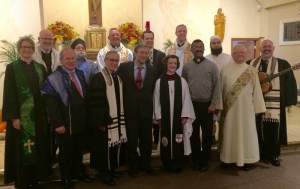
Plainview-Old Bethpage Interfaith Clergy, November 24, 2015

On Tuesday night, I participated in my fourth Plainview-Old Bethpage Interfaith Thanksgiving Service.  Every year I find the service moving. I am grateful for a holiday that we can all honor without fear of stepping on each other’s toes.  But as I sat there last night, I became acutely aware of my surroundings.  On my left sat the Mufti from the local Muslim community and on my right sat the priest from the local Roman Catholic parish.  It occurred to me in that moment that the Mufti usually only says prayers with men.  The women pray separately.  And yet, there we were, side by side, giving thanks to God.  It also occurred to me that although the priest has been warm and affirming, his Church does not recognize my ordination as appropriately apostolic – especially given my gender.  And yet, there we were, as equal leaders in our respective communities.  Despite having had long relationships with the fellow clergy leaders, this was the first time I realized how radical our relationships are – to sit next to each other despite profound differences – and yet still be able to praise, lead, and worship together.

Truthfully, I do not know what God is doing this week.  On a basic level, I suspect God is reminding me that I am not even close to having “seen it all.”  But on a deeper level, I also suspect that God is inviting me to go further, to delve deeper, and to see more widely.  Perhaps a disadvantage to my profession is a naïve sense that I have a hold on who this God is that we worship and serve.  This week, God has humbled me by reminding me that God is so much more. As I anticipate celebrating Eucharist on Thanksgiving Day, I expect to approach the Table with keener sense of wonder, gratitude, and awe for the ways in which God is so much more.  What a blessed gift this week has been.  Thanks be to God for being more than I could ask for or imagine!

Sermon – John 18.33-37, P29, YB, November 22, 2015

25 Wednesday Nov 2015

Posted by jandrewsweckerly in Uncategorized

≈ Leave a comment

Tags

ambiguity, angst, bizarre, Christ the King, communion, divinity, Eucharist, evil, faith, follow, Jesus, king, mystery, Pilate, Sermon, terrorism, uncomfortable, violence

Every once in a while, I am reminded of how bizarre our faith can sound to others.  When a child asks a seemingly basic question, or when a non-believing stranger asks me a question that is not easy to explain, I can imagine how strange my responses sound.  But having been raised in the faith, the strangeness never bothered me.  And if I really was not sure about something, I found myself comfortable with the explanation, “It’s a mystery.”

But lately, I have been barraged by incidents where “It’s a mystery,” just does not cut it!  The first instance was the First Holy Communion class I did with David and William a few weeks ago.  David and William actually went pretty easy on me.  But those classes are always challenging because they do not allow you to simply experience Holy Eucharist – I have to explain Holy Eucharist:  from why we process and reverence an instrument of death (the cross had the same purpose as our modern-day electric chair); to what to do when we don’t necessarily believe everything in the Nicene Creed; to why the priest holds out her hands during the Eucharistic prayer.  The second instance of “It’s a mystery,” not cutting it was in Bible Study class last week.  The group is reading John and John’s rather gory discussion of eating flesh and drinking blood.  The group wanted to know what Episcopalians believe about what happens to the bread and wine when the priest consecrates the elements – and how that differs from what other denominations believe.  I am fairly certain that if I had told the group that what happens in Eucharist is a mystery, they would not have let me off the hook so easily.  The final instance of “It’s a mystery,” not cutting it has been in reading the book, The Year of Living Biblically.  In this past week’s assignment, our author, A.J. Jacobs finally makes his way into the New Testament.  As an agnostic Jew, the author discusses his fears about trying to live the Bible literally if he cannot get behind the idea of Jesus as the Messiah and the idea of Jesus being both human and divine.  As a cynical New Yorker who confesses he has no desire to convert, I am sure my “It’s a mystery,” explanation would get him nowhere.

The challenges of our faith are not limited to worship, Eucharist, and Jesus’ divinity.  Today we celebrate yet another bizarre element of our faith – Christ the King Sunday.  On this last Sunday of Pentecost, before we enter into the season of Advent, we declare Christ as our King.  On the surface, that is not a bizarre claim, I realize.  Many communities have kings, and the way we venerate Christ is not unlike the way many kingdoms venerate their kings.  Given the familiarity of that image, we might imagine that Christ the King Sunday is about regal processions, festive adornments, and praise-worthy songs.  In fact, we will do some of that today.  The problem though with Christ the King Sunday is not that Jesus is our King.  The problem is what kind of king Jesus is.

We have seen evidence of what kind of king Jesus is.  Most famously would be the Palm Sunday procession.  Jesus does not ride into Jerusalem on horseback with a sword and an army.  No, he rides into town on a borrowed donkey, accompanied by a little crowd – nothing newsworthy really.  There are other clues too.  There is that time when the Samaritans refuse housing to Jesus and his disciples.  The disciples ask, “Lord, do you want us to command fire to come down from heaven and consume them?”[i]  But Jesus just rebukes the disciples and keeps on going.  Even when Jesus knows Judas is going to betray him, he does not stop Judas.  Instead of stopping Judas or outing Judas, Jesus quietly lets Judas leave to betray him.

So we should not be surprised today at the interaction between Pilate and Jesus and why this passage, of all passages, should be selected for Christ the King Sunday.  Pilate is perplexed by this man who is being labeled (or more accurately, is being accused of having claimed to be) the king of the Jews.  So Pilate asks repeatedly whether Jesus is indeed the king of the Jews.  Jesus mockingly explains that if he were a traditional king, his people would be fighting to save him – which they are decidedly not doing.  Jesus cryptically further explains that his kingship does not look like kingship in the traditional sense – and in fact, his version of kingship is the only kind of kingship that can save anyone.  Violence, retaliation, and revenge will not work.[ii]  A battle of wills will not win control.  The only thing that will win is sacrifice, selflessness, and ceding.  Jesus will not overcome the evil of the world by matching wills with rulers like Pilate.  Jesus will only overcome by allowing himself to be overcome.  When we really think about Jesus’ kingship, his kingship is yet another bizarre thing about our faith.  Who pins their faith on a weak, non-violent, forgiving man?

Given the multiple terrorist attacks we have witnessed over the past week, the irony of Christ the King Sunday is not lost on me.  Just this past week, at Lunch Bunch, we were discussing the challenges of engaging in war to stop terrorism verses isolationism.  The discussion we had was the same discussion that hundreds of theologians have had for centuries.  I have even witnessed top scholars debate the ethics of intervention versus non-violence.  We watch Jesus turn the other cheek – in fact, Jesus tells us to turn the other cheek, give away our tunics, go a second mile, give to borrowers, and love our enemies.[iii]  But we watched what happened in World War II when we stayed out of the war as long as possible – a genocide happened.  And we have seen what sanctions do in foreign countries – though they are non-violent, the brunt of the restrictions hit the poorest of the country.  And yet, we are also only one country.  We cannot possibly fight every force of evil, have troops in every country, and wage war every time evil emerges.

This is one of those times when I would love to say, “It’s a mystery!”  We say that phrase because the answer is beyond our knowing – or because we just do not know the answer.  Any kind of guessing about “What Would Jesus Do,” is not likely to get us very far.  We know that Jesus does not fight Pilate today, and has no intention of answering evil for evil.  But we also know that Jesus is wholly other – the Messiah, the Savior, the sacrifice for our sins.  His death is different from our deaths, and the kingdom he brings is both already and not yet.

Despite the fact that I cannot give you answers about what we should do about ISIS, about terrorism, or about violence, what I can tell you is that the ambiguity of Jesus’ identity as Christ the King is actually good news today.  Now I know ambiguity does not sound like a gift.  But in this instance, I believe ambiguity is where we can put our faith today.  Ambiguity is a gift today because ambiguity makes us uncomfortable.  Because we do not have definitive answers, we are forced to stay in prayer and keep discerning God’s will in this chaotic world.  Because we do not have a king who answers violence for violence (which is quite frankly, a very easy black-and-white formula to replicate), we are forced to contemplate our faith in light of the world.  Because we follow Christ the King, we do not get to say, “It’s a mystery,” as an excuse not to wrestle.

As I think about the conversations I have had with David and William, with our Thursday Bible Study Group, and even the conversation I would have with A.J. Jacobs, I realize ambiguity is the most honest, vulnerable, real way we can start any conversation about faith and Jesus Christ.  And if we ever want a young person, a non-believer, or even someone wise beyond their years to trust that they can have an authentic, meaningful conversation with us about faith, then we have to be willing to step into the ambiguity of faith.  One of Jacobs’ advisors talks about the “glory of following things we can’t explain.”[iv]  That is what Christ the King offers us today – the opportunity to follow things we cannot always explain.  Jesus invites us share our ponderings and struggles with knowing this king who is sometimes counterintuitive.  He invites us to relinquish our angst about the ambiguity, and instead to celebrate the King of ambiguity.  Amen.

[i] Luke 9.54.

[ii] David Lose, “Christ the King B:  Not of this World,” November 16, 2015 as found at http://www.davidlose.net/2015/chirst-the-king-b-not-of-this-world/ on November 19, 2015.

[iii] Matthew 5.39-48.

[iv] A. J. Jacobs, The Year of Living Biblically (London:  Arrow Books, 2009), 203.

You did it to me…

19 Thursday Nov 2015

Posted by jandrewsweckerly in Uncategorized

≈ Leave a comment

Tags

compassion, doing, Elizabeth, exhaustion, fatigue, feeling, Jesus, refugees, suffering, thinking, violence

I have been struggling with what to say in the face of recent acts of violence, the American debate about welcoming Syrian refugees, and an overwhelming sense of compassion fatigue and confusion about what is the “right” thing to do when considering war and peace, good and evil, life and death.  Theoretical conversations only get us so far.  Real life is where our theology is truly tested.  This week, instead of being fired up and ready for action, I find myself exhausted – exhausted by our continual ability to treat each other inhumanely, exhausted by an overwhelming sense impotence in the face of suffering and evil, and exhausted by oversimplifications and generalizations that end up justifying our behavior.

In the midst of my exhaustion, fatigue, and inability to articulate anything coherent this week, I celebrated the life and witness of Elizabeth, Princess of Hungary at Eucharist today.  For those of you who do not know her story, she was born in the early 1200s and was married by age fourteen.  She had a passion for the poor; so much so, that her husband allowed her to use her dowry to tend the sick and poor.  When a famine struck the land, she sold her jewels to build a hospital to care for others and she opened the royal granary.  When her husband died, she was kicked out by the court for her “extravagances.”  But she dedicated her life to the sick and poor anyway, and died at age 24 from exhaustion.

Photo credit:  http://maxwellheightschurch.com/serving-the-world/

Photo credit: http://maxwellheightschurch.com/serving-the-world/

As I celebrate another year this month (many more than Elizabeth got to enjoy), I am struck by how much she did in so little time.  I am exhausted from thinking and feeling so much.  Elizabeth was exhausted from doing so much.  And as if I needed any further reminder of what Jesus is calling me to do than Elizabeth’s witness, the gospel lesson assigned today comes from Matthew.  Jesus says, “I was hungry and you gave me food, I was thirsty and you gave me something to drink, I was a stranger and you welcomed me, I was naked and you gave me clothing, I was sick and you took care of me, I was in prison and you visited me…Truly I tell you, just as you did it to one of the least of these who are members of my family, you did it to me.”  (Matthew 25.31-40)

While my exhausted heart, mind, and soul are wondering what to make of all of this, Jesus is clear and strong.  I was hungry and you gave me food, I was thirsty and you gave me something to drink, I was a stranger and you welcomed me.  When I feed, slake, or welcome others, not only am I loving them, but also I am loving Christ Jesus.  I am sure Jesus is moved when our hearts and minds pondering these things.  But today, Jesus is also inviting us to do.  To feed, slake, welcome, clothe, tend, and visit.  Because when we do those things, we do them to Jesus.

Sermon – 1 Samuel 1.4-20, 2.1-10, P28, YB, November 15, 2015

19 Thursday Nov 2015

Posted by jandrewsweckerly in Uncategorized

≈ Leave a comment

Tags

anger, God, Hannah, honest, intercession, intimacy, praise, pray, prayer, relationship, Sermon, Thanksgiving, vulnerable

At some point in life, most of us have the experience of having a best friend.  Perhaps we met the person on the playground as a child; maybe we met him in college or at work; perhaps our best friend is a cousin or sibling; or maybe our best friend is our spouse or partner.  Regardless of how we met her, that best friend has seen the best and worst of us.  He has congratulated us when we got a part in the play, when we got a promotion, or when we found new love.  She has consoled us when we failed a test, when our heart was broken, or when a family member died.  He has seen us laugh so hard that we snort or pee in our pants, and he has seen us sob so hard that snot runs down our faces.  She has seen us dressed to the nines, and she has seen us in our stained, ill-fitting sweats.  And our best friend has taken the best and the worst from us too:  we have danced together, yelled at each other, confessed our darkest secrets to each other, and, yes, we have even hated each other at times.  Despite having experienced the very best and very worst of us, we know that she loves us deeply, he always forgives us, and she is always there for us.  The relationship is far from perfect, but the relationship is beautiful.

In many ways, the relationship we have with our best friend is similar to the relationship we have with God.  On our good days, we come to God with our thanksgivings and praise, offering our adoration and humility to God.  On our bad days, we are angry and curse God.  We confess things to God that we confess to no one else:  both those things done and left undone, but also those deep longings and desires that we do not admit to others.  We have cried a thousand tears with God and we have laughed with great mirth.  Although our best friend knows us better than any other human being, God knows even the stuff we are embarrassed or afraid to share with that best friend.  And since our Lord is not human, God’s forgiveness does not know the limits of human forgiveness.  Through the life, death, and resurrection of Jesus Christ, our relationship with other human beings will never quite equal our relationship with God.

Given that intimacy, I am often surprised when people ask me about prayer.  Throughout my ministry I have had people ask me how they should pray, what they should say, or when or where is the best time and place to pray.  I think the challenge is that most of us have some notion of what prayer should look like.  We imagine the pinnacle of brayer being the Zen-like posture of monks in silent prayer.  Or when someone offers a prayer, we assume we should bow our heads, fold our hands, and shush others into silence.  Or when someone asks us to offer the prayer, we scramble to remember common prayer phrases like, “Holy God…Bless us, we pray…you alone are worthy…”  Our prayers sound very little like our everyday speech.  Sometimes, if we are feeling especially uncomfortable, we peek around the room to see what everyone else is doing.  People often ask me how to pray because they do not feel like they are doing it “right,” because their usual method of prayer has become stale or dissatisfying, or because when they pray, God seems far away or even like a stranger.  Or sometimes people come to me about prayer because they are overwhelmed with the suffering of the world:  the poverty, the gun violence, the terror that keeps striking in places like Paris.  How do we pray to God when suffering seems like an endless abyss?

In scripture today, we see Hannah pray twice.  In the first occurrence, Hannah looks nothing like our notions of prayer.  She has been emotionally tortured by Elkanah’s second wife, Peninnah – just like Peninnah does every year when they travel to make their annual sacrifice.  Peninnah is ever fertile and Hannah is barren.  And, probably because Elkanah loves Hannah more, Peninnah throws Hannah’s infertility in her face whenever she can.  Meanwhile, Elkanah is acting like a wounded puppy.  He does not understand why Hannah is so upset – isn’t he enough?  So Hannah escapes to the Temple to pray.  Her prayer is unlikely offered from a pew, while she delicately flips through a prayer book to find some pre-written prayers.  Her prayer is not said reverentially, with a bowed head.  In fact, she does not quietly whisper prayers to God with her eyes closed.  No, when Eli, the temple priest, sees Hannah praying, he accuses Hannah of being drunk in the Temple.  Now I do not know if you have ever been in the presence of a drunken person, but people who are drunk are rarely still and reserved.  No, I imagine Hannah was pacing.  Maybe she was waving her fists at God as the tears spilled down her cheeks.  Maybe there was rage and devastation in her eyes.  The text says that she is silent, but that her lips are moving.  I imagine she was giving God a piece of her mind.  And in fact, the text tells us that she even resorts to bargaining with God – promising to commit his life to the Temple if God gives her a male child.  If Eli thought Hannah looked drunk, the scene could not have been pretty!

The second occurrence of Hannah praying today is found in the Song of Hannah from first Samuel.  Here we see a very different posture of prayer from Hannah.  Instead of ranting and raving in the temple, here we see Hannah giving praise to God for the deliverance of a child.  Hannah is full of gratitude for her own good fortune.  But Hannah’s prayer is bigger than herself too.  She proclaims the Lord to be a liberator – one who frees the oppressed, brings low the privileged, honors the faithful, and cuts off the wicked.  In Hannah’s personal experience with God, she is given a glimpse into the global nature of God.[i]  Hers is revolutionary song because God has heard her prayer and answered her.  We see a very different form of prayer from Hannah the second time than we do from Hannah the first time.

For those of you reading along with A.J. Jacobs’ The Year of Living Biblically, prayer is common topic from the author.  Not a believer himself, Jacobs struggles with prayer.  He does not know what to do or say.  But he feels compelled by the Bible to be in prayer.  One of his spiritual guides suggests that there are four types of prayer – Adoration, Confession, Thanksgiving, and Supplication.[ii]  Jacobs latches on to Thanksgiving at first.  He starts by thanking God for the food that has been prepared, in its many stages.  As he thinks about all the stages – the earth, the farmer, the packager, the person who puts on labels, the grocery stockers, the cashier – his prayer lengthens.  Jacobs also takes on intercessory prayer as a form of prayer – praying strictly for the needs of others.  Jacobs confesses, “It’s ten minutes where it’s impossible to be self-centered.  Ten minutes where I can’t think about my career, my Amazon.com ranking, or that a blog in San Francisco made snarky comments about my latest Esquire article.”[iii]  Slowly, Jacobs’ ideas about and experiences of prayer become transformed.  Prayer is not like what he thought prayer would be like.

That’s the great thing about prayer.  Hannah’s first “drunken” prayer of desperation and self-pity, her second prayer of adoration and revolution, and Jacobs’ ten minutes of intercessions that keep him from being self-centered are totally different.  My prayers in the car on the way to pick up the kids are very different from the prayers our Contemplative Prayer Group offers on Friday nights.  And the prayers of an evangelical pastor, which are accompanied by the creative tinkling of the keyboardist to emphasize and dramatize the preacher’s prayers, are totally different from the chanted prayers of the officiant of Evensong.  There is no single wrong or right way to pray.  And the same person who offers eloquent, beautiful prayers in the day can be the same person who rages against God in the night.

When we allow prayer to be what prayer needs to be, we let go.  Then our prayers become not some preconceived notion of what we think they should be, but become a real conversation between us and the living God.  Whether we are wrapped up in our own suffering, totally ceding our worries to God, or railing at God for the injustice and the inhumanity in this world, something powerful happens in prayer.  Where else can we stomp our feet at God, looking like a drunkard, except at the feet of God?  Ultimately, that is what is most important in our prayer life – being our honest, vulnerable, mercurial selves.  As one priest explains, “…The relationship we’re offered with God is a real one.  A genuine relationship.  The God who made the heavens and the earth wants to know us, and wants us to know [God].  And when we’re excited, we’re to gush out like Hannah breaking out into song.  And when things are falling apart, we’re to gush out like Hannah at Shiloh.”[iv]  God does not care what our prayers look like or even what we say.  God is just glad we show up.  Our invitation this week is to show up.  Amen.

[i] Kate Foster Connors, “Pastoral Perspective,” Feasting on the Word, Yr. B, Vol. 4 (Louisville: Westminster John Knox Press, 2009), 298, 300.

[ii] A. J. Jacobs, The Year of Living Biblically (London:  Arrow Books, 2009), 95.

[iii] Jacobs, 128.

[iv] Rick Morley, “Pouring Out Our Souls – A Reflection on 1 Samuel 1.4-20 & 2.1-10,” November 8, 2012, as found at http://www.rickmorley.com/archives/2052 on November 12, 2015.

← Older posts
Newer posts →

Recent Posts

  • On the Myth and Magic of Advent…
  • On Risking Failure and Facing Fear…
  • Sermon – Luke 23.33-43, P29, YC, November 23, 2025
  • On Inhabiting Gratitude…
  • Sermon – Luke 20.27-38, P27, YC, November 9, 2025

Archives

  • December 2025
  • November 2025
  • October 2025
  • September 2025
  • August 2025
  • July 2025
  • June 2025
  • March 2025
  • February 2025
  • December 2024
  • November 2024
  • October 2024
  • September 2024
  • August 2024
  • July 2024
  • June 2024
  • May 2024
  • March 2024
  • February 2024
  • January 2024
  • December 2023
  • November 2023
  • October 2023
  • September 2023
  • August 2023
  • July 2023
  • June 2023
  • May 2023
  • March 2023
  • February 2023
  • January 2023
  • December 2022
  • November 2022
  • October 2022
  • June 2022
  • May 2022
  • January 2022
  • December 2021
  • November 2021
  • October 2021
  • September 2021
  • August 2021
  • June 2021
  • May 2021
  • April 2021
  • March 2021
  • February 2021
  • January 2021
  • December 2020
  • November 2020
  • October 2020
  • September 2020
  • August 2020
  • July 2020
  • June 2020
  • May 2020
  • April 2020
  • March 2020
  • February 2020
  • January 2020
  • December 2019
  • November 2019
  • October 2019
  • September 2019
  • August 2019
  • July 2019
  • June 2019
  • May 2019
  • April 2019
  • March 2019
  • February 2019
  • January 2019
  • December 2018
  • November 2018
  • October 2018
  • September 2018
  • August 2018
  • July 2018
  • June 2018
  • May 2018
  • April 2018
  • March 2018
  • February 2018
  • January 2018
  • December 2017
  • November 2017
  • October 2017
  • September 2017
  • August 2017
  • July 2017
  • June 2017
  • May 2017
  • April 2017
  • March 2017
  • February 2017
  • January 2017
  • December 2016
  • November 2016
  • October 2016
  • September 2016
  • August 2016
  • July 2016
  • June 2016
  • May 2016
  • April 2016
  • March 2016
  • February 2016
  • January 2016
  • December 2015
  • November 2015
  • October 2015
  • September 2015
  • August 2015
  • July 2015
  • June 2015
  • May 2015
  • April 2015
  • March 2015
  • February 2015
  • January 2015
  • December 2014
  • November 2014
  • October 2014
  • September 2014
  • August 2014
  • July 2014
  • June 2014
  • April 2014
  • March 2014
  • February 2014
  • January 2014
  • December 2013
  • November 2013
  • October 2013
  • September 2013
  • August 2013
  • July 2013
  • June 2013
  • May 2013
  • April 2013
  • March 2013
  • February 2013
  • January 2013
  • December 2012
  • November 2012
  • October 2012
  • September 2012

Categories

  • reflection
  • Sermons
  • Uncategorized

Meta

  • Create account
  • Log in
  • Entries feed
  • Comments feed
  • WordPress.com

Blog at WordPress.com.

  • Subscribe Subscribed
    • Seeking and Serving
    • Join 394 other subscribers
    • Already have a WordPress.com account? Log in now.
    • Seeking and Serving
    • Subscribe Subscribed
    • Sign up
    • Log in
    • Report this content
    • View site in Reader
    • Manage subscriptions
    • Collapse this bar
 

Loading Comments...