• About

Seeking and Serving

~ seek and serve Christ in all persons

Seeking and Serving

Category Archives: Uncategorized

In the midst of life…

19 Wednesday Nov 2014

Posted by jandrewsweckerly in Uncategorized

≈ 3 Comments

Tags

birth, blessing, church, death, Diocese, God, joy, life

Courtesy of http://www.glogster.com/deathhangel/death-and-life/g-6l1p46td8m4d3uhesabrba0

Courtesy of http://www.glogster.com/deathhangel/death-and-life/g-6l1p46td8m4d3uhesabrba0

Maybe it is because today is my birthday or maybe it is because we just lost a dear family member to cancer, but life and death have been on my mind a lot lately.  The funny thing about being a priest is that those two things are almost always held in tension.  In the course of one week, I can hold the hand of a dying person and then bless a baby at the communion rail.  I can celebrate a funeral and baptize a child in the course of two days.  I can officiate a wedding and offer counsel to someone getting a divorce in a matter of weeks.  And so, with the death of our family member so fresh in my mind, I took a deep breath on the way to work today and thanked God for this wonderful life that I have been given.  Many days I grumble and complain about the little stuff of life – but today, both life and death are giving me perspective.

The same has been true about my work lately.  This past weekend, The Diocese of Long Island held its Annual Convention.  In the Bishop’s address, he told us about the many churches around the diocese that had closed or merged with other parishes.  Though he ran through the list relatively quickly, I knew all too well how painful each of those closures must have been.  I have been a part of churches that have had to close and it is a brutal process – it feels very much like the death of a loved one.

But just like in the death of a loved one, life slowly springs up.  The Bishop told us about a particular parish in Brooklyn that had to close due to “life-safety issues.”  Located near the Barclays Center, the sale of the property netted almost $20 million for the Diocese – all of which is being invested and distributed.  Some of the proceeds will go to support local churches and ministries while others will be used for international missions.  But out of that death is coming tremendous life.  Though we mourn with that community, through the death of that stage of their ministry they are birthing incredible new life.

And such is life – a continual cycle of life and death, suffering and blessing, mourning and celebrating.  Today, I turn toward celebration and life.  I can do that with deep joy because the sobering reality of death sets me free to appreciate every blessing of this life.  My cup runneth over – thanks be to God!

Sermon – Matthew 25.1-13, P27, YA, November 9, 2014

12 Wednesday Nov 2014

Posted by jandrewsweckerly in Uncategorized

≈ Leave a comment

Tags

abundance, choice, choices matter, forgive, God, growth, life, rigidity, scarcity, Sermon, trust, unforgiving

I am fortunate in that I do not have a long commute to work.  But there have been a few times when I have needed to take the Long Island Railroad during morning rush hour.  What I found fascinating about those trips is how people use their time on the train.  Most people are on their phones, probably doing any number of things:  scanning email, sending a few quick texts, checking Facebook, reading the news.  Some people are reading the paper:  catching up on the headlines, reading the sports page, or checking the financial reports.  Others use their hour on the train to catch up on sleep.  That one always scares me – how people sleep lightly enough not to miss their stop is beyond me.  And I suppose there are a few people like me, who enjoy the people watching.  But those are rarely the morning regulars – they got over that fascination a long time ago and chose some other way to spend their time.

We make choices every day:  how we spend our money, what we will do with free evenings, what groups we want to be involved in, and with whom we want to spend our time.  What we do while commuting is just one example of the myriad choices available to us on a given day.  But over time, those choices begin to shape who we are.  Those choices begin to define whether we are an avid reader, someone who is connected to the goings-on of the world, someone who is physically fit, or someone who is known for their volunteer work.  What seem like inconsequential decisions, like regularly watching a TV show, a standing appointment with a friend for dinner, or joining a civic group, slowly begin to shape a life.  Those little choices we make day in and day out shape who we are and what our life is really about.  In my line of work, I go to a lot of funerals, and that is one of the consistent things I see:  the choices a person makes over time informs who they are.  So in a eulogy, someone is described a devoted mother, or an avid sailor, or an advocate for the poor.

Our gospel lesson today is all about how our choices matter.[i]  The most obvious choice we see is the choice by the foolish bridesmaids not to bring extra oil.  Actually, the foolish bridesmaids make two choices.  First, they choose not to bring extra oil, perhaps assuming the groom will not be long.  Second, once they realize they are out of oil and the others are not going to share, they choose to go buy more.  Neither of their choices is illogical really.  Based on the customs of the time, the maids should not have needed extra oil.[ii]  Their choice not to bring extra oil is a perhaps presumptuous, but not scandalous.  The second choice is reactionary.  The wise bridesmaids tell them to go and they do – in the middle of the night, the foolish maids make an impetuous decision that ends up costing them greatly.  The foolish maids’ choices create a world fraught with risk – where split-second decisions leave the maids with little footing in a world that is constantly throwing choices at them

But the foolish bridesmaids are not the only ones making choices in our parable today.  The wise ones make choices too.  When faced with the needs of the oil-less bridesmaids, the wise bridesmaids send the foolish ones away to get their own oil.  They do not consider sharing their oil or allowing the foolish ones to stand with them.  Quite frankly, they should not have to share.  They have thoughtfully constructed a world in which careful planning and preparation pay off in great rewards.  Their choices have lead to a world in which everyone fends for themselves, where pity is not necessary, and boundaries are clear and concise.

And of course, the bridegroom makes a choice too.  When the foolish bridesmaids knock at the door, the groom has a choice:  he can justifiably send them away since they were not considerate enough to be ready and waiting for him; or he can be forgiving and graciously allow them into the celebration.  The choice of the groom to close the door leads to a world in which mistakes are severely punished and there are no second chances.

This parable is one of those parables that does not leave us feeling good about the world.  In fact, the choices of the characters in the parable depict a world that is marked by rigidity, scarcity, and lacking in forgiveness.  We know this world all too well.  All we have to do is listen to the current debate in the United States about immigration.  Whenever we debate the issue of what to do with illegal immigrants, the arguments are similarly marked by rigidity, scarcity, and a lack of forgiveness.  We worry about the drain on our resources with illegal immigrants – the health care, education, and social services needed for them.  We worry about the jobs they will be taking from legal citizens.  And we worry about our capacity for compassion – I have heard many argue that we cannot save every child in the world by welcoming them here.  All of those fears are valid.  And so we draw boundaries, we put up limits, and we say no.  We make choices that shape our experience as Americans.  And like the bridesmaids with extra oil, our decisions could probably be labeled as wise.

Although that wisdom is usually praiseworthy, and is clearly praised in our lesson today, for some reason, that wisdom does not sit well with me this week.  Instead, I have found myself wondering what other choices the three characters in this story could have made. [iii]  The foolish bridesmaids could have simply chosen to stay.  Sure, they would have had to risk being in the dark for a while, and leaning into the light of others.  They may even have had to plead their case with the groom once he arrived.  But at least they would have been there.  They could have stayed.  Staying would have been scary and made them vulnerable.  But they could have chosen to stay.  Meanwhile, the wise bridesmaids could have chosen to either share their oil, or stand side-by-side with the foolish ones, letting their light shine the way for both of them.  Sure, they were within their right to refuse.  They are the ones who thought ahead and did the right thing.  But they could have chosen another way.  They could have chosen to share their abundance with the foolish.  The bridegroom had a choice too.  The groom had every right to refuse entry to the foolish maids – based on what he knew, they were late and unprepared.  He had no obligation to let in people to his celebration who do not care enough about him to be prepared to wait for him.  But the groom could have chosen to let them in anyway.  He could have chosen gracious hospitality, even to the undeserving maids.

I recently had a conversation with another parent about creating healthy eating habits for children.  She was explaining to me a philosophy in which parents let children guide their own eating choices.  So instead of serving children the healthy food first and then bringing out the dessert, the parent is to put everything out on the table and allow the child to serve themselves.  The argument is that through experience, the child will eventually learn that loading up a plate with dessert leaves the child unsatisfied, if not sick.  Over time, the child will learn what foods make her feel good, what portions she needs to feel full, and how to plan her plate accordingly.  Truthfully the idea sounded crazy to me – like some hippy, permissive parenting that would lead to malnourished, unruly children and wasted healthy food.  But then again, I tend to choose a world guided by structure and order imposed from an authority.  This parent was suggesting a different kind of world guided by trust, that makes room for growth through mistakes, and that leads by example.

That is the funny thing about choices.  Our choices shape our world.  Most people read today’s gospel and think:  Okay, the moral of the story is to choose preparedness and alertness and when Jesus returns, we will be ready.  But instead, the moral of this story might be that the choices that we make shape our world – and our choices may not be as obvious as we think.  So yes, we can choose to live lives with strict boundaries and rules, lives that are guarded and have limits, and lives that are grounded in consequences.  We can also choose to live lives that are grounded in forgiveness, that make room for mistakes, and that make us uncomfortable, but also make room for joy.  Sometimes those choices will be obvious: when we actively decide to forgive someone who has wronged us or when we purposefully decide to share our resources even though the other does not deserve our generosity.  But sometimes the choices will not be so obvious:  when we commit to a new ministry, even if we are not sure where that ministry will take us or what that ministry will demand of us; when we choose to give up some of our disposable income to support the work of this church, even if we are not sure we can spare the money; or when we give up some of our family’s outside commitments so that we can be more present in the life and work of the church.  Those choices demand sacrifice, vulnerability, and work.  But those choices might also be the choices that make someone say at our funeral, “He loved the Lord, he loved the church, and he boldly lived a life of trust and abundance.  And look where his life led.”  Amen.

[i] Anthony B. Robinson, “Choices that Matter,” Christian Century, vol. 110, no. 29, October 20, 1993, 1011.

[ii] John M. Buchanan, “Pastoral Perspective,” Feasting on the Word, Year A, Vol. 4 (Louisville: Westminster John Knox Press, 2011), 286.

[iii] David R. Henson, “The Breaking of the Bridesmaids: Rethinking a Problematic Parable” as found at http://www.patheos.com/blogs/davidhenson/2014/11/the-breaking-of-the-bridesmaids-how-scripture-undermines-a-parable/ as posted on November 3, 2014.


Finding our way through priorities…

05 Wednesday Nov 2014

Posted by jandrewsweckerly in Uncategorized

≈ Leave a comment

Tags

blessed, church, fair share, gift, God, pledge, resources, stewardship, walking the way

This year, St. Margaret’s has been Walking the Way through our Stewardship Season, praying on what giving means to us, why we give, and how our giving shapes our relationship with God and our church.  Below is a guest post from parishioner Kimberly Irvine on why she is pledging this year, and how the Holy Spirit is moving in her on her Walk.  I hope you enjoy her words.

Writing this blog post was not an easy exercise for me.  My desire to find the exact words to express to you why stewardship and pledging are vital to our church, was keeping from saying what is my heart.

The fact is I’m truly grateful to God for allowing me to be part of this community of faith.  St. Margaret’s has always been for me, a place filled with faith, joy, and love.  I believe in the good work our church is doing. I see God’s love at work in our church all the time.

Part of me is also worried because the church budget is projecting that in 2015 our church will be operating at a deficit again.  The funds our church raises through pledges, and other fund raising activities, will not generate enough revenue to cover the operating expenses of our church.  This surprises me because as a parish, I believe we are all very blessed, we are generous when asked to support special initiatives, and we share a common desire to be part of this extraordinary community.

Courtesy of http://imgarcade.com/1/christian-stewardship-clip-art/

Courtesy of http://imgarcade.com/1/christian-stewardship-clip-art/

Learning of the church’s deficit, also makes me begin to question whether or not I’m giving my fair share to our church.  God has given generously to me; am I giving back as generously as I should?  This is not an easy question to answer. We all worry about money.  We need to pay our mortgages, and other bills.  We also want to go on vacations and have nice things.  I’m remembering part of sermon we heard earlier this month, where we were reminded that all we have comes from God.  Everything we have is not ours; it is all God’s, and we must give back to God what is God’s.  Can we prioritize and give to God first?

Since I believe strongly in the mission and vision of our church, I feel responsible to use the resources God has given me to financially support the church.   I make a financial commitment to St. Margaret’s because I really want our church to thrive and grow.  I want to see the good work of our church continue to expand in our community and the world.  This year I plan to increase my pledge, and try to be more intentional about giving to God first.  I pray that all parishioners of St. Margaret’s can make similar commitments in support of our church.

We are united in faith; let’s also be united in contributing financially to our church.

I found this prayer from this year’s stewardship bulletin very meaningful:

Gracious God, giver of all we have and hold; grant the people of this church a deep and abiding awareness that all things come from you – our health, our incomes, our jobs, our talents and our generous impulse.  Send your Holy Spirit to help us as we swim against the rising tides of materialism, envy, individualism and greed I our culture. When we are tempted to think of money as a private matter, remind us that you have asked for part of what we are given, to be returned to you as a symbol of our awareness that you give all we have. And finally, assist us as we help each other to embrace the grace of giving, for you are the lover of our souls and call us to nothing less than transformation in Jesus Christ our Lord. Amen.

Respectfully submitted by Kim Irvine

Sermon – Matthew 5.1-12, All Saints Sunday, YA, November 2, 2014

05 Wednesday Nov 2014

Posted by jandrewsweckerly in Uncategorized

≈ Leave a comment

Tags

Beatitudes, blessed, discipleship, God, Jesus, journey, money, path, road, Sermon, stewardship, walking the way

Courtesy of http://firecatching.blogspot.com/2011_04_01_archive.html

Courtesy of http://firecatching.blogspot.com/2011_04_01_archive.html

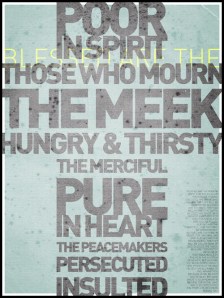
Today we hear one of the most beloved pieces of scripture.  The Beatitudes from Matthew’s gospel have been the source of inspiration for Christians for centuries, for artists and musicians, for entire ministries, and even for comedians like Monty Python.  As soon as we hear that phrase, “Blessed are…” our eyes close and we let the words flow over us.  We nod in assent, and maybe even whisper, “Yes!”  And as the preacher for In-Gathering Sunday, getting the Beatitudes in the lectionary is like being handed a silver platter.  What other inspiration can we need on a Sunday like this than to think about blessings?  That is what our Stewardship Committee has been encouraging us to do for weeks: to think about the ways that we are blessed and to return that blessing to this community through the gift of our financial resources.  That message could not be better captured than in the Beatitudes from our gospel lesson today.

Or at least that is what I thought before I started really working with the Beatitudes this week.  The more I poured over the text, the more I became confused.  Then the questions came pouring in:  What does it mean to be poor in spirit?  How do we know if we are pure in heart?  I might prefer peace, but could any of us in our everyday lives be considered peacemakers?  And those are just the surface level questions.  When we read at a deeper level, ethical questions begin to emerge.  Our news outlets have been flooded lately with people who are reviled, persecuted, and having evil uttered against them.  All we have to remember are Christians in Iraq, Palestine, or Burma whose very faith means a life of oppression and sometimes death.  Is the word for them today, “You are blessed”?  Many a liberation theologian has balked at the idea of Holy Scripture being used to keep down oppressed peoples.

Luckily, I stumbled on two things this week that opened up the Beatitudes for me in a fresh way.  First I began to look at what the word translated as “blessed” really means.  There are a couple of words in scripture that are translated in English as “blessed,” but they do not necessarily have the same meaning.  In our Beatitudes today, one scholar argues that the phrase translated as “blessed are you when…” is more rightly translated as “You are on the right road when…”  For example, “You are on the right road when you are poor in spirit.”[i]  So blessed does not really mean, “Happy are you when people persecute you,” but instead, “You are on the right road when people persecute you.”  Somehow this translation makes for a much more sober, honest rendering of Jesus’ words.  Jesus is not saying that these things are cause for happiness in a superficial way.  Jesus is saying that we are fortunate in those experiences because they point us to a deeper truth:  that we are heading in the right direction, making the right decisions, and living a meaningful life.

The other source of insight I found this week was from The Message’s translation of this text.  If you are not familiar with The Message, The Message is a paraphrase of the Bible:  not a literal translation of the Biblical language, but a modern rephrasing of the text to make the text more accessible.  Of course, biblical scholars often cringe when they hear certain paraphrases of key texts, but in the case of the Beatitudes, I found this paraphrase quite useful.

I have taken the two ideas – The Message’s paraphrase and the new introduction of “You are on the right road when…” and want to read for you my hybrid rephrasing of the Beatitudes.  Our text now goes like this:

You are on the right path when you’re at the end of your rope.  With less of you there is more of God and God’s rule.  You are on the right path when you feel you’ve lost what is most dear to you.  Only then can you be embraced by the One most dear to you.  You’re on the right path when you’re content with just who you are—no more, no less.  That’s the moment you find yourselves proud owners of everything that can’t be bought.  You’re on the right path when you’ve worked up a good appetite for God.  God’s food and drink in the best meal you’ll ever eat.  You’re on the right path when you care.  At the moment of being ‘care-full,’ you find yourselves cared for.  You’re on the right path when you get your inside world—your mind and heart—put right.  Then you can see God in the outside world.  You’re on the right path when you can show people how to cooperate instead of compete or fight.  That’s when you discover who you really are, and your place in God’s family.  You’re on the right path when your commitment to God provokes persecution.  The persecution drives you even deeper into God’s kingdom.  Not only that— You’re on the right path every time people put you down or throw you out or speak lies about you to discredit God.  What it means is that the truth is too close for comfort and they are uncomfortable.  You can be glad when that happens—give a cheer, even!—for though they don’t like it, God does!  And all heaven applauds.  And know that you are in good company.  God’s prophets and witnesses have always gotten into this kind of trouble.

This Stewardship Season, we have been talking about “Walking the Way.”  Certainly Walking the Way is a metaphor for our journey into a time of reflection about the value our money holds for us and how our relationship with that money is connected to our relationship with God.  But the Walking the Way metaphor is one that goes beyond just our money too.  Walking the Way is a metaphor for our entire journey with God – a path that is ever winding, has steep slopes at times, is sometimes full of potholes and rocks, and at other times is as smooth as a freshly paved road.  Our entire life is a journey – one in which we mature in faith from the time of our birth and baptism to the time of our old age and death.  We are constantly Walking the Way with Christ, growing, learning, messing up, and returning to a loving God.

What I like about this reworded rendition of the Beatitudes is the affirmation in them.  When we are on a journey, Walking the Way, we sometimes struggle to know whether we are on the right path.  We wonder if we are where we should be and whether God is really with us.  This rendition of the Beatitudes gives us a tiny glimpse into that affirmation:  You are on the right path when…  Of course, the description is not all roses.  Mourning, persecution, and making peace are not easy roads.  But a sign of true discipleship, of Walking the Way, are those times when the path is in fact quite rocky.  Then we know that we are on the right path, and Jesus is walking right beside us.  Amen.

[i] Earl F. Palmer, “Pastoral Perspective,” Feasting on the Word, Year A, Vol. 4 (Louisville: Westminster John Knox Press, 2011), 238.

Homily – Hebrews 4.12–16, John Wyclif, October 30, 2014

05 Wednesday Nov 2014

Posted by jandrewsweckerly in Uncategorized

≈ Leave a comment

Tags

alive, challenge, change, comfort, God, homily, John Wyclif, question, scripture

Today we honor John Wyclif.  Born around 1330, John was educated at Oxford.  He served as a parish priest, but spent most of his vocation teaching theology and philosophy at Oxford and was celebrated for his academic achievements.  In 1374, Wyclif defended the Crown during a dispute with the papacy about finances.  This stance gained him a group of powerful patrons who were able to protect Wyclif.  This protected status gave him the freedom to try out his theological views, many of which were at odds with the medieval church.  Many of Wyclif’s ideas became the fodder for the reform movement in the following centuries.  In fact, later reformers like John Hus and Martin Luther acknowledged a debt to Wyclif.

Wyclif’s ideas may not seem radical now, but that is because they are a part of our Anglican identity.  Wyclif believed believers could have a direct, unmediated relationship with God, not needing intervention from the church or a priest.  He believed the national church should be free from papal authority.  He believed scripture should be available in the language of the people – and he translated the Vulgate into English.  He even questioned transubstantiation, which eventually gained him some enemies.

What I love about this feast day for Wyclif is that we get this lovely passage from Hebrews.  The lesson opens up with this line: “The word of God is something alive and active.”  So often we think about Holy Scripture as a static collection of books.  We might try to understand a passage, but often forget that Holy Scripture is alive and active.  Or perhaps we do not forget, but we long for scripture to be static and still, because if Holy Scripture stays the same, we can be comfortable and avoid change.

Once, when I was visiting a friend at Trinity Wall Street, she told me that the clergy have a lot of freedom there.  Because their funding comes from their huge investments, they are not dependent upon pledges for support.  And because they are not dependent upon pledges, they never have to worry about someone becoming upset and taking their pledge away.  I imagine that the clergy are much like Wyclif in his day – free to explore new concepts and ideas, and to challenge the status quo.  We know that when Wyclif did that, the church was transformed – it became alive and active like the Holy Scriptures.  That is our invitation today, too: to consider how our own faith life might become more alive and active, how the Holy Spirit might be working in us in new ways and to jump into the unknown.  Amen.

To whom does it belong?

31 Friday Oct 2014

Posted by jandrewsweckerly in Uncategorized

≈ Leave a comment

Tags

God, greed, parable, stewardship, tenants, walking the way

As St. Margaret’s approaches our In-Gathering Sunday, a day when we gather our pledges for the coming year, some parishioners have been praying on what it means to Walk the Way in this Stewardship Season.  Below is a guest post from parishioner Barbara Archer.  I hope you enjoy her words.

As I sat in the pew Out East four weeks ago, listening to the Parable of the Tenants (Matthew 21:33), I found myself thinking, “What could I possibly have to do with this awful parable that Jesus told over 2,000 years ago?”  In addition, I thought, “I can’t wait to see how the priest is going to use this is parable in his sermon.  “The priest admitted that this was one of the “hard” parables but I was quite taken aback when he compared the tenants in the parable to me!

For a quick refresher of the Parable of the Tenants, there was an absentee vineyard owner who rented his vineyard to tenants.  When the owner sent his slaves to collect his portion of the grapes, the tenants killed the slaves.  The vineyard owner sends a second set of slaves to collect his portion of the grapes and the tenants do the same thing as before, killing the slaves.  Finally, the owner sends his son to the tenants thinking that they would respect his son and give the owner’s son his share of the grapes.  The tenants decide to kill the son so that they can have the son’s inheritance.  The parable goes on further but I will stop at this point.

I think most would agree that the tenants were the greedy scoundrels of this parable so how could I be compared to them?  The priest went on to explain that even though the vineyard owner had given the tenants all of his property, they were unwilling to share any portion of their profits.  The tenants greedily wanted to hang on to whatever they had made regardless of the fact that the vineyard owner had given them everything they needed to be  successful.  The priest went on to remind us that God gives us everything we need to be successful yet, often times, we turn our backs on God.  We refuse to give God, His share of our hard earned dollars despite the fact that He has given us everything!

Are you giving back to God his fair share?  Are you like the tenants?  It is a sobering question to ask yourself and to reflect on.  As we find our Stewardship Campaign coming to an end and our In-Gathering or Commitment Sunday nearly upon us (Nov. 2), please continue to pray and return your blue card with your 2015 Pledge Commitment this coming Sunday.  Our Stewardship theme this year is “Walking the Way.”  Which way are you walking?

Faithfully,
Barbara Archer

Sermon – Matthew 22.34-46, P25, YA, October 25, 2014

30 Thursday Oct 2014

Posted by jandrewsweckerly in Uncategorized

≈ 2 Comments

Tags

active, commandment, God, heart, Jesus, love, mind, neighbor, passive, Sermon, soul, stewardship

I hear it all the time.  Whether talking to engaged friends or working with a couple in premarital counseling, inevitably the question will come up, “So why do you want to get married?”  And then I get the response, “Well, we’re just so in love.”  Though their googly eyes are endearing and make me somewhat nostalgic for a time long ago, my thought is almost always, “Cute.  I wonder how long that will last.”  Though I try not to squash their mushy moment, eventually we get around to talking about life outside of their love bubble – talking about what happens when they argue, how they will negotiate the in-laws, and who will balance the checkbook.  Those are the times when the warm emotions of love are sometimes difficult, if not impossible, to maintain.  I do not meant to suggest that those warm, fuzzies of love are temporary necessarily; I simply mean that the emotional experience of love is not enough to sustain any relationship – neither those between couples, family, nor friends.  We are right to assume that love is necessary for relationships, but our definition of love has to be much bigger if we are to maintain any kind of meaningful relationships with others.

Sometimes we forget the multilayered meaning of love when we hear passages like the one from our gospel lesson today.  When asked about the greatest commandment, Jesus says, “You shall love the Lord your God with all your heart, and with all your soul, and with all your mind… and… love your neighbor as yourself.”  These commandments are so familiar to us that we sometimes forget how hard they really sound.  If our definition of love only includes the emotional kind of love that we might call “being in love,” does that mean we need to have googly eyes toward God?  I know very few people who profess to be “in love” with God.  In fact, I am not sure we would even say that we love God.  We might be grateful to God, we may revere God, or we might even be in awe of God.  But I know very few people who would say, “I love God.”  That emotion just feels strange to us.  And yet, Jesus says today, love the Lord your God with all your heart, and with all your soul, and with all your mind.

Now the second commandment is a little easier.  We are used to loving our neighbors – loving people is what we are used to doing.  We love our friends and our family.  But Jesus says to love our neighbor, not just our friends.  Our neighbor includes those grouchy neighbors next door, that kid from school or that guy from work who always pushes your buttons, and most certainly that woman who cut you off while driving.  Our neighbor also includes those neighbors that often go unseen by us: the teen at JFK High School whose family cannot afford clothes and school supplies this year, that family who picked up our produce in Huntington Station through Food Not Bombs, that homeless man who received basic toiletries from St. Ignatius this week, or that Veteran’s family who is struggling to put life back together after returning to Plainview from war.  About these grouchy, mean, and unseen neighbors Jesus says, “Love your neighbor as yourself.”

When I work with those couples planning weddings, I am grateful when they choose the First Corinthians passage for their wedding, “Love is patient, love is kind…”[i]    I am grateful because then we can talk about what love really is.  We can talk about how love is more than simply a warm feeling or even a passionate desire.  In fact, when scripture talks about love, more often than not the kind of love scripture is talking about is not a passive emotion, but an active mercy.  In scripture, love is not something we feel, but something that we do.  To help us understand the difference, scripture will often translate the word for love as “loving-kindness.”  Love is not a feeling, but a choice:  a choice that we have to make over and over again.  As one person explains, “To love neighbor as oneself is to act toward the other as one would act toward those close to you.  We treat the stranger as well as we treat those that we love emotionally.”[ii]

So what does this active love look like?  For our neighbor, this kind of love is a bit more obvious.  The next time someone is rude to you or unkind to you, instead of reacting to them defensively, perhaps you take a moment to wonder what happened to them in life that made them act this way toward you.  Once you start to wonder about what things make them human and what has hurt them in life, your ability to be angry with them for hurting you lessens a bit.  In my early working days, I worked with a woman who most of the time was pretty pleasant to be around.  But there were times that she lashed out – and when she did I used to be both perplexed and angry.  I eventually started avoiding her altogether when, in a totally different context, someone who knew her shared with me that her father and an ex-husband had been alcoholics and were both abusive.  Suddenly the pieces fell together for me.  She had not known the kind of love that God commands – and I had not loved her as my neighbor.  The next time she snapped at me, her snapping felt less personal and awful – and instead I could see a vulnerable, hurting person who did not know how to love.  When Jesus tells us to love our neighbor as ourselves, this is the kind of shift in thinking Jesus invites.

In some ways, loving our neighbor is a tangible task we can imagine assuming.  But loving God still feels a little foreign, let alone loving God with all our heart, mind, and soul.  Luckily, God leads by example.  Our stories of God tell us of how, time and again, God chooses God’s people, makes covenants with them, forgives them, and invites them into relationship again. God’s love for God’s people is not an emotion, but an action.  Just recently we reheard the Exodus stories of how as soon as the people get out of bondage, they complain about not having food, not having water, and feeling separated from their creature comforts.  We heard again about how when God takes too long with Moses up on the mountain, they quickly revert to worshiping a golden calf.  And yet God keeps providing for, caring for, and loving them.  This is our model for how we are to love God too.  “We can love with our heart: through generosity to God’s people.  We can love with our soul: by worshiping God and praying for our neighbors and ourselves.  And we can love with our minds: studying God’s Word and letting it correct us, enlighten us, and send us out in loving action to the world.”[iii]

As we continue to prayerfully walk the way through this stewardship season, I first wondered whether this lesson really had anything to say about stewardship.  But as I thought about loving God and neighbor, I realized that is what stewardship is really all about.  Like love, stewardship is not something we feel or think about – stewardship is something we do.  When we make a financial pledge or contribution, we are expressing to God our gratitude for our blessings.  We take money from our pockets – money that certainly could be used for a hundred other things we want or need – and we instead give that money to God.  This is our full-bodied way of loving God with our heart, soul, and mind.  And, when the church uses that money for educating our children, serving our neighbors in need, and sharing the Gospel in our community, the church helps us to love our neighbor through our money too.  Jesus is certainly inviting us to change our feelings about God and our neighbor – but Jesus is also inviting us to change our actions toward God and neighbor.  That is what love is.

Next week, you will have the chance to act on that love.  We will process our pledge cards forward, as a symbolic gesture of our financial commitment to the work and ministry of St. Margaret’s.  We commit to funding the worship, which helps us love God with our soul.  We commit to funding the outreach and evangelism, which helps us love God with heart.  We commit to funding education and formation, which helps us love God with our minds.  And we commit to funding a ministry that enables us to not only love God, but to love our neighbor as ourselves.  I cannot think of a better way to invest our money than to invest our money in love.  Amen.

[i] 1 Corinthians 13.1-13.

[ii] Clayton Schmit, “Matthew 22:34-46 Commentary,” 2011, as found at http://www.workingpreacher.org/preaching.aspx?commentary_id=1063 on October 21, 2014.

[iii] Schmit.

Stepping out on faith…

23 Thursday Oct 2014

Posted by jandrewsweckerly in Uncategorized

≈ Leave a comment

Tags

ambiguity, confidence, control, faith, fear, generosity, God, hope, trust

Courtesy of http://blog.catchthesun.net/2014/09/computer-tools-for-copy-editors-macros/

Courtesy of http://blog.catchthesun.net/2014/09/computer-tools-for-copy-editors-macros/

Control is something I write about a lot.  Perhaps I write about it so much because I never quite master giving up my desire for control back to God.  I am reminded of the book, Divergent, by Veronica Roth.  In it, the dauntless faction seeks to master its fears through simulations.  In the book there is disagreement about whether fears can ever actually be mastered or whether the work is just recognizing the fear and its cues, and then modifying one’s bodily response to those fears.

If you asked me this week whether I was in the “never mastering fears” camp, the answer would be a resounding yes.  As someone who values control, my life has felt totally out of control this week.  It started with a standby jury summons – every day this week I could not know the fate of my day until 5:00 pm the night beforehand.  So I was already in a state of ambiguity, hoping my childcare arrangement for the day would work.  Then, just as the week was starting, I received a late night pastoral care call night, necessitating a visit in the wee hours of the night.  Two nights later my youngest daughter had one of “those” nights: uncontrollable crying, waking up everyone in the house, and leaving us all weary.  Even as I sit waiting to be called for voir dire, I wonder what will happen today.  Needless to say, this creature of control is being pushed to the limit.

This experience is especially interesting to me as I think about what is happening at St. Margaret’s.  We are approaching our Annual Meeting in December, where we present our budget for 2015.  We do not know what our pledges will be this year yet, especially because some of our older members are quite frail.  So during budget planning, our Vestry had to step out on faith with an estimated budget – in fact, a budget that expects a deficit.  And yet, here we are, stepping into the great unknown, praying that God and the people are with us.

As I plod through my stressfully ambiguous week, I appreciate what kind of ambiguity and risk our Vestry has assumed.  But I especially appreciate their faith, hope, and confidence.  They are inspiring us to embrace generosity – generosity of our time, talent, and treasure.  I am grateful for the powerful witness this week.  They are an inspiration to me and the entire parish.

Sermon – Matthew 22.15-22, P24, YA, October 19, 2014

23 Thursday Oct 2014

Posted by jandrewsweckerly in Uncategorized

≈ Leave a comment

Tags

belong, church, emperor, giving, God, Jesus, perspective, Sermon, state, stewardship, taxes

Today’s gospel lesson is one of those funny lessons in the Bible that is often quoted, but frequently misconstrued.  Jesus’ says, “Give therefore to the emperor the things that are the emperor’s, and to God the things that are God’s.”  As one scholar points out, “Some people point to this passage as proof that God and politics should be kept separate — that things like taxes have absolutely nothing to do with one’s theological commitments.  Others say that this story proves that religion is a matter of the heart, and that Jesus doesn’t really care about mundane things like what you do with your money.  And some have cited this passage as proof that Jesus taught that the law is the law, and our duty as Christians is to support the government no matter what.”[i]

All of these conclusions are based in modern assumptions, and ignore the context within which Jesus says these words.  Jesus is not laying out a treatise of how his followers are to navigate the tensions between church and state.  What Jesus is doing is navigating the various factions that would much rather have him eliminated than hear the real meaning of his words.  The Pharisees and the Herodians have little in common.  In fact, they are pretty much enemies, with the Herodians being dedicated to King Herod and the Pharisees being dedicated to Jewish Law – including being opposed to paying the tax to Caesar for religious reasons.  But despite these divided loyalties, the Pharisees and Herodians are united in their desire to remove Jesus from the scene.[ii]  And so they play this game, trying to trick Jesus into either angering the state or angering the faithful – either way cursing Jesus.  What they had forgotten is how clever and insightful Jesus can be.  And with this one response, “Give therefore to the emperor the things that are the emperor’s, and to God the things that are God’s,” Jesus answers a trick question much more broadly than the answer that either the Pharisees or the Herodians were hoping for.

Jesus is not really talking about the separation of church and state today.  He is not even really talking about taxes.  Jesus is talking about a new perspective on the whole of our lives – a way to think about money certainly, but also a way to put all things in perspective.  Now I do not know about you, but I am kind of a visual learner.  I need to see something in writing or have something in a chart or spreadsheet to really grasp a new idea.  So let’s take Jesus’ statement, “Give therefore to the emperor the things that are the emperor’s, and to God the things that are God’s,” and make a mental pie chart.  Are you ready?  First, let’s put our taxes pie piece in the chart.  What is that, like twenty percent, right?  So now we have a pie chart that leaves about eighty percent.  From that, let’s take our pledge out.  For ease of argument, let’s say you subscribe to giving a tithe, so we will take ten percent out.  That leaves us with seventy percent with which to play.  But Jesus says that the things that belong to God should be given to God.  If we have jobs or we go to school, our ability to do those things belongs to God.  So, we have to give that back to God.  That probably leaves us with about fifty percent in our pie chart.  Our good health is all owed to God as well, so now we are down to about forty percent.  Those friends and family that we hold so dear – those are also gifts from God.  Now we are down to about thirty percent.  And let’s not forget about food, shelter, and clothing.  We just dropped down to about fifteen percent.  Then there is the air we breathe, and God’s own creation upon which we rely.  Now we are down to about five percent.

Whew!  We have five percent of our “stuff” that belongs to us.  But wait – Jesus did not say, “Give therefore to the emperor the things that are the emperor’s, and to God the things that are God’s…and then keep the final five percent for yourselves.”  Surely Jesus knew we would need a night on the town, or a moment to just be self-absorbed, and not think about those suffering around the world.  But here is where the rub is in our lesson today.  The reason why the Pharisees and the Herodians leave Jesus amazed and go away is because they are shocked into silence.  If Jesus answers that the people should not pay the tax, the Herodians will be able to call him a seditionist.  If Jesus tells the people they should pay the tax, the Pharisees will be able to accuse him of not following the law of God because the use of the coin alone, which claimed Caesar’s divinity, was blasphemous.  Not to mention the fact that Caesar was oppressing the people.  If Jesus says they should pay the tax, surely the people of faith will turn on him.[iii]  But Jesus answers with “Give therefore to the emperor the things that are the emperor’s, and to God the things that are God’s.”

The reason Jesus is able to send the people away amazed is because Jesus point out one even trickier, harder truth – everything we have – our tax money, our tithe, our jobs, our health, our family and friends, our food, shelter and clothing, the very air we breathe – everything belongs to God.  What Jesus is really saying today is that our question – and yes, this is our question too, not just the question of the Pharisees and Herodians – our question today is laughable.  We can make all the pie charts and balance sheets we want.  The pie chart really only has one big piece – and that piece says, “God’s.”

This past week, my daughter and I were talking about the prayer rocks that we got from the Stewardship Committee last week.  If you have not received yours yet, there are some in the back.  The idea is that when you received your pledge card and stewardship packet, you would have a tool to help you prayerfully consider your pledge for the coming year.  The rock is meant to be your tactile way of praying about your pledge this year.  The other nice thing about the rock is that the rock is also a conversation piece.  That is how my daughter and I had a prayerful conversation this week.  We were comparing our rocks – both of ours says “love” on the rock, but hers is more oblong and black, while mine is rounder and grayer.  When my daughter asked me what we were supposed to do with our rocks, I told her that the rock was supposed to help us think about what we wanted to give to God this year.  I suggested she decide on a coin that she could take to church every Sunday.  Instead, my daughter told me she wanted to give a can of food every Sunday.  See, I wanted her to understand the connection of our money with God.  But perhaps my daughter understood the bigger statement of Jesus today – that everything, including the food on our shelves, belongs to God.  So we compromised, agreeing that she could do both.  Because she was right – our money, our food, our livelihood all belongs to God.  Our poor pledge coordinator is going to have to figure out how to calculate that pledge when we turn in our card on November 2nd.

I joke, but I think our pledge card this year might be some hybrid of our ideas.  The adults of our family will certainly be putting on a tithe.  The children in our family will have to calculate a dime or nickel times 52 weeks in the year.  And our cupboard will have to sacrifice 52 items as well.  Normally once a month or so, our family goes to Costco and gets a packet of something to put in our food drive.  But I like my daughter’s idea better – because my daughter’s idea reminds us that the food on our shelves – our food, not food bought for others – belongs to God.  And as Jesus reminds us today, we are to give to God the things that are God’s.  Amen.

[i] Lance Pape, “Commentary on Matthew 22:15-22, found at http://www.workingpreacher.org/preaching.aspx?commentary_id=2201 on October 15, 2014.

[ii] Marvin A. McMickle, “Homiletical Perspective,” Feasting on the Word, Year A, Vol. 4 (Louisville: Westminster John Knox Press, 2011), 191.

[iii] Susan Grove Eastman, “Exegetical Perspective, Feasting on the Word, Year A, Vol. 4 (Louisville: Westminster John Knox Press, 2011), 191, 193.  Other resources explain this duality as well.

Homily – Acts 20.28-32, Robert Grosseteste, October 9, 2014

23 Thursday Oct 2014

Posted by jandrewsweckerly in Uncategorized

≈ Leave a comment

Tags

baptism, clergy, God, grace, homily, laity, ministry, Robert Grosseteste, self-care, shepherd

Today we honor Robert Grosseteste.  Robert was one of the outstanding English bishops from the 13th century.  Though he had humble beginnings in Suffolk, he rose to preeminence in the Church, distinguishing himself as a scholar in all branches of study:  law, medicine, languages, sciences, and theology.  He was appointed master of the Oxford School.  He was a theology professor and translated Aristotle’s works from the Greek, wrote commentaries on them, and sought to refute the philosopher’s views by developing a scientific method based on Augustine’s theories.  Because of Robert, Oxford began to emphasize the study of sciences – and many of his pupils became leaders.  In 1235, Robert was consecrated Bishop of Lincoln.  He was a very hands-on bishop, making a point to tend to the pastoral needs of his clergy and laity.  Those under his care really saw him as the shepherd of the Diocese.

In many ways, I think Bishop Grosseteste took to heart the instructions from Acts today.  “Keep watch over yourselves and over all the flock, of which the Holy Spirit has made you overseers, to shepherd the church of God …” says the lesson.  Robert was the consummate shepherd tending to his flock.  His regular visits to rural deaneries were not only to tend to pastoral needs, but also to questions of doctrine.  He knew, as Acts says, that “savage wolves” would come among his flock, and he tended and protected them as much as he could.

In some ways, we hear about bishops or those called to tend flocks, and we start to tune out.  The work from Acts sounds like the work of the clergy.  What we forget is that through our baptism, we are all given work to do.  We are all tenders of this community.  We take care of each other, we pray for one another, we visit the hurting in our community.  That is the work of the baptized. But Acts also says, “Keep watch over yourselves.”  What we sometimes forget is that we also need to confess when we need pastoral care ourselves; we need to remember that our own formation is ongoing – meaning we need to make sure we are consistently finding ways to grow in our faith.  If we do not care for our own spiritual well-being, we will find it much more difficult to tend to others’ spiritual well-being.

Luckily, as Robert knew and Acts affirms, God and the message of God’s grace is able to build us up.  This is the final reminder from Acts – that God will strengthen us through grace.  We can all be the pastors, the ministers that we become through our baptism – because God and God’ grace enables and continually invites us in to watch over ourselves and all the flock.  Amen.

← Older posts
Newer posts →

Recent Posts

  • On the Myth and Magic of Advent…
  • On Risking Failure and Facing Fear…
  • Sermon – Luke 23.33-43, P29, YC, November 23, 2025
  • On Inhabiting Gratitude…
  • Sermon – Luke 20.27-38, P27, YC, November 9, 2025

Archives

  • December 2025
  • November 2025
  • October 2025
  • September 2025
  • August 2025
  • July 2025
  • June 2025
  • March 2025
  • February 2025
  • December 2024
  • November 2024
  • October 2024
  • September 2024
  • August 2024
  • July 2024
  • June 2024
  • May 2024
  • March 2024
  • February 2024
  • January 2024
  • December 2023
  • November 2023
  • October 2023
  • September 2023
  • August 2023
  • July 2023
  • June 2023
  • May 2023
  • March 2023
  • February 2023
  • January 2023
  • December 2022
  • November 2022
  • October 2022
  • June 2022
  • May 2022
  • January 2022
  • December 2021
  • November 2021
  • October 2021
  • September 2021
  • August 2021
  • June 2021
  • May 2021
  • April 2021
  • March 2021
  • February 2021
  • January 2021
  • December 2020
  • November 2020
  • October 2020
  • September 2020
  • August 2020
  • July 2020
  • June 2020
  • May 2020
  • April 2020
  • March 2020
  • February 2020
  • January 2020
  • December 2019
  • November 2019
  • October 2019
  • September 2019
  • August 2019
  • July 2019
  • June 2019
  • May 2019
  • April 2019
  • March 2019
  • February 2019
  • January 2019
  • December 2018
  • November 2018
  • October 2018
  • September 2018
  • August 2018
  • July 2018
  • June 2018
  • May 2018
  • April 2018
  • March 2018
  • February 2018
  • January 2018
  • December 2017
  • November 2017
  • October 2017
  • September 2017
  • August 2017
  • July 2017
  • June 2017
  • May 2017
  • April 2017
  • March 2017
  • February 2017
  • January 2017
  • December 2016
  • November 2016
  • October 2016
  • September 2016
  • August 2016
  • July 2016
  • June 2016
  • May 2016
  • April 2016
  • March 2016
  • February 2016
  • January 2016
  • December 2015
  • November 2015
  • October 2015
  • September 2015
  • August 2015
  • July 2015
  • June 2015
  • May 2015
  • April 2015
  • March 2015
  • February 2015
  • January 2015
  • December 2014
  • November 2014
  • October 2014
  • September 2014
  • August 2014
  • July 2014
  • June 2014
  • April 2014
  • March 2014
  • February 2014
  • January 2014
  • December 2013
  • November 2013
  • October 2013
  • September 2013
  • August 2013
  • July 2013
  • June 2013
  • May 2013
  • April 2013
  • March 2013
  • February 2013
  • January 2013
  • December 2012
  • November 2012
  • October 2012
  • September 2012

Categories

  • reflection
  • Sermons
  • Uncategorized

Meta

  • Create account
  • Log in
  • Entries feed
  • Comments feed
  • WordPress.com

Blog at WordPress.com.

  • Subscribe Subscribed
    • Seeking and Serving
    • Join 394 other subscribers
    • Already have a WordPress.com account? Log in now.
    • Seeking and Serving
    • Subscribe Subscribed
    • Sign up
    • Log in
    • Report this content
    • View site in Reader
    • Manage subscriptions
    • Collapse this bar
 

Loading Comments...