One “Why” of Church…

Tags

, , , , , , , , , , , , ,

A few months back, a commenter on my blog asked why people even need to go to church.  I have thought of hundreds of reasons, and could probably write a whole series of posts about that question.  But this week, one of those reasons became very clear to me.  One of reasons being a part of a church community is so important is because being a part of a church community teaches members how to be in meaningful, faithful, sacred relationships with others.

Certainly, scripture teaches us humans are made in the image of God, and that our creation was very good.  Scripture also teaches us to love God, love ourselves, and love our neighbor.  And there is much scripture that teaches us what community means, the value of every person to making the community whole, and what behaviors are needed to be loving people made in the image of God.

Now, I know the Church and her leaders have often failed at living in that specifically Christian way.  But belonging to a church means you are committing to trying to live the life of love intentionally, authentically, and humbly.  The Church is where we learn how to lovingly live through conflict.  The Church is where we learn how to kneel at the altar rail right next to someone who has hurt us, who disagrees with us, who has challenged us, and see the commonality in our outstretched arms, waiting for the healing body of Christ.  The Church is where we learn how to say, “I’m sorry,” “I was wrong,” “I messed up,” and “I forgive you.”  The Church is the place where we can hold the fragility of human experience, the sinful nature of each of us, and the beauty of God’s creation in tension, and experience the depths of love known only through the eyes of Christ.

Maybe Church is not a place like that for you.  For me, the Church makes me a better human being, and a better child of God.  The Church keeps me honest, loves me when I do not deserve it, and molds me into a servant of God who can share that same life-giving, liberating love with others.  I am so grateful to be a part of a church, so honored to be a priest in the Church, and so overwhelmed by the power of love I find powerfully within the community of the Church.  If that is a not a gift you have received, I invite you to my church, anytime.  If that is a gift you have received, I invite you to give thanks to God for God’s gift of the Church to us.  And if you are giving thanks this week for your own church experience, I encourage you to give that gift to someone else.

Sermon – Matthew 3.13-17, E1, YA, January 12, 2020

Tags

, , , , , , , , , , , , , , ,

This sermon was delivered on the occasion of our Annual Meeting at Hickory Neck Episcopal Church.  

As I have been preparing for our Annual Meeting, I have been thinking how grateful I am to have John as our companion today as we look back at a year of ministry and look forward toward what is to come.  In general John is not my favorite character in scripture.  He always seems a bit extreme – sort of like that overly enthusiastic street corner preacher to whom you carefully give a wide berth and with whom you avoid eye contact for fear of having to explain how your understanding of Jesus is a bit different from theirs.  But today, I find resonance with John.

When Jesus asks John to baptize him, John’s immediate response is to resist.  John’s response is the classic, “But that’s not how we’ve always done it,” response.  This year, Hickory Neck had countless opportunities to respond like John.  When our Sunday School program elected to repurpose an unused classroom that had become storage because our Godly Play program had grown so much, we could have resisted the change and associated work involved.  When our Curate suggested we try out Ashes-to-Go on Ash Wednesday, we could have easily come up with myriad reasons why our property was not suited for such a program.  When our Praise Band decided to take a break from worship leadership and try Jam Sessions as a way to cultivate praise music in our community, we could have easily resisted their discernment and their creativity.  When the Kensington School offered to take over the children’s station at our Fall Festival, we could have easily gotten in the way or resisted their leadership.  When our Outreach Committee suggested we take on a week of the Winter Shelter by ourselves, separating from our long-time two-week sharing pattern with St. Martin’s, we could have resisted the change because we have never done Winter Shelter that way.  The opportunities to respond with John-like resistance have been overwhelmingly present over the last year.

Fortunately for us, Hickory Neck is a community who, like John works through innate human and communal tendencies toward resistance to change, and instead, embraces consent.  When John initially resists Jesus, Jesus comes back to John with an invitation to trust him.  John and Jesus engage in an open relationship of dialogue.  And, Matthew tells us, quite simply, “Then John consented.”  Matthew’s simplicity can belie how tremendous John’s consent is.  John’s consenting means letting go of control, letting go of the comfort of familiarity, letting go of the confidence that you are right and the other is wrong.  Those three little words, “Then he consented,” reveal John’s trust, John’s courage, and John’s humility.  John’s consent is not passive or weak.  John’s consent is bold!

That is what I have seen in Hickory Neck in this last year of ministry.  We have been bold!  When your Vestry formed this time last year, they took on a year-long process of visioning and strategic planning.  You will learn more about that process in the coming months, but I can tell you the Vestry has exhibited a lot of trust, courage, and humility as they looked at who we are and where we are going.  Hickory Neck has been bold in other areas too.  When our Parish Life team decided to resurrect the Shrove Tuesday Talent Show, I was uncertain how the Talent Show would go.  But we spent the night laughing, playing, and glorifying God in bold ways.  When the Kensington School invited us to teach Godly Play as an elective class, I was almost certain we would not have anyone sign up.  But out of 70 students, about a third of whom are ineligible due to age, we have over 20 students who regularly come to listen for God.  When our Musician decided to organize Evensongs, helping us prepare for a pilgrimage in England, I wondered whether many people would come to hear the traditional musical offering.  But when over 100 people, half of whom were visitors, attended, we saw how we are a community who can celebrate all kinds of music.  Or when we decided to totally transform this space for Flip Flop Mass, even the staff were not sure what we were doing.  But the joy and delight on worshippers faces afterwards taught us we had found something unique, meaningful, and fun.  Hickory Neck has been embracing bold responses to God all year long!

Part of our willingness to be bold this past year has been rooted in Hickory Neck’s identity and values.  As our Vestry articulated our values this year, one of those values was curiosity – an embracing of experimentation, playfulness, and joy.  That value, which is not common among churches, I assure you, creates in us an inherent ability to do what John does – to consent to Jesus, to the movement of the Spirit in what might be happening next.  That is why I am confident 2020 holds the promise of many more expressions of boldness.  After a successful year of offering a Godly Play class at the Kensington School here in Toano, the director has asked us to offer a Godly Play class at their Williamsburg location – a location that has around 250 kids as compared to the 70 kids here.  We will need to find about four more teachers to enable such an undertaking, but such boldness could mean sharing the good news not only with our immediate Upper James City County families, but families throughout our region.  As we face the departure of our curate later this month, a full-time clergy position that cannot be financially replaced due to pledging, we could choose fear, resistance, or despondency.  Instead, our Personnel Committee, Vestry, and Staff have been creatively trying to figure out a new staffing structure – a way to think about ministry differently, employing the gifts of the entire community to achieve something different, but equally life-giving that can facilitate the achievement of the strategic priorities our Vestry has articulated.  When our dream of bringing more childcare to our community was realized, a group of parishioners realized that not everyone could afford that childcare.  Instead of feeling frustrated or stymied, a group came together to form a Scholarship Committee to figure out how to make childcare accessible to our neighbors.  That group has boldly discerned the need to create a 501(c)3 nonprofit organization that can raise funds – and not just for children in our community needing care, but eventually, even for seniors needing help with care.  The process may take a while to coalesce, but the Committee is demonstrating to all of us how to live more boldly this year.

The reason John is able to consent comes out of his trust in Christ Jesus.  We know from Matthew’s Gospel that John is not always consistent in his trust.  Chapters later, as he sits in a jail cell, his trust in Jesus waivers.  But here today, at the banks of the River Jordan, John talks to Jesus about his misgivings, John articulates why he believes he knows what is best, and John takes into consideration the wisdom of another way from Jesus.  John chooses the boldness of the unknown path of Christ over the confidence of how things have always been.  John chooses the wisdom of the Spirit over his own long-accumulated wisdom.  John chooses to trust God is doing something new, and consents to going along for the ride.

The same is true for Hickory Neck.  Any of the boldness we are hoping to embrace this year is rooted in who we are:  a community anchored in deep, daily prayer, in meaningful, diverse worship, in varied forms of study and theological reflection, in life-giving, meaningful relationships with one another and the wider community, in the giving of care and support to those who need that care.  All of those activities, those things that shape who Hickory Neck is, create a foundation for us to have a deep enough relationship with Christ that when the Spirit invites us into something new, something seemingly out of our reach, something unlike the way we have done things, we have no problem looking into the eyes of Jesus, and consenting.  Now, being bold is not easy.  To be bold means we acknowledge we are leaving our comfort zones and a sense of security.  But when I look around our community – when I look at each of you and the gifts you bring to Hickory Neck and the ways God is working good through you, the idea of being bold with you isn’t so scary.  In fact, being bold is kind of exciting, invigorating, and fun.  I cannot wait to have more fun with you this coming year, and I am so grateful we have each other live into this new year of ministry.  God has great things in store for us, and I feel privileged to be able to stand with you as we consent to the movement of the Spirit together.  Amen.

On Seeing Christ in the Chaos…

Tags

, , , , , , , , , , , ,

61002735_2362089520513961_2511345267203112960_o

Photo Credit:  Charlie Bauer; reuse with permission only

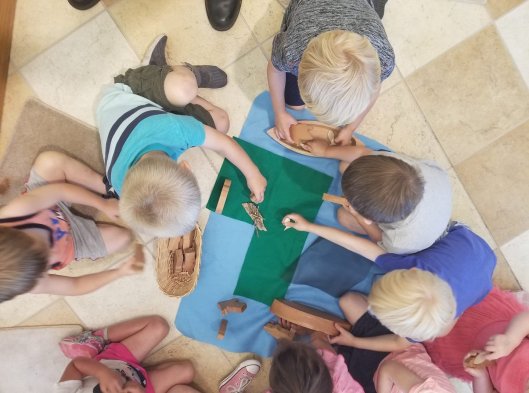
Yesterday at the Godly Play class Hickory Neck offers at The Kensington School, we finally got to tell the Epiphany story – the story of the magi visiting the Christ Child.  As we reviewed the whole story of Advent and Christmas, out came all the figurines of prophets, Mary, Joseph, Jesus, Angels, Shepherds, various animals, and wise men.  Typically, the teacher tells the story quietly, using the figurines, and then we have the kids retell the story, taking turns with the figurines.  And because the class has become so large, we usually have two sets of figurines so we can break into groups.  I would never say the class is perfectly orderly, but it is much more measured than you might imagine with two- to five-year-olds.

But not yesterday.  I’m not sure whether we, the leaders, were off our game, or the kids were still hyped up from returning from break, but the retelling portion of class was utter chaos.  Taking turns fell apart, quiet redirecting failed miserably, and by the time we regrouped to close the class, there was a mass of wooden, sacred figures in a disordered pile.  As we were making our way out, I looked at the pile sadly, grateful that they were all made out of sturdy wood and nothing more destructible, but somewhat disappointed to see such a holy mess.

But as I was thinking about the mess today, I was thinking perhaps my sadness at the chaos was my own “stuff,” having nothing to do with the success of the class.  Too often, we like our Gospel stories neat and tidy.  Too often we tell familiar scriptural stories expecting them to teach specific lessons.  But when we are honest, we know that is not how the Good News works.  The Good News upends worlds, upends social order, and upends our expectations.  Engaging with Jesus is messy work, and sometimes, in the midst of trying to figure out our faith, we end up with a messy rubble in front of us.

I do not know what you are you struggling with today – what things you wish were under control but are actually a mess, or what things you have been expecting from God that just are not how you expected, or what chaos others are making in your life that makes you feel bereft.  What I can tell you is that Christ is there, maybe a bit mired in the chaos too, but there nonetheless.  And sometimes, the mess is just what you need to shake you up and see the movement of God in a new and fresh way.  I suspect things will not turn out as you expect, but then, the Holy Spirit rarely works in ways we expect.  Sending you prayers today, that you might see Christ in the chaos!

Sermon – Matthew 2.1-12, Isaiah 60.1-6, EP, YA, January 5, 2020

Tags

, , , , , , , , , , , , , , , , , , ,

At our 9:00 am service today, we honor the feast of Epiphany with our annual Epiphany Pageant.  Every year I love watching the children and youth bring the Christmas story alive one more time.  Part of what makes the service special is hearing the story with fresh ears – not from a clergy person reading from the aisle like every other Sunday, but with a variety of voices narrating and enlivening the words, making the incarnation story more incarnate.  I love how the pageant keeps us in the Christmas moment one more week, and I love how the story brings all our Christmas characters under one roof, reminding us of the continual unfolding of the mystery of the incarnation.  Though there is something certainly endearing about the whole experience of a pageant, there is also something quite profound in a pageant too.

But what pageants can sometimes do is focus our attention so intently on the manger – on Jesus and his family – that we forget what happens outside the manger is just as important as what happens at the manger.  Even our beloved carol “We Three Kings,” draws us to the experience of the magi’s adoration in Bethlehem, without insight into what happens in Jerusalem.  This year, after hearing of registrations, of humble births, of angel choruses, of everyday shepherds spreading the Gospel, and of cosmic explanations of the incarnation, we turn our attention to Jerusalem.  Isaiah gives us some clue about where our attention is drawn.  “Arise, shine; for your light has come, and the glory of the LORD has risen upon you…Lift up your eyes and look around…”[i]  The instruction in Isaiah is not for Bethlehem, but the city of Jerusalem[ii] – the city where Jesus’ journey will end, the city for whom Jesus weeps, the city of eventual redemption and salvation.  There, Isaiah foretells of the incarnation, how the people of God are to reflect the light of Christ, and to pay attention to what is happening around them, to God incarnate.

Those words, “lift up your eyes and look around,” have been lingering with me this week.  Instead of looking deep into the scene at the manger or with the holy family, I am drawn by what is happening in Jerusalem.  Three things happen there.  One, we learn more about the magi.  The testimony of the magi is what most of us associate with Epiphany.  Foreigners set out on a quest, more attuned to the cosmic nature of the incarnation than the people of faith.  Their astrological findings do not simply fascinate them, but inspire action – a long, uncomfortable journey to see the incarnation for themselves.  As profound as their witness is, they are not able to complete the journey alone.  They stop in Jerusalem for guidance.  They know they are on the right path, they just cannot quite get to the proper place. And so, the magi stop and ask for help along the way.  They know something significant has happened, but they need guidance from people of faith to fully realize their journey.[iii]

The magi’s insightful question, “Where is the child who has been born king of the Jews?” is a question that brings in the second action.  The chief priests and scribes, the ultimate insiders of the faithful, those who hold the revelation of scripture and interpret scripture for the people of God, are given news that should be earth shattering.  When asked about the birth of the Messiah, the religious leaders recall what they know of the Messiah:  the Messiah is to be born of Bethlehem and is to shepherd and rule the people of God.  The religious leaders offer the key – the prophecy of scripture about the coming Messiah.  And yet, even though they have this scriptural foundation, they do not react to the news of the magi.  Even though these wise people profess this awaited Messiah has been born, the religious leaders do not drop everything.  They do not even ask to go with the Magi, just to check and see if this story might have something.  They may be versed in scripture, but their inaction shows that even insiders sometimes need outsiders to be faithful.[iv]

Finally, the third thing that happens are the actions of Herod.  Herod is probably the most fascinating to me.  He is wise too, even if he uses his wisdom for his own nefarious purposes.  Herod knows the announcement, even if from an outsider of a new king being born means his own kingship is threatened, and shows how fragile his rule is.[v]  But instead of acting impulsively, he manipulates those around him.  First, he calls in the religious leaders.  You see, Herod is not a Jew – in fact, he is a Roman, serving at the leisure of the kingdom.  But his subjects are Jewish, and so he is wise enough to seek their counsel on what a king, what a Messiah, might look like.  But instead of sending his religious leaders to check things out in Bethlehem, knowing they might discover a true king among them, he secretly sends the foreigners, hoping to manipulate them into doing the work of finding the king, knowing he will get news from them so he can kill this new king.  Herod is only worried about himself and his power, and he will do whatever is needed to maintain that power.

The foreign magi are so unfamiliar with the people of God, they do not initially understand the weight of their question about the new king.  The scribes and religious leaders are so buried in their scripture, and so keen to keep balance with secular power, they do not realize the messianic fulfillment right in front of them.  And Herod is so bent on keeping his power, he does not fully understand the power of God working all around him.  All three of these agents in our story need the words of Isaiah today – all three need to lift up their eyes and look around.

We are not unlike the characters in our story today.  How often are we so mired in our own power – as people of privilege and comfort, as Americans with power more globally, as members and advocates in this community – how often does a word about the movement of God, the promise of change, and the possibility of giving up some of our power to allow that fulfillment, make us just as nefarious as Herod – just as willing to manipulate the world around us?  Or how often have we steeped ourselves in scripture, scouring God’s Holy Word, longing for some sort of guidance or truth, not realizing truth is being spoken through another right to our faces?  Or how often have we been so intent on a mission, so focused on what we sense God calling us to do, we ignore the consequences of our actions, forget the power of our words?

Today’s scripture reading is certainly about the gift of the magi to us – the revelation of the incarnation, the insight of foreigners, and the abundance and homage the incarnation inspires.  But today’s scripture reading is also an invitation to consider our own response to that incarnation in the modern era, considering the ways in which we have not lifted our eyes and looked around.  Taking up Isaiah’s invitation to self-critique is important because there is also a promise in Isaiah.  You see, when we lift our eyes and look around, we acknowledge the narrowness in our lives, or we acknowledge the ways in which we are blind to our own power, or we discover the ways in which we even hide behind our faith, we are then able to see the promise in Isaiah.  Isaiah tells us to look around because glory of the LORD has risen upon us.  Isaiah says in verse five, “Nations shall come to your light, and kings to the brightness of your dawn.”  When we talk about shining our light on this holy hill here at Hickory Neck, this is what we mean.  The gift of the magi to us is not news that is frightening.  When we are not hoarding power or hiding behind our intellect or comfort zones, the news of the magi is news for rejoicing.  And that rejoicing is light that draws nations, and kings, and neighbors, and strangers, and family members, and friends.  The gift of the magi is the invitation to let go of the things that feel under our control, and embrace the thing in no way we control, but in every way brings us grace, love, and abundance.  That is the kind of living that shines light from this hill and brings others to Christ’s light.  That is the light offered to us today in the magi.  That is the kind of good news worthy of pageants and proclamation today.  Amen.

[i] Isaiah 60.1, 4a

[ii] Rolf Jacobson, “Sermon Brainwave #701 – Day of Epiphany,” December 29, 2019, as found at http://www.workingpreacher.org/brainwave.aspx?podcast_id=1216 on January 3, 2019.

[iii] R. Alan Culpepper, “Exegetical Perspective,” Feasting on the Word, Yr. A, Vol. 1 (Louisville:  Westminster John Knox Press, 2010), 217.

[iv] Culpepper, 217.

[v] Stanley Hauerwas, Matthew (Grand Rapids:  Brazos Press, 2006), 38-39.

Sermon – Luke 2.1-20, CD, YA, December 25, 2019

Tags

, , , , , , , , , , , , , , ,

This past year I have been learning a lot about Godly Play, the program we use with our smallest children in Sunday School, and more recently, the program we use with the Kensington School too.  At first blush, the program is pretty simple:  we tell Bible stories, using simple props to engage the children visually, we let the children play with the story, and then we wonder about the story along the way.  But when we are telling the story with the Kensington School, we have about fifteen kids, ages two-and-a-half to five years old.  I do not know how much time you have spent with that age group recently, but what that means is working super hard to hold their attention.  Being the loud extrovert that I am, I assumed holding their attention would mean using a loud, commanding voice.  But I have discovered from our seasoned teachers that the opposite is true.  They lower their voices to a slow-paced, almost whisper, and they manage to keep the children on the edges of their seats – as if something amazing is going to happen if they listen really hard.

Oftentimes, when we think of Christmas, we imagine a similar pattern.  When we gather on Christmas Eve, we look forward to savoring the familiar story, imagining being able to hear a pin drop as the beloved story is told again.  Our favorite song on Christmas Eve is usually Silent Night.  The song lulls us to imagining Mary and Joseph blissfully enjoying a silent night of wonder.  But that holy night, and most Christmas Eve services, are anything but quiet.  Bethlehem is inundated with people coming in for the registration.  The fact that there is no room for Joseph and Mary tells us how crowded Bethlehem is.  But Mary and Joseph not only have to tend with homecoming revelers, they also have to contend with the animals over whose abode they have taken.  Add into the mix a screaming newborn, and the idea of a silent night is almost comical.

But Mary and Joseph get even more noise than that.  You see, nearby shepherds hear a cacophony of praise from the heavenly hosts in the middle of the night.  Their night has been anything but quiet too.  Instead of trying to get the animals and themselves back to sleep, they decide to go into town and see this thing which has come to pass.  And so, they spend the night, talking to Mary and Joseph, maybe taking turns trying to soothe the baby Jesus.  When they leave those rudimentary quarters, they leave town praising and glorifying God.  This is no silent night for the shepherds either.

I think that is why I enjoy our celebration on Christmas Day so much.  Silence is in short supply on Christmas Eve.  We sing carols, we hear the giddy laughter of children awaiting gifts, stockings, and cookies, and we chant the mass, singing our traditionally spoken words.  For those of us with small children, even the wee hours of the morning on Christmas Day are loud – filled with cries of elation, joy, and battery-operated toys.  But on Christmas Day, after a noisy night and morning, we make our way to church and find, perhaps for the first time, the silence for which we have been looking.  We do not sing carols.  We do not have to speak over the hubbub of full pews.  Instead we gather in relative quiet, and tell the old story again – but this time with a softness that cannot be found on Christmas Eve.

What I love about finding true silence on Christmas Day is that our morning is structured a lot like I imagine that first holy morning being structured.  Christmas Eve is full of noise – of animals, shepherds, angels, and crying babies.  But that next morning, the dust has settled.  Gone are the shepherds and angels.  The animals have calmed down after too many midnight guests.  I even imagine baby Jesus has given in to sleep, since most newborns get their nights and days reversed for the first few weeks.  Into this relative quiet is when I imagine Mary treasuring all those words and pondering them in her heart.  The night before is just too loud.  The exhausted, travel-weary, physically and emotionally spent Mary gets a moment in the morning to begin to process what God has done in and through her.  After the break of dawn, as the sun rises and the loud revelers and news deliverers have gone, she can have a quiet moment as she rocks or feeds baby Jesus and ponder in her heart this child at her breast.

I do not think that night is silent.  But I understand why our hymnodists would want to talk about silence.  I think that is why I prefer the hymn, “Let all mortal flesh keep silence.”  Instead of depicting a silent night, that hymn invites us to keep silence as a form of reverence.  The first verse says, “Let all mortal flesh keep silence, and with fear and trembling stand; ponder nothing earthly minded, for with blessing in his hand, Christ our God to earth descendeth, our full homage to demand.”  I like the hymn because that is the kind of pondering I imagine Mary does in her heart this morning.  Unlike most new mothers, I do not think she is worried about the impact of birth on her body or even about her humble surroundings.  I imagine her thoughts that morning are consumed with nothing earthly minded.  Instead, I imagine her heart is pondering the blessing of Christ our God descending on earth through her – and the enormity of the event drives her to pay silent homage as she gazes on Jesus’ precious face.

That is what the church invites us to do today as well.  We structure a morning for worship.  The dust of gift wrap, eggnog, and stocking stuffers is settling.  The noise of carols, singing choirs and priests, and antsy children in pews is fading.  The anxiety of preparing for the big event of this day is easing.  And all that is left is a moment to let our mortal flesh keep silent before the Christ Child.  This morning we take a moment to ponder nothing earthly minded, and instead join Mary as she ponders all that has happened in her heart.  We come to church on this holy morning to ponder the miracle of the Christ Child.  We honor the way in which God is ever trying to honor the covenant God has made with us – willing to go to the extreme of taking on human form to care for and preserve us.  Our God’s love knows no bounds.  Humbled by that knowledge, we come to pay God homage.

The question for us in our pondering is what we will do with that love.  Though we make space this morning for silence, we do not remain here all day.  Like any other Sunday, the clergy will dismiss us to go in peace, and serve the Lord.  Anytime we feast at Christ’s table, that is our charge:  to take whatever sustenance we have gained and to go out into the world to do the work that Christ has given us to do.  Certainly that may involve cooking, travel, or more gift giving.  But the news we ponder in our hearts today is much bigger than today.  Today we are commissioned to consider the impact of the birth of the Christ Child on our lives, what our response will be to the God who is so faithful to God’s covenant with us that God would take on human flesh to redeem us.  As our talented Godly Play teachers might pose, I wonder what new work God is crafting in our hearts.  Perhaps this morning, or for at least the next few minutes, you can let your mortal flesh keep silence and ponder with Mary.  And then go out with the shepherds, glorifying and praising God in your work.  Amen.


Sermon – Luke 2.1-14, CE, YA, December 24, 2019

Tags

, , , , , , , , , , , ,

This December, my elder daughter and I are slowly finishing the last book in the Harry Potter series.  The process has taken us several years, since we usually only finish a few pages each night.  But each time we pick the book up, I can never tell who is more excited – her or me.  You see, I have read the series at least three times – once during a summer interning at a hospital, when I needed a brain break from the emotional labor, and twice while spending lots of time nursing, when I needed a brain break from a different kind of labor.  But reading the books with my daughter has been different.  Although I know what will happen, there have been parts of the seven books I forgot entirely.  As I have watched through her eyes, I had forgotten the range of emotions the books evoke, the anticipation the author builds, and the slew of questions that take ages to answer.  In rereading them with her, I have also seen bigger truths – some allegories and religious parallels that only sink in after multiple readings.  The whole experience has been so fun, I cannot wait to start all over again with our younger daughter!

I have been thinking about how our favorite books are often like that.  Though we have endless options of books to read, sometimes we will pick an old favorite to read again.  I think many of us will reread favorite books because we like the familiarity, like cozying up with old friend.  Some of us enjoy rereading books because we enjoy catching new tidbits we never caught before.  While others of us enjoy rereading books because there is some comfort in knowing how the story ends – of being certain about what will happen.  The same can be true for small children too.  I cannot tell you how many times I read Goodnight Moon over the years.  But I never minded because I totally understood the comfort my kids found in the familiarity of a known book; the comfort they sought in Goodnight Moon was the same comfort I sought in familiar books too.

In a lot of ways, that is what we are doing tonight.  We are telling a story we have heard over and over again – although tonight’s New Revised Standard Version may not sound as familiar as the old King James Version; even Charlie Brown’s friends knew that version.  Every year, every single Christmas Eve, we make our way to church – sometimes having fought over what to wear, when, where, and what to eat, or whether or not to open any gifts beforehand.  But we make our way here tonight because we know the ultimate reward is sitting here, in the quiet of night, listening to the story we hear every year of a powerful emperor imposing a tax; of a very pregnant Mary making her way to Bethlehem with her betrothed, Joseph; of Mary giving birth and putting the Christ Child in a manger because there is no room in the inn; of shepherds minding their business in the dark of night; of angels appearing announcing glorious news; and of a chorus of angels singing magnificent truth.  And our reactions are much like they are with any favorite book.  We find comfort in the story’s familiarity, we look for and sometimes hear tiny details we forgot or had not thought about before, and we find comfort in knowing how the story will end.  Glory to God in the highest, indeed!

But the main reason we tell this story year after year after year is not simply for the familiarity and comfort – though the Church wants us to experience that goodness too.  The main reason we tell this familiar story again tonight is because we need to remember who we are and who God is.  You see, what happened on that beautiful, special night, is God came in human form among us – came as Jesus Christ incarnate – because God loves us so very much.  God saw we were struggling to be good, to live as loving people made in God’s image, and God knew we needed Jesus to help us.  We learn in this story that God is awesome, God loves us and is faithful to God’s covenant even when we are not, and God does unimaginably incredible things for us.  This beloved, almost quaint, story is full of good news about who God is.

But this beloved, familiar story also tells us something about who we are.  This story tells us that whatever baggage we came in here with tonight, whatever we are struggling with on a weekly basis, whatever self-doubts we might have, we learn in this story that we are worthy of God’s love.  We learn in this story that no matter who we are – an esteemed king, feared among the people and wielding great power; a couple with nowhere to go, feeling unsure about the future; everyday workers going about their daily jobs, just trying to pay the bills; or a vulnerable baby, unaware of the dangers all around – no matter who we are, we are loved by God, and given the opportunity to have a relationship with God.  We also learn in this story a bit harder reality.  We learn in this story that being loved by God means sharing God’s love – of going to visit people who need visiting and need to know the love of God in their isolation and loneliness, of caring for people who have no place to go no matter what we judgments we make about how they got into their current situation, of taking on tasks that seem insurmountable but will help more people experience the love of God.  We find out a lot about ourselves tonight in this familiar story too.

I know each of us who has gathered here tonight came for a different reason.  Maybe you just like the music, or maybe someone made you come, or maybe you came out of habit, or maybe you came because you wanted some sense of comfort and familiarity.  Regardless of how you got here, the Church tonight tells us a story full of meaning.  We certainly tell this story tonight because this is safe place we can cozy up to the story and feel comforted in familiarity.  We tell this story because we need reminding who God is and who we are.  But we especially tell this story tonight because God wants us to go from this place and do something with all the love and comfort we receive tonight.  God wants us to share God’s love with those who need love the most – even to the people we sometimes do not like (actually, especially to the people we do not like).  God wants us tonight to remember who we are, and who God is, and then go out into the world, rejoicing, sharing the love of Christ, retelling the Christ Child’s story, and bringing Jesus’ story to life for others.  Who knows?  Maybe this will become your new favorite story you want to read over and over again!  Amen.

On Cellos, Love, and the Incarnation…

Tags

, , , , , , , , , , ,

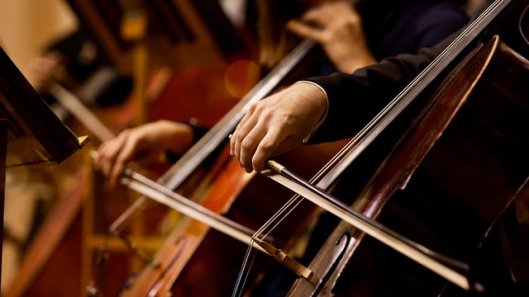
Yesterday, my elder child performed in the school’s Christmas concert.  She had been pretty excited and anxious about the concert for weeks.  They worked very hard in class, and she had been practicing daily at home.  She was determined to learn the special songs so she could play them.  Over these last months, she has asked me to sit nearby occasionally and listen; other times, I could hear the songs of the cello floating down the stairs.  But none of that prepared me for what I saw yesterday.  Yesterday, she sat tall in her chair, attentive, and calm.  Suddenly, her arms look graceful and light.  Her movements were like that of a dancer, able to beautifully coax out a tune from her curved instrument.  I was stunned by her beauty, having never fully seen it before as she plugged away at home.  My heart warmed, and was filled with love for the nimble creature – a child who certainly gives me a run for my money in fierceness, stubbornness, and independence, but also who I keep discovering I love more than I even understand.

As I have been thinking about that surge of love and awe for my child, I began to wonder if that was what Mary felt on that night Jesus was born.  Her pregnancy was so fraught.  From her bizarre conception story, to working out marital details with Joseph, to the encounter with her cousin Elizabeth, to the government’s census that forced her to travel while very pregnant, to replaying the conversation with the Angel Gabriel, knowing wondrous, awful, amazing things were to happen with her child.  Though she seemed to embrace her role fully, I sometimes wonder whether she was able to feel love for the child who had brought so much chaos to her life – at least not until she laid eyes on him.  I suspect only then, did her sense of purpose become intertwined with a sense of deep love – a sense of awe bigger than herself.

I think that is how God loves us.  At times, I suspect God, like any parent, has a wicked eye roll and has mastered a deep sigh in response to our behavior.  But I also imagine God has this deep sense of awe, wonder, and love for us – for the ways in which we can be beautiful to one another, the ways in which we use our gifts for good, and the ways in which we glorify God.  I believe the entire Incarnation is due to this deep love – a love even deeper than we experience in those fleeting moments of insight with our children and one another.  That realization is how I head into Christmas this year.  Not thinking about cute babies, or crazy birth narratives necessarily, but in humbled awe of how much God loves us.  When we catch a glimpse of that love, we do not really need anything else this Christmas.  In this last week before Christmas, I invite you to consider the best gift that is waiting for you this year.  Everything else is just trimming.

Sermon – Matthew 11.2-11, A3, YA, December 15, 2019

Tags

, , , , , , , , , , , , ,

Advent is one of the stranger seasons of the Church, in which the experience of churchgoers seems completely out of alignment with the secular world.  The secular world put on bells weeks ago, has been playing songs about holly, jolly Christmases, and in general is so excited about Christmas presents, vacations, and fun that there is a little room for anything but joy.  Meanwhile, those sitting in church in these weeks have heard about preparing our lives and hearts for the return of the Lord, about repenting and making a way for our God, of quietly, soberly, and humbly waiting for what is to come.  But on this third Sunday of Advent, those two worlds collide:  the saccharine-filled, tap-dancing, over-caffeinated secular world of pre-Christmas and the quiet, methodical, prayerful world of Advent both turn us to joy.  This third Sunday of Advent, called Gaudete or Rose Sunday, we light a pink candle, and we proclaim a mini-sabbath from our somberness and lean into joy.  The church seems to be telling us, “Okay, take one day to smile, to linger on how cute baby Jesus must have been, and how exciting things must have been at the manger.  This time of year might just be the hap-happiest season of all!”

Given the Church’s permission to lean into to joy this week, we might anticipate a gospel reading that is also full of joy – maybe Mary and Elizabeth sharing their pregnant joys or angels delivering good tidings of great joy.  Instead, we get John the Baptist, sitting in a cold jail cell, asking an unthinkable question to Jesus, “Are you the one to come, or are we to wait for another?”  Now John has never really been a character who has embodied joy.  He lived the life of an ascetic, he preached about people’s sinfulness and their need to repent, he drove people to be baptized, in their hope to get right with God.  But John has been certain about Jesus in the past.  Earlier in Matthew, John says, “One who is more powerful than I is coming after me; I am not worthy to carry his sandals.”[i]  In John’s Gospel, John the Baptizer says, “Here is the Lamb of God who takes away the sin of the world!”[ii] and “He must increase, but I must decrease.”[iii]  In Luke’s Gospel, John’s surety about Jesus happens before he is even born, as he leaps in his mother Elizabeth’s womb.[iv]  So what has happened to John?  Why can he not just get on the joy train with us today?

Well, a couple of things have indeed changed.  John is no longer free to roam around as he pleases, he is no longer surrounded by growing crowds who are mesmerized by his words, and his own disciples seem lost without him.  John is sitting in a cold, hard jail cell, his life hanging in the balance, and Jesus, the guy he was so sure about, is not exactly playing along.  He is not acting like he is supposed to, and in that dark, damp place, John is left wondering, “Was I wrong?  Is Jesus not The One?  If he is the Messiah, surely I would not be here, suffering without Jesus taking decisive, bold action.”  And John is right to question.  Wonderful things are happening through Jesus, blessings of which the prophet Isaiah had foretold.  But according to scholars, there are no distinctive documents that depicted the Messiah behaving in the way Jesus does.[v]  If Jesus is the Messiah, John’s doubts are not unfounded.

Truth be told, as much as we would like a joyful sabbath from our quiet, sober, season of repentance, we understand John’s plight.  We have all had those moments of darkness where we too have asked God, “Are you the one who is to come?”  That question is a question we have all asked at one point or another.  In the midst of chronic pain, as a romantic relationship is falling apart, as a pink slip is delivered, as loneliness overwhelms us, we have asked Jesus, “Are you the one who is to come?” because we too have been disappointed by God.  We too have expected God to be with us in a specific way, to make things right in the ways we imagined, or to fix the world and show the world that God is indeed present.  Hickory Neck acknowledges that very reality this coming weekend in our Blue Christmas service – a service where we boldly confess that Christmas is not a joyful season for all – and that is okay.  We understand the darkness that can live on the margins of the light.

Although we may all understand John’s plight in some way, although we have all had those deep, painful moments of questioning, we may find ourselves wondering, why we chose this specific text on the day that is supposed to be about joy.  Surely we did not don our rose-colored bow-tie, pink dress, or rose sweater for nothing!  Fortunately, we do get joy from this text from Matthew too – albeit not necessarily in the ways we may want.  When John asks, “Are you the one who is come?” I suspect he wanted a simple, “Yes, of course!  Do not fret!”  But Jesus does not usually do direct.  Instead, Jesus says, “Look around you, John.  What do you see?”  And for those of us not there, Jesus reminds us:  the blind receive their sight, the lame walk, the lepers are cleansed, the deaf hear, the dead are raised, and the poor have good news brought to them.  The Good News John is looking for may not look familiar, but there is good news.  Jesus’ version of Messiahship is not familiar, but his Messiahship is good.

One of the most powerful, and sometimes annoying, questions my spiritual director asks me when talking about my life and ministry is, “Where are you seeing God?”  The question is the same question I have asked many of you too.  Where in the midst of struggle, suffering, or pain are you seeing God?  The question is annoying because sometimes we just want to sit in our suffering – sit in our cold jail cells – with our questions and not look to joy.  But that is what looking for God does.  When we recall the people around us who bring us meals or baked goods, just because, we begin to see the loving care surrounding us.  When we remember the conversation with a good friend when she sees a profound truth that brings us comfort and peace, we begin to hear the comforting words of Jesus.  When we reassess the blessing happening around us – our everyday needs being met, the appearance of an encouraging bloom or bird’s song, or an unexpected act of kindness – we begin to see that maybe, just maybe, there is joy bubbling up all around us.

This Gaudete Sunday may not bring us the kind of joy that makes us feel like this is the most wonderful time of the year.  But today’s gospel does bring the kind of joy that matters – the deep, abiding joy that come from realizing God is active in our lives, making a way for goodness, healing, and grace.  Today’s gospel reminds us our questions and doubts are okay, and are answered by examples of blessing all around us.  Today’s gospel takes our frustrations about how life should be, and shows us the abundance in what is.  Jesus offers us today the kind of joy that eases those lines of stress between our furrowed brows, that softens the tension in the middle of our chests, and unclenches the teeth, shoulders, and hands that have been hardened for so long.  Jesus offers us the kind of joy that is a deep breath of release, a refreshing gulp of cool water, an all-encompassing hug of compassion.  Our invitation today is to receive Christ’s joy with assurance, and then share his joy beyond these walls.  Amen.

[i] Mt. 3.11

[ii] Jn. 1.29

[iii] Jn. 3.30

[iv] Lk. 1.41

[v] William R. Herzog, II, “Exegetical Perspective,” Feasting on the Word, Yr. A, Vol. 1 (Louisville:  Westminster John Knox Press, 2010), 71.

On Being Still…

Tags

, , , , , , , , , , ,

One of the things I regularly try to teach and model for our family and parish is the value of reining in consumerism during Advent.  It is so easy to get caught up in all the things we want to get our loved ones – creative, funny, thoughtful gifts to show our family, colleagues, and friends how much we appreciate them.  But too often we spend too much, straining our budgets and our emotions instead of creating the spirit of joy giving the gifts intended.

This Advent, I have noticed the same pull happens with our time during Advent.  Between shopping, work parties, school-related events, performances, and community events, we could be busy from sunup to sundown every weekend in December, not to mention weeknights.  Just this past weekend in our town, there was a parade in the morning, events all day, a boat show in the evening, and fireworks on the second evening.  There is a constant invitation to allow our time to be consumed, just like there is an invitation to allow our financial resources to be consumed.

So this past weekend, we chose one thing.  Just one out of the four or five things we wanted to do.  And you know what happened?  Nothing!  We reveled in the one event, savoring and enjoying it.  And then we rested.  We came home and trimmed the hearth, spent time together, and took naps.  It was glorious!

Every year, the church invites us into a quiet, reflective Advent.  Every year it sounds awesome.  I get devotions, or activities to center the family, and about half-way through Advent we fizzle out because we are so exhausted from the running and stress.  It wasn’t until this year, having taken the quieter weekend option that I realized what the church (and yes, even me from the pulpit!) has been inviting us to do.  Be still.  Keep watch.  Take rest in the Lord.  Not just for an hour on Sunday, but the whole of Advent.  How might you make space this year, say “no” to a few things, spend less, and just be still, alert for the presence of God acting in your life?  I suspect if you do, your new favorite season might just become Advent!

On Thanksgiving and Imperfection…

Tags

, , , , , , , , , ,

The last two weeks have been marked with rituals of thanksgiving:  a community ecumenical Thanksgiving service at the local Roman Catholic Church, Holy Eucharist on Thanksgiving Day at Hickory Neck, dinner and visiting with my dad, and, today, offering the benediction at the 400th anniversary of the first official English Thanksgiving in North America.  The rituals have all been tremendous blessings and ways to center and ground life in gratitude, a practice that can sometimes fall to the wayside in the busyness of life.

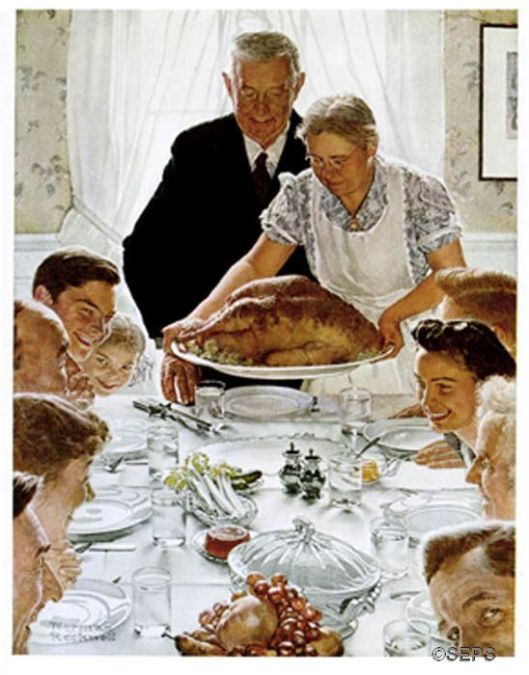
However, what has struck me about this season of gratitude is how imperfect it has been.  Often when we think of Thanksgiving Day, we immediately picture Norman Rockwell’s famous painting of the perfect meal.  But as I checked in with people and as I watched those around me, I realized nothing about this season of thanksgiving has been perfect.  I had parishioners who just welcomed a baby a few days before Thanksgiving Day and had resigned themselves to having Chinese so that no one would have to cook or stress about taking the newborn out.  I heard stories of family drama over the menu for the day.  My own family was coming off a few hospitalizations so resigned ourselves to dinner out – which then got foiled by a two-hour wait, with a wait staff that looked like they wanted to be home with their own families.  The music and collaboration of clergy was beautiful last week, but we hold in tension our denominational differences.  Even the anniversary celebration today is consciously honoring the ways in which the histories of American Indians, African-Americans, and English-Americans bring a shadow over our celebration.

As I have been pondering this imperfection, this disconnect between our ideal of perfected thanksgiving rituals and the reality of the messiness of life, I have actually found deep spiritual comfort.  Nothing about our lives is perfect.  We are all sinners, trying to be better versions of ourselves.  Even our offering of thanksgiving is imperfect.  But the love of God is perfect.  God sees our messiness and loves us anyway.  God sees the ways we hurt each other, the ways we argue, the ways we are rude or unkind, the ways that we cannot always honor our rituals, and God loves us anyway.  In fact, I sometimes wonder if God doesn’t prefer our imperfection, for in confessing our imperfection, we are fully honest, fully vulnerable, and fully trusting of God.  We bring our real selves to God, and it is there that we give the most heartfelt thanksgiving.  We feel, know, and experience God most powerfully in those moments of imperfection.

This week, I invite you to continue your practice of gratitude with God and one another.  In our thanksgiving, we are not just thanking one another for appearance’s sake, but we are thanking one another in fullness, in love, and in generosity.  Use this week to find people to thank – for the big things and the very tiny things.  My guess is we may all start working toward the perfection of God’s love with each act of thanksgiving.