It’s complicated…

Tags

, , , , , , , , , ,

10

Photo credit:  https://www.shutterstock.com/video/search/child-walking

Every once in a while, I have one of those pastoral fails – those moments when I say something that ends up sounding horribly thoughtless and makes me feel disappointed in myself.  Last week, I was talking to a new mom about the struggles of those first weeks of new motherhood.  I was bemoaning how when my mom left two weeks after my first child was born, I cried for hours, not knowing how to raise a child without her help.  Only hours later did I remember that this person’s mom died many years ago, and how insensitive my story sounded in hindsight.

Motherhood is a bit of a minefield.  Some of us are extremely fortunate to have awesome moms and wonderful relationships with those moms.  Some of us have more strained relationships, others of us have cutoff relationships, some had negligent or hurtful mothers, and many are still grieving our mothers who have passed.  Meanwhile, some of us have had amazing experiences being moms ourselves, while others have longed to have children or have lost pregnancies or children.  Motherhood is so complicated that I sometimes find myself caught off guard by my own unexpected emotional response to motherhood.

For a priest, that is why I dread Mother’s Day.  Mother’s Day is a day where I feel split in half – where I both want to honor the goodness and sacredness of motherhood, and I want to honor ways motherhood can be so painful.  This year, I was blessed by a friend who wrote about how to honor the tensions we find on Mother’s Day.  I leave with you a prayer she references found in Women’s Uncommon Prayers, written by the Reverend Leslie Nipps.  May your Mother’s Day find the balance I long for you to find.

On this Mother’s Day, we give thanks to God for the divine gift of motherhood in all its diverse forms. Let us pray for all the mothers among us today; for our own mothers, those living and those who have passed away; for the mothers that loved us and those who feel short of loving us fully; for all who hope to be mothers someday and for those whose hope to have children has been frustrated; for all mothers who have lost children; for all women and men who have mothered others in any way—those who have been our substitute mothers and we who have done so for those in need; and for the earth that bore us and provides us with our sustenance.  We pray this all in the name of God, our great and loving Mother.  Amen. (p. 364)

Sermon – John 15.9-17, E6, YB, May 6, 2018

Tags

, , , , , , , , , , , , , ,

Jesus’ words today from John’s gospel have been beckoning me all week.  “As the Father has loved me, so I have loved you; abide in my love…I have said these things to you so that my joy may be in you, and that your joy may be complete…You are my friends…You did not choose me but I chose you.”  These are words that our weary souls need to hear.  We long for the wide, open embrace of God, the unconditional acceptance, the assurance that everything will be okay.  Jesus’ words today are a warm blanket we crawl into and wrap around ourselves, draping over our feelings of sadness, loneliness, doubt, insecurity, and uncertainty.  Jesus’ invitation to abide in his love is the fulfillment of every longing, aching need in our lives, and today Jesus offers that love freely, abundantly, joyfully, completely.

For some of here today, that is your sermon:  Jesus loves you, chooses you, befriends you, and completes your joy.  The humbling, overwhelming love of God invites you into that warm blanket, and you do not need to speak – just accept the gift and abide with God this week.[i]

For others of us, we may be a little too hardened to fully receive the invitation to abide in God’s love.  I used to serve with a priest whose main sermon, no matter what the text, was God loves us.  She said those words so often I remember I would sometimes stop listening.  My cynical self would start the diatribe, “Yeah, yeah, yeah.  God is love.”  The problem for many of us is love has failed us.  We have been in love, been loved by family or friends, or even have felt God’s love.  But we have also been hurt, rejected, or felt abandoned by all those parties.  And if we feel the failure of love too often, “Abide in my love,” sounds too shallow to have meaning, too romantic to last, too wonderful to be sustained.

For those of us who might roll our eyes at the saccharine nature of love we have experienced in the world, we may need a different sermon today.   Part of our challenge is we have defined love in such a way that we will be disappointed every time.  We watch movies, read books, even gaze at couples in those first dreamy weeks of new love, and think we know what love is.  Love becomes two people who agree all the time, who are always able to look lovingly at another never noticing imperfections, who never experience conflict, and who are always happy.  And if that is our expectation of love, we will always be disappointed.  For those of us in this camp, our sermon today is to redefine love.

A few years ago, Paul and Lucy were such a couple.  They had a romantic beginning – meeting in medical school, Paul was funny, smart, and playful.  As they built a life together, they began to dream and to plan.  When Paul finished his 90-hour workweek rotations, and life got back to normal, they would try to have a baby.  Everything was perfect – at least everything was perfect if you did not look too closely.  And then Paul got the diagnosis – a cancer that would give him two more years of life.  And suddenly everything changed.  Lucy’s life began to become about taking care of Paul, walking him through treatments, holding him in pain.  And Paul’s life became about making sure Lucy could enjoy life beyond him.  At one point, Paul assured Lucy he wanted her to remarry after he died.  The two even agreed to have that baby they had been planning.  Lucy worried having a child would make dying worse for Paul.  “Don’t you think that saying goodbye to a child would make your death more painful?” she asked Paul.  He replied, “Wouldn’t it be great if it did?”[ii]

What Paul and Lucy show us is love is not some sappy, sentimentalized emotion best captured by a romantic comedy with a great soundtrack.  Love is beautiful not because love is perfect, pretty, polished.  Love is beautiful because love is “all in,” ready for the ugliness of life, willing to take on pain and suffering and see that pain as a blessing.  Of course, Jesus describes love in the same way in today’s gospel lesson if we are paying attention.  We find ourselves so tarrying in the comforting love language and we sometimes miss the other love language in the text.  “Keep my commandments…love one another as I have loved you…lay down one’s life for one’s friends…go and bear fruit, fruit that will last.”  Jesus shows us what love looks like throughout his life.  He kneels down and tenderly washes the dirty, worn feet of his companions.  He accepts and welcomes adulterers, oppressors, and outcasts of every kind.  He loves and forgives, even when betrayed by his closest friends.  He gives up his life in the most gruesome, humiliating way.  Jesus’ love is not pretty or polished.  But Jesus’ love is profound.

That kind of love is the kind of love that drove most of us to Hickory Neck.  Maybe we came thinking we wanted a perfect, polished, pretty loving community that would make us feel loved too.  And many times, Hickory Neck is just that.  But other times we find a different kind of love at Hickory Neck – a love that stands by us when spouses die, when marriages fail, and when children stumble into dark places; a love that stands by us when diagnoses come, when tragedy strikes, and when sinfulness overcomes us; a love that stands by us when we disagree, when we hurt one another, and when we fail to meet each other’s expectations.  That kind of love sits next to us when we cry, even when no words are exchanged; that kind of love receives awful news and is able to simply say, “this is awful,”; that kind of love prays for us even when we do not realize we are receiving or need prayer.  The love we often find at Hickory Neck may seem to others to be messy, imperfect, and even difficult.  But the love we find at Hickory Neck is much more akin to the kind of love that mimics God’s love for us, that lays down our lives for one another.

The challenge for us today is in four tiny words from Jesus, “Go and bear fruit.”  Both the unconditional blanket of Christ’s love and the messy, ugly, beautiful love of Christ are for us today.  But that gift of love becomes fullest when shared.  We practice that sharing of love every week here at Hickory Neck – with the people we like, and even the people we may not like as much.  But our practicing is preparation for sharing that love beyond these walls – with the family member who drives us crazy, with the neighbor whose annoying habits reveal a lack of love, with the stranger who makes us uncomfortable.  Now, you may go home today and start thinking to yourself, or your friend might say to you, or even Satan himself may start asking you, “Yeah, but won’t that kind of love hurt?  Won’t you be risking pain and hurt by giving that kind of love?”  Today, Jesus invites you to say, “Wouldn’t it be great if it did?”  Amen.

[i] Karoline Lewis, “Abide in my Love,” April 29, 2018, as found at http://www.workingpreacher.org/craft.aspx?post=5142 on May 2, 2018.

[ii] David Greene, “Inside A Doctor’s Mind At The End Of His Life,” February 12, 2016, as found at https://www.npr.org/templates/transcript/transcript.php?storyId=466189316 on May 3, 2018.

On Bringing the Church and World Together…

Tags

, , , , , , , , , ,

img_0160

Photo credit:  http://stas.org/en/media/photos/rogation-days-2016-15612

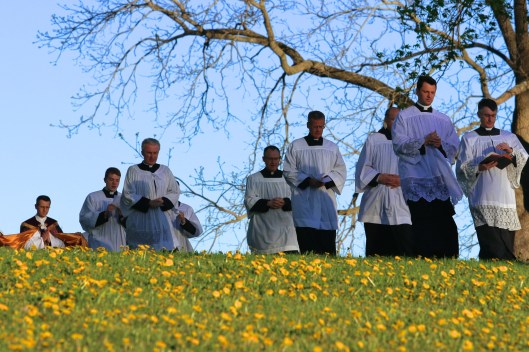
This coming Sunday at Hickory Neck, we will be adding a procession and blessing before our service begins in honor of Rogation Days.  Traditionally, Rogation Days are the three days before Ascension Day during which the litany is said as an act of intercession. In England, Rogation Days were associated with the blessing of the fields at planting, and in the United States they have been associated with rural life, agriculture and fishing, commerce and industry, and the stewardship of creation.[i]  For Hickory Neck, we are using this year’s Rogation Days to give thanks for rainwater collection barrels built for our Community Garden by a Boy Scout in our parish.  We will also bless the Garden, praying for a fruitful harvest for our parishioners and neighbors who use the gardens this year.

What I love about this upcoming event is that it represents a confluence of everything about which the church should be.  Our Community Garden has long been an example of using our property as a way to bless and welcome others.  At the garden, I see strangers become friends, people planting and tending in sacred silence, and the fruits of labor shared with one another.  Meanwhile, it has been a joy to watch our parishioner take leadership of an Eagle Scout project that benefits the church, the community, and his troop.  Watching our parishioner bring his faith community and his service community together has been a tremendous witness to each of us about how to make connections between the various parts of our lives.  And marking Rogation Days with liturgy is the church’s way of making the everyday parts of our lives sacred.  We take the labor of our hands, the fellowship of friends and strangers, the bounty of creation, and we name it all as holy.

Often when people think about church, they think about the building and the people who regularly attend worship services on Sundays.  But the church is much more about what the faith community does outside of the walls of the building, and how the community uses the blessing of its property to bless others.  This Sunday, we celebrate the ways in which we are living into the fullness of our identity, while also challenging ourselves to ever be outwardly-minded in our ministry.  I hope you will join us, but mostly, I hope you will invite a friend as we celebrate the ways in which the blessing of our community flows out into the world!

21463342_1589859034403684_3079109709240303206_n

Rainwater Collection Barrels Installation.  Photo credit:  Paula Simmons.  Permission required for reuse.


[i] Donald S. Armentrout and Robert Boak Slocum, eds., An Episcopal Dictionary of the Church:  A User-Friendly Reference for Episcopalians, “Rogation Days,” as found at https://www.episcopalchurch.org/library/glossary/rogation-days on May 1, 2018.

On Paths Not Taken…

Tags

, , , , , , , , , , , , , ,

Walking-Gravel-Feet-Sneakers-Free-Image-Path-Male--4740

Photo credit:  https://www.pixcove.com/walking-bases-gravel-grit-feet-sneakers-path-trail-male-shoes-walk-man-legs/

Today is the feast of St. Mark the Evangelist.  Typically, this is the day we honor the author of the gospel of Mark.  Who Mark was is a little uncertain, as there are several references to Marks in scripture.  If we are to believe that they all point to the same person, we have some clues about his identity.  In Colossians, Paul refers to Mark, the cousin of Barnabas, who joined Paul and Barnabas on their first missionary journey.  At some point in the journey, Mark turned back, abandoning the mission.  Later, when the three are ready to journey again, Paul refused to travel with Mark because of his earlier abandonment.  Later, the two reconcile and Mark and Paul journey to Rome together.

St. Mark’s Basilica in Venice honors the fullness of Mark’s progression from turning back on his missionary journey with Paul and Barnabas, to proclaiming the gospel of Jesus Christ as Son of God, to bearing witness later in life as companions of Peter and Paul.  So often, when someone disappoints us or seems like a failure, we turn an eye of judgment upon them.  We may welcome them back in the fold if they repent or correct their ways, but we always remember in the back of our minds how once upon a time they disappointed us.  But the Basilica seems to claim Mark’s entire journey is a journey to be celebrated.

I wonder what those times have been when you have abandoned your own missionary journey.  Perhaps you felt an initial call and sense of passion, but then you got scared, or you started to doubt yourself or the call, or you just could not pull your life together to follow Christ’s invitation.  So often when we talk about faith journeys, we talk about forks in the road, or new paths, but we rarely admit those times when we did an about-face, and just let go of what God had called us to do.  Perhaps we are ashamed or fear the judgment of others.

What I like about St. Mark’s story is that God is present throughout Mark’s journey and God uses Mark no matter what.  Whether it was a vocation we quit, a relationship with a faith community we left, or a personal relationship we cutoff, God is ever present with us, using our actions for good.  Some of us will never return to the same path like Mark did.  But we certainly take something powerful from that experience of walking away.  I invite you to consider those turns on your journey which you have been holding in shadow and consider letting God’s light to shine on them.  My guess is you will find more people who want to celebrate your path than judge.

Sermon – Psalm 23, E4, YB, April 22, 2018

Tags

, , , , , , , , , , , , ,

Many years ago, I was planning the funeral of a longtime, beloved church member.  We had visited on multiple occasions, and I knew all the stories about her children, including the son who was no longer going to church.  We talked about Jesus and her faith walk, and I always looked forward to sassy, witty, heartfelt stories.  When I sat down with her children to plan her funeral, I had an idea of what I could expect.  As we chose the lessons for the funeral, I shared with them that many people appreciate hearing the 23rd Psalm.  “Oh, no, we can’t do the 23rd Psalm,” the family protested.  A bit taken aback, since the parishioner I knew would have loved the psalm, they explained to me what had happened in her last days.  Her daughter had been comforting her one afternoon and decided to start reading scripture with her mom.  She started with the 23rd Psalm, and the mother snapped at her, saying, “Don’t read that one!  I’m not dead yet!”

Every year, on this Good Shepherd Sunday, we hear the 23rd Psalm.  Though many of us are more familiar with the King James Version, the words of Psalm 23 are words that are familiar even to those who do not attend church regularly.  Whether we have heard the psalm at a funeral, or read the psalm at someone’s deathbed, or seen the psalm on someone’s wall, the 23rd Psalm is one of the most well-known psalms in our culture.  Even in surveys, when asked about their favorite piece of scripture in times of trouble, many respondents name Psalm 23.[i]

In some respect, this familiarity and preference is a blessing and something to be celebrated.  But in other ways, this familiarity can be a tremendous hindrance to hearing these sacred words with fresh ears.  For example, most of us hear the psalm’s words as words of comfort for the dying.  We hear the words, “the valley of the shadow of death,” and we assume the whole psalm is about death.  Lying down in green pastures, remaining by still waters, gathering at a table, and having goodness and mercy follow us all sound like end of life images.  We envision the peaceful, beautiful resting place, gathered around the heavenly banquet table, and we take home the promise that no matter what happens in life, at least the ending will be a place of respite and relief.  And in some ways, that is true.  But I am not sure that is what this psalm is ultimately about; this is a psalm not about death, but about life.

The 23rd Psalm is a psalm on the move.[ii]  Throughout the psalm, we hear the activity of life.  Those green pastures we are going to lie down in are the places where we will find rest after a long day.  Those still waters are the sources of water we will need to drink in this earthly life.  Those righteous pathways we will be on are the paths of ethical living, those paths where we will seek and serve Christ, loving our neighbor as ourselves.  That rod and staff that will comfort us because those are God’s tools that will push and pull us toward our vocations and the purposes God gives us.  The dwelling we do in the house of the Lord is not the eternal dwelling place, but the earthly church where we find renewal for the journey.  That valley of the shadow of death is not the valley of death, but those shadowy places in our lives where we are reminded of the darkness of death:  times of illness, divorce, unemployment, loneliness.  The 23rd Psalm is not ultimately about a promise in death, but about the promise we are given in life – the promise of refreshment, restoration, reinvigoration for the journey of life.

This winter Charlie and I attended a training on church development.  One of the first images from the presentation was that of a base camp on a mountain.  We talked about the purpose of a base camp – what people need from and do at a base camp.  Ideas included rest, refreshment, preparation, and stocking up for the journey.  No one mentioned making a permanent home or using base camp as a place of escape.  Our instructor then asked us how a base camp is similar to Church.  We began to talk about how Church does the same thing – is a place of refreshment, rest, preparation, and stocking up for the journey.  Church is not a place to escape the real world or to hide away from hurt and pain.  Instead, Church is the place where we refill our tanks so that we can go out into the world – gathering the strength we need for the journey.  Church is not the house of the Lord where we will dwell forever.  In fact, that translation, “to dwell” is not helpful.  The word in Hebrew that is translated as “dwell” is better translated as “return.”[iii]  So instead of talking about a place where we will hide out from the world or imagining the heavenly kingdom where we will dwell, the psalmist is talking about the place we will keep returning – the base camp, the Church, where we will keep returning for strength so that we can get back into the world doing the activity of discipleship – the life where we will rest, drink, walk, be righteous, commune, and serve.[iv]

So just in case I have ruined Psalm 23 for you forever, making the psalm feel more like a psalm of work and labor as opposed to a psalm for rest and relief, have no fear.  There is one more line that similarly gets mistranslated which may open this text for you in another way.  In verse six, the psalmist says, “Surely goodness and mercy shall follow me all the days of my life.”  Again, understanding the original Hebrew is helpful.  The word translated as “follow” is better translated as “pursue” or “chase down,”  Goodness and mercy shall chase me down all the days of my life.[v]  Shifting that word does a similar thing as the rest of the verbs in this text.  When goodness and mercy follow us, we often think of hindsight.  Bad things happen to us, but when we look back, we will see goodness and mercy came out of the bad things.  But the psalmist says something more powerful than that.  The psalmist says that goodness and mercy will pursue us – will hunt us down and knock us over with their power.  We will feel threatened by that valley of the shadow of death, or we will worry about places to lie or drink or walk.  But the psalmist tells us those worries are futile because even in the midst of those stresses, God’s goodness and mercy is constantly seeking to bowl us over.

Scholar Gary Simpson says this about God’s goodness, “The goodness of God is in every place before we ever arrive at any particular place.  The good things that happen to us along life’s journey do not happen because we have arrived.  God’s goodness has already been where we are planning to go.  The goodness of God is so present that every direction that we turn to look, wherever we are, we bump into goodness again.  It is perhaps egocentric and arrogant to think that goodness follows us.  The goodness of God goes ahead of us, clearing out new ground, pulling us to new terrain, lighting a pathway in the dark places of new possibility, opening doors that no one can shut.”[vi]

I think that parishioner resisted hearing the 23rd Psalm in her last days of life because like many of us, she had trapped the psalm in the land of the dying.  But the 23rd Psalm is a psalm for the land of the living – a psalm that commissions us to continue our work of discipleship, to move out into the world with the promise of the essentials we will need, to keep returning to God’s house for sustenance and refueling, and to remember that no matter what we face, God’s goodness is already there, chasing us down.  On this Good Shepherd Sunday, perhaps you were hoping to hear a few words of comfort, longing to dwell in this house for longer than an hour today.  But today, that Good Shepherd is prodding you with a staff, filling up your tank so that you can go out into the world, serving as God’s disciple in all the green pastures and right paths where God leads.  You can do your work because no matter how much those shadows linger, God’s goodness will chase you down – all the days of your life.  Amen.

[i] Rolf Jacobson, “Commentary on Psalm 23,” March 30, 2014, as found at http://www.workingpreacher.org/preaching.aspx?commentary_id=2004 as found on April 19, 2018.

[ii] Joel LeMon, “Commentary on Psalm 23,” April 25, 2015, as found at http://www.workingpreacher.org/preaching.aspx?commentary_id=3646 on April 19, 2018.

[iii] LeMon.

[iv] Cameron B.R. Howard, “#602 – Fourth Sunday of Easter,” April 14, 2018, as found at http://www.workingpreacher.org/brainwave.aspx?podcast_id=1008 on April 17, 2018.

[v] Gary V. Simpson “Pastoral Perspective,” Feasting on the Word, Year B, Vol. 2 (Louisville:  Westminster John Knox Press, 2008), 438.

[vi] Simpson, 440.

On Resurrection Living…

Tags

, , , , , , , , , , , ,

I have been thinking a lot about death lately.  That probably sounds a bit morbid, but given my profession, should not be much of a surprise.  I think death has been on my mind for lots of reasons:  we celebrated the death of an incredible woman at our parish last week, our Adult Forum series during Eastertide is about death (end of life care, wills, legacy giving, funeral planning), and this Sunday’s lessons, although beloved, are quite common readings for funerals.  Everywhere I turn seems to offer reminders of death, and yet here we are in the season of Easter – a time to honor resurrection – to honor Christ’s victory over death!

One of the reasons we are freed up to talk about death in Eastertide is because death is changed through the resurrection of Christ.  In light of the resurrection, we see our life and death differently.  We proclaim that difference in the Book of Common Prayer at funerals.  “Life is changed, not ended,” we say in the burial office.  Whereas the secular world would have us consume life to its fullest, ignoring the inevitability of death; would have us preserve our bodies and make ourselves look younger to ignore our natural aging; would have us avoid conversations with our loved ones and community about death, the Church says something different.

The Church says Christ’s resurrection changes life so much, talking about death is no longer morbid.  The Church says, the promise of eternal life allows us make those funeral plans with a spirit of joy, not a spirit of dread.  The Church says that our time among the living is meant to bless and honor others, so making that will and designating those legacy gifts to a church are in great congruence with our understanding of resurrection living.  An Adult Forum series on death (or Resurrection Living, as we have called it) or reading lessons from funerals during Eastertide makes perfect sense.  Those exercises free us from seeing death as final, encouraging instead a life of resurrection hope and joy – a life lived in the light of eternal life.  I hope you will join us this week at Hickory Neck as we dive into that new identity and welcome the transformation of life in the light of the resurrection.


Sermon – Luke 24.36b-48, E3, YB, April 15, 2018

Tags

, , , , , , , , , ,

Last month I was talking to Pastor Alex from Stonehouse Presbyterian.  We were walking toward our cars and he complimented my license plate, noting how fun spotting my plate around town has been.  I chuckled and told him the plate had been both a blessing and a curse.  He asked me what I meant, and I explained.  You see, I love the plate for the very reason he mentioned – that I run into people who recognize my plate, that people connect who I am with what I do, that people ask me about my vocation and about Hickory Neck.  But the plate is also a bit of a curse.  If I had to choose any place to be a witness for Christ, I am not sure the car is the best location.  You see, the car is where I leave prayer books, post-its about phone calls, gum wrappers, and coffee cups.  The car is where I cart around children – sometimes singing at the tops of our lungs to a favorite song, and sometimes scowling after an argument about behavior.  The car is where I find a moment to getaway before picking up children, and the car is where I sometimes reveal that I once lived in a region of the country that is known for impatient, sometimes foul-mouthed drivers.  The car is not really home to my best witness for loving Christ.  And yet, there is where a big plate – on both the front and the back – witnesses to the world who and whose I am.

That is what I find so funny about the disciples this week.  Here they are in Luke’s gospel, not unlike what we heard in John’s gospel last week, hiding in a room, afraid, disbelieving, and wondering what to make of all that has happened.  To be fair, life has gotten a bit chaotic of late.  Their whole world has gotten turned upside down since that beautiful, sacred night when Jesus washed their feet.  They had ideas about what was coming in their life, what was going to happen to Jesus, and how the world would be changed.  But Jesus dies, they are outcasts, and God seems to have closed a door – a tomb door.  Then, just days later, their world gets upended again.  The disciples learn from the women that the same closed tomb door is now open.  Two of the disciples have an encounter with the risen Christ on the road to Emmaus.  And as if all of that is not enough, today, Jesus shows up – very much alive, proving his corporality, teaching them, and reminding them they are witnesses.

The disciples certainly have our sympathy and concern.  And yet, the disciples remain holed up in a room – as if they can hide.  As if they can integrate back into the world, with no one realizing who and whose they are.  As if no one will notice the license plate on their car that says, “Jesus’ disciple.”  The disciples are hiding, acting as though no one is watching, no one is making conclusions about them based on their behavior, no one is making conclusions about Christ.  Their hiding is just as much of a witness as going out into the community.  Perhaps they feel being in that room is giving them a break from being witnesses – that no one sees them.  But we know better.  And so does Jesus.  “You are witnesses of these things,” says Jesus.

Sometimes we do the exact same thing.  We too can start to believe that we have hiding places in our lives – places where we do not have to be witnesses.  Maybe yours is a car.  Maybe yours is at work or school because those places seem more removed from what we do here on Sundays.  Maybe yours is at home, on vacation, or when surrounded by friends.  Like the disciples, we too have that same longing to “turn off” our witness.  Maybe we are just tired and feel like being a witness for Christ is exhausting.  Maybe we are upset with or disappointed in God and are not sure communicating those feelings helps our witness of Christ.  Or maybe we are just afraid – that people will notice that we do not live lives that reflect who and whose we are.

But “turning off” our identity as people of faith is not really an option.  Sooner or later we will get caught.  Sometimes being caught can be a very positive thing.  An acquaintance who knows you go to church may ask you to add them to your church’s prayer list because they or their child just received a horrible diagnosis.  But sometimes being caught can be less flattering.  At our Adult Forum series on evangelism this fall, we watched a video about how not to invite people to church.  The video features two neighbors, one who is out gardening in the yard and the other who is clearly just coming home from church.  The neighbor who is out gardening wonders to himself, “I wonder why he never invites me to his church.  I would go if he asked me.”  But sometimes being caught can be even worse.  I had a friend who waited tables during college.  She always moaned when she got her work schedule and discovered she was assigned a Sunday.  I finally asked her why she hated Sundays so much.  She said, “Because that’s when all the churchgoers go out to eat – and they are the worst tippers!”  Somehow, in all her long hours of trying to make a few bucks to pay for books and school fees she had gotten the message that people of faith did not value her.

We know from experience that hiding as a Christian is really an illusion.  Wherever we are, whenever we are, with whomever we are, our identity is always there.  Jesus confirms that today.  As biblical scholar Karoline Lewis says, “Jesus’ address to the disciples is not, ‘you will be witnesses.’ Not, ‘please be witnesses.’ Not, ‘consider being witnesses if you have time.’ No, [Jesus says] ‘you are witnesses of these things.’ We are witnesses.  As it turns out, witnessing is not voluntary, but a state of being.”[i]  Lewis goes on to add, “‘We are witnesses’ does not depend on our acceptance or agreement or approval. ‘We are witnesses’ does not depend on our readiness or recognition or responsiveness. ‘We are witnesses’ just is.”[ii]  The disciples learn that today.  When Jesus says, you are witnesses, he empowers a very scared, uncertain, fearful group of followers to remember who and whose they are.

The good news is that Jesus does not judge the disciples today.  Jesus meets the disciples where they are.[iii]  Jesus’ first words are words of encouragement.  “Peace be with you,” he says.  Then, ever the tender pastor, Jesus asks the question in verse 38, “Why are you frightened, and why do doubts arise in your heart?”  Knowing their confusion, Jesus eats with them to assure them he is really there, not just some ghost or figment of their imagination.  He sits down and teaches them once again, taking them back to their roots, reminding them of how the prophets have taught them all they need to know.  And then, come those fateful words in verse 48, “you are witnesses of these things.”  Jesus meets them where they are, offering comfort, assurance, and affirmation.  But Jesus also encourages them to move beyond where they are.

After September 11th, there were two widows featured on the news.  “Grateful for the outpouring of support they received, they started thinking about the women in Afghanistan who, when widowed, lose status in that society and therefore find their already difficult lives even harder.  They raised money and formed a foundation called Beyond the 11th to support Afghani widows, and even made visits to Afghanistan to meet the widows they were helping.”[iv]  Those widows had lot of options – fear, anger, vengeance, or isolation.  But instead, they remembered how Jesus encourages us to remember our identity as witnesses and to move beyond where we are.  Our invitation today is to reclaim that same identity.  Now I do not know if that means you go put a Hickory Neck bumper sticker on your car, or you start wearing that cross necklace again, or you start tangibly connecting your words and actions to your identity as a witness.  Only you can know the shape your witness will take.  But today Jesus invites us to let go of our hiding places, realizing that even when we think we are hiding, we are still witnessing.  Our invitation is to own who we are, so that others might see the beauty of who and whose we are.  Amen.

[i] Karoline Lewis, “We Are Witnesses,” April 9, 2018, as found at http://www.workingpreacher.org/craft.aspx?post=5126 on April 12, 2018.

[ii] Lewis.

[iii] Nancy R. Blakely, “Pastoral Perspective,” Feasting on the Word, Year B, Vol. 2 (Louisville:  Westminster John Knox Press, 2008), 424.

[iv] Blakely, 428.

On Being Agents of Joy…

Tags

, , , , , , ,

IMG_0325

Photo credit:  Photo taken by Jennifer Andrews-Weckerly on March 25, 2018.  Permission required for reuse.

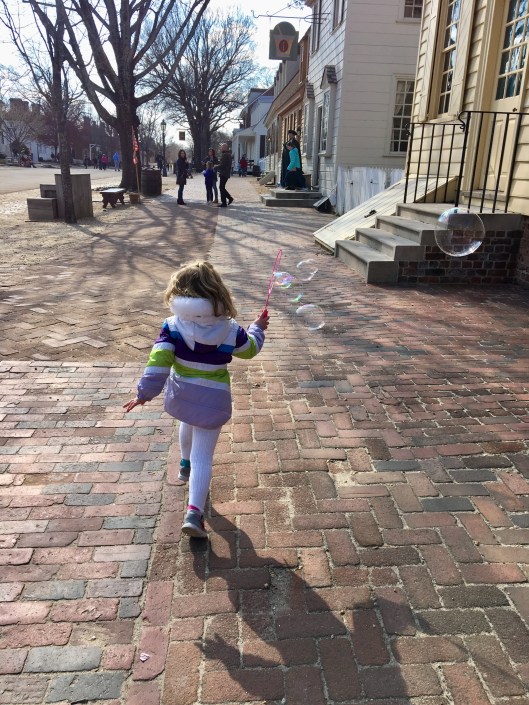
A couple of weeks ago, in the midst of one of the craziest seasons for a clergy family, we found a moment to head down to the historic district of our town.  My daughter had just received a bubble wand as a birthday gift and wanted to take it along.  Somehow, a bubble wand seemed like a bad idea – it being totally out of context in the otherwise historically accurate setting.  But, I was not in the mood for an argument, so I consented.

There we were, in the midst of tourists, costumed interpreters, walking along cobblestoned streets filled with colonial architecture, and my daughter was gleefully running down the sidewalk with her pink princess bubble wand.  Seeing her happy and joyful was enough to bring a smile to my weary face.  But what I had not anticipated was how her bubble-making would bring joy to so many around us.  A large visiting family burst into smiles as she rained bubbles on them.  Little children began tugging on their parents’ clothing, giggling and shouting, “Look!”  A mother wistfully thanked us, explaining that her preteens had been catching and chasing the bubbles behind us.  I saw some teenage girls light up with a long-gone innocence as the bubbles floated toward their laps.  Even a costumed interpreter whispered as she passed, “We all love your bubbles.”

What was so beautiful about that day was the way in which my little four-year old was able to freely and abundantly give away the unexpected gift of joy, laughter, and refreshment.  It was such a powerful thing to witness the strength of her gift; seeing her joy, and the spreading of her joy, brought me unexpected joy.  That kind of innocent, pure, wholesome goodness is so rare in life and my daughter gave it with abandon.

That wave of abundance, generosity, and joy made me wonder what ways we might be invited to be agents of joy.  Perhaps the opportunity could be as simple as bubbles.  I had a friend who kept them in her car for whenever she got caught in traffic (it is hard to stay cranky in traffic when bubbles are floating by).  But it could be something else – sending a card or making a phone call when a person randomly pops into your mind.  Starting a practice of thoughtful, tiny good deeds – little gifts to those whom you know need it, maybe even without credit.  Or maybe a new idea will strike you.  I would love to hear your ideas.  But more so, I would love to hear how it goes when you try it.  Practices of abundant joy are catching.  I can’t wait to hear about the joy you spread this week.

Sermon – John 20.1-18, ED, YB, April 1, 2018

Tags

, , , , , , , , , , , ,

Last weekend, before Holy Week started, our family celebrated my youngest’s fourth birthday.  A dear friend was there and asked me how I was doing, knowing full well that Holy Week and Easter were coming.  I launched into a diatribe about all the things I was juggling – birthday party, work commitments, packing for Spring Break, and the pressures of writing an Easter sermon.  The last complaint caught her attention.  “You’re worried about an Easter sermon?” she asked.  “Oh, yes!” I explained.  “It’s a big day.  The sermon needs to be good!”  She looked at me, dumbfounded, and said to me, in a way that only a best friend can, “You know nobody comes to church on Easter because of the sermon.”

Now as a preacher, you can imagine my ego was a little bruised.  But the more I thought about her observation, the more I realized she was right.  We come to church on Easter for a whole host of reasons.  We come to church on Easter because that is what our family has always done, and the continued observation of Easter somehow connects us to the past, present, and future, creating a sense of belonging and identity.  We come to church on Easter, because we long for a good word – a reminder that even in a tumultuous world, there is the promise of resurrection life, joy, and hope.  We come to church on Easter because we love the music, the flowers, the crowded seats, the Easter attire, and the experience of being a part of community.  And some of us are not sure why we come to church on Easter, but we suspect, or at least hope, we will find something that can revive our weary souls.

I suspect what most of us are hoping for today is an experience like Mary Magdalene’s.  I am not sure Mary knew why she went to the tomb that fateful day.  In John’s gospel, Mary is not there with spices to anoint Jesus’ body.  She does not bring flowers or some memento to leave at the tomb.  In fact, she comes to the tomb in darkness, before the morning light has arisen, perhaps in a fog of knowing she needs something but not sure what that something might be.  And then, not unlike the chaos that may have been your morning to get here on time and half-way presentable, Mary’s life gets thrown into chaos.  An empty tomb means she and the disciples run around like chickens with their heads cut off.  Later, Mary finds herself bemoaning to angels and a stranger alike that she just wants Jesus’ body – a physical reminder of all the horror and love and pain that has happened.  And in the midst of this chaos, a simple, profound thing happens.  Mary is called by her name.[i]  And her world gets turned on its head.

There is something very powerful about being called by your name.  We will frequent restaurants or coffee shops because we love being recognized by name by our favorite barista or shop owner.  If you have ever received a blessing or healing prayer by a person who knew your name, you know the intimacy that is created between the two of you, and the power of hearing your name lifted up to God.  We even try to use nametags here at Hickory Neck because we know how wonderful being known by name feels.  Being known by name creates a feeling of acceptance, affirmation, affection, and acknowledgement.[ii]  I can only imagine the rush of emotions when Jesus calls Mary by name today – not just the recognition of who Jesus is, but the reminder of how much he has loved her.

I suspect we should add that to the list of reasons why we come to church on Easter Sunday.  We want to be known too.  Perhaps we want to literally be called by name.  But perhaps we know just being here creates the same sense of belonging that being known by name creates.  When we sit in these seats today, we know that we are sitting next to someone who is longing for belonging today too – who also rallied to get to church on time – maybe with kids in cute dresses, or maybe just pulling their aching bodies to church.  When we sit in the seats today, we know that we are surrounded by a group of people who also love having their senses overwhelmed – from the smell of fragrant lilies, to the joyous sound of song [brass], to the taste of communion bread and wine, to the sight of fanfare and smiles, to the feel of another hand at the peace.  When we sit in these seats today, we know that we will be offered a word of joy, light, love, hope – and we want our lives to be marked by that same sense of promise.

Now you may feel tempted today to take all that affirmation, encouragement, and joy, and go about the next days on your own personal high – as though the gifts you receive today are solely for you.  But what all this fanfare, acknowledgment, and hope are meant to do is to propel you out into the world.  When Mary is called by name, receiving the blessing of recognition and encouragement, she does not stay at the feet of the resurrected Jesus.  She becomes John’s gospel’s first preacher.  “I have seen the Lord,” Mary says to the disciples.  Now I know some of you will go out from this place today and do just that – you will put on your Facebook page, “Alleluia, Christ is Risen!” or you will hug your neighbor and tell them what a joyous day you just had at church.  But for others of you, sharing today’s joy may take you a little more time, or may look a bit different than proclaiming, “I have seen the Lord,” to your favorite barista.  But what Mary invites us to do today is find our own way of sharing the beautiful gift we receive today – to give someone else the gift of joy and hope, to quietly tell a friend what a cool experience this day was, or to simply call someone else by name – sharing that same sense of belonging and affirmation you receive today.   You came to church this Easter Sunday for something.  Mary invites you to give that something to someone else.  Amen.  Alleluia!

[i] Serene Jones, “Theological Perspective,” Feasting on the Word, Year B, Vol. 2 (Louisville:  Westminster John Knox Press, 2008), 378.

[ii] D. Cameron Murchison, “Pastoral Perspective,” Feasting on the Word, Year B, Vol. 2 (Louisville:  Westminster John Knox Press, 2008), 380.

Homily – Mark 16.1-8, EV, YB, March 31, 2018

Tags

, , , , , , , , ,

I once worked with a parish who wanted to tweak their outreach efforts.  Instead of simply volunteering together with an outreach ministry or donating funds, they wanted to partner outreach and formation – what the secular world would call service learning.  And so, we experimented.  We gathered a team for six weeks in preparation for service with a transitional home for women coming out of prison.  The first week, two clients came to talk to us about their experiences with the ministry we were serving.  We heard stories of abuse, addition, and authority.  We learned about the things within their control and the things outside their control. Then we spent four weeks reading about a woman whose ministry in a prison led to her live and serve among the prisoners, guards, and families affected by the prison.  In the final week, the parishioners served a meal for the women in the transitional house, engaging in meaningful conversation as we ate.  When we gathered after our days of service, each participant felt as though their experience at the transitional home was much richer than the experience would have been had they simply showed up at the house with a hot meal, having never thought much about who they would encounter and why.  With old assumptions gone, parishioners were able to ask meaningful questions, understand how hard the road ahead would be, and share their own journeys.

Easter Vigil is a bit like that service learning group.  You see, we could gather tonight, and ring in Easter, happily celebrating the empty tomb the two Marys discover.  The miracle of that event, and the consequences of Christ’s resurrection are cause enough for a tremendous celebration.  But what we do tonight is not just jump into the resurrection.  First, we learn together why the resurrection is meaningful at all.  We start at the beginning, when the world was a formless void.  We learn about the creative God, who makes order out of a disordered world, who creates the beauty of the world around us, and who trusts us to care for that beauty.  But, of course, we fail at being stewards of God’s creation, and fall into sin so deep that God destroys most of the created order, saving one family from every species.  And God gives us a covenant – to never destroy the world again.  Generations later, as God helps us flee suffering and enslavement, God does the impossible – parts an entire sea so that we might be forever free.  Later, God is able to restore a valley of dry bones to life through God’s prophet Ezekiel.  God teaches us that even death and destruction can be restored.  Even as they are scattered in exile, God once again promises to restore the people.  Story after story after story tells us tonight that we belong to a God who creates us in beauty, stays in relationship, and restores us to wholeness.

When you know the breadth of our walk with God – when you remember all the pieces of what we know about God – then what happens to God’s Son this night makes more sense.  We can move from singing, “this is the night,” to singing, “how wonderful.”  “How wonderful and beyond our knowing, O God, is your mercy and loving-kindness to us, that to redeem a slave, you gave a Son.  How holy is this night, when wickedness is put to flight, and sin is washed away.  It restores innocence to the fallen, and joy to those who mourn.  It casts out pride and hatred, and brings peace and concord.  How blessed is this night, when earth and heaven are joined and man is reconciled to God.”[i]  What is shocking about this night is not just the empty tomb.  What is shocking is the empty tomb in light of all that has gone before – despite our sinfulness, the breaking of covenant after covenant, our unfaithfulness and lack of gratitude, God stays in relationship.  God keeps making creation new.  God goes a step further in the resurrection of Christ Jesus.

That is why I love that we get Mark’s gospel to close our learning tonight.  Ever the succinct writer, Mark describes for us perfectly how overwhelming God’s love and commitment is to us.  Despite all the drama of our relationship with God, despite all the unfaithfulness, and despite all the waywardness of our behavior, God’s love never ends.  That realization leads to the same sort of terror, amazement, and fear that the Marys experience – the experience of a theophany – of an encounter with or a revelation of God.[ii]  The women flee the tomb tonight and remain silent because they are completely overwhelmed by their encounter with God and God’s love.  On Palm Sunday we were silent at the tomb in grief and despair.  Tonight we are silent at the tomb in unspeakable joy.  The women at the tomb give us permission tonight not to describe the experience, but simply to allow the blessing of this night to overwhelm us.  We can go and tell the news to others tomorrow.  But for tonight, hold on to that marvelous, wonderous feeling of knowing that Christ has been raised.  Amen.  Alleluia.

[i] BCP, 287.

[ii] Gail R. O’Day, “Homiletical Perspective,” Feasting on the Word, Year B, Vol. 2 (Louisville:  Westminster John Knox Press, 2008), 357.