Sermon – 1 Samuel 17.1a, 4-11, 19-23, 32-49, P7, YB, June 24, 2018

Tags

, , , , , , , , , , , , , , , , , , , , , ,

This summer, our Faith and Film series is all about superheroes.  I was never a huge fan of superheroes growing up.  I liked Superman and Batman nominally, sported a pair of Wonder Woman Underoos as a kid, but in general wasn’t really into superheroes and certainly not into comic books.  But a few years ago, I stumbled into the film, The Avengers, and found myself curious about the back stories of all these superheroes.  That began a deep dive into multiple films, many of which you can see this summer.  The first one, Captain America, is a classic story of the little guy overcoming.  Steve Rogers, a literal little guy with a bad case of asthma, wants to enlist in the US Army during World War II so badly, but his health and height disqualify him.  Impressed by his tenacity, Steve gets recruited into an experimental program to be medically turned into a Super Soldier.  There begins his journey of the little man taking on the big man of Nazi Germany.

Most of us enjoy a good story of the little man overcoming.  That’s why the story of David and Goliath is so epic in our memory.  This little kid, totally untrained, completely unarmed (with the exception of some rocks and a sling), and certainly the underdog to the 9 feet 6 inches[i] of Goliath, David is the prototypical little man.  And yet, with the entire Philistine army staring them down, with a giant taunting them for forty days, and with the ominous threat of defeat, no one else is willing to step forward.  The giant, covered in over 126 pounds of armor, and holding huge weapons like the spear whose iron head weighs fifteen pounds[ii], utilizes his own brand of psychological warfare.[iii]  In the end, that dry river bed between the two armies is not just a valley of separation, but a “chasm of fear.”[iv]  And yet, somehow, the teenage shepherd boy steps forward to fight – the little man, the underdog, makes his move.

But unlike a typical underdog, David does not need science, or a lucky break, or some trick.  What David needs has nothing to do with him.  Instead, what he needs is God.  No one in the Israeli camp has mentioned God at this point in the story.  Saul has tried to overcome the chasm of fear with the promise of riches and even his own daughter’s hand in marriage.  And yet, the entire army of Israel can only see how mismatched they would be against the ultimate warrior.  But David sees things differently.  Having fought lions and bears to save his sheep, David knows he can fight Goliath too.  But not because he is a mighty warrior – but because Yahweh delivered David then too.  Even Saul, God’s formerly appointed king, has forgotten God.  But not David.  David is first to speak Yahweh’s name in almost forty verses of text.[v]  When David faces Goliath, he invokes God’s name, recalling with the name the entire memory of Yahweh’s deliverances of Israel in the past.  David knows that he does not need the conventions of human warfare, but only the God of Israel.[vi]

This week, I have been thinking what a ridiculous sermon that is:  all we need is God.  If all we needed was God, we wouldn’t be in such a political mess, totally unable to compromise, hear each other, and work for the common good.  If all we needed was God, that cancer diagnosis, that lost job, that lost pregnancy, or that lost relationship would not have felt so devastating.  If all we needed was God, we would have figured out a way to both secure our borders and humanely treat those fleeing injustice and seeking asylum.  In saying all we need is God, we sound like a bunch of hippies singing the great Beatles song, “All You Need is Love.”  As modern pragmatists, we know better – we know letting go and letting God is what you say – but not what you do.

So how do we turn ourselves from being skeptics, cynics, and dispassionates to seeing all we need is God?  Well, first we have to define a few things.  What is happening in David’s story should not be a surprise.  If you remember a few weeks ago, when the people broke their longstanding covenant with God, asking for a king like the other nations, God gave them Saul.  And Saul was just that – like the other nations, fighting battles with weapons of other nations.  So when David offers to fight, Saul does what a conventional leader would do – arm David with the conventions of war.  He tries to weigh down David with his armor, hoping against hope that there might be a modicum of protection against the Philistine.  Saul is a ruler like the other nations have.  The contrast between Saul and David then becomes a contrast between trusting conventional means and the means of God.[vii]  Saul has become ruled by fear instead of faith.

The way we pull ourselves out of being skeptical, cynical, or dispassionate is not by rallying behind the idea that we are the little man – the underdog David or Captain America, just waiting to be empowered by God.  The way we put to bed our skepticism, cynical thoughts, or dispassionate feelings about all the things in life overwhelming us is to recall the faithfulness of God.  When David says, “All you need is love,” he does not mean all you need is people giving hugs to one another.  What he means is, all you need is to remember the faithfulness of God – especially when we are not faithful at all!  In his speeches to Saul and Goliath, David is recalling the salvation narrative – the stories of God’s faithfulness for generations.  His trust is actually pretty bold too, considering the current king Saul’s appointment represents the breaking of covenant between God and the people.  But David trusts even a broken covenant can be overcome.  David claims his identity as a child of God and knows his identity is all he needs to fight the worst this world has to offer.

This past week, as politics and religion got dragged together in front of camera crews, I slowly began to realize that we are in a David moment.  We can keep doing what we have been doing – keeping our faith out of politics, putting politics in a box that we especially do not open on Sundays, or we can start realizing that we can never put our faith in a box.  The bond that we have as Episcopalians and especially within the hugely politically diverse community that is Hickory Neck is extremely fragile.  Our fragility is why I rarely talk about politics among the community.  I value our ability to come to the Eucharistic Table in spite of our difference over just about anything else.  But that high value on the common table can come at a cost – the cost is never talking about what being a people of God means – what being a disciple of Christ and being an American means.  In order to protect that common table, I have put on 126 pounds of brass armor, and taken up a spear whose head weighs fifteen pounds.  Instead, today David invites us to shed the ill-fitting armor, and just walk in the clothes God gave us (and maybe a few stones).

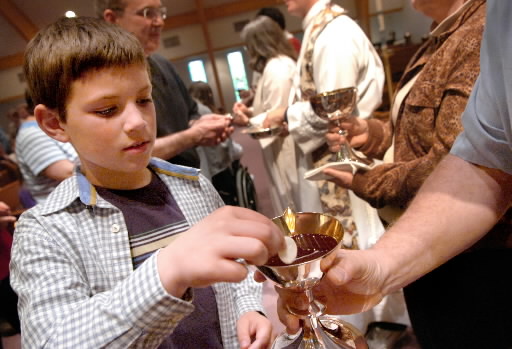
I am not saying once we shed man-made armor we will suddenly know what immigration policies are the best.  But what I am saying is until we take on God’s armor, until we recall all those times when God has delivered us, when God has turned chasms of fear into paths of faithfulness, until we remember that we have a distinct identity as children of God and disciples of Christ, we will not be able to take on the Goliath issues of our day.  Stripping down to David-like clothing, we are able sit down comfortably, to see each other more honestly, to be in relationship more authentically, to gather at this table – not just trying to avoid banging our heavy armor into each other, barely able to make eye contact because of our heavy helmets, but actually brushing the skin of elbows with one another, looking deeply into the eyes of the chalice bearer serving you Christ’s blood, and offering the hand of Christian friendship as we rise from the altar rail together.  We can do all those things because God is faithful.  We can do all those things because God has delivered us before.  We can do all those things because we are Christ’s disciples – and that is what we do through God.  We may be underdogs, and we may be vulnerable in a world that is happy to deploy psychological warfare, but we are united and empowered by the love of God.  Our invitation is to step trustingly, boldly, confidently into that love.  Amen.

[i] William P. Brown, “Exegetical Perspective,” Feasting on the Word, Supplemental Essays for Year B, Batch 2 (Louisville:  Westminster John Knox Press, 2012), 4.

[ii] Richard F. Ward, “Homiletical Perspective,” Feasting on the Word, Supplemental Essays for Year B, Batch 2 (Louisville:  Westminster John Knox Press, 2012), 4.

[iii] Walter Brueggemann, Interpretation:  A Biblical Commentary for Teaching and Preach, First and Second Samuel (Louisville:  John Knox Press, 1990), 131.

[iv] Ward, 2.

[v] Brueggemann, 130.

[vi] Brueggemann, 132.

[vii] Brueggemann, 131.

On Politics, Priests, and Prayer…

Tags

, , , , , , , , , , , , , , , , ,

lightstock_99088_medium_david_needham

Photo credit:  https://www.lebanonfbc.org/ministries/power-prayer-pop

One of the hardest parts of being a priest is creating a community in which we can talk about the Gospel of Jesus Christ, hold widely varying political opinions, and yet still gather at the Eucharistic Table – elbow to elbow, as the imperfect, but beloved body of Christ, determined to stay in community.  I say that the work is difficult because I have seen how fragile this work really can be.  During my priestly formation at seminary, congregations and Dioceses were walking away from that common table over the issue of human sexuality.  Although I was proud of what the Episcopal Church did at the time, I also deeply mourned the loss of diversity at the Table – the creation of a more homogenous Church than a Church who was devoted to staying in the tension while honoring the Gospel.

Because of my high value of the uniting force of the Eucharistic Table, my priesthood has taken a slightly different shape than I might have imagined in my early twenties.  If you had asked me then about the primary role of the priest, I might have argued the role of prophet – decrying injustice and leading the people of faith to a more just world.  But as I aged, and as I served diverse parishes, I began to see the role of prophet is one of many roles, one that needs to be used judiciously so as not to alienate parishioners and create an exclusive community of like-minded people.  And so, my priesthood has been marked with great caution around politics.  While many of my colleagues will beat the drum for justice, I find myself trying to carefully walk with my diverse congregations as we discern together how to interpret politics in light of the Gospel – not in light of Democrats or Republicans, but in light of the witness of Jesus Christ.  That doesn’t mean I don’t have strong political opinions; it just means that I try to take focus off the politician or political issue of the moment and try to create disciples who can see and follow Christ.

That being said, this past week, the issue of what is happening to families seeking asylum on our southern border, and the separation of children from parents as a punitive, purportedly deterring action has shifted my normal practice – not because I changed my mind about politics and the Church, but because two agents of our government utilized Holy Scripture to justify those actions.  Here’s the thing:  if this were just another issue where we are divided about policy, where we had a debate about the extents to which we value national security over other values, I would have happily encouraged our parishioners to be faithful Christians in dialogue.  But when Attorney General Jeff Sessions invoked Holy Scripture to justify separating children from parents, he stepped into my area of authority, leaving me no other option but to speak.

Now I could layout a Biblical defense against the small portion of Romans 13 that Attorney General Sessions quoted, giving you the context of the chapter, giving you the verses immediately following what he quoted as a counter to his argument.  I could quote to you chapter and verse for countless other scripture lessons that tell us to love one another, respect the dignity of other human beings, care for the outcast and alien, tend the poor, and honor children.  I could also tell you about how that same bit of scripture was used to justify slavery, Nazis, or apartheid in South Africa.  But the problem with a scripture quoting war is that no one wins.  What is more important is what we know of the canon of Scripture:  that our God is a God of love, that Jesus walked the earth showing us how to be agents of love, healing, and grace, and that the Holy Spirit works through us today to keep spreading that love.

Knowing what I know about the Good News of God in Christ, in my baptismal identity as one who seeks and serves Christ in all persons, respecting the dignity of every human being, I cannot stand idly by or be silent when the Holy Scriptures of Christians are being used to justify political actions that are antithetical to our Christian identity.  As a priest, I invite you this week, especially when a governmental leader is invoking our faith, to reflect on how the Gospel of Christ is informing your view on this issue.  Not as a Republican and not as a Democrat, but as a follower of Christ.  Fortunately, prominent politicians on both sides of the aisle seem to be coming to agreement on this issue – a rarity these days – but also an example to Episcopalians who hold a high view of coming to the Eucharistic Table across our differences.  I am not saying we need to agree on this – in fact, I suspect we will not.  What I am asking is that you live into your identity as a disciple of Christ, as an agent of love, and then respond in conversation, in political advocacy, and in worship as one holding in tension both our American and Christian identities.  I support you in this difficult, hard work.  I love you as you struggle.  I welcome you to the Eucharistic Table.

On God’s Mothering Wings…

Tags

, , , , , , , , ,

fall-asleep-fast-FB

Photo credit:  https://themilitarywifeandmom.com/one-simple-trick-to-help-your-kids-fall-asleep-fast/

The other night I was rocking my younger to sleep.  The practice is slowly becoming a rarity.  She is getting a bit big for rocking, and now seems to prefer me to sing to her in her bed without rocking her.  The loss of that privilege is one more thing on the list of preferences that demonstrate she is becoming a big girl and is needing me less and less.  So, although she consented to the rocking, her body revealed her resistance.  She was tense and alert.  But once I was able to quiet her down, and the rocking continued, her body began to let go.  Fatigue overcame her, and I could feel her body gradually relaxing in my arms.  That willful, determined, independent little girl was able to let go for a moment, and give into sleep in my arms.

As the tension in her body melted away, I wondered if that is how God feels when I finally cede control to God – if I am similarly determined and defiant when it comes to my relationship with God.  The revelation reminded me of the lament of Jesus from Matthew 23, “Jerusalem, Jerusalem, the city that kills the prophets and stones those who are sent to it! How often have I desired to gather your children together as a hen gathers her brood under her wings, and you were not willing!”  I have always loved that image of the hen gathering her brood, but I never thought about how willful those chicks felt to the mother hen, how willful we are when it comes to God.

As I held my child that night, and I felt her breathing slow and her muscles untense, I was keenly aware of how our bodies were becoming more sympathetic.  Her relaxing into me allowed me to relax too – such that I was not fighting for intimacy with her but just experiencing it.  Barriers came down, just for a moment, and we were able to just lean into one another.

I wonder what barriers are up between you and God these days.  What might leaning into God, trusting God to handle your vulnerability and weakness, feel like?  I do not think God wants us to give up our strength, independence, or drive.  But I do suspect that we would do a better job with those if we were bold enough to admit when we need God too.  That may mean confessing that to God directly.  It may mean finding a trusted friend who can serve as Christ for you this week.  Or it may mean confessing that weakness to a friend who is also struggling so that they can see their weakness as beloved as yours.  Allowing ourselves to be gathered by God’s mothering wings – even if only every once in a while – might just be what we need to strengthen us for Christ’s work in the world.

Sermon – 1 Samuel 8.4-20, 11.14-14, P5, YB, June 10, 2018

Tags

, , , , , , , , , , , , ,

Today we encounter one of the most pivotal moments in our faith history.  The story from First Samuel may not seem that momentous.  Surely the Flood, or the crossing of the Red Sea, or the arrival at the Promised Land, or, I don’t know, the birth, ministry, death, and resurrection of Jesus Christ are more pivotal.  But this short piece of scripture contains something quite theologically significant in the covenantal relationship between God and God’s people.  Samuel has been a righteous prophet and judge for the people, but much like his predecessor Eli who we heard about last week, his sons have become corrupt leaders and the people are unhappy.  And so, the people suggest a solution:  a king.  In their minds this is a great solution.  A king could solve their problems, and most certainly would help protect them from enemies.  A king would dispense justice and mercy to foster right relationships among the people, would hold fast to the covenantal law, and would be appointed by God.  And they would still have prophets to act as their system of checks and balances.[i]  Besides, all the other nations have kings, why shouldn’t they?

The request sounds innocent enough.  As twenty-first century Americans, having no governing leader is inconceivable.  For us, the idea of a theocracy is so foreign, we almost have a hard time imagining the concept.  A king, or at least a president, sounds perfectly reasonable.  But for the people of God, a theocracy is all they have ever known.  “Since the time when Israel first became a nation, Israel had been a theocracy, a community guided and protected by YHWH.  They were set apart, distinctive from other nations, and they had no king as others nations did.  Israel was led by various judges whom God raised up in times of need.  These leaders included, among others, Moses, Miriam, Aaron, Deborah, Samson, Gideon, and Samuel, who served not as kings or queens but as mouthpieces for God as they arbitrated disputes, saw that justice was done, or led the people to victory over a threatening enemy.”[ii]  So this request for a king is a huge shift.  As Walter Brueggemann explains, “Their request is nothing less than a change in Israel’s foundational commitments….This request for a king is one more step in [a] continuing performance of mistrust.”[iii]  In other words, the people of God do not trust God, and out of their mistrust, they are willing to change the entire basis of their relationship with God.

Now if you were to ask me about my greatest spiritual struggle, I would likely say worry.  I have told countless people how much the Matthean text about worry has been a spiritual guide for me, “Consider the lilies of the field…do not worry about tomorrow, for tomorrow will bring worries of its own. Today’s trouble is enough for today.”[iv]  My whole life I have thought my greatest struggle was worry.  But in reflecting this week, I am not sure my greatest issue is worry.  My greatest issue might be trust.  I worry because I do not trust – I do not trust God to make a way, so I strive and fail and strive again to make my own way.  I suspect I am not alone.  We all fail to trust God from time to time.  And any logical person would quietly support your lack of trust in God.  Because to trust in God seems naïve, lacks self-responsibility, and discredits our agency in the world.  Most of us read today’s Old Testament lesson, and secretly we agree with the Israelites.  Sure, there is no perfect form of government, but you have to have something!  We may jokingly or even figuratively ask Jesus to take the wheel, but we all know that we still need to drive the car.

But when we step away from a theocracy, when we change the foundational covenantal commitment between us and God, we must face the same fate as the Israelites.  Samuel tells them what having a king will mean.  Having a king will mean giving up their sons for service in battle and for the tending of the king’s fields, giving up their daughters as cooks and sexual servants, giving up their best land, livestock, and produce.  And worst of all – worst of all – they will be the king’s slaves.  Now for a people who have been enslaved before, this should be the ultimate warning.  All they need to do was think back to those days with Pharaoh – no rights, no power, brutal labor, no hope.  But then, God says something even worse.  When the Israelites finally see God is right and that the new king they wanted is a mess (and spoiler alert:  the new kings will be a mess – the kings do all that Samuel predicts and even more horrible things); when the Israelites cry out, God will not answer them.  This critical part of their relationship with God will be over.

These are the words that have haunted me this week, “…in that day you will cry out because of your king, whom you have chosen for yourselves; but the LORD will not answer you in that day.”  Are there things I could do that would make God not answer me?  Is there a chance that on the two millionth time I refuse to trust God, our relationship could finally break?  Is there a chance we could have a government so broken by ego and lack of compassion and compromise that God would refuse to exert God’s power to redeem us?  A couple of years ago, we talked to our pediatrician about discipline and our frustration with our children’s constant pushing of boundaries.  The pediatrician recommended the “Three Rule.”  Instead of threatening punishments and consequences, instead of engaging in lengthy explanations about why behaviors were unacceptable and what the consequence would be, we should follow the “Three Rule.”  When a child does something unacceptable, the parent says, “one.”  No words are exchanged, no threats are made.  Just the number one.  If, or I guess I should say when, the behavior continues, the parent simply says, “two.”  Finally, when the behavior still continues, the parent says, “three,” and the child immediately goes to their room for a period of time commiserate with their age.  But, and here’s the kicker, when their time is up, there is no discussion, no scolding, just a return to normal.

Now I get a little wary of comparing God with a parent, since parents are just as flawed as kings, but here is what I appreciate about God in this text today.  God strikes me as a person who calmly works through the Three Rule.  So, although Samuel breaks the rule by going on an on about the consequences of a king, God does something extraordinary with the people of God’s request.  God says “okay.”  In a wonderful combination of “grace and judgment, the Lord commands Samuel to ‘listen’ to the people but also to ‘warn them and show them the ways of the king.’”  God does not smite the people or abandon the people.  God, as God always does, respects their free-will and allows the people of God to choose their fate – even if their choice is a fundamental altering of the very basis of their relationship with God.  There is something reassuring to me about a God who allows us full agency in our relationship – whose love is not tied to us making good decisions – and who can remain calm even when we are catastrophically proposing a fundamental change in our relationship with God.

But even more than God’s reaction, I am not convinced the judgment of God is as final as Samuel predicts.  We know God is a God who judges.  Lord knows the Israelites do indeed suffer the consequences of taking on a human king – their sons, daughters, and property are decimated, and eventually the kingdom is divided and ultimately destroyed, with the peoples scattered all over the world.  But we know a few things more about God.  We know that God’s mind can be changed.  We saw this reality firsthand when Moses advocated for mercy with the sinful people, or when Nineveh repented of their sins, or when some of those earthly kings changed their ways.  But mostly we know that God sends a Messiah – God’s only Son to redeem us.  Though judgment is a part of our relationship with God, so is redemption, forgiveness, and grace.  I am not sure I will ever master trusting God fully.  Perhaps I am just too human.  But our invitation this week is to keep trying.  Our invitation is to pause in those moments of mistrust and recount the wonderful deeds of our God.  Maybe you start with a scriptural mantra, “Noah, Abraham, Moses, Joshua, Hannah, Jonah, Ruth, Peter, Paul.”  But perhaps more importantly you start your own mantra, “That time when I walked away from God, that time when I blamed God, that time when I…”  We have seen God’s faithfulness, even through the sacrifice of God’s only Son.  But we have also seen God’s faithfulness every day of our earthly life.  Our invitation is to listen, as God listens to God’s people everyday.  Amen.

[i] Carol J. Dempsey, “Theological Perspective,” Feasting on the Word, Supplemental Essays for Year B (Louisville:  Westminster John Knox Press, 2012), 3.

[ii] Marianne Blickenstaff, “Pastoral Perspective,” Feasting on the Word, Supplemental Essays for Year B (Louisville:  Westminster John Knox Press, 2012), 1.

[iii] Walter Brueggemann, Interpretation:  A Biblical Commentary for Teaching and Preach, First and Second Samuel (Louisville:  John Knox Press, 1990), 62.

[iv] Matthew 6.28, 34

On Searching for Hope…

Tags

, , , , , , , , , , ,

e4c08c2a8201dc34bbae76b2c5b2a0b3_how-to-break-sunlight-through-the-clouds-sun-rays-through-clouds-drawing_1450-1024

Photo credit:  https://clipartxtras.com/categories/view/8acee3134d57ecf959eedd985d89984fd9af8e11/sun-rays-through-clouds-drawing.html

One of my favorite podcasts has become “Stayed Tuned with Preet,” a podcast hosted by Preet Bharara, former U.S. Attorney, that addresses issues of justice and fairness.  The topics vary pretty widely – from law enforcement, to the psychology of leadership, to the opioid crisis, to gun control, to the #metoo movement.  What I appreciate about his podcast is he breaks down a lot of the complicated legal matters in the news into terms I can understand, he shares his passion for justice, and he tries to frame a current specific issue in the broader context of justice in society.  Admittedly, there are times when I listen to Preet’s podcast and begin to wonder if there is any hope.  But what Preet always does at the end of his podcast is tell a story of hope – sometimes entirely unrelated to the current episode, but always life-giving.

What Preet does is what I try to do in preaching.  I am always looking for the problem in the scriptural text assigned for the day (and the related problem in our modern lives), and the hope in the text (and the related hope in our everyday lives).  Sometimes finding the hope is harder than others.  This Sunday, we get the text from I Samuel where the people finally ask God for a king.  That may not sound like an unreasonable request, but you have to remember that God just spent a generation’s lifetime liberating the people from an overlord – from Pharaoh.  And despite God’s faithfulness, and the warning God’s prophet gives them about what life will be like under a king (spoiler alert:  it’s not good!), the people stubbornly demand a king anyway.  In Samuel’s warning, he says, “And in that day you will cry out because of your king, whom you have chosen for yourselves; but the Lord will not answer you in that day.”  As I have been praying on this text this week, I have been wondering where the hope is.

Last night, I sat in on a conversation on racial reconciliation, and we wondered the same thing too.  As we look at the world around us, and see the deep divisions among us (on every issue!), and see the ongoing prejudice among us, many of us found ourselves wondering where the hope is.  We spent time talking openly and vulnerably about where our hope is being dashed and the moments that seem irredeemable in life.  But after some time, our conversation shifted – from the moments that were irredeemable to the ones that were redemptive.  We began to talk about how and where we find hope.  And each bit of hope shared brought more hope into the room.  Though we all come from different backgrounds, we seemed to conclude the night convinced that God, through the instrument of the Church, was going to be the source of hopeful change in the world.

I am wondering where you are finding hope today.  Whatever is going on your life, whatever is dragging you down today, what are the glimmers of hope that are sustaining you?  I could preach to you about how God is always our source of “big picture” hope, but I think more often God provides us with little glimmers of hope that leads us on the path to that big picture hope.  Those glimmers are our food for the daily walk with Christ that nourish our souls and keep us out of the dark and searching for the light.  If you have not found the hope today, keep looking.  And if you get to the close of the day and are still not convinced, reach out for support.  You are not alone.

On Politics at the Table…

Tags

, , , , , , , , , , , ,

Last week I talked about Presiding Bishop Michael Curry’s sermon at the Royal Wedding.  His sermon on the transformative power of love created shock waves – one, because most people weren’t expecting such a powerful sermon on a royal wedding day; but two, because his words resonated so deeply with people.  He created a spark of hope, a sense of clarity of purpose, and a renewed passion for justice and compassion.   The message was not new:  he simply preached the gospel of Jesus, a two-thousand-year old message.  And yet, the gospel, like it does for every generation, spoke a word of truth.

But after appearances on the Today Show, Good Morning America, The View, and countless other programs, it would be easy to soften Bishop Curry’s message, to say, “Yes!  Love is the answer!” and walk away with a warm fuzzy feeling.  The trouble is, Bishop Curry’s sermon was not just about the easy parts of love.  Bishop Curry preached about the action of love.  If we find the message of love compelling, then we have to start living lives of love.  And that is where his powerful message starts getting uncomfortable.

5b0830721a00002700cdfc6f

Photo credit:  https://www.huffingtonpost.com/entry/bishop-michael-curry-joins-christian-march-to-white-house-to-reclaim-jesus_us_5b07261ae4b0fdb2aa51b060

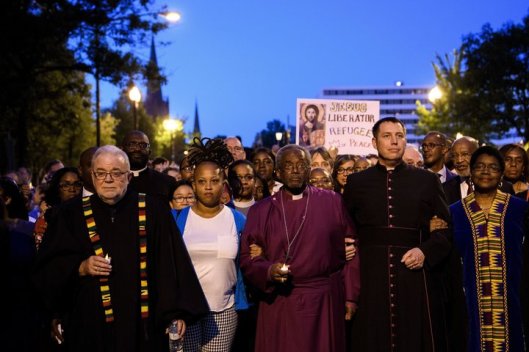
Less than a week after his historic sermon, Bishop Curry joined prominent faith leaders from all over the country in a movement called, “Reclaiming Jesus.”  A video explaining the movement can be found here.  Now if you have spent any time with me, you know that I am very hesitant to talk politics in the pulpit or even publicly.  I have always served in churches that were a wonderfully complicated mixture of political opinions.  The Eucharistic Table is the thing that brings us together, kneeling before God, shoulder to shoulder with fellow church members whose bumper stickers promote the exact opposite opinion of our own.

But just because I do not believe Jesus was a Democrat or a Republican, does not mean that I do no think Jesus and the Gospel are not political.  In fact, Jesus’ very life was ended because he was too “political” – because his message of love made people uncomfortable.  That is what the Reclaiming Jesus movement is about – reminding us that the Church still has a message of love – and that message is not passive or polite but is quite active and alarming.

This week, I am taking the warm, encouraging feelings I had from Bishop Curry’s sermon and listening once again to his words about what love in the world means.  I invite you to join me.  Join me in hearing what in the Reclaiming Jesus message makes you uncomfortable.  Join me in pondering how both political parties get it a little bit wrong and a little bit right.  Join me in remembering that Jesus’ message of love is not the same as an invitation to “avoid politics.”  The question is how we can do politics better.  How can we be an example of what it means to don different bumper stickers and work together for justice, peace, and love?  What Bishop Curry preached at the Royal Wedding sounded beautiful – just like Jesus’ own words.  But what Bishop Curry and Jesus called for was not just beautiful.  It is hard, confusing, challenging work – and even harder to do when we disagree so deeply.  Thank God for the Eucharistic Table!  It is the only promise to me that we can do this – that we can be political agents of love together.  I hope you will join me!

chalice-emhc

Photo credit:  http://www.freerepublic.com/focus/religion/3163266/posts

On Peter, Paul, and Michael…

Tags

, , , , , , , , , ,

In seminary, each third-year student preaches a “senior sermon” in front of the entire seminary.  It’s a bit nerve-wracking because seminarians and priests are a pretty tough crowd.  Add that on top of professors who have molded you for three years, and the pressure is pretty intense.  I remember talking to a professor about my nerves and he assured me, “Well, you know what the old hymn says:  If you cannot preach like Peter, if you cannot pray like Paul, you can tell the love of Jesus and say, ‘He died for all.’”

That hymn to which he was referring is, “There is a Balm in Gilead,” which is the same hymn that Presiding Bishop Michael Curry quoted in his sermon at the Royal Wedding.  Of course, preaching after Bishop Curry the next day felt equally daunting.  Lord knows, I cannot preach like Peter, and I certainly cannot preach like Bishop Curry.  But as I was thinking about it, I think what people have loved so much about Bishop Curry’s preaching at the Royal Wedding is:  1) he was authentically himself (which is obviously a bit different culturally from those gathered in the royal family, but his authenticity was infectious), 2) he was passionate about the love of Jesus and its ability to change the world, and 3) he gave the world a glimpse of what is so awesome about the Episcopal Church – a Church who understands the radical power of love and brings together people from all walks of life to thoughtfully, willfully, beautifully engage in doing powerful work in the world through love.

What has been fascinating to me about Bishop Curry’s sermon and the way it has been described as “stealing the show,” is that Bishop Curry was just doing what the Episcopal Church does every Sunday, at every wedding, and at every funeral – we worship God in the beauty of holiness, we teach those gathered, and we equip them to go out into the world sharing the good news of God in Jesus Christ.  What Bishop Curry’s success does is embolden us to live into our identity as disciples of Christ and members of the Episcopal Church.  I suspect you have talked to someone about Bishop Curry’s sermon in the last few days.  How about instead of just marveling about Bishop Curry’s talent as a preacher, you use this event to talk to someone about how you are inspired to be a follower of Jesus?  Keep it authentic:  “He was awesome, wasn’t he?  He reminds me of my church and the amazing things we are doing to harness the power of love.  I’d love to show you!”

What Bishop Curry did on Saturday at the Royal Wedding was be himself – a member of the Jesus Movement, sharing the Good News of God in Christ.  Your invitation is to be yourself and do the same.  You may not preach like Peter, and you may not pray like Paul.  But you can tell the love of Jesus, and say, “He died for all.”  I can’t wait to hear about your adventures!!

17426137_10155645675302565_2278358373496741633_n

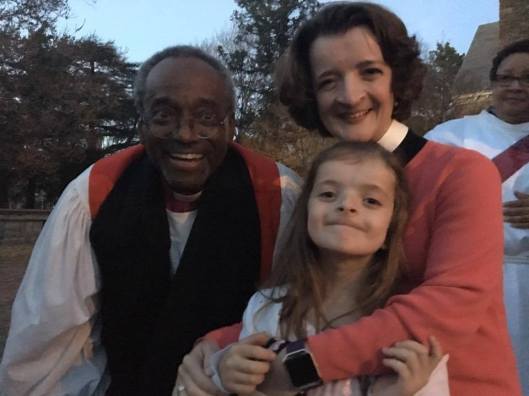
With Presiding Bishop Curry in 2017, Photo credit:  Jennifer Andrews-Weckerly (use only with permission)


Homily – Acts 2.1-21, Pentecost, YB, May 20, 2018

Tags

, , , , , , , , , , ,

33092215_1843823495673902_5618488268858327040_o

Photo credit:  John Rothnie (permission to reuse required)

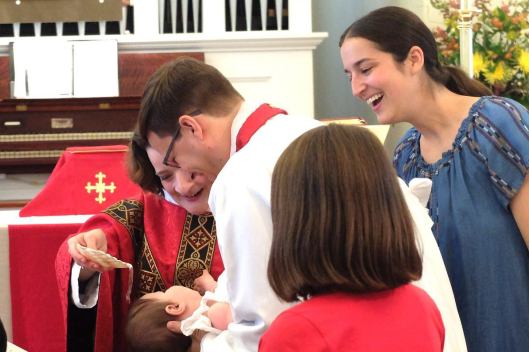
I have been looking forward to this baptism for months.  Olive is one of four babies born at Hickory Neck within a month of each other, and one of five within a five-month period.  Not only did I enjoy watching Olive grow in her mom’s belly, I knew how fun welcoming her to the community would be, and especially how special her baptism would be.  So when the Bauer Family finally settled on Pentecost, I was thrilled – baptizing a baby on feast day adds excitement to an already festive day.

But as the liturgy planning staff met about a month ago, I realized we may have made a huge mistake.  We were talking about the needs for today, and remembered we needed to recruit all our foreign language speakers because Pentecost is the one feast of the year where we really try to simulate the experience of the historically significant day in the life of the faith.  And as we were talking about rotas, translations, and participants, a sudden sense of dread hit me.  “Um, Charlie?” I said.  “Are you sure you want to baptize Olive on Pentecost?  I mean, I love Pentecost, but, especially for strangers to our community, Pentecost is a little weird.  Do you want us to just skip the whole languages part?”  To his credit, Charlie didn’t hesitate.  “What better day to baptize?!?” he said, as though my question were silly.

I have been encouraged by Charlie’s enthusiasm, but the more I thought about his response, the more I questioned his logic.  Don’t get me wrong – I love what we do at Pentecost.  Pentecost is one of the few days of the liturgical year that our scripture really comes to life.  Hearing the cacophony of languages helps you to really imagine yourself there.  But this is the kind of service that I would also say to first-time visitor, “Just so you know, we don’t always do this!”  Because, although I love the cacophony, I wouldn’t want anyone to think today is the norm – that we always break into tongues in the service or that we always like to shock your senses.  Surely if we were going to baptize Olive, we should find a tamer way to welcome her to the community, and not freak out her family and friends from all the ends of the country.

We do this all the time with Church.  If we get the nerve up to ask a friend to Church, and they take us up on the offer, we want them to experience the best of Hickory Neck:  a welcoming environment, beautiful liturgy, a sense of belonging, and a deep connection to the immanent and transcendent God.  But just like when you introduce a new romantic interest to your family, you don’t have them meet everyone in the family at the beginning.  You save crazy Uncle Joe until at least the second or third Christmas, when you know your boy or girlfriend is already in love with you enough to make allowances for the crazy in your family.  The same is true for church – we would much rather you see the beauty of Hickory Neck on a regular Sunday or even on a day like Easter.  There is no need for us to show you some of the really weird parts of our faith, like Pentecost, until you have at least been here for a while.

So why was Charlie so enthusiastic about bringing his extended family to celebrate baptism on this one, crazy, bizarre day in the life of the church?  Was he not thinking this through?  Or was he secretly hoping to ensure his family never comes back?  I started working through why this might be the perfect day for a baptism, thinking through what we learn about the church and membership within.  First, we learn the power of the gospel, of the good news of God in Christ, to reach all peoples, no matter who they are.  Although practically speaking, today’s multilingual reading sounds jarring, what we know about this piece of scripture is that despite the din of noise, everyone heard the good news in their own language.  The gospel is not limited to one group of people or to one tribe or nation; the gospel speak truth to all.  Second, we learn that Jesus’ story is not just for us – Jesus’ story is for all.  Up until this point in our story, Jesus has been keeping his resurrection and ascension to a limited group of people.  But today, that norm implodes.  Jesus’ story is no longer for those nearest and dearest to Jesus – Jesus’ story is for everyone.  Third, we are reminded of our commission from Jesus – to go out into all the world, sharing the good news of God in Christ.  Not just the English-speaking places, not just the places where people look and act like us, not just the places that make us comfortable.  And finally, Pentecost affirms the ways in which God loves us, no matter what.  No matter how loud, crazy, or chaotic our lives become, God is with us, breaking through the din of noise we create and making that noise holy.

Perhaps instead of finding the most proper, polished day to baptize a child of God, today may be the perfect day to teach us all what the life of faith is about.  We all know that when our romantic interest or dear friend finally meets Crazy Uncle Joe, or finally sees us when we are sick or not looking our best, or finally realizes we have some pretty awful flaws, and LOVES US ANYWAY – those are the people we want to keep around.  The same is true for those new to the church or those being initiated into the community of faith – we want you to see us on our craziest days so that you know, no matter what God loves you anyway.  God sees your craziness, your chaos, those parts of yourself that you hide from others, and God not only loves you, God commissions you and makes a way you share that love to the ends of the earth.

That is what we affirm today in our baptismal covenant.  Given the promise of unconditional love from God, we promise in return to live a life in accordance with that unconditional love.  To seek and serve all persons, to strive for justice, to respect the dignity of every human being, to proclaim by word and example the good news of God in Christ, to resist evil and repent, and to keep coming back to the community, breaking bread and joining in the prayers.  The chaos of today, the beauty of baptism today, the reminder of God’s love today are all meant to build us up so that we can get back out into the world.  What better day than today to baptize?!?  Amen.

On Letting Go and Listening…

Tags

, , , , , , , , ,

Our church is currently being blessed with a lot of activity.  This week, the site for the school that will join our property has begun construction.  Footers are ready to be dug and the foundation laid.  Meanwhile, this weekend, we are hosting our second Annual High Fiber Festival.  Volunteers are being recruited, parking layouts are being designed, and signs are being hung for this great event that raises money for outreach ministries.  Both events are wonderful signs of vitality and life at Hickory Neck – and yet both events have been the victim of all sorts of things out of their control.  Permit approvals delayed construction at the school.  Delays in school construction have created challenges for parking at the Festival.  And now rain seems to be threatening progress and success for both.

I have been thinking that both projects seem to be challenging my long-held battle with control.  As I imagine many of us do, I sometimes fall under the illusion that more things are under my control than actually are.  I consider myself a pretty faithful Christian, but when issues like control arise, I realize how far I have to go.  I think that phrase, “Let go and let God,” was written for me!  Lord knows, I cannot control the rain!

That is why I love that we get the Acts lesson for Pentecost this Sunday.  Talk about a people whose life are completely out of control!  If the cross, death, resurrection, and ascension were not enough to make the disciples realize they are not in control, perhaps Pentecost would be.  I imagine the disciples were finally getting their feet on the ground and preparing themselves to take up Jesus’ mantle of spreading the Good News.  But none of them could have prepared for the dramatic event of breaking into tongues all at once.

What I love about Pentecost though is everyone hears in the din of noise.  Despite the chaos and seeming utter loss of control, those gathered can hear clearly.  I wonder if that might be an invitation for us this week – to look at the chaos and situations in our lives that seem out of control and see where we hear God’s voice.  Maybe God’s voice is speaking to us directly.  Maybe God’s voice is speaking to us through a wise friend or confidant.  Maybe God’s voice is speaking to us through strangers or the seeming “coincidences,” of life.  I’d love to hear your stories of where you have heard God this week!

Singing-In-The-Rain-red-umbrella

Photo credit:  https://www.voices.com/blog/4-lessons-singing-in-the-rain/

Sermon – John 17.6-19, Acts 1.15-17, 21-26, E7, YB, May 13, 2018

Tags

, , , , , , , , , , ,

I used to belong to a community that had healing prayers every Wednesday at a midday Eucharist.  I never liked to go forward myself, but I was happy to see so many other people go forward for prayers.  Honestly, for the longest time, I did not really understand the whole process.  Were the same people so sick they needed prayers every week?  Were they having prayers for themselves or for other people?  And I had no idea what the priests were saying to them or what they said to the priests.  I was so intimidated by the whole process that I usually just sat in my seat and prayed for those going forward.

Then one day, some stuff was going on in my life I felt overwhelmed by and I finally stood up and got in line with all the other people.  I was so nervous.  I wasn’t sure if I was supposed to tell the priest my whole story, or if I was supposed to ask for something specific, or if I was just supposed to bow my head and wait for the priest to pray.  When I finally reached the priest, he looked at me expectantly.  I mumbled some prayer request that was super short and in no way indicated why I really needed prayers.  But then the priest did something extraordinary.  He prayed for me by name and was able to craft a prayer so thoughtful and generous, that I felt like he could see into my soul and understand what was really weighing me down.  By simply saying my name, I felt known, cared for, understood, and seen – really seen – for the first time in a long time.

I suspect that is what the disciples are looking for at this point in our narrative.  For weeks, Jesus has been making resurrection appearances, teaching the disciples, and talking to them about next steps.  These weeks have been reassuring, lifegiving, and invigorating.  What seemed to be a massive disaster is now a holy victory.  But then, just days ago, Jesus finally leaves them for good as he ascends into heaven.  Before he goes, he tells them to wait for the Spirit to clothe them with power.  We are told they disciples return to the temple, praising God, but in our Acts lesson today, the disciples are busy figuring out their leadership plan.  You see, the establishment of twelve disciples was important to the ancestral roots of the twelve tribes of Israel.  The disciples want to be ready to “witness the messianic kingdom inaugurated by the death and resurrection of Jesus.” [i]

This is what we all do when we are scared.  We busy ourselves.  Jesus tells the disciples to wait for the Holy Spirit, and what do the disciples do?  They start developing a leadership plan, thinking about their presentation to the faith community, and organizing themselves.  None of these things were things Jesus told them to do.  In fact, Jesus told them to wait.  But we are not very good at waiting.  I remember last summer when the Vestry finished our needs assessment about child care and adult day care in Upper James City County, the conclusions were clear.  Both were needed and anything we could do would be a help.  When we finished that final assessment, I remember thinking, “Now what?!?  How in the world are we going to actually do something about either of these issues?”  When we left that meeting, I sensed we all walked away with the same sense of dread.  The community had spoken, but we had no idea how to live into God’s dream for us.  It was like looking over a great chasm with no way to cross over.  I remember wondering what other work we could do to prepare ourselves for something like that.  But I also remember being so clueless about what would come next that I kind of just looked to God with a sense of panic, wondering, “Now what?!?”

That’s why I love the gospel lesson from John today.  The lesson from John does not fit chronologically with where we have been in the Luke-Acts story.  John’s gospel today includes the words of Jesus’ farewell discourse before his passion.  These last verses of John 17 are a part of a prayer that Jesus says after an extensive time of teaching.  The words we hear today are not the words of a desperate prayer said in private by Jesus to God.  The words we hear today are words of prayer said for and about the disciples – said right within their hearing.  The words are not particularly pretty.  In typical John form, they sound circuitous and repetitive – so much so, they can be hard to really hear.  But if we listen closely, Jesus’ words today are an impassioned prayer for the personal care and safety of the disciples, so that the disciples can feel empowered to go out into the world under God’s protection.  “This is not Jesus teaching his disciples how to pray.  This is not only a personal prayer or privatized piety.  After betrayal and predicted denial, after concerned questions and foretold rejection, the disciples do not need another lesson, another miracle, another example.  They need exactly what Jesus does, because Jesus knows — for Jesus to pray for them.”[ii]

Jesus’ prayer is like the priest’s prayer at that healing service.  Jesus sees these scared, confused, anxious disciples and he prays for them by name, reminding them how they are loved, calling down God’s motherly love for the disciples, and asking for a sense of empowerment for each disciple. Although his prayer is not said in those days between the Ascension and Pentecost, the disciples could stand to remember this moment as they wait.  When we steer far from God’s providence, and we start to busy ourselves to hide our anxiety, these are the words we return to to steady ourselves.  Jesus’ words today, called the High Priestly Prayer, are the words of a priest – calling us by name, naming our specific anxieties before God, soothing us by their healing power, and calming us so that we might be able to go out into the world.

But Jesus’ words are not just the words of a priest.  Jesus’ words today are the words of all the faithful – said on behalf of another we name, said in the confidence of a child of God, said in the presence of one receiving prayer.  We can give away the gift of prayer and blessing the disciples needed too.  You may not feel comfortable praying aloud with another person yet.  If so, a prayer, using the person’s name and praying as Jesus does for that person is fine.  But Jesus’ words and actions for the disciples today embolden you to do what Jesus does.  You can ask the other person if you might pray for them – and pray with them right then and there:  whether you are praying for your own child and the concerns they have just voiced to you, whether you are praying for a friend who has finally confessed what is on their heart aloud, or whether you are praying for an acquaintance who cannot express their heart, but who is speaking to you because they know you are a person of faith and they need a priestly prayer from Jesus.  Any of you who have gathered at the side altar for healing prayers, or who have had your name called aloud for prayer knows the power of this work.

Normally, I commission you at the end of every sermon – giving you a task to do out in the world, bringing the good news of God in Christ into the broken world.  But on this Sunday between the Ascension and Pentecost, I invite you to take Jesus word’s seriously:  to pray while you wait for the empowerment of the Spirit.  This is not an invitation to look busy or to use action to cover anxiety this week.  This is an invitation to be present every day, looking around you for those who need your prayer, and then offering that personal, named prayer for those in your path.  As Jesus prayed for the disciples, as the disciples prayed for those with whom they shared the good news, so we continue the age-old practice of deep, personal, abiding prayer with others.  Those prayers for the disciples are prayers for us – Jesus prays for us today.[iii]  Our invitation is to give that comforting, loving, emboldening gift to others.  Your words, your calling another by name, give them power to sit and wait for our God too.  Amen.

[i] David S. Cunningham, “Theological Perspective,” Feasting on the Word, Year B, Vol. 2 (Louisville:  Westminster John Knox Press, 2008), 528.

[ii] Karoline Lewis, “Prayers Needed,” May 6, 2018, as found at http://www.workingpreacher.org/craft.aspx?post=5147 on May 9, 2018.

[iii] David Lose, “Easter 7 B:  Prayer is Love,” May 10, 2018, as found at http://www.davidlose.net/2018/05/easter-7-b-pray-is-love/ on May 10, 2018.