On Patience and Humanity…

Tags

, , , , , , , , , ,

Our youngest recently graduated to a “big girl” bed, which means that she now officially refuses to stay in it for sleeping.  Since she discovered her new freedom, we have spent anywhere from twenty minutes to two hours trying to get her to sleep.  We have tried everything – a predictable routine of bath, book, rocking, and bed.  We have tried gently returning her to her room, with limited conversation.  We have tried insisting she put herself back to bed (this one almost never succeeds).  And of course, we have raised our voices many a time – not exactly the best remedy to get someone to go to sleep.  There have been tears (hers and ours), arguments, and desperation.  We keep reminding ourselves that this is a phase, but when you are in the thick of a phase, it can be hard to see straight.

I was bemoaning our situation this weekend, wondering why she doesn’t just go to sleep.  Clearly she is tired, and she feels better when she is rested.  But logic is not her strong suit right now.  In the midst of my frustration, it occurred to me that this must be a little taste of God’s relationship with us.  Surely God knows what is best for us, and would love for us to follow God’s will.  And yet, we are stubborn.  We want to do things our way, and we want to be in control.  Sometimes it occurs to us to go to God in prayer, seeking guidance.  But most of the time we are so fixed on what we want and what we think is best, we rarely look to God.  God gives us the gift of free will, and with that comes the mess of human decisions and actions.

Thinking about God’s infinite patience with my own stubbornness has made me wonder if I might take a deep breath and try to offer that same patience with my little one.  I often find that when I take that breath, imagining God’s lens of patience, I am able to see my child’s frustration, her longing for independence, and her confusion.  Seeing her humanity makes my heart much more generous.  Thinking about God’s infinite patience has also made me wonder to whom else I could extend a little more patience.  Perhaps it is the friend or family member who feels like a perpetual burden.  Perhaps it is a colleague or fellow volunteer who refuses our advice.  Or perhaps, and maybe even more frustrating lately, it is that elected official for whom we may or may not have voted.  If God can love us, honor our humanity, and abide with us, surely we might be able to share the same love, honor, and patience – even if it sometimes makes us crazy!  I promise to pray for you as you endeavor to follow God’s example – as long as you pray for me too!

gods-patience

Photo credit:  www.ottawacoc.org/sermons/393261-gods-patience/

Sermon – John 1.29-42, EP2, YA, January 15, 2017

Tags

, , , , , , , , , , , , , , ,

A little over a year ago, I got an email from the Search Committee at Hickory Neck, asking me to think about submitting my name for consideration as Rector.  They detailed how they obtained my name and several reasons why I should consider applying.  “Oh, and by the way,” they said, “the deadline is in one week.”  I remember experiencing a wave of emotions from that email.  But the first cogent thought I had next was, “Well, I better go and see what they are all about.”  I spent the next twenty-four hours pouring over the available information.  I could not really explain why, but I knew I wanted to know more.

That is how most of the discernment process went.  In various ways, Hickory Neck kept saying to me, “Come and see.”  And I kept saying, “Okay.”  When confidants would ask what I liked about Hickory Neck, I had a hard time explaining my experience.  All I could say was that something about Hickory Neck was very compelling to me.  With every email, phone call, interview, or visit – I wanted to know more, to see more, to connect more.  Each, “Come and see,” had a note of expectancy, hope, and promise.  And every time I came and saw, I wanted to experience more.

The first followers of Jesus are drawn to Jesus in a similar fashion.  In our gospel lesson today, John the Baptist keeps pointing to Jesus, trying to convince those around him that they have got to go check out this Jesus character.[i]  Three times John basically says, “Come and see this Jesus!”  Jesus himself engages others with a similar invitation.  He asks what the seekers are looking for, and when they answer, Jesus says, “Come and see.”  Jesus does not talk about himself at length, or even really answer the questions of John’s disciples.  He simply invites them to “Come and see.”  One of John’s disciples, Andrew, after going and seeing Jesus, turns and does the same thing – he grabs his brother, and says to him, “Come and see.”  He does not give an elaborate explanation.  He brings his brother to Jesus and shows him so that his brother can see too.

We do the same today through the vehicle of our Annual Meeting.  Now, for many people, the Annual Meeting is code for the boring business of church.  The same thing happens every year:  we elect Vestry members, look at the budget, and hear about the state of the church.  Some years we might actually be interested in the reports – certainly last year we were eager to hear news from our Search Committee.  But most years, the Annual Meeting is sounds about as exciting as the title.

Perhaps the problem is simply the title – perhaps we should call today our Annual Celebration or our annual Come-and-See Party.  Because that is what our Annual Meeting really is:  a chance for us to come together and see the good work that Jesus is doing in our midst.  In 2016 alone, Jesus set our hearts on fire.  There were the obvious things:  new leadership being installed and ordained; good friends and leaders being sent off to new adventures; hungry, cold neighbors using these walls for shelter and protection; children, youth, and adults finding new inspiration, learning, and joy in their journey; curious visitors becoming brothers and sisters in our growing community; monies, food, and supplies being raised and collected for our neighbors in need; homebound members being brought into our midst through our Eucharistic Visitors; new worship experiences that touched our hearts and sparked something fresh in us; social media giving us tools to invite, welcome, and connect with seekers in our community; witnesses that inspired us to live generously and dream new dreams; laughter, tears, and songs bouncing off these walls; and all manner of traffic on our grounds – from people with gardening tools, to people with casseroles and Brunswick stew, to people with beloved pets, to brides and babies in white gowns, to old friends in caskets, to blue grass musicians.  And all of those obvious things do not even touch the not so obvious things:  the faithful parishioners who gather weekly in prayer, meditation, and study; the quiet volunteers who send cards, make calls, and visit hospitals; the parishioners who watch small children so their parents can worship; the women who clean the silver, polish the brass, and arrange the flowers; the men who rearrange furniture, hang greens, and cook meals; the children who teach us, inspire us, and lead us in worship; the youth who lead us in song, who ask hard questions, and call us to authenticity; and the brave who keep bugging their neighbors to come and see Christ at Hickory Neck.

This past year has been a year of incredible, rich, life-giving ministry.  We see that renewed spirit in the wonderful growth in our ministry this year.  Much of what happens at our Annual Come-and-See Celebration will give us the opportunity to do just that – come and see the incredible work Jesus is doing in our community.  And the celebration of the good work of 2016 is inspiring work on our growing edges in 2017.  Today, parishioners will receive time and talent forms to prayerfully consider how Jesus is inviting us to give back to this life-giving parish.  As we look at our budget, we can celebrate how generous giving has helped us grow our staff – and how extended giving will allow us to do even more in 2017.  Seeing the many successes of our engagement in social media, we will be looking at even more ways that our online presence allows us to invite more people to come and see Christ at Hickory Neck.  Celebrating our work in feeding, clothing, and giving shelter to our neighbors will help us consider how we might encounter Christ in new and more meaningful ways with our neighbors in Upper James City County.  With the Holy Spirit blowing behind us, we are filled up with Christ’s light and ready to shine our lights even brighter from this holy hill.

But all that we see and hear today is not just for us.  Just like John the Baptist, and Andrew and Simon Peter, when we see all that Christ is and all that Christ is doing, we cannot keep the good news to ourselves.  We do not need some lengthy explanation or some canned evangelism speech.[ii]  We do not even need to worry about what baggage others might be carrying around about Church.  All we need to do is harness those three words, “Come and see.”  Those powerful words are all we need because the light of Christ is already aglow in our faces when we talk about Hickory Neck.  I know that when I was engaged in the discernment process with the Search Committee, with words failing me, I felt that same glow.  The people, the work, the passion, the life present here fills us up with such light that all we need to do is say, “Come and see,” and others will find their way to the same joy we have found in this community.

Like any Sunday, we come together today, especially on this Annual Meeting Sunday to celebrate all that has been, all that is, and all that is yet to come.  We gather together to celebrate both our successes and our growing edges.  We assemble today to remember what about Jesus draws us in, especially in the context of this community of faith, and then to do our parts to be Johns, Andrews, and Simons, pointing the way for others, and with a twinkle in our eyes, saying, “Come, and see!”

[i][i] Rodger Y. Nishioka, “Pastoral Perspective,” Feasting on the Word, Yr. A, Vol. 1 (Louisville:  Westminster John Knox Press, 2010), 262.

[ii] David Lose, “Epiphany 2A:  A Question, Invitation, and Promise,” January 9, 2017, as found at http://www.davidlose.net/2017/01/epiphany-2-a-a-question-invitation-and-promise/ on January 11, 2017.

Come and See!

Tags

, , , , , , , , , , , ,

This past weekend, Williamsburg was hit with over a foot of snow.  Living in an area without many plows, and serving in a church without a Rectory on the campus, I knew that Sunday services at Hickory Neck would be nearly impossible.  Our parking lot did not get plowed until early Monday morning, and many of our parishioners live on rural roads.  With great disappointment, I cancelled all Sunday services.  But then my husband turned to me with a twinkle in his eye and said, “You should lead Morning Prayer on Facebook Live!”

That night I put together a video to tell people what we were going to do and where they should go to join me in worship.  And on Sunday morning, at 10:00 am, I went live.  By the time we had finished, there were over 60 views.  By the time we got to the end of the day, there were over 300 views.  By Tuesday night, there were over 700 views.  The positive feedback poured in – from our parishioners, from their neighbors, and from dozens of people who were snowed in all up and down the Atlantic coast.

As I have thought about the experience, I realized what a gift technology can be.  Isolated in homes, people were able to come together and pray the same prayers, hear the same readings, confess our sins, lift up our intercessions and thanksgivings, and give glory to God.  So often we talk about the challenge of the church is being tied to the walls of the physical building, not taking the Gospel out in the world.  Our experience on Facebook felt like a little way of getting ourselves out in the world, and sharing the beauty of worship in virtual community.

Of course, I don’t think church can always be expressed in virtual ways.  Being physically present with one another allows us to engage all our senses, to read the body language of someone who is suffering or experiencing joy, and to engage in the holy meal that brings us together despite our divisions.  But the experience certainly made me realize that we can supplement that communal physical experience with communal virtual experiences.  And once you show your neighbor that cool video from your church, then, like Jesus in our Gospel lesson this coming Sunday, you can say, “Come and see!”[i]

come-see

Photo credit:  https://www.queertheology.com/john-1-29-42


[i] John 1.39.

On Sushi and Other Adventures…

Tags

, , , , , , , ,

sushi-roll

Photo credit:  www.lifehack.org/articles/lifestyle/kitchen-hack-five-minute-maki-sushi-rolls.html

My husband and I have very different experiences of food.  I like to try new things and am constantly surprised but what things I discover and grow to love.  He is much less experimental and is easily turned off by new smells or flavors.  I love a variety of foods, and he is what I would call, “picky.”  Our differences have certainly made shared meals difficult.  I have learned to use meals with friends or colleagues as my time to play with food.  And I have also learned what common foods we like and can share on a weekly basis.

When we had children, I was desperate to instill in them a love of the varieties of food – not because I think my husband’s preferences are bad necessarily, but more because I want them to be willing to try new things.  That has meant introducing things to the kids at an early age, treating new foods like a fun experiment, and learning how to use “thank you, please” bites (a practice in which the child has to try at least one solid bite of a new food – every time it is served).  The experiment has taken time.  Things I introduced early did not go so well.  But over time, my oldest has become more and more interested in new tastes and textures.

This week, on a mommy-daughter date, I decided to try sushi again with my oldest.  She tried it once before (in a gracious, “thank you, please” bite), but I figured it had been a year or two and we could try again.  I got a sampling of sushi, and she bravely tried every kind.  She had miso soup for the first time, and proclaimed she loved it (I waited to tell her what the green stuff (seaweed) and white stuff (tofu) was until after she ate it first).  She also tried some noodles as a backup plan.   As we were wrapping up our fun lunch, my daughter said to me, “Mommy, I like trying new foods.”

I was thinking about her adventurous spirit and realized we could all use a little more willingness to try new things.  Your thing might not be food, but there might be other areas of life that you have been avoiding out of a sense of fear or trepidation.  Maybe it’s a new clothing style, a fun recreational activity, or a book.  Maybe it is a new form of prayer, an outreach opportunity, or a new style of worship or liturgical music.  As I look back at these first nine months at Hickory Neck, I realize we have both been doing a lot of experimenting – I have been trying new things and so has the parish.  Some of the changes we have loved, some have been a bit awkward, and some did not work at all.  But knowing that we are committed to the adventure has made the trying of things less intimidating – and I think more exciting!  We are probably not going to like everything we try, but a good, “thank you, please” bite won’t hurt.  Here’s to more adventures, Hickory Neck – with God, with one another, and with the world!

Homily – Luke 2.15-21, Holy Name, YA, January 1, 2017

Tags

, , , , , , , , , , , , ,

Our gospel today picks up where we left off a little over a week ago.  On Christmas Eve, we heard how Mary and Joseph journeyed to Bethlehem to be registered.  We learned of how there was no room for them in the inn, and how they ended up delivering little Jesus, the savior of the world, in a room designated for animals.  Exhausted, they placed him in a manger, in bands of cloth, making the best of an awful situation.  We also learned of some unsuspecting shepherds who experienced an angelic encounter.  An angel appeared to them in the fields and told them of the messiah who had been born, where they could find the messiah, and what they could look for – that manger and those bands of cloth.

Today we pick up where we left off.  The angels leave, and the shepherds decide to check out the story.  They visit with Mary and Joseph, confirm the story, and then share their experience with the tired couple.  We are told Mary treasures the words, but ponders them too.  She is clearly still figuring all this out.  Meanwhile, the shepherds go back to work, praising God.  And Mary and Joseph go back to work too – following the circumcision customs, but perhaps, more importantly, following through with what they were asked to do – naming Jesus as the Angel commanded.[i]

What I love about this story is that no one acts alone.  Mary gets the bizarre news of her pregnancy alone, but then her cousin Elizabeth affirms her and confirms the good news.  Shepherds are minding their business when the angels appear to them.  They could have stayed at home that night, but they go and share the news.  Mary and Joseph go on a scary journey that seems to be making one bad turn after another.  But then shepherds come and give them a good word.  Even the naming of Jesus takes place in community – at least a rabbi or priest comes and performs the naming right, knowingly or not, naming the child the same name the angel gave Mary – Jesus, or “Joshua, meaning salvation”[ii].

Going at things alone is part of our contemporary mindset.  We place a value on people being able to fend for themselves.  The number one goal of parents is to teach their children independence.  And Lord knows we hear a lot of, “I do it by myself!” at our house these days.  In and of itself, independence is not a bad thing.  We have gifts and talents of which God expects us to be good stewards.  But going at life alone can have the opposite effect of what we think.  By glorifying independence we forget the inherent dependence we all have.  If nothing else, we are certainly dependent upon our Lord and Savior, without whom nothing would be possible.  But Jesus teaches us that community is equally important.  Jesus was never a lone ranger in his ministry. He understood the people of faith to be a community – to need each other for learning and understanding.  Unlike what the world might have us believe, life is not all about independence.  Quite the opposite, we need each other in this crazy journey of faith – to learn from each other, to challenge each other, to support each other, and cheer each other on when we get weary.

As our children and I were reading our Advent and Christmas devotional this week, we learned about Simeon and Anna, whose story comes in the verses just following the passage we read today.  If you remember Simeon and Anna are elder members of the faith, living and working in the temple when Jesus is to be presented.  The devotional asked us what elderly people we know and what they teach us.  I was surprised to hear my seven-year old jump in with all sorts of idea about what our elders teach us.  She said that our elders have lived a lot longer and so they have a lot to teach us about the world.  She said they can help teach the children how to live and what they can do in the world.  When I asked the question about what our elders teach us, I had expected the standard, “I don’t know.”  Instead, I got a response that showed a great deal of insight into how much we need each other – young and old, rich and poor, male and female, liberal and conservative – if we are going to survive in this journey of faith and life.

All the parts of our Christmas story are a bit like a puzzle.  Each piece is important in its own right, but once you put the pieces together, the puzzle reveals something much more valuable.  Though the parts we hear about during Christmastide are some of our favorite parts, they are just pieces in the puzzle.  The story of Jesus would not be complete without angelic appearances, shared stories between cousins, and tired, weary people sharing good news together.  Mary would have nothing to treasure and ponder without the ragtag community that has gathered around her.

The same is true for us.  Our Christmas story is a beautiful story.  But unless we share the story in community, unless we share our story in community, we only get a partial glimpse into the good work Christ is doing in our lives.  We need each other to encourage and support each other in the faith journey.  We need each other to interpret God’s movement in our lives, and to teach us wisdom.  We need each other in those moments of treasuring and pondering our own story.  Today we give thanks for the tremendous community of faith who help us in our journeys toward Christ.  Thanks be to God!  Amen.

[i] Fred B. Craddock, Luke, Interpretation:  A Bible Commentary for Teaching and Preaching (Louisville:  John Knox Press, 1990), 36-37.

[ii] Craddock, 36.

Sermon – Luke 2.1-14, CE, 8/11 PM, December 24, 2016

Tags

, , , , , , , , , , ,

In our house, we are still in the stage where Christmas is a big deal.  With a seven- and a two-year old under foot, there are Christmas presents galore.  We try not to go too crazy ourselves, but once you add in faraway grandparents, aunts and uncles, and friends, the tree is bombarded with gifts.  This year I have been staring at that tree and wondering where in the world all that “stuff” is going to go.  The kids already have quite a bit of toys and games.  I look around at our full house and wonder where everything will fit.

That is why I was excited when a friend of mine shared a great new find this year.  Called a “Christmas Sack,” the large cloth bag is meant to filled with toys, games, or clothing the children (and adults!) no longer need and would like to share with someone who does.  They fill up the bag before Christmas, and put the bag by the tree on Christmas Eve.  The next morning, the bag is empty, and in the bag’s place are new things for the kids to enjoy.  The idea was brilliant, and reminded me of an old adage another parent had once given me – for everything that comes in, something must go out.  What I love about the idea of that bag is the bag makes room – makes room for the house to not feel cluttered, makes room for the kids to play and really enjoy their new things, and makes room for whatever might come.  I want our children to grow up in a home where there is that kind of room.

Mary and Joseph run into a similar problem on that fateful night over two thousand years ago.  Their problem is not so much houses overrun with presents.  Their problem is homes and guesthouses overrun with people.  The tyranny of living under the Roman thumb is that the Roman emperor is always looking for ways to squeeze the people – to live in prosperity no matter whether others suffer or not.  In our story tonight, the emperor has gone to extremes – making people return to hometowns to be registered.  He wants to make sure he has not missed any opportunities to tax his people, and so he degradingly corrals people into towns to count them like animals.  By the time Mary and Joseph roll into town, all the homes of their relatives and friends are full – even the guestrooms are full.[i]  There is no room for them.  No space has been left over for hospitality.  No room has been left for whatever might come.

And so, in the midst of a dehumanizing governmental reign, at the tail end of an already scandalous marriage and pregnancy, Mary and Joseph are squeezed into the section of a home that is reserved for animals.  Alone, denigrated, shamed, and weary, they bring into this world a savior for people just like them – a savior for the poor, oppressed, marginalized, dehumanized, and victimized.  In a vulnerable little package arrives the Godhead, in the most vulnerable of situations, to be a light to all who are vulnerable.  What should have been a party of epic proportions becomes a gathering of misfits, who are the only ones who get to see the miracle of Christ’s birth.

As I have been thinking about how there was no room for the Holy Family, I have wondered what it would have been like for someone to make room for this vulnerable family.  Had someone, anyone, said yes to Mary and Joseph, imagine the wonder they could have experienced that night.  Might they have seen something different in this Christ Child?  Might they have been awake when the shepherds came and heard their tale?  Might they have been given first row seats to the most holy of nights?  I wonder if one of the reasons that no one makes room that night is that no one is ready for the Messiah.  In the midst of their own travel and cramped accommodations, the sense of persecution by their government, and perhaps a loss of hope about what could be, no one makes room for the possibility of a Messiah who can make things different.  No one makes room for whatever might come.

Of course, I am not sure any of us is prepared to make room for Jesus tonight either.  I do not know about you, but I have been running to the store all week because my brain is so scattered that I keep forgetting small things like milk, and worrying that we will run out when the stores are closed.  I keep remembering one more person I wanted to send a greeting to or for whom I wanted get a gift.  A week ago, I gave up on getting out my Christmas cards (which I decided could be Epiphany cards to give myself a break).  When you are running at full speed, tending to the mundane of life, professional or familial obligations, and making sure you have laundered enough clothing, we can easily forget to make room for Jesus in our lives.

This week I was reading about a custom in Russia.  On the eve of Christmas, Christians fast all day until the first star appears that night.  Of course, fasting until the first star reminds them of the star that led the magi to Bethlehem.  But the custom is also meant to be a fast for the soul – as one monk puts it, to “abstain from bad or useless thoughts and speech, and await in silence and composure the savior who is coming to us.”[ii]  Truthfully, I cannot imagine anyone fasting and staying silent all day on Christmas Eve, but the idea is certainly intriguing.  The physical fasting alone might make us savor our Christmas meals a bit more.  But the spiritual fasting might be just what we need in these days of noise, suffering, and chaos – a quieting of the soul to make room for the voice of Christ, and whatever else might come.

Now, the first star has most certainly appeared by now.  But you have done an incredible thing by coming here tonight.  In some ways, this service is your mini-fast.  You chose to take a break in the family festivities, the hubbub of preparations, and the noise of life to come to church.  You have gathered with a community of people who have made that same choice.  And we certainly will not be breaking our fast until we eat the holy meal.  I invite you to use this special time that you have chosen to set apart as a time to take in a deep breath, to savor the quiet of this night, and to invite Jesus in – to either help you make room in your heart for him, or to invite Jesus in to the room you have already made.

The gift of this service tonight is to help you create that room and give you eyes to see what God is up to when you create space.  I often find that when I create room for Jesus, I remember how fortunate I am to have family, friends, and food, and then can pray for those who lack those things.  When I create room for Jesus, I can look around my community and see Marys and Josephs all around me who need a little hand – a literal room, or at least my compassion and grace.  When I create room for Jesus, I see all the tiny interruptions in my day not as hurdles to accomplishing tasks, but as moments with Jesus as each person reveals to me a facet of Jesus for which I had not been listening or looking.  I look forward to hearing what you do with the room you create for Jesus tonight and for whatever else might come.

[i] Douglas R.A. Hare, “Exegetical Perspective,” Feasting on the Word, Yr. A, Vol. 1 (Louisville:  Westminster John Knox Press, 2010), 121.

[ii][ii] A monk of the Easter Church, “Christmas Eve,” A Christmas Sourcebook, Mary Ann Simcoe, ed. (Chicago:  Liturgy Training Publications, 1984), 13.

Homily – Luke 2.-8-20, Blue Christmas, December 21, 2016

Tags

, , , , , , , , , , ,

I can still picture the perfect Christmas in my head.  My cousins were all there, along with my aunts, uncles, and grandparents.  The kids’ table was the coveted spot for dinner – even some the adults offered to make the “sacrifice” of not sitting at the adult table in order to join the kids.  After a dinner with the lamb and asparagus casserole my grandfather always cooked, the cousins challenged the aunts and uncles to a football game in the yard.  I scored a touchdown, which if you know me, was a minor miracle.  It was a perfectly beautiful, chilly day, and I remember being happy.

Of course, I was too young to know what was actually happening.  Marriages were hanging on by a string, and only one would survive.  Anxiety was hidden beneath the surface at the kids’ table as one family member barked at us for various offenses.  At least one family member was struggling with her sexuality.  Cousins would later be caught in the middle of nasty divorces, meaning I would not see them for several years.  Jobs would be lost, and identity would be questioned in the midst of unemployment.  American politics would infect family politics.  Even my own immediate family was heading for all sorts of tumult.

For a long time, I mourned the loss of that perfect Christmas.  I saw other families seeming to hold their Christmases together without effort.  I watched commercials that reminded me more of how things used to be rather than how they were.  I would receive annual Christmas cards and letters from seemingly perfect friends that made me feel like I did not measure up.  Even the pictures of the Holy Family seemed to capture a peace and contentment that I would never have.

But slowly, over the years, the old Biblical narrative seemed to unravel.  Knowing how hard marriage is, I could finally imagine how tense things must have been between Joseph and Mary.  Knowing how hard pregnancy is, I could finally imagine how miserable Mary must have been by the time they arrived in Bethlehem.  Knowing how brutal the Roman rulers were, I could imagine how dehumanizing going back to your hometown to be enrolled in the census must have been.  Knowing that not one family member, friend, or business would take in the Holy Family, leaving them in the most humiliating of situations, I could imagine how panicked and lonely the first-time mom, Mary, must have felt, even in her exhaustion.  Knowing how filthy shepherds usually were, and how Mary and Joseph just wanted a little peace, I could imagine how overwhelmed the Holy Family felt.  Though we like nativity sets, cards, and pageants that depict the Holy Family’s experience as heavenly perfection, the scripture tells a different story.

One of my favorite paintings of Mary is a painting that depicts her, just after birth, splayed, half-dressed, on a rustic bed, with women hovering in the dark background, tending to baby Jesus.[i]  There’s something very real and raw about that painting – the animals and baby are all there, but none of it seems perfect.  That’s what I love about this service too.  We too are tired, overwhelmed, and feeling vulnerable.  We too are lost without our loved ones this year.  We too are terrified of the ambiguity of life, and the sense that we are not in control.  But unlike everywhere else we live and work, this gathering tonight says we do not have to hide; we do not have to stuff our vulnerabilities and weaknesses in a box; we do not need to try to find perfection.

Tonight we are simply invited to be real, vulnerable, and honest about the imperfection of our lives, of ourselves, and of this time of year.  And though some artists might want you to believe that the Holy Family puts forth some sort of perfection standard, if anything, the Holy Family is right there with us.  Sitting among smelly animals and shepherds, settling into itchy hay and drafty stables, and wrapping their child in scraps of simple cloths, the Holy Family invites us into an imperfect Christmas.  Only when we enter fully enter into the imperfection of our Christmases are we able to allow the perfection of Christ to light a small flame of hope in our hearts.  May that light be kindled or stoked tonight, and may that light of hope grow ever strong in the days, weeks, and years to come.

[i] Paul Gauguin, “Te Tamari No Atua (Nativity), 1896,” as found at http://www.jesus-story.net/painting_birth_christ.htm on December 20, 2016.

On Snow Globes and Other Deceptions…

Tags

, , , , , , , , ,

snow-globe-tree-with-snow

Photo credit:  www.balsamhill.com/Christmas-Tree-Musical-Snow-Globe-p/4000824.htm

When I was growing up, we used to have a Christmas snow globe.  If you wound it up, it would play a lovely Christmas carol.  But you could also shake the large globe and snow would delicately swirl around the Christmas tree.  Something about the snow globe was mesmerizing.  I would wind up the music, shake the globe, and just stare into the glass.  There was something so peaceful about that globe – like a perfect world inviting me in to the snowy calm.

Of course, there were no snow blowers, plows, or ice melt in the snow globe.  There were no grumpy people shoveling out sidewalks and cars before the snow gets too heavy or the snow turns to a thick layer of ice.  No one was slipping on ice, sliding into a car accident, or shivering without shelter.  No, the snow globe does not invite that kind of realism.  The snow globe only captures the magical moment of freshly fallen, untouched snow, and dreamy winter.

Too often, we choose to keep gazing at snow globes, or to create our own snow globes.  We stare into snow globes because the destruction, hate, and violence of the world have caused compassion fatigue.  We create our own snow globes to insulate ourselves from the outside world so that we do not have to encounter the other.  Today our church delivered holiday gifts for seven families who live in a large public housing development.  As soon as we parked our car to drop off the gifts, I knew we were not in our snow globe anymore.  As a priest, those in need often come to me.  Today, I stepped onto their territory and it was a helpful reminder of how insulated my world can be if I create a globe around it.

The funny thing is that once I stepped out of snow globe, I did not slip on the ice.  I did not feel a sense of burden or dread.  Instead, people greeted me – making sure that I saw them.  Instead, a resident saw my colleague’s clergy collar and asked him to pray with him.  His friend said, “Well, while you’re at it, can you pray for my daughter too?”  Before I knew it, six of us were holding hands in the middle of this housing development, praying for health, wholeness, and the birth of our Savior.  I don’t know about you, but that’s better than any snow globe I can create.  What snow globes have you been looking into or what snow globes have you inadvertently created?  Join me this week as we pull our gazes away from the world of pretend protection and into the world of blessed encounter.

Sermon – Matthew 1.18-25, A4, YA, December 18, 2016

Tags

, , , , , , , , , , , , , ,

This week, I have been thinking a lot about callings.  Of course, with Charlie’s ordination to the priesthood this weekend, thinking about callings is not unusual.  I have always enjoyed ordinations – and not just because I am a priest.  I remember the first ordination I went to there were six people being ordained.  I only knew one of the six because she was our new assistant at the Cathedral.  But I remember being awed by the service.  The six ordinands seemed set apart.  As they processed down the aisle, wearing their simple albs, I remember wondering how they came to be called as priests, imagining they must have led a special life or be particularly holy.  I remember the swarms of clergy who gathered up front to lay hands on the new priests.  I remember how the new priests somehow seemed bathed in light that day – as if they had some special connection to the holy.

Having been through the ordination process myself, I look at ordinands a little differently today.  Instead of seeing perfectly pious priests processing, I see people who have come through a great ordeal.  I imagine the countless nights of struggling with God about why in the world they should become priests.  I imagine the stressful meetings with bishops, priests, and committees and the ambiguity about what would happen.  I imagine the exams, the sense of failure after messy pastoral visit, and the countless “no”s that come along in the process.  I no longer see perfectly coifed new priests, but instead see the haggard, raw, vulnerable people who have said, “yes,” to what promises to be a life of hard, beautiful, ugly, blessed days.   In that way, I do not see the ordained as all that different from the rest of us – a vulnerable group of people who are trying to figure out what in the world God wants us to do with our lives.

That is why I love that we hear Joseph’s story today.  Most of us think of Joseph as the stable, quiet figure in Jesus’ life.  He is present on the holy night of Jesus’ birth.  He protects Jesus from Herod by fleeing to Egypt.  He teaches Jesus a trade.  He accepts the mighty task of raising a child that is both his own and not his own.  In our minds, he is a righteous, quiet, solid man of faith.

While all of those things may be true, what they miss is the mess of his life behind the scenes. [i]  Joseph is a typical man of faith, righteously living his life, betrothed to a faithful, promising young woman.  He is quietly living his life when his world gets turned upside down.  His betrothed becomes pregnant, which must mean she has been unfaithful, and in Joseph’s time, that means his soon-to-be wife must either be stoned or divorced immediately.[ii]  Trying to overcome this tremendous disgrace and disappointment, Joseph discerns the best, most gracious path forward.  And just when he has settled what is next, God comes along, and flips his world upside-down again.  Now Joseph is supposed to not only believe that Mary is magically pregnant through the Holy Spirit, but he is also to stay with her and take the baby in as his own.  And based on scripture, we know once Jesus hits the teenage years, Joseph’s story disappears altogether.  Even though God calls Joseph to do this tremendous, hard, messy, but beautiful thing, Joseph does not get the spotlight for long.  He goes about his everyday life, living out his calling, relatively unnoticed by the world.

One of the things I have loved about mentoring people over the years is seeing just that same phenomenon.  Throughout our lives we have distinct seasons of discerning call.  Sometimes those moments are obvious:  graduating from school, trying to find a job, figuring out how to spend time in retirement.  The pattern seems to go a little like this:  we hit a point where we need to discern what God is calling us to do; we go through a process of discernment, sometimes formal, but usually informal; we make a decision and take the necessary steps to follow that path; and eventually we look back.  In looking back, we rarely find that the call we heard and answered leads us to where we expected or wanted.  Invariably, there are twists and turns we never could have anticipated.  Invariably, there are failures scattered throughout the successes.  Answering a call is never a simple, clean, or easy process.

Just this week, I was reading about a young man from North Carolina who happened to see a traveling ballet company at his church at age seven.  Four years later, he found himself practicing six days a week.  He eventually joined the New York City Ballet.  He says, “I’ve always seen ballet as my way of serving God.  I think it’s what God has called me to do.”[iii]  What I love about this young man’s story is that whether you are a ballet dancer, cabinet maker, housekeeper, or financial manager, at some point, God has called you to that work for a reason.  The ballet dancer admits he sacrificed a lot to follow his call.  I imagine he failed a lot before he succeeded.  And some day, his body will no longer be able to dance, and he will have to figure out what else God is calling him to do.  His story is the messy, beautiful, challenging story of call we all live.

And if we have never struggled with discerning our professional calling, we have certainly struggled to understand what God is doing in our personal lives.  Though we are approaching a season of joy and merriment, I know there are many of us who are facing medical diagnoses whose purpose we do not understand.  There those among us who are living in relationships – romantic, familial, or otherwise – that are at times loving, hurtful, confusing, and life-giving.  And there are those of us who feel lost, lonely, or restless, even though everything in our lives seems to be moving along well on the outside.  God is in the midst of the personal too – calling us, challenging us, and shaping us.

If we were ever unsure about God’s presence in our messy professional and personal calls, Joseph stands ready to remind us.  He too faces a medical diagnosis that changes his world – a pregnancy that he did not plan, or even participate in, that changes the course of his life forever.  He too faces a relationship that seems broken.  Even when he feels as though he is choosing a kind, compassionate, and righteous decision, God calls him to take another path.  Joseph too understood what feeling lost is like.  Just because an angel tells him to take in Mary and adopt the child as his own, I doubt that things are easy sailing at home, on that journey to Bethlehem, or even after Jesus’ birth.  Though Joseph is listening to God and following God’s call, he is never promised a simple, peaceful, happy life.

So why do we do it?  Why do we listen to God’s call for us if we have no guarantees of a happy, smooth, or peaceful life?  We follow God’s call because we have experienced that sense of dis-ease when we do not follow God’s call – that sense that we are not using all the gifts God has given us, or that discomfort that comes from trying to force what we “should” do in life with what God calls us to do in life.  We follow God’s call because we have experienced the tremendous grace that comes from answering God’s call.  Sure, the road is messy, and hard, and sometimes frustrating.  But the road is also full of beautiful surprises, wonderful accidents, and joyful confirmations that we are right where God wants us.  And we follow God’s call because we are part of a people who have always followed God’s call:  from Abraham, to Moses, to Esther, to Jonah, to Mary, to Joseph.  Our ancestors have taught us that when we say “yes,” God does indeed turn our lives upside down.  But our ancestors have also taught us that in the midst of that topsy-turvy turmoil is where we find out truest selves, where we meet the world’s deepest needs, and where we find ourselves in Christ’s light and love.  So, do not be afraid.  God is with us.  God is with you.  Amen.

[i] David Lose, “Matthew’s Version of the Incarnation,” December 17, 2013, as found at http://www.workingpreacher.org/craft.aspx?post=2961 on December 14, 2016.

[ii] Douglas R. A. Hare, “Exegetical Perspective,” Feasting on the Word, Yr. A, Vol. 1 (Louisville:  Westminster John Knox Press, 2010), 93.

[iii] Quote and story from Humans of New York, December 12, 2016, at http://www.humansofnewyork.com/post/154395391126/i-was-first-exposed-to-ballet-at-the-age-of-seven, as found on December 14, 2016.  Photo by Brandon Stanton.  Subject unnamed.

The Revolution of Christmas…

Tags

, , , , , , , , , , , ,

Last week our church got a call about whether we would be willing to “adopt” some families for Christmas.  The call came in late, was from an area we do not normally serve, and we had already run and completed a successful local “Angel Tree” program.   But after much discussion, we decided to offer the invitation and see what transpired.

Two surprising things happened out of that effort.  One, I was blown away by the money that came in from parishioners.  Although most were too tapped to do the shopping, they were willing to open their wallets.  Two, once I got the list, my heart melted.  There were basic items, like clothing and shoes.  But the “wish list” items got me.  There were the cute items – like racecars, baby dolls, musical toys, and card games.  Those gifts made me think of the innocence of Christmas gifts when we are young.  Then there were the bigger dreamers, who longed for electronic gifts.  Though I knew we could not afford them, I remembered stories I had read of homeless persons owning smart phones – in order to “fit in” with everyone else, and to have one form of connection to the world when all other ties had been cut.  There was a request by a teenager whose only wish was a gift card to a shop that caters to teens.  I suddenly remembered how hard it is to be a teenager, desperately wanting to blend in with your peers, and how hard that would be when parents can barely afford food or rent.  And then there was the teenage boy whose only wish was socks and stocking stuffers.  His innocent request at such a mature age broke my heart.  No greed, just some simple pleasures and a basic need.

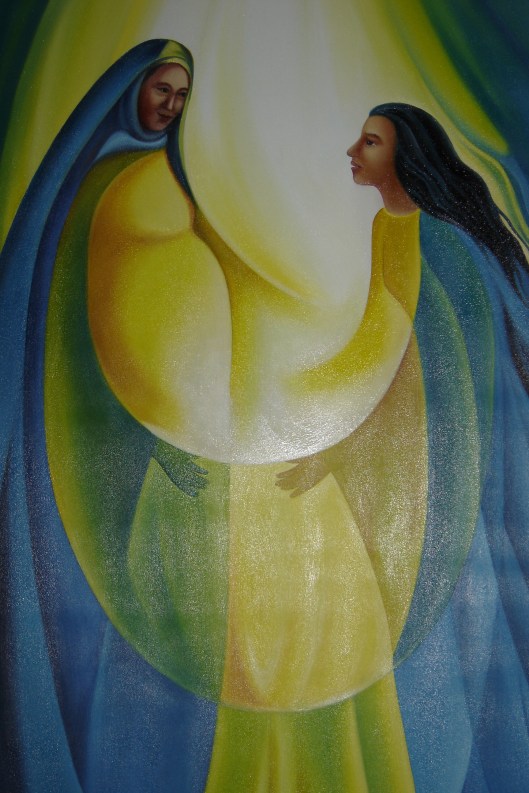
mary-and-elizabeth

Photo credit:  https://walktheway.wordpress.com/2013/12/21/solidarity-mary-with-elizabeth/

When a pregnant Mary visits with her pregnant cousin Elizabeth, Mary breaks into a song of justice for the poor (Luke 1.46-55).  When Elizabeth confirms everything the Angel Gabriel had declared about Mary’s baby, Mary sees the beginning of redemption for oppressed peoples everywhere.  And she does not just whisper the song to Elizabeth, but shouts it loudly among her people.  Christians today still sing her Magnificat, in hundreds of settings and languages, every day, around the world.  Though most of us are excited about gifts, parties, and the familiar smells and tastes at Christmas, as Christians, we are also excited for the revolution that Christmas signifies – the dawn of justice for the poor and oppressed.  A baby born into poverty who will be the champion of the poor.

Our gifts to our neighbors in need at Christmas are just one small way that we remember the revolution of Christ’s birth.  Of course, Christmas is just the beginning.  Our witness for Christ is not just about how Christ has redeemed us, but how Christ is using us as agents for change, as advocates for the poor and downtrodden, as servants who “lift up the lowly, and fill the hungry with good things.”  Our God of abundance invites us to be a people of abundance.  I look forward to hearing how you are celebrating the revolution of Christmas this year!