• About

Seeking and Serving

~ seek and serve Christ in all persons

Seeking and Serving

Tag Archives: anxiety

On Risking Failure and Facing Fear…

03 Wednesday Dec 2025

Posted by jandrewsweckerly in reflection

≈ Leave a comment

Tags

anxiety, challenge, failure, fear, God, growth, hesitant, Holy Spirit, invitations, Jesus, joy, new, risk, try, yes

Photo credit: https://stock.adobe.com/search?k=parachute+jump+plane

I was listening to a podcast this week that was talking about how, as they mature, adults have a harder time trying new things because they have a deeper understanding, and perhaps fear of, failure.  Children don’t have this same hesitancy.  They try new things, figure out what works and what doesn’t, and keep at it.  There is a freedom in their development that allows them not to hold back or be afraid, but to keep trying out new experiences and challenges.

As one of my daughters ages, she is heading into that in-between time where she doesn’t have the same innocent willingness to try and fail, and is starting to understand that failures or inadequacies are sometimes noticed by others negatively.  She is trying out a new extracurricular this fall, and hated the first session.  As we headed into the second session, she pulled out all the stops about why she shouldn’t have to go back:  she wasn’t good enough, people weren’t nice, she would bring down the group through her inexperience.  In a moment of weakness, I almost caved.  I know how big those feelings are.  I palpably remember the anxiety that kind of experience brings, and I wanted to protect her from that hurt. 

When she came out of the second practice, she was a different person.  She was smiling, had a lightness to her step, and a warmth about her.  “That was fun!” she said.  As I listened to her describe the session, I was overwhelmed with two realizations.  First, I realized how close I came to cutting off a growth experience – how she would have never had learned the feeling of what it means to push through fear and find joy.  And second, I realized I needed to take a long look at where I am cutting off growth experiences in my own life.  Masked with the label, “wisdom,” how often do I fail to risk?

I wonder what growth opportunities are being presented to you today.  It doesn’t have to be something big or dramatically different.  Part of creating an openness to growth means being open to the little invitations – talking to a stranger when that’s not something you would normally do, reaching out for support when you don’t like feeling dependent upon someone, saying yes to an invitation to something that is not at all in your comfort zone but you admittedly have never tried to know for sure.  Those yeses prepare us for the yeses the Holy Spirit desires in each of our lives.  Those invitations are often God’s quiet invitations into God’s joy.  Those experiences are often pathways to the incarnate Jesus in your life.  I can’t wait to hear what you say yes to this week!

Sermon & Annual Meeting Address – 1 Corinthians 12.12-31a, EP3, YC, January 26, 2025

12 Wednesday Feb 2025

Posted by jandrewsweckerly in Sermons

≈ Leave a comment

Tags

Annual Meeting, anxiety, body, Christ, Holy Spirit, home, Jesus, members, Paul, Sermon, system, value

One of the things we do on Annual Meeting Sunday is install new Vestry Members.  Even though only one third of the Vestry rotates on and off each year, I always remind Vestries that we become a new, changed body every year.  Each of those nine members bring different gifts, talents, and insights.  Each of those members shifts the tone and tenor of our work, and helps us dance a little bit differently.  I was reminded of this reality last week.  When talking about a retiring Vestry member, another member said, “What’s so cool about him is that he does not speak often, but when he does everyone gets really quiet because the insight he offers is so profound.”  That feedback was entirely true – and that feedback reminded of me of another Vestry member much earlier in my tenure at Hickory Neck who would do the same thing – come in toward the end of a conversation with an insight none of us had seen but was entirely needed.

That is the funny thing about bodies – we need all our parts to be the best versions of our bodies.  I think that is why Paul leans into the metaphor of a body to describe the followers of Christ in first Corinthians.  As one scholar writes, “The human body has 206 bones, 693 muscles, and about 6 pounds of skin, along with ligaments, cartilage, veins, arteries, blood, fat, and more.  Every time we hear a sound; every time we take a step; every time we take a breath, hundreds of different parts work together so that what we experience is a single movement, our minds and bodies working as one unit.  Even the great engineers struggle to achieve anything like [the body] in mechanical form.  The human body represents one of the most complex systems in existence.”[i]

For Paul, that super complex system represents the body of Christ – the way each part of the body (or in this case, each member of the church) is not just a belonging member, but is a member whose participation is vital – the whole body is thrown out of balance when we are not all using our gifts.  Scholar Raewynne Whiteley explains, “Every single person in the church matters – the homebound elderly, babies, those with disabilities, and well as the generous givers and hard workers.  This is a reality we can name, which has less to do with equality than with wholeness.  Only with all our members can the body of the church be whole.”[ii]

This last year, we saw what wholeness looks like at Hickory Neck.  Tech team members and pop-up prayer leaders who stream worship online connect us to homebound members, overstretched families who cannot make their way to church but want to pray with us, and those unchurched in our wider community who want to see if they have a place in this body before braving the doors that open to super friendly (sometimes overwhelmingly so) Hickory Neckers.  Retirees who live far from their families and have very little interaction with children in the daily lives connect with children whose own grandparents may live far away and whose parents may be frazzled just by trying to get the family in the car on Sunday mornings.  College students who love to sing but maybe have an estranged relationship or no relationship with the Church connect with a community who cares about the poor and hear sermons from clergy that help them think about faith and politics a little differently. 

And that is just the everyday Sunday at Hickory Neck.  If we are to believe Paul’s metaphor that we are a complex body of parts that need one another, we need only to look at the long list of moving parts in our community in the last year:  from 5 baptisms, 2 first communions, 11 confirmations/receptions/ reaffirmations, and 1 wedding; from 19 members of Discovery Class, 25 participants in Godly Play classes at the Kensington School, and countless volunteers during the Winter Shelter; from a brand new Choir Camp with 20 children, guest concerts with well over 100 attendees each time, to a guest choir of 38 high school students from New Jersey; from over 13,000 points of pastoral care from clergy, an increase in pledges by over $17,000, and an increase in average Sunday attendance by 8%.  This is a complex community, who is not only content with daily operations but is ever trying new things like a Cursillo Eucharist, St. Patrick’s Day Liturgy, a children’s Chorister program, Holy Vino fundraiser, a new organ, a Finance Committee, and even a priest as a dancing star in Williamsburg.  When Bishop Haynes visited us in 2024, and said we are a vibrant, thriving community, this is what she meant.

Now, there is an inherent tension about being a body with varying parts, as Paul reminds us.  As scholar Karen Stokes explains, “There will always be differences with a congregation – differing opinions, experiences, priorities, needs – and it is dangerous to try to play down those differences in the interest of some superficial harmony.  When this natural diversity within a congregation is not allowed to be expressed openly, subtle judgments are communicated:  when the ear gets the message that it would really be better if [the ear] were an eye, when the foot realizes the community values hands more highly.”[iii]  If we do not let the uniqueness of each part be celebrated, when we face changes, anxieties can increase.  And Stokes goes on to say, “Anxiety lessens once’s ability to be imaginative, creative, and self-reflective, and instead causes reactivity, defensiveness, even paranoia”[iv] 

We have been talking a lot the last couple of weeks about our finances and our need for increased revenue to support our vibrant, varied ministries.  Those conversations have brought up a lot of anxiety.  After nine years at Hickory Neck, I have come to recognize that every January is similar – talk of finances gets all of us anxious.  As I have been marinating on Paul’s body metaphor and thinking about the miracle of such diverse parts working so harmoniously together, and as I reflected on 2024 and how we started with anxiety around budgets twelve months ago and managed to power through a tremendous year of vibrant ministry, I find I am looking toward 2025 with renewed confidence.  Perhaps this is the time of year when we are reminded that we are not all ears or feet or eyes.  We will not see ministry the same or hold the same opinions.  Even though we might approach ministry differently, we are all here to see the body do what the body of Christ does best – love God, love self, and love neighbor. 

Just a few weeks ago, I was talking to a first-time visitor who was looking for a new church home.  She heard about Hickory Neck from another new family to Hickory Neck and was able in that one Sunday to see a place for her family here.  That experience tells us all something powerful:  we may be a body that is complex, and beautiful, and sometimes anxious because of our differences; but we are also a body who honors how every person who comes through that door is a part we did not even realize we were missing and who we are thrilled to welcome into their unique contribution to our whole.  Having seen church communities who are not open to new body parts being added, I can tell you, having that experience made me realize we are a beautiful, complex, fabulous body, made possible by the gifts of the Spirit, who works in and through each of us.[v]  Our work this year is to let the Spirit use us to be awesome ears, eyes, feet, tendons, and muscles.  I cannot wait to see what the Spirit does with this fabulous body in 2025!  Amen.


[i] Raewynne J. Whiteley, “Homiletical Perspective,” Feasting on the Word, Yr. C, Vol. 1 (Louisville:  Westminster John Knox Press, 2009), 279.

[ii] Whiteley, 283.

[iii] Karen Stokes, “Pastoral Perspective,” Feasting on the Word, Yr. C, Vol. 1 (Louisville:  Westminster John Knox Press, 2009), 280.

[iv] Stokes, 280.

[v] Whiteley, 283.

Sermon – John 11.32-44, AS, YB, November 3, 2024

13 Wednesday Nov 2024

Posted by jandrewsweckerly in Sermons

≈ Leave a comment

Tags

All Saints Sunday, anxiety, baptism, burial, covenant, God, grief, Jesus, presidential election, saints, Sermon, ultimate

I imagine if you were to poll a group of priests, most of them would say that one of their favorite liturgies in the Episcopal Church is the burial office – not because of the painful journey of grief and loss that leads to such an office, but because of what the liturgy and its scripture lessons accomplish.  In the midst of personal pain and gut-wrenching bereavement, the Church shows up with scripture lessons that point us toward ultimate things – that remind us of the ultimate source of hope for the faithful:  the promise of resurrection and eternal life.  Grief can upend your entire center, leaving you feeling lost.  But scripture, the burial office liturgy, and our faith are like a tether that hold us steady – that hold us close to Christ when Christ can feel absent.

Our lessons today on this feast of All Saints are all lessons traditionally recommended for a burial office – ones that have given us hope as we have lost spouses, parents, children, friends, and spiritual mentors.  They are lessons that give us hope for that feast of rich food and well-aged wines, where death is swallowed up forever, and God wipes away our tears.  They are lessons that promise that death will be no more, mourning and crying and pain will be no more, for the first things have passed away.  They are lessons that depict a Jesus deeply disturbed and deeply moved by our suffering. 

So why all this focus on end things?  Why this focus on ultimate things?  For one, as we honor the saints who have gone before on All Saints Sunday, these are lessons that remind us of what the Church has always believed about life, death, and eternal life in Christ.  As we will later recall in the service those souls closer to our own journeys and tie ribbons on the altar rail in their memory, the Church wants us to be ever confident in where those souls are and where we will go too.  And as we reaffirm our baptismal covenant today – that reminder of how in baptism we go down into the baptismal waters and die to self and come up again born anew in Christ, we are reminded that we are a kingdom people, living in resurrection not just in eternal life but in the here and now.

I am especially grateful for this feast of All Saints, on this day of remembering ultimate things, as we head into a week that feels especially weighty and consequential.  Not only are we each feeling our own anxieties and fears about how this presidential election will go (probably not all agreeing about which way would be best), I was also reminded yesterday as I watched the investiture of our new Presiding Bishop Rowe, that the rest of the world joins in our anxiety.  As a primate from South Sudan reminded us, our presidential election this week does not just impact us, but has ripple effects in countries around the world. 

Into this global anxiety, in this conflicted country, commonwealth, and county, we are gifted the same thing the Church gifts us with at every burial and every reminder of the saints:  the reminder of ultimate things.  We are reminded that in celebration and catastrophe, God is with us, wiping away tears.  We are reminded that in victory and defeat, death holds no power over us.  But maybe most importantly, we are reminded in anxiety, in relief, in hope, and in hope vanquished, Jesus is by our side, deeply moved and ever ready to continue showing us God’s glory when God’s glory feels long lost.

Today our lessons and our liturgy are powerful reminders that we have a sacred duty to live into our baptismal covenant.  That may not sound like much of a balm – maybe the command to honor our baptismal covenant feels more like homework than comfort.  But we are never baptized just into comfort.  We are baptized through comfort to live radical lives as Christ’s disciples – where we share the good news of God in Christ, where we gather in weekly worship and communion, where we seek and serve Christ in all persons, and where we strive for justice and peace, respecting the dignity of every human being.

Yes, this time feels so weighty on our shoulders that we feel like we may collapse under the weight of this time.  But the Jesus who weeps for Lazarus is the same Jesus who told us his burden is easy and his yoke is light.  The Jesus who is deeply disturbed is also the Jesus who troubles the water – the waters in which we died in baptism and rose to new life.  The Jesus who walked alongside Martha and Mary is the same Jesus who walks alongside you and me.  Our invitation today is take that baptismal covenant seriously – with the heft of ultimate things like death and resurrection and eternal life.  We stand in those baptismal waters this week, and we invite others to join us.  Those waters are our source of strength this week.  Amen.

Sermon – Proverbs 31.10-31, P20, YB, September 22, 2024

02 Wednesday Oct 2024

Posted by jandrewsweckerly in Sermons

≈ Leave a comment

Tags

anxiety, capable woman, community, creator, election, God, grace, king, partnership, powerful, president, Sermon, strength, together

As the presidential election approaches in just about six weeks, I have spoken with many of you about a rising sense of anxiety and despair.  One of the things I have noticed about the last three presidential elections is that we have kind of gotten lost – so caught up in big personalities and dramatic events that we have lost sight of one core question in elections:  what do we need in a president to create a just country that reflects the priority of love.

Since I always tell our community that I do not preach politics – just Jesus – I thought I would turn to scripture this week for guidance.  I started with the daily office.  On Wednesday, I came across Psalm 72.  The psalm begins, “Give the king your justice, O God, and your righteousness to a king’s son.  May he judge your people with righteousness, and your poor with justice.  May he defend the cause of the poor of the people, give deliverance to the needy, and crush the oppressor.”  “Yes,” I thought, “This is the president we need.  After all this debate and controversy, this is the kind of president I want.”  Then I kept reading.  The more I read about this noble king, the more the king sounded a lot like Jesus.  Finally, a truth seeped through – this year, as I am considering my choice for President, I have not been looking for an actual person.  I have been looking for a savior; and that is not fair to any human being.  Any person running for president is going to be flawed.  And we already have a Savior – we do not need another one. 

Then I turned to our Old Testament lesson for today: the so-called “capable woman” from Proverbs.  I spent some time with this text when I was writing my thesis in seminary, so I am always drawn to this familiar text.  But the more I read about this woman this time, the more inadequate I felt.  She makes clothes, rises before dawn to feed her family, manages a staff, purchases a field, and plants a vineyard by herself.  She in an entrepreneur, selling her wares for good money.  She cares for the poor, and is a wise teacher.  She does all this and is happy.  As a priest, mother of two, and a wife, I feel woefully inadequate next to the capable woman.  In fact, in Hebrew, the word to describe her is not really “capable” per se.  The word, hayil, is a word that means much more than capable.  Hayil is primarily used in the Old Testament to describe men of great power, valor, and strength.  Hayil is a term for powerful warriors.  In fact, this Proverbs woman and Ruth are the only women in the Old Testament to earn the title normally reserved for men.  The Proverbs woman is not just capable; she is a woman of strength and power.  She is a superwoman. 

The challenge with these two images – the righteous king and the powerful woman – is that neither of these labels feels attainable.  For women, the Proverbs woman of power is especially loaded.  Many of us long to be a woman of hayil.  We want to be a woman who can do everything – work outside the home, manage our finances, care for a home and family, maintain a healthy relationship with God, have power and honor in our lives.  This is the challenge of the modern woman – society is opening doors for us to do everything – to work, to raise a family, to be successful.  But the reality is that we either kill ourselves trying to do everything, or we feel horribly guilty for our many failures.  Unlike celebrities, who seem to manage family, fame, and face with ease, we feel overwhelmed and woefully inadequate.  In fact, as I was pondering preaching this text this week, I stumbled across a quote from one seminary professor.  She writes, “Many of you will conclude this text is too much a minefield and steer clear, with good reason.”[i] 

Of course, today is not just a sermon for the women in our community.  Men often feel the same sense of being overwhelmed by trying to do everything.  Forget the kingly imagery from the Psalm.  There is often pressure for men to be financially stable, and if you have a family, to provide for them.  There is now an expectation that men play a role in the rearing of children and doing housework, being involved in the community, and caring for the upkeep of your home.  As I have read parenting magazines over the years, I have seen story after story of men trying to navigate the modern family’s expectations of playing both traditional and nontraditional male roles.  And for the man and woman running for President, expecting a “just king” or a “capable woman” places incredibly unfair expectations on either candidate.

So, what do we make of this woman of hayil in Proverbs today?  Like the King in Psalm 72, I wonder if the woman in Proverbs is perhaps not a particular human, but an ideal.  All the practices of the woman of strength are practices that we should strive to embody – we are to be industrious, using the talents that God has given us for the good of ourselves and others.  We are to work hard and to care for the poor and needy.  We are to use our words wisely, and shape the next generation to love kindness and walk humbly with God.  And most of all, we are to fear the Lord.  Fear in this sense is not the kind of fear that cowers from God, but that holds the Lord in awe, marveling at the majesty of God, rooting our lives in that sense of wonder, gratitude, and reverent humility before the Creator.[ii]  But mostly, this text is a reminder that we do not put these expectations just on presidents – these are expectations, or ways of life, for each of us.

The good news is that we do not strive for the ideal of hayil alone.  Perhaps a better image for us today is not a single woman of hayil, but a community of hayil.  This text from Proverbs is not inviting us to be all things to all people, but instead is inviting all men and women to consider together what the tasks of a family, church, or community are, and to consider the ways we can share in those tasks together.[iii]  When we focus on only one woman, we miss that this text encourages us to think about the partnerships between men and women in the work of the community.  This text is not a beautiful hymn to one human woman, but is a lesson about interdependence, partnership, and the contours of community.[iv]

That’s what excites me about Hickory Neck.  We are on a journey to become a woman, a community, of hayil.  I see you using your time, talent, and treasure to help in the ways that you are most gifted.  I see you praying for one another, especially when one of us looks particularly overwhelmed or stressed.  I see you looking beyond our doors about the way we can individually and collectively care for our neighbors in need.  I see you leaning into our creativity to make a path forward in a new reality.  In this moment, Hickory Neck is living as the woman of hayil.

Of course, we still have work to do – we are still accomplishing the ideal as a community.  A priest friend of mine had a set of triplets in her parish.  She knew that the mother could not manage all three alone – one person only has two arms!  So, the priest arranged for a rocking chair in the narthex to help ease the babies’ tempers.  There were older women in the congregation who, within seconds of a cry, would swoop up one of the babies and rock the child in the side aisle, without the mother having to even ask for help.  There were men who caught the crawling babies under pews and returned them to their mother.  And mostly, there were patient parishioners, who would focus through the cries of the children to hear the sermon without complaint.  We too can offer this grace to one another.  Whether there is a parent with a child who could use some help, whether there is a parishioner who needs a hand to get to the communion rail, or whether we offer prayers for someone who we notice is struggling this week, we are a community who can exemplify the holy partnership we see in scripture today.  We can acknowledge that our work is best accomplished together because our shared labor expresses faith, hope, and love in ways that build us up and bring us together.  We can all be that woman of hayil, that superwoman for the wider community, but only if we do the work together.  Amen.


[i] Amy Oden, https://www.workingpreacher.org/commentaries/revised-common-lectionary/ordinary-25-2/commentary-on-proverbs-3110-3, September 23, 2012, as found on September 20, 2024. 

[ii] Kathleen M. O’Connor, “Exegetical Perspective,” Feasting on the Word, Yr. B, vol. 4 (Louisville: Westminster John Knox Press, 2009), 79.

[iii] H. James Hopkins, “Homiletical Perspective,” Feasting on the Word, Yr. B, vol. 4 (Louisville: Westminster John Knox Press, 2009), 77.

[iv] Hopkins, 79.

Sermon – Matthew 22.1-14, P23, YA, October 15, 2023

20 Friday Oct 2023

Posted by jandrewsweckerly in Sermons

≈ Leave a comment

Tags

allegory, anxiety, church, clothing of discipleship, discipleship, dream, God, kingdom of God, membership, parable, response, Sermon, stewardship, wedding banquet

I cannot count the number of times I have had some variation of the dream.  The procession has started and I am not vested yet.  I run into the vesting room, only to be unable to find my alb and cincture.  Of course, I could grab one of the hundreds of albs in the vesting room but they are either too long or too short.  If I somehow manage to run into church vested, usually the service has begun without me.  And sure enough, when I look at the pulpit, my sermon is nowhere to be found.  Before I was a priest, the nightmares were about a test for a class I have not attended all semester, or a classroom I cannot find, or a mystery locker that has books I need.  We all have them – or at least I hope I am not the only one!  I have heard of church musician nightmares about unpracticed pieces of music or music missing from the music stand.  And, of course, there is the classic nightmare of showing up to an important event without your clothes.

So, in our gospel lesson, when the person who was not originally invited to the wedding banquet because he did not have enough social capital is put on the spot in front of everyone by an agitated and somewhat violent host about not wearing the right garment, our anxiety levels and sense of injustice soar.  What if he did not own a wedding garment?  Maybe he was too poor to have one.  Maybe he did not know the social mores of fancy banquets.  Surely God does not cast us out with no regard for human dignity.  Isn’t that what Jesus is all about – loving and welcoming all?!?

Truth be told, this whole parable is one of those awful parables we wish we could skip or at least skim until we reach something more palatable.  With the Holy Land crumbling into violence and suffering, the last thing I wanted to read about this week was of entitled invitees to the king’s wedding feast violently mistreating messengers from the king and the retaliatory destruction and burning of the city.  And then, when the seemingly guilty parties have done to them what they did to others, the king cannot seem to contain his anger, and lashes out at a seemingly innocent man about not wearing the right garment, even though he had very little time to prepare for the afterthought invitation to the banquet.  In what has been a week of violence, particularly violence against civilians on all sides, the last thing I wanted to hear this morning was more violence from our gospel lesson. 

If we are going to tackle this seemingly awful parable, we are going to have to step back to see what is happening.  First, as scholar Yung Suk Kim explains, “a parable is not intended for literal interpretation…  For example, while the king is like God in some sense, he is not the same as God.  Likewise, his son is not Jesus.  His slaves who went out to call the invited guests are not prophets, and invited guests are not Israel.  The king’s violent response is not the same as the fall of Jerusalem.  Allegorical interpretation is not wrong [with parables] but has limitations…  Indeed, the allegorical interpretation cannot explain the complexities in the parable of the wedding banquet.”[i]

Second, despite our ability to remove immediate comparisons of God to the violent king, Matthew does say the kingdom of God is like this parable.  So, there is some learning, even in the uncomfortable casting out of the man who shows up at the party in the wrong garb – fulfilling every anxiety dream we have ever had.  When we hear those harsh words, many called, but few are chosen, we finally understand the “so what?” of all this violence and seeming overactions.  Karoline Lewis explains, “…many are called but few are chosen indeed.  The chosen are the ones who realize that just showing up is not enough anymore.  The chosen are the ones who insist that mere acquiescence, week after week, day after day, to doctrine and dogma will not stand the test of what it means to be the salt of the earth and the light of the world.  The chosen are the ones who believe that a God who is Immanuel might very well stake a claim on their own humanity.  And, the chosen are the ones who understand that the time for bringing about the Kingdom of Heaven is now — not later, not tomorrow, not someday, but now.”[ii]

Today’s language is violent and somewhat despondent.  And although that may not be literally applied to God, this text comes with consequences.  Today’s text reminds us that RSVPing to church, and showing up to consume comfort and reassurance is not the totality of membership in the body of Christ.  Showing up in this community means being gifted the clothing of discipleship – clothing we will put on every week.  We are always welcome in these chairs and on our YouTube channel.  And, to belong here means to take on the clothing of discipleship.  As Lewis says, we can no longer don the clothing of “complacency, conformity, and any kind of garb that is content with the way things are.”  Today we are invited to put on “…the kind of compassion, birthed by God’s own righteousness, that cannot, anymore, leave things the way they are.”[iii] 

But no need to worry about a new anxiety dream.  If you forget your clothing of discipleship, we have that clothing ready for you every Sunday.  That is why in stewardship season, so many of us are generous with our gifts of time, talent, and treasure – because we know how precious the gift of that weekly garb is.  We know the feeling of coming to church weary, downtrodden, and tired, and we also know the feeling of leaving church empowered and invigorated to slip on that gown of discipleship anew for the coming week.  Hickory Neck is the place we come to every week to join in the communal feast.  And Hickory Neck is the place where that weekly feast emboldens us to feed others.  There is no casting out into the outer darkness from these doors – not without the garb of discipleship we are gifted with from this place of nourishment and belonging.  Amen.


[i] Yung Suk Kim, “Commentary on Matthew 22:1-14,” October 15, 2023, as found at https://www.workingpreacher.org/commentaries/revised-common-lectionary/ordinary-28/commentary-on-matthew-221-14-9 on October 12, 2023.

[ii] Karoline Lewis, “What Not To Wear,” October 8, 2017, as found at https://www.workingpreacher.org/dear-working-preacher/what-not-to-wear on October 12, 2023.

[iii] Lewis.

On Not Really Being Alone…

16 Wednesday Aug 2023

Posted by jandrewsweckerly in reflection

≈ 1 Comment

Tags

alone, anxiety, challenges, companions, creation, curse, encourage, fear, friend, God, gratitude, panic, prayer, sabbatical, stranger, yes

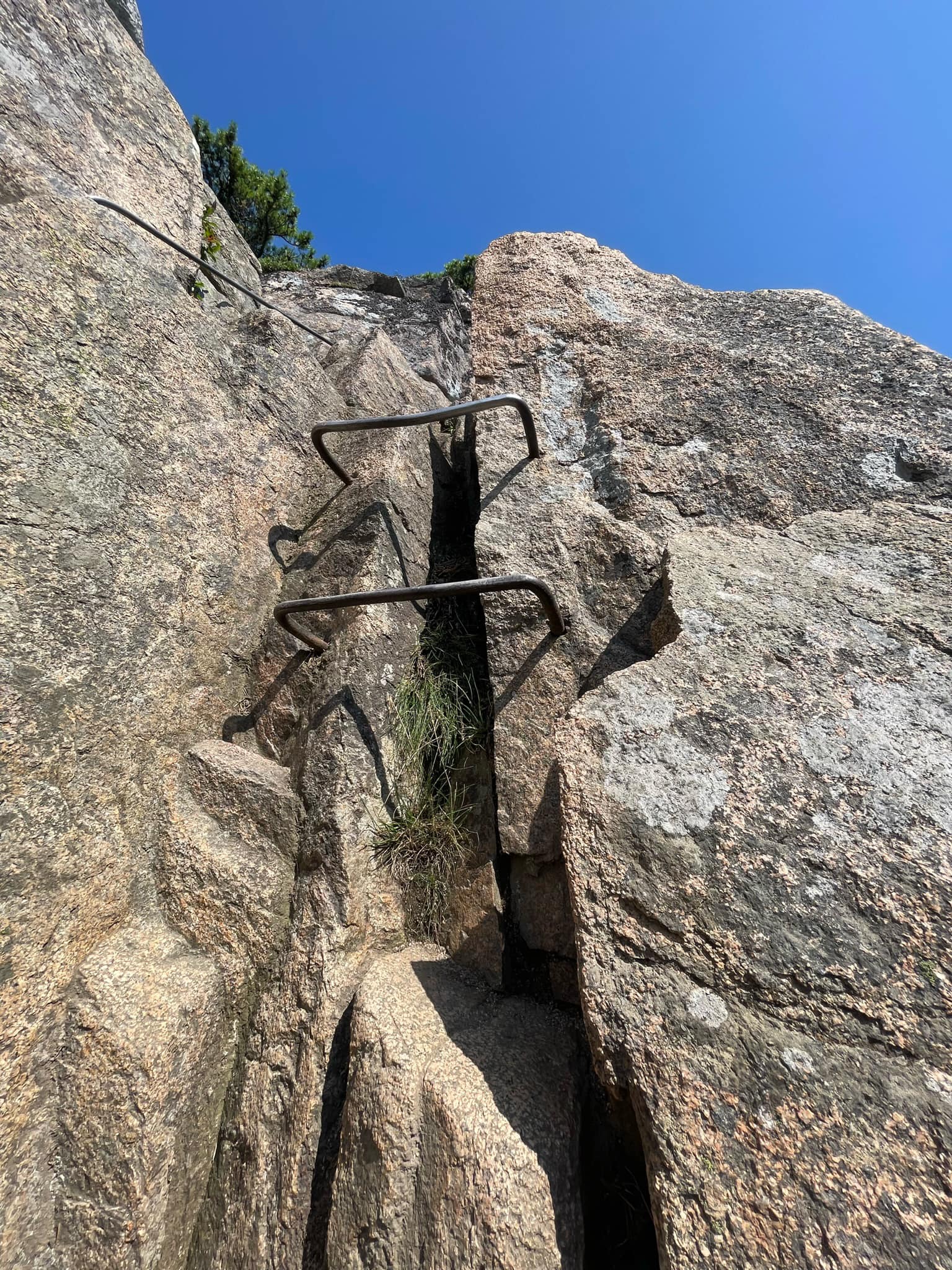
Beehive Trail Iron Rungs, Acadia National Park (Photo credit: Elaine Ho; reuse with permission)

Last week, I finished up my sabbatical on a trip with college friends to Acadia National Park.  Having been friends for over 26 years, and having traveled together, domestically and abroad, we know each other well – each other’s habits, weaknesses, and strengths.  We know who is most likely to get up early for exercise, who you don’t talk to before they’ve had coffee, and who is a total chicken when it comes to anything adventure related.  That last one would be me.  But since we all know how tentative I am, we all know they will push me to try new adventures anyway, and I will say yes – even if I grumble, curse, and sometimes pray my way through the adventures.

This year’s adventure was hiking the Beehive Loop Trail – a trail with a steep mountain cliff, boulders, exposed ledges, and iron rungs.  We’ve done hikes before, and I’m relatively fit, but this was definitely a difficulty I have never tried and would certainly not have tried of my own volition.  But this is what we do, and so off I went.  I knew the trail was no joke when the first part of the “trail” was actually just a path of small boulders to navigate over.  As we made our way up, I could see the views were going to be amazing.  But I stopped when I got to the first real set of iron rungs.  After a few deep breaths, some encouraging words whispered in my ear, I grabbed the first rung.  As I scanned for where to place my feet, I could see worn footholds from thousands of hikers before me.  As we walked along ledges, the skinny tree trunks I used as handholds were smooth from those same thousands of hikers who had grabbed them before me.  When the hikers in front of us were moving slowly and we just had to stand on narrow ledges waiting for our turn, I hugged the rock cliff beside us. 

Nature’s handrails, Beehive Trail, Acadia National Park (Photo credit: Elizabeth Shows Caffey; reuse with permission)

During that hike, I slowly realized the reason I say yes to these challenging women is not because I’m avoiding conflict or caving to peer pressure.  I say yes because I am never alone in my yes.  Whether it is my amazing friend who refuses to bound ahead because she knows that if I slip or start to panic, she will catch me and encourage me ever so gently.  Whether it is the guidance of travelers before me who have left their wisdom behind.  Whether it is in God’s creation herself who stands strong when we need her.  So, as I mutter the reminder, “I love these women…” like it’s both a curse and a blessing, I am reminding myself I am not alone.  When I sigh in profound gratitude, “Thank you, tree,” I am reminding myself that God has not left me comfortless.  When I watch out-of-shape elders, and seemingly too young youngsters, being cheered on and reaching the top, I am reminded that none of us is alone. 

I wonder what challenges you are facing today that feel like a challenge you are facing alone.  I could have faced that mountain ledge or those crazy iron rungs and thought, “I am utterly alone in this.  Only I can take each step, ascend each level.  This is my battle to face.”  But just as I was never alone – and not just with my three other friends, but with countless generations of hikers, and centuries old formations of God’s creation, we are not alone in the challenges we face either.  How many times have we cried out to God for help, only to find a friend or stranger unexpectedly accompanying us?  Sometimes that worn foothold is hard to notice in the face of panic.  Sometimes the smoothness of that tree trunk is barely noticeable because we are gripping so hard or trying to move forward so quickly.  But God is with us, giving us companions for the journey.  We are not alone.

Sabbatical Journey…On Seeing through Song

28 Wednesday Jun 2023

Posted by jandrewsweckerly in reflection

≈ Leave a comment

Tags

anxiety, creation, enormity, gift, God, great, Holy Spirit, inexpressible, inspiration, longing, song

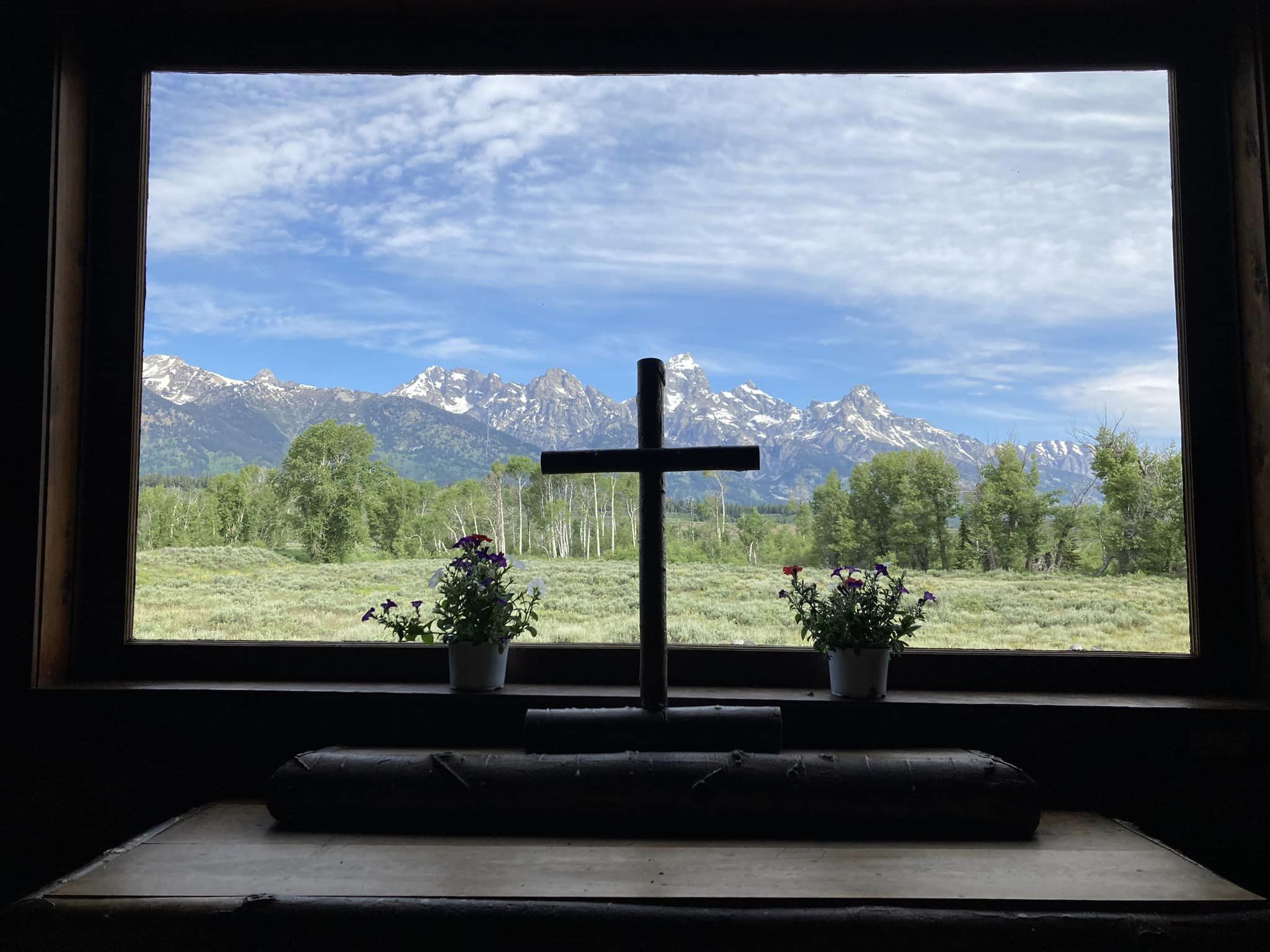
Chapel of the Transfiguration, Episcopal, Grand Teton National Park (reuse with permission only)

After a day of exploring the magnificent Grand Tetons, seeing beautiful waterfalls, peaceful lakes and rivers, we closed the day with a covered wagon dinner and show.  I had been pondering the beauty of this day, when the western quartet closed the show with the old hymn, “How Great Thou Art.”  If you are not familiar with the hymn, the lyrics are:

O Lord my God, when I in awesome wonder
Consider all the works Thy hands have made,
I see the stars, I hear the rolling thunder,
Thy pow’r thru-out the universe displayed!

Chorus
Then sings my soul, my Savior God, to Thee;
How great Thou art, how great Thou art!
Then sings my soul, my Savior God, to Thee;
How great Thou art, how great Thou art!

When thru the woods and forest glades I wander

And hear the birds sing sweetly in the trees,
When I look down from lofty mountain grandeur
And hear the brook and feel the gentle breeze,

Repeat Chorus

I could not have asked for a better summary of this day.  As I saw the enormity of the mountains, I stood I awesome wonder.  As I listened to a different familiar hymn being played in rustic chapel, I remember thinking I could look at the views all day from that beautiful space.  As I watched the calm lake, I marveled at the reflection of God’s creation.  As I heard the roar of waterfalls, I felt in my chest the way that God’s love sometimes roaringly overpowers me.  And as the mist of the falls kissed my face, I remember thinking, “My God, how great thou art!”

Sometimes words fail me, especially when encountering so much of God’s inspiring creation.  So often, the artistry of song has helped me shape words my mouth could not.  Tonight, singing that song “How Great Thou Art,” with the help of guitars and a fiddle, I knew immediately those were the words I could not articulate all day.  Other times, sacred songs have come to me in sorrow, in anxiety, and in longing.  I hardly ever choose the songs.  And sometimes I must sit in silence for a long while before the songs pop into my head.  In these times, the songs feel like gifts from God, who knows I need a way to express the inexpressible.

What songs are you longing to hear?  I would love to hear how the Holy Spirit has flitted through your longing heart and given you a song.       

Sermon – Acts 1.6-14, E7, YA, May 21, 2023

30 Tuesday May 2023

Posted by jandrewsweckerly in Sermons

≈ Leave a comment

Tags

absence, anxiety, apostles, Ascension, experience, focus, God, Holy Spirit, intimacy, Jesus, presence, sabbatical, Sermon, staring, temptation

One of my favorite videos on YouTube is an experiment by the group called SoulPancake.  They asked six pairs of individuals, in various stages of relationship (from total strangers to a couple who has been married 55 years) to sit in two chairs facing one another, and without speaking, look into one another’s eyes for four minutes.  At first the couples are a bit uncomfortable – initially unsettled by the forced silence, but ultimately jarred by what they quickly realize is deep intimacy.  Slowly over the four minutes the couples settle in, their faces transforming from discomfort to curious to deep connection.  You can almost see the sparks of love emerging in their eyes, tension draining from their bodies, and invariably smiles of appreciation spreading across their mouths.[i] 

When Willie James Jennings writes about the ascension of Jesus, one his primary concerns is that in focusing on the heavens, where Jesus used to be, the disciples will forget to focus on one another, on the stranger in need of witness, and on the presence of God.  Jennings worries that the disciples are looking “into the heavens concerned by absence rather than looking forward to see presence.”[ii]  The text from the Acts of the Apostles tells us of the last earthly day of Jesus’ post-resurrection life.  Jesus gives the disciples a commission and is lifted up into the clouds and whisked away.  The text tells us the disciples do exactly what you might imagine – they stand there, staring at the heavens.  I imagine that standing and staring had several iterations:  there was likely the stunned awe of the moment; there may have been some not wanting to leave for fear of missing what might happen next; there may be some immediate second guessing about what this all means; there may be some Peter-esque desire to preserve the sacred location of the profound moment; there may be a sense deep grief, or conversely a sense of profound joy.  Whatever those disciples are doing, they are not at all doing they are supposed to do.  Hence the men in white robes asking their very basic question, “Why do you stand looking up toward heaven?”

You and I are about to engage in the profound and infrequent journey of sabbatical.  The temptations in this time are many.  For either of us, we could easily see this as twelve weeks of frozen time – where we will each gaze upon God, and then simply pick up where we left off in August.  For either of us, we could be prepared to happily engage in sabbatical activities, absorbed in our own mountaintop experiences, forgetting the journey of the other.  For either of us, we could be guided by fear, burying our talent like in the parable in Matthew – just hoping not to risk doing sabbatical the “wrong way” instead of investing our talents to see what return we gain. 

But there is danger in looking up in the heavens into absence as opposed to looking forward to presence.  Alan Hirsch tells us, “the biggest blockage to the next experience of God is often the last experience of God, because we get locked into it.”[iii]  [repeat]  What those men in white knew was that if the disciples stood there lost in themselves or even in the ascended Jesus, they would never get their next experience of God – they would get so locked into the mountaintop experience of Jesus’ ascension, that they would never make their way to the next experience of God – in their case the great gift of the Holy Spirit on Pentecost.

That is our invitation today.  As we stand on the precipice of sabbatical, maybe as we are still reveling in the memory of an outstanding parish-wide retreat this weekend, or wondering what sabbatical activities we want to try, or even feeling a bit of anxiety about what is next, a great whispering is happening nearby, “why are you standing looking up toward heaven?”  Our invitation instead is to resist letting our next experience of God be our last experience of God.  Our invitation is to gather in these next weeks in prayer and community, knowing that the Holy Spirit will do a new thing in all of us.  Our invitation is to walk down the mountain and into the valley of witnessing the gospel of Jesus, looking forward not only for the presence of God, but gazing deeply into the eyes of others.[iv]  This time of sabbatical is not a time to marked by absence, but instead is a time looking forward to see presence.  We can only see that presence if we pull our eyes from heaven and gaze into the sacred we find in one another.  The next experience of God promises to be greater still than our last experience of God.  I can’t wait to hear all about your next experience.  Amen.


[i] Georgia Koch, “How To Connect With Anyone,” SoulPancake, February 12, 2015, as found at https://www.youtube.com/watch?v=Xm-T3HCa618 on May 20, 2023.

[ii] Willie James Jennings, Acts:  Belief:  A Theological Commentary on the Bible (Louisville:  Westminster John Knox Press, 2017), 19-20.

[iii]  Alan Hirsch and Rob Kelly, Metanoia: How God Radically Transforms People, Churches, and Organizations From the Inside Out (Cody, Wyoming:  100 Movements Publishing, 2023).

[iv] John S. McClure, “Homiletical Perspective,” Feasting on the Word, Yr. A, Vol. 2 (Louisville:  Westminster John Knox Press, 2010), 525.

Sermon – Genesis 3.8-15, Mark 3.20-35, P5, YB, June 6, 2021

16 Wednesday Jun 2021

Posted by jandrewsweckerly in Sermons

≈ Leave a comment

Tags

anxiety, belonging, discomfort, evil, God, goodness, Holy Spirit, Jesus, listen, relationship, relax, restless, Sermon, sinfulness, summer, The Fall

Last week we talked about the long journey we had made in the liturgical year that helped us get to Trinity Sunday.  After Trinity Sunday, we enter into the next long journey of what we call “ordinary time,” that time that stretches through summer and the fall when we settle into the stories about the life and ministry of Jesus.  In some ways, what happens in the Church is like what happens in the summer – we kick off our shoes, pull up a refreshing beverage, and settle into a good summer read.  The shift should be a palpable sigh of relief as we ease into the familiar stories we love.

Except, nothing about scripture lessons today is remotely relaxing – in fact, our Old Testament and Gospel texts do quite the opposite, making us tense with discomfort and anxiety.  We start with the story in Genesis, traditionally call the story of the fall.  Adam and Eve have already consumed the fruit from the forbidden tree, and today we hear the story of their being “caught.”  Right away, God knows something is amiss, and how do Adam and Eve respond?  In a comical exercise of finger pointing.  Adam blames both Eve and God:  Eve because she “made” Adam eat the fruit and God because God gave Eve to him in the first place.  Eve blames the serpent, recognizing she was tricked.  The curses from God fly:  on the serpent, on the land, and later in Genesis, on the man and woman and their habitation.  Historically, this text has been used to subjugate women, but most theologians know this story impacts all kinds of theological concepts – from our sinful nature, free will, promises of salvation, and the covenant.[i]  But you do not have to be a theologian to read this text and know that the finger pointing of humans when caught in sinfulness is not going to lead to goodness.

Then we get this strange story about Jesus in Mark’s gospel.  Jesus is simply sitting among the people and his disciples when things go crazy.  The scribes come and begin to proclaim that Jesus is possessed by Satan, and anything seemingly good Jesus is doing is rooted in evil.  Then Jesus’ own family assume he has had a mental breakdown and they come to restrain Jesus.  The people who should know and love Jesus best and the people who should be able to recognize the power of the Holy Spirit try to cast him out.  In response, Jesus rejects them all.  Instead, he professes to have no family except those who gather around him and do the will of God.  Jesus does not actually define what the will of God is, so we should be careful not to project our own notions of doing justice or serving those in need.  For now, being a part of the family of Jesus seems to involve sitting around.  As scholar Matt Skinner says, “The way into kinship—belonging—with Jesus is sticking around. It’s to acknowledge that you’ve been caught up into a new reality—this transformational alternate reality called ‘the kingdom of God’—and to hold on for the ride. That’s probably not the entirety of what it means to do or to accomplish or to commit to ‘the will of God,’ but it seems to be the biggest part, as far as Mark is concerned.”[ii]

Perhaps that is our invitation this summer too.  We are still invited to kick off our shoes, sit at Jesus’ feet, and pull up a good book.  But instead of rereading a comforting story, this may need to be a summer of reading the stories that ask us hard questions: of whether we are in right relationship with God or hiding who we really are; whether we are insisting on our own will or way instead of the way of Jesus; whether we are too restless to slow down and simply sit with the Holy Spirit.  In the flurry of regathering, of finally getting to experience some familiar practices like sitting in chairs [pews] we have missed, using our voices to sing [speak] among others, and seeing familiar friends and meeting new ones, we can miss why we love this community so much in the first place.  We can forget that Hickory Neck is a place we like to come because we are a community who does not let each other hide, who challenges one another to follow the way of love, who will remind us to slow down and listen for the soft voice of God.  Who we are and what this community does is the reason why we will continue to livestream services – so those who still need to be at home can be a part of us too, so those who are tending to life’s daily commitments can come back to the video for a good word, and so those who are longing for something more in life can get to know this Jesus – who redefines who is in and out – and sit at his feet with us.  Our experience this summer might not be one you were hoping for after a long, hard fifteen months – but I suspect this summer will be even better than you could have imagined.  Amen.


[i][i] James O. Duke, “Theological Perspective,” Feasting on the Word, Year B, Vol. 3 (Louisville: Westminster John Knox Press, 2009), 98.

[ii] Matt Skinner, “Stick Around,” May 30, 2021, as found at https://www.workingpreacher.org/dear-working-preacher/stick-around on June 4, 2021.

Sermon – Luke 2.1-20, CE, YB, December 24, 2020

06 Wednesday Jan 2021

Posted by jandrewsweckerly in Sermons

≈ Leave a comment

Tags

anxiety, beautiful, Bonhoeffer, Christ, Christ Child, Christmas, different, discomfort, displacement, Eucharist, familiar, feast, God, Jesus, joy, magnificence, real

This year, Christmas is unlike any other we have experienced.  For starters, we are gathered in homes around the globe, perhaps in pjs, on couches, or even bundled up in our beds, instead of being here together, crammed into seats where we may not normally sit, sitting next to friends and strangers, dressed in our Christmas finery.  Instead of gathering with large groups of extended family and friends, or traveling great distances, many of us are home alone, only able to see beloved faces on screens or hear familiar voices on phones.  Meals may be much smaller, gift exchanging more subdued (if happening at all), and singing is happening in isolation, not in the warmth of this space, where the sound fills not just the room but also our hearts.  Operating in the background of all of this is anxiety – fear for the health of ourselves and our loved ones, concern about financial stability, and dread about how much longer this pandemic may press down upon us.  Christmas this year is an experience in displacement, discomfort, and dissatisfaction.

And yet, here we are – gathered virtually, hearing the achingly familiar Christmas story, singing the soothing, familiar songs, and eventually participating in the ritual of the Eucharistic feast – even if we receive the feast spiritually.  Although this is not at all how I hoped to spend this Christmas, both for us as a community, or even personally with my own family, as I hear the Christmas story again this year, something is different.  The displacement of Mary and Joseph, the strain of a long journey, the collective discomfort of being herded against their will, and the anxiety of giving birth with none of the creature comforts of home or health feels strikingly familiar and contemporary.  The shock of angels is more palpable when we imagine shepherds going about the daily tasks needed for survival, the sheer ordinariness of working the night shift, and the miraculous happening among the least.  Even the experience of intimate conversation between strangers forced together by life is familiar, as we recall the recent conversations we have had with neighbors who, perhaps until this year, we have only spoken to superficially.  And Lord knows we have been doing a lot of pondering in our hearts these days.  Somehow the rawness of these days cracks open this overly familiar story in ways I could have never expected.

This Christmas, as I was preparing for tonight, I stumbled on a letter from Dietrich Bonhoeffer to his parents.  Bonhoeffer was a pastor, theologian, and political activist in World War II Germany.  When word of his anti-Nazi activism spread, he was imprisoned for a year and a half.  Sitting in that jail cell as Christmas approached, Bonhoeffer wrote to his parents, “In times like these we learn as never before what it means to possess a past and a spiritual heritage untrammeled by the changes and chances of the present.  A spiritual heritage reaching back for centuries is a wonderful support and comfort in face of all temporary stresses and strains.”  He goes on to say, “I daresay [Christmas] will have more meaning and will be observed with greater sincerity here in this prison than in places where all that survives of the feast is its name.  That misery, suffering, poverty, loneliness, helplessness and guilt look very different to the eyes of God from what they do to man, that God should come down to the very place which men usually abhor, that Christ was born in a stable because there was no room for him in the inn – these are things which a prisoner can understand better than anyone else.  For a prisoner, the Christmas story is glad tidings in a very real sense.”[i]

We may not have wanted any of this:  the discomfort, the dislocation, the anxiety, the suffering, the total upendedness of these days, especially during a holiday that is supposed to be reserved for joy and jubilation.  But perhaps the good news for us this Christmas is we get to know the Christmas story in a different way – not in the shiny, pretty way we normally tell the story, but in the raw, gritty, real way we tell the story tonight.  We hear, smell, and feel the ordinariness of the room with the holy family:  the “sweat; blood; makeshift blankets and diapers; the raw, immediate joy that comes with new life.”  But we also hear the unfathomable news of angels through shepherds intruding into that space, beautifully weaving the ordinary and extraordinary.[ii]  I know this is not the Christmas any of us wanted.  But perhaps in this terrible, awful, beautiful Christmas, we can more profoundly understand the terrible, awful, beautiful thing that happens in the Christ Child this year.  And whether we sing with jubilation with angels and shepherds, or ponder these things in our hearts with Mary, perhaps we see the Christ Child in his magnificence for the first time.  Amen.


[i] Dietrich Bonhoeffer, Letter to his parents, December 17, 1943, as found in A Christmas Sourcebook, Mary Ann Simcoe, ed. (Chicago:  Liturgy Training Publications, 1984), 11.

[ii] Cynthia RL. Rigby, “Theological Perspective,” Feasting on the Word, Yr. B, Vol. 1 (Louisville:  Westminster John Knox Press, 2008), 116, 118.

← Older posts

Recent Posts

  • On the Myth and Magic of Advent…
  • On Risking Failure and Facing Fear…
  • Sermon – Luke 23.33-43, P29, YC, November 23, 2025
  • On Inhabiting Gratitude…
  • Sermon – Luke 20.27-38, P27, YC, November 9, 2025

Archives

  • December 2025
  • November 2025
  • October 2025
  • September 2025
  • August 2025
  • July 2025
  • June 2025
  • March 2025
  • February 2025
  • December 2024
  • November 2024
  • October 2024
  • September 2024
  • August 2024
  • July 2024
  • June 2024
  • May 2024
  • March 2024
  • February 2024
  • January 2024
  • December 2023
  • November 2023
  • October 2023
  • September 2023
  • August 2023
  • July 2023
  • June 2023
  • May 2023
  • March 2023
  • February 2023
  • January 2023
  • December 2022
  • November 2022
  • October 2022
  • June 2022
  • May 2022
  • January 2022
  • December 2021
  • November 2021
  • October 2021
  • September 2021
  • August 2021
  • June 2021
  • May 2021
  • April 2021
  • March 2021
  • February 2021
  • January 2021
  • December 2020
  • November 2020
  • October 2020
  • September 2020
  • August 2020
  • July 2020
  • June 2020
  • May 2020
  • April 2020
  • March 2020
  • February 2020
  • January 2020
  • December 2019
  • November 2019
  • October 2019
  • September 2019
  • August 2019
  • July 2019
  • June 2019
  • May 2019
  • April 2019
  • March 2019
  • February 2019
  • January 2019
  • December 2018
  • November 2018
  • October 2018
  • September 2018
  • August 2018
  • July 2018
  • June 2018
  • May 2018
  • April 2018
  • March 2018
  • February 2018
  • January 2018
  • December 2017
  • November 2017
  • October 2017
  • September 2017
  • August 2017
  • July 2017
  • June 2017
  • May 2017
  • April 2017
  • March 2017
  • February 2017
  • January 2017
  • December 2016
  • November 2016
  • October 2016
  • September 2016
  • August 2016
  • July 2016
  • June 2016
  • May 2016
  • April 2016
  • March 2016
  • February 2016
  • January 2016
  • December 2015
  • November 2015
  • October 2015
  • September 2015
  • August 2015
  • July 2015
  • June 2015
  • May 2015
  • April 2015
  • March 2015
  • February 2015
  • January 2015
  • December 2014
  • November 2014
  • October 2014
  • September 2014
  • August 2014
  • July 2014
  • June 2014
  • April 2014
  • March 2014
  • February 2014
  • January 2014
  • December 2013
  • November 2013
  • October 2013
  • September 2013
  • August 2013
  • July 2013
  • June 2013
  • May 2013
  • April 2013
  • March 2013
  • February 2013
  • January 2013
  • December 2012
  • November 2012
  • October 2012
  • September 2012

Categories

  • reflection
  • Sermons
  • Uncategorized

Meta

  • Create account
  • Log in
  • Entries feed
  • Comments feed
  • WordPress.com

Blog at WordPress.com.

  • Subscribe Subscribed
    • Seeking and Serving
    • Join 394 other subscribers
    • Already have a WordPress.com account? Log in now.
    • Seeking and Serving
    • Subscribe Subscribed
    • Sign up
    • Log in
    • Report this content
    • View site in Reader
    • Manage subscriptions
    • Collapse this bar
 

Loading Comments...