• About

Seeking and Serving

~ seek and serve Christ in all persons

Seeking and Serving

Tag Archives: Christ

Sermon – Matthew 2.1-12, Isaiah 60.1-6, EP, YA, January 5, 2020

08 Wednesday Jan 2020

Posted by jandrewsweckerly in Sermons, Uncategorized

≈ Leave a comment

Tags

abundance, Bethlehem, Christ, control, Epiphany, God, grace, hide, ignore, incarnation, Jerusalem, light, love, magi, mystery, need, pageant, power, promise, Sermon

At our 9:00 am service today, we honor the feast of Epiphany with our annual Epiphany Pageant.  Every year I love watching the children and youth bring the Christmas story alive one more time.  Part of what makes the service special is hearing the story with fresh ears – not from a clergy person reading from the aisle like every other Sunday, but with a variety of voices narrating and enlivening the words, making the incarnation story more incarnate.  I love how the pageant keeps us in the Christmas moment one more week, and I love how the story brings all our Christmas characters under one roof, reminding us of the continual unfolding of the mystery of the incarnation.  Though there is something certainly endearing about the whole experience of a pageant, there is also something quite profound in a pageant too.

But what pageants can sometimes do is focus our attention so intently on the manger – on Jesus and his family – that we forget what happens outside the manger is just as important as what happens at the manger.  Even our beloved carol “We Three Kings,” draws us to the experience of the magi’s adoration in Bethlehem, without insight into what happens in Jerusalem.  This year, after hearing of registrations, of humble births, of angel choruses, of everyday shepherds spreading the Gospel, and of cosmic explanations of the incarnation, we turn our attention to Jerusalem.  Isaiah gives us some clue about where our attention is drawn.  “Arise, shine; for your light has come, and the glory of the LORD has risen upon you…Lift up your eyes and look around…”[i]  The instruction in Isaiah is not for Bethlehem, but the city of Jerusalem[ii] – the city where Jesus’ journey will end, the city for whom Jesus weeps, the city of eventual redemption and salvation.  There, Isaiah foretells of the incarnation, how the people of God are to reflect the light of Christ, and to pay attention to what is happening around them, to God incarnate.

Those words, “lift up your eyes and look around,” have been lingering with me this week.  Instead of looking deep into the scene at the manger or with the holy family, I am drawn by what is happening in Jerusalem.  Three things happen there.  One, we learn more about the magi.  The testimony of the magi is what most of us associate with Epiphany.  Foreigners set out on a quest, more attuned to the cosmic nature of the incarnation than the people of faith.  Their astrological findings do not simply fascinate them, but inspire action – a long, uncomfortable journey to see the incarnation for themselves.  As profound as their witness is, they are not able to complete the journey alone.  They stop in Jerusalem for guidance.  They know they are on the right path, they just cannot quite get to the proper place. And so, the magi stop and ask for help along the way.  They know something significant has happened, but they need guidance from people of faith to fully realize their journey.[iii]

The magi’s insightful question, “Where is the child who has been born king of the Jews?” is a question that brings in the second action.  The chief priests and scribes, the ultimate insiders of the faithful, those who hold the revelation of scripture and interpret scripture for the people of God, are given news that should be earth shattering.  When asked about the birth of the Messiah, the religious leaders recall what they know of the Messiah:  the Messiah is to be born of Bethlehem and is to shepherd and rule the people of God.  The religious leaders offer the key – the prophecy of scripture about the coming Messiah.  And yet, even though they have this scriptural foundation, they do not react to the news of the magi.  Even though these wise people profess this awaited Messiah has been born, the religious leaders do not drop everything.  They do not even ask to go with the Magi, just to check and see if this story might have something.  They may be versed in scripture, but their inaction shows that even insiders sometimes need outsiders to be faithful.[iv]

Finally, the third thing that happens are the actions of Herod.  Herod is probably the most fascinating to me.  He is wise too, even if he uses his wisdom for his own nefarious purposes.  Herod knows the announcement, even if from an outsider of a new king being born means his own kingship is threatened, and shows how fragile his rule is.[v]  But instead of acting impulsively, he manipulates those around him.  First, he calls in the religious leaders.  You see, Herod is not a Jew – in fact, he is a Roman, serving at the leisure of the kingdom.  But his subjects are Jewish, and so he is wise enough to seek their counsel on what a king, what a Messiah, might look like.  But instead of sending his religious leaders to check things out in Bethlehem, knowing they might discover a true king among them, he secretly sends the foreigners, hoping to manipulate them into doing the work of finding the king, knowing he will get news from them so he can kill this new king.  Herod is only worried about himself and his power, and he will do whatever is needed to maintain that power.

The foreign magi are so unfamiliar with the people of God, they do not initially understand the weight of their question about the new king.  The scribes and religious leaders are so buried in their scripture, and so keen to keep balance with secular power, they do not realize the messianic fulfillment right in front of them.  And Herod is so bent on keeping his power, he does not fully understand the power of God working all around him.  All three of these agents in our story need the words of Isaiah today – all three need to lift up their eyes and look around.

We are not unlike the characters in our story today.  How often are we so mired in our own power – as people of privilege and comfort, as Americans with power more globally, as members and advocates in this community – how often does a word about the movement of God, the promise of change, and the possibility of giving up some of our power to allow that fulfillment, make us just as nefarious as Herod – just as willing to manipulate the world around us?  Or how often have we steeped ourselves in scripture, scouring God’s Holy Word, longing for some sort of guidance or truth, not realizing truth is being spoken through another right to our faces?  Or how often have we been so intent on a mission, so focused on what we sense God calling us to do, we ignore the consequences of our actions, forget the power of our words?

Today’s scripture reading is certainly about the gift of the magi to us – the revelation of the incarnation, the insight of foreigners, and the abundance and homage the incarnation inspires.  But today’s scripture reading is also an invitation to consider our own response to that incarnation in the modern era, considering the ways in which we have not lifted our eyes and looked around.  Taking up Isaiah’s invitation to self-critique is important because there is also a promise in Isaiah.  You see, when we lift our eyes and look around, we acknowledge the narrowness in our lives, or we acknowledge the ways in which we are blind to our own power, or we discover the ways in which we even hide behind our faith, we are then able to see the promise in Isaiah.  Isaiah tells us to look around because glory of the LORD has risen upon us.  Isaiah says in verse five, “Nations shall come to your light, and kings to the brightness of your dawn.”  When we talk about shining our light on this holy hill here at Hickory Neck, this is what we mean.  The gift of the magi to us is not news that is frightening.  When we are not hoarding power or hiding behind our intellect or comfort zones, the news of the magi is news for rejoicing.  And that rejoicing is light that draws nations, and kings, and neighbors, and strangers, and family members, and friends.  The gift of the magi is the invitation to let go of the things that feel under our control, and embrace the thing in no way we control, but in every way brings us grace, love, and abundance.  That is the kind of living that shines light from this hill and brings others to Christ’s light.  That is the light offered to us today in the magi.  That is the kind of good news worthy of pageants and proclamation today.  Amen.

[i] Isaiah 60.1, 4a

[ii] Rolf Jacobson, “Sermon Brainwave #701 – Day of Epiphany,” December 29, 2019, as found at http://www.workingpreacher.org/brainwave.aspx?podcast_id=1216 on January 3, 2019.

[iii] R. Alan Culpepper, “Exegetical Perspective,” Feasting on the Word, Yr. A, Vol. 1 (Louisville:  Westminster John Knox Press, 2010), 217.

[iv] Culpepper, 217.

[v] Stanley Hauerwas, Matthew (Grand Rapids:  Brazos Press, 2006), 38-39.

On Jesus, Love, Me, and You…

17 Wednesday Jul 2019

Posted by jandrewsweckerly in Uncategorized

≈ 1 Comment

Tags

Christ, intergenerational, Jesus, Jesus Loves Me, love, meaning, ministry, neighbors, profound, relationship, Savior, simple, song, together, walk

Jesus-Loves-Me-this-I-Know

Photo credit:  https://mandjsquared.com/index.php/product/jesus-loves-me-this-i-know/

After welcoming The Kensington School, an independent child development center, on to the Hickory Neck property, the two communities have sought ways to enter into mutual relationship.  One of those efforts has been offering a voluntary Godly Play class for students of the school.  We began the class in the fall, and have had over 18 children registered for the class.  We recently changed the day of the week the class is offered, and so yesterday, I was finally able to join the class.  The children were full of life and wonder, and I loved to watch them engage in the story.  But probably one of my favorite parts was singing Jesus Loves Me with the children.  They clearly knew the words, and it was fun to sing such a familiar childhood song – so simple and, especially in these days, so profound.

My day carried on like any other adventurous day in ministry, and that afternoon, I celebrated Eucharist at a local retirement home.  We usually sing a few songs, and the chaplain always reminds me that familiar songs are important, as they bring up many fond memories for the residents.  So, without thinking, I chose two, and midway through the final song, I realized I had subconsciously chosen the very song I had sung early that morning – Jesus Loves Me.  The same feelings emerged, especially as many of the retirees in that space are in bodies that no longer do all the things they used to do.  But they can sing about the love of a Savior – that they, even in their weakened states, are loved.

I have been thinking about a couple of things since then.  Hickory Neck has been articulating its mission in Upper James City County, and one of the tenets of our mission is to engage in intergenerational ministry.  Knowing our unique setting – a community comprised predominantly of young families and a large retirement community – our parish seeks to minister to both, and in fact, we believe our ministry will be richer as both young and old walk together in Christ.  Yesterday’s convergence of three and four year-olds singing the same words as ninety-three and ninety-four year-olds made me hopeful about the potential of Hickory Neck’s ministry.

But yesterday’s experience also made me think about all of us in the middle – those of us who are twenty-three and twenty-four to sixty-three and sixty-four; those of us who are busily going about life, trying to do our part to make the world a better place, and trying to find meaning and joy in this world.  For those of us in the middle, I wonder if we might hear the words of a song that seems almost childishly simple as instead something profoundly important about ourselves and our neighbors.  Yes, Jesus loves me.  But, Jesus also loves you.  And, from what I know about Jesus, he especially loves those whom we would like to deem “other,” or as unworthy of God’s love.  Jesus loves them too.  Perhaps we in the middle can take a cue from those at the beginning and those near the end and remember the simple, profound words that can hold us together, and help us love better.

Sermon – Luke 23:33-43, Meditation on Jesus’ Second Last Words, March 13, 2019

27 Wednesday Mar 2019

Posted by jandrewsweckerly in Sermons, Uncategorized

≈ Leave a comment

Tags

Christ, clarity, criminal, crisis, future, God, inclusion, Jesus, Kingdom, paradise, penitent, present, remember, Sermon, Seven Last Words

I preached the following sermon as part of a seven-week ecumenical preaching series on the Seven Last Words of Christ.  This sermon was offered at New Zion Baptist Church, one of the fellow members of the Upper James City County Ministerium, of which Hickory Neck Episcopal Church is a member.  

One of the funny things about life is that when left to our own devices, we can become consumed with things that do not have ultimate significance.  Whether our coworkers are counting on us to fill a shift, we have an important meeting, or we have a long to-do list to get accomplished, we can easily begin to think that the agenda we have set for ourselves is of ultimate importance.  We know this to be a falsehood though:  one phone call from the school nurse saying our child has a fever, or one appointment with the doctor telling us the test results came back positive, or one loved one experiences a car crash, and suddenly everything we thought was so important takes a backseat.  Crisis has a funny way of creating clarity in our lives when nothing else will.

I think that is what happens to the penitent criminal next to Jesus.  In the text we hear tonight, he is called a criminal, but in Matthew and Mark he is called a thief.  The distinction matters because crucifixion was not a crime for petty larceny.  Crucifixion was “…reserved for enemies of the state.  Crucifixion was saved for people the Roman Empire wanted to make examples of – people who had committed crimes like insurrection – civil disobedience – treason.  It’s why Jesus was crucified.”[i]  So presumably, our penitent criminal has been fighting the state too.  I suspect he has been so focused on his work, he sees nothing else, he sees no other way.  Only upon finding himself on a cross – in the midst of crisis – does he find clarity.

In that clarity, the penitent criminal doesn’t ask to be remembered on earth – to have a legacy that lives on.  He asks instead to be remembered – to have his body be re-membered – to be brought along with Jesus to that place that really matters.  The criminal does not ask to be remembered because he fears being nothing.  He confidently asks to be remembered, “because he recognizes the One who can remember.  …[He] is able to see and acknowledge that this is indeed the One to redeem Israel.”[ii]  This criminal could have been fighting the same empire, the same kingdom, that Jesus was fighting.  Except Jesus was bringing about a kingdom that threatens all the kingdoms of this world.[iii]  And in this moment on his cross, the criminal could see the Way.

I worry for us, here in Williamsburg, Virginia, among our ecumenical friends, even during Lent, we do not always have that same clarity.  Two thousand years after Christ’s death, we slip into assumptions that we can control the world around us.  We may even be trying to change our community – fighting injustice, organizing for the poor, rallying for the disenfranchised, and resisting the evil of this kingdom.  But if we are not rooted in Christ’s cross – rooted in helping to bring about the heavenly kingdom – perhaps we too are sitting on our own crosses, not having gained the clarity to simply ask, “Jesus, remember me when you come into your kingdom.”

In college, I spent ten days on a mission trip to Honduras.  We were in a rural village for most of the visit, needing to hike from the main road for about an hour before we arrived.  The week was filled with humbling experiences – seeing the sacrifices the village made to host us, learning about the plight of subsistence farmers who cannot own their land, trying to make an impact, but realizing how little power we really had.  During our ten days together, one of the songs we frequently sang was the Taizé chant, “Jesus, remember me.”  If you do not know the song, the song simply repeats the phrase, “Jesus, remember me, when you come into your kingdom; Jesus, remember me, when you come into your kingdom.”  The song is also quite easily translated into Spanish due to its simplicity.  On one of our last nights as a team, in our closing worship, one of the team leaders was so overwhelmed by our experience that he began to change the words, “Jesus, forget me…” he sang.  His words shocked us.  For him, I think his changing of the words was his way of expressing how unworthy he would ever be to be remembered by Jesus.  Not in a world of such deep injustice.

What my teammate’s version of that song did though was forget what happens in Luke’s gospel when the criminal asks Jesus to remember him.  Jesus says the words we honor tonight, “Truly I tell you, today you will be with me in Paradise.”  As Peter Gomes reminds us, “Jesus doesn’t say, ‘There, there, there, it will be all right, just hold on a little tighter.’  He doesn’t say that; he says, ‘Today’ – now, this instant, as soon as I’m there – ‘you will be there also.’  Jesus claims lordship of the future.”[iv]

Jesus says something powerful today.  This Paradise that Jesus points to is not a place they will go someday, but “a relationship that they entered today…Paradise is whenever, wherever you are with Jesus.”[v]  Now I don’t know about you, but that sounds like Good News to me.  When we get those moments of clarity – hanging from a cross, in the face of our sinfulness that makes us want to be forgotten, Jesus says, right now, right here, you are with me.  Last week, we heard Jesus’ promise of forgiveness, “Father, forgive them, for they do not know what they are doing.”  Today, Jesus moves beyond forgiveness to full inclusion in the kingdom – full, reconciled relationship that changes the here and now.

A few weeks ago, our parish hosted the Emergency Winter Shelter.  We partnered with many of you here, and I know many of you host your own weeks, or partner with other parishes that do.  When we host Winter Shelter Week, we often encourage our people to witness Christ’s love through service of others – to bring Christ’s light to the guests of our shelter.  But what I remembered this year, is that as much as we think of our selves as bearers of God’s light into the darkness, I think what we actually do is not bring Christ’s light, but discover Christ’s light is already there – because that is where God is – at the heart of suffering, illness, and oppression.  We do not bring God to our guests.  God is already with our guests.  We just get to be witnesses to the inbreaking of the kingdom.  When we serve the homeless in our community, we are asking Jesus to remember us – and Jesus reminds us that we are there with him in Paradise.

As much as I love singing “Jesus remember me,” during Lent, I confess that as I reflect on these last words of Jesus, I wonder if instead singing the Taizé song “Ubi Caritas,” might capture the spirit of what Jesus is saying.  The English translation of Ubi Caritas is “Where love and charity are, there is God.”  I think if my friend who simply wanted to be forgotten that night in Honduras had remembered Jesus’ response to those words, he would have remembered that Jesus does not care if we are worthy.  Our acts of charity, of love, of kindness, are where God is.  Today.  Not in the future.  Today, we are in God’s kingdom.  As that defeated revolutionary is hanging on the cross wanting to be remembered, as he and Jesus both long for justice, into that darkness, Jesus proclaims the light already present.  In our community, the light is present too.  Into the face of racism, sexism, xenophobia, homophobia, hatred, hunger, poverty, and oppression; into our divisions right here in Williamsburg, when we fail to love our neighbor; into the denominational differences that pull us apart on Sunday mornings, Jesus’ light is already here.  “Truly I tell you, today…today…TODAY… you…and you…and you…YOU… will be with me in Paradise.”  Amen.


paradise

Photo credit:  https://www.eyekons.com/img/Church/Beerhorst_Cross-Shattered-Christ-CD_Contents.pdf

[i] The Rev. Linda Pepe, “Today You Will Be with Me in Paradise: Luke 22.33-43,” 2013, as found at  http://www.theologicalstew.com/today-you-will-be-with-me-in-paradise-luke-23-33-43.html on March 1, 2019.

[ii] Stanley Hauerwas, Cross-Shattered Christ:  Meditations on the Seven Last Words (Grand Rapids:  Brazos Press, 2004), 42.

[iii] Hauerwas, 42.

[iv] Peter J. Gomes, The Preaching of the Passion:  The Seven Last Words form the Cross (Cincinnati:  Forward Movement, 2002), 27.

[v] William H. Willimon, Thank God It’s Friday:  Encountering the Seven Last Words form the Cross (Nashville:  Abingdon Press, 2006), 20.

Holding on to Joy in Lent…

06 Wednesday Mar 2019

Posted by jandrewsweckerly in Uncategorized

≈ Leave a comment

Tags

Ash Wednesday, Christ, discipline, earthy, holy, identity, joy, kindness, Lent, life, light, love, repent, virtue

IMG_6748

Photo credit:  Jennifer Andrews-Weckerly; reuse only with permission

Last night I had one of the most fun Shrove Tuesday/Mardi Gras celebrations I have ever had.  We had a great crowd, there was a spirit of joy and celebration, the Kensington School hosted an awesome kids’ corner with fun activities, and best of all was the Hickory Neck Talent Show.  I have not laughed so hard and smiled so much in a long time.  I even woke up this morning with an uplifted spirit, the smile still lingering on my face.

While I am so grateful for that blessing, as a priest, it does make entering into Ash Wednesday a bit tricky.  Here I am still coming down from the high of last night, and now I need to enter into a worship service where I tell people to fast, to repent, and to remember their mortality.  It almost feels like emotional or spiritual whip-lash, and I have been struggling this morning to know how to help others with that same abrupt shift.

Where I have landed is that I think the best way to enter into Ash Wednesday and the season of Lent is with that same lingering sense of celebration.  You see, when you have experienced the highs of life, talking about the “lows” of life seems a bit more bearable.  Yes, we are mortal, and yes, we will return to the dust.  But while we are still mortal, we can make this life here on earth one of great joy and love – one of laughter, of community, of togetherness.

I wonder if this might be a way to enter Lent in a healthier way.  Instead of lamenting our sinful nature (and believe me, we do need to lament our sins), perhaps our Ashes today might remind of us the earthy nature of being humans and encourage us to strive for the ways we might live that earthy life in a more holy way.  I plan to do that today by entering into a season of kindness.  I am taking the joy from my community of faith last night and channeling it into forty days of kindness – where my repentance becomes a practice of demonstrating my identity – of living more faithfully the virtue of kindness.  What Lenten discipline are you taking up?  What might be a way for you to joyfully grasp onto this fleeting life and make it a witness to Christ’s light and love?  I can’t wait to hear all about it!!

Ash-Wednesday-1

Photo credit:  https://saintvincents.org/2019/02/25/ash-wednesday-march-6/

On Walking toward Christ through Kindness…

13 Wednesday Feb 2019

Posted by jandrewsweckerly in Uncategorized

≈ Leave a comment

Tags

Acts, Christ, faith, grace, humility, kindness, life, love, model, patience, receive, student, teacher, transform

walking

Photo credit:  https://www.truefaithcogic.org/put-on-the-lord-jesus-christ/

Many people I encounter, both church-going and non-church-going, tend to think my role as a priest is to teach people how to live holy lives.  The expectation is not unfounded.  When I was ordained, the bishop asked me several questions in front of the congregation.  One of them was, “Will you do your best to pattern your life and that of your family in accordance with the teachings of Christ, so that you may be a wholesome example to your people?”  Not only does the Church anticipate I will teach my community how to live holy lives, the Church expects me to exemplify how to live a holy life.

The reality of that expectation sneaks up on me sometimes.  This week has been one of those times.  On Sunday, I challenged our church community to participate in Random Acts of Kindness Week, doing at least three acts of kindness this week, and reporting back next Sunday.  Just a few days in, two funny things have struck me.  One, I have felt a pressure to do kind acts myself.  As a servant leader, I need to set the tone with my own behavior.  And so, I have been plugging away – purchasing food for our local food pantry, collecting prom dresses and accessories for a program that helps low-income teens, and writing some kind notes.  But planned acts are almost easy.  It is the everyday inculcation of kindness that I am not as sure about.  Just two Sundays ago we heard the passage from 1 Corinthians, “Love is patient, love is kind.  Love is not envious or boastful or arrogant or rude.  It does not insist on its own way; it is not irritable or resentful; it does not rejoice in wrongdoing, but rejoices in the truth.  It bears all things, believes all things, hopes all things, endures all things. Love never ends.”[i]  Although I may be performing kind acts, I have a bit further to go before I am living a life of kindness:  of patience, humility, flexibility, and generosity.

The second thing that struck me this week is how often I have been the recipient of kindness since we started honoring this week.  Already a parishioner has offered to cook me and my family a meal – just because.  Another parishioner sent me a thank you note for my kindness and work on behalf of the church.  Two classmates came to support me on Sunday, even though they have their own church homes.  And the kindness is not limited to people I know.  I have noticed people holding doors for me, waiting patiently for me as a pull out of a parking space, asking how I am doing (and really wanting to know).  I am not sure if people are inspired by this week, or if they are already living faithful lives of loving-kindness.  Either way, I find myself inspired by those around me, who are managing to be kind in the mundane parts of life.

If anything, this week is teaching me that the work of modeling faithful living will go way beyond a week.  And although the intentional acts I am doing this week are great, they are just a small part of transforming my entire life into a model of kindness and graciousness.  The other thing I am learning is that all of the modeling does not have to come from me.  In fact, I am also a student of Christ, still on the path to learning how to walk in Christ’s path.  The good news is that I have more than a week to master this transformation.  In fact, Hickory Neck will be taking up a Lenten kindness challenge this year.  I am so excited to see what forty days of living a life of kindness might teach me.  If they are as powerful as this first seven, then Hickory Neck is in for some incredible inspiration.  I cannot wait to hear what you are learning about this week too!

[i] 1 Corinthians 13.1.13

On Gifts and Giving…

23 Wednesday Jan 2019

Posted by jandrewsweckerly in Uncategorized

≈ Leave a comment

Tags

challenge, Christ, church, encounter, gifts, God, Holy Spirit, listen, ministry, new, passion, talent, time, volunteer

etno-garden-plitvice-lakes-team-building-ruke

Photo credit:  https://www.plitvice-etnogarden.com/team-building/

As every year of ordained ministry passes, I become more grateful for my work before ordination.  For about six years, I was the Director of Volunteer Services for a Habitat for Humanity affiliate in Delaware.  Coordinating over 2000 volunteers a year, a major part of my job was helping people find just the right volunteer position based on their gifts.  Most volunteers that came my way expected that volunteering at Habitat meant wielding a hammer.  And sometimes that was true.  But sometimes you were hanging drywall, or painting, or putting down flooring.  Sometimes you weren’t doing construction work at all.  Volunteers were needed in the office, partnering with families as they worked on their sweat equity hours and financial training classes, helping raise funds, and serving on the Board.  Sometimes the gifts of a person were a perfect match for what we needed, and sometimes volunteers wanted to try something totally out of their comfort zone.  Figuring that out took time, listening, and a little bit of experimenting.

The same is true in churches.  We all come to church with many gifts, and sometimes those gifts are just what is needed:  the elementary music teacher who takes on the pageant, the architect who takes on property management, the financial planner who serves on the endowment board.  But sometimes, church is where we want to find and use other gifts:  the engineer who is also great relating with kids, the military officer who is also great with technology, or the construction worker who is a fantastic listener and discernment partner.  And sometimes, the things we think we would never be able to do we discover we can do through service at church.

This week at Hickory Neck, we are spending some time discerning our gifts and how we might use them to build up the church.  For some, this is a time to renew our passion for a current ministry we serve, and rededicate ourselves to making that ministry more powerful.  For others, we need a break from serving in one capacity, and want to try something new.  For others, we have yet to commit to serving the church and are nervous to step forward.  What the church reminds us during this time of connection is each of us has gifts, and the church is better when we gift those talents and our time to the church.  The church knows that when we give of that time and talent, we get so much more back.  We learn, we grow, we make new friends, and we come closer to God.  Whether it’s picking up sticks on a cleanup day, making meals for the homebound or new parents, or editing a newsletter, in those activities we have holy encounters with Christ.

I cannot wait to hear how you will give of yourself this year at Hickory Neck.  I cannot wait to hear how you are challenging yourself, and listening to the whisper of the Holy Spirit.  I cannot wait to hear in the coming year the ways in which you bump into God, even in the most unlikely places.  When each of us tends to our gifts and our journey at Hickory Neck, the community as a whole benefits.  We all get a bit closer to God when we simply show up and use our gifts.  I look forward to hearing about your journey in time and talent this year!

On Being Blessed to Belong…

24 Wednesday Oct 2018

Posted by jandrewsweckerly in Uncategorized

≈ Leave a comment

Tags

belong, belonging, blessed, Christ, church, commitment, delight, fellowship, Holy Spirit, joy, love, pledge, stewardship

Family-Gathering-Main

Photo credit:  https://www.silversneakers.com/blog/activities-for-seniors/

A couple of Sundays ago, something magical happened at our 11:15 service.  As we transitioned from adult formation to setting up for our last service, every time I turned around, someone special had arrived.  First it was an older couple who have limited their driving.  Their daughter was in town and brought them to church.  You should have seen their faces light up as one parishioner after another rejoiced in seeing them back in church.  Then there was the graduate student who we see occasionally, but whose studies keep him super busy.  I was delighted to see him again, and I think he was delighted to be recognized and warmly greeted.  Then there was the couple who have both had health issues.  I noticed early into the service they had quietly sneaked into the back row of the church, and when our eyes met, we both lit up with smiles.  And none of that accounts for those who had returned after vacations, visiting family members of our Choral Scholars, and our regulars who were equally happy to experience the sense of reunion that Sunday.

That overwhelming sense of joy and reunion is at the heart of what has been our stewardship season this fall called, “Blessed to Belong.”  In a world that can feel stressful, isolating, challenging, or discouraging, having a place where you can experience blessing and belonging is a priceless gift.  That sense of belonging creates a sense of protection, comfort, encouragement, and hope.  That sense of belonging creates so much joy you want to share the joy with others.  That sense of belonging is one known through the love of Christ and the fellowship of the Holy Spirit.  Though belonging can connote exclusivity, instead, at church, belonging begets belonging.  The bubbling sense of delight we experience at Hickory Neck cannot help but be shared.

This Sunday, we will gather in our financial pledges for the 2019 budget year.  Even our ingathering is a festive demonstration of belonging, as the community organically rises from their seats and joins the throngs showing their commitment to the work and ministry of Hickory Neck.  The procession in our way of saying, “Yes, I want to belong here, and have my belonging mean something.”  I cannot wait to join you all as we shuffle our way to the altar, blessing our commitment to Christ and Christ’s church, and hugging each other along the way.  Oh Lord, I want to be in that number!  When the saints go marching in!

Sermon – Ephesians 4.25-5.2, P14, YB, August 12, 2018

22 Wednesday Aug 2018

Posted by jandrewsweckerly in Sermons, Uncategorized

≈ Leave a comment

Tags

baptism, children, Christ, Christian, Ephesians, faith, formation, God, identity, imitators, improve, love, offering, Paul, Sermon, systems, vacation bible school

I used to LOVE Vacation Bible School when I was growing up.  As a preacher’s kid, of course that meant I went to VBS at my dad’s church.  But I loved Vacation Bible School more than that.  I would sign up for VBS at the Baptist Church, the Presbyterian Church, and the Lutheran Church, and would beg, “Can I go? Can I go?”  I have always joked that what I really like about VBS was the crafts.  But as I watched our own children in Vacation Bible School this week at Hickory Neck, I began to wonder if my crafts assessment was entirely true.  I liked the songs too.  And the snacks.  And the storytelling.  I liked the instant comradery and the games and laughter.  I liked the feeling of being loved by people who did not even know me.  VBS was the first – and probably only since I did not go to church with many Baptists – place where I was asked if I had accepted Jesus as my Lord and Savior; and if I had not, I could ask Jesus to come to me in that moment.  My eight-year-old self was not sure what the pastor meant, but I did know a strange warming of my heart that night.

On those hot, humid summer nights, with the cicadas chirping and the lightning bugs flashing, VBS accomplished for me what I talked about with the Baptismal family last weekend.  When we prepare a child and their family for baptism, we talk about how their primary role is to raise the child up in the faith – get them to church, talk about Jesus at home, pray together, and read the Bible stories.  The parents and godparents are not flying solo with the task of raising the child in the faith – we as a community pledged just last week that we would be active in raising Dallas up in the faith.

As I watched our children at Vacation Bible School this past week, I slowly began to realize that we were doing just that – raising children up in the faith.  We were teaching them to pray, to sing, to learn, to tactilely use their bodies to engage Jesus.  And sure, there were games and snacks and laughter and silliness.  But there were also children who walked over to their neighbor’s houses and delivered VBS registration forms, inviting them into Jesus’ love too.  There were children who remembered their neighbors with pets and tentatively rang doorbells to deliver pet treats they had made with their own hands.  There were children whose joyous songs in the Public Library later that day brought hope to a man who had lost hope.  When I was a child, I was lured by crafts and snacks and potato sack races; but I left with love, and hope, and mercy.  I left knowing deep in my soul who Jesus was and what being a Christian meant.

This week I have begun to wonder if we might need an adult version of VBS; if we might need a week of evenings where we just spend some time with Jesus among the community of the faithful.  Bishop Curry would call that a revival, and Episcopal Churches are doing revivals all around the country.  I am not sure what we call that week matters, but I am beginning to wonder if we need those summer nights because we have fallen away from the practices Paul articulates today in his epistle to the Ephesians.  Paul is quite clear.  If we are going to claim the moniker of Christian, then our lives need to be signposts.  We need to speak truth to one another.  We need to not let anger rule our lives.  We need to make new ways for thieves and sinners to not only repent, but be fully restored into the world as those who not only contribute their labor, but who are freed to give their money to the poor.  We need to take on kindness, tenderness, forgiveness.  We need to be imitators of God, beloved children of God, living in love.

We hear Paul’s words today and say to ourselves, “Yes, yes, the world needs more of that.”  But what we really mean is, “Yes, that lady two rows over needs to start doing that,” or “Yes, that guy on my committee needs to be that.”  But Paul is not talking to our neighbor.  He is talking to us.  He is talking each person in this room saying, “You…I need you to live in the life of love, to be an imitator of God, to be…to be a Christian.”  And that is where the squirming begins.  I hear Paul’s words about not letting the sun go down on your anger and I can tell you there have been many a night when I was just not done with my anger – I needed to let my anger burn off before I could speak a word of forgiveness or, more importantly, a word or apology.  I hear Paul’s words about thieves and I am not worried about thieves being gainfully employed so they can make charitable contributions – I need them to punished for what they took from me.  I hear Paul’s words telling me to imitate God and I am incredulous that I could ever achieve such holiness – I need to worry about all those other people who are not imitating God towards me!

This week, I attended a conference called the Global Leadership Summit.  Founded over 25 years ago, the conference is for all people, regardless of industry or position at work or home, looking to hone their leadership skills, to learn new techniques, and to refresh old learnings.  The Conference is held in Chicago, but through technology is live broadcasted all over the world, even to Williamsburg.  One of the things I took from the Summit was that my leadership improvement work was primarily about improving myself.  Craig Groeschel reminded us, “When the leader gets better, everyone gets better.”  His message is the same message we teach congregations and families through family systems work.  The only person you can improve in a system is yourself – even though you know for certain your brother Bob is the real problem.  System experts live by this understanding though because they have witnessed time and again when one person in the system gets better, he or she creates a ripple in the system – and almost magically, everyone else starts getting better.

The reason why we send our children to VBS or Sunday School or Children’s Chapel is because we want them to know, and love, and embody Christ.  We want them to be imitators of God, beloved children, who live in love, as Christ loved us.  But what we sometimes forget in helping our children grow in Christ is that we adults need to grow in Christ too – to become those imitators of God, beloved children, who live in love, as Christ loved us.  We like to bemoan the state of the world today – to look at how we are so divided and cannot seem to come together and we want to just give up on the world, or worse yet, we want to bury our heads in the sand and not come back up until things magically get better.  But what Paul says to us today is not to worry about everyone else.  Start working on yourself.  Now whether that means you need to go to a Leadership Summit, or join a Bible Study, or commit to coming to Church regularly, or maybe agree to help with VBS so you can absorb some of that joyful goodness – do something for your faith formation today.  Systems work teaches us that the only person we can change in a dysfunctional system is ourselves.  Paul looking at Ephesians or the United States in 2018 would same the same – work on yourself, imitate God, live in love, make your life like Christ’s – or as Paul says, “a fragrant offering and sacrifice to God.”

I know that Episcopalians are pretty divided about the use of incense.  I have always loved incense.  The parish I served in Alexandria used incense every Sunday.  I loved how the scent lingered in my hair and on my clothes after church.  Sometimes, I would bring my alb home, and when I opened the bag, the fragrance of incense wafted into the room.  Years later, on the occasions my other parishes used incense, I found the scent had a calming effect on my body.  That fragrance was my physical, tangible way of remembering that I was in the presence of God.

When Paul invites us to be a fragrant offering, he is inviting us to be that tangible reminder of God that lingers behind.  When we respect the dignity of every human being, our Christian fragrant offering lingers behind.  When we are kind, tenderhearted, and forgiving, our fragrant offering lingers behind.  When we seek to imitate God in our lives, even as others see us fail and try again and again, our fragrant offering lingers behind.  I am not saying our work on ourselves will be perfect right away – or even ever help us achieve that true fragrant offering.  But what Paul encourages us to do is try.  To put ourselves in places where we can grow in faith and love and mercy so that we can become those fragrant offerings that linger with others.  And Paul knows we can do that work because God is with us to enable us.  Our invitation today is to accept the challenge:  to not leave behind the foul odors of anger, judgment, and malice, but through our baptismal-life striving through our faithful work on ourselves, to leave behind the fragrant scent of God.  What happens after that is God’s work.  Amen.

On Seeing God in the Body…

08 Wednesday Aug 2018

Posted by jandrewsweckerly in Uncategorized

≈ Leave a comment

Tags

body, body of Christ, Christ, church, gift, God, ministry, play, vacation bible school, vocation, witness, work

IMG_2385

Photo credit:  Jennifer Andrews-Weckerly; reuse with permission only

One of the things I learned very early on in my priesthood is I cannot do all the work of the church.  The priest cannot be everywhere, at every event, leading every ministry.  And I have wholeheartedly come to believe that she should not try.  In doing so, the priest disables the ministry of the laity, and to be frank, never gets close to the glory of what can happen when everyone contributes their gifts in ministry to the work of the church.  When Paul talks about the Body of Christ being like parts of the body – where every hand, foot, elbow, and nose are needed to make the Body complete – Paul was talking about the leaders too.  The Body of Christ does not function without all the members.

I have been reminded of this truth this week as I have watched our Vacation Bible School program in action.  Months of planning, organizing, imagining, and executing have come to fruition.  I was given 10 minutes this week for teaching and prayer.  The rest of the time – five days, 15 hours, 900 minutes – has been filled with adults, youth, and even children leading a wonderful week of reflection about where we see God, how we can be helpers in God’s mission, and how we can be God’s hands, changing the world.  It has been a glorious experience to watch fingers strumming guitars, adults comforting children, teens running little ones’ energy out, children holding hands, priests from neighboring churches teaching and praying, and, as I like to imagine, God smiling broadly as God hears us asking God to “kumbaya.”

Part of what is nice about this week is I get to see the work of the Body up close.  I get to see church members flexing their vocational gifts, teaching and showing our kids how much God loves them and how they are now empowered to love others.  But much like my contribution this week is just a small part of the whole, I realize Vacation Bible School week is just a small part of the larger whole.  Every week our parishioners – children, youth, and adults – are living out their vocations every day.  They are teaching children, building homes, healing bodies, fighting fires, studying for tests, and holding each other’s hands as faithful children of God.  There are holy moments every week, every day, every hour, every minute, where we live into the gifts God has given us, and show God’s love to others.  Our witness to Christ does not happen unless we are all doing are part as the Body of Christ.

I wonder where you are seeing God and the work of the Body of Christ today.  At home, at work, at play, we can all see God working through each other.  Our invitation this week is to look for that work, to be a part of that work in our own lives, and to witness where we see that work in others.  My suspicion is once we start doing that work, we will be smiling as God has been smiling this week!

GC79: Compassionate Compromise

19 Thursday Jul 2018

Posted by jandrewsweckerly in Uncategorized

≈ Leave a comment

Tags

Christ, compromise, Episcopal Church, General Convention, LGBTQ, marriage rites, protest, theology, traditional, witness

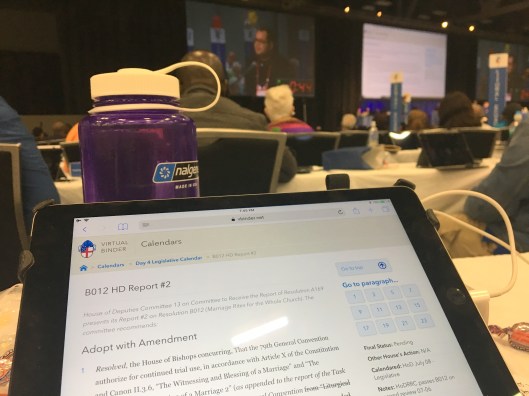
IMG_1818

Photo Credit:  Jennifer Andrews-Weckerly (reuse with permission)

As an alternate to General Convention, I stood ready to fill in when deputies needed a break from the floor.  On the two sessions where I was able to serve as a Deputy, I was able to participate in the debate, revision, and voting on B012, entitled Marriage Rites for the Whole Church.  This resolution came to be because although we authorized marriage rites for same sex couples at the 78th General Convention, there was a provision that allowed bishops who hold a theological position that does not embrace marriage for same-sex couples to forbid his or her priests from conducting such rites.  This left the LGBTQ community in those dioceses unable to be married in their home parishes by their home priests, despite a change in the legal ability to do so.  This was deemed a compromise that could keep everyone at the table despite our theological differences.

However, given the protests of the LGBTQ community and their supporters, B012 proposed an option for priests and their parishes who wanted to conduct marriages for all despite their bishop’s protest to seek the oversight of another bishop in the Episcopal Church.  The resolution allowed for bishops and protesting churches and clergy to hold their ground, while also allowing dissenting clergy and parishes to minister to their community fully.  I talked about the testimonies and debate about this issue earlier.  The resolution was heavily edited as a result of that that testimony, and what came before the House of Deputies seemed like a well-crafted compromise.  But the debate on the floor indicated something quite different.  Our more traditional brothers and sisters felt their theology was being compromised, and many diocese in Province IX, including churches in foreign countries where same-sex marriage is still illegal, were threatening to break from the church.  It was a heart-wrenching debate, and our own deputation was even divided on what to do.

When the vote finally came, we voted by orders – so that the entire house could see how the lay and ordained voted.  As the minutes ticked by, my stomach turned.  I honestly did not know what would be the best outcome, and I feared for our path forward.  When the votes came in, they were overwhelmingly in favor of B012.  I am not sure what changed people’s minds, and I am not sure how people came to see that this was a good compromise.  My only reflection was that everyone was a bit unhappy, not fully getting what they wanted – which is the definition of a good compromise, if you ask me.

I do not know if the passage of B012 will have any negative impact in the future.  What I do know is that the process seemed to model something we have a hard time doing in the United States – compromise.  I have always said that if the Episcopal Church cannot model compromise, respect, and dignity, we cannot expect the world outside to do so.  The passage of B012 in both Houses made me feel like there might be hope for all of us to witness compassionate compromise through Christ to others.

← Older posts
Newer posts →

Recent Posts

  • On the Myth and Magic of Advent…
  • On Risking Failure and Facing Fear…
  • Sermon – Luke 23.33-43, P29, YC, November 23, 2025
  • On Inhabiting Gratitude…
  • Sermon – Luke 20.27-38, P27, YC, November 9, 2025

Archives

  • December 2025
  • November 2025
  • October 2025
  • September 2025
  • August 2025
  • July 2025
  • June 2025
  • March 2025
  • February 2025
  • December 2024
  • November 2024
  • October 2024
  • September 2024
  • August 2024
  • July 2024
  • June 2024
  • May 2024
  • March 2024
  • February 2024
  • January 2024
  • December 2023
  • November 2023
  • October 2023
  • September 2023
  • August 2023
  • July 2023
  • June 2023
  • May 2023
  • March 2023
  • February 2023
  • January 2023
  • December 2022
  • November 2022
  • October 2022
  • June 2022
  • May 2022
  • January 2022
  • December 2021
  • November 2021
  • October 2021
  • September 2021
  • August 2021
  • June 2021
  • May 2021
  • April 2021
  • March 2021
  • February 2021
  • January 2021
  • December 2020
  • November 2020
  • October 2020
  • September 2020
  • August 2020
  • July 2020
  • June 2020
  • May 2020
  • April 2020
  • March 2020
  • February 2020
  • January 2020
  • December 2019
  • November 2019
  • October 2019
  • September 2019
  • August 2019
  • July 2019
  • June 2019
  • May 2019
  • April 2019
  • March 2019
  • February 2019
  • January 2019
  • December 2018
  • November 2018
  • October 2018
  • September 2018
  • August 2018
  • July 2018
  • June 2018
  • May 2018
  • April 2018
  • March 2018
  • February 2018
  • January 2018
  • December 2017
  • November 2017
  • October 2017
  • September 2017
  • August 2017
  • July 2017
  • June 2017
  • May 2017
  • April 2017
  • March 2017
  • February 2017
  • January 2017
  • December 2016
  • November 2016
  • October 2016
  • September 2016
  • August 2016
  • July 2016
  • June 2016
  • May 2016
  • April 2016
  • March 2016
  • February 2016
  • January 2016
  • December 2015
  • November 2015
  • October 2015
  • September 2015
  • August 2015
  • July 2015
  • June 2015
  • May 2015
  • April 2015
  • March 2015
  • February 2015
  • January 2015
  • December 2014
  • November 2014
  • October 2014
  • September 2014
  • August 2014
  • July 2014
  • June 2014
  • April 2014
  • March 2014
  • February 2014
  • January 2014
  • December 2013
  • November 2013
  • October 2013
  • September 2013
  • August 2013
  • July 2013
  • June 2013
  • May 2013
  • April 2013
  • March 2013
  • February 2013
  • January 2013
  • December 2012
  • November 2012
  • October 2012
  • September 2012

Categories

  • reflection
  • Sermons
  • Uncategorized

Meta

  • Create account
  • Log in
  • Entries feed
  • Comments feed
  • WordPress.com

Blog at WordPress.com.

  • Subscribe Subscribed
    • Seeking and Serving
    • Join 394 other subscribers
    • Already have a WordPress.com account? Log in now.
    • Seeking and Serving
    • Subscribe Subscribed
    • Sign up
    • Log in
    • Report this content
    • View site in Reader
    • Manage subscriptions
    • Collapse this bar
 

Loading Comments...