• About

Seeking and Serving

~ seek and serve Christ in all persons

Seeking and Serving

Tag Archives: church

So Let Your Light Shine…

03 Wednesday Aug 2016

Posted by jandrewsweckerly in Uncategorized

≈ Leave a comment

Tags

Christ, church, glory, God, inspire, joy, light, passion, shine, transformation

Let-Your-Light-Shine-Banner

Photo credit:  embracingbeauty.com/2013/04/20/letting-our-light-shine-by-donating-w-champions-for-kids-mobilizingmillions-cbias/

These last few weeks, I have been visiting outreach ministries that our parish supports.  The ministries have varied widely – from a free health clinic, to a ministry aimed at keeping seniors independent as long as possible, to a multi-service agency that works in a particularly impoverished area of our community.  Visiting the agencies has given me a great deal of perspective on the larger Williamsburg community – the various ways that poverty can impact the lives of our neighbors.  Whether the challenge is housing, health care, food, clothing, transportation, or education, the needs vary wide.  Luckily, there are people who are passionate about each need, and are working hard to make life a little better for our neighbors.

Equally helpful to learning the statistics and needs of each agency has been watching the passion of our parishioners who are involved in the ministries.  At each agency, a parishioner has shared with me why they volunteer, what inspires them, and how important the ministry is to our community.  With each parishioner, I see a certain tenderness toward the clients and a passion about the issue.   The parishioner’s entire demeanor changes when they talk about the ministry – making the case even more compelling than the executive director of the agency can make it.

As I have watched the physical transformation of our parishioners as they tell me about their passion for outreach ministries, I realized that is the same transformation I hope to see when they tell their friends about Hickory Neck.  You see, just like outreach ministries give us a sense of purpose outside of ourselves, church should similarly give us a sense of purpose outside of ourselves.  At church, we find ourselves inspired by worshiping our God.  At church, we find ourselves renewed as we learn and grow in our faith journey.  At church, we find ourselves made whole as we laugh and rejoice together.  At church, we are changed, we change others, and we change our community beyond the church walls.

I saw that same transformation as I interviewed with the Search Committee and Vestry over six months ago.  I saw that transformation in our parishioners this summer when I asked each of you what brings you joy about Hickory Neck.  And today, I imagine each of you might feel that inner transformation, that deep sense of joy, if you were to think about why you love Hickory Neck.  My invitation for all of us in the coming weeks is to take ourselves to that deep, inner sense of meaning, purpose, and joy, and to start inviting your friends and neighbors into that same experience.  If you speak from the heart, letting your light and passion shine through you, I promise you will inspire others more than you know.  Just like I saw the bodily transformation when you talked about your passions for outreach, your neighbors will be equally drawn in by your passion for church.  As we look to kick off the program year, I look forward to hearing how our newcomers were inspired by the Christ light shining in you, and wanted to find out how to capture that same light.

Putting Paint to Canvas…

27 Wednesday Jul 2016

Posted by jandrewsweckerly in Uncategorized

≈ Leave a comment

Tags

art, calendar, church, collaborate, community, masterpiece, ministry, mission, paint, priorities

paintbrush

Photo credit:  www.colortheorypainting.com/color-theory-blog/

This past winter, my church at the time held a “Paint Nite,” as a fundraising event.  As someone who has very little artistic skill, I was skeptical that I would come away with anything of worth.  Just sitting in front of the blank canvas seemed daunting.  When we took our first strokes to prepare the canvas for more color, I was convinced I would ruin the whole thing.  But as our teacher for the night slowly guided us through the exercise, breaking down each step of the process, the blank canvas slowly transformed.  First, into blocks of color; then with odd shapes inserted here and there; and finally, a picture emerged.  When I finished for the night, I sat back and thought to myself, “That’s not actually all that bad.”  As I looked around the room, all of our once blank canvases were transformed into unique, yet similar, works of art.

In some ways, that is the work of Hickory Neck this summer.  Committee leaders and Vestry liaisons have been gathering these past couple of months to prepare for our Vestry’s retreat/workday on Saturday.  Each Vestry member is assigned to be a liaison to a ministry area of the church and has been asked to assemble a calendar of the work each ministry area would like to do this year.  The Vestry and clergy will come together on Saturday to put that work together on a blank calendar and see what work of art emerges.

To some, working on calendars for a whole day may sound dull.  But I am convinced that our work this Saturday is important work for the life of the community.  By taking a holistic look at our calendar, we get a sense of our priorities, our strengths, and our challenges.  Instead of each ministry area doing what they do in isolation, we can step back and look at the fuller tapestry of life at Hickory Neck and discern whether the picture our calendar presents is the image we really want.  This is exciting work, full of possibility and potential.

I ask that you hold our Vestry in prayer this weekend as we do this collaborative work.  If you have already spent time working with your Vestry liaison, reflecting on goals and plans, thank you for the work you have already done.  If your ministry area has not yet had a chance to offer your dreams and goals with your Vestry liaison, please reach out to them this week.  This weekend we will be painting a beautiful picture together and I look forward to sharing the masterpiece with each of you as we kickoff our program year in September.  Great things are already happening at Hickory Neck.  Your Vestry and clergy are excited to make that work even better!

The Sound of Silence…

07 Thursday Jul 2016

Posted by jandrewsweckerly in Uncategorized

≈ 1 Comment

Tags

brokenness, church, contemplations, Episcopal, God, listen, noise, prayer, Rite I, silence, sinfulness, worship

The-Sound-of-Silence

Photo credit:  advisoranalyst.com/glablog/s015/05/27/jeff-miller-the-sound-of-silence.html

In almost every parish I have served, there has been an 8:00 am, Rite I, spoken service.  The crowd usually is not that large.  Because the service is spoken, it tends to be very quiet and to be the shortest service of the day.  Those who are attracted to the service usually like the language (We use “thee” and “thou” language and the service has a more penitential tone.)  Others like the brevity of the service – appreciating both going to church and having the rest of the day free.  While others like the service because it feels more contemplative and centering.

Though the service is always pretty quiet in whatever Episcopal Church you choose, what I have noticed about the 8:00 am crowd at Hickory Neck is that they tend to be not just prompt, but early.  Every Sunday, at least five minutes before the service begins, everyone is seated and is silent.  Up until this past Sunday, I found the practice unsettling.  On Sundays, I am usually amped up, and ready to jump into liturgical leadership.  As an extrovert, I am chatty, and am used to some lighthearted conversation before the service starts.  So the silence immediately before the service feels discordant with my pent-up energy.

But this past Sunday, I remembered a complaint long ago from a fellow parishioner at the Cathedral where I became an Episcopalian.  She used to complain that the beginning of the service was not meant to be happy hour – she was irritated by the chatter all around her when all she wanted to do was kneel on the prayer cushion in front of her and enjoy a moment of silence before the service began.  Even the bulletin had a comment at the beginning that reminded people that we should respect others’ desire to begin our worship in quiet contemplation and centering prayer.  Though I appreciated the guidance, I never really “got” it – until this past Sunday.

The beauty of five minutes of silence before worship is that you can let go of all the stuff on your to-do list.  The beauty of the five minutes of silence before worship is that you can let go of the pain, worry, anger, or stress that is ever present and present yourself humbly before worship.  The beauty of the five minutes of silence before worship is that you can listen to God instead of talk to God.  As a celebrant, I do not know that I will ever be able to use those last five minutes to center myself (I tend to arrive much earlier at church to find that centering time).  But as one who facilitates worship, I have found myself greatly appreciating the gift of those five minutes for our parishioners.  I could use a good five minutes today to just listen.  In the noise of mass gun violence, terrorism, racism, poverty, and suffering, I am a bit out of things to say to God.  Instead I would rather kneel in silence today and give humanity’s and my own brokenness and sinfulness to God.  What might you offer to God today in that silence?  What do you imagine you might hear in that silence?

Making hay…

29 Wednesday Jun 2016

Posted by jandrewsweckerly in Uncategorized

≈ Leave a comment

Tags

abundance, church, enjoy, God, goodness, make hay, proverb, summer, time, work

hay in field 1100_0

Photo credit:  www.cattlenetwork.com/advice-and-tips/cattle-feeding/make-hay-supplies-last-through-winter

“Make hay while the sun shines.”  That has been the motto this summer at our household.  Being new to our town, we are discovering all sorts of fun things – places to go, foods to try, even a community pool to enjoy.  I suppose coming from a climate that has long, sometimes tough winters, summer in a new place has felt like an open invitation to enjoy all the goodness around us for as long as we can (even though we have heard that winters are not so bad here).

In some ways, living by that old proverb has been a ton of fun.  For those of you who know me, I can be a creature of habit – Mondays are laundry day, Fridays are pizza night, etc.  Plus, we have young children who can be quite cranky if they do not get enough sleep or who can be quite rowdy if they do not get proper nutrition (e.g. too much ice cream from the awesome homemade ice cream joint within walking distance means sugar-crazed bedtime routines).  But despite my penchant for order and predictability, I am trying to embrace the “Make hay while the sun shines” mantra because we having a lot of fun.

That proverb is embraced at church over the summer too.  In the ebb and flow of church life, the program year (September through May) is the busy time of year – more programs, more activities, and more meetings.  In the summer, people travel, kids are off on adventures, and some of us are “making hay.”  Based on that shift, one might imagine that all is quiet at church during the summer.  In fact, we too are busy “making hay.”  The program year is being planned, calendars are coming together, and groups are meeting to strategize for needs in the fall.

I am grateful for time set apart for hay making.  Parishioners at Hickory Neck are working hard so that when things kickoff in the fall, all runs smoothly.  I am grateful for the time that people are committing to the church, the creativity they are contributing, and the joy and laughter with which we do it all.  Thank you to all those contributing behind the scenes!  I am happy to be making hay with you this summer!!

On Big Changes…

08 Wednesday Jun 2016

Posted by jandrewsweckerly in Uncategorized

≈ Leave a comment

Tags

baptism, being, celebrate, change, church, Holy Spirit, identity, nature, ontological change, ordination

4792_115739632564_7119988_n

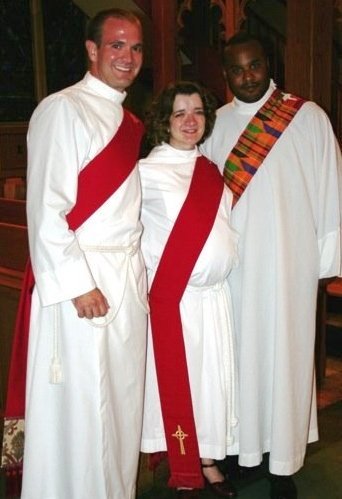
The Reverands Jody Burnett, Jennifer Andrews-Weckerly, and Charles Fischer III, Cathedral Church of St. John, June 24, 2009

Later this month I will celebrate the seven-year anniversary of my ordination.  What most people remember about that day was that I was very pregnant.  I confess that my large belly in an alb and a stole were rather extraordinary.  But what I remember about that day was a brief, but profound encounter.  I had gotten to the Cathedral early to make sure everything was in place and everyone knew where to go.  I was bustling around, managing logistics, when I ran into my boss, who was the rector of the church where I was serving.  She saw that I had my clergy shirt on but that I had not yet put on my collar.  You see, although you are not technically ordained until midway through the liturgy, you put your collar on before the liturgy starts.  The idea seemed strange to me to put it on before the bishop laid hands on me.  And if I am really being honest, I was really nervous about the whole endeavor.  My rector put her hands on my shoulders, looked me square in the eye, and said, “Jennifer, it’s time.  Go put on your collar.”

When we talk about ordination, we talk about the newly ordained experiencing an ontological change – a change in who the person is and in the nature of her existence.  It sounds rather dramatic because the change is dramatic.  When we ordain someone, we forever set them apart for a specific role in the church.

This Saturday, we will join our new curate, Charlie Bauer, as he is ordained to the transitional diaconate.  Charlie will be facing a similar ontological change – committing the rest of his life to this new way of being in and for the church.  Ordained persons do not simply start a new job.  Their whole person and existence is changed.  That is why an ordination is so special – because it is a day set apart for honoring this tremendous change.

Of course, all people in the church have access to ontological change.  Both baptism and confirmation are considered similar ontological changes – something profound happens in those moments, moments that only happen once in a lifetime.  We are marked as something different, and the way that we live our lives changes forever.  Because that change for all of us is so profound, the church sets apart days that we reaffirm our baptismal covenant and ordination vows.  We want to remember those tremendous moments when we put on a collar or stole, when water was poured over our heads, when a bishop placed heavy hands on our heads, and when we felt the Holy Spirit whisk through the room.  I hope you will join us as we celebrate this ontological change with Charlie.  But I especially hope you will take a moment to remember your own change and how the Spirit invites you to reclaim your changed identity.


The Power of Stories

18 Wednesday May 2016

Posted by jandrewsweckerly in Uncategorized

≈ Leave a comment

Tags

church, connect, encounter, meet, power, sacred, stories, stranger

Story

Photo credit: coolerinsights.com/2016/04/how-to-tell-winning-brand-stories-on-social-media/

Last week we started our Meet and Greets at Hickory Neck.  I knew that I wanted to get to know the people of the parish in a more meaningful way than just shaking hands in the receiving line after church.  And so, we are gathering in small groups of 10-12 people, and taking time to tell our stories.  The gatherings have already been a tremendous blessing.  I am learning about the varied ways that people found their way to Hickory Neck, their loves and passions, and their hopes and dreams.

What I particularly enjoy about the gatherings is the reminder of how powerful our stories are.  Each person in our community has a unique story, with elements that are quite familiar to us, and elements that are totally foreign to us.  I think that fascination with stories is why I have been attracted to efforts like Humans of New York or StoryCorps.  Those efforts are hoping to capture the everyday nature of our stories, while demonstrating the powerful ways that we connect through our stories.  Our stories have the ability to bring others joy, to elicit empathy, to bring us to tears, and to open up new worlds.

Too often, we are tempted to ignore the depth of those stories with strangers.  We are busy about our business, trying to accomplish tasks, or stick to a schedule.  In that routine, we forget that there are people all around us who have rich stories and whose lives may have something to teach us.  From that man who snapped at you in line, to the child who fell asleep in school, to the mom out in public in her pajamas, to the teen engrossed in social media, each person has a story behind their behavior – and the story may be much different than a quick glance allows us to assess.

If you have not joined a Meet and Greet, I encourage you to sign up at church.  In fact, even last night someone commented about how much they were learning about people they had known for quite some time.  But beyond our work within the community, I invite you to start looking at those outside of our community with a different eye:  the eye of someone who sees the unique and sacred stories we all have.  I look forward to hearing how your encounters go.

Sermon – Acts 2.1-21, Pentecost, YC, May 15, 2016

18 Wednesday May 2016

Posted by jandrewsweckerly in Sermons, Uncategorized

≈ Leave a comment

Tags

Babel, church, context, culture, Episcopal, hearing, Holy Spirit, languages, love, Pentecost, pentecostal, Sermon, tongues, understanding, wind

Though I often share with people that I grew up in the Methodist Church, what that story fails to capture is my earliest experiences in church.  You see, before my father became a United Methodist minister, he, my mother, and I worshiped at a Pentecostal church.  So my first memories of church are quite different from my current experiences in church.  I remember the pastor putting his hand on a person’s forehead and the person crumbling to the ground, presumably slain in the spirit or healed of a malady.  I remember sitting in the pew once with a friend of my parents’ when the woman leaned over to me and whispered, “I’ll be right back.”  She then proceeded to run up and down the aisle, her hands waving in the air.  I do not remember anyone speaking in tongues, but I would not be surprised if that happened.

I have always found the fact that Episcopalians like Pentecost so much fascinating because we are about as far from Pentecostal as any church could get.  I have yet to find an Episcopal Church that encourages running up and down aisles, speaking in tongues, and being slain in the spirit.  That does not mean we do not move.  In fact, we stand, kneel, sit, cross ourselves, bow, and sometimes even genuflect.  You might find a few of us lift our hands in praise, but most of us keep our hands tightly to our sides.  You might find a few of us who will say an unprompted “Amen!” aloud, but they will likely get a few glares.  We are likely to, rather proudly, wear red on Pentecost.  But that is the extent of most Episcopalians “Pentecostalism.”  We like things much more ordered, predictable, and civilized.  In other words, if we are really being honest, Episcopalians are not all that big on Pentecost.

Our aversion to Pentecostal experiences are not all that unfounded.  All one has to do is look at the first Pentecost that we read about in Acts today.  The day the Holy Spirit comes down from heaven is a pretty disorderly, unpredictable, uncivilized day.  Wind whips through people’s hair, fire bursts into flames on people’s heads, and a cacophony of noise ensues that both makes no sense at all, and yet makes perfect sense to each person there.  Although that chaos may sound very similar to anyone with small children in the house, that chaos is not exactly what we have come to expect as civil Episcopalians.

But if we are to get our heads around Pentecost, we have to understand what was really happening on this feast of Pentecost.  The feast of Pentecost was known to most Jews as the feast of Weeks, or Shavuot.  Shavuot is the third of the three great festivals of Judaism.  Shavuot was a joyful celebration, in which the first fruits of the harvest were offered to God.[i]  But Shavuot was not simply an agricultural festival.  Shavuot, or Pentecost, was fifty days after the Passover.  At Passover, the Jews celebrated the saving of the Israelites from the death that came upon the firstborn of the Egyptians.  Fifty days after that dramatic event, the Israelites arrived at Mt. Sinai to receive the law from Moses.  And so, in addition to thanking God for the first fruits of the harvest, praying that the rest of the harvest might be equally bountiful, Pentecost was also “about God giving to [God’s] redeemed people the way of life by which they must now carry out [God’s] purposes.”[ii]

The parallels in and of themselves are uncanny.  At the Passover, the people of God are saved as death passed over their homes.  In Christ, the people of God are saved once again as Christ our Passover is sacrificed for us.  At Shavuot, the people of God are given the new way of life, specifically through the vehicle of Torah, or the Ten Commandments.  At Pentecost this day, we are reminded of the New Commandment given through Jesus that we love the Lord our God and love our neighbors as ourselves.[iii]

So if this day is all about us being given the way of life that we must now live, what do we learn in this chaotic, uncivilized day?  Most remarkably, we see people speaking in tongues they do not know, and yet, all understanding in their native tongues.  That does not mean that all the languages suddenly became one – like making English the official language of Christianity.  Instead, “Pentecost gives power to the band of Jesus followers to speak the languages of the world, to tell the gospel in every language.  The early church [is] to bear witness to the ends of the earth in the languages of the people of the world.”[iv]

I have been thinking a lot about speaking other people’s languages this past week.  Having just moved from Long Island to Williamsburg, I have been keenly aware of language differences over the last month.  Of course, some of our differences in language are more about dialect than anything else – our vowels sound different, or r’s are sometimes dropped.  But a more poignant difference in our language is around culture.  On Long Island, communication is usually concise and incisive.  That may sound rather appealing, but the first time someone tells you how they really feel about you, and the way that they feel is pretty negative, the language can feel like a slap in the face.  Of course, that is not to say Southerners have the market on ideal communication.  I remember many a time growing up when someone said, “Bless your heart,” and their words had nothing to do with a blessing.

As I have been ruminating on those differences this week, I wondered whether those differences go beyond region and perhaps are at the root of many of our challenges today.  I have wondered if part of our country’s problem in communicating with one another is rooted in the fact that we are not speaking the same language.  Of course, most of us can speak English in this country, but even though we speak the same language, we do not speak from the same cultural reality.  There are experiences that I have as a woman that my male brothers will never fully understand.  There are experiences that my African-American brothers and sisters experience that I will never fully understand.  There are experiences that our young adults are having through technology that us older folks will never fully understand.  In some ways, I wonder if in America, we have become more like the people of Babel than the people of Pentecost.

Luckily, we are not beyond God’s power to make our Babel-like ways right.  There are all sorts of tangible ways we can work toward understanding others’ languages.  We have a pretty incredible collection of young adults in this parish.  Being a part of community means that we can reach out to our young people to hear their stories and trials – just as they can learn about our own stories and trials.  Being a part of community means that we can join any number of the outreach ministries of Hickory Neck and learn quite quickly what language and cultural context poverty creates.  Being a part of a community means that we can read authors whose cultural contexts are completely different from ours and learn more clearly why movements like “Black Lives Matter,” might have arisen in the first place.

That is the true invitation of Pentecost:  to step boldly into the chaos of differing languages, knowing that the Holy Spirit will bring about true understanding.  Of course, stepping into that cacophony is scary.  As N.T. Wright says, stepping into the cacophony means getting “out there in the wind, letting it sweep through your life, your heart, your imagination, your powers of speech, and transform you from a listless or lifeless believer into someone whose heart is on fire with the love of God.”[v]  That kind of transformation may not sound like what you were hoping by wearing red today.  But that kind of transformation offers the promise not of calming the cacophony of language all around us, but helping us hear in the midst of the chaos.  God, whose very existence in the form of the Trinity is three distinct persons, yet one, invites us to live as a community differentiated in persons, but untied in love.[vi]  That Pentecostal community will be loud, messy, and hard.  But that community will be life-giving, renewing, and beautiful.  Our invitation today is to step into the wind of the Spirit.  Amen.

[i] Margaret P. Aymer, “Exegetical Perspective,” Feasting on the Word, Yr. C, Vol. 3 (Louisville: Westminster John Knox Press, 2010), 15.

[ii] N.T. Wright, Acts for Everyone, Part 1, Chapters 1-12 (Louisville: Westminster John Knox Press, 2008), 21.

[iii] Aymer, 17.

[iv] Aymer, 17.

[v] Wright, 22.

[vi] Michael Jinkins, “Pastoral Perspective,” Feasting on the Word, Yr. C, Vol. 3 (Louisville: Westminster John Knox Press, 2010), 18.

Speaking my Language

11 Wednesday May 2016

Posted by jandrewsweckerly in Uncategorized

≈ 1 Comment

Tags

church, communicate, culture, hear, Holy Spirit, language, new, North, Pentecost, South, speak, tongues

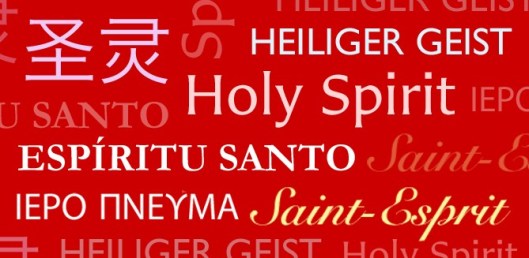
Pentecost Sunday

Photo credit:  stbarts.org/worship/pentecost-languages/

As many of you know, I was raised in the South.  My San Diego-native husband tells me that when he met me in high school, I had an endearing North Carolina accent.  But after going to college with people from all over the country and living in Delaware, I found that my accent faded.  I tended to pick up phrases and patterns of speech from those around me.  Of course, one call from my Alabama-native mother, and all bets were off.  But about four years ago, my family moved to Long Island with our then two-year-old.  Surrounded by Long Islanders, she quickly started pronouncing vowels differently and dropping r’s.  I am not sure how much of the dialect I assimilated, but my ears certainly adjusted.

What I came to finally understand about all these dialects is that much more important than the sound of words are the culturally different ways people communicate with one another in different regions of the country.  My experience on Long Island was that people were very direct and incisive with their words.  Being from the South, this was more of a shock than the dialect.  In the South, people are indirect and subtle with their language.  Though I was raised to interpret conversations in the South, if I am honest, I found the Long Island way of communicating refreshing.  Although I sometimes felt like I was being slapped in the face by the brutal honesty of another person, when I went home, I knew where I stood.  That was not always the case in the South.  People are almost always polite, but hidden in the politeness are sometimes feeling of resentment or hurt, which cannot be addressed if you do not know how to hear the subtlety.

This Sunday, the Church is celebrating Pentecost.  If you remember the story from Acts, those gathered begin speaking in tongues.  The miracle was not in the speaking of tongues, but in the understanding of tongues by everyone gathered.  Each heard their own language and the message was clearly understood by all.  Having recently returned to the South, I find myself wondering in what ways the Church could be speaking more clearly.  I am not suggesting that one region of the country has the market on clear speech.  What I am suggesting is that as a Church, we are not always great at communicating the power of Christ in our lives.  We either get lost in “church speak,” or we try to academically explain matters of the heart, or, out of fear or discomfort, we do not speak at all.  As we honor the miracle of the work of the Holy Spirit over two thousand years ago, our invitation at Pentecost is to honor the ways in which the Holy Spirit can continue to enliven the church to speak understandably to a new generation.

In it Together…

06 Friday May 2016

Posted by jandrewsweckerly in Uncategorized

≈ Leave a comment

Tags

alcoholism, both-and, church, compassion, either-or, Eucharist, gratitude, grief, honor, joy, mother, Mother's Day, pain

Hands-together

Photo credit:  indianapublicmedia.org/harmonia/offering-hand/

This week I attended our Spring Clergy Day.  Our presenters for the day talked to us about addictions and their impact on families and communities.  As part of our work, we eventually began to talk about how we honor those in our midst who are struggling with the disease of addiction while staying true to ourselves.  One specific issue at hand was how to make room for alcoholics in a Church that serves wine as the blood of Christ.  Although our Bishop was pretty clear that he did not want us to step outside of the rubrics (i.e. using grape juice instead of wine/non-alcoholic wine), several clergy members shared practices they had adopted to make parishioners struggling with alcoholism feel incorporated into the community.  Ultimately, what we decided was that each parish was different, and the important point was that we talked about the issue, especially soliciting the opinions of those who suffer from the disease.

Meanwhile, this Sunday is Mother’s Day.  I have come to dread Mother’s Day because of the many pastoral implications (see my posts here and here).  However, I am in a new parish that longs to honor those mothers and mothering-types who have made a healthy impact in their lives.  I realized the dilemma of trying to honor mothers while honoring those for whom Mother’s Day is a hard day is not unlike the dilemma of trying to honor years of tradition in the Anglican Church and the pastoral sensitivities needed of a modern priest.

In both of these instances, I find myself mostly concerned about making room for both joy and compassion.  How do we honor the struggle of the alcoholic while also honoring the power the taste and tradition of wine has on our spirituality?  How do we honor the amazing mother we have in our lives while also honoring the fact that not everyone is so lucky?  How do we celebrate the pregnancy or birth of a child in our parish while also honoring how difficult hearing about pregnancy is for someone struggling with infertility?

I am hopeful that we can do both.  This Sunday, my parish is going to try to do just that.  We had several parishioners who really wanted to honor the mothers in our midst.  Holding on to that inner tension, we agreed that every female would be offered a flower and a poem that named the inherent challenge of honoring the amazing mothers in our lives and the ways that this day is hard for many of us.  Our hope is that by doing both, we have the opportunity to give thanks and rejoice while also leaving room for grief and intercession.  We know there is no perfect way to do both – but we also know that in doing nothing, we sever any opportunity for joy by simply attending to grief.  Instead, we are electing to go with the both-and instead of the either-or.  Prayers for all of you as you navigate the both-and of this world!

Sermon – Acts 16.9-15, E6, YC, May 1, 2016

06 Friday May 2016

Posted by jandrewsweckerly in Sermons, Uncategorized

≈ Leave a comment

Tags

blessing, change, church, community, conversation, evangelism, God, growth, hear, Holy Spirit, listen, new, Paul, prepare, Sermon, together, work

One of the things that the Search Committee, Vestry, and I all talked about during our time of discernment was church growth.  Now church growth is a loaded topic because inherent in the conversation are a lot of assumptions.  One assumption is that we can talk about church growth without talking about change.  Many churches say they want to grow, but what they mean is that they want to find fresh meat for volunteer positions and new pledgers for the budget.  But inherent in church growth are not just bodies to fill out needs:  church growth means incorporating new people who will have new ideas, new dreams, and new ways of doing things.  The second assumption when we talk about church growth is that we can go about church growth passively.  In other words, as long as we have a good website, we have good programs, a shiny new Rector, and we are nice to people once they arrive, we will grow.  While those things are important and necessary, those things do not fully address how we get people to step on our property, how we encourage people to come back after a first visit, or how we incorporate newcomers fully into the life and ministry of the church.  The final, and my personal favorite, assumption is that church growth is done by the Rector.  The Rector can certainly help lay the foundation of a strong system of invitation, welcome, and incorporation.  But the primary way that church growth happens is through Church members inviting others to church.

All that is to say that my response to the Search Committee and Vestry went a little like this:  I am more than happy to give Hickory Neck all of the infrastructure Hickory Neck needs to grow; but Hickory Neck is going to have to work, be open to change, and get real comfortable with talking about their faith in the neighborhood.  Now I know many of you may be sitting here right now, cursing the Search Committee and Vestry for signing you up for some hard, scary work ahead.  But let me let you in on a little secret:  church growth (or evangelism, if we are feeling really sassy) is not that hard or scary.  That is the great thing about the readings from the Acts of the Apostles during Eastertide:  they are all about the growth of the church.  Last week we heard about how Peter began to understand that God was calling him to share the Good News with the gentiles.  Today, we hear about how Paul is diverted to Europe to share the Good News with the people of Macedonia.

Many of us get a little uncomfortable talking about apostles spreading the Good News because the stories about Peter and Paul seem strange and foreign.  They involve dreams or visions in which God tells them what to do.  They involve going to foreign lands to talk with strangers.  And they sometimes involve, as we will hear next week, getting arrested and sent to jail.  Most of us hear these familiar stories and assume that the stories do not really apply to us because they are historical, ancient stories.  But after the drama of being diverted to a foreign land and searching for a place to join with sympathetic people, what happens to Paul in our text today is not actually all that foreign or unrelatable.  The story tells us that on the Sabbath day, Paul and his companions go find where faithful people are gathered and simply start talking.  The text does not say that Paul gives a presentation about the merits of converting to Christianity.  The text does not say that Paul leads a worship service, with music and the holy meal.  The text simply says that Paul sits down among those gathered, and starts talking.  While Paul is talking, a woman in the group, Lydia, who we understand from the text is an independent woman of wealth[i], overhears what Paul is saying and is so compelled by what Paul says that she and her household are not only baptized, but insist that Paul and his companions come stay with her during their stay in Philippi.

Soon after I became a rector for the first time, I realized I had a lot to learn about church growth.  I read books, poured through research, and talked with experts in the field.  One of my favorite conversations about church growth was with a friend who does church consulting on growth.  In her formation, she had a professor who insisted as part of her training that she needed to go out into town and just start talking to people about Jesus.  She was terrified.  For the first few weeks of class, my friend, now a priest, lied to her professor.  Each week he would ask her how the project was going, and she would tell him that the project was going well.  Finally, the professor called her bluff and insisted that she immediately go somewhere and do her assignment.  So my friend went to a coffee shop, wrote on a piece of paper, “Talk to me about Jesus and I will buy you a cup of coffee,” and then set up her laptop in the hopes that no one would take her up on the offer.  Much to her chagrin, a patron came up to her and said, “I’ll talk to you about Jesus, but I’ll buy the coffee.”  The conversation that ensued was full of the stranger’s story – about how she used to go to church, how she still believes, how the church hurt her, but how she still misses having a church community.  My friend listened to the story, honored the stranger by acknowledging how hard her journey had been, and then did the one thing that is key when talking about church growth.  My friend acknowledged where she saw the presence of God in this stranger’s journey.  And, for good measure, my friend told her that if she ever wanted to try church again, she knew a great place that might just work.

That is the funny thing about church growth.  Church growth happens through real people having real conversations in real time.  Paul sits down with a bunch of women and starts talking.  My friend sat down with a stranger and listened and reflected back on the stranger’s journey.  That is the same invitation that I will be giving us to do over and over again in my time here at Hickory Neck:  that we start having real conversations with real people in real time.  Now I know what some of you may be thinking.  First, you may be thinking, “I cannot believe the Search Committee and Vestry decided to hire this priest who is going to make me do this!”  Second, you may be thinking, “I have no idea how to have real conversations with real people in real time!  What does she expect me to do?  Start talking to strangers at the coffee shop, on the golf course, and at the Little League game?”

Before you get too anxious, I want to give you a little piece of comfort from scripture.  In Peter’s story last week, in Paul’s story today, and in the texts coming up next week and at Pentecost, we learn that all of these encounters happen with the Holy Spirit going before, making a way for the encounter to happen.  In today’s story, Paul has no intention of going to Macedonia.  In fact, in the verses we did not read today, Paul and his crew actually had plans and made attempts to go to other places, but their plans were thwarted by the Holy Spirit.  Finally, Paul has a vision that he was supposed to go to Macedonia.[ii]  Once he and the group decide to follow that vision, everything becomes smooth.  Their travel is not thwarted, they easily find their way to Philippi, they stumble onto a group of women who are believers, and out of nowhere, just through conversations about faith, Lydia steps up and not only desires baptism, she demands that Paul and his company accept her hospitality.  That is the reality about growth:  yes, growth involves putting ourselves out there to have hard conversations, and yes, growth involves being vulnerable and uncomfortable, and yes, growth will even involve change to us personally and to our community as a whole.  But God shows us through the story of scripture, that the Holy Spirit is ever before us, making the way smooth.  When our intentions are simply to share our story, to listen to the stories of others, and to honor the ways in which God is already active and blessing us, then the rest flows smoothly.

We are probably going to be talking about church growth a lot in the years to come.  We will talk about how to grow, we will make changes that will create a strong foundation for invitation, welcome, and incorporation, and we will get out there and talk to our neighbors.  But at the heart of all that work is the promise that the Holy Spirit is ever before us, making the way smooth, calming our nerves so that God can work in spite of us, and showing us how our holy conversations will be a source of blessing to us as much as those conversations are a blessing to others.[iii]  We will do this work together:  you, me, and the Holy Spirit.  The work will be hard, scary, and beautiful.  The work will be a blessing to us all and allow us to be a blessing to this community.  We can do this work together, because the Holy Spirit goes before us.  Amen.

[i] David G. Forney, “Pastoral Perspective,” Feasting on the Word, Year C, Vol. 2 (Louisville:  Westminster John Knox Press, 2009), 476.

[ii] Brian Peterson, “Commentary on Acts 16:9-15,” May 5, 2013, as found at http://www.workingpreacher.org/preaching.aspx?commentary_id=1627 on April 27, 2016.

[iii] Peterson.

← Older posts
Newer posts →

Recent Posts

  • On Politics, Football, and Love…
  • On Sharing the Love…
  • Sermon – Micah 6.1-8, Matthew 5.1-12, EP4, YA, January 30, 2026
  • On Justice, Kindness, Humility, and the Messy Middle…
  • Feast of the Rev. Dr. Martin Luther King, Jr., January 18, 2026

Archives

  • February 2026
  • January 2026
  • December 2025
  • November 2025
  • October 2025
  • September 2025
  • August 2025
  • July 2025
  • June 2025
  • March 2025
  • February 2025
  • December 2024
  • November 2024
  • October 2024
  • September 2024
  • August 2024
  • July 2024
  • June 2024
  • May 2024
  • March 2024
  • February 2024
  • January 2024
  • December 2023
  • November 2023
  • October 2023
  • September 2023
  • August 2023
  • July 2023
  • June 2023
  • May 2023
  • March 2023
  • February 2023
  • January 2023
  • December 2022
  • November 2022
  • October 2022
  • June 2022
  • May 2022
  • January 2022
  • December 2021
  • November 2021
  • October 2021
  • September 2021
  • August 2021
  • June 2021
  • May 2021
  • April 2021
  • March 2021
  • February 2021
  • January 2021
  • December 2020
  • November 2020
  • October 2020
  • September 2020
  • August 2020
  • July 2020
  • June 2020
  • May 2020
  • April 2020
  • March 2020
  • February 2020
  • January 2020
  • December 2019
  • November 2019
  • October 2019
  • September 2019
  • August 2019
  • July 2019
  • June 2019
  • May 2019
  • April 2019
  • March 2019
  • February 2019
  • January 2019
  • December 2018
  • November 2018
  • October 2018
  • September 2018
  • August 2018
  • July 2018
  • June 2018
  • May 2018
  • April 2018
  • March 2018
  • February 2018
  • January 2018
  • December 2017
  • November 2017
  • October 2017
  • September 2017
  • August 2017
  • July 2017
  • June 2017
  • May 2017
  • April 2017
  • March 2017
  • February 2017
  • January 2017
  • December 2016
  • November 2016
  • October 2016
  • September 2016
  • August 2016
  • July 2016
  • June 2016
  • May 2016
  • April 2016
  • March 2016
  • February 2016
  • January 2016
  • December 2015
  • November 2015
  • October 2015
  • September 2015
  • August 2015
  • July 2015
  • June 2015
  • May 2015
  • April 2015
  • March 2015
  • February 2015
  • January 2015
  • December 2014
  • November 2014
  • October 2014
  • September 2014
  • August 2014
  • July 2014
  • June 2014
  • April 2014
  • March 2014
  • February 2014
  • January 2014
  • December 2013
  • November 2013
  • October 2013
  • September 2013
  • August 2013
  • July 2013
  • June 2013
  • May 2013
  • April 2013
  • March 2013
  • February 2013
  • January 2013
  • December 2012
  • November 2012
  • October 2012
  • September 2012

Categories

  • reflection
  • Sermons
  • Uncategorized

Meta

  • Create account
  • Log in
  • Entries feed
  • Comments feed
  • WordPress.com

Blog at WordPress.com.

  • Subscribe Subscribed
    • Seeking and Serving
    • Join 395 other subscribers
    • Already have a WordPress.com account? Log in now.
    • Seeking and Serving
    • Subscribe Subscribed
    • Sign up
    • Log in
    • Report this content
    • View site in Reader
    • Manage subscriptions
    • Collapse this bar
 

Loading Comments...