• About

Seeking and Serving

~ seek and serve Christ in all persons

Seeking and Serving

Tag Archives: church

An Advent Rollercoaster…

11 Thursday Dec 2014

Posted by jandrewsweckerly in Uncategorized

≈ Leave a comment

Tags

Advent, Blue Christmas, Christmas, church, Gaudete Sunday, grief, joy

This Advent has been a both-and experience for me this year.  There have been some incredibly joyful moments:  watching my daughter’s excitement about picking a Christmas tree, reading devotionals from our Advent calendar and enjoying my daughter’s insightful comments, and anticipating some fun time with family over the holidays.  But there have also been some sobering moments:   grieving the loss of my husband’s grandfather, keeping vigil at the bedside of a longtime parishioner and then burying him this week, and listening to stories of neighboring families who are struggling to make ends meet and who are dreading the disappointment of their children when Christmas comes.  In some ways, the sobering moments have been hanging heavily for me.  That reality has felt normal because Advent is meant to be a quieter, penitential season of preparation.  But the lows have felt really low, and I have found myself longing for the highs – or at least some sense of joy.

Courtesy of http://www.newliturgicalmovement.org/2010/12/gaudete-sunday-exhibition-of-some-rose.html#.VIm-6dLF-Jo

Courtesy of http://www.newliturgicalmovement.org/2010/12/gaudete-sunday-exhibition-of-some-rose.html#.VIm-6dLF-Jo

That is why I am looking forward to two upcoming events at St. Margaret’s.  First is the third Sunday of Advent.  This Sunday is known as “Gaudete Sunday.”  Basically, Gaudete Sunday is meant to offer a break from the penitential themes of Advent, instead emphasizing the joy of the coming of the Lord.  For a full explanation about the name and origin, look here.  This year, I am finding myself longing for Gaudete Sunday, needing more of the joyful moments like I mentioned above and less of the hard moments that keep coming my way.  I am grateful for the Church’s gift of respite to us of this Sunday.

Oddly enough, I am also looking forward to our Blue Christmas service coming up in a little over a week.  The service is meant to be for those who find Christmas to be a difficult or challenging time.  Given that I was just saying I wanted a little more joy, it may sound funny that I am looking forward to this service.  But the truth is, I am looking forward to sharing some of my Advent grief and sadness with others.  Being able to acknowledge those feelings in the context of worship and have them affirmed seems like a tremendous gift.

I suppose that is both the nature of Advent and life – times of highs and lows, joys and grief, eager anticipation and dread.  My hope is that if your Advent is taking on that both-and shape, you might lean on the Church to help you navigate that experience, and to find companions on the journey.  Come join us for a holy Advent.

Sermon – Isaiah 40.1-11, A2, YB, December 7, 2014

10 Wednesday Dec 2014

Posted by jandrewsweckerly in Uncategorized

≈ Leave a comment

Tags

Advent, care, Christmas, church, community, God, Isaiah, preparation, prepare, promise, Sermon, the Lord, work

This sermon was delivered on the occasion of our Annual Meeting. 

This time of year, I do a lot of preparing.  Though the setup takes a lot of work, I particularly love preparing our house for Christmas.  Unpacking and hanging all the ornaments is a tradition I shared with my family, and that I now can share with my girls.  I love telling my oldest daughter the stories behind certain ornaments and helping her decide where they should go.  I also put out our international crèche collection.  They remind me of travels I have made or friends from far away places.  Each inspires something different in me, reflecting the culture and artistry of different countries.  And of course, my daughter loves helping me hide away the baby Jesuses until Christmas day.  We even take down some artwork on our wall to make room for the cards which friends from far and wide send to us.  There is something homey and comforting about the whole process of preparing for Christmas, and I love the way that the preparation makes me feel grounded and joyful.

In our Old Testament lesson today, the text says, “prepare the way of the LORD.”  In this season of Advent, we are to prepare for the arrival of the Christ Child.  Now certainly, unpacking ornaments, advent wreaths, and crèches are one way to prepare.  But God is talking about a different kind of preparation today.  God is not talking about an outward change – like decorating our homes.  God is talking about an inward preparation – an inward change in anticipation of the LORD.  I am reminded of how one of our parishioners just recently prepared himself for the LORD.  Several weeks ago, one of our young parishioners decided to receive his first communion.  He prepared by reading about the Eucharist at home with his family, asking questions, and talking with them about their experiences.  He worked on memorizing the Lord’s Prayer, so that he might fully participate in the prayer life of our community.  And then he sat with me as we walked through the Eucharistic liturgy, talking about what each part means, why that part is significant, and what all those crazy things on the altar are called.  Finally, he chose someone to present him before the entire community, where he and we all declared that he was prepared to be in full communion with this community.  He waited and worked to prepare himself for the consumption of our LORD.  And now, each week that I have placed the body of Christ in his hand since then, I have felt a sweet, deeply abiding satisfaction when he reaches his hands toward me to receive Christ’s body.

The kind of preparation that our young parishioner did is a small taste of the kind of preparation God calls for in our Old Testament today.  Isaiah says that in order to prepare, we need to make straight in the desert a highway for our God, lift up every valley, make low every mountain and hill, level the uneven ground, and make plain the rough places.  This passage is so familiar to us, that many of us miss the magnitude of what God is saying.  When was the last time you tried to fill in a valley or level a mountain?  Of course, God is not telling us to literally take the winding roads of deserts and make them straight.  But in the metaphors, God is telling us that preparing for God is not easy work.  In fact, preparing for the LORD is a monumental task.  Preparing for the LORD is not like preparing our homes for Christmas, where we can make a basic checklist and slowly check the items off the list.  When given the hefty work of preparing ourselves inwardly for God, the task of leveling our valleys and mountains and smoothing out our rough places is much more difficult.

In some ways, I have watched St. Margaret’s do a lot of this interior work.  Over the course of the last year, our Vestry and Buildings and Grounds Committee have made level the mess that had become our Undercroft.  Though taking on an expensive project, they together worked to clean out harmful mold and mildew, solved a drainage problem to prevent that kind of damage again, and reimagined how that space could be utilized by us and our community.  Meanwhile, our educational offerings have been totally made low in this last year.  We revamped our Sunday School program after years of struggling to find the best way to raise our children in the faith.  We reworked our worship schedule so that adults could claim an hour in their busy lives to ponder their faith and make straight paths in the desert.  We have filled in the valleys by marching in parades, sponsoring baseball teams, eating pancakes at local diners, and inviting total strangers into our midst so that they might help us fill in those valleys.  Of course, anyone who knows St. Margaret’s also knows that you are only a stranger here for about one Sunday before our wonderfully welcoming community has made sure they know your whole life story before your coffee cup is empty.

All of those have been wonderfully positive things in our lives, but not easy work.  I cannot tell you the number of people who worried and fretted over our Undercroft expenses, complained about how long the work was taking, and questioned the wisdom of the work.  I cannot tell you the number of times I myself considered whether we should halt educational offerings altogether due to low turnout.  I cannot tell you how many times I needed each one of us to invite someone to church and instead heard someone say, “Oh, well isn’t that what our new website is for?”  We have been making progress toward straightening paths, filling in valleys, and leveling mountains.  But we have also gotten very dirty, been impatient and frustrated with each other, and sometimes have dropped our shovels altogether.  That is what happens when you do this kind of preparation for the LORD.  The work is not easy.  The work is monumental.  The work is, well, work.  And work is what God is inviting us into today.

The good news is that today’s text is one of those “both-and” texts.[i]  Yes, God is inviting us into some hard work today.  As we reflect on another year of service, at the mounds of dirt we have already moved, God is charging us to roll up our sleeves and keep digging.  And yes, God promises that the work of preparing will not be easy work.  But God also makes a promise while we are in the mire of making roads straight.  Our text today from Isaiah says, “He will feed his flock like a shepherd; he will gather the lambs in his arms, and carry them in his bosom, and gently lead the mother sheep.”  This last sentence has been lingering with me this week.  Maybe because I am a nursing mom, or maybe because this is the only time that scripture talks about the work of a mother sheep, but I find myself riveted by these words.

Just this week, I had one of “those” nights at our house.  I do not know whether she was teething or just had a rough day, but I lost count after the fifth time I woke up to my infant’s crying one night.  The next morning, I woke up bleary-eyed, almost falling asleep while eating my morning cereal, spilling my coffee on my computer, and generally having a rough time trying to focus.  That is the life of a mother with young children.  And I assume, the life of a mother sheep is not much easier – constantly using her body to protect and feed her lambs.  To that wearied mother sheep, God says that God will gently lead her.  In fact, not only that, God will gather up her lambs, embracing them in God’s bosom, and then God will gently lead the mother sheep.  I am reminded of the many times someone has scooped up my daughters when they were losing their cool.  I am reminded of the individuals who have forced me to go take a date night while they watched my kids.  I am reminded of the encouraging words and sympathetic nods I have received over these last five years.

That is the kind of care God promises us in the midst of our work.  God says, “Go out there and get dirty filling valleys, leveling mountains, and straitening roads.  And when you are weary from the work, I will scoop up your little ones, and gently lead you by my side.”  As I look forward to the coming year, I hear both a charge and a comfort for us today.  We all have more to learn, more people to serve, more spreading of the gospel to do.  But we also have a shepherd who tenderly encourages and comforts us – and then kicks us right back into the ring.  Thanks be to God!  Amen.

[i] George W. Stroup, “Theological Perspective,” Feasting on the Word, Yr. B, Vol. 1 (Louisville: Westminster John Knox Press, 2008), 28.

In the midst of life…

19 Wednesday Nov 2014

Posted by jandrewsweckerly in Uncategorized

≈ 3 Comments

Tags

birth, blessing, church, death, Diocese, God, joy, life

Courtesy of http://www.glogster.com/deathhangel/death-and-life/g-6l1p46td8m4d3uhesabrba0

Courtesy of http://www.glogster.com/deathhangel/death-and-life/g-6l1p46td8m4d3uhesabrba0

Maybe it is because today is my birthday or maybe it is because we just lost a dear family member to cancer, but life and death have been on my mind a lot lately.  The funny thing about being a priest is that those two things are almost always held in tension.  In the course of one week, I can hold the hand of a dying person and then bless a baby at the communion rail.  I can celebrate a funeral and baptize a child in the course of two days.  I can officiate a wedding and offer counsel to someone getting a divorce in a matter of weeks.  And so, with the death of our family member so fresh in my mind, I took a deep breath on the way to work today and thanked God for this wonderful life that I have been given.  Many days I grumble and complain about the little stuff of life – but today, both life and death are giving me perspective.

The same has been true about my work lately.  This past weekend, The Diocese of Long Island held its Annual Convention.  In the Bishop’s address, he told us about the many churches around the diocese that had closed or merged with other parishes.  Though he ran through the list relatively quickly, I knew all too well how painful each of those closures must have been.  I have been a part of churches that have had to close and it is a brutal process – it feels very much like the death of a loved one.

But just like in the death of a loved one, life slowly springs up.  The Bishop told us about a particular parish in Brooklyn that had to close due to “life-safety issues.”  Located near the Barclays Center, the sale of the property netted almost $20 million for the Diocese – all of which is being invested and distributed.  Some of the proceeds will go to support local churches and ministries while others will be used for international missions.  But out of that death is coming tremendous life.  Though we mourn with that community, through the death of that stage of their ministry they are birthing incredible new life.

And such is life – a continual cycle of life and death, suffering and blessing, mourning and celebrating.  Today, I turn toward celebration and life.  I can do that with deep joy because the sobering reality of death sets me free to appreciate every blessing of this life.  My cup runneth over – thanks be to God!

Finding our way through priorities…

05 Wednesday Nov 2014

Posted by jandrewsweckerly in Uncategorized

≈ Leave a comment

Tags

blessed, church, fair share, gift, God, pledge, resources, stewardship, walking the way

This year, St. Margaret’s has been Walking the Way through our Stewardship Season, praying on what giving means to us, why we give, and how our giving shapes our relationship with God and our church.  Below is a guest post from parishioner Kimberly Irvine on why she is pledging this year, and how the Holy Spirit is moving in her on her Walk.  I hope you enjoy her words.

Writing this blog post was not an easy exercise for me.  My desire to find the exact words to express to you why stewardship and pledging are vital to our church, was keeping from saying what is my heart.

The fact is I’m truly grateful to God for allowing me to be part of this community of faith.  St. Margaret’s has always been for me, a place filled with faith, joy, and love.  I believe in the good work our church is doing. I see God’s love at work in our church all the time.

Part of me is also worried because the church budget is projecting that in 2015 our church will be operating at a deficit again.  The funds our church raises through pledges, and other fund raising activities, will not generate enough revenue to cover the operating expenses of our church.  This surprises me because as a parish, I believe we are all very blessed, we are generous when asked to support special initiatives, and we share a common desire to be part of this extraordinary community.

Courtesy of http://imgarcade.com/1/christian-stewardship-clip-art/

Courtesy of http://imgarcade.com/1/christian-stewardship-clip-art/

Learning of the church’s deficit, also makes me begin to question whether or not I’m giving my fair share to our church.  God has given generously to me; am I giving back as generously as I should?  This is not an easy question to answer. We all worry about money.  We need to pay our mortgages, and other bills.  We also want to go on vacations and have nice things.  I’m remembering part of sermon we heard earlier this month, where we were reminded that all we have comes from God.  Everything we have is not ours; it is all God’s, and we must give back to God what is God’s.  Can we prioritize and give to God first?

Since I believe strongly in the mission and vision of our church, I feel responsible to use the resources God has given me to financially support the church.   I make a financial commitment to St. Margaret’s because I really want our church to thrive and grow.  I want to see the good work of our church continue to expand in our community and the world.  This year I plan to increase my pledge, and try to be more intentional about giving to God first.  I pray that all parishioners of St. Margaret’s can make similar commitments in support of our church.

We are united in faith; let’s also be united in contributing financially to our church.

I found this prayer from this year’s stewardship bulletin very meaningful:

Gracious God, giver of all we have and hold; grant the people of this church a deep and abiding awareness that all things come from you – our health, our incomes, our jobs, our talents and our generous impulse.  Send your Holy Spirit to help us as we swim against the rising tides of materialism, envy, individualism and greed I our culture. When we are tempted to think of money as a private matter, remind us that you have asked for part of what we are given, to be returned to you as a symbol of our awareness that you give all we have. And finally, assist us as we help each other to embrace the grace of giving, for you are the lover of our souls and call us to nothing less than transformation in Jesus Christ our Lord. Amen.

Respectfully submitted by Kim Irvine

Sermon – Matthew 22.15-22, P24, YA, October 19, 2014

23 Thursday Oct 2014

Posted by jandrewsweckerly in Uncategorized

≈ Leave a comment

Tags

belong, church, emperor, giving, God, Jesus, perspective, Sermon, state, stewardship, taxes

Today’s gospel lesson is one of those funny lessons in the Bible that is often quoted, but frequently misconstrued.  Jesus’ says, “Give therefore to the emperor the things that are the emperor’s, and to God the things that are God’s.”  As one scholar points out, “Some people point to this passage as proof that God and politics should be kept separate — that things like taxes have absolutely nothing to do with one’s theological commitments.  Others say that this story proves that religion is a matter of the heart, and that Jesus doesn’t really care about mundane things like what you do with your money.  And some have cited this passage as proof that Jesus taught that the law is the law, and our duty as Christians is to support the government no matter what.”[i]

All of these conclusions are based in modern assumptions, and ignore the context within which Jesus says these words.  Jesus is not laying out a treatise of how his followers are to navigate the tensions between church and state.  What Jesus is doing is navigating the various factions that would much rather have him eliminated than hear the real meaning of his words.  The Pharisees and the Herodians have little in common.  In fact, they are pretty much enemies, with the Herodians being dedicated to King Herod and the Pharisees being dedicated to Jewish Law – including being opposed to paying the tax to Caesar for religious reasons.  But despite these divided loyalties, the Pharisees and Herodians are united in their desire to remove Jesus from the scene.[ii]  And so they play this game, trying to trick Jesus into either angering the state or angering the faithful – either way cursing Jesus.  What they had forgotten is how clever and insightful Jesus can be.  And with this one response, “Give therefore to the emperor the things that are the emperor’s, and to God the things that are God’s,” Jesus answers a trick question much more broadly than the answer that either the Pharisees or the Herodians were hoping for.

Jesus is not really talking about the separation of church and state today.  He is not even really talking about taxes.  Jesus is talking about a new perspective on the whole of our lives – a way to think about money certainly, but also a way to put all things in perspective.  Now I do not know about you, but I am kind of a visual learner.  I need to see something in writing or have something in a chart or spreadsheet to really grasp a new idea.  So let’s take Jesus’ statement, “Give therefore to the emperor the things that are the emperor’s, and to God the things that are God’s,” and make a mental pie chart.  Are you ready?  First, let’s put our taxes pie piece in the chart.  What is that, like twenty percent, right?  So now we have a pie chart that leaves about eighty percent.  From that, let’s take our pledge out.  For ease of argument, let’s say you subscribe to giving a tithe, so we will take ten percent out.  That leaves us with seventy percent with which to play.  But Jesus says that the things that belong to God should be given to God.  If we have jobs or we go to school, our ability to do those things belongs to God.  So, we have to give that back to God.  That probably leaves us with about fifty percent in our pie chart.  Our good health is all owed to God as well, so now we are down to about forty percent.  Those friends and family that we hold so dear – those are also gifts from God.  Now we are down to about thirty percent.  And let’s not forget about food, shelter, and clothing.  We just dropped down to about fifteen percent.  Then there is the air we breathe, and God’s own creation upon which we rely.  Now we are down to about five percent.

Whew!  We have five percent of our “stuff” that belongs to us.  But wait – Jesus did not say, “Give therefore to the emperor the things that are the emperor’s, and to God the things that are God’s…and then keep the final five percent for yourselves.”  Surely Jesus knew we would need a night on the town, or a moment to just be self-absorbed, and not think about those suffering around the world.  But here is where the rub is in our lesson today.  The reason why the Pharisees and the Herodians leave Jesus amazed and go away is because they are shocked into silence.  If Jesus answers that the people should not pay the tax, the Herodians will be able to call him a seditionist.  If Jesus tells the people they should pay the tax, the Pharisees will be able to accuse him of not following the law of God because the use of the coin alone, which claimed Caesar’s divinity, was blasphemous.  Not to mention the fact that Caesar was oppressing the people.  If Jesus says they should pay the tax, surely the people of faith will turn on him.[iii]  But Jesus answers with “Give therefore to the emperor the things that are the emperor’s, and to God the things that are God’s.”

The reason Jesus is able to send the people away amazed is because Jesus point out one even trickier, harder truth – everything we have – our tax money, our tithe, our jobs, our health, our family and friends, our food, shelter and clothing, the very air we breathe – everything belongs to God.  What Jesus is really saying today is that our question – and yes, this is our question too, not just the question of the Pharisees and Herodians – our question today is laughable.  We can make all the pie charts and balance sheets we want.  The pie chart really only has one big piece – and that piece says, “God’s.”

This past week, my daughter and I were talking about the prayer rocks that we got from the Stewardship Committee last week.  If you have not received yours yet, there are some in the back.  The idea is that when you received your pledge card and stewardship packet, you would have a tool to help you prayerfully consider your pledge for the coming year.  The rock is meant to be your tactile way of praying about your pledge this year.  The other nice thing about the rock is that the rock is also a conversation piece.  That is how my daughter and I had a prayerful conversation this week.  We were comparing our rocks – both of ours says “love” on the rock, but hers is more oblong and black, while mine is rounder and grayer.  When my daughter asked me what we were supposed to do with our rocks, I told her that the rock was supposed to help us think about what we wanted to give to God this year.  I suggested she decide on a coin that she could take to church every Sunday.  Instead, my daughter told me she wanted to give a can of food every Sunday.  See, I wanted her to understand the connection of our money with God.  But perhaps my daughter understood the bigger statement of Jesus today – that everything, including the food on our shelves, belongs to God.  So we compromised, agreeing that she could do both.  Because she was right – our money, our food, our livelihood all belongs to God.  Our poor pledge coordinator is going to have to figure out how to calculate that pledge when we turn in our card on November 2nd.

I joke, but I think our pledge card this year might be some hybrid of our ideas.  The adults of our family will certainly be putting on a tithe.  The children in our family will have to calculate a dime or nickel times 52 weeks in the year.  And our cupboard will have to sacrifice 52 items as well.  Normally once a month or so, our family goes to Costco and gets a packet of something to put in our food drive.  But I like my daughter’s idea better – because my daughter’s idea reminds us that the food on our shelves – our food, not food bought for others – belongs to God.  And as Jesus reminds us today, we are to give to God the things that are God’s.  Amen.

[i] Lance Pape, “Commentary on Matthew 22:15-22, found at http://www.workingpreacher.org/preaching.aspx?commentary_id=2201 on October 15, 2014.

[ii] Marvin A. McMickle, “Homiletical Perspective,” Feasting on the Word, Year A, Vol. 4 (Louisville: Westminster John Knox Press, 2011), 191.

[iii] Susan Grove Eastman, “Exegetical Perspective, Feasting on the Word, Year A, Vol. 4 (Louisville: Westminster John Knox Press, 2011), 191, 193.  Other resources explain this duality as well.

Shaking up normal…

01 Wednesday Oct 2014

Posted by jandrewsweckerly in Uncategorized

≈ Leave a comment

Tags

Christian, church, faithful, holiday, holy days, Jewish, normal

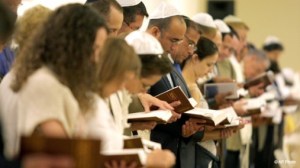
I grew up in the rural South, where there was not a whole lot of diversity.  Though I knew about the Jewish faith, I did not really know any practicing Jewish people growing up.  It wasn’t until adulthood that I became friends with a practicing Jewish person.  She took me to her synagogue, made me latkes, and talked to me about her experience of faith.  When I got to seminary, the study of Hebrew broke open that world even further, and suddenly I found myself exposed to my Jewish heritage as a Christian.  But nothing really prepared me for my experience here in Plainview, NY, which has a moderately large Jewish population.  I may have learned Hebrew and studied about Jewish people, but I had yet to live among a modestly large Jewish population.  When I first went to the interfaith clergy group, I found that the fellow Christians and I were in the minority among eight other rabbis and cantors.  I quickly realized how little I knew, and kept having to ask questions.  The rabbis and cantors have been ever patient and helpful.

Our parish is located right next door to one of the larger synagogues in Plainview.  On the high holy days, the synagogue uses our parking lot, and the lot is flooded with cars.  In the past couple of years, I have enjoyed watching the people of faith flock to the temple, as they honor their holy days.  As a person who loves Holy Week, I love to see another faith tradition alive with honoring their holy days.

Courtesy of http://mthollywood.blogspot.com/2012/09/rosh-hashanah-jewish-new-year.html

Courtesy of http://mthollywood.blogspot.com/2012/09/rosh-hashanah-jewish-new-year.html

But this year, since my oldest child is now in public school, I realized that the schools are closed for Rosh Hashanah.  If I am being honest, my first thought was not about honor and respect.  My first thought was the dread of having to secure childcare while I kept working.  But as the faithful came in and out of our parking lot that day, and as my kindergartener asked all sorts of questions, I began to see things from a different perspective.  I structure much of my life around the church calendar – Christmas, Lent, Easter.  My vacation plans and workload are all connected to these holy days.  I realize only now how strange my honoring of those days might be to non-Christians, who also have to work out childcare and the disruption of what is just another day in December or the spring.

This week, I am grateful to my Jewish brothers and sisters for reminding me of how self-centered I can be, and for pushing me out of my comfort zone.  My guess is that my faith-keeping is not just unusual to them, but may be unusual to all un-churched persons.  Even my southern United Methodist mother finds all our Episcopal rituals and observances a little over the top.  I note this because I think we can all become caught up in our own “normal” and forget the ways that our normal can seem strange or be downright alienating.  My hope is that this observation makes us all a little more self-aware, a bit more intentional about how we share our Christmas and Easter joy when the time comes, and a lot more attuned to the ways that we can make our own faith traditions accessible, inspiring, and intriguing to our neighbors outside our walls.

Redefining home…

19 Friday Sep 2014

Posted by jandrewsweckerly in Uncategorized

≈ Leave a comment

Tags

church, comfort, community, construction, home, Jesus, joy, outside, renovation, welcome, world

Courtesy of Dan McGee, St. Margaret's Parishioner

Courtesy of Dan McGee, St. Margaret’s Parishioner

This past Sunday we rededicated our Undercroft.  The Undercroft has been under construction since November 2013, and includes two Sunday School Rooms, our Parish Hall, two bathrooms, and the kitchen.  All rooms were completely renovated with the exception of the kitchen, which only received new flooring.  During construction, our Coffee Hours were moved to the Narthex; a tight space, but one that sufficed – and certainly brought us closer, literally and figuratively.  Many of our normal fellowship activities were either moved off campus or were cancelled altogether.  Our support groups had to move to our Library, which meant meetings on those nights also had to go off campus.

As I looked around the room during our rededication celebration, two things occurred to me.  One, I had really missed being in that space.  Many warm memories have been formed in that space, which all came flooding back.  But mostly, I missed the sound – the noise of people talking, laughing, sharing stories, and lingering a little longer over a meal.  Though we had shared in communion at the altar upstairs, the communion meal was continuing downstairs:  and it was a raucous meal – one I am sure Jesus would have approved.

Two, I found myself a little wary by the sense of deep comfort that was overwhelming me.  One of the nice things about being forced off campus was that we finally did what we had been hesitant to do – take the church out into the world.  Our committees were meeting at local dining establishments, our coffee hours spilled out into the lawn over the summer, and we got to know each other’s homes more intimately.  My fear is that in the comfort of being back “home” we will stop venturing out into the world, sharing our presence and ministry with others.

My hope is that we can do two things with our space.  First, my hope is that we can share that feeling of home with others by inviting more outside groups to utilize our space.  I would love for us to share our joy and warmth with others, so that this can become their home too.  Two, my hope is that we can keep taking church to the streets and to one another.  There is a way in which having meetings here month after month starts to stifle joy and creativity.  My hope is that our committees will agree to keep going off campus at least a few times a year to mix it up; but more importantly, to show the community that there is life and activity at St. Margaret’s.  And they are most welcome to join us!

Sermon – Matthew 18.15-20, P18, YA, September 7, 2014

11 Thursday Sep 2014

Posted by jandrewsweckerly in Uncategorized

≈ Leave a comment

Tags

avoid, church, conflict, conflict resolution, God, Jesus, present, reconciliation, Sermon

I have heard the argument many times before.  When people see conflict, poor behavior, and ugliness in the Church, the complaint is always the same.  People feel like they see enough ugliness in the world, at work, at school, or even at home.  When they come to Church they just want to be around people who love each other, who never fight, and who are always on their best, most loving, supportive behavior.  Many imagine that the Church should be a conflict-free zone of love and joy; full of those who love the Lord, love one another, and love every person who walks through those doors.  We want an escape from the world when we come to Church – not more of the same.

And so, in order to create this magical conflict-free Church, we start engaging in behaviors that avoid immediate conflict, but probably make things a lot worse.  Instead of dealing with conflict directly, when we feel wronged by someone, we just talk about them behind their back.  Or, when someone sins against us, instead of approaching the problem with the person, we just call a bunch of people in the church to complain about them.  Or if we are feeling wronged by someone, instead of talking to them one-on-one, we just send them a nasty email, copy the clergy, and, while we are at it, we CC the bishop.  Or if all else fails, when someone does us wrong, we don’t say anything:  we just avoid them; un-friend them on Facebook; and, if we cannot avoid them on Sundays, then we just leave the church altogether.[i]

Part of the reason we engage in these behaviors that usually make the conflict worse is because the alternative is downright scary.  We hear Jesus’ instruction manual for dealing with conflict in the church in Matthew’s gospel and we panic.  First of all, Jesus’ instructions force us to admit that we will have to deal with conflict within the Church.  This premise totally dismantles our dream of the loving, conflict-free Church.  And we are not sure we are ready to let go of that dream.  But secondly, if we can let go of our tight grasp on our conflict-free Church dream, we sure as heck do not want to follow Jesus’ instructions.  Going to someone directly to talk about how someone has sinned against us scares most of us to death.  We are not sure what to say and we are not sure how what we say will be received.  And if we somehow manage to get over our fears and the person rejects us, we cannot imagine taking one or two others with us to approach the offender again.  That sounds way too much like an intervention, and we worry that the number of people in the room will only escalate things.  And since we can barely imagine taking one or two other parishioners along with us, we find the idea of bringing the offence before the entire parish unfathomable.  Jesus must be out of his mind if he thinks we are going to parade our personal business in front of the whole church.

I served in a parish once that went through a major conflict.  A parishioner who had been working with the youth group had developed some serious boundary issues which came to a crisis point.  After receiving complaints from several parishioners, the rector called the person-in-question into his office.  That one-on-one meeting did not go so well.  Rumors started to fly, and the offender’s version of the conversation was quite different from the rector’s version.  Eventually, others had to be brought into the conversation.  The whole issue took about a year to resolve, and the offender was so angry that he eventually left the church and many other parishioners were hurt and frustrated along the way.

Part of the challenge is that using Jesus’ model for conflict resolution is not as simple as the model sounds.  Meeting one-on-one can go horribly wrong, as the meeting with my old rector went wrong.  And having a meeting with three or four people can also go horribly wrong – the offender can feel attacked, confidentiality can be difficult to keep, and rumors can start to spread.  And sharing an individual offense with the entire parish is difficult in our litigious society.  Charges of slander and libel are much too easy to file.

The good news is that I do not think the specifics of Jesus’ conflict resolution plan really matter – at least not in the strictest sense.[ii]  What is more important is that this passage from Matthew does several critical things.  First, this passage debunks the notion that the Church will ever be conflict-free.  That this passage exists at all is evidence that conflict is a natural, unavoidable part of life, even life in the church.[iii]  I know that may sound like bad news to some of us, but actually the reality that conflict is unavoidable opens the door to the second good part of this passage.  In addition to helping us see the inevitability of conflict, this passage also reminds us that there are healthy ways to deal with conflict.  Though we may not choose Jesus’ exact method, there are ways to encourage reconciliation over back-stabbing and gossip.  And those reconciling methods are healthy for the offender, the victim, and the community as a whole.  Jesus is not worried about “whether or not we fight, disagree, or wound one another, but how we go about addressing and resolving those issues.”[iv]

Finally, Jesus reminds us that God is with us even in our ugly moments of conflict.  Jesus says, “For where two or three are gathered in my name, I am there among them.”  We often jokingly quote this passage when we are having low church attendance.  But what Jesus means when he says these words is that when two or three are gathered in resolving conflict, Jesus is there in their midst.  I cannot imagine a more assuring word from Jesus today.

I once knew a couple who were married for 55 years.  One day I asked the wife what their secret was.  She told me several things, but one of them stuck.  She said that if either of them was disciplining the children and the other parent disagreed with their decision, they never questioned the decision in front of the children.  Later that night, they might talk about their disagreement, but they always supported one another in the heat of the moment.  I remember thinking that their practice necessitated respect, biting one’s tongue, and a humble love that was free from pride.  All of that was not visible through the good stuff of their marriage, but instead through the hard stuff of their marriage.

Now I know some of you are going to go home disappointed today.  Your dream of Church being a conflict-free love fest is getting shattered today.  You may have been hoping after hearing Paul talk about love today that we could all just sing, “They Will Know We Are Christians by Our Love,” and walk out of here on a cloud.  Truthfully, having people see how we love each other and being able to recognize our Christian identity through our love is wonderful.  But equally wonderful today would be if we could sing, “They Will Know We Are Christians by How We Fight.”

In a few moments, we will do a few things that mark our Christian identity.  We will confess our sins, ask for healing, and pass the peace.  These are all steps toward reconciliation with God, with ourselves, and with one another.  Perhaps you have been experiencing conflict here in our church community, at home, or at work.  Now is your chance to reconcile that conflict, and live into what being a person of faith means.  There is no way to avoid the fact that Christians fight, disagree, and argue.  But how we fight means much more than that we fight.  The church invites us to be a people committed to reconciliation, knowing that where two or three are gathered in conflict together, Christ is in the midst of us.  Amen.

[i] Rick Morley, “Before You Unfriend – Matthew 18:15-20,” August 23, 2011, as found at http://www.rickmorley. com/ archives/803?utm_source=rss&utm_medium=rss&utm_campaign=proper18agospel on September 4, 2014.

[ii] Eric Barreto, “Commentary on Matthew 18:15-20,” as found at http://www.workingpreacher.org/preaching.aspx? commentary_id=2164 on September 5, 2014.

[iii] Jin S. Kim, “Pastoral Perspective,” Feasting on the Word, Year A, Vol. 4 (Louisville: Westminster John Knox Press, 2011), 46.

[iv] Kim, 46.

Sermon – Matthew 15.10-28, P15, YA, August 17, 2014

27 Wednesday Aug 2014

Posted by jandrewsweckerly in Uncategorized

≈ Leave a comment

Tags

Canaanite, change, church, hypocrite, Jesus, liberate, mercy, parents, Sermon, transformation

We have all either heard or said the words ourselves, “Do as I say, not as I do.”  Maybe your dad said the words when you overheard him using an inappropriate word.  Maybe your mom said the words when you caught her being impatient with someone.  Maybe you said the words when your own child caught you having a late night treat that you said was off limits to everyone.  Do as I say, not as I do.  The phrase is our universal way of admitting that even though we know the right things to do, we do not always do them.  In essence, we are failures.  In this simple phrase we hear echoes of Paul’s words to the Romans, “For I do not do the good I want, but the evil I do not want is what I do.”[i]  But the phrase, “Do as I say, not as I do,” is a little bit more than simply admitting failure.  The simple phrase is also a phrase full of frustration, exasperation, and impatience – a rueful admitting of defeat, a hint of embarrassment at one’s failure and hypocrisy, and a petulant insistence that your words be heeded anyway.

What is harder than hearing a parent utter these words is hearing Jesus utter words like this today.  The beginning of our gospel lesson is a long passage in which Jesus explains how misguided the Pharisees have become.  They are so caught up in worrying about rituals that the Pharisees have not noticed that what is coming out of their mouths is much more offensive than what is going in their mouths.  Instead of worrying about the legalities of cleaning rituals, Jesus is instead insisting that they need to worry about how their words are defiling them more than their unclean hands are defiling them.

So after this long diatribe about how the Pharisees are essentially being hypocrites what does Jesus do?  He gets caught being a hypocrite himself.  He has just given the disciples a lecture about worrying about the words coming out of their mouths when Jesus turns around and basically does the exact same thing.  A poor Canaanite woman comes to Jesus, shouting for mercy for her demon-possessed daughter.  Normally the gracious healer, Jesus totally ignores the woman.  Then, when the disciples beg Jesus to send her away, Jesus makes some snide remark about how he is only here on earth to help the Israelites, not some lowly Canaanite.  When the woman throws herself at Jesus feet, Jesus then says the unthinkable – something so awful that even we are embarrassed.  Jesus says to the woman, “It is not fair to take the children’s food and throw it to the dogs.”  Even to modern ears, Jesus’ words sting.  We like the kind, generous, caring version of Jesus – not this version of Jesus who calls people dogs and refuses to help them.  But even worse is what happens next.  The Canaanite woman calls Jesus to task.  “Yet even the dogs eat the crumbs that fall from their masters’ table.”

We have all been there.  We have all been mid-stream in doing what we thought was the right thing, living our lives the best way we know how when someone – a child, a friend, or even a stranger – has called us out and made us see the ugliness in our words and actions.  I have been caught several times by my daughter.  We have a practice of praying before our meals at home, trying to teach our daughter some easy prayers.  One night we were out with friends who I knew were not church-goers.  When the meal came, we all began to eat.  But my daughter, rather loudly asked, “Why aren’t we saying the blessing, Mommy?”  I tried to quickly and quietly shush her, but I am sure whatever stammering I did only made things worse – both for my daughter and our friends.

Most of us are pretty hesitant to talk to people about church, especially why they do not go to church.  We are hesitant because at some point in our lives we have had pointed out to us how the church is full of a bunch of hypocrites.  And, honestly, few of us have a response to that accusation because we know we do not live the lives we aspire to live.  Even Mahatma Gandhi is rumored to have said, “I like your Christ.  I do not like your Christians.  Your Christians are so unlike your Christ.”[ii]  The sting of that quote or conversations that involve similar accusations usually make us steer clear of even bringing up church with our non-church friends.  Or when we try to address their valid concerns, we end up stammering into some explanation that basically ends up sounding like, “Do as I say, not as I do.”

The problem with these encounters is that none of us likes to admit is that though we go to church, and though we pray to God, and though we raise our children in the faith, we still do not really have this whole faith thing all figured out.  We are still unsure about some things, we do not always understand why we do what we do, and most of us are not confident enough in Holy Scripture to feel like we could hold our own in a debate.  Though many of us have had powerful experiences with God, most of us still feel like failures in being good Christians.  In fact, if you ask most adults in church, the two things they dislike the most are teaching Sunday School and evangelizing.  The reason we dislike those two things is because we are afraid – afraid of being asked a question we cannot answer or afraid of being exposed as the hypocrites we fear that we really are.

The good news is that we are not alone.  Even Jesus, the same Jesus that Gandhi praises, has been in our shoes.  When the Canaanite woman comes back at Jesus with her sharp accusation about even dogs getting crumbs, Jesus has a choice.  He can pull the classic parental line, “Do as I say, not as I do.”  Surely he is exasperated by the Canaanite woman and all the disciples constantly pushing him and asking questions.  A simple, “Do as I say, not as I do,” and then a stomping away in the other direction would not be unforgiveable.  Or Jesus can take a moment, check his pride at the door, and admit he is wrong.  And that is exactly what Jesus does.  “Woman, great is your faith!” Jesus says, and heals her daughter.  Jesus finally hears the Canaanite woman and admits he is wrong.  He could have easily stood his ground, stuck to his mission to the Israelites, and followed tradition.  But instead, Jesus chooses mercy over pride.  Jesus chooses to admit he is wrong over saving his reputation.  Jesus chooses change over tradition.  As ugly, embarrassing, and unappealing as Jesus seems earlier in this story, Jesus’ willingness to change his mind, change his behavior, and change his entire mission makes him much more appealing, inviting, and energizing.[iii]

Though hard to listen to, Jesus’ transformation in this story is an invitation to us to be open to such transformation in our own lives.  There is something wonderfully freeing about Jesus’ simple transformation.  All Jesus basically does is say, “You know what, I was wrong.”  Instead of stammering through some awkward response to my daughter about why we were not praying with the non-church-going friends, I could have just said, “You know what, you’re right.  Let’s say a prayer.”  That simple giving of thanks probably would have been way less awkward, hypocritical, and confusing than just thanking God out loud.  Or when someone accuses us or our church of being hypocrites, we could just say, “You know what, you’re right.”  Once we confess our sinful natures and then explain why church still holds some meaning for us, maybe we could open the door to a more honest, vulnerable conversation about the good stuff of our church.

The invitation today from Jesus is simple.  Be open to the fact that we are all going to mess up this whole faith thing.  We are all going to preach one thing and do another.  And instead of saying a hurried, “Do as I say, not as I do,” we can all start a different conversation.  Instead we can all try to say, “You know what, you are right.  I am sorry.  Thank you for giving me the opportunity to make a change.”  My guess is that the freedom your confession brings will not only liberate you, but liberate others as well.  Amen.

[i] Romans 7.19.

[ii] I say that this quote is rumored to be from Gandhi because I could not find a source for the quote.  There seems to be debate about whether Gandhi actually said these words, this quote is legend, or this is a combination of comments he made.

[iii] David Lose, “Pentecost 10A: What the Canaanite Woman Teaches,” as found at http://www.davidlose.net/2014/ 08/ pentecost-10a/ on August 14, 2014.

Love and marriage…

06 Wednesday Aug 2014

Posted by jandrewsweckerly in Uncategorized

≈ 1 Comment

Tags

anniversary, church, community, God, love, marriage, sacred, secular, vows

Courtesy of http://www.carbonfiberweddingbands.org/wedding-bands/

Courtesy of http://www.carbonfiberweddingbands.org/wedding-bands/

This week my husband and I celebrated thirteen years of marriage.  A few friends asked me what romantic plans we had, and I found I had to do some explaining.  You see, twelve years ago, on our first wedding anniversary, we found ourselves at an impromptu family reunion.  At the time, we reasoned that we would just celebrate our anniversary some other time.  But a few days later, as we talked about the reunion, we realized something.  Our wedding was a celebration not only of our love and commitment and the covenant we were entering into, but also a celebration of the community who was vowing to hold us to our covenant – to support us, love us, and encourage us in the good and bad times.  In that light, it seemed completely appropriate that we would celebrate our anniversary in the same fashion as we celebrated our wedding – surrounded by the community that holds us accountable to our vows.

Ever since the first anniversary, we have made a point of celebrating our special day with others.  Sometimes the gathering has been large; sometimes quite small.  Sometimes we have celebrated with family, and sometimes we have celebrated with friends.  We have celebrated our anniversary with people who did not even know us when we got married, and we have celebrated with people who knew us before we knew each other.  Each year, the celebration reminds us of the blessing of friends and family in our lives and how we could not grow and thrive in marriage with the support of a lot of others.

What I like about the tradition we have developed is that the tradition pushes against secular expectations.  Secular expectations tell us that we should have a dreamy, romantic night with expensive gifts exchanged (don’t get me wrong – I am all for date nights and presents!).  Secular expectations would tell us that marriage is private.  But that is not what the Church tells us.  Sacred expectations are that marriage is blessed within the context of a community.  Sacred expectations are that the community should ask how marriages are going – not just to gossip or vent, but to continue to live into the vow that the entire community takes to help marriages thrive.

So today, I ask for your prayers: prayers that my husband and I might continue to find joy in one another, might continue to find love and support in our marriage, and might glorify God in our life together.  In return, I lift up prayers today for all my friends who are married:  those who are in those first years of wedded bliss, those who are struggling with all sorts of marital challenges, and those who are just treading water.  I also lift up prayers for those who long to be married, but have not found a partner; for those who have lost their spouses to death; for those who are divorced; and for those who long to be married legally but still live in places where that is not an option.  We are all the community of faith, and we all need one another.  I thank God for all of you today!

← Older posts
Newer posts →

Recent Posts

  • On Politics, Football, and Love…
  • On Sharing the Love…
  • Sermon – Micah 6.1-8, Matthew 5.1-12, EP4, YA, January 30, 2026
  • On Justice, Kindness, Humility, and the Messy Middle…
  • Feast of the Rev. Dr. Martin Luther King, Jr., January 18, 2026

Archives

  • February 2026
  • January 2026
  • December 2025
  • November 2025
  • October 2025
  • September 2025
  • August 2025
  • July 2025
  • June 2025
  • March 2025
  • February 2025
  • December 2024
  • November 2024
  • October 2024
  • September 2024
  • August 2024
  • July 2024
  • June 2024
  • May 2024
  • March 2024
  • February 2024
  • January 2024
  • December 2023
  • November 2023
  • October 2023
  • September 2023
  • August 2023
  • July 2023
  • June 2023
  • May 2023
  • March 2023
  • February 2023
  • January 2023
  • December 2022
  • November 2022
  • October 2022
  • June 2022
  • May 2022
  • January 2022
  • December 2021
  • November 2021
  • October 2021
  • September 2021
  • August 2021
  • June 2021
  • May 2021
  • April 2021
  • March 2021
  • February 2021
  • January 2021
  • December 2020
  • November 2020
  • October 2020
  • September 2020
  • August 2020
  • July 2020
  • June 2020
  • May 2020
  • April 2020
  • March 2020
  • February 2020
  • January 2020
  • December 2019
  • November 2019
  • October 2019
  • September 2019
  • August 2019
  • July 2019
  • June 2019
  • May 2019
  • April 2019
  • March 2019
  • February 2019
  • January 2019
  • December 2018
  • November 2018
  • October 2018
  • September 2018
  • August 2018
  • July 2018
  • June 2018
  • May 2018
  • April 2018
  • March 2018
  • February 2018
  • January 2018
  • December 2017
  • November 2017
  • October 2017
  • September 2017
  • August 2017
  • July 2017
  • June 2017
  • May 2017
  • April 2017
  • March 2017
  • February 2017
  • January 2017
  • December 2016
  • November 2016
  • October 2016
  • September 2016
  • August 2016
  • July 2016
  • June 2016
  • May 2016
  • April 2016
  • March 2016
  • February 2016
  • January 2016
  • December 2015
  • November 2015
  • October 2015
  • September 2015
  • August 2015
  • July 2015
  • June 2015
  • May 2015
  • April 2015
  • March 2015
  • February 2015
  • January 2015
  • December 2014
  • November 2014
  • October 2014
  • September 2014
  • August 2014
  • July 2014
  • June 2014
  • April 2014
  • March 2014
  • February 2014
  • January 2014
  • December 2013
  • November 2013
  • October 2013
  • September 2013
  • August 2013
  • July 2013
  • June 2013
  • May 2013
  • April 2013
  • March 2013
  • February 2013
  • January 2013
  • December 2012
  • November 2012
  • October 2012
  • September 2012

Categories

  • reflection
  • Sermons
  • Uncategorized

Meta

  • Create account
  • Log in
  • Entries feed
  • Comments feed
  • WordPress.com

Blog at WordPress.com.

  • Subscribe Subscribed
    • Seeking and Serving
    • Join 395 other subscribers
    • Already have a WordPress.com account? Log in now.
    • Seeking and Serving
    • Subscribe Subscribed
    • Sign up
    • Log in
    • Report this content
    • View site in Reader
    • Manage subscriptions
    • Collapse this bar
 

Loading Comments...