• About

Seeking and Serving

~ seek and serve Christ in all persons

Seeking and Serving

Tag Archives: church

Redefining home…

19 Friday Sep 2014

Posted by jandrewsweckerly in Uncategorized

≈ Leave a comment

Tags

church, comfort, community, construction, home, Jesus, joy, outside, renovation, welcome, world

Courtesy of Dan McGee, St. Margaret's Parishioner

Courtesy of Dan McGee, St. Margaret’s Parishioner

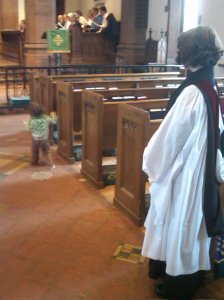
This past Sunday we rededicated our Undercroft.  The Undercroft has been under construction since November 2013, and includes two Sunday School Rooms, our Parish Hall, two bathrooms, and the kitchen.  All rooms were completely renovated with the exception of the kitchen, which only received new flooring.  During construction, our Coffee Hours were moved to the Narthex; a tight space, but one that sufficed – and certainly brought us closer, literally and figuratively.  Many of our normal fellowship activities were either moved off campus or were cancelled altogether.  Our support groups had to move to our Library, which meant meetings on those nights also had to go off campus.

As I looked around the room during our rededication celebration, two things occurred to me.  One, I had really missed being in that space.  Many warm memories have been formed in that space, which all came flooding back.  But mostly, I missed the sound – the noise of people talking, laughing, sharing stories, and lingering a little longer over a meal.  Though we had shared in communion at the altar upstairs, the communion meal was continuing downstairs:  and it was a raucous meal – one I am sure Jesus would have approved.

Two, I found myself a little wary by the sense of deep comfort that was overwhelming me.  One of the nice things about being forced off campus was that we finally did what we had been hesitant to do – take the church out into the world.  Our committees were meeting at local dining establishments, our coffee hours spilled out into the lawn over the summer, and we got to know each other’s homes more intimately.  My fear is that in the comfort of being back “home” we will stop venturing out into the world, sharing our presence and ministry with others.

My hope is that we can do two things with our space.  First, my hope is that we can share that feeling of home with others by inviting more outside groups to utilize our space.  I would love for us to share our joy and warmth with others, so that this can become their home too.  Two, my hope is that we can keep taking church to the streets and to one another.  There is a way in which having meetings here month after month starts to stifle joy and creativity.  My hope is that our committees will agree to keep going off campus at least a few times a year to mix it up; but more importantly, to show the community that there is life and activity at St. Margaret’s.  And they are most welcome to join us!

Sermon – Matthew 18.15-20, P18, YA, September 7, 2014

11 Thursday Sep 2014

Posted by jandrewsweckerly in Uncategorized

≈ Leave a comment

Tags

avoid, church, conflict, conflict resolution, God, Jesus, present, reconciliation, Sermon

I have heard the argument many times before.  When people see conflict, poor behavior, and ugliness in the Church, the complaint is always the same.  People feel like they see enough ugliness in the world, at work, at school, or even at home.  When they come to Church they just want to be around people who love each other, who never fight, and who are always on their best, most loving, supportive behavior.  Many imagine that the Church should be a conflict-free zone of love and joy; full of those who love the Lord, love one another, and love every person who walks through those doors.  We want an escape from the world when we come to Church – not more of the same.

And so, in order to create this magical conflict-free Church, we start engaging in behaviors that avoid immediate conflict, but probably make things a lot worse.  Instead of dealing with conflict directly, when we feel wronged by someone, we just talk about them behind their back.  Or, when someone sins against us, instead of approaching the problem with the person, we just call a bunch of people in the church to complain about them.  Or if we are feeling wronged by someone, instead of talking to them one-on-one, we just send them a nasty email, copy the clergy, and, while we are at it, we CC the bishop.  Or if all else fails, when someone does us wrong, we don’t say anything:  we just avoid them; un-friend them on Facebook; and, if we cannot avoid them on Sundays, then we just leave the church altogether.[i]

Part of the reason we engage in these behaviors that usually make the conflict worse is because the alternative is downright scary.  We hear Jesus’ instruction manual for dealing with conflict in the church in Matthew’s gospel and we panic.  First of all, Jesus’ instructions force us to admit that we will have to deal with conflict within the Church.  This premise totally dismantles our dream of the loving, conflict-free Church.  And we are not sure we are ready to let go of that dream.  But secondly, if we can let go of our tight grasp on our conflict-free Church dream, we sure as heck do not want to follow Jesus’ instructions.  Going to someone directly to talk about how someone has sinned against us scares most of us to death.  We are not sure what to say and we are not sure how what we say will be received.  And if we somehow manage to get over our fears and the person rejects us, we cannot imagine taking one or two others with us to approach the offender again.  That sounds way too much like an intervention, and we worry that the number of people in the room will only escalate things.  And since we can barely imagine taking one or two other parishioners along with us, we find the idea of bringing the offence before the entire parish unfathomable.  Jesus must be out of his mind if he thinks we are going to parade our personal business in front of the whole church.

I served in a parish once that went through a major conflict.  A parishioner who had been working with the youth group had developed some serious boundary issues which came to a crisis point.  After receiving complaints from several parishioners, the rector called the person-in-question into his office.  That one-on-one meeting did not go so well.  Rumors started to fly, and the offender’s version of the conversation was quite different from the rector’s version.  Eventually, others had to be brought into the conversation.  The whole issue took about a year to resolve, and the offender was so angry that he eventually left the church and many other parishioners were hurt and frustrated along the way.

Part of the challenge is that using Jesus’ model for conflict resolution is not as simple as the model sounds.  Meeting one-on-one can go horribly wrong, as the meeting with my old rector went wrong.  And having a meeting with three or four people can also go horribly wrong – the offender can feel attacked, confidentiality can be difficult to keep, and rumors can start to spread.  And sharing an individual offense with the entire parish is difficult in our litigious society.  Charges of slander and libel are much too easy to file.

The good news is that I do not think the specifics of Jesus’ conflict resolution plan really matter – at least not in the strictest sense.[ii]  What is more important is that this passage from Matthew does several critical things.  First, this passage debunks the notion that the Church will ever be conflict-free.  That this passage exists at all is evidence that conflict is a natural, unavoidable part of life, even life in the church.[iii]  I know that may sound like bad news to some of us, but actually the reality that conflict is unavoidable opens the door to the second good part of this passage.  In addition to helping us see the inevitability of conflict, this passage also reminds us that there are healthy ways to deal with conflict.  Though we may not choose Jesus’ exact method, there are ways to encourage reconciliation over back-stabbing and gossip.  And those reconciling methods are healthy for the offender, the victim, and the community as a whole.  Jesus is not worried about “whether or not we fight, disagree, or wound one another, but how we go about addressing and resolving those issues.”[iv]

Finally, Jesus reminds us that God is with us even in our ugly moments of conflict.  Jesus says, “For where two or three are gathered in my name, I am there among them.”  We often jokingly quote this passage when we are having low church attendance.  But what Jesus means when he says these words is that when two or three are gathered in resolving conflict, Jesus is there in their midst.  I cannot imagine a more assuring word from Jesus today.

I once knew a couple who were married for 55 years.  One day I asked the wife what their secret was.  She told me several things, but one of them stuck.  She said that if either of them was disciplining the children and the other parent disagreed with their decision, they never questioned the decision in front of the children.  Later that night, they might talk about their disagreement, but they always supported one another in the heat of the moment.  I remember thinking that their practice necessitated respect, biting one’s tongue, and a humble love that was free from pride.  All of that was not visible through the good stuff of their marriage, but instead through the hard stuff of their marriage.

Now I know some of you are going to go home disappointed today.  Your dream of Church being a conflict-free love fest is getting shattered today.  You may have been hoping after hearing Paul talk about love today that we could all just sing, “They Will Know We Are Christians by Our Love,” and walk out of here on a cloud.  Truthfully, having people see how we love each other and being able to recognize our Christian identity through our love is wonderful.  But equally wonderful today would be if we could sing, “They Will Know We Are Christians by How We Fight.”

In a few moments, we will do a few things that mark our Christian identity.  We will confess our sins, ask for healing, and pass the peace.  These are all steps toward reconciliation with God, with ourselves, and with one another.  Perhaps you have been experiencing conflict here in our church community, at home, or at work.  Now is your chance to reconcile that conflict, and live into what being a person of faith means.  There is no way to avoid the fact that Christians fight, disagree, and argue.  But how we fight means much more than that we fight.  The church invites us to be a people committed to reconciliation, knowing that where two or three are gathered in conflict together, Christ is in the midst of us.  Amen.

[i] Rick Morley, “Before You Unfriend – Matthew 18:15-20,” August 23, 2011, as found at http://www.rickmorley. com/ archives/803?utm_source=rss&utm_medium=rss&utm_campaign=proper18agospel on September 4, 2014.

[ii] Eric Barreto, “Commentary on Matthew 18:15-20,” as found at http://www.workingpreacher.org/preaching.aspx? commentary_id=2164 on September 5, 2014.

[iii] Jin S. Kim, “Pastoral Perspective,” Feasting on the Word, Year A, Vol. 4 (Louisville: Westminster John Knox Press, 2011), 46.

[iv] Kim, 46.

Sermon – Matthew 15.10-28, P15, YA, August 17, 2014

27 Wednesday Aug 2014

Posted by jandrewsweckerly in Uncategorized

≈ Leave a comment

Tags

Canaanite, change, church, hypocrite, Jesus, liberate, mercy, parents, Sermon, transformation

We have all either heard or said the words ourselves, “Do as I say, not as I do.”  Maybe your dad said the words when you overheard him using an inappropriate word.  Maybe your mom said the words when you caught her being impatient with someone.  Maybe you said the words when your own child caught you having a late night treat that you said was off limits to everyone.  Do as I say, not as I do.  The phrase is our universal way of admitting that even though we know the right things to do, we do not always do them.  In essence, we are failures.  In this simple phrase we hear echoes of Paul’s words to the Romans, “For I do not do the good I want, but the evil I do not want is what I do.”[i]  But the phrase, “Do as I say, not as I do,” is a little bit more than simply admitting failure.  The simple phrase is also a phrase full of frustration, exasperation, and impatience – a rueful admitting of defeat, a hint of embarrassment at one’s failure and hypocrisy, and a petulant insistence that your words be heeded anyway.

What is harder than hearing a parent utter these words is hearing Jesus utter words like this today.  The beginning of our gospel lesson is a long passage in which Jesus explains how misguided the Pharisees have become.  They are so caught up in worrying about rituals that the Pharisees have not noticed that what is coming out of their mouths is much more offensive than what is going in their mouths.  Instead of worrying about the legalities of cleaning rituals, Jesus is instead insisting that they need to worry about how their words are defiling them more than their unclean hands are defiling them.

So after this long diatribe about how the Pharisees are essentially being hypocrites what does Jesus do?  He gets caught being a hypocrite himself.  He has just given the disciples a lecture about worrying about the words coming out of their mouths when Jesus turns around and basically does the exact same thing.  A poor Canaanite woman comes to Jesus, shouting for mercy for her demon-possessed daughter.  Normally the gracious healer, Jesus totally ignores the woman.  Then, when the disciples beg Jesus to send her away, Jesus makes some snide remark about how he is only here on earth to help the Israelites, not some lowly Canaanite.  When the woman throws herself at Jesus feet, Jesus then says the unthinkable – something so awful that even we are embarrassed.  Jesus says to the woman, “It is not fair to take the children’s food and throw it to the dogs.”  Even to modern ears, Jesus’ words sting.  We like the kind, generous, caring version of Jesus – not this version of Jesus who calls people dogs and refuses to help them.  But even worse is what happens next.  The Canaanite woman calls Jesus to task.  “Yet even the dogs eat the crumbs that fall from their masters’ table.”

We have all been there.  We have all been mid-stream in doing what we thought was the right thing, living our lives the best way we know how when someone – a child, a friend, or even a stranger – has called us out and made us see the ugliness in our words and actions.  I have been caught several times by my daughter.  We have a practice of praying before our meals at home, trying to teach our daughter some easy prayers.  One night we were out with friends who I knew were not church-goers.  When the meal came, we all began to eat.  But my daughter, rather loudly asked, “Why aren’t we saying the blessing, Mommy?”  I tried to quickly and quietly shush her, but I am sure whatever stammering I did only made things worse – both for my daughter and our friends.

Most of us are pretty hesitant to talk to people about church, especially why they do not go to church.  We are hesitant because at some point in our lives we have had pointed out to us how the church is full of a bunch of hypocrites.  And, honestly, few of us have a response to that accusation because we know we do not live the lives we aspire to live.  Even Mahatma Gandhi is rumored to have said, “I like your Christ.  I do not like your Christians.  Your Christians are so unlike your Christ.”[ii]  The sting of that quote or conversations that involve similar accusations usually make us steer clear of even bringing up church with our non-church friends.  Or when we try to address their valid concerns, we end up stammering into some explanation that basically ends up sounding like, “Do as I say, not as I do.”

The problem with these encounters is that none of us likes to admit is that though we go to church, and though we pray to God, and though we raise our children in the faith, we still do not really have this whole faith thing all figured out.  We are still unsure about some things, we do not always understand why we do what we do, and most of us are not confident enough in Holy Scripture to feel like we could hold our own in a debate.  Though many of us have had powerful experiences with God, most of us still feel like failures in being good Christians.  In fact, if you ask most adults in church, the two things they dislike the most are teaching Sunday School and evangelizing.  The reason we dislike those two things is because we are afraid – afraid of being asked a question we cannot answer or afraid of being exposed as the hypocrites we fear that we really are.

The good news is that we are not alone.  Even Jesus, the same Jesus that Gandhi praises, has been in our shoes.  When the Canaanite woman comes back at Jesus with her sharp accusation about even dogs getting crumbs, Jesus has a choice.  He can pull the classic parental line, “Do as I say, not as I do.”  Surely he is exasperated by the Canaanite woman and all the disciples constantly pushing him and asking questions.  A simple, “Do as I say, not as I do,” and then a stomping away in the other direction would not be unforgiveable.  Or Jesus can take a moment, check his pride at the door, and admit he is wrong.  And that is exactly what Jesus does.  “Woman, great is your faith!” Jesus says, and heals her daughter.  Jesus finally hears the Canaanite woman and admits he is wrong.  He could have easily stood his ground, stuck to his mission to the Israelites, and followed tradition.  But instead, Jesus chooses mercy over pride.  Jesus chooses to admit he is wrong over saving his reputation.  Jesus chooses change over tradition.  As ugly, embarrassing, and unappealing as Jesus seems earlier in this story, Jesus’ willingness to change his mind, change his behavior, and change his entire mission makes him much more appealing, inviting, and energizing.[iii]

Though hard to listen to, Jesus’ transformation in this story is an invitation to us to be open to such transformation in our own lives.  There is something wonderfully freeing about Jesus’ simple transformation.  All Jesus basically does is say, “You know what, I was wrong.”  Instead of stammering through some awkward response to my daughter about why we were not praying with the non-church-going friends, I could have just said, “You know what, you’re right.  Let’s say a prayer.”  That simple giving of thanks probably would have been way less awkward, hypocritical, and confusing than just thanking God out loud.  Or when someone accuses us or our church of being hypocrites, we could just say, “You know what, you’re right.”  Once we confess our sinful natures and then explain why church still holds some meaning for us, maybe we could open the door to a more honest, vulnerable conversation about the good stuff of our church.

The invitation today from Jesus is simple.  Be open to the fact that we are all going to mess up this whole faith thing.  We are all going to preach one thing and do another.  And instead of saying a hurried, “Do as I say, not as I do,” we can all start a different conversation.  Instead we can all try to say, “You know what, you are right.  I am sorry.  Thank you for giving me the opportunity to make a change.”  My guess is that the freedom your confession brings will not only liberate you, but liberate others as well.  Amen.

[i] Romans 7.19.

[ii] I say that this quote is rumored to be from Gandhi because I could not find a source for the quote.  There seems to be debate about whether Gandhi actually said these words, this quote is legend, or this is a combination of comments he made.

[iii] David Lose, “Pentecost 10A: What the Canaanite Woman Teaches,” as found at http://www.davidlose.net/2014/ 08/ pentecost-10a/ on August 14, 2014.

Love and marriage…

06 Wednesday Aug 2014

Posted by jandrewsweckerly in Uncategorized

≈ 1 Comment

Tags

anniversary, church, community, God, love, marriage, sacred, secular, vows

Courtesy of http://www.carbonfiberweddingbands.org/wedding-bands/

Courtesy of http://www.carbonfiberweddingbands.org/wedding-bands/

This week my husband and I celebrated thirteen years of marriage.  A few friends asked me what romantic plans we had, and I found I had to do some explaining.  You see, twelve years ago, on our first wedding anniversary, we found ourselves at an impromptu family reunion.  At the time, we reasoned that we would just celebrate our anniversary some other time.  But a few days later, as we talked about the reunion, we realized something.  Our wedding was a celebration not only of our love and commitment and the covenant we were entering into, but also a celebration of the community who was vowing to hold us to our covenant – to support us, love us, and encourage us in the good and bad times.  In that light, it seemed completely appropriate that we would celebrate our anniversary in the same fashion as we celebrated our wedding – surrounded by the community that holds us accountable to our vows.

Ever since the first anniversary, we have made a point of celebrating our special day with others.  Sometimes the gathering has been large; sometimes quite small.  Sometimes we have celebrated with family, and sometimes we have celebrated with friends.  We have celebrated our anniversary with people who did not even know us when we got married, and we have celebrated with people who knew us before we knew each other.  Each year, the celebration reminds us of the blessing of friends and family in our lives and how we could not grow and thrive in marriage with the support of a lot of others.

What I like about the tradition we have developed is that the tradition pushes against secular expectations.  Secular expectations tell us that we should have a dreamy, romantic night with expensive gifts exchanged (don’t get me wrong – I am all for date nights and presents!).  Secular expectations would tell us that marriage is private.  But that is not what the Church tells us.  Sacred expectations are that marriage is blessed within the context of a community.  Sacred expectations are that the community should ask how marriages are going – not just to gossip or vent, but to continue to live into the vow that the entire community takes to help marriages thrive.

So today, I ask for your prayers: prayers that my husband and I might continue to find joy in one another, might continue to find love and support in our marriage, and might glorify God in our life together.  In return, I lift up prayers today for all my friends who are married:  those who are in those first years of wedded bliss, those who are struggling with all sorts of marital challenges, and those who are just treading water.  I also lift up prayers for those who long to be married, but have not found a partner; for those who have lost their spouses to death; for those who are divorced; and for those who long to be married legally but still live in places where that is not an option.  We are all the community of faith, and we all need one another.  I thank God for all of you today!

Homily – Jeremiah 1.4-10, William White, July 17, 2014

23 Wednesday Jul 2014

Posted by jandrewsweckerly in Uncategorized

≈ Leave a comment

Tags

affirmation, bishop, bold, call, challenge, church, Episcopal, God, Jeremiah, William White

Today we honor William White, first bishop of Pennsylvania.  Born in 1747 in Philadelphia, White went to England to be ordained as a deacon and then priest.  He served at churches in Pennsylvania and was also the chaplain of the Continental Congress and U.S. Senate.  When elected bishop, he had to travel back to England; he and Samuel Provost were consecrated in 1787.  Bishop White was the chief architect of the Constitution of the Episcopal Church and served as Presiding Bishop at the first General Convention.  In addition to mentoring many church greats, Bishop White steered the American Church through its first decades of independent life – a hearty task given the Episcopal Church’s ties to England after the Revolution.

I have often wondered how those early church formers experienced their call.  The transition from the Church of England to the Episcopal Church must have been scary.  We often talk about the church reinventing itself today, but the church in the U.S. in the late 1700s really had to reinvent its whole identity.  I imagine many thought the church would die or at least flee from the United States.  To have been so bold as to totally reinvent the structure of the church took vision, courage and faith.

Bishop White could have easily told God what Jeremiah did in our Old Testament lesson today.  Jeremiah says, “Ah, Lord God!  Truly I do not know how to speak, for I am only a boy.”  Bishop White was only forty years old when he became Bishop – one could argue he was only a boy, too.  But when God calls people to ministries, God does so with gusto.  God tells Jeremiah, “… you shall go tell to whom I send you, and you shall speak whatever I command you.”  God’s instructions are firm and a bit scary.  But God also affirms Jeremiah: “I am with you to deliver you,” says the LORD.

Bishop White must have heard God’s affirmation in order to do all that he did.  But God’s challenge and comfort is not just for prophets and leaders.  God’s challenge and comfort is for each of us, too.  Though we may not have such grandiose calls, God still has a call on each person here.  Our reminder today is that God does challenge us to go where God sends, but God also comforts us with the assurance that God is with us and delivers us.  Amen.

Where everybody knows your name…

16 Wednesday Jul 2014

Posted by jandrewsweckerly in Uncategorized

≈ Leave a comment

Tags

church, community, God, known, love, welcome

Anyone who has spent much time around our family knows that we are regulars at a particular wholesale warehouse chain.  Though you might not think a family of four needs to buy goods in bulk, there are actually quite a few things we regularly purchase to stock our home.  Almost every Monday I make my way to said store for our weekly needs.  That kind of regularity means that you get to know the staff – those who greet you, those who serve samples, and those who check your receipt on the way out.  My oldest daughter has her favorites, and we always greet them by name.  My regularity in shopping also meant that the employees were able to track my pregnancy and are now enjoying greeting our newest addition.

Of course, most of this I do not regularly notice unless I have a guest with me.  This past weekend a friend was visiting and she, the baby, and I went to our favorite store.  My friend was witness to our odd familiarity.  A staff person who gives out samples warmly greeted me, “Oh, you had the baby!  How exciting!  And you look great!”  One employee was on break and not in her usual spot, so we talked about her station and her shift for the day.  Another employee asked as we were checking out, “Where’s your oldest today?”  My friend and I later joked about how I was like a celebrity at the store – or how maybe I should be the store chaplain.

The funny thing is that I am not sure anyone at the store knows that I am a priest.  I usually shop on my days off, so I rarely, if ever, have shopped in my collar.  Part of me is happy to have a place where I am not Jennifer the priest.  I am able to be just the regular with the engaging kids.  But part of me wishes I were known as Jennifer the priest.  Though I joked about being the store chaplain, there is a part of me that really would love to be known as a pastoral resource for the everyday people we have come to know at our favorite store.

Courtesy of http://fontsinuse.com/uses/5067/cheers-logo-and-opening-titles

Courtesy of http://fontsinuse.com/uses/5067/cheers-logo-and-opening-titles

I have been thinking about that realization this week, and I have come to a few conclusions.  One, I realized this store is sort of like that bar in the TV Show Cheers – a place where everybody knows your name.  There is something to being known and feeling welcome that is quite comforting.  In fact, when we first relocated to Long Island, this store was one of the first ones I sought out because the store is the same no matter where you go.  I enjoyed that familiarity.  Two, though familiarity is nice, it is not the same as having people who really know you – not just the outside stuff, but all of your story:  the trials you have faced, the joys you have celebrated, and challenges you have conquered.  And three, there is only so much one can expect from an hour each week – especially when there is so much going on:  product to reshelf, samples to push, receipts to check.

What struck me is that what I am looking for at this store is what many of us are looking for when we come to church.  Yes, we want to seek and serve Christ in all persons and we want an experience with God, but we also want a community that makes us feel welcome and where we can be known and loved.  We want a place where people are glad we came, and who are willing to pull up a chair (or bar stool) and talk about real life.  And just like with church, there will only be so much we can do with one hour on a Sunday.  If we are in and out, enjoying the busyness of worship without engaging in anything else, we will find true fulfillment difficult.  What I am still unsure about is whether “church” has to take place in a building with a steeple, or whether we can make “church” happen elsewhere – even in the line for samples.

Homily – Deuteronomy 10.17–21, Matthew 5.43–48, Independence Day, July 3, 2014

09 Wednesday Jul 2014

Posted by jandrewsweckerly in Uncategorized

≈ Leave a comment

Tags

church, enemy, Fourth of July, God, homily, Independence Day, love, owe, politics, power, state

Anticipating the Fourth of July, today we celebrate our Independence Day.  What you may not know is that July 4th is actually a feast day in the Episcopal Church.  The psalms, lessons, and prayer were first appointed for this national observance in the Proposed Prayer Book of 1786.  But at the General Convention of 1789, they were deleted.  Bishop William White pushed for the deletion because he thought it was inappropriate, since the majority of the clergy had been loyal to the Crown.  Bishop White wanted the church to be honest about who the church was, had been, and could be.  Not until the 1928 Prayer Book did the liturgical observance return.

Now I am going to do something today I almost never do – talk politics.  I get very wary when motions of church and state blend.  The idea of honoring our Independence Day in the context of church makes me nervous.  I get nervous because I often find that instead of honoring the Fourth for the freedoms we have, our nationalism becomes about pushing agendas – liberal or conservative ones, and we seem to honor superior power over the blessing of freedom from opposition.

All we have to do is look at our texts today and see how we forget.  Our texts do not talk about superiority or dominance.  The texts talk about loving enemies (like the British over 240 years ago, or any modern “enemy” today).  The texts talk about caring for the orphan and widow, loving strangers, and providing food and clothing to the needy.  If we want to honor our founding fathers, we must strive to, as our collect says, “maintain our liberties in righteousness and peace.”

One of my favorite comedians, Stephen Colbert, once said this: “If this is going to be a Christian nation that doesn’t help the poor, either we have to pretend that Jesus was just as selfish as we are, or we’ve got to acknowledge that He commanded us to love the poor and serve the needy without condition and then admit that we just don’t want to do it.”  I know his words have some satirical sting, depending on your politics, but as we celebrate our independence and our faith fathers and national founders, perhaps the Fourth can become not about what we won, but what we owe – to the poor, the needy, the stranger … and to ourselves and our God.  Amen.


A child of God…

02 Wednesday Jul 2014

Posted by jandrewsweckerly in Uncategorized

≈ 1 Comment

Tags

children, church, family, God, parent, priest

I am a regular advocate for children in Church.  I think the practice shapes children at a young age and enlivens worship for the community.  Though distracting to some, the noise of children makes me feel like the church is alive and joyful.  That is why I always encourage parents with young children, because I know from experience that the noises of your own child sound ten times louder than they do to anyone else.  I also know that wrangling little ones can be frustrating some days and other days down-right impossible.  Many a parent has expressed to me that they are glad the sermons are posted online, since they often do not hear it when their little ones are particularly active.  I encourage parents to persevere and even make sure that Sunday School does not bleed into worship time so that our children can be present as gifts to the rest of the congregation.

But every once in a while, my own daughter reminds me how my principles do not always coincide with the realities of experience.  This past Sunday, as we were serving communion, my daughter managed to sneak away from her dad, and kneeled next to another parishioner.  When I reverently offered her the host, she abruptly grabbed it from my hand and shoved it enthusiastically into her mouth.  As her parent, my immediate reaction was to be a little embarrassed and to wonder what the other parishioners must think of my parenting skills.  Despite a couple of chuckles, I squashed my embarrassment, and moved on to the next person at the rail.  Later that morning, during the final hymn, my daughter joined me in the aisle as I sang and waited to deliver the morning’s announcements.  As the hymn was wrapping up, she dropped my hand and started shaking her hips in the center aisle, dancing to the hymn with reckless abandon.  Again, my initial instinct was to fret over what parishioners might think about the kind of dancing I was teaching at home.

Later, as I was thinking about the two incidents, several things came to me.  One, I was once again reminded how hard it is to manage children in the context of formal worship.  I am so grateful to the parents who do it every week and who allow us to be blessed by their children.  Two, I realized how hyper aware I am of my role within the church and how that role has some serious implications for my family.  In my ordination vows, the bishop asked me, “Will you do your best to pattern your life and the life of your family in accordance with the teachings of Christ, so that you may be a wholesome example to your people?”  Sometimes, I think that question makes priests and their families feel like they have to be perfect – including in the pew on Sundays.  But what I realized was that my daughter was not shattering our “perfect” image.  She was inviting me to let go of pretenses and be real with our parish.  Being a parent, in fact being a human, is messy, and I do not need to pretend that I somehow have a better hold on being “not messy” simply because I am a priest.

Finally, what I realized on Sunday is that being a “wholesome example” means loving my child in the way that I love all our children at church.  When I could step back from the fact that my child was greedily grabbing Eucharist and dancing a little “inappropriately” in church, I could see the incidents totally differently.  When I could see my child as a child of God, I could see someone who was demonstrating how eager we all should be to receive Christ’s body at the table:  how our longing for Jesus sometimes is downright greedy and aggressive, and grabbing for the bread is a physical way of showing a passionate longing for Christ.  When I could see my child as a child of God, I could see someone who was moved by the Holy Spirit to joyfully dance before the Lord, not unlike David so many years before[i]:  someone who was actually inspired by the music being sung and played, not just dutifully and dispassionately singing the words.  I thought about how her body is a gift from God and how wonderful it was that she was using her body to praise God, even if my uptight-self resisted it.

One of the greatest reasons having children among our midst in church is because they help us get out of ourselves and our need to keep up appearances, and they help us to see the holy in new, exciting, and fresh ways.  So, please keep bringing those little ones.  We all need them to show us the face of Christ.  And for our parents, occasionally they might remind you how they are children of God as much as they are your children as well.

[i] 2 Samuel 6.16

The power of smell…

25 Wednesday Jun 2014

Posted by jandrewsweckerly in Uncategorized

≈ Leave a comment

Tags

church, God, holy, memory, power, scent, smell

Courtesy of http://cyndi-rose.com/2013/05/03/focus-on-what-is-right-not-on-what-is-wrong/

Courtesy of http://cyndi-rose.com/2013/05/03/focus-on-what-is-right-not-on-what-is-wrong/

Last week I was taking a walk for a bit of exercise on my day off.  I was trucking along when all of a sudden a fragrance hit me – the smell of honeysuckle.  I stuttered to a stop just so I could inhale the scent a little longer.  Honeysuckle is one of those scents that takes me back to a happy place in my childhood.  You see, every June when I was growing up, my family would travel to the mountains of North Carolina for the Annual Conference of the United Methodist Western North Carolina Conference.  The conference lasted a few days at the end of the week, but our family would go up on the Monday before and make the week our annual vacation.  Lake Junaluska holds many fond memories for me – canoeing on the Lake, crafts at the childcare center, swimming in the pool, feeding ducks, and in general enjoying the beauty of the property.  All those memories are triggered by the smell of honeysuckle, whose blooming always coincided with Annual Conference, forever connecting the smell with the memories.

Smell has a powerful way of connecting us to memories.  The smell of your favorite food that your mom used to make, the cologne or perfume of your first crush, the scent of baby oil, the aroma of coffee, or the smell of a campfire:  all of these smells have the ability to halt time for us and take us back to a place of warm, fond memories.  The scents conjure up people or places that made us happy and shaped our lives.  Though we rarely hold those memories actively in our everyday lives, a simple scent can bring a smile to our faces as those memories bubble up in our minds.

One of the things that I love about Episcopal Church is the way that the Church engages all the senses:  the sight of the cross, the touch of hands passing the peace, the sound of psalms being chanted, or the taste of communion.  Of course, as someone formed in “high church” worship, incense is the smell I associate with church.  When I was in seminary, I served in a church that used a lot of incense – I could smell it in my hair when I came home, I could smell it in my vestments when I put them on before services, and I could even sometimes smell it when the church was empty and dark, the incense still lingering in the walls.  Anytime I smell incense now, it has a calming effect on me.  Without thinking, I take a deep breath, and somehow am transported to memories of my experience with the holy – at churches, at monasteries, on retreat.  I have considered several times getting a home incense kit for devotions, just to help me connect to those memories.

Though many churches shy away from incense, what I like about incense is that the smell plants in our memories experiences with the holy.  Much like the fond memories of childhood, fond memories of church can help shape us and give us grounding throughout life.  The next time you are in church, I invite you to consider what smells might help ground you throughout the week.  Maybe it is the scent of holy wine, maybe the smell of extinguished candles, or maybe even the smell of weathered pages in a BCP or hymnal.  Whatever the scent, allow its power to reconnect you with God and transport you to a place where you knew God loved you and cared for you beyond measure.

Sermon – Matthew 28.16-20, TS, YA, June 15, 2014

18 Wednesday Jun 2014

Posted by jandrewsweckerly in Uncategorized

≈ Leave a comment

Tags

church, community, disciples, God, heresy, Holy Spirit, Jesus, Trinity Sunday, triune

There have been many jokes around the Andrews-Weckerly household this week about why in the world I chose this Sunday, of all Sundays in the liturgical year, to return from maternity leave.  Trinity Sunday is sort of a dreaded Sunday for most preachers.  This is the Sunday that rectors give to seminarians, curates, and deacons because they feel overwhelmed by the prospect of preaching the doctrine of the Trinity in the pulpit – perhaps out of a fear of committing heresy or just out of a fear of producing a theologically correct, but pastorally unengaging sermon.  And trust me, the thought crossed my mind to let our beloved Deacon Anthony pinch hit today.

The truth is, we all struggle a bit with the Trinity, even if we do not realize that we struggle.  Think about your prayer life and whether you tend to favor one person of the Trinity in your petitions.  I know people who habitually pray to God, but somehow get tripped up on saying Jesus’ name in a prayer.  I know others who feel awkward praying to the Holy Spirit, not really sure what language to use.  Still, there are others who do not like the masculine images associated with God the Father, and so they are more likely to either pray to the Holy Spirit, or use feminine language for God.  And that is just our prayer life.  Have you ever tried explaining the Trinity to a four-year old?  Words like “coeternal” and “holy, undivided,” are difficult to explain to a kid who has learned the stories of the Bible, but does not quite know how to make sense of the fact that Jesus is both the Son of God and coeternal with God – or that the Holy Spirit descended upon Jesus like a dove, but is also the same God as God and Jesus.

Confused yet?  The good news is that you are not alone.  The Church took over a hundred years of debating to finally be able to articulate a coherent theology of the Trinity.  Theologians Arius and Athanasius debated long and hard over the persons of the Trinity, who they were, how they related to one another, and what the implications were for those theological conclusions.  Though we are quite used to the Creed we say every Sunday, and the use of the Trinity in blessings and other parts of the liturgy, those creeds and liturgies did not just develop overnight or without a great deal of arguing and prayerful consideration.

And yet, here we are today, celebrating Trinity Sunday and reading Jesus’ instruction to baptize in the name of the Father, and of the Son, and of the Holy Spirit.  Jesus’ instructions today are not just for the disciples – those instructions are for us too.  So how are we supposed to baptize in the name of the Father, Son, and Holy Ghost authentically if we do not even really understand or feel comfortable with the idea of the Trinity?  Does our lack of understanding matter?  The first answer is yes.  We do need a working understanding of the Trinity, because a fuller understanding of the breadth of God helps us to engage in fuller worship of and relationship with God.[i]  We cannot go out into the world without understanding that, “The same God who is God over us as God the Father and Creator, and God with and for us as the incarnate Word and Son, is also God in and among us as God the Holy Spirit.”[ii]  In fact, our God is so big, so strong, and so mighty that we take an entire Sunday, Trinity Sunday, to celebrate this awesome God who is relational, self-giving, and full of love.  So, yes, our lack of understanding about the Trinity matters.

But the gospel lesson today tells us something else too – our lack of understanding does not matter.  The lesson from Matthew begins, “The eleven disciples went to Galilee, to the mountain to which Jesus had directed them.  When they saw him, they worshiped him; but some doubted.”  This group of disciples – a group who is already down to eleven – in their final encounter with Jesus still have some doubts.  Though they worship, they still struggle with questions, uncertainty, and confusion.  Jesus even has to tell them, “All authority in heaven and earth has been given to me,” because he wants them to understand who he is in relation to the God they know and love – a fact that they clearly still do not fully comprehend.  To this shrinking group of confused, doubting, questioning disciples Jesus declares, “I am with you always, to the end of the age.”  Jesus trusts them to go and to make disciples and to baptize and to teach, even if they do not fully understand this Trinity business.  Jesus’ affirmation of the disciples even in the midst of their doubt is an incredible affirmation for us today too.

So if our understanding of the Trinity both matters and does not matter, how do we live into this ambiguity?  How do we faithfully live as disciples in this tension?  Well, the disciples tell us that too.  We live into the tension in community.  While I was on maternity leave, I gained a new appreciation for the value of community.  I watched this community from afar as you took on new responsibilities in my absence, as you ministered to one another, and as you shared the Good News, even when you did not realize that you were.  As you baptized a baby, buried a matriarch, and worshiped outside in God’s creation.  As you visited the sick, prayed for the weary, and fed the hungry.  As you taught our children, learned from one another, and walked the streets of Plainview as members of this church.  You did all of those things probably with a sense of the triune God, but also probably with a healthy dose of doubt as you worshiped and worked.

Many of you have asked me whether I missed being away from church during maternity leave.  Though there were certainly things that I enjoyed taking a break from, I realized palpably how much I missed our community of faith during Holy Week.  As I watched each day of Holy Week passing, I felt a sense of deep longing and absence.  I had not realized how strongly I am marked by the ritual and presence of this community.  Even when I struggle to define the Trinity, I have a community of faith that always gathers and makes meaning in my life.  Being absent from the community during that time was almost like losing an arm or being a foreigner in a foreign land.

This day that we celebrate is certainly about the creator, redeemer, and sustainer God that we sort-of know.  This day is also a day that we celebrate the wonderful gift of a community of faith with which to worship and doubt together in a beautiful dance before our triune God.  If you have not taken a moment recently to fully appreciate the gift of this community, I invite you to do that today.  If you have been so busy with renovation projects, running a ministry, or just trying to get to church, take a moment today to appreciate the gift of this community.  Or if you are relatively new to this community, or just do not feel like you have found your own ministry in this place, I invite you to take that next step, and to find a way to connect more deeply to the life and ministry here at St. Margaret’s.  I think you will find a wonderful set of companions who do not have “it” all figured out, but who worship in the midst of their doubt – and who have a triune God who is with them always, to the end of the age.  Amen.

[i] Stephen B. Boyd, “Theological Perspective,” Feasting on the Word, Yr. A., Vol. 3 (Louisville: Westminster John Knox Press, 2011), 46.

[ii] Steven P. Eason, “Pastoral Perspective,” Feasting on the Word, Yr. A., Vol. 3 (Louisville: Westminster John Knox Press, 2011), 46.

← Older posts
Newer posts →

Recent Posts

  • On Redefining Community…
  • On Parenting, Milestones, and Community…
  • Sermon – Acts 2.42-47, E4, YA, April 26, 2026
  • On Seasons of Discernment…
  • Sermon – Luke 24.13-35, E3, YA, April 19, 2026

Archives

  • May 2026
  • April 2026
  • February 2026
  • January 2026
  • December 2025
  • November 2025
  • October 2025
  • September 2025
  • August 2025
  • July 2025
  • June 2025
  • March 2025
  • February 2025
  • December 2024
  • November 2024
  • October 2024
  • September 2024
  • August 2024
  • July 2024
  • June 2024
  • May 2024
  • March 2024
  • February 2024
  • January 2024
  • December 2023
  • November 2023
  • October 2023
  • September 2023
  • August 2023
  • July 2023
  • June 2023
  • May 2023
  • March 2023
  • February 2023
  • January 2023
  • December 2022
  • November 2022
  • October 2022
  • June 2022
  • May 2022
  • January 2022
  • December 2021
  • November 2021
  • October 2021
  • September 2021
  • August 2021
  • June 2021
  • May 2021
  • April 2021
  • March 2021
  • February 2021
  • January 2021
  • December 2020
  • November 2020
  • October 2020
  • September 2020
  • August 2020
  • July 2020
  • June 2020
  • May 2020
  • April 2020
  • March 2020
  • February 2020
  • January 2020
  • December 2019
  • November 2019
  • October 2019
  • September 2019
  • August 2019
  • July 2019
  • June 2019
  • May 2019
  • April 2019
  • March 2019
  • February 2019
  • January 2019
  • December 2018
  • November 2018
  • October 2018
  • September 2018
  • August 2018
  • July 2018
  • June 2018
  • May 2018
  • April 2018
  • March 2018
  • February 2018
  • January 2018
  • December 2017
  • November 2017
  • October 2017
  • September 2017
  • August 2017
  • July 2017
  • June 2017
  • May 2017
  • April 2017
  • March 2017
  • February 2017
  • January 2017
  • December 2016
  • November 2016
  • October 2016
  • September 2016
  • August 2016
  • July 2016
  • June 2016
  • May 2016
  • April 2016
  • March 2016
  • February 2016
  • January 2016
  • December 2015
  • November 2015
  • October 2015
  • September 2015
  • August 2015
  • July 2015
  • June 2015
  • May 2015
  • April 2015
  • March 2015
  • February 2015
  • January 2015
  • December 2014
  • November 2014
  • October 2014
  • September 2014
  • August 2014
  • July 2014
  • June 2014
  • April 2014
  • March 2014
  • February 2014
  • January 2014
  • December 2013
  • November 2013
  • October 2013
  • September 2013
  • August 2013
  • July 2013
  • June 2013
  • May 2013
  • April 2013
  • March 2013
  • February 2013
  • January 2013
  • December 2012
  • November 2012
  • October 2012
  • September 2012

Categories

  • reflection
  • Sermons
  • Uncategorized

Meta

  • Create account
  • Log in
  • Entries feed
  • Comments feed
  • WordPress.com

Blog at WordPress.com.

  • Subscribe Subscribed
    • Seeking and Serving
    • Join 391 other subscribers
    • Already have a WordPress.com account? Log in now.
    • Seeking and Serving
    • Subscribe Subscribed
    • Sign up
    • Log in
    • Report this content
    • View site in Reader
    • Manage subscriptions
    • Collapse this bar

Loading Comments...