• About

Seeking and Serving

~ seek and serve Christ in all persons

Seeking and Serving

Tag Archives: church

Sermon – John 1.43-51, E2, YB, January 18, 2015

21 Wednesday Jan 2015

Posted by jandrewsweckerly in Uncategorized

≈ Leave a comment

Tags

church, come and see, disciple, evangelism, favorite, God, invite, Jesus, Nathanael, passion, Philip, Sermon, share, testimony

I have lots of friends who swear that Wicked is their favorite musical.  They know all the songs, they have seen the show multiple times, and they reference lines from the characters.  The cult around the musical feels just like that – a cult.  When I confessed that I had not ever seen the show, my friends were aghast.  “You HAVE to see the show!” they would exclaim.  To be honest, they were so passionate about Wicked that I had almost decided that there was no way the show could be that good – surely I would be underwhelmed.  But finally, after much cajoling, I went to see the show with some friends.  And all of a sudden, I got it:  the witty humor, the creative back story, the emotional narrative, and the moving music.  I could not stop thinking and talking about the show for weeks.

Though we have all had encounters with people who are passionate about something – the latest show, a newly released movie, or a favorite restaurant – I imagine that few of us are as passionate about church.  We just do not have the same fervor about church as we do about other passions in our life.  Somehow, being publicly passionate about those other things seems more socially acceptable than being publicly passionate about church.  Our initial concerns are usually about social stigma.  We do not want to become that person that people avoid because we are always babbling on about church.  Our fear may also be about what to say.  How do we explain to others what draws us to this place and makes us spend a good portion of our time here?  Or maybe we have lost some of our passion about church.  Perhaps we come to church out of habit or some longing, but we are not so jazzed about church that we are rushing around, telling friends and strangers alike, “You have to come and see my church.  It is awesome!”

Though we may not be running around like excited new Christians, the disciples of Jesus did in the early days.  In our gospel lesson today, we are told that when Philip meets Jesus and begins following him, he finds Nathanael and says, “We have found him about whom Moses in the law and also the prophets wrote, Jesus son of Joseph from Nazareth.”  And when Nathanael scoffs, “Can anything good come out of Nazareth?” Philip is undeterred.  Philip excitedly insists, “Come and see.”  You can almost imagine Philip’s big grin and irresistible enthusiasm.  “Come and see,” he says.  This is his simple invitation.  Come and see.  The words are warm and inviting.  The words are gentle and hospitable.  The words, “Come and see,” are not some forceful demand or even a judgmental threat.[i]  There is no, “or else,” at the end of Philip’s invitation.  His invitation is light and easy:  Come and see.

That is our greatest fear when we talk about evangelism.  Because we have such a meaningful relationship with God and the church, we do not want to be associated with Christians who judge and condemn.  We would never be that Christian on a street corner telling people that they are going to hell unless they repent.  In fact, those are the very people who sometimes make us paranoid to even admit our faith in public.  Or maybe we have friends or family who were hurt by the church, and although we still feel drawn to the church, we want to respect their pain.  I have lost count of the number of my own friends and family who have had those negative experiences:  divorcees who felt judged or downright excluded when they wished to be remarried, women who wanted to be priests but felt that sense of call when the church did not affirm the ordination of women, or lesbian and gay friends who just did not feel welcome or treated as equals in the church.  The list is extensive and even if our church experience is not like that, we fear being associated with “those Christians.”

The challenge for us is that we get so caught up in the “what ifs” of sharing our faith that we forget the really wonderful things about our faith.  Philip reminds us today of the simple joy of our faith and our relationship with Christ.  Take a moment to think about your favorite thing about the life we share in this faith community.[ii]  I do not want you to worry about some elaborate theological explanation of your faith.  I just want you to think about your favorite thing about your experience here at St. Margaret’s.  Maybe your favorite thing is the community, and the warm welcome and inclusion you have felt here.  Maybe your favorite thing is the way that the worship experience connects you to God or opens up new truth for you.  Maybe your favorite thing is the way church is like an oasis, a place where you can breathe in the midst of the chaos of life, and find some sense of peace.  Or maybe your favorite thing is something else altogether.  But think about that favorite thing that keeps you coming back here week after week.

Now, imagine sharing that favorite thing with someone else, and inviting them to come and see for themselves.  Before you panic, I want to reassure you.  I am not asking you to go to someone and persuade them to become a Christian.  I am not even asking you to “prove” the truth of the Christian faith.[iii]  I am simply inviting you to invite someone you know to come and see that aspect of our congregational life that you enjoy.  When we have talked about evangelism before, many of you have told me about how you do not really have any friends you can invite to church.  Actually our excuses are numerous (and yes, I say “our” because I have the same excuses too).  We may worry that our friends live too far away, or maybe they already have a church community, or maybe you just do not like to mix your friends community with your church community.  Many of you have turned to me and either said, “Well, isn’t it the priest’s job to grow the church,” or “That is what our website is for.”  And the answer to those things is yes.  Yes, the rector plays some role in people’s attraction to a church and certainly many seekers find us through our website.  But the number one way that people come to a church is by personal invitation.  Every study I have read says that the number one way to attract people to your parish is through personal invitation.

The good news is that the personal invitation is not as scary as the invitation sounds.  Just look at Philip.  When Nathanael scoffs and says, “Can anything good come out of Nazareth?” Philip could have had any number of responses.  As one person argues, “Philip could have given Nathanael some of his own opinions.  He could have said, ‘This Jesus knows a lot about the Bible.’  Or he might have said, ‘There is something about this man Jesus that draws me to him.’  Even when Nathanael expressed skepticism about ‘anything good coming out of Nazareth,’ Philip might have listed some successful people from Nazareth.”[iv]  But Philip does none of that.  His offer is warm, simple, and gracious.  Come and see.

The beauty of our gospel lesson is that Philip’s testimony to Nathaniel is not that impressive.  His testimony would not win any academic awards or even impress most people.  But his invitation does get Nathanael to in fact, come and see.[v]  And that is what our gospel is inviting us to do today too.  Not to come up with some master plan or some convincing argument.  But to think about the one thing that draws you to this place, and then simply share that one thing with someone else.  Your closing argument will then be easy.  Come and see.  I cannot imagine a better gift that you can give to those you know than to let them see the one thing that gives you life, gives you joy, and gives you passion; and then to invite them to come and see.  Amen.

[i] David Lose, “Epiphany 2B:  Come and See,” January 12, 2015 found at http://www.davidlose.net/2015/01/epiphany-2-b/.

[ii] Lose.

[iii] Michael Rogness, “Commentary on John 1.43-51,” as found at http://www.workingpreacher.org/preaching.aspx?commentary_id=2314 on January 14, 2015.

[iv] Rogness.

[v] Ted A. Smith, “Homiletical Perspective,” Feasting on the Word, Yr. B, Vol. 1 (Louisville: Westminster John Knox Press, 2008), 263.

Sermon – Luke 2.1-20, YB, CE, December 24, 2014

14 Wednesday Jan 2015

Posted by jandrewsweckerly in Uncategorized

≈ Leave a comment

Tags

change, Christmas Eve, church, comfort, familiarity, God, Grinch, holy, Jesus, peace, Sermon, strength

Most of us have a favorite Christmas movie.  Whether we like “It’s a Wonderful Life,” “A Charlie Brown Christmas,” or “A Christmas Story,” many of us find that until we have watched that special movie, we do not feel like Christmas has really arrived.  My personal favorite is “How the Grinch Stole Christmas” – the animated one, not the newer one with Jim Carrey.  I love the cute little dog that the Grinch dresses up like a reindeer, I love the little girl who sweetly encounters the Grinch dressed as Santa, and I love the songs throughout the movie.  But my favorite part is when the Grinch hears the Whos singing on Christmas morning despite their supposedly ruined Christmases and how the Grinch’s heart is warmed and grows in size.  Part of what I love about the movie is the movie’s wonderful lesson about the true meaning of Christmas – that material goods and abundance do not make Christmas:  only love and community make Christmas.  But I think the real reason I love this movie is its familiarity.  I like that I can watch the movie every Christmas and the movie never changes.  I like that no matter what house I lived in growing up, or where I found myself as an adult, or even how happy or sad I was on a given Christmas, the familiarity of the movie made me feel like I had something to ground me.  When all else in my world was changing, the movie never changes.

I think that is why we find ourselves at Church on a Christmas Eve too.  Every year we find ourselves sitting in a pew hearing the same story of Mary, Joseph, shepherds, angels, and the baby Jesus.  The story is so familiar that we could probably recite the story if pressed.  Whether we are a child or an adult, at home or far away, with loved ones or alone, the story never changes.  That changelessness, that familiarity is something we eagerly anticipate every Christmas and in large part is why we come to Church this night.

Familiarity is something we all long for at Christmas.  When we have lived long enough, we come to know that despite the fact that we celebrate Christmas every year and we try to keep familiar traditions, our celebration is never the same.  Invariably someone has passed away and their absence changes our experience; a family member is not present because of a falling out in the past year; the grandchildren become too old to play silly games or make crafts and the mood is different; or any other number of things have changed – divorce, births, illness, job loss, or moves.  Even if you still gather with your family or a set of friends, change is inevitable at Christmas.  And because we all know how unsettling change can be, we long for something that is unchanging that we can cling to and with which we can ground ourselves.

This Advent we have talked a lot about how much turbulence and change has been happening in our world.  We have watched as the world has erupted in violence.  The atrocities, suffering, and fighting have been so vivid that many of us have stepped away from watching the news.  We have seen unrest in our own country, as issues of race, class, and gender have collided.  And in case any of us were tempted to believe that those issues of race, class, and gender are someone else’s issues, we have only to look at as far as Staten Island to know that we are not yet in a place of peace and justice.  The noise of unrest is so loud that there are times when instead of listening to the news we turn to music, sports, or any other escape we can think of to run from the reality of our world.

The funny thing is that though we turn to our gospel lesson for comfort and familiarity, the same noise that we find in our lives and in our world is present in our reading tonight too.  The very reason that Mary, Joseph, and Jesus end up in a stable is that the Roman Empire has been greedily looking for more ways to bring in money into the empire.  And so peoples are being displaced, making their way back to their hometowns so that the empire can determine whether they have collected enough money from the people.  The Pax Romana is bearing down upon the people, and this nobody couple from Bethlehem is just one more victim of the injustice of the system.[i]

Perhaps that background noise is part of why we love this story so much.  Despite the chaos of that night and of that time, good news comes – to shepherds, to angels, to Mary and Joseph.  We savor the familiar words of goodness that override the story:  “do not be afraid”; “good news of great joy”; “peace among those whom he favors.”  To displaced Mary and Joseph, to disenfranchised shepherds, and to distant little Bethlehem peace, joy, comfort, and hope explode on this very night.  We have learned from hearing Scripture Sunday after Sunday that Scripture can often be hard, challenging, and downright condemning.  We spend much time throughout the Church year struggling with where God is challenging us to live differently and beckoning us to live more Christ-like lives.  But not on this night.  On this night, we get assurance, comfort, and joy.  We get an innocent baby – in fact a baby that will change the world for good.  Like young parents ourselves, we can worry about money, health, and safety later – because on this night of Jesus’ birth, we just want to cling to the Christ Child and all that the child represents.

Now there are times in our lives when clinging to the familiar just for the sake of comfort is a bad thing.  Maybe you yourself have been criticized for living in the past, romanticizing what once was, especially at this time of year.  But this is one of those rare instances when the Church says that we have permission to live in the past and cling to the familiar.  That is because this familiar – this story of Jesus’ birth – is worthy of that kind of devotion.  We are not staking our claim on something superficially good when we come to Church this night – we are not clinging to a romanticized past that can never fulfill us.  We are clinging to an event that happened a long time ago, but whose significance changed things forever.  In this incarnate experience of God, the game changed for all time.  God became flesh and dwelled among us, and we are changed for the better.

So tonight, I invite you accept the gift of familiarity and comfort.  Let this night warm your heart and soul and cling to the familiar story and all that the story means for us.  Hold fast to that comfort, and return to these words whenever you need them.  We have 364 other days to worry about what is going on in the world.  In fact what happens here in Scripture tonight deeply impacts how we will respond to that world the rest of the year.  But that is for another day.  Tonight, take the gift of comfort, joy, and hope and let that gift fill you up and strengthen you for the work God has given you.  Use that gift as fuel, and then let God’s holy meal fill your belly so that you are strengthened for the work ahead.  May God’s peace and joy fill you up and overflow out of you to others.  And then be agents of peace through the Prince of Peace who comforts you tonight.  Amen.

[i] David Lose, “Something More,” December 18, 2011 as found at http://www.workingpreacher.org/craft.aspx?post=1612 on December 20, 2014.

Homily – Isaiah 25.6-9, Cemetery Memorial Service, December 20, 2014

14 Wednesday Jan 2015

Posted by jandrewsweckerly in Uncategorized

≈ Leave a comment

Tags

Christmas, church, God, grief, homily, imperfect, joy, sad

Our Cemetery Memorial Service has become one of my favorite services of the year.  That may sound a little strange to you, but what I like about this service is the service’s honesty.  This time of year, there is a lot of dishonesty floating around:  the notion that buying things can make you happy, the assumption that everyone has abundant food this time of year, and even the idea that there is such a thing as the perfect family, the perfect Christmas, or the perfect life.  We see glossy ads, hear songs about loving, joyful Christmases, and watch movies that package Christmas with a pretty bow.  Though most of us know in the depths of our hearts that there is no such thing as a perfect Christmas experience, no one wants to talk about that reality.  We prefer that everyone stay in their lane, and put on a happy face.  Perhaps we have even convinced ourselves that we can “fake it ‘til we make it.”  In other words, if we say we are happy and that everything is perfect at Christmas, perhaps we and Christmas will become so.

But instead of buying into the Christmas hype, the Church tells another story today.  Simply by gathering us together as mourners, the Church acknowledges the pain and sadness that is often right below the surface at this time of year.  While others are decking the halls, rocking around the Christmas Tree, and having a holly, jolly Christmas, the Church invites us in, and encourages us to acknowledge the other part of Christmas – the part that is hard, sad, or empty.  We make space for grief, for honoring a loved one, and for acknowledging a sense of absence.  I have especially been grateful for that gift this year.  About a month ago, our family lost a grandfather.  He had lived a full, long life, and we know that he is at peace with the Lord.  But his absence is more obvious in the small parts of life.  Upon flying out for the funeral, my husband realized this would be the first time his grandfather would not meet him at the airport.  As we have prepared for holiday treats, we realized that our annual box of chocolates would not be arriving from him this year.  As we send out Christmas cards, I realized I would need one less card this year.  And those are just the things related to our family.  St. Margaret’s also lost a long-time parishioner this month – one who had been a major presence in our ministry here, whose bed I sat next to as we said prayers in his last days.  In addition to the grief of his family, our entire community is mourning the hole that he left.  Add into that grief the grief felt all over the world from violence, war, and hunger, and we come here today with much to offer up to God.

Of course, that is what I bring into this place today.  And each of you has your own story:  of wives, fathers, and daughters lost; of patriarchs in your family and of children whose lives were ended too soon; of lives well-lived and of lives barely lived at all.  To each of us, the Church says today that our mourning and our sadness are okay.  The Church creates this window of time where we can stop, be still, and know that God is with us.  The Church acknowledges the imperfect nature of this holiday, and celebrates anyway.

That is why I love the words we heard from the prophet Isaiah today.  The text says, “On this mountain the LORD of hosts will make for all peoples a feast of rich food, a feast of well-aged wines, of rich food filled with marrow, of well-aged wines strained clear.  And he will destroy on this mountain the shroud that is cast over all peoples, the sheet that is spread over all nations; he will swallow up death forever.  Then the Lord GOD will wipe away the tears from all faces, and the disgrace of his people he will take away from all the earth, for the LORD has spoken.”  What is so inviting about the words from Isaiah today is that they put our experiences in perspective.  Yes, our Christmas meals may not be utter perfection.  But God is preparing a feast for us that is more perfect than anything we could ever prepare ourselves.  Any darkness we feel now will be swallowed up by God.  Any tears we shed will be wiped away by our Lord.  Any sadness we feel at the dinner table will be eclipsed by the pure and holy joy we will find at God’s feast of rich food and well-aged wines.  Our loved ones are already enjoying that feast ahead of us.  Our joy is that we too are promised the opportunity to join them at the heavenly banquet when our time comes.

So this Christmas, give yourself permission to experience Christmas imperfectly.  Give yourself permission to be both joyful and sad.  Give yourself permission to lean into God when you need the strength to carry on.  And know, that maybe, just maybe, if you allow yourself to focus on the much grander feast that is to come and that already is for our loved ones, maybe you will find smiling a little easier.  Maybe you will find moments of joy that shine light into the darkness.  Maybe you will even find the ability to let yourself laugh and sing and to celebrate this imperfect holiday.  That is my wish for each of you.  That the blessing of this night will create a small, steady flame that warms and encourages you in the days and weeks to come.  Amen.

Keeping Christ in Christmas…

19 Friday Dec 2014

Posted by jandrewsweckerly in Uncategorized

≈ Leave a comment

Tags

Christ, Christmas, church, encourage, guilt, Jesus, uplifting, witness

I live in an area of our country that has a lot of “Keep Christ in Christmas,” signs.  I think people post these signs for all sorts of reasons:  for fear that Christmas has become too secular and lost its focus on the birth of the Christ Child; out of resistance to Christmas becoming a consumerist holiday; as a defensive response to what feels like a mandate to be “politically correct,” (i.e. saying “Happy Holidays!” instead of “Merry Christmas!”).  Many of these arguments make sense to me.  I myself have a hard time explaining to my five-year old why Christmas is both the celebration of Jesus’ birth and the day Santa Claus comes.  I too feel lured in by the advertisements that want me to spend more money than I have in order to show my love and affection.  I too want to be fully Christian, not wanting to minimize my faith in order to honor others’ faith.  In fact, it was not until I moved to a community with a large Jewish population that I really had to think about whether my “Merry Christmas!” greeting was even appropriate.

But here is my issue:  when I see those (sometimes very large) signs posted all around town, they do not sound like a gentle reminder or encouragement to return to our Lord.  When I see them, I feel like someone is shouting at me, “Keep Christ in Christmas!!”  Those signs do not feel well-intended, encouraging, or uplifting.  They seem angry, defensive, and off-putting.  They make me feel like I am guilty and should be ashamed of something.  And if I, as a priest in the Church, feel criticized, judged, and reprimanded by the signs, imagine how someone feels who knows very little about the Church.

Courtesy of https://www.facebook.com/uCatholic/photos/pb.123119221038808.-2207520000.1418930355./1004120959605292/?type=3&theater

Courtesy of https://www.facebook.com/uCatholic/photos/pb.123119221038808.-2207520000.1418930355./1004120959605292/?type=3&theater

A meme has recently been floating around that helped me identify what it is that is so off-putting about the normal “Keep Christ in Christmas” sign.  The sign says, “Want to keep Christ in Christmas?  Feed the hungry, clothe the naked, forgive the guilty, welcome the unwanted, care for the ill, love your enemies.”  The quote comes from Steve Maraboli, and I think his words get at my struggle.  What I like about this quote is that it does not just describe how to reclaim a holiday.  This quote describes how to live as an authentic Christian, to live like Christ, in the midst of this holiday.  That is a much more powerful witness to me than simply insisting people keep Christ in Christmas.  Perhaps instead of saying “Keep Christ in Christmas,” our message could be, “Be Christ this Christmas.”  When we busy ourselves with being Christ to others it is a lot easier to remember the reason for the season – no fussing and finger-wagging necessary.

An Advent Rollercoaster…

11 Thursday Dec 2014

Posted by jandrewsweckerly in Uncategorized

≈ Leave a comment

Tags

Advent, Blue Christmas, Christmas, church, Gaudete Sunday, grief, joy

This Advent has been a both-and experience for me this year.  There have been some incredibly joyful moments:  watching my daughter’s excitement about picking a Christmas tree, reading devotionals from our Advent calendar and enjoying my daughter’s insightful comments, and anticipating some fun time with family over the holidays.  But there have also been some sobering moments:   grieving the loss of my husband’s grandfather, keeping vigil at the bedside of a longtime parishioner and then burying him this week, and listening to stories of neighboring families who are struggling to make ends meet and who are dreading the disappointment of their children when Christmas comes.  In some ways, the sobering moments have been hanging heavily for me.  That reality has felt normal because Advent is meant to be a quieter, penitential season of preparation.  But the lows have felt really low, and I have found myself longing for the highs – or at least some sense of joy.

Courtesy of http://www.newliturgicalmovement.org/2010/12/gaudete-sunday-exhibition-of-some-rose.html#.VIm-6dLF-Jo

Courtesy of http://www.newliturgicalmovement.org/2010/12/gaudete-sunday-exhibition-of-some-rose.html#.VIm-6dLF-Jo

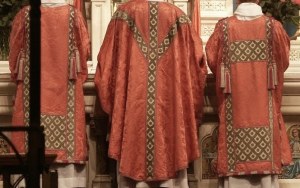
That is why I am looking forward to two upcoming events at St. Margaret’s.  First is the third Sunday of Advent.  This Sunday is known as “Gaudete Sunday.”  Basically, Gaudete Sunday is meant to offer a break from the penitential themes of Advent, instead emphasizing the joy of the coming of the Lord.  For a full explanation about the name and origin, look here.  This year, I am finding myself longing for Gaudete Sunday, needing more of the joyful moments like I mentioned above and less of the hard moments that keep coming my way.  I am grateful for the Church’s gift of respite to us of this Sunday.

Oddly enough, I am also looking forward to our Blue Christmas service coming up in a little over a week.  The service is meant to be for those who find Christmas to be a difficult or challenging time.  Given that I was just saying I wanted a little more joy, it may sound funny that I am looking forward to this service.  But the truth is, I am looking forward to sharing some of my Advent grief and sadness with others.  Being able to acknowledge those feelings in the context of worship and have them affirmed seems like a tremendous gift.

I suppose that is both the nature of Advent and life – times of highs and lows, joys and grief, eager anticipation and dread.  My hope is that if your Advent is taking on that both-and shape, you might lean on the Church to help you navigate that experience, and to find companions on the journey.  Come join us for a holy Advent.

Sermon – Isaiah 40.1-11, A2, YB, December 7, 2014

10 Wednesday Dec 2014

Posted by jandrewsweckerly in Uncategorized

≈ Leave a comment

Tags

Advent, care, Christmas, church, community, God, Isaiah, preparation, prepare, promise, Sermon, the Lord, work

This sermon was delivered on the occasion of our Annual Meeting. 

This time of year, I do a lot of preparing.  Though the setup takes a lot of work, I particularly love preparing our house for Christmas.  Unpacking and hanging all the ornaments is a tradition I shared with my family, and that I now can share with my girls.  I love telling my oldest daughter the stories behind certain ornaments and helping her decide where they should go.  I also put out our international crèche collection.  They remind me of travels I have made or friends from far away places.  Each inspires something different in me, reflecting the culture and artistry of different countries.  And of course, my daughter loves helping me hide away the baby Jesuses until Christmas day.  We even take down some artwork on our wall to make room for the cards which friends from far and wide send to us.  There is something homey and comforting about the whole process of preparing for Christmas, and I love the way that the preparation makes me feel grounded and joyful.

In our Old Testament lesson today, the text says, “prepare the way of the LORD.”  In this season of Advent, we are to prepare for the arrival of the Christ Child.  Now certainly, unpacking ornaments, advent wreaths, and crèches are one way to prepare.  But God is talking about a different kind of preparation today.  God is not talking about an outward change – like decorating our homes.  God is talking about an inward preparation – an inward change in anticipation of the LORD.  I am reminded of how one of our parishioners just recently prepared himself for the LORD.  Several weeks ago, one of our young parishioners decided to receive his first communion.  He prepared by reading about the Eucharist at home with his family, asking questions, and talking with them about their experiences.  He worked on memorizing the Lord’s Prayer, so that he might fully participate in the prayer life of our community.  And then he sat with me as we walked through the Eucharistic liturgy, talking about what each part means, why that part is significant, and what all those crazy things on the altar are called.  Finally, he chose someone to present him before the entire community, where he and we all declared that he was prepared to be in full communion with this community.  He waited and worked to prepare himself for the consumption of our LORD.  And now, each week that I have placed the body of Christ in his hand since then, I have felt a sweet, deeply abiding satisfaction when he reaches his hands toward me to receive Christ’s body.

The kind of preparation that our young parishioner did is a small taste of the kind of preparation God calls for in our Old Testament today.  Isaiah says that in order to prepare, we need to make straight in the desert a highway for our God, lift up every valley, make low every mountain and hill, level the uneven ground, and make plain the rough places.  This passage is so familiar to us, that many of us miss the magnitude of what God is saying.  When was the last time you tried to fill in a valley or level a mountain?  Of course, God is not telling us to literally take the winding roads of deserts and make them straight.  But in the metaphors, God is telling us that preparing for God is not easy work.  In fact, preparing for the LORD is a monumental task.  Preparing for the LORD is not like preparing our homes for Christmas, where we can make a basic checklist and slowly check the items off the list.  When given the hefty work of preparing ourselves inwardly for God, the task of leveling our valleys and mountains and smoothing out our rough places is much more difficult.

In some ways, I have watched St. Margaret’s do a lot of this interior work.  Over the course of the last year, our Vestry and Buildings and Grounds Committee have made level the mess that had become our Undercroft.  Though taking on an expensive project, they together worked to clean out harmful mold and mildew, solved a drainage problem to prevent that kind of damage again, and reimagined how that space could be utilized by us and our community.  Meanwhile, our educational offerings have been totally made low in this last year.  We revamped our Sunday School program after years of struggling to find the best way to raise our children in the faith.  We reworked our worship schedule so that adults could claim an hour in their busy lives to ponder their faith and make straight paths in the desert.  We have filled in the valleys by marching in parades, sponsoring baseball teams, eating pancakes at local diners, and inviting total strangers into our midst so that they might help us fill in those valleys.  Of course, anyone who knows St. Margaret’s also knows that you are only a stranger here for about one Sunday before our wonderfully welcoming community has made sure they know your whole life story before your coffee cup is empty.

All of those have been wonderfully positive things in our lives, but not easy work.  I cannot tell you the number of people who worried and fretted over our Undercroft expenses, complained about how long the work was taking, and questioned the wisdom of the work.  I cannot tell you the number of times I myself considered whether we should halt educational offerings altogether due to low turnout.  I cannot tell you how many times I needed each one of us to invite someone to church and instead heard someone say, “Oh, well isn’t that what our new website is for?”  We have been making progress toward straightening paths, filling in valleys, and leveling mountains.  But we have also gotten very dirty, been impatient and frustrated with each other, and sometimes have dropped our shovels altogether.  That is what happens when you do this kind of preparation for the LORD.  The work is not easy.  The work is monumental.  The work is, well, work.  And work is what God is inviting us into today.

The good news is that today’s text is one of those “both-and” texts.[i]  Yes, God is inviting us into some hard work today.  As we reflect on another year of service, at the mounds of dirt we have already moved, God is charging us to roll up our sleeves and keep digging.  And yes, God promises that the work of preparing will not be easy work.  But God also makes a promise while we are in the mire of making roads straight.  Our text today from Isaiah says, “He will feed his flock like a shepherd; he will gather the lambs in his arms, and carry them in his bosom, and gently lead the mother sheep.”  This last sentence has been lingering with me this week.  Maybe because I am a nursing mom, or maybe because this is the only time that scripture talks about the work of a mother sheep, but I find myself riveted by these words.

Just this week, I had one of “those” nights at our house.  I do not know whether she was teething or just had a rough day, but I lost count after the fifth time I woke up to my infant’s crying one night.  The next morning, I woke up bleary-eyed, almost falling asleep while eating my morning cereal, spilling my coffee on my computer, and generally having a rough time trying to focus.  That is the life of a mother with young children.  And I assume, the life of a mother sheep is not much easier – constantly using her body to protect and feed her lambs.  To that wearied mother sheep, God says that God will gently lead her.  In fact, not only that, God will gather up her lambs, embracing them in God’s bosom, and then God will gently lead the mother sheep.  I am reminded of the many times someone has scooped up my daughters when they were losing their cool.  I am reminded of the individuals who have forced me to go take a date night while they watched my kids.  I am reminded of the encouraging words and sympathetic nods I have received over these last five years.

That is the kind of care God promises us in the midst of our work.  God says, “Go out there and get dirty filling valleys, leveling mountains, and straitening roads.  And when you are weary from the work, I will scoop up your little ones, and gently lead you by my side.”  As I look forward to the coming year, I hear both a charge and a comfort for us today.  We all have more to learn, more people to serve, more spreading of the gospel to do.  But we also have a shepherd who tenderly encourages and comforts us – and then kicks us right back into the ring.  Thanks be to God!  Amen.

[i] George W. Stroup, “Theological Perspective,” Feasting on the Word, Yr. B, Vol. 1 (Louisville: Westminster John Knox Press, 2008), 28.

In the midst of life…

19 Wednesday Nov 2014

Posted by jandrewsweckerly in Uncategorized

≈ 3 Comments

Tags

birth, blessing, church, death, Diocese, God, joy, life

Courtesy of http://www.glogster.com/deathhangel/death-and-life/g-6l1p46td8m4d3uhesabrba0

Courtesy of http://www.glogster.com/deathhangel/death-and-life/g-6l1p46td8m4d3uhesabrba0

Maybe it is because today is my birthday or maybe it is because we just lost a dear family member to cancer, but life and death have been on my mind a lot lately.  The funny thing about being a priest is that those two things are almost always held in tension.  In the course of one week, I can hold the hand of a dying person and then bless a baby at the communion rail.  I can celebrate a funeral and baptize a child in the course of two days.  I can officiate a wedding and offer counsel to someone getting a divorce in a matter of weeks.  And so, with the death of our family member so fresh in my mind, I took a deep breath on the way to work today and thanked God for this wonderful life that I have been given.  Many days I grumble and complain about the little stuff of life – but today, both life and death are giving me perspective.

The same has been true about my work lately.  This past weekend, The Diocese of Long Island held its Annual Convention.  In the Bishop’s address, he told us about the many churches around the diocese that had closed or merged with other parishes.  Though he ran through the list relatively quickly, I knew all too well how painful each of those closures must have been.  I have been a part of churches that have had to close and it is a brutal process – it feels very much like the death of a loved one.

But just like in the death of a loved one, life slowly springs up.  The Bishop told us about a particular parish in Brooklyn that had to close due to “life-safety issues.”  Located near the Barclays Center, the sale of the property netted almost $20 million for the Diocese – all of which is being invested and distributed.  Some of the proceeds will go to support local churches and ministries while others will be used for international missions.  But out of that death is coming tremendous life.  Though we mourn with that community, through the death of that stage of their ministry they are birthing incredible new life.

And such is life – a continual cycle of life and death, suffering and blessing, mourning and celebrating.  Today, I turn toward celebration and life.  I can do that with deep joy because the sobering reality of death sets me free to appreciate every blessing of this life.  My cup runneth over – thanks be to God!

Finding our way through priorities…

05 Wednesday Nov 2014

Posted by jandrewsweckerly in Uncategorized

≈ Leave a comment

Tags

blessed, church, fair share, gift, God, pledge, resources, stewardship, walking the way

This year, St. Margaret’s has been Walking the Way through our Stewardship Season, praying on what giving means to us, why we give, and how our giving shapes our relationship with God and our church.  Below is a guest post from parishioner Kimberly Irvine on why she is pledging this year, and how the Holy Spirit is moving in her on her Walk.  I hope you enjoy her words.

Writing this blog post was not an easy exercise for me.  My desire to find the exact words to express to you why stewardship and pledging are vital to our church, was keeping from saying what is my heart.

The fact is I’m truly grateful to God for allowing me to be part of this community of faith.  St. Margaret’s has always been for me, a place filled with faith, joy, and love.  I believe in the good work our church is doing. I see God’s love at work in our church all the time.

Part of me is also worried because the church budget is projecting that in 2015 our church will be operating at a deficit again.  The funds our church raises through pledges, and other fund raising activities, will not generate enough revenue to cover the operating expenses of our church.  This surprises me because as a parish, I believe we are all very blessed, we are generous when asked to support special initiatives, and we share a common desire to be part of this extraordinary community.

Courtesy of http://imgarcade.com/1/christian-stewardship-clip-art/

Courtesy of http://imgarcade.com/1/christian-stewardship-clip-art/

Learning of the church’s deficit, also makes me begin to question whether or not I’m giving my fair share to our church.  God has given generously to me; am I giving back as generously as I should?  This is not an easy question to answer. We all worry about money.  We need to pay our mortgages, and other bills.  We also want to go on vacations and have nice things.  I’m remembering part of sermon we heard earlier this month, where we were reminded that all we have comes from God.  Everything we have is not ours; it is all God’s, and we must give back to God what is God’s.  Can we prioritize and give to God first?

Since I believe strongly in the mission and vision of our church, I feel responsible to use the resources God has given me to financially support the church.   I make a financial commitment to St. Margaret’s because I really want our church to thrive and grow.  I want to see the good work of our church continue to expand in our community and the world.  This year I plan to increase my pledge, and try to be more intentional about giving to God first.  I pray that all parishioners of St. Margaret’s can make similar commitments in support of our church.

We are united in faith; let’s also be united in contributing financially to our church.

I found this prayer from this year’s stewardship bulletin very meaningful:

Gracious God, giver of all we have and hold; grant the people of this church a deep and abiding awareness that all things come from you – our health, our incomes, our jobs, our talents and our generous impulse.  Send your Holy Spirit to help us as we swim against the rising tides of materialism, envy, individualism and greed I our culture. When we are tempted to think of money as a private matter, remind us that you have asked for part of what we are given, to be returned to you as a symbol of our awareness that you give all we have. And finally, assist us as we help each other to embrace the grace of giving, for you are the lover of our souls and call us to nothing less than transformation in Jesus Christ our Lord. Amen.

Respectfully submitted by Kim Irvine

Sermon – Matthew 22.15-22, P24, YA, October 19, 2014

23 Thursday Oct 2014

Posted by jandrewsweckerly in Uncategorized

≈ Leave a comment

Tags

belong, church, emperor, giving, God, Jesus, perspective, Sermon, state, stewardship, taxes

Today’s gospel lesson is one of those funny lessons in the Bible that is often quoted, but frequently misconstrued.  Jesus’ says, “Give therefore to the emperor the things that are the emperor’s, and to God the things that are God’s.”  As one scholar points out, “Some people point to this passage as proof that God and politics should be kept separate — that things like taxes have absolutely nothing to do with one’s theological commitments.  Others say that this story proves that religion is a matter of the heart, and that Jesus doesn’t really care about mundane things like what you do with your money.  And some have cited this passage as proof that Jesus taught that the law is the law, and our duty as Christians is to support the government no matter what.”[i]

All of these conclusions are based in modern assumptions, and ignore the context within which Jesus says these words.  Jesus is not laying out a treatise of how his followers are to navigate the tensions between church and state.  What Jesus is doing is navigating the various factions that would much rather have him eliminated than hear the real meaning of his words.  The Pharisees and the Herodians have little in common.  In fact, they are pretty much enemies, with the Herodians being dedicated to King Herod and the Pharisees being dedicated to Jewish Law – including being opposed to paying the tax to Caesar for religious reasons.  But despite these divided loyalties, the Pharisees and Herodians are united in their desire to remove Jesus from the scene.[ii]  And so they play this game, trying to trick Jesus into either angering the state or angering the faithful – either way cursing Jesus.  What they had forgotten is how clever and insightful Jesus can be.  And with this one response, “Give therefore to the emperor the things that are the emperor’s, and to God the things that are God’s,” Jesus answers a trick question much more broadly than the answer that either the Pharisees or the Herodians were hoping for.

Jesus is not really talking about the separation of church and state today.  He is not even really talking about taxes.  Jesus is talking about a new perspective on the whole of our lives – a way to think about money certainly, but also a way to put all things in perspective.  Now I do not know about you, but I am kind of a visual learner.  I need to see something in writing or have something in a chart or spreadsheet to really grasp a new idea.  So let’s take Jesus’ statement, “Give therefore to the emperor the things that are the emperor’s, and to God the things that are God’s,” and make a mental pie chart.  Are you ready?  First, let’s put our taxes pie piece in the chart.  What is that, like twenty percent, right?  So now we have a pie chart that leaves about eighty percent.  From that, let’s take our pledge out.  For ease of argument, let’s say you subscribe to giving a tithe, so we will take ten percent out.  That leaves us with seventy percent with which to play.  But Jesus says that the things that belong to God should be given to God.  If we have jobs or we go to school, our ability to do those things belongs to God.  So, we have to give that back to God.  That probably leaves us with about fifty percent in our pie chart.  Our good health is all owed to God as well, so now we are down to about forty percent.  Those friends and family that we hold so dear – those are also gifts from God.  Now we are down to about thirty percent.  And let’s not forget about food, shelter, and clothing.  We just dropped down to about fifteen percent.  Then there is the air we breathe, and God’s own creation upon which we rely.  Now we are down to about five percent.

Whew!  We have five percent of our “stuff” that belongs to us.  But wait – Jesus did not say, “Give therefore to the emperor the things that are the emperor’s, and to God the things that are God’s…and then keep the final five percent for yourselves.”  Surely Jesus knew we would need a night on the town, or a moment to just be self-absorbed, and not think about those suffering around the world.  But here is where the rub is in our lesson today.  The reason why the Pharisees and the Herodians leave Jesus amazed and go away is because they are shocked into silence.  If Jesus answers that the people should not pay the tax, the Herodians will be able to call him a seditionist.  If Jesus tells the people they should pay the tax, the Pharisees will be able to accuse him of not following the law of God because the use of the coin alone, which claimed Caesar’s divinity, was blasphemous.  Not to mention the fact that Caesar was oppressing the people.  If Jesus says they should pay the tax, surely the people of faith will turn on him.[iii]  But Jesus answers with “Give therefore to the emperor the things that are the emperor’s, and to God the things that are God’s.”

The reason Jesus is able to send the people away amazed is because Jesus point out one even trickier, harder truth – everything we have – our tax money, our tithe, our jobs, our health, our family and friends, our food, shelter and clothing, the very air we breathe – everything belongs to God.  What Jesus is really saying today is that our question – and yes, this is our question too, not just the question of the Pharisees and Herodians – our question today is laughable.  We can make all the pie charts and balance sheets we want.  The pie chart really only has one big piece – and that piece says, “God’s.”

This past week, my daughter and I were talking about the prayer rocks that we got from the Stewardship Committee last week.  If you have not received yours yet, there are some in the back.  The idea is that when you received your pledge card and stewardship packet, you would have a tool to help you prayerfully consider your pledge for the coming year.  The rock is meant to be your tactile way of praying about your pledge this year.  The other nice thing about the rock is that the rock is also a conversation piece.  That is how my daughter and I had a prayerful conversation this week.  We were comparing our rocks – both of ours says “love” on the rock, but hers is more oblong and black, while mine is rounder and grayer.  When my daughter asked me what we were supposed to do with our rocks, I told her that the rock was supposed to help us think about what we wanted to give to God this year.  I suggested she decide on a coin that she could take to church every Sunday.  Instead, my daughter told me she wanted to give a can of food every Sunday.  See, I wanted her to understand the connection of our money with God.  But perhaps my daughter understood the bigger statement of Jesus today – that everything, including the food on our shelves, belongs to God.  So we compromised, agreeing that she could do both.  Because she was right – our money, our food, our livelihood all belongs to God.  Our poor pledge coordinator is going to have to figure out how to calculate that pledge when we turn in our card on November 2nd.

I joke, but I think our pledge card this year might be some hybrid of our ideas.  The adults of our family will certainly be putting on a tithe.  The children in our family will have to calculate a dime or nickel times 52 weeks in the year.  And our cupboard will have to sacrifice 52 items as well.  Normally once a month or so, our family goes to Costco and gets a packet of something to put in our food drive.  But I like my daughter’s idea better – because my daughter’s idea reminds us that the food on our shelves – our food, not food bought for others – belongs to God.  And as Jesus reminds us today, we are to give to God the things that are God’s.  Amen.

[i] Lance Pape, “Commentary on Matthew 22:15-22, found at http://www.workingpreacher.org/preaching.aspx?commentary_id=2201 on October 15, 2014.

[ii] Marvin A. McMickle, “Homiletical Perspective,” Feasting on the Word, Year A, Vol. 4 (Louisville: Westminster John Knox Press, 2011), 191.

[iii] Susan Grove Eastman, “Exegetical Perspective, Feasting on the Word, Year A, Vol. 4 (Louisville: Westminster John Knox Press, 2011), 191, 193.  Other resources explain this duality as well.

Shaking up normal…

01 Wednesday Oct 2014

Posted by jandrewsweckerly in Uncategorized

≈ Leave a comment

Tags

Christian, church, faithful, holiday, holy days, Jewish, normal

I grew up in the rural South, where there was not a whole lot of diversity.  Though I knew about the Jewish faith, I did not really know any practicing Jewish people growing up.  It wasn’t until adulthood that I became friends with a practicing Jewish person.  She took me to her synagogue, made me latkes, and talked to me about her experience of faith.  When I got to seminary, the study of Hebrew broke open that world even further, and suddenly I found myself exposed to my Jewish heritage as a Christian.  But nothing really prepared me for my experience here in Plainview, NY, which has a moderately large Jewish population.  I may have learned Hebrew and studied about Jewish people, but I had yet to live among a modestly large Jewish population.  When I first went to the interfaith clergy group, I found that the fellow Christians and I were in the minority among eight other rabbis and cantors.  I quickly realized how little I knew, and kept having to ask questions.  The rabbis and cantors have been ever patient and helpful.

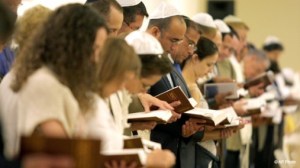
Our parish is located right next door to one of the larger synagogues in Plainview.  On the high holy days, the synagogue uses our parking lot, and the lot is flooded with cars.  In the past couple of years, I have enjoyed watching the people of faith flock to the temple, as they honor their holy days.  As a person who loves Holy Week, I love to see another faith tradition alive with honoring their holy days.

Courtesy of http://mthollywood.blogspot.com/2012/09/rosh-hashanah-jewish-new-year.html

Courtesy of http://mthollywood.blogspot.com/2012/09/rosh-hashanah-jewish-new-year.html

But this year, since my oldest child is now in public school, I realized that the schools are closed for Rosh Hashanah.  If I am being honest, my first thought was not about honor and respect.  My first thought was the dread of having to secure childcare while I kept working.  But as the faithful came in and out of our parking lot that day, and as my kindergartener asked all sorts of questions, I began to see things from a different perspective.  I structure much of my life around the church calendar – Christmas, Lent, Easter.  My vacation plans and workload are all connected to these holy days.  I realize only now how strange my honoring of those days might be to non-Christians, who also have to work out childcare and the disruption of what is just another day in December or the spring.

This week, I am grateful to my Jewish brothers and sisters for reminding me of how self-centered I can be, and for pushing me out of my comfort zone.  My guess is that my faith-keeping is not just unusual to them, but may be unusual to all un-churched persons.  Even my southern United Methodist mother finds all our Episcopal rituals and observances a little over the top.  I note this because I think we can all become caught up in our own “normal” and forget the ways that our normal can seem strange or be downright alienating.  My hope is that this observation makes us all a little more self-aware, a bit more intentional about how we share our Christmas and Easter joy when the time comes, and a lot more attuned to the ways that we can make our own faith traditions accessible, inspiring, and intriguing to our neighbors outside our walls.

← Older posts
Newer posts →

Recent Posts

  • On Redefining Community…
  • On Parenting, Milestones, and Community…
  • Sermon – Acts 2.42-47, E4, YA, April 26, 2026
  • On Seasons of Discernment…
  • Sermon – Luke 24.13-35, E3, YA, April 19, 2026

Archives

  • May 2026
  • April 2026
  • February 2026
  • January 2026
  • December 2025
  • November 2025
  • October 2025
  • September 2025
  • August 2025
  • July 2025
  • June 2025
  • March 2025
  • February 2025
  • December 2024
  • November 2024
  • October 2024
  • September 2024
  • August 2024
  • July 2024
  • June 2024
  • May 2024
  • March 2024
  • February 2024
  • January 2024
  • December 2023
  • November 2023
  • October 2023
  • September 2023
  • August 2023
  • July 2023
  • June 2023
  • May 2023
  • March 2023
  • February 2023
  • January 2023
  • December 2022
  • November 2022
  • October 2022
  • June 2022
  • May 2022
  • January 2022
  • December 2021
  • November 2021
  • October 2021
  • September 2021
  • August 2021
  • June 2021
  • May 2021
  • April 2021
  • March 2021
  • February 2021
  • January 2021
  • December 2020
  • November 2020
  • October 2020
  • September 2020
  • August 2020
  • July 2020
  • June 2020
  • May 2020
  • April 2020
  • March 2020
  • February 2020
  • January 2020
  • December 2019
  • November 2019
  • October 2019
  • September 2019
  • August 2019
  • July 2019
  • June 2019
  • May 2019
  • April 2019
  • March 2019
  • February 2019
  • January 2019
  • December 2018
  • November 2018
  • October 2018
  • September 2018
  • August 2018
  • July 2018
  • June 2018
  • May 2018
  • April 2018
  • March 2018
  • February 2018
  • January 2018
  • December 2017
  • November 2017
  • October 2017
  • September 2017
  • August 2017
  • July 2017
  • June 2017
  • May 2017
  • April 2017
  • March 2017
  • February 2017
  • January 2017
  • December 2016
  • November 2016
  • October 2016
  • September 2016
  • August 2016
  • July 2016
  • June 2016
  • May 2016
  • April 2016
  • March 2016
  • February 2016
  • January 2016
  • December 2015
  • November 2015
  • October 2015
  • September 2015
  • August 2015
  • July 2015
  • June 2015
  • May 2015
  • April 2015
  • March 2015
  • February 2015
  • January 2015
  • December 2014
  • November 2014
  • October 2014
  • September 2014
  • August 2014
  • July 2014
  • June 2014
  • April 2014
  • March 2014
  • February 2014
  • January 2014
  • December 2013
  • November 2013
  • October 2013
  • September 2013
  • August 2013
  • July 2013
  • June 2013
  • May 2013
  • April 2013
  • March 2013
  • February 2013
  • January 2013
  • December 2012
  • November 2012
  • October 2012
  • September 2012

Categories

  • reflection
  • Sermons
  • Uncategorized

Meta

  • Create account
  • Log in
  • Entries feed
  • Comments feed
  • WordPress.com

Blog at WordPress.com.

  • Subscribe Subscribed
    • Seeking and Serving
    • Join 391 other subscribers
    • Already have a WordPress.com account? Log in now.
    • Seeking and Serving
    • Subscribe Subscribed
    • Sign up
    • Log in
    • Report this content
    • View site in Reader
    • Manage subscriptions
    • Collapse this bar

Loading Comments...