• About

Seeking and Serving

~ seek and serve Christ in all persons

Seeking and Serving

Tag Archives: church

Sermon – 2 Samuel 6.1-5, 12b-19, P10, YB, July 12, 2015

17 Friday Jul 2015

Posted by jandrewsweckerly in Uncategorized

≈ Leave a comment

Tags

celebration, church, community, dancing, David, God, grief, hurt, joy, Michal, mourning, praise, restraint, Sermon, silly, social media, sorrow

One of the side bonuses of being a parent of small children is that you have to step up your silliness game.  In general, I am not what most people would call being adept at being silly – I tend to err on the side of being serious and thoughtful.  I am not sure when the loss of silliness happened, but I imagine the loss began as I matured into adulthood.  Even scripture seems to condone this putting away of silliness.  First Corinthians says, “When I was a child, I spoke like a child, I thought like a child, I reasoned like a child; when I became an adult, I put an end to childish ways.”[i]  Most of us embrace the mantra of putting aside childish ways when we mature – except perhaps when we are in the presence of a child.  I learned pretty quickly that harnessing silliness could garner me much parenting success.  Nothing deflates a temper tantrum like a silly face contest.  Nothing distracts a fussy baby like silly noises.  And nothing makes a car of children happier than a parent grooving out to a favorite song on the radio while driving.  Sure, the drivers on either side of the car will look at you like you are crazy – and if you think about them too much, you’ll become too self-conscious to keep up your silly dancing.  But if you can block them out, and dance with abandon, the joy in the car multiplies – and the whole car shakes as you and the children dance in your seats.

Restraint is a value for most of us.  Most of the time, dancing while driving is not really appropriate.  Instead we should be calmly and intently focused on driving.  Most of the time, we expect a certain amount of decorum while working.  The expectations around attire, behavior, and language are quite different at work than they are at home.  And most of the time, we expect a significant amount of restraint from those attending church, especially as Episcopalians.  Though we encourage people to come as they are, there are still certain garments that would raise eyebrows if you wore them to church.  Though we say “Amen,” throughout our services, we have designated times for those amens, and many of us tense up when someone says a spontaneous “Amen.”  Though we often sing songs of praise in church, many of us get uncomfortable if someone embodies that praise, either through clapping, raising their hands, or, heaven-forbid, dancing.

And yet, that is exactly where we find David today in our Old Testament lesson – exuberantly, and without many clothes, dancing before the ark of the Lord.  Before we can understand why David’s actions are so outlandish, we need to understand the fullness of this story.  If you recall, we have been tracking David’s story this summer.  We have seen him from his earliest days, when Samuel anoints him after calling him in from the shepherd’s fields; to his daring battle as a boy with the giant Goliath; to his tenuous relationship with Saul and Saul’s children – who seemed to both love David and fear the threat of David at the same time; to the ultimate demise and death of Saul and Jonathan; and to today’s reading, where David is establishing his rule of the people by bringing the ark of the Lord into the city of Jerusalem – the city of David.  If you remember, the ark of the Lord is known as the container of God’s presence among the people.  They built the ark back in Moses’ day, and most recently, the ark had been stolen by the Philistines.  David retrieves the ark so that the ark can be brought back in the center of the people, marking how David’s rule and God’s presence and favor are tied.[ii]  David’s favor with God leads David to begin his dancing journey of celebration to Jerusalem.

Now lest we think that dancing before the ark is totally normal in those days, we encounter a strange comment by David’s wife, Michal.  The text says, “As the ark of the LORD came into the city of David, Michal daughter of Saul looked out of the window, and saw King David leaping and dancing before the LORD; and she despised him in her heart.”[iii]  You almost miss the line in the long text, but that is partially because we do not get the rest of the story today.  In the verses following what we hear today, David and Michal have a heated conversation about the inappropriateness of a king dancing nearly naked before the common people.  In the end, the text says that Michal never bears a child to David, as if suggesting that she is in the wrong for judging David.

But here this is where I am intrigued.  You see, Michal was the daughter of Saul and the sister of Jonathan, both of whom are now dead.  There is some debate about why Michal despises David,[iv] but I think we must remember that Michal is mourning.  In theory, this is a day for joy, since Michal’s husband is now king.  But Michal has every right to be mourning.  That line, “and she despised him in her heart,” though sharp and jarring, is not unfamiliar to me when I really think about her reaction.

One of the realities of the advent of social media is how quickly news travels.  If you follow social media, you are bombarded with news.  Normally, this is a good thing, because social media allows us to stay in touch with the highlights of friends’ lives from around the world.  Where social media becomes a challenge is when someone is struggling.  I have many friends who have struggled with infertility.  Nothing is worse for someone struggling with infertility than to watch a news feed of friend after friend getting pregnant.  They post the coveted ultrasound picture of a baby.  There are endless congratulations, and follow-up baby-bump pictures.  Everyone is full of joy, except for the person who wants that reality and cannot have it.  Every pregnancy announcement feels like another painful reminder of how you cannot seem to become pregnant.  The same is true about jobs or college acceptances.  The social media community seems adept at celebrating the good, but really struggles with recognizing those who mourn while we simultaneously rejoice.  We prefer to dance instead and forget the bad stuff.

We struggle with that reality in the context of church too.  On our healing prayer Sundays I am acutely aware of that reality.  Though each Sunday is meant to be an Easter celebration, once a month we try to remember how Sunday does not always feel like a celebration.  There are parts of our lives that are not whole or healed.  There are times when we still mourn or long for something else.  There are times when we are just not in the mood to dance, and would much rather have people sit with us in our discomfort than for them to be dancing around praising a God who quite frankly may seem absent, neglectful, or downright mean.[v]

I think that is why I love this story from Second Samuel so much.  When we read about David, we long to be like David – unfettered, totally unself-conscious, and full of joy.  We want to be a people of gratitude, celebration, and praise.  But sometimes, we are more like Michal.  We are not ready for joy, we are not ready for celebration, and we not ready to praise God yet.  And quite frankly, having someone in our face doing just that – or worse, telling us to get over ourselves and start dancing makes us despise them in our hearts too.  But that is what I love about this story.  Michal was not edited out of the story.  This is not a simple story about how we should always praise God.  This is a complex story about how freeing and life-giving praising God can be.  In fact, the joy we get from God can make us dance with abandon, totally liberated from what is socially acceptable.  But, there are also times when we are just not there – and the command to make a joyful noise makes us more angry than willing to yield.  And that’s okay.  Things may not turn out how we want them.  We may need to mourn that reality for a long time.  In this complex reality, the Church stands in solidarity with us all, celebrating what can be celebrated, giving space for hurt and mourning where needed.  We are a community of both Davids and Michals.  And sometimes we identify with one more than the other.  To us all, the Church offers a humble meal, reminding us that there is room for all at God’s table.  Amen.

[i] 1 Corinthians 13.11

[ii] Walter Brueggemann, First and Second Samuel: Interpretation, A Bible Commentary for Teaching and Preaching (Louisville:  John Knox Press, 1990), 250-251.

[iii] 2 Samuel 6.16

[iv] Brueggemann, 251.  Also, see other theories by J. Mary Luti, “Homiletical Perspective,” Feasting on the Word, supplemental essays (Louisville:  Westminster John Knox Pres, 2012), 6.

[v] David G. Forney, “Pastoral Perspective,” Feasting on the Word, supplemental essays (Louisville:  Westminster John Knox Pres, 2012), 3.
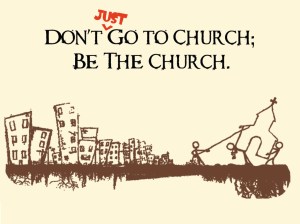
On Being the Church…

08 Wednesday Jul 2015

Posted by jandrewsweckerly in Uncategorized

≈ Leave a comment

Tags

baptism, church, decline, Episcopal, growth, Jesus, responsibility

Over the course of the last year, I have read countless articles about the state of our struggling Church.  The struggle is not just an Episcopal one, but is common across most denominations.  There are all sorts of theories about why it is happening and who or what is to blame.  I myself have pondered these theories in my heart, as I wonder what ministry will look like twenty years from now.  But in all the finger-pointing and discussion about what is causing our attrition, I stumbled on this prayer last week in a blog entry by David Lose:

L: Let us pray together.
C: Your church is composed of people like me.
I help make it what it is.
It will be friendly, if I am.
Its pews will be filled, if I help fill them.
It will do great work, if I work.
It will make generous gifts to many causes, if I am a generous giver.
It will bring other people into its worship and fellowship, if I invite and bring them.
It will be a church where people grow in faith and serve you, if I am open to such growth and service.
Therefore, with your help Lord, we shall dedicate ourselves to the task of being all the things you want your church to be.  Amen.[i]

What I loved about this prayer is that it took the argument about church decline and made it personal.  No longer was the issue one that “the Church” was facing, but one that I am personally facing.  There is no mysterious formula that will solve this problem.  The issue is me – about how I make the Church the place the Church is meant to be – the place God longs for her to be.  I cannot count on people simply having an inspired desire to come to Church.  I need to share my story.  I need to get my hands dirty being Church.  I need to stop hiding my love of Jesus and start living as one who is loved by that same Jesus.

Photo credit:  http://www.cfi-hq.org/2015/04/

Photo credit: http://www.cfi-hq.org/2015/04/

Our church just had two baptism Sundays in a row.  In those services we made some tremendous promises – to seek and serve Christ, to share the good news, to strive for justice and peace, and to be present in the life and work of the church.  That all sounds like a lot of work.  But the truth is that the work is not onerous when done in community.  The work is not onerous when we look into the eyes of infants and confidently welcome them into the community of faith.  The work is not onerous when it gives us great joy.  Over the next few weeks, I invite you to pray this prayer everyday.  Pay attention to whether its words create some shifting in you.  Linger in the parts that seem the most uncomfortable.  And then keep inviting the Spirit of the Living God to fall afresh on you.

[i] The prayer was not written by David Lose, but one he stumbled upon in a church in Wisconsin.  The full citation can be found at https://www.workingpreacher.org/craft.aspx?post=1620.

Embracing joy…

03 Wednesday Jun 2015

Posted by jandrewsweckerly in Uncategorized

≈ Leave a comment

Tags

Christ, church, constructive criticism, encouragement, faithful, health, Holy Spirit, improvement, joy, review, servant

Our Vestry and Parish just completed a Mutual Ministry Review – a time to reflect on the health of our congregation and to strategize about how to move toward greater health and wholeness.  There was a lot of positive feedback in the survey indicating the ways in which we have grown and changed for the better in the last three years of ministry together.  And of course, there was plenty of constructive criticism about what we can do to make our ministry together better.  Some of the feedback included things we could do quite easily, and some of the feedback will take longer to address.  But the Vestry was energized to make those changes and move toward wholeness.

Like with any feedback though, we quickly lost sight of all that is going well.  We lingered only for a moment on the good and positive work God is fostering among us, and we immediately dug in with the work we needed to do to improve.  Although I am super proud of our Vestry’s desire to dig in and do some of the dirty work of improvement, I want to take a moment to remind our whole parish of the need to prayerfully lift up the goodness in our midst.  Without being rooted in gratitude for all the goodness God has brought us, my fear is that we will be overwhelmed by the burden of improvement and not steadied by the encouragement of the Holy Spirit.

I was reminded of that lesson this Sunday.  This Sunday the Vestry started working on prioritizing our improvement work and making goals and deadlines for ourselves.  The work is important and necessary, but I must admit our spirits were a bit heavy.  But just thirty minutes before our meeting, in the context of worship, we honored all of our children and teachers who had participated in Sunday School, Rite 13, and Adult Formation this program year.  The transept was overflowing with people.  Because we use a rotation model for Sunday School, we had over 10 teachers and shepherds this year.  We had three teachers for Rite 13, and five teachers for adult formation.  For a parish with a relatively small average Sunday attendance, those numbers are tremendous.  And that does not include all the children who were present!  It was a glorious sight and a testimony to the good work we are doing to form us into a community that is seeking Christ.  Well done, good and faithful servants!!

Photo credit: http://urfamilies.org/full-of-joy-in-the-lord/

Photo credit: http://urfamilies.org/full-of-joy-in-the-lord/

My encouragement to all of us this week is to hold on to that moment.  Hold on to that image of a full transept of people who have spent the last year deepening their relationship with Christ, and marvel at the good work that the Spirit is doing at St. Margaret’s.  And give yourselves a pat on the back for the ways in which you have committed yourselves to being faithful builders of the Kingdom of God.  There will always be work to do, but my hope is that we can see the joy behind the work we do.  Because there is a lot to be joyful about!

Evangelism joy…

28 Thursday May 2015

Posted by jandrewsweckerly in Uncategorized

≈ Leave a comment

Tags

church, evangelism, fear, fun, Good News, joy, parade, worry

This Monday our parish walked in our local Memorial Day Parade.  I did a lot of cajoling to get our parishioners out among the community that day.  But I must admit, that morning all I wanted to do was stay in bed.  I had experienced some sleepless nights with the little one, Monday is normally my day off and walking in the parade would mean losing not just my day off but a holiday too, and it is a rare weekday that I get to have my whole family together.  So despite all my haranguing about our need to evangelize, all I wanted to do was stay in bed (or at least stay in my pajamas, since little ones do not believe in sleeping in around our house).


But as soon as the crowds began to gather, I realized how good God is.  While walking to the parade, we ran into one of my daughter’s friends from kindergarten.  Later, we ran into the clergy and staff of our neighboring Lutheran church and preschool, who had not seen our youngest child since our preschooler graduated last spring.  I found myself introducing St. Margaret’s parishioners to non-church friends.  We managed to gather the largest number of parishioners to ever walk the parade.  And, quite honestly, I had fun.

That’s the funny thing about evangelism.  We get all nervous about what will happen.  We wonder what we will say.  We fret about how people will react when we talk about church.  We worry it will be awkward.  But Monday gave me a renewed spirit for sharing the Good News.  Sharing your joy about church isn’t really all that awkward.  In fact, it tends to segue into other conversations, because joy is contagious.  Thanks for reminding me about my joy, St. Margaret’s!  Let’s do it again soon!

Sermon – Luke 24.36b-48, E3, YB, April 19, 2015

23 Thursday Apr 2015

Posted by jandrewsweckerly in Uncategorized

≈ Leave a comment

Tags

church, disciples, eat, embolden, Eucharist, food, heal, Jesus, peace, power, reconcile, Sermon, witness

I have been thinking this week about the power of food.  In almost all my mission trips, there was a food story.  Whether I was uncertain about eating what looked like undercooked chicken in the Dominican Republic, or I was struggling with the proper way to eat the tiny bird I was given in Burma, or I was trying to swallow the freshly made tamale in Honduras when all I wanted to eat was a saltine because I was so sick – there was always a dramatic food story from each trip that led to endless jokes later.  Of course there are good food stories too.  There are those foods that you always eat when you visit a favorite restaurant, the foods you beg your mom to make when you visit home, or the foods whose recipes you try to master before your grandfather passes away and the magic taste is gone with him.  Food is a powerful thing.  There is the basic need for food for sustenance, there is the nostalgia and delight that the smell and taste of food can bring, there is the adventure of trying new and exotic foods, and there are ways in which food can be the enemy – from overeating to disordered eating.  Food is the common denominator among all peoples, and in many ways, our life is centered around food.  The common joke in the South is that you know a family is a good southern family if they are planning their next meal while eating the current one.

So today, when Jesus says, “Have you anything here to eat?” Jesus harnesses the power of food to do something equally powerful.  In Luke’s gospel, the women have found the empty tomb and reported the news to the disbelieving disciples.  Peter has confirmed the news, but the disciples remain huddled in fear.  Two of those gathered have an encounter with Jesus on their walk to Emmaus, and return to the disciples to share the news.  Finally, in our lesson today, Jesus appears among them.  Though he offers peace to them, and tries to calm their doubts and fears, the text tells us that they are joyful, but still in disbelief and wonder.  Despite the fact that the disciples have received multiple testimonies of the risen Lord and despite the fact that the same risen Lord is standing right in front of them, offering them peace and assurance and even showing his wounds as proof of his identity, the disciples just cannot get their heads around this strange new reality.  And so Jesus resorts to the one power left he has to reach the disciples – the power of food.  To this scared, confused, disbelieving gang of followers, Jesus says the most basic, normal question, “Have you anything here to eat?”

Who among us has not tried to use food as the great peace maker?  Almost every time we go to visit family, our family anxiously asks, “What do you guys eat?”  Whenever we host friends, we are careful to ask about food allergies or what kinds of foods they do not like.  Pretty much every birthday party we have been to with our five-year old has served pizza and cake – because apparently, every kid likes pizza and cake.  Nothing feels better than satisfied eaters around a dinner table.  Once people are happily eating, the conversation flows and the laughter soon follows.  Likewise, when we make the wrong food choices for a meal, the results can be disastrous.  I always have loved the scene from the film, My Big Fat Greek Wedding, when the Greek girl invites her very non-Greek boyfriend to meet the family.  The whole family has gathered, a pig is on the spit, food is flowing, music is playing, and the favorite Aunt comes up the boyfriend and asks him what she can serve him.  The Greek girl tries to calmly and quietly explain that her boyfriend is a vegetarian.  The Aunt seems confused, and so she explains that her boyfriend does not eat meat.  The Aunt loudly asks, “What do you mean he doesn’t eat meat?!?”  The room suddenly stops – a record scratches as the music halts, a glass drops from a stunned hand, and jaws drop as they stare at this strange boyfriend.  But the Aunt, ever the gracious host, quickly affirms the boyfriend and says, “That’s okay, that’s okay.  I’ll make lamb!”

Though the Aunt clearly does not comprehend the practice of being a vegetarian, she still leans on food as a way make peace.  Once she has made peace, the party continues, and the family gets back to knowing the foreigner and welcoming him as family.  That is because food has that power.  Food can break down walls between foreigners, food can soothe old hurts, and food can help make new friends.  Food has power.

Jesus seemed to know this truth.  When appearances, conversations, and physical evidence cannot not seem to calm the disciples enough for them to understand what God is doing in the risen Christ, Jesus resorts back to the one thing that can transform everything.  “Have you anything here to eat?” is not just a question about whether there is food in the house.  His question is a disarming one – a question that not only requires the mundane work of preparing food, but also gets the disciples into a place a familiarity, comfort, and ease.  In this place, gathered around the table with food, the disciples are finally put in a place where they can really hear Jesus.  In fact, the text says that Jesus opens their minds to understand the scriptures.  Finally, after confusion, fear, and disbelief, through the power of food comes clarity, wisdom, and direction.  Jesus is able to break through, create understanding, and most importantly, commission the disciples to spread the good news to all the nations.[i]

On those mission trips, those funny food stories always led to something more powerful.  That questionable chicken was procured for us because the village leaders knew how hard we had labored and they wanted to give us food to sustain us – even if it meant driving out of the way to obtain the chicken.  And once we ate, the hungry villagers ate too.  Those tiny birds that we panicked about in Burma were actually quite a delicacy.  They are a rare treat that were painstakingly prepared by the women of the church.  And though I am sure our faces betrayed our uncertainty, you could not have seen more proud looks on those women as we began to pick through those tiny bones for meat.  Those mounds of fresh tamales were like a death sentence to me in Honduras.  But I learned that the women of the village had pooled their money for the ingredients and had been working all day to prepare for the feast.  After we ate those delicious offerings, there was great dancing and celebration as our team honored a productive week with our village hosts.

Churches understand the power of food.  I still hear stories at St. Margaret’s about the progressive dinners held back in the day.  Parishioners who are often quite overbooked will clear their calendars for our annual parish picnic.  I have told many a friend that St. Margaret’s is the only parish I know whose Coffee Hour truly lasts an hour – sometimes more if the conversation is really hopping.  Even our most recent new endeavor of providing a family-friendly worship and fellowship opportunity is centered around food – Pasta, Pray, and Play.  Churches understand the power of food to bring people together, to enrich relationships, and to create new connections.

But probably most important for the Church is the power of food to heal, reconcile, and embolden.  The Eucharistic Meal is the primary way we use the power of food.  For those of us who have been receiving communion our whole lives, we sometimes forget the power of that simple meal.  I remember, at one of the services when one of our young people received his first communion, the look of consternation on his face when he first tasted the dry wafer.  I do not know what he was expecting, but I can tell you, that wafer shocked his senses.  That is what our Eucharistic Meal is supposed to do.  We spend an hour pondering and praying about what God is doing in our lives, we confess our failures to live as faithful servants of God, we reconcile with our brothers and sisters in the peace, and then we stand humbly before God and receive a meal that restores us and makes us whole.  That single meal gives us the peace and the power to get back out into the world and try again – try again to be the witnesses Jesus invites us to be today.  That is the power of this food – this meal can transform us and enable us to be faithful witnesses in the world.  When Jesus says today, “Have you anything here to eat?” we say emphatically, yes, we do.  Amen.

[i] Sarah S. Henrich, “Exegetical Perspective,” Feasting on the Word, Yr. B, vol. 2 (Louisville:  Westminster John Knox Press, 2008), 429.

Sermon – Mark 16.1-8, EV, YB, April 4, 2015

15 Wednesday Apr 2015

Posted by jandrewsweckerly in Uncategorized

≈ Leave a comment

Tags

church, Easter Vigil, God, history, Jesus Christ, love, Princess Bride, salvation, Sermon, story

Tonight we celebrate one of the most ancient, and in many traditions, the most important liturgies of the Church.  This is the festival of the resurrection of our Lord – despite what you may have learned about Easter Sunday.  Tonight is the night that we liturgically mark that shift from Lent and the Passion to our Lord and Savior’s Resurrection.  The church gives us this incredible gift tonight, and our job is to hearken back to an innocent sense of awe as we realize what God does through Jesus Christ.

Luckily the Church helps us hearken back to that innocent sense of awe through the structure of the liturgy.  I like to think the Church’s work in the Easter Vigil as being like that Grandfather in the movie The Princess Bride, who visits his sick grandson to read him a fantastic story.  In that movie, the grandson is skeptical – that in fact his grandfather might be planning to read him a boring or sappy story.  But the grandfather insists that this story is one of the greatest stories ever told – a story that his father read him, that he read to his son, and now, he would read to him.

The Church is like that grandfather to us tonight, who gathers up the grandchildren around him, and says, “Let me tell you a story.  This story is greater than any other story you have ever heard.  This story is full of intrigue and surprise, full of the primal elements, full of drama and passion, and full of twists and turns you do not expect.  Do you want to hear the story?”  And before the grandfather can even begin, the grandchildren are waiting with baited breath.

“Once upon a time, before there was time, or people, or even land or sky, the earth as we know the earth was a formless void – filled with watery chaos.  God created the world as we know the world, and proclaimed that creation, ‘good.’  Sometime later, that world fell into sin and God used water to cleanse the whole earth through flood.  To the one person God saved, God promised to never do such destruction again and made a covenant of protection.  Much later, the people of God were fleeing a horrible fate – an awful leader who had enslaved the people.  This time, God once again manipulated the water – both to save God’s people and to destroy those who wished to destroy God’s people.  On the other side of the sea, on dry land, the people rejoiced.  Later, the people fell away from God and although God was grieved, God spoke to the prophet Ezekiel.  God told Ezekiel to reassemble the dry bones of God’s people, and to breathe new life into them.  And the people lived again.  Much later, when the people had become dispersed and disheartened, God proclaimed new hope.  God proclaimed that God would gather God’s people again and would eliminate their despair.

“But after all of that – after creation and floods, after the division of the sea and the giving of new life to old bones, even after promising to save the people – after all of that, yet still the people of God lived in sin and in separation from God.  And, knowing no other way, God did something so unexpected, so wonderful that we could never repay God.  God sent God’s Son to live and breathe among us, to show us the way of faithful living and the way to eternal life.  And as if that were not enough, that same Son was betrayed by his friends, mocked and reviled, and killed on a cross.  That was a dark, painful time – darker and more painful than anything the people had known before.  And so the people of God did the only thing they knew to do:  they mourned, they hid in fear, and a few brave women went to tend to this precious gift they had been given, making his death as sacred as they knew how.  But something amazing happened – something no one ever anticipated.  The Son of Man, the Prince of Peace, the Messiah, Jesus was not there.  And the disciples went from east to west, sharing the sacred and imperishable proclamation of eternal salvation.”

At the end of the film The Princess Bride, the grandfather finishes the book, and tells his grandson to go off to sleep.  The once skeptical grandson hesitantly addresses his grandfather, “Grandpa?  Maybe you could come over and read it again to me tomorrow.”  His grandfather smiles and responds, “As you wish.”  Those words are significant because in the story the grandfather tells, the main characters say, “As you wish,” as their code word for, “I love you.”  Tonight, we too hear the story of our salvation, the great sweeping of our history with our Lord, and the salvific work of our Savior Jesus Christ, and we too find ourselves strangely warmed, longing to perhaps hear the story again.  And to us, the Church says, “As you wish.”  Amen.

Sermon – John 13.1-17, 31b-35, MT, YB, April 2, 2015

15 Wednesday Apr 2015

Posted by jandrewsweckerly in Uncategorized

≈ Leave a comment

Tags

belonging, brokenness, church, dinner, Eucharist, failings, footwashing, forgiveness, God, home, identity, Jesus, joy, Last Supper, Maundy Thursday, peace, renewal, sacred, Sermon, sinfulness, strength, table

The dinner table is where sacred things happen.  The dinner table is where food is served that can satisfy a hunger, can heal an ailing body, can delight the senses, and can invoke a nostalgia like no other.  The dinner table is where stories are told, days are recounted, prayers are said, and laughter is had.  The dinner table is where places are set, dishes are passed, plates are cleared, and remnants are cleaned.  The dinner table is the host of all things mundane – like that frozen meal you threw together before you ran off to the next thing; and the dinner table is the host of all things momentous – like that gloriously planned and executed Thanksgiving meal that you hosted for your friends and family.  Because the dinner table can do all these things, the dinner table becomes the place in our home where sacred things happen – a holy site for one’s everyday and one’s extraordinary moments.

The dinner table where Jesus and his disciples gathered for that Last Supper was no different.  They had gathered at table hundreds of times in the three years they had spent together.  There had been learning and laughter, stories and questions, arguments and celebrations.  In many ways, all of these things seem to happen in the course of this one night during the Last Supper.  Jesus and the disciples are likely chatting up a storm, talking about the days events, when Jesus does something extraordinary.  He gets up, takes off his outer robes, and washes the feet of his disciples.  This kind of event is unheard of.  Hosts and well-respected teachers do not wash others feet; that task was assigned to a household slave.[i]  And some of the midrashic commentary suggests that not even a Hebrew slave was expected to perform such a menial task.  Instead, the slave might bring out a bowl of water, but the guest would wash his own feet.[ii]  So of course, a lively debate ensues with Peter, who does not understand what is happening.  Jesus washes Peter’s feet anyway – and washes Judas’ feet – before returning to that dinner table to explain what he has done.  He goes on to explain that not only will he die soon, but also that he expects a certain behavior after he is gone – that they love one another.

That is the funny thing about dinner tables.  They can bring out the most sacred and holy of conversations.  The dinner table is where one tells his family that he has terminal cancer.  The dinner table is where one tells her best friend that she lost her job and has no idea what she is going to do.  The dinner table is where the young couple announces that that they lost their pregnancy.  The dinner table is where the college student tells his parents that he is dropping out of school.  We tell these awful, scary stories at the dinner table because we know that the table can handle them.  The table is where we gather with those who we care about and is therefore the place where we can share both the joys of life and also the really hard stuff of life.  Though our table may have never hosted a dinner as beautiful as one of the tables Norman Rockwell could paint, our table is still a sacred place that can hold all the parts of us – the good, the bad, the beautiful, and the ugly.  We can share the awfulness of life there because we know that those gathered can handle it, and can carry us until we can be back at the table laughing some day.

What I love about our celebration of this day is that all of those things – the good, the bad, the beautiful, and the ugly – were present that night with Jesus and his disciples.  So yes, earlier in the evening, there probably is a raucous conversation.  The disciples are gathered at the table, in all their imperfection: those who love Jesus with a beautiful innocence and those who greedily hope to be at Jesus’ left and right hand; those who humbly understand Jesus and those who want Jesus to victoriously claim his Messianic power; those who profess undying faithfulness (even though they will fail to be faithful) and those who actively betray Jesus.  At that table Jesus not only talks about how to be agents of love, Jesus also shows them how to love.  On this last night – this last night before the storm of Jesus’ trial, crucifixion, and death – a sacred moment happens at the dinner table.  And though we do not hear the story tonight, we also know that Jesus then breaks the bread and offers the wine, instituting the sacrament of Holy Communion.

We know the rest of the story.  The disciples, who still do not really understand Jesus fully, muddle their way through footwashing and Holy Communion.  Then those same dense disciples sleep their way through Jesus’ last prayers.  One of those disciples becomes violent when a soldier tries to seize Jesus.  And eventually, most of the disciples betray and abandon Jesus altogether.  To this unfaithful, dimwitted, scared group, Jesus offers a sacred moment at the dinner table, inviting them into the depths of his soul and a pathway to our God:  and encourages them to love anyway.

Our own Eucharistic table is not unlike that dinner table with Jesus.  Tonight, we too will tell stories, sing, and laugh.  We too will wash feet in humility, embarrassment, and servitude.  We too will hear the sobering invitation to the Eucharistic meal, and will walk our unworthy selves to the rail to receive that sacrificial body and blood.  We too will argue with God in our prayers, pondering what God is calling us to do in our lives and resisting that call with our whole being.  We too will lean on Jesus, longing for the comfort that only Jesus can give.  And we too will hear Jesus’ desperate plea for us to also be agents of love – not just to talk about love, or profess love, but to show love as Jesus has shown love to us.

In this way, our Eucharistic table is not unlike the dinner table in your own home.  Our Eucharistic table has hosted countless stories, arguments, and bouts of laugher.  Our Eucharistic table has witnessed great sadness and great joy.  Our Eucharistic table feeds us, even when we feel or act unworthily.  And our Eucharistic table charges us to go out into the world, being the agents of love who are willing to wash the feet of others – even those who betray us and fail us.  This Lent, we have been praying Eucharistic Prayer C.  In that prayer, the priest prays, “Deliver us from the presumption of coming to this Table for solace only, and not for strength; for pardon only, and not for renewal.”[iii]   This Eucharistic table, like our own dinner table, can handle all of us – all our failings, sinfulness, and brokenness.  This table can fill us up with joy, forgiveness, and peace.  This table can be a place where we find belonging, identity, and security.  But this table is also meant to build us up – to give us strength and renewal for doing the work God has given us to do – to love others as Christ loves us.  Sacred things happen at this table.  Those sacred things happen so that we can do sacred things in the world for our God.  Amen.

[i] Guy D. Nave, Jr., “Exegetical Perspective,” Feasting on the Word, Yr. B, vol. 2 (Louisville:  Westminster John Knox Press, 2008), 279.

[ii] Mary Louise Bringle, “Homiletical Perspective, Feasting on the Word, Yr. B, vol. 2 (Louisville:  Westminster John Knox Press, 2008), 279.

[iii] BCP, 372.

Sermon – Mark 1.9-15, L1, YB, February 22, 2015

25 Wednesday Feb 2015

Posted by jandrewsweckerly in Uncategorized

≈ 1 Comment

Tags

Ash Wednesday, church, death, honesty, Jesus, journey, Lent, penitence, pilgrimage, pilgrims, Sermon, sobering, wilderness

Lent is a funny season.  Lent gives us all these seemingly horrible things and calls them gifts.  We kick things off with a bang on Ash Wednesday.  We gather in the church and kneel before God while someone tells us that we are dust and to dust we shall return.  In other words, we come to church to be reminded that death is real, death is unavoidable, and death is coming.  With the exception of people facing severe illness or people beyond a certain age, death is not typically a part of our everyday conversations.  Rarely are you drinking a latte with a friend who casually says, “So you know we are going to die, right?  Maybe today, maybe tomorrow, but we will both die.”  That is because death for us is one of those conversations that we do not really like to entertain because death brings down the mood and makes us feel sad.  And yet, that is how we kick off the season of Lent.  “Happy Lent!  We’re all going to die!”

And if that were not sobering enough, the Church takes the next forty days reminding us of our brokenness, of our sinfulness, and of our failures.  We kneel more, confess more intentionally, and pray to reconnect with God.  The season seems to gather us up, place us sackcloth, and then let us wallow in our own sense of unworthiness.  Why in the world would any of us make a commitment to come to Church in Lent with the promise of such guilt and sobriety?

Actually, I think most of us have a love-hate relationship with the wilderness we find in Lent.  We do not want to do the hard work that Lent requires, and yet we also desperately long for a place that acknowledges the reality of all that is hidden behind our perfectly constructed masks, and invites us to just be still and present with our LORD.  In a world that Photoshops, creates whole lines of anti-aging products, and fights death tooth and nail, the church creates a season where we look at ourselves without enhancements and work towards contentment, peace, and even joy.  Lent is a season of honesty, “when the church reminds us of what our culture denies – that our days are limited, and that we’ve made a mess of things.”[i]

Of course, the church did not really invent Lent per se.  The people of God have been experiencing the same concept for years, most frequently in the wilderness.  We know the stories well:  Noah completing his forty days on a ship, floating in his own, albeit probably very loud, watery wilderness; the people of Israel wandering the desert wilderness for forty years; and, as we hear on this first Sunday in Lent, Jesus, led out to the wilderness by the Spirit for forty days immediately after his life-changing baptism.  Each of those experiences are full of Lenten themes:  being taken out of the comforts of life; wondering whether there will be relief from suffering, whether there is dry land, food in the desert, or Satan himself; and glimpses of hope, whether from an olive branch, manna from heaven, or tending angels.  These wilderness experiences, or Lenten-type journeys, pave the way for renewal and reinvention.

This winter, one of our Movies with Margaret features was called The Way.  In the film, a father and his adult son have become somewhat estranged.  The son decided to travel the world to find himself, and the father scoffs.  Months into his son’s travels, the father gets a call.  His son had decided to walk the Camino – the pilgrim’s path in France and Spain that pilgrims have been walking since the ninth century.  Unfortunately the son died while walking the Camino, and the father now needed to pick up the body.  While going through his son’s hiking pack, the father replays their last conversation – about how his Dad is too rigid and never travels anymore since his wife died.  Untrained and unprepared, the father straps on his son’s pack and begins to walk.  He confesses he has no idea why he is walking, but he walks anyway.

The movie goes on to document what might be described as the father’s own wilderness journey.  He deals with getting lost, trying to sleep in noisy hostels, not being able to get rid of talkative fellow pilgrims, losing his bag briefly in a river, getting arrested, and later having his bag stolen by a gypsy.  When he gets to the end of the journey, he takes his documents to the pilgrimage office to have the paperwork authorized and get a certificate of completion.  Before the official will sign his paperwork, he asks a question that stumps the father.  “What is your reason for walking the Way?”  The father stammers.  He cannot put into words why he grabbed his son’s bag and started walking.  Recalling the last fight he had with his son, the best he can come up with is, “I thought I needed to travel more.”

Mark does not give us many details about Jesus’ journey in the wilderness.  Unlike the other gospels, we do not hear the details of his encounter with Satan.  We do not really understand what happens with those wild beasts – whether they were friends of foes.  We hear about some angels at the end, but we do not know how much they are present.  All we really know is that Jesus is in a wilderness for forty days and that those days happen after he is baptized and proclaimed the beloved and before he can begin his earthly ministry.

We too start a wilderness experience today.  At the beginning of our liturgy we confessed many things.  We confessed blindness of heart, pride, vainglory, hypocrisy, envy, hatred, and malice.  We confessed our inordinate and sinful affections and our fear of dying suddenly and unprepared.  We confessed our loneliness, our suffering, and our ignorance.  And we prayed for our enemies.  The ashes from Ash Wednesday and their message of the inevitability of death still linger in our subconscious.  Like the father in The Way, we put all of those confessions and acknowledgments in a pack, put the pack on our back, and we begin to walk.  None of us knows what will happen on this forty-day journey.  We do not know how our Lenten disciplines will shape us, or what external factors will impact our lives.  But we begin the Lenten journey anyway.

The promise for us is refreshment at the end of the journey.  For me, that refreshment is the Easter Vigil.  At Easter Vigil, I put down my pack full of my forty days’ worth of experiences.  I hear the piercing words of the Exultet and the old stories of our salvation told in the darkness.  I watch candles flicker as we sing hymns.  And then I watch the church explode with light and the sound of bells.  We say the forbidden “A-word” after a forty-day hiatus.  We feast on the Eucharistic meal after fasting from that meal since Maundy Thursday.  And we rejoice in our risen Lord.

In the movie, The Way, the father reaches the end of the pilgrimage and has a sacred moment in the church at the Pilgrim’s mass.  He decides to keep journeying further to spread his son’s ashes into the sea.  And at the end of the film, we see him traveling to other places – finally taking up his son’s challenge to see more of the world.  That’s the funny thing about journeys.  They are not the end of the story.  Our Lenten journey will be a true pilgrim’s journey.  But our journey will not end at the Vigil.  Just like Jesus’ journey did not end with angels tending to him.  As Barbara Brown Taylor says, “Even after he left the wilderness, [Jesus] carried [the wilderness] inside him, and far from fleeing [the wilderness] later in his life he sought [the wilderness] out.  Without the wilderness he might not have been the same person.  Because of the wilderness he was not afraid of anything.”[ii]  We all need the wilderness to shape us and mold us.  Our Lenten pilgrimage will change us, both as individuals and as a community, because in the church, we do not journey alone.  Your fellow pilgrims are here in the pews beside you – perhaps to annoy you, or send you on a detour – but maybe also to bail you out of jail from time to time.  Together we are pilgrims on the way, being transformed for new life beyond Lent.  Amen.

[i] Dan Clendenin, “To See Death Daily,” posted February 16, 2015 at http://www.journeywithjesus.net/Essays/20150216JJ.shtml.

[ii] Barbara Brown Taylor, “Four Stops in the Wilderness,” Journal for Preachers, vol. 24, no. 2, Lent 2001, 4.

An invitation…

25 Wednesday Feb 2015

Posted by jandrewsweckerly in Uncategorized

≈ Leave a comment

Tags

Ash Wednesday, ashes, church, death, dust, God, holy, invitation, Lent, relief, sobriety

In my line of work, I deal with death a lot.  The first two calls a family usually makes when a loved one dies are to the funeral home and to the priest.  I have done funerals for people I have known and loved, and for people who I have never met.  I have done funerals for people who were deeply involved with and committed to the Church, and for people who actively avoided the church.  I have done funerals for grandmothers, husbands, sisters, and children.  I have held the hand of a shallow-breathing senior who had lived a long life but was approaching the last hours, and have touched the tiny hand of a stillborn.  Death is ever present in my life, always a phone call away.

Photo credit:  http://www.commonschurch.org/event/ash-wednesday/

Photo credit: http://www.commonschurch.org/event/ash-wednesday/

So you would think that Ash Wednesday would not be that jarring to me.  A day meant to remind us of the fragility of life, that we are dust and to dust we shall return, really should not be that extraordinary.  But every year it gets me.  Though I deal with death when it comes my way, Ash Wednesday is a little different.  Ash Wednesday involves reminding people who may be nowhere near death to ponder the shortness of life.  Each time I spread gritty ashes on a forehead, my whole being shutters.  I think of the many laughs I have shared with the person my age; I think of the illness someone in their 50s overcame and the fullness of life they have enjoyed since then; I think of the bounding energy of the six-year old and how much joy they bring; and I think of the quiet confidence and wisdom of the grandmother figure.  Every time I say, “Remember you are dust, and to dust you shall return,” I feel like I am whispering a dark truth into each person’s ears.  There is nothing more sobering than those words, than those grainy ashes, than those shared moments of eye contact.  And no matter how well I clean up afterwards, a little black residue remains on my thumb, reminding me how close death lingers.

Though the reality of Ash Wednesday is sobering, and perhaps something one might want to avoid, I find that most people who come for ashes are relieved.  They are relieved for the gift of a church that will remind them of things of ultimate importance.  They are relieved for some perspective and levity in a world that tells them if they push more, do more, achieve more, they will somehow be happier.  They are relieved to be shaken out of the distractions or the fog of life and to be invited into a sense of clarity and purpose.  I certainly am relieved in that same way.  Because I am the solo priest at my parish, I usually have a parishioner also spread ashes on my forehead.  No matter who I end up asking, there is always a moment of shared humility and connection.  I am grateful to the church for the gift of Ash Wednesday and the invitation for a holy Lent.

Comfort food…

30 Friday Jan 2015

Posted by jandrewsweckerly in Uncategorized

≈ 3 Comments

Tags

church, comfort food, Eucharist, God, meal, nostalgia, senses, taste

Courtesy of https://www.flickr.com/photos/lorikay/172625272/

Courtesy of https://www.flickr.com/photos/lorikay/172625272/

Whenever my family and I travel to familiar places, there are required food-related stops.  When we go to San Diego, it is El Indio, Rubios, and In-N-Out.  When we go to Delaware, it is Capriotti’s and Rita’s.  When we go anywhere South, it is Krispy Kreme, Chick-fil-A, and Waffle House.  Somehow our trips do not feel complete until we have made it to our special food establishments.  In fact, in San Diego, the very first stop after the airport is not home – it is straight to El Indio.  We look forward to the food for weeks before our trips, and we make sure that whatever agenda is planned, those food stops are figured into the master plan.

Not only do we make the stops because the food is amazing (because it is!), we also make the stops out of a sense of nostalgia.  Because many of those establishments have not expanded to where we currently live, there is a way in which the food brings us back to other times in our lives.  The sense of taste overwhelms the mind with memories, and we find ourselves savoring not just the food but the treasured experiences as well.  Food has a tremendous power to create a sense of home – sometimes even more so than a particular house.

I have often felt that same way about the Eucharistic meal.  Though I celebrate Eucharist multiple times per week now, every once in a while, powerful sensory experiences overwhelm what could be the mundane.  The flavor of the host (yes, those bland wafers actually do have a taste), whether or not the host is stale or crunchy in your mouth, the sharp taste of communion wine at a time that would not normally be acceptable for consumption of wine – all of these sensory experiences can make communion powerful over and over again.  And sometimes, the familiarity of the taste and texture is also comforting.  When all else in my world seems out of control, that moment of receiving the body and blood of Christ is centering like nothing else can be.

I wonder what you have done lately to connect on a sensory level with God.  Maybe you have missed church these last couple of weeks (or months, or years).  Maybe you come to church, but you disconnect during the familiar Eucharistic prayer because it is just too familiar.  This past Sunday at St. Margaret’s, we sang “Taste and See,” one of my favorite communion hymns.  The words are based on Psalm 34.  Like a familiar dining establishment, whenever I read the psalm, I think of the song.  And whenever I think of the song, I am reminded of the many powerful times that holy meal has shaken up my senses in fresh ways.  I invite you reconnect with God this week on a sensory level.  Perhaps you will remember another place you call home.

← Older posts
Newer posts →

Recent Posts

  • On Redefining Community…
  • On Parenting, Milestones, and Community…
  • Sermon – Acts 2.42-47, E4, YA, April 26, 2026
  • On Seasons of Discernment…
  • Sermon – Luke 24.13-35, E3, YA, April 19, 2026

Archives

  • May 2026
  • April 2026
  • February 2026
  • January 2026
  • December 2025
  • November 2025
  • October 2025
  • September 2025
  • August 2025
  • July 2025
  • June 2025
  • March 2025
  • February 2025
  • December 2024
  • November 2024
  • October 2024
  • September 2024
  • August 2024
  • July 2024
  • June 2024
  • May 2024
  • March 2024
  • February 2024
  • January 2024
  • December 2023
  • November 2023
  • October 2023
  • September 2023
  • August 2023
  • July 2023
  • June 2023
  • May 2023
  • March 2023
  • February 2023
  • January 2023
  • December 2022
  • November 2022
  • October 2022
  • June 2022
  • May 2022
  • January 2022
  • December 2021
  • November 2021
  • October 2021
  • September 2021
  • August 2021
  • June 2021
  • May 2021
  • April 2021
  • March 2021
  • February 2021
  • January 2021
  • December 2020
  • November 2020
  • October 2020
  • September 2020
  • August 2020
  • July 2020
  • June 2020
  • May 2020
  • April 2020
  • March 2020
  • February 2020
  • January 2020
  • December 2019
  • November 2019
  • October 2019
  • September 2019
  • August 2019
  • July 2019
  • June 2019
  • May 2019
  • April 2019
  • March 2019
  • February 2019
  • January 2019
  • December 2018
  • November 2018
  • October 2018
  • September 2018
  • August 2018
  • July 2018
  • June 2018
  • May 2018
  • April 2018
  • March 2018
  • February 2018
  • January 2018
  • December 2017
  • November 2017
  • October 2017
  • September 2017
  • August 2017
  • July 2017
  • June 2017
  • May 2017
  • April 2017
  • March 2017
  • February 2017
  • January 2017
  • December 2016
  • November 2016
  • October 2016
  • September 2016
  • August 2016
  • July 2016
  • June 2016
  • May 2016
  • April 2016
  • March 2016
  • February 2016
  • January 2016
  • December 2015
  • November 2015
  • October 2015
  • September 2015
  • August 2015
  • July 2015
  • June 2015
  • May 2015
  • April 2015
  • March 2015
  • February 2015
  • January 2015
  • December 2014
  • November 2014
  • October 2014
  • September 2014
  • August 2014
  • July 2014
  • June 2014
  • April 2014
  • March 2014
  • February 2014
  • January 2014
  • December 2013
  • November 2013
  • October 2013
  • September 2013
  • August 2013
  • July 2013
  • June 2013
  • May 2013
  • April 2013
  • March 2013
  • February 2013
  • January 2013
  • December 2012
  • November 2012
  • October 2012
  • September 2012

Categories

  • reflection
  • Sermons
  • Uncategorized

Meta

  • Create account
  • Log in
  • Entries feed
  • Comments feed
  • WordPress.com

Blog at WordPress.com.

  • Subscribe Subscribed
    • Seeking and Serving
    • Join 391 other subscribers
    • Already have a WordPress.com account? Log in now.
    • Seeking and Serving
    • Subscribe Subscribed
    • Sign up
    • Log in
    • Report this content
    • View site in Reader
    • Manage subscriptions
    • Collapse this bar

Loading Comments...