• About

Seeking and Serving

~ seek and serve Christ in all persons

Seeking and Serving

Tag Archives: connection

Sabbatical Journey…On Hope and Humanity

29 Thursday Jun 2023

Posted by jandrewsweckerly in reflection

≈ Leave a comment

Tags

baptismal covenant, bitter, connection, dignity, division, God, hope, humanity, Jesus, reverence, sacred

West Yellowstone (reuse with permission)

I often find myself worried about the state of humanity.  Between our bitter American politics – where the art of compromise seems lost, the nasty interpersonal ways we interact with one another (don’t get me started about my local newspaper’s anonymous section), the way we are almost desensitized to mass violence, and the never-ending presence global warfare, I sometimes find it difficult to see hope or redemption for humanity.

But today was not one of those days.  Today was all about community and shared connection.  It started when we drove through Grand Teton to get to Yellowstone.  We had already had our Teton experience but were hoping to get a last view on our way out of town.  But a thick fog fell on the whole area, and my immediate thought was one of sorrow for all the beautiful sights today’s visitors would miss.  Later, at Old Faithful, we sat waiting for about thirty minutes to see the iconic geyser.  Swarms of people were gathered from all over the country and the world.  But when the geyser finally blew, the united gasp and cheers of joy made me feel like the barriers between strangers were immediately leveled.  Finally, at a community theater in West Yellowstone, we enjoyed a musical in a small venue with a variety of people.  With interaction encouraged, kids invited on stage to sing before the show, laughter, and the love of theater, I felt a true sense of connection to the gathered community.

Of course, I am unlikely to see most of the people I spent time with today again.  So, in the strictest definition, I was not building community.  But what was happening was the fulfilling of my baptismal covenant – where we were all respecting the dignity of every human being.  I think we make that promise in baptism because that is the real first step to building community:  respect, and being able to see the sacred in every person created in the image of God.  When we do that, all that hopelessness about humanity fades away.

If you have not looked at someone today with that kind of reverence, I invite you to give it a try.  Maybe you just watch people a little more gently (remembering days when you were “in a mood,” or when parenting was just super hard).  Maybe you offer a hand or an encouraging word.  Or maybe tonight you pray for someone you never actually met but crossed paths with during the course of the day.  I look forward to seeing how Jesus softens your heart and gifts you renewed hope!
Sabbatical Journey…Finding God on the Road

18 Sunday Jun 2023

Posted by jandrewsweckerly in reflection

≈ Leave a comment

Tags

blessing, competition, connection, game, God, grace, human, image of God, journey, prayer

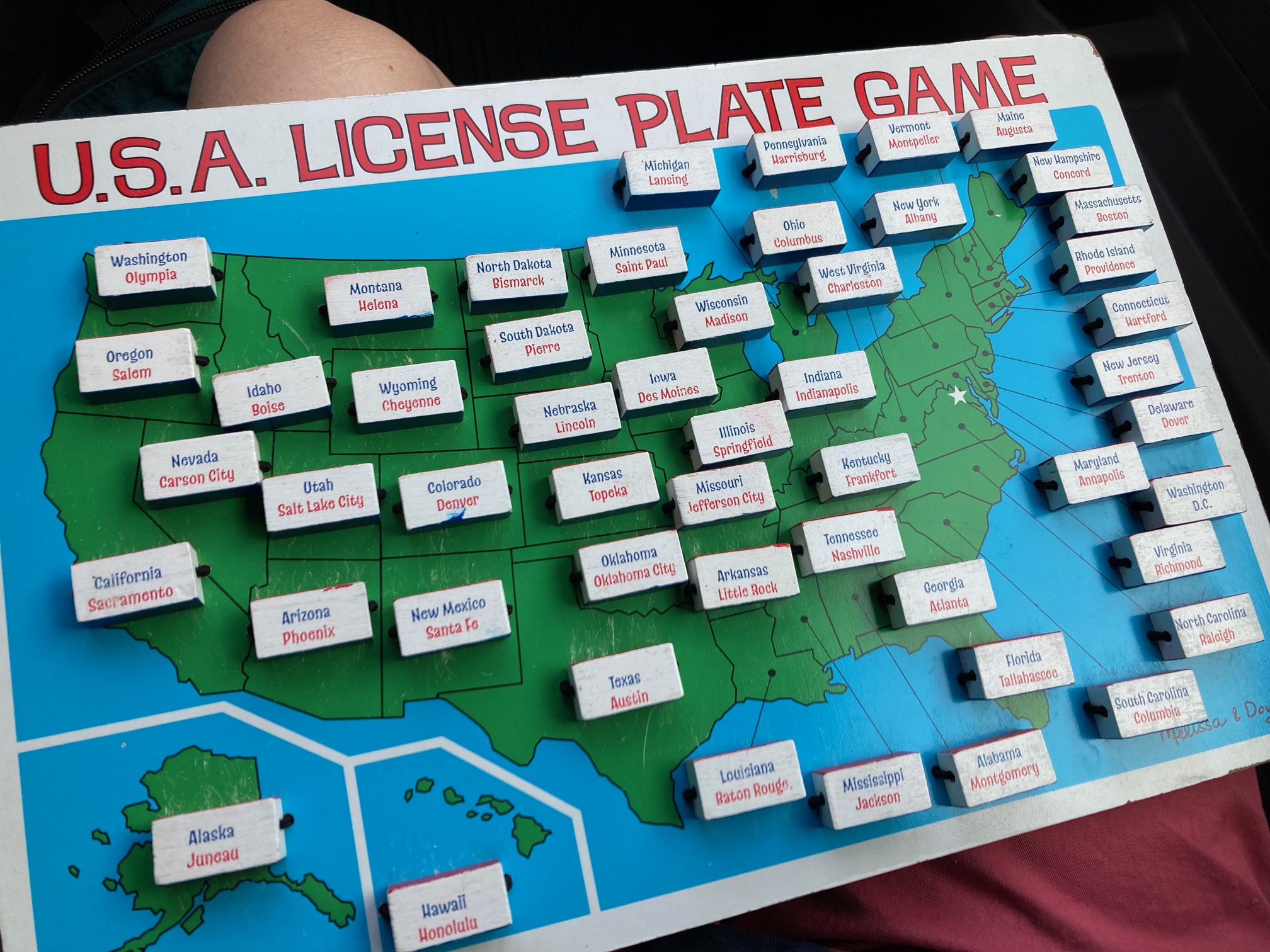
Photo credit: Jennifer Andrews-Weckerly (reuse with permission only)

One of our favorite road trip pastimes as a family is the “license plate game.”  We try to spot license plates from all fifty states while we drive.  We even have a little board that allows you to flip over a wooden replica of a plate when you see that state’s plate, helping you track which ones you are missing.  It’s a fun game for all ages that helps pass the time, and in feels mildly educational as parents.

Today we embarked on our family’s sabbatical road trip:  twenty-one states in twenty-one days.  Many of the sites have been on our bucket lists for years, and some of the sites we only learned about while planning the route.  We know this will be the trip of a lifetime, and we are thrilled to be able to do this together.  One of the themes of my sabbatical has been connection, and we suspect there will be lots of connection by the end of this journey.

As we commenced our journey today, the license plate game started immediately.  We had a bit of a slow start at the beginning, and I wondered if we were going to get stuck as we drove further away from the East Coast.  At some point, as kids and the other adult were snoozing, I saw one of the states I was particularly worried about missing, and I remember thinking, “Oh thank goodness for Delaware!!” 

My thought was rather silly and overly dramatic, but as I kept driving, I began to wonder what it might be like to not just treat the game as a calculated collection of inanimate objects, but instead to imagine the lives and worth of each human life in the cars.  How much more life-giving would it be to say to another driver, “I am so grateful for you today!  May your travels be a source of blessing!”  The image of 35 blessings instead of 35 wooden blocks on our game board made me realize how unfathomable God’s love is for all of God’s creatures.  Here I am competing in a game, when, if I use God’s eyes of grace, I might be seeing 35 blessings, 35 carloads of people made in God’s image, 35 possibilities for connection, or 35 invitations to move closer to God in prayer.

I look forward to finding new ways to see with God’s eyes of grace on the next leg of our trip.  I would love to hear how you found God’s invitation to blessing through others today!

Sermon – Luke 2.1-20, CE, YC, December 24, 2021

12 Wednesday Jan 2022

Posted by jandrewsweckerly in Sermons

≈ Leave a comment

Tags

appearance, Christmas, Christmas Eve, church, connection, earth, Good News, heaven, Jesus, Joseph, light, love, Mary, miracle, neighbors, ordinary, Sermon

Church on Christmas Eve is always a funny thing.  For years, I scoured the stores for matching dresses for our girls.  I served in churches where people would sport tuxedos and fur coats for the night’s services.  Family pictures were regularly taken by the Christmas tree – either at home or at church.  Quite frankly, I was a little relieved when I became a priest and never had to worry about a new outfit because no one would see the outfit under my vestments anyway.  And then the pandemic hit.  Last year, we had to watch Christmas from home – maybe in matching pajamas, but more likely just in a pair of jeans or sweats.  A year later, we are all out of the habit of dressing for public, and, if you are here at Hickory Neck, you know jeans are just as acceptable as that fancy dress or jacket in the back of your closet or that some of you are fabulously sporting tonight. 

I am not really sure where the notion of dressing up for Christmas came from, except maybe an older tradition of always dressing up for church.  But nothing about our Christmas story screams high fashion.  Mary and Joseph are traveling to Bethlehem under order of the oppressive government and are likely in traveling clothes, dirty and weary from the road.  Mary also gives birth this night, so her body is likely sweaty and soiled.  Meanwhile, her child is not in a matching layette, but in bands of cloth.  Both are likely an exhausted mess.  And the shepherds who later come visit are likely not to fresh-smelling themselves, probably in their most utilitarian clothing for tending to sheep in the dark cold of night.

And yet, in these most basic settings, the privilege of the miraculous happens.  Mary births not just an ordinary baby, but the Christ Child – the Messiah – as Isaiah says, the “Wonderful Counselor, Mighty God, Everlasting Father, Prince of Peace.”  Meanwhile, not only does an angel appear in the blinding glory of God, but also a whole multitude of the heavenly host shows up.  All to ordinary people, dressed in ordinary garb, going about doing ordinary things.  But as scholar Sarah Henrich says, “Heaven and earth meet in obscure places, not in the halls of power.”[i] 

This week I read about such a meeting of the heavenly and earthly in the Washington Post.  In November 2020, Kim Morton was sitting at home with her daughter watching a movie in Baltimore County, Maryland, when her neighbor sent her text telling her to look outside.  Her neighbor, Matt Riggs, had hung a string of Christmas lights all the way across the street from his house to hers, as he explained, to brighten Kim’s world and to show her that they were always connected, despite the isolation the pandemic had created.  Kim had been struggling with anxiety and depression, had lost a loved one, had a lot of work stress, and had started experiencing panic attacks.  Matt knew her pain himself, and so decided they both needed a reminder that they are not alone in their pain. 

But here’s the funny thing about Matt and Kim’s story.  The neighbors saw what Matt did, and they wanted in too.  Neighbors across the street from one another started talking and said, “Let’s do it too!”  Slowly, but surely, neighbors started reaching out to one another with expressions of connection, love, and quite literally, light.  By the time Christmas arrived, 75% of the neighbors had joined in with strings of light crossing the entire drive.  And this year, in November 2021, the whole neighborhood held a house-to-house light hanging party.  Kim, the initial recipient of the lights said, “It made me look up, literally and figuratively, above all the things that were dragging me down.  It was light, pushing back the darkness.”[ii]

Matt and Kim’s story did not happen in Jerusalem, Bethlehem, or even New York City.  Their story happened in a little neighborhood, outside of Baltimore, that no one had heard of until the Washington Post came along.  And although Matt and Kim never mention Jesus, the truth is that heaven and earth met in an obscure place, shining connection, love, and light.  This Christmas, the ordinary, earthy setting of Bethlehem and the shepherd fields are reminders – reminders that we can have all the fancy bow ties and heels we want, but more often, we will see and experience the sacred in the ordinary moments where Jesus shows up and offers us love.  The birth of the Christ Child tonight is a reminder that we, like ordinary shepherds can be used to be sharers of the Good News in tiny, ordinary ways – ways that show Christ’s love and light, and in ways that help us experience sacred connection with our neighbors.  Amen.


[i] Sarah Henrich, “Commentary on Luke 2:1-14 [15-20],” December 24, 2021, as found at https://www.workingpreacher.org/commentaries/revised-common-lectionary/christmas-eve-nativity-of-our-lord/commentary-on-luke-21-14-15-20-20 on December 22, 2021. 

[ii] Sydney Page, “A man strung Christmas lights from his home to his neighbor’s to support her. The whole community followed,” Washington Post, December 21, 2021.

Sermon – Luke 1:39-55, A4, YC, December 19, 2021

22 Wednesday Dec 2021

Posted by jandrewsweckerly in Sermons

≈ Leave a comment

Tags

blessing, community, connection, Elizabeth, God, Holy Spirit, isolation, Mary, mirror, pregnant, prophecy, Sermon, The Visitation

A couple of years ago, I had the occasion to take a long walk with a mentor and friend.  I do not really remember what we talked about, except that our conversation was mostly about life, family, and vocation.  I remember she said something to me that was so profound, her words took my breath away and I stuttered in my steps.  But the funny thing was, she did not say anything new.  In fact, her words started with that classic line, “So what I hear you saying is…”  She simply reflected my own words back to me in a way I couldn’t hear them myself.  She held up a mirror to me and in that mirror I saw my truth in a way I could not have seen alone.

Although much of this day liturgically is about Mary, I find myself strangely drawn to Elizabeth this year.  We know a few things about Elizabeth.  She was a descendent of Aaron, which means her lineage is part of the priestly line in Judaism.  Her husband, Zechariah, is also a priest, but more of an ordinary village priest, not one of the priests based in Jerusalem.[i]  Elizabeth is a part of Aaron’s priestly line in her own right.  We also know when Elizabeth’s husband is told she will bear a child, he does not initially believe – and because of that is struck mute for the duration of Elizabeth’s pregnancy.  On the other hand, Elizabeth responds to her pregnancy with a profession of God’s favor for her.  And because Zechariah is mute, Elizabeth does the blessing and prophesying when Mary shows up.  As scholars Levine and Witherington tell us, “Elizabeth’s cry is both exultation and prophecy: ‘Blessed are you among women.’”[ii]

Sometimes I think we get lost in the reality of these two pregnancies and do not hear all of what is being said.  There have been countless artistic renderings of these two pregnant women.  And of course, the identity of who is in these wombs is important to the message of the Luke’s gospel.  But sometimes I think the presence of pregnant bellies is distraction to the other thing Elizabeth is preaching.  Pregnant bellies are at times a source of grief for those who long to carry a child but cannot; are at times a source of lost identity – because all people and artists see are the growing bellies and not the person carrying the child; and are at times a source of oppression and loss of power – especially for those, like Elizabeth who have been barren, and those like Mary who are pregnant way before societal expectations dictate. 

But here’s what we miss when our minds only see pregnant bellies.  As scholars point out, “Mary is blessed not simply because she is pregnant with an extraordinary child; Mary herself is blessed, and so she is more than simply a womb…Mary is blessed not simply because she conceived, but because she ‘believed’ – she trusted – that the ancient prophesies would be fulfilled.”[iii]  Elizabeth does what my mentor did so many years ago, and holds up a mirror to Mary.  Sure, Elizabeth confirms the words of the Angel Gabriel[iv], and prophesies Mary’s child will be, but she also looks deeply at Mary and says, “Look.  Look what you did.  You said yes.  You believed this tremendously impossible thing God told you and you said yes.  Blessed are you for your willingness to believe and say yes.”

What I love about The Visitation is the way we have access to Elizabeth’s here at Hickory Neck every Sunday.  I think one of the things we missed when we shut down churches during the pandemic was that reality – having access to an Elizabeth each week who somehow could see you, could reflect back what you shared in time after church over coffee or breakfast, or who had the ability to name faith in you – those times when you believed and trusted in God, even if in the moment, you had very little trust.  That is the gift of church every week – gathering with a group of people who you may not otherwise encounter in the world out there, getting to know their stories, and sharing the truth of God’s sacred activity in each other’s lives.  That is what Mary and Elizabeth give to each other: “…community and connection.”  As one scholar explains, “God removes their isolation and helps them to understand themselves more fully as part of something larger than their individual destinies.  Together they are known more fully, and begin to see more clearly, than they do as individuals.”[v]  Certainly we can experience faith alone – yes, even on the golf course occasionally.  And we can definitely experience church online, sharing our comments, prayers, and praises in the comments (something we do not even always even do in church).  But we also distinctly experience the incarnate God through other incarnate people – those people made in the image of God, whom the Holy Spirit uses to speak truth, and through whose bodies we witness truth, grace, and love.  May we all know Elizabeth’s this week as we walk toward the manger in awe and wonder and trust.  Amen.


[i] Amy-Jill Levine and Ben Witherington, III, The Gospel of Luke: New Cambridge Bible Commentary (Cambridge:  Cambridge University Press, 2018), 26.

[ii] Levine and Witherington, 38.

[iii] Levine and Witherington, 38-39.

[iv] Stephen A. Cooper, “Exegetical Perspective,” Feasting on the Word, Year C, Vol. 1  (Louisville: Westminster John Knox Press, 2009), 93.

[v] Michael S. Bennett, “Pastoral Perspective,” Feasting on the Word, Year C, Vol. 1  (Louisville: Westminster John Knox Press, 2009), 94.

On Being Normal and Other Longings…

03 Thursday Jun 2021

Posted by jandrewsweckerly in reflection

≈ Leave a comment

Tags

church, community, connection, core, discipleship, God, goodness, happy, normal, pandemic, restrictions

Photo credit: https://avalonassnmgmt.com/2020/11/23/normal-is-overrated-for-now/

This Sunday, our parish is introducing two in-person worship services for the first time in fifteen months.  There is a lot about which to be excited!  We will be able to worship in our beloved Historic Chapel, which was not able to be used during most of the pandemic due to structural restrictions.  We will be able to sing congregationally, even if we have to keep our masks on for a little while longer.  We will be able to skip registration and check-in, we can sit wherever we want (you have no idea how hard such a simple thing has been for some of our parishioners!), and we can receive communion sitting right next to other people – some people we have loved and missed for a long time and some people who are completely new to us!  There are a few restrictions remaining, like masking, avoiding touch, and not being able to share a common cup, but we are okay with incremental change and so very happy for what we will get to experience this Sunday.

All that being said, you may have noticed I am being very careful to not say we are “going back to normal.”  Partially that is because we are not yet fully engaging in church as we once were.  And in some ways, there are permanent additions, such as livestreaming, that we never experienced pre-pandemic, that will be mainstays for us now. 

But the real reason I have avoided using the term “normal,” is because I don’t want us to go back to normal.  “Normal” in March 2020 meant a country deeply divided politically; neglecting, or downright oppressing, immigrants, the impoverished, women, and the LGBTQ community; and a deep unwillingness to talk about systemic racism.  Even our church was unwilling to fully embrace digital discipleship and evangelism.  I am not interested in returning to that kind of “normal.”

And so, although it may seem like semantics, we are introducing worship in a new way.  We are modeling all the goodness of things we once knew, and hopefully letting go of some of the things that needed to be let go.  We are holding fast to the things we loved during this pandemic – connecting to people who are far away, helping the less mobile feel a part of the community, and encouraging connection, even when the service times do not match your schedule.  And we are coming out on the other end as something different – with the same core values and passions – but expressed in a different way.  And for now, that, as God said in creation, is very good!

On Barriers and Saying Yes…

05 Wednesday May 2021

Posted by jandrewsweckerly in reflection

≈ Leave a comment

Tags

abundance, baptism, connection, curiosity, discipleship, evangelism, faith, God, godparents, grace, Holy Spirit, Jesus, limits, liturgy, longing, sacred

Photo credit: https://aleteia.org/2020/03/30/how-laypeople-can-baptize-in-an-emergency/

On Sunday, we heard the story of the Philip and the Ethiopian eunuch.[i]  At one point in the story, the eunuch says, “What is to prevent me from being baptized?”  The question is simultaneously wonderful – how amazing to hear someone so inspired by the witness of Jesus that they want to baptized right away – and anxiety-making.  Episcopalians are very clear about our identity and our liturgical ways of doing things.  So certain is our identity, that I could imagine an Episcopalian responding to the eunuch, “Well, we need to sign you up for baptism class, and then find out when the next best baptismal feast day is on the liturgical calendar.  Once we get everything lined up, we’d be thrilled to schedule your baptism!”  Somehow, that response from Philip would not have made for such an enticing story about the power of evangelism and discipleship.

The eunuch’s words were ringing in my ears when I received a similar request recently.  One of our young parishioners lost her godfather to an unexpected death during COVID.  We were all devastated and grieved together.  But a few weeks ago, the family contacted me with a request.  They had already talked as a family about how her godfather would always be her godfather, even from heaven.  But they also wanted to appoint a new earthly godfather who could help their daughter grow in the life of faith.  And so, their question was, “Is there a way you can do that liturgically by Zoom?”

One answer could have been no; we do not have such a liturgy in our Prayer Book.  But the request was so pure and Spirit-led that I knew even a Prayer Book would not want to limit such grace and abundance.  And so, in consultation with some fellow clergy and liturgical resources, including the Book of Common Prayer, we cobbled together a beautiful liturgy.  We prayed for the godfather who had passed and the ways in which he would always be with us.  The godchild formally asked the godfather if he would be willing to be her earthly godfather.  We asked the normal questions we ask in a baptismal liturgy of the godfather, and then we all reaffirmed our Baptismal Covenant and prayed over the new “family” we had created – all via Zoom.  And although we were not in our beloved chapel, we created a profound, intimately sacred space together, where the Holy Spirit blessed us as a community.

When I think about those questions, “What is to prevent me from being baptized?” and “Can we designate a new godparent?” these are questions of curiosity and longing.  These are questions inspired by those seeking Christ and wanting a deeper connection to God.  If this pandemic has taught us anything, we have learned the ways in which the Holy Spirit is unbounded and can act – whether in a building, alongside a road, or online.  This week, I invite you to ponder what limits you have placed around your own connection to God – what barriers or rules have hindered your connection to the sacred.  How might you begin lessening your grip to allow room for encounters with the sacred?


[i] Acts 8.26-40

On Finding Blessings among the Curses…

10 Wednesday Mar 2021

Posted by jandrewsweckerly in reflection

≈ Leave a comment

Tags

blessing, connection, curse, God, grace, gratitude, Myanmar, pandemic, technology

Photo credit: Troy Mendez

Last week, a seminary classmate sent an email to a group of six of us who had travelled to Myanmar on a mission trip while in seminary.  The trip was a powerful, multiple week trip – for us as individuals, for us as a team (one of our members passed away a couple of years after seminary), and, when we returned, for our relationships with the Burmese students at the seminary.  The experience of that trip forever changed the dynamics between us – there are inside jokes that lead to ribbing; we know each other in ways that only fellow travelers can, leading to belly-laughs and understanding sighs too deep for words; and our connection to the Anglican Church in Myanmar and our spiritual experiences there created a brotherhood and sisterhood that is difficult to articulate. 

So, when the toughly-won democracy crumbled a few weeks ago in Myanmar, we all watched in horror.  The call to gather from my classmate was certainly an opportunity for us to catch up, but more importantly for us to pray – to pray for our Burmese classmates, the brothers and sisters in Christ we met there, and the countless people who simply want to live their lives free of the brutality of a military junta.  Over the course of this year, I have complained more times than I can count about the amount of time I spent on Zoom.  But as the six of us gathered virtually from around the country to tell stories, to laugh, to mourn, and to pray, I confess to you, I have never been more grateful for a technological tool.  Even in that virtual space, we were able to find the rhythm of a group established fourteen years ago, and slow down enough to put the needs of Myanmar above our own.

As we work to vaccinate our country and as churches begin to regather again, I find myself once again grateful for the ways God has made a way in the wilderness.  And although I will be thrilled to see people in person again, I am glad we will still have technological advances available to us – to facilitate community, care, and compassion.  Not once in the years since we left seminary has our mission team managed to get together in person.  But with technology, we were able to create a virtual space of real connection between us, and, perhaps more importantly, a place where God could move among us and beyond us.  I would never wish this pandemic on any of us, but I remain astounded at the way God has used the gifts God has given us to facilitate the spreading of the Good News. 

One year into this pandemic, I give thanks for the ways in which technology has facilitated fellowship, formation, worship, and pastoral care.  I wonder what graces this pandemic has gifted you over this last year.  What ways has necessity inspired blessedness?  As you reflect this week, I invite you to join me in offering gratitude for God’s grace in the midst of a very dark year. 

Please continue to keep Myanmar in your prayers as they struggle for the restoration of democracy, for the safety of innocent people being brutalized and disappeared, and for the encouragement and protection to keep fighting for justice.

On Rituals, Church, and Candy…

05 Thursday Nov 2020

Posted by jandrewsweckerly in Uncategorized

≈ 1 Comment

Tags

children, church, community, connection, creativity, grace, Halloween, incarnational, innocence, Jesus, joy, neighbor, normalcy, pandemic, ritual, safety, trick-or-treat

Photo Credit: https://www.hauntedwisconsin.com/things-to-do/kids-family/trick-or-treat/

Last weekend, I took my younger daughter trick-or-treating.  We spent a long time as parents debating whether we should take our children.  We read scientific articles, talked to other parents, and spent time in long conversations.  Ultimately, we decided to go ahead, making sure we donned our masks, only traveled as a family, and sanitized our hands frequently between houses.  We also talked to our child about how although she may want to greet friends with warm hugs, that night was a night for verbal greetings instead of physical.  Our child did not argue with the restrictions and was simply happy to be going at all.

We embarked at the designated time not knowing what to expect – whether other families with children would be out safely, whether homeowners would respect social distancing and mask wearing, or whether the entire evening would need to be abandoned.  Much to my surprise, the evening went better than I could have hoped.  The number of trick-or-treaters was cut in half, and people mostly respected safe distancing.  Homes distributing candy were also at about fifty percent, and many of those who distributed exhibited tons of creativity:  from baskets of candy lowered from outdoor balconies, to candy “kabobs” planted in yards, to zipline delivery mechanisms, to clotheslines of candy. Many homeowners bagged candy to reduce touching and many seemed to have read the best practices about how to hand out candy.  I was blown away by our neighbors’ thoughtfulness, creativity, and grace.

But what struck me the most was a truth emerging from the whole evening.  If you had asked me or any of my neighbors before Halloween why we were participating in the ritual of trick-or-treating, we probably all would have said we were doing it for the kids:  to give them some sort of normalcy in this crazy, abnormal time.  But as I tucked my child in that night, and thought about all our experiences, I realized a deeper truth.  I think all of us adults participated in the ritual not just because the children needed it; we participated because we needed it.  We needed just one thing to be semi-normal in this super stressful, topsy-turvy world.  And we took our precautions and stretched our creativity, but we participated in a ritual that reminded us of joy, innocence, and community.

In many ways, that is what we are trying to do every week in churches too.  The very essence of Church is incarnational – from how we gather (in large groups), how we worship (using our all our senses, including touch), how we participate in ritual (often kneeling shoulder to shoulder, receiving communion from common dishes, and laying on of hands), to how we interact (from children’s programming and play to Coffee Hours).  With this pandemic, our incarnational essence just is not possible in the same way.  And so, we are worshiping online, we are offering socially distant worship services, and we are gathering on Zoom for pretty much everything – from formation, to fellowship, to learning, and even play.  I know Church right now is not the same, but if Halloween offers any lessons, perhaps it is that participating in the ritual – even an amended and altered ritual – is important for our spiritual, emotional, and physical health.  If you have taken a break from the ritual of Church because it just is not the same (and you are right, it is not), please know that Hickory Neck is here to help you reclaim some of that ritual.  It may be awkward or push your technological abilities.  But I promise, even those unusual connections might just offer the ritual you need to stay healthy and whole!

Sermon – Matthew 11.25-30, St. Francis Feast, YA, October 4, 2020

07 Wednesday Oct 2020

Posted by jandrewsweckerly in Sermons

≈ Leave a comment

Tags

animals, blessing, Blessing of the Animals, connection, creation, God, humanity, interconnected, Jesus, poor, Sermon, solidarity, St. Francis, yoke

Today we honor the life and witness of St. Francis of Assisi.  St. Francis is well-known and beloved for myriad reasons.  Primarily, people tend to appreciate two things about him: his commitment to living in solidarity with the poor, which included dramatically stripping his clothing off, begging for food, and supporting the most needy; and, his affinity for the creatures of God, with stories of preaching to birds, negotiating with a violent wolf to make peace with the local town, and generally valuing the beasts of the earth.  The second component of his identity is why we do things like the Blessing of the Animals. The first component, we tend to get a little uncomfortable with – or at least like to admire his commitment to being in solidarity with the poor, but not actually imitate it. In fact, one author argues, “Of all the saints, Francis is the most popular and admired, but probably the least imitated.”[i]

This week I have struggled with which component to bring to the fore: Francis’ solidarity with the poor, or Francis’ love of creatures.  But as I looked to our gospel lesson, and started thinking about yokes, I realized, the two are not unrelated.  You see, yokes were used to harness two animals for work.  The yoke allowed the two not just to double their work, but to rely on one another – if one was tired, the other could push harder; and then the weaker one could later support the stronger one.  Yokes, like Jesus’ work, were easy and made the burden light. 

But beyond the mechanics of a good yoke, the yoke is also a good metaphor for how we see the gospel.  Being yoked to another makes you connected.  And once you are connected, and see how dependent upon one another you are, you begin to see how that connection extends beyond the two of you – that your yoked interconnection is a microcosm of the connectedness of all of God’s creation.  When Francis was experiencing his conversion, he heard a sermon on another Matthew text.  In Matthew 10, Jesus instructs the disciples to go and proclaim the good news, curing the sick, raising the dead, cleansing the lepers, and casting out demons.  All of this without pay, without backup supplies, and relying on the kindness of strangers.  After the priest explained the text to Francis, Francis’ response was, “This is what I wish, this is what I seek, this is what I long to do with all my heart.”[ii]

But what Francis learned and what we learn when we do likewise is helping the poor and the sick opens our eyes.  We slowly begin to see all of humanity is connected.  And the more we spend time seeing the humanity in others – especially the humanity in those we would rather not – then we start to see that our interconnectedness extends even further – to God’s creation, to God’s creatures, to the cosmos.  If we open our hearts to one, we cannot help to open our hearts to all.  Francis’ love for the poor and Francis’ love for creatures were not two separate things – they were one in the same. 

In our psalm today, we heard the invitation to all of God’s creation:  Mountains and all hills, fruit trees and all cedars;  Wild beasts and all cattle, creeping things and winged birds; Kings of the earth and all peoples, princes and all rulers of the world; Young men and maidens, old and young together.[iii]  We bless animals today because Francis reminded us how all of God’s creation is worthy of love.  But the invitation for us today is not just to love on cute dogs, cats, hamsters, and horses.  The invitation for us is to start claiming our yoked nature – yoked to those we love, yoked to our political opponents, yoked to those who have different ethics and values than ourselves, yoked to parents who make different parenting decisions, yoked to those with different skin color or sexual orientation, yoked to those we see as deserving of God’s grace and those who are not.  Our yoked nature allows us to pray the Prayer of St. Francis from our Prayer Book:  “Lord, make us instruments of your peace. Where there is hatred, let us sow love; where there is injury, pardon; where there is discord, union; where there is doubt, faith; where there is despair, hope; where there is darkness, light; where there is sadness, joy. Grant that we may not so much seek to be consoled as to console; to be understood as to understand; to be loved as to love. For it is in giving that we receive; it is in pardoning that we are pardoned; and it is in dying that we are born to eternal life.”[iv]  We can do the work of St. Francis because of the yoke of Jesus.  Thanks be to God.


[i] Holy Men, Holy Women:  Celebrating the Saints (New York:  The Church Pension Fund, 2010), 622.

[ii] Hilarion Kistner, The Gospels According to Saint Francis (Cincinnati:  Franciscan Media, 2014), 7-8.

[iii] Psalm 148.9-12.

[iv] BCP, 833.

The Pilgrim’s Way…Day 5

11 Tuesday Feb 2020

Posted by jandrewsweckerly in Uncategorized

≈ Leave a comment

Tags

beautiful, blessing, body, connection, Eucharist, evensong, evocative, God, instrument, intimate, liturgy, music, pilgrimage, power, Salisbury, sound, spiritual, Winchester

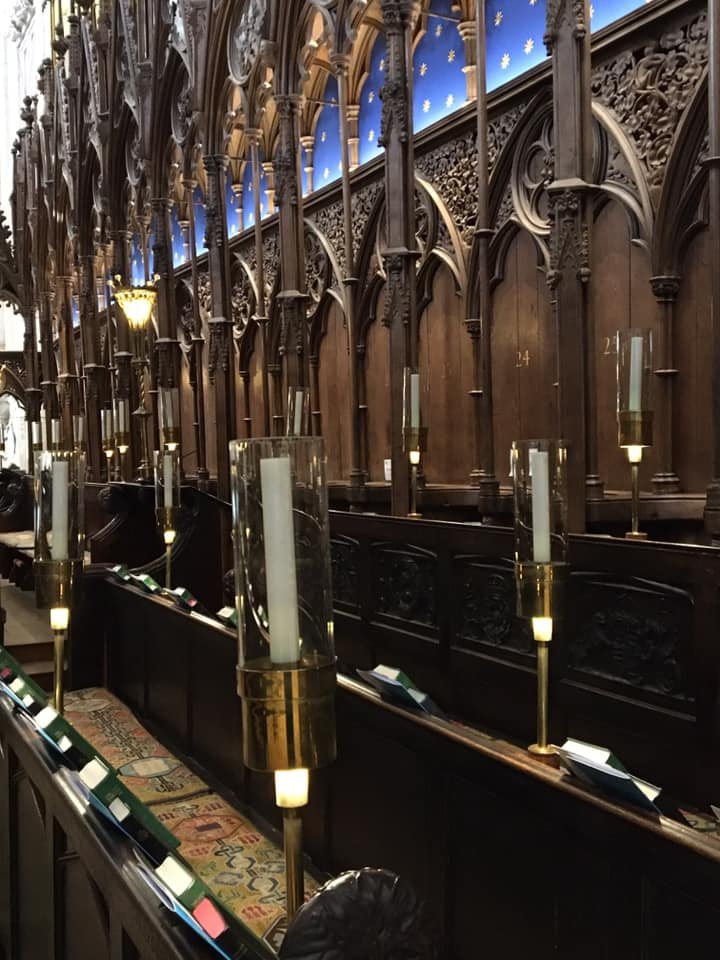
84338524_2889910537731854_333793429337145344_n

Photo credit:  Jennifer Andrews-Weckerly; reuse with permission only

Sixteen pilgrims from Hickory Neck Church traveled to England for 8 days of pilgrimage.  Our focus was on choral music, hearing Evensong or Choral Mass at a Cathedral, Minster, or college everyday.  This is the fifth entry, initially posted on our church Facebook page.  For those of you who do not follow us on Facebook, I am repeating the journey’s daily entries here.  Enjoy!

Salisbury/Winchester

Today, I was struck by the tremendous power of liturgy. We stumbled into a midday Eucharist at Salisbury Cathedral. It was spoken, and the homily was humbly short, but poignant. Then, as the priest set the table, she asked if anyone was a licensed Chalicist. I didn’t volunteer for fear someone else would want to help, and even unsure what the rules were in the Mother Church. But as the priest finished the Eucharistic Prayer, I determined I would just go up and offer to help. As soon as the priest saw my collar, she gratefully handed me the chalice. I found myself profoundly moved: doing something almost innate, but something that also felt foreign in the vast space, in a country not my own. And yet the power of Christ’s meal knows no boundaries. His blood is shed for you, and my body is His instrument.

Later this evening, we attended Evensong at Winchester Cathedral. The Adult singers and boy Chorister’s voices sang in perfection: clean and clear, expressive and moving. Their anthem, Deep River, is the third movement of Michael Tippett’s oratorio about the Nazi government’s violent pogrom against its Jewish population—called Kristallnacht. Pulling from African-American spirituals, this last movement holds a message of hope for the possible healing that would come from Man’s acceptance of his Shadow in relation to his Light. Combining the sound of spirituals and Anglican Choral singing, and the message of justice and reconciliation, I felt all my spiritual worlds colliding, and the words and sounds brought me to tears. I was amazed by how evocative a piece a liturgical music could be. I left Evensong feeling like I had journeyed with God somewhere deeply intimate and profoundly beautiful.

I don’t know if you have had one of those liturgical moments lately. If you are longing for that kind of connection, you are always welcome at Hickory Neck. And if you have found that liturgical blessing, do share it with someone who needs it!

The lyrics for Deep River:

Deep river,
My home is over Jordan.
Deep river, Lord.
I want to cross over into campground.

Deep River,
My home is over Jordan.
Deep river, Lord,
I want to cross over into campground.

Oh, don’t you want to go,
To the Gospel feast;
That Promised Land,
Where all is peace?

Oh, deep river, Lord,
I want to cross over into campground.

86441337_2889910554398519_6456003992475402240_n

Photo credit:  Jennifer Andrews-Weckerly; reuse with permission only

← Older posts

Recent Posts

  • On the Myth and Magic of Advent…
  • On Risking Failure and Facing Fear…
  • Sermon – Luke 23.33-43, P29, YC, November 23, 2025
  • On Inhabiting Gratitude…
  • Sermon – Luke 20.27-38, P27, YC, November 9, 2025

Archives

  • December 2025
  • November 2025
  • October 2025
  • September 2025
  • August 2025
  • July 2025
  • June 2025
  • March 2025
  • February 2025
  • December 2024
  • November 2024
  • October 2024
  • September 2024
  • August 2024
  • July 2024
  • June 2024
  • May 2024
  • March 2024
  • February 2024
  • January 2024
  • December 2023
  • November 2023
  • October 2023
  • September 2023
  • August 2023
  • July 2023
  • June 2023
  • May 2023
  • March 2023
  • February 2023
  • January 2023
  • December 2022
  • November 2022
  • October 2022
  • June 2022
  • May 2022
  • January 2022
  • December 2021
  • November 2021
  • October 2021
  • September 2021
  • August 2021
  • June 2021
  • May 2021
  • April 2021
  • March 2021
  • February 2021
  • January 2021
  • December 2020
  • November 2020
  • October 2020
  • September 2020
  • August 2020
  • July 2020
  • June 2020
  • May 2020
  • April 2020
  • March 2020
  • February 2020
  • January 2020
  • December 2019
  • November 2019
  • October 2019
  • September 2019
  • August 2019
  • July 2019
  • June 2019
  • May 2019
  • April 2019
  • March 2019
  • February 2019
  • January 2019
  • December 2018
  • November 2018
  • October 2018
  • September 2018
  • August 2018
  • July 2018
  • June 2018
  • May 2018
  • April 2018
  • March 2018
  • February 2018
  • January 2018
  • December 2017
  • November 2017
  • October 2017
  • September 2017
  • August 2017
  • July 2017
  • June 2017
  • May 2017
  • April 2017
  • March 2017
  • February 2017
  • January 2017
  • December 2016
  • November 2016
  • October 2016
  • September 2016
  • August 2016
  • July 2016
  • June 2016
  • May 2016
  • April 2016
  • March 2016
  • February 2016
  • January 2016
  • December 2015
  • November 2015
  • October 2015
  • September 2015
  • August 2015
  • July 2015
  • June 2015
  • May 2015
  • April 2015
  • March 2015
  • February 2015
  • January 2015
  • December 2014
  • November 2014
  • October 2014
  • September 2014
  • August 2014
  • July 2014
  • June 2014
  • April 2014
  • March 2014
  • February 2014
  • January 2014
  • December 2013
  • November 2013
  • October 2013
  • September 2013
  • August 2013
  • July 2013
  • June 2013
  • May 2013
  • April 2013
  • March 2013
  • February 2013
  • January 2013
  • December 2012
  • November 2012
  • October 2012
  • September 2012

Categories

  • reflection
  • Sermons
  • Uncategorized

Meta

  • Create account
  • Log in
  • Entries feed
  • Comments feed
  • WordPress.com

Blog at WordPress.com.

  • Subscribe Subscribed
    • Seeking and Serving
    • Join 394 other subscribers
    • Already have a WordPress.com account? Log in now.
    • Seeking and Serving
    • Subscribe Subscribed
    • Sign up
    • Log in
    • Report this content
    • View site in Reader
    • Manage subscriptions
    • Collapse this bar
 

Loading Comments...