• About

Seeking and Serving

~ seek and serve Christ in all persons

Seeking and Serving

Tag Archives: discipleship

Sermon – Mark 1.14-20, Jonah 3.1-3, 10, EP3, YB, January 21, 2018

24 Wednesday Jan 2018

Posted by jandrewsweckerly in Sermons, Uncategorized

≈ Leave a comment

Tags

adventure, brothers, call, community, disciple, discipleship, faithful, follow, God, gospel, immediately, Jesus, John, Jonah, journey, Mark, moment, Nathaniel, Sermon

What is fun about our lessons from last week and this week is we get two different gospellers’ versions of Jesus’ first call to the disciples.  Last week, in John’s gospel, we got that great story of Philip and Nathaniel.  When Philip is asked to follow Jesus, he runs to find Nathaniel.  They have this great conversation about whether anything good can come from Nazareth.  Nathaniel reluctantly comes, and when he finally speaks with Jesus, he is amazed at what Jesus knows about him.  In the midst of community, conversation, and collaboration, both Philip and Nathaniel are able to say yes to Jesus’ invitation to discipleship.  On the other hand, Mark’s gospel paints a very different picture of the calling of the disciples.  Mark tells us Jesus passes two sets of brothers by the seashore, and instructs them to follow him.  Both sets of brothers drop what they are in the middle of doing.  In fact, the second set of brothers wordlessly abandon their father to follow Jesus.  No conversations or discernment; no collaboration or goodbyes.  In Mark’s gospel, Jesus invites, and disciples drop everything immediately and go.

I do not know about you, but I am actually in the John camp when we are talking about discipleship.  As an extrovert, I tend to process things aloud.  I need to talk through a problem with others to figure out what the best option might be.  I like to get input from others, using them as sounding boards to make sure my decision will have a positive impact.  I like to marinate on the feedback, pray a bit, share my leanings with a confidant or two, and then act.  So the idea of Nathaniel hemming and hawing, expressing his initial doubt with Philip, and then challenging Jesus when he seems to have some insight about Nathaniel seems totally relatable to me.  I need conversation, community, and collaboration, especially if I am going to drop everything important in life and follow someone in a new direction.

In some ways, I may even be closer to Jonah when we are talking about discipleship.  We hear only a small part from Jonah’s riveting story today, but what we might all remember is Jonah is a terrible follower of God.  The first two chapters of Jonah are filled with Jonah saying “yes” to God, and then totally running in the opposite direction.  He even endangers some total strangers when he boards a boat in the opposite direction of Nineveh.  He needs to be swallowed by a large fish, facing death and shame before he is willing to do what God has asked Jonah to do.

Many of you have heard this before, but my own call narrative was neither immediate nor direct.  When I first sensed a call to ministry in college, I avoided it.  I figured, maybe I could just volunteer for a year instead.  I loved working at a Food Bank that year, but figured, maybe I should work at a faith-based non-profit instead.  That would certainly count as serving God, right?!?  And then, when that did not feel totally right, I started to look at going to school – not for a Masters in Divinity, but maybe to study theology.  You know, try to learn about God, but not to be a minister.  Even when my priest suggested ordination it took me another whole year of talking to other people, reading countless books, prayer, and going on retreat before I could say yes.  Clearly, my identification with Nathaniel and Jonah is not unfounded.

But today’s lessons are nothing like my tendencies.  The portion of Jonah that we get today does not highlight any of Jonah’s dramatic avoidance and foibles.  Instead, when Jonah offers the shortest sermon ever, “Forty days more, and Nineveh shall be overthrown,” immediately, the people of Nineveh believe God, proclaim a fast, and everyone – everyone great and small – puts on sackcloth.  To understand the significance of this response by Nineveh, we need to remember that Nineveh is no saint.  They are a great kingdom of people who have been oppressing God’s chosen for ages.  They are tyrants, powermongers, and bullies.  No one scares Nineveh.  And yet, with Jonah’s sermon of judgment, they stop immediately, take on a fast, and repent of their ways.  No debates, no town hall meetings, no consultation with the king.  In fact, in the verses we do not read today, the king even proclaims that the livestock need to be put in sackcloth.  The repentance of Nineveh is total and immediate.

We see the parallels in Mark’s gospel today.  The two sets of brothers we read about, Simon and Andrew and James and John sound very similar.  They are both in the fishing industry, they are both working on nets, and they both respond immediately to Jesus’ invitation to follow him.  But there are some subtle differences that make their stories even more powerful.  You see, Simon Peter and Andrew are fishing from the shore with leaded nets.  They are fishermen, but not very wealthy ones.  Meanwhile James and John are from a higher socioeconomic status.  James and John have a boat and hired workers.  They are fishing by dragnet method, which means they are able to harvest much larger catches.[i]  Their father is also mentioned, which likely means their family has been at this business for generations.  And yet, despite the fact that James are John are in the midst of a long-standing, thriving business, both James and John and Simon Peter and Andrew have the same response to Jesus.  They drop everything immediately and go.

I wonder when you have similarly acted with immediacy to God’s call on you.  The moments do not have to be as dramatic as walking out of the classroom, office, or house without a word to anyone.  Maybe they were moments around giving to the church or a cause.  Maybe they were moments when you offered help to a stranger, knowing full well you were going to be late to your next engagement.  Maybe you called a Congress member or State Representative because your faith could no longer tolerate inaction on an issue.  Maybe you heard the volunteer sexton was retiring, and you said, “Here I am.”  Or maybe your immediacy was in getting out of bed one day and finally stepping in the doors of a church – because you needed a community to help you figure out this voice that was calling you to something new.  At some point all of us hear Jesus say, “Follow me.”

Now you may be sitting there thinking, “I have never said yes to that voice,” or “Most of the time I feel like a failure in following Jesus.”  The good news is that you are not alone.  Despite the fact that Simon Peter, Andrew, John, and James all behave exemplary today, we know as we read more of Mark’s gospel, that these are the same men who will fail time and again in their faith.  These are the same men who will deny Jesus, will argue about feeding five thousand people, will try to hold on to Jesus, and will vie for favor with Jesus.  Yes, today, they say yes immediately and they drop everything they have ever known and step out and follow Jesus.  But tomorrow they stumble, and keep stumbling their entire journey with Christ.

What our texts remind us of today is, as one scholar puts it, “Becoming a faithful Christian disciple takes both a moment and a lifetime.”[ii]  We are not going to feel emboldened to follow Jesus every day.  We are not going to abandon our families and our way of life every day.  There will be moments, hard days when we need courage and reassurance.  On those days, we can remember the moments when we said yes and answered the call.  We can recall with encouragement, on those days when we do not feel very faithful, the days when in fact we were entirely faithful.  And if we are struggling to hold onto those “yes” moments, we remember that we are called in community.[iii]  Whether the entire city of Nineveh was acting together, or disciples were called in pairs, our ability to answer God faithfully is usually done within the context of community – within a group of people who can remind us of our faithful days, and let us go when we need follow.  We are not alone in this adventure of following Jesus.  And that is good news!  Amen.

[i] Daniel J. Harrington, ed., The Gospel of Mark, Sacra Pagina Series, vol. 2 (Collegeville, MN:  The Liturgical Press, 2002), 76.

[ii] Elton W. Brown, “Pastoral Perspective,” Feasting on the Word, Year B, Vol. 1 (Louisville: Westminster John Knox Press, 2008), 286.

[iii] Karoline Lewis, “You are Never Alone,” January 14, 2018, as found at http://www.workingpreacher.org/craft.aspx?post=5044 on January 18, 2017.


Sermon – 1 Samuel 3:1-20, Psalm 139:1-5, 12-17, 1 Corinthians 6:12-20, John 1:43-51, EP2, YB, January 14, 2018

17 Wednesday Jan 2018

Posted by jandrewsweckerly in Sermons, Uncategorized

≈ Leave a comment

Tags

call, church, discipleship, faithful, Jesus, reaction, relation, relationship, revelation, Sermon

As we celebrate our Annual Meeting and another year of ministry in Jesus Christ through Hickory Neck, we could not have received a better set of lessons.  Today’s lessons are all about discipleship – what being a disciple of Jesus means for us today.  Our lessons tell us discipleship involves relation, revelation, and reaction.

What we first learn about discipleship is relation – that our work as disciples cannot happen without being related to one another.  In Samuel’s almost comical call story, inexperienced Samuel would never have understood that God was trying to speak to him unless he had been in relationship with Eli – his mentor and guide in the life of faith.  Similarly, skeptical Nathaniel would have likely never believed that Jesus could be the Messiah had enthusiastic Philip not said to him, “Come and see.”  Even our lesson from first Corinthians, which perhaps embarrassingly talks about fornication and prositution, shows us that how we relate to others matters – how we use our marvelously made bodies with others matters.

This past year of discipleship at Hickory Neck has similarly and importantly been about relation.  Whether we were talking about race through film, books, or testimony; whether we were sharing a festive meal or taking the holy meal to our homebound members; whether we sharing our stories of giving at Stewardship parties or sharing our faith journeys in confirmation class; whether we were discerning how to modify worship at Hickory Neck or talking with community leaders about how Hickory Neck could address wider needs of our community; whether we were preparing for a quiet day of reflection in Lent or whether we were preparing to welcome a new community onto our property – whatever we did this year, we did so in relation to others.  At Hickory Neck, long-timers and newcomers alike are needed when we are discerning the call of God on our common life.  At Hickory Neck, when changes big and small are being made, we do so with the input of others – both inside and outside of the community – to ensure our discernment is reflective of our related nature through Christ.  At Hickory Neck, we experience God most when we relate to one another through deep, meaningful, vulnerable relationships that rely on trust in one another and on our Lord and Savior, Jesus Christ.  We are Samuels who cannot discern God’s voice without Elis, and we are Nathaniels, who cannot believe what we are hearing without Philips.  Our discipleship is impossible without relation.

After relation, the second thing we learn from our lessons today about discipleship is revelation.  When skeptical Nathaniel responds to Philip’s invitation to come and see, and he meets Jesus, he asks Jesus how Jesus knows him.  Jesus responds, “I saw you.”  Likewise, upon the third interruption of Eli’s sleep, Eli finally realizes that Samuel is not sleepily confused; Eli realizes God is trying to speak to Samuel.  Furthermore, when Eli sees Samuel the next morning, his insistence on knowing what God said to Samuel reveals his own sin and his own coming punishment.  Even Paul’s letter to the Corinthians reveals to them how important their bodies are.  When the psalmist says God created us, knit us together, and we are marvelously made, Paul understands that those wonderful bodies God made are meant to be used for the glory of God.

The more we committed to our relationships at Hickory Neck over this past year, the more we began to experience revelation through those relationships.  When our Tuesday night seekers group invited our brothers and sisters from New Zion Baptist Church to a joint Bible Study, all sorts of beautiful, hard revelations were experienced that night.  When our liturgical task forces worked to define and discern what God was doing at Hickory Neck through worship, we discovered new and beautiful ways we could honor the abundant liturgical variety found in these walls.  When an outstanding mortgage was weighing on our budget or when longtime givers moved on from Hickory Neck, we realized how our giving could impact change at Hickory Neck.  And our budding relationship with the Kensington School has been full of revelation by the Holy Spirit – from sensing within the Vestry that the time had come to think again about a school, to discerning with community leaders that a school was indeed needed, to responding immediately when Charlie got word that Kensington was looking in our neighborhood, to developing a relationship so strong that Kensington would choose to come to Hickory Neck as opposed to another location, God used our relationships to reveal new, different possibilities for ministry.

In some ways, relation and revelation might be the easy parts of discipleship.  The harder part is that third part of discipleship:  reaction.  When Paul writes that letter to the Corinthians, Paul is able to say some hard things about the ways his friends are using their bodies.  The Corinthians could have used that revelation to linger in shame or guilt.  But Paul has a different idea. “Glorify God in your body,” Paul says.  Paul calls the community to change.  When Philip shares his experience with Jesus with Nathaniel, Philip’s story is not an idle tale.  “Come and see,” Philip says.  Philip issues an invitation to action.  And when Eli counsels Samuel what to do about the voice he keeps hearing, Samuel needs to say the words, “Speak for your servant is listening.”  In each of these stories, when something dramatic is revealed through relationship, true discipleship means answering with reaction – doing something in response.

This past year, Hickory Neck has embraced this last part of discipleship with vigor.  When our neighbors needed shelter this past winter, even when our community would have preferred to keep our treasured tradition of a Mardi Gras party, we opened our doors and found new ways to celebrate and care for one another and the wider community.  When we realized that our neighbors were longing for relationship with Christ and our welcome on Sunday mornings was not enough, we developed new ways to invite others to church, and new ways to help newcomers feel more connected once they found their way to Hickory Neck.  When we realized how deep and wide the stain of slavery on our nation was, we welcomed a stranger from Ghana into our home, and found a new friend and a deeper commitment to dealing with our own demons.  When we found new ways to use our property – either through new worship experiences, creating space for community leaders to offer healing yoga to our neighbors in need, or agreeing to step into a rapidly moving process of welcoming a school – we prayed, pondered, and wondered – but eventually said yes.

As I looked back on this year in preparation for our Annual Meeting, I was overwhelmed by the faithful discipleship of Hickory Neck.  We have taken to heart the steps of relation, revelation, and reaction, and said yes time and again.  Being in relation to one another is not easy – look at how hard our country is struggling to stay in relationship with one another.  And yet, the Hickory Neck community takes the uncomfortable and is unwavering.  Welcoming revelation is also not easy – holding up a mirror to our behavior can be scary.  And yet, the Hickory Neck community embraces that vulnerability with boldness.  Being willing to react is not easy either – answering the call to come and see, or saying, “Here I am,” involves strength and commitment.  And yet, the Hickory Neck community trustingly takes on the challenge, and acts with passion and vigor.  I cannot fully express to you how incredibly proud I am of you for all that you have done this year for the sake of the Gospel.  Your discipleship has been an inspiration to me, as I seek each day to faithfully serve Christ as his disciple too.  Of course, the work of discipleship is never done – we will continue to need to commit to the work of relation, revelation, and reaction.  But for today, in this moment of reflection and celebration, know that you are doing good work in the name Christ, glorifying God in your bodies.  Well done, good and faithful servants.  I feel privileged to work alongside you!

On Needing Each Other…

16 Thursday Nov 2017

Posted by jandrewsweckerly in Uncategorized

≈ Leave a comment

Tags

community, discipleship, each other, equal, gifts, God, housing, need, others, value

each-other

Photo credit:  https://www.gcurley.info/news/2015/01/

This morning I attending a symposium about housing in the greater Williamsburg area.  The theme of the symposium was the effect of housing on health, both for individuals and the community.  One of the ideas that stuck with me was about the consequence of a lack of affordable housing.  What the researchers found was that a lack of affordable housing had a negative impact on the entire community – not just those struggling to make ends meet, but also on those in upper-income brackets.  When communities do not have affordable housing, service industry workers can eventually opt out of living and working in the community altogether, creating a void of laborers, and an increase in the cost-of-living for all.  Whereas many wealthy community members may not be concerned about affordable housing, in fact, a lack of affordable housing hurts the property values and economy for all.

The idea of affordable housing being a problem for everyone reminded me of an idea I have been pondering lately:  we need each other.  In the United States, we have long-held ideals about individualism, independence, and industriousness.  We value an “every man for himself” ethic.  But that kind of ethic only gets us so far.  Sooner or later, we eventually discover that every man (or woman!) cannot do everything for himself or herself.  In fact, we need each other.  I suspect that our need for one another is not a surprise when we are really honest.  But many of us have a hard time being honest about our mutual need because it means admitting vulnerability, dependency, and incompleteness.  Whether we like it or not, we need one another.

This Sunday at Hickory Neck Church, we are finishing a series on discipleship, using Rowan Williams’ book Being Disciples.  Williams argues that there are two principles of Christian faith and discipleship that we need to form the basis of a moral society:  we are each of equal value to God, and we are all dependent on each other.  His second point is what connected with me today.  Williams argues, “The community that most perfectly represents what God wants to see in the human world is one where the resources of each person are offered for every other, whether those resources are financial or spiritual or intellectual or administrative.”[i]  When we allow each person to be needed, to play a role in each other’s lives, we begin to be able to see that we are not just being kind – we actually need each other.

I invite you to take a look around this week, and try to imagine what each person you meet has to offer the world.  From infants to wise elders; from wealthy to homeless; from male to female; from convict to free – imagine what gift each person has for the world, and how you can honor and respect the dignity of each person you meet.  Even when someone is rude, unkind, or on the other side of the political aisle, I encourage you to find what you need in each other.  God will help you find the answers, and I hope you will share them here!!

[i] Rowan Williams, Being Disciples:  Essentials of the Christian Life (Grand Rapids:  William B. Eerdmans Publishing Company, 2016), 69.

On Remembering Roots…

29 Wednesday Mar 2017

Posted by jandrewsweckerly in Uncategorized

≈ Leave a comment

Tags

Campus Ministry, Christ, church, college, community, disciple, discipleship, faithful, formation, fun, Jesus, leadership, love

842x347-WELS-CampusMinistry

Photo credit:  https://wels.net/serving-you/christian-life/campus-ministry/

Last night, as a member of our Diocesan College Ministry Commission, I visited Canterbury at William & Mary.  We had some time with both the students involved in the Episcopal Campus ministry and with the Campus Minister.  It is a vibrant ministry, with a lot of passion and enthusiasm around service, worship, and discipleship.  Canterbury is a place where they can ask questions of their faith, become leaders, serve their community, and forge deep friendships.  They are doing the work began in their baptism, continued in their confirmation, and now affirmed as adults.

As I listened to the students and Campus Minister, I was flooded with a host of memories from my own experience in Campus Ministry at Duke.  Although I was involved in the Wesley Fellowship, the models are quite similar.  Wesley was the place where I came into my own faith, where I engaged my intellect in partnership with professors at the Divinity School, where I first discovered the power of mission trips, and ultimately, where I began to feel a sense of call to ordained ministry.  Wesley created disciples – encouraging us to find a local church community, fostering a personal spirituality, developing deep Christian friendships, and exploring the implications of my faith.  Most of my friends from Wesley took a year or more to volunteer or live in intentional Christian community.  Today, most of the alumni I know are clergy, lay leaders, non-profit workers, social services providers, and are raising up a new generation of faithful disciples.

When I was in college, I thought Wesley was doing something revolutionary.  The community certainly articulated its faith a little differently than my home churches had.  But more than that, we created an intimate, trusting, challenging space that fed me and informed my life path.  As I thought about that experience and the experience of the Canterbury students at Williams & Mary, campus ministry does exactly what Church does – or should do.  We are forming people into faithful disciples, who want to learn and grow in their faith, who want to find ways to serve God and live out their baptismal covenant, who want to develop the deep bonds of Christian community, and who want to have some fun while they are at it!

As a pastor, I often get caught up in the programmatic and administrative work of Church.  I want to create a community that offers the things necessary to produce faithful disciples.  What last night reminded me of is that I need to remember to look around and enjoy what we are creating too.  If you have been looking for a community that can help you find meaning and purpose, can help you grow in unexpected ways, can help you connect with others on the spiritual journey, and can embolden you to live a life full of the love of Christ, come join us at Hickory Neck.  And if you are already a member, invite a friend into this rich experience.  There is good news to share!

Sermon – Matthew 5.1-12, All Saints Sunday, YA, November 2, 2014

05 Wednesday Nov 2014

Posted by jandrewsweckerly in Uncategorized

≈ Leave a comment

Tags

Beatitudes, blessed, discipleship, God, Jesus, journey, money, path, road, Sermon, stewardship, walking the way

Courtesy of http://firecatching.blogspot.com/2011_04_01_archive.html

Courtesy of http://firecatching.blogspot.com/2011_04_01_archive.html

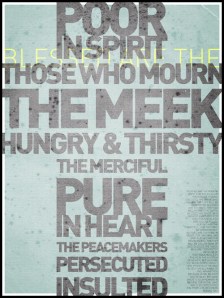
Today we hear one of the most beloved pieces of scripture.  The Beatitudes from Matthew’s gospel have been the source of inspiration for Christians for centuries, for artists and musicians, for entire ministries, and even for comedians like Monty Python.  As soon as we hear that phrase, “Blessed are…” our eyes close and we let the words flow over us.  We nod in assent, and maybe even whisper, “Yes!”  And as the preacher for In-Gathering Sunday, getting the Beatitudes in the lectionary is like being handed a silver platter.  What other inspiration can we need on a Sunday like this than to think about blessings?  That is what our Stewardship Committee has been encouraging us to do for weeks: to think about the ways that we are blessed and to return that blessing to this community through the gift of our financial resources.  That message could not be better captured than in the Beatitudes from our gospel lesson today.

Or at least that is what I thought before I started really working with the Beatitudes this week.  The more I poured over the text, the more I became confused.  Then the questions came pouring in:  What does it mean to be poor in spirit?  How do we know if we are pure in heart?  I might prefer peace, but could any of us in our everyday lives be considered peacemakers?  And those are just the surface level questions.  When we read at a deeper level, ethical questions begin to emerge.  Our news outlets have been flooded lately with people who are reviled, persecuted, and having evil uttered against them.  All we have to remember are Christians in Iraq, Palestine, or Burma whose very faith means a life of oppression and sometimes death.  Is the word for them today, “You are blessed”?  Many a liberation theologian has balked at the idea of Holy Scripture being used to keep down oppressed peoples.

Luckily, I stumbled on two things this week that opened up the Beatitudes for me in a fresh way.  First I began to look at what the word translated as “blessed” really means.  There are a couple of words in scripture that are translated in English as “blessed,” but they do not necessarily have the same meaning.  In our Beatitudes today, one scholar argues that the phrase translated as “blessed are you when…” is more rightly translated as “You are on the right road when…”  For example, “You are on the right road when you are poor in spirit.”[i]  So blessed does not really mean, “Happy are you when people persecute you,” but instead, “You are on the right road when people persecute you.”  Somehow this translation makes for a much more sober, honest rendering of Jesus’ words.  Jesus is not saying that these things are cause for happiness in a superficial way.  Jesus is saying that we are fortunate in those experiences because they point us to a deeper truth:  that we are heading in the right direction, making the right decisions, and living a meaningful life.

The other source of insight I found this week was from The Message’s translation of this text.  If you are not familiar with The Message, The Message is a paraphrase of the Bible:  not a literal translation of the Biblical language, but a modern rephrasing of the text to make the text more accessible.  Of course, biblical scholars often cringe when they hear certain paraphrases of key texts, but in the case of the Beatitudes, I found this paraphrase quite useful.

I have taken the two ideas – The Message’s paraphrase and the new introduction of “You are on the right road when…” and want to read for you my hybrid rephrasing of the Beatitudes.  Our text now goes like this:

You are on the right path when you’re at the end of your rope.  With less of you there is more of God and God’s rule.  You are on the right path when you feel you’ve lost what is most dear to you.  Only then can you be embraced by the One most dear to you.  You’re on the right path when you’re content with just who you are—no more, no less.  That’s the moment you find yourselves proud owners of everything that can’t be bought.  You’re on the right path when you’ve worked up a good appetite for God.  God’s food and drink in the best meal you’ll ever eat.  You’re on the right path when you care.  At the moment of being ‘care-full,’ you find yourselves cared for.  You’re on the right path when you get your inside world—your mind and heart—put right.  Then you can see God in the outside world.  You’re on the right path when you can show people how to cooperate instead of compete or fight.  That’s when you discover who you really are, and your place in God’s family.  You’re on the right path when your commitment to God provokes persecution.  The persecution drives you even deeper into God’s kingdom.  Not only that— You’re on the right path every time people put you down or throw you out or speak lies about you to discredit God.  What it means is that the truth is too close for comfort and they are uncomfortable.  You can be glad when that happens—give a cheer, even!—for though they don’t like it, God does!  And all heaven applauds.  And know that you are in good company.  God’s prophets and witnesses have always gotten into this kind of trouble.

This Stewardship Season, we have been talking about “Walking the Way.”  Certainly Walking the Way is a metaphor for our journey into a time of reflection about the value our money holds for us and how our relationship with that money is connected to our relationship with God.  But the Walking the Way metaphor is one that goes beyond just our money too.  Walking the Way is a metaphor for our entire journey with God – a path that is ever winding, has steep slopes at times, is sometimes full of potholes and rocks, and at other times is as smooth as a freshly paved road.  Our entire life is a journey – one in which we mature in faith from the time of our birth and baptism to the time of our old age and death.  We are constantly Walking the Way with Christ, growing, learning, messing up, and returning to a loving God.

What I like about this reworded rendition of the Beatitudes is the affirmation in them.  When we are on a journey, Walking the Way, we sometimes struggle to know whether we are on the right path.  We wonder if we are where we should be and whether God is really with us.  This rendition of the Beatitudes gives us a tiny glimpse into that affirmation:  You are on the right path when…  Of course, the description is not all roses.  Mourning, persecution, and making peace are not easy roads.  But a sign of true discipleship, of Walking the Way, are those times when the path is in fact quite rocky.  Then we know that we are on the right path, and Jesus is walking right beside us.  Amen.

[i] Earl F. Palmer, “Pastoral Perspective,” Feasting on the Word, Year A, Vol. 4 (Louisville: Westminster John Knox Press, 2011), 238.

Homily – Romans 10.8b-18, Feast of St. Andrew the Apostle, November 29, 2012

05 Wednesday Dec 2012

Posted by jandrewsweckerly in Uncategorized

≈ Leave a comment

Tags

discipleship, evangelism, proclamation, relationship with God, Sermon, St. Andrew

I lead a weekly Eucharist on Thursdays at St. Margaret’s.  The service is a short, spoken service, and my homilies are brief reflections on the saint or feast appointed for the day.  I do not usually write out these homilies, but instead outline my thoughts.  Last week a parishioner felt like it was a “waste of gems,” for me not to publish them on the blog too.  So, she is helping me type up my outlines, and I will try to start posting them here.  They are obviously less formulated than my sermons and will read a bit like an outline, but perhaps they will feed your spiritual journey.  Enjoy this first installment from the Feast of St. Andrew the Apostle.

**********************

But how are they to call on one in whom they have not believed?  And how are they to believe in one of whom they have never heard?  And how are they to hear without someone to proclaim him?  And how are they to proclaim him unless they are sent?

When we lament the shrinking church, we often forget one or more of these four steps.  In reverse order, the steps are a little clearer:  People have to be sent in order to proclaim;   Others cannot hear without proclamation; If others don’t hear, they can’t believe; and unless they believe, they cannot call on God.  Sending.  Proclaiming.  Belief.  Relationship with God.

Some of us stop at sending.  Church sends us out every Sunday, but we quickly move on to the next thing.  Some of us stop at proclaiming – we might invite others to church, but proclaiming sounds way too scary.  Others stop at belief.  We might be able to talk about our faith, but we can’t imagine being responsible for someone else’s belief.  Finally, we might convince someone to believe, but we can’t force them to have a relationship with God.

Today we celebrate Andrew the Apostle.  Andrew had every reason to avoid these steps, too.  Often he is simply known as Peter’s brother.  Andrew is not a part of the inner circle, which included Peter, James, and John.  Andrew could easily have left the work of going, proclaiming, and creating disciples to the others, just keeping his faith to himself.

What Andrew shows us is that everyone can be a disciple and evangelist.  We simply need:

  1. A willingness to respond.  Matthew says Andrew immediately leaves his nets and follows Jesus when he calls;
  2. A willingness to hear.  John says that Andrew had been John the Baptist’s disciple, and when John the Baptist proclaimed Jesus the Lamb of God, Andrew switched camps;
  3. A willingness to share the Good News.  John says Andrew’s first act after following Jesus is to go get his brother and bring him to Jesus.

Andrew is just a regular guy doing the work of proclamation!

Andrew teaches us today that we can all be evangelists.  Now I know how we hate that word and even the concept of evangelism, but Andrew makes it simple.  Go into the world, proclaim (tell your God story), encourage belief (you believe – it must be important enough to share), and foster a relationship with God (don’t stop talking – all your life is a witness to others that can foster others’ relationships with Christ).

Being an evangelist is all of this work, and the work really isn’t all that scary.  As Paul says, “The word is near you, on your lips and in your heart.”

Sermon – Mt. 11.25-30, Feast of St. Francis, October 7, 2012

09 Tuesday Oct 2012

Posted by jandrewsweckerly in Uncategorized

≈ Leave a comment

Tags

burden, discipleship, Sermon, yoke

“Come to me, all you that are weary and are carrying heavy burdens, and I will give you rest.”  These words from Jesus are familiar, comforting words.  In Rite I, we often hear this passage quoted immediately after the confession.  They seem to offer a word of peace to us, who so often feel weary from life’s stresses, anxieties, and pains.  And, when we are suffering, these words can certainly be a tender word of encouragement and promise for us.

But these words today from Jesus offer so much more to us.  Jesus offers these words in the context of commissioning disciples.  Jesus has described the way of discipleship in the gospel of Matthew; discipleship means serving the poor, working for justice, and striving for peace.  This work will be long and hard; this work will be work that will make the disciples weary.  But to those willing to take on the work of discipleship, Jesus offers these words of comfort.  And then Jesus explains how this work of discipleship can be accomplished, “Take my yoke upon you, and learn from me; for I am gentle and humble in heart, and you will find rest for your souls.  For my yoke is easy, and my burden is light.”

Now I do not know how much you know about yokes, but I have been learning a lot about them this week.  There are two kinds of yokes.  There are the kinds meant for one person:   imagine if you will the person hauling water from a well in the village, the yoke over her shoulders, while two buckets full of water hang below.  Although the yoke distributes the weight, the yoke is not necessarily easy.  The other type of yoke is a yoke for two animals.  Two oxen work together, making the workload easier.  If one ox is tired, the other pushes a little harder; later the roles reverse.  When constructed properly, a yoke for two is built to balance the work between two animals – the yoke does not chafe or rub.  A good yoke does make the work easier and light.

This is the metaphor that Jesus uses for the work of discipleship.[i]  When Jesus invites the disciples into the work of discipleship, he admits that the work will be difficult – but when yoked to Jesus, the work feels light.  When they fashion their steps in the steps of Jesus, they find that the suffering they face seems light.  Fighting for the poor, struggling for justice, striving for peace feels easier when yoked to Christ.  So often, when we are doing this work of discipleship, we forget this promise.  We think that we need to solve the world’s problems on our own, and we feel overwhelmed.[ii]  The “Study, Sup, and Serve” group has been talking about the issue of hunger the last couple of weeks.  As we learn more and more about how complicated hunger is – how hunger is not simply solved by giving someone food – we have all felt a bit overwhelmed.  Where do we begin?  How do we keep from being paralyzed by the weight of the work?  The problem of hunger seems impossible to solve.  But with Jesus yoked to us, we are promised that the yoke of alleviating hunger will be easy – the burden will be light.

On Friday, at our first edition of “Movies with Margaret,” we watched The Blind Side.  The movie is about an affluent white family in the south who encounter a poor, homeless, inner-city African-American boy named Michael.  They take him into their home, and all of their lives are transformed.  In the movie, the mother of the family, Leigh Ann, is challenged by some of her affluent friends who worry about the safety of her children with this boy around.  One friend concludes, “Well, you are changing that boy’s life.”  Leigh Ann insists, “No, you’re wrong.  He’s changing mine.”  Leigh Ann could have ignored Michael when she noticed that he was cold and homeless.  We have all made hundreds of excuses about why we cannot help this person or that person.  She could have only allowed him to stay in her home one night, having certainly fulfilled her Christian duty to shelter the homeless.  But she does not.  She keeps letting him stay.  She buys him clothes.  She helps him get academic help.  She builds his self-esteem.  And even though she takes on this very risky proposition – because Michael could have been violent, he could have stolen from her, he could have ruined her reputation in the community – even though she takes on this work, the work does not feel burdensome.  In fact, her helping Michael makes her happy.  The yoke is easy – the burden is light.

St. Francis, who we honor today, came to know Jesus’ burden as light as well.  Francis came from a very wealthy family.  He had a joyous youth, marked by revelry and social honor.  But once he encountered beggars and lepers, he suddenly gave up this way of life.  He renounced his privilege, and assumed a life of poverty, honoring the poor, the sick, and the disenfranchised.  By stripping himself of earthly wealth, which had become its own burden of sorts, Francis took on a new burden:  the burden of discipleship in Christ.  Francis began to see Christ in everyone – honoring the poor by living in poverty, caring for those less fortunate through the alms he collected, and by loving God’s creation by engaging that creation – whether by preaching to birds or negotiating peace between animals and humans.  Francis saw the bigger picture of God’s creation, and he was a faithful steward of that created order.  Through his work, he found great joy in the companions on the journey.  The yoke was easy – the burden was light.

The invitation of our gospel lesson is not simply a word of comfort – an invitation to curl up next to Jesus and hide from the world of pain and suffering.  The invitation from our gospel lesson today is to find comfort in the work of discipleship, of following Jesus.  Whatever the work might be – whether the work is alleviating hunger in our communities, caring for the poor and disenfranchised, or even sharing the Good News of Christ with a total stranger – the work will not be burdensome.

The first time I went on a mission trip was in college.  My mother was visiting during parents’ weekend, and the campus ministers had a meeting for parents to ease their concerns about us staying in a rural village in Honduras.  I remember my mom embarrassing me with questions about where we would go to the bathroom and whether we would be able to shower.  To her credit, I am not really a camper, and am pretty wigged out by bugs and filth.  But to both of our surprises, I found the trip was liberating.  When I travel on a mission trip, a different version of myself emerges.  I do not worry about my hair or makeup.  I seem to manage all manner of toilets – even if the toilet is a hole in the ground.  I seem to roll with whatever bugs I catch – and yes, I have caught everything from stomach bugs, sinus infections, and worms.  I morph into a person who does not need the comforts of this life.  The burden of being in a foreign and uncomfortable place rarely feels like a burden.  The joys that come from doing that work far outweigh the weight of the work.  That yoke of mission is fashioned so comfortably, and Jesus walks with me so steadily by my side in the yoke, that the yoke is easy – the burden is light.

This is the promise that Jesus offers today.  When we are wearied by trying to affect change for the poor and hungry, or even when we cannot get over the hump of inaction, Jesus promises us a yoke that is perfectly fashioned for us, and in which he will be our yoked partner.  Jesus yokes himself to us because we need him – for comfort, for encouragement, for strength.  But Jesus also needs us – to be his hands and feet in the world.  We do the work together.  In fact, the work will feel unlike work at all.  Because the yoke is easy – the burden is light.  Amen.


[i] Douglas R. A. Hare, Matthew, Interpretation: A Bible Commentary for Teaching and Preaching (Louisville: John Knox Press, 1993), 129.

[ii] Barbara Brown Taylor, The Seeds of Heaven: Sermons on the Gospel of Matthew (Louisville: Westminster John Knox Press, 2004), 21.

Newer posts →

Recent Posts

  • On the Myth and Magic of Advent…
  • On Risking Failure and Facing Fear…
  • Sermon – Luke 23.33-43, P29, YC, November 23, 2025
  • On Inhabiting Gratitude…
  • Sermon – Luke 20.27-38, P27, YC, November 9, 2025

Archives

  • December 2025
  • November 2025
  • October 2025
  • September 2025
  • August 2025
  • July 2025
  • June 2025
  • March 2025
  • February 2025
  • December 2024
  • November 2024
  • October 2024
  • September 2024
  • August 2024
  • July 2024
  • June 2024
  • May 2024
  • March 2024
  • February 2024
  • January 2024
  • December 2023
  • November 2023
  • October 2023
  • September 2023
  • August 2023
  • July 2023
  • June 2023
  • May 2023
  • March 2023
  • February 2023
  • January 2023
  • December 2022
  • November 2022
  • October 2022
  • June 2022
  • May 2022
  • January 2022
  • December 2021
  • November 2021
  • October 2021
  • September 2021
  • August 2021
  • June 2021
  • May 2021
  • April 2021
  • March 2021
  • February 2021
  • January 2021
  • December 2020
  • November 2020
  • October 2020
  • September 2020
  • August 2020
  • July 2020
  • June 2020
  • May 2020
  • April 2020
  • March 2020
  • February 2020
  • January 2020
  • December 2019
  • November 2019
  • October 2019
  • September 2019
  • August 2019
  • July 2019
  • June 2019
  • May 2019
  • April 2019
  • March 2019
  • February 2019
  • January 2019
  • December 2018
  • November 2018
  • October 2018
  • September 2018
  • August 2018
  • July 2018
  • June 2018
  • May 2018
  • April 2018
  • March 2018
  • February 2018
  • January 2018
  • December 2017
  • November 2017
  • October 2017
  • September 2017
  • August 2017
  • July 2017
  • June 2017
  • May 2017
  • April 2017
  • March 2017
  • February 2017
  • January 2017
  • December 2016
  • November 2016
  • October 2016
  • September 2016
  • August 2016
  • July 2016
  • June 2016
  • May 2016
  • April 2016
  • March 2016
  • February 2016
  • January 2016
  • December 2015
  • November 2015
  • October 2015
  • September 2015
  • August 2015
  • July 2015
  • June 2015
  • May 2015
  • April 2015
  • March 2015
  • February 2015
  • January 2015
  • December 2014
  • November 2014
  • October 2014
  • September 2014
  • August 2014
  • July 2014
  • June 2014
  • April 2014
  • March 2014
  • February 2014
  • January 2014
  • December 2013
  • November 2013
  • October 2013
  • September 2013
  • August 2013
  • July 2013
  • June 2013
  • May 2013
  • April 2013
  • March 2013
  • February 2013
  • January 2013
  • December 2012
  • November 2012
  • October 2012
  • September 2012

Categories

  • reflection
  • Sermons
  • Uncategorized

Meta

  • Create account
  • Log in
  • Entries feed
  • Comments feed
  • WordPress.com

Blog at WordPress.com.

  • Subscribe Subscribed
    • Seeking and Serving
    • Join 394 other subscribers
    • Already have a WordPress.com account? Log in now.
    • Seeking and Serving
    • Subscribe Subscribed
    • Sign up
    • Log in
    • Report this content
    • View site in Reader
    • Manage subscriptions
    • Collapse this bar
 

Loading Comments...