• About

Seeking and Serving

~ seek and serve Christ in all persons

Seeking and Serving

Tag Archives: Episcopal

On Leaks and Parishes…

31 Thursday Jul 2025

Posted by jandrewsweckerly in reflection

≈ Leave a comment

Tags

church, Episcopal, faith, God, member, parish, spiritual, world

Photo credit: Jennifer Andrews-Weckerly. Reuse with permission only.

Last week at our church we discovered a leak in our parish house that necessitated saws, hammers, and very loud industrial fans.  By Friday, the constant noise broke my patience and I decided I needed to find an alternate place to work remotely – maybe not a place of silence, but certainly a change of scenery.  I landed in two different eateries/coffeehouses and decided to publicize my “remote office.”

What I found was people visiting from out-of-town I did not know were here, parishioners running errands, happy for an open ear, and lots of gratitude for being invited into the shared experience – both from church members and non-members alike.  The experience reminded me why Episcopal Churches are often referred to as “parishes.” Once upon a time, Episcopal churches served a geographic region, or a parish, and the priest was sort of the neighborhood priest.  Doing my work and meeting people where they are – whether they are from my actual church or not, reminded me of the original intention or churches:  that their priests were for the good of the entire community, not just the members.

Archbishop William Temple is attributed with having once said, “The Church is the only institution that exists primarily for the benefit of those who are not its members.”  At our church, we often talk about our mission being simultaneously about those inside our walls and those outside our walls.  That’s why we are doing some big things of late:  developing a third worship service designed specifically for people who are not a part of our community; forming a team who will look at alternative uses of our property that are missional and community-facing; and establishing small groups for spiritual formation that meet off campus – in homes and places of everyday “parish” life.  If we truly believe Archbishop Temple, then our clergy sitting in coffeehouses and eateries should more often be the norm than the crisis-driven exception.

Being out in the “parish” is not just the role of the priest.  I wonder how you are taking your faith, your worship community, your church out into the world.  When was the last time you asked a friend about their spiritual health (in the same way you would ask them about their physical or emotional health)?  When was the last time you were listening deeply to another person’s story and were willing to offer where you saw God in their story?  When was the last time you invited someone to church – not necessarily to the building on Sunday at a certain time, but into the experience of “church” that has been so transformative for you?  I cannot wait to hear about how you can envision taking your church out into the parish!

Sermon – Matthew 2.1-12, EP, YC, January 5, 2025

12 Wednesday Feb 2025

Posted by jandrewsweckerly in Sermons

≈ Leave a comment

Tags

both/and, either/or, Epiphany, Episcopal, fear, God, hope, Jesus, magi, Sermon

Many Episcopalians find their way to the Episcopal Church from another way – another denomination or even no faith at all.  One common theme among those making their way to the Episcopal Church is that they are fleeing a faith that is “black and white,” or “either/or.”  They find comfort in the Episcopal Church because the Episcopal Church embraces the “gray,” or the “both/and.”  The appeal of those other traditions is obvious – there is no ambiguity or need for discernment in a “black and white” faith.  Something is either right or wrong.  That kind of clarity is refreshing in a world that is always complex, complicated, and ambiguous.  But our Episcopal tradition does not offer the comfort that comes from absolutes.  Our tradition helps us find comfort within, not despite, the complexity and ambiguity of both our sacred and secular lives.

Take our gospel lesson today.  We could easily read the Epiphany story, the story of the visitation of the Wise Men or Magi, and make easy, defendable categories:  Herod is bad, the Magi are good.  But before we dig in too deeply in that dichotomy, we are going to be good Episcopalians this morning and look into the gray.  We start with the Magi.  There is something quite magical about these wise people of thought.  Their magic is not in how they used their mental capacities to track a star to find the Messiah.  What is magical about the Magi is their response to finding Jesus.  Matthew tells in the literal translation that the Magi “rejoiced with a really, really big joy.”[i]  These Magi, who know very little about the life, death, and resurrection of the king of the Jews feel something, feel really, really big joy in the Christ Child because they, unlike most of us, have “mastered the art of hoping in God.”[ii]

Ellen Davis, Old Testament scholar, explains there is a Proverbs verse that helps us understand the Magi.  Proverbs 10.28 says, “The hope of the righteous is gladness.”  She goes on to explain, “Those who train their sights on the faithfulness of God, ‘the righteous’ – they already experience joy even before they see their hopes fulfilled, even if they never live to see (in this world, at least) the clear fulfillment of all that God has promised…That is the kind of joy that burst forth that night on the streets of Roman-occupied Bethlehem, like flowers springing suddenly out of stone pavement.  It was joy that takes root in nothing more (or less) substantial than hope itself.”[iii]

The Magi’s hope does not teach us that because God is born in Jesus all is right in the world.  I am not sure any of us would believe that anyway, given the current state of the world.  Instead, as Davis explains, “Christian hope is something very different from the natural feeling of elation that comes when things are going our way.  No, hope is not a feeling that ebbs and flows.  Rather, it is a way of living that we choose; and gradually, day by day, we learn to be graceful in it.  Hope is a way of living beyond our own limited vision and natural fears, a way of living into God’s faithfulness and there finding fullness of joy forevermore.”[iv]

Now, we could easily stop our interpretation there, and say, “Don’t be bad like Herod, be hopeful and righteous like the Magi, and all shall be well.”  But remember how I told you about the ambiguity of the Episcopal Church?  Let’s go back to Herod – the supposed “wrong” to the “right” of the Magi.  We know Herod is a horrible, power-hungry, paranoid ruler.  We are told that when these foreigners come out saying a new King of the Jews has been born, Herod is afraid.  He’s not scared of a baby – he’s scared about the threat to his power.  And so, he pulls together his own biblical scholars in secret, and then talks to the Magi in secret to get them to find this baby – not so that he can worship him, as Herod claims, but so that he can kill the threat to his power.  And when that does not work because the Magi go home another way, we find out in the verses following our text today, that Herod has all the boys in Bethlehem under the age of two murdered – just to make super sure that his power is secure.

But the problem of making Herod out to be the villain is we skip over one key point.  The text says, all of Jerusalem is frightened by this new king too.  As Davis explains, “Herod could not have secured the deaths of all those children, if he were the only one who was afraid.  Matthew is pointing to the clearly documented fact that fear is contagious, and [fear] readily crosses party lines…Fear spreads like plague through an unhealthy system, infecting not only those who are powerless to defend themselves – the Jewish families in Bethlehem – but also infecting the relatively powerful, the ruling elite in Jerusalem, who sensed (with that gut-gripping fear that comes in the middle of the night) the fragility of the base on which their power rested.”[v]

So, before we try to simplify again – Magi are good, Herod (and the people of faith in Jerusalem) are bad,” Ellen Davis encourages us to see another way.  She says, “This is not a simple picture of them and us, as we would prefer to believe.  Rather, if we read the story deeply and honestly, I think we will identify both with fearful Jerusalem and with hopeful Magi; for they both reveal aspects of our own situation that we have not seen clearly before…there is judgment for us in that picture of Herod and all Jerusalem.  Matthew holds [that judgment] before us like a mirror, challenging us to acknowledge our fear, to recognize the violence that springs from fear and will doubtless perpetuate [violence].  Yet Matthew does not consign us to despair.  For alongside that mirror is a second one – you might call [the second mirror] a glass of vision, for [the second mirror] show us something a little ahead of where we are now.  [The mirror] shows what we as a church can and will look like if we stand against the tyranny of self-perpetuating fear.  We will look like the Magi.”[vi]

I cannot think of a better time to read this “both/and” text, this “gray” text where everything is not so rigid as we might prefer.  Many in our communities are full of fear right now – fear from what the changes of a new administration will do in power, fear of violence like the wonton killing of those in New Orleans this New Year’s, and even fear of financial instability in these volatile times.  We do not honor the Magi today because their message is “Just have hope and all shall be well!”  Instead, as Davis argues, Matthew, “challenges us to be the community of resistance that the church has been…from the beginning.  [Matthew] challenges us as a church to examine and deepen our understanding of the systems that generate fear for ourselves and others.  He challenges us as a church to find ways out of those systems – not to despair, though the systems are large and powerful, but to find and commit ourselves to the small steps by which we may depart from the country governed by fear and go by another road to our own country, that place we call the kingdom of God.  Matthew’s Gospel challenges us to live boldly in the hope of the Magi, so that having rejoiced with them at the first coming of Christ, we may at his second coming know fullness of joy forevermore.”[vii]  That may not be the “right/wrong” word you were looking for this morning.  But I think the beauty of the gray of Holy Scripture today is exactly what we need.  Amen.


[i] Ellen F. Davis, “Stargazers,” January 5, 2003, Sermons from Duke Chapel:  Voices from “A Great Towering Church,” William H. Willimon, ed. (Durham, NC:  Duke University Press, 2005), 337.

[ii] Davis, 338.

[iii] Davis 338.

[iv] Davis, 339.

[v] Davis, 340. 

[vi] Davis, 341.

[vii] Davis, 341.

Sermon – John 1.6-8, 19-28, A3, YB, December 17, 2023

03 Wednesday Jan 2024

Posted by jandrewsweckerly in Sermons

≈ Leave a comment

Tags

Advent, call, discernment, Episcopal, evangelism, identity, Jesus, John, nervous, Sermon, vocation, witness

Episcopalians are a funny crew.  I can claim that description honestly because I actively chose the Episcopal Church, having been raised in another denomination.  But what continues to humor me all these many years later is the almost universal look of panic Episcopalians get in their eyes when you start talking about evangelism.  I can already feel the nervous shifting in the room, so know that you are not alone.  The problem is the concept of evangelism brings up all sorts of images:  the guy on the street corner with a megaphone talking about the end being near; people knocking on your door with tracks about Jesus; the person asking you directly if you have been saved; or maybe even some more personally deeply damaging memories from so-called evangelicals.  And so, Episcopalians either:  just don’t do evangelism (entirely faithful but absolutely unwilling to talk to people about their faith life or Jesus); or they might be willing to share something vaguely about their church, but couldn’t imagine uttering the name Jesus; or they’ll do my favorite thing, which is quote St. Francis who is quoted as saying, “Preach the gospel at all times and if necessary, use words.” – and use that as the ultimate excuse to never actually have to use words.

For all of us squeamish Episcopalians, scripture gives us John today.  Now, in Mark’s gospel, John is called “John the baptizer.”  In Matthew’s gospel, he is called “John the Baptist.”  In Luke’s gospel, he is called, “John, the son of Zechariah, in the wilderness.”  But in John’s gospel that we read today, our beloved John is “John the Witness.”[i]   In fact, John’s gospel doesn’t have any narratives about John leaping in the womb, John dressed in funny clothes, or even John baptizing Jesus.  Instead, John’s gospel is the one that starts with that flowery poetry, “In the beginning was the Word, and the Word was with God, and the Word was God.”  Into this beautifully convoluted prologue comes John, who comes as a witness – whose entire job is to point to Jesus. 

I am not suggesting that your whole life needs to be a self-emptying, agency-free pointing to Jesus.  I had a dear friend whose response to every compliment was, “It’s not me.  It’s all Jesus working in me.”  This is a wonderfully humble way to live, but also a completely irritatingly sanctimonious way to live.  Instead, what John’s gospel today is inviting us to do today is to be entire clear about who we are in relation to Jesus.  Four times John the Witness is asked about his identity, “Who are you?” they ask.  “Are you Elijah?  Are you the prophet?  Who are you?”  And John the Witness says over and over again, “I am not.  I am not.  No, I am not.”  Even the prologue in the gospel tells us, “[John] came as a witness to testify to the light…He himself was not the light, but he came to testify to the light…”[ii]  In the verses following what we read, we’ll find John the Witness shouting to crowds about Jesus, “There he is!”  John is crystal clear about who is he and his role in honoring Jesus the Messiah.  His whole purpose is to be a witness.

Now, I know I might have painted this Advent as a time of sacred silence, a time of quiet preparation.  We even spent last week letting the words of Advent lap over us like cool refreshing water.  But this week, our quiet work is not passive.  Our invitation today is to get real clear on who we are.  Those questions for John are questions for each of us as well.  Who are you?  What then?  Who are you?  We have talked countless times about the work of discernment about our call – our vocation in the world.  Our work of being faithful followers of Christ is constantly checking that we know who we are and what we are called to be doing.  This is ongoing work that does not end – even in the midst of crazy Christmas preparations, we are to ask, “Who am I?” – what is God calling me to do?

This work of discernment does not excuse us nervous Episcopalians from evangelism.  I can imagine the math you were all just doing:  If John the Witness’s answers to “Who am I?” was that he was a witness, maybe my “Who am I?” will be something else – something less evangelical.  But the entire reason we do the work of answering the barrage of questions about who we are is so that we can prepare ourselves for active encounters with others about who they are – what they long for – how the coming Jesus has blessed us, and how our Church has helped us answer “Who are you?”  John is not the only Witness today in our gospel lesson.  John is simply pointing the way for our own witness too.  Amen.


[i] Gary W. Charles, “Exegetical Perspective,” Feasting on the Word, Yr. B, Vol. 1 (Louisville: Westminster John Knox Press, 2008), 71.

[ii] John 1.7-8.

Sabbatical Journey…On Differences and Experiences

26 Monday Jun 2023

Posted by jandrewsweckerly in reflection

≈ 1 Comment

Tags

church, Church of Latter-Day Saints, differences, Episcopal, experience, faith, question, Salt Lake City, welcome

She Will Find What is Lost, by Brian Kershisnik, at the CJCLDS Conference Center (picture taken June 25, 2023)

Today, we toured Salt Lake City with a family friend and her family.  We wanted to learn about Temple Square, and help the kids learn a little more about the Church of Jesus Christ of Latter-Day Saints.  We couldn’t have had a more patient, open, vulnerable tour guide than our friend.  She constantly said all questions were fair game, and she meant it.  We learned about Church structure and governance, liturgical practices, theology, and personal experience.  Her son told us about his Morman mission to Korea and her girls talked about their choice not to take a mission.  We also got to see the 20,000-seat Conference Center, and the Tabernacle with the 11,000-pipe organ.  And we got the real experience of most businesses being closed on Sundays due to the widely respected sabbath day of rest. 

As we were talking with our friend about her faith and considering the differences in practices and theology, I began to realize how strange my faith must sound to the unchurched.  It is tricky enough to navigate and respect differences within the Abrahamic faiths.  But to someone who is unchurched, surely how we interpret scripture, what we practice (and don’t), and all our rules and restrictions must seem so foreign and intimidating.  Trying to figure out the differences between an Episcopalian and a member of the LDS must feel completely befuddling. 

I think we forget that what matters most to the unchurched is not necessarily all those distinctions among us, but how we treat the unchurched.  So much of what we think about church or other faiths is based on our experience of them – not some heady explanation of doctrine.  So, whether we are treated with dignity matters.  Whether we are given freedom to explore and ask questions without judgment matters.  Whether we experience genuine love and acceptance as we are matters.  I have known many an Episcopalian who was drawn to the Episcopal Church because they were frustrated by the doctrine of another denomination or faith.  But what kept them in the Episcopal Church wasn’t the doctrine they were seeking, but the reception they received once they kept coming back to church.

I hope this blog is one small way you might begin to experience the invitation of church another way.  Your questions and your struggles are welcome here.  You pain and hurt, as well as your hopes and joys, are welcome here.  Your skepticism and your hesitancy are welcome here.  Most of us people of faith are still figuring out this whole faith thing too.  You are welcome here.

Sermon – Acts 1.15-17, 21-26, E7, YB, May 16, 2021

26 Wednesday May 2021

Posted by jandrewsweckerly in Sermons

≈ Leave a comment

Tags

apostles, bishop, discernment, disciples, election, Episcopal, God, goodness, grace, Holy Spirit, Jesus, prayer, Sermon, trust, will

I have sometimes daydreamed about the experience of liturgical freedom:  picking and choosing the scripture for a given Sunday (particularly when I need to address a specific issue), praying an extemporaneous prayer on a Sunday to address a certain topic in the church, or drafting our own liturgical experience to address a particular need.  However, as crazy as the idea may sound, I more often find freedom within our Episcopal constraints than within the endless possibilities of what could be. 

This past week was a classic example.  Last Sunday, totally unaware of the announcement I would be making on Tuesday, Bob preached about the invitation of the Resurrection being an invitation into discernment – discernment about what each of us needs to do to bring about the kingdom here on earth.  On Tuesday night, our regularly scheduled Discover Class topic, which was scheduled months ago, was focused on the structure and leadership model of the Episcopal Church, including who bishops are and how they are elected.  Then today, we get this lesson from the Acts of the Apostles in which Peter and the other apostles are attempting to replace the twelfth spot Judas left open through his death.  All that daydreaming about constructing our spiritual experiences went out the window this week when I remembered the Holy Spirit does a much better job at constructing those experiences than I ever could!

To say that this portion of the Acts of the Apostles is a divine gift is not necessarily because we happen to be talking about a bishop’s election this week just as the apostles are talking about an election of sorts.  In fact, what the apostles are doing is the opposite of an election.  No one asks Matthias or Justus to go through an interview process or offer their vision of leadership for the next decade.  Instead, their criteria are pretty simple.  First, the replacement should be someone who knows Jesus personally.  Second, they want to honor their ancestral roots in the twelve tribes of Israel – eleven apostles will not suffice.[i]  Third, their decision is rooted in prayer.  And finally, their decision is based on trust in the will of God.  Nowadays, we might think the casting of lots is a little too random and could lead to a poor appointment of leadership – I mean when was the last time we selected a Rector, Warden, or Committee Chair by flipping a coin?  But according to New Testament scholar Kathy Grieb, the casting of lots is “an ancient biblical practice for determining God’s will…”[ii]

Hearing about all the coincidences in our last week, from talking about discernment, to the structure of the Episcopal Church, to the selection of the last apostle, may be intriguing or even amusing, but may also leave you asking, “So, what?  What does all of this have to do with me or my experience of Hickory Neck, or even more broadly, with Jesus?”  As I have reflected on these coincidences – or as Carl Jung referred to them as instances of “synchronicity” or “meaningful coincidence”[iii] – I see an invitation for all of us from Peter.  First is an invitation to recall our identity.  We are a community whose historic identity has been about weathering change – whether it was the identity crisis created by the Revolutionary War, the replacement of a faith community by schools and hospitals for over a century, to reclaiming and expanding our land to become a church again, to surviving a global pandemic.  The possibility of a change in clergy – a very small possibility at that – does not alter the fact that we are a community rooted in Jesus’ love, shining our light on this Holy Hill for almost three centuries.  Second is an invitation into prayer:  prayer for the Hickory Neck Community, prayer for your Rector, and prayer for the Diocese of Iowa and the other candidates.  Our hurt, our frustration, our fear, and our joy can be left at the feet of Christ in prayer.  When given the space, prayer can do much more than we can imagine.  And finally, our invitation this week is to trust in God.  We may not always like what God does – I am pretty sure the apostles would much rather have not been trying to figure out a leadership model in Jesus’ absence.  But we do know that God is faithful, and, in time, God leads us to goodness and grace.  I do not know where the next couple of months will lead us.  But I do know if we can stay rooted in our identity, in prayer, and in our faith in God, we will come out stronger disciples for Jesus, strengthened to take on whatever “meaningful coincidences” the Holy Spirit throws our way.  Amen.


[i] Noel Leo Erskine, “Theological Perspective,” Feasting on the Word, Year B, Vol. 2 (Louisville: Westminster John Knox Press, 2008), 528.

[ii] A. Katherine Grieb, “Exegetical Perspective,” Feasting on the Word, Year B, Vol. 2 (Louisville: Westminster John Knox Press, 2008), 531.

[iii] Carl G. Jung, Synchronicity: An Acausal Connecting Principle (Princeton:  Princeton University Press, 2012), 44, as cited at https://artsofthought.com/2020/05/30/carl-jung-synchronicity/ on May 14, 2021.

Sermon – Matthew 28.16-20, TS, YA, June 7, 2020

17 Wednesday Jun 2020

Posted by jandrewsweckerly in Sermons, Uncategorized

≈ Leave a comment

Tags

Christian, connect, Coronavirus, danger, disciples, engage, Episcopal, God, Great Commission, Jesus, love, pandemic, protest, relationship, Sermon, witness

We have had a week.  For most of us, the Coronavirus alone would be enough – the suffering of those infected, the over 100,000 deaths in our country from the virus, the economic hardship on our communities, and the chafing reality of staying distanced from one another.  But in the midst of a pandemic, our country has also exploded with civil unrest as we grapple with the death of another man of color under the hands of a police officer.  We have witnessed daily peaceful protests, violent, destructive rioting, unsettling debates about the extent of national executive power over state’s rights, renewed conversations about systemic racism, and vivid images of police officers and National Guard members trying to balance their genuine support for the content of the protests with needing to keep crowds safe.  And whether he meant to our not, by the aggressive clearing of peaceful protesters in order to take a photograph in front of an Episcopal Church with a Bible in hand, our President has forced Episcopalians and all Christians to take a hard look at what being a Christian means and what Christian witness looks like.  Like I said, it has been a week.

At the end of a week like this, I had been hoping for a comforting word from scripture – maybe something about the Good Shepherd, or some pastoral scene of Jesus gathered in loving community.  Instead, our gospel lesson today from Matthew is the Great Commission – the very last words of Matthew’s gospel – which are not words of comfort and rest, but words of sending out.  Jesus says, “Go therefore and make disciples of all nations, baptizing them in the name of the Father and of the Son and of the Holy Spirit, and teaching them to obey everything that I have commanded you.”  These are not words of retreat and rest.  In these last words of Jesus, Jesus sends us out into the world, encourages us to do work that requires relationship-building, listening, and teaching.[i]  These are words of engagement, witness, and connection.

I do not know about you, but I was not ready to hear these words today.  The idea of venturing out in public still feels fraught with danger in this time of pandemic.  The idea of witnessing Christ’s love, particularly with our brothers and sisters of color, feels fraught with danger because of the volatility and justified anger of many of the protestors.  The idea of relationship building required in the act of “making disciples” feels fraught with hypocrisy as our brothers and sisters of color remind us how deeply our own racism runs.  When Jesus says, “Go!” to us today, I find myself hesitating at the door.  Go how?  Go where?  Go to whom?

So how do we go?  The good news is that Jesus tells us how we will go.  After the words of the Great Commission, Jesus says, “And remember, I am with you always, to the end of the age.”  We can cross that threshold because Jesus is with us – always – to the end of the age.  And where shall we go?  Jesus says we should go to all the nations.  In other words, everyone needs God’s message of love and hope.  The good news today is going to the nations is, surprisingly, still possible.  Even in this pandemic’s limitations on our movement, we can still share God’s love – in our prayers from home, in our words to our neighbors, in our letters to elected officials, in our public witness on social media, and in our calls of support to police officers trying to do the work of reconciliation in their own sphere.  And to whom shall we go?  To our neighbors of color who need our support, to our political opponents (and yes, I recognize those opponents are different for each of us) who need us to stay engaged in honest, calm, productive relationship, to our political allies, who need us to not be an echo chamber, but need us to hold up a mirror to ensure we are actually sharing truth with love.

I know many of you may be thinking, “I can’t.  Even with Jesus’ promise to be with me, I just can’t.  It’s too hard.”  But here’s what I can tell you:  you already are.  I watched this week as over twenty parishioners reclaimed the gospel message of love on the front porch of our historic chapel.  I watched this week as many of you offered up your prayers – for peace, for understanding, for love.  I watched this week as many of you joined peaceful protests – witnessing Christ’s love for all.  I watched this week as many of you searched for reading materials – whether you were looking for books and articles about race, or whether you were ordering your Bibles to join in our 90-day Bible Reading Challenge, looking for ways to hone your ability to make disciples, to build relationships.  Jesus’ Great Commission today may feel like more work instead of the salve you were hoping for today.  But I can tell you the fact that you are already living the Great Commission in your own way, with your own gifts, and your own abilities, is your salve today.  Keep going.  Keep building relationships.  Keep witnessing God’s love.  It’s not too hard – because Jesus is with you always, even to the end of the age.  Amen.

[i] Thomas G. Long, Matthew (Louisville: Westminster John Knox Press, 1997), 326.

On Discernment…

25 Wednesday Sep 2019

Posted by jandrewsweckerly in Uncategorized

≈ Leave a comment

Tags

bishop, choose, Diocese, discernment, Episcopal, God, Holy Spirit, identity, politics, prayer, silence, space, trust

70764-shoes-direction-arrows-road-gettyimages-11361.1200w.tn

Photo credit:  https://www.ibelieve.com/faith/what-is-discernment-ways-grow-more-discerning.html

This past weekend, our Diocese elected its next bishop.  Having never served in a diocese that was electing a bishop, I was not entirely sure what to expect.  I had heard stories of clergy politicking for particular candidates, trying to sway their colleagues to vote a particular way.  I knew we have a diversity of perspectives in our Diocese and coming to consensus may be difficult.  And although I had spoken to many clergy colleagues about their discernment for the best bishop, I did not know nearly as many laity and what their discernment had been like.  By the time we gathered for the election, I felt anxious, hoping we could be civil, but dreading what might be a contentious process.

Instead, I found something quite different.  Some of the difference may have been the result of careful crafting.  We were seated in an auditorium, with a long center row.  Try as one might, getting up and down to talk to others between votes was not exactly easy.  Instead, many of us were left to pray on our own or consult the limited people around us.  Likewise, once the polling was closed, we were required to wait for the candidates to be notified of the results before we were; once the results were announced though, the leadership immediately had us vote again.  We had little ability to process the results of one ballot with others before voting again.  Further, before each vote, our chaplain read a prayer from the Book of Common Prayer.  And finally, there was absolutely no internet or WiFi in the room, forcing us away from technology and into a real sense of presence in the room.

Perhaps it was the rigid structure that guided our behavior, making the election different than I expected.  But I also suspect those gathered last weekend consciously chose a different path.  Instead of dividing into camps behind one of the six candidates, our laity and clergy seemed to embrace the election as a matter of prayerful discernment, not premeditated politicking.  Limited by the confines of the room, you could sense the powerful prayers emanating from each delegate – desperately trying to discern the Holy Spirit’s will.  The pacing of the ballots did two things.  One, there was ample time to prayerfully consider the name one just submitted electronically, before knowing what everyone else had just done; and two, there was a mandate to keep moving, to keep faithfully and rapidly calling on God for answers.  Even our chaplain seemed to root us in tradition.  By using the BCP instead of extemporaneous prayer, she minimized her and our influence on one another – instead, calling us back to the book the is such a marker of our identity.

You may already know about the dramatic turn of events toward the end of our election.  I suspect the prayerful process of discernment in which we were engaged in that space was also shared among the candidates, helping them to faithfully discern what they should do too.  Having walked through that experience so prayerfully, I wonder if there is not something for us all to learn from about the hard decisions of everyday life.  Perhaps we too could stand to:  root ourselves in prayer, trust those around us to be praying too, create environments around our discernment where are weakness are less able to thrive, return again and again to the beautiful words of prayer book, make space for silence when you do not know all there is to know, and, perhaps most importantly, trust the Holy Spirit to do great things in spite of us.  If you are in discernment about something in your life, know that you have my prayers.  I would love to hear your stories of how the Spirit is moving in your life too!

GC79: When People Start Getting Real…

07 Saturday Jul 2018

Posted by jandrewsweckerly in Uncategorized

≈ Leave a comment

Tags

apathy, children of God, compromise, conversation, Episcopal, General Convention, Jesus, justice, prayer, relationship, truth, uncomfortable

36768122_10157017520522565_436164541772988416_o

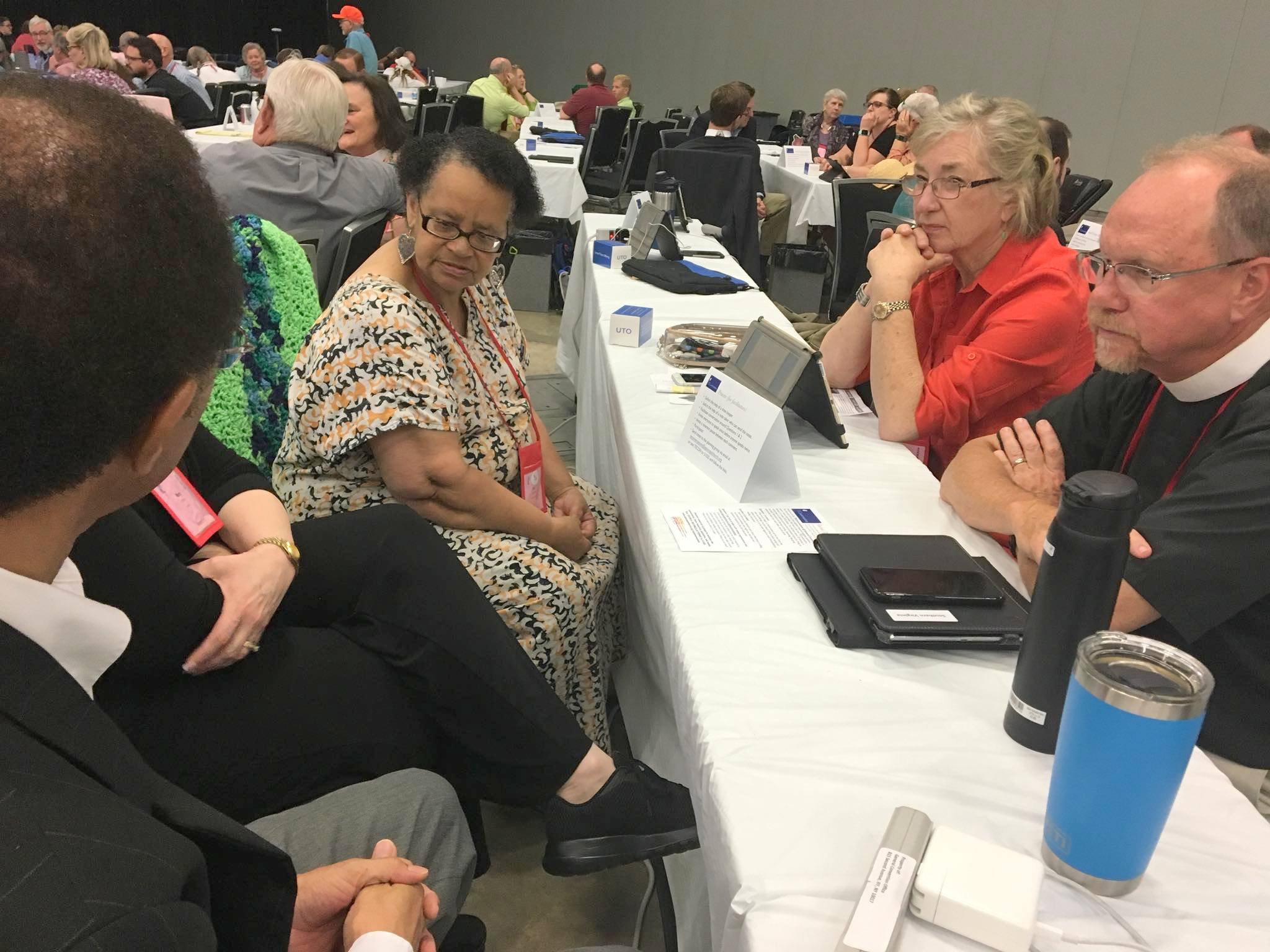
General Convention, July 6, 2018.  Photo credit: Jennifer Andrews-Weckerly (reuse with permission)

One of the things that I am finding powerful about General Convention is a willingness to enter into a time of truth-telling.  Before I arrived, the House of Bishops hosted a listening session of stories from women who have been sexually harassed or abused in the context of the church.  From what I hear it was a powerful experience of honesty and vulnerability, and I believe many of the bishops (most of whom are male) were moved by the experience.

Last night, I sat in on a hearing for people to offer their testimonies about a couple of resolutions involving marriage rights, particularly same-sex marriages.  Much of the conversation was about a resolution put forth involving a compromise (B012).  According to the resolution, bishops can still make decisions with their conscious for their priests and diocese, but would give permission for any priests who feel called to celebrate same-sex marriages to do so with the oversight of another bishop of the Church.  The testimonies lasted for almost two hours (not including the two hours earlier in the day), and many things became abundantly clear.  Our LGBTQ brothers and sisters are hurting and longing to be treated as equal children of God.  And our more conservative brothers and sisters are fearful about not being able to be faithful to their understanding of Scripture and tradition.  The tension was high.  But also present was a spirit of graciousness.  People of opposing views were sitting beside one another, able to make eye contact and stay in the room.  I came away realizing that what I was seeing was what compromise looks like – no one fully happy, but a path forward for now.  And in a county that seems incapable of compromise, it was a gift to see the Church moving in that direction.

And then today, we spent time together talking about Racial Reconciliation – a topic that my conversation partner said has been a topic for twenty years of General Conventions – which means we haven’t gotten there yet.  It was an inspiring, beautiful, hard time, but a time I was glad to see us have.  One of my favorite speakers, the Rev. Nancy Frausto, had this to say, “This society has been contaminated by the plague of apathy.”  In other words, in a political environment where injustice is rampant, we cannot afford to let apathy infect us.

I do not know where these conversations will lead.  I suspect we will not solve the world’s ills at this Convention.  But what we are starting to do is show the world what it means to be a diverse people who stay together, find a compromise, and love and lead together.  It is not easy.  In fact, it’s pretty uncomfortable. But following Jesus is pretty uncomfortable too.  If the Church can’t do it, I’m not sure we can ask anyone else to do that work.  I’m proud of the Episcopal Church tonight.  And I will continue to hold her in my prayers.

On Discipleship and Decisions…

04 Wednesday Jul 2018

Posted by jandrewsweckerly in Uncategorized

≈ 1 Comment

Tags

decisions, disciple, discipleship, Episcopal, Episcopal Church, General Convention, identity, Jesus, prayer

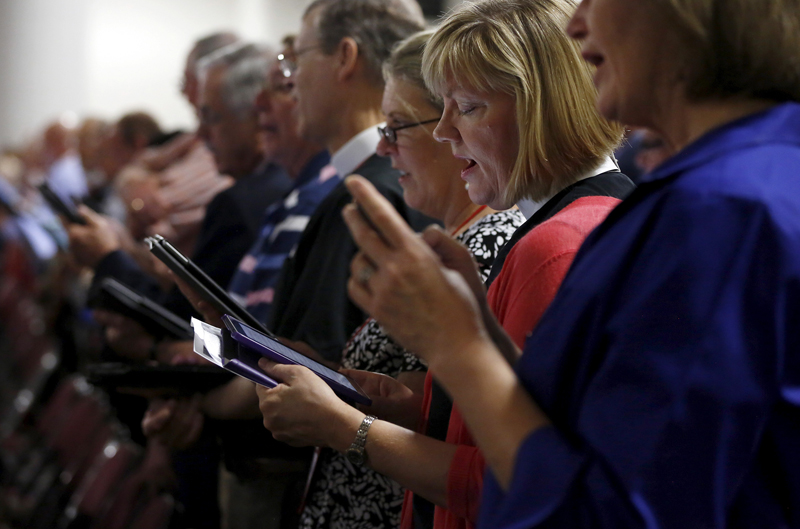
Members sing during a church service during the General Convention of the Episcopal Church in Salt Lake City

Photo credit:  https://religionnews.com/2015/07/02/episcopal-church-expansive-inclusive-thanks-gay-marriage-votes-commentary/

Today, I am traveling to Austin for the General Convention of the Episcopal Church.  General Convention meets every three years and is a bicameral legislature that includes the House of Deputies and the House of Bishops, composed of deputies and bishops from each diocese. During General Convention, deputies and bishops consider a wide range of important matters facing the Church.  Some years the issues have a huge impact (examples include the ordination of women and members of the LGBTQ community, as well as same-sex marriage).  Other years, General Convention works on important issues that are less flashy.  Regardless of the news cycle, the work of General Convention is about continuing to define who and whose we are, and making sure our work reflects our identity.

I am attending this year as an alternate clergy deputy for the Diocese of Southern Virginia.  My work is to support the eight clergy and lay deputies and our bishops, helping them make important decisions, and filling in when breaks are needed.  The official meetings take place July 5-13, but there are already many committee meetings happening.

In talking to a clergy colleague about my participation in General Convention he asked me, “Why in the world did you volunteer?”  I have been thinking (and laughing) about that question, and after reflection, I realized why I was so interested in serving.  One of the things I preach about a lot is about identity – understanding it, naming it, living into it.  In the current climate of the United States, our identity as disciples of Jesus is an anchor.  But just saying we are disciples without critically examining our lives through that lens does little good.  For me, being a part of General Convention is a way of participating in the work of honing our identity as Episcopalians, and where applicable, helping us to better live into that identity.

I look forward to serving the broader church, our Diocese, and ultimately my parish through this work.  This kind of work creates the space for making us all better, and I am hopeful about what the week can bring.  I ask your prayers for the General Convention over the next many days.  Like any family, parish, Diocese, or church who tries to come to consensus across differences, we will need your prayers to listen deeply, speak intentionally, and make decisions thoughtfully and prayerfully.  I look forward to sharing this experience with you!

On Peter, Paul, and Michael…

23 Wednesday May 2018

Posted by jandrewsweckerly in Uncategorized

≈ 1 Comment

Tags

church, disciple, Episcopal, Good News, Jesus, Jesus Movement, love, power, Presiding Bishop Michael Curry, Royal Wedding, Sermon

In seminary, each third-year student preaches a “senior sermon” in front of the entire seminary.  It’s a bit nerve-wracking because seminarians and priests are a pretty tough crowd.  Add that on top of professors who have molded you for three years, and the pressure is pretty intense.  I remember talking to a professor about my nerves and he assured me, “Well, you know what the old hymn says:  If you cannot preach like Peter, if you cannot pray like Paul, you can tell the love of Jesus and say, ‘He died for all.’”

That hymn to which he was referring is, “There is a Balm in Gilead,” which is the same hymn that Presiding Bishop Michael Curry quoted in his sermon at the Royal Wedding.  Of course, preaching after Bishop Curry the next day felt equally daunting.  Lord knows, I cannot preach like Peter, and I certainly cannot preach like Bishop Curry.  But as I was thinking about it, I think what people have loved so much about Bishop Curry’s preaching at the Royal Wedding is:  1) he was authentically himself (which is obviously a bit different culturally from those gathered in the royal family, but his authenticity was infectious), 2) he was passionate about the love of Jesus and its ability to change the world, and 3) he gave the world a glimpse of what is so awesome about the Episcopal Church – a Church who understands the radical power of love and brings together people from all walks of life to thoughtfully, willfully, beautifully engage in doing powerful work in the world through love.

What has been fascinating to me about Bishop Curry’s sermon and the way it has been described as “stealing the show,” is that Bishop Curry was just doing what the Episcopal Church does every Sunday, at every wedding, and at every funeral – we worship God in the beauty of holiness, we teach those gathered, and we equip them to go out into the world sharing the good news of God in Jesus Christ.  What Bishop Curry’s success does is embolden us to live into our identity as disciples of Christ and members of the Episcopal Church.  I suspect you have talked to someone about Bishop Curry’s sermon in the last few days.  How about instead of just marveling about Bishop Curry’s talent as a preacher, you use this event to talk to someone about how you are inspired to be a follower of Jesus?  Keep it authentic:  “He was awesome, wasn’t he?  He reminds me of my church and the amazing things we are doing to harness the power of love.  I’d love to show you!”

What Bishop Curry did on Saturday at the Royal Wedding was be himself – a member of the Jesus Movement, sharing the Good News of God in Christ.  Your invitation is to be yourself and do the same.  You may not preach like Peter, and you may not pray like Paul.  But you can tell the love of Jesus, and say, “He died for all.”  I can’t wait to hear about your adventures!!

17426137_10155645675302565_2278358373496741633_n

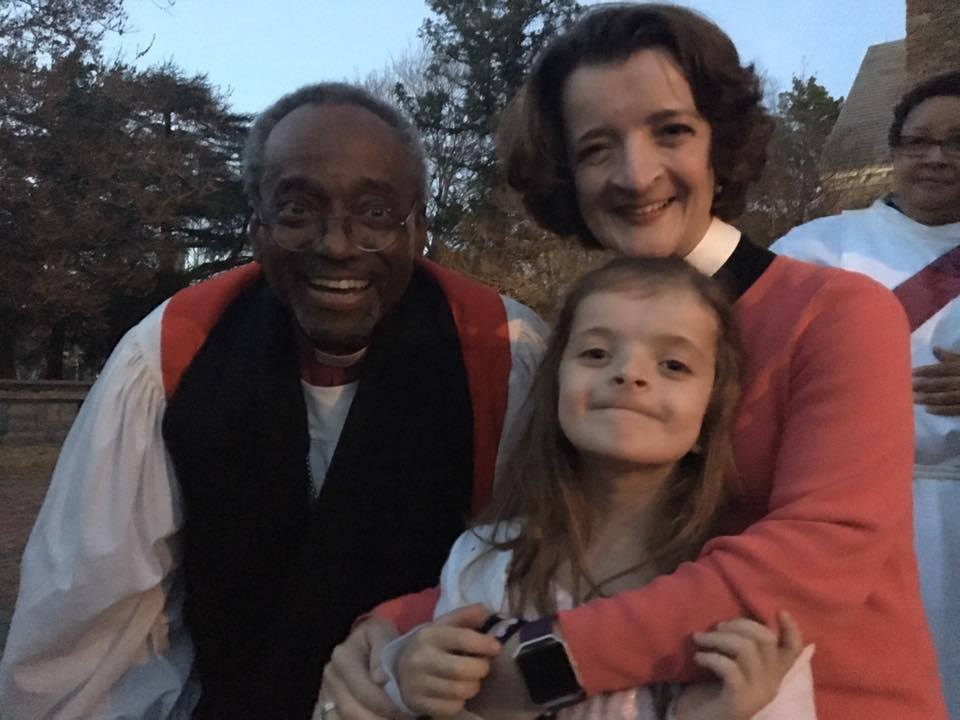
With Presiding Bishop Curry in 2017, Photo credit:  Jennifer Andrews-Weckerly (use only with permission)


← Older posts

Recent Posts

  • On the Myth and Magic of Advent…
  • On Risking Failure and Facing Fear…
  • Sermon – Luke 23.33-43, P29, YC, November 23, 2025
  • On Inhabiting Gratitude…
  • Sermon – Luke 20.27-38, P27, YC, November 9, 2025

Archives

  • December 2025
  • November 2025
  • October 2025
  • September 2025
  • August 2025
  • July 2025
  • June 2025
  • March 2025
  • February 2025
  • December 2024
  • November 2024
  • October 2024
  • September 2024
  • August 2024
  • July 2024
  • June 2024
  • May 2024
  • March 2024
  • February 2024
  • January 2024
  • December 2023
  • November 2023
  • October 2023
  • September 2023
  • August 2023
  • July 2023
  • June 2023
  • May 2023
  • March 2023
  • February 2023
  • January 2023
  • December 2022
  • November 2022
  • October 2022
  • June 2022
  • May 2022
  • January 2022
  • December 2021
  • November 2021
  • October 2021
  • September 2021
  • August 2021
  • June 2021
  • May 2021
  • April 2021
  • March 2021
  • February 2021
  • January 2021
  • December 2020
  • November 2020
  • October 2020
  • September 2020
  • August 2020
  • July 2020
  • June 2020
  • May 2020
  • April 2020
  • March 2020
  • February 2020
  • January 2020
  • December 2019
  • November 2019
  • October 2019
  • September 2019
  • August 2019
  • July 2019
  • June 2019
  • May 2019
  • April 2019
  • March 2019
  • February 2019
  • January 2019
  • December 2018
  • November 2018
  • October 2018
  • September 2018
  • August 2018
  • July 2018
  • June 2018
  • May 2018
  • April 2018
  • March 2018
  • February 2018
  • January 2018
  • December 2017
  • November 2017
  • October 2017
  • September 2017
  • August 2017
  • July 2017
  • June 2017
  • May 2017
  • April 2017
  • March 2017
  • February 2017
  • January 2017
  • December 2016
  • November 2016
  • October 2016
  • September 2016
  • August 2016
  • July 2016
  • June 2016
  • May 2016
  • April 2016
  • March 2016
  • February 2016
  • January 2016
  • December 2015
  • November 2015
  • October 2015
  • September 2015
  • August 2015
  • July 2015
  • June 2015
  • May 2015
  • April 2015
  • March 2015
  • February 2015
  • January 2015
  • December 2014
  • November 2014
  • October 2014
  • September 2014
  • August 2014
  • July 2014
  • June 2014
  • April 2014
  • March 2014
  • February 2014
  • January 2014
  • December 2013
  • November 2013
  • October 2013
  • September 2013
  • August 2013
  • July 2013
  • June 2013
  • May 2013
  • April 2013
  • March 2013
  • February 2013
  • January 2013
  • December 2012
  • November 2012
  • October 2012
  • September 2012

Categories

  • reflection
  • Sermons
  • Uncategorized

Meta

  • Create account
  • Log in
  • Entries feed
  • Comments feed
  • WordPress.com

Blog at WordPress.com.

  • Subscribe Subscribed
    • Seeking and Serving
    • Join 394 other subscribers
    • Already have a WordPress.com account? Log in now.
    • Seeking and Serving
    • Subscribe Subscribed
    • Sign up
    • Log in
    • Report this content
    • View site in Reader
    • Manage subscriptions
    • Collapse this bar
 

Loading Comments...