• About

Seeking and Serving

~ seek and serve Christ in all persons

Seeking and Serving

Tag Archives: Episcopal

On Progress and Outstanding Work…

30 Wednesday Sep 2015

Posted by jandrewsweckerly in Uncategorized

≈ Leave a comment

Tags

boundaries, Christian, church, conflicted, Episcopal, Eucharist, excitement, exclusion, God, Jesus, love, open table, Pope Francis, Roman Catholic, Spirit, table, unity

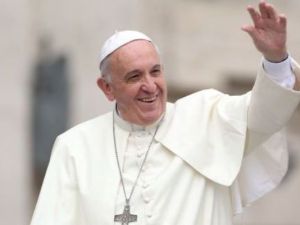
Photo credit: http://www.wusa9.com/story/life/faith/pope-coverage/2015/08/20/poll-pope-francis/32052555/

Photo credit: http://www.wusa9.com/story/life/faith/pope-coverage/2015/08/20/poll-pope-francis/32052555/

I must admit, the Pope’s visit to the United States last week was awesome.  Though I have been happy for the Roman Catholic Church since Pope Francis was elected, last week I realized his witness is good for all Christians.  Too often people professing to be Christian make Christians look bad.  Their hatred and exclusion in no way reflects the love and inclusion expressed by Jesus Christ.  But not Pope Francis.  He continues to challenge all of us to get back to the work Jesus gave us to do – to love and care for the poor, disenfranchised, and unjustly treated.  He beckons us toward lives of making peace and justice.  In essence, he reminds us to live as Christ called us to live.  And in starkly obvious ways, he reminded us that Jesus was not a Democrat or a Republican.  In fact, Jesus made, and continues to make, everyone uncomfortable.  Pope Francis did the same thing.  Though we all loved what he did for the Church and Christians in general last week, he likely made each of us feel uncomfortable at some point during his visit.  But I think we could all respect that he was trying to get us back to our true identity – he is a Christian who made us proud, not embarrassed, to be Christians.

Coming off the high of the Pope’s visit, I attended a funeral mass this week at the local Roman Catholic Church.  I was there to support a parishioner who had lost his mother (a Roman Catholic).  I wore my collar, but sat in the pew.  I prayed with the priest, cried with the family, and reverenced during the Eucharist.  But when the Eucharist was distributed, I stayed in my seat.  To his credit, the priest did not disinvite any non-RC attendees.  But he did not actively invite them either.  So instead of risking offense, I stayed in my seat, as I have been well-trained by many other RC priests that I am not to receive Eucharist as a non-RC.  I knew the moment would come and I was mentally prepared to stay in that seat.  But I must admit, my heart ached in that moment.  I felt a sharp pain in my chest as others walked around me to go forward for the heavenly meal.  For all the unity, the love, and the excitement of last week, I realized in that moment that we have a long way to go.

Of course, that work is not limited to the Roman Catholic Church.  Last week I preached about how much the Episcopal Church does its own work of excluding people – even from the Table, if you are not baptized.  In fact, I remember writing a paper in my liturgics class in seminary defending the practice of limiting the Eucharist to those who are baptized.  I don’t remember my argument at the time, but it was good, well-thought out, and prayerfully constructed.  But sitting in that pew yesterday, not receiving the comfort of the holy meal made me rethink the whole concept of an open table.  I do not really know if I am ready to make any changes right away, but the experience was a powerful lesson in the realities of constructing boundaries around the Table.  I do not want anyone’s heart to hurt the way mine did yesterday.  What about you?  What boundaries the church has constructed make you feel conflicted?  What might compel you to reconsider your position?  I invite us to pray about these conflicts as a community and see where the Spirit is leading.

Sermon – Mark 9.38-50, P21, YB, September 27, 2015

30 Wednesday Sep 2015

Posted by jandrewsweckerly in Uncategorized

≈ Leave a comment

Tags

barrier, boundaries, call, church, division, Episcopal, exclusivity, God, hospital, in, Jesus, out, prayer, priest, Roman Catholic, rules, sent, Sermon

“Are you the priest they sent?”  That was the question he asked me.  I was confused at first, but realized one of the nurses must have called an on-call priest.  I also knew from experience that if he was looking for the “priest they sent” he was not looking for me.  You see, I’m a priest, but I’m also a woman.  When people at hospitals are looking for priests, the majority of the time they mean a Roman Catholic priest.  But he seemed desperate, so I delicately said “No, I’m actually here to see a parishioner.”  But I stayed and talked to him a bit more about what was going on and whether the chaplain’s office had been called.  His wife joined us as we talked.  Then the inevitable question came.  She asked what church affiliation I had.  I told them I was a priest in the Episcopal Church, and that they were welcome to wait for a Catholic priest.  She insisted it didn’t matter – they just wanted a priest to say prayers.

Honestly, I was floored.  That had never happened to me.  Usually when I tell a Roman Catholic person that I am not a Roman Catholic priest, they reveal (subtly or not so subtly) that I am not the kind of priest they want.  And truthfully, I am totally fine with that.  I totally understand and would never assert any differently, especially to someone in crisis at the hospital.  We ended the conversation with the agreement that we would go to our separate rooms.  When I was done, if they still didn’t have their Roman Catholic priest, I would be happy to say prayers.  I went on to my visit, fully anticipating the “real” priest to show up for them while I was elsewhere.

That division among the Church, among the faithful of God, is not unique to Roman Catholics.  We all make boundaries and distinctions about who is in and who is out.  Episcopalians are only in full communion with the Evangelical Lutheran Church of America.  So if I ever wanted to have a United Methodist Minister or Presbyterian pastor celebrate Eucharist, I would not be allowed.  We also make rules around the communion rail.  Most Episcopal Churches say that all baptized Christians are welcome to the table – meaning if you have not been baptized, you should not receive.  Even to serve on Vestry we have boundaries.  All Vestry members have to be financial supporters of the parish, are expected to be present regularly in worship and parish events, and are asked to contribute to at least one ministry of the church.  If the Vestry member is unwilling to make those commitments, they cannot serve on Vestry.  We often think of Roman Catholics as having lots of boundaries – from no women at the altar, to no married clergy, to no communion unless you are Roman Catholic.  But the reality is that, as Episcopalians, we have an equal number of boundaries that keep people in and out of our community.

The good news is that we come by our exclusivity honestly.  In our gospel lesson from Mark today, we are told about an encounter between the disciples and Jesus.  John comes up to Jesus and says, “Teacher, we saw someone casting out demons in your name, and we tried to stop him, because he was not following us.”  John is so confident of his authority that he almost sounds like he is boasting to Jesus.  “Hey, Jesus, there’s some dude who is trying to do our work and he keeps using your name.  But don’t worry – we shut him down.”  You can almost imagine John expecting Jesus to give him a chug on the shoulder and say, “Good work, John!”  But that is not how the story unfolds.  Instead, Jesus says the total opposite, “Do not stop him; for no one who does a deed of power in my name will be able soon afterward to speak evil of me.  Whoever is not against us is for us.”  You can imagine the disciples’ confusion.  Jesus is constantly pulling them aside and only telling them how to interpret his parables.  When Jesus commissions people, he commissions the disciples, and no one else.  And although people are often following Jesus in droves, his crew, or his posse, is made up of the disciples.  In the disciples’ minds, Jesus is implicitly telling them that they are the insiders, with special privileges, and everyone else is an outsider.  The disciples are in; everyone else is out.  And anyone who tries to break those boundaries is going against the will of Jesus – and, ergo, the will of God.

Despite the fact that Jesus shuts down the notion of insiders and outsiders, the Christian community has been struggling with boundaries since Jesus’ death.  Who is a Christian?  Who can have communion?  What are the rules and what are the consequences of breaking the rules?  Now, boundaries are not necessarily bad.  Boundaries help us define who we are and what behavior is acceptable.  Boundaries help us uphold values and create meaning.  Boundaries can even help us make an informed choice about belonging to a community.[i]  Clearly Jesus created some boundaries.  When he says, “Whoever is not against us is for us,” he implies that there are people who are in fact against them.  Jesus himself creates a group of insiders and outsiders.  What Jesus is trying to communicate is not that boundaries are bad.  What Jesus is trying to communicate is that we are capable of getting so wrapped up in our boundaries that we exclude people from the love of Christ.  And nothing could be more harmful, or even sinful, than making someone feel that they are cut off from the love of Christ.

I had a friend who started going to therapy to help him cope with a spouse suffering from depression.  He imagined that the therapist would share her knowledge of persons suffering from depression and teach him some coping skills.  But after a lengthy explanation about what was wrong with his spouse, the first question the therapist asked was about him.  The therapist wanted to know what his issues were.  My friend interrupted, “No, no, no, I’m not here for me, I’m here to learn more about dealing with my spouse.”  The therapist wisely said, “Yes.  But before we get to your spouse, let’s talk about you.”  That therapist did what Jesus does with the disciples.  Jesus redirects the disciples concern about others by telling them to worry about their own problems – those hands, feet, and eyes that cause them to sin.  You see, Jesus is very clever.  What he realizes is that when the disciples start sorting through their own sinfulness, their own “stuff,” they do not have time to worry about boundaries and rules and barriers.[ii]  And when they let go of those boundaries, rules, and barriers, something incredible can happen – the love of God and the fellowship of Christ can grow and thrive.

By the time I finished my visit with my parishioner, the Catholic on-call priest had still not arrived.  I went into the room of the family and realized they needed more than a prayer.  They were going to be removing life support and wanted someone to offer the patient Last Rites.  I again reminded them that I was an Episcopal Priest.  The wife of the couple said, “It’s still Last Rites though, right?”  “Yes,” I replied.  “Okay, then.”  That was all.  Here I was bringing up boundaries again and again, and this person, who normally has even more boundaries than I do, insisted that I let go of my boundaries and help her family have an experience with God.  The first words the husband had asked me were, “Are you the priest they sent?”  My first answer was correct.  I was not.  But my answer was not complete.  I was not the priest that “they” sent.  But I was the priest that God sent.  You see, God has a call on me – and in fact God has a call on each person here.  God sends us everyday – to our workplaces, to our schools, to our friends, and to strangers.  Everyday we have the choice to get tangled up in boundaries and rules and limitations.  But we also have the choice to remember the ways that Jesus wants us to love God and love our neighbors.  Those are the only two boundaries Jesus really cares about anyway.

That is our invitation this week:  to consider how God is calling you and also to consider how you are getting in the way of God’s call.  The boundaries and the rules really are not as complicated as they sound.  If the Pope can say, “Who am I to judge?” surely we can start letting go and embracing love.  Then, the next time someone asks you, “Are you the person that was sent?” you can reply, “Yes.  Yes, I am.”  Amen.

[i] Harry B. Adams, “Pastoral Perspective,” Feasting on the Word, Yr. B, vol. 4 (Louisville:  Westminster John Knox Press, 2009), 116, 118.

[ii] Amy Oden, “Commentary on Mark 9.38-50,” September 30, 2012, as found at http://www.workingpreacher.org/preaching.aspx?commentary_id=1357 on September 25, 2015.

On Being the Church…

08 Wednesday Jul 2015

Posted by jandrewsweckerly in Uncategorized

≈ Leave a comment

Tags

baptism, church, decline, Episcopal, growth, Jesus, responsibility

Over the course of the last year, I have read countless articles about the state of our struggling Church.  The struggle is not just an Episcopal one, but is common across most denominations.  There are all sorts of theories about why it is happening and who or what is to blame.  I myself have pondered these theories in my heart, as I wonder what ministry will look like twenty years from now.  But in all the finger-pointing and discussion about what is causing our attrition, I stumbled on this prayer last week in a blog entry by David Lose:

L: Let us pray together.
C: Your church is composed of people like me.
I help make it what it is.
It will be friendly, if I am.
Its pews will be filled, if I help fill them.
It will do great work, if I work.
It will make generous gifts to many causes, if I am a generous giver.
It will bring other people into its worship and fellowship, if I invite and bring them.
It will be a church where people grow in faith and serve you, if I am open to such growth and service.
Therefore, with your help Lord, we shall dedicate ourselves to the task of being all the things you want your church to be.  Amen.[i]

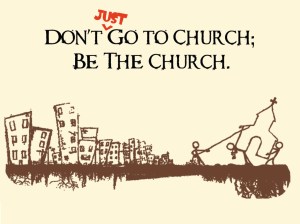
What I loved about this prayer is that it took the argument about church decline and made it personal.  No longer was the issue one that “the Church” was facing, but one that I am personally facing.  There is no mysterious formula that will solve this problem.  The issue is me – about how I make the Church the place the Church is meant to be – the place God longs for her to be.  I cannot count on people simply having an inspired desire to come to Church.  I need to share my story.  I need to get my hands dirty being Church.  I need to stop hiding my love of Jesus and start living as one who is loved by that same Jesus.

Photo credit:  http://www.cfi-hq.org/2015/04/

Photo credit: http://www.cfi-hq.org/2015/04/

Our church just had two baptism Sundays in a row.  In those services we made some tremendous promises – to seek and serve Christ, to share the good news, to strive for justice and peace, and to be present in the life and work of the church.  That all sounds like a lot of work.  But the truth is that the work is not onerous when done in community.  The work is not onerous when we look into the eyes of infants and confidently welcome them into the community of faith.  The work is not onerous when it gives us great joy.  Over the next few weeks, I invite you to pray this prayer everyday.  Pay attention to whether its words create some shifting in you.  Linger in the parts that seem the most uncomfortable.  And then keep inviting the Spirit of the Living God to fall afresh on you.

[i] The prayer was not written by David Lose, but one he stumbled upon in a church in Wisconsin.  The full citation can be found at https://www.workingpreacher.org/craft.aspx?post=1620.

Sermon – John 20.1-18, ED, YB, April 5, 2015

15 Wednesday Apr 2015

Posted by jandrewsweckerly in Uncategorized

≈ Leave a comment

Tags

community, Easter, Episcopal, intellect, Jesus, John, Mary Magdalene, mystery, personal, questions, realness, Sermon, theological, visceral

Growing up in the church, I always had a lot of questions.  There were a lot of things in the Bible that I found confusing, and downright contradictory, and I wanted someone to explain them.  Often the answers were unsatisfactory, and I struggled to understand why the adults in my church did not just have clear answers.  So imagine my delight in adulthood when I discovered the Episcopal Church and the way that the Church seemed to embrace questions.  Of course, the answers were still not always clear, and priests used words like “mystery” and “I don’t know.”  But at least I was in a place that welcomed the questions, and that fact gave me hope that one day, I might actually figure out all this “God stuff.”  And of course, going to seminary was a dream – I could actually spend 24-7 steeped in my questions, in textbooks, and in my favorite spot, the Library.  And though I discovered that there is rarely one answer to a question, the fact that there were myriad answers that one must hold in tension was just fine.  I was just happy to have developed some of the language and ideas around those big questions.

So imagine how proud I was when my first child finally started asking questions about Jesus.  I was going to be the parent who did not have to use words like “mystery” and “I don’t know.”  I did know, and with her first question, I launched into an explanation of epic proportions.  It was not until I looked in the rearview mirror of the car and saw her eyes glazed over and her attention fading that I realized I had lost her.  Somehow my accumulated knowledge and reference to the debates of scholars was of no help with a three-year old.

What I probably should have done was taken a cue from John’s gospel that we hear today.  The funny thing is that John’s gospel is usually pretty heady – his sentences are often convoluted and complicated.  And to be honest, sometimes my eyes glaze over and my attention fades when I read John’s gospel.  But today’s lesson is a little different.  Today, as we hear about the most significant fact of the Christian faith – Jesus’ resurrection – John is not abstract or intellectual at all.  Quite the opposite, the encounter between the risen Lord and Mary Magdalene is visceral, emotional, and deeply, deeply personal.[i]

This kind of revelation about God is not what we expect from John’s gospel.  This is the same gospel that begins, “In the beginning was the Word, and the Word was with God, and the Word was God.  He was in the beginning with God.  All things came into being through him, and without him not one thing came into being.”  No mangers, angels, or kings.  John is all about theologically explaining Jesus.  So why then does John give us a story about Mary, Peter, and the beloved disciple running around like crazy people?  Why does John have Mary repeatedly not being able to see past her grief to realize that not only is she speaking to angels who are trying to give her good news, she is also talking to the very man whom she is grieving?  John beautifully transitions today from being a writer who consistently presents Jesus in heady, intellectual ways, to being a writer who also shows us that Jesus is most known in the tangible, realness of life.  In the story, Mary is desperate to see her Lord’s body – what she imagines is the last tangible piece of him left.  She is so distraught that she cannot even see clearly when he is looking at her straight in the eye.  Only when she has turned away in despair, is she able to find Jesus.  Jesus says, “’Mary,’ and the sound of his voice saying her names helps her to see him.  He does not offer a general address; no, he uses a word that applies to her and her alone, a word that captures the utter particularity of her individual life – her name.”[ii]

We do not get a distant, transcendent Jesus in John.  We do not get some flowery, academic description of a concept of Jesus.  We get a real man, addressing a real woman, using the sound of his raspy voice, calling a woman by her very own name.  The gospel does not get much more real and tangible than that.  John’s gospel is such a relief to us today because who among us cannot relate to the busyness of this text?  Before we get to the part of Jesus saying Mary’s name we have Mary and disciples running back and forth, people walking past one another without a word, Mary misinterpreting things because she is so singularly focused on what she thinks should be happening.  Of course she could not see Jesus.  Neither can we.  We are running from work to home to meetings to practices to church.  We are answering emails, hearing headlines on the news, and eating dinner.  We are on the phone, driving the car, and scarfing down lunch.  How can we connect to Jesus in the chaos of our lives?

We can certainly try to connect to Jesus through the study of academic readings and theological debates.  We can try to mentally work our way toward Jesus.  But more often, Jesus is revealed to us instead through embodied, physical ways.  As one scholar explains, “As he did with Mary, Jesus comes to us not as a general idea or an imagined ghostly figure, but as a presence that reaches beyond our mind’s overt powers of knowing and touches our lives in ways that we cannot see.  They are felt – tasted, touched, smelled, heard, seen in image, and as such, often as unconscious as they are visceral.”[iii]  Sometimes we will experience God through study and the use of our minds.  But sometimes, we will come to know God through the emotional and personal – like being called by name.

Once we are willing to accept that there are some things that are beyond our knowing, we can perhaps lessen our grip on our Episcopal embrace of the intellect, and realize that some things of God have to be experienced.  In order to do that, we are going to need some help.  We are going to need to “go to church and be in a space where we physically, emotionally, communally, experience Jesus in our midst.”[iv]  Whether in the taste of the communion wine, the smell of the Easter flowers, the sound a favorite old hymn, or the feel of hard wooden pew, church is one of those places in which the familiar tastes, smells, sounds, touches, and sights stirs up something deep inside of us.  Though church can certainly feed our minds, we can feed our minds anywhere.  But our bodies need to be fed too.  And sometimes the only way to feed our body is through our physical, visceral experiences that can only be had in church – so that our bodies might be reminded of Christ too.

Of course, that means we are going to have to give up some things.  We are going to have to give up on the notion that our brains will be able to answer all our questions.  We are going to have to give up some time on Sundays so that we can place ourselves in the position to taste, touch, feel, see, and hear Jesus.  And we might even have to be willing to say the occasional, “I don’t know,” when our children ask us really hard questions.  But my guess is that children, and even adults, when they are willing to admit it, might be relieved to hear us say, “I don’t know.  But sometimes in my gut, I can feel Jesus with me.  And every once in a while, though the thought may be really strange, I really can hear Jesus calling my name.”  My guess is that the ambiguity, the visceral, tangible concept of Christ, and the sense of wonder and mystery you share might make for a more engaging answer anyway.  Amen.

[i] Serene Jones, “Theological Perspective,” Feasting on the Word, Yr. B, vol. 2 (Louisville:  Westminster John Knox Press, 2008), 376.

[ii] Jones, 378.

[iii] Jones, 378.

[iv] Jones, 380.

Forever empty?

25 Wednesday Feb 2015

Posted by jandrewsweckerly in Uncategorized

≈ Leave a comment

Tags

darkness, discipline, Episcopal, God, happiness, journey, Lent, light, Louis C.K., redemption, sadness, sin, technology

Photo credit:  http://www.huffingtonpost.co.uk/2013/09/23/louis-ck-texting-driving_n_3974759.html

Photo credit: http://www.huffingtonpost.co.uk/2013/09/23/louis-ck-texting-driving_n_3974759.html

I was talking to a parent recently about the challenges of raising children.  She reminded me of an awesome interview by Louis C.K. with Conan O’Brien.  The interview itself is funny and, as fair warning, quite crass (do not watch it with impressionable ears nearby – the link can be found here).  But what struck me about the interview is what I would label as pretty powerful theology by Louis C.K.  In his interview, he argues that we use technology to fill our time so that we can avoid the reality that there are parts of life that are tremendously sad and times when we feel utterly alone.  He further argues that by filling up that dark space and not allowing ourselves to fully experience that deep sadness, we never get to true happiness.

I was struck this week about how appropriate Louis C.K.’s words are for the Lenten experience.  I have a couple of parishioners who really dislike Lent and find it horribly depressing.  In some ways I agree with them.  Lent is somewhat depressing, and for some odd reason, that is what I like about Lent.  I never could fully explain that reality until I heard this interview.  What Louis C.K. points out is that sometimes we really need to go to those dark places.  Otherwise, we can never really find the true, deeply abiding happy places too.

In the Episcopal Church, The Catechism in the back of our Book of Common Prayer says this about sin:

Q:  What is sin?
A:  Sin is the seeking of our own will instead of the will of God, thus distorting our relationship with God, with other people, and with all creation.
Q:  How does sin have power over us?
A:  Sin has power over us because we lose our liberty when our relationship with God is distorted.
Q:  What is redemption?
A:  Redemption is the act of God which sets us free from the power of evil, sin, and death.
(BCP 848-849)

Lent gives us the opportunity to really examine our own sinfulness – the ways in which we have distorted our relationship with God, other people, and all creation.  Many of my friends have given up some form of technology for Lent – by not checking Facebook, taking Sabbaths from TV or the internet, or putting down their cell phones at certain points of the day.  My guess is that their discipline will create room for them to contemplate their sinfulness, or as Louis C.K. might say, their “forever empty.”  My prayer for them is that their practice leads to an ability to find their way back to God, who redeems us and helps us find that true happiness.  I am curious about how you are journeying into your own “forever empty” this Lent, and I look forward to hearing how that journey leads to the light.

Homily – Jeremiah 1.4-10, William White, July 17, 2014

23 Wednesday Jul 2014

Posted by jandrewsweckerly in Uncategorized

≈ Leave a comment

Tags

affirmation, bishop, bold, call, challenge, church, Episcopal, God, Jeremiah, William White

Today we honor William White, first bishop of Pennsylvania.  Born in 1747 in Philadelphia, White went to England to be ordained as a deacon and then priest.  He served at churches in Pennsylvania and was also the chaplain of the Continental Congress and U.S. Senate.  When elected bishop, he had to travel back to England; he and Samuel Provost were consecrated in 1787.  Bishop White was the chief architect of the Constitution of the Episcopal Church and served as Presiding Bishop at the first General Convention.  In addition to mentoring many church greats, Bishop White steered the American Church through its first decades of independent life – a hearty task given the Episcopal Church’s ties to England after the Revolution.

I have often wondered how those early church formers experienced their call.  The transition from the Church of England to the Episcopal Church must have been scary.  We often talk about the church reinventing itself today, but the church in the U.S. in the late 1700s really had to reinvent its whole identity.  I imagine many thought the church would die or at least flee from the United States.  To have been so bold as to totally reinvent the structure of the church took vision, courage and faith.

Bishop White could have easily told God what Jeremiah did in our Old Testament lesson today.  Jeremiah says, “Ah, Lord God!  Truly I do not know how to speak, for I am only a boy.”  Bishop White was only forty years old when he became Bishop – one could argue he was only a boy, too.  But when God calls people to ministries, God does so with gusto.  God tells Jeremiah, “… you shall go tell to whom I send you, and you shall speak whatever I command you.”  God’s instructions are firm and a bit scary.  But God also affirms Jeremiah: “I am with you to deliver you,” says the LORD.

Bishop White must have heard God’s affirmation in order to do all that he did.  But God’s challenge and comfort is not just for prophets and leaders.  God’s challenge and comfort is for each of us, too.  Though we may not have such grandiose calls, God still has a call on each person here.  Our reminder today is that God does challenge us to go where God sends, but God also comforts us with the assurance that God is with us and delivers us.  Amen.

Homily – Acts 20.28-32, Samuel Seabury, November 14, 2013

27 Wednesday Nov 2013

Posted by jandrewsweckerly in Uncategorized

≈ Leave a comment

Tags

church, Episcopal, flexibility, God, homily, Samuel Seabury, tenacity, trust

Today we honor the life and work of Samuel Seabury, first American Bishop of the Episcopal Church.  Born in 1729 in Connecticut, and ordained priest in England in 1753, Seabury worked in New Jersey, Long Island, and Westchester County.  During the American Revolution, he remained loyal to the British crown and served as a chaplain to the British army.  After the Revolution, in 1783, Seabury was asked by Connecticut clergymen to seek episcopal consecration in England.  He negotiated for a year, but could not obtain episcopal orders because as an American citizen, he could not swear allegiance to the crown.  He turned to the Episcopal Church in Scotland, which consecrated him bishop.  In Connecticut, he was officially recognized as bishop in 1785.  In 1792, he participated in the first consecration of a bishop on American soil.

I do not know many modern Episcopalian who could have lived the life of Samuel Seabury.  He had to deal with changing national loyalties; travel by boat to ask a people from whom he had just revolted to consecrate him; negotiate for a year; think creatively to involve Scotland; not give up; and establish a new system here in the U.S.  Samuel’s faith life required a certain flexibility, creativity, and tenacity that many of us lack.  I sense that lack even in myself as I hear Episcopalians talk about reinventing our church for this new age.  Can’t we just stay as we are where we are comfortable and just pray it will all work out?

But our lesson from the Acts of the Apostles allows no such hesitancy.  Paul exhorts us to keep watch – over ourselves and over the whole flock.  Our job is to care for the church that “God obtained with the blood of [God’s] Son.”  But Paul does not exhort without encouragement.  He says that God’s grace will build us up and that the Holy Spirit makes us overseers.  We can do our work with flexibility, creativity, tenacity, and change because God’s grace will build us up, and the Holy Spirit empowers us to do the work.  The road may be hard at times, but we have the great cloud of witnesses pushing us forward.  Samuel knows we can do it; we just have to let go and trust.  Amen.

Sermon – Luke 17.11-19, P23, YC, October 13, 2013

17 Thursday Oct 2013

Posted by jandrewsweckerly in Uncategorized

≈ Leave a comment

Tags

blessing, Episcopal, faithful living, gratitude, Jesus, lepers, praise, Samaritan, Sermon, stewardship, tithe

I have never been what I would call physically expressive with my faith.  I remember the last time I worshipped at my mother’s church, I was so uncomfortable with the raised hands and utterances of praise, that I found my arms tightly crossed and my eyes glued to the screens to avoid looking around me.  I remember walking an outdoor labyrinth with a priest friend of mine, who upon reaching the center of the labyrinth raised her arms and her head silently to God and just stood there for a long time.  My pace slowed dramatically as I began to panic about how I would never feel comfortable in such a stance, even if I was all alone.  I remember in the multi-cultural church where I worshipped in college watching parishioners stomp and clap as the choir led a spirit-filled song.  I managed to eek out an “Amen,” or maybe even a quiet, “Yes,” but I was drowned out by the boisterous praise around me.

As Episcopalians (or as many call us, “God’s Frozen Chosen”), I imagine that many of us in this room do not see anything strange about my aversion to physical manifestations of praise.  The most physicality we like to show in worship is through our active alternating between standing, sitting, and kneeling.  But my aversion to praise lately has not simply been physical.  I have noticed that the lack of praise has been missing from my words and actions lately too.  Lately my prayers for the parish have become a long litany of people who are hurting or suffering or who simply could use a sense of God’s presence in their lives.  Rarely do I lift up an equally long litany of things for which I am grateful for in this parish and in your lives.  I am not really sure how I got to this praise-lacking place.  Part of me wants to blame my lack of praise on the endless bad news in our world – the recent government shutdown, the economy, shootings, natural disasters, injustice and oppression, and wars.  But I think a larger part of the lack of praise has to do with something missing in my relationship with God – a focus on what needs work in my life as opposed to a focus on what ways my life is so blessed.

I guess you could say I sympathize with the nine lepers who do not return to Jesus when they are healed.  Of course, those lepers do nothing wrong per se.  In fact, they follow Jesus’ instructions to the letter.  Jesus tells them to go and present themselves to the priests and that they will be healed along the way.  And so, the nine lepers obediently follow directions, and in doing so, live life faithfully.  But when Jesus asks the Samaritan leper where the other nine lepers are, we notice immediately that there might be more to our spiritual journey than simply living life faithfully or following the rules.  The contrast between the lepers is so vivid that you can almost see the story in colors.  The nine lepers who are healed and follow Jesus’ instructions to go to the priests might be depicted in beige or taupe.  They do not lack color, but their color is pretty neutral.  Much like their actions are mundane, so are the colors they merit.  Meanwhile, the Samaritan leper might be depicted in vibrant reds, oranges, and golds.  His return to Jesus and his physically dramatic praise that includes prostrating himself at Jesus feet makes him more vibrant in the story.  He is the man raising his hands in praise, standing in wonder before God in the center of a labyrinth, or stomping his feet and shouting at the top of his lungs in worship.  Of course our eyes might be drawn to the vibrant colors of the Samaritan, but we would rarely pick such vibrant colors ourselves – or if we did, we would only use those colors in accessories – a vibrant bag or pair of shoes, but certainly not an entire vibrant outfit.

What the Samaritan leper shows us is that faithful living is more than just following rules or being relatively well-behaved.  Faithful living is more than trying to be a generally good person, or occasionally dropping a few extra dollars in the offering plate if you have some to spare.  The Samaritan shows us that true faithful living is not a quiet or mild experience.  Faithful living is expressive, passionate, and full of wonder and gratitude.  The Samaritan shows us this reality because not only does he perceive his blessing, he articulates his blessing.[i]  This is what sets the Samaritan apart from the other lepers.  Surely they perceive or see their blessing too.  But the Samaritan then articulates or gives word to his blessing.  We see what this double action of seeing and speaking does – the Samaritan is blessed by Jesus.  All ten of the lepers are healed.  That work is done and given without strings attached.  All are healed.  But the Samaritan gains more.  By articulating his thanksgiving, his blessing is doubled.  His gratitude overwhelms him, which seems to overwhelm God into more blessing.  What a fantastic cycle!

David Lose says, “Gratitude is the noblest emotion.  Gratitude draws us out of ourselves into something larger, bigger, and grander than we could imagine and joins us to the font of blessing itself.  But maybe, just maybe, gratitude is also the most powerful emotion, as it frees us from fear, releases us from anxiety, and emboldens us to do more and dare more than we’d ever imagined.”[ii]  The practice of gratitude changes things.  “When Christians practice gratitude, they come to worship not just to ‘get something out of it,’ but to give thanks and praise to God.  Stewardship is transformed from fundraising to the glad gratitude of joyful givers.  The mission of the church changes from ethical duty to the work of grateful hands and hearts.  Prayer includes not only our intercessions and supplications, but also our thanksgivings at the table.”[iii]

Gratitude is something we have been talking a lot about these past couple of months within the Stewardship Committee.  Today is our official kickoff of stewardship season, and you will be hearing a lot about gratitude over these coming Sundays.  A long time ago, before Scott and I were even married, we talked about the model of stewardship with which I had grown up.  Though United Methodists do not use “pledge” language, they do talk about giving and more specifically about tithing.  Growing up, my family always committed to tithing and talked about that practice regularly.  I always knew money was tight, but no matter what, that ten percent was going back to God on Sundays.  I saw how deeply tithing impacted my parents’ spiritual lives, and Scott and I agreed early in our relationship that we would take on that same spiritual discipline.

So you can imagine my amusement then when I first experienced stewardship in the Episcopal Church.  I heard people making the invitation to give and they used a phrase called the “modern tithe.”  Apparently the modern tithe was the phrase used for giving a percentage of your income to the church – a percentage that you could determine yourselves.  I almost laughed the first time I heard about the modern tithe.  The modern tithe idea sends the message that gratitude is important, but we should decide how much of the tithe we want to give.  The whole idea seemed like a slippery slope to me.  The reason I found the idea strange was because I had lived with the ten percent notion my whole life.  And what I learned about ten percent is that sometimes that ten percent is easy and feels great to give, and sometimes that ten percent feels like it could send you into poverty and despair.  But that is what is great about a sacrificial discipline.  No matter where you are in life, that practice of always giving that percentage is a way of saying, “Lord, this does not feel good right now, but I know you to be faithful and full of blessing, and so I give this to you grudgingly, hoping you can infuse my heart with the gratitude I have felt so many times before.”

I tell you that the Andrews-Weckerlys tithe ten percent not because I want to guilt you into doing the same.  I tell you about our tithing because I want my story to help me reclaim some of that joyful gratitude that the Samaritan has and that I have had at many times in my life.  I confess that lately that monthly pledge check has been hard.  More often I write those numbers with a deep sigh of resignation than with a song of praise.  My hope is that in telling you my story of how I feel like one of the nine lepers, that you might encourage me to be like the one Samaritan leper.  My hope is that in sharing my struggles, you might begin to ponder where you are in your spiritual walk with God and whether your financial giving is a reflection of the deep gratitude you have toward God or instead is the obedient, but joyless following of expectations.  My hope is that in offering up my challenges, we might all have more open, honest conversations at home, with one another, and with God about where we are and where we want to be.  The invitation of that bright, loud, boisterous Samaritan is there for all of us.  Blessings await.  Amen.


[i] David Lose, “Second Blessing,” as found on http://www.workingpreacher.org/craft.aspx?post=2796 on October 11, 2013.

[ii] Lose.

[iii] Kimberly Bracken Long, “Pastoral Perspective,” Feasting on the Word, Yr. C, vol. 4 (Louisville: Westminster John Knox Press, 2010), 168.


Newer posts →

Recent Posts

  • On the Myth and Magic of Advent…
  • On Risking Failure and Facing Fear…
  • Sermon – Luke 23.33-43, P29, YC, November 23, 2025
  • On Inhabiting Gratitude…
  • Sermon – Luke 20.27-38, P27, YC, November 9, 2025

Archives

  • December 2025
  • November 2025
  • October 2025
  • September 2025
  • August 2025
  • July 2025
  • June 2025
  • March 2025
  • February 2025
  • December 2024
  • November 2024
  • October 2024
  • September 2024
  • August 2024
  • July 2024
  • June 2024
  • May 2024
  • March 2024
  • February 2024
  • January 2024
  • December 2023
  • November 2023
  • October 2023
  • September 2023
  • August 2023
  • July 2023
  • June 2023
  • May 2023
  • March 2023
  • February 2023
  • January 2023
  • December 2022
  • November 2022
  • October 2022
  • June 2022
  • May 2022
  • January 2022
  • December 2021
  • November 2021
  • October 2021
  • September 2021
  • August 2021
  • June 2021
  • May 2021
  • April 2021
  • March 2021
  • February 2021
  • January 2021
  • December 2020
  • November 2020
  • October 2020
  • September 2020
  • August 2020
  • July 2020
  • June 2020
  • May 2020
  • April 2020
  • March 2020
  • February 2020
  • January 2020
  • December 2019
  • November 2019
  • October 2019
  • September 2019
  • August 2019
  • July 2019
  • June 2019
  • May 2019
  • April 2019
  • March 2019
  • February 2019
  • January 2019
  • December 2018
  • November 2018
  • October 2018
  • September 2018
  • August 2018
  • July 2018
  • June 2018
  • May 2018
  • April 2018
  • March 2018
  • February 2018
  • January 2018
  • December 2017
  • November 2017
  • October 2017
  • September 2017
  • August 2017
  • July 2017
  • June 2017
  • May 2017
  • April 2017
  • March 2017
  • February 2017
  • January 2017
  • December 2016
  • November 2016
  • October 2016
  • September 2016
  • August 2016
  • July 2016
  • June 2016
  • May 2016
  • April 2016
  • March 2016
  • February 2016
  • January 2016
  • December 2015
  • November 2015
  • October 2015
  • September 2015
  • August 2015
  • July 2015
  • June 2015
  • May 2015
  • April 2015
  • March 2015
  • February 2015
  • January 2015
  • December 2014
  • November 2014
  • October 2014
  • September 2014
  • August 2014
  • July 2014
  • June 2014
  • April 2014
  • March 2014
  • February 2014
  • January 2014
  • December 2013
  • November 2013
  • October 2013
  • September 2013
  • August 2013
  • July 2013
  • June 2013
  • May 2013
  • April 2013
  • March 2013
  • February 2013
  • January 2013
  • December 2012
  • November 2012
  • October 2012
  • September 2012

Categories

  • reflection
  • Sermons
  • Uncategorized

Meta

  • Create account
  • Log in
  • Entries feed
  • Comments feed
  • WordPress.com

Blog at WordPress.com.

  • Subscribe Subscribed
    • Seeking and Serving
    • Join 394 other subscribers
    • Already have a WordPress.com account? Log in now.
    • Seeking and Serving
    • Subscribe Subscribed
    • Sign up
    • Log in
    • Report this content
    • View site in Reader
    • Manage subscriptions
    • Collapse this bar
 

Loading Comments...