• About

Seeking and Serving

~ seek and serve Christ in all persons

Seeking and Serving

Tag Archives: faith

Sermon – Matthew 18.21-35, P19, YA, September 17, 2023

20 Wednesday Sep 2023

Posted by jandrewsweckerly in Sermons

≈ Leave a comment

Tags

abundance, conflict, faith, forgive, forgiven, forgiveness, God, health, Jesus, love, parable, power, resentment, scarcity, Sermon

One of the tricky things about Jesus’ parables is where to situate ourselves, especially when the parable is a familiar one.  As soon as we hear the words, “…the kingdom of heaven may be compared to a king who wished to settle accounts…” our brains jump ahead, “Oh, this is the one where the guy is forgiven of his debts and then two seconds later turns around and refuses to forgive someone else’s debt.”  We may have felt pity for the first slave who owed so much, we may have been shocked by his poor behavior toward the other slave, or we may have even thought, “That guy deserved what he got!”  But the thing that is the hardest to do when reading this familiar parable is to situate ourselves in the shoes of the first slave.  And yet, that is the entire reason Jesus tells the parable today. 

We know where to situate ourselves because of what happens before the parable.  If you remember our gospel last week, we talked about Jesus’ conflict resolution plan.  In the very next verse after Jesus explains how the community of faith is to handle conflict, Peter asks a question in today’s text.  The question is a fair one, and when we’re really honest with ourselves, one we may have asked God ourselves.  Peter asks, “Lord, if another member of the church sins against me, how often should I forgive?  As many as seven times?”  The parable Jesus tells today is in response to Peter’s question about conflict, sin, and forgiveness in the community of faith.  Essentially, Jesus says, “Let me tell you a little story about forgiveness.”  So, we, who have resisted forgiveness ourselves like Peter, can situate ourselves with not just Peter, but with the slave who fails so miserably at forgiveness. 

Now, before you get too defensive about how you would never treat a fellow human being like the first slave treats the second, we need to think about Peter’s question first.  Theologian Stanley Hauerwas explains, “Peter’s question presupposes that he is the one who has been sinned against.  He assumes that he is in the position of power against the one who has wronged him.  But Jesus’s reply reminds Peter that he is to learn to be the forgiven.”[i]  Before we begin to think about offering forgiveness, we operate from one foundational truth:  we are a people who have first been forgiven.[ii]  Our forgiven status is at the heart of our ability to be a people of forgiveness.

But before we even talk about being a people of forgiveness, we need to talk a little bit about what forgiveness is not.  Some of us believe that forgiveness means excusing or overlooking the harm that has been done to us and saying that everything is okay.  For those who hold that belief, forgiveness can be equated with stuffing our feelings down deep inside or downright lying in order to keep the peace.  Others of us believe that forgiveness means allowing those who have hurt us to persist in their behavior.  For those who hold this belief, forgiveness is so important, that we become recurring victims of offenses.  Still others believe that forgiving means forgetting what happened.  For those who hold this belief, forgiveness is pretending an old hurt does not still hurt.  Finally, others see forgiveness as something that we can do at will, and always all at once.  For those who hold this belief, forgiveness must be immediate and offered quickly.  The problem with all these models of forgiveness – of overlooking the harm, saying everything is okay, of allowing recurring behavior, of trying to forget, or forgiving once and for all – is that these models of forgiveness would have been totally foreign to Jesus.  According to author Jan Richardson, in Jesus’ teaching about forgiveness, “…nowhere does Jesus lay upon us the kinds of burdens we have often placed upon ourselves—burdens that can make one of the most difficult spiritual practices nearly impossible.”[iii]

So, if we know what forgiveness is not, we need to know what forgiveness is.  I like what scholar Debie Thomas has to say about forgiveness.  She says, “I think forgiveness is choosing to foreground love instead of resentment. If I’m consumed with my own pain, if I’ve made injury my identity, if I insist on weaponizing my well-deserved anger in every interaction I have with people who hurt me, then I’m drinking poison, and the poison will kill me long before it does anything to my abusers. To choose forgiveness is…to cast my hunger for healing deep into Christ’s heart, because healing belongs to him, and he’s the only one powerful enough to secure it.”  She goes on to say, “Secondly, …forgiveness is a transformed way of seeing.  A way of seeing that is forward-focused.  Future-focused.  Eschaton-focused.  …abuse and oppression are [n]ever God’s will or plan for anyone.  But I do believe that God is always and everywhere in the business of taking the worst things that happen to us, and going to work on them for the purposes of multiplying wholeness and blessing…Because God loves us, we don’t have to forgive out of scarcity. We can forgive out of God’s abundance.”[iv]

So how many times are we to forgive?  Not seven times.  Not even really seventy-seven times or seventy times seven, as some translations say.[v]  The forgiveness that first slave receives is hyperbolically abundant – the forgiveness by the king of ten thousand talents (or the equivalent of 150,000 years of labor)[vi] is almost ludicrous in its generosity.  But that is how abundantly God loves us.  We are invited today to love with that kind of ludicrous abundance too.  For our health, for our faith in the better world God is creating, we pray for the strength to ask God to “forgive us our sins as we forgive those who sin against us.”  We are a forgiven people, who, because God loves us, can forgive not out of scarcity, but out of God’s abundance.  Amen.  


[i] Stanley Hauerwas, Matthew:  Brazos Theological Commentary on the Bible (Grand Rapids:  Brazos Press, 2006), 166.

[ii] Hauerwas, 166.

[iii] Jan Richardson, “The Hardest Blessing,” September 9, 2014, as found at http://paintedprayerbook.com/2014/09/09/the-hardest-blessing/#.VBOogcKwKi0 on September 16, 2023.

[iv] Debie Thomas, “Unpacking Forgiveness,” September 6, 2020, as found at https://www.journeywithjesus.net/essays/2748-unpacking-forgiveness on September 16, 2023.

[v] Lewis R. Donelson, “Exegetical Perspective,” Feasting on the Word, Year A, Vol. 4 (Louisville: Westminster John Knox Press, 2011), 69.

[vi] David Lose, “Pentecost 14A: Forgiveness and Freedom,” Sept. 7, 2014, as found at http://www.davidlose.net/ 2014/09/pentecost-14-a/.

Sabbatical Journey…On Differences and Experiences

26 Monday Jun 2023

Posted by jandrewsweckerly in reflection

≈ 1 Comment

Tags

church, Church of Latter-Day Saints, differences, Episcopal, experience, faith, question, Salt Lake City, welcome

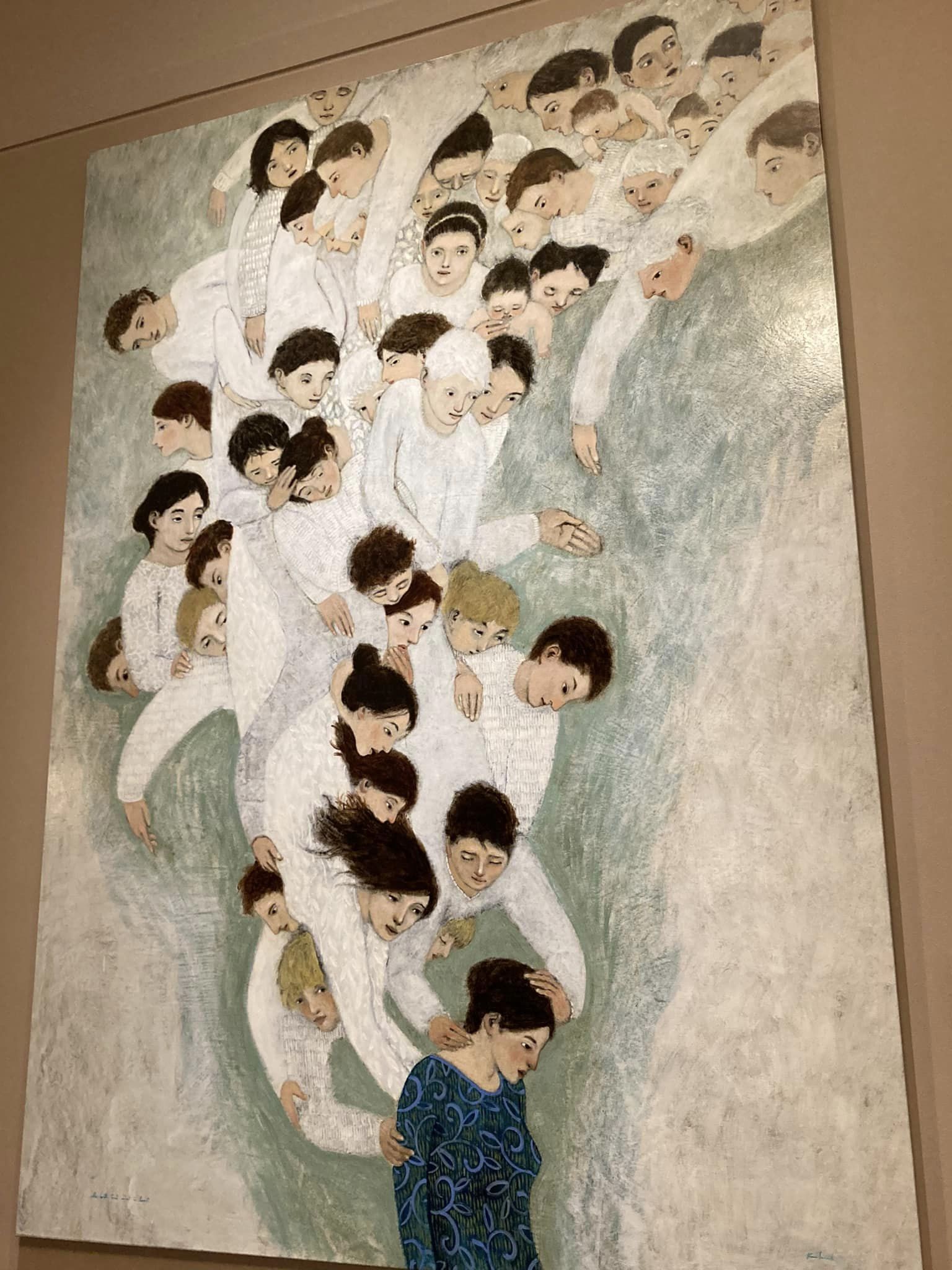
She Will Find What is Lost, by Brian Kershisnik, at the CJCLDS Conference Center (picture taken June 25, 2023)

Today, we toured Salt Lake City with a family friend and her family.  We wanted to learn about Temple Square, and help the kids learn a little more about the Church of Jesus Christ of Latter-Day Saints.  We couldn’t have had a more patient, open, vulnerable tour guide than our friend.  She constantly said all questions were fair game, and she meant it.  We learned about Church structure and governance, liturgical practices, theology, and personal experience.  Her son told us about his Morman mission to Korea and her girls talked about their choice not to take a mission.  We also got to see the 20,000-seat Conference Center, and the Tabernacle with the 11,000-pipe organ.  And we got the real experience of most businesses being closed on Sundays due to the widely respected sabbath day of rest. 

As we were talking with our friend about her faith and considering the differences in practices and theology, I began to realize how strange my faith must sound to the unchurched.  It is tricky enough to navigate and respect differences within the Abrahamic faiths.  But to someone who is unchurched, surely how we interpret scripture, what we practice (and don’t), and all our rules and restrictions must seem so foreign and intimidating.  Trying to figure out the differences between an Episcopalian and a member of the LDS must feel completely befuddling. 

I think we forget that what matters most to the unchurched is not necessarily all those distinctions among us, but how we treat the unchurched.  So much of what we think about church or other faiths is based on our experience of them – not some heady explanation of doctrine.  So, whether we are treated with dignity matters.  Whether we are given freedom to explore and ask questions without judgment matters.  Whether we experience genuine love and acceptance as we are matters.  I have known many an Episcopalian who was drawn to the Episcopal Church because they were frustrated by the doctrine of another denomination or faith.  But what kept them in the Episcopal Church wasn’t the doctrine they were seeking, but the reception they received once they kept coming back to church.

I hope this blog is one small way you might begin to experience the invitation of church another way.  Your questions and your struggles are welcome here.  You pain and hurt, as well as your hopes and joys, are welcome here.  Your skepticism and your hesitancy are welcome here.  Most of us people of faith are still figuring out this whole faith thing too.  You are welcome here.

Sabbatical Journey…On Finding Mystery

25 Sunday Jun 2023

Posted by jandrewsweckerly in reflection

≈ 1 Comment

Tags

Bryce Canyon, divine, experience, faith, God, hoodoo, knowledge, mystery, open, rigidity, science

Inspiration Point at Bryce Canyon (reuse with permission)

Our sabbatical journey got back on the road, heading this time to Bryce Canyon in Utah.  Before we got started, we watched a fabulous introductory video, telling us all about the flora and fauna of the Canyon, how the hoodoos were formed, the history of the Canyon becoming a National Park, and more.  It was a great introduction to what we would see, and what we might miss otherwise.

Despite the very scientific explanation of how the hoodoos (freestanding columns of weathered rock) are formed, I confess that in this one instance, the science leapt out of my mind as soon as I saw the hoodoos myself – or rather the sea of hoodoos.  Truly, one hoodoo alone is magnificent.  But hundreds of thousands of them is mind boggling.  I stood there unable to comprehend how such an unusual sight could be repeated over and over again.  All I could conclude was that it was a mystery. 

Now I know what you are thinking – there is nothing mysterious about rock formations.  I saw the scientist explain the formation process myself!  But knowing the science and experiencing the science are two different things.  As I stared into what seemed like infinite hoodoos, I kept coming back to that word:  mystery.

Sometimes I think we steer clear of the word mystery when it comes to our faith.  Saying something is a mystery seems like a cop out, or a way to shut down an intellectual conversation.  But I think there is enough in all of our lives that has taught us that mystery is indeed a reality.  Labeling some of our experiences, whether in nature or with God, as mystery allows us the freedom to set aside rigidity and open ourselves to things that seem impossible.  I wonder where in your life you are finding mystery and how mystery is deepening your sense of the divine.  

Sermon – John 3.1-17, L2, YA, March 5, 2023

29 Monday May 2023

Posted by jandrewsweckerly in Sermons

≈ Leave a comment

Tags

belief, character, curious, faith, Jesus, Lent, love, Nicodemus, Sermon, skeptical, story

For the next four Sundays in Lent, our lectionary has us step away from the gospel of Matthew – the primary gospel for Year A in the lectionary – and take up the gospel of John.  Each of these Sundays will be a study in story and character:  today we read of Nicodemus, next week the Samaritan woman at the well, then the healed blind man, and finally the Lazarus story.  What I love about the use of the Johannine stories this Lent is they are centered on characters – people – trying to figure out this whole Jesus thing.  They are not passages like John’s flowery beginning:  “In the beginning was the Word, and the Word was with God, and the Word was God…[i]” 

Over the next four weeks, instead of pouring over John’s convoluted text, we will be using John’s stories and characters to help to illuminate that text.  But like any story, we have to be careful about the lure of familiar stories.  Today is no exception.  Right away, John begins to tell us what we presume is everything we need to know.  “There was a Pharisee named Nicodemus, a leader of the Jews.  He came to Jesus by night..”  Immediately, our brains start firing:  this is going to be one of those stories of silly leaders who should know things, but clearly do not.  And Nicodemus is sneaking in under the cover of night:  clearly Nicodemus is embarrassed, unsure, and probably a bit shady.  Two sentences in and we have this all figured out.  Forget how Nicodemus is so dimwitted he can’t understand what Jesus means by being born again.  We hear all the hints and triggers, and we’ve written the sermon before I said a word to you.  Moral of the story:  don’t be like Nicodemus; live in the light of Jesus, because God so loved the world.  Done!

But when we live in a black and white world – or this case a day and night, or darkness and light, world – we miss all the gray where we reside in our faith journey.  No doubt, Nicodemus visits Jesus from the shadows.  But we have to remember, given Nicodemus’ position, approaching Jesus publicly would have been “difficult, perhaps even dangerous…in the bright light of day.”[ii]  Truth be told, Nicodemus is not so different from any of us.  Nicodemus is “a successful and self-confident man, he plays a leadership role in his community.  He is spiritually open and curious, yet also rational.  He approaches Jesus directly and tries to figure out Jesus’ actions and social networks.  He is committed and curious enough that he makes an appointment to talk to Jesus face to face.”  Now, he may not be ready to go public, and so he, “…makes the appointment in the middle of the night, when he can keep his faith secret, separated from the rest of his life.  His imagination is caught by Jesus, but he wants to compartmentalize whatever faith he has.”[iii] 

Knowing Nicodemus has compartmentalized his faith, and knowing he is a bit skeptical, and knowing, eventually, he really does not get what Jesus is saying, the text today invites us not to judge or belittle Nicodemus, but instead see ourselves in him.  Before you get indignant about how maybe you have been born again through baptism, or how you can describe a moment when you were saved by proclaiming your belief in Jesus, I want you to remember one redeeming thing about Nicodemus today:  He is curious.  Nicodemus could have stayed even further in the shadows, he could have not approached Jesus at all, he could have said nothing when Jesus cryptically talks about being born from above.  Instead, Nicodemus stays curious.  Nicodemus may not be able to fully understand Jesus, but he follows his curiosity about Jesus.  Our instinct may be to hear judgment about Nicodemus, but what our text wants us to hear is “God blesses the curious because they are ready to learn and experience something new.”  The curious are blessed because “they can be truly born again.”[iv]

You may have heard John 3.16 today, listened to Nicodemus’ seeming failure, and thought you were going to be told to just believe today.  Diana Butler Bass explains that the word “believe” in John 3.16 comes from the German word for “love.”  To believe is not to hold an opinion.[v]  In fact, believing is “not so much about what one does with one’s mind as about what one does with one’s heart and one’s life.”[vi]  Your invitation today is not to avoid the patterns of Nicodemus, living in the light by just willing your mind to believe in Jesus.  Your invitation is to follow Nicodemus on the path of curiosity that will lead you into the life of love.  To help us on this journey toward curiosity and the life of love, I share this benediction:

Blessed are we in the tender place
between curiosity and dread,
We who wonder how to be whole,
when dreams have disappeared and
part of us with them,
where mastery, control, determination,
bootstrapping, and grit,
are consigned to the realm of before
(where most of the world lives),
in the fever dream that promises infinite
choices, unlimited progress, best life now.

Blessed are we in the after,
forced into stories we never
would have written.
Far outside of answers to questions
we even know to ask.

God, show us a glimmer of possibility
in this new constraint,
that small truths will be given back to us.
We are held.
We are safe.
We are loved.
We are loved.
We are loved.
Amen.[vii]


[i] John 1.1-5.

[ii] George W. Stroup, “Theological Perspective,” Feasting on the Word, Yr. A, Vol. 2 (Louisville:  Westminster John Knox Press, 2010), 70.

[iii] Deborah J. Kapp, “Pastoral Perspective,” Feasting on the Word, Yr. A, Vol. 2 (Louisville:  Westminster John Knox Press, 2010), 68.

[iv] 10.

[v] As explained by Debie Thomas in Into the Mess & Other Jesus Stories:  Reflections on the Life of Christ (Eugene, OR:  Cascade Books, 2022), 34.

[vi] Stroup, 72.

[vii] Brenda Thompson and Jessica Richie, Bless the Lent we Actually Have:  Sermon Guide (KateBowler.com, 2022), 9.

On Stories and Invitation…

11 Wednesday Jan 2023

Posted by jandrewsweckerly in reflection

≈ 1 Comment

Tags

church, faith, Harry Potter, Holy Spirit, invitation, journey, joy, meaning, sharing, story, storytelling

Photo credit: https://www.npr.org/2020/10/15/923962314/good-conversations-take-time-and-attention-heres-how-to-have-better-ones

Last night, my younger daughter and I started reading the first book in the Harry Potter series.  I love the series, although I found it later in life.  I never read them as a young adult.  I started them the summer I was serving as a chaplain in a hospital in my early thirties because I needed something to read that was not overly taxing on my emotionally drained self.  Later, I read them while breastfeeding my first child (I spent a lot of time on a pump!), and then again with my first child when she was old enough.  I could not wait to start the series again with my younger child.

But what has surprised me in restarting this adventure is this is not the first attempt.  Normally an avid reader, I thought my daughter would be excited about reading them with me.  And, given my super enthusiasm for the books (and her knowledge that her older sister and I enjoyed them so much), I thought she would be equally enthusiastic.  But every time I mentioned starting them, even making a point at age eight to tell her I though she was finally old enough to enjoy the privilege, she was only lukewarm about the experience.  We even tried this fall to start them, and she just was not that excited.  With a new set of books all her own being gifted at Christmas, I am hoping this is the attempt that will stick!

I have been thinking how much her journey with Harry Potter might be like others’ experiences with churchgoers who just know that you will love their church.  I recognize I cannot speak with authority about never being raised in the Church – although my faith journey has taken me through multiple denominations, I have never not felt a draw to the Church.  But having ministered to many people who are new to the Church or who are simply Church curious from a very guarded distance, I sense that even our most enthusiastic descriptions are not always compelling to someone who has never been a part of Church culture. 

Many people who have seen the Church decline over the years perhaps feel this is an inevitable reality.  I disagree.  I believe the power of shared stories, including shared stories of faith, remains important.  I am not at all advocating for pressured pitches that many of us have been scarred by (I grew up in a very conservative area and was asked if I was saved more times that I can count).  But being willing to share your faith story is as vital as being able to share about the most amazing food you ever tasted:  it’s an exchange in joy, an exchange in life, and exchange in meaning.  The other person may not be moved to start attending your church, but they might just be intrigued enough to keep listening.  Convincing people to come to our church is not our work.  Our work is simply to share our faith journey joy and invite others to come and see.  The rest is the work of the Holy Spirit and will come (or not!) in its own time. 

Sermon – Matthew 1.18-25, A4, YA, December 18, 2022

21 Wednesday Dec 2022

Posted by jandrewsweckerly in Sermons

≈ Leave a comment

Tags

afriad, baptism, Christ Child, faith, God, Joseph, journey, love, Mary, messy, righteous, Sermon

I have always loved stories and images of Mary and the Christ Child.  Mary is revered around the world, a patron saint to many, an intercessor for others (just think of all the “Hail Mary”s said globally), and a spiritual companion to some.  I remember in the Holy Land visiting a chapel honoring Mary, the mother of Jesus.  The chapel commissioned artists from around the world to depict their unique cultural version of Mary and Child.  The walls are lined with these floor-to-ceiling renderings of the sacred pair.  I was so taken with the images that I now have my own collection of Mary and Child paintings in my office. 

I also remember that same day in the Holy Land, after spending what felt like hours meditating with these stunning paintings, then going down the road to a chapel dedicated to Joseph.  The chapel was much smaller, rather nondescript, and quite frankly, easily forgettable.  The only real memorable thing about the chapel is how distinctly different the Joseph chapel is from the Mary chapel. 

I am struck this year, particularly as we baptize little Melody, how glad I am that we get Joseph’s story this Advent as opposed to Mary’s.  On baptism Sundays with children, we have two realities.  The first reality is the adorable, belovedness of the child, the glossy photos with family and fonts, the perfect hopefulness of initiating a child of God into the family of faith.  We often skim over the second reality.  We will hear right at the beginning of the baptism some questions for the family about renouncing Satan, evil powers of the world, and sinful desires.  I often joke with the family how inappropriate talking about evil seems at a child’s baptism until you remember those painful sleepless nights of new parenting.  But the reason we talk about that second reality is because we are initiating someone into the life of faith, and for those of us who have been at the life of faith for a while, we know the life of faith is not all roses, glossy photos, and cake.  There will be real struggles.

And that is why I love that we start off Melody’s journey with a story about Joseph.  We are told Joseph is a righteous man.  He is devoted to God and lives an ethical life.  He represents reality number one of baptism.  But then, Joseph is presented with reality number two.  When he learns Mary is pregnant before their marriage is consummated, he has three options:  the harsh one would be to have her publicly held responsible, most likely by stoning; the generous one he plans to choose of quietly divorcing her, which saves her life, but will leave her in poverty with child in tow; or the unheard of third one, especially for a righteous man, of marrying her anyway and living forever in scandal.  As one scholar explains, “In choosing Joseph to be Jesus’s earthly father, God leads a righteous man with an impeccable reputation straight into doubt, shame, scandal, and controversy…[God] requires Joseph to embrace a mess he has not created, to love a woman whose story he doesn’t understand, to protect a baby he didn’t father, to accept an heir who is not his son.  In other words, God’s messy plan of salvation requires Joseph – a quiet, cautious, status quo kind of guy – to choose precisely what he fears and dreads the most.  The fraught, the complicated, the suspicious, and the inexplicable.”[i]

I would much rather Melody start her faith journey off with a story that lets her know, honestly and unequivocally, how messy this journey will be.  We have a hint of that messiness in Matthew’s gospel from the beginning.  In the verses before what we heard today, is a long list of Joseph’s forefathers: from Abraham, who almost kills his son Ishmael and twice risks the life and safety of his wife Sarah, to Jacob, the trickster who steals his inheritance and livelihood twice, to David, who steals another man’s wife and has her husband murdered, to Tamar, who pretends to be a sex worker, and Rahab who is one.  The genealogy of Christ is a “long line of broken, imperfect, dishonorable, and scandalous people.”  As Debie Thomas explains, “The perfect backdrop, I suppose, for God’s relentless work of restoration, healing, and hope.”[ii]

That’s what telling Joseph’s story does for Melody and all of us today.  Joseph reminds us that our faith journey will be messy.  Our faith journey will not take us where we think our journey will.  Our faith journey will invite us to love people we never thought we could.  Our faith journey will sometimes seem meaningless or small, like that Joseph’s chapel in the Holy Land.  But as the angel tells Joseph, so the angel of the Lord tells us today, “Do not be afraid.”  Do not be afraid of the messiness of this journey.  Do not be afraid of going where society may deem too messy.  Do not be afraid to love with abandon, even if your loving is not seen by the crowds, or recognized all over the world.  When we come out of the waters of baptism, we walk right into the mess – because the mess of the world is where God is.  And we want to be there too.  Amen.


[i] Debie Thomas, Into the Mess & Other Jesus Stories:  Reflections on the Life of Christ (Eugene, OR:  Cascade Books, 2022), 12.

[ii] Thomas, 13.

Sermon – Luke 17.11-19, P23, YC, October 9, 2022

19 Wednesday Oct 2022

Posted by jandrewsweckerly in Sermons

≈ Leave a comment

Tags

blessing, bountiful, faith, goodness, grateful, gratitude, healing, health, Jesus, praise, Sermon, stewardship, talent, thanks, time, treasure, wholeness

Every once in a while, when we are having a particularly whiny, complaining, cranky evening at the Andrews-Weckerly household, I will break out the old, “So, what are you grateful for today?” question.  I cannot claim that our family has mastered some Zen-like practice of gratitude.  In fact, we still have to regularly remind each other simply to say, “Thank you!”  And if I am being honest, my question about what we are grateful for is a question based out frustration not out of a sense of habituated thankfulness.

I think that is why today’s Gospel lesson from Luke makes me so uncomfortable today.  Jesus graciously heals ten lepers at once with barely a word or flourish.  One of them, a Samaritan to be clear, returns, praising God in a loud voice, prostrating himself at Jesus’ feet, and thanking Jesus.  But Jesus’ response is where my guilt resides. “Were not ten made clean?  But the other nine, where are they?  Was none of them found to return and give praise to God except this foreigner?” Jesus asks.  How many times have I been one of the nine?  How many times have I experienced blessing, only to focus on another ill in my life?  How many times have I been surrounded by bountiful abundance only to be able to talk about scarcity?

For Jesus, this is unfathomable.  For Jesus, faith and gratitude go hand in hand.  Scholar Kimberly Long describes the issue thus, “…to ‘have faith’ is to live it, and to live [faith] is to give thanks.  It is living a life of gratitude that constitutes living a life of faith…One might almost say, in fact, that ‘faith’ and ‘gratitude’ are two words for the same thing:  to practice gratitude is to practice faith.”[i]  Some of you may be thinking, “Oh, to be faithful I just have to be thankful?  That’s not so hard!”  But how many of us have started a gratitude journal only to get out of the habit?  How many of us have engaged in the Ignatian practice of closing the day with enumerating the blessings of the day, giving thanks to God, only to slip into watching one more episode of your favorite show or reading one more chapter of a book, only to slip off to sleep before remembering to give thanks?  How many of us have had New Year’s resolutions or Lenten disciplines about gratitude only to drop them after a few weeks?

But here is why gratitude and faith are so intimately connected.  Jesus says at the end of this passage today, “…your faith has made you well.”  Now if we understand faith and gratitude as being synonymous, then Jesus does not mean because the Samaritan believes something he is healed.  He means because the Samaritan has embodied gratitude he has been made well.  But Jesus is not simply referring to being healed of leprosy.  The Samaritan’s life of gratitude has made him whole – has made him “truly and deeply well.”[ii]  C.S. Lewis perhaps captured the relationship of gratitude and wholeness most clearly.  He said, “I noticed how the humblest and at the same time most balanced minds praised most:  while the cranks, misfits, and malcontents praised least.  Praise almost seems to be inner health made audible.”[iii] 

Of course, this should not be news to us.  Luke’s gospel is always featuring praising.  As one professor explains, “Praising/thanking/blessing/glorifying God is a recurring theme in [Luke’s] writings – from the shepherds in the fields (2.20), to Simeon and Anna at the presentation in the temple (2.28, 38), to witnesses of Jesus’ miracles (5.25, 7.16, 18.43, etc.), to the centurion at the foot of the cross (23.47), and to both Jews and Gentiles who witness the growth of the church in Acts (4.21, 11.18, 13.48, etc.).  It seems, therefore, that Luke recounts this story not to distinguish one leper from the others but to emphasize the proper response to any act of grace:  thanks and praise to God.”[iv]

Luckily for you, Hickory Neck actually grounds you in praise every Sunday.  When we celebrate the Eucharistic feast, the celebrant says, “Let us give thanks to the Lord our God,” and you respond, “It is right to give him thanks and praise.” [or in the case of Rite I, we say, It is meet and right so to do.]  And then the celebrant affirms your words, saying, “It is right, and a good and joyful thing, always and everywhere to give thanks to you, Father Almighty, Creator of heaven and earth.”[v]  [“It is very meet, right, and our bounden duty, that we should at all times, and in all places, give thanks unto thee, O Lord, holy Father, almighty, everlasting God.]   In fact, the entire Eucharist Prayer is also referred to as the “Great Thanksgiving.” Our whole purpose of gathering on Sundays is to enter into praise of God – and as Luke tells us, we do that to make our beings whole – to make our beings truly and deeply well. 

And because we know doing something out of habit can make us forget why we are doing what we are doing, this month we enter into what we call stewardship season – or perhaps what should be called gratitude season.  This month we will be talking about the bountiful goodness we all experience in this community – the ways in which Hickory Neck is a blessing to us, the ways in which Hickory Neck feeds and shapes our faith lives, and the ways in which Hickory Neck helps us be a blessing to others.  In this month of praise and thanksgiving, we will be talking about how to make our praise tangible:  how the gift of our time, the offering of our talents, and the presentation of our financial giving might be acts of praise and gratitude.  This community has been a place where most of us have experienced transformative healing and wholeness.  Our invitation is to follow the example of the Samaritan and let our acts of gratitude become reflections of how Hickory Neck is helping us be truly and deeply well.  Amen.    


[i] Kimberly Bracken Long, “Pastoral Perspective,” Feasting on the Word, Yr. C, Vol. 4 (Louisville:  Westminster John Knox Press, 2010), 166.

[ii] Long, 166.

[iii] As quoted by John M. Buchanan, “Homiletical Perspective,” Feasting on the Word, Yr. C, Vol. 4 (Louisville:  Westminster John Knox Press, 2010), 165.

[iv] Oliver Larry Yarbrough, “Exegetical Perspective,” Feasting on the Word, Yr. C, Vol. 4 (Louisville:  Westminster John Knox Press, 2010), 169.

[v] BCP, 361.

Sermon – Isaiah 58.9b-14, P16, YC, August 21, 2022

05 Wednesday Oct 2022

Posted by jandrewsweckerly in Sermons

≈ Leave a comment

Tags

baptism, church, community, darkness, Episcopal Church, faith, Jesus, journey, light, messy, salvation, Sermon, water

Last night, we baptized Becky Breshears in the waters of the Chickahominy River.  When most of us think of baptism, we imagine the baptism of an infant or child, someone for whom godparents make promises to raise in the life of the faith, much like we did with baby Olivia a few weeks ago.  The sacrament of baptism for a child is certainly considered being fully initiated into the family of Christ, but we make pronouncements and promises on behalf of the baptized.  And as the baptized grows up, we continue to shepherd and guide her, answer her questions, and help her claim her faith as her own.  There is an endearing, almost romantic, notion to baptism, full of idealism and hope. 

At least, that seems to be true in Episcopal Churches, where we quite primly and gently pour water from beautiful fonts over the heads of babies – the messiest part being if the water accidently runs into the baby’s eyes.  Of course, adult baptism is totally normal in our tradition too, we just do not do adult baptism as frequently.  When we do adult baptism, we become much more like other denominations, who have always understood baptism to be a mature proclamation of one’s own faith.  In some ways an adult baptism is more exciting because an adult baptism is not about something we hope and pray will develop into a faithful life, but adult baptism is the fully developed proclamation now – a set of pronouncements and promises on one’s own behalf.  An adult baptism is bold, dramatic, and, especially in instances like last night, much messier!

But adult baptism, especially in the Episcopal Church, are not about proclaiming one has her faith life all figured out – that she has some sense of earned clarity and certainty that has led her to baptism, as if baptism is the end of a journey of discernment.  Quite the opposite; baptism is a beginning for Episcopalians.  The baptized does not proclaim she knows all there is to know about faith and salvation.  Instead, the baptized claims that she is starting a new journey with Jesus, with a community of faith who walks with her.  And part of the act of baptism is giving the newly baptized tools to walk that journey.

That’s why I love the lesson from Isaiah today.  Instead of scripture capturing a moment (like a baptism), scripture today tells us what the baptized journey will be like.  Isaiah describes five things that are critical to the life of baptism.  First, the faithful will “remove the yoke from among you” – or in modern language, be an agent of economic liberation for the oppressed, not taking advantage of others.  Second, the faithful will refrain from “pointing the finger,” or take responsibility for one’s own actions, not accusing others but acting to change the self.  Third, the faithful will “refrain from speaking evil,” because “speech, when it is careless or deceitful, can be destructive and injurious.”[i]  Our words have power and are to be used for good.  Fourth, the faithful are to “offer food to the hungry.”  The life of the faithful is a life of self-sacrifice and sharing what we have learned to call our own.  And finally, we are to “satisfy the needs of the afflicted” – not just helping others or solving their problems but letting the disadvantaged “define their own needs and letting them set the criteria for deciding whether our help is effective.”[ii]

What the prophet Isaiah tells us is that as the faithful, we structure our lives differently than the secular, self-interested world might have us live.  That includes honoring even the sabbath – this holy day, not as just a day to go to church (though I hope you all will regularly – either in person or online), but also to be a day of honoring God through letting go of the self and focusing on the Lord and on the cares of those in need.   That’s why in our gospel lesson Jesus’ actions of healing others on the sabbath is so controversial – because Jesus reminds us the sabbath is a day of selflessness, healing, and giving glory to God.

Last night, Becky committed herself to that life, and we, as fellow baptized recommit ourselves this very day, to a life lived differently – a life lived in the light of Christ.  The prophet Isaiah tells us that when we live faithful lives, our light shall rise in the darkness, the Lord will guide us continually, will satisfy our needs in parched places, make our bones strong, and we shall be like a watered garden – a spring – whose waters never fail.  We shall be repairers of the breach, restorers of the streets to live in. 

Earlier I used the language of self-sacrifice.  What the Holy Spirit does in baptism and what the Church tries to continue to do on every sabbath is relocate the self from the center of our universe and place us firmly within a community of faith who cares for one another while placing God in the center of our universe.  When we take that step in baptism or renew the step our parents took for us, and in gathering in weekly worship (whether gathering in person or gathering virtually), we commit not to having this faith thing figured out – but just that we want to live a life where our parched places are always quenched through the living waters of baptism, and where our lives become bigger than they have ever been – where our lives shine the light of Christ in the darkness.  Amen.


[i] Jon L. Berquist, “Exegetical Perspective,” Feasting on the Word, Yr. C, Vol. 3, Supplement for P16 (Louisville: Westminster John Knox Press, 2010), 4.

[ii] Berquist, 4.

The Grace of Seasons…

01 Wednesday Jun 2022

Posted by jandrewsweckerly in reflection

≈ Leave a comment

Tags

church, faith, God, grief, journey, joy, life, naming, prayer, scripture, season, stability, thanks

Photo credit: Jennifer Andrews-Weckerly. Reuse with permission.

I have been working on some continuing education classes for about a year and a half.  I just had a three week break and during that time was able to quickly read three fluffy novels.  The funny thing is, during that same time, I kept watching friends talk about the most recent book they were reading and feeling jealous, thinking, “I never have time to read!”  But I realized during this break between semesters that I will eventually have time and I do still love to read; this is just a season of life when my reading is a little limited to the academic variety. 

That realization got me thinking about seasons of life.  I remember a season with newborns when I did a ton of reading because I was hooked up to a breast pump for about 2 hours a day.  I remember a season before COVID when I traveled distances for meetings and was able to catch up on podcasts and phone calls, feeling more knowledgeable and caught up on the day’s news.  I remember multiple seasons of parenthood when I thought I would never survive something, only to look fondly upon that season later. 

Our faith journey can be a lot like that too.  We all have seasons – seasons when we feel a bit too busy for regular church attendance (thank goodness for those recorded livestreams!); seasons when everything is clicking and some piece of scripture we read totally connects with something happening in our life; and seasons when we are too angry, sad, or unsure to even engage God in prayer.  The nice thing is when we can recognize that we are in a season, we can remember the hard stuff will not last forever, and good stuff will change and shift into new and different good stuff. 

I do not know what kind of season you are in right now.  Maybe you are in a season of grief, of feeling a lack of control, or in a rut of what feels like failures.  Maybe you are in a season of new life, of exciting possibilities, of new opportunities.  Maybe you are in a season of stability and are hoping nothing rocks the boat.  I invite you to talk about that season with God.  Whether you need to curse the season, give thanks for the season, or plead for a new season, somehow just naming the experience of the season is enough to lift its power and help you see grace in it.  That is my prayer for you today.

Sermon – Mark 9.30-37, P20, YB, September 19, 2021

29 Wednesday Sep 2021

Posted by jandrewsweckerly in Sermons

≈ Leave a comment

Tags

creative, design thinking, faith, fear, Five Whys, God, innovation, innovative, Jesus, Messiah, Peter, problem, relationship, Savior, seekers, Sermon, solving, stuck, thinking, truth, why

This spring I took a class on Design Thinking.  Technically speaking, “Design thinking is a non-linear, iterative process that teams use to understand users, challenge assumptions, redefine problems and create innovative solutions to prototype and test.”[i]  In layman’s terms, design thinking is a non-traditional way of getting to innovative idea.  Within design thinking are several methods to help people get out of their traditional ways of thinking.  One of my favorites is The Five Whys Method.  You start with a problem, and you ask why the problem is happening.  Then you look at the first “why?” and ask the question again.  Why is that answer happening.  And on and on until you get to the root of the issue[ii] – almost like peeling layers off an onion.  At first, the Five Whys feel a little silly.  But the more you play with the method, the faster you realize the problem you are looking at is not the actual problem.  And when you finally hit the right answer, you may be surprised by how uncomfortably honest the answer is.

 In our gospel lesson today, the disciples clearly have never heard of the Five Whys Method.  In fact, when Jesus, privately teaching the disciples, tells them he will be betrayed, killed, and will rise again on the third day, the disciples say nothing.  The text tells us they do not understand Jesus, and they are “afraid to ask him.”  They are afraid to ask why.  They are afraid to go beyond that first layer of the onion because they do not even like the layer in front of them.  We talked last week about how Peter tried to discourage Jesus from this same fate:  because a Messiah is not supposed to suffer and die – a Messiah is supposed to free them from oppressive power.[iii] 

We can understand their fear.  When taking that class on design thinking I practiced the method using a challenge we were facing at Hickory Neck.  To be honest, I do not even remember the actual presenting problem.  But what I do remember was getting the answer to the third why.  When I answered why to that third question, the answer took my breath away.  I was mortified and ashamed:  surely that was not the answer to the problem.  As I stood stunned at the words that had just come out of my mouth, and after some awkward silence, my partner asked me again, “Okay.  But why?”  As I shook off my paralysis and answered the fourth why, I started getting some more honest clarity.  By the time I got to the fifth why, I was sold on the method.  The method helped me name the thing I could not name just staring at presenting problem.

After the conversation with the disciples, Jesus introduces a child into the teaching with the disciples.  Scholars have many theories about the introduction.  Thousands of years ago, children were not regarded with honor.  As Sharon Ringe explains, “A child did not contribute much if anything to the economic value of a household or community, and a child could not do anything to enhance one’s position in the struggles for prestige or influence.  One would obtain no benefit from according to a child the hospitality or rituals of honor or respect that one might offer to someone of higher status…”[iv]  Most scholars agree Jesus does not introduce children because they are cute and to be loved (even if they are!).  But I wonder if Jesus, having known a few children, knew that children are particularly adept at asking, “why?”  Any of you who has known a preschooler has known the incessant way they can ask the question, “why?”  And as children age, the question does not stop:  the question just gets increasingly uncomfortable.  I think Jesus knew the disciples were stuck on their own conceptions of the Messiah and their role in the divine narrative, and Jesus wanted them to start probing why that narrative mattered to them.  Jesus wanted them to start peeling back the narratives, but saw they were afraid of truth.

That is our invitation today.  Our gospel scene is an invitation for us into deeper, more honest, more probing relationship with Jesus.  Instead of taking our relationship with Jesus at face value, instead of being afraid of hard questions, instead of being afraid of scary answers, our invitation today is to engage in our faith in the same way we engage in innovative thinking:  to keep asking the whys over and over again.  The good news is we have a community of seekers who can ask those whys with us and hold us in the uncomfortable answers until we get clarity.  The good news is we have tools to help overcome our fear and silence, and kids in our community who will keep us honest.  The good news is we have a Savior who is willing to engage with us in a brutally honest, yet radically salvific relationship.  Thanks be to God!  Amen.


[i] Teo Yu Siang, “Design Thinking,” Interaction Design Foundation, as found at https://www.interaction-design.org/literature/topics/design-thinking on September 18, 2021.

[ii] iSixSigma-Editorial, “Determine the Root Cause: 5 Whys,” as found at https://www.isixsigma.com/tools-templates/cause-effect/determine-root-cause-5-whys/ on September 18, 2021. 

[iii] N.T. Wright, Mark for Everyone (Louisville: Westminster John Knox Press, 2004), 122.

[iv] Sharon H. Ringe, “Exegetical Perspective,” Feasting on the Word, Year B, Vol. 4 (Louisville: Westminster John Knox Press, 2009), 97.

← Older posts
Newer posts →

Recent Posts

  • On Sharing the Love…
  • Sermon – Micah 6.1-8, Matthew 5.1-12, EP4, YA, January 30, 2026
  • On Justice, Kindness, Humility, and the Messy Middle…
  • Feast of the Rev. Dr. Martin Luther King, Jr., January 18, 2026
  • On Peace, Love, and Conduits…

Archives

  • February 2026
  • January 2026
  • December 2025
  • November 2025
  • October 2025
  • September 2025
  • August 2025
  • July 2025
  • June 2025
  • March 2025
  • February 2025
  • December 2024
  • November 2024
  • October 2024
  • September 2024
  • August 2024
  • July 2024
  • June 2024
  • May 2024
  • March 2024
  • February 2024
  • January 2024
  • December 2023
  • November 2023
  • October 2023
  • September 2023
  • August 2023
  • July 2023
  • June 2023
  • May 2023
  • March 2023
  • February 2023
  • January 2023
  • December 2022
  • November 2022
  • October 2022
  • June 2022
  • May 2022
  • January 2022
  • December 2021
  • November 2021
  • October 2021
  • September 2021
  • August 2021
  • June 2021
  • May 2021
  • April 2021
  • March 2021
  • February 2021
  • January 2021
  • December 2020
  • November 2020
  • October 2020
  • September 2020
  • August 2020
  • July 2020
  • June 2020
  • May 2020
  • April 2020
  • March 2020
  • February 2020
  • January 2020
  • December 2019
  • November 2019
  • October 2019
  • September 2019
  • August 2019
  • July 2019
  • June 2019
  • May 2019
  • April 2019
  • March 2019
  • February 2019
  • January 2019
  • December 2018
  • November 2018
  • October 2018
  • September 2018
  • August 2018
  • July 2018
  • June 2018
  • May 2018
  • April 2018
  • March 2018
  • February 2018
  • January 2018
  • December 2017
  • November 2017
  • October 2017
  • September 2017
  • August 2017
  • July 2017
  • June 2017
  • May 2017
  • April 2017
  • March 2017
  • February 2017
  • January 2017
  • December 2016
  • November 2016
  • October 2016
  • September 2016
  • August 2016
  • July 2016
  • June 2016
  • May 2016
  • April 2016
  • March 2016
  • February 2016
  • January 2016
  • December 2015
  • November 2015
  • October 2015
  • September 2015
  • August 2015
  • July 2015
  • June 2015
  • May 2015
  • April 2015
  • March 2015
  • February 2015
  • January 2015
  • December 2014
  • November 2014
  • October 2014
  • September 2014
  • August 2014
  • July 2014
  • June 2014
  • April 2014
  • March 2014
  • February 2014
  • January 2014
  • December 2013
  • November 2013
  • October 2013
  • September 2013
  • August 2013
  • July 2013
  • June 2013
  • May 2013
  • April 2013
  • March 2013
  • February 2013
  • January 2013
  • December 2012
  • November 2012
  • October 2012
  • September 2012

Categories

  • reflection
  • Sermons
  • Uncategorized

Meta

  • Create account
  • Log in
  • Entries feed
  • Comments feed
  • WordPress.com

Blog at WordPress.com.

  • Subscribe Subscribed
    • Seeking and Serving
    • Join 395 other subscribers
    • Already have a WordPress.com account? Log in now.
    • Seeking and Serving
    • Subscribe Subscribed
    • Sign up
    • Log in
    • Report this content
    • View site in Reader
    • Manage subscriptions
    • Collapse this bar
 

Loading Comments...