• About

Seeking and Serving

~ seek and serve Christ in all persons

Seeking and Serving

Tag Archives: God

On Letting the Dust Settle…

21 Wednesday Feb 2024

Posted by jandrewsweckerly in reflection

≈ Leave a comment

Tags

buzz, church, comsume, details, dust, God, journey, Lent, neighbor, rejoice, repair, repent, self

Photo credit: https://ymi.today/2015/04/when-dust-settles-in-the-sunlight/

Oftentimes, I think are two version of church:  the version that is consumed and the version that is fully knowledgeable of all the details and intricacies that it takes to create the consumable experience.  In the former, one comes to church, prays prayers, sings beautifully written songs, hears scripture, engages with a sermon, consumes communion, and is commissioned to go out and live the Gospel.  Of course, there may also be the juggling of children, the scramble to get there on time, and the focus needed to fully engage all that is “church,” and not be distracted by life whispering in the background. 

For the latter – the version of church that is fully knowledgeable, the experience of church happens through a filter.  In that experience, you are juggling the personnel details (did the lector show up, how the procession should line up based on who is serving, whether a choir member is late and didn’t get to rehearse fully), you are painfully aware of the hours of planning that went into the bulletin (the liturgical and musical decisions that were made to create a seamless experience), and you are mindful of all the administrative details (did the altar book get marked, which cruet has wine and which has water, do we have enough wafers for the number of people in church, did we remember all the announcements, and on and on).  People in both categories consume church in equal amounts, but the buzz behind the experiences may be different.

As someone who falls in that latter category, I have been especially grateful for Lent this year.  Our staff worked really hard to have all the liturgy planning completed early this year.  That is a fantastic feat, but it also means this winter has been extremely busy and detail-filled.  Even the start of Lent was chaotic.  On Shrove Tuesday, you are eating and merrymaking, and less than 24 hours later, you are spreading ash on people’s foreheads and making sure they have a meaningful Ash Wednesday.  By that Sunday, you are chanting or saying the very long Great Litany on the first Sunday of Lent, and by that Monday, you take a gulp of air once you realize you have done it – Lent has begun.

What all that preplanning has meant for me this year is that gulp of air is an invitation to trust the planning and to now live into Lent.  Instead of my head being abuzz with details, now I can sit down and clear out space to be with God – to do a meaningful assessment of my relationships with God, self, and neighbor, and see what invitations arise about what in those relationships needs repentance, repair, or rejoicing.  In essence, I suppose I shift now to being a consumer of church for a time.  I get to do the prayer, fasting, and alms giving that Lent invites without all the intricacies that began the season.

I wonder where you are finding yourself at the beginning of this second week in Lent.  How are you creating spaces where the buzz of life, the swirl of life’s details, and the burdens of the everyday can be set aside to connect with God, self, and neighbor?  How are you finding meaningful ways to repent, repair, and rejoice?  I cannot wait to hear how this Lent is reigniting your faith journey!

Sermon – Mt. 6.1-6, 16-21, AW, YB, February 14, 2024

21 Wednesday Feb 2024

Posted by jandrewsweckerly in Sermons

≈ Leave a comment

Tags

alms giving, Ash Wednesday, church, corrupt, death, fasting, God, Jesus, Lent, life, love, prayer, reconnect, relationship, repentence, Sermon, Valentine's Day

This morning, I got a fun text from a friend.  “Happy Ash Valentine’s Day!” she exclaimed.  I have seen all sorts of humor about the confluence of Valentine’s Day and Ash Wednesday this year.  From questions about whether the clergy might be making the sign of a heart instead of the sign of a cross with our ashes tonight (sorry to disappoint those of you who were hoping that wasn’t just a rumor); to a meme from the National Church that says  “You can’t have VaLENTines with the LENT”; to actual candy conversation hearts that say “U R Dust,” “Ashes 2 Ashes,” or “Repent” instead of the traditional “Be Mine,” “True Love,” or “Kiss Me.”  Even my own daughter petulantly asked me, “Do we always have to celebrate Ash Wednesday on Valentine’s Day??”

Though the humor has been fun, what lurks under the surface is a discomfort with talking about death – especially on a day meant to be for celebrating the happiness of love.  But part of my job as a priest is to bring a certain sobriety about death to the world – no matter the day.  That is not to say that I am a party pooper or that I don’t like a good box of chocolates myself, but my role as a priest is to name the truth about what happens in death – earthly death and reunion with our Lord in eternal life.  In fact, the Church is one of the few places left in the world that openly and regularly talks about death.  In a world that encourages anti-aging treatments, who has desensitized us to death as we have moved away from an agrarian lifestyle, and whose medical advances have extended life much longer than before, we learn that death can be conquered and should be fought at all costs.

Pushing against this secular understanding of death, the Church gives us Ash Wednesday – even on Valentine’s Day.  The Church looks at our flailing efforts to preserve life and as we humbly come to the altar rail, rubs gritty ash on our heads and says, “Remember you are dust and to dust you shall return.”  There is no, “Don’t worry about death; you’ll be fine!”  Instead, those grave words, “Remember you are dust and to dust you shall return,” echo in our heads, haunting our thoughts.  Every year the Church reminds us of the finite amount of time we have on this earth – even on a day seems like we should be talking about love and life.

This is why I love Lent so much.  The Church dedicates forty days to a time where we cut to the chase and honestly assess our relationship with God.  We take a sobering look at our lives, a sobering look that could be reserved only for the time of death, and we discern what manifestation of sinfulness has pulled us away from God.  Our Prayer Book defines sin as “the seeking of our own will instead of the will of God, thus distorting our relationship with God, with other people, and with all creation.”[i]  Lent is the season when we focus on repentance from our sin – not just a feeling guilty about our sinfulness, but eagerly seeking ways to amend those relationships and turn back toward resurrection living.  What most people get only at the time of death, we are given every year at the time of Lent:  a time of sobering realignment. 

This is why we get Matthew’s gospel lesson on Ash Wednesday.  As we begin our sobering Lenten journey, the gospel lesson names disciplines and practices that can help us along the way.  Jesus names those ancient practices that have brought people back to God for ages – giving alms, praying, and fasting.  Each one of these practices has ways of bringing us closer to God by shaking up our normal routines.  Of course, any Lenten practice can have the same effect.  Giving up caffeine, reading a daily devotional, or reconnecting with nature are equally valid ways to shake up our routines enough to notice the ways in which we have become more self-centered than God-centered.  Although Jesus names the disciplines of alms giving, prayer, and fasting, the actual discipline itself is not the issue for Jesus.  The issue is our intentions in our practice. 

This is why we hear Jesus labeling so many people as hypocrites in our gospel lesson today.  Jesus is less concerned about what disciplines we assume and is more concerned about the authenticity behind those disciplines.  Jesus is not arguing that private acts are authentic and public ones are inauthentic by nature.  What matters is the desire and motivation behind these practices.  We have all seen this in action.  One of my favorite comediennes jokes about this very behavior in one of her shows.  She talks about how people sometimes use prayer requests as a means of gossip.  In one of her jokes, she has the gossiper of the church inviting people into a prayer circle so that they can pray for someone in the church who just got pregnant, even though the news was supposed to be private.  We all know the kind of hypocritical behavior Jesus is addressing.  This kind of behavior will never get us to the sobriety we need to right our relationship with God and others.

Of course, any kind of practice we take up this Lent can be corrupted.  The giving up of a particular kind of food can be more for weight loss than a connection to God.  The taking up of a volunteer activity can be to fulfill a requirement for something else.  Whatever we do this Lent, that deprivation or incorporation is meant to help us restore our relationship with God, other people, and all creation.  So, when we give up a food, instead of glorying in the fact that we lost a few pounds, we can see how that food has become an emotional crutch that keeps us from leaning on God and others.  When we take on a new prayer routine, we slowly begin to see how little time we give to God in our daily lives.  Whatever our practice, Jesus is concerned that authenticity be at the heart, so that we can more readily prepare for Good Friday and Easter.[ii] 

And so, in order to shake us out of our self-centered, sinful, distant ways, especially on a day for love, Ash Wednesday gives us death.  Ash Wednesday grittily, messily, publicly reminds us of our death, and then leaves us marked so that we can humbly enter a Lenten reconnection with God.  Ash Wednesday throws death in our faces so that we can wake up in a world that would have us keep striving for longevity of earthly life or superficial happiness instead of striving for intimacy with God here and now.  This Ash Wednesday, our ashes are the outward reminder of the sobering journey we now begin, because only when we consider our own death can we begin to see the resurrection glory that awaits us at Easter.  My prayer is that our journey this Lent is not one of painful guilt or loveless deprivation, but instead one of glorious reconnection with our creator, redeemer, and sustainer.  Amen.      


[i] BCP, 848.

[ii] Lori Brandt Hale, “Theological Perspective,” Feasting on the Word, Yr. C, Vol. 2 (Louisville: Westminster John Knox Press, 2009), 24.

On Ashes, Valentines, and Ultimate Things…

14 Wednesday Feb 2024

Posted by jandrewsweckerly in reflection

≈ Leave a comment

Tags

Ash Wednesday, church, death, God, love, neighbor, relationship, self, ultimate significance, Valentine's Day

Photo credit: https://abidingpresence.net/newsfeed/2018/2/8/holiday-mashup

“Happy Ash Valentine’s Day!” my friend wrote this morning.  At first the greeting made me chuckle, especially given the number of grimaces and eye rolls I have received this year about how the Church has to celebrate Ash Wednesday on a day that is supposed to be about love.  Truth be told, I am not even sure how many faithful will even come to church tonight instead of going out to dinner or staying in for a cozy night with loved ones. 

But what I loved about that greeting today was how it married the two notions:  that you can celebrate love and death all at the same time.  In the same way that the Church soberly says, “Remember you are dust and to dust you shall return,” the secular world, despite the obvious consumerism of the day, uses this day to soberly say, “No really.  I love you:  I love you my friend, I love you my co-worker, I love you my classmate, and I love you, my beloved.”  These two days, at their root, are meant to talk about ultimate things:  love and death.  And as a priest, when I walk individuals and families toward death, there is nothing but love hovering around.

I wonder if the confluence of Ash Valentine’s Day might be an invitation for us this Lent.  How might you use these next forty day to meditate and act on those things of ultimate significance?  How are tending your relationship with God in a way that acknowledges that relationship’s ultimate significance?  How are you loving your neighbor in a way that honors the ultimate significance of their dignity?  How are you caring for yourself in a way that shows the ultimate significance of your identity as a child of God?  I don’t know if you need some silly candy conversation hearts that remind you that you are dust – or if you need ones that remind you that you are truly loved.  Either way, I hope this Ash Valentine’s Day is a day you can enter into Lent with significance, remembering you are loved. 

Sermon – Matthew 2.1-12, EPD, YB, January 7, 2024

14 Wednesday Feb 2024

Posted by jandrewsweckerly in Sermons

≈ Leave a comment

Tags

attention, Epiphany, faith, fear, God, Jesus, joy, learning, magi, mess, pilgrimage, questions, Sermon, wonder

When you are preparing for ordination, you get asked lots of “big picture” questions:  Who is Jesus to you?  Why do you think you need to be a priest to live out your call?  Where do you see God in your daily life?  Fortunately, or not, those are not really questions we ask each other in our everyday lives.  We sort of settle into a comfort zone with our faith, hoping that just being in church, or maybe being in a study group, or doing some sort of devotional practice will help us grow in faith.  We likely feel connected to God, but we may not regularly engage in the rigorous questioning of our faith.

Our gospel lesson today opens up for us how easily we can miss the activity of God if we aren’t paying attention.  Today we celebrate the feast of the Epiphany – the revelation of Jesus’ identity as the Messiah through the journey of the Magi.  But before we get to those cool, and slightly odd gifts, we learn a lot about the context of Jesus’ arrival.  First, we are told about King Herod – a man desperate to hold on to power by whatever means possible.  Who, when hearing a child has been born, a tiny little baby – who might, one day – threaten his power, is terrified.  And so, Herod goes to the scholars to confirm where this threat is.  Then, he proceeds to meet with the Magi in secret, pretending that he too wants to honor this new leader (as if that would ever be something a paranoid, power-hungry leader would do), and schemes to make sure he can find this threat through the Magi.  And we learn, well after this passage, that his terror is so strong that he kills a whole generation of male children to ensure this supposed future king cannot threaten his power.  Herod is so obsessed with power, he is blind to the extraordinary thing happening in front of him.[i]

Then we are told about the people of faith.  We are told that the Magi’s news terrifies all of Jerusalem too.  For a people of faith who were eagerly awaiting a Messiah, we now see how the system of oppression and fear that Herod has created has paralyzed them.  Though a Messiah would free them, they only know that in their day-to-day life, any threat to Herod means havoc and suffering in their lives.  Even the Biblical Scholars of Herod’s day miss the movement of God.  They very clearly state that the Messiah is to be born in Bethlehem.  One would think that even if strangers tell you the Messiah has come, your scholarly training might make you curious enough to follow the Magi and see if a revolution is coming.  But even their academic training does not embolden them for action.[ii]

Instead, strangers to faith – the “unchurched” as we might call them today – are the ones able to point to God.  These are people who study.  These are people who do not just bury themselves in books, but also keenly pay attention to the world around them.  These are people courageous enough to confirm their conclusions – even if confirmation means traveling quite far.  These are people willing to ask for directions, open to help to understand their suspicions.  These are people capable of great joy, gratitude, and reverence for something that is not even a part of their sense of identity.  And they are vigilant and attentive, willing to keep responding upon further dreams and insight, going another way to their home.[iii]

The good news for us today is that even when we are overwhelmed by fear, even when we are stuck in our faith life, even when we have the truth in our hands but are missing the living Lord, God will find ways to break through the mess of life and break into our lives.  As one scholars says, “Just as the powers that be try and fail to prevent the resurrection, so they try and fail to prevent the birth of God’s child.  God’s purposes cannot be thwarted; God’s purposes will prevail.”[iv]  If, then, God appears anyway, our invitation is to open our hearts, minds, and lives to receptivity to that presence.  Maybe that happens in your daily spiritual practices of prayer, journaling, or study.  Maybe that happens by surrounding yourself with people – churchy types or those foreign to the faith – who are already attuned to God and can help you see the movement of the Spirit in your own life.  Or maybe that happens simply by committing not just to being in church regularly, but being fully present when you are here, cultivating the practice of openness to Jesus.  The promise of accepting that invitation is a journey of adventure, not unlike the Magi – full of learning, joy, and wonder.  Come join the great pilgrimage!


[i] William R. Herzog, II, “Exegetical Perspective,” Feasting on the Word, Yr. B, Vol. 1 (Louisville: Westminster John Knox Press, 2008), 215.

[ii] James C. Howell, “Theological Perspective,” Feasting on the Word, Yr. B, Vol. 1 (Louisville: Westminster John Knox Press, 2008), 214.

[iii] William V. Arnold, “Pastoral Perspective,” Feasting on the Word, Yr. B, Vol. 1 (Louisville: Westminster John Knox Press, 2008), 212, 214.

[iv] Herzog, 217.

On Finding Our Way to Reconciliation…

03 Wednesday Jan 2024

Posted by jandrewsweckerly in reflection

≈ Leave a comment

Tags

children, creation, God, incarceration, land, legacy, lynching, parent, racial reconciliation, reconciliation, segregation, sin, slavery

Photo credit: https://orionmagazine.org/article/this-land-was-made/

This past week, my family was able to visit The Legacy Museum in Montgomery, Alabama.  The museum artfully and comprehensively presents the “history of the destructive violence that shaped our nation, from the slave trade, to the era of Jim Crow and racial terror lynchings, to our current mass incarceration crisis.”  We have made a point as a family to visit various museums focusing on civil rights, but this museum was the first to tie those four actions in history (slavery, segregation, lynchings, and modern incarceration) so intentionally, powerfully, and succinctly. 

One of the more moving sections for our family was a wall of jars of dirt, of varying colored soil.  As we moved closer, we learned the story of the project through the Equal Justice Initiative.  Family members, researchers, and volunteers worked have worked together to trace every known lynching, visit the site, collect dirt in a large jar, and then label the jar with the name of the victim, the date, and the location of the lynching.  Something about the varying colors of soil from around our country, and the sheer volume of jars was mesmerizing – as though you could see the variation in the victims’ stories, while being reminded of the ways the earth bears witness to the sins of her inhabitants.

As we left the museum, we soberly began talking about impact the museum had on us and what we might like to do differently to be a part of breaking the cycle of violence in our own day.  Inspired by leaders in the closing “Reflection Room,” we realized we all could do something – in our way, in our own place, in our own time.  As a parent, part of my work is exposing my children to the awfulness of our humanity that we do not always discuss – especially recognizing the inherent privilege we have to determine when and how our children know this part of our nation’s story.   But I especially appreciated the invitation to begin wondering where God was uniquely inviting each of us to play a part in the shaping of the future.

I often say the work of racial reconciliation can never be “done” or completed.  Racial reconciliation is lifelong work for us as a country.  But sometimes I worry that the reality that we could never “accomplish” racial reconciliation creates a disincentive to even try – to do anything because it feels so very big.  As we begin a new year, and as we add many resolutions to our plans for 2024, I invite you to pick just one thing you can do to be a part of work of reconciliation – in your own way, your own place, your own time.  God and God’s created order have shown us vividly how far we have to go.  Together, we can find our own place in the history of reconciliation. 

Sermon – Luke 2.1-20, CE, YB, December 24, 2023

03 Wednesday Jan 2024

Posted by jandrewsweckerly in Sermons

≈ Leave a comment

Tags

Bethlehem, chaos, Christmas, Christmas Eve, devastation, God, good, holy, Holy Land, incarnate, Jesus, Mary, messy, political, Sermon, silent

Sometimes on Christmas Eve, we hear a bunch of strange words.  And instead of paying too much attention to them, our minds simply get cued that Christmas has begun.  But those funny words [that Chloe read so beautifully] – of Emperors, registrations, censuses, some guy named Quirinius, a bunch of town names, something about the line of David, and of a pregnant woman who isn’t quite yet married – all those words matter.  They matter because they set the stage for the birth of the Christ Child.  We often think of that birth as this simplified, sacred moment, where everything gets really still.  We’ll even sing Silent Night tonight.  But nothing about that night was remotely silent.  Joseph and a very pregnant Mary have journeyed over 90 miles[i] by donkey and foot.  The Emperor has created political chaos by forcing people from their residences to their ancestral homes – all likely in an effort to extort more money from strained peoples.  Into that upheaval and manipulation, we find the Bread of Life being born in the town, Bethlehem, whose name means House of Bread, in a bed that was literally used to feed. 

This year, I am especially grateful for the reminder that Jesus was born into the chaos of political manipulation, suffering, and tension.  Over the last many weeks, we have all been watching as the Holy Land has yet again fallen into chaos – as leaders fight over land, disregard human dignity, and desecrate all that is holy.  The images have been horrific:  from children standing in long lines with makeshift bowls hoping for enough soup to stave off starvation for themselves and maybe a little for their parents; to hospitals and other places that should be safe zones being decimated; to the Lutheran Church in Bethlehem whose creche this year placed the baby Jesus in a pile of rubble.[ii]  And although we associate Christmas with shiny lights, joyous songs, and abundant food and blessings, the reality of that first Christmas was much more similar to Christmas in the Holy Land this year.

Just this week, I read that Christmas in Bethlehem is cancelled – the very place that welcomed Jesus into the manger has once again had to close its doors to the Holy Family.  As Sophia Lee reports, “Typically, Bethlehem—a Palestinian city of about 30,000 people in the Israeli-occupied West Bank—is jammed with more than 3 million visitors coming from all over the world to celebrate the birth of the Messiah.  Marching bands and carol singers and dancers and fireworks would fill the city with loud cheer and festive energy.  Thousands would pack the Church of the Nativity, golden lights would twinkle across Star Street, and a giant tree with a ruby star would illuminate Manger Square.  Instead, the streets are dark and hushed.”  Christian leaders in Bethlehem report, “It will be a silent night this Christmas—but it’ll still be a holy night… Stripping Christmas of all its extraneous decorations and Western traditions,” they say, “will help them focus on the true meaning of Christmas.”  One pastor explained, “…if you look at the real story of Christmas, it was a story of pure hardship.  But God didn’t leave Mary and Joseph.  And they didn’t leave God.”[iii]

For weeks, I have been feeling like we would have to forego everything good and holy about Christmas – that celebrating this Christmas just did not feel appropriate or respectful of the devastation in the very land we are celebrating.  But the clergy of the Holy Land are paving the way to our Christmas celebrations this year.  Truth be told, Christmas was never about shiny lights, boisterous parties, and lots of presents.  Christmas was and always has been about the miracle of the incarnation – God taking on human form in order to bring us redemption and salvation.  And when God does something, God never does that something half-way.  If God was going to become human, God was going to become incarnate in super fleshy ways – not in shiny, idealized human ways, but in raw, earthy, messy ways.  Jesus came among us – not to the polished versions of ourselves we present to the outside world, but to the real, gritty versions of ourselves who actually need an incarnate God.  And I cannot think of better news than that.  This Christmas, in the midst of censuses, registrations, and funnily named places; in the midst of bombings, bloodshed, and loss; in the midst of anxiety, loneliness, and dissatisfaction, Jesus comes among us.  Jesus does not leave Mary and Joseph.  Jesus does not leave Palestinian or Jew.  Jesus does not leave you or me.  And that is good news for a merry Christmas.  Amen.     


[i] Timothy L. Adkins-Jones, “Commentary on Luke 2:1-14 [15-20],” December 24, 2023, as found at https://www.workingpreacher.org/commentaries/revised-common-lectionary/christmas-eve-nativity-of-our-lord/commentary-on-luke-21-14-15-20-24 on December 20, 2023.

[ii] As found at https://www.facebook.com/christmaslutheranchurch on December 21, 2023.

[iii] Sophia Lee, “Bethlehem Cancels Christmas, But Local Pastors Still Expect a Holy Night,” Christianity Today, December 20, 2023, as found at https://www.christianitytoday.com/news/2023/december/bethlehem-cancel-christmas-christian-pastors-church-nativit.html on December 21, 2023.

On Children, Questions, and Dignity…

06 Wednesday Dec 2023

Posted by jandrewsweckerly in reflection

≈ Leave a comment

Tags

Advent, baptismal covenant, children, complex, complicated, creation, dignity, faith, God, humanity, image of God, Jesus, questions, respect, scripture, slow down, village

Photo credit: https://www.adl.org/resources/tools-and-strategies/respecting-dignity-words

We have been having lots of “big” conversations around our house the last couple of weeks.  The first happened when my younger child and I went to shop for our Angel Tree gifts – an annual tradition from our church and the Salvation Army.  Our girls tend to prefer to choose someone their age – perhaps because they feel more equipped to imagine what someone their age wants, or because it helps them feel a sense of camaraderie.  This year, the nine-year old we selected ended up being quite different from the nine-year old in our family.  Though the toys she wanted were familiar, the size of clothing needed made it obvious that the two girls could not be more different.  So, in the middle of a store, I found myself having a deep conversation about genetics, systems of poverty, and the blessed nature of all creation.

Later, the conversation turned heavy again.  Something came across the same nine-year old’s radar about Israel and Palestine, and the barrage of questions were endless and increasingly difficult.  We started with why they were fighting, talked about what each side had done, and what the impact of this war has been.  Eventually we got into the murky waters of the religious backgrounds of the warring sides – careful to talk about the interconnectedness of the Abrahamic faiths.  But then came the gut-punch question, “So, who do we want to win?”  Talking about war and peace, death and destruction, and the biblical complicatedness of the Holy Land was not exactly the conversation I was expecting between school, dinner, and various sports practices.

One of the disadvantages of being a “grown up” is we often think we have things figured out:  capable of complicated thought, educated and experienced, we have seen enough of life to understand its complexities and make judgments based on our learnings.  It is one of the many reasons why I am so grateful for the children in our lives – both my own, but also our community’s children.  As part of their village, our work is to responsibly help them see the complicated, often sinful, nature of humanity, and help them love humanity in all its complexity.  In essence, children help us see why one of the main promises in our baptismal covenant is we will respect the dignity of every human being.

As we bustle around the Advent season, tempted to be too busy to handle anything other than our massive to-do lists, I invite you to slow down.  When we run so fast and when our minds are so occupied, we miss the invitations to respect the dignity of every human being:  from our neighbors impacted by poverty, to the frazzled parent just trying to get their children to school, to the person suffering within their body, to the innocent bystanders of war.  Scripture tells us that each person, when they are at their best or their worst, their strongest or their weakest, their most successful or their most failing, are made in the image of God.  Whether we like them or not, Jesus asks us to respect the dignity of that creation every day.  How might you better respect the dignity of the humans around you today?

Sermon – Matthew 25.14-30, P28, YA, November 19, 2023

29 Wednesday Nov 2023

Posted by jandrewsweckerly in Sermons

≈ 1 Comment

Tags

call, distort, exchatological, fear, gifts, God, Jesus, motivation, parable, real, risk, Sermon, vocation

One of the beloved pastors in my life I met in college.  She led me on my first international mission trip, opening my eyes to the realities of ethical living and our responsibilities to what scripture would define as the “least of these.”  She introduced me to the Episcopal Church in a subtle way that left me intrigued and wanting to know more.  She taught me about radical hospitality, as her family of five were constantly welcoming wandering students into their home.  And she introduced me to the Cathedral where I would ultimately experience a call to ordained ministry.  To say she played a formative role in my faith journey is an understatement.

What I knew as a loving pastor, a model Christian, and an inspiring mentor, though, had another side.  After college, I decided to volunteer for a year:  a noble endeavor, to be sure, but also an endeavor that left me with very little to spend on housing.  This pastor offered to let me live in the guest quarters of the Episcopal Center on campus in exchange for being the building’s caretaker:  cleaning it weekly, making sure the building was shut down and locked after group use, being on hand with any repairmen or women who needed access to the building.  It was a dream job, but it came with a cost.  No longer was my pastor my pastor – she was my boss.  And my pastor as a boss had a very different way of being than my pastor as a pastor.  She was firm, curt, and had little tolerance for anything other than excellence.  Gone were the niceties and loving nature, and in their place was an all-business task master.  It took me several weeks to figure out how to switch hats with her:  when to know we could be loving and playful and when to know we were being focused and task-oriented. 

The contrast between my mentor and pastor reminds me of the contrast we have seen in Jesus in these last several weeks of Matthew’s gospel.  First, we got the wedding host who seemed to be generously welcoming all to the party, only to cast someone out who wore the wrong clothing.  Then we got the feuding bridesmaids who refuse to care for one another, and the bridegroom who has no patience for a lack of preparedness.  And then we get today’s parable with the affirming, encouraging landowner and his harsh treatment of the tentative servant with his one talent.  If we simply had just today’s instance of God’s harshness or unjust judgment, we could say the parable is an anomaly, a strange outlier.  But given the repeated telling of scary-ending stories, we are cued into the idea that something else is going on in Matthew’s gospel.  Indeed, all these unsettling parables are what we call eschatological parables – stories about the end times.[i]  At this point in Matthew’s gospel, Jesus is approaching the end of his life.  Instead of continuing to heal, preach, and lovingly teach his disciples, he starts getting real.   I am reminded of one of the first reality television shows that ever aired, MTV’s The Real World.  MTV would pair seven very different individuals and make them live together for a few months.  The tagline of the show was, “This is what happens when people stop being polite and start getting real.” 

Understanding that Jesus is facing his immanent death is critical to understanding what is going on with Jesus in these parables.  Any of us who has journeyed with someone who is dying knows that at some point, they stop being polite and start getting real.  This is their last chance to tell others the essentials:  the life lessons learned, the love they want to share, and the stern encouragement they want to give.  Although this landowner seems harsh or even irrationally mean, what he is doing is communicating ultimate significance. 

Let’s go back to that third servant in today’s parable.  We know what the third servant does is not all that bad.  He does not squander the entrusted wealth, or act rashly.  He is conservatively prudent and, perhaps based on his skill level, wise to restrain himself.  But ultimately, the landowner is not upset about what the servant does.  The landowner is upset about the servant’s motivation:  fear.[ii] 

Now fear can be a very healthy thing, indeed.  Healthy doses of fear can secure survival and safety.  But fear can also be dangerous.  Fear can distort every good thing about our nature.  Fear can cut off creativity.  When we are overcome with fear, we cannot be imaginative and playful, coming to new solutions and ways of being.  Fear can mess with our sense of trust.  When we are overcome with fear, we forget the goodness of others, our previous examples of how things have gone well, or even the bold support of our God.  Fear can diminish our confidence.  When we are overcome with fear, all the good, powerful, and holy parts of us get riddled with self-doubt and inaction.  And finally, fear hinders with our willingness to take risks.  When we are overcome with fear, we cannot do the things that will lead to great payoff. 

Fear in the abstract is a normal reaction in life.  But we have to remember what Jesus is talking about in this parable to understand why the landowner is so harsh about fear.  You see, talents are not just metaphors for the thing things we are good at or even for the money we have in life.  Talents are metaphors for the vocations we each have.[iii]  Each person in this room has a calling.  Some of us are called to particular jobs or courses of study.  Some of us are called to particular roles within families or groups.  Some of us are called to use our gifts in particular ways.  We all have a call, a vocation in life.  And our vocation is affirmed by the skills or materials we are given to live out that call.  The problem with the third servant is that he is given what he needs in abundance – that single talent represents about twenty years of pay![iv]  The landowner affirms him, trusts him, and gives him space and time to live out his vocation.  But the third servant allows himself to be so overcome with fear that he does not live out his vocation.  He shuts down creativity, trust, confidence, and risk-taking all because he is afraid.  And that is the ultimate sin for God. 

What this parable invites us to do today is not to see this landowner – this stand-in for God – as a mean, cruel, reactive God that punishes.  Quite the opposite, the parable today invites us to remember that our God is trusting, discerning about our gifts, confident in our abilities, and joyful in our obedience.  God gives each person in this room a vocation, a purpose, in this world, gives us the gifts and encouragement we need to fulfill that vocation, and, ultimately, expects us to go out into the world and boldly take the risk of doing what God has already enabled us to do.  No one likes being thrust out of the nest, having to use our wings to sustain us.  But our parable reminds us we can do what we need to do.  We have beautiful wings and our flying will help others, will bring blessing to the world, and will bring us great joy.  Getting scared when God stops being polite and starts getting real is normal.  But letting fear overpower our beauty is not what God desires for us – because God knows you can do it.  God knows your willingness to live out your vocation means great things for the world.  You can do it – and you will, because the world needs you.  Amen.


[i] Mark Douglas, “Theological Perspective,” Feasting on the Word, Yr. A, Vol. 4 (Louisville:  Westminster John Knox Press, 2011), 308

[ii] Douglas, 312.

[iii] Idea presented by Matthew Skinner in the podcast, “SB570 – Twenty-fourth Sunday after Pentecost (Ord. 33)” November 11, 2017, as found at http://www.workingpreacher.org/brainwave.aspx?podcast_id=948 on November 17, 2017.

[iv] Debie Thomas, “The Good Kind of Worthless,” November 8, 2020, as found at https://www.journeywithjesus.net/essays/2814-the-good-kind-of-worthless on November 17, 2023.


Sermon – Mathew 25.1-13, P27, YA, November 12, 2023

29 Wednesday Nov 2023

Posted by jandrewsweckerly in Sermons

≈ Leave a comment

Tags

abundance, bridesmaids, God, Jesus, parable, poor, prepared, scarcity, Sermon, talent, time, today, treasure, welcome

I have never really liked this parable from Matthew.  Every time I hear it, I think of hundreds of reasons why Jesus gets the story all wrong.  Surely, Jesus does not mean that we should not share our bounty or at least figure out creative solutions to inclusivity.  Just two weeks ago we talked about loving our neighbor as ourselves, and loving means sharing your bounty.  And surely, Jesus does not mean that one moment of being unprepared means being kept from the heavenly banquet.  Even the sinner dying on the cross beside Jesus is gifted eternal life in the kingdom.  And surely, Jesus does not mean to advocate a theology of scarcity.  We are always talking about God’s abundant love, and hoarding our “oil” can only create a cold heart of scarcity that is rigidly stuck on self-preservation.  Nothing of this parable feels remotely like the Jesus I know, and yet here we are, on a Celebration Sunday studying a celebration that seems to be the antithesis of the Good News.

Though Matthew gives us this uncomfortable story, I am reminded of another uncomfortable story in John’s gospel.  Jesus is reclining with his friends, enjoying a relaxing meal.  And Mary, whose brother has recently been raised from the dead, kneels at Jesus’ feet, and pours this really expensive perfume all over Jesus’ feet.  Judas freaks out, exclaiming that the cost of that perfume could have been used to feed the poor – a group of people Jesus deeply cares about and argues that the kingdom of God holds dear.  Now, there is some commentary in John’s gospel about how Judas is a little shady and that he did not actually care about the poor.  But we know Jesus cared about the poor – a lot!  And yet Jesus shushes Judas and basically says there is a time for all things.  Certainly, they will always be time for serving the poor.  But in this moment, they only have Jesus a little longer and Mary’s undivided focus on Jesus is just the right thing to be doing, forsaking all the other good things she could be doing.  

One of my favorite theologians is Stanley Hauerwas.  There are many reasons why I love him – both personally and theologically – but Stanley has always been a theologian who has made uncomfortable arguments for followers of Jesus – always arguing that our lives must be lived radically differently than our capitalistic societies would have us live.  Following Jesus means sacrifice and valuing of the community over the self.  So, when I went to his writings about Matthew’s bridesmaid parable, I thought for sure he would have something to say about these stingy “wise bridesmaids.”  Surely Hauerwas of all people would have encouraged the wise bridesmaids to stand by the foolish ones, letting them benefit from their light.  Or surely Hauerwas would encourage the foolish bridesmaids to not go running around in the night, but to stand firmly before our God of mercy and wait for the abundant, merciful bridegroom to hold wide the door for unprepared sinners.

Sadly, that is not what Hauerwas argues.  Hauerwas says that if the bridesmaids who had thought ahead, “had shared their oil when the bridegroom had come, there would have been no light.  Those who follow Jesus will be expected to lead lives that make it possible for the hungry to be fed and the stranger welcomed, but the practice of charity requires a community prepared to welcome Christ as the bridegroom, for he alone makes possible hospitality to the stranger in the world where there will always be another stranger needing hospitality.”[i]

This parable today is not about us navigating some perceived ethical challenge about caring for the “less than.”  Today’s parable is instead about being prepared for Christ.  I may not like that the foolish bridesmaids return too late to enter the celebration, and I may not like that the groom closes the doors, and I definitely do not like that five women are left out in the cold.  I do not like any of those things, but they happen whether I like them or not.  “Windows close.  Chances fade.  Times runs out…  The opportunity to mend the friendship, forgive the debt, break the habit, write the check, heal the wound, confront the injustice, embrace the church, relinquish the bitterness, closes down.  Opportunities end.”  As Debie Thomas says, “We tell ourselves that there’s always tomorrow.  That we’ll get to it – whatever “it” is – eventually.  Because there will always be more time.” But, “what if there isn’t?  What if this parable is telling us to be alert now, awake now, active now?  What if [this parable is] inviting us to live as if each day – singular and fleeting – is all we have?  Tomorrow, if [tomorrow] comes, will be its own gift, its own miracle, its own challenge.  Don’t presume that [tomorrow] belongs to you.  Do what is needful now.”[ii] 

That is our invitation on this Celebration Sunday.  Hickory Neck offers the vehicle of your time, talent, and treasure to help you see whether you have arranged your resources to reflect your preparation for Christ the bridegroom.  That is likely the most accessible way for us to step back and look at all the things we are holding – that oil for our lamps – and see if we are using that oil in a way that allows us to welcome Christ so that Christ can make possible hospitality to the stranger in the world.  There will always be strangers for us to welcome, but today, our invitation is to ensure that we have first welcomed Christ in our lives in such a powerful way that we are invited to dance into the banquet hall with Christ, ready for the dance that will take its light back out into the world.  Amen.


[i] Stanley Hauerwas, Matthew:  Brazos Theological Commentary on the Bible (Grand Rapids:  Brazos Press, 2006), 209.

[ii] Debie Thomas, Into the Mess and Other Jesus Stories:  Reflections on the Life of Christ (Eugene, OR:  Cascade Books, 2022),162.

On Looking Back to Look Forward…

20 Friday Oct 2023

Posted by jandrewsweckerly in reflection

≈ Leave a comment

Tags

church, Episcopal Church, formation, God, gospel, history, impact, seminary, stewardship

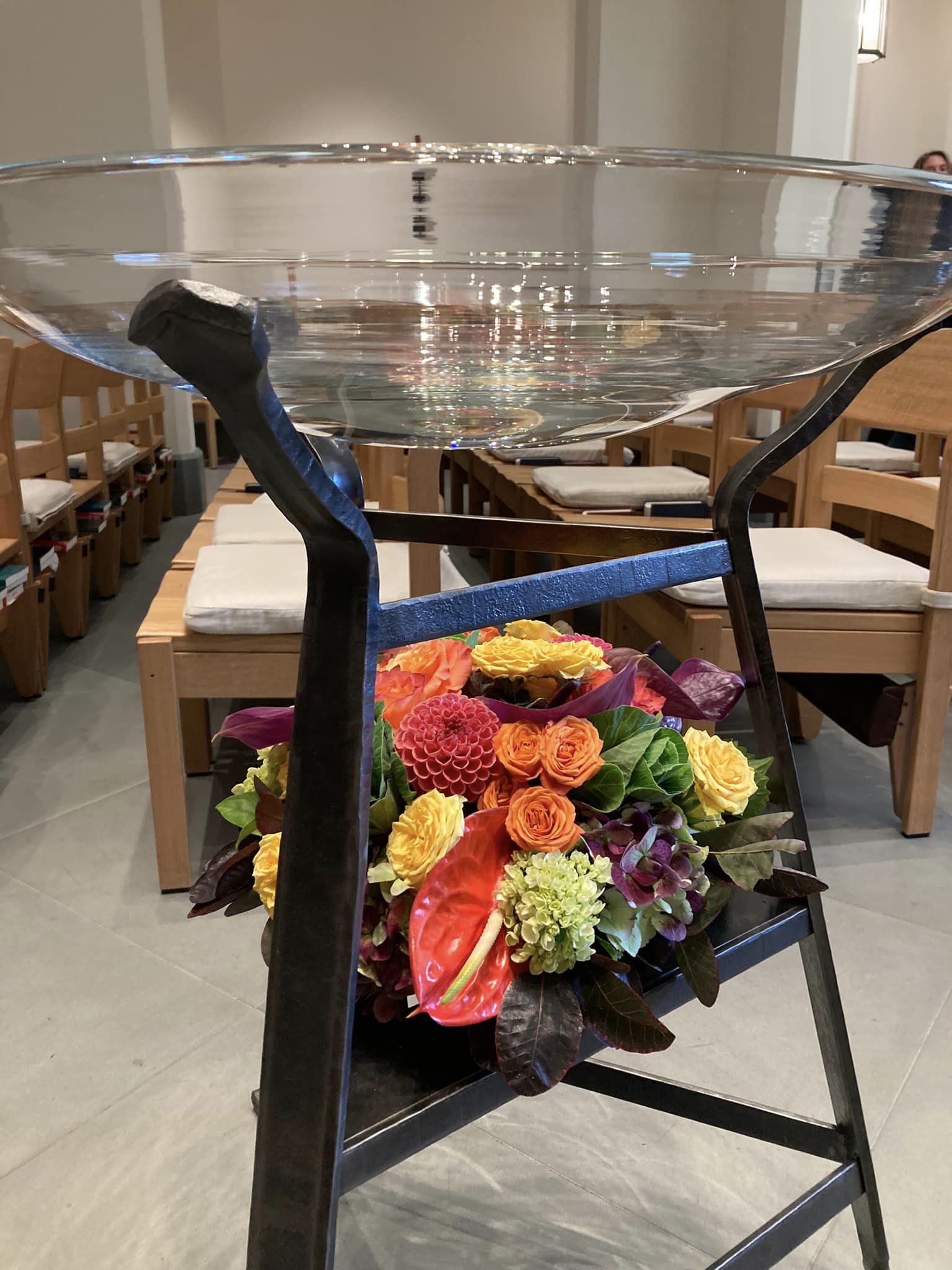
Font at Virginia Theological Seminary

I remember when I was a seminarian, sitting in daily worship, my eyes and mind would sometimes wander.  In particular, I was fascinated by the names or other small mementos carved into the old pews.  I always wondered who the mystery person was who left their mark, how long ago they carved it, and how they managed not to get caught.  What I loved about those small little marks was how they made me feel connected – connected to a long line of priests and lay leaders shaped by the seminary, all with varying gifts and talents, serving God in God’s church around the world.

Last week, my seminary honored 200 years of forming priests in the Episcopal Church.  Though those pews from the old chapel were lost in a fire, what struck me was the massive changes the seminary has seen.  From slaves who helped build and then worked on the property, wars that shaped the context for ministry dramatically for generations, fiduciary decisions that impacted the viability and structure of the seminary, the growing diversity of the student body as the Episcopal Church’s understanding of who can be called to ministry has expanded, and an evolving physical plant that has shifted what the school on the holy hill looks like – all of that change has made for a rich and layered history, of which I am a small part. 

But perhaps what speaks to me most about Virginia Theological Seminary is the ways that it also has a microcosmic impact on the church – namely, the ministry of every graduate from the seminary.  My time at VTS shaped and formed me into the priest I am today – from academic formation to liturgical formation, from learnings on leadership to the development of relationships, from shaping my spirituality to shaping my sense of the wider church.  And for every graduate like me, VTS has shaped thousands of others who go out into the world to preach the gospel.  That reality is what inspires my financial support every year – knowing the future generations I can support.

As my church journeys into stewardship season, a time of discernment about how we will support our church financially and with our time, I am reminded of how we all come to think about the stewardship of our resources.  Supporting my seminary and my church financially are ways I say to those institutions and my community that these institutions are important to me:  they have made an impact in my life, and have inspired me to make an impact on the them.  I would not be the priest, mother, or wife that I am without either my seminary or Hickory Neck Church.  What about you?  How has our church shaped your life?  What stories are the stories that make you eager to be a part of financially supporting ministries of impact?  I can’t wait to hear what inspires your giving!

← Older posts
Newer posts →

Recent Posts

  • On Getting It Right…
  • Sermon – Matthew 9.9-13, 18-26, P5, YA, June 7, 2026
  • On God, Grace, and Letting Go…
  • On Spiritual Check-Ins…
  • Sermon – Acts 1.6-14, E7, YA, May 17, 2026

Archives

  • June 2026
  • May 2026
  • April 2026
  • February 2026
  • January 2026
  • December 2025
  • November 2025
  • October 2025
  • September 2025
  • August 2025
  • July 2025
  • June 2025
  • March 2025
  • February 2025
  • December 2024
  • November 2024
  • October 2024
  • September 2024
  • August 2024
  • July 2024
  • June 2024
  • May 2024
  • March 2024
  • February 2024
  • January 2024
  • December 2023
  • November 2023
  • October 2023
  • September 2023
  • August 2023
  • July 2023
  • June 2023
  • May 2023
  • March 2023
  • February 2023
  • January 2023
  • December 2022
  • November 2022
  • October 2022
  • June 2022
  • May 2022
  • January 2022
  • December 2021
  • November 2021
  • October 2021
  • September 2021
  • August 2021
  • June 2021
  • May 2021
  • April 2021
  • March 2021
  • February 2021
  • January 2021
  • December 2020
  • November 2020
  • October 2020
  • September 2020
  • August 2020
  • July 2020
  • June 2020
  • May 2020
  • April 2020
  • March 2020
  • February 2020
  • January 2020
  • December 2019
  • November 2019
  • October 2019
  • September 2019
  • August 2019
  • July 2019
  • June 2019
  • May 2019
  • April 2019
  • March 2019
  • February 2019
  • January 2019
  • December 2018
  • November 2018
  • October 2018
  • September 2018
  • August 2018
  • July 2018
  • June 2018
  • May 2018
  • April 2018
  • March 2018
  • February 2018
  • January 2018
  • December 2017
  • November 2017
  • October 2017
  • September 2017
  • August 2017
  • July 2017
  • June 2017
  • May 2017
  • April 2017
  • March 2017
  • February 2017
  • January 2017
  • December 2016
  • November 2016
  • October 2016
  • September 2016
  • August 2016
  • July 2016
  • June 2016
  • May 2016
  • April 2016
  • March 2016
  • February 2016
  • January 2016
  • December 2015
  • November 2015
  • October 2015
  • September 2015
  • August 2015
  • July 2015
  • June 2015
  • May 2015
  • April 2015
  • March 2015
  • February 2015
  • January 2015
  • December 2014
  • November 2014
  • October 2014
  • September 2014
  • August 2014
  • July 2014
  • June 2014
  • April 2014
  • March 2014
  • February 2014
  • January 2014
  • December 2013
  • November 2013
  • October 2013
  • September 2013
  • August 2013
  • July 2013
  • June 2013
  • May 2013
  • April 2013
  • March 2013
  • February 2013
  • January 2013
  • December 2012
  • November 2012
  • October 2012
  • September 2012

Categories

  • reflection
  • Sermons
  • Uncategorized

Meta

  • Create account
  • Log in
  • Entries feed
  • Comments feed
  • WordPress.com

Blog at WordPress.com.

  • Subscribe Subscribed
    • Seeking and Serving
    • Join 391 other subscribers
    • Already have a WordPress.com account? Log in now.
    • Seeking and Serving
    • Subscribe Subscribed
    • Sign up
    • Log in
    • Report this content
    • View site in Reader
    • Manage subscriptions
    • Collapse this bar

Loading Comments...