• About

Seeking and Serving

~ seek and serve Christ in all persons

Seeking and Serving

Tag Archives: God

On Seeing God in the Body…

08 Wednesday Aug 2018

Posted by jandrewsweckerly in Uncategorized

≈ Leave a comment

Tags

body, body of Christ, Christ, church, gift, God, ministry, play, vacation bible school, vocation, witness, work

IMG_2385

Photo credit:  Jennifer Andrews-Weckerly; reuse with permission only

One of the things I learned very early on in my priesthood is I cannot do all the work of the church.  The priest cannot be everywhere, at every event, leading every ministry.  And I have wholeheartedly come to believe that she should not try.  In doing so, the priest disables the ministry of the laity, and to be frank, never gets close to the glory of what can happen when everyone contributes their gifts in ministry to the work of the church.  When Paul talks about the Body of Christ being like parts of the body – where every hand, foot, elbow, and nose are needed to make the Body complete – Paul was talking about the leaders too.  The Body of Christ does not function without all the members.

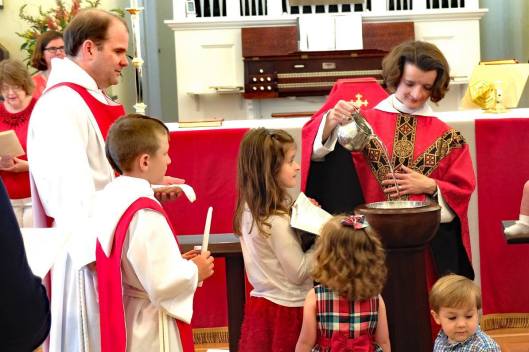
I have been reminded of this truth this week as I have watched our Vacation Bible School program in action.  Months of planning, organizing, imagining, and executing have come to fruition.  I was given 10 minutes this week for teaching and prayer.  The rest of the time – five days, 15 hours, 900 minutes – has been filled with adults, youth, and even children leading a wonderful week of reflection about where we see God, how we can be helpers in God’s mission, and how we can be God’s hands, changing the world.  It has been a glorious experience to watch fingers strumming guitars, adults comforting children, teens running little ones’ energy out, children holding hands, priests from neighboring churches teaching and praying, and, as I like to imagine, God smiling broadly as God hears us asking God to “kumbaya.”

Part of what is nice about this week is I get to see the work of the Body up close.  I get to see church members flexing their vocational gifts, teaching and showing our kids how much God loves them and how they are now empowered to love others.  But much like my contribution this week is just a small part of the whole, I realize Vacation Bible School week is just a small part of the larger whole.  Every week our parishioners – children, youth, and adults – are living out their vocations every day.  They are teaching children, building homes, healing bodies, fighting fires, studying for tests, and holding each other’s hands as faithful children of God.  There are holy moments every week, every day, every hour, every minute, where we live into the gifts God has given us, and show God’s love to others.  Our witness to Christ does not happen unless we are all doing are part as the Body of Christ.

I wonder where you are seeing God and the work of the Body of Christ today.  At home, at work, at play, we can all see God working through each other.  Our invitation this week is to look for that work, to be a part of that work in our own lives, and to witness where we see that work in others.  My suspicion is once we start doing that work, we will be smiling as God has been smiling this week!

On Raising Kids in the Faith…

01 Wednesday Aug 2018

Posted by jandrewsweckerly in Uncategorized

≈ Leave a comment

Tags

baptism, children, church, faith, formation, God, kids, questions, scripture, teach, teaching, vacation bible school

kids_SS

Photo credit:  http://livingwaterlutheran.us/

Last week, as we were driving to summer day-camp, my eight-year old was mid-stream with a story from the backseat when she abruptly jumped to another story she remembered.  Used to the constant chatter from my little ones, I barely noticed, but she exclaimed, “Oh my goodness!  I’m just like Mark!”  “What?” I asked, having no idea who this Mark was and what he had to do with either of her stories.  “You know, like Mark from the Bible, when he interrupts one story with another one.  Ha!”

As I struggled to stay focused on driving, my mouth fell open.  I was stunned.  You see, several weeks ago, I preached a sermon about Mark, explaining his “sandwiching technique,” – basically interrupting the telling of a story with another story, only to return to the original story.  You can read here about why he utilizes this literary technique.  I was shocked to know that my daughter actually remembered that detail from a sermon; honestly, I was a little surprised that she was listening at all, let alone remembering anything I said.  In my shock, I managed to stammer out, “Oh, you remember that?”  “Yeah.  Everyone thinks I don’t listen in church because I’m doing other things.  But I listen.”

Now I don’t expect children of all ages to grasp literary devices of Gospel writers, but what that conversation reminded me of is how often children are listening, and especially listening to what we have to say about God.  Many parents I talk to often worry about how to help their children learn about God, feeling a bit inadequate themselves for such a daunting task.  The advice I give them is simple:  bring them to church.  Let them experience as much of the liturgies as they can handle.  Let them go to Children’s Chapel and Sunday School as much as you can.  And when things like Vacation Bible School come up, as they do next week at Hickory Neck, take them.  The songs, the stories, the dialogue will slowly seep in, and the questions will surely pop up in the backseat of a car, at the dinner table, or before bed.  And if you are not sure about the answers, don’t worry.  You can always use the question as a “wondering moment,” asking questions and leaving things open for their imaginations (and the Holy Spirit!).

This Sunday we will baptize a baby at Hickory Neck, and his parents, godparents, and the parish will pledge to do the same – see that the child is raised up in the church.  We won’t have all the answers, and we may even stumble through trying to explain our faith (I could tell you countless stories about my own bumbling).  But in the end, each child’s journey feeds and enriches the journey of each of us.  Their questions inspire the adults to get into church too – to be steeped in the liturgy, to study scripture, to engage in conversation, to reflect on the presence of God in our lives.  The Church offers that tremendous gift to us every week.  Our invitation is to get ourselves there.

33076825_1843825552340363_5100443877848907776_o

Photo credit:  John Rothnie (permission required for reuse)

GC79: Kingdom Work

26 Thursday Jul 2018

Posted by jandrewsweckerly in Uncategorized

≈ Leave a comment

Tags

Episcopal Church, General Convention, God, heaven, hope, Jesus Christ, Kingdom, liberating, life-giving, loving, people

IMG_5342

Photo credit:  Ruth Beresford (reuse only with permission)

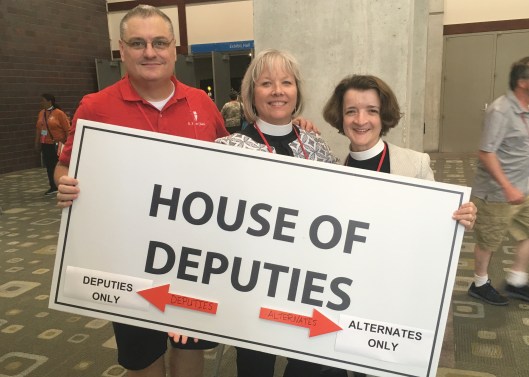
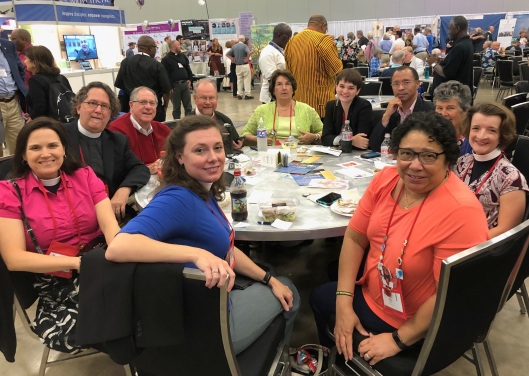
One of the questions I have received about General Convention is what it is like.  What you notice right away is General Convention’s impressive scale.  Every one of the 110 dioceses of the Episcopal Church is able to bring four clergy and four lay deputies.  They may also bring four alternate clergy and four alternate lay deputies.   In total, that’s over 800 people on the floor of the House of Deputies.  All bishops are also present, meeting in the House of Bishops.  Each diocese can have 1 – 3 bishops in place (Diocesan, Suffragan, and Assisting/Assistant).  Visitors from near and far can also attend, as well as media from dioceses, youth observers, and distinguished guests.  The Exhibit Hall also has an extraordinary number of staff and volunteers, and in addition to booths, the seminaries regularly bring in staff or faculty for seminary reunions.  Meanwhile, the entire Convention Center is run by massive amounts of volunteers – covering everything from check-in, monitoring the floor, helping with worship, to the exhibits.  Meanwhile, the ECW holds its annual triennium at the same time, which involves representatives, organizers, and volunteers.  Needless to say, Episcopalians take over the host city (this year coined as the Episcapocalypse).  Even Austin, Texas, which prides itself in being “weird,” I think was a little overwhelmed by our numbers.

IMG_1950

Photo credit:  Chris Girata (reuse only with permission)

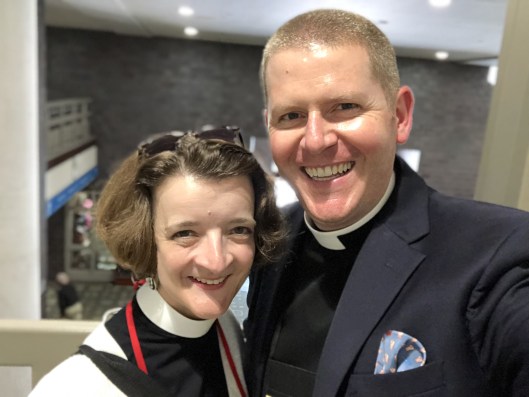
What I particularly enjoyed was getting a taste of what it might be like to enter God’s heavenly kingdom.  People from all walks of my life were present at Convention.  There were people from my time in undergraduate campus ministry, my time working as a lay person, my time in seminary, my time as a curate, my first time as a rector, and my current position.  The joy of greeting one longtime friend or colleague after another was heartwarming.  It also reminded me of how incredibly blessed my life has been to be full of incredible people who have shaped, influenced, and sometimes directed my faith life.  God’s abundance was all around me in the faces of God’s children.

IMG_1885

Photo credit:  Hickman Alexandre (reuse only with permission)

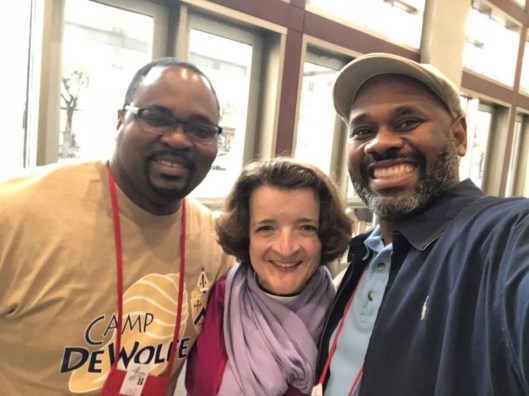
But you could not be at General Convention without meeting other people.  A conversation about something mundane would lead to the realization that we had friends in common.  Waiting in line for something would lead to a conversation about a shared passion.  People you have “met” online through vocational networking you could finally meet in person.  Suddenly, you realized you were making connections from all over the world.  The family of the Episcopal Church is deep and wide.  I leave General Convention feeling hopeful for the future of the Episcopal Church, knowing that it is full of passionate people, doing their part to create a loving, liberating, life-giving world through Jesus Christ.  Thanks be to God!

IMG_1749

Photo credit:  Ann Turner (reuse only with permission)

GC79: Reconciliation in Real Time

20 Friday Jul 2018

Posted by jandrewsweckerly in Uncategorized

≈ Leave a comment

Tags

anxiety, bishops, change, cheer, concern, Cuba, Episcopal Church, family, General Convention, God, home, House of Bishops, humbling, mercy, reconciliation, right, wrong

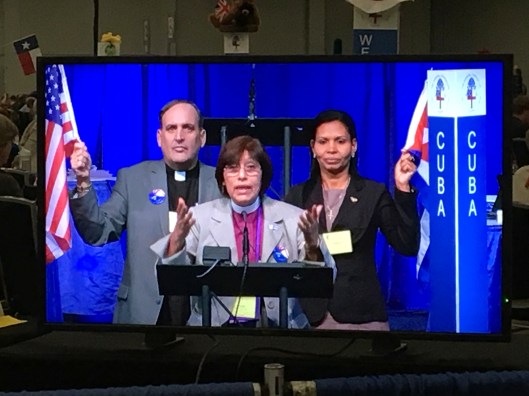
IMG_1927In 1966, in light of the Cuban Revolution and the political response of the United States, the House of Bishops voted to separate from the Diocese of Cuba from the Episcopal Church, leaving it an autonomous diocese without a provincial home.  The clergy scattered, some returning or immigrating to the US, but some who remained in Cuba were imprisoned, executed, or disappeared; priests lost their pensions, and they operated in isolation from the Church.  Cuba officially requested to be reaffiliated with the Episcopal Church and was given a list of requirements before admission.  As of GC79, all of those conditions had been met.  However, leading up to the resolution coming to the floor of both the Deputies and Bishops, there was controversy on what it would mean, how this admission might impact the admission of other Dioceses (or their exit), how to affirm already elected bishops (assuming they had not followed the current practices of approval for bishops in the Episcopal Church), among other concerns.  In other words, there was a desire to right the wrong done 52 years ago, but some anxiety about the implications of the decision.

As an alternate deputy, I had the leisure of observing either House.  On Tuesday, I happened to be observing the House of Bishops when resolution A238 came to the floor.  Each testimony pleaded for righting the wrong done by the House of Bishops in 1966.  Retired bishop Leo Frade from the Diocese of Southeast Florida spoke passionately about the resolution.  As a Cuban American who had been a part of the Church in Cuba, he got quite emotional in his plea for the bishops to do the right thing.  When it came time for the vote, the vote was a unanimous approval for readmittance.  The entire house – bishops and visitors – exploded.  Cheers and clapping filled the room, and the standing ovation lasted several minutes.  Unbeknownst to me, the Bishop of Cuba was present and was invited to approach the platform to address the House.  Bishop Curry embraced her.  The House broke into singing the Doxology.

Bishop Griselda Delgado’s speech was the most humbling.  Despite every reason to feel resentful or hurt, Bishop Delgado communicated nothing but forgiveness and reconciliation.  “We are family,” she insisted.  And although we severed the relationship so many years ago, she insisted, “Cuba never left.”  Her sentiments struck me as the exact way that God sees us.  When we reject God, God never leaves us.  When we abandon God, we do not abandon our familial ties with God.  Bishop Delgado’s profound sense of right relationship, reconciliation, and forgiveness brought the House to tears.  We did not deserve her mercy, and yet there she was, offering mercy.  When Bishop Delgado said, “The Holy Spirit is here,” I knew she was right.  In response, Presiding Bishop Curry said, “The Bishop may take her seat at Table 7.”  Those words were words of righting a wrong – fully, completely, unconditionally.

The experience the next day was equally powerful in the House of Deputies.  They too needed to approve the resolution, and it also passed unanimously.  Bishop Delgado spoke there too, but equally powerful was the triangular sign with the word, “Cuba” written on it.  It was processed to a table, and the deputies from Cuba were seated in the House of Deputies.  “Welcome home,” pronounced President Jennings.

What I loved about the approval of this resolution was seeing how legislation can powerfully effect change.  Sometimes, in the weeds of parliamentary procedure, and canonical revisions, one can wonder if all we are doing is navel gazing.  But on these days, we watched first-hand the commitment to change, the willingness to boldly repent, and the receiving of mercy.  Surely the presence of this Lord has been in this place!

GC79: On Needing Revival…

18 Wednesday Jul 2018

Posted by jandrewsweckerly in Uncategorized

≈ Leave a comment

Tags

Bible, Bishop Curry, church, Episcopal Church, General Convention, God, God's word, Holy Spirit, interpretation, liberation, love, ordination, protest, revival, role, scripture, women

This week, I continue with more reflections from the General Convention of the Episcopal Church.  Look for posts in the days to come that give some insight into the experiences of the week, the take-home lessons, the pondering questions still ruminating in me.  Thanks for following along!

On Saturday evening of General Convention, we were invited to a revival at a local church.  The revival was powerful and clearly moving to many in the crowd.  Of particular note was the Spanish translator hired to translate for Bishop Curry.  She was poised, animated, and seemed to feed off Bishop Curry’s energy.  I do not know how she did it, but the two of them really seemed to be preaching together – to be dancing in God’s word as they preached a message of love and life.  Even for someone whose Spanish is minimal, I found her translation and presence really made Bishop Curry’s sermon come alive in a new way.

But what has been staying with me about that evening was the protest outside the church.  Members of Westboro Baptist Church gathered to protest what the Episcopal Church has been doing; from their signs, I understand they are mostly upset about the ordination of women, and our inclusion of the LGBTQ community in ordained and married life.  In the course of my life, I have had many conversations about both of those issues, including people confronting me about my own ordination and my theological understanding about the expansiveness of God’s love for all.  Those conversations have sometimes been hard, hurtful, and even anger-inducing.  But ultimately, they were always conversations – things said to my face, debates had between people, disagreements had within the context of relationship.

So the sentiments of the protestors was not new to me (although some of the language used against female pastors would have made many clutch their pearls).  What was heartbreaking was seeing a preteen standing next to her mother with a sign that read, “No Women Preachers – 1 Tim. 2.12.”  I went back and reread 1 Timothy 12, and I confess, a good portion of the chapter is about wives submitting to their husbands, keeping silent, allowing their husbands to lead.  We’ll talk about that in another blog post.  But as I looked at the young girl, I remembered all the times I started asking hard questions about things I had read in the Bible that did not seem to make sense – that did not seem to jive with the wide embrace of God’s love.  I remembered the Sunday School teacher who encouraged us to read the Bible literally, condemning her own current marriage because she had once been divorced.  I remember feeling a sense of discomfort until I found liberation in the Episcopal Church – a church that taught me to ask hard questions, to be uncomfortable in the ambiguity, to be released from the bonds of literal biblical interpretation, and to read the Bible in a new way.

Holding all that in my mind, I grieved for this young woman.  I sorrowed for the mother standing next to her, teaching her to keep silent, and to disrespect every woman who believes God is empowering us with God’s word.  I lamented the hate being inculcated into this young girl.  I mourned the light being limited in her life.  As female preachers poured out of buses for the revival, I found myself wanting to whisper into her ear, “God’s love is bigger than the words in 1 Timothy.”  Holy Scripture has been used time and again to limit God’s love, grace, and mercy.  I am sure I am guilty of a similar sin in one way or another; perhaps even this blog post is an exercise in sinful presumption.  My prayer for all of us is that we have people whispering in our ears words of truth, reconciliation, and peace.  Let not the work of the Holy Spirit be extinguished in us.

IMG_1755

Photo credit:  Jennifer Andrews-Weckerly (permission needed for reuse)

GC79: Prayer and Presence

13 Friday Jul 2018

Posted by jandrewsweckerly in Uncategorized

≈ Leave a comment

Tags

asylum, Detention, families, General Convention, God, Hutto, immigration, isolation, prayer, presence, women

36853368_10157022959522565_1614959607975772160_n

Photo credit:  Jennifer Andrews-Weckerly (reuse with permission)

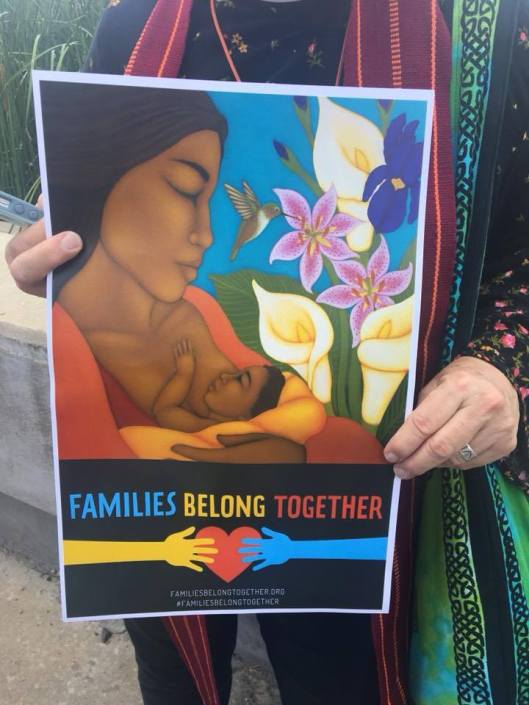
On Sunday of General Convention, the Convention invited us to step out into the world on issues of injustice.  The Bishops gathered to protest against gun violence in the morning.  At midday, we were all invited not to a protest, but a prayer service – a service of solidarity with our sisters seeking asylum in this country.  I was a bit conflicted about the prayer service.  My parishioners have been trying to reconcile their sense of the injustice of families being torn apart at our borders, but with divergent opinions about how immigration and asylum should work in the United States.  I certainly have my opinions about the matter, but I always try to honor the diversity of our community.

Ultimately, I decided that we can always stand to pray.  And so, with a friend and her one-year old daughter, we drove to the Hutto Detention Center for a prayer service.  The Hutto Detention Center was once a prison in Texas.  It is run by a privately-held, for-profit corporation, and hosts women – some of whom have been separated from their children, but all of whom are awaiting help from lawyers as they process asylum petitions.  The day was sweltering hot, and we were in a field by the Center.  Around 1,200 Episcopalians had gathered, with a line of buses surrounding us that had brought many from Austin.  The former identity as a prison was obvious – small, skinny windows, stark, cold walls, high, barbed fences.  Songs were spontaneous at times:  We Shall Overcome, Amazing Grace, This Little Light of Mine.  There were spoken prayers, and impassioned pleas for justice.

I found myself staring out at the building, wondering about the stories, fear, and suffering inside.  I later learned that there have been high occurrences of sexual assault in the Detention Center.  As the child we were with cooed and chattered, I wondered about the hole in my heart I would feel if my children were stripped from me – children I would protect at all costs.  A portion of the crowd walked to the street to get closer and I felt myself drawn to their path.  I wanted a connection with the women inside so deeply.

As we stopped at the entrance, chants began.  “We see you, God loves you.”  “You are not alone.”  Songs followed.  As tense, cold guards stood in front of us (for whom I was grateful and sympathetic toward), I found my grief increasing.  There were rumors that the guards would have pulled the women away from the windows, so it was possible that they would not even hear us.  But as we began to move back to the field, we saw them – women waving in windows, waiving towels behind tall windows.  Later, we would find out from Grassroots Leadership that, “A woman called from Hutto after today’s prayer and told us they were glued to the windows until the last bus left the detention center.  Women inside were crying, saying they knew they weren’t alone after seeing so many people there.”

I know this is a complicated issue for many of us.  But I have to tell you, prayer, relationship, and empathy would certainly get us a long way.  Those are humans, fleeing violence, degradation, and persecution in their home countries, stuck behind cold walls, being persecuted in another country.  And for that, we could all stand to do a lot more praying.

GC79: Everyday Evangelism…

12 Thursday Jul 2018

Posted by jandrewsweckerly in Uncategorized

≈ Leave a comment

Tags

conversation, evangelism, General Convention, God, Jesus, relationship, story, stranger

36759698_10157020460107565_1355952824961204224_o

Photo credit:  Jennifer Andrews-Weckerly (reuse only with permission)

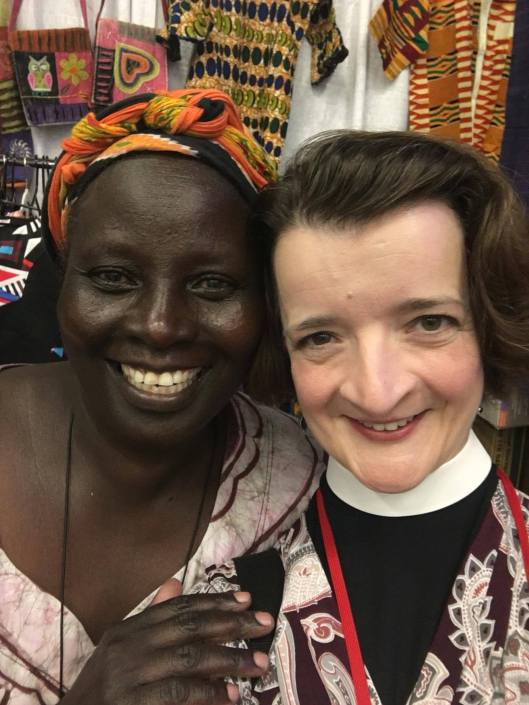
On my first day of General Convention, I had to start as a “visitor” until I could get my alternate name badge.  That meant I had some spare time to explore the exhibits in the Exhibit Hall.  I decided to grab lunch there, and after I made my purchase, I realized I didn’t know anyone in the eating area, and many of the tables were full of deputations or groups of friends.  There was a table with just one petite older woman of color.  I figured General Convention was partly about meeting the wider church, so I asked to join her.

We began the normal chitchat of the day – the weather, the food, etc.  I asked her where she was from and she said, “Arizona now, but I’m from Kenya.”  Well, you can imagine my excitement – one of my best friends from seminary is a female priest from Kenya.  We launched into a conversation about what brought her to the States, and before I knew it, we were deep in a conversation about the husband who left her for another woman, the kids he left her to manage, the impact of the divorce on her family, the hurtful things a priest said to her about the divorce, the way she has experienced racism – not just as a person of color, but as a woman from Africa.

After we grieved the hard stuff, and my apology about the sins of the church, she began to tell me about the good stuff:  the grandchildren she moved to Arizona to enjoy; the women she works with back in various countries in Africa to produce clothing that will feed their families; the school she is trying to help some of the women establish in their hometown.  She was at Convention to display and sell their wares.  She jokingly told me, “Yeah, I’m a little concerned.  The women gave me several items that are going to be way too small for anyone here to wear.”  I knew God had brought us together for a reason!  “Mary,” I exclaimed, “I guess that means I’m going to have to buy one of those smalls!”

Later that week, I dropped by new friend’s booth.  We embraced like old friends.  I could see the wrinkles of hurt and toil on her face more distinctly this time, but I could also see the twinkle of new relationship in her eyes.  I came away with a cute dress, but more importantly, I came away with a sense of kinship, of having connected with another human about the journey of life, and where God can work through us to do good.  When we talk about evangelism in the church, I always try to remind Hickory Neck that evangelism is about hearing people’s stories and naming God in them.  It is not easy work.  It will involve sitting down at tables with strangers and maybe even starting by talking about the weather.  But if you hang in there, you might just hear the story of how God is working through us all – and even find a new sister or brother in Christ along the way.

On Holiness and Heroes…

27 Wednesday Jun 2018

Posted by jandrewsweckerly in Uncategorized

≈ Leave a comment

Tags

baptism, Christ, discern, disciple, Episcopalian, ethics, fantasy, foundational, God, identity, Jesus, morals, purpose, superheroes

Wonder Woman

Photo credit:  https://www.themarysue.com/no-boys-allowed/

This Sunday we begin our summer film series at Hickory Neck called “Faith and Film.”  When I announced to our parish that this year’s theme would be superheroes, I got some raised eyebrows.  My suspicion is that for those of our parish who have not already blocked out the next five Sunday evenings, their raised eyebrows are because superhero movies may seem frivolous, superficial, or even violent.  On the surface, I can understand the suspicions.  For a long time, I though superhero films dabbled a little too much in escapism and fantasy.  And there is certainly some of that component to the films – who doesn’t enjoy what filmmakers can do with computer graphics these days?!

But at the heart of these films is something much more significant.  Each film seems to asks deep, defining questions.  What kind of person are you going to be?  What morals or ethics will rule your life?   What things are of ultimate significance in your life?  What responsibility do you have for the world and people around you?  These questions are not frivolous questions.  When someone dons a Captain America hat or a Wonder Woman shirt, they are not just celebrating a fun, fictional hero – they are also celebrating a moral way of life.

I cannot imagine anything more relevant to a disciple of Jesus than discerning and making decisions about your life that reflect your morals and ethics.  As Episcopalians, we look to our baptismal covenant for that definition.  It defines five core elements:  1) continuing in the apostles’ teaching and fellowship, the breaking of the bread, and the prayers, 2) resisting evil, and, whenever we fall into sin, repenting and returning to the Lord, 3) proclaiming by word and example the Good News of God in Christ, 4) seeking and serving Christ in all persons, loving our neighbor as ourselves, and 5) striving for justice and peace among all people, and respecting the dignity of every human being.[i]

These days, as our current political climate challenges us on more and more specific issues, I cannot imagine a better topic than to talk about what defines us and our behavior, and then recommitting to that identity and purpose.  The good news is that if you are able to make it to all five movies, the following Sunday (August 5), we will be renewing our baptismal covenants as we baptize a child of God – an event where we all commit to being superheroes in the life of Christ.  I hope you will join us for this fun, sometimes frivolous, but mostly foundational journey.

[i] Book of Common Prayer, 304-304.

Sermon – 1 Samuel 17.1a, 4-11, 19-23, 32-49, P7, YB, June 24, 2018

27 Wednesday Jun 2018

Posted by jandrewsweckerly in Sermons, Uncategorized

≈ Leave a comment

Tags

armor, bold, Christ, confident, cynical, David, disciple, dispassionate, Eucharist, faith, faithfulness, fear, God, Goliath, identity, love, politics, Sermon, skeptical, table, trust, underdog, vulnerable

This summer, our Faith and Film series is all about superheroes.  I was never a huge fan of superheroes growing up.  I liked Superman and Batman nominally, sported a pair of Wonder Woman Underoos as a kid, but in general wasn’t really into superheroes and certainly not into comic books.  But a few years ago, I stumbled into the film, The Avengers, and found myself curious about the back stories of all these superheroes.  That began a deep dive into multiple films, many of which you can see this summer.  The first one, Captain America, is a classic story of the little guy overcoming.  Steve Rogers, a literal little guy with a bad case of asthma, wants to enlist in the US Army during World War II so badly, but his health and height disqualify him.  Impressed by his tenacity, Steve gets recruited into an experimental program to be medically turned into a Super Soldier.  There begins his journey of the little man taking on the big man of Nazi Germany.

Most of us enjoy a good story of the little man overcoming.  That’s why the story of David and Goliath is so epic in our memory.  This little kid, totally untrained, completely unarmed (with the exception of some rocks and a sling), and certainly the underdog to the 9 feet 6 inches[i] of Goliath, David is the prototypical little man.  And yet, with the entire Philistine army staring them down, with a giant taunting them for forty days, and with the ominous threat of defeat, no one else is willing to step forward.  The giant, covered in over 126 pounds of armor, and holding huge weapons like the spear whose iron head weighs fifteen pounds[ii], utilizes his own brand of psychological warfare.[iii]  In the end, that dry river bed between the two armies is not just a valley of separation, but a “chasm of fear.”[iv]  And yet, somehow, the teenage shepherd boy steps forward to fight – the little man, the underdog, makes his move.

But unlike a typical underdog, David does not need science, or a lucky break, or some trick.  What David needs has nothing to do with him.  Instead, what he needs is God.  No one in the Israeli camp has mentioned God at this point in the story.  Saul has tried to overcome the chasm of fear with the promise of riches and even his own daughter’s hand in marriage.  And yet, the entire army of Israel can only see how mismatched they would be against the ultimate warrior.  But David sees things differently.  Having fought lions and bears to save his sheep, David knows he can fight Goliath too.  But not because he is a mighty warrior – but because Yahweh delivered David then too.  Even Saul, God’s formerly appointed king, has forgotten God.  But not David.  David is first to speak Yahweh’s name in almost forty verses of text.[v]  When David faces Goliath, he invokes God’s name, recalling with the name the entire memory of Yahweh’s deliverances of Israel in the past.  David knows that he does not need the conventions of human warfare, but only the God of Israel.[vi]

This week, I have been thinking what a ridiculous sermon that is:  all we need is God.  If all we needed was God, we wouldn’t be in such a political mess, totally unable to compromise, hear each other, and work for the common good.  If all we needed was God, that cancer diagnosis, that lost job, that lost pregnancy, or that lost relationship would not have felt so devastating.  If all we needed was God, we would have figured out a way to both secure our borders and humanely treat those fleeing injustice and seeking asylum.  In saying all we need is God, we sound like a bunch of hippies singing the great Beatles song, “All You Need is Love.”  As modern pragmatists, we know better – we know letting go and letting God is what you say – but not what you do.

So how do we turn ourselves from being skeptics, cynics, and dispassionates to seeing all we need is God?  Well, first we have to define a few things.  What is happening in David’s story should not be a surprise.  If you remember a few weeks ago, when the people broke their longstanding covenant with God, asking for a king like the other nations, God gave them Saul.  And Saul was just that – like the other nations, fighting battles with weapons of other nations.  So when David offers to fight, Saul does what a conventional leader would do – arm David with the conventions of war.  He tries to weigh down David with his armor, hoping against hope that there might be a modicum of protection against the Philistine.  Saul is a ruler like the other nations have.  The contrast between Saul and David then becomes a contrast between trusting conventional means and the means of God.[vii]  Saul has become ruled by fear instead of faith.

The way we pull ourselves out of being skeptical, cynical, or dispassionate is not by rallying behind the idea that we are the little man – the underdog David or Captain America, just waiting to be empowered by God.  The way we put to bed our skepticism, cynical thoughts, or dispassionate feelings about all the things in life overwhelming us is to recall the faithfulness of God.  When David says, “All you need is love,” he does not mean all you need is people giving hugs to one another.  What he means is, all you need is to remember the faithfulness of God – especially when we are not faithful at all!  In his speeches to Saul and Goliath, David is recalling the salvation narrative – the stories of God’s faithfulness for generations.  His trust is actually pretty bold too, considering the current king Saul’s appointment represents the breaking of covenant between God and the people.  But David trusts even a broken covenant can be overcome.  David claims his identity as a child of God and knows his identity is all he needs to fight the worst this world has to offer.

This past week, as politics and religion got dragged together in front of camera crews, I slowly began to realize that we are in a David moment.  We can keep doing what we have been doing – keeping our faith out of politics, putting politics in a box that we especially do not open on Sundays, or we can start realizing that we can never put our faith in a box.  The bond that we have as Episcopalians and especially within the hugely politically diverse community that is Hickory Neck is extremely fragile.  Our fragility is why I rarely talk about politics among the community.  I value our ability to come to the Eucharistic Table in spite of our difference over just about anything else.  But that high value on the common table can come at a cost – the cost is never talking about what being a people of God means – what being a disciple of Christ and being an American means.  In order to protect that common table, I have put on 126 pounds of brass armor, and taken up a spear whose head weighs fifteen pounds.  Instead, today David invites us to shed the ill-fitting armor, and just walk in the clothes God gave us (and maybe a few stones).

I am not saying once we shed man-made armor we will suddenly know what immigration policies are the best.  But what I am saying is until we take on God’s armor, until we recall all those times when God has delivered us, when God has turned chasms of fear into paths of faithfulness, until we remember that we have a distinct identity as children of God and disciples of Christ, we will not be able to take on the Goliath issues of our day.  Stripping down to David-like clothing, we are able sit down comfortably, to see each other more honestly, to be in relationship more authentically, to gather at this table – not just trying to avoid banging our heavy armor into each other, barely able to make eye contact because of our heavy helmets, but actually brushing the skin of elbows with one another, looking deeply into the eyes of the chalice bearer serving you Christ’s blood, and offering the hand of Christian friendship as we rise from the altar rail together.  We can do all those things because God is faithful.  We can do all those things because God has delivered us before.  We can do all those things because we are Christ’s disciples – and that is what we do through God.  We may be underdogs, and we may be vulnerable in a world that is happy to deploy psychological warfare, but we are united and empowered by the love of God.  Our invitation is to step trustingly, boldly, confidently into that love.  Amen.

[i] William P. Brown, “Exegetical Perspective,” Feasting on the Word, Supplemental Essays for Year B, Batch 2 (Louisville:  Westminster John Knox Press, 2012), 4.

[ii] Richard F. Ward, “Homiletical Perspective,” Feasting on the Word, Supplemental Essays for Year B, Batch 2 (Louisville:  Westminster John Knox Press, 2012), 4.

[iii] Walter Brueggemann, Interpretation:  A Biblical Commentary for Teaching and Preach, First and Second Samuel (Louisville:  John Knox Press, 1990), 131.

[iv] Ward, 2.

[v] Brueggemann, 130.

[vi] Brueggemann, 132.

[vii] Brueggemann, 131.

On God’s Mothering Wings…

13 Wednesday Jun 2018

Posted by jandrewsweckerly in Uncategorized

≈ Leave a comment

Tags

barrier, brood, God, hen, Jesus, relax, strength, vulnerability, weakness, willfulness

fall-asleep-fast-FB

Photo credit:  https://themilitarywifeandmom.com/one-simple-trick-to-help-your-kids-fall-asleep-fast/

The other night I was rocking my younger to sleep.  The practice is slowly becoming a rarity.  She is getting a bit big for rocking, and now seems to prefer me to sing to her in her bed without rocking her.  The loss of that privilege is one more thing on the list of preferences that demonstrate she is becoming a big girl and is needing me less and less.  So, although she consented to the rocking, her body revealed her resistance.  She was tense and alert.  But once I was able to quiet her down, and the rocking continued, her body began to let go.  Fatigue overcame her, and I could feel her body gradually relaxing in my arms.  That willful, determined, independent little girl was able to let go for a moment, and give into sleep in my arms.

As the tension in her body melted away, I wondered if that is how God feels when I finally cede control to God – if I am similarly determined and defiant when it comes to my relationship with God.  The revelation reminded me of the lament of Jesus from Matthew 23, “Jerusalem, Jerusalem, the city that kills the prophets and stones those who are sent to it! How often have I desired to gather your children together as a hen gathers her brood under her wings, and you were not willing!”  I have always loved that image of the hen gathering her brood, but I never thought about how willful those chicks felt to the mother hen, how willful we are when it comes to God.

As I held my child that night, and I felt her breathing slow and her muscles untense, I was keenly aware of how our bodies were becoming more sympathetic.  Her relaxing into me allowed me to relax too – such that I was not fighting for intimacy with her but just experiencing it.  Barriers came down, just for a moment, and we were able to just lean into one another.

I wonder what barriers are up between you and God these days.  What might leaning into God, trusting God to handle your vulnerability and weakness, feel like?  I do not think God wants us to give up our strength, independence, or drive.  But I do suspect that we would do a better job with those if we were bold enough to admit when we need God too.  That may mean confessing that to God directly.  It may mean finding a trusted friend who can serve as Christ for you this week.  Or it may mean confessing that weakness to a friend who is also struggling so that they can see their weakness as beloved as yours.  Allowing ourselves to be gathered by God’s mothering wings – even if only every once in a while – might just be what we need to strengthen us for Christ’s work in the world.

← Older posts
Newer posts →

Recent Posts

  • On Politics, Football, and Love…
  • On Sharing the Love…
  • Sermon – Micah 6.1-8, Matthew 5.1-12, EP4, YA, January 30, 2026
  • On Justice, Kindness, Humility, and the Messy Middle…
  • Feast of the Rev. Dr. Martin Luther King, Jr., January 18, 2026

Archives

  • February 2026
  • January 2026
  • December 2025
  • November 2025
  • October 2025
  • September 2025
  • August 2025
  • July 2025
  • June 2025
  • March 2025
  • February 2025
  • December 2024
  • November 2024
  • October 2024
  • September 2024
  • August 2024
  • July 2024
  • June 2024
  • May 2024
  • March 2024
  • February 2024
  • January 2024
  • December 2023
  • November 2023
  • October 2023
  • September 2023
  • August 2023
  • July 2023
  • June 2023
  • May 2023
  • March 2023
  • February 2023
  • January 2023
  • December 2022
  • November 2022
  • October 2022
  • June 2022
  • May 2022
  • January 2022
  • December 2021
  • November 2021
  • October 2021
  • September 2021
  • August 2021
  • June 2021
  • May 2021
  • April 2021
  • March 2021
  • February 2021
  • January 2021
  • December 2020
  • November 2020
  • October 2020
  • September 2020
  • August 2020
  • July 2020
  • June 2020
  • May 2020
  • April 2020
  • March 2020
  • February 2020
  • January 2020
  • December 2019
  • November 2019
  • October 2019
  • September 2019
  • August 2019
  • July 2019
  • June 2019
  • May 2019
  • April 2019
  • March 2019
  • February 2019
  • January 2019
  • December 2018
  • November 2018
  • October 2018
  • September 2018
  • August 2018
  • July 2018
  • June 2018
  • May 2018
  • April 2018
  • March 2018
  • February 2018
  • January 2018
  • December 2017
  • November 2017
  • October 2017
  • September 2017
  • August 2017
  • July 2017
  • June 2017
  • May 2017
  • April 2017
  • March 2017
  • February 2017
  • January 2017
  • December 2016
  • November 2016
  • October 2016
  • September 2016
  • August 2016
  • July 2016
  • June 2016
  • May 2016
  • April 2016
  • March 2016
  • February 2016
  • January 2016
  • December 2015
  • November 2015
  • October 2015
  • September 2015
  • August 2015
  • July 2015
  • June 2015
  • May 2015
  • April 2015
  • March 2015
  • February 2015
  • January 2015
  • December 2014
  • November 2014
  • October 2014
  • September 2014
  • August 2014
  • July 2014
  • June 2014
  • April 2014
  • March 2014
  • February 2014
  • January 2014
  • December 2013
  • November 2013
  • October 2013
  • September 2013
  • August 2013
  • July 2013
  • June 2013
  • May 2013
  • April 2013
  • March 2013
  • February 2013
  • January 2013
  • December 2012
  • November 2012
  • October 2012
  • September 2012

Categories

  • reflection
  • Sermons
  • Uncategorized

Meta

  • Create account
  • Log in
  • Entries feed
  • Comments feed
  • WordPress.com

Blog at WordPress.com.

  • Subscribe Subscribed
    • Seeking and Serving
    • Join 395 other subscribers
    • Already have a WordPress.com account? Log in now.
    • Seeking and Serving
    • Subscribe Subscribed
    • Sign up
    • Log in
    • Report this content
    • View site in Reader
    • Manage subscriptions
    • Collapse this bar
 

Loading Comments...