• About

Seeking and Serving

~ seek and serve Christ in all persons

Seeking and Serving

Tag Archives: God

On Race and the Pilgrimage Ahead…

16 Wednesday Aug 2017

Posted by jandrewsweckerly in Uncategorized

≈ Leave a comment

Tags

action, call, God, journey, pilgrimage, race, racism, sin, transform

diverse_kids_hugging_84470891

Photo credit:  parentingsquad.com/6-ways-to-improve-race-relations-at-home

Last summer a confluence of events happened.  I heard an interview with the author of Homegoing that made me want to read her novel about the history of the slave trade in Ghana and America.  I learned of a Diocesan pilgrimage to Ghana.  I was invited to a racial reconciliation discussion group in the community.  And my Netflix queue brought up two movies in a row – Lee Daniel’s The Butler and Straight Outta Compton.  As I read, watched, listened, and prayed, I wondered if God might be inviting me and our church community to talk more deeply about race.

So we did.  We read Homegoing at our church and our discussions were vulnerable and beautiful.  We went to a play in Colonial Williamsburg about the difficulty of serving as black and white interpreters in a time of slavery.  We hosted an Anglican priest from Ghana, prayed for this year’s Ghanaian pilgrims, and encouraged parishioners to consider a pilgrimage themselves.  We hosted a Bible Study with a predominantly African-American church. And we watched sports films that addressed racial relations.  At some point this summer, about a year after my initial epiphany, I began to wonder if I were beating the same drum too often.  Maybe race was a conversation we needed to give a rest.

And then the protests and counter-protests happened in Charlottesville.  As I watched hatred, racism, and violence on full display, as I saw rage, indignation, and entitlement in protestors’ eyes, and as I watched peaceful resistance dissolve into violent resistance, I knew we were not done with this race topic.  The scars are so deep and the impact is so rampant that we may never be done.  But fatigue, especially by white people, is not an excuse to disengage.  This week, I invite you to consider what you want to do in your life and in your community about racism.  If you are looking for suggestions, I commend the concrete suggestions by the Diocese of Virginia found here.

For me, I am committing to staying involved in our local ecumenical racial reconciliation discussion group.  I will keep inviting our church into race-related conversations, and encourage our exploration of our own complicity with the sin of racism.  I will keep reading and learning.  And I want to commit to going to Ghana with our Diocesan pilgrimage group.  I am not sure our family can afford it (I guess you know what to get me for my birthday!), but I feel God pushing me to walk through those slave castles, to learn in-person our shared history, and see the impact of slavery on another country.  I feel drawn to walking with fellow pilgrims of both white and black races, seeing how God might transform me on the journey.  If you feel similarly called, please join us next summer.  Or if you know you cannot make the pilgrimage, but want to financially support our engagement, I will help you become a partner with us.  Whatever you choose, do something.  I look forward to hearing about how God is calling you or how God is already using you for change.

On Adventures and God…

09 Wednesday Aug 2017

Posted by jandrewsweckerly in Uncategorized

≈ Leave a comment

Tags

adventure, bruise, church, doubt, fear, fun, God, hurt, invitation, new, question, relationship

IMG_5281

Photo credit:  Elizabeth Shows Caffey

One of the themes of this summer for me has been new adventures.  This summer I tried aerial yoga for the first time – a practice of yoga that involves being suspended from the ceiling with silks.  I also rode a bike for the first time in over 20 years.  And last night, for the first time ever, I represented our church by throwing one of the first pitches at our local minor league baseball games.  In each of those instances, I was nervous, skeptical, or downright scared.  I know I yelped at least once in aerial yoga.  When I first started riding the bike, I was so stressed out that my hands started hurting from gripping the handlebars.  And as I waited to throw that first pitch, my stomach was doing flip-flops.

Those examples may not sound all that thrilling to you.  I certainly did not skydive, bungee jump, or walk a tightrope.  But those adventures were all experiences I normally would have declined – coming up with a hundred reasons why the adventures would be a bad idea:  pulled muscles, skinned knees, or a bruised ego.  But in each instance, I could see in the eyes of the people asking me to take the adventure a sense of longing, hopefulness, vulnerability.  They were inviting me into adventure, and saying “no” would have meant a crushed spirit of enthusiasm.  And so, against my better judgment, I said “yes.”  And you know what?  In every instance I had a ton of fun!

I was thinking this morning about that weighty pause when someone invites you into adventure – when you can either say “yes” or “no,” with the person left eagerly anticipating your response.  I think we experience that same weighty pause with God all the time.  God is constantly inviting us to take on new adventures:  stepping through the church doors for the first time in a long time, hoping not to be judged or hurt; going to a church study group, unsure about how your doubts or questions may be received; serving dinner at the homeless ministry, wondering what you can possibly say to or have in common with someone who lives on the streets.  If you do not have a relationship with Christ, saying “yes” can be hard.  But even when you do have a relationship with Christ, responding positively to an invitation from God can be hard.  Taking on new adventures with God means trusting, letting go of fear, and making yourself vulnerable.

I wonder what invitations to adventure God has been inviting you to try this week.  What invitation might you say “yes” to that you have been delaying or refusing altogether?  The risk is that you might pull some muscles, skin some knees, or bruise that old ego.  But the payoff is that you might find meaning, purpose, and renewed relationship with God.  And I suspect that you might also have a bit of fun!

Sermon – Luke 9.28-36, Transfiguration, YA, August 6, 2017

09 Wednesday Aug 2017

Posted by jandrewsweckerly in Sermons, Uncategorized

≈ Leave a comment

Tags

coincidences, community, dismiss, dramatic, encounter, fantastic, feast, God, God winks, incredulous, invitation, Jesus, light, revelations, Sermon, shine, synchronicity, Transfiguration, voice

Today we celebrate the feast of the Transfiguration of Our Lord.  Now, normally, we celebrate this feast on the last Sunday of Epiphany, right before Lent begins.  This is the last celebration in a season of days meant to celebrate the ways Christ is made manifest to us.  And what a feast!  What better way to close out Epiphany than to use one of the most glorious experiences of Christ’s life – Jesus shining brightly, wonderfully transfigured for an elite group of disciples?  But we are not in the season of Epiphany.  In fact, we are right in the heart of the season of Pentecost – or what we call “ordinary time.”  As we amble our way through the end of summer relaxation, the placement of such a magnificent feast day seems out of context.  This is not the season of the year when we come to church expecting drama and flair.

And yet, I wonder if this is not the perfect time to talk about dramatic revelations of God.  Just in the past two weeks, I have been a part of two different conversations that talked about how we notice God in the small, seemingly mundane moments of life.  The first was a conversation with a study group.  We were talking about the concept of synchronicity as coined by Carl Jung.  Jung defined synchronicity as “meaningful coincidences” – those events that on the surface seem like coincidences, but upon further reflection the event carries much meaning.  The group could think of countless times when a particularly meaningful song came on the radio at just the right time or someone called you just when you needed the call.  The second conversation I had was with a group of friends, a few of which had read a book about what the author called “God Winks.”  These were little moments when something innocuous happens, but upon further reflection, they may have been moments where God was trying to communicate, affirm, or comfort.  Examples included seeing a bird just after the death of a loved one, or seeing a flower bloom in an unexpected place.

I loved the convergence of these conversations because I think they get to the heart of why the Transfiguration is sometimes hard for us to fully appreciate.  You see, in Luke’s gospel, the text is quite dramatic.  In the midst of prayer on the mountain, suddenly Jesus’ face and clothing becomes a dazzling white.  Two of the greats of our faith, Moses and Elijah, not only appear, but are talking to Jesus.  And when Peter speaks to try to make sense of this fantastic moment, a cloud rushes in, blocking their sight and booming into their ears the very voice of God.  And then, just as quickly as the light and sound show begin, they are left in silence with Jesus as if the event never happened.

We love this story.  And yet, there is a way in which this story is so fantastic, we cannot really relate to the event.  I imagine very few, and maybe none of us, have ever experienced an encounter with God where we saw blazing lights, an appearance of the fathers of our faith, and heard the voice of God.  Occasionally, we will hear stories of someone who dies and is revived, who then tells stories of a bright light.  But for most of us, those kinds of moments are beyond our faith experience.  They are so fantastic that they feel fictional, or at least inaccessible.  The danger with that kind of conclusion is that we can conclude that Jesus himself is also inaccessible – at least in meaningful ways to us.  Unless God talks to us with Bose-quality sound or Jesus shines before us like the lights of Las Vegas, we must be doing something wrong.

Episcopalians can be especially susceptible to this kind of dismissal.  As a people who value the mind, and who celebrate the gift of our post-Enlightenment era, we are skeptical when people share their mountaintop experiences.  I had a friend from high school who went to a pretty conservative, evangelical school for college.  Though she herself was somewhat theologically conservative, even she found herself to be in unfamiliar territory.  You see, at her school, there was an expectation that people share stories of how they heard God speaking to them.  I am not sure why, but apparently the student body had dramatic encounters with God – so much so that not only were you expected to have them yourself, but also they almost became a point of pride or one-upmanship.  The whole practice was like Christian bullying from my friend’s perspective.

But the danger with dismissing other’s dramatic God moments or even the Transfiguration is that we can end up dismissing encounters with God altogether.  Since we do not live in the time of Jesus, I do not expect that any of us will ever witness what Peter, John, and James do.  And since most of us will not have near-death experiences, I do not think we will encounter bright, shiny Jesuses or disorienting, booming clouds.  But we will experience God in tangible ways.  We will have those moments of synchronicity or God Winks.  We may not hear the voice of God directly.  But even if we do not hear a distinct voice whom we believe to be God, God is speaking to us all the time.

I cannot tell you the countless times I have talked to someone who said they felt an odd compulsion to call a friend they had not spoken to in a long time.  When they acted on the impulse, they found a friend in desperate need who needed a good word.  I cannot tell you the number of times someone was clouded with anxiety and the sun shone beautiful rays of light through the clouds, a rainbow appeared, or a creature crossed their path.  I cannot tell you the number of times someone has gotten off their routine – a missed bus, a forgotten item in the house, or a traffic jam, only to then have an encounter they never would have had if they had been on time.

I do not think those are mere coincidences.  I think, knowing how incredulous our information-overloaded minds are, God finds new, brilliant ways to speak to us all the time.  They may not be moments filled with light, but when we realize how we saw God in a person on a particular day, we feel like a light has shined into our minds and hearts.  Those moments may not be clear words spoken into our minds by God, but they may be clear words spoken by a stranger that are as disorienting as God’s own words.  You see, God is showing God’s self and speaking to us all the time.

Our invitation in light of the Transfiguration is two-fold.  First, God invites us to hone our senses.  God invites us to let go of all our human-created incredulity, and to be open to those God Winks or meaningful coincidences.  In order to do that, we are probably going to have to start sharing our crazy stories, knowing that we may be judged or doubted.  But the more we share those experiences, the more we create a community of people looking for tangible signs of God in everyday life.

Second, God invites us to shine light and be God’s voice for others.  About the Transfiguration, scholar Cláudio Carvalhaes says, “Unless we get out of the fortress of our worship spaces, and rebuke the unclean spirits of the powers that be, and shed light into the lives of the poor of our communities, we will never know what transfiguration means.  Glory will be an unknown word and experience.”[i]  Carvalhaes argues that sensing God’s voice and light in our own lives is not enough.  Our work is to come off the mountain, as Jesus and the disciples do in the verses following our reading today, and be agents of healing, care, and wholeness.  The Transfiguration “was never meant as a private experience of spirituality removed from the public square.  It was a vision to carry us down, a glimpse of the unimagined possibility at ground level.”[ii]  In sharing Christ’s dazzling light, and God’s booming voice, we also find our lives transfigured – changed through encounter with others.  We create space for those God Winks and meaningful coincidences to occur, and in so doing, make space for God in us, through us, and around us.  Amen.

[i] Cláudio Carvalhaes, “Commentary on Luke 9:28-36, (37-43),” February 07, 2016, as found at http://www.workingpreacher.org/preaching.aspx?commentary_id=2756 on August 2, 2017.

[ii] Lori Brandt Hale, “Theological Perspective,” Feasting on the Word, Yr. C, vol. 4 (Louisville:  Westminster John Knox Press, 2009), 456.

Sermon – Genesis 29.15-28, P12, YA, July 30, 2017

02 Wednesday Aug 2017

Posted by jandrewsweckerly in Sermons, Uncategorized

≈ Leave a comment

Tags

dehumanize, God, gospel, hope, Jacob, Jesus, Laban, Leah, light, love, Monticello, power, property, Rachel, redemption, Sermon, sexism, slavery, women

Every week that I am preaching, I start out by listening to a podcast by biblical scholars.  They talk for about twenty minutes on the four lessons, and always have interesting things to say.  Sometimes their insights lead me in a particular direction, and sometimes not.  This week, these most esteemed scholars had one thing to say:  do not preach on the Old Testament lesson.  In all my years of listening to them, I do not think they have ever suggested avoiding a text altogether.  Their reasoning was sound.  They simply felt that this part of the Jacob story – the antics between Laban and Jacob that leave Rachel and Leah voiceless property, objectified and dehumanized – had no good news, no gospel, to offer or preach from this week and should therefore be avoided.

So.  Let’s talk about the gospel in Rachel and Leah’s story.  To get there, you are going to have to hang through some rough stuff first.  Here is the thing about this story:  this story of Laban tricking Jacob to marry Leah before marrying Rachel is often depicted as a story only about Jacob and Laban.  In fact, usually this story is depicted as being the story of how Jacob finally gets what is coming to him.  Perhaps there is some validity to that analysis.  Jacob, the trickster finally gets tricked.[i]  Jacob, the man who weasels his way into the birthright and his father’s blessing, is weaseled out of his desired bride and is tricked into fourteen years of service for her – a price well beyond anything that would be expected in his day, especially of a relative to the bride’s family.[ii]  One could argue that Jacob met his match in his father-in-law Laban – a man equally dishonest, scheming, and self-centered.

And all of that analysis is interesting.  But I do not think that is where the heart of the story is today.  Today I am more interested in Rachel and Leah.  Rachel and Leah have been put at odds probably their entire life.  Though Leah is the older sister, Rachel is the more attractive sister.  And in their day, and ours, being attractive means wielding some power.  Then, Jacob comes along and wants something he cannot really have – a younger sister whose older sister has not yet been married.  Then the two women are thrown around as objects, as though they are non-persons.  We hear nothing of what Leah feels, being veiled and forced to marry a man who does not want her, without his consent or hers, and then to be scorned the next morning.  To make matters worse, a week later, her husband also marries her sister.  And let’s not forget about Rachel.  We assume she desires Jacob as he desires her, but we are never told about her feelings.  Assuming she did want to marry him, she had to stay silent as Leah took what had been promised to her.  Then, in order to get the husband she may or may not have wanted, she had to share him with her much more fertile sister.  Though we do not read about it today, Rachel’s barrenness is just one more way she is the victim in our story.

But all of those questions and ruminations are just speculation.  We know nothing of how either woman felt because the text does not tell us.  The text, the culture, the men in our story treat the women like objects; silent property to be manipulated at their will.  Rachel and Leah are pawns in Jacob and Laban’s twisted, deceptive lives, with no rights, no voice, and no power.  And when we look at their voiceless, powerless, hopeless lives, we may believe, like those scholars, that there seems to be little good news here.  We could even ask the harder question:  where is God?  Where is God when Rachel and Leah are dehumanized and objectified by an entire system and family?

The easy way out of this story would be to suggest that we are lucky because at least we do not live in a society like Rachel and Leah’s.  But the reality of treating some people in society as property has long been a part of our identity – thousands of years ago, hundreds of years ago, and today.  Last weekend, Scott and I had the opportunity to visit Monticello.  I had never been and was excited to learn about a respected founding father.  And what I learned was not disappointing.  Jefferson was a brilliant man:  a scientific genius, a profound wordsmith, with a creative, prolific mind.  But what drew me in was the slave tour at Monticello.  Behind the grandeur of Monticello, the technological advances, and conveniences of the property was the reality of slavery.  Behind all of fascinating parts of Monticello were the voiceless, dehumanized, objectified men, women, and children.  Behind the thrill of advancement and intellectual prowess was the cold, harsh reality of people whose lives were out of their own control.  To be fair, of slaveholders, Jefferson was one of the less physically brutal, and there is a chance that he actually loved at least one of those slaves.  But they were still slaves, ever living under the threat of physical violence, and perhaps worse, separation from their partners and children.

Two stories at Monticello helped me connect with the utter depravity of our story from scripture, as well as the redemption and hope from our story from scripture.  The first was of a slave at Monticello who was “leased” to a local townsman while Jefferson was out of the country.  She came with three sons.  In the course of her time in town, two of her sons came of age and were sold away.  Meanwhile, she and the man began a relationship and she had two daughters with him.  When Jefferson returned to the country, the slave approached Jefferson herself and asked if she and the man could continue to live together with their children.  Jefferson agreed that the man could buy her and the two children they had borne together.  But her remaining son he ordered back to Monticello.  I was struck by how even though Jefferson was somewhat gracious to her, she still lacked power – she lived at the mercy of others, her children treated as property.  Her life was traded like Leah was traded from Laban to Jacob.

But then there was another story.  When Jefferson died, he left behind many debts, so the majority of the slaves were sold.  One slave was able to buy his freedom, but not the freedom of his wife and eight children.  One by one, over time, the former slave bought back his wife and seven children.  But one child remained.  Eventually the remaining son of that slave was to be sold to a plantation far away, and the man could not gather enough funds to purchase him before he was sold.  In solidarity, the former slaves of Monticello pooled their money and were able to help the man finally reunite his entire family.  Even in the midst of the sinful institution of slavery that treated our brothers and sisters as dehumanized property, the powerless were able to scrape up some power and find a sense of agency.  They found some sense of redemption in their collective power.

I like to believe that there is some glimmer of redemption in Rachel and Leah’s story too.  Despite the ways they are objectified, made into commodities to be bartered without input, these two women and their servants give birth to the twelve tribes of Israel – the very fathers of our faith.  God moves in human imperfection, and God’s love overcomes human failure to love.[iii]  In the face of barrenness, God opens wombs.  In the face of oppression, God makes a way out.  In the face of Leah’s lesser status, comes the genealogical line that produces Jesus.[iv]  This voiceless, unwanted, powerless one produces the man who redeems us all.

It is easy to sit in judgment of Jacob and Laban, or to sit in judgment of the institution of slavery.  As biblical scholar Beth Tanner says, “We can sit comfortably on a Sunday morning and condemn their actions and their culture and thank God we have evolved.  But that would mean we miss the point of the narrative completely.  They are not “them.”  They are us.  We are far from perfect.  Families are messy and often broken.  We hurt each other intentionally and unintentionally.  We act in our own best interest and against the greater good of others.  We forget to ask those with less power about decisions that impact their lives.  To look on this family is to look straight into human brokenness.  To look on the culture is to hold up a mirror to our world that still judges individuals on their appearance and treats women as less than men.  [The story of our ancestors] is not cleaned up to impress the neighbors or provide unobtainable role models for moral living.  They are faithful and sinful.  They are blessed by God and cursed by their actions.  Their culture is on display in this text, and it has a good dose of corporate sin in its sexism and treatment of those with less power.”[v]

In that messiness, in that hopelessness, in that depravity is still gospel light.  “Gospel is present because God keeps God’s promises to a sinful humanity.  God is faithful when we are busy managing our lives.  God is faithful even when God is not overtly part of the narrative.  God loves the broken families of the world.  God loves so much God will send [God’s] son to ‘the sons of Israel’ and by extension, to us.”[vi]  I don’t know about you, but when I am staring into acres of land, contemplating the racism and oppression that began hundreds of years ago, or I am facing a text about the powerlessness of women that continues from thousands of years ago, I am grateful for a God who is faithful to us even when we are not faithful to God.  I am beyond humbled by our God who refuses to disown us in our hatefulness, and goes to ultimate lengths to save us from ourselves.  And I am thrilled by a God who can make a great nation out of us, despite ourselves.  We are not beyond God’s redemption.  We are not beyond God’s forgiveness and grace.  This text is our reminder that God’s good news is offered fresh, everyday, throughout time, offering us the opportunity to become co-creators of goodness.  And that is good news to be preached.  Amen.

[i] W. Eugene March, “Exegetical Perspective,” Feasting on the Word, Supplemental Essays, Batch 2, Proper 12, Year A (Louisville:  Westminster John Knox Press, 2011), 6.

[ii] Greg Garrett, “Theological Perspective,” Feasting on the Word, Supplemental Essays, Batch 2, Proper 12, Year A (Louisville:  Westminster John Knox Press, 2011),3.

[iii] Garrett, 5.

[iv] Matthew 1.3.

[v] Beth L. Tanner, “Commentary on Genesis 29:15-28,” July 30, 2017, as found at http://www.workingpreacher.org/preaching.aspx?commentary_id=3353 on July 26, 2017.

[vi] Tanner.

On Baseball, Community, and Church…

12 Wednesday Jul 2017

Posted by jandrewsweckerly in Uncategorized

≈ Leave a comment

Tags

baseball, church, community, disciple, God, Good News, Little League, Lord, love, meaning, ritual, serve, support

baseball kids

Photo credit:  newprovidencepal.org/baseball/

This summer we have had the joy of supporting both a friend’s and a parishioner’s little league baseball teams.  Not having boys myself, it has been a long time since I watched a little league game.  In fact, after the first game we saw, I shared with my husband that I could not imagine giving up so much family time for one member’s extracurricular interest.  He understood my hesitation, but invited me to look around.  You see, with all those mornings, afternoons, and evenings at the baseball field; with the ritual of packing chairs, canopies, and ice chests; and with the repeated gathering of parents and siblings, slowly, slowly a community is formed.  Parents learn about each other’s lives, siblings convert boredom into adventures, and guests are quickly made to feel welcome with a shared chair, beverage, or joke.

What those teams, especially travelling teams, have done is create a community.  They have created a group of people who know each other’s stories, who share wins and losses together, and who slowly learn to talk more than just baseball – but life!  They have created a community where kids do not just have one set of parents – they have a whole community of moms, dads, and siblings.  They have created a community that revolves around ritual, memory-making, and maybe even meaning-making.  In many ways, those teams have created something similar to what Church creates.  Church too creates a multigenerational community – where every elder is a grandma, and every adult can parent children.  Church too creates a community where wins and losses are shared together, where stories are known, and companionship is created.  Church too revolves around ritual, memory-making, and meaning-making.

Church creates community, but uses that creation for a different purpose.  The community of Church nurtures, forms, offers comfort, and creates community, but almost as a side-benefit to the main work we do.  Our purpose is to shape disciples for sharing and living the Good News of God in Christ.  So, while we are loved and supported in the community, we are loved and supported so that we can go out into the world to love and support others.  While we share stories, wins, and loses, we also go out to listen to others’ stories, naming where we see God acting in their lives.  While we participate in ritual, making memories and meaning, that same ritual sends us out to love and serve the Lord in the world.  We may come for the community Church creates.  But we stay because that community demands we be much more.

Today I am grateful for our many communities.  In fact, I think we all need more than just Church communities to keep us grounded in the world God created.  But if you haven’t been to church in a while, I invite you to give it a try.  You may find even more than you were looking for!

On Food, Tears, and God…

05 Wednesday Jul 2017

Posted by jandrewsweckerly in Uncategorized

≈ Leave a comment

Tags

comfort, community, emotion, familiar, food, God, intimacy, memory, power, relationship, taste, tears, worship

IMG_5249About ten years ago, I traveled with a group of seven seminarians to Myanmar, or Burma.  The purpose was to learn about, develop relationships with, and support the Anglican Church in Myanmar.  I could talk for days about that four-week trip, but one of the experiences that lingered with me was the food.  Part of why the cuisine lingered with me was because each of my three years in seminary we had one or two Burmese students at the seminary.  After the trip, we took to having reunions at a local Burmese Restaurant.  We found the meals reminded us of the flavors of that trip, the food comforted our Burmese friends, and the fellowship kept the experience vivid and meaningful for years to come.


This past weekend I was traveling in the area of my seminary and made a trip to the restaurant for lunch.  I ordered my two favorite, most potent memory-invoking dishes:  mohingar, a fish-based soup, and pickled tea leaf salad.  I had been looking forward to the food for weeks – so much so that I was salivating by the time I pulled into the parking lot of the restaurant.  What I was not expecting was the wave of emotion that accompanied the food.  As the heat of the salad opened my sinuses, I was reminded of multiple episodes on our trip where funny food-related experiences happened – a too-hot pepper eaten, the presentation of tiny birds as an appetizer, an avocado milkshake.  As I sipped the mohingar, the warmth in my belly reminded me of all the times the food, though foreign, was exceptionally comforting – like discovering a comfort food you never knew you missed.  As those memories and feelings emerged, I became overwhelmed and found myself fighting back tears.  The rush of emotions was completely unexpected and disorienting, and I could not be sure whether I was sad or profoundly happy.

I have talked a couple of times about the power of food, taste, and memory (both here and here) to connect with our spiritual life.  But what I realized this weekend (as I tried not to cry into my mohingar) is that food and taste point to the powerful experiences that can happen in faith communities.  For the team that traveled to Burma, the food was a tool for bringing us together and sharing memories.  For our Burmese friends and fellow students, the food was an opportunity to experience intimacy and trust that I do not think would have happened in the classroom alone.  The taste of the familiar dishes were not simply familiar tastes.  They were also tools for creating and sustaining community, and honoring that community through the senses.

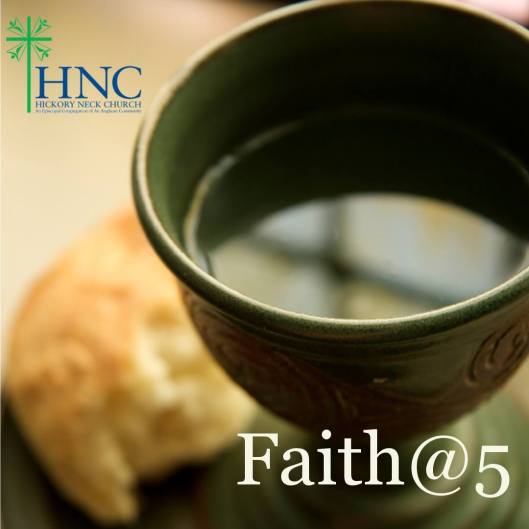
This week, we will be starting a new summertime worship service at Hickory Neck.   Though rooted in our Episcopal and Anglican identity, the service is a departure from our Sunday morning services.  We are using different prayers and music; we are settling into a more casual style of worship and preaching; and we are even changing small things like the type of bread we eat for communion.  Part of the changes are certainly meant to shift the sensory experiences of worship.  But another part of the changes is meant to shape community a bit differently – to create a sense of intimacy, familiarity, shared spiritual journey.  I am not sure if pita bread will be able to accomplish all of that, but I hope you will come out and give this new offering a try.  Who knows what memories, relationships, and encounters with God you will create?!19264649_1524550660934522_2960725217281690693_o

The Blessing of Broken Plans…

21 Wednesday Jun 2017

Posted by jandrewsweckerly in Uncategorized

≈ Leave a comment

Tags

broken, control, flexible, God, invitation, laugh, look, love, order, plans, routine, unpredictable, upheaval

planner

Photo credit:  www.moleskinerie.com/2014/10/meet-the-moleskin-evernote-planner.html

I am a planner.  I like routine.  I like order and control.  Knowing that those are my natural dispositions, I probably should not have decided to become a priest or a mother.  Both of those vocations regularly involve upset plans, routines, order, and control.  Of course, one cannot do either job well without plans, routines, order, and control – but one has to also be able to extremely flexible when those things fall apart.

This past week has been a week like that.  We had a parish death about two weeks ago, which meant the funeral needed to be on my normal Sabbath.  I was totally fine with that – in fact, I usually drop everything when a death happens.  Again, that is part of being a priest.  You learn to reshuffle the week, and make it work.  And that was what I was doing until this weekend hit.  I ate something that was apparently spoiled and got sick overnight.  The next morning the malfunction light on my car came on as the car lurched its way down the highway.  And then, right as I was trying to rally to get back to my work routine, my eldest got sick in the middle of the night too.

Of course, it is not often the case that everything is shifting and changing all at once.  But when you have a week of concentrated upheaval, you begin to wonder about what God is up to.  In general, I think singular schedule changers are good reminders about self-importance.  Mass schedule changers though seem to be an invitation to do a few things.  First, laugh.  Laugh at how silly it is to think we are ever fully able to control this crazy, wild, wonderful gift of life.  Second, look.  Look at the room full of mourners reminding you of ultimate importance.  Third, love.  Love that God made a tender moment of cuddling with your three-year old because you are too tired to do anything else.

I don’t wish the chaos of my last week on anyone.  It can be disorienting, frustrating, and exhausting.  But if you do find those moments of unpredictability coming your way, perhaps you can take a moment to see where God is inviting you to laugh, look, and love.  Your plans will be there tomorrow!

Sermon – Genesis 18.1-1, 21-1-7, P6, YA, June 18, 2017

21 Wednesday Jun 2017

Posted by jandrewsweckerly in Sermons, Uncategorized

≈ Leave a comment

Tags

Abraham, anger, conversation, doubt, dream, faith, frustration, God, honor, lack of faith, laugh, laughter, promise, Sarah, Sermon, share, transform

Today we get one of my favorite stories in scripture – Sarah’s laughter at God’s promise.  The story is perfectly crafted.  The story with a flurry of activity.  Abraham is sitting in his tent in the heat of the day when three guests suddenly appear.  As soon as Abraham sees them, he runs to greet them, begging them to stay.  Then Abraham sends the entire household into a tizzy.  He barks orders about baking cakes, grabs a calf and commands the calf be prepared for the guests.  He gets curds and milk and rushes to plate the feast for the guests.  We can almost imagine Abraham panting as he finally delivers the meals to the guests.

But then the story comes to a screeching halt, with a question that tells us what is really important.  “Where is your wife, Sarah?”  And slowly, the promise of a child to a barren, post-menopausal woman unfolds.  Abraham and Sarah were promised long ago to be the parents of a great nation.  But Sarah had given up on that dream.  She had already asked Abraham to go to her slave-girl and have a child with Hagar as a representative child for her.  Her action with Hagar had been a desperate move, but what else could she have done?  So when this guest, or God, as the text later tells us, says that Sarah will conceive herself, after years of longing, hoping, feeling devastated and powerless, Sarah does what we all might do.  She laughs.  She laughs at the prospect of pleasure in her marriage when she and Abraham are so advanced in age.  She laughs at the impossibility that their pleasure might lead to progeny.  She laughs at the promise because believing the promise would mean opening herself up to unfilled dreams yet again.

Sarah’s laughter has long been used as a criticism for a lack of faith in God.  When God asks, “Is anything too wonderful for the Lord?” and when Sarah quickly denies her laughter, countless readers have wagged their fingers at Sarah as if to say, “Oh ye of little faith.”  And I can see how we get there.  The exchange between Sarah and God – the laughter that bubbles out from years of hurt and disappointment, the scolding by God, the attempt to lie to cover up embarrassment, and the scolding yet again when God calls Sarah on her dishonesty – is all too familiar to us.  What the accusation of lacking faith forgets is how terribly vulnerable and resigned Sarah is.  I cannot tell you the number of people I have counseled who at the end of second marriage have begun to doubt God’s presence.  I cannot tell you the number of people I have sat with after receiving a bad diagnosis for themselves or their loved one who has begun to whether God has abandoned them.  I cannot tell you the number of people have received yet another rejection letter who have begun to question God’s call on their life.  When Sarah laughs, I do not feel justification for judgment against her level of faith.  When Sarah laughs, I hear the ache of countless believers who know how ludicrous God’s promises can be.

What gets me about the judgment of Sarah is the short memory of scripture readers.  In the chapter before what we heard today, Abraham is given the same promise that Sarah hears – a child by Sarah.  And his reaction?  He does not simply laugh quietly to himself as Sarah does in that tent.  He falls on his face and laughs full-bodied at God.  The only difference in laughter between Abraham and Sarah is that Abraham laughs in front of God where Sarah tries to hide her laughter.  Both are an acknowledgement of doubt about what God can do.  Both take all their disappointment, pain, and hurt, and dissolve into laughter because, quite frankly, sometimes God is laughable.  Sometimes God makes no sense at all, and laughing is the only release and protection from more hurt.  Humans questioning God is a natural part of a genuine God-human conversation, a conventional motif we see throughout the Old Testament.[i]

This week, I stumbled on an Old Testament scholar, Kathryn Shifferdecker, who suggests that God may not be a God of judgment in this passage.  In fact, she sees God as fully understanding the comedy of the situation.  She sees a God with a sense of humor, who when God says, “Oh yes you did laugh,” says so with a twinkle in his eye.[ii]  The theory totally shifted the reading for me.  Suddenly the pieces all fit together.  Instead of an angry or disappointed God, who judges disbelief, our God is a God who understands that God’s promises are sometimes laughable – even if they are true.  Why else would God tell Abraham to name his son Isaac, which means, “he laughs,” in Hebrew?[iii]  As Schifferdecker explains, “Abraham falls on his face in a fit of laughter.  Sarah laughs behind the tent door.  And the LORD (I believe) laughs with them at the divine, wonderful absurdity of it all.  Given the humor of the scene under the oaks of Mamre, and the comedy of a God who acts in unexpected ways to fulfill God’s promises, it is entirely appropriate that the child of the promise should be named ‘Laughter.’”[iv]

The image of the three of them laughing – Sarah, Abraham, and God, makes a lot of sense once we hear the final words of Sarah.  In chapter 21, Sarah, perhaps initially embarrassed or doubtful of God, now says, “God has brought laughter for me; everyone who hears will laugh with me.”  This story is not a story of shame for those of us who struggle with doubt, anger, or frustration with God.  This is not a story of an unfaithful follower of God.  This is a story about a woman and a man who look at the absurdity of God’s promise with the fullness of their humanity and laugh – hard, belly-shaking, on-the-floor laughter that only comes when the divine finally breaks through our disappointment, shame, and anger, and brings us to laughter.

I love this story even more as I think about the trinity of Abraham, Sarah, and God laughing.  Their laughter affirms our own incredulous walks with God.  Their laughter takes those moments when we no long trust God’s promises, and transforms them.  No longer do we need to hide away our deepest doubts, but instead we honor them.  We share them.  And we create communities of laughter with them.  Amen.

[i] Leander E. Keck, ed., New Interpreter’s Bible Commentary, vol. I (Abingdon Press, 1994), 465.

[ii] Kathryn M. Schifferdecker, “Commentary on Genesis 18:1-15 [21:1-7],” June 18, 2017, as found at http://www.workingpreacher.org/preaching.aspx?commentary_id=3301 on June 14, 2017.

[iii] Tamara Cohn Eshkenazi, ed., The Torah:  A Women’s Commentary, (Women of Reform Judaism URJ Press, 2008), 97.

[iv] Schifferdecker.

Homily – Matthew 28.16-20, TS, YA, June 11, 2017

14 Wednesday Jun 2017

Posted by jandrewsweckerly in Sermons, Uncategorized

≈ 1 Comment

Tags

always, anxiety, baptize, disciples, evangelism, evangelist, fear, go, God, Great Commission, Holy Spirit, homily, Jesus, teach

When I first sat in the chapel at my seminary, I immediately got a little nervous.  You see, over the altar was a huge stain glass window.  Around the edges of the window were emblazoned the words, “Go ye into all the world and preach the gospel.”  I remember staring at those words and thinking, “When I said I wanted to be a priest, I didn’t mean I wanted to go out evangelize people.”  Sure, I wanted to gather communities around the sacraments, encouraging us to serve the poor and needy, and creating groups of people set apart.  My early vision was about the people who were already there.  But that is not what Jesus commands in the Great Commission.  Though Mark’s gospel is where the instruction comes from to preach the gospel, Matthew’s intent in similar.  They are to go, make disciples, baptize, and teach.  In other words, they are to be evangelists.  I don’t know about you, but no matter how many sermons I hear from Presiding Bishop Curry about the Jesus Movement, I still get nervous thinking about going out into the world to make disciples.

I have been thinking a lot this week about why, after all these years after Jesus’ commission, we are still a little skittish about the idea of going out, making disciples, baptizing, and teaching.  I think a lot of our anxiety is about fear.  We are afraid of what people will think.  We do not want to be perceived as one of those faith groups that goes door to door, pressuring someone to come to Jesus.  We do not want to be perceived as judgmental, as if by sharing the Good News we are saying someone’s life is incomplete.  We do not want to be perceived as fanatical, nosy, or just uncool.  And as we all know, the minute you start talking about God, you can get into all kinds of trouble around interpretation of Scripture, historical sins of the Church, and modern heresies.  Forget being judged – we could lose friends!

So why in the world would we ever do what Jesus is asking?  Why would we go out, make disciples, baptize, and teach?  We do what Jesus asks because we were once baptized, and faithful people surrounded us, promising to journey with us, to raise us into the life of faith, and to help us get to know the mysterious, loving, life-giving entity that we call Father, Son, and Holy Spirit.  We do what Jesus asks because we have been taught – by countless faithful people.  Some of them were priests, professors, and Sunday School teachers.  But some of them were everyday people, just trying to make sense of the Word of God, who spoke truth to us and changed our lives.  We do what Jesus asks because we were made disciples.  At some point along the line, we learned enough, prayed enough, struggled enough, served enough, and were loved enough that we decided to walk in the way of Christ – even on those days when we do not understand fully what that means.  If all of those wonderfully converting things have happened to us, have brought beautiful children of God into our lives, and have changed our lives for the better, why wouldn’t we want to share that with others?!?

I imagine you may not still be convinced.  You may be still sitting there thinking about that scary window at the seminary thinking, “There is no way I can do that.” After rereading Matthew’s gospel this week, here is what I wish that seminary window had done.  In that big arched window, emblazoned with the words “Go ye into all the world and preach the gospel,” I would have put under the window, perhaps even in parentheses, the words Jesus says today:  Remember, I am with you always, to the end of the age.  The going, the baptizing, the teaching, the making disciples is all done because Jesus, coeternal with that creative, blessing God we read about today, through the ever-present power of the Holy Spirit is with us always, to the end of the age.[i]  Not just back then, in a historical moment with the disciples, not just tomorrow when we are finally ready, but now, this very moment, God – Father, Son, and Holy Spirit – is with us, always, to the end of the age.[ii]  Our God created you in God’s image, making you very good.  This community, as the community of the Corinthians did with Paul, has taught you how to agree with one another, live in peace, be a people of love who greet one another with holy kisses.  And Jesus sends you out to do some hard, life-giving, joyful work, which you can do because the Jesus, through the Spirit, is with you always, to the end of the age.  When we dismiss you today, we will dismiss you to love and serve the Lord.  But we also dismiss you to go, make disciples, baptize, and teach.  And we all say, “Thanks be to God,” because we know that God is with us, always, to the end of the age.  Amen.

[i] Thomas G. Long, “Homiletical Perspective,” Feasting on the Word, Yr. A, Vol. 3 (Louisville:  Westminster John Knox Press, 2011), 49.

[ii] David Lose, “Trinity Sunday A:  The Great Promise,” June 7, 2017, as found at http://www.davidlose.net/2017/06/trinity-sunday-a-the-great-promise/ on July 8, 2017.

On Life, Death, and the In-Between…

07 Wednesday Jun 2017

Posted by jandrewsweckerly in Uncategorized

≈ Leave a comment

Tags

birth, death, gift, God, joy, life, promise, thin space, Trinity, vocation

At the hospital where I delivered my second child, they had a practice of allowing the spouse or supporting person of the mother push a button that would play a tinkling song throughout the hospital marking the birth of a child.  The practice has many wonderful implications.  One, it makes room for joy – joy that can be experienced throughout the whole hospital community.  For those of you who have spent much time in hospitals, you know joy can be lacking.  Two, it creates a sense of mutuality between the birthing mother and her support team.  When the mom is doing most of the hard labor, it is nice to have tangible ways for the supporting team to participate.  Three, it creates little moments of celebration for the hospital staff – something they need too when bogged down with the work of health care.

But what felt like a wonderful, life-giving gift as I was delivering has taken on new layers of meaning as a pastor who visits hospitals.  More often than not, I have heard that song played while sitting with someone with a serious illness or who is approaching death.  The sense of irony about the circle of life is never lost on me, the patient, or their family.  It still feels like a gift, but a bittersweet one nonetheless.  I have also wondered what that song does for women and men in the hospital who have struggled with infertility or who have just lost a child.  That song represents so many unfulfilled dreams and heartache.

That being said, I do not think the disadvantages of the song outnumber the advantages.  I think the song actually does for everyday people what those in healthcare and pastoral care experience everyday – the thin spaces between life and death.  I cannot tell you the number of times when I have experienced life and death in a matter of days, hours, or minutes.  I have written about that here.  In a given week, I can hear the tinkling song while I sit at the bedside of a dying parishioner.  In a given day, I can hear elementary children playing and laughing, and then sit with a family member who needs a good cry.  In a given span of hours, I can bury a parishioner and then counsel a parishioner who is burying a marriage, birthing new love, or celebrating a new beginning.  This work is such that life and death are thinly separated.

The consequence of that thin space is that I get regular reminders of the enormity of God’s presence.  If I find the experience of celebrating life and watching life pass away in a matter of minutes, how much more infinitely does God experience the highest of highs and the lowest of lows in the human experience.  The God who created us and the world about us and called it good, and yet stood by as we sullied that creation has seen much.  The God who took on human form to experience for God’s self the complexity of the human experience knows much.  The God who breathes through life, death, and vocation in between feels much.  As we celebrate Trinity Sunday this weekend, I wonder how your appreciation of the three-in-one Godhead might help you appreciate both the promise that God is with us always, but also help you name God with us always for others.

worlds-oldest-new-father

Photo credit:  https://www.everydayfamily.com/blog/worlds-oldest-new-father/

← Older posts
Newer posts →

Recent Posts

  • On Politics, Football, and Love…
  • On Sharing the Love…
  • Sermon – Micah 6.1-8, Matthew 5.1-12, EP4, YA, January 30, 2026
  • On Justice, Kindness, Humility, and the Messy Middle…
  • Feast of the Rev. Dr. Martin Luther King, Jr., January 18, 2026

Archives

  • February 2026
  • January 2026
  • December 2025
  • November 2025
  • October 2025
  • September 2025
  • August 2025
  • July 2025
  • June 2025
  • March 2025
  • February 2025
  • December 2024
  • November 2024
  • October 2024
  • September 2024
  • August 2024
  • July 2024
  • June 2024
  • May 2024
  • March 2024
  • February 2024
  • January 2024
  • December 2023
  • November 2023
  • October 2023
  • September 2023
  • August 2023
  • July 2023
  • June 2023
  • May 2023
  • March 2023
  • February 2023
  • January 2023
  • December 2022
  • November 2022
  • October 2022
  • June 2022
  • May 2022
  • January 2022
  • December 2021
  • November 2021
  • October 2021
  • September 2021
  • August 2021
  • June 2021
  • May 2021
  • April 2021
  • March 2021
  • February 2021
  • January 2021
  • December 2020
  • November 2020
  • October 2020
  • September 2020
  • August 2020
  • July 2020
  • June 2020
  • May 2020
  • April 2020
  • March 2020
  • February 2020
  • January 2020
  • December 2019
  • November 2019
  • October 2019
  • September 2019
  • August 2019
  • July 2019
  • June 2019
  • May 2019
  • April 2019
  • March 2019
  • February 2019
  • January 2019
  • December 2018
  • November 2018
  • October 2018
  • September 2018
  • August 2018
  • July 2018
  • June 2018
  • May 2018
  • April 2018
  • March 2018
  • February 2018
  • January 2018
  • December 2017
  • November 2017
  • October 2017
  • September 2017
  • August 2017
  • July 2017
  • June 2017
  • May 2017
  • April 2017
  • March 2017
  • February 2017
  • January 2017
  • December 2016
  • November 2016
  • October 2016
  • September 2016
  • August 2016
  • July 2016
  • June 2016
  • May 2016
  • April 2016
  • March 2016
  • February 2016
  • January 2016
  • December 2015
  • November 2015
  • October 2015
  • September 2015
  • August 2015
  • July 2015
  • June 2015
  • May 2015
  • April 2015
  • March 2015
  • February 2015
  • January 2015
  • December 2014
  • November 2014
  • October 2014
  • September 2014
  • August 2014
  • July 2014
  • June 2014
  • April 2014
  • March 2014
  • February 2014
  • January 2014
  • December 2013
  • November 2013
  • October 2013
  • September 2013
  • August 2013
  • July 2013
  • June 2013
  • May 2013
  • April 2013
  • March 2013
  • February 2013
  • January 2013
  • December 2012
  • November 2012
  • October 2012
  • September 2012

Categories

  • reflection
  • Sermons
  • Uncategorized

Meta

  • Create account
  • Log in
  • Entries feed
  • Comments feed
  • WordPress.com

Blog at WordPress.com.

  • Subscribe Subscribed
    • Seeking and Serving
    • Join 391 other subscribers
    • Already have a WordPress.com account? Log in now.
    • Seeking and Serving
    • Subscribe Subscribed
    • Sign up
    • Log in
    • Report this content
    • View site in Reader
    • Manage subscriptions
    • Collapse this bar
 

Loading Comments...