• About

Seeking and Serving

~ seek and serve Christ in all persons

Seeking and Serving

Tag Archives: God

Sermon – Luke 2.1-20, CE, YC, December 24, 2015

05 Tuesday Jan 2016

Posted by jandrewsweckerly in Uncategorized

≈ Leave a comment

Tags

agricultural, celebrate, Christmas, civic, extraordinary, family, gift, God, holiness, Jesus, Joseph, life, Mary, ordinary, Sermon, shepherds

In many ways, the story that we tell tonight is rather ordinary.  As the story begins, the government is doing what the government does – finding ways to tax the people.  And so the people without influence are herded – herded back to their hometowns to be registered so that the Emperor can be certain he is getting all he is owed.  But anytime you move masses of people, you get overcrowding.  That is what happens in Bethlehem this night.  Though Joseph’s extended family is expecting him, they run out of space.  Though the story says there is no room in the inn, the more likely scenario is that the family guest room was already full.[i]  So Joseph and his pregnant fiancé get the leftovers – the area of the home meant for the animals.  We’ve had those moments – when your delinquent uncle or your slacker friend shows up unexpected.  You grab a pillow and a blanket and offer space on the couch – or the floor if the couch is already taken.  This is just an ordinary night of making the space work.

Of course, no woman would want to give birth under these conditions, but that is the funny thing about birth – births happen all the time, whether people are ready or not.  Though every time a baby is born we marvel at the miracle of life, births are really much more commonplace that we give them credit for being.  Just like any other birth, Mary finds a place to lay the baby, and just like any other mother, Mary finds a way to swaddle the baby so that he can ease off to sleep.  And so in the messiness of managing civic life and familial life, here our story has us working through the ordinary mess of reproductive life.

And in case we were to get too excited about our story, God decides to reveal the occurrences of that night to even more ordinary people.  Enter the shepherds.  These are ordinary men, doing the necessary work of shepherding.  In fact, these men are so ordinary, they are almost invisible to the outside world.  They are not busy heading to their home town to be counted because according to the day, they are not worth counting.[ii]  They are the migrant workers that do the work no one else wants to do.  So while everyone is sleeping, or eating, or enjoying the warmth of a fire, the shepherds are out tending their flocks, focused on the ordinariness of agricultural life.

Of course, the story becomes interesting when we hear about all of the extraordinary parts of this story.  Yes, there is the same greedy government, the same crowded family, the same new parents, and the same business of farm life.  But something extraordinary breaks into the ordinary this night.  In the midst of everyday lives, God breaks in through the ordinary and proclaims good news of great joy.  The Messiah has been born – the long awaited Savior who will change everything.  In fact, the angels are so blown away by this extraordinary moment in time that they break into song, praising God.  That is what we do when faced with the extraordinary.  We praise God for God’s goodness and mercy and grace.  God takes on human flesh for us, and the angels do the only thing they can – they praise God in gratitude.

The shepherds’ initial reaction to the same news is quite ordinary – they go and talk to the family.  They tell Mary and Joseph what they saw.  Again, the scene is quite ordinary – a travel-worn family making due in rustic quarters having a conversation with equally worn shepherds.  No one is out of place in this scene – everyone is equally ordinary.  And yet, the extraordinary lights up the room.  So extraordinary is the night that the shepherds leave, glorifying and praising God.  They echo the response of the angels, expressing their overwhelming gratitude in the only way they know how – praising and thanking God.  Mary too knows how extraordinary this night is.  She treasures this extraordinary moment in her heart, left pondering what new thing God is doing.

That is what we love about this story:  the juxtaposition of the ordinary with the extraordinary.  The ordinary part we know intimately.  We too find ourselves living ordinary lives.  We work, we play, we laugh, we cry.  We pay our taxes, we deal with family, we go through labor pains.  We come to church, we pray together, we read scripture together, and we feast on the holy meal.  With the exception of a few fun vacations, nights out on the town, or the wedding of a friend, our lives are relatively ordinary.  I am pretty sure most of us have not witnessed a heavenly host bringing us good tidings of great joy.

We do not get the extraordinary most days:  except, of course, when we do.  Even in our ordinary lives, God breaks in with the extraordinary.  Just a couple of weeks ago a parishioner was telling me about how our conversations at church had finally worn him down.  When he ran into a homeless person on his walk in the City, he decided to finally give him some money – a practice that he never endorses.  Something about his experience with God was softening his resolve and he was able, in a moment of clarity, to see the humanity of the man.  Or the other week, I was talking to a teacher about the profound things her children sometimes say.  They sometimes say things that stop her in her tracks and make her reevaluate her way of being.  Or a few months ago I was talking to another person of faith about her prayer life.  She confessed rather sheepishly that sometimes in her prayers, especially when she makes room to listen to God, hears a response back.  She felt like she could not really explain the phenomenon well, but she knew the voice must be from God because the words rang so true and were nothing she would have come to on her own.

That is what happens in our ordinary lives – God breaks through again and again, overwhelming us with the extraordinary.  Those moments are gifts that we celebrate an honor, because they are just that – gifts.  That is the same reason we celebrate tonight.  We honor the gift that God gives us in Christ Jesus.  For all intents and purposes, Jesus is just another baby born under ordinary circumstances.  But we know that he is so much more:  God Incarnate, Wonderful Counselor, Mighty God, Everlasting Father, Prince of Peace.  Tonight is about honoring the extraordinary in the midst of the ordinary.  Tonight is about claiming the joy that can only come from extraordinary acts of God.  But tonight is also about claiming the joy of a community that invites us to praise – to glorify God as we go our own ways this night.  We are blessed over and over.  In the trials and tribulations of ordinary life, we are so blessed by our extraordinary God and the community of faith that gathers with us.  In fact, the extraordinary nature of God hallows our ordinary lives, making them anything but ordinary.  Tonight, I invite you to embrace the extraordinary in our midst, to honor the holiness of the ordinary, and to find ways to share that extraordinary in our ordinary lives tomorrow.  Amen.

[i] Richard Swanson, “Commentary on Luke 2:[1-7] 8-20,” December 25, 2013, as found at https://www.workingpreacher.org/preaching.aspx?commentary_id=1880 on December 22, 2015.

[ii] Michael S. Bennett, “Pastoral Perspective,” Feasting on the Word, Yr. C, vol. 1 (Louisville:  Westminster John Knox Press, 2009), 118.

Sermon – Luke 1.39-45, A4, YC, December 20, 2015

05 Tuesday Jan 2016

Posted by jandrewsweckerly in Uncategorized

≈ Leave a comment

Tags

acceptance, authenticity, Christmas, community, Elizabeth, fear, God, intimacy, Jesus, love, Mary, pregnancy, relationship, Sermon

This time of year, seven years ago, I was about a month into pregnancy.  The season was one of expectation, disbelief, and excitement, but we were not telling anyone about the pregnancy for fear that something could go wrong.  Hiding one’s pregnancy in those first months is a common cultural practice for many women and families who are sensitive about the uncertainty of pregnancy.  But holding a secret like pregnancy can invoke a mixture of emotions.  You may feel anxious that someone will discover your secret.  You may feel afraid that something will go wrong and worry about how you would share the news.  You may feel guilty about telling white lies to hide your ultimate secret.  Holding a secret about ourselves can create an inner tension and an outer isolation that is unsettling and unnerving.

We do not know whether Mary had planned to tell Elizabeth about her pregnancy.  In Luke’s gospel, Mary never gets the chance to tell Elizabeth the news herself.  Luke only tells us that after Mary is told that she is pregnant with Jesus, the angel tells her that Elizabeth, who is past the childbearing age, is six months pregnant.  Mary immediately goes to Elizabeth.  Most scholars believe that Mary goes to Elizabeth to offer care for Elizabeth’s pregnancy.[i]  But we cannot know whether Mary planned to tell Elizabeth about her own pregnancy.  Mary had every reason not to tell her.  To an outsider, Mary’s pregnancy is not good news. She is unwed, young, poor, and pregnant.  This combination would make her an outcast, and typically no man would take her as a wife.[ii]  In Mary’s day, her pregnancy and her resulting un-marriable status is almost a death sentence.  Women in this time depended on a husband for financial support and social acceptance.  Although Mary’s pregnancy is good news from God, in the social context, that joy is negated and forced into silence.  Given her situation, we can imagine that Mary might have wanted to keep her pregnancy a secret.  Although she is rushing to Elizabeth to care for her, Mary may have been dreading the pending time of holding a secret and the inner tension and outer isolation that her secret will cause.

In modern times, we too struggle with sharing information within a community.  One of our most common greetings is, “How are you?”  And the usual response is, “Good.”  But our common greeting is rarely a genuine question about how someone is actually doing.  In fact, many of us have a short list of people with whom we avoid asking that question altogether because we know we will be there an hour later hearing about aches, pains, and their crazy neighbor.  We prefer our short greeting and response because not only do we not want to really hear about someone else’s problems, we do not want to tell others how we are truly doing either.  “Good” becomes our code word for, “I am mostly fine, but I don’t want to tell you how I really am.”  Sometimes “good” is a necessary response for keeping others from prying into our lives.

But sometimes “good” is a way of preventing authentic relationship.  While I was in seminary we were required to serve part-time in local parishes.  At the church where I was serving, Easter Vigil was a big deal.  We had many more acolytes, ushers, and Eucharistic Ministers than normal.  As we prepared to line up the large group for the procession, I noticed one of the acolytes was not as chipper as she usually is.  I asked her if she was okay, and she blurted out that she had had a fight with her parents on the way to church and was still in a bad mood.  I was surprised by her candor, especially in front of all the other acolytes.  But as soon as she shared her frustration, several of the acolytes gave her a pat on the shoulder, or commiserated with her experience.  Somehow, saying out loud why she was in a bad mood allowed her to release some of her tension and start fresh that night.

Preventing authentic relationship is not just something we do with each other.  We also struggle with sharing information with God.  During worship, we model corporate confession to God.  But how many of us really take our personal struggles to God?  Perhaps we have been so ashamed of something that we could not even talk to God about it.  Or perhaps we have been angry about how something is going in our life – the job that we did not get, the unhappiness we are having in a relationship, or the illness that is not healing.  Sometimes our anger about a situation clouds our emotions so much that we cannot imagine lifting the situation to God in prayer.  At times of heightened emotions, we feel the least capable of inviting God into our shame, anger, or grief.

The encounter between Elizabeth and Mary today offers a complete counter to our natural tendencies toward being guarded and resistant to authenticity and intimacy.  Before Mary can offer a veiled “I’m good,” Elizabeth immediately greets Mary with joy and blessing.  If Mary is at all concerned about Elizabeth’s judgment, shunning, or slandering within the community, Mary misjudges.  Instead of the expected judgment, Elizabeth offers Mary warm acceptance and praise.  Elizabeth not only blesses Mary for being the carrier of the Savior, she also blesses Mary for being faithful to God.[iii]  Elizabeth does not tentatively ask Mary if she is going to be okay or encourage her to be quiet about her shameful pregnancy.  Instead, Elizabeth sees the glory of Mary’s pregnancy, ignores cultural norms, and celebrates loudly the magnificence of what God will do through Mary.  Elizabeth proclaims, “Blessed are you among women, and blessed is the fruit of your womb.”  Elizabeth’s response is the exact opposite of what Mary may have expected.

The countercultural response of Elizabeth to Mary is the same countercultural way that God operates among us.  God chooses Mary, a young, poor, unwed woman to be the bearer of God.  God chooses Elizabeth, a woman far beyond the age of conception, to be God’s prophet.[iv]  God lifts up the poor and oppressed and calls them blessed.  God takes on human form in Jesus, lowering God’s self to come and be among us.  God’s way is almost always countercultural.  God has a way of turning things upside down and shaking up our thinking.  Through the brief encounter between Elizabeth and Mary – two marginal women – God reveals the earthy, authentic, countercultural way that God calls us to be in relationship with one another and with God.  Looking through this very human interaction between two women, we are able to anticipate the very human child of Jesus who will transform all our relationships in a countercultural way.

As we anticipate the celebration of Christ’s birth and we await the coming of Christ again, we are reminded through Elizabeth and Mary of the invitation that we have into authentic, Christian relationship with one another and with God.  Mary and Elizabeth’s encounter reminds us that our church community is a gift.  Our community is a place where we can be vulnerable with one another, share our hopes and dreams with one another, and share our shame, guilt, and fear with one another.  Our community is a place where when someone asks you how you are, we really want to know how you are.  Our community is a place where we can expect beautifully, and often brutally, shared honesty.  Our community helps us model the kind of relationship that Elizabeth and Mary have.

Elizabeth and Mary also invite us into authentic relationship with God.  Most Sundays we open our worship with a prayer called the Collect for Purity.  We pray: Almighty God, unto whom all hearts are open, all desires known, and from whom no secrets are hid…”  Weekly we admit that despite the fact that we do not want to take our shame, our anger, our fear, or our secrets to God, God knows them anyway.  God is the Elizabeth for us Marys.  God greets us with joy and blessing before we can even share our secret.  God already knows and God loves us.  God wipes away tension and isolation and throws upon us the cloak of love.  As we enter into a time with family, friends, and church to celebrate Christ’s birth, I invite you to let go of anxiety and isolation.  I invite you to consider the warmth of Elizabeth toward Mary and God toward us, and to give that anxiety and isolation to God.  Give those feelings to God because perhaps this year, you will find an Elizabeth in your life who can warmly embrace you into the love and acceptance of Christ.  Amen.

[i] Robert Redman, “Theological Perspective,” Feasting on the Word, Yr. C, vol. 1 (Louisville:  Westminster John Knox Press, 2009), 94.

[ii] Judith Jones, “Commentary on Luke 1:39-45, (46-55),” December 20, 2015 as found at https://www.workingpreacher.org/preaching.aspx?commentary_id=2723 on December 12, 2015.

[iii] Stephen A. Cooper, “Exegetical Perspective,” Feasting on the Word, Yr. C, vol. 1 (Louisville:  Westminster John Knox Press, 2009), 95.

[iv] Charles C. Campbell, “Homiletical Perspective,” Feasting on the Word, Yr. C, vol. 1 (Louisville:  Westminster John Knox Press, 2009), 95.

Sermon – Philippians 1.3-11, A2, YC, December 6, 2015

11 Friday Dec 2015

Posted by jandrewsweckerly in Uncategorized

≈ Leave a comment

Tags

action, affirmation, community, faith, family, God, Good News, Jesus, letter, love, mission, overflow, Paul, Philippians, seeking, Sermon, serving, sharing

This sermon was given on the occasion of our Annual Meeting.

My dearest St. Margaret’s, “I thank my God every time I remember you, constantly praying with joy in every one of my prayers for all of you, because of your sharing in the gospel from the first day until now.  I am confident of this, that the one who began a good work among you will bring it to completion by the day of Jesus Christ.  It is right for me to think this way about all of you, because you hold me in your heart, for all of you share in God’s grace with me…For God is my witness, how I long for all of you with the compassion of Christ Jesus.”

If ever I were to write a love letter to St. Margaret’s, I would steal these words from Paul to the Philippians.  You see, Paul saw in the Philippians what I see in you:  a community of faith alive with the Holy Spirit, sharing the Good News of Christ Jesus in our community.  A little over four years ago, I became your rector.  You were bruised and battered, having not only survived a tumultuous relationship with your last rector, but also a strained relationship with an interim, as well as the absence of consistent leadership for over two years through the limits of a supply priest.  Having had years of struggle, I quickly came to realize that St. Margaret’s had some baggage.  But St. Margaret’s also had a sense of tenacity, determination, and a deep-rooted joy that could not be stifled.  You see, as Paul writes, I could see that over fifty years ago, “the one who began a good work among you [would] bring [that good work] to completion by the day of Jesus Christ.”  I knew God was not done with us yet.

And so, over time, I came to love each of you:  not the dreamy romantic love of love birds, but the kind of love that family has for each other.  That is what people usually describe as being so wonderful about St. Margaret’s:  that we are like family.  Now when I first heard that description, I got a little nervous.  I have served at too many funerals and weddings to know that every family has some drama.  Every family has a loud Uncle Carl, crazy Aunt Bessie, or overbearing Grandma Jones.  Every family has experienced sibling drama or tensions between parent and child.  Describing St. Margaret’s as being like a family made me wary.  I began to wonder who the loud uncle, the crazy aunt, or the overbearing grandma were in this community.  But over the years, I began to understand more fully why the description of St. Margaret’s as family works so well.  Don’t get me wrong, we have our loud uncles, crazy aunts, and overbearing grandmas – though I will never tell you who they are!  But like a family, we know each other.  We know each other’s foibles, quirks, and tendencies.  We know each other’s hurts, failures, and embarrassing moments.  We even know how to predict the reactions of each other to any given situation.  But also like family, we love each other anyway.  We love each other in the way that loving mothers, protective fathers, supporting sisters, and encouraging brothers can.  We love each other not despite our weaknesses but because of those weaknesses.  In fact, no matter how much we might annoy each other at times, those foibles, quirks, and tendencies are what we have come to love about one another.  In essence, we have come to see each other with the loving eyes that Christ has for each of us.  We have come to love like Paul.[i]  Somewhere deep in our hearts, we too pray, “I thank my God every time I remember you, constantly praying with joy in every one of my prayers for all of you.”

Paul gushes about the Philippians today:  about how much he loves them, how proud he is of their work to spread the Good News, and how he sees Christ moving and acting among them for good.  But Paul’s letter is not simply a letter of affirmation – a love letter for the Philippians to put under their pillows and pull out when they are feeling low.  Paul’s letter is more.  Paul’s letter comes with a charge.  “And this is my prayer, that your love may overflow more and more with knowledge and full insight to help you to determine what is best, so that in the day of Christ you may be pure and blameless, having produced the harvest of righteousness that comes through Jesus Christ for the glory and praise of God.”  Paul does not want the Philippians to keep this love to themselves.  He wants them to let their love overflow into action.[ii]

The more and more I read Paul’s charge this week, the more and more I began to see the mission of St. Margaret’s in his words.[iii]  Several years ago, St. Margaret’s took up a mantra.  We want to be a community of faith seeking Christ, serving Christ, and sharing Christ in our community and beyond.  First, we want to be a community seeking Christ – a community committed to learning more about this God we follow, and deepening our journey with Christ.  As Paul says, we want to build up knowledge and full insight to help us determine what is best.  And so that is a part of our work here.  We are teaching our children how to walk in the way of Christ.  We are studying God’s word and challenging one another to grow through prayer, reading, and reflection.  We are engaging in meaningful worship that inspires and delights us, and helps us to connect with our God.  We are a community of faith seeking Christ.

We are also a community of faith serving Christ.  As Paul says, we are letting our love overflow.  St. Margaret’s is a community that cares about others – not just those inside the doors, but outside the doors too.  I see that love in the ways that wallets open as soon as we learn of a need in our community.  I see that love when you think of others when grocery shopping for yourselves, adding in a few extra cans or boxes for people you have never met.  I see that love when we spread peanut butter and scoop jelly, praying that the recipient of that sandwich might know the love of Christ that you have known and be encouraged in their struggle.  Our love overflows into vegetable gardens, into grief support groups, and into the hearts and minds of those who long for love.  We are a community of faith serving Christ.

We are also a community of faith sharing Christ.  As Paul says, we are to let our love overflow so that it might produce a harvest.  What I have loved about this community is that although we are nervous about sharing the Good News – of evangelizing – we share the Good News anyway.  When you gush with friends about the meaningful thing that happened at church, when you tell a stranger about how your church is doing good work, or when you serve as an example of Christ-like love in the world, you are sharing the Good News.  We do that when we walk in the parade, we do that when we put our name on baseball jerseys, and we do that when we wear our St. Margaret’s shirts to the gym, grocery store, or shopping mall.  We are a community of faith sharing Christ.

We are a community of faith seeking Christ, serving Christ, and sharing Christ because the love, joy, and acceptance we have found inside these walls is not just for us.  Fifty-two years ago, God began a good work in us.  God planted the seeds of righteousness in this community, and today we are invited to harvest that work.  And Paul assures us, as he assured the Philippians years ago, that God will bring to completion the good work began in us.  All we have to do is let our love overflow – overflow from us, overflow from our beautiful, complicated relationships with one another, and overflow from our community out into the world.  So tuck that love letter under your pillow when you need affirmation and a reminder that you are doing the good work that God calls you to do.  But also pull out that love letter when you feel weary – when you need to be inspired to get back out there, to seek Christ, serve Christ, and share Christ.  God loves you with a deep affection; and God wants your love to overflow to others more and more.  Amen.

[i] Leander E. Keck, ed., New Interpreter’s Bible, vol. 11 (Nashville: Abingdon Press, 2000), 484.

[ii] Philip E. Campbell, “Exegetical Perspective,” Feasting on the Word, Yr. C, vol. 1 (Louisville:  Westminster John Knox Press, 2009), 39.

[iii] Edward Pillar, “Commentary on Philippians 1.3-11,” December 6, 2015 as found at  http://www.workingpreacher.org/preaching.aspx?commentary_id=2695 on December 3, 2015.

All in…

03 Thursday Dec 2015

Posted by jandrewsweckerly in Uncategorized

≈ Leave a comment

Tags

accountable, Advent, Christmas, church, community, God, spiritual disciplines

Photo Credit: http://www.catholic-chaplaincy.org.uk/homily-2014-november-30-advent-1st-sunday/

Photo Credit: http://www.catholic-chaplaincy.org.uk/homily-2014-november-30-advent-1st-sunday/

We often talk about spiritual disciplines in Church.  We encourage regular prayer, daily devotions, or time set aside for Bible study or journaling.  The options are endless really.  The idea is that you create space for regular connection to God.  Otherwise, we can easily get swept up in the busyness of life and only connect to God on Sundays – or worse, neglect our relationship with God altogether.  That temptation is ever heightened during Advent:  a time when many of forget about Advent altogether because we are so focused on Christmas.  And the secular world has no intention of helping us separate the two.  Even the Church struggles as we plan Christmas parties, pageants, greening, and liturgies.  Put simply, it is hard to focus on Advent, even if we want to focus on Advent.

To help combat this tendency, I have taken up two spiritual disciplines – one with my family and one with my Church.  The discipline my family is taking on is the 40-day bag challenge.  We are taking turns with the bags, figuring out who will be purging what areas.  But the idea is that by clearing out space in our home we might also clear out space for one another and for God.

The other discipline is reading the Advent and Christmastide devotional book, Night Visions, by Jan L. Richardson.  Richardson combines reflections, art, and poetry each day to take us out of ourselves and to help us reconnect with the quiet, intentional invitation of Advent.  Our parish is reading this book together as part of our “Reading with the Rector” program.  My hope is that by regular, short readings, I will get the boost I need to re-center each day in hope, waiting, and quiet expectation.

I mention these two disciplines not because I am proud or because I think my disciplines are particularly praiseworthy this Advent.  I mention these two disciplines because I want your help.  I want your help to keep me accountable to the life I want to have as priest, a wife, a mother, and member of my community, especially in a season when I could easily be tempted to do otherwise.  That’s the funny thing about spiritual disciplines.  Though they are personal and individual, we experience the most success in our disciplines when we share them within the community of faith.  So feel free to message me here, email me, or post questions on my Facebook wall.  And if you need help with your own disciplines, I’m happy to ask you about yours too.  Maybe together we can prepare our hearts for that most sacred night with the Christ Child.  I’m in.  Are you?

More…

25 Wednesday Nov 2015

Posted by jandrewsweckerly in Uncategorized

≈ 1 Comment

Tags

clergy, God, Good News, interfaith, Jesus, life, love, mercy, ministry, more, Thanksgiving, Transgender, wideness, witness, worship

Every once in a while, I have experiences in ministry when I think, “Well I never would have imagined that happening!”  I admit that the experience is rare.  There is not a lot that surprises me anymore in this line of work.  Though I am relatively young, I still feel like I have seen it all.

But that has not been the case this week.  This week I found myself in two situations I would have never anticipated.  On Sunday night, our parish hosted the Long Island Transgender Day of Remembrance.  I had no role in crafting the liturgy or planning the evening.  I simply offered our space and was asked to give an opening and closing prayer.  In fact, the planning committee warned me that this would not be like a “church service” – so I should not get my hopes up!  But as I sat in my pew, watching testimonial after testimonial, listening to over eighty names of those who were murdered because of their transgender identity, and hearing beautiful music about the wideness of God’s love and the call to love “the other” – I tell you, I experienced “Church.”  You see, Church is supposed to be about worshiping our God who shows mercy and compassion, who calls us to love the outcast and the oppressed, and who compels us to go out and witness the Good News of God in Christ.  Sunday night, I felt like the Good News came back inside and witnessed to me.

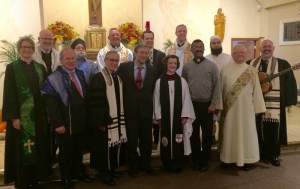
Plainview-Old Bethpage Interfaith Clergy, November 24, 2015

On Tuesday night, I participated in my fourth Plainview-Old Bethpage Interfaith Thanksgiving Service.  Every year I find the service moving. I am grateful for a holiday that we can all honor without fear of stepping on each other’s toes.  But as I sat there last night, I became acutely aware of my surroundings.  On my left sat the Mufti from the local Muslim community and on my right sat the priest from the local Roman Catholic parish.  It occurred to me in that moment that the Mufti usually only says prayers with men.  The women pray separately.  And yet, there we were, side by side, giving thanks to God.  It also occurred to me that although the priest has been warm and affirming, his Church does not recognize my ordination as appropriately apostolic – especially given my gender.  And yet, there we were, as equal leaders in our respective communities.  Despite having had long relationships with the fellow clergy leaders, this was the first time I realized how radical our relationships are – to sit next to each other despite profound differences – and yet still be able to praise, lead, and worship together.

Truthfully, I do not know what God is doing this week.  On a basic level, I suspect God is reminding me that I am not even close to having “seen it all.”  But on a deeper level, I also suspect that God is inviting me to go further, to delve deeper, and to see more widely.  Perhaps a disadvantage to my profession is a naïve sense that I have a hold on who this God is that we worship and serve.  This week, God has humbled me by reminding me that God is so much more. As I anticipate celebrating Eucharist on Thanksgiving Day, I expect to approach the Table with keener sense of wonder, gratitude, and awe for the ways in which God is so much more.  What a blessed gift this week has been.  Thanks be to God for being more than I could ask for or imagine!

Sermon – 1 Samuel 1.4-20, 2.1-10, P28, YB, November 15, 2015

19 Thursday Nov 2015

Posted by jandrewsweckerly in Uncategorized

≈ Leave a comment

Tags

anger, God, Hannah, honest, intercession, intimacy, praise, pray, prayer, relationship, Sermon, Thanksgiving, vulnerable

At some point in life, most of us have the experience of having a best friend.  Perhaps we met the person on the playground as a child; maybe we met him in college or at work; perhaps our best friend is a cousin or sibling; or maybe our best friend is our spouse or partner.  Regardless of how we met her, that best friend has seen the best and worst of us.  He has congratulated us when we got a part in the play, when we got a promotion, or when we found new love.  She has consoled us when we failed a test, when our heart was broken, or when a family member died.  He has seen us laugh so hard that we snort or pee in our pants, and he has seen us sob so hard that snot runs down our faces.  She has seen us dressed to the nines, and she has seen us in our stained, ill-fitting sweats.  And our best friend has taken the best and the worst from us too:  we have danced together, yelled at each other, confessed our darkest secrets to each other, and, yes, we have even hated each other at times.  Despite having experienced the very best and very worst of us, we know that she loves us deeply, he always forgives us, and she is always there for us.  The relationship is far from perfect, but the relationship is beautiful.

In many ways, the relationship we have with our best friend is similar to the relationship we have with God.  On our good days, we come to God with our thanksgivings and praise, offering our adoration and humility to God.  On our bad days, we are angry and curse God.  We confess things to God that we confess to no one else:  both those things done and left undone, but also those deep longings and desires that we do not admit to others.  We have cried a thousand tears with God and we have laughed with great mirth.  Although our best friend knows us better than any other human being, God knows even the stuff we are embarrassed or afraid to share with that best friend.  And since our Lord is not human, God’s forgiveness does not know the limits of human forgiveness.  Through the life, death, and resurrection of Jesus Christ, our relationship with other human beings will never quite equal our relationship with God.

Given that intimacy, I am often surprised when people ask me about prayer.  Throughout my ministry I have had people ask me how they should pray, what they should say, or when or where is the best time and place to pray.  I think the challenge is that most of us have some notion of what prayer should look like.  We imagine the pinnacle of brayer being the Zen-like posture of monks in silent prayer.  Or when someone offers a prayer, we assume we should bow our heads, fold our hands, and shush others into silence.  Or when someone asks us to offer the prayer, we scramble to remember common prayer phrases like, “Holy God…Bless us, we pray…you alone are worthy…”  Our prayers sound very little like our everyday speech.  Sometimes, if we are feeling especially uncomfortable, we peek around the room to see what everyone else is doing.  People often ask me how to pray because they do not feel like they are doing it “right,” because their usual method of prayer has become stale or dissatisfying, or because when they pray, God seems far away or even like a stranger.  Or sometimes people come to me about prayer because they are overwhelmed with the suffering of the world:  the poverty, the gun violence, the terror that keeps striking in places like Paris.  How do we pray to God when suffering seems like an endless abyss?

In scripture today, we see Hannah pray twice.  In the first occurrence, Hannah looks nothing like our notions of prayer.  She has been emotionally tortured by Elkanah’s second wife, Peninnah – just like Peninnah does every year when they travel to make their annual sacrifice.  Peninnah is ever fertile and Hannah is barren.  And, probably because Elkanah loves Hannah more, Peninnah throws Hannah’s infertility in her face whenever she can.  Meanwhile, Elkanah is acting like a wounded puppy.  He does not understand why Hannah is so upset – isn’t he enough?  So Hannah escapes to the Temple to pray.  Her prayer is unlikely offered from a pew, while she delicately flips through a prayer book to find some pre-written prayers.  Her prayer is not said reverentially, with a bowed head.  In fact, she does not quietly whisper prayers to God with her eyes closed.  No, when Eli, the temple priest, sees Hannah praying, he accuses Hannah of being drunk in the Temple.  Now I do not know if you have ever been in the presence of a drunken person, but people who are drunk are rarely still and reserved.  No, I imagine Hannah was pacing.  Maybe she was waving her fists at God as the tears spilled down her cheeks.  Maybe there was rage and devastation in her eyes.  The text says that she is silent, but that her lips are moving.  I imagine she was giving God a piece of her mind.  And in fact, the text tells us that she even resorts to bargaining with God – promising to commit his life to the Temple if God gives her a male child.  If Eli thought Hannah looked drunk, the scene could not have been pretty!

The second occurrence of Hannah praying today is found in the Song of Hannah from first Samuel.  Here we see a very different posture of prayer from Hannah.  Instead of ranting and raving in the temple, here we see Hannah giving praise to God for the deliverance of a child.  Hannah is full of gratitude for her own good fortune.  But Hannah’s prayer is bigger than herself too.  She proclaims the Lord to be a liberator – one who frees the oppressed, brings low the privileged, honors the faithful, and cuts off the wicked.  In Hannah’s personal experience with God, she is given a glimpse into the global nature of God.[i]  Hers is revolutionary song because God has heard her prayer and answered her.  We see a very different form of prayer from Hannah the second time than we do from Hannah the first time.

For those of you reading along with A.J. Jacobs’ The Year of Living Biblically, prayer is common topic from the author.  Not a believer himself, Jacobs struggles with prayer.  He does not know what to do or say.  But he feels compelled by the Bible to be in prayer.  One of his spiritual guides suggests that there are four types of prayer – Adoration, Confession, Thanksgiving, and Supplication.[ii]  Jacobs latches on to Thanksgiving at first.  He starts by thanking God for the food that has been prepared, in its many stages.  As he thinks about all the stages – the earth, the farmer, the packager, the person who puts on labels, the grocery stockers, the cashier – his prayer lengthens.  Jacobs also takes on intercessory prayer as a form of prayer – praying strictly for the needs of others.  Jacobs confesses, “It’s ten minutes where it’s impossible to be self-centered.  Ten minutes where I can’t think about my career, my Amazon.com ranking, or that a blog in San Francisco made snarky comments about my latest Esquire article.”[iii]  Slowly, Jacobs’ ideas about and experiences of prayer become transformed.  Prayer is not like what he thought prayer would be like.

That’s the great thing about prayer.  Hannah’s first “drunken” prayer of desperation and self-pity, her second prayer of adoration and revolution, and Jacobs’ ten minutes of intercessions that keep him from being self-centered are totally different.  My prayers in the car on the way to pick up the kids are very different from the prayers our Contemplative Prayer Group offers on Friday nights.  And the prayers of an evangelical pastor, which are accompanied by the creative tinkling of the keyboardist to emphasize and dramatize the preacher’s prayers, are totally different from the chanted prayers of the officiant of Evensong.  There is no single wrong or right way to pray.  And the same person who offers eloquent, beautiful prayers in the day can be the same person who rages against God in the night.

When we allow prayer to be what prayer needs to be, we let go.  Then our prayers become not some preconceived notion of what we think they should be, but become a real conversation between us and the living God.  Whether we are wrapped up in our own suffering, totally ceding our worries to God, or railing at God for the injustice and the inhumanity in this world, something powerful happens in prayer.  Where else can we stomp our feet at God, looking like a drunkard, except at the feet of God?  Ultimately, that is what is most important in our prayer life – being our honest, vulnerable, mercurial selves.  As one priest explains, “…The relationship we’re offered with God is a real one.  A genuine relationship.  The God who made the heavens and the earth wants to know us, and wants us to know [God].  And when we’re excited, we’re to gush out like Hannah breaking out into song.  And when things are falling apart, we’re to gush out like Hannah at Shiloh.”[iv]  God does not care what our prayers look like or even what we say.  God is just glad we show up.  Our invitation this week is to show up.  Amen.

[i] Kate Foster Connors, “Pastoral Perspective,” Feasting on the Word, Yr. B, Vol. 4 (Louisville: Westminster John Knox Press, 2009), 298, 300.

[ii] A. J. Jacobs, The Year of Living Biblically (London:  Arrow Books, 2009), 95.

[iii] Jacobs, 128.

[iv] Rick Morley, “Pouring Out Our Souls – A Reflection on 1 Samuel 1.4-20 & 2.1-10,” November 8, 2012, as found at http://www.rickmorley.com/archives/2052 on November 12, 2015.

On seeing beauty…

04 Wednesday Nov 2015

Posted by jandrewsweckerly in Uncategorized

≈ 2 Comments

Tags

awe, beauty, creation, fall, God, leaves, love, season, seeing

Photo credit: http://xyer.co/fall-leaves-wallpapers.html

Photo credit: http://xyer.co/fall-leaves-wallpapers.html

Most of you know that fall is my favorite season.  Every year I am blown away by the turning of leaves.  Something about that transition is magical and mystical.  Each tree seems to have a period of glory.  Sometimes it sneaks up you.  You walk on the same path every day.  But one day, that tree has gone from a slow transition to being brilliantly red, orange, or yellow.  It takes your breath away and you literally stop in your tracks.  Sometimes you just stare; but sometimes you close your eyes, taking a deep breath of the cool, autumn air, the image of those colors blazed in your mind.

Over the years I have had my favorites.  In seminary, there were three small trees planted in a triangle formation.  They turned a brilliant yellow every year.  But when the leaves fell, three circles of yellow formed on the grass.  I couldn’t help thinking of our Trinitarian God looking at those concentric circles of yellow bliss.  In my first curacy there was a bush on the church campus that turned blazing red.  It was one of those that would sneak up on you.  Fortunately, it always held its leaves for a while, so its color was a daily gift of joy for weeks.  Here at St. Margaret’s there is a wall of trees lining the front entrance of the property.  They are enormously tall, but otherwise unassuming.  Their leaves aren’t even pretty in shape.  But, when the time is right, they all turn a beautiful yellow that becomes stunning when the sun hits them just right.

As I was walking the property this week, I wondered whether God looks at each of us the way that I lovingly look at the changing leaves.  I wonder whether God sees heart-stopping beauty in each of us, gasping in awe of us.  Of course, we could never see ourselves in such awe-inspiring ways, but I imagine God can.  And unlike us, who have our favorite seasons, I imagine God is in awe of us in all seasons of life.  When we are budding with new life, when we are deep shades of green, when we explode in shockingly beautiful colors, and even when we are bare and vulnerable, God sees our beauty always.

If God can see that kind of beauty in us, how might our behavior change if we started seeing that same beauty in ourselves and in others?  The work would be hard.  I don’t always like the brusque winters or the lazy summers I sometimes see in others.  Sometimes I look at myself and only see the ugly shape of my leaves and not their brilliant color.  But if God is willing to see the beauty in all seasons of my life, perhaps I can start trying to see the beauty in myself and others too.

Sermon – Job 42.1-6, 10-17, P25, YB, October 25, 2015

28 Wednesday Oct 2015

Posted by jandrewsweckerly in Uncategorized

≈ Leave a comment

Tags

abundance, faithfulness, gift, God, happily ever after, happy, Job, new normal, opportunity, Sermon, stewardship, suffering, theology of gratitude, transform, wealth

I remember well the reentry experience I had after my first major international mission trip.  A team of about 20 of us traveled to Honduras for ten days, spending seven of those days in a rural, impoverished village.  When I came back to Duke, I came back a changed person.  Suddenly the mounds of food available in the dining hall seemed exorbitant, if not wasteful when I remembered the hungry children of the village.  Although the long, hot showers felt glorious, I also could not help but feeling guilty for using so much water and having that water so ready at my fingertips when I had become so accustomed to having only a bucket of water to bathe with every other day – a bucket that I had to share with someone else.  Even being able to go to the student health center for the stomach bug I brought back with me felt like a luxury after having run a health clinic with meager supplies and only one doctor.

All that would be enough to make me feel out of place.  But what made the experience worse was that I felt like a transformed, confused, vulnerable person in a sea of people going about their everyday lives.  In fact, I was very clear that I was the weird one.  All I had to do was have the basic, “What did you do for Spring Break?” conversation, and I could tell that no one could relate to my new reality.  They had been to Cancun, Cabo, or Costa Rica for Spring Break.  They had stories about partying, pools, and pina coladas.  There biggest stressors were navigating taxis without speaking Spanish, haggling with shop owners about prices, and trying to figure out how much to tip the cabana guys.  My stories about a lack of indoor plumbing, sleeping on cement floors, and boiling water to drink just led to blank stares and quick exits.  Instead, I was left alone, on a campus full of abundance, with students who have never had to worry about money or even their basic needs being met, in a place where my only responsibility was to study and attend classes.  Having seen real poverty, I would never again be able to look at the campus and people and privilege around me and see all of that in the same way again.

I think that is what makes me so uncomfortable about the happily-ever-after ending we get in Job today.  These last few weeks we have been reading through Job.  We hear the confusing conversation between the Adversary and God about how the Adversary will test Job’s righteousness by taking everything away – his children, his livestock, his home.  We remember how his friends try to tell him he must have done something to deserve his suffering.  We hear Job lash out at God, demanding to know why he is suffering so.  And last week we heard God put Job in his place, asking how Job thought he had any right to presume he knew God’s ways.  The today, when Job humbly confesses and submits to God, God suddenly relieves Job of his suffering.  He brings back his wealth – twice as much as he had before.  He blesses Job with children and livestock again.  On the surface, the whole story sounds so simple.  Job has everything taken away, he remains faithful, and then is restored his fortunes.  But something about that ending does not sit well with me.  How could Job ever look at his ten children without remembering the ten he had before?  How could Job ever look at that livestock and wealth without remembering how he once had nothing?  How could Job receive his consoling brothers and sisters without remembering how they had all deserted him and left him to sit with his sores and grief?  For some reason, I just cannot imagine how all that abundance in the face of recent tragedy somehow makes up for all his suffering.

Of course, we all try to make that transition in life.  I know widowers or divorcees who have had countless people ask why they do not start dating – as if a new spouse could ever make them forget the one with whom they shared a lifetime.  I know pet owners who have lost a beloved pet, only to have someone say, “You should just get a new puppy.  A puppy will make you forget your old dog.”  I even know young mothers who have lost a pregnancy or even an infant, only to have someone say, “You’re young.  You can always have another.”  To their credit, I genuinely think our friends and family are trying to say something that they think is helpful.  They are facing the abyss of pain too, and simply want to make everything okay.  And so they, and we, say something that even sounds awful to us coming out of our mouths.  But we do not know what else to say.

As I have thought about Job this week, I realized the end of his story is not a happily-ever-after ending.  The end of his story is a story about the new normal.  The new normal is not just a return to the same – or even a doubling of what was before.  The new normal for Job is learning how to be a person of faith in the midst of abundance.  Job teaches us a lot about living in the new normal.  Job prays for his friends who tried to blame Job’s suffering on Job.  Job eats with his siblings who disappeared during his suffering.  And Job does something radical.  When he has those ten children, three of them are daughters.  The text tells us that he gives the daughters an inheritance along with their brothers.  That kind of action was unheard of in Job’s day.[i]  Women were not given inheritances.  If they wanted security, they got married.  But Job, in his new normal, decides not just to enjoy his wealth, but to make his wealth count for others – for the most vulnerable:  for women.

Though I would never wish Job’s fate on anyone, Job’s suffering and trials teach him something about faithfulness.  Job moves from basically espousing a prosperity gospel – one in which he was blessed with good things because of his faithfulness – to espousing a theology of gratitude.  His wealth is no longer something for him to possess as a reward, but is now a tool for making a difference in the world.  That is not to say that Job is not a righteous man before his trials.  The text tells us he is.  What the text does infer is that Job’s relationship with his wealth is transformed, along with his faith.[ii]

A few weeks ago, Deacon Anthony told us about an experience of a man in New York City that he saw on the website, “Humans of New York.”  The story about the man in his own words goes like this, “Not long ago it looked like I was about to get everything.  I was one of the first employees at a company that sold for a billion dollars.  So I started a new company, and everything seemed to be going perfectly, but suddenly everything came apart.  This has been the toughest year of my adult life.  I went bankrupt, my company failed, and a person I loved died.  I didn’t commit suicide—though I considered it.  But my ideas of myself have definitely died.  I thought I was better than everyone.  I saw my success as the culmination of all my positive merits.  Losing everything forced me to realize how much of my good fortune was due to things that had been given to me.”[iii]  I think that man from New York understood Job’s reality deeply.  His year of tragedy taught him the same thing that Job’s time of tragedy taught him.  Everything is a gift:  our wealth, our abundance, our comfort, our security.  Everything is a gift.  And once we realize that everything is a gift, we are irrevocably changed.  We cannot go back to living life in a haphazard, oblivious way.  Our perspective toward abundance, and our responsibility to manage that abundance, changes.

Job found a way to transform the lives of his daughters with his wealth – even though society would have never have considered asking him, let alone expected him to do so.  Often we talk about wealth being a burden or a responsibility.  All we need to do is think about the lesson we heard recently about the rich getting into heaven being like a camel going through the eye of a needle.  Or we know those familiar words from Luke, “to whom much is given, much is required.”  But Job does not teach us that lesson today.  Wealth is not a burden or a responsibility.  Wealth frees us for opportunity – opportunities to bless, to transform, and to flourish.  Like that man in New York understood, wealth is a gift.  Our invitation this week is to consider how we might use our wealth as a gift.  Instead of seeing this stewardship season as a reminder of the burden we all have to support the operating budget of the church, I invite you to consider this stewardship season as a gift – an invitation to use your wealth to create opportunities to bless, to transform, and to flourish the ministries of this place.  Like Job joyfully watched his daughters experience a new freedom, I wonder what new opportunities your wealth might create in this community.  Amen.

[i] Dale P. Andrews, “Homiletical Perspective,” Feasting on the Word, Yr. B, Vol. 4 (Louisville: Westminster John Knox Press, 2009), 199.

[ii] Kathryn M. Schifferdecker, “Commentary on Job 42:1-6, 10-17,” October 28, 2012, as found at http://www.workingpreacher.org/preaching.aspx?commentary_id=1455 on October 22, 2015.

[iii] Found at “Humans of New York,” October 10, 2015, found at https://www.facebook.com/humansofnewyork/photos/a.102107073196735.4429.102099916530784/1105944539479645/?type=3&fref=nf on October 23, 2015.

Gratitude and Giving

23 Friday Oct 2015

Posted by jandrewsweckerly in Uncategorized

≈ Leave a comment

Tags

church, community, encouragement, faith, giving, God, gratitude, pledging, prayer, spiritual, stewardship, upheaval

This week we begin a series of guest blog posts by parishioners at the Episcopal Church of St. Margaret in Plainview, NY.  They are reflecting on what stewardship means to them, and how God the Giver has been a part of their lives.  Our first guest post is from parishioner Phil Russo.

I am grateful for many blessings in my life but most recently I find my gratitude rooted in the support my family has received during times of adversity.  Over the course of the past two years I have encountered two sudden and unexpected upheavals.  The first involved my mom suddenly falling ill, resulting in a long hospital stay, with series of setback after setback.  As we began to grasp the reality and gravity of the situation, my family and I founds ourselves sitting in a hospice facility knowing that the end was near.

Photo credit:  http://newmanec.com/parish/prayers/

Photo credit: http://newmanec.com/parish/prayers/

The second upheaval was even more unexpected and impactful, as my wife Nancy fell seriously ill.  It turned our life upside down as we faced surgery, treatments, and adjusting to a new normal striving to get our lives back.  During both of these ordeals, I found myself praying more often, asking God for help.  At times I labored in trying to understand why these things were happening to me and my family.  As many of you know, these kinds of things can test your faith.  One constant source of support and comfort was knowing that we had a church family at St. Margaret’s praying for us, pulling for us and reaching out with words of encouragement.

St. Margaret’s for me has always been a kind of spiritual anchor, a kind of home base for me and my family in our faith journey.  It made us feel good to be part such a caring church community.  It also underlined the importance of having a spiritual support base to lean on in time of need.  I am grateful and blessed to be part of the St. Margaret’s family.  It just seems logical for me to start from a place of gratitude when I consider my thoughts about Stewardship and pledging financial support.

I am also grateful that I have gotten involved in some of the business aspects that go into keeping St. Margaret’s running.  Unfortunately, St. Margaret’s pledges do not cover expenses and we operate at a loss.  This is not sustainable.  This is an inconvenient truth that many do not realize or may choose to treat with indifference or leave to others to deal with.  It will eventually cause us to make difficult decisions and possibly cut programs near and dear to many.  Therefore, I find it helpful to keep these facts in mind as I consider my annual pledge.  It always starts with gratitude but it is also grounded in an understanding of the financial side of St. Margaret’s.

Submitted by Phil Russo.

Homily – Mark 10.35-45, P24, YB, October 18, 2015

23 Friday Oct 2015

Posted by jandrewsweckerly in Uncategorized

≈ Leave a comment

Tags

blessed, earn, entitlement, gift, giving, God, gratitude, homily, Jesus, ours, ownership, privilege, serving, wealth, Zebedee

Most of you know that father was a Methodist minister.  One of my favorite children’s sermons he gave was about an apple.  He gathered us all around and he had an apple and a carving knife.  He said that the apple represented all the money that our families had.  Then he asked us what were all the things that our family needed that we had to spend our money on.  We all shouted out our answers:  clothes, food, our houses, cars.  With each answer, he cut out a chunk of the apple.  When were down to about 1/3 of the apple, he invited us to answer what else we spend our money on.  We had answers for that too:  toys, games, vacation, movies.  By the time we finished, there was nothing left of the apple.

Suddenly, my father gasped.  “Oh, no!  We forgot something.  We forgot to give some of our money to God!”  There was good news though.  My dad had another apple.  He suggested we try to do things a little differently this time.  “How about we give some of our money…say 10%…to God?  Okay?”  Then we carved out all those things we need.  Then we still had a little left for all the stuff we like – maybe not as much, but there was still some there.

Photo credit:  http://callahandesign.biz/home/

Photo credit: http://callahandesign.biz/home/

Thirty years later, I think the point of his children’s sermon was that if we start by returning some of our wealth to God, we’ll have plenty for everything else.  But as I was thinking about that apple this week, something else occurred to me.  That apple – that apple that represents “our” money that we get to choose how to divvy up – is not really ours.  That apple actually belongs to God entirely.  We have money because we work for it, right?  But how do we get jobs in the first place?  We could argue that we have jobs because we worked hard to get there, or we went to school.  But in Eucharistic Prayer C, one of the things we say is that God blessed us with “memory, reason, and skill.”  So yes, we work hard, but we are able to do that work through the blessings of God.  God blesses us with abilities and talents.  God blesses us with good health and a sense of forbearance.  God blesses us with shelter, food, and clothing so that we can rest, build up strength, and fit in socially at work.  God blesses us with support systems, like friends, neighbors, and family who help us stay emotionally stable enough to do the work God has given us to do.  All that money that is “ours” that we “earn” on our own is not really ours when we are honest.

Now, no one is more uncomfortable with this notion than me.  When I was growing up people always said I was smart, but I always insisted that it was because I was a hard worker.  Nothing came easy to me and I worked for everything I got.  So imagine my discomfort when I had to think about my apple – all my income – and realize I didn’t have that apple because I worked hard to earn that apple.  I had that apple because God blessed me with all the things I needed to be able to work hard and earn.  When I insist that I should get to choose who gets what slices of my apple, I get lost in a sense of entitlement instead of gratitude about where the apple comes from in the first place.

The sons of Zebedee had the same struggle with a sense of entitlement.  In fact, the sons of Zebedee sound almost impish today.  “Teacher, we want you to do for us whatever we ask of you.”  They try to manipulate Jesus into the answer they want before they even ask us the question.  “Jesus, promise us you’ll do this one, tiny little favor.”  And then they ask a most ludicrous question – to be at Jesus’ right and left hand in his glory. In essence, they want the most favored spots in the kingdom of God.  Jesus chides them, “You do not know what you are asking.”  The other disciples are enraged – either because they think the Zebedee brothers are being selfish, or because they are mad that they didn’t think of the idea first.

But at the heart of their request is something bigger – a sense of entitlement.[i]  Their question indicates that they think they are owed such a privilege.  And maybe in their eyes they were owed.  They left everything to follow Jesus.  Jesus keeps talking about how they are going to suffer anyway, so they want some guaranteed reward for that suffering.  And they have already proven themselves – look at how loyal they are to Jesus and the cause.  Their request is not just a reward – they earned those places of honor.

But what Jesus does today is what he always does – he turns everything upside down.  The Zebedee boys will be honored – but not with cushy titles or offices.  They will be honored by enduring the same suffering – sharing in Christ’s cup – that Jesus endures.  Honor, Jesus explains, does not come from earning and amassing wealth.  Honor comes from serving others – from emptying ourselves of wealth and serving others.

This week, I was reading an article about a couple who lives on 6.25% of their income.[ii]  They earn just under $245,000 a year, and yet they live on just over $15,000.  They give about $100,000 to charity.  And not just this year, but every year since 2008.  Now, I don’t know whether this couple is Christian, but I tell you what they do seem to understand – that apple isn’t fully theirs either.  And in fact, giving about 40% of their apple away has brought them a sense of freedom and joy that is hard to find elsewhere.

In these weeks of discernment about your giving to St. Margaret’s, I invite you to consider your own relationship with your wealth – with your apple.  I am not suggesting you need to give 40% of your apple to the Church – though I also would not stop you.  But what I am inviting you to consider is how God – God the Giver – gifted you with that apple.  I am inviting you not just to consider the wealth that the apple represents, but also all the other blessings that even enable you to possess the apple.  My guess is that the more you pray on those blessings, the more and more overwhelmed you will become about the abundance God has showered upon you.  Sit in that spiritual space of being overwhelmed by God’s abundance this week and listen for how the Spirit is calling you to use your apple.  Amen.

[i] Stephen B. Chapman, “Sons of Entitlement,” Christian Century, vol. 123, no. 21, October 17, 2006, 20.

[ii] William MacAskill, “Giving to Receive,” October 9, 2015 as found at http://qz.com/515655/this-couple-lives-on-6-of-their-income-so-they-can-give-100000-a-year-to-charity/ on October 14, 2015.

← Older posts
Newer posts →

Recent Posts

  • On Politics, Football, and Love…
  • On Sharing the Love…
  • Sermon – Micah 6.1-8, Matthew 5.1-12, EP4, YA, January 30, 2026
  • On Justice, Kindness, Humility, and the Messy Middle…
  • Feast of the Rev. Dr. Martin Luther King, Jr., January 18, 2026

Archives

  • February 2026
  • January 2026
  • December 2025
  • November 2025
  • October 2025
  • September 2025
  • August 2025
  • July 2025
  • June 2025
  • March 2025
  • February 2025
  • December 2024
  • November 2024
  • October 2024
  • September 2024
  • August 2024
  • July 2024
  • June 2024
  • May 2024
  • March 2024
  • February 2024
  • January 2024
  • December 2023
  • November 2023
  • October 2023
  • September 2023
  • August 2023
  • July 2023
  • June 2023
  • May 2023
  • March 2023
  • February 2023
  • January 2023
  • December 2022
  • November 2022
  • October 2022
  • June 2022
  • May 2022
  • January 2022
  • December 2021
  • November 2021
  • October 2021
  • September 2021
  • August 2021
  • June 2021
  • May 2021
  • April 2021
  • March 2021
  • February 2021
  • January 2021
  • December 2020
  • November 2020
  • October 2020
  • September 2020
  • August 2020
  • July 2020
  • June 2020
  • May 2020
  • April 2020
  • March 2020
  • February 2020
  • January 2020
  • December 2019
  • November 2019
  • October 2019
  • September 2019
  • August 2019
  • July 2019
  • June 2019
  • May 2019
  • April 2019
  • March 2019
  • February 2019
  • January 2019
  • December 2018
  • November 2018
  • October 2018
  • September 2018
  • August 2018
  • July 2018
  • June 2018
  • May 2018
  • April 2018
  • March 2018
  • February 2018
  • January 2018
  • December 2017
  • November 2017
  • October 2017
  • September 2017
  • August 2017
  • July 2017
  • June 2017
  • May 2017
  • April 2017
  • March 2017
  • February 2017
  • January 2017
  • December 2016
  • November 2016
  • October 2016
  • September 2016
  • August 2016
  • July 2016
  • June 2016
  • May 2016
  • April 2016
  • March 2016
  • February 2016
  • January 2016
  • December 2015
  • November 2015
  • October 2015
  • September 2015
  • August 2015
  • July 2015
  • June 2015
  • May 2015
  • April 2015
  • March 2015
  • February 2015
  • January 2015
  • December 2014
  • November 2014
  • October 2014
  • September 2014
  • August 2014
  • July 2014
  • June 2014
  • April 2014
  • March 2014
  • February 2014
  • January 2014
  • December 2013
  • November 2013
  • October 2013
  • September 2013
  • August 2013
  • July 2013
  • June 2013
  • May 2013
  • April 2013
  • March 2013
  • February 2013
  • January 2013
  • December 2012
  • November 2012
  • October 2012
  • September 2012

Categories

  • reflection
  • Sermons
  • Uncategorized

Meta

  • Create account
  • Log in
  • Entries feed
  • Comments feed
  • WordPress.com

Blog at WordPress.com.

  • Subscribe Subscribed
    • Seeking and Serving
    • Join 391 other subscribers
    • Already have a WordPress.com account? Log in now.
    • Seeking and Serving
    • Subscribe Subscribed
    • Sign up
    • Log in
    • Report this content
    • View site in Reader
    • Manage subscriptions
    • Collapse this bar
 

Loading Comments...