• About

Seeking and Serving

~ seek and serve Christ in all persons

Seeking and Serving

Tag Archives: grace

Sermon – Luke 20.27-38, P27, YC, November 9, 2025

12 Wednesday Nov 2025

Posted by jandrewsweckerly in Sermons

≈ Leave a comment

Tags

death, earth, God, grace, heaven, Jesus, love, mercy, questions, resurrection, Sadducees, Sermon

When my oldest was about three years old, a parishioner of mine died.  At the time we were still recovering from Hurricane Sandy.  Though many of us finally had our power back, an early snow storm delivered just enough snow to knock out power in some of the local schools and mucked up roads that were already struggling to be freed from fallen trees.  My daughter’s school was cancelled, and I had anticipated just trying to stay warm at home for the day.  But when I got the call that my church member had died – I was dumbfounded.  There was no doubt in my mind that I would go join the family for prayers, but I had no idea how to incorporate my daughter into the visit.  With the weather conditions such as they were, there was no way she could stay anywhere else.  And so began a ten-minute drive during which I frantically tried to explain to my three-year old daughter what death meant, what heaven is, and what God’s role in all of this is.  Of course, I totally forgot to factor into my explanation the fact that the parishioner’s body would still be present, and how her body figured into my three-year-old-appropriate explanation of heaven.  Needless to say, that day was not one of my finest parenting or priestly moments, and I ended up fielding questions about death, heaven, and God for months.

Truthfully, I think adults have just as many questions about death, heaven, and God as young children do.  When we hear the complicated question of the Sadducees to Jesus about the woman with seven husbands, we find ourselves morbidly curious too.  What does happen to this woman in the afterlife?  Would she have wanted to be with one over another in heaven?  Her scenario makes us think of all the stories of loved ones we know – or maybe even of ourselves.  What happens to the widow who remarries in the resurrection?  What about the couple who divorces and later remarries?  Surely they will not have to be reunited with their exes!  Or what about that abusive father, that mean uncle, or that estranged sister?  Do we face them in the afterlife?  Since we do not really have anyone to give us an insider’s perspective, these are the questions that we really wonder about.  And if we have ever held the hand of a loved one approaching death, we may have asked these questions to God, to our priest, or to a friend.  So, when the Sadducees ask this question of Jesus, we perk up, hoping for some real clarity from Jesus, and secretly praying for the answer that we think is best.

The trouble with this text though is the Sadducees are not really asking Jesus a practical question about what happens in the resurrection.  In fact, the Sadducees do not even believe in the resurrection.  The Sadducees are the group of people who believe the Torah – those first five books of the Hebrew Scriptures – to be the only authorized scripture.  None of the other books that we know from scripture – the prophetic writings or the Psalms – are considered valid scripture by the Sadducees.  Because there is neither a doctrine of resurrection of the dead nor a belief in angels in the written Torah, the Sadducees refuse to believe that there is life after this earthly life.  The Pharisees, along with Jesus and his disciples, on the other hand, believe in ongoing interpretation of Torah handed down by word of mouth, and so, they have no problem with the ideas of resurrection presented in other Hebrew scriptures.[i]

This question by the Sadducees about the resurrection, therefore, is not really a question for which the Sadducees are looking for answers.  Instead, this is a question meant to both ridicule Jesus,[ii] and to trap Jesus in an impossible question.  Though we may feel some sense of camaraderie in shared curiosity, the Sadducees are not simply a curious bunch with a heartfelt question.  They are trying to manipulate Jesus and embarrass him in front of the crowd.  Luckily for us, Jesus offers an answer anyway.  The answer is not as specific as we might like, but the answer does offer hope and mercy in a roundabout way.

What Jesus basically tells the Sadducees and those gathered around him is that the resurrection is not like life here on earth.  Life after earthly life is not “Earthly Life, Part II,” where everything is the same, but better.  In the resurrection life, rules of this life – and in particular, rules that applied to Levirate marriage, like a brother taking on a widowed sister-in-law – are not the same as the rules in the afterlife.  Jesus does not explain exactly what this looks like or how this plays out, and Jesus does not fully satiate our curiosity.  But Jesus does give an answer that is full of mercy and love.  Jesus basically tells those gathered that the beauty of the resurrection is that the strictures and limitations of this life are lifted in the life to come.  Things like women being treated as property to be managed, infertility, and grief are erased in the afterlife.  Things like disappointment in marriage, pressure to be married, and even death itself are no longer present in the afterlife.  Things that define us here, limit or frustrate us, or pain us here in this life are absent in the afterlife.  Jesus will never concede to the Sadducees that resurrection life does not exist.  But Jesus does try to kindly invite the Sadducees into seeing that resurrection life is so much more than they can imagine, and so much fuller of true life than this earthly life they know.  Jesus does not answer their question fully, but Jesus does say that the Creator God of Torah is still revealing truth, and that the truth is full of mercy, grace, and love.

I am reminded of the scene from the movie The Matrix where the main character, Neo, goes to visit a woman called the Oracle to find out if he is “the one,” a messiah-like figure to save the world.  Neo goes to the Oracle with a clear-cut question, “Am I the One?”  The conversation that ensues is complex and layered with meaning.  She seems to be telling Neo he is not the one, but we later learn in the movie that she was actually telling him that he is not the one if he will not claim his status as the One.  The scene is as complicated as my rudimentary attempts to explain the scene.  But what the scene reminds me of is our conversations with God about ultimate things.  We often come to God with basic questions and concerns that are rarely answered directly.  But that does not mean we do not get an answer.  In the end, the answer is loving, full of compassion, and ultimately full of truth when we are ready to understand and interpret that truth.

This is all that Jesus can offer us today.  Jesus is not offering an exclusive interview to a top news source to tell us everything we want to know about resurrection life.  We will not be able to watch with bated breath as Jesus answers every question we want answered.  Instead, Jesus offers us a promise to take home.  His promise is that we have resurrection life beyond this earthly life.  His promise is that resurrection life is not some two-dimensional repeat of this life, with the limited happiness we can find here, but instead is a three-dimensional life beyond our knowing because of our limited earthly experience.  His promise is that God is ever revealing truth to us, showing us the most important truth:  that God loves us, shows us exquisite mercy, and offers us unfailing grace.  Jesus’ words today may not be the 60-Minute special we were hoping for, but Jesus’ words today give us something to hold on to in the midst of this crazy, chaotic world that is our earthly home.  Hold fast to the Lord who loves you, shows you exquisite mercy, and offers you unfailing grace.  Amen.


[i] Vernon K. Robbins, “Exegetical Perspective,” Feasting on the Word, Yr. C, vol. 4 (Louisville: Westminster John Knox Press, 2010), 285.

[ii] Eberhard Busch, “Theological Perspective,” Feasting on the Word, Yr. C, vol. 4 (Louisville: Westminster John Knox Press, 2010), 286

On Claiming Your Why…

05 Wednesday Nov 2025

Posted by jandrewsweckerly in reflection

≈ Leave a comment

Tags

abundance, bless, church, community, God, grace, gratitude, home, obligation, why

Photo credit: https://worksheets.clipart-library.com/five-whys-worksheet.html

In one of my executive leadership courses we read about the “five whys.”  Developed within the Toyota Motor Corporation, the process is a problem-solving process meant to get to the deepest root causes of a problem by asking the simple question, “why?” repeatedly.  While this was intended for manufacturing processes, the “five whys” found its way into all industries as a way to help teams focus on the root of any situation. 

I have often said that at church, understanding your “why” is really important.  Using a system like the “five whys” to get to the root of a challenge before the Vestry, or a situation before the staff, or even to problem before lay leaders, discerning the real “why” before us helps us address the issue at hand at a deeper, much more relevant manner.

This autumn, our parishioners have been sharing their “whys” with our congregation about why supporting ministry at Hickory Neck Church is so important.  Through short video testimonies we have heard all kinds of whys, learned about the impact of ministries in our faith community, and been able to see the deeper meaning people are finding in our spiritual home.  Why would we want to know that?  Well, as we consider how we want to support the church with our time, talent, and treasure, knowing our whys helps us convert our giving from obligation to gratitude.  Once we understand our why more deeply – and the whys of fellow members – we begin to see the wideness of God’s mercy in this place, and begin to feel more committed to supporting this place that blesses us and others so richly.  Slowly, we see we are not being pressured to give, we are being invited into a vibrant, life-changing, purpose-making place that we can enable with the resources God has given us.

We’ve shared the case for Hickory Neck, we’ve heard from fellow parishioners, and now, we are invited to ask our “five whys” about this place we have come to call our spiritual home.  I look forward to hearing about the abundance and grace you find when you ask your “five whys” this week.  I suspect your whys might inspire my own!

On the Nose…

29 Wednesday Oct 2025

Posted by jandrewsweckerly in reflection

≈ Leave a comment

Tags

broken, Christ, grace, healing, Jesus, love, perfume, recollection, scent

Photo credit: https://www.istockphoto.com/search/2/image-film?phrase=perfume+spray

We recently spent some time with friends who are fragrance aficionados.  Often when we gather, we do a fragrance sampling, noting what we smell and what it evokes – and whether we could imagine wearing the fragrance ourselves.  Our friends are great guides, teaching us tips from the industry, helping us define fragrance-specific terms, and sharing the gracious wisdom that all scent evaluations are subjective.  The sessions are always a delight, sometimes leading us to new fragrances we enjoy.

When I returned home after the visit, I asked one of my daughters whether she liked a particular fragrance I was trying.  She confessed it was nice, but said, “I just prefer your ‘Mom Smell.’”  Through our chuckles, I asked her what she meant about a “Mom Smell.”  She couldn’t quite explain it, and I can only assume she meant a combination of the soap, hair products, or laundry detergent I use.  But I knew what she meant – like scientifically devised fragrances can, any smell can evoke the essence of a person or place we know and love.  It is the gift of recollection that comes through the sense of smell.

Her insight had me wondering if all of life isn’t about leaving behind traces of our scent, unbeknownst to us.  Who had a positive experience or a blessing through me that is recalled when the smell something reminiscent of my “Mom Smell” wafts by?  Who has been in a location far from me and smelled my soap or laundry detergent and remembered something kind and generous I said or did?  We all leave traces of ourselves in this world.  I wonder what gifts you are leaving behind, unbeknownst to you.  I wonder what recollections people have of you that remind them of the grace and love of Christ himself.  I look forward to hearing about what healing scent you are trying to leave for this broken world.

Sermon – John 16.12-15, TS, YC, June 15, 2025

18 Wednesday Jun 2025

Posted by jandrewsweckerly in Sermons

≈ Leave a comment

Tags

community, cross, feed, God, grace, Holy Spirit, horizontal, Jesus, love, relationship, sacred, Sermon, Trinity, Trinity Sunday, triune, vertical, work

Most of you know that I grew up the United Methodist Church.  My first meaningful exposure to the Episcopal Church came through an ecumenical mission trip led by the Episcopal Campus minister at my university.  We spent a semester being shaped by Episcopal liturgies, and the community in the rural Honduran village we served was primarily Roman Catholic by tradition.  On one dark night, as we closed a long, physically demanding day in prayer with our team and village members, I watched as a large portion of those gathered crossed themselves at the words, “In the name of the Father, the Son, and the Holy Spirit.”  My weary, dirty, displaced self suddenly felt the urge to cross myself too.  The urge to cross myself was a longing – a longing that brought up the guilt of what my Methodist teammates might think of me suddenly doing something that was decidedly not Methodist – but also a longing for a physical, tangible way to grab onto God – to feel intimately connected and related to God.  I am not even sure I understood what crossing oneself meant, but there was an aching deep in my chest for an action that could make me feel not only related to the trinitarian God we were all worshiping, but also to the hodgepodge collection of people of faith who had gathered.

Today we celebrate Trinity Sunday – the only Sunday in the whole church year focused on a Christian doctrine as opposed to an event or a piece of scripture.  Each of the three years in the lectionary focused on Trinity Sunday attempts to utilize a piece of scripture that somehow relates to the persons of the Trinity, but because the concept of the Trinity is not explicitly articulated in Holy Scripture, each year we just get a taste of this strange doctrine we all profess, even though most of us, even theologians and scholars over the centuries, struggle to articulate.[i]

Given the lack of a “Trinity 101” text in scripture, I am grateful we get this passage from John’s gospel today.  We are still in the Farewell Address of Jesus – that very long speech in John’s gospel that Jesus makes as the disciples gather for their last supper with Jesus that we have been reading from for weeks.  We know this is the long address that is often circular and convoluted in nature.  In this particular piece of Jesus’ address, he is telling them again about the coming of the Holy Spirit, or the Advocate.  Jesus explains how the coming Holy Spirit will share Jesus’ truth, which is, in fact, truth from God.  In this circular explanation of how the disciples will still experience relationship with God, we see something deeply relational between and among the persons of the Trinity. 

As scholar Debie Thomas explains of this text, we “…see that God is communal.  It’s one thing to say that God values community.  Or that God thinks community is good for us.  It’s altogether another to say that God is community.  That God is relationship, intimacy, connection, and communion.  …God is Relationship, and it is only in relationship that we’ll experience God’s fullness.”[ii]  Perhaps that is what I was longing for that dark night in that rural village – relationship.  I was longing for a deeper relationship with God – but equally profoundly, a relationship with fellow people of faith.  Sure, maybe making the sign of the cross is just a gesture.  But in that moment, the gesture was a physical manifestation of the relationship found in the triune God, and found in Christian community.

When we can see that the triune God is community, relationship, intimacy, and connection, something about that convoluted explanation of Jesus begins to click not only about the Trinity, but also about our everyday lives.  If the very nature of God is communal and relational, then our invitation is for our lives to also reflect that triune nature.  That means, when we are here, gathered across differences, across divides, and across diversions, we are doing the sacred work of relationship.  That means when we are out in our community, caring for those in need, using our God-given gifts in our vocations, and loving stranger and loved-one alike, we are doing the sacred work of relationship.  And that means when we following the news to learn more about civic life outside these walls, when we are engaging our political representatives in honest dialogue, and when we are praying for the peace this world needs, we are doing the sacred work of relationship.

That is the beauty of honoring the Trinity today.  Jesus teaches us today that the very nature of God is relational – a relationship that is accessible vertically through our relationship with God.  Jesus also teaches us today that the sacred relationship found among the Trinity is also accessible horizontally through all those made in God’s image – in other words, through every human being God has gifted to us.  Our invitation today is to let that crossing of vertical and horizontal create in us a vehicle of God’s love and grace.[iii]  That longing for relationship is fed here so that you can feed that longing in others.  In the name of the Father, and of the Son, and of the Holy Spirit.  Amen.


[i] David Lose, “Resurrecting the Trinity,” May 23, 2010, as found at https://www.workingpreacher.org/dear-working-preacher/resurrecting-the-trinity on June 13, 2025.

[ii] Debie Thomas, “The Trinity: So What?” June 9, 2019, as found at https://journeywithjesus.net/essays/2251-the-trinity-so-what on June 13, 2025.

[iii] David Lose, “Trinity C:  Don’t Mention the Trinity!” May 17, 2019, as found at https://www.davidlose.net/2016/05/trinity-c-shh-dont-mention-the-trinity/ on June 13, 2025.

On the Dance of Trust…

12 Wednesday Feb 2025

Posted by jandrewsweckerly in reflection

≈ 2 Comments

Tags

afraid, dance, God, grace, hard, trust

Photo credit: World Class Ballroom

In a little over a week, I will be competing in my town’s version of Dancing with the Stars – where 12 of us local “stars” are paired with professional dancers and perform our routines in a ticketed show.  The event is for charity, hoping to raise about $60,000 for our local Big Brothers Big Sisters affiliate and Literacy for Life.  When I was asked to be a star this year, I was excited.  I loved the idea of supporting local ministries, of a clergy person doing something so outside the box, and the fun of dancing.

Naively, I thought years of dancing in childhood and adolescence would be a big help.  I took ballet, tap, and jazz all through my school years – even taking a little ballet in college.  I was on dance teams in high school and college, doing hip hop style dancing.  And I even took a “Social Dance” class in college meant to teach you the basics of ballroom dance.  Consequently, I was fully expecting to learn and execute my routine with relative ease.

What I hadn’t accounted for in my mental preparation was what dancing with a partner would mean.  Of course, I knew that, as a female, I would need to let the male lead – and I also knew that would be hard based on previous experiences.  It can be hard to trust someone who also doesn’t know what they are doing.  But I had assumed dancing with a professional would make the trust part easier.  That was until a lesson recently where my teacher basically told me that I needed to fall forward in a particular position – with the promise he would catch me.  When I gave him an incredulous look, he explained that if I tried to catch myself, I would make him fall.  But if I just fell, he would catch me and the move would look dramatically graceful.

I have loved getting to know my teacher and have no reason not to trust him – he’s incredibly talented and has been doing this for ages.  But my resistance to trusting my teacher has given me a lot of insight on how deeply demanding trusting God is.  God has proven to us time and again how God is holding us, caring for us, bringing us to the right places at the right time.  And yet, every time something gets scary or unfamiliar, we yank that trust right back.  I suppose that is why we hear that refrain in Scripture, “Do not be afraid,” so often – because being unafraid is really hard.

I wonder in what ways you are holding back your trust in God these days.  I wonder how often you are unwilling to “fall,” expecting something dramatically graceful, and instead limiting God’s grace by your resistance to giving up control.  Letting go will not be easy – God wouldn’t have to tell us to not be afraid so much if letting go were easy.  But imagine the beautiful dance you could produce if you could reach out your hand and instead say, “Here I am.  Send me.” 

You can help me “let go” by making a donation to the amazing charities we are supporting.  Click HERE to donate today and make a difference in the lives of others.

Sermon – Proverbs 31.10-31, P20, YB, September 22, 2024

02 Wednesday Oct 2024

Posted by jandrewsweckerly in Sermons

≈ Leave a comment

Tags

anxiety, capable woman, community, creator, election, God, grace, king, partnership, powerful, president, Sermon, strength, together

As the presidential election approaches in just about six weeks, I have spoken with many of you about a rising sense of anxiety and despair.  One of the things I have noticed about the last three presidential elections is that we have kind of gotten lost – so caught up in big personalities and dramatic events that we have lost sight of one core question in elections:  what do we need in a president to create a just country that reflects the priority of love.

Since I always tell our community that I do not preach politics – just Jesus – I thought I would turn to scripture this week for guidance.  I started with the daily office.  On Wednesday, I came across Psalm 72.  The psalm begins, “Give the king your justice, O God, and your righteousness to a king’s son.  May he judge your people with righteousness, and your poor with justice.  May he defend the cause of the poor of the people, give deliverance to the needy, and crush the oppressor.”  “Yes,” I thought, “This is the president we need.  After all this debate and controversy, this is the kind of president I want.”  Then I kept reading.  The more I read about this noble king, the more the king sounded a lot like Jesus.  Finally, a truth seeped through – this year, as I am considering my choice for President, I have not been looking for an actual person.  I have been looking for a savior; and that is not fair to any human being.  Any person running for president is going to be flawed.  And we already have a Savior – we do not need another one. 

Then I turned to our Old Testament lesson for today: the so-called “capable woman” from Proverbs.  I spent some time with this text when I was writing my thesis in seminary, so I am always drawn to this familiar text.  But the more I read about this woman this time, the more inadequate I felt.  She makes clothes, rises before dawn to feed her family, manages a staff, purchases a field, and plants a vineyard by herself.  She in an entrepreneur, selling her wares for good money.  She cares for the poor, and is a wise teacher.  She does all this and is happy.  As a priest, mother of two, and a wife, I feel woefully inadequate next to the capable woman.  In fact, in Hebrew, the word to describe her is not really “capable” per se.  The word, hayil, is a word that means much more than capable.  Hayil is primarily used in the Old Testament to describe men of great power, valor, and strength.  Hayil is a term for powerful warriors.  In fact, this Proverbs woman and Ruth are the only women in the Old Testament to earn the title normally reserved for men.  The Proverbs woman is not just capable; she is a woman of strength and power.  She is a superwoman. 

The challenge with these two images – the righteous king and the powerful woman – is that neither of these labels feels attainable.  For women, the Proverbs woman of power is especially loaded.  Many of us long to be a woman of hayil.  We want to be a woman who can do everything – work outside the home, manage our finances, care for a home and family, maintain a healthy relationship with God, have power and honor in our lives.  This is the challenge of the modern woman – society is opening doors for us to do everything – to work, to raise a family, to be successful.  But the reality is that we either kill ourselves trying to do everything, or we feel horribly guilty for our many failures.  Unlike celebrities, who seem to manage family, fame, and face with ease, we feel overwhelmed and woefully inadequate.  In fact, as I was pondering preaching this text this week, I stumbled across a quote from one seminary professor.  She writes, “Many of you will conclude this text is too much a minefield and steer clear, with good reason.”[i] 

Of course, today is not just a sermon for the women in our community.  Men often feel the same sense of being overwhelmed by trying to do everything.  Forget the kingly imagery from the Psalm.  There is often pressure for men to be financially stable, and if you have a family, to provide for them.  There is now an expectation that men play a role in the rearing of children and doing housework, being involved in the community, and caring for the upkeep of your home.  As I have read parenting magazines over the years, I have seen story after story of men trying to navigate the modern family’s expectations of playing both traditional and nontraditional male roles.  And for the man and woman running for President, expecting a “just king” or a “capable woman” places incredibly unfair expectations on either candidate.

So, what do we make of this woman of hayil in Proverbs today?  Like the King in Psalm 72, I wonder if the woman in Proverbs is perhaps not a particular human, but an ideal.  All the practices of the woman of strength are practices that we should strive to embody – we are to be industrious, using the talents that God has given us for the good of ourselves and others.  We are to work hard and to care for the poor and needy.  We are to use our words wisely, and shape the next generation to love kindness and walk humbly with God.  And most of all, we are to fear the Lord.  Fear in this sense is not the kind of fear that cowers from God, but that holds the Lord in awe, marveling at the majesty of God, rooting our lives in that sense of wonder, gratitude, and reverent humility before the Creator.[ii]  But mostly, this text is a reminder that we do not put these expectations just on presidents – these are expectations, or ways of life, for each of us.

The good news is that we do not strive for the ideal of hayil alone.  Perhaps a better image for us today is not a single woman of hayil, but a community of hayil.  This text from Proverbs is not inviting us to be all things to all people, but instead is inviting all men and women to consider together what the tasks of a family, church, or community are, and to consider the ways we can share in those tasks together.[iii]  When we focus on only one woman, we miss that this text encourages us to think about the partnerships between men and women in the work of the community.  This text is not a beautiful hymn to one human woman, but is a lesson about interdependence, partnership, and the contours of community.[iv]

That’s what excites me about Hickory Neck.  We are on a journey to become a woman, a community, of hayil.  I see you using your time, talent, and treasure to help in the ways that you are most gifted.  I see you praying for one another, especially when one of us looks particularly overwhelmed or stressed.  I see you looking beyond our doors about the way we can individually and collectively care for our neighbors in need.  I see you leaning into our creativity to make a path forward in a new reality.  In this moment, Hickory Neck is living as the woman of hayil.

Of course, we still have work to do – we are still accomplishing the ideal as a community.  A priest friend of mine had a set of triplets in her parish.  She knew that the mother could not manage all three alone – one person only has two arms!  So, the priest arranged for a rocking chair in the narthex to help ease the babies’ tempers.  There were older women in the congregation who, within seconds of a cry, would swoop up one of the babies and rock the child in the side aisle, without the mother having to even ask for help.  There were men who caught the crawling babies under pews and returned them to their mother.  And mostly, there were patient parishioners, who would focus through the cries of the children to hear the sermon without complaint.  We too can offer this grace to one another.  Whether there is a parent with a child who could use some help, whether there is a parishioner who needs a hand to get to the communion rail, or whether we offer prayers for someone who we notice is struggling this week, we are a community who can exemplify the holy partnership we see in scripture today.  We can acknowledge that our work is best accomplished together because our shared labor expresses faith, hope, and love in ways that build us up and bring us together.  We can all be that woman of hayil, that superwoman for the wider community, but only if we do the work together.  Amen.


[i] Amy Oden, https://www.workingpreacher.org/commentaries/revised-common-lectionary/ordinary-25-2/commentary-on-proverbs-3110-3, September 23, 2012, as found on September 20, 2024. 

[ii] Kathleen M. O’Connor, “Exegetical Perspective,” Feasting on the Word, Yr. B, vol. 4 (Louisville: Westminster John Knox Press, 2009), 79.

[iii] H. James Hopkins, “Homiletical Perspective,” Feasting on the Word, Yr. B, vol. 4 (Louisville: Westminster John Knox Press, 2009), 77.

[iv] Hopkins, 79.

On the Business of Church…

19 Wednesday Jun 2024

Posted by jandrewsweckerly in reflection

≈ Leave a comment

Tags

business, Episcopal Church, General Convention, God, good, governance, grace, Holy Spirit, Jesus, legislation, love, mission, prayer, purpose, vision

Photo credit: https://episcopalnewsservice.org/2020/11/20/80th-general-convention-postponed-to-july-2022-as-pandemic-disrupts-planning-of-triennial-gathering/

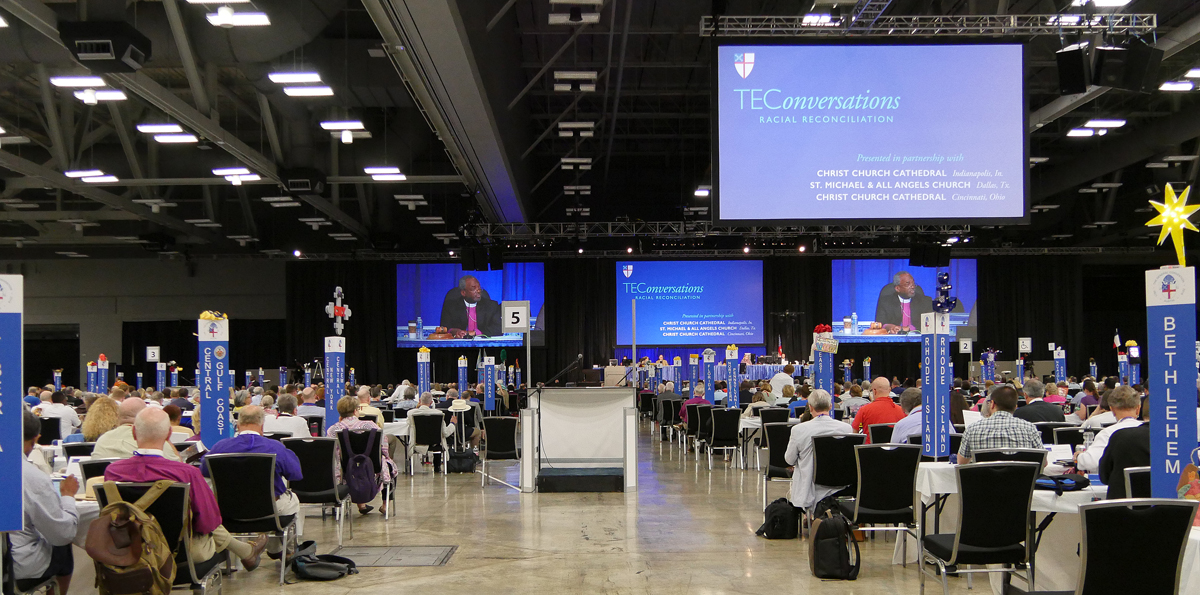
This weekend, Episcopalians will descend upon Louisville, Kentucky, for our General Convention.  The General Convention is the governing body of The Episcopal Church.  Every three years (or in this case, two years, due to a delayed GC during COVID), General Convention meets as a bicameral legislature that includes the House of Deputies and the House of Bishops, composed of deputies and bishops from each diocese.  In the House of Deputies, which includes elected lay and ordained deputies and alternates, over 1000 people will gather, and about 140 bishops will gather in the House of Bishops.  This year, we have a shortened Convention of six days of legislative sessions, covering everything from governance, justice issues, ecumenical and interfaith issues, evangelism and church vitality, liturgy, stewardship, formation, and mission.  In those six days, we will review over 275 pieces of legislation. 

Of course, General Convention is not all business.  It is a place of innovation and collaboration.  An exhibit hall of vendors is place of ideas, resources, and connection.  The legislative halls and common spaces are places of reunion with former seminary classmates, dioceses where one has served or worshiped before, and friends from professional connections.  It may be a chance to meet people in person that you have only known online, people you have admired the work of from afar, or a place to make new friends.  And then there are the opportunities to gather in worship in unfamiliar and familiar styles, the deep conversations and sharing of best practices, and the inspiration that can come from being steeped in the wideness of God’s church.

Ultimately, General Convention can be a place of great tension:  of trying to accomplish a great deal of business while honoring and developing relationships across difference, of challenging and trying to correct the failings of the Episcopal Church while learning and being inspired to renew our ministries, of taking a step back to clarify mission, purpose, and priorities while narrowing in and aligning decisions with that clarity.  Add in doing all that with over 1100 people, and that we get anything accomplished is a minor miracle.

Knowing all that, I invite your prayers for the Church as we gather:  that we root ourselves in God’s grace and power, that we ground ourselves in the love of Jesus and serve as faithful disciples, and that we undergird our work with the creative, life-giving, wise movement of the Holy Spirit.  And then ultimately, I invite your prayers that our work will mean something:  to the country church in rural America, to the beleaguered inner city church, to the bustling suburban church, and to churches whose primary languages are not English; to the churches who are shrinking and the churches who are thriving; to the person who is struggling with their faith, the person excited about a new ministry, to the person who is worried about the future of the church, and the person who is entirely unchurched.  We bring each of you with us in our prayers as we gather.  I hope you will surround us in prayer as well – that God is working for good in all of it.     

On Pastoring and Motherhood…

08 Wednesday May 2024

Posted by jandrewsweckerly in reflection

≈ Leave a comment

Tags

care, complicated, grace, gratitude, Jesus, love, mother, Mother's Day, mothering, pain, pastor, sorrow, suffering, tension

Photo credit: https://community.thriveglobal.com/remembering-mom-hands-on-mothers-day-loss-support-memories-inspire/

One of the deepest privileges of being a pastor is being gifted with people’s stories.  Sometimes those are stories of great joy:  of new love leading to marriage, of the gift of children, of the excitement of a new vocation.  And sometimes those are stories of deep pain and grief:  of life lost, of hurts deeply experienced, of dreams deflated.  The sum of those stories is uncountable – they are words and emotions that drift in and out of the pastor’s consciousness – the vessel for all that needs to be said and released.  It means that even in the pastor’s moments of greatest joys, there is, at the subconscious level, the treasuring and honoring of deepest pain and suffering.

Normally, I find I am able to hold that reality with tenderness and grace.  But nothing challenges that ability more than holidays that desire to create a forced, well-intentioned experience.  Secular ones, like the approaching Mother’s Day this weekend, are the worst offenders.  On the surface there is nothing wrong with Mother’s Day.  I know countless people who have been tremendous mothers in my life and in the lives of others, who rarely get a thank you, let alone a day of honor.  There is nothing wrong with honoring the mothers in our lives.  The challenge is the sea of complicated feelings that come along with such an effort:  the grief over mothers we have lost, the suffering caused by mothers who were abusive or absent, the pain of those women who wanted to be a mother and never could or who were mothers and who lost their pregnancies or their children, and for the hurt of those relationships between children and mothers that is estranged.  Our much-deserved celebration of mothering is always tainted with the very messy reality of mothering.

For that reason, you will not find me liturgically celebrating Mother’s Day at church.  Instead, I invite you to put on your pastor shoes this Mother’s Day and hold in tension the beloved and the painful this day.  Reach out to friends who have struggled with infertility, lost a pregnancy, or grieve the loss of a child or a relationship with their child.  Reach out to those who had beautiful, healthy relationships with their mothers and now grieve their death every day.  Reach out to those who are mothering figures in your life, even if they never birthed you and give them thanks.  At our church, we quietly offer resources for the complicated nature of the day.  You can find them here, here, and here.  But whatever you do, use this Mother’s Day to “mother in” the love of Jesus, who could see mothers everywhere and honored all of them. 

On Celebrating Life, Death, and Movies…

04 Wednesday Oct 2023

Posted by jandrewsweckerly in reflection

≈ Leave a comment

Tags

bless, celebration, change, community, death, end, Episcopal Church, eternal life, finality, grace, growth, Holy Spirit, Jesus, joy, life, ministry, movies, new, past

Photo credit: https://www.cnn.com/2023/09/28/tech/netflix-dvd-rental-movies-ending/index.html

Well, it finally happened.  Netflix’s DVD business closed last Friday.  Now I recognize that acknowledging I still received DVDs from Netflix may make me seem old-fashioned.  Even a contemporary exclaimed recently, “Do people even have the equipment to play DVDs anymore?!?”  I took a good ribbing, but the truth is I love movies, and Netflix’s DVD business allowed me to watch movies that were not available via streaming services.  I was constantly finding new gems, and still had over 100 movies in my queue that I hoped to watch some day.

For those of us old-timers still watching DVDs, the closing of Netflix’s DVD branch has been tinged with nostalgia and a tiny bit of grief.  Over the course of 18 years, I watched 667 films, each story sparking my imagination, eliciting pleasure, sorrow, excitement, indignation, laughter, and hope.  Obviously there will be other ways for me to revel in the artistry of filmmaking, but there is a certain finality to the closing of this chapter. 

Despite my wistfulness, I commend Netflix for the way they have handled this change.  Instead of wallowing in grief, or attempting to apologize for market changes beyond their control, instead, they have handled this “death” with grace and joy.  Knowing the closing was coming, this year they used their iconic mailing envelopes to feature celebratory artwork honoring how a whole generation has been shaped by their service.  On the week of their closure, the sent a “gift” to every member – a summary of the highlights of our membership – what movies we had watched each year, milestones in our membership, and even the list of movies in our queue in case we want to find another way to see them.  Instead of a death, it has felt like a celebration of life.

In a lot of ways, it has reminded me of the ways the Episcopal Church approaches death.  When someone we love passes, we use the burial office to celebrate life – certainly the life of the one who has died, but especially the promise of eternal life promised in Jesus Christ.  But I’ve been thinking about it over this last week, and the Church honors “mini-deaths” all the time:  the ending of a ministry that is no longer needed or effectively utilized, the retirement of a ministry leader after a successful tenure, or the blessing of a parishioner or staff member who moves away from the community.  All those transitions can be hard because they make us remember fondly the ways ministry blessed us in the past.  But those transitions are also often the source of new life:  a new ministry we could never have imagined five years ago, a new leader whose fresh ideas opens up new opportunities, and new members who shape and mold us into a new community.

I wonder what things feel like they are dying in your life right now – what things you thought would always be there are undergoing change.  Where might the Holy Spirit be inviting you to see new shoots of growth in the midst of something withering on the vine?  How might those “mini-deaths,” be tremendous gifts to you or your community?  How might we take a cue from Netflix, and find ways to celebrate those endings with dignity and joy?  I am grateful for the ways a secular business is helping me see the sacred in our own life cycles.  Let’s celebrate together!

Sabbatical Journey…Finding God on the Road

18 Sunday Jun 2023

Posted by jandrewsweckerly in reflection

≈ Leave a comment

Tags

blessing, competition, connection, game, God, grace, human, image of God, journey, prayer

Photo credit: Jennifer Andrews-Weckerly (reuse with permission only)

One of our favorite road trip pastimes as a family is the “license plate game.”  We try to spot license plates from all fifty states while we drive.  We even have a little board that allows you to flip over a wooden replica of a plate when you see that state’s plate, helping you track which ones you are missing.  It’s a fun game for all ages that helps pass the time, and in feels mildly educational as parents.

Today we embarked on our family’s sabbatical road trip:  twenty-one states in twenty-one days.  Many of the sites have been on our bucket lists for years, and some of the sites we only learned about while planning the route.  We know this will be the trip of a lifetime, and we are thrilled to be able to do this together.  One of the themes of my sabbatical has been connection, and we suspect there will be lots of connection by the end of this journey.

As we commenced our journey today, the license plate game started immediately.  We had a bit of a slow start at the beginning, and I wondered if we were going to get stuck as we drove further away from the East Coast.  At some point, as kids and the other adult were snoozing, I saw one of the states I was particularly worried about missing, and I remember thinking, “Oh thank goodness for Delaware!!” 

My thought was rather silly and overly dramatic, but as I kept driving, I began to wonder what it might be like to not just treat the game as a calculated collection of inanimate objects, but instead to imagine the lives and worth of each human life in the cars.  How much more life-giving would it be to say to another driver, “I am so grateful for you today!  May your travels be a source of blessing!”  The image of 35 blessings instead of 35 wooden blocks on our game board made me realize how unfathomable God’s love is for all of God’s creatures.  Here I am competing in a game, when, if I use God’s eyes of grace, I might be seeing 35 blessings, 35 carloads of people made in God’s image, 35 possibilities for connection, or 35 invitations to move closer to God in prayer.

I look forward to finding new ways to see with God’s eyes of grace on the next leg of our trip.  I would love to hear how you found God’s invitation to blessing through others today!

← Older posts

Recent Posts

  • On the Myth and Magic of Advent…
  • On Risking Failure and Facing Fear…
  • Sermon – Luke 23.33-43, P29, YC, November 23, 2025
  • On Inhabiting Gratitude…
  • Sermon – Luke 20.27-38, P27, YC, November 9, 2025

Archives

  • December 2025
  • November 2025
  • October 2025
  • September 2025
  • August 2025
  • July 2025
  • June 2025
  • March 2025
  • February 2025
  • December 2024
  • November 2024
  • October 2024
  • September 2024
  • August 2024
  • July 2024
  • June 2024
  • May 2024
  • March 2024
  • February 2024
  • January 2024
  • December 2023
  • November 2023
  • October 2023
  • September 2023
  • August 2023
  • July 2023
  • June 2023
  • May 2023
  • March 2023
  • February 2023
  • January 2023
  • December 2022
  • November 2022
  • October 2022
  • June 2022
  • May 2022
  • January 2022
  • December 2021
  • November 2021
  • October 2021
  • September 2021
  • August 2021
  • June 2021
  • May 2021
  • April 2021
  • March 2021
  • February 2021
  • January 2021
  • December 2020
  • November 2020
  • October 2020
  • September 2020
  • August 2020
  • July 2020
  • June 2020
  • May 2020
  • April 2020
  • March 2020
  • February 2020
  • January 2020
  • December 2019
  • November 2019
  • October 2019
  • September 2019
  • August 2019
  • July 2019
  • June 2019
  • May 2019
  • April 2019
  • March 2019
  • February 2019
  • January 2019
  • December 2018
  • November 2018
  • October 2018
  • September 2018
  • August 2018
  • July 2018
  • June 2018
  • May 2018
  • April 2018
  • March 2018
  • February 2018
  • January 2018
  • December 2017
  • November 2017
  • October 2017
  • September 2017
  • August 2017
  • July 2017
  • June 2017
  • May 2017
  • April 2017
  • March 2017
  • February 2017
  • January 2017
  • December 2016
  • November 2016
  • October 2016
  • September 2016
  • August 2016
  • July 2016
  • June 2016
  • May 2016
  • April 2016
  • March 2016
  • February 2016
  • January 2016
  • December 2015
  • November 2015
  • October 2015
  • September 2015
  • August 2015
  • July 2015
  • June 2015
  • May 2015
  • April 2015
  • March 2015
  • February 2015
  • January 2015
  • December 2014
  • November 2014
  • October 2014
  • September 2014
  • August 2014
  • July 2014
  • June 2014
  • April 2014
  • March 2014
  • February 2014
  • January 2014
  • December 2013
  • November 2013
  • October 2013
  • September 2013
  • August 2013
  • July 2013
  • June 2013
  • May 2013
  • April 2013
  • March 2013
  • February 2013
  • January 2013
  • December 2012
  • November 2012
  • October 2012
  • September 2012

Categories

  • reflection
  • Sermons
  • Uncategorized

Meta

  • Create account
  • Log in
  • Entries feed
  • Comments feed
  • WordPress.com

Blog at WordPress.com.

  • Subscribe Subscribed
    • Seeking and Serving
    • Join 394 other subscribers
    • Already have a WordPress.com account? Log in now.
    • Seeking and Serving
    • Subscribe Subscribed
    • Sign up
    • Log in
    • Report this content
    • View site in Reader
    • Manage subscriptions
    • Collapse this bar
 

Loading Comments...