• About

Seeking and Serving

~ seek and serve Christ in all persons

Seeking and Serving

Tag Archives: gratitude

On Birthdays and Blessings…

20 Wednesday Nov 2019

Posted by jandrewsweckerly in Uncategorized

≈ Leave a comment

Tags

big, birthday, blessing, celebrate, God, gratitude, life, little, thankful, ultimate

gratitude

Photo credit:  https://www.lupus.org.uk/lupus-trust-uk-news/2019/8/2/qzppdr7brifhgd5i9zi7h8o1ia34i0

My husband and I experience our birthdays very differently.  He is perfectly happy to have a quiet, reserved day, wanting to be acknowledged, but not wanting a lot of attention on him.  I, on the other hand, love have a ton of attention on my birthday – songs, cake, cheers, you name it.  So when my daughter insisted I wear a “It’s My Birthday!” sash yesterday, I only hesitated for a second.  What was funny about the sash was the experience I had wearing it.  The funniest reactions were probably at the bus stop.  I think most of the kids must have parents more like my husband as they seemed surprised I was celebrating.  But one kid in particular asked me, “So are you having a big party with your friends tonight?”  When I replied I was not, her response was, “Yeah, I guess you’re too old, huh?”

It’s funny how a six-year old can make you question your life.  I was suddenly wondering, “Should I have assembled a party?  Should I have found other big ways to celebrate?”  But as the evening closed yesterday, I reflected on what my day of celebration entailed:  a breakfast, including eggs and coffee, my children proudly made by themselves; a lunch in the school cafeteria with my older daughter and her friends; an evening watching my younger daughter’s ballet class – an activity I cherished growing up; a surprise dinner by my husband, fully ready upon our return home; not to mention cards, cupcakes, and endless texts, calls, and social media messages.  It wasn’t a party in the traditional sense, but it did feel like wonderful day of celebrating life – my life here and now.

In the last couple of weeks, I have administered last rites, conducted a funeral, spent several days with my dad who was in the hospital, talked to families dealing with crisis, consoled the bereaved, baptized a baby, and heard people’s life stories for the first time.  When you are that deep in the reality of life, parties or treats no longer seem necessary.  What suddenly becomes important are the ultimate things of life – breath, family, loved ones, intimacy, little life moments.

To help me keep celebrating, I invite you this week, to slow down and look at the blessings all around you.  I know some of you are hurting, some of you are just trying to get by, and some of you don’t have that many stressors right now.  Wherever you are, take a moment today to give thanks to God for all your bountiful blessings – big and very small.  Each breath, each day, each year is a gift.  Tell me where you are feeling grateful.  I’d like to celebrate with you!

On Cultivating Gratitude…

22 Wednesday Nov 2017

Posted by jandrewsweckerly in Uncategorized

≈ Leave a comment

Tags

blessing, cultivate, enrich, God, gratitude, intentional, joy, practices, Spirit, spiritual, Thanksgiving, Thanksgiving Day

Sixty-and-Me_Women-Over-50-Express-their-Gratitude-on-Thanksgiving-Day-740x417

Photo credit:  sixtyandme.com/50-women-over-50-express-their-gratitude-on-thanksgiving-day/

I don’t know about you, but I find my spiritual life has hills and valleys.  There are times when I feel especially close to God, and that closeness leads to a sense of overflowing gratitude.  And there are times when I fill up the extra space in my life with everything but God.  In those valleys, I sometimes feel God is far away – mostly because that is where I pushed God.  In those times, gratitude is often the last thing I experience.  Instead, I can be irritable and short-tempered.

In order to stay out of those valleys of self-absorption, I have found I need intentional practices of gratitude.  Celebrating Thanksgiving Day tomorrow helps put most of us in a spirit of gratitude (assuming we are not in a spiral of menacing traveling conditions, dread about time with challenging family members, or anxiety about food preparations).  But this year, I have found that I am coming into Thanksgiving Day with a full cup.  I am working on a stack of thank you notes for the generous pledges our parishioners have made to our church; the generosity of our parishioners makes writing the notes a joy.  Our church has been negotiating a new partnership which looks like may come to fruition; it is the culmination of a lot of dreams, most of which began before my arrival, and the promise of fulfillment is at times overwhelming.  And our church has two different services for Thanksgiving:  one with our ecumenical brothers and sisters, and a mass on Thanksgiving Day; both are occasions for deep joy and gratitude.

The thing about these events and experiences is they cultivate in me a spirit of gratitude.  When my spirit is primed for thanksgiving, every time I take a walk or hop in my car, I find a breathtaking tree that has hit its peak fall color.  When my spirit is primed for thanksgiving, the little things my family does – an unprompted “thank you,” a cleaning up of the kitchen, a spontaneous hug – all make my heart warmed.  When my spirit is primed for thanksgiving, I see the daily tasks of others that go unnoticed:  the county worker clearing a dead animal from the street, the childcare provider who sees my child being extra clingy and swoops her up in a big, distracting hug, or the administrator who has already thought about the things on my mind and started the projects I need accomplished.

If your spirit has not been primed, there is still time.  Perhaps you can start with tomorrow’s celebration, looking for glimpses of hope and blessing throughout your day (even in the midst of family drama, I promise you can find those glimpses!).  But do not let the thanksgiving end there.  Find ways to enrich your spirit each day:  whether it is putting on lenses of gratitude, taking up a tangible practice, or surrounding yourself with others who are naturally inclined toward an attitude of gratitude.  My suspicion is you will find your cup running over soon, and that overflow can be a blessing to others!

A Journey to Generosity…

04 Wednesday Oct 2017

Posted by jandrewsweckerly in Uncategorized

≈ Leave a comment

Tags

bless, evangelism, generosity, giving, God, gratitude, Holy Spirit, idea, inspire, journey, life, light, stewardship, vision

tens_nodate_logovertical (1)I am always amused when I discover the Holy Spirit at work because the discovery usually happens when I am in the thick of executing something I thought I had planned myself.  Ideas come to me, I test out the idea with others, I do the planning to implement the idea – basically the whole process involves a great deal of self-direction.  But when an idea really blows me away is when the idea takes off in even better ways than I planned.  When I finally realize how inspired the idea is, I realize that the idea could not have possibly come from me alone.  The only way those incredible moments of confluence occur is through the Holy Spirit.

I had one of those moments this week.  On Sunday we kicked off our stewardship campaign entitled “Journey to Generosity.”   All sorts of activities are a part of that campaign:  inspirational materials from our Stewardship Committee explaining the campaign, reflections from fellow parishioners, Parish Parties, sermons from the clergy, and meditations from national church leaders.  All of those experiences would be enough to situate us in a place of profound gratitude.  But then other things started happening.

The first has been attending our adult formation series.  The series is about evangelism, so I had expected our energies to be focused on the work of spreading the good news.  But the first sentence from the book we are using says, “Evangelism is your natural expression of gratitude for God’s goodness.”[i]  While I thought our conversations about gratitude and generosity would be limited to stewardship, here gratitude was permeating other areas of church life.  The second thing that happened was welcoming the first of three babies due this month at church.  As I held the first one yesterday, especially after a rough twenty-four hours of mourning another massive shooting in Las Vegas, I looked at that tiny child and felt a profound sense of gratitude for the gift of life.

Our “inspired” idea to talk and pray about our Journey to Generosity has already morphed into something much bigger.  I find myself being grateful not just for the generosity of parishioners who are passionate about our church and support its work through financial giving.  I am also grateful for a community of people who are so enthusiastic about their gratitude that they want to go out and share the good news with others.  I am grateful for a church community so generous in spirit that they can take tragedy and find rays of light and hope all around.  I am grateful for a community whose gratitude is so powerful that they have a vision of making our community a better place:  through our Fall Festival, through our visioning work with our Vestry, and through daily service to others.  What seemed like a catchy campaign slogan has actually been naming a way of life at Hickory Neck:  a life rooted in gratitude and generosity.  Thank you for letting me be a part of this journey with you all.  You inspire me every day and you transform my relationship with God every week.  God bless you on your journey to generosity!

[i] David Gortner, Transforming Evangelism (New York:  Church Publishing, 2008), 1.

Sermon – Exodus 16.2-15, Matthew 20.1-16, P20, YA, September 24, 2017

27 Wednesday Sep 2017

Posted by jandrewsweckerly in Sermons, Uncategorized

≈ Leave a comment

Tags

abundance, complain, deserve, fairness, faithful, generosity, God, gratitude, Jesus, laborers, loyal, parable, scripture, Sermon, whine

This week in Discovery Class, we did a review of Holy Scripture.  We talked about how many years writing the Bible took, the content in each section, the types of literature we find in scripture, and what scripture reveals about us as God’s people.  Our homework was to study today’s gospel lesson, being sure to read the text immediately before and after the text we hear today as a way of helping us interpret the passage.  That tip was especially telling in today’s Old and New Testament lessons

In our lesson from Exodus last Sunday, we heard the story of the parting of the Sea of Reeds.  We heard of that dramatic moment where God allows the Israelites to pass through on dry land, but destroys the Egyptians as the waters return.  The last line in last week’s lesson from Exodus is, “Israel saw the great work that the Lord did against the Egyptians.  So the people feared the Lord and believed in the Lord and in his servant Moses.”  Today, the first sentence from our Exodus reading is, “The whole congregation of the Israelites complained against Moses and Aaron in the wilderness. The Israelites said to them, ‘If only we had died by the hand of the Lord in the land of Egypt, when we sat by the fleshpots and ate our fill of bread; for you have brought us out into this wilderness to kill this whole assembly with hunger.’”  Israel’s groaning and complaining today are much more grievous when we read the great heights of their praise and faithfulness last week.

Likewise, in our gospel lesson today, we hear the familiar story of the generous landowner, who gives the same wage to those who work an hour and those who work all day in the broiling sun.  We can read this passage, and criticize the envious, hardworking laborers for their lack of gratitude.  But the power of the story is heightened when we realize immediately before Jesus’ parable, Peter interrupts Jesus’ teaching and basically says, “But what about us?  We left everything behind and we have been following you.  What’s in it for us?”  And right after Jesus’ parable, the mother of James and John approaches Jesus and basically says, “Listen, if it’s not too much trouble, can my boys sit at your right and left hand in the kingdom?”  So, when Jesus says to Peter, “many who are first will be last, and the last will be first,” and when the landowner says to the workers, “the last will be first, and the first will be last,” what do you think Jesus is trying to address?[i]

I do not know about you, but both of these texts have left me pretty uncomfortable this week.  Watching the Israelites go from faithful, obedient, loyal followers, to whiny, unappreciative, complaining messes hits a little too close to home.  Admittedly, part of me cringes at this text because we have been hammering home the importance of gratitude with our own children.  No sooner is the ice cream cone finished before the complaint comes that we never do anything nice for them.  But as much as we fuss at them, we know the same is true for us.  We are great at praise and thanksgiving to God – when things are going well.  When seas are parting, and enemies are defeated, our God is awesome.  But when we cannot seem to make ends meet, when our loved one is sick again, or when our relationships are falling apart, gratitude is the last thing on our lips.  We find ourselves in what one scholar calls the “spiritual wilderness of ingratitude.”[ii]  We cringe at these readings because we are no more masters at gratitude than our children are.

What both of these lessons do, ever so brutally, is lure us in with stories about abundant, underserved generosity, and put under a microscope our deeply buried discomfort with abundant, underserved generosity.  Part of the reason we are uncomfortable is because God’s generosity often bumps up against our notions of fairness.[iii]  I do not know if we understand the concept of fairness innately or if we are taught fairness by our community, but somewhere along the line, we learn the concept of fairness and apply the concept with exacting scrutiny.  I remember when I was a child and wanted a treat, my dad would make my brother and me share the treat.  One child was allowed to split the treat in half, but the other child got to pick which half he or she wanted.  You can imagine how precise my cuts became when looking at that cookie.

But our notions of fairness evolve over time.  One could take that same cookie and give a slightly larger half to the older child since they are bigger.  Or one could take that same cookie and give the slightly larger half to the child who was better-behaved.  Or one could give the larger half to the one who was physically weaker and needed more nourishment.  There are all sorts of ways to determine fairness.  But God’s measure, in both the Hebrew and Christian Scriptures seems to be that everyone receives God’s generosity despite worth or effort – or even the showing of gratitude.

Take our lesson from Exodus.  The people have clearly approached mutiny.  Their love for God is buried in their physical hunger and their self-centered greed.  But instead of punishing the Israelites, God lavishes them with all they need.  God gives them bread every day and meat every night.  In fact, God even gives them a double portion on the eve of the Sabbath so that they can observe the Sabbath without having to work for their food.  The feast is not a rich feast of wines and marrow, but their feast is gloriously generous and enough.

The same is true in Jesus’ parable.  Yes, the landowner has a weird way of putting the day-long workers in the awkward position of watching his generosity, but ultimately, the landowner gives everyone enough.  He gives the wage he promised to the day-long workers – a wage that will fill them and their families for days.[iv]  But he also gives the same wage to the hour-long workers.  Sure, they did not deserve the wage, but the same wage that feeds the other workers feeds them too.  The landowner is gloriously generous and gives enough.[v]

I have been wondering all week where these texts leave us:  maybe a bit guilty, perhaps a bit convicted, and definitely “last” in the pecking order Jesus describes.  But what I realized this week is both in Exodus and in Jesus’ parable, perhaps being last is not all that bad.  You see, Jesus does not say, “The last shall be first, and the first shall be ejected.”  No, Jesus says, “the last will be first, and the first will be last.”  So even on our worst Israelite days, when we are moaning and complaining about the very God who miraculously saved us, or even on our worst vineyard days, when we are complaining about an unfair, albeit generous, owner, we are still not ejected.  We are not taken out of God’s generosity; we are not stripped of our blessing.  We may be last, but we still have enough.  Our abundantly generous God takes care of us when we deserve God’s care and when we do not.  Our abundantly generous God gives us enough when we think God’s generosity is fair and when we do not.  Our abundantly generous God loves us whether we embrace God’s generosity or we do not.

I cannot promise we will ever get in line with God’s generosity.  I am not sure we will ever be cured of our sense of fairness or even our ill-conceived notions that we could earn God’s generosity.  But what I can tell you is that we are not alone.  Our people thousands of years ago did not master God’s generosity.  The disciples two thousand years ago did not master Christ’s generosity.  And I suspect we will not either.  But every week, we try.  Every week we continue on our journey toward generosity – seeing God’s generosity in ourselves and others – being inspired to try again.  I am not sure we will ever be first in line.  But the good news is we get to stay in line – which means there is always room to try again.  Our generous God will make sure we have enough until then.  Amen.

[i] Barbara Brown Taylor, The Seeds of Heaven: Sermons on the Gospel of Matthew (Louisville:  Westminster John Knox Press, 2004), 100-102.

[ii] Deborah A. Block, “Homiletical Perspective,” Feasting on the Word, Supplemental Essays, Year A  (Louisville:  Westminster John Knox Press, 2011), 2.

[iii] Taylor, 103.

[iv] Amy-Jill Levine, Short Stories by Jesus: The Enigmatic Parables of a Controversial Rabbi (New York:  Harper Collins, 2014), 224.

[v] Block, 4.

On Blessings and Curses, and Surviving Thanksgiving Meals

23 Wednesday Nov 2016

Posted by jandrewsweckerly in Uncategorized

≈ Leave a comment

Tags

conflict, creation, fall, family, God, gratitude, heart, leaves, mind, prayer, space, Thanksgiving, Thanksgiving Day

Colorful autumn

Photo credit:  www.fluentu.com/french/blog/french-fall-autumn-vocabulary-word-list

For those of you who know me well (or read this blog each fall), you know that I love the changing of the leaves during Fall.  Fall is my favorite season of the year – the cooler weather, the crunch of leaves, and the brilliant reds, yellows, and oranges that take your breath away.  The leaves turned later than usual this year in Virginia, so I have had time to enjoy their beautiful journey until now.  Just this week, a light wind was blowing, and a tree was raining down yellow leaves like a flower girl before the bride.  Some people like to stop and smell the roses.  I like to stop and revel in the beauty of God’s changing leaves.

Watching and being fed spiritually by that beauty this year led us to creating a Thanksgiving Tree at Youth Group this past Sunday.  We took a poster with a bare tree, and then used our post-it notes to cover the tree with things for which we are grateful.  We had five categories, including family, relationships, creation, God, and school/work.  I challenged the group to write down three things in each category – not just a one-word response, but an explanation of their gratitude.  Perhaps 15 notes seemed like overkill to the young adults, but what I was hoping was that the more they thought about the blessings in their lives, the less space the negative would have in their hearts and minds.

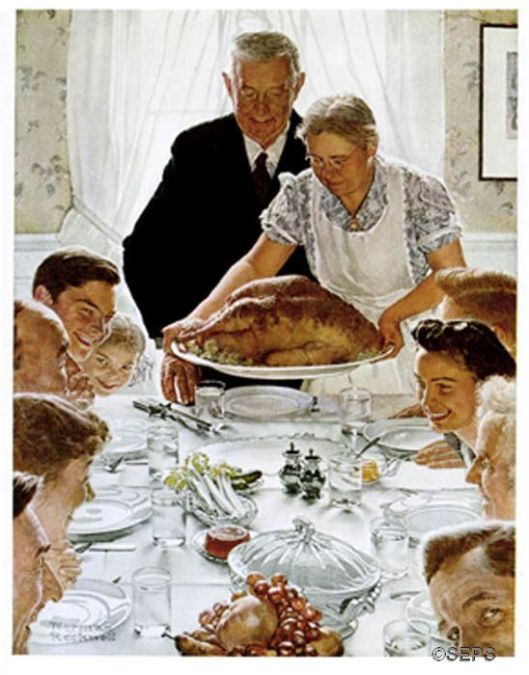
That is my prayer for each of you this week as we head into Thanksgiving celebrations.  Though we may have Normal Rockwell images of Thanksgiving Day meals in our minds, and although some of you may actually get that experience, the reality of most meals, especially if spent with family, is that they will include a fair share of conflict.  If you are lucky to avoid talking about politics, some other family drama will surely emerge.  Expecting that conflict, I invite you to start praying your thanksgivings.  If your crazy family promises to bring angst, start praying now about the things that bring you joy about each member of your family.  You may have to dig deep (Lord knows your uncle’s jokes can drive you insane – but maybe you can thank God for predictability with your uncle or for the knowing glances of your cousins).  But my guess is that the more you start looking at your family or friends with the eyes of gratitude, there will be a lot more space in your heart and mind for blessings than curses.

If you can master that practice of thanksgiving prayers throughout one of the more stressful days of the year, perhaps you can carry that prayer practice through the next month.  As you hone that spiritual discipline for the next month, you may find it becomes easier to carry it into the next year.  Given our current climate, we are going to need all the space we can get for blessings. img_3401

Ecumenical Thanksgiving Homily – Ruth 2.2-9, Matthew 22.34-40, November 20, 2016

23 Wednesday Nov 2016

Posted by jandrewsweckerly in Uncategorized

≈ Leave a comment

Tags

active, Boaz, community, ecumenical, God, gratitude, Great Commandment, homily, Jesus, love, mercy, ministry, neighbor, Ruth, Thanksgiving, worship

When I learned we would be gathering for worship as ecumenical brothers and sisters to celebrate a service of Thanksgiving, I could not have been happier.  But when I realized we would be reading from the book of Ruth, I was thrilled!  Ruth has always held a special place in my heart.  This woman, a complete stranger to our faith, teaches us more about faithful living than most of our ancestors. She marries a foreigner, quickly becoming a widow with no support, following her widowed mother-in-law to a foreign land.  In her abandonment, she pledges allegiance to a God who in many ways has felt absent.  And when they return the foreign land of Bread, and she sees Naomi may not be able to support her, she takes it upon herself to go sweat in the fields, and secure them a livelihood.  She even eventually permanently ensures their security by somewhat scandalously approaching Boaz for not only food, but marriage, and progeny.  Ruth puts all others before herself, and she is faithful to God and her family.  If anyone is a beacon of living into the Great Commandment to love neighbor as self, Ruth is that beacon of light.

But the more I thought about our text today, the more I realized that despite the fact that I love Ruth, we gathered here today are more like Boaz.  You see, we are people of privilege and power.  Though we can certainly name countless people who may have more wealth and influence than we do, most of us know where our next meal is coming from, have a roof over our heads, and have our basic needs met.  Some of us are even comfortable enough to enjoy much more than our basic needs.  In that way, we are much more like Boaz, a man with power and influence, who can use that power for good or for evil.

Boaz has little obligation to Ruth, the foreigner.  He knows she is connected to Naomi, making her adopted family, but allowing her to glean with the other gleaners would have been enough.  He didn’t have to give her tips about how to be safe from the men, give her access to drinking water, feed her his bread at mealtime, and tell his men to make sure she got extra grain to glean.  He did not have to say yes when she asked for his help in taking her in.  He did not have to negotiate with the next-of-kin to have her hand.  Boaz takes God’s command to love neighbor beyond what anyone would expect.

I have been thinking about Boaz as I have been thinking about our ministry together.  Though you may not know about each case, each of the clergy here work with families in need through the use of discretionary or alms funds.  Each church here has ministries that we support – whether food pantries, homeless shelters, elder care, medical clinics, or assistance with basic needs like back-to-school supplies, clothing drives, or holiday support.  And all of us collectively have taken that a step further and agreed to help provide more food assistance by starting up a local food distribution outlet through our partners at House of Mercy.  But just because we do that work does not mean that we do that work like Boaz.

My husband is a social worker in Richmond and he was recently telling me about a client’s experience with a church.  The client reached out to a church for assistance, and instead of pastorally working with the client, the church representative gave them a hard time, wanting to know what poor decisions the client had made that brought them to the church doors.  Now, I know we all screen the clients we help.  We have to be smart about how we help those in need.  But that client experienced a loss of dignity at that church that Boaz never exerts.  In fact, Boaz knows how degrading poverty can be.  He sees Ruth, and knows simply by her gender and foreignness that she is at risk for assault and manipulation.  And so, not only does he help her, but he looks at all those around him and hold them accountable for caring for the disadvantaged too.  He does not act alone in his mercy – he makes his whole community merciful.

As we head into a holiday marked for Thanksgiving, the church invites us to look at our ancestors for the best ways to fulfill Jesus’ Great Commandment.  Want to know how to love God and our neighbors?  Look at our sister Ruth.  Want to know how to show love, dignity, and compassion?  Look at our brother Boaz.  Though many of us spend this time of year reflecting on what we have to be grateful for, the church invites us also to use this time as a time of action.  Our gratitude is not passive.  Our gratitude is active – a call to action to love God and love neighbor.  I know many families who have a tradition of going around the Thanksgiving table, enumerating those things for which they are grateful.  Perhaps this year, our families can also enumerate what we are going to do in response to those things for which we are grateful.  Our ancestors, our Savior, and our faith communities are here to embolden us in that response.  Thanks be to God!

Participating in Gratitude…

02 Wednesday Nov 2016

Posted by jandrewsweckerly in Uncategorized

≈ Leave a comment

Tags

blessed, cycle, generosity, gift, God, grateful, gratitude, note, sacred, thanks, Thanksgiving

thank-you-note

Photo credit:  https://fastcompany.com/3057431/hit-the-ground-running/heres-what-to-write-in-your-thank-you-after-a-job-interview

In honor of Thanksgiving Day at the end of the month, a trend has developed that uses the entire month of November as a month of gratitude.  The practice has several forms:  journaling about at least five things for which you are grateful every day; posting daily on Facebook a note of gratitude; or using Instagram or other outlets to post a daily photo of something for which you are grateful.  The practice is quite spiritually based.  I have had countless spiritual directors who have encouraged me to use gratitude as a discipline for my prayer life – using the end of the day to give thanks for things in life as opposed to our natural tendency to look back at the day and make mental note of all the things that went unaccomplished or were hurtful to ourselves or others.

This past Sunday we gathered our pledges for the upcoming calendar year.  Each year in the Episcopal Church, parishioners are asked to fill out a pledge card, letting the Vestry, or governing board, know how much income can be expected so they can formulate a budget.  The pledge cards certainly serve a practical purpose.  But their use can also serve a deep spiritual purpose.  As I blessed three different baskets of pledge cards on Sunday, I had the thought that each of those baskets were like piles of thank you notes to God – a way of articulating how blessed we are and how grateful we are for the resources we have and our ability to share and support ministry with those resources.  Each card held a story – a story of someone who feels connected to and passionate about Hickory Neck, who has been nurtured and challenged in this place, who has a unique life story, and who has encountered Christ here.  As I thought of the conversations, prayers, and reflections those cards represented, I could not help but smile.  There is something quite beautiful in witnessing the intimate, vulnerable exchange between God and parishioner.  I felt privileged to bless that sacred act.

In the coming weeks, I have the privilege of entering into that sacred space of thanksgiving and gratitude.  I have the task of thanking each pledging member.  When the Stewardship Committee and I first talked about the campaign, we joked about whether my hand would be able to survive writing so many notes.  There may be times my hand actually does get sore, but so far, I am nothing but grateful to be writing those notes.  I have found that writing them has been a tremendous time of blessing – an opportunity for me to pray for each parishioner, to thank God for the gift of them to our community, and to send my blessings upon them.  The “duty” has become an incredible gift that keeps the cycle of gratitude going.

How are you participating in the cycle of gratitude?  In what ways do you cultivate a spirit of generosity, passing your sense of gratitude and blessing on to others?  I look forward to hearing how you are participating in the cycle, and how God is using you to bless others.

Sermon – Luke 17.11-19, P23, YC, October 9, 2016

12 Wednesday Oct 2016

Posted by jandrewsweckerly in Sermons, Uncategorized

≈ 1 Comment

Tags

church, compliment, duty, generously, giving, grateful, gratitude, guilt, Jesus, joy, leper, living, obligation, pledge, practice, praise, Sermon, stewardship, Thanksgiving, transformation, turning

I once knew a man who was impossible to compliment.  Whether you wanted to compliment a job well done or good deed, his response was always the same, “It’s not me.  All the glory goes to God.”  His response always left me feeling like I just offered a present that was rejected.  Of course, I totally agreed with what he was saying – none of us is able to do good without the God who empowers us to do so.  And truly, Jesus was not that great at accepting compliments either, especially if you recall all the times he asked people to keep a healing secret or to just go back to work.  But upon receiving a compliment, a simple, “Thank you,” would not have hurt this man.  After a while, I just stopped trying to praise his work or good deeds.

I think that is why I relate to the nine lepers who do not return to Jesus to give him thanks and praise.  There were ten lepers originally – nine who were Jewish and one who was a Samaritan.  We are not sure why the ten are together – the Jews and the Samaritans were enemies and rarely spent time together.[i]  We are told at the beginning of the text that Jesus was passing through a borderland between Samaria and Galilee, so there is a possibility that then ten men banded together through their disease instead of culture.  You see, both Samaritans and those of Galilee would have been seen as impure due to their leprosy.  Being exiled to the borders of their land, they may have found more in common than divided them.  And so, as a group, they shout out to Jesus for healing – careful not to approach him, of course, which would have been improper in their condition.  Respecting their distance, Jesus does not insist they come forward, but instead tells them to go to the priest to show themselves to be healed.  Along the way, they are healed, but they still would have needed to show a priest in order to be restored to their families and friends.[ii]

The Samaritan among them returns and gives praise to God, but the others do not.  We do not know how their journey unfolds.  Presumably they are faithfully doing what Jesus told them to do – going to the priest for restoration.  Perhaps they give praise to God once the priest restores them.  Perhaps they give praise when they are reunited with their families.  Maybe they even show their praise through helping lepers later.  But that is all supposition.  All we get today is Jesus’ criticism of the nine because they neglect to turn and give God praise and thanksgiving.

I have been reflecting on Jesus’ words this week, and what rubs me the wrong way may be the same thing that rubbed me the wrong way when that man I knew always refused praise.  In both cases, whether Jesus, or the man I knew, there is both implicit and explicit criticism of my own practice of gratitude and thanksgiving.  What irritated me about the man’s responses to me was that they made me feel guilty – that perhaps I was not grateful enough to God for the goodness in my life.  The same thing irritates me about Jesus this week – his judgment of the nine makes me feel guilty about the ways I have walked away healed and not given praise to God.

This week we are kicking off our stewardship season in a campaign called, “Living Generously.”  After the service, you will be receiving a packet of information about how you can support the ministry of Hickory Neck, and a pledge card that we will collect in a celebratory ingathering in just four weeks.  Most preachers would have read the text today and thought, “Yes!  The perfect Stewardship text!”  But the more I sat with Jesus’ words, the more I realized that his words actually bring up feelings of dread rather than joy.  Most people associate stewardship with the same sense of guilt that this reading brings up.  We feel guilted into showing gratitude, and so we guiltily look at our budgets and see if we can increase our pledge this year.

The first time I experienced the concept of pledging was when I started regularly attending an Episcopal Church.  In the churches where I grew up, you never had to tell anyone what you were going to give.  The preacher might have talked about a tithe – ten percent of your income.  But the preacher never wanted you to say exactly what you were going to give.  So when the warden of this church started explaining how he wanted us to pledge, I was aghast.  I remember thinking, “That’s private!  I don’t have to tell you how much I am going to give!”  Now, I knew we would probably tithe that year, but the idea of telling someone else about my giving seemed to go against every cultural norm I knew.  Fortunately, I stayed to hear the rest of the warden’s talk.  He explained that the way the church formed the church’s budget was through the knowledge of what income they could expect.  The Vestry would adjust expenses accordingly and try to get the budget balanced.  My outrage faded as I realized how responsible that model seemed.  Thus began my adult journey into pledging.

But that journey into pledging experienced a transformation about eight years later.  We were at a new church, and the priest asked to hold our pledge cards until a particular Sunday.  We did and the funniest thing happened.  In the middle of the service, a banner appeared.  The banner was processed down the aisle, joyful music started playing, and people started following the banner forward.  We placed our pledge in a basket, and I felt something stirring in me.  The priest blessed the pile of pledge cards, and something about stewardship turned in my heart – the pledging, the monthly giving was no longer an obligation or burden – something to be guilted into.  My pledge was a joyful sign of gratitude – a sign blessed by God and affirmed by the community.  And I have to say – it felt good!

In the gospel lesson today, the text says that the Samaritan turns back to Jesus.  That word for turns back is more than just a physical description – the action of turning back is a sign of deep transformation – a reorienting of the Samaritan’s life from duty to gratitude.[iii]  I do not think Jesus was looking for a guilty admission of thanks from the other nine lepers.  What Jesus is looking for is a transformation of the heart – a turning of one’s life away from obligation and duty to joyful gratitude and thanksgiving.

I was reading this week about a woman with an interesting habit.  Whenever someone asked her how she is – that basic question we always ask and anticipate the answer being, “Fine,” – instead she would say, “I’m grateful.”  No matter what is on her plate – stress at work or school, an illness that kept plaguing her, strife at home – her response is always the same, “I’m grateful.”[iv]  As I thought about her response this week, I realized that her response is probably one that took willful practice.  I am sure there were weeks when she really felt grateful.  But there were also probably weeks when she had to say she felt grateful even if she was not sure what there was to be grateful about.  But slowly, slowly, I imagine the practice cultivated a spirit of gratitude.  A practice like that can do exactly what Jesus wants for us all – a turning of the heart to praise and thanksgiving.  I know I will never be able to shift toward the kind of response that the man I knew always gave, rejecting praise altogether.  But learning to say, “I’m grateful,” might be a way for me to get a little closer to the same sentiment.

What that woman is doing, what Jesus is encouraging, and even what our Stewardship campaign is inviting is not a sense of guilt or burden, but a genuine invitation into a life that turns our heart to gratitude and transforms the way we see the world.  Now that does not mean that every time you write the check to fulfill your pledge you will part from that treasure with a joyful heart.  But that practice is a small invitation, every time, for us to turn our hearts and to see not only the God from whom all blessings flow, but to even see the blessings in the first place.  Jesus is not mad at those lepers because they are ungrateful – he is sad for them because they have denied themselves the gift of transformation.  That is the gift that he and the Church offer us every week – the gift of a transformed heart that can change everything.  For that, I’m grateful.  Amen.

[i] Audrey West, “Commentary on Luke 17.11-19,” October 9, 2016, as found at https://www.workingpreacher.org/preaching.aspx?commentary_id=3029 on October 5, 2016.

[ii] Oliver Larry Yarbrough, “Exegetical Perspective,” Feasting on the Word, Yr. C, Vol. 4 (Louisville: Westminster John Knox Press, 2010), 169.

[iii] Margit Ernst-Habib, “Theological Perspective,” Feasting on the Word, Yr. C, Vol. 4 (Louisville: Westminster John Knox Press, 2010), 166.

[iv] David Lose, “Pentecost 21C:  Gratitude and Grace,” October 3, 2016, as found at http://www.davidlose.net/2016/10/pentecost-21-c-gratitude-and-grace/ on October 5, 2016.

Homily – Luke 7.37-8.3, P6, YC, June 12, 2016

15 Wednesday Jun 2016

Posted by jandrewsweckerly in Sermons, Uncategorized

≈ Leave a comment

Tags

awkward, extravagant, foolishness, forgiven, generosity, gratitude, homily, hospitality, Jesus, little, love, Pharisee, scandal, Simon, sin, woman

Most of you know that before I went off to seminary, I worked with a Habitat for Humanity affiliate.  My time at Habitat taught me a lot about politics, about motivating volunteers, and about organizing people for change.  But some of the more profound lessons came from the homeowners themselves.  The Habitat program includes sending homeowners to financial counseling so that once they purchase the home they are financially stable enough to stay in the home.  I remember getting feedback from one of our financial counselors.  You see, in looking at one particular homeowner’s budget, the counselor realized that the homeowner was giving 10% of her income – a tithe – to her church.  The counselor tried to reason with her – that the 10% could really get her out of the hole – even if she only gave 5% to church, the homeowner would be able to manage some of her debt.  But the homeowner refused.  The Lord had gotten her this far – and there was no way she going to stop giving to the church now, she argued.

Our staff conversations were all over the map about the issue.  We wondered what arguments might convince her – the welfare of her children, the parable of the talents, or something else.  We wondered whether her pastor had guilted her into her tithe.  We wondered how much of the issue was cultural, as most of us were of Caucasian descent, while the homeowner was African-American.  While most of respected her decision, and did not pressure her to give up her tithe, what we never talked about was our own practice around giving.  Being people who work in nonprofit, one might argue that we were already big-hearted people.  But our discomfort with and unwillingness to talk about our own financial generosity probably said more than we ever realized.

That is what is so hard about our gospel lesson today.  The sensationalism of the story tempts us to be distracted from the heart of the story.  I mean, what this woman does with Jesus is scandalous on so many levels.  One, she is a known sinner in the community, so she has no place at the table.  Two, she is showing a level of intimacy that makes us uncomfortable even by today’s standards – kneeling by Jesus, crying on his feet, using her long hair to dry his feet, touching him in a vulnerable way.  Three, she shows no sense of shame – she does this in public, in front of everyone, and she, according to Jesus, does all of this because she knows that she is forgiven[i] – she claims her forgiveness boldly like a slap in the face.

But while our minds are filled with visually stimulating, scandalous images, the real story is happening off stage.  The Pharisee, Simon is exposed as a mess.  He disregards conventional hospitality norms, neglecting to offer Jesus water for his feet, a kiss of greeting, and oil for anointing.  He judges the woman (muttering about her known sinfulness).  He judges Jesus (muttering about his claim to prophecy).  He begrudgingly admits that the answer to Jesus’ parable about the forgiven debts is that the one with bigger debts is more grateful than the one with few debts.  To all this commotion, Jesus says, “the one to whom little is forgiven, loves little.”

This is the turning point in Jesus’ interaction today.  Jesus does not say, “Watch out, Simon, because the one who loves little is forgiven little.”  But rather than render judgment, Jesus instead simply offers a description:  Those who have been forgiven little love very little.”[ii]  Now, it could be that Jesus is not talking about those who are not forgiven, but those who don’t notice their forgiveness.  Or perhaps those who don’t even think they need forgiveness.  If we cannot admit our need, we cannot receive the remedy for our lack, will not experience the gratitude of those who have received, and so are unable to love with abandon.[iii]

If, then, we are people like Jesus says, who need little forgiveness but then risk loving little, what can we do to find a well of gratitude and generosity that goes deep into the soul?  The number one thing we can do is to surround ourselves by people for whom much has been forgiven.  That means not just helping other people or those less fortunate than ourselves, but really getting to know those less fortunate than ourselves.  That means listening to the stories of those whose struggle is not like our own.  That means examining our lives in light of those experiences, and turning our hearts to abundant gratitude too.

I often think back to that experience with the Habitat staff and wonder whether we could have asked each other different questions.  We could have asked each other how much of our own budgets are designated for church giving – and what that says about our priorities.  We could have had longer conversations about what our financial practices say about our lives of faith – where our sweet spot is between trust, responsibility, and faithfulness.  But mostly, we could have trusted the homeowner – perhaps even admired the homeowner.  The implication was that her tithing was foolishness – but perhaps her tithing was extravagant generosity in the face of threat.  Those questions, like the interaction between Jesus and this woman, are going to feel awkward sometimes.  But the tunnel of awkwardness leads to the freedom of abundance.  Amen.

[i] M. Jan Holton, “Pastoral Perspective,” Feasting on the Word, Yr. C, Vol. 3 (Louisville: Westminster John Knox Press, 2010), 144.

[ii] David Lose, “Forgiveness & Gratitude,” June 9, 2013 as found at http://www.workingpreacher.org/craft.aspx?post=2601on June 9, 2016.

[iii] Steven J. Kraftchick, “Theological Perspective,” Feasting on the Word, Yr. C, Vol. 3 (Louisville: Westminster John Knox Press, 2010), 143.

On Being Overly Generous…

01 Wednesday Jun 2016

Posted by jandrewsweckerly in Uncategorized

≈ Leave a comment

Tags

eyes, generous, God, goodness, gratitude, prayer, see, worthiness

stars

Photo credit:  https://gooddayswithkids.com/tag/sticker-charts/

In the last several weeks, our six-year old started a “star chart” for herself.  Any time she helps around the house or with her sister, she can add a sticker to the chart.  We are not really rigid about it, and we have not even designated a reward – the satisfaction of stickers alone seems to be working.  Yesterday, I overheard her talking to herself as she placed stickers on the chart.  Her list of “good deeds” seemed endless – from holding her sister’s hand across the street, to saying thank you for something, to putting clothes in the dirty pile.  As her list got longer, I thought to myself, “Well, that’s being a little overly generous.  Stickers should be for really good things, not just everyday niceties.”

But as I thought about my reaction some more, I wondered if perhaps I had missed something.  I once had a spiritual director who encouraged me to switch up my prayer life.  Instead of praying about my concerns and worries, he suggested I pray about all the things that had gone well that day.  The switch was difficult at first.  I am really good at articulating my worries and stressors.  But I am not always good at celebrating what has gone well – even the smallest things on my to-do list.  Those good things seem negligible somehow – as not being as important as the things not yet done.

I wonder if my spiritual director was trying to capture for me what my daughter has captured in her star chart.  In celebrating the small victories every day, we allow our hearts to fill with a sense of gratitude.  And, like those multiplying stickers, the more goodness we articulate, the more goodness we begin to see.  In some ways, when we begin to see all the little bits of worthiness in ourselves, I imagine we begin to get a glimpse of the way that God sees us – as beautiful creatures who mess up from time to time, but who, day in and day out, do a lot of tremendously good things – both big and small.  If you were to start a star chart with the eyes of God in mind, how might you fill up your chart this week?

← Older posts
Newer posts →

Recent Posts

  • On the Myth and Magic of Advent…
  • On Risking Failure and Facing Fear…
  • Sermon – Luke 23.33-43, P29, YC, November 23, 2025
  • On Inhabiting Gratitude…
  • Sermon – Luke 20.27-38, P27, YC, November 9, 2025

Archives

  • December 2025
  • November 2025
  • October 2025
  • September 2025
  • August 2025
  • July 2025
  • June 2025
  • March 2025
  • February 2025
  • December 2024
  • November 2024
  • October 2024
  • September 2024
  • August 2024
  • July 2024
  • June 2024
  • May 2024
  • March 2024
  • February 2024
  • January 2024
  • December 2023
  • November 2023
  • October 2023
  • September 2023
  • August 2023
  • July 2023
  • June 2023
  • May 2023
  • March 2023
  • February 2023
  • January 2023
  • December 2022
  • November 2022
  • October 2022
  • June 2022
  • May 2022
  • January 2022
  • December 2021
  • November 2021
  • October 2021
  • September 2021
  • August 2021
  • June 2021
  • May 2021
  • April 2021
  • March 2021
  • February 2021
  • January 2021
  • December 2020
  • November 2020
  • October 2020
  • September 2020
  • August 2020
  • July 2020
  • June 2020
  • May 2020
  • April 2020
  • March 2020
  • February 2020
  • January 2020
  • December 2019
  • November 2019
  • October 2019
  • September 2019
  • August 2019
  • July 2019
  • June 2019
  • May 2019
  • April 2019
  • March 2019
  • February 2019
  • January 2019
  • December 2018
  • November 2018
  • October 2018
  • September 2018
  • August 2018
  • July 2018
  • June 2018
  • May 2018
  • April 2018
  • March 2018
  • February 2018
  • January 2018
  • December 2017
  • November 2017
  • October 2017
  • September 2017
  • August 2017
  • July 2017
  • June 2017
  • May 2017
  • April 2017
  • March 2017
  • February 2017
  • January 2017
  • December 2016
  • November 2016
  • October 2016
  • September 2016
  • August 2016
  • July 2016
  • June 2016
  • May 2016
  • April 2016
  • March 2016
  • February 2016
  • January 2016
  • December 2015
  • November 2015
  • October 2015
  • September 2015
  • August 2015
  • July 2015
  • June 2015
  • May 2015
  • April 2015
  • March 2015
  • February 2015
  • January 2015
  • December 2014
  • November 2014
  • October 2014
  • September 2014
  • August 2014
  • July 2014
  • June 2014
  • April 2014
  • March 2014
  • February 2014
  • January 2014
  • December 2013
  • November 2013
  • October 2013
  • September 2013
  • August 2013
  • July 2013
  • June 2013
  • May 2013
  • April 2013
  • March 2013
  • February 2013
  • January 2013
  • December 2012
  • November 2012
  • October 2012
  • September 2012

Categories

  • reflection
  • Sermons
  • Uncategorized

Meta

  • Create account
  • Log in
  • Entries feed
  • Comments feed
  • WordPress.com

Blog at WordPress.com.

  • Subscribe Subscribed
    • Seeking and Serving
    • Join 394 other subscribers
    • Already have a WordPress.com account? Log in now.
    • Seeking and Serving
    • Subscribe Subscribed
    • Sign up
    • Log in
    • Report this content
    • View site in Reader
    • Manage subscriptions
    • Collapse this bar
 

Loading Comments...