• About

Seeking and Serving

~ seek and serve Christ in all persons

Seeking and Serving

Tag Archives: grief

On Grief, Grace, and God in a Pandemic…

30 Thursday Apr 2020

Posted by jandrewsweckerly in Uncategorized

≈ Leave a comment

Tags

cope, Coronavirus, emotion, freedom, God, grace, grief, Jesus, loss, lovingkindness, pandemic

istock-467983993

Photo credit:  https://www.timeshighereducation.com/student/blogs/how-deal-grief-while-university

This week, I hopped in the car to pick up an order of food from a local restaurant.  We’ve been trying to support our local businesses, and this has become a weekly treat.  On my drive there, I suddenly felt a sense of freedom.  I was totally alone in the car, I was blasting music only I like, and I was free from the confines of our home.  The whole trip was probably only 20 minutes round trip, and I have been out of the house many times, as I am the designated person to pick up necessities, but something about this particular drive was so gloriously freeing that the release of blissful emotion almost made me cry with longing.

As I thought about the drive later, I began to understand the surprising surge of emotion.  Intellectually, I know we as a world are suffering a tremendous amount of grief.  But I had not fully acknowledged my own grief – grief over seemingly small losses.  In my case, the loss of freedom to structure my day, create space without children around for contemplation or accomplishing work, to go about daily rituals (work, shopping, dropping off kids), or even the ability to just hop in the car and go wherever I want.  I suppose I had not acknowledged my grief because there is much bigger grief all around me – grief over the death of loved ones whose funerals are indefinitely postponed, grief over lost livelihoods and the threat of financial ruin, grief over the incapacitating of the body from this virus, grief over lost milestones, such as graduations, weddings, and baptisms.  In the face of such enormous grief, my feelings felt petty or unmerited.

I have counseled more families than I can count after a loved one has been lost.  We talk about how important having a funeral as soon as possible is so the grief process can begin.  With church members, we send a series of four books over the following year to help them as their grief evolves.  But in the midst of a pandemic, grief is a strange animal.  There are ways in which we are hesitant to acknowledge or give credence to our grief.  There are ways in which we stuff our grief because we are just trying to survive.  And there are ways in which our grief simply cannot be processed because of the elimination of our normal rituals.

All of that is to say, I hope that you can use this time to give yourself the same amount of grace and lovingkindness that our Lord gives us.  This time is unlike anything most of us have faced, and our normal coping mechanisms may not be sufficient.  And that is okay.  The good news is that Christ is walking with us in this time, holding our fragile selves together (and staying nearby with the fragility shatters).  Our invitation is to accept that tenderness for ourselves, and, when possible, extend that tenderness to others – our loved ones, our neighbors, and strangers.  As always, you are in my prayers.  Today I especially pray that you can feel God’s loving arms surrounding you on every side.

Sermon – John 13:1-17, 31b-35, MT, YA, April 9, 2020

23 Thursday Apr 2020

Posted by jandrewsweckerly in Sermons, Uncategorized

≈ Leave a comment

Tags

community, Coronavirus, disciples, grief, important, Jesus, journey, love, Maundy Thursday, pandemic, Sermon, tradition

I have been thinking about this night for a couple of weeks now.  Normally on this night, we wash each other’s feet, we share in what is a “Last Supper” for us until Easter, and then the church goes dark as the altar is stripped of every adornment.  This is a night for intimacy, vulnerability, and community.  But we are in this supremely odd moment where none of those things are allowed.  In this pandemic, we are avoiding the intimacy of touch; we are avoiding making ourselves vulnerable; we are avoiding gathering in community.  There is a way in which this very service, reminds us of the grief of this global moment.

But the more I thought about this gathering, the more I realized how well positioned we are this year to honor this night more powerfully than perhaps ever before.  In the course of just a few hours, the disciples and Jesus’ followers will be mourning the absence of his physical touch too.  Although we are not experiencing the intimacy of touch, we are experiencing the intimacy of a community gathered virtually.  Even in our homes, we are all turned to our devices, coming together from afar – creating a sense of community when we may feel like we do not have one.  And although we are not celebrating our traditional Maundy Thursday service, we are experiencing the tradition of Evensong – a service that is offered almost everyday in Cathedrals, Minsters, and colleges in the Mother Church in England.  In that way, tonight’s service brings us the comfort of a liturgical experience that has grounded the church for centuries.

If anything, living in the time of a pandemic, I believe we are beginning to find clarity about the ultimate importance of things – what really matters and what does not.  Jesus helps us see that tonight.  Strip away everything else, and Jesus concludes, “I give you a new commandment, that you love one another.  Just as I have loved you, you also should love one another.  By this everyone will know that you are my disciples, if you have love for one another.”  You may be thinking, “Great!  Another thing to do!”  But relax.  Here’s the good news tonight:  you’re already showing others you are Christ’s disciples.  I see you checking in on your neighbors and fellow parishioners.  I see you advocating for the disadvantaged and the vulnerable.  I see you supporting ministries financially in this uncertain time.  I see you praying for one another.  I see you doing your part to end the spread of this virus – whether you are a medical professional risking your own health, whether you are a healthy parishioner volunteering to get goods to those in need, or whether you are simply self-isolating.  We may be gathering virtually, but we are gathering in love, living as the faithful disciples Christ invited us to be – living as the faithful disciples you can be and are being.

As we journey further into the grief of this moment with Christ, and continue to journey into the grief of this pandemic, tonight we hold onto the life of love.  There is no better way to share intimacy, vulnerability, and community than to do exactly what we are doing in this moment.  Thanks be to God.  Amen.

On Holy Week, Distance, and Hope…

08 Wednesday Apr 2020

Posted by jandrewsweckerly in Uncategorized

≈ Leave a comment

Tags

church, community, Coronavirus, creativity, different, digital, grace, grief, Holy Spirit, Holy Week, hope, intimate, physical, sacrament, technology, tradition

Digital Holy Week

Photo credit:  https://www.brownsvilleherald.com/news/business/the-latest-holy-week-ceremonies-closed-to-public-over-virus/image_b2f632ed-6243-5410-accd-34ccf4865671.html

I remember the first time I was a Rector and planning Holy Week.  I was debating about whether to use the reserve sacrament on Good Friday or not.  I spoke to a priest colleague, and he shared the philosophy of the Rector under which he was serving:  on Good Friday, not even the consolation of the Holy Meal is available to us.

When our staff at Hickory Neck first started talking about Holy Week, we were faced with a stark reality:  there was no way for us to celebrate Holy Week the way we traditionally do.  Sure, we could use technology, and sure, we could try to do parts of what we normally do, but so much of Holy Week is physical and intimate – from waving palms, to washing feet, to kissing crosses, to huddling together around a fire, to having water sprinkled around, to gathering close in the dark, to finally gathering in a huge celebration with large crowds, Easter egg hunts, pictures with friends, and brass instruments.  There just is not a way to create that same feel digitally.  And so, Holy Week would need to be different.

For those of you who know me, you know Holy Week is superlatively special to me – it is my favorite week of the year.  So, for a moment, I grieved that loss, adding it to the long list of things I am grieving during this pandemic.  But then I took a deep breath, made room for Holy Spirit as I relaxed my grip on what I falsely imagined was under my control, and let the creativity flow.  Before I knew it, we were trying evensong for Maundy Thursday – a service we experienced daily on a recent pilgrimage in England.  We were creating a simple, powerful Good Friday liturgy.  And, I was trying for the first time a liturgy I had barely noticed in the Prayer Book – a Holy Saturday liturgy.

Holy Week and Easter will not be the same this year.  But, in all honesty, nothing is the same in this season of life.  If our lives are so distinctly different these days, it makes sense that our liturgies would be different too, as liturgies reflect the life of the people.  Somehow, creating this alternative Holy Week has felt like the Church settling in alongside the community and walking in step with them (from a safe distance, of course!).  Somehow, recognizing grief, discomfort, and sadness has made room for creativity, hope, and grace.  Somehow, experiencing a daily life much more in line with the journey of Holy Week is making Holy Week viscerally palpable, and ultimately healing, life-giving, and strengthening.  We still have a long way to go with this virus and its impact, but I am especially grateful for the gift of Holy Week this year.

Sermon – Matthew 26.14- 27.66, PS, YA, April 5, 2020

08 Wednesday Apr 2020

Posted by jandrewsweckerly in Sermons, Uncategorized

≈ Leave a comment

Tags

afraid, angry, anxious, change, Coronavirus, disciples, God, grief, hope, Jesus, Lent, Lord, Palm Sunday, promise, rollercoaster, Sermon, turbulent, victory, walk

There is a meme that has been circulating that reads, “This Lent is the Lent-iest Lent I’ve ever Lented.”  Of course, the grammar is intentionally ridiculous, but the meme had the effect of making me want to laugh and cry all at the same time.  Lent is usually when we craft a time of sacrifice and abstinence – a time of purposeful withdrawal from comfort to help us ascetically come closer to God.  But this Lent, we have not needed to craft anything.  Comfort has been ripped away from us, our footing has been upended, and a sense of being bereft has swept over us as our governments have attempted to force us to respect the dignity of every human being through stay at home orders with punitive consequences.  In other words, that daily devotional I started reading in the first week of Lent is buried under a pile of crisis management paperwork.

Because this has been a “Lent-y” Lent, the emotional rollercoaster of Palm Sunday is much more relatable than in most years.  We started out our service singing loud hosanas, feeling the high of the promise of the arrival of a savior-king, and we end with a reading where disciples have deserted and betrayed, the faithful have condemned out of fear and resentment, the leadership have mocked and brutalized, the Chosen One of Israel lies dead in a tomb while the remaining faithful women linger at a distance, fearfully mourning Christ’s death.  In this “Lent-iest Lent we’ve ever Lented,” we are no stranger to the feeling of going from confident security and relative prosperity, to sober, fearful waiting and looking at the tomb that is sealed with finality.  As death and the threat of infection hang around us, we do not need to contrive a sense of deep mournfulness and communal culpability.  We do not need to imagine the feeling of Christ’s death.  From singing hosanas to shouting “Let him be crucified,” we are living the narrative of Palm Sunday today.

Though I would never wish our current reality on us, and though I wish we were having a more man-made experience of Lent, I must confess the confluence of this time with this virus feels appropriate.  We do not have to imagine the grief of sitting by the cross mourning the reality of death – we are already sitting by the cross mourning.  We do not have to imagine being forced from the crowd to take up a stranger’s cross in a violent, turbulent moment – we are already in a turbulent moment in the company of strangers.  We do not have to imagine what feels like the extinguishing of hope and victory – we are already in the midst of clouded hope and unseen victory.

I suppose that is where I find hope today.  We do not need to imagine today.  We are the disciples, afraid and unworthy.  We are the mourning women, anxious and bereft.  We are the religious leaders, angry and discouraged.  None of that may sound hopeful.  But I see hope all around.  I see hope in governor’s wives who can see and speak to truth, warning us and helping us see.  I see hope in disciples who can see their own unfaithfulness and mourn with honesty.  I see hope in Jews who risk reputation and sacrifice personal wealth to properly bury the Christ.  I see hope in a Messiah who wanted to escape certain and necessary death, but dies with dignity and faithfulness to save us.  Though today is a sober day, today is also a day of promise.  The hosannas we say are not in vain.  The songs we sing are not in vain.  The prayers we pray are not in vain.  I have hope that we will come through this unique Lent a changed people – a people more humble about our frailty, a people more sober about the importance of community, a people more astounded by the blessing of a savior.  Even in our physical separation, we walk this holiest of weeks together, we mourn and comfort together, and we hold out hope together.  Today, we walk in the light of the Lord.  Amen.

A Confession and a Call to Action…

07 Friday Jun 2019

Posted by jandrewsweckerly in Uncategorized

≈ Leave a comment

Tags

change, church, community, confess, God, grief, gun violence, indifference, inevitability, love, mass shooting, power, prayer, recommit, resignation

lightstock_110522_small_user_17564203

Photo credit:  https://www.firstchristianjax.com/event/prayer-vigil/

Over the weekend, a mass shooting happened in Virginia Beach.  Virginia Beach is less than an hour and a half away from Hickory Neck.  Some of our parishioners were colleagues with some of those killed.  There are many Episcopal Churches in Virginia Beach, and I know their priests have been working hard on pastoral care and preparing funerals.  Having a mass shooting so close to home, and certainly within our Diocese, has made this new reality of mass gun violence weightier and more tangible – as if the violence is making its way toward my personal sphere.

On Tuesday, our Bishop joined a worship service at an Episcopal parish in Virginia Beach.  As I thought about the service, I found myself wondering what liturgy they might be using, and how one even constructs a liturgy when you and your community is under such stress.  And then a dreadful thought occurred to me – one that is painful to confess.  I thought, “well, maybe I should develop a liturgy now when I’m not overcome with grief and counseling others, so the liturgy is easily modified for the situation.”

As soon as I had the thought, I crumpled in grief.  This is where I have come.  After years and years of devastating, massive amounts of death, countless pleas for us to change – change something, anything, and sermon after sermon preached about how we must do and be better, I have allowed myself to succumb to inevitability instead of demanding change.  This realization has been sitting with me all week, and it still brings me to tears when I recall my own sense of resignation.

This week, my prayer for us is a bit different.   My prayer for us is that we recommit to working for change.  My prayer is that we not let the sin of indifference or the sense of inevitability paralyze us from being agents of love and change.  My prayer is that we stop letting the sense of powerlessness take away our power.  I do not want to develop a “just in case” liturgy.  I don’t want to have to officiate over such a liturgy.  I want us all to acknowledge that we want to be better, and start doing the hard work of gathering diverse peoples to the table and finding a path forward.  Let’s be the Church – the Church our community needs.

O God, you made us in your own image and redeemed us through Jesus your Son: Look with compassion on the whole human family; take away the arrogance and hatred which infect our hearts; break down the walls that separate us; unite us in bonds of love; and work through our struggle and confusion to accomplish your purposes on earth; that, in your good time, all nations and races may serve you in harmony around your heavenly throne; through Jesus Christ our Lord. Amen.  (BCP, 815)

On Grieving Together…

22 Wednesday Aug 2018

Posted by jandrewsweckerly in Uncategorized

≈ Leave a comment

Tags

community, companion, death, eternal life, God, grief, Jesus Christ, life, mortality, pastor, strength

elderly-woman-and-child-holding-hands-750

Photo credit:  https://www.everplans.com/articles/how-to-make-sure-your-legacy-lives-on-after-youre-gone

Grief is a funny thing.  We all experience it differently, respond to it differently, and let it impact us differently.  Sometimes we let grief do its work and then we are done; sometimes the grief sneaks up on us; and sometimes the grief never fades, a constant companion.  This week my grandmother passed away.  We knew this call would come soon.  I had taken my girls to see her months ago for a goodbye.  She had been in Hospice and had stopped eating.  But in the flurry of living – of clothes strewn about, water sloshing around, story-telling, cleaning, and brushing, the news of death was jarring.  For a moment I thought I would wait – share the news with the girls at a more appropriate time.  But then I remembered there is no appropriate time.  Death happens when it happens, and its companion, grief, comes as it will.

My initial work was helping my girls navigate their grief.  Upon receiving the news, my younger’s eyes got wide, and she was quick to assert that we needed to leave so that we could “take ‘Mee-maw’ to the hospital and take care of her.”  I tried to explain that it was too late, but she insisted that if we rushed, we could help her.  Once her disappointed face registered reality, she proclaimed, “Well, I’m not going to die!”  Then began a conversation about mortality and eternal life.  And a new level of grief began.

Meanwhile, the older child seemed to hold her thoughts and emotions at bay, being equally distracted by her sister’s reactions.  We talked about it briefly as I tucked her in, and she seemed okay.  The next morning, after I had dropped her off at camp and was heading back to my car, she ran back up to me and gave me a big hug and started crying.  “I’m sad about what happened yesterday.”  I honestly wasn’t sure what she was talking about until she explained her delayed reaction to Mee-maw’s death.  Time stood still as we grieved together.  A minute later, she was drying her face with the back of her hand and running to catch up with friends.

My own grief finally caught up with me as I watched an emotional movie later that night.  The truth is, my grandmother was a complicated woman.  She was the matriarch of the family who sometimes ruled with an iron first – even if you were only aware of her power subconsciously.  She was intimidatingly smart, held a wealth of knowledge in her mind, and could talk to any stranger.  I loved and respected her, and also saw her many flaws and the ways she hurt people.  She was not really a loving, doting grandmother, but a woman who held everyone to high standards and pushed us to be our best.  I was often afraid of the woman who insisted on the title “Grandmother Andrews.”  But in these last years, I loved seeing her humanity as a new generation of greatgrandchildren called her “Mee-maw.”

As I wade through grief this week, I welcome your prayers.  Even pastors need pastoring sometimes.  But also know that I am praying for you and the ways in which grief continues to be your companion:  for the grandparents, parents, spouses, and friends lost; for the marriages, jobs, and pregnancies lost; for the possibilities, dreams, and loves lost.  You especially have my prayers as grief reminds us all of our own mortality.  As you hold me, I also hold you in the promise of eternal life, a new reality in Christ Jesus.  May that grounding strengthen each of us as we stand together in the already and the not yet.

Almighty God, look with pity upon the sorrows of your servants.  Remember us, Lord, in mercy; nourish us with patience; comfort us with a sense of your goodness; lift up your countenance up us; and give us peace; through Jesus Christ our Lord.  Amen.  (BCP 467, amended)

On Finding a Hand…

20 Wednesday Dec 2017

Posted by jandrewsweckerly in Uncategorized

≈ Leave a comment

Tags

Blue Christmas, broken, Christmas, church, grief, hand, joy, loneliness, Mary, sadness, sorrow, walk, winter solstice

stock-old-couple-holding-hands-wintersmall1

Photo credit:  https://sinceileft.com/2014/06/11/118/

Tomorrow night is the longest night of the calendar year in the northern hemisphere – the winter solstice, when the earth reminds us how little light these days have.  We mark the longest night at our church with a service called Blue Christmas, acknowledging the ways in which Christmas can also be devoid of light for many of us.  For some, the reasons are obvious:  grief over the loss of a loved one, broken marriages or other relationships, illness, or loneliness.  For others, the reasons are a bit more ambiguous:  a recognition that the world around you seems filled with happiness, and yet, there is a dull sadness or pain aching inside that is oddly out of place.

What is interesting about the Blue Christmas service is that there are years when I feel like I really need the service, and there are years that I do not realize how much I needed it until I am there.  I think that is because there is a way in which our culture romanticizes Christmas, creating inevitable shortcomings.  Even when you are happy, have created the perfect meal, are enjoying a long-held tradition, there is someone who is not there, some hurt that is not addressed, some bit of life that is unresolved.  All of that is true most days – but the expectations of Christmas are unrealistic that cannot be met fully.

I think that is why I cling to Mary so much this time of year.  Mary always lived in a world of joy and sorrow, of blessings and curses.  The news of her pregnancy made her shout for joy, but also reminded her of how broken the world was to need such a savior.  The joy she experienced of new birth was matched by the promise of sacrificial death.  Mary lived in the “both-and;” the ambiguity always present in life.  I like to suppose she cherished the joys as much as she could:  the joys of a baby kicking in her womb, even as the neighbors stared and judged her unwedded state; the thrill of holding a new baby, even in the most rustic of accommodations; the miracle of new life, even if the miracle can only really happen in his death.  It is in times like this time of year I long to hold Mary’s hand and walk with her for a while.

If you need a place to put your messy feelings this year, or you need a Mary to walk with you, I invite you to join us for our Blue Christmas service.  But if you cannot make it tomorrow, know that Hickory Neck is a place that always has an open hand, ready to walk with you whatever the time of year is, and whatever you are facing.  You are not alone.

On Cars and Change…

27 Wednesday Sep 2017

Posted by jandrewsweckerly in Uncategorized

≈ Leave a comment

Tags

car, change, God, grief, Holy Spirit, ideas, life, new, old, relationship with God, sad, season, time

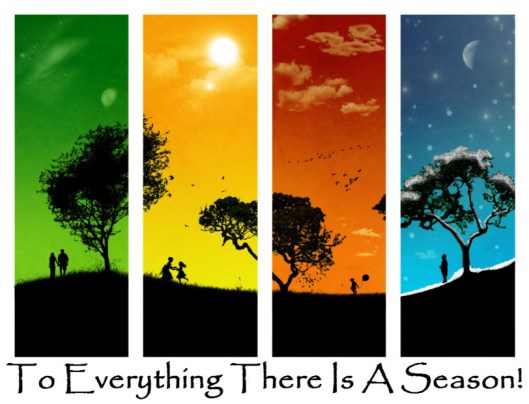
to-everything-there-is-a-season-orlando-espinosa

Photo credit:  https://orlandoespinosa.wordpress.com/2015/12/09/to-everything/

This weekend we got a new car and traded in my old car.  My old car was fifteen years old and had almost 180,000 miles.  We would have kept the car longer, but there were too many expensive fixes to make repairing the car worth the car’s value.  Normally, people get pretty excited about a new car – all the old dents and scratches are gone, and in my case, I can now be certain I won’t be break down on the highway.  But mostly I have been a bit sad about having to get rid of the old car.  That car helped us get through three rounds of graduate school, four moves, multiple jobs, the birth of two children, and was only six months younger than our marriage.  The car survived endless road trips, commutes to work, and at one point was our shared car until we got a second car.  Although the car had started making me anxious with all its repair needs, I felt like I was saying goodbye to a good, faithful friend.

As I have been reflecting on that experience, I have been thinking my experience with my old and new car is similar to how we all experience change.  Most of us know that change in inevitable, and yet most of us do not like change.  Even if the thing we are changing from is good for us, we miss the old quirks, patterns, and sense of regularity.  And the further out of the familiar we get, the more epic the memory of what once was becomes.  This is often the point at which people begin to refer to the “good ol’ days,” or “the way things used to be.”  Whatever the new change is will rarely seem as good as the old standard.

I have been feeling that way about my new car.  Sure, it is more reliable, it has fewer things peeling, sagging, or just broken, and it is more sporty, shiny, and colorful.  But I am finding I am not yet sold.  The new car just does not feel like it fits yet.  Observing my feelings about my car has been especially helpful for me as I think about all the times I have introduced change at church.  Sure, whatever changes I have introduced are usually for the good, and most often, become the new “way we have always done it.”  But falling in love with the new change takes time.  It does not happen overnight.

Perhaps this may be a good way we can approach our relationship with God.  The Holy Spirit is God’s agent of change.  She is always whispering new ideas, blowing new people into our lives, and breathing life into our imaginations.  Listening to the movement of the Holy Spirit is exciting, fun, and invigorating.  But boldly following the Holy Spirit also needs to involve tending to the grief of letting go of the what the Spirit was doing before.  The writer of Ecclesiastes says, “For everything there is a season, and a time for every matter under heaven.”  I wonder what seasons are passing away in your life, and what new times are arriving for you.  My prayer for you is that you be able to appreciate the season you are in, let go of the seasons that have passed, and embrace the seasons that are yet to come.  I know the Holy Spirit is doing good things in you.  I cannot wait to walk with you in the twists and turns!

Sermon – John 20.1-18, ED, YA, April 16, 2017

27 Thursday Apr 2017

Posted by jandrewsweckerly in Sermons, Uncategorized

≈ Leave a comment

Tags

affirmation, belonging, call, church, clarity, despair, Easter, Good Shepherd, grief, identity, Jesus, love, Mary, name, purpose, Sermon

Every generation has a baby name that is popular.  In my generation, that name was Jennifer.  As I was growing up, every grade had tons of Jennifers.  I became quite accustomed to the experience of eagerly looking up when someone called my name, only to be disappointed to see they were calling out to someone else.  The name was so common that by the time I got to college, I learned to ignore people calling out my name because more likely than not, they were not actually calling me.  They were calling one of the other twenty Jennifers nearby.  Although the practice helped me save face, the practice was a bit of a hindrance when someone actually was trying to get my attention.

The solution, of course, was a nickname – something to distinguish me from the sea of other Jennifers.  So in college, most of my buddies just started calling me “Andrews.”  It may sound silly, but having a name that was distinct, that when called, I knew I could answer, gave me a sense of belonging and identity.  When someone shouted, “Andrews” across the quad, I knew a friendly face would be looking for me when I raised my eyes.  Though seemingly simple, that nickname made me feel known, especially at a time when everyone is trying to figure out their new identity, where they belong, and who they will be.

I suspect that Mary was the common name in Jesus’ generation.  All we need to do is read through the New Testament to know that there are more Marys than we can count.  Sometimes I even have to look back when I come across a Mary to be sure I am thinking of the right one.  So when Jesus calls Mary Magdalene by name, I imagine there must have been some way she knows not only that this is Jesus, but also that he is talking to her.

Easter morning has been a rough morning for Mary.  She comes in the tomb before the first light of dawn has broken.  She is probably still a bit bleary eyed – that kind of haze one has in the days after a death of a beloved one.  She comes to halt before she gets all the way to the tomb though.  The stone that is supposed to be covering the tomb, protecting Jesus’ body, is gone.  Before even going in to assess the situation, Mary runs – runs hard to find the disciples, demanding that they get up and help her.  Two of them, the beloved disciple and Peter, sprint ahead of Mary.  She is too tired from her first run to keep up.  By the time she reaches the tomb, the two disciples are already stepping out of the tomb, Peter looking perplexed and the other disciple with an enigmatic smile.  And without so much as a word to her, they leave – just like they left Jesus on that fateful day.[i]  Mary, overcome with the memories of Jesus’ crucifixion and the continued emotion of this morning, breaks into tears.  When she finally checks inside the tomb herself, she not only sees two angels, she also has an encounter with a supposed gardener.  Frustrated by their insensitive questions, she exasperatedly asks the gardener to just tell her where the body is.

That is when the big news today happens.  The supposed gardener calls her by name.  Not the common name that everyone has.  The supposed gardener calls her by the name that only Jesus calls her.  The haze dissipates.  The tears halt.  The cloud of despair vanishes.  And she calls Jesus by the name that only a few call him, “Rabbouni!”  This is a tremendous moment in our text today.  In the flurry of running, and confusion, and questions, and tears, and despair, two people see each other crystal clearly.  Mary is called by her name – Jesus communicates to Mary that she is known, the she is beloved, that she has an identity and a purpose unique to her.  She is his sheep who knows and recognizes the voice of the shepherd – the Good Shepherd.[ii]  Her relief is palpable.  The return of her confidence is immediate.  Her sense of celebration is ready to explode!

When I was in high school, I had a summer where I attended both a short conference and then a long summer program.  Both were residential.  The conference was the Hugh O’Brian Youth Leadership conference, or HOBY for short.  I made a few fast friends, but was there just a few days.  A week or so later, I was off to a six-week residential program.  It was my first time staying away from home that long, and I was admittedly a bit nervous since no one else from my high school was going.  After I unloaded my bags, and was getting ready to say goodbye to my parents, someone behind my shouted, “Hey, HOBY!”  Without even looking at who it was, I knew I did not need to worry about belonging.  I was already known here.  I had a place here.  I could have a purpose for those six weeks.

We have all had those moments of clarity around identity, belonging, and purpose.  Whether we are returning to our home town after a long time away, whether we develop good friends at school or in a civic group, and whether that happens at a reunion, we all know the deep, profoundly affirming feeling that comes from being known.  For those of you with a church home, and especially for those of you who have found a home here at Hickory Neck, you most likely found that feeling here.  Perhaps the liturgy was what brought you a sense of identity – either the liturgy reminded you of a practice from your earlier life, or the liturgy offered something to you that you did not even know you were missing.  Perhaps a ministry at church brought you a sense of identity – those little sacred moments that come when you realize that you are actually really good at inspiring people to serve the world, making beautiful music, or teaching children about the love of God.  Or perhaps the community brought you a sense of identity – that first time when someone remembered your name or a part of your story, when someone came to you for expert advice, or when someone knew just by looking at you that you were hurting – and then offered to take you to lunch or coffee.  The church is a place where both Christ and the community call you by name.

Now I would love to tell you that the wonderfully affirming and life-giving feeling of being known is an end unto itself.  I would love to send you home on this beautiful Easter Day with simply a sense of love and affirmation.  And that is certainly part of the gift I am giving you today – to tell you that you can be known and loved here.  But something else happens to Mary at that tomb.  After that profound moment of affirmation, Jesus tells her to go and be a witness to the disciples.  Jesus always gives his beloved homework.  He is that teacher that even on a Friday will give you an assignment for the weekend!  But Mary does not see this as a burden.  Even though Jesus will not let her cling to him – cling to the way things used to be, Jesus’ affirmation this day propels her to go out and share the good news of the risen Lord with the disciples.  In this way, Jesus not only recognizes and honors her identity; Jesus also gives her purpose – a call.

That is your homework on this Easter Sunday.  I know you want to go eat those big Easter meals ,go find those Easter eggs, and find what Easter chocolate awaits at home.  But remember that while this place is a place that calls you by name and affirms your beautiful identity, this is also a place that commissions you to go out and share the good news.  That wonderful sense of affirmation is not for you to bottle up and keep for yourself.  That sense of affirmation is meant to embolden you to share that affirmation with others – to meet people where they are, to hear their stories, and to share how this day of resurrection, love, and affirmation is for them too.  In the same way that you have a vocation, a call on your life, you also are to affirm vocation and call in others.  So this week, as you bask in the warmth and beauty of this day, go out and share that good news with others.  Someone may be waiting for you to call them by name.  Amen.

[i] Richard B. Hays, “Do Not Cling to Me,” Christian Century, vol. 109, no. 10, March 18-25, 1992, 299.

[ii] Karoline M. Lewis, John:  Fortress Biblical Preaching Commentaries (Minneapolis:  Fortress Press, 2014), 241.

Sermon – John 9.1-41, I Samuel 16.1-13, L4, YA, March 26, 2017

29 Wednesday Mar 2017

Posted by jandrewsweckerly in Sermons, Uncategorized

≈ Leave a comment

Tags

blind man, fresh, God, grief, Jesus, Laetare Sunday, Lent, Mothering Sunday, Pharisees, refreshment, renewal, repentance, revelation, Rose Sunday, sabbath, Samuel, Saul, Sermon, spiritual journey, stuck, unstuck

In a lot of ways, Lent is about being stuck.  Many of us sit down before Lent and take stock of our lives, discerning where we are stuck, and commit to working on getting unstuck.  Some of us are not that organized, and only discover how stuck we are as we enter into the penitential season, letting the prayers, scriptural lessons, and liturgies work on us.  And some of us cannot even claim to have done that work.  We only discover when we are stuck when someone metaphorically or literally smacks us against the head and tells us to shake off whatever is getting in our way, and get back in the game.

Two characters in our scripture readings today are similarly stuck.  The first is Samuel.  If you remember, Samuel is the prophet who anoints the first king of Israel – Saul.  But eventually Saul falls out of grace with God, and although Samuel delivers God’s judgment, Samuel grieves.  We are not really sure why Samuel grieves – if Samuel was really rooting for Saul and is disappointed in Saul’s failure[i]; if Samuel is lost in Saul’s failure and is scared of what is to come for Israel; or if Samuel is worried about himself.  After all, Samuel was intimately involved in helping Israel find a king – something God did not want for Israel in the first place.  Regardless of the “Why?” of Samuel’s grief, we do know that God is unhappy with Samuel’s continued grief.  God clearly thinks Samuel is stuck in grief.  “How long will you grieve over Saul?  I have rejected him from being king of Israel.  Fill your horn with oil and set out…”

Samuel is not the only character in our scripture today who is stuck.  In John’s gospel, we find a blind man healed by Jesus on the Sabbath.  But Jesus’ actions are not the center of the story.  Twenty-six verses – or 63% of the text we heard –  is about the Pharisees being stuck in their own understanding of who, how, and when a person can heal another.  For twenty-six verses they try to figure out who Jesus is, confident that he must be a sinner if he is healing on the Sabbath.  They barrage both the formerly-blind man and his parents about the incident – bringing in the healed man twice.  The banter goes on and on and finally, the healed man says exasperatedly, “I do not know whether he is a sinner.  One thing I do know, that though I was blind, now I see.”

In both Samuel and the Pharisees, we see God’s people, God’s leaders even, so stuck in their spiritual journeys that they are unable to see the work of God among them.  In both cases, neither party is doing something wrong – grief is an appropriate response from Samuel.  Samuel has invested a lot in Saul and has tried to mentor him on the right path for years.  And if we are honest, there is probably a bit of self-pity in his grief, as God’s being done with Saul means Samuel is in for a rocky road, seditiously anointing another as king before Saul has abdicated or been removed from his seat of power.[ii]  Likewise, the Pharisees are dutifully following the law of the Lord.  They have been taught for generations to honor the Sabbath and keep it holy.  We even prayed those very words last week, when we prayed the Decalogue together.  The Pharisees’ confusion is about a man acting in contradiction to everything they have ever been taught.

I wonder how often we find ourselves similarly stuck in our journey with God.  I cannot tell you the number of times someone in the midst of grief or discernment has said to me, “But this is not what was supposed to happen!”  We never plan for divorces, unexpected deaths, layoffs, addictions, betrayals, or illness.  We cannot anticipate the ways that tragedy or surprising life-changes will shake us to the core and sometimes paralyze us into inaction.  Sometimes we do not even realize we are stuck.  We get so caught up in our way of coping with life or simply surviving, that we do not realize how we deafen ourselves to the voice of God, speaking new and fresh revelation to us.

The good news for us, and for Samuel and the Pharisees, is that there is room for redemption and repentance.  God finally speaks directly and plainly to Samuel.  When Samuel has wallowed enough in his grief, God basically says, “Enough.  You have had plenty of time to grieve.  You have work to do, so get up and go.”  God even has a plan for Samuel’s safety when he protests about that.  “No more excuses.  I have you covered.  Go.”  The healed man does a similar thing for the Pharisees.  As they barrage him with question after question, he finally slows down and says, “Argue all you want!  Your confusion does not change the fact that I was blind and now I see.  Deal with it!”  Of course, the Pharisees do not accept the invitation to repentance – to change their minds.  But the healed man gives them more than enough direction toward truth and change.

The same is true for us.  There are all kinds of opportunities for us to get unstuck this Lenten season.  Many of you have already told me how the change in our liturgical pattern was just enough of a change to unsettle and reorient your senses in our worship of God.  Our bible studies have offered multiple opportunities to review the saving acts of God in history.  Our ecumenical services have given us ample occasions to see and hear God in fresh ways – whether through a different preaching style, music that touches us in new ways, or liturgical differences that shake up our senses.  I know we had a long conversation at our house about why the wine was so different at the other churches!  And I suspect our Quiet Day this coming Saturday may just be what some of us need help us hear God saying, “Enough.  Get going!”

But even in this season of repentance, of orienting ourselves back to God, the church gives us a Sunday of renewal – what the Episcopal Church calls, “Rose Sunday,” “Mothering Sunday,” or in the Latin, “Laetare Sunday.”  On this fourth Sunday in Lent, we take a break.  Virgil Michel said about this Sunday, “A Christian Lent can never be entirely sad.  With the fourth Sunday the pent up spiritual joy in the true member of Christ bursts forth in anticipation of the Easter joy to come…This was the day when the catechumens were decked with roses and when roses were mutually exchanged.  Thence comes the custom of the rose vestment.”[iii]  Our custom on this Refreshment Sunday is to wear rose-colored clothes and eat simnel cake as a way of honoring this day of refreshment.  We all need those reminders to listen to God, to be more open to revelation, to get ourselves unstuck.  But we also need those days when we say as a community, “Getting unstuck is hard work.  That you are trying is blessing enough today.  Take in a breath of God’s sweet mercy, and fill up that horn of oil tomorrow.  There is time to get up and get going.”

So breathe in the refreshment today.  Take courage that you are in good company in your need for renewal and redirection – both in the person sitting near you today and in our biblical ancestors.  Honor this Sabbath that is meant for rest for your wearied souls.  Do all those things; because tomorrow, you will indeed need to recommit to that work of getting unstuck.  You will need to pick up that horn and go do the work God has given you to do.  You will need to work on your hearing and eyesight, as God sprinkles wisdom all around for you to see and hear.  But today, fully take this Sabbath.  The good news is God will empower you to do all those other things you need to do tomorrow.  Amen.

[i] Carol A. Newsom, “Exegetical Perspective,” Feasting on the Word, Yr. A, Vol. 2 (Louisville:  Westminster John Knox Press, 2010), 101.

[ii] Newsom, 101.

[iii] Virgil Michel, The Liturgy of the Church, quoted in A Lent Sourcebook:  The Forty Days, J. Robert Baker, Evelyn Kaehler, and Peter Mazar, ed. (Chicago:  Liturgical Training Publications, 1990), 51.

← Older posts
Newer posts →

Recent Posts

  • On Sharing the Love…
  • Sermon – Micah 6.1-8, Matthew 5.1-12, EP4, YA, January 30, 2026
  • On Justice, Kindness, Humility, and the Messy Middle…
  • Feast of the Rev. Dr. Martin Luther King, Jr., January 18, 2026
  • On Peace, Love, and Conduits…

Archives

  • February 2026
  • January 2026
  • December 2025
  • November 2025
  • October 2025
  • September 2025
  • August 2025
  • July 2025
  • June 2025
  • March 2025
  • February 2025
  • December 2024
  • November 2024
  • October 2024
  • September 2024
  • August 2024
  • July 2024
  • June 2024
  • May 2024
  • March 2024
  • February 2024
  • January 2024
  • December 2023
  • November 2023
  • October 2023
  • September 2023
  • August 2023
  • July 2023
  • June 2023
  • May 2023
  • March 2023
  • February 2023
  • January 2023
  • December 2022
  • November 2022
  • October 2022
  • June 2022
  • May 2022
  • January 2022
  • December 2021
  • November 2021
  • October 2021
  • September 2021
  • August 2021
  • June 2021
  • May 2021
  • April 2021
  • March 2021
  • February 2021
  • January 2021
  • December 2020
  • November 2020
  • October 2020
  • September 2020
  • August 2020
  • July 2020
  • June 2020
  • May 2020
  • April 2020
  • March 2020
  • February 2020
  • January 2020
  • December 2019
  • November 2019
  • October 2019
  • September 2019
  • August 2019
  • July 2019
  • June 2019
  • May 2019
  • April 2019
  • March 2019
  • February 2019
  • January 2019
  • December 2018
  • November 2018
  • October 2018
  • September 2018
  • August 2018
  • July 2018
  • June 2018
  • May 2018
  • April 2018
  • March 2018
  • February 2018
  • January 2018
  • December 2017
  • November 2017
  • October 2017
  • September 2017
  • August 2017
  • July 2017
  • June 2017
  • May 2017
  • April 2017
  • March 2017
  • February 2017
  • January 2017
  • December 2016
  • November 2016
  • October 2016
  • September 2016
  • August 2016
  • July 2016
  • June 2016
  • May 2016
  • April 2016
  • March 2016
  • February 2016
  • January 2016
  • December 2015
  • November 2015
  • October 2015
  • September 2015
  • August 2015
  • July 2015
  • June 2015
  • May 2015
  • April 2015
  • March 2015
  • February 2015
  • January 2015
  • December 2014
  • November 2014
  • October 2014
  • September 2014
  • August 2014
  • July 2014
  • June 2014
  • April 2014
  • March 2014
  • February 2014
  • January 2014
  • December 2013
  • November 2013
  • October 2013
  • September 2013
  • August 2013
  • July 2013
  • June 2013
  • May 2013
  • April 2013
  • March 2013
  • February 2013
  • January 2013
  • December 2012
  • November 2012
  • October 2012
  • September 2012

Categories

  • reflection
  • Sermons
  • Uncategorized

Meta

  • Create account
  • Log in
  • Entries feed
  • Comments feed
  • WordPress.com

Blog at WordPress.com.

  • Subscribe Subscribed
    • Seeking and Serving
    • Join 395 other subscribers
    • Already have a WordPress.com account? Log in now.
    • Seeking and Serving
    • Subscribe Subscribed
    • Sign up
    • Log in
    • Report this content
    • View site in Reader
    • Manage subscriptions
    • Collapse this bar
 

Loading Comments...