• About

Seeking and Serving

~ seek and serve Christ in all persons

Seeking and Serving

Tag Archives: growth

On Risking Failure and Facing Fear…

03 Wednesday Dec 2025

Posted by jandrewsweckerly in reflection

≈ Leave a comment

Tags

anxiety, challenge, failure, fear, God, growth, hesitant, Holy Spirit, invitations, Jesus, joy, new, risk, try, yes

Photo credit: https://stock.adobe.com/search?k=parachute+jump+plane

I was listening to a podcast this week that was talking about how, as they mature, adults have a harder time trying new things because they have a deeper understanding, and perhaps fear of, failure.  Children don’t have this same hesitancy.  They try new things, figure out what works and what doesn’t, and keep at it.  There is a freedom in their development that allows them not to hold back or be afraid, but to keep trying out new experiences and challenges.

As one of my daughters ages, she is heading into that in-between time where she doesn’t have the same innocent willingness to try and fail, and is starting to understand that failures or inadequacies are sometimes noticed by others negatively.  She is trying out a new extracurricular this fall, and hated the first session.  As we headed into the second session, she pulled out all the stops about why she shouldn’t have to go back:  she wasn’t good enough, people weren’t nice, she would bring down the group through her inexperience.  In a moment of weakness, I almost caved.  I know how big those feelings are.  I palpably remember the anxiety that kind of experience brings, and I wanted to protect her from that hurt. 

When she came out of the second practice, she was a different person.  She was smiling, had a lightness to her step, and a warmth about her.  “That was fun!” she said.  As I listened to her describe the session, I was overwhelmed with two realizations.  First, I realized how close I came to cutting off a growth experience – how she would have never had learned the feeling of what it means to push through fear and find joy.  And second, I realized I needed to take a long look at where I am cutting off growth experiences in my own life.  Masked with the label, “wisdom,” how often do I fail to risk?

I wonder what growth opportunities are being presented to you today.  It doesn’t have to be something big or dramatically different.  Part of creating an openness to growth means being open to the little invitations – talking to a stranger when that’s not something you would normally do, reaching out for support when you don’t like feeling dependent upon someone, saying yes to an invitation to something that is not at all in your comfort zone but you admittedly have never tried to know for sure.  Those yeses prepare us for the yeses the Holy Spirit desires in each of our lives.  Those invitations are often God’s quiet invitations into God’s joy.  Those experiences are often pathways to the incarnate Jesus in your life.  I can’t wait to hear what you say yes to this week!

Sermon – Acts 16.9-15, E6, YC, May 25, 2025

18 Wednesday Jun 2025

Posted by jandrewsweckerly in Sermons

≈ Leave a comment

Tags

Bible, church, Easter, evangelism, God, gratitude, growth, Jesus, Sermon, uncomfortable

Last week at the Rector’s Forum, I talked about the work of the Vestry since our Annual Meeting in January.  At the Vestry Retreat weeks after the Annual Meeting, the Vestry defined the “main thing” for Hickory Neck in the coming year:  growth.  Now the word growth is layered:  growth certainly means growth of resources, growth of membership, but especially spiritual growth of those in and around our community.  Out of that focus, the Vestry formulated five strategic initiatives, all rooted in best practices for healthy, growing parishes.  You will continue to hear about their work and efforts, and their labor is filled with a renewed sense of energy and vibrancy.

At the heart of Eastertide – these seven weeks after egg hunts, fancy clothes, and celebratory singing – is that very work: the growth of the church.  The resurrection is not a one-time stunning event, but the catalyst for the formation of the church.  In these weeks since Jesus’ resurrection, the disciples and apostles are doing the very work Hickory Neck is doing two thousand years later – growing the church (or as some more sassy followers of Jesus might say:  engaging in evangelism). 

What I appreciate about our lesson from Acts today is that the practice of church growth, of evangelism, in biblical times was not exactly precise.  You would think that the book of Acts would tell the story of how, after Jesus’ death, the disciples knew exactly how to spread the Good News.  You would think after all those years with Jesus, the disciples had clear instructions for moving forward, and were able to draw up a structured growth plan.  But our stories from Acts this year have included nothing of the sort.  So far, we have heard stories of a brutal persecutor of Christians being dramatically converted, of Peter realizing that Gentiles should also be included in the Christian community, and today we hear of this foreign woman of power coming to Christ.  I am pretty sure if the disciples sat down and planned their target audience for the Good News, Paul, Cornelius, and Lydia would not have been on their list.  And yet, this is the story of evangelism we hear during Eastertide: a story of unlikely and unexpected people hearing and responding to the word of God.

On the surface, this seems like good news.  These stories of conversion give a sense of confidence that no matter with whom we share the story of Jesus, they will be converted.  But looking at the end of the story glosses over the actual experiences of those on the evangelism journey.  If you remember, when Paul is converted, and his eyes are scaled over, the Christian who goes to talk with him is scared to death.  God tells him to go to Paul, but that is little assurance when that instruction means walking into the lair of a nasty murderer of Christians.  And for Peter, his interaction with Cornelius means that he must surrender all that has been familiar to him – the necessity of circumcision and all that he has known as being central markers of faithfulness – and let go of that familiarity.  Even with this interaction between Paul and Lydia today, Paul must take on a long journey based on a few words in a dream, only to find not a Macedonian man who is asking for help, but a foreign woman.[i]

These stories during Eastertide highlight our own anxieties about growing the church.  We might support the Vestry’s focus on growth, and we might be excited about their strategic initiatives.  And, we sort of hope that work is someone else’s work to do.  Before seminary, I was taking a Bible Study class that necessitated me doing some reading while traveling.  I don’t know if you have ever lugged around and read a Bible while traveling by plane, but doing so will lead to some very interesting experiences.  I had a slightly uncomfortable conversation with a young evangelical male who started telling me about his conservative views on scripture.  I had a businessman ask me if I was a minister or theology student.  When I told him no, he seemed bewildered as to why I would be reading the Bible, and kept eyeing me suspiciously the rest of that flight.  I had a middle-aged woman start telling me about her church and Bible Studies she had enjoyed.  And of course, there were tons of people who just stared at me warily trying to figure out what my angle was.  You would think the lesson from my trip would be, “Take a Bible with you, and see how you can grow the church.”  But to be honest, I found myself wanting to never carry a Bible with me again in an airport.

I think why we get so uncomfortable about church growth or evangelism is we imagine evangelism as knocking on the doors of strangers, presenting some uncomfortable script, and then having doors slammed in our faces.  But our lesson from Acts today shows us a different model.  Our lesson from Acts tells us is that yes, evangelism will entail going places that may be uncomfortable or interacting with people you would not expect.  Paul goes on a long journey expecting to meet a man and gets something quite different.  Lydia goes seeking a place to pray with her familiar girlfriends and hears something entirely new.  But evangelism is not just about the evangelizer and the evangelizee.  The other major actor is the Holy Spirit.  The text tells us that the Lord opened Lydia’s heart to listen eagerly to Paul.  Scholar Ronald Cole-Turner says evangelism is the intersection between human faithfulness and divine guidance.  “Paul would not have been guided to this place at this moment, were he not first of all at God’s disposal, open to being guided, sensitively attuned to being steered in one direction and away from all others.  Lydia would not have arrived at this place or time, had she not first of all been a worshiper of God, a seeker already on her way.  Peter does his part and Lydia hers, but it is God who guides all things and works in and through all things, not just for good but for what would otherwise be impossible.”[ii]

What is so liberating about this understanding of church growth is that even if we thought we had to or could do evangelism on our own, we realize today that our work of growth only happens with God.  David Gortner says, “Evangelism is a spiritual practice of expressing gratitude for God’s goodness and grace.”[iii]  That does not sound so bad, does it?  A spiritual practice of expressing gratitude for God’s goodness and grace.  He does not define evangelism as saving souls or self-righteously driving away your friends.  He says that evangelism is about expressing gratitude for God’s goodness and grace.  Knowing that definition of evangelism and knowing from scripture that evangelism happens as a partnership between our faithfulness and God’s guidance makes the whole enterprise seem a lot less scary. So, right now, I want you to take a deep breath, clear your mind, and then think about the best vacation you ever had.  Think about all the reasons why the vacation was wonderful and why you enjoyed yourself.  Think about the joy or peace that the vacation brought you and notice the warm smile starting to spread on your face.  Imagine the enthusiasm in your voice if you were to share that story with the person sitting next to you and the great conversation your sharing might evoke.  Now, take another deep breath, and then imagine the same full-body experience happening with a conversation about your faith journey.  Think about the great joy you have had in your relationship with God.  Think about the sense of meaning or peace you have at times found in God.  And now think about the broad smile on your face and the enthusiasm in your voice as you share that story with someone else and the incredible conversation your sharing might evoke.  That is all that happens between Paul and Lydia.  That is all that God invites you to do today.  Because the Holy Spir


[i] Eric Barreto, “Commentary on Acts 16:9-15,” May 9, 2010, as found at https://www.workingpreacher.org/commentaries/revised-common-lectionary/sixth-sunday-of-easter-3/commentary-on-acts-169-15-2 on May 22, 2025.

[ii] Ronald Cole-Turner, “Theological Perspective,” Feasting on the Word, Yr. C, Vol. 2 (Louisville: Westminster John Knox Press, 2009), 476

[iii] David Gortner, Transforming Evangelism (New York: Church Publishing, 2008), 29.

On Blooms of Hope…

13 Wednesday Nov 2024

Posted by jandrewsweckerly in reflection

≈ Leave a comment

Tags

blooms, comfort, generosity, God, good, goodness, growth, hope, plants, suffice, thriving

Photo credit: Jennifer Andrews-Weckerly; permission required for reuse

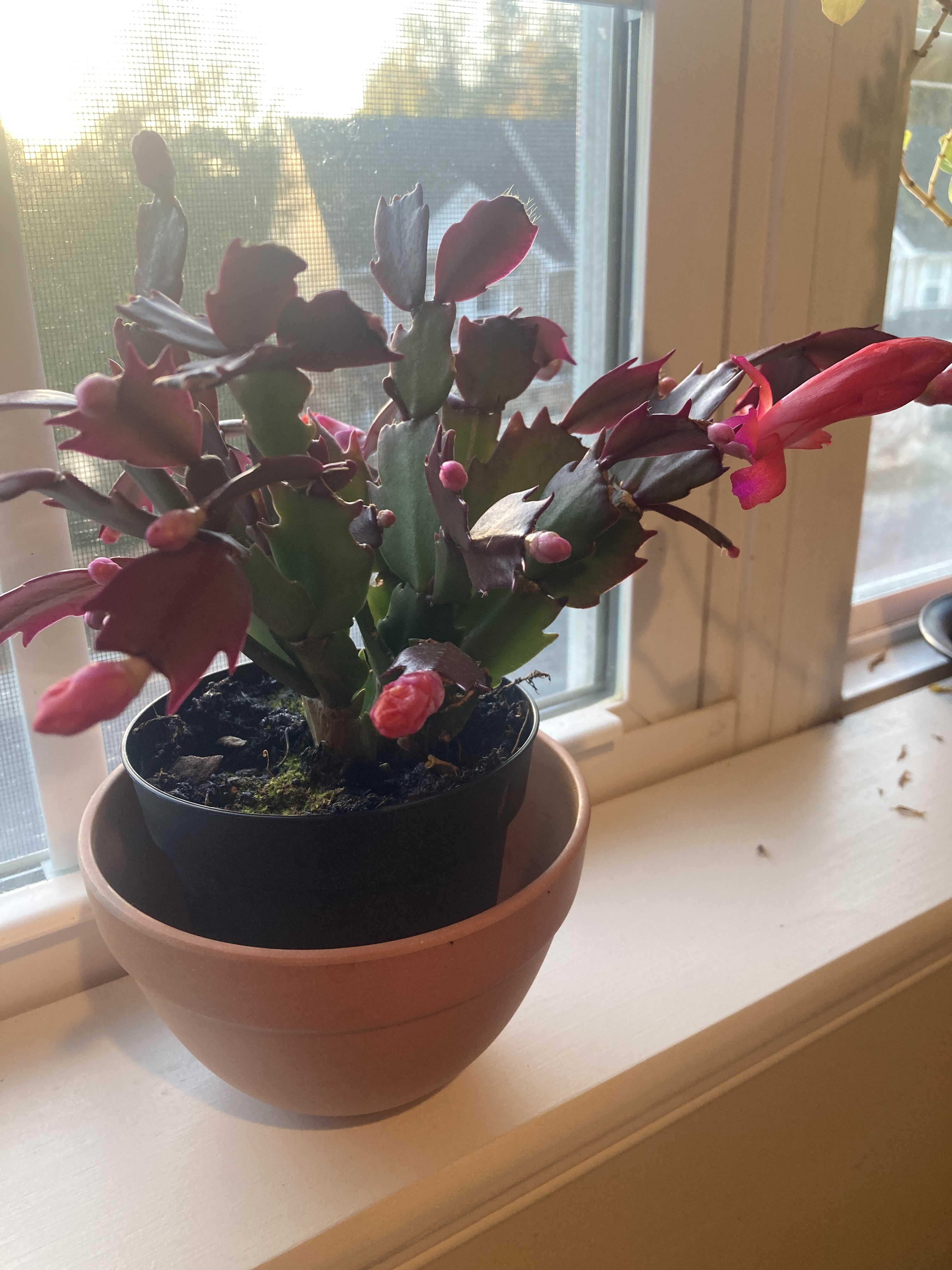
I have written before about how I am not good with plants.  If the term “brown thumb” was invented for anyone, it was likely me.  I have been known to even kill a cactus.  I am so resigned to this reality that when someone gifts me a potted plant, even one with blooms already on it, my immediate reaction is guilt about how short a life the plant can expect in my care.

So, imagine my surprise when a similar gift from last Christmas, a Christmas cactus, began blooming today.  I was so shocked, that I went online to learn about the plant’s blooming practices.  It was in this research that I learned I have been doing everything wrong.  The research says the plant should never be in direct light (it is sitting in the full blast of the sunrise every morning); it says you should only water the plant when the top two inches are dry (I am pretty sure I water it weekly no matter what); and it says the plant should be kept in a cool, humid space (nope, and nope).  So, despite all my mistakes, despite how this plant should likely be dead by now, here this cute plant is blooming for the first time. 

That plant has reminded me of two things today.  First, that plant has reminded me of the ways that God can work for good despite me.  I do not have the gifts, interest, or time to lovingly help plants thrive.  But God has taken my measly offerings – the occasional remembrance to water the plant without any recollection how long ago I watered it last, the guilt that has kept me from throwing the plant away before now, and the half-hearted attempt to at least give the plant sunlight – God has taken these offerings and transformed them not just to survival, but to thriving.  I am humbled by a God who can produce good despite me.

Two, I am also struck by the fact that this plant is just one tiny example of the small goodness that surrounds us all the time.  The last week has been a rough one, especially in a congregation and a community that is very “purple” politically.  Though we are quite civil with one another, emotions have been all over the spectrum and I have been struggling to see where the hope is.  But the truth is hope and goodness have been around me this whole time.  I certainly see hope in this plant who is thriving despite me – and looking quite beautiful, indeed.  I see hope in the ways people are caring for one another – asking how people are really doing, and finding ways to offer solidarity and comfort where possible.  And I see hope as parishioners increase their giving to the church in a time when budgets are stretched and prices are rising.  We could find counter arguments for all those instances – reasons to be wary or suspicious or doubtful.  Or we can choose to notice the blooms opening slowly all around us.  I am not entirely sure what God is doing these days, but I have to tell you, I feel confident that God is here, bringing us comfort and signs of hope.  And that will suffice for today.

Sermon – Mark 6.1-13, P9, YB, July 7, 2024

17 Wednesday Jul 2024

Posted by jandrewsweckerly in Sermons

≈ Leave a comment

Tags

change, control, Episcopal Church, fresh, God, growth, Holy Spirit, Jesus, lane, limit, movement, new, Philadelphia Eleven, Sermon, uncomfortable

I realized recently that one of things I often say when I am asked how my family is doing is to offer a halfhearted compliment, “Everyone is staying in their lane.”   I think I started adopting that minimum standard, “staying in your lane,” because I have learned over the years how little control I have as a parent.  I may not be able to control what things my kids are interested in, I may not be able to control how well they perform in school, and I may not be able to control how they handle interpersonal relationships.  But if each family member is “staying in their lane,” then that means I have at least controlled their meddling with one another, their active misbehavior, or their making a scene anywhere else. 

That is what seems to be bothering the folks in Jesus’ hometown of Nazareth – Jesus is not staying in his lane.  At the beginning, there seems to be a modicum of respect for what Jesus is teaching in the synagogue – they compliment the wisdom he seems to have gained and the healing acts he has performed.  But the compliments end there.  Then the questions begin.  Where did he get this wisdom?  Isn’t he the carpenter’s son?  Isn’t he the son of Mary – a question dripping with criticism, as you would usually only refer to someone’s parentage through the father, not the mother.[i]  In other words, the people of Jesus’ hometown are basically saying, “Stay in your lane, Jesus!”

Passages like this can be so tempting for us.  We read about Jesus’ hometown and think, “Those silly folks from Nazareth!  They cannot see what God is doing right in front of them!”  As if “those” people and finger pointing is what the gospel calls for.  But when we start wagging our fingers at “those” people, we forget one kernel of truth about scripture:  we are always “those” people.”  Anytime something someone does in scripture makes us uncomfortable or sanctimonious, scripture is speaking straight to “us” not “those people.”  So, the people of Nazareth aren’t the only ones telling Jesus to stay in his lane.  We tell that to Jesus all the time.  When the Holy Spirit is calling us try a new ministry that feels daunting, we are tempted to tell Jesus to stay in his lane and let us do things our way.  When Jesus puts people in our lives that push us out of our comfort zones, we grumble to Jesus to stay in his lane and stop sending us prophets – I mean, annoying people.  When we hear that still, quiet voice speaking truth to us in places we like to keep in a box, we cut Jesus some nasty side-eye and tell Jesus to stay in his lane.

But as scholar Debie Thomas says, “The call of the Gospel is not a call to stand still.  It is a call to choose movement over stasis, change over security, growth over decay.”[ii]  Just last Sunday, we started a movie series about changemakers.  Last week, the film was The Philadelphia Eleven, the story of the unsanctioned ordination of the first eleven women in the Episcopal Church.  The vitriol of the bishops, clergy, and lay people who were opposed to those women’s ordination was shocking to the ears.  From the clergy person who stated with confidence, “Women can be anything they want – except a priest in God’s holy church.”  From the woman who lamented the ways those women had violated what God calls women to be and do in the world.  To the bishops held a public, scathing trial of the three male bishops who dared to ordain the first eleven.  The Philadelphia Eleven had waited time after time for the Episcopal Church to change – to chose growth, change, and movement instead of decay, security, and stasis.  And when the church refused to let these women out of their lane, the stepped out of their lane anyway.

Scholar Thomas concludes, “The scandal of the Incarnation is precisely that Jesus doesn’t stay in his lane.  God doesn’t limit God’s self to our small and stingy notions of the sacred.  God exceeds, God abounds, God transgresses, God transcends.  The lowly carpenter reveals himself as Lord.  The guy with the tainted birth story offers us salvation.  The hometown prophet tells us truths we’d rather not hear… [Jesus] will call out to us, nevertheless, daring us always to see and experience him anew.”[iii]  Our invitation today is let Jesus out of his lane in our life:  to not hold his lane as sacred, and to open ourselves to the ways his transgression of lanes is helping us to experience Jesus in new and fresh ways.  Maybe we do that in weekly worship, opening ourselves through song, prayer, and scripture to fresh experiences of God.  Maybe we come to the film series or Bible study this summer to see where God is exceeding, abounding, transgressing, and transcending.  Or maybe we let go of whatever boundary we are holding here at Hickory Neck to see what happens when we ask Jesus to please cross out of his lane.  The promise for us is a fresh experience of Jesus in our own day, time, and place.  Amen.


[i] Efrain Agosto, “Exegetical Perspective,” Feasting on the Word, Year B, Vol. 3 (Louisville:  Westminster John Knox Press, 2009), 215.

[ii] Debie Thomas, “Hometown Prophets,” June 27, 2021, as found at https://www.journeywithjesus.net/essays/3058-hometown-prophets on July 5, 2024.

[iii] Thomas.

On Celebrating Life, Death, and Movies…

04 Wednesday Oct 2023

Posted by jandrewsweckerly in reflection

≈ Leave a comment

Tags

bless, celebration, change, community, death, end, Episcopal Church, eternal life, finality, grace, growth, Holy Spirit, Jesus, joy, life, ministry, movies, new, past

Photo credit: https://www.cnn.com/2023/09/28/tech/netflix-dvd-rental-movies-ending/index.html

Well, it finally happened.  Netflix’s DVD business closed last Friday.  Now I recognize that acknowledging I still received DVDs from Netflix may make me seem old-fashioned.  Even a contemporary exclaimed recently, “Do people even have the equipment to play DVDs anymore?!?”  I took a good ribbing, but the truth is I love movies, and Netflix’s DVD business allowed me to watch movies that were not available via streaming services.  I was constantly finding new gems, and still had over 100 movies in my queue that I hoped to watch some day.

For those of us old-timers still watching DVDs, the closing of Netflix’s DVD branch has been tinged with nostalgia and a tiny bit of grief.  Over the course of 18 years, I watched 667 films, each story sparking my imagination, eliciting pleasure, sorrow, excitement, indignation, laughter, and hope.  Obviously there will be other ways for me to revel in the artistry of filmmaking, but there is a certain finality to the closing of this chapter. 

Despite my wistfulness, I commend Netflix for the way they have handled this change.  Instead of wallowing in grief, or attempting to apologize for market changes beyond their control, instead, they have handled this “death” with grace and joy.  Knowing the closing was coming, this year they used their iconic mailing envelopes to feature celebratory artwork honoring how a whole generation has been shaped by their service.  On the week of their closure, the sent a “gift” to every member – a summary of the highlights of our membership – what movies we had watched each year, milestones in our membership, and even the list of movies in our queue in case we want to find another way to see them.  Instead of a death, it has felt like a celebration of life.

In a lot of ways, it has reminded me of the ways the Episcopal Church approaches death.  When someone we love passes, we use the burial office to celebrate life – certainly the life of the one who has died, but especially the promise of eternal life promised in Jesus Christ.  But I’ve been thinking about it over this last week, and the Church honors “mini-deaths” all the time:  the ending of a ministry that is no longer needed or effectively utilized, the retirement of a ministry leader after a successful tenure, or the blessing of a parishioner or staff member who moves away from the community.  All those transitions can be hard because they make us remember fondly the ways ministry blessed us in the past.  But those transitions are also often the source of new life:  a new ministry we could never have imagined five years ago, a new leader whose fresh ideas opens up new opportunities, and new members who shape and mold us into a new community.

I wonder what things feel like they are dying in your life right now – what things you thought would always be there are undergoing change.  Where might the Holy Spirit be inviting you to see new shoots of growth in the midst of something withering on the vine?  How might those “mini-deaths,” be tremendous gifts to you or your community?  How might we take a cue from Netflix, and find ways to celebrate those endings with dignity and joy?  I am grateful for the ways a secular business is helping me see the sacred in our own life cycles.  Let’s celebrate together!

Looking for Love…

22 Wednesday Jun 2016

Posted by jandrewsweckerly in Uncategorized

≈ 4 Comments

Tags

death, God, growth, hesed, love, loving kindness, marriage, plant

IMG_1797One of the things you may not know about me is that I am terrible with plants.  Though many people have a green thumb, I am a textbook example of a brown thumb.  My instincts and habits are terrible.  Either I water the plant too much or not enough.  I never know how much sun is enough.  I am lucky if a plant lasts more than a month in my house.  If I am really honest, most of my plants suffer from neglect.  I just get too busy and by the time I remember the plant, the plant is past the point of redemption.  One of my former parishioners was convinced she could convert me to a green thumb.  She even regularly put plants on our front porch – right near the water spigot.  I am sure she mourned many a plant on my behalf.

IMG_1794There is, however, one exception to this rule.  It was a plant given to us as a wedding present almost fifteen years ago.  Of course, when we received it, my immediate thought was, “Great!  There goes another plant in the trash!”  But much to my surprise, the plant was hearty.  No matter how long I forgot to water it, it managed to forgive me and perk back up when watered.  No matter how many new places I took it, it kept on going.  I jokingly started referring to the plant as our “love plant.”  It was a reminder of our special day, and like a loving marriage, it held together through thick and thin.

But during our most recent move, I pretty much killed our love plant.  I left the plant in the car.  It was not that warm in April, so I figured it would be okay there.  But I think our love plant just got scorched over the several-day move.  I had never seen the plant look like it did.  Normally the leaves naturally fell off when it was getting thirsty (my number one sign to water it!!).  But these leaves just shriveled and refused to fall or separate from the stem.  One stem seemed salvageable, but the other was totally gone – shriveled and dry.  I was devastated – not only for the plant that lasted almost 15 years with me, but also because of the significance the love plant had assumed.  What did its death mean?  Was it a sign about my marriage?!?IMG_1795

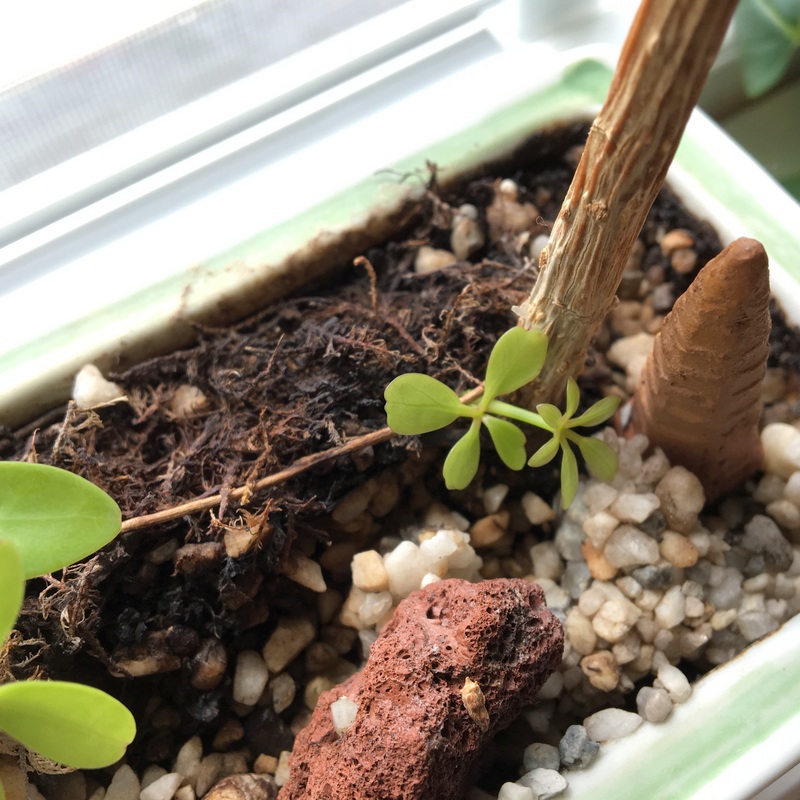
I refused to throw the plant away.  It just broke my heart too much.  So it sat on a window sill and I just let it be a sad reminder of my failure.  But then last week, something incredible happened.  At the bottom of the “barely alive” stem of the plant appeared new foliage.  I almost cried.  The plant has never gotten new foliage at the bottom – only at the top.  I don’t know what it means or if they will just fade too, but the joy I felt for those new little guys was overwhelming.  And then, today, I noticed some new foliage on the “dead” stem too. IMG_1796

I do not know if there is any real symbolism in the new growth, but I have to imagine there is.  My husband and I have started new jobs, our kids have begun new schools, and we have begun a new phase of our life.  Almost fifteen years later, love continues to find new ways to grow in our marriage, even on days when it feels like the love is dried up.  That kind of faithfulness is the same faithfulness we see in God’s hesed, or loving-kindness, for all of us.  Even when we feel like God’s love has abandoned us, we find new springs of life bubbling up where we least expect it.  Today, I encourage you to look for the new growth in your life.  Where is love sneaking in and gifting you with joy?

Sermon – Acts 16.9-15, E6, YC, May 1, 2016

06 Friday May 2016

Posted by jandrewsweckerly in Sermons, Uncategorized

≈ Leave a comment

Tags

blessing, change, church, community, conversation, evangelism, God, growth, hear, Holy Spirit, listen, new, Paul, prepare, Sermon, together, work

One of the things that the Search Committee, Vestry, and I all talked about during our time of discernment was church growth.  Now church growth is a loaded topic because inherent in the conversation are a lot of assumptions.  One assumption is that we can talk about church growth without talking about change.  Many churches say they want to grow, but what they mean is that they want to find fresh meat for volunteer positions and new pledgers for the budget.  But inherent in church growth are not just bodies to fill out needs:  church growth means incorporating new people who will have new ideas, new dreams, and new ways of doing things.  The second assumption when we talk about church growth is that we can go about church growth passively.  In other words, as long as we have a good website, we have good programs, a shiny new Rector, and we are nice to people once they arrive, we will grow.  While those things are important and necessary, those things do not fully address how we get people to step on our property, how we encourage people to come back after a first visit, or how we incorporate newcomers fully into the life and ministry of the church.  The final, and my personal favorite, assumption is that church growth is done by the Rector.  The Rector can certainly help lay the foundation of a strong system of invitation, welcome, and incorporation.  But the primary way that church growth happens is through Church members inviting others to church.

All that is to say that my response to the Search Committee and Vestry went a little like this:  I am more than happy to give Hickory Neck all of the infrastructure Hickory Neck needs to grow; but Hickory Neck is going to have to work, be open to change, and get real comfortable with talking about their faith in the neighborhood.  Now I know many of you may be sitting here right now, cursing the Search Committee and Vestry for signing you up for some hard, scary work ahead.  But let me let you in on a little secret:  church growth (or evangelism, if we are feeling really sassy) is not that hard or scary.  That is the great thing about the readings from the Acts of the Apostles during Eastertide:  they are all about the growth of the church.  Last week we heard about how Peter began to understand that God was calling him to share the Good News with the gentiles.  Today, we hear about how Paul is diverted to Europe to share the Good News with the people of Macedonia.

Many of us get a little uncomfortable talking about apostles spreading the Good News because the stories about Peter and Paul seem strange and foreign.  They involve dreams or visions in which God tells them what to do.  They involve going to foreign lands to talk with strangers.  And they sometimes involve, as we will hear next week, getting arrested and sent to jail.  Most of us hear these familiar stories and assume that the stories do not really apply to us because they are historical, ancient stories.  But after the drama of being diverted to a foreign land and searching for a place to join with sympathetic people, what happens to Paul in our text today is not actually all that foreign or unrelatable.  The story tells us that on the Sabbath day, Paul and his companions go find where faithful people are gathered and simply start talking.  The text does not say that Paul gives a presentation about the merits of converting to Christianity.  The text does not say that Paul leads a worship service, with music and the holy meal.  The text simply says that Paul sits down among those gathered, and starts talking.  While Paul is talking, a woman in the group, Lydia, who we understand from the text is an independent woman of wealth[i], overhears what Paul is saying and is so compelled by what Paul says that she and her household are not only baptized, but insist that Paul and his companions come stay with her during their stay in Philippi.

Soon after I became a rector for the first time, I realized I had a lot to learn about church growth.  I read books, poured through research, and talked with experts in the field.  One of my favorite conversations about church growth was with a friend who does church consulting on growth.  In her formation, she had a professor who insisted as part of her training that she needed to go out into town and just start talking to people about Jesus.  She was terrified.  For the first few weeks of class, my friend, now a priest, lied to her professor.  Each week he would ask her how the project was going, and she would tell him that the project was going well.  Finally, the professor called her bluff and insisted that she immediately go somewhere and do her assignment.  So my friend went to a coffee shop, wrote on a piece of paper, “Talk to me about Jesus and I will buy you a cup of coffee,” and then set up her laptop in the hopes that no one would take her up on the offer.  Much to her chagrin, a patron came up to her and said, “I’ll talk to you about Jesus, but I’ll buy the coffee.”  The conversation that ensued was full of the stranger’s story – about how she used to go to church, how she still believes, how the church hurt her, but how she still misses having a church community.  My friend listened to the story, honored the stranger by acknowledging how hard her journey had been, and then did the one thing that is key when talking about church growth.  My friend acknowledged where she saw the presence of God in this stranger’s journey.  And, for good measure, my friend told her that if she ever wanted to try church again, she knew a great place that might just work.

That is the funny thing about church growth.  Church growth happens through real people having real conversations in real time.  Paul sits down with a bunch of women and starts talking.  My friend sat down with a stranger and listened and reflected back on the stranger’s journey.  That is the same invitation that I will be giving us to do over and over again in my time here at Hickory Neck:  that we start having real conversations with real people in real time.  Now I know what some of you may be thinking.  First, you may be thinking, “I cannot believe the Search Committee and Vestry decided to hire this priest who is going to make me do this!”  Second, you may be thinking, “I have no idea how to have real conversations with real people in real time!  What does she expect me to do?  Start talking to strangers at the coffee shop, on the golf course, and at the Little League game?”

Before you get too anxious, I want to give you a little piece of comfort from scripture.  In Peter’s story last week, in Paul’s story today, and in the texts coming up next week and at Pentecost, we learn that all of these encounters happen with the Holy Spirit going before, making a way for the encounter to happen.  In today’s story, Paul has no intention of going to Macedonia.  In fact, in the verses we did not read today, Paul and his crew actually had plans and made attempts to go to other places, but their plans were thwarted by the Holy Spirit.  Finally, Paul has a vision that he was supposed to go to Macedonia.[ii]  Once he and the group decide to follow that vision, everything becomes smooth.  Their travel is not thwarted, they easily find their way to Philippi, they stumble onto a group of women who are believers, and out of nowhere, just through conversations about faith, Lydia steps up and not only desires baptism, she demands that Paul and his company accept her hospitality.  That is the reality about growth:  yes, growth involves putting ourselves out there to have hard conversations, and yes, growth involves being vulnerable and uncomfortable, and yes, growth will even involve change to us personally and to our community as a whole.  But God shows us through the story of scripture, that the Holy Spirit is ever before us, making the way smooth.  When our intentions are simply to share our story, to listen to the stories of others, and to honor the ways in which God is already active and blessing us, then the rest flows smoothly.

We are probably going to be talking about church growth a lot in the years to come.  We will talk about how to grow, we will make changes that will create a strong foundation for invitation, welcome, and incorporation, and we will get out there and talk to our neighbors.  But at the heart of all that work is the promise that the Holy Spirit is ever before us, making the way smooth, calming our nerves so that God can work in spite of us, and showing us how our holy conversations will be a source of blessing to us as much as those conversations are a blessing to others.[iii]  We will do this work together:  you, me, and the Holy Spirit.  The work will be hard, scary, and beautiful.  The work will be a blessing to us all and allow us to be a blessing to this community.  We can do this work together, because the Holy Spirit goes before us.  Amen.

[i] David G. Forney, “Pastoral Perspective,” Feasting on the Word, Year C, Vol. 2 (Louisville:  Westminster John Knox Press, 2009), 476.

[ii] Brian Peterson, “Commentary on Acts 16:9-15,” May 5, 2013, as found at http://www.workingpreacher.org/preaching.aspx?commentary_id=1627 on April 27, 2016.

[iii] Peterson.

On Being the Church…

08 Wednesday Jul 2015

Posted by jandrewsweckerly in Uncategorized

≈ Leave a comment

Tags

baptism, church, decline, Episcopal, growth, Jesus, responsibility

Over the course of the last year, I have read countless articles about the state of our struggling Church.  The struggle is not just an Episcopal one, but is common across most denominations.  There are all sorts of theories about why it is happening and who or what is to blame.  I myself have pondered these theories in my heart, as I wonder what ministry will look like twenty years from now.  But in all the finger-pointing and discussion about what is causing our attrition, I stumbled on this prayer last week in a blog entry by David Lose:

L: Let us pray together.
C: Your church is composed of people like me.
I help make it what it is.
It will be friendly, if I am.
Its pews will be filled, if I help fill them.
It will do great work, if I work.
It will make generous gifts to many causes, if I am a generous giver.
It will bring other people into its worship and fellowship, if I invite and bring them.
It will be a church where people grow in faith and serve you, if I am open to such growth and service.
Therefore, with your help Lord, we shall dedicate ourselves to the task of being all the things you want your church to be.  Amen.[i]

What I loved about this prayer is that it took the argument about church decline and made it personal.  No longer was the issue one that “the Church” was facing, but one that I am personally facing.  There is no mysterious formula that will solve this problem.  The issue is me – about how I make the Church the place the Church is meant to be – the place God longs for her to be.  I cannot count on people simply having an inspired desire to come to Church.  I need to share my story.  I need to get my hands dirty being Church.  I need to stop hiding my love of Jesus and start living as one who is loved by that same Jesus.

Photo credit:  http://www.cfi-hq.org/2015/04/

Photo credit: http://www.cfi-hq.org/2015/04/

Our church just had two baptism Sundays in a row.  In those services we made some tremendous promises – to seek and serve Christ, to share the good news, to strive for justice and peace, and to be present in the life and work of the church.  That all sounds like a lot of work.  But the truth is that the work is not onerous when done in community.  The work is not onerous when we look into the eyes of infants and confidently welcome them into the community of faith.  The work is not onerous when it gives us great joy.  Over the next few weeks, I invite you to pray this prayer everyday.  Pay attention to whether its words create some shifting in you.  Linger in the parts that seem the most uncomfortable.  And then keep inviting the Spirit of the Living God to fall afresh on you.

[i] The prayer was not written by David Lose, but one he stumbled upon in a church in Wisconsin.  The full citation can be found at https://www.workingpreacher.org/craft.aspx?post=1620.

Sermon – Matthew 25.1-13, P27, YA, November 9, 2014

12 Wednesday Nov 2014

Posted by jandrewsweckerly in Uncategorized

≈ Leave a comment

Tags

abundance, choice, choices matter, forgive, God, growth, life, rigidity, scarcity, Sermon, trust, unforgiving

I am fortunate in that I do not have a long commute to work.  But there have been a few times when I have needed to take the Long Island Railroad during morning rush hour.  What I found fascinating about those trips is how people use their time on the train.  Most people are on their phones, probably doing any number of things:  scanning email, sending a few quick texts, checking Facebook, reading the news.  Some people are reading the paper:  catching up on the headlines, reading the sports page, or checking the financial reports.  Others use their hour on the train to catch up on sleep.  That one always scares me – how people sleep lightly enough not to miss their stop is beyond me.  And I suppose there are a few people like me, who enjoy the people watching.  But those are rarely the morning regulars – they got over that fascination a long time ago and chose some other way to spend their time.

We make choices every day:  how we spend our money, what we will do with free evenings, what groups we want to be involved in, and with whom we want to spend our time.  What we do while commuting is just one example of the myriad choices available to us on a given day.  But over time, those choices begin to shape who we are.  Those choices begin to define whether we are an avid reader, someone who is connected to the goings-on of the world, someone who is physically fit, or someone who is known for their volunteer work.  What seem like inconsequential decisions, like regularly watching a TV show, a standing appointment with a friend for dinner, or joining a civic group, slowly begin to shape a life.  Those little choices we make day in and day out shape who we are and what our life is really about.  In my line of work, I go to a lot of funerals, and that is one of the consistent things I see:  the choices a person makes over time informs who they are.  So in a eulogy, someone is described a devoted mother, or an avid sailor, or an advocate for the poor.

Our gospel lesson today is all about how our choices matter.[i]  The most obvious choice we see is the choice by the foolish bridesmaids not to bring extra oil.  Actually, the foolish bridesmaids make two choices.  First, they choose not to bring extra oil, perhaps assuming the groom will not be long.  Second, once they realize they are out of oil and the others are not going to share, they choose to go buy more.  Neither of their choices is illogical really.  Based on the customs of the time, the maids should not have needed extra oil.[ii]  Their choice not to bring extra oil is a perhaps presumptuous, but not scandalous.  The second choice is reactionary.  The wise bridesmaids tell them to go and they do – in the middle of the night, the foolish maids make an impetuous decision that ends up costing them greatly.  The foolish maids’ choices create a world fraught with risk – where split-second decisions leave the maids with little footing in a world that is constantly throwing choices at them

But the foolish bridesmaids are not the only ones making choices in our parable today.  The wise ones make choices too.  When faced with the needs of the oil-less bridesmaids, the wise bridesmaids send the foolish ones away to get their own oil.  They do not consider sharing their oil or allowing the foolish ones to stand with them.  Quite frankly, they should not have to share.  They have thoughtfully constructed a world in which careful planning and preparation pay off in great rewards.  Their choices have lead to a world in which everyone fends for themselves, where pity is not necessary, and boundaries are clear and concise.

And of course, the bridegroom makes a choice too.  When the foolish bridesmaids knock at the door, the groom has a choice:  he can justifiably send them away since they were not considerate enough to be ready and waiting for him; or he can be forgiving and graciously allow them into the celebration.  The choice of the groom to close the door leads to a world in which mistakes are severely punished and there are no second chances.

This parable is one of those parables that does not leave us feeling good about the world.  In fact, the choices of the characters in the parable depict a world that is marked by rigidity, scarcity, and lacking in forgiveness.  We know this world all too well.  All we have to do is listen to the current debate in the United States about immigration.  Whenever we debate the issue of what to do with illegal immigrants, the arguments are similarly marked by rigidity, scarcity, and a lack of forgiveness.  We worry about the drain on our resources with illegal immigrants – the health care, education, and social services needed for them.  We worry about the jobs they will be taking from legal citizens.  And we worry about our capacity for compassion – I have heard many argue that we cannot save every child in the world by welcoming them here.  All of those fears are valid.  And so we draw boundaries, we put up limits, and we say no.  We make choices that shape our experience as Americans.  And like the bridesmaids with extra oil, our decisions could probably be labeled as wise.

Although that wisdom is usually praiseworthy, and is clearly praised in our lesson today, for some reason, that wisdom does not sit well with me this week.  Instead, I have found myself wondering what other choices the three characters in this story could have made. [iii]  The foolish bridesmaids could have simply chosen to stay.  Sure, they would have had to risk being in the dark for a while, and leaning into the light of others.  They may even have had to plead their case with the groom once he arrived.  But at least they would have been there.  They could have stayed.  Staying would have been scary and made them vulnerable.  But they could have chosen to stay.  Meanwhile, the wise bridesmaids could have chosen to either share their oil, or stand side-by-side with the foolish ones, letting their light shine the way for both of them.  Sure, they were within their right to refuse.  They are the ones who thought ahead and did the right thing.  But they could have chosen another way.  They could have chosen to share their abundance with the foolish.  The bridegroom had a choice too.  The groom had every right to refuse entry to the foolish maids – based on what he knew, they were late and unprepared.  He had no obligation to let in people to his celebration who do not care enough about him to be prepared to wait for him.  But the groom could have chosen to let them in anyway.  He could have chosen gracious hospitality, even to the undeserving maids.

I recently had a conversation with another parent about creating healthy eating habits for children.  She was explaining to me a philosophy in which parents let children guide their own eating choices.  So instead of serving children the healthy food first and then bringing out the dessert, the parent is to put everything out on the table and allow the child to serve themselves.  The argument is that through experience, the child will eventually learn that loading up a plate with dessert leaves the child unsatisfied, if not sick.  Over time, the child will learn what foods make her feel good, what portions she needs to feel full, and how to plan her plate accordingly.  Truthfully the idea sounded crazy to me – like some hippy, permissive parenting that would lead to malnourished, unruly children and wasted healthy food.  But then again, I tend to choose a world guided by structure and order imposed from an authority.  This parent was suggesting a different kind of world guided by trust, that makes room for growth through mistakes, and that leads by example.

That is the funny thing about choices.  Our choices shape our world.  Most people read today’s gospel and think:  Okay, the moral of the story is to choose preparedness and alertness and when Jesus returns, we will be ready.  But instead, the moral of this story might be that the choices that we make shape our world – and our choices may not be as obvious as we think.  So yes, we can choose to live lives with strict boundaries and rules, lives that are guarded and have limits, and lives that are grounded in consequences.  We can also choose to live lives that are grounded in forgiveness, that make room for mistakes, and that make us uncomfortable, but also make room for joy.  Sometimes those choices will be obvious: when we actively decide to forgive someone who has wronged us or when we purposefully decide to share our resources even though the other does not deserve our generosity.  But sometimes the choices will not be so obvious:  when we commit to a new ministry, even if we are not sure where that ministry will take us or what that ministry will demand of us; when we choose to give up some of our disposable income to support the work of this church, even if we are not sure we can spare the money; or when we give up some of our family’s outside commitments so that we can be more present in the life and work of the church.  Those choices demand sacrifice, vulnerability, and work.  But those choices might also be the choices that make someone say at our funeral, “He loved the Lord, he loved the church, and he boldly lived a life of trust and abundance.  And look where his life led.”  Amen.

[i] Anthony B. Robinson, “Choices that Matter,” Christian Century, vol. 110, no. 29, October 20, 1993, 1011.

[ii] John M. Buchanan, “Pastoral Perspective,” Feasting on the Word, Year A, Vol. 4 (Louisville: Westminster John Knox Press, 2011), 286.

[iii] David R. Henson, “The Breaking of the Bridesmaids: Rethinking a Problematic Parable” as found at http://www.patheos.com/blogs/davidhenson/2014/11/the-breaking-of-the-bridesmaids-how-scripture-undermines-a-parable/ as posted on November 3, 2014.


Recent Posts

  • On the Myth and Magic of Advent…
  • On Risking Failure and Facing Fear…
  • Sermon – Luke 23.33-43, P29, YC, November 23, 2025
  • On Inhabiting Gratitude…
  • Sermon – Luke 20.27-38, P27, YC, November 9, 2025

Archives

  • December 2025
  • November 2025
  • October 2025
  • September 2025
  • August 2025
  • July 2025
  • June 2025
  • March 2025
  • February 2025
  • December 2024
  • November 2024
  • October 2024
  • September 2024
  • August 2024
  • July 2024
  • June 2024
  • May 2024
  • March 2024
  • February 2024
  • January 2024
  • December 2023
  • November 2023
  • October 2023
  • September 2023
  • August 2023
  • July 2023
  • June 2023
  • May 2023
  • March 2023
  • February 2023
  • January 2023
  • December 2022
  • November 2022
  • October 2022
  • June 2022
  • May 2022
  • January 2022
  • December 2021
  • November 2021
  • October 2021
  • September 2021
  • August 2021
  • June 2021
  • May 2021
  • April 2021
  • March 2021
  • February 2021
  • January 2021
  • December 2020
  • November 2020
  • October 2020
  • September 2020
  • August 2020
  • July 2020
  • June 2020
  • May 2020
  • April 2020
  • March 2020
  • February 2020
  • January 2020
  • December 2019
  • November 2019
  • October 2019
  • September 2019
  • August 2019
  • July 2019
  • June 2019
  • May 2019
  • April 2019
  • March 2019
  • February 2019
  • January 2019
  • December 2018
  • November 2018
  • October 2018
  • September 2018
  • August 2018
  • July 2018
  • June 2018
  • May 2018
  • April 2018
  • March 2018
  • February 2018
  • January 2018
  • December 2017
  • November 2017
  • October 2017
  • September 2017
  • August 2017
  • July 2017
  • June 2017
  • May 2017
  • April 2017
  • March 2017
  • February 2017
  • January 2017
  • December 2016
  • November 2016
  • October 2016
  • September 2016
  • August 2016
  • July 2016
  • June 2016
  • May 2016
  • April 2016
  • March 2016
  • February 2016
  • January 2016
  • December 2015
  • November 2015
  • October 2015
  • September 2015
  • August 2015
  • July 2015
  • June 2015
  • May 2015
  • April 2015
  • March 2015
  • February 2015
  • January 2015
  • December 2014
  • November 2014
  • October 2014
  • September 2014
  • August 2014
  • July 2014
  • June 2014
  • April 2014
  • March 2014
  • February 2014
  • January 2014
  • December 2013
  • November 2013
  • October 2013
  • September 2013
  • August 2013
  • July 2013
  • June 2013
  • May 2013
  • April 2013
  • March 2013
  • February 2013
  • January 2013
  • December 2012
  • November 2012
  • October 2012
  • September 2012

Categories

  • reflection
  • Sermons
  • Uncategorized

Meta

  • Create account
  • Log in
  • Entries feed
  • Comments feed
  • WordPress.com

Blog at WordPress.com.

  • Subscribe Subscribed
    • Seeking and Serving
    • Join 394 other subscribers
    • Already have a WordPress.com account? Log in now.
    • Seeking and Serving
    • Subscribe Subscribed
    • Sign up
    • Log in
    • Report this content
    • View site in Reader
    • Manage subscriptions
    • Collapse this bar
 

Loading Comments...