• About

Seeking and Serving

~ seek and serve Christ in all persons

Seeking and Serving

Tag Archives: history

Sermon – Exodus 32.7-14, P19, YC, September 14, 2025

24 Wednesday Sep 2025

Posted by jandrewsweckerly in Sermons

≈ Leave a comment

Tags

change, changelessness, God, history, idol, journey, love, Moses, relationship, Sermon

This week Hickory Neck hosted a group from St. Luke’s Episcopal Church in Powatan.  The group has been touring historic churches, gleaning lessons from each church’s stories, and asked if they could come do the same with us.  I told Hickory Neck’s story – from a newly constructed country church, to the act of siding with the British and closing altogether after the Revolutionary Way, to being a school for generations of children, to being a hospital for physical healing, to being ransacked by militias in multiple wars – where even the pulpit was used as firewood, to finally hosting a worshiping community just over 100 years ago, to now, being situated on 12 times the amount of property we originally had, hosting three buildings and a vibrant community of faith.

As I fielded questions from the group, I reflected on how as I have prayed in those wooden pews, as I have brushed my hand over those bricks with initials carved in them, and as I have stepped over a tombstone every time I enter that historic building, I find myself wondering about the stories of countless souls who have graced that building.  I know the more recent stories – of children in window wells, and people crowded around the altar for seating, and even of decisions like the one to build a new chapel so we have room to grow.  But I wonder about the stories of those who first opened the church who awaited who might show up that first Sunday of business.  I wonder about the grief experienced by those who watched their worship space become something else – or for those kids who grew up to tell tales like “when I was young, that didn’t used to be a church…”  I wonder about those who, for over 60 years never imagined anything for Hickory Neck other than being a little family-sized church, to those who worried a new building would mean the loss of intimacy the historic church provided.

As I pondered those various voices, imagined the myriad emotions of almost three hundred years experienced on this property, contemplated how those histories impacted spiritual relationships with God, I could not help but recall another group of followers of God – the Hebrews we read about in our lesson from Exodus today.  Those folks had been on a long journey too.  Their ancestor Abraham had journeyed to a foreign land and been promised countless descendants.  After his own dramatic journey, his descendants ended up in Egypt to escape a time of famine.  The rescuing by his son Joseph evolved into slavery under a new pharaoh.  After deaths and suffering, a reluctant prophet, Moses was sent.  Then came plagues, a mass exodus, a chase that led to drowning of the enemy, and a long journey in the wilderness.  But despite centuries of God’s faithfulness, the people lose their hope again and cling to something tangible – an idol – to soothe their anxiety. 

Now the part of that story we get today is interesting – I mean, who doesn’t have questions about the idea of God changing God’s mind, of God being so enraged by the infidelity of God’s people that God would destroy them entirely, of Moses slyly arguing with God, reminding God of how appearances matter (Does God want the Egyptians to see God destroy the very people God liberated?), of how God’s action of rage would negate the promise God made to Abraham, of whose people the Hebrews are (with God and Moses sounding like two arguing parents – your people have sinned…I think you mean your people with whom you made a covenant!). 

But what is more interesting to me is the greater arc.  Reading Genesis and Exodus is like reading a soap opera.  Journeys and betrayals, covenants and falls from grace, destruction and rebuilding, promises made and promises broken.  In the greater arc of that saga is a truth:  God’s faithfulness.  Over and over and over again, God’s faithfulness wins the day.  Theologians have read this passage from Exodus, and become anxious about the implications of a God that can change God’s mind.  If God’s mind can change, does that somehow make what we know about God inconsistent?  Danish Christian philosopher Søren Kierkegaard addresses this very issue.  Kierkegaard describes God as, “You Changeless One … You who are changeless in love, who just for our own good do not let yourself change.”[i]  In other words, “To say that God can be changed is not to suggest that God’s love for the world can be changed, but simply to say that there is no part of the world, no matter how meaningless to us, that is not of importance to God.”[ii]

As I think about the chaos of these days – of the unchecked shootings of children, political activists, and everyday people doing everyday things; of the demonizing of anyone who does not think like we do; of the disregard for the dignity of other human beings – I can empathize with a sinful people who would make an idol to have some tangible sense of comfort.  But this week, as I thought about the soap opera of our ancestors in Genesis and Exodus, and as I imagined the varied journey of our ancestors at Hickory Neck, I found myself overwhelmed with the faithfulness of our God – of the Changeless One who is changeless in love.    

I do not know what part of the world’s chaos is tugging at your anxiety or your temptation to craft an idol – perhaps an idol of money, power, popularity, and fame.[iii]  Whatever that force that is tugging at you, pastor Catherine Young reminds us that the interaction between Moses and God today is an invitation to remember that, “We can converse – even argue – with God.  The irony-filled dialogue between Moses and God shows that God has a sense of humor and appreciates ours.  More than our piety, God wants our honesty and candor.  God calls us to talk, listen, wrestle with our emotions, and be honest about our problems.  Those direct interactions change us…and sometimes they even change the mind of God!”[iv]  What they do not change though is God’s changelessness – God’s changeless love for God’s people in ancient days, in American history, and in our own day.  You Changeless One … You who are changeless in love, who just for our own good do not let yourself change.  Amen.


[i] Søren Kierkegaard “The Changelessness of God,” found in the collection of Kierkegaard writings, The Moment and Late Writings, eds. Howard V. Hong and Edna H. Hong, Princeton University Press, 1998, p. 268.

[ii] Michael Fitzpatrick, “The Lord’s Mind was Changed,” September 4, 2022, as found at https://journeywithjesus.net/essays/3442-the-lord-s-mind-was-changed on September 12, 2025.

[iii] Catherine E. Young, “Pastoral Perspective,” Feasting on the Word, Yr. C, Supplemental Essays (Louisville:  Westminster John Knox Press, 2010), 3.

[iv] Young, 5.
On Looking Back to Look Forward…

20 Friday Oct 2023

Posted by jandrewsweckerly in reflection

≈ Leave a comment

Tags

church, Episcopal Church, formation, God, gospel, history, impact, seminary, stewardship

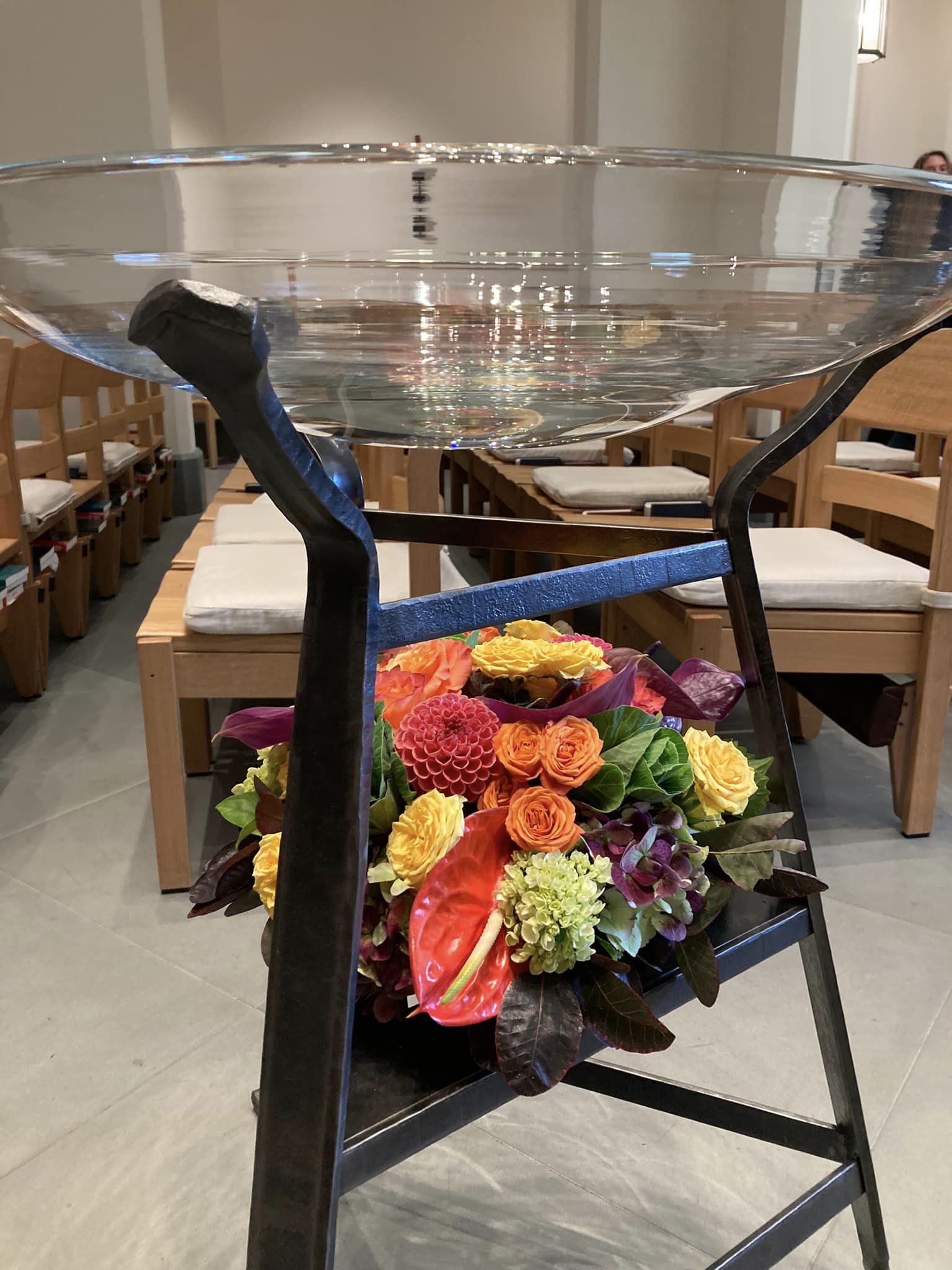
Font at Virginia Theological Seminary

I remember when I was a seminarian, sitting in daily worship, my eyes and mind would sometimes wander.  In particular, I was fascinated by the names or other small mementos carved into the old pews.  I always wondered who the mystery person was who left their mark, how long ago they carved it, and how they managed not to get caught.  What I loved about those small little marks was how they made me feel connected – connected to a long line of priests and lay leaders shaped by the seminary, all with varying gifts and talents, serving God in God’s church around the world.

Last week, my seminary honored 200 years of forming priests in the Episcopal Church.  Though those pews from the old chapel were lost in a fire, what struck me was the massive changes the seminary has seen.  From slaves who helped build and then worked on the property, wars that shaped the context for ministry dramatically for generations, fiduciary decisions that impacted the viability and structure of the seminary, the growing diversity of the student body as the Episcopal Church’s understanding of who can be called to ministry has expanded, and an evolving physical plant that has shifted what the school on the holy hill looks like – all of that change has made for a rich and layered history, of which I am a small part. 

But perhaps what speaks to me most about Virginia Theological Seminary is the ways that it also has a microcosmic impact on the church – namely, the ministry of every graduate from the seminary.  My time at VTS shaped and formed me into the priest I am today – from academic formation to liturgical formation, from learnings on leadership to the development of relationships, from shaping my spirituality to shaping my sense of the wider church.  And for every graduate like me, VTS has shaped thousands of others who go out into the world to preach the gospel.  That reality is what inspires my financial support every year – knowing the future generations I can support.

As my church journeys into stewardship season, a time of discernment about how we will support our church financially and with our time, I am reminded of how we all come to think about the stewardship of our resources.  Supporting my seminary and my church financially are ways I say to those institutions and my community that these institutions are important to me:  they have made an impact in my life, and have inspired me to make an impact on the them.  I would not be the priest, mother, or wife that I am without either my seminary or Hickory Neck Church.  What about you?  How has our church shaped your life?  What stories are the stories that make you eager to be a part of financially supporting ministries of impact?  I can’t wait to hear what inspires your giving!

Sermon – Genesis 7.1-5, 11-18, 8.6-18, 9.8-13, UJCCM Lenten Series, March 9, 2022

25 Wednesday May 2022

Posted by jandrewsweckerly in Sermons

≈ Leave a comment

Tags

ark, ecumenical, flood, God, history, judgment, Lent, Noah, pandemic, relationships, salvation, salvation narrative, saving, Sermon, transforming

This Lent, we as an ecumenical body in Upper James City County are retelling the “salvation narrative” – or at least that is the fancy phrase we use to describe the body of stories that show us time and again God’s saving deeds in history, and how those stories inform how we understand what will happen on Easter Sunday – how the life, death, and resurrection of Jesus will bring the fullness of redemption.  We started last week with the story of creation – the ways in which God lovingly called the created order good and made us in God’s image.  Tonight, we shift to another of the legendary stories – the story of the flood.

This is a story we know and love:  we use Noah’s ark as artwork in babies’ nurseries, I have Noah’s ark in the form of Christmas ornaments, we even sing songs about how God told Noah to build an “ark-y, ark-y” made of “bark-y, bark-y.”  I think we love this story so much because of the good news at the end.  But before we get to the end, we have to wade through a whole lot of a horrible beginning and middle.  You see, despite the goodness of creation, of the ways in which we were made in God’s image, we humans fall into sinfulness.  We do not hear much of that part of the story tonight.  Despite all the verses we did hear, what we do not hear is how horribly sinful humanity has become in Noah’s time.  This sinfulness grieves God so very much that God set God’s mind to do a terrible, awful thing[i].  Those waters out of which God formed the earth – those waters that God used a dome to separate – separate the waters from the waters, God uses to destroy the beautiful creation God has made.  God removes the dome, and the waters came down from the skies and the waters rise up from the ground.[ii] 

From the beginning of this horrible decision, God makes a choice – a choice to save some life instead of recreating life again[iii].  And so, on that ark that Noah builds, floats the people who will repopulate the earth, and the animals that will restore the created order.  We hear very little in scripture what those days are like[iv]:  the panic of rising waters, the death all around them, the solitude and silence of watery chaos, the noise of a bizarrely filled boat.  We have only our imagination to fill in what those desperate days may have been like. 

In some ways, I think Lent is a lot like those days on the boat.  There is the obvious forty days connection, but more telling is the stark reality of sinfulness and judgment.  Imagining the depravity of those days that would drive God to destroy most of creation is not as hard as we might like to think.  Sometimes, I wonder if God is not similarly grieved by us today.  Here we are after two years of a pandemic where our own country spent more time arguing over the supremacy of personal freedom over the call to love one another.  Here we are, for likely the millionth time debating whether there is such a thing as a just war as we watch civilians and children slaughtered in Ukraine.  Here we are divided by political party, divided by socioeconomic status, divided by race, divided by theology into denominations and faiths.  Here we are, refusing as individuals to love all our neighbors as ourselves, and love the Lord our God.  Lent is our season to float in the lapping waters of our sinfulness, wondering whether we should be on that boat or not.

But here’s the funny story about the flood.  This story is not about you.  This story is not even really about Noah, or the animals God saved, or even the rainbow at the end of the story we like to cling to so desperately.  This story is not about our sinfulness and brokenness and inability to live into the image of God in which we are created.  No, this is a story about God.  Everything in this story that we value, that makes this story a “salvation narrative,” is about God’s actions.  The reason we do not hear all the gory details about the lead-up to the flood – the details that even movies have been made about – is because this is a story about salvation, not judgment – on what God does to preserve creation.[v]

One of the exercises I have done with young adults is to talk about images of God.  We create a safe space where we can talk about those images – not just the ones the church likes us to see – of the shepherd caring for the flock, even at times with a lamb on his shoulders, or of the saccharine-y Jesus’ we hang around that look more like an American Jesus than a Middle Eastern Jesus.  Instead, we try to get real with the youth.  The images they often have are of a foreboding man on a throne, an intimidating father figure, or a judge behind a bench.  And when we adults are honest, our images are pretty similar.  But the images of God in this story, as one scholar writes are “striking:  a God who expresses sorrow and regret; a God who judges, but doesn’t want to, and then not in arbitrary or annihilative ways; a God who goes beyond justice and determines to save some creatures, including every animal and bird; a God who commits to the future of a less than perfect world; a God open to change and doing things in new ways; a God who promises never to do this again.  The story reveals and resolves a fundamental tension within God, emphasizing finally, not a God who decides to destroy, but a God who wills to save, who is committed to change based on experience with the world and who promises to stand by the creation.”[vi]

That’s the funny thing about this story.  The flood seems like a story for Lent because we find ourselves as sinful as Noah’s world, and we know we need to change our ways.  Lent is all about repentance after all – a turning from our sinfulness and returning to God.  But here’s the thing: even after the flood (and let’s be honest, even after this Lent), the people will keep going back to sinning.  I mean, we’re just in chapter nine of Genesis:  there is a whole lot more sinning left in the Old Testament for us to read.  Scholars argue, “The flood has effected no change in humankind.  But [the flood] has effected an irreversible change in God.”[vii]  This salvation narrative tells us more about God than ourselves.  God establishes the covenant with humanity and creation to never flood the earth again.  Certainly, there may be judgment again, but never the kind that annihilates the earth.  That rainbow that we love is not meant to remind us of God’s promise, but to remind God of the covenant – the restraint God promises to keep in the midst of well-deserved judgment.[viii]  Every promise God makes, all the salvation narratives we will hear the rest of this Lent, are made possible by the foundation of the promise God makes to Noah.[ix]

So, if this salvation narrative is not about us, does that mean we get a free pass for Lent?  Not exactly.  The real question for us tonight, based on everything we just learned (or remembered) about God, is “So what?”  Professor Patricia Tull argues, “Scripture says that a good and wise God created us good.  We’re capable of great evil, as the flood story says and as we know every day.  But God means for us to be transformed, just as the flood transformed God’s intentions.”[x]  Lent is our opportunity to mirror God’s transformation of intention.  What in your life this year needs transforming?  What have you been holding on to – a grudge, a hurt, an anger, a self-righteous indignation – needs to be released?  God learned in the flood that God could not change humanity – but God could change God’s relationship with humanity.  Our invitation this Lent is not necessarily to change ourselves, and certainly not to try to change others (which never goes well), but to transform our relationships – our relationship with God, our relationships with others, and even our relationship with ourselves.  Use the watery chaos of this Lent to listen through the noise of animals around you to hear the promise of the rainbow come Easter.  Amen.


[i] Leander E. Keck, ed, The New Interpreter’s Bible, vol. 1 (Nashville:  Abingdon Press, 1994), 394.

[ii] Keck, 392.

[iii] Keck, 394.

[iv] Keck, 389.

[v] Keck, 389.

[vi] Keck, 395.

[vii] Keck, 395.

[viii] Keck, 400.

[ix] Keck, 401.

[x] Patricia Tull, “Commentary on Genesis 7:1-5, 11-18; 8:6-18; 9:8-13,” April 15, 2017, as found at https://www.workingpreacher.org/commentaries/revised-common-lectionary/vigil-of-easter-3/commentary-on-genesis-71-5-11-18-86-18-98-13 on March 9, 2022.

The Pilgrim’s Way…Day 7

13 Thursday Feb 2020

Posted by jandrewsweckerly in Uncategorized

≈ Leave a comment

Tags

Christ, community, evensong, faith, feel, God, guide, hear, history, London, pilgrimage, profound, space, spiritual, St. Paul's Cathedral, Westminster Abbey

84582427_2894152720640969_3643179195351171072_n

Photo credit:  Jennifer Andrews-Weckerly; reuse with permission only

Sixteen pilgrims from Hickory Neck Church traveled to England for 8 days of pilgrimage.  Our focus was on choral music, hearing Evensong or Choral Mass at a Cathedral, Minster, or college everyday.  This is the seventh entry, initially posted on our church Facebook page.  For those of you who do not follow us on Facebook, I am repeating the journey’s daily entries here.  Enjoy!

London – Westminster Abbey/St. Paul’s Cathedral

Today’s journey highlighted a truth about our spiritual lives in general. One of the tricky dynamics of being a pilgrim in cathedrals, minsters, and colleges is you need a guide to teach you and create a depth of learning and growth. What the naked eye sees only gets you so far. Then you need someone who can explain how many years worship has happened there, why you are only one pilgrim in centuries of pilgrims, and how our history informs our present. Our guides are not just historical guides; they are spiritual guides too.

But the other part of pilgrimage is experience. No three hour lecture can replace the experience of staring at beautiful arches, stained glass windows, modern art, or a flickering prayer candle. No amount of talking can help you hear God more than just sitting and listening. No lesson on the historical period of a composer can help you hear the intricacies of Evensong that can sometimes take your breath away. Sometimes pilgrimage is about making space to hear and feel God in profound ways – in ways that are hard to access in the hubbub of everyday life.

Today was such a day. The morning was full of kings, queens, murder, theft, and a lot of royal history as it relates to the faith. This afternoon was about making room for God. And Evensong was a breath of fresh air – with sounds of comfort, of embracing gentleness, of the maternal nature of God. Today was about finding a spiritual guide and then letting go in order to meet God on your own.

Where are you on your journey? Do you need a guide, or perhaps a faith community, to start enriching your spiritual life? Or do you need to let go of learning for a time and simply bring yourself to God’s house for either new connections to Christ, or to recall richer spiritual times, waiting for enlightenment? I can’t wait to hear about your pilgrimage!

85121020_2894152613974313_5887720260903108608_n

Photo credit:  Jennifer Andrews-Weckerly; reuse with permission only

Sermon – Deuteronomy 34.1-12, P25, YA, October 29, 2017, 8 AM

01 Wednesday Nov 2017

Posted by jandrewsweckerly in Sermons, Uncategorized

≈ Leave a comment

Tags

anniversary, future, God, history, Israelites, Joshua, journey, Kingdom, Moses, past, present, Promised Land, Sermon

This morning our community is celebrating our past, present, and future.  We celebrate the community of Hickory Neck, who one hundred years ago, came together to consecrate this historic church, which had been dormant of worship since the Revolutionary War, used varyingly as a school and hospital.  We celebrate a community who committed itself this year to paying off our debt which covered the cost of our New Chapel, as well as renovations to existing buildings.  And we celebrate our commitments to financially support Hickory Neck in the year ahead through our pledges of offerings.  In each celebration, we see glimpses of who Hickory has been, is, and is becoming.

We are not unlike our ancestors, the Israelites, as we find them on the brink of the Promised Land.  Today’s lesson from Deuteronomy tells the story of the last days of Moses and the beginning of Joshua’s leadership.  In their mourning over Moses’ death, the community remembers the profound ways in which God, through Moses, changed their lives.  They were exiles by famine from their land, enslaved by the Egyptians, and indebted to Pharaoh.  But Moses became their advocate, leading them out of slavery, across the Sea of Reeds, and through the long years of the wilderness.  Moses took all their complaints and whining, and advocated for food, water, and safety.  Moses took their metaphorical wandering, and delivered a new law from the Lord.  Moses organized their community and empowered the next generation to lead.  Moses’ death reminds the people of Israel all they have been through.  Their mourning is where they find themselves in the present:  no longer wandering, but not yet into their next phase of life.

And yet, Moses’ death also points them to their future.  Moses has already blessed Joshua as their next leader, and Joshua will take them into the Promised Land.  Moses is even given the gift of seeing the beauty of that land, as far as the eye can see.  Though Moses knows he is not to cross over, God shows him all that is to come.  The vision is vast, abundant, and blessed.  We suspect Moses can die in peace having seen the land of milk and honey, even if he himself will not experience the land.  And Moses has already seen Joshua receive the spirit of wisdom.  There is nothing left to do but join God in the heavenly kingdom.

On days of introspection about the past, present, and future, we can easily gloss over all the hard stuff.  Though today the people of Israel honor their esteemed leader, and they have the Promised Land ahead of them, we do not often get a sympathetic retelling of the Israelite story.  For the last several weeks, we have heard stories of the Israelites complaining about water and food, but we forget how debilitating hunger and thirst can be.  We read the story of the construction of the golden calf recently, but we rarely wonder about what waiting blindly at the foot of the mountain for Moses to return felt like or the doubt his absence created.  We also recently heard the story of the Passover, but we rarely imagine how terrifying that night must have been and what being saved meant.

I have wondered what stories linger behind our own history.  I have asked our historians about the Hickory Neck community one hundred years ago.  I have wondered who the members were, what their feelings were about the old church that was no longer theirs, or what inspired them to regather.  But we have no record of their story:  their passion that lead to us worshiping here today.  We can only imagine the negotiating they did, the partnerships they forged, the strain they underwent in those early years.  And though many of you were here when we built our New Chapel, I was not.  I imagine there were lingering doubts and concerns about whether a capital campaign, and taking on a mortgage was a good idea.  I am sure there were anxieties about church growth and identity.  And I already know some of that same labor is true today.  We wonder where the Holy Spirit is guiding us, what ministries will define us, and what people will join our community and change us for the better.  The future is always ambiguous and daunting.

That is why I appreciate our parallel story of the Israelites, Moses, and Joshua today.  As one scholar writes, what our ancient story and our modern story reminds us of is “Building the realm of God is a process, and we each have our part to play, even if we will not be around to see all our hopes come to fruition.  Even if we will not be present for the final outcome, it is important that we build the realm of God in the here and now, trusting God to work through each of us to bring about God’s vision for the world.  Furthermore, God assures us in [today’s Old Testament reading] that there will be people to continue leading us to the promised land and building God’s kingdom after we are gone.  The emergence of Joshua as the new leader of the Israelite people shows us that the work to be done is bigger than any one individual, and God will continue to provide prophetic presence through different people and voices.”[i]

In both the stories of our biblical and historical ancestors, we are reminded that we are a part of a greater narrative – each phase of the journey filled with challenges, hard times, and anxious moments.  But each phase is also filled with successes, celebratory times, and joyful, life-giving moments.  That is why we have been talking about journeys this month.  As we have reflected on our personal journeys to generosity during stewardship season, we have heard countless stories of how our journey has evolved, changed, and deepened.  We have also heard of the fellow pilgrims along the way who taught us about generosity and shaped our journey along the way.  What we have been doing this month, and what our Old Testament lesson and our current celebrations remind us of is “there is value in the journey.  The value lies in the growth, the relationships, and the spiritual development we experience along the way, not to mention the incremental progress we make toward creating the just and peaceable world that God desires for all of creation.”[ii]

Our invitation this week, is to continue to invest in the journey.  Each of you have shared with me the innumerable ways that Hickory Neck has influenced your journey.  I cannot tell you the countless times that this building alone has played a powerful part of your experience here.  I cannot tell you the multiple times I have heard about the passion and excitement that enlivened your faith life as we built a new worship space after hundreds of years on this land.  I cannot tell you the hundreds of times I have heard dreams and vision whispered in my ear as you have envisioned what the next steps of our journey together at Hickory Neck will be.  There will be hard moments and joyful moments, times of struggle and times of celebration.  Today we are reminded of the God who journeys in each phase with us, and empowers us as partners on the journey to change the kingdom of God here on earth.  God will empower us to stay on the journey together.  I cannot wait to see where the journey leads!  Amen.

[i] Leslie A. Klingensmith, “Homiletical Perspective,” Feasting on the Word, Supplement to Yr. A, Proper 25 (Louisville:  Westminster John Knox Press, 2011), 4.

[ii] Klingensmith, 6.

Sermon – Mark 16.1-8, EV, YB, April 4, 2015

15 Wednesday Apr 2015

Posted by jandrewsweckerly in Uncategorized

≈ Leave a comment

Tags

church, Easter Vigil, God, history, Jesus Christ, love, Princess Bride, salvation, Sermon, story

Tonight we celebrate one of the most ancient, and in many traditions, the most important liturgies of the Church.  This is the festival of the resurrection of our Lord – despite what you may have learned about Easter Sunday.  Tonight is the night that we liturgically mark that shift from Lent and the Passion to our Lord and Savior’s Resurrection.  The church gives us this incredible gift tonight, and our job is to hearken back to an innocent sense of awe as we realize what God does through Jesus Christ.

Luckily the Church helps us hearken back to that innocent sense of awe through the structure of the liturgy.  I like to think the Church’s work in the Easter Vigil as being like that Grandfather in the movie The Princess Bride, who visits his sick grandson to read him a fantastic story.  In that movie, the grandson is skeptical – that in fact his grandfather might be planning to read him a boring or sappy story.  But the grandfather insists that this story is one of the greatest stories ever told – a story that his father read him, that he read to his son, and now, he would read to him.

The Church is like that grandfather to us tonight, who gathers up the grandchildren around him, and says, “Let me tell you a story.  This story is greater than any other story you have ever heard.  This story is full of intrigue and surprise, full of the primal elements, full of drama and passion, and full of twists and turns you do not expect.  Do you want to hear the story?”  And before the grandfather can even begin, the grandchildren are waiting with baited breath.

“Once upon a time, before there was time, or people, or even land or sky, the earth as we know the earth was a formless void – filled with watery chaos.  God created the world as we know the world, and proclaimed that creation, ‘good.’  Sometime later, that world fell into sin and God used water to cleanse the whole earth through flood.  To the one person God saved, God promised to never do such destruction again and made a covenant of protection.  Much later, the people of God were fleeing a horrible fate – an awful leader who had enslaved the people.  This time, God once again manipulated the water – both to save God’s people and to destroy those who wished to destroy God’s people.  On the other side of the sea, on dry land, the people rejoiced.  Later, the people fell away from God and although God was grieved, God spoke to the prophet Ezekiel.  God told Ezekiel to reassemble the dry bones of God’s people, and to breathe new life into them.  And the people lived again.  Much later, when the people had become dispersed and disheartened, God proclaimed new hope.  God proclaimed that God would gather God’s people again and would eliminate their despair.

“But after all of that – after creation and floods, after the division of the sea and the giving of new life to old bones, even after promising to save the people – after all of that, yet still the people of God lived in sin and in separation from God.  And, knowing no other way, God did something so unexpected, so wonderful that we could never repay God.  God sent God’s Son to live and breathe among us, to show us the way of faithful living and the way to eternal life.  And as if that were not enough, that same Son was betrayed by his friends, mocked and reviled, and killed on a cross.  That was a dark, painful time – darker and more painful than anything the people had known before.  And so the people of God did the only thing they knew to do:  they mourned, they hid in fear, and a few brave women went to tend to this precious gift they had been given, making his death as sacred as they knew how.  But something amazing happened – something no one ever anticipated.  The Son of Man, the Prince of Peace, the Messiah, Jesus was not there.  And the disciples went from east to west, sharing the sacred and imperishable proclamation of eternal salvation.”

At the end of the film The Princess Bride, the grandfather finishes the book, and tells his grandson to go off to sleep.  The once skeptical grandson hesitantly addresses his grandfather, “Grandpa?  Maybe you could come over and read it again to me tomorrow.”  His grandfather smiles and responds, “As you wish.”  Those words are significant because in the story the grandfather tells, the main characters say, “As you wish,” as their code word for, “I love you.”  Tonight, we too hear the story of our salvation, the great sweeping of our history with our Lord, and the salvific work of our Savior Jesus Christ, and we too find ourselves strangely warmed, longing to perhaps hear the story again.  And to us, the Church says, “As you wish.”  Amen.

Recent Posts

  • On the Myth and Magic of Advent…
  • On Risking Failure and Facing Fear…
  • Sermon – Luke 23.33-43, P29, YC, November 23, 2025
  • On Inhabiting Gratitude…
  • Sermon – Luke 20.27-38, P27, YC, November 9, 2025

Archives

  • December 2025
  • November 2025
  • October 2025
  • September 2025
  • August 2025
  • July 2025
  • June 2025
  • March 2025
  • February 2025
  • December 2024
  • November 2024
  • October 2024
  • September 2024
  • August 2024
  • July 2024
  • June 2024
  • May 2024
  • March 2024
  • February 2024
  • January 2024
  • December 2023
  • November 2023
  • October 2023
  • September 2023
  • August 2023
  • July 2023
  • June 2023
  • May 2023
  • March 2023
  • February 2023
  • January 2023
  • December 2022
  • November 2022
  • October 2022
  • June 2022
  • May 2022
  • January 2022
  • December 2021
  • November 2021
  • October 2021
  • September 2021
  • August 2021
  • June 2021
  • May 2021
  • April 2021
  • March 2021
  • February 2021
  • January 2021
  • December 2020
  • November 2020
  • October 2020
  • September 2020
  • August 2020
  • July 2020
  • June 2020
  • May 2020
  • April 2020
  • March 2020
  • February 2020
  • January 2020
  • December 2019
  • November 2019
  • October 2019
  • September 2019
  • August 2019
  • July 2019
  • June 2019
  • May 2019
  • April 2019
  • March 2019
  • February 2019
  • January 2019
  • December 2018
  • November 2018
  • October 2018
  • September 2018
  • August 2018
  • July 2018
  • June 2018
  • May 2018
  • April 2018
  • March 2018
  • February 2018
  • January 2018
  • December 2017
  • November 2017
  • October 2017
  • September 2017
  • August 2017
  • July 2017
  • June 2017
  • May 2017
  • April 2017
  • March 2017
  • February 2017
  • January 2017
  • December 2016
  • November 2016
  • October 2016
  • September 2016
  • August 2016
  • July 2016
  • June 2016
  • May 2016
  • April 2016
  • March 2016
  • February 2016
  • January 2016
  • December 2015
  • November 2015
  • October 2015
  • September 2015
  • August 2015
  • July 2015
  • June 2015
  • May 2015
  • April 2015
  • March 2015
  • February 2015
  • January 2015
  • December 2014
  • November 2014
  • October 2014
  • September 2014
  • August 2014
  • July 2014
  • June 2014
  • April 2014
  • March 2014
  • February 2014
  • January 2014
  • December 2013
  • November 2013
  • October 2013
  • September 2013
  • August 2013
  • July 2013
  • June 2013
  • May 2013
  • April 2013
  • March 2013
  • February 2013
  • January 2013
  • December 2012
  • November 2012
  • October 2012
  • September 2012

Categories

  • reflection
  • Sermons
  • Uncategorized

Meta

  • Create account
  • Log in
  • Entries feed
  • Comments feed
  • WordPress.com

Blog at WordPress.com.

  • Subscribe Subscribed
    • Seeking and Serving
    • Join 394 other subscribers
    • Already have a WordPress.com account? Log in now.
    • Seeking and Serving
    • Subscribe Subscribed
    • Sign up
    • Log in
    • Report this content
    • View site in Reader
    • Manage subscriptions
    • Collapse this bar
 

Loading Comments...