• About

Seeking and Serving

~ seek and serve Christ in all persons

Seeking and Serving

Tag Archives: Holy Spirit

Sermon – John 14.15-21, E6, YA, May 21, 2017

24 Wednesday May 2017

Posted by jandrewsweckerly in Sermons, Uncategorized

≈ Leave a comment

Tags

abide, Advocate, Bible Study, hard, Holy Spirit, Jesus, love, Paraclete, promise, relationship, separation, Sermon, sin, work

If you could have any person, living or dead, over for dinner, who would it be?  We have all played the game.  Either you were asked the question at a job interview, you used the question as part of an icebreaker, or you shared the question at the family dinner table as a conversation starter.  The answers are always telling – some would like to have dinner with their favorite celebrity or sports hero; some would love to talk to a famous figure in history, like Martin Luther King, Jr. or Abraham Lincoln; while others would want to have dinner one more time with a loved one who has died.  Invariably, though, someone will give the answer we all get to eventually.  If we could have dinner with any person, dead or alive, we would want to have dinner with Jesus.  We could finally ask Jesus all the answers to our questions!  We could ask Jesus what that one parable means that we can never figure out.  We could ask Jesus what death and eternal life are like.  We could ask Jesus why things are the way they are today and what he plans on doing about them!  The options are endless and the gift of that time with Jesus seems like the gift a magic decoder ring for life.

Except, I am not sure that dinner with Jesus is the best answer to that age-old question about dinner guests.  If you remember, Jesus was not always the easiest to understand.[i]  Think about all those parables that no one understood.  Think about all those times Jesus said something to the disciples that they could not comprehend.  Think about all those times that Jesus was challenged by Pharisees, foreigners, and faithful alike, only to get cryptic, unexpected answers.  Though we like to think we would have understood better than all of those, I suspect that even a modern-day dinner with Jesus would leave us with way more questions than answers.

That’s why I love our gospel passage today.  Jesus is preparing to leave his beloved disciples.  He has gathered them for a last meal, has washed their feet, and is sharing with them all his last instructions and words of wisdom.  The anxiety of his disciples is rising as they start to piece together how Jesus is giving what we now call his “Farewell Address.”  To those anxious, confused, uncertain disciples, Jesus offers a promise.  Jesus says, “I will not leave you orphaned.”  Instead, Jesus will send the Advocate.  Actually, he says, God will send, “another Advocate, to be with you forever.”  The first Advocate is Jesus himself.[ii]  Unlike Jesus, who is limited by time and space, the next Advocate will be with us forever.  The text tells us that the Advocate will abide in us – will actually be in us.  That word, “Advocate,” is alternatively translated as “counselor, comforter, helper, mediator, or broker.”[iii]  The word in Greek is Parakletos or Paraclete, which literally means “to call alongside.”  This Holy Spirit, this second Advocate, is the one who is called to be alongside us.[iv]

In just a couple of weeks we will celebrate the fulfillment of Jesus’ promise today.  The celebration of Pentecost is a significant feast for us because what Jesus promises in his Farewell Address finally comes to fruition.  Not only does the Spirit fill for us a spiritual need, the Spirit also fills for us a practical need.  You see, throughout his final instructions, through both word and deed, Jesus gives the disciples one final instruction – to love.  Jesus wants his followers to embrace, “not an abstract philosophical concept, but the lived reality revealed in the life, relationships, and actions of a simple Nazarene who looks and talks like them and lives simply among them.”[v]

This past week, our Tuesday night Bible Study group invited a Bible Study group from New Zion Baptist Church to join us for a mutual Bible Study.  After having talked quite a lot about race relations here at Hickory Neck, and having watched our country struggle with race, our Bible Study group decided the best thing they could do was to start building relationships with people of color.  Intentionally or not, the group selected 1 Corinthians 13 as their text for study.  Most of you who have been to a wedding will know this text by heart.  “Love is patient, love is kind…”  On and on we hear Paul talk about the characteristics of love – how love is not envious, boastful, or rude; how love does not insist on its own way, and is not irritable or resentful.”  Just like with a wedding, on the surface, the text was quite romantic for what we were trying to do – talk about loving each other and how we could do that as two different communities.  But what we realized as we studied and reflected on the text is the more we talked about love, the less romantic love felt.  Quite the opposite, we realized the love we Christians are called into is hard work.  We talked about how hard being patient and kind are.  We talked about how hard not being irritable or resentful can be, and how often we insist on our own way.  What seemed like a simple text for a simple gathering – an interracial Bible Study on love, suddenly felt anything but simple.  As we shared our stories, we realized not only did we have a massive amount of work to do on ourselves, we would also have a massive amount of work to do if we were even going to attempt to love each other.

That is why Jesus’ promise today, the promise of the one who comes alongside of us, is so incredibly powerful.  Because if the disciples recall the ways that Jesus feeds the hungry, touches lepers, heals the sick, speaks and acts with care and regard toward women, shows compassion and fiercely protests against injustice,[vi] and then realize that Jesus wants them to do the same in his absence, they could indeed become overwhelmed.  They cannot even seem to get through Jesus’ farewell address without one disciple departing to betray him, and the promise of another disciple who will deny him.  How in the world will they manage to master the simple and yet enormous work of love?!?

Toward the end of our Bible Study, as we became more and more sober about the enormity and humbling nature of living a life of love, someone finally stood up and said something quite simple.  He confessed he did not have any answers and perhaps was not sure he could do what Jesus would want for us.  But what he would do is go and have coffee with anyone who was willing.  That’s all.  Coffee.  It was a simple offer, and maybe seemed like nothing on the surface.  But that offer of coffee was profound.  In that offer was an unspoken confession of sin and separation, and a commitment to turn toward love and relationship.  After over an hour of talking about love, that offer of coffee was a commitment to not just talk about love, but to act on love.

I believe the ability of that parishioner to offer coffee came because the Paraclete, the Advocate, the Spirit was abiding in him.  Jesus had not left him an orphan.  Jesus sent another Advocate who empowered him to be an agent of love.  That is the power of the gospel today.  We will never likely get that dinner with Jesus, even though I am not convinced that dinner would help us anyway.  But we do get dinner with the Spirit – everyday, offering us God’s presence and spirit of truth, empowering us to be agents of love.  We get a dinner with our Advocate, who invites us to pull up another chair, so that we can share that love with our neighbor – one coffee at a time.  Amen.

[i] N. T. Wright, John for Everyone, Part 2 (Louisville: Westminster John Knox Press, 2004), 63.

[ii] Linda Lee Clader, “Homiletical Perspective,” Feasting on the Word, Yr. A, Vol. 2 (Louisville:  Westminster John Knox Press, 2010), 491.

[iii] Larry D. Bouchard, “Theological Perspective,” Feasting on the Word, Yr. A, Vol. 2 (Louisville:  Westminster John Knox Press, 2010), 492.

[iv] Karoline M. Lewis, John:  Fortress Biblical Preaching Commentaries (Minneapolis:  Fortress Press, 2014), 191.

[v] Nancy J. Ramsay, “Pastoral Perspective,” Feasting on the Word, Yr. A, Vol. 2 (Louisville:  Westminster John Knox Press, 2010), 492.

[vi] Ramsay, 492.

The Power of Love…

14 Thursday Jul 2016

Posted by jandrewsweckerly in Uncategorized

≈ 2 Comments

Tags

broad, death, Holy Spirit, Jesus, love, mantle, power, racism, reconciliation

Love_Sign_VA

Photo credit:  blog.claibornehouse.net/2011/06/yes-virginia-we-are-for-lovers.html

Last week, two very opposite realities collided for me.  On the one hand, I was processing all sorts of anger, grief, frustration, and hopelessness.  In the course of one week, two more African-American men were killed at the hands of police officers, and five police officers were killed in retaliation.  Though each case was different, all I could see was blood and death and racism.  By the end of the week, I was despairing, wondering how we could pull our act together to be able to have open, honest, vulnerable conversations about our own participation in the sin of racism without turning to violence and degradation.

On the other hand, as the reports from Dallas were filling TV screens, I was on my way to a weekend getaway – a vacation planned long ago with some dear friends.  The following days involved sun, sand, food, art, yoga, laughter, and joy.  Part of me felt guilty for having so much fun, but part of my soul really needed that time away.  It was cleansing and restorative, and in some ways, could not be better timed.

As I made my way home on Monday, I found myself listening to and seeing stories of reconciliation:  Protestors and counter-protestors hugging; a Police Chief being raw and real about how hard being a police officer is; a surgeon, who worked tirelessly on the same police officers that he, as a black male, fears in daily life.  As I drove home, I passed a rest area that had a simple sign:  LOVE.  I have always loved Virginia’s slogan, “Virginia is for Lovers,” but never have I appreciated how deeply that lesson could go.  Virginia has made a claim on love – the same claim that our Lord and Savior Jesus Christ asks us to claim every day.

And in case I did not receive the message clearly enough, I am blessed with two children who have the capacity to show unbounded love.  Hugs, kisses, giggles, and gentle pats on my face were the tangible reminders of what love can do out in the world.  How each of us makes a claim on love will vary.  But traveling through an airport, seeing all the world’s people crammed into one place is a great way to see how broadly and widely we will need to love if we take up the mantle of Christ.  The good news is that the Spirit is already working to empower us to be agents of love.  Our work is to let the Holy Spirit work on us.

On Big Changes…

08 Wednesday Jun 2016

Posted by jandrewsweckerly in Uncategorized

≈ Leave a comment

Tags

baptism, being, celebrate, change, church, Holy Spirit, identity, nature, ontological change, ordination

4792_115739632564_7119988_n

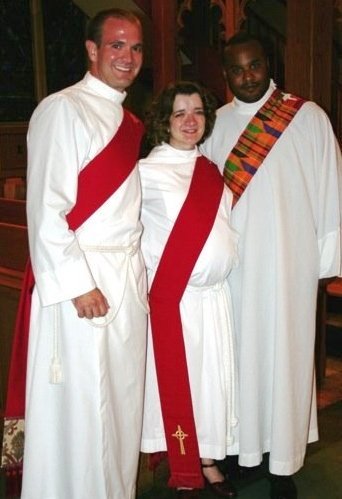
The Reverands Jody Burnett, Jennifer Andrews-Weckerly, and Charles Fischer III, Cathedral Church of St. John, June 24, 2009

Later this month I will celebrate the seven-year anniversary of my ordination.  What most people remember about that day was that I was very pregnant.  I confess that my large belly in an alb and a stole were rather extraordinary.  But what I remember about that day was a brief, but profound encounter.  I had gotten to the Cathedral early to make sure everything was in place and everyone knew where to go.  I was bustling around, managing logistics, when I ran into my boss, who was the rector of the church where I was serving.  She saw that I had my clergy shirt on but that I had not yet put on my collar.  You see, although you are not technically ordained until midway through the liturgy, you put your collar on before the liturgy starts.  The idea seemed strange to me to put it on before the bishop laid hands on me.  And if I am really being honest, I was really nervous about the whole endeavor.  My rector put her hands on my shoulders, looked me square in the eye, and said, “Jennifer, it’s time.  Go put on your collar.”

When we talk about ordination, we talk about the newly ordained experiencing an ontological change – a change in who the person is and in the nature of her existence.  It sounds rather dramatic because the change is dramatic.  When we ordain someone, we forever set them apart for a specific role in the church.

This Saturday, we will join our new curate, Charlie Bauer, as he is ordained to the transitional diaconate.  Charlie will be facing a similar ontological change – committing the rest of his life to this new way of being in and for the church.  Ordained persons do not simply start a new job.  Their whole person and existence is changed.  That is why an ordination is so special – because it is a day set apart for honoring this tremendous change.

Of course, all people in the church have access to ontological change.  Both baptism and confirmation are considered similar ontological changes – something profound happens in those moments, moments that only happen once in a lifetime.  We are marked as something different, and the way that we live our lives changes forever.  Because that change for all of us is so profound, the church sets apart days that we reaffirm our baptismal covenant and ordination vows.  We want to remember those tremendous moments when we put on a collar or stole, when water was poured over our heads, when a bishop placed heavy hands on our heads, and when we felt the Holy Spirit whisk through the room.  I hope you will join us as we celebrate this ontological change with Charlie.  But I especially hope you will take a moment to remember your own change and how the Spirit invites you to reclaim your changed identity.


Sermon – Romans 5.1-5, John 16.12-15, TS, YC, May 22, 2016

25 Wednesday May 2016

Posted by jandrewsweckerly in Sermons, Uncategorized

≈ Leave a comment

Tags

activity, attention, community, disciples, doctrine, faith, God, grace, grow, guide, heresy, Holy Spirit, Jesus, learn, love, seminary, Sermon, suffering, theology, Trinity, Trinity Sunday, world

In seminary one of my favorite professors was our theology professor.  I did not like her because of the subject she taught.  In fact, her class was one of the classes that gave me the most headaches as I struggled to understand theological arguments.  Instead, what I liked about her was the way that she taught.  She had a dizzying intellect, and yet she had the ability to gently make you feel like you were not an idiot.  Someone in class would ask a question, trying to get their head around a theological concept.  Her soft response would be, “Oh, yes, yes, I could see how you might get to that conclusion.  So-and-so also argued that heresy in the fourth century.”  Or she might answer, “Oh yes, that heresy is one of the church’s favorite,” and then go on to explain how the church struggled to counter the heresy.  What I loved about her responses was she let you know that although you clearly did not understand the theological concept, you were not the first person to struggle to understand and you will not be the last.  Struggling to understand and articulate a cogent theological concept without slipping into a heretical argument is a basic part of being a Christian.

What I loved about the pastoral nature of my professor’s responses was she understood that being able to articulate a definition of God is incredibly difficult.  More important to her than you getting that articulation correct was your engagement with the concept.  Perhaps she understood that theologians for centuries have tried to do the same thing – define who God is and what God means.  That may be why she never seemed bothered by our heresies – because she knew that her role, and in fact the role of the church, is to be involved in the ongoing endeavor of naming God’s activity in our world.[i]  That is the same work that we do every year on the feast of Trinity Sunday – embracing the endeavor of naming God’s activity in our world.

To help us in that endeavor, we get two great pieces of scripture today.  In our gospel lesson from John, Jesus tells the disciples that the Spirit will guide the disciples into all truth.  Jesus’ promise to the disciples tells us those closest to Jesus, those who have been sitting at Jesus’ feet, learning truth from the source, are still going to need help.  The disciples, who will be commissioned to go out into the world to share the Good News, will not do that work alone.  The Spirit will go with them, helping them to continue to learn and grow into the fullness of faith.

I was recently invited to come to Sunday School for a little round of “stump the priest.”  I laughed at the title, but inside I was thinking, “What if they ask a question that really does stump me?!?”  Luckily, a cooler head prevailed.  The truth is they probably will stump me – several times over.  But that will give us a chance to talk about how the Spirit guides us into all truth – in childhood, in young adulthood, and into our older years.  But more importantly, I hope that we get the chance to talk about how the community of faith is a vital part of that learning of all truth.  We are certainly dependent on the Spirit, but we are also dependent on each other, because the Spirit so often speaks to us through people and the words of those around us.[ii]

That is one of the things I love most about being in the Episcopal Church.  The Episcopal Church has always been a place where ambiguity is okay.  As David Lose explains, “…being part of being a Trinitarian community [means] striving to be a place that knows it doesn’t have all the answers, and so consequently makes space for conversation and values those who bring different voices and experiences into its midst.  Conversation, valuing difference, being inclusive – these things aren’t easy, but genuine community, while challenging, is also creative, productive, and enriching.”[iii]

The other great piece of learning today comes from our reading in Romans.  On the surface, this piece of scripture has always troubled me.  Paul’s claim that suffering produces endurance, endurance produces character, and character produces hope, has always sounded a little dismissive about suffering.  But I do not think Paul meant for this formula of suffering leading to hope was not meant to be prescriptive, but descriptive.[iv]  In other words, he is not saying those who are suffering should be grateful.  What he is saying is those who are suffering have the opportunity to not waste the pain.  Peter Steinke says, “We ‘waste’ suffering if we gloss over, deny, avoid, or neglect its message…. If, however, we can learn from pain, [pain] is not wasted but a source of life and health.”[v]  My suspicion is that Paul is trying to capture what we learn from our gospel lesson today.  Even in the midst of suffering the Holy Spirit and the community of faith can guide us into all truth.

I have been a part of parishes that have a communal component to their premarital counseling.  In addition to meeting with the priest, each engaged couple is partnered with a married couple in the parish for mentoring.  One would think that the married couple’s job is to tell the engaged couple how to do everything and give them advice.  But more often, the couples end up talking about how hard marriage is, what struggles they have dealt with, and how they got through the suffering.  The relationships between the mentors and the mentees often last well beyond the wedding.  When done with honesty, vulnerability, and compassion, the couples realize that they gain strength from one another and find a place where they can go when they are looking for truth and guidance.

Our gospel and epistle lessons today weave together an understanding of the Trinity that is both vertical and horizontal.[vi]  Vertically, we learn that our understanding of God is ever changing and dynamic – much like God is ever changing and dynamic.  I think that is why my professor was so open to us stepping into and out of heresies and doctrine.  She knew that every Christian had to take that journey of steps and missteps.  But I think she also understood that truth was ever evolving and that the Spirit was with us in that journey.  She was not worried about us because, “…a critical characteristic of faith is an ever-striving and dynamic making sense of God.  The Trinity [cannot] be the only way to get God.  [That theology] is as limited and finite as our humanity.  [The theology of the Trinity] is one attempt of the church to articulate the being of God in a particular time and place.”[vii]  We will continue to walk toward truth in our own time and place too.

Horizontally, our lessons teach us that we find our way to that truth the Spirit is showing us through the vehicle of those around us – both those in the church, and those outside our walls.  I cannot count the number of times I have learned something profound about God by someone who never harkens the door a church.  Our job is to pay attention:  pay attention to the way that God is using others to show us more about God; pay attention to the ways God invites us to interpret our sufferings with others; pay attention to those who are struggling toward truth along with us.  We will surely step into heresy now and then.  But we will also step into God’s love and grace through the guidance of the Holy Spirit and those around us.  Amen.

[i] Karoline Lewis, “Trinity Talk,” May 15, 2016, as found on http://www.workingpreacher.org/craft.aspx?post=4648 on May 18, 2016.

[ii] David Lose, “Trinity C:  Don’t Mention the Trinity,” May 17, 2016, as found on http://www.davidlose.net/2016/05/trinity-c-shh-dont-mention-the-trinity/ on May 18, 2016.

[iii] Lose.

[iv] Richard L. Sheffield, “Homiletical Perspective,” Feasting on the Word, Yr. C, Vol. 3 (Louisville: Westminster John Knox Press, 2010), 39.

[v][v] Sheffield, 41.

[vi] Lose.

[vii] Lewis.

Sermon – Acts 2.1-21, Pentecost, YC, May 15, 2016

18 Wednesday May 2016

Posted by jandrewsweckerly in Sermons, Uncategorized

≈ Leave a comment

Tags

Babel, church, context, culture, Episcopal, hearing, Holy Spirit, languages, love, Pentecost, pentecostal, Sermon, tongues, understanding, wind

Though I often share with people that I grew up in the Methodist Church, what that story fails to capture is my earliest experiences in church.  You see, before my father became a United Methodist minister, he, my mother, and I worshiped at a Pentecostal church.  So my first memories of church are quite different from my current experiences in church.  I remember the pastor putting his hand on a person’s forehead and the person crumbling to the ground, presumably slain in the spirit or healed of a malady.  I remember sitting in the pew once with a friend of my parents’ when the woman leaned over to me and whispered, “I’ll be right back.”  She then proceeded to run up and down the aisle, her hands waving in the air.  I do not remember anyone speaking in tongues, but I would not be surprised if that happened.

I have always found the fact that Episcopalians like Pentecost so much fascinating because we are about as far from Pentecostal as any church could get.  I have yet to find an Episcopal Church that encourages running up and down aisles, speaking in tongues, and being slain in the spirit.  That does not mean we do not move.  In fact, we stand, kneel, sit, cross ourselves, bow, and sometimes even genuflect.  You might find a few of us lift our hands in praise, but most of us keep our hands tightly to our sides.  You might find a few of us who will say an unprompted “Amen!” aloud, but they will likely get a few glares.  We are likely to, rather proudly, wear red on Pentecost.  But that is the extent of most Episcopalians “Pentecostalism.”  We like things much more ordered, predictable, and civilized.  In other words, if we are really being honest, Episcopalians are not all that big on Pentecost.

Our aversion to Pentecostal experiences are not all that unfounded.  All one has to do is look at the first Pentecost that we read about in Acts today.  The day the Holy Spirit comes down from heaven is a pretty disorderly, unpredictable, uncivilized day.  Wind whips through people’s hair, fire bursts into flames on people’s heads, and a cacophony of noise ensues that both makes no sense at all, and yet makes perfect sense to each person there.  Although that chaos may sound very similar to anyone with small children in the house, that chaos is not exactly what we have come to expect as civil Episcopalians.

But if we are to get our heads around Pentecost, we have to understand what was really happening on this feast of Pentecost.  The feast of Pentecost was known to most Jews as the feast of Weeks, or Shavuot.  Shavuot is the third of the three great festivals of Judaism.  Shavuot was a joyful celebration, in which the first fruits of the harvest were offered to God.[i]  But Shavuot was not simply an agricultural festival.  Shavuot, or Pentecost, was fifty days after the Passover.  At Passover, the Jews celebrated the saving of the Israelites from the death that came upon the firstborn of the Egyptians.  Fifty days after that dramatic event, the Israelites arrived at Mt. Sinai to receive the law from Moses.  And so, in addition to thanking God for the first fruits of the harvest, praying that the rest of the harvest might be equally bountiful, Pentecost was also “about God giving to [God’s] redeemed people the way of life by which they must now carry out [God’s] purposes.”[ii]

The parallels in and of themselves are uncanny.  At the Passover, the people of God are saved as death passed over their homes.  In Christ, the people of God are saved once again as Christ our Passover is sacrificed for us.  At Shavuot, the people of God are given the new way of life, specifically through the vehicle of Torah, or the Ten Commandments.  At Pentecost this day, we are reminded of the New Commandment given through Jesus that we love the Lord our God and love our neighbors as ourselves.[iii]

So if this day is all about us being given the way of life that we must now live, what do we learn in this chaotic, uncivilized day?  Most remarkably, we see people speaking in tongues they do not know, and yet, all understanding in their native tongues.  That does not mean that all the languages suddenly became one – like making English the official language of Christianity.  Instead, “Pentecost gives power to the band of Jesus followers to speak the languages of the world, to tell the gospel in every language.  The early church [is] to bear witness to the ends of the earth in the languages of the people of the world.”[iv]

I have been thinking a lot about speaking other people’s languages this past week.  Having just moved from Long Island to Williamsburg, I have been keenly aware of language differences over the last month.  Of course, some of our differences in language are more about dialect than anything else – our vowels sound different, or r’s are sometimes dropped.  But a more poignant difference in our language is around culture.  On Long Island, communication is usually concise and incisive.  That may sound rather appealing, but the first time someone tells you how they really feel about you, and the way that they feel is pretty negative, the language can feel like a slap in the face.  Of course, that is not to say Southerners have the market on ideal communication.  I remember many a time growing up when someone said, “Bless your heart,” and their words had nothing to do with a blessing.

As I have been ruminating on those differences this week, I wondered whether those differences go beyond region and perhaps are at the root of many of our challenges today.  I have wondered if part of our country’s problem in communicating with one another is rooted in the fact that we are not speaking the same language.  Of course, most of us can speak English in this country, but even though we speak the same language, we do not speak from the same cultural reality.  There are experiences that I have as a woman that my male brothers will never fully understand.  There are experiences that my African-American brothers and sisters experience that I will never fully understand.  There are experiences that our young adults are having through technology that us older folks will never fully understand.  In some ways, I wonder if in America, we have become more like the people of Babel than the people of Pentecost.

Luckily, we are not beyond God’s power to make our Babel-like ways right.  There are all sorts of tangible ways we can work toward understanding others’ languages.  We have a pretty incredible collection of young adults in this parish.  Being a part of community means that we can reach out to our young people to hear their stories and trials – just as they can learn about our own stories and trials.  Being a part of community means that we can join any number of the outreach ministries of Hickory Neck and learn quite quickly what language and cultural context poverty creates.  Being a part of a community means that we can read authors whose cultural contexts are completely different from ours and learn more clearly why movements like “Black Lives Matter,” might have arisen in the first place.

That is the true invitation of Pentecost:  to step boldly into the chaos of differing languages, knowing that the Holy Spirit will bring about true understanding.  Of course, stepping into that cacophony is scary.  As N.T. Wright says, stepping into the cacophony means getting “out there in the wind, letting it sweep through your life, your heart, your imagination, your powers of speech, and transform you from a listless or lifeless believer into someone whose heart is on fire with the love of God.”[v]  That kind of transformation may not sound like what you were hoping by wearing red today.  But that kind of transformation offers the promise not of calming the cacophony of language all around us, but helping us hear in the midst of the chaos.  God, whose very existence in the form of the Trinity is three distinct persons, yet one, invites us to live as a community differentiated in persons, but untied in love.[vi]  That Pentecostal community will be loud, messy, and hard.  But that community will be life-giving, renewing, and beautiful.  Our invitation today is to step into the wind of the Spirit.  Amen.

[i] Margaret P. Aymer, “Exegetical Perspective,” Feasting on the Word, Yr. C, Vol. 3 (Louisville: Westminster John Knox Press, 2010), 15.

[ii] N.T. Wright, Acts for Everyone, Part 1, Chapters 1-12 (Louisville: Westminster John Knox Press, 2008), 21.

[iii] Aymer, 17.

[iv] Aymer, 17.

[v] Wright, 22.

[vi] Michael Jinkins, “Pastoral Perspective,” Feasting on the Word, Yr. C, Vol. 3 (Louisville: Westminster John Knox Press, 2010), 18.

Speaking my Language

11 Wednesday May 2016

Posted by jandrewsweckerly in Uncategorized

≈ 1 Comment

Tags

church, communicate, culture, hear, Holy Spirit, language, new, North, Pentecost, South, speak, tongues

Pentecost Sunday

Photo credit:  stbarts.org/worship/pentecost-languages/

As many of you know, I was raised in the South.  My San Diego-native husband tells me that when he met me in high school, I had an endearing North Carolina accent.  But after going to college with people from all over the country and living in Delaware, I found that my accent faded.  I tended to pick up phrases and patterns of speech from those around me.  Of course, one call from my Alabama-native mother, and all bets were off.  But about four years ago, my family moved to Long Island with our then two-year-old.  Surrounded by Long Islanders, she quickly started pronouncing vowels differently and dropping r’s.  I am not sure how much of the dialect I assimilated, but my ears certainly adjusted.

What I came to finally understand about all these dialects is that much more important than the sound of words are the culturally different ways people communicate with one another in different regions of the country.  My experience on Long Island was that people were very direct and incisive with their words.  Being from the South, this was more of a shock than the dialect.  In the South, people are indirect and subtle with their language.  Though I was raised to interpret conversations in the South, if I am honest, I found the Long Island way of communicating refreshing.  Although I sometimes felt like I was being slapped in the face by the brutal honesty of another person, when I went home, I knew where I stood.  That was not always the case in the South.  People are almost always polite, but hidden in the politeness are sometimes feeling of resentment or hurt, which cannot be addressed if you do not know how to hear the subtlety.

This Sunday, the Church is celebrating Pentecost.  If you remember the story from Acts, those gathered begin speaking in tongues.  The miracle was not in the speaking of tongues, but in the understanding of tongues by everyone gathered.  Each heard their own language and the message was clearly understood by all.  Having recently returned to the South, I find myself wondering in what ways the Church could be speaking more clearly.  I am not suggesting that one region of the country has the market on clear speech.  What I am suggesting is that as a Church, we are not always great at communicating the power of Christ in our lives.  We either get lost in “church speak,” or we try to academically explain matters of the heart, or, out of fear or discomfort, we do not speak at all.  As we honor the miracle of the work of the Holy Spirit over two thousand years ago, our invitation at Pentecost is to honor the ways in which the Holy Spirit can continue to enliven the church to speak understandably to a new generation.

Sermon – Acts 16.9-15, E6, YC, May 1, 2016

06 Friday May 2016

Posted by jandrewsweckerly in Sermons, Uncategorized

≈ Leave a comment

Tags

blessing, change, church, community, conversation, evangelism, God, growth, hear, Holy Spirit, listen, new, Paul, prepare, Sermon, together, work

One of the things that the Search Committee, Vestry, and I all talked about during our time of discernment was church growth.  Now church growth is a loaded topic because inherent in the conversation are a lot of assumptions.  One assumption is that we can talk about church growth without talking about change.  Many churches say they want to grow, but what they mean is that they want to find fresh meat for volunteer positions and new pledgers for the budget.  But inherent in church growth are not just bodies to fill out needs:  church growth means incorporating new people who will have new ideas, new dreams, and new ways of doing things.  The second assumption when we talk about church growth is that we can go about church growth passively.  In other words, as long as we have a good website, we have good programs, a shiny new Rector, and we are nice to people once they arrive, we will grow.  While those things are important and necessary, those things do not fully address how we get people to step on our property, how we encourage people to come back after a first visit, or how we incorporate newcomers fully into the life and ministry of the church.  The final, and my personal favorite, assumption is that church growth is done by the Rector.  The Rector can certainly help lay the foundation of a strong system of invitation, welcome, and incorporation.  But the primary way that church growth happens is through Church members inviting others to church.

All that is to say that my response to the Search Committee and Vestry went a little like this:  I am more than happy to give Hickory Neck all of the infrastructure Hickory Neck needs to grow; but Hickory Neck is going to have to work, be open to change, and get real comfortable with talking about their faith in the neighborhood.  Now I know many of you may be sitting here right now, cursing the Search Committee and Vestry for signing you up for some hard, scary work ahead.  But let me let you in on a little secret:  church growth (or evangelism, if we are feeling really sassy) is not that hard or scary.  That is the great thing about the readings from the Acts of the Apostles during Eastertide:  they are all about the growth of the church.  Last week we heard about how Peter began to understand that God was calling him to share the Good News with the gentiles.  Today, we hear about how Paul is diverted to Europe to share the Good News with the people of Macedonia.

Many of us get a little uncomfortable talking about apostles spreading the Good News because the stories about Peter and Paul seem strange and foreign.  They involve dreams or visions in which God tells them what to do.  They involve going to foreign lands to talk with strangers.  And they sometimes involve, as we will hear next week, getting arrested and sent to jail.  Most of us hear these familiar stories and assume that the stories do not really apply to us because they are historical, ancient stories.  But after the drama of being diverted to a foreign land and searching for a place to join with sympathetic people, what happens to Paul in our text today is not actually all that foreign or unrelatable.  The story tells us that on the Sabbath day, Paul and his companions go find where faithful people are gathered and simply start talking.  The text does not say that Paul gives a presentation about the merits of converting to Christianity.  The text does not say that Paul leads a worship service, with music and the holy meal.  The text simply says that Paul sits down among those gathered, and starts talking.  While Paul is talking, a woman in the group, Lydia, who we understand from the text is an independent woman of wealth[i], overhears what Paul is saying and is so compelled by what Paul says that she and her household are not only baptized, but insist that Paul and his companions come stay with her during their stay in Philippi.

Soon after I became a rector for the first time, I realized I had a lot to learn about church growth.  I read books, poured through research, and talked with experts in the field.  One of my favorite conversations about church growth was with a friend who does church consulting on growth.  In her formation, she had a professor who insisted as part of her training that she needed to go out into town and just start talking to people about Jesus.  She was terrified.  For the first few weeks of class, my friend, now a priest, lied to her professor.  Each week he would ask her how the project was going, and she would tell him that the project was going well.  Finally, the professor called her bluff and insisted that she immediately go somewhere and do her assignment.  So my friend went to a coffee shop, wrote on a piece of paper, “Talk to me about Jesus and I will buy you a cup of coffee,” and then set up her laptop in the hopes that no one would take her up on the offer.  Much to her chagrin, a patron came up to her and said, “I’ll talk to you about Jesus, but I’ll buy the coffee.”  The conversation that ensued was full of the stranger’s story – about how she used to go to church, how she still believes, how the church hurt her, but how she still misses having a church community.  My friend listened to the story, honored the stranger by acknowledging how hard her journey had been, and then did the one thing that is key when talking about church growth.  My friend acknowledged where she saw the presence of God in this stranger’s journey.  And, for good measure, my friend told her that if she ever wanted to try church again, she knew a great place that might just work.

That is the funny thing about church growth.  Church growth happens through real people having real conversations in real time.  Paul sits down with a bunch of women and starts talking.  My friend sat down with a stranger and listened and reflected back on the stranger’s journey.  That is the same invitation that I will be giving us to do over and over again in my time here at Hickory Neck:  that we start having real conversations with real people in real time.  Now I know what some of you may be thinking.  First, you may be thinking, “I cannot believe the Search Committee and Vestry decided to hire this priest who is going to make me do this!”  Second, you may be thinking, “I have no idea how to have real conversations with real people in real time!  What does she expect me to do?  Start talking to strangers at the coffee shop, on the golf course, and at the Little League game?”

Before you get too anxious, I want to give you a little piece of comfort from scripture.  In Peter’s story last week, in Paul’s story today, and in the texts coming up next week and at Pentecost, we learn that all of these encounters happen with the Holy Spirit going before, making a way for the encounter to happen.  In today’s story, Paul has no intention of going to Macedonia.  In fact, in the verses we did not read today, Paul and his crew actually had plans and made attempts to go to other places, but their plans were thwarted by the Holy Spirit.  Finally, Paul has a vision that he was supposed to go to Macedonia.[ii]  Once he and the group decide to follow that vision, everything becomes smooth.  Their travel is not thwarted, they easily find their way to Philippi, they stumble onto a group of women who are believers, and out of nowhere, just through conversations about faith, Lydia steps up and not only desires baptism, she demands that Paul and his company accept her hospitality.  That is the reality about growth:  yes, growth involves putting ourselves out there to have hard conversations, and yes, growth involves being vulnerable and uncomfortable, and yes, growth will even involve change to us personally and to our community as a whole.  But God shows us through the story of scripture, that the Holy Spirit is ever before us, making the way smooth.  When our intentions are simply to share our story, to listen to the stories of others, and to honor the ways in which God is already active and blessing us, then the rest flows smoothly.

We are probably going to be talking about church growth a lot in the years to come.  We will talk about how to grow, we will make changes that will create a strong foundation for invitation, welcome, and incorporation, and we will get out there and talk to our neighbors.  But at the heart of all that work is the promise that the Holy Spirit is ever before us, making the way smooth, calming our nerves so that God can work in spite of us, and showing us how our holy conversations will be a source of blessing to us as much as those conversations are a blessing to others.[iii]  We will do this work together:  you, me, and the Holy Spirit.  The work will be hard, scary, and beautiful.  The work will be a blessing to us all and allow us to be a blessing to this community.  We can do this work together, because the Holy Spirit goes before us.  Amen.

[i] David G. Forney, “Pastoral Perspective,” Feasting on the Word, Year C, Vol. 2 (Louisville:  Westminster John Knox Press, 2009), 476.

[ii] Brian Peterson, “Commentary on Acts 16:9-15,” May 5, 2013, as found at http://www.workingpreacher.org/preaching.aspx?commentary_id=1627 on April 27, 2016.

[iii] Peterson.

Sermon – Acts 9.36-43, E4, YC, April 17, 2016

20 Wednesday Apr 2016

Posted by jandrewsweckerly in Sermons, Uncategorized

≈ 1 Comment

Tags

charity, Dorcas, first Sunday, gestating, God, good works, health, hibernation, Hickory Neck, Holy Spirit, ministry, miracle, new life, Peter, Sermon, servant, Tabitha, work

This morning I want start with some thanksgiving.  I would like to thank the members of the Search Committee and the Vestry for being so faithful in prayerful discernment with me and the other candidates for Rector of Hickory Neck Episcopal Church.  My interactions with them gave me a sense of hope and joy about what lies ahead for us as a community of faith.  Though I know he has moved on to his next cure, I would also like to thank Henry for being such a faithful shepherd among us, especially during a time of transition and upheaval while still being new to the priesthood.  He paved the way for us to be ready for this next phase of ministry.  And finally, I would like to thank each one of you.  You have put a tremendous amount of prayer and trust into this process, and I am grateful for your support of this parish.  I am looking forward to learning about your ministries in this place and helping bolster your good work in the world.

The people of Hickory Neck are in good company today.  In our reading from Acts this morning, we hear about another faithful servant of God.  Tabitha, also known in her community by the name Dorcas, is a disciple renowned for her good works and acts of charity.  We know that she is an adept seamstress, who uses her sewing prowess to clothe the needy in her community.  We know that her witness and work are so powerful that the widows who benefit from her charity are found weeping by her deathbed.  We know that her discipleship is so profound that two men journey to a nearby town to find Peter in the hopes that he might be able to do something miraculous for the woman who was a miracle for so many others.[i]

As I prayed with Tabitha this week, I realized how many similarities her witness shares with Hickory Neck’s witness and ministry.  One of the reasons I was attracted to Hickory Neck during the discernment process was the vibrancy of ministry and the health of the congregation.  I was impressed to learn that thousands of dollars raised by your annual Fall Festival go directly to supporting local outreach ministries.  I have enjoyed hearing stories about making meals, visiting prisoners, and collecting goods for our neighbors in need.  But even more impressive to me is the desire among parishioners to do more:  to dream bigger dreams about how not only we can use our hands to more directly serve the poor, but also how we might use the gift of this property more creatively to be a living witness of the love of Jesus in our community.  What I saw in the discernment process was a church who is healthy and vibrant and who is poised for new and exciting work.

Now what is funny about all those good vibrations is that juxtaposed with that percolating vision is a community who has been treading water.  After the decline of your last rector, a shortened interim period, and making due with only an assistant, many of you have also shared with me your sense that these last few years have also been a time of getting by, but maybe not necessarily thriving.  I would never suggest that these last years have been like a death – but maybe like a time of hibernation.  Like an animal who lives off their stored up energy and fat over the winter, Hickory Neck has been getting by with the things that she learned long ago:  good worship and music, solid pastoral care and welcome, and powerful outreach ministries and educational opportunities.

Now Tabitha is not hibernating.  According to Luke’s writing in Acts, Tabitha is not just sleeping.  She becomes quite ill and dies.  Truthfully, if Tabitha had been in a deep sleep, her story might be a little easier to believe.  I do not know about you, but miracle stories like Tabitha’s are always a little strange to me.  Whether the story is the one from First Kings, where Elijah brings the son of the widow back to life after a strange ritual of laying himself over the dead boy’s body three times[ii]; or whether the story is of Jesus raising his friend Lazarus from the dead after four days in the tomb[iii]; or whether the story is this strange one where Peter prays over a dead disciple and simply says, “Tabitha, get up,” and she does, these stories always seem strange to me.  One, I do not really understand the mechanics of raising someone from the dead.  Having never seen such a miracle myself, I cannot imagine how or why such a thing happens.  Perhaps I am too jaded by modern science, but part of me just does not understand raising people from the dead.  Two, I do not understand why people are raised from the dead.  The idea sounds great in principle.  I am sure the mourning families and friends are incredibly relieved.  But, with the exception of Jesus, all of the people who are raised from the dead must have to die again eventually.  I’m not sure why people even bother.  Finally, what I really do not understand about these stories is what they mean for us today.  Though we love these biblical stories, I know plenty of people who would like to see their loved ones raised from the dead.  Many of them might even have a case based on the good works they have done, like Tabitha.  Surely people like Tabitha deserve another chance to keep making a difference in the world!

Regardless of the fact that the text does not tell us how, or why, or even why not someone else, what the text does tell us is that Tabitha is in fact dead, Peter in fact raises her from the dead, and then the alive Tabitha is presented to her people, presumably to get back to doing all the good works and charity she had been doing before – or perhaps even better works of charity.  Implicit in Peter’s words, “Tabitha, get up,” is the notion that Tabitha’s work is not done yet.  In fact, Tabitha must have even greater works to do.  God is not done with Tabitha yet.

That is what I love about this story for Hickory Neck.  God is not done with us yet either.  As I was reading up about hibernation, one of the things I learned is that some species, like polar bears, hibernate while gestating their young.  I was blown away by that realization.  Pregnancy is that time when the host is usually taking on more calories, building up muscles to prepare for the birth, and dealing with the activity of a developing fetus – especially once the kicking begins.  I cannot imagine sleeping through that whole process or storing up enough sustenance to help both bodies grow and thrive during hibernation.

But the more I thought about the hibernating polar bear, the more I realized that is exactly what has been happening with Hickory Neck.  Perhaps these last couple of years have felt like a hibernation period – a time of lower energy and output.  But I wonder if Hickory Neck is not unlike a hibernating mama polar bear.  Though we have been keeping things steady, we have also been working hard on nurturing and producing new life.  We have not been sleeping to survive a cold spell.  We have been resting to cultivate and grow new life – a new life which is about to be born.

Today, Peter’s words and actions are for us too.  The text tells us that when Peter arrives he sends everyone outside, kneels down, and prays.  We have been praying too.  We have been praying that God guide us through a time of turbulence and transition, we have been praying that Jesus nurture us during our time of hibernating, and we have been praying that the Holy Spirit help us explode with renewed energy and life.  After Peter prays, his words to Tabitha are simple, “Tabitha, get up.”  Hickory Neck has received a similar charge.  When the Holy Spirit led us to one another, we heard the same words.  “Hickory Neck, get up.”  God is not done with us yet either.  That new life we have been gestating is eager to be born in and through us.  Finally, one more thing happens in our text.  The text says, “Peter gave Tabitha his hand and helped her up.”  Though Peter’s words are unambiguous to Tabitha, Peter does not expect Tabitha to get up and get to work alone.  He offers her a hand.  The same is true for us.  Though we are charged to get up and start caring for this new life we have been nurturing, we do not do the work alone.  The Holy Spirit is reaching out to us to help guide us to our feet.  I will be reaching out my hand to each of you, but I will also need you to reach your hand out to me.  And, more importantly, we will also need to reach out our hands to those not yet in our midst, who will be a part of the new life we have been gestating.  I do not know about you, but I cannot wait to see what our new growing family looks like.  So, Hickory Neck, get up!  Amen.

[i] Stephen D. Jones, “Homiletical Perspective,” Feasting on the Word, Year C, Vol. 2 (Louisville:  Westminster John Knox Press, 2009), 429.

[ii] 1 Kings 17.17-24

[iii] John 11.1-44

Sermon – Luke 4.1-13, L1, YC, February 14, 2016

17 Wednesday Feb 2016

Posted by jandrewsweckerly in Sermons, Uncategorized

≈ 2 Comments

Tags

clergy, death, dependence, faithfulness, formation, God, Holy Spirit, hope, Lent, presence, Satan, Sermon, temptation, transition, wilderness

The irony of this being the first Sunday in Lent after the week we have had is not lost on me.  By now our parish should have received a letter from me explaining how I have accepted a call to a new position in Williamsburg, Virginia.  The letter has been met with a variety of reactions, from surprise to disappointment, from understanding to hurt, from confusion to anger.  But no matter what the initial reactions have been, the primary question from all has been, “What does that mean for St. Margaret’s now?”  That question and the news of coming change alone would have been enough for the week.  But then on Friday we lost one of the patriarchs of St. Margaret’s.  Though any death is hard, as a founding member and a perpetual evangelist, Chet will be deeply missed.  Given the week we have had, I cannot think of a better Sunday to talk about the wilderness.

In Luke’s gospel today, Jesus goes from the high of his baptism, where God proclaims Jesus’ identity as God’s son, out to the wilderness where he will be tempted for forty days by Satan.  The people of God are no strangers to the wilderness.  Before the people of Israel entered the land of promise in our Old Testament reading today, first they wandered for forty years in the wilderness.  Those years typify what a wilderness experience is all about:  confusion, fear, wariness, hunger, dissatisfaction, mourning, regret, anger, jealousy, and impatience.  In the wilderness, the people of Israel wondered why they had ever left Egypt, even though Egypt had been a place of slavery.  At least in Egypt they knew from where their next meal would come.  In the wilderness, the people of Israel whined about everything – a lack of food, a lack of water, a lack of direction.  They lost hope in God to provide for them so, in a moment of weakness, they had their priest construct a golden calf for them to worship.  They behaved so badly that a whole generation did not get the chance to see the promised land.  For Jesus, the wilderness is no different.  The wilderness is marked by scarcity and temptation.  Voices try to sway Jesus away from God.  And when Jesus was at his weakest, Satan himself came to tempt Jesus to take matters into his own hands instead of trusting God to stand with Jesus.

Of course, St. Margaret’s is no stranger to wilderness times.  Before we had parish status we went through several vicars, experiencing one transition after another.  When the twenty-year tenure of our first rector ended, many wondered how we would survive.  Clergy transitions can feel much like those wilderness moments for the Israelites.  On the one hand, transitions are full of promise as we imagine what new life a different clergy person might breathe into our community.  On the other hand, there are days when we glorify Egypt, when although our time in Egypt was not perfect and maybe had even become stale, at least we knew what to expect or had the stability of Father so-and-so.  Likewise, we have been through many parish deaths.  Each one hits us in a unique way, and each one makes us wonder what we will do without the person we have lost.  Who will be our warden, our treasurer, our coordinator of ushers, or our major donor?  How will we sing in the choir, laugh at coffee hour, or balance the budget without them?

That is the scary thing about the wilderness.  The wilderness tempts us into thinking and doing all sorts of things.  Although the three specific temptations of Jesus that Luke describes are certainly challenging, what is more unsettling is the underlying nature of temptation itself.  As one scholar argues, “…temptation is not so often temptation toward something – usually portrayed as doing something you shouldn’t – but rather is usually the temptation away from something – namely, our relationship with God and the identity we receive in and through that relationship.”[i]  What the wilderness has the chance to do is undermine our confidence in ourselves and in the community God made us to be.  That is what Satan is trying to do to Jesus:  erode Jesus’ confidence in his identity, in his security, and in his worthiness before God.  Satan did the same thing to the people of Israel for forty years, and Satan will do the same thing to St. Margaret’s if we let him.  Satan will try to erode our confidence that God is still acting and moving in this place and will continue to make this community a place of sacred encounter and experiences with God and God’s people.

As I was thinking about the wilderness of Lent, transition, and death, I kept coming back to the Holy Spirit.  You see, when Jesus goes into the wilderness, he does not go alone.  The text tells us that the Spirit led Jesus into the wilderness.  The Spirit does not just drop Jesus off to fend for himself.  “…the Spirit continues to abide with him, enabling him to grow stronger through this season.”[ii]  Being filled with and accompanied by the Holy Spirit is the only way one gets through the wilderness.[iii]  The Spirit stays with Jesus in the wilderness because being chosen and anointed for one’s mission is not enough.  Jesus must be tested, being led to places of hunger and despair.  Only then does he learn dependence on God, who graciously provides for all our needs in all of life’s seasons.[iv]  The Holy Spirit enables Jesus to journey through the wilderness so that Jesus can learn that lesson about dependence upon the Lord our God.  The Holy Spirit’s company allows Jesus to see the powerful presence and abundance of God in his deepest need.

Thinking about the Holy Spirit this week has shifted my energy.  Instead of thinking about the wilderness with a sense of dread and familiarity, instead of bracing myself for impact, and instead of erecting soaring walls of protection to keep pain out, I found myself asking a different set of questions.  Where have I experienced God’s faithfulness in the wilderness?  How has my relationship with God been transformed?  How strong are the temptations of returning to old ways – to ways of relying on myself?[v]  Somehow, shifting the questions from where has God been absent in the wilderness to where has God or the Holy Spirit been present in the wilderness gave me a sense of hope.  Instead of looking for the bad – the dreariness of Lent, the burden of transition, the grief of death – I found myself wanting to look for the good – the blessing of time set apart with God, the opportunity for new life and growth, the reminder of resurrection promised for us all.

I will not tell you that the next forty days or even forty weeks will be easy.  In fact, I know that many of those days and weeks will be very hard.  But having been through Lents, transitions, and deaths before, and having watched Jesus held up by the Spirit, I can tell you that we have all experienced God’s faithfulness in the wilderness.  Though none of us likes the wilderness, the wilderness is a necessary part of our formation in Christ – like the necessity of wildfires to restore health and wholeness to ecosystems.  Just like those fires can contribute to overall forest health, the wilderness can contribute to our overall spiritual health.  In these next forty days, I invite you to not turn inward toward fear, protection, and isolation.  I invite you to turn to one another for strength and companionship.  I invite you to come to me as we all process what this change means for St. Margaret’s.  But mostly, I invite you to remember the Holy Spirit who is keeping vigil with each one of us.  The wilderness of Lent this year may be more palpable than in years past.  But I invite you to hold on to the hope of God’s promise to be with you in the midst of the wilderness.  Amen.

[i] David Lose, “Lent 1 C: Identity Theft,” February 9, 2016, as found at http://www.davidlose.net/2016/02/lent-1-c-identity-theft/ on February 11, 2016.

[ii] Jeffery L. Tribble, Sr., “Pastoral Perspective,” Feasting on the Word, Yr. C, vol. 2 (Louisville:  Westminster John Knox Press, 2009), 44.

[iii] Karoline Lewis, “Filled With the Holy Spirit,” February 7, 2016 as found at http://www.workingpreacher.org/craft.aspx?post=4291 on February 11, 2016.

[iv] Tribble, 44.

[v] Kimberly M. Van Driel, “Homiletical Perspective,” Feasting on the Word, Yr. C, vol. 2 (Louisville:  Westminster John Knox Press, 2009), 47.

Embracing joy…

03 Wednesday Jun 2015

Posted by jandrewsweckerly in Uncategorized

≈ Leave a comment

Tags

Christ, church, constructive criticism, encouragement, faithful, health, Holy Spirit, improvement, joy, review, servant

Our Vestry and Parish just completed a Mutual Ministry Review – a time to reflect on the health of our congregation and to strategize about how to move toward greater health and wholeness.  There was a lot of positive feedback in the survey indicating the ways in which we have grown and changed for the better in the last three years of ministry together.  And of course, there was plenty of constructive criticism about what we can do to make our ministry together better.  Some of the feedback included things we could do quite easily, and some of the feedback will take longer to address.  But the Vestry was energized to make those changes and move toward wholeness.

Like with any feedback though, we quickly lost sight of all that is going well.  We lingered only for a moment on the good and positive work God is fostering among us, and we immediately dug in with the work we needed to do to improve.  Although I am super proud of our Vestry’s desire to dig in and do some of the dirty work of improvement, I want to take a moment to remind our whole parish of the need to prayerfully lift up the goodness in our midst.  Without being rooted in gratitude for all the goodness God has brought us, my fear is that we will be overwhelmed by the burden of improvement and not steadied by the encouragement of the Holy Spirit.

I was reminded of that lesson this Sunday.  This Sunday the Vestry started working on prioritizing our improvement work and making goals and deadlines for ourselves.  The work is important and necessary, but I must admit our spirits were a bit heavy.  But just thirty minutes before our meeting, in the context of worship, we honored all of our children and teachers who had participated in Sunday School, Rite 13, and Adult Formation this program year.  The transept was overflowing with people.  Because we use a rotation model for Sunday School, we had over 10 teachers and shepherds this year.  We had three teachers for Rite 13, and five teachers for adult formation.  For a parish with a relatively small average Sunday attendance, those numbers are tremendous.  And that does not include all the children who were present!  It was a glorious sight and a testimony to the good work we are doing to form us into a community that is seeking Christ.  Well done, good and faithful servants!!

Photo credit: http://urfamilies.org/full-of-joy-in-the-lord/

Photo credit: http://urfamilies.org/full-of-joy-in-the-lord/

My encouragement to all of us this week is to hold on to that moment.  Hold on to that image of a full transept of people who have spent the last year deepening their relationship with Christ, and marvel at the good work that the Spirit is doing at St. Margaret’s.  And give yourselves a pat on the back for the ways in which you have committed yourselves to being faithful builders of the Kingdom of God.  There will always be work to do, but my hope is that we can see the joy behind the work we do.  Because there is a lot to be joyful about!

← Older posts
Newer posts →

Recent Posts

  • On the Myth and Magic of Advent…
  • On Risking Failure and Facing Fear…
  • Sermon – Luke 23.33-43, P29, YC, November 23, 2025
  • On Inhabiting Gratitude…
  • Sermon – Luke 20.27-38, P27, YC, November 9, 2025

Archives

  • December 2025
  • November 2025
  • October 2025
  • September 2025
  • August 2025
  • July 2025
  • June 2025
  • March 2025
  • February 2025
  • December 2024
  • November 2024
  • October 2024
  • September 2024
  • August 2024
  • July 2024
  • June 2024
  • May 2024
  • March 2024
  • February 2024
  • January 2024
  • December 2023
  • November 2023
  • October 2023
  • September 2023
  • August 2023
  • July 2023
  • June 2023
  • May 2023
  • March 2023
  • February 2023
  • January 2023
  • December 2022
  • November 2022
  • October 2022
  • June 2022
  • May 2022
  • January 2022
  • December 2021
  • November 2021
  • October 2021
  • September 2021
  • August 2021
  • June 2021
  • May 2021
  • April 2021
  • March 2021
  • February 2021
  • January 2021
  • December 2020
  • November 2020
  • October 2020
  • September 2020
  • August 2020
  • July 2020
  • June 2020
  • May 2020
  • April 2020
  • March 2020
  • February 2020
  • January 2020
  • December 2019
  • November 2019
  • October 2019
  • September 2019
  • August 2019
  • July 2019
  • June 2019
  • May 2019
  • April 2019
  • March 2019
  • February 2019
  • January 2019
  • December 2018
  • November 2018
  • October 2018
  • September 2018
  • August 2018
  • July 2018
  • June 2018
  • May 2018
  • April 2018
  • March 2018
  • February 2018
  • January 2018
  • December 2017
  • November 2017
  • October 2017
  • September 2017
  • August 2017
  • July 2017
  • June 2017
  • May 2017
  • April 2017
  • March 2017
  • February 2017
  • January 2017
  • December 2016
  • November 2016
  • October 2016
  • September 2016
  • August 2016
  • July 2016
  • June 2016
  • May 2016
  • April 2016
  • March 2016
  • February 2016
  • January 2016
  • December 2015
  • November 2015
  • October 2015
  • September 2015
  • August 2015
  • July 2015
  • June 2015
  • May 2015
  • April 2015
  • March 2015
  • February 2015
  • January 2015
  • December 2014
  • November 2014
  • October 2014
  • September 2014
  • August 2014
  • July 2014
  • June 2014
  • April 2014
  • March 2014
  • February 2014
  • January 2014
  • December 2013
  • November 2013
  • October 2013
  • September 2013
  • August 2013
  • July 2013
  • June 2013
  • May 2013
  • April 2013
  • March 2013
  • February 2013
  • January 2013
  • December 2012
  • November 2012
  • October 2012
  • September 2012

Categories

  • reflection
  • Sermons
  • Uncategorized

Meta

  • Create account
  • Log in
  • Entries feed
  • Comments feed
  • WordPress.com

Blog at WordPress.com.

  • Subscribe Subscribed
    • Seeking and Serving
    • Join 394 other subscribers
    • Already have a WordPress.com account? Log in now.
    • Seeking and Serving
    • Subscribe Subscribed
    • Sign up
    • Log in
    • Report this content
    • View site in Reader
    • Manage subscriptions
    • Collapse this bar
 

Loading Comments...