• About

Seeking and Serving

~ seek and serve Christ in all persons

Seeking and Serving

Tag Archives: human

Sabbatical Journey…Finding God on the Road

18 Sunday Jun 2023

Posted by jandrewsweckerly in reflection

≈ Leave a comment

Tags

blessing, competition, connection, game, God, grace, human, image of God, journey, prayer

Photo credit: Jennifer Andrews-Weckerly (reuse with permission only)

One of our favorite road trip pastimes as a family is the “license plate game.”  We try to spot license plates from all fifty states while we drive.  We even have a little board that allows you to flip over a wooden replica of a plate when you see that state’s plate, helping you track which ones you are missing.  It’s a fun game for all ages that helps pass the time, and in feels mildly educational as parents.

Today we embarked on our family’s sabbatical road trip:  twenty-one states in twenty-one days.  Many of the sites have been on our bucket lists for years, and some of the sites we only learned about while planning the route.  We know this will be the trip of a lifetime, and we are thrilled to be able to do this together.  One of the themes of my sabbatical has been connection, and we suspect there will be lots of connection by the end of this journey.

As we commenced our journey today, the license plate game started immediately.  We had a bit of a slow start at the beginning, and I wondered if we were going to get stuck as we drove further away from the East Coast.  At some point, as kids and the other adult were snoozing, I saw one of the states I was particularly worried about missing, and I remember thinking, “Oh thank goodness for Delaware!!” 

My thought was rather silly and overly dramatic, but as I kept driving, I began to wonder what it might be like to not just treat the game as a calculated collection of inanimate objects, but instead to imagine the lives and worth of each human life in the cars.  How much more life-giving would it be to say to another driver, “I am so grateful for you today!  May your travels be a source of blessing!”  The image of 35 blessings instead of 35 wooden blocks on our game board made me realize how unfathomable God’s love is for all of God’s creatures.  Here I am competing in a game, when, if I use God’s eyes of grace, I might be seeing 35 blessings, 35 carloads of people made in God’s image, 35 possibilities for connection, or 35 invitations to move closer to God in prayer.

I look forward to finding new ways to see with God’s eyes of grace on the next leg of our trip.  I would love to hear how you found God’s invitation to blessing through others today!

Sermon – John 14.1-14, E5, YA, May 7, 2023 (8:00 AM)

30 Tuesday May 2023

Posted by jandrewsweckerly in Sermons

≈ Leave a comment

Tags

believe, disciple, Eastertide, everyday, funerals, God, grace, human, Jesus, Philip, resurrection, Sermon, share, slow, Thomas, witness

The gospel text we hear from John today may be quite familiar.  Today’s text is a favorite for funerals.  I have lost count of the number of times I have heard the first six verses of chapter fourteen, and after countless funerals, I am convinced the first six verses would be the ones I want read at my own funeral.  What I love about this text, and what I suspect so many others love too, is layered.  I love Jesus’ description of the heavenly kingdom – a place of abundance, with many dwelling places.  I love that Jesus lovingly goes before us, and even promises to come back for us and guide us there.  I love the assurance that I already know the way, and I love Jesus’ words, “Do not let your hearts be troubled.”  And as if that were not enough, I love the very human response of Thomas – so stuck in his anxiety and fear that he cannot really hear Jesus.  His panicked words make me feel reassured in my own human messiness.

But what is funny about this text is that we never read the rest of the verses at funerals.  Because I have studied just the first six verses countless times, I was stunned this week by the following eight verses of our text.  After that entire interaction with Thomas, where clearly Thomas needed and received careful, loving guidance, Philip enters the scene – and does the exact same thing as Thomas.  Literally seconds after Jesus patiently explains how he will go and prepare a place for us, and he will guide them, and they will know the way because Jesus is the way, what does Philip do?  He basically says, “Great, if you could just prove yourself one more time, then I will definitely believe you.” 

Truth be told, the introduction of Philip makes me love this text even more.  You see, in this Eastertide season, as we continue to talk about what the resurrection means in our everyday life, we go back to this time before Jesus’ death when he broke the resurrection down, not once, but twice.  But the explanation we hear today – twice – really takes us all the way back to the beginning.  Remember John’s gospel does not start with warm, familiar birth stories.  John starts with the poetic, “In the beginning was the Word, and the Word was with God, and the Word was God.”  John has told us from the beginning that Jesus was from the beginning and became flesh so that the followers of God might make God known.  And so, Jesus patiently (and occasionally a little impatiently) tells us over and over again that Jesus is there to help us know God and to bring us into resurrection life in the heavenly kingdom.  And if Jesus can be patient, and occasionally a little impatient, with Thomas and Philip, surely God can handle my own slowness to come to confidence in Christ.

But that is not the end of our invitation today – to recognize Jesus’ salvation and care for us.  This entire convoluted conversation with Thomas and Philip is to help them and us believe.  Now, do not confuse things, I do not mean belief as end in and of itself.  Karoline Lewis sheds light on what believing means, “…to believe in Jesus,” Lewis says, “is to witness in the world his presence so that others might have their own encounter by which then to believe in Jesus…Every sign, every encounter, every conversation has been with that sole purpose in mind, to make God known so that a moment of believing might happen.  In these works, the disciples are invited to participate.”  This witness becomes important because Jesus is returning to the Father, because discipleship is based on witnessing, because greater works will be made possible in our witnessing.[i] 

So as much as I love these very human interactions between Thomas, Philip, and Jesus, this text is not just meant to reassure me of my humanness and God’s grace with me despite that flawed humanness.  This text is meant to remind us of our commission as disciples.  Resurrection promise is not just comfort food for the journey.  Resurrection promise is fuel for the journey – a journey that is not just about us, but about who we bring along with us into resurrection life.  That is our invitation today.  As we journey in this Eastertide, Jesus reminds us once again that our Easter joy is not meant for us alone; our Easter joy is meant to be shared.  Thomas and Philip just remind us in our very humanness that we can be the faithful disciples Jesus needs.  Amen.


[i] Karoline M. Lewis, John:  Fortress Biblical Preaching Commentaries, (Minneapolis:  Fortress Press, 2014), 189-190.

Sermon – John 9.1-41, L4, YA, March 19, 2023

29 Monday May 2023

Posted by jandrewsweckerly in Sermons

≈ Leave a comment

Tags

award, belief, blind man, confident, human, Jesus, journey, Lent, new, proud, repent, resist, Sermon, should

We are in the midst of award season.  Just last weekend, the Oscars grabbed our attention with surprising wins and disappointing losses.  This week College Basketball’s March Madness has us riveted again, with expected wins, surprising upsets, and underdogs to encourage.  Despite the vested interest I may have in some of these “award” events, I find myself most drawn to the human responses.  At the Oscars, and most award shows these days, they split the TV screen with the five nominees in order to help us capture the suspense and joy of the moment.  Later, in replays and online chatter, our attention gets redirected to those who do not receive awards:  were they gracious in their loss, do they visibly show their disappointment, or do they struggle to conceal their emotions?  The Big Tournament is not much different.  Every game could either be the last of the season or the last of a career for some students.  Like clockwork, players whose teams do not advance show a variety of emotions:  from the gracious loser who can genuinely say “good game,” to the victor, the player who looks angry about the loss – perhaps most angry at themselves, or the player who just breaks down in tears at a season or career suddenly gone. 

The worst part about the award season though is our reaction to those human responses.  We say things like, “She should have been happy to just be nominated,” or “Someone should have taught them about being a good sportsman?”  Our shift from understanding to a finger-pointing-should happens almost instantaneously.  Sadly, when we are given the vivid stories we have been given these last three weeks in John’s Gospel, we do the same thing in Scripture.  I can imagine the thoughts that were bouncing around in our heads during that long gospel lesson:  How could the disciples, of all people, assume someone sinned just because he is blind?  How dare those parents just abandon their son – they should have been leading the healing celebrations! And those hard-headed Pharisees?  They should relent with what Jesus is trying to show them.  Before we realize, we have turned into that Pharisee from Luke’s gospel who prays loudly, “God, I thank you that I am not like other people: thieves, rogues, adulterers, or even like this tax collector!”[i]

The challenge when we moralize this story about the blind man is that we tend to place ourselves dishonestly in the story.  Either, we relate most to the blind man, perhaps even recalling when God has brought about some transformation in our lives or when we have followed Jesus even when we were judged or outcast; or we read the story as an outsider looking in – as if this is a story unrelated to our own journey with Jesus.  In other words, this becomes a story about those people.  But John’s Gospel will not let us do either of those things today.  You see, John’s whole gospel is about belief.  Just two weeks ago we talked about belief when we read John 3.16 – whosoever believes in him.  But, according to scholar Karoline Lewis, “…believing in the Gospel of John is synonymous with relationship with Jesus.  To state that he believes in Jesus means that the formerly blind man is in relationship with Jesus.”  Lewis goes on to say, “When we say, ‘Lord, I believe,’ we are not only making a confession of faith but making a claim of the true presence of relationship with Jesus…To acknowledge belief as a relational category may very well transform much of how we think church and faith need to be.”[ii]

The Pharisees, the folks whom we are most like in this story, cannot be moved into this belief as relationship with Jesus.  They are confident in their own truth:  they follow the God of Moses, they know that no one but God heals on the sabbath, they know blindness is caused by sin (even the disciples agree with this one).  They resist God doing a new thing:  they demand to know Jesus’ origin, they grill the formerly blind man not once, but twice, and they even do a background check with this man’s parents.  They are proud:  when the formerly blind man asks if they might be asking so many questions because they want to follow Jesus too, and when Jesus suggests they are the blind ones, the people of faith scoff and hold their ground. 

Now, I know putting ourselves in the place of the Pharisees may feel a little too-Lent-y today.  We know we need to be repenting of our confidence in self alone, our hardhearted resistance, and our pride and vainglory.  But surely, we are not that bad, right?  Instead of assuring us that we are not, I want to assure us of something else.  The blind man’s journey to belief is just that.  At the beginning of our story today, he cannot see Jesus at all.  But he can hear Jesus and he does respond by going down and washing away the mud.  When he is first questioned by his neighbors, he honestly says he doesn’t know where this Jesus guy is.  When questioned by the religious authority about Jesus’ identity, he only slowly makes his way to belief by claiming Jesus must be a prophet.  When pushed even further, he reviews the truth of his experience, slowly realizing that maybe, just maybe, he is disciple of this stranger.  Finally, in his conversation with Jesus after being kicked out of the synagogue, he says, “I believe.”  Or in other words, “I have and want a relationship with you.”  The formerly blind man’s relationship is not immediate,[iii] he does not come to relationship confidently, and he struggles to understand.  But he does struggle.

Our invitation today is not to go home feeling guilty about our hardhearted, self-centered, pride and resistance.  Our invitation is to see and hear how God can transform our resistance to the new things Jesus is doing.  The journey will not be easy – we will have people question us – in fact, we may question ourselves.  We will not know the answers, we may be afraid, and we may be cutoff from what we thought was our place of belonging.  But what the formerly blind man reminds us today is that belief, relationship with Jesus, is a journey.  Amazing things will happen – my goodness, how amazing that a man blind from birth can find new life.  But new life really comes as we walk as disciples of Christ, following Jesus when those around us, and even we ourselves, resist.  Our invitation though is to keep listening, knowing that slowly, our blindness will be lifted too.  Thanks be to God!  Amen.


[i] Luke 18.11.

[ii] Karoline M. Lewis, John:  Fortress Biblical Preaching Commentaries (Minneapolis:  Fortress Press, 2014), 132.

[iii] Karoline M. Lewis, “Exegetical Perspective,” Feasting on the Word, Yr. A, Vol. 2 (Louisville:  Westminster John Knox Press, 2010), 119

On the Awkward and the Sacred…

14 Wednesday Oct 2020

Posted by jandrewsweckerly in Uncategorized

≈ Leave a comment

Tags

awkward, church, creative, gratitude, Holy Spirit, human, new, open, pandemic, sacred, tradition, virtual, worship, Zoom

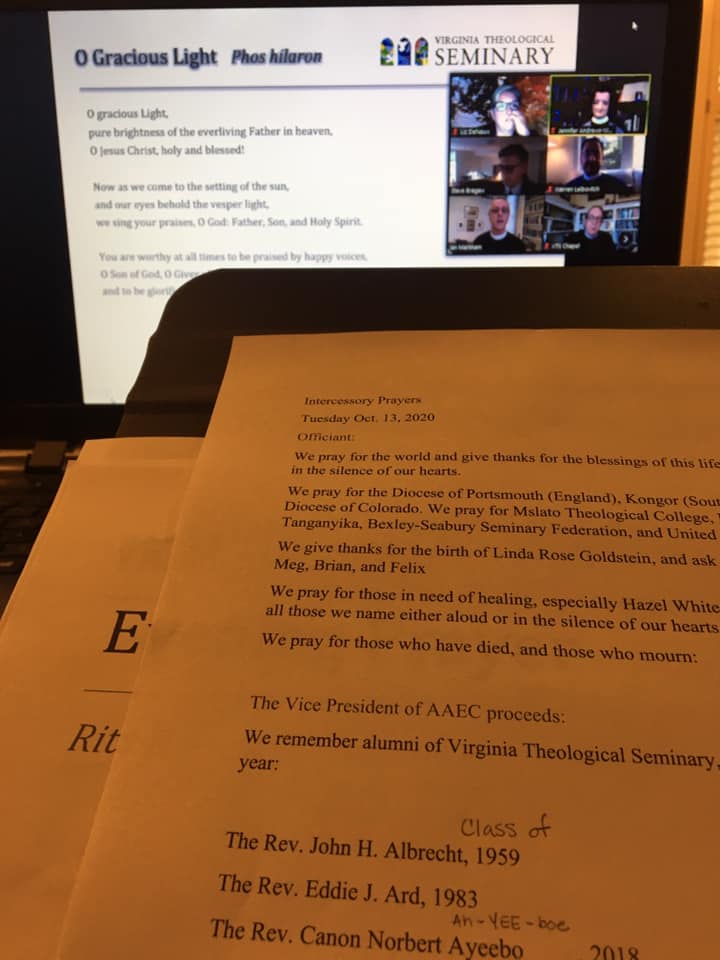
Phot Credit: Jennifer Andrews-Weckerly; permission to reuse required

One of the disadvantages of leading virtual worship is that you do not get to participate in worship.  Of course, I can always go back and watch later, but I never get the “live” experience of watching prayers.  That all changed this week.  My seminary held their annual Convocation yesterday.  It was entirely virtual, with webinars, Zoom meetings, breakout rooms, and Zoom worship.  Our worship at Hickory Neck Church is via Facebook Live, so this was my first time worshiping with a community via Zoom, and I was curious to see how it would feel.

My initial response was dissatisfaction.  Although I could see there were about 50 people gathered, once slides were used on the shared screen, I could only see six people without constantly scrolling.  Although the sermon was close to my normal experiences with preaching, watching faces that seemed spaced out was a bit odd (Do the faces look that spaced out when I preach??).  And of course, when I joined in speaking the italicized words (those words “the people” are supposed to say), because we were all on mute, I felt like only the officiant and I were participating.

But that was just the initial reaction.  As I said more and more of the unison readings, I felt less and less awkward.  And even though I could only see a few faces, I loved knowing I was not alone in the worship experience.  And as I became less paranoid about what my own video screen was showing, I was able to relax into my chair, and transport myself to an imaginary pew.  The worship experience was not the same – but it was also familiar, human, holy, and lovely.

Looking back on that experience, I want to offer major kudos to all who are “making it work” with virtual church.  I know it is not the same.  I know it is hard staying positive when all you want is something more familiar.  I am so grateful for all of you who are sticking with it, making the awkward become sacred.  I hope that you are having moments of grace and blessing.  And I also hope you are noticing all the names (and faces if you’re Zooming) you do not recognize:  those folks who find it harder to harken the doors of the church than to hop on Facebook for worship – whether when you are live, or at 10:00 pm, as you watch the archived video while you ease off to sleep.   This may not be church as we have always known it.  But we are also fashioning something new, flexible, and creative, while rooting ourselves in the traditions we know and love that ground us.  This week, you have my gratitude for all the ways you are staying open to the Holy Spirit.  And if you have not found a place to experience the Spirit, I’ve got just the place for you!!

Sermon – Luke 24.13-35, Acts 2.14a, 36-41, E3, YA, April 26, 2020

30 Thursday Apr 2020

Posted by jandrewsweckerly in Sermons, Uncategorized

≈ Leave a comment

Tags

church, crisis, disciples, Easter, Emmaus, faith, hope, human, Jesus, lost, love, pandemic, resurrection, Sermon, vulnerable, weakness

To say we have been operating in crisis mode here at Hickory Neck would be an understatement.  We went from normal operations, to heavy restrictions for gathering and receiving communion, to entirely closing our buildings, to moving all worship online, to virtual learning, fellowship, and pastoral care.  All of those changes happened rapidly, and with an eye to whatever was next.  Once we figured out some semblance of a new rhythm and “normal,” Holy Week came, and we had to figure out how to make our most sacred week of the Church Year meaningful despite our inability to gather physically.  Baptisms and confirmations have been postponed, our Bishop’s visit has been delayed, and farewells and celebrations have been canceled.  And yet, here we are, about half-way through a stay-at-home order, with infection and death rates at astronomical levels, and the Church finds herself in the third week of Easter, still proclaiming her alleluias.

I am not sure I could pull myself together and proclaim those alleluias without the lessons from Holy Scripture we have been journeying with these last Sundays.  In a normal Eastertide, we are more carefree, reveling in Easter joy, making bold proclamations about resurrection and eternal life, and listening to the early Easter stories like the walk to Emmaus with a sense of endearment – as if saying, “Bless their hearts!” as the early Christians try to figure out what in the world is going on after Jesus’ resurrection.  But this is not a normal Eastertide.  In fact, Biblical scholar Matt Skinner refers to this time as “Pandemic Easter.”[i]  For the first time in perhaps most of our lives, we can more deeply empathize with the disciples during these early days of resurrection.  The modern Church has used Eastertide as a bold proclamation of the meaning of Jesus’ death and resurrection.  But the first disciples of Christ are not boldly doing anything.  In fact, they are bereft, confused, scared, given glimpses of hope followed by bouts of despair and doubt.  They are not sure what to believe, even having seen the risen Jesus themselves.  Even those who receive the teaching from the disciples in our Acts lesson are overcome with emotion and can only ask, “Brothers, what should we do?”

Somehow, living in Pandemic Easter has made our Eastertide lessons much more powerfully relatable.  I do not know if I am ready to boldly proclaim, “The Lord is Risen Indeed.”  But I am willing to say to fellow Christians, and to God, “What should we do?”  I am willing to talk with a fellow person of faith, or even a person of no faith, walking with them (either metaphorically or at least at a distance of six feet) as we make our way through this mess.  Those disciples on the walk to Emmaus look different to me this year.  Those two people who thought they knew what they believed, who are confused by testimony of Jesus’ resurrection, who walk away from the protective hideout with fellow disciples, are trying to make sense of life, death, and Jesus.  They are not people to be pitied or seen as adorably unsure of their faith.  They are us.  They are people in a life-altering crisis, trying to make sense of death and defeat, wondering where hope may be, and a bit lost.

And here comes the best part.  Now, I have always thought the best parts of this story are where Jesus teaches the disciples unawares, shares a meal with them, or their hearts becoming strangely warmed, allowing them to become the second set of witnesses after the women at the tomb.  But in Pandemic Easter, the best part of this story might just be what happens on the walk to Emmaus.  Jesus invites these two followers to talk about what has happened to them.  He literally walks with them as they share their shock, their grief, their sadness.  Perhaps in Easters past, I thought Jesus was being coy or trying to trick the disciples in some way.  But in Pandemic Easter, I think Jesus is doing what we all need:  Jesus listens, he lets the disciples share their reality, he makes space for the human response to a new normal.    Jesus makes space for questions like, “What should we do?”

I don’t know about you, but the very real, vulnerable, human interactions between Jesus and the disciples in Scripture today has been a tremendous balm to me.  More than perhaps any year, the Church is not telling us how to embrace and proclaim a certain and sure faith.  Today the Church is simply inviting us to hover in the actual experience of Easter – days of confusion, sadness, fear, and grief.  We are able to tarry there because Scripture reminds us today that Jesus walks with us.  When we cannot yet understand, when we perhaps cannot even believe, Jesus walks with us on the journey.  Jesus listens to our real human response to crisis and walks with us.  Someday – maybe today, maybe in a week or month, or maybe in a year, we will be able to hear Jesus’ teaching and understand, and our hearts will be strangely warmed with conviction.  Until then, Jesus walks with us where we are, acknowledging the fullness of our weakness, and staying with us and loving us through it all.  Thanks be to God.

[i] Matt Skinner, “The Road to Emmaus Feels Longer This Year,” April 19, 2020, as found at http://www.workingpreacher.org/craft.aspx?post=5428 on April 24, 2020.

Sermon – John 4.5-42, L3, YA, March 15, 2020

19 Thursday Mar 2020

Posted by jandrewsweckerly in Sermons, Uncategorized

≈ Leave a comment

Tags

anxiety, Caronavirus, flesh, God, human, incarnate, incarnation, intimate, Jesus, Messiah, relationship, Samaritan, Sermon, vulnerable, well, woman

Today’s gospel lesson is one of those lessons that can be so full of intrigue that we miss what is happening in the text.  Most of us have heard this lesson hundreds of times, and have probably lingered on the part of the conversation where Jesus calls out the woman for living with someone who is not her husband, after already having had five husbands.  The conversation sounds straight out of Jerry Springer or Dr. Phil, where in the next scene we expect the other husbands to arrive, and a fight to break loose.

The problem with that kind of reading is we have the tone all wrong.  By narrowing in on what sounds like a “gotcha!” statement from Jesus right in the middle of about 40 verses, we forget all of the words and actions surrounding this event in the middle.  We have clues all along in the reading:  Jesus going through Samaria (when most Jews avoid Samaria); a woman appearing at a well at noon (when most of the woman have come and gone); Jesus (a Jew) talking to a Samaritan woman in broad daylight (a triple no-no); disciples appearing and engaging in conversation that sounds like The Three Stooges; talk of prophets, messiahs, disciples, and evangelism.

When we step back and take the broad view of this lesson, we are able to not be distracted by the sweep of the narrative, the scandalous and the absurd details, and the confusing stream of thought.  When seen broadly, we find a story that illuminates what having an incarnate God really looks like.  Too often, when we talk of the incarnation, we think of the baby Jesus, or the bodily, gruesome crucifixion.  But we sometimes forget the everydayness of the incarnation:  the fact that Jesus is thirsty and needs something from another, namely this Samaritan woman; the fact that Jesus initiates an intimate relationship, where two people can talk about the pain, suffering, and societal rejection of a widow and/or divorcee, who is simply trying to get by in a community that ostracizes her, even from drawing water from the well in the cool of morning; the fact that Jesus understands barrenness and empowers her to instead birth new believers.[i]  As Karoline Lewis says, says, “To take the incarnation seriously, to give it the fullest extent and expression, demands that no aspect of what it means to be human be overlooked.  To do so would truncate the principal theological claim of [John’s] Gospel.  At stake for the fourth evangelist is that Jesus is truly God in the flesh and every aspect of what humanity entails God now knows.”[ii]

I find this reading immensely meaningful today, because we are living in a moment when being flesh and bone is particularly precarious and unnerving.  A pandemic has gone all over the world and landed in our schools, our churches, our gathering places, and our homes.  Our lives have been upended by the threat of the Coronavirus, knowing the vulnerability of some in our community, and understanding suddenly how intricately intwined our lives are, even at a time when we have opined about how socially distanced we are.  This is a time when we feel very fleshy and vulnerable and here is Jesus talking to a vulnerable woman about his own fleshiness.

I don’t know about you, but I find this strange, circuitous conversation very comforting today.  In a time of anxiety, fear, and upheaval, Jesus is right there, in the midst of everyday messiness, and saying, “I feel you.  I understand.  I, your God, am incarnate, and I see and know you.”  And in response, the woman who is seen, known, and heard in turn goes to her community and becomes Jesus for others.  As Lewis says, “The woman at the well is not only a witness.  She is Jesus, the ‘I AM’ in the world, for her people.”[iii]

This is our invitation today too.  In the midst of upheaval, of disorientation, of anxiety, we are invited to be fully enfleshed Jesuses for others – to see their pain, their suffering, their uncertainty, and offer solidarity, comfort, and encouragement.  Even in a time of physical separation, we are invited into intimate relationship with one another, into relationships that honor the holy in one another, and help us all move forward.  This is what the Messiah does for us.  This is what we can do for one another.  Amen.

[i] Karoline M. Lewis, John:  Fortress Biblical Preaching Commentaries (Minneapolis: Fortress Press, 2014), 64.

[ii] Lewis, 55.

[iii] Lewis, 65.

On humanity…

29 Wednesday Jul 2015

Posted by jandrewsweckerly in Uncategorized

≈ Leave a comment

Tags

Bathsheba, community, David, dignity, healthy, honest, human, humanity, humble, king, Nathan, power, sin

This summer I have loved the unfolding of the David story in our lectionary.  I have preached on his story several times because I love how very complicated his story is.  When most of us think of David, we think of the revered king.  He was favored and anointed by God, is celebrated by the people of faith as an exemplary king, and for Christians, he is honored in the lineage that produces Jesus, the Messiah.  Our selective memory of David is not unfounded.  He has very humble beginnings.  As the youngest son of his family, relegated to working in the fields as a shepherd, he is anointed as the favored one.  As a boy, when whole armies feared Goliath, David is considered brave, fighting off the giant Goliath with only a bag of stones.  As a young man he is the beloved friend of Jonathan and Michal.  He survives multiple murder attempts by Saul – even being presented with the opportunity to kill Saul himself, David refrains.  He dances boldly before God when he becomes king, showing proper adoration of the Lord.  He and his son, Solomon, will be the last of the noble kings, before a strain of evil kings runs the people of Israel to the ground.

At least that is what our selective memory holds.  When we proudly proclaim Jesus is descended from the house of David, we sometimes gloss over the other “stuff” about David.  We gloss over the way he cuts off Michal in her grief.  We gloss over the way he rapes Bathsheba, and then has her husband killed when he cannot hide his indiscretion.  Of course, the text does not say David raped her – just that he “lay with her.”  But when a king (who has infinitely more power than a common woman) sends men to your home when your husband is away, and they take you (not asking if you are interested in going) to the king, and the king has sex with you, I am guessing the sex was not consensual.  Later, we gloss over the fact that despite this horrid beginning of a relationship with Bathsheba, Bathsheba is the one who later bares him the son, Solomon.  The list of things we gloss over about David is indeed long.

I think that is why I love the unfolding story of David.  He is beloved and horribly flawed.  He is a revered leader with deep sinfulness.  He is noble king and he is human.  I have great affection for David and I am deeply disappointed by him.  But isn’t that the way with all great people?  I remember when I first learned of how The Rev. Dr. Martin Luther King, Jr. was complicit with the sexism of his time, I finally began to see him as human too.  And of course, David’s humanity forces me to reconcile with my own humanity.

Photo credit:  http://www.artforhumanity.org/

Photo credit: http://www.artforhumanity.org/

But all of that reflection on David overshadows the humanity of Bathsheba.  Like so many characters in the Bible, especially women, we are left with little of her perspective.  And because we have so little information, many of us are hesitant to preach about her story.  And yet, we are a community that has Bathshebas too – women stripped of power and dignity.  I do not know what that means for Sunday’s preaching (when we will get Nathan’s judgment of David for his actions with Bathsheba), especially since I try to be careful about sensitive subjects in the pulpit.  But this week, as we continue to journey with David, I am lingering with Bathsheba.  I am lingering on what it means to be a community of Davids, Bathshebas, and Nathans – and how we do that in a healthy, honest, and humble way.  Stay tuned!

Homily – Deuteronomy 15.7-11, Charles Freer Andrews, February 12, 2015

11 Wednesday Mar 2015

Posted by jandrewsweckerly in Uncategorized

≈ Leave a comment

Tags

Britain, Charles Freer Andrews, Deuteronomy, dignity, friend, God, homily, human, India, neighbor, poor, social justice

Today we honor Charles Freer Andrews.  Born in Birmingham, England, in 1871, Andrews was ordained a priest in 1897.  Turned on to social justice efforts in college, Andrews became interested in the cause of social justice throughout the British Empire, especially in India.  In 1904, he began to teach philosophy in Delhi, where his students and colleagues began to refer to him by an Indian name which means “Friend of the Poor.”  Andrews openly criticized the racist treatment of the Indian people by British officials, and in 1913 he successfully mediated a cotton worker’s strike which could have become violent.  He travelled to South Africa to help Indians there.  While there, he met Gandhi.  Andrews was impressed by Gandhi’s teaching of non-violence, knowledge of Christian faith and practice of peace.  Andrews and Gandhi worked together to negotiate matters of Indian authority with the British government.  Andrews also took up the Indian cause in Fiji, and eventually returned to England where he taught about social justice and radical discipleship.

I am sure Andrews was no stranger to our text from Deuteronomy today.  The passage is all about the sabbatical year, where debts were forgiven.  The passage warned the faithful against scheming around the rules of the seventh year.  Knowing that year was approaching, people were hesitant to give to those whose debts would be quickly forgiven.  Instead, the people of God are told, “Open your hand to the poor and needy neighbor in your land.”

In many ways, St. Margaret’s is a faithful witness to opening our hands.  We are constantly collecting food and basic toiletries, giving gifts to the less fortunate and growing produce to feed the hungry.  We give liberally and ungrudgingly, as the text suggests.  But in all our good works, I sometimes wonder whether we could be labeled “Friend of the Poor,” as Andrews was.  It is one thing to give good or money to the poor, a necessary and important effort, but giving to the poor is not the same as being their friend.  Being a friend means getting involved, hearing their stories, finding out how they got to where they are today.  That work is much harder and messier, yet more meaningful.

Last week a story broke about Pope Francis and the Vatican opening up a new set of showers and a barber shop for the homeless of Rome.  The facility is beautiful and the homeless are treated with dignity and care.  The Vatican is trying to live into a life that embraces the poor and recognizes their humanity.  Now whether they become “friends of the poor” is something that is yet to be seen.  We all have that same invitation – to see the dignity of every human being and then to try to be their friend.  Good luck with your work!  Amen.

On dignity…

30 Wednesday Jul 2014

Posted by jandrewsweckerly in Uncategorized

≈ 1 Comment

Tags

baptism, dignity, human, humanity, Jesus, laborers

Today I drove by a pharmacy whose property is regularly peppered with “day laborers.”  I have yet to see someone actually out hiring people, but I imagine it must happen since every time I pass by, there are always 5 – 20 men standing around waiting.  Of course there are more men in the mornings and less in the afternoons.  But I consistently see men there, even in the late afternoons.  I have often wondered whether these men actually get hired at such a late hour, but their presence there leads me to believe that they must some days.

As I drove by the men gathered today, I was reminded of Jesus’ parable of the laborers in the vineyard (Matthew 20.1-16).  The landowner goes out at nine, noon, three, and five, each time hiring men from the marketplace.  At the end of the day, the landowner gives a full day’s wages to all the men, regardless of how long each person worked.  The ones who work the longest grumble at how unfair the landowner’s actions seem, but the landowner scolds them for their disdain for landowner’s generosity.

Courtesy of http://intentionaljane.com/tag/dignity/

Courtesy of http://intentionaljane.com/tag/dignity/

What I have always liked about the parable is the way that the landowner sees the humanity in people – recognizes that even though someone did not get the opportunity to work, they may have wanted the dignity that work provides and the security that income can create.  I think we often forget the ways that our society strips people of dignity – either by creating barriers to earning a livable wage, by creating systems meant to help individuals without realizing how hard receiving help can be, or by simply reducing people into issues – “immigrants,” “refuges,” or the “homeless,” as opposed to persons known by name.  One of my new favorite blogs/Facebook pages is called “Humans of New York.”  A photographer collects photos of assorted people from New York and usually includes a quote or a short story about them.  I just love the glimpses into people’s lives – people you might never give a thought or glance to, but who have a story.

We promise in our baptismal covenant to “respect the dignity of every human being.”  I wonder what that looks like in your life.  Just this morning I ran across a video of a man who approaches a homeless man on the street – a person who is virtually ignored by every other person passing by.  The man asks if he can borrow the homeless man’s bucket, and at first the homeless man seems wary and concerned.  But to his surprise, the man uses the bucket and a couple of friends to create an impromptu moment of music, which leads to some extra cash that the man then gives to the homeless man.  Something about the video give me a glimpse into what we mean when we talk about dignity – all three “helpers” sit with the man, they make him a part of something beautiful, and then they let him live in peace.  But especially they seem to be saying, “I see you.  You are not alone.  You are a person and I honor your dignity.”  How might you respect the dignity of every human being today?

Sermon – I Kings 17.8-24, P5, YC, June 9, 2013

12 Wednesday Jun 2013

Posted by jandrewsweckerly in Uncategorized

≈ Leave a comment

Tags

Elijah, God, healing, honest, human, intimate, prayer, relationship, Sermon

Last week I lost my watch.  When I say that I lost my watch, I do not mean I misplaced my watch.  I went for a walk, took the watch off while I was walking, and about an hour after my walk realized the watch was gone.  I searched the path of my walk, I looked all over the church and our house, but the watch is gone.  Now, truthfully, a watch is certainly replaceable, but this watch was sentimental – a gift from a special occasion that meant a lot to me.  So, of course, ever since I lost my watch, I have been praying to St. Anthony.  St. Anthony is the patron saint of lost things.  The prayer I learned, and have been praying for over a week is, “St. Anthony, St. Anthony, please come around, something is lost that cannot be found.”  Though I know the watch is most likely gone, I keep occasionally offering up the prayer with some desperate sense of hope.

We do funny things in our prayer lives, especially when things are not going our way.  We have been known to bargain with God.  “God, if you please just grant this one thing, I promise I will never blank again.”  We have been known to try to negotiate with God.  “I know that I am not perfect, God, but let me tell you about all the good I have done.  Surely you can grant this one thing to your faithful servant.”  And we have been known to rail at God.  “How can you do this to me God?  Haven’t I been through enough?!?”  Sure, we know the Lord’s Prayer, and we may pray the daily office at home, and we may even pray with scripture, especially our favorite psalms.  But when we are at our lowest, when we feel like we have tried everything we are supposed to say or do with God, sometimes our prayers simply reveal our broken, frustrated, desperate spirits.

This is the prayer that Elijah offers today.  Elijah has already created quite the imposition on a poor widow.  Elijah goes to the widow, a woman who is about to die of starvation, and asks her to feed and house him.  Now, God takes care of the widow’s lack of food, but while Elijah is still there, the woman’s son almost dies of illness.  The woman blames Elijah, and Elijah at first seems fairly composed as he asks for the boy.  But when he retires to another room with boy, Elijah lets God have it.  Elijah cries out to God in anger, rage, and despair.[i]  “O Lord my God, have you brought calamity even upon the widow with whom I am staying, by killing her son?”  Elijah does not come to God with a polite request that God heal the son.  Elijah does not offer some traditional prayer of healing.  Elijah simply cries out to God.  He cries out to God for the injustice done to this poor widow – who is already clearly impoverished by having no husband.  The death of an only son would mean certain death for her as well.  Her son was her only hope for survival in this world.[ii]  Elijah boldly accuses God of an injustice – in fact accuses God of killing this boy and all that he represents to the widow.

Some may hear in Elijah’s prayer a sense of self-interest.  If he is proclaiming to be a man of God, and God then kills this woman’s only sense of hope, then the death makes Elijah look bad.  Who wants to follow a prophet of a God who kills the downtrodden?  Or, we might hear Elijah’s prayer as petulant.  Perhaps he sounds like a man whining about fairness – something childish and narrow-minded.  But I hear Elijah’s prayer as both fully human and as an honest portrayal of someone with an intimate relationship with God.  In any intimate relationship, the overly polite ways of being with one another end eventually.  In time, the only thing that works in that intimate relationship is being brutally and fully honest, holding one another to account and being totally open about the good and the bad of the relationship.  This is what Elijah is doing here.  Elijah, who knows God intimately, holds God to account.  “Really, God?  This is how you are going to treat people?  You claim to care about the poor and oppressed, and you have forced me to impose on this poor widow, and now you are going to let her only son, her only source of potential security die??”  Elijah does not ask this of God for himself or out of a sense of injustice.  Elijah asks this of a God whom he knows to be better than this – a God who loves and cares for the poor and oppressed.  And he also knows that God can do the impossible.  Elijah knows that God can bring this child from death to life.

What I love about this passage is twofold.  First, I love the very human, intimate depiction of prayer.  As Episcopalians, with our reliance on our Prayer Book and our desire for beauty and intelligence when we talk to God, we can become so formal with God that we forget that we have a real relationship with God who can handle our real words.  We can be brutally honest with God or even angry with God, and God will still love us.  We can be vulnerable and frustrated and desperate with God.  We can even come to God when we do not have words – when our emotions are so overwhelming that we no longer have anything left to say.  Elijah gives us permission today to be fully ourselves with the God who loves us no matter what.

I also love that we get this passage today because today is our monthly healing service.  Since I have been at St. Margaret’s, I have been regularly asked questions about our healing services.  Our tradition of monthly healing services that began well before my time here still has many of us questioning.  I have had adults ask me who they are allowed to ask prayers for – whether they can only ask for healing prayers for themselves or whether they can ask for healing for others as well.  I have had some of our teens ask me what we are actually doing when we lay hands on people.  Even my own daughter asked me why I made the sign of the cross on her forehead when she came forward once.  Elijah points the way to answers for those questions today.  By praying our litany of healing and by coming forward for ourselves and others, we proclaim several things.  We proclaim that intimate relationship with God means that we can be fully honest about all that is ailing us, our neighbors, and the oppressed.  We proclaim that God can do the impossible through prayer and we offer up our hopes that the impossible is possible for us too.  And we proclaim that although we may not understand God in the midst of suffering, we still come to God, hoping for healing, hoping for clarity, hoping for peace.  Whether you come forward today for healing is actually not that important.  What is most important is that you know that you can, that you know that your God is a God who can do the impossible but who also cares for you so deeply that God can handle all the parts of you – the good, the bad, and the ugly.  Amen.


[i] Carolyn J. Sharp, “Theological Perspective,” Feasting on the Word, Yr. C, Vol. 3 (Louisville: Westminster John Knox Press, 2010), 100.

[ii] Glaucia Vasconcelos Wilkey, “Pastoral Perspective, Feasting on the Word, Yr. C, Vol. 3 (Louisville: Westminster John Knox Press, 2010), 102.

Recent Posts

  • On the Myth and Magic of Advent…
  • On Risking Failure and Facing Fear…
  • Sermon – Luke 23.33-43, P29, YC, November 23, 2025
  • On Inhabiting Gratitude…
  • Sermon – Luke 20.27-38, P27, YC, November 9, 2025

Archives

  • December 2025
  • November 2025
  • October 2025
  • September 2025
  • August 2025
  • July 2025
  • June 2025
  • March 2025
  • February 2025
  • December 2024
  • November 2024
  • October 2024
  • September 2024
  • August 2024
  • July 2024
  • June 2024
  • May 2024
  • March 2024
  • February 2024
  • January 2024
  • December 2023
  • November 2023
  • October 2023
  • September 2023
  • August 2023
  • July 2023
  • June 2023
  • May 2023
  • March 2023
  • February 2023
  • January 2023
  • December 2022
  • November 2022
  • October 2022
  • June 2022
  • May 2022
  • January 2022
  • December 2021
  • November 2021
  • October 2021
  • September 2021
  • August 2021
  • June 2021
  • May 2021
  • April 2021
  • March 2021
  • February 2021
  • January 2021
  • December 2020
  • November 2020
  • October 2020
  • September 2020
  • August 2020
  • July 2020
  • June 2020
  • May 2020
  • April 2020
  • March 2020
  • February 2020
  • January 2020
  • December 2019
  • November 2019
  • October 2019
  • September 2019
  • August 2019
  • July 2019
  • June 2019
  • May 2019
  • April 2019
  • March 2019
  • February 2019
  • January 2019
  • December 2018
  • November 2018
  • October 2018
  • September 2018
  • August 2018
  • July 2018
  • June 2018
  • May 2018
  • April 2018
  • March 2018
  • February 2018
  • January 2018
  • December 2017
  • November 2017
  • October 2017
  • September 2017
  • August 2017
  • July 2017
  • June 2017
  • May 2017
  • April 2017
  • March 2017
  • February 2017
  • January 2017
  • December 2016
  • November 2016
  • October 2016
  • September 2016
  • August 2016
  • July 2016
  • June 2016
  • May 2016
  • April 2016
  • March 2016
  • February 2016
  • January 2016
  • December 2015
  • November 2015
  • October 2015
  • September 2015
  • August 2015
  • July 2015
  • June 2015
  • May 2015
  • April 2015
  • March 2015
  • February 2015
  • January 2015
  • December 2014
  • November 2014
  • October 2014
  • September 2014
  • August 2014
  • July 2014
  • June 2014
  • April 2014
  • March 2014
  • February 2014
  • January 2014
  • December 2013
  • November 2013
  • October 2013
  • September 2013
  • August 2013
  • July 2013
  • June 2013
  • May 2013
  • April 2013
  • March 2013
  • February 2013
  • January 2013
  • December 2012
  • November 2012
  • October 2012
  • September 2012

Categories

  • reflection
  • Sermons
  • Uncategorized

Meta

  • Create account
  • Log in
  • Entries feed
  • Comments feed
  • WordPress.com

Blog at WordPress.com.

  • Subscribe Subscribed
    • Seeking and Serving
    • Join 394 other subscribers
    • Already have a WordPress.com account? Log in now.
    • Seeking and Serving
    • Subscribe Subscribed
    • Sign up
    • Log in
    • Report this content
    • View site in Reader
    • Manage subscriptions
    • Collapse this bar
 

Loading Comments...